La montée en puissance du nationalisme en Angleterre

Source: The Conversation – France in French (3) – By Kevin Rocheron, Doctorant en civilisation britannique, Université Sorbonne Nouvelle, Paris 3

La lourde défaite du Parti conservateur aux législatives de l’été 2024 a entraîné une recomposition politique au Royaume-Uni, les travaillistes au pouvoir considérent désormais que leur premier adversaire est le parti d’extrême droite Reform UK. C’est dans ce contexte qu’intervient l’essor du nationalisme en Angleterre.


Ces dernières semaines ont été marquées par une spectaculaire multiplication du nombre de drapeaux accrochés et brandis dans l’espace public en Angleterre. La croix de saint Georges, emblème de l’Angleterre, et l’Union Jack, drapeau britannique, ont occupé les lampadaires, les boîtes aux lettres, les ponts d’autoroute voire des ronds-points ou des passages piétons repeints aux couleurs nationales. La présence de ces symboles a culminé le 13 septembre, lorsque près de 110 000 personnes se sont rassemblées à Londres pour participer à la marche « Unite the Kingdom », organisée à l’initiative de Tommy Robinson, figure controversée de l’extrême droite britannique.

Traditionnellement, le drapeau britannique est hissé lors d’événements militaires ou monarchiques. La croix de saint Georges, quant à elle, n’apparaît que lors de grandes compétitions sportives, lorsque l’Angleterre joue en tant que nation. Mais depuis l’été dernier, le drapeau a quitté les stades pour investir le quotidien et le champ politique, transformant ce symbole national en enjeu identitaire.

Le déclencheur fut l’appel du collectif Weoley Warriors à une opération d’affichage de drapeaux, finançant et hissant des centaines de bannières sur le mobilier urbain. Leur mot d’ordre : « Une population fière est une population forte » (« A proud community is a strong community »). L’initiative, relayée par l’organisation Operation Raise the Colours, s’est diffusée dans tout le pays. À Birmingham (Midlands de l’Ouest, Angleterre), le conseil municipal travailliste a ordonné le retrait de ces drapeaux pour des raisons de sécurité, déclenchant une polémique. Plusieurs groupes ont accusé les autorités locales d’avoir fait preuve de « deux poids, deux mesures », en tolérant par exemple l’affichage de drapeaux palestiniens lors de manifestations ou sur des bâtiments publics, tout en retirant les drapeaux de la croix de saint Georges. Cet épisode a été instrumentalisé par certains militants nationalistes pour dénoncer une marginalisation de l’identité anglaise au profit d’autres revendications politiques ou communautaires.

Si Weoley Warriors et Operation Raise the Colours se disent apolitiques et revendiquent un simple patriotisme, les publications de leurs membres sur les réseaux sociaux sont, elles, clairement politisées : appels à des élections anticipées, critiques virulentes de la BBC, du Parti travailliste, de Keir Starmer, du maire travailliste de Londres Sadiq Khan ainsi que de la politique d’accueil des demandeurs d’asile.

Les racines de la colère

Contrairement au pays de Galles, à l’Écosse et à l’Irlande du Nord, dont l’identité s’appuie sur une langue, des institutions ou des coutumes propres, l’identité anglaise a longtemps été confondue avec celle du Royaume-Uni.

La confusion entre les termes « Angleterre », « Grande-Bretagne » et « Royaume-Uni » reste d’ailleurs fréquente dans le langage courant. Majoritaire sur les plans politique, économique et géographique, l’Angleterre n’a longtemps pas ressenti le besoin de se doter d’une conscience nationale distincte. Cependant, depuis vingt ans, un sentiment « anglais » (plutôt que « britannique ») a émergé, se construisant souvent par opposition : à l’Écosse, à l’Union européenne et, plus récemment, aux demandeurs d’asile.

Le tournant s’est produit au début des années 2000, lorsque le gouvernement travailliste de Tony Blair a mis en place un ambitieux projet de création de Parlements et de gouvernements nationaux en Écosse, au pays de Galles et en Irlande du Nord (un processus appelé « devolution »). L’Angleterre en fut exclue, créant une situation paradoxale : les députés écossais, gallois et nord-irlandais pouvaient voter à Westminster sur des sujets touchant exclusivement l’Angleterre, alors que les députés anglais ne pouvaient pas se prononcer sur les matières dévolues aux Parlements nationaux.

Cette asymétrie a donné naissance à la fameuse « West Lothian Question », symbole d’une injustice démocratique ressentie. La situation s’est aggravée avec le référendum d’indépendance écossais de 2014 (soldé par une victoire à 55 % du non à la question « L’Écosse doit-elle devenir un pays indépendant ? ») et la montée en puissance en Écosse du Scottish National Party (SNP) (parti indépendantiste écossais, ndlr)), qui ont nourri l’impression que l’Union se définissait selon les priorités de l’Écosse, au détriment de l’Angleterre.

Le référendum sur le Brexit de 2016 a fourni un nouvel exutoire. L’Angleterre a voté majoritairement en faveur du Leave, c’est-à-dire pour quitter l’UE (53,4 %), contrairement à l’Écosse (62 % pour le Remain, rester) et à l’Irlande du Nord (55,8 % pour le Remain). Le pays de Galles a lui aussi opté pour le Leave (52,5 %), malgré les importants financements européens dont il bénéficiait. Ce vote traduit une combinaison de ressentiment économique et de défiance vis-à-vis des élites, rejoignant ainsi le camp anglais plus que l’écossais ou le nord-irlandais. Le slogan des partisans du Leave, « Take back control », cristallisait une volonté de reprendre le pouvoir, de contrôler les frontières et de rompre avec un sentiment d’abandon économique.

Plus récemment, la question migratoire est devenue un nouveau catalyseur de colère.

Depuis le Brexit, l’immigration nette a augmenté. La liberté de circulation en provenance de l’UE a pris fin mais le Royaume-Uni a mis en place un système à points qui a encouragé l’arrivée de travailleurs qualifiés issus de pays extérieurs à l’UE.

Dans le même temps, les pénuries de main-d’œuvre dans la santé, les services sociaux, l’hôtellerie-restauration et l’agriculture ont conduit de nombreux employeurs à dépendre davantage des travailleurs immigrés. Il en a résulté un décalage entre les attentes, selon lesquelles le Brexit devait réduire l’immigration, et la réalité, marquée par un maintien ou même une augmentation des flux migratoires, ce qui a nourri un profond sentiment de frustration.

Parallèlement, la hausse des traversées de la Manche en petites embarcations depuis 2018 est devenue un enjeu particulièrement visible et hautement symbolique. Bien que les traversées de la Manche sur des bateaux de fortune ne représentent qu’une très faible part des flux migratoires, l’importante médiatisation de ces arrivées sur les côtes du sud de l’Angleterre a renforcé l’impression d’une perte de contrôle.


À lire aussi :
Comment au moins 27 personnes qui tentaient de rejoindre l’Angleterre se sont noyées dans la Manche le 24 novembre 2021, et peut-on éviter que de tels drames se reproduisent ?


En outre, le projet des gouvernements conservateurs visant à transférer certains demandeurs d’asile vers le Rwanda, ainsi que les promesses répétées de « Stop the boats » (« Arrêtez les bateaux »), un slogan popularisé par l’ancien premier ministre conservateur Rishi Sunak (octobre 2022-juillet 2024), soulignent que l’immigration a été l’un des sujets les plus mis en avant par les premiers ministres britanniques.

À cela s’ajoutent l’effet des réseaux sociaux et la désinformation. L’exemple de l’affaire de Southport, à l’été 2024, est révélateur. Trois personnes avaient été tuées et dix blessées lors d’une attaque au couteau ; quand un suspect a été arrêté, de fausses informations circulant sur Internet ont rapidement associé la tragédie à l’immigration et à l’islam, des affirmations dont il s’est révélé qu’elles étaient infondées.

Durant tout l’été, des manifestations se sont multipliées devant les hôtels et centres d’accueil de réfugiés dans tout le pays, et particulièrement en Angleterre. Les organisateurs, plusieurs mouvements d’extrême droite comme Patriotic Alternative ou Homeland Party, ont activement contribué à l’organisation de ces protestations locales, notamment sur les réseaux sociaux.

Le fait que de nombreux drapeaux aient été levés dans la région de Birmingham, l’une des plus cosmopolites du pays, souligne la sensibilité accrue de ces tensions et met en lumière les défis auxquels le modèle multiculturaliste britannique est confronté. Cette crispation est d’autant plus forte que, dans le débat politique actuel, rares sont les responsables de partis prêts à défendre ouvertement les bénéfices de l’immigration.

Les enquêtes « Future of England Survey » ont montré que ceux qui se définissent comme « anglais » plutôt que « britanniques » sont plus eurosceptiques, considèrent que l’Angleterre est désavantagée par rapport aux autres nations au sein du Royaume-Uni, ressentent davantage de colère et de peur face à l’avenir politique et votent plus que les autres catégories en faveur du parti Reform UK.

Une identité captée par le parti Reform UK

Jusqu’à récemment, le parti conservateur, plus implanté en Angleterre que dans les trois autres nations, attirait ce vote pro-anglais. Mais sa défaite électorale de 2024 a ouvert un espace politique que le parti d’extrême droite Reform UK, dirigé par Nigel Farage, occupe désormais.

Bien que Nigel Farage n’ait pas participé au rassemblement Unite the Kingdom et qu’il ait toujours pris ses distances vis-à-vis de Tommy Robinson, lequel a eu de nombreux démêlés judiciaires et a été condamné à plusieurs peines de prison entre 2005 et 2025, il a pu tirer parti politiquement de ses thématiques. En effet, les émeutes et protestations encouragées ou soutenues par Robinson placent au centre de l’agenda médiatique la question migratoire, laquelle se trouve au cœur du programme de Farage. Cela lui permet de capter un électorat inquiet sans endosser l’étiquette d’extrémiste, en offrant aux mécontents une traduction électorale plus crédible que le militantisme de rue.

Considérant désormais Reform UK comme son principal opposant, le gouvernement travailliste de Keir Starmer a préféré reprendre une partie de son discours sur l’immigration plutôt que le contester, ce qui renforce la légitimité des thèmes portés par Nigel Farage auprès d’une partie de l’électorat anglais. Le choix récent du premier ministre de nommer au poste de Home Secretary (ministre de l’intérieur) Shabana Mahmood, réputée particulièrement ferme sur le thème de l’immigration, montre que Reform UK dicte l’agenda politique britannique.

Lors des dernières législatives, Reform UK a recueilli 19 % des voix en Angleterre contre seulement 7 % en Écosse, confirmant son ancrage essentiellement anglais. Les élections locales de mai dernier ont également abouti à un succès pour Reform UK, qui a ravi nombre de sièges aux conservateurs. Les sondages YouGov le donnent aujourd’hui en tête devant les travaillistes si de nouvelles élections devaient avoir lieu.

La campagne de Nigel Farage s’articule autour d’un agenda populiste en opposant « le peuple » à Westminster : arrêt de l’immigration, lutte contre un gouvernement qualifié de corrompu, sortie du Royaume-Uni de la Convention de sauvegarde des droits de l’homme et libertés fondamentales (dont le pays est partie en sa qualité de membre du Conseil de l’Europe) qui est accusée d’être un frein à l’expulsion d’immigrés et défense des valeurs et de la culture britanniques. Autant de thèmes qui lui permettent de capter un électorat conservateur déçu, en quête de réponses claires et d’un discours centré sur l’« anglicité ».

Quelles réponses au nationalisme anglais ?

Plusieurs solutions ont été envisagées par les gouvernements successifs pour apaiser ce malaise identitaire.

Symboliquement, certains députés ont proposé de doter l’Angleterre d’un hymne national distinct de God Save the King, l’hymne national britannique, ou de créer un jour férié pour célébrer la Saint-Georges, comme c’est déjà le cas pour saint Andrew et saint Patrick, respectivement les saints patrons de l’Écosse et de l’Irlande du Nord. Ces projets n’ont pas abouti par manque de soutien au niveau politique.

Sur le plan institutionnel, la procédure parlementaire « English Votes for English Laws » (EVEL) (« Des votes anglais pour des lois anglaises »), introduite en 2015 pour répondre à la West Lothian Question, et qui devait corriger les défauts induits par la devolution, en permettant aux seuls députés anglais de voter uniquement sur les projets de loi ne concernant que l’Angleterre, a été supprimée en 2021, car jugée trop lourde et porteuse de division. La voie régionale envisagée par Tony Blair, permettant de doter des assemblées régionales en Angleterre dans un État britannique jugé trop centralisé, a été testée lors du référendum de 2004 dans le Nord-Est. Rejetée par 74 % des votants, elle a été abandonnée.

Sur le plan économique, la politique de Levelling Up (rééquilibrage) lancée par le conservateur Boris Johnson (premier ministre de 2019 à 2022) visait à réduire les inégalités régionales et à redonner « un sens de fierté et d’appartenance » aux collectivités locales, mais son impact est resté limité, faute de financements suffisants et de continuité politique.

Le basculement d’une partie notable de l’électorat vers le parti de Nigel Farage s’explique non seulement par l’accumulation de crises et la perte de confiance dans la capacité des gouvernements conservateurs comme travaillistes à y répondre, mais aussi par le rôle joué par des premiers ministres successifs, de Boris Johnson à Keir Starmer, dont les déclarations sur l’immigration ont contribué à nourrir ces tensions.

La multiplication des drapeaux illustre un nationalisme anglais en quête de reconnaissance. Ce mouvement s’inscrit dans une poussée identitaire plus large à l’échelle mondiale. Des figures, comme Éric Zemmour en France ou Elon Musk aux États-Unis, y trouvent un écho et participent à alimenter ce réveil patriotique, comme le montre leur participation à la manifestation Unite the Kingdom du 13 septembre à Londres.

Plutôt que d’unir le royaume, ce sursaut national risque d’accentuer les fractures et de faire du Royaume-Uni un État plus désuni encore. En effet, si Reform UK capitalise sur cette colère, les nations dévolues, notamment l’Écosse, restent méfiantes face à ce renforcement de l’« anglicité ».

The Conversation

Kevin Rocheron ne travaille pas, ne conseille pas, ne possède pas de parts, ne reçoit pas de fonds d’une organisation qui pourrait tirer profit de cet article, et n’a déclaré aucune autre affiliation que son organisme de recherche.

ref. La montée en puissance du nationalisme en Angleterre – https://theconversation.com/la-montee-en-puissance-du-nationalisme-en-angleterre-265814


Tanzania’s social media clampdown and the elections – what’s at risk

Source: The Conversation – Africa (2) – By Leah Mwainyekule, Lecturer, University of Westminster

Social media platforms like WhatsApp, Instagram, Facebook and X have transformed political dialogue and activism in Tanzania. The democratisation of political expression has especially empowered young voters and activists to challenge government actions and champion causes such as human rights, the release of political prisoners, and electoral reforms.

This is significant in a country politically dominated by one ruling party since independence in 1961. The government has responded by frequently clamping down on social media through arrests, mass content removals and platform-specific shutdowns. This is in addition to direct controls over media outlets. Media and communication scholar Leah Mwainyekule examines Tanzania’s social media landscape ahead of elections in October 2025.

What is the history of Tanzania’s social media curbs?

Tanzania’s political system is dominated by the Chama Cha Mapinduzi (CCM) party, which has held power continuously since independence in 1961. The ruling party has kept in place a political structure headed by a powerful president in a tightly controlled political space. Opposition parties have faced suppression marked by restrictions on rallies, arrests, violence and exclusion from electoral processes. This worsened under former president John Magufuli, who clamped down on political dissent, persecuted opposition figures and imposed legal curbs against media and civic debate.

While President Samia Suluhu Hassan has recently introduced moderate reforms – restoring some rights, easing bans and facilitating dialogue – opposition leaders still confront severe charges or incarceration. The main opposition party – Chama cha Demokrasia na Maendeleo (Chadema) – still can’t contest major elections.

Tanzania’s social media curbs are embedded in this political environment. The government claims to be controlling digital content to maintain political and social stability. This strategy is often justified by concerns about national security, misinformation and public order.

Laws and regulations govern the digital space. The landmark legislation is the Cybercrimes Act of 2015, which introduced provisions about online activities.

  • It’s illegal to share or receive unauthorised information, even if truthful or publicly available.

  • Police have extensive powers to conduct searches and seizures.

  • Secret surveillance and interception of communications can happen without judicial authorisation or proper due process.

The law has been condemned for provisions which limit political expression through blogs, online media and mobile platforms like WhatsApp. People have been arrested for criticising government officials or the president on WhatsApp and Facebook.

Further controls relate to obligations for internet service providers, social media platform owners, and expanded categories of prohibited content. They are contained in another law which was amended in 2025.


Read more:
Democracy in Africa: digital voting technology and social media can be a force for good – and bad


Critics highlight provisions that undermine online anonymity. Internet service providers and online content service providers have to be able to identify the source of online content. Internet café operators are required to register users through recognised IDs, assign static IP addresses, and install cameras to monitor users’ activities.

The laws are vague about defining what’s not allowed. It might be:

The lack of clear guidelines enables officials to target critics or unwanted content as they please.

Finally, critics have pointed to unrealistic deadlines for content removal.
The 2018 regulations said platforms must remove prohibited content within 12 hours of notification. The 2020 update reduced this deadline to just two hours. This made it one of the most stringent requirements globally.

The two-hour removal window applies mainly to content flagged by the Tanzania Communications Regulatory Authority. But it could also relate to complaints from affected users. Platforms must also suspend or terminate accounts of users who fail to remove prohibited content within this period. This short deadline makes it nearly impossible to check whether content is legal before removal.

These regulations are widely perceived as politically motivated. They appear designed to suppress government critics, media and opposition voices. They stifle legitimate public discourse.

What are the government’s most recent actions?

The most recent example is the government’s suspension of the country’s most popular online forum, Jamii Forums, for 90 days in September 2025. The government cited the publication of content that “misleads the public”, “defames” the president and undermines national unity.

The government has also resorted to blanket bans of platforms like X (formerly Twitter). The most recent followed the hacking of official police accounts in a cyber attack. Although some users access X through virtual private networks, the ban remains officially enforced by internet service providers across the country.


Read more:
Twitter in Kenya’s last poll: a great way to reach voters, but not a game-changer


The timing of the shutdown echoes similar action in 2020 in the run-up to the previous general election.

Tools to bypass national network restrictions are illegal and punishable by law.

Traditional media such as radio, television and newspapers face growing government censorship and surveillance pressure.

What is the effect on social and political debates?

Tanzania is set for general elections on 29 October 2025. The restrictions on social media will doubtless be felt. The restrictions reduce the platforms available for open discussion of government policies, political ideas and election choices. This shrinking digital space undermines public participation and limits access to diverse viewpoints critical for democratic debate.


Read more:
Africans are concerned about ills of social media but oppose government restrictions


Social media also play another important role. Social media users are known to expose electoral fraud, misinformation and government misconduct.

The scales are tilted against dissent, opposition narratives and minority voices.

At the same time, misinformation and hate speech may grow. This can increase the risks of polarisation and identity-based tensions.

What is the effect of governance?

The expanding restrictions reflect a governance model favouring information control over transparency and accountability. This can normalise censorship, arbitrary detentions and media suppression.

In essence, Tanzania’s social media curbs are likely to weaken governance. They undermine transparency, increase tension, and erode public trust, limiting democratic accountability.

The Conversation

Leah Mwainyekule does not work for, consult, own shares in or receive funding from any company or organisation that would benefit from this article, and has disclosed no relevant affiliations beyond their academic appointment.

ref. Tanzania’s social media clampdown and the elections – what’s at risk – https://theconversation.com/tanzanias-social-media-clampdown-and-the-elections-whats-at-risk-265215

AI in Africa: 5 issues that must be tackled for digital equality

Source: The Conversation – Africa – By Rachel Adams, Honorary Research Fellow of The Ethics Lab, University of Cape Town

The AI revolution risks deepening inequality between the global north and south. Clarote & AI4Media/betterimagesofai.org, CC BY-SA

If it’s steered correctly, artificial intelligence (AI) has the potential to accelerate development. It can drive breakthroughs in agriculture. It can expand access to healthcare and education. It can boost financial inclusion and strengthen democratic participation.

But without deliberate action, the AI “revolution” risks deepening inequality more than it will expand opportunity.

As a scholar of the history and future of AI, I’ve written about the dangers of AI widening global inequality. There’s an urgent need to develop governance mechanisms that will try to redistribute the benefits of this technology.

The scale of the AI gap is stark. Africa holds less than 1% of global data centre capacity. Data centres are the engines that drive AI. This means the continent has minimal infrastructure for hosting the computing power necessary to build and run AI models.

While only 32 countries worldwide host specialised AI data centres, the US and China account for over 90% of them.

And only about 5% of Africa’s AI talent (innovators with AI skills) have sufficient access to the resources needed for advanced research and innovation.


Read more:
One in three South Africans have never heard of AI – what this means for policy


Leaders and policy-makers from around the world must grapple with an uncomfortable truth: AI is not equally distributed, and without deliberate action it will magnify global divides.

But they also still have the chance to set a new trajectory – one where Africa and the global majority shape the rules of the game. One that ensures AI becomes a force for shared prosperity rather than exclusion.

To achieve this, five critical policy areas most be addressed. These are data; computing capacity; AI for local languages; skills and AI literacy; and AI safety, ethics and governance. These are not just African priorities; they’re global imperatives.

1. Compute and infrastructure

Access to computational power has become the defining chokepoint in today’s AI ecosystem. African researchers and innovators will remain on the margins of the AI economy unless there is investment in regional data centres, GPU clusters (a group of computers working together on large-scale AI processing) and secure cloud infrastructure.

Europe, by contrast, has pooled over US$8 billion in establishing the European High-Performance Computing Joint Undertaking to ensure the continent has computing capacity for local innovations.

African countries should press for funding and partnerships to expand local capacity. They will also need to insist on transparency from global providers about who controls access, and ensure regional cooperation to pool resources across borders.

2. Data governance

AI systems are only as good as the data they’re trained on. Much of the continent’s data is fragmented, poorly governed, or extracted without fairly compensating those it’s collected from. Large, diverse and machine-readable datasets are used to teach AI models about the contexts and realities the data reflect.

Where ethical stewardship frameworks exist, locally managed datasets have already driven innovation that has impact. For example, the Lacuna Fund has helped researchers across Africa build over 75 open-machine-learning datasets in areas like agriculture, health, climate and low-resource languages. These have filled critical data gaps, allowing for tools that better reflect African realities. Realities like high-accuracy crop yield datasets for farming. Or voice/text resources for under-served languages.

Robust national data protection and governance laws are needed. So are regional data commons, a shared resource where data is collected, stored, and made accessible to a community under common standards and governance. This would enable collaboration, reuse, and equitable benefits. Standards for quality, openness, interoperability and ethics developed by multilateral organisations must be designed with African priorities at their centre.

3. AI for local languages

Inclusive AI depends on the languages it speaks. Current large models overwhelmingly privilege English and other dominant languages. African languages are all but invisible in the digital sphere. This not only entrenches existing biases and inequalities, it also risks excluding millions from access to AI-enabled services.


Read more:
AI chatbots can boost public health in Africa – why language inclusion matters


Take the example of the Cape Town-based non-profit organisation Gender Rights in Tech. It has developed a trauma-informed chatbot called Zuzi that supports survivors of gender-based violence by providing anonymous, accessible guidance in diverse South African languages on their rights, available legal services, and sexual and reproductive health. It helps overcome stigma and bridge gaps in access. Zuzi demonstrates the power of AI technologies in local languages.

Dedicated investment in datasets, benchmarks, and models for African languages is urgently needed, as well as in tools for speech recognition, text-to-speech, and literacy.

4. AI skills and literacy

African infrastructure and data will mean little without human capacity to use them. At present, AI skills supply falls far short of demand, and public understanding of AI’s benefits and risks remains low.

To increase skills, AI and data science will need to be integrated into school and university curricula, and vocational training will need to be expanded. Supporting lifelong learning programmes is essential.

Public awareness campaigns can ensure citizens understand both the promise and perils of AI. This will support deeper public debate on these issues. It can also target support for women, rural communities, and African language speakers to help prevent new divides from forming.

5. Safety, ethics, and governance

Finally, stronger governance frameworks are urgently needed. African countries face unique risks from AI. Among them are electoral interference, disinformation, job disruption, and environmental costs. These risks are shaped by Africa’s structural realities: fragile information ecosystems, large informal labour markets, weak social safety nets, and resource-strained infrastructure. National strategies are emerging, but enforcement capacity and oversight remain limited.

African governments should push for the creation of an African AI safety institute. Safety and ethical audits must be mandated for high-risk systems. Regulations and AI governance instruments must be aligned with rights-based African principles that emphasise equity, justice, transparency, and accountability. Participation in global standard-setting bodies is also crucial to ensure that African perspectives help shape the rules being written elsewhere.

All eyes on the G20

Taken together, these priorities are not defensive measures but a blueprint for empowerment. If pursued, they would reduce the risk of inequality. They would position Africa and other regions across the majority world to shape AI in ways that serve their people and economies.

Digital and technology ministers from the world’s biggest economies will be attending the G20’s digital economy working group ministerial meeting at the end of September.

On paper, it’s a routine meeting. In practice, it may be the most consequential gathering on AI policy Africa has ever hosted.


Read more:
Hype and western values are shaping AI reporting in Africa: what needs to change


This is the first time the G20’s digital ministers are meeting on African soil. It’s happening at the very moment AI is being hailed as the technology that will redefine the global economy.

This meeting will not stand alone. It will be followed by the AI for Africa conference, co-hosted by South Africa’s G20 presidency, Unesco and the African Union. Here the AI in Africa Initiative will be launched. It is designed as a practical mechanism to carry forward the G20’s commitments and advance implementation of the African Union’s Continental AI Strategy.

Cape Town could mark a turning point: the moment when African leadership, working in concert with the G20, starts to close the AI divide and harness this technology for shared prosperity.

The Conversation

Rachel Adams receives funding from the International Development Research Centre of Canada, under the AI4Development funding programme, co-led with the Foreign and Commonwealth Development Office of the UK.

ref. AI in Africa: 5 issues that must be tackled for digital equality – https://theconversation.com/ai-in-africa-5-issues-that-must-be-tackled-for-digital-equality-265611

L’écriture inclusive, une arme contre les stéréotypes de genre

Source: The Conversation – in French – By Benjamin Storme, Professeur assistant en linguistique française, Leiden University

L’écriture inclusive vise une égalité des représentations entre femmes et hommes. Mais face à la diversité des options proposées, quelle stratégie adopter ? Une étude récente montre que les formulations rendant visibles à la fois le masculin et le féminin – comme « étudiants et étudiantes » – sont les plus efficaces pour réduire les stéréotypes de genre.


La réduction des inégalités femmes-hommes est un des objectifs affichés des politiques publiques contemporaines. Diverses mesures ont été prises en France dans ce but au cours des dernières décennies, qu’il s’agisse des lois sur l’égalité salariale ou plus récemment de la mise en place du congé paternité ou des programmes de sensibilisation aux stéréotypes de genre.

À côté de ces mesures sociales, des recherches suggèrent que même des actions aussi simples en apparence que l’utilisation de l’écriture inclusive peuvent également jouer un rôle, en offrant une représentation plus équilibrée des femmes et des hommes dans la langue.

Souvent réduite au point médian (« étudiant·e·s ») ou au pronom « iel », sujets de vifs débats ces dernières années, l’écriture inclusive correspond en réalité à une pluralité de stratégies, incluant les doublets (« étudiants et étudiantes »), les contractions avec parenthèses (« étudiant(e)s »), les noms invariables en genre (« une personne »), l’accord de proximité, etc. Cette diversité soulève la question suivante : y a-t-il une stratégie qui permettrait une meilleure parité entre les femmes et les hommes et qui serait donc à privilégier ?

Le problème du masculin générique

Avant d’aborder cette question, il faut revenir aux motivations de l’écriture inclusive. En français, on utilise traditionnellement des mots masculins pour décrire un groupe mixte – une règle qui peut être résumée par la célèbre formule « le masculin l’emporte sur le féminin ». Par exemple, une offre d’emploi visant indifféremment des femmes et des hommes sera typiquement écrite au masculin : « Nous recherchons des étudiants pour de l’aide aux devoirs. »

En théorie, cet usage dit « générique » du masculin devrait être neutre, c’est-à-dire désigner aussi bien des femmes et des hommes. C’est d’ailleurs ce qu’affirment un certain nombre de linguistes, comme Claude Hagège dans une tribune parue dans le Monde, en 2017.

Cependant, de nombreuses études en psycholinguistique montrent que la forme masculine oriente l’interprétation vers les hommes, non seulement en français, mais aussi dans d’autres langues comme l’anglais, l’allemand ou l’espagnol. Ainsi les lecteurs et lectrices de l’annonce cherchant des étudiants pour l’aide au devoir s’imagineront plus volontiers que cette annonce s’adresse à des hommes qu’à des femmes. On parle alors d’un biais masculin.

Des études montrent également que ce biais masculin ne se limite pas à l’interprétation du texte, mais a des conséquences tangibles sur les lectrices, réduisant leur intérêt pour ces annonces ainsi que leur aptitude à se projeter dans le métier correspondant.

L’écriture inclusive, une diversité de stratégies

C’est pour répondre à ce défaut de représentativité des femmes dans l’utilisation du masculin générique que l’écriture inclusive a été proposée. Comme on l’a vu plus haut, l’écriture inclusive correspond à une diversité de stratégies. Derrière cette multitude, on peut dégager deux grandes catégories, la féminisation et la neutralisation, que l’on trouve en français comme dans d’autres langues (l’anglais ou l’allemand).

La féminisation consiste à rendre le genre féminin visible, en présentant systématiquement les formes masculines et féminines des mots pour évoquer un groupe mixte. Il peut s’agir de doublets (« étudiants et étudiantes ») ou d’abréviations, comme le point médian (« étudiant·e·s ») ou les parenthèses (« étudiant(e)s »).

La neutralisation est au contraire une stratégie d’invisibilisation du genre. On utilise une forme qui n’a pas de genre grammatical (élève) ou dont le genre grammatical est invariable (des personnes, le groupe). Dire « les élèves » à la place de « les étudiants » permet ainsi d’éviter d’indiquer explicitement le genre du nom. La neutralisation consiste donc à régler le problème du genre dans la langue en l’éliminant, suivant ainsi le modèle de la plupart des langues du monde, qui n’ont pas de genre grammatical.

Approche expérimentale

S’il est bien établi que féminisation et neutralisation offrent une meilleure représentation des femmes que le masculin générique, il reste à déterminer laquelle de ces deux stratégies est la plus inclusive.

Les recherches portant sur cette question en français sont assez récentes et les résultats diffèrent d’une étude à l’autre.

Ces études antérieures se focalisent sur des noms qui ne sont pas socialement stéréotypés en genre, comme « étudiant ». Mais que se passe-t-il quand le nom désigne une activité stéréotypiquement masculine, comme « ingénieur/ingénieure », ou stéréotypiquement féminine, comme « esthéticien/esthéticienne » ?

Notre article de recherche teste l’hypothèse selon laquelle rendre visible le genre par la féminisation permet de mieux contrer ces stéréotypes. Cette hypothèse s’appuie sur l’idée que la présence des deux genres impliquée par la féminisation (étudiants et étudiantes) force une interprétation plus proche de la parité, là où l’absence d’information de genre dans le cas de la neutralisation (élèves) laisserait au contraire les stéréotypes guider l’interprétation.

L’article adopte une approche expérimentale pour tester cette hypothèse. L’étude établit d’abord les stéréotypes de genre associés à diverses activités connues pour être plutôt stéréotypées masculines (ingénierie, pilote d’avion, etc.), féminines (soins de beauté, baby-sitting, etc.), ou neutres (public d’un spectacle, skieur/skieuse, etc.).

Pour ce faire, 90 personnes lisent des annonces invitant à rejoindre un groupe pratiquant ces activités, présentées sous la forme d’un verbe (travailler dans l’ingénierie, faire du ski, etc.). Les sujets doivent indiquer la proportion de femmes dans le groupe visé par l’annonce, ce afin d’établir un score de stéréotype pour chacune de ces activités.

Ensuite 90 autres personnes sont invitées à lire les mêmes annonces, mais présentées cette fois avec des noms plutôt que des verbes : (i) les formes masculines (les ingénieurs) et les deux formes d’écriture inclusive concurrentes, (ii) la féminisation, avec les formes doubles (les ingénieurs et ingénieures), et (iii) la neutralisation, avec les formes invariables en genre (l’équipe d’ingénierie). Les sujets doivent là aussi indiquer la proportion de femmes dans le groupe visé par l’annonce. On compare ensuite les scores des deux études afin d’établir comment différentes stratégies d’écriture interfèrent avec les stéréotypes.

Rendre le genre visible réduit les stéréotypes

Les résultats confirment que les deux stratégies d’écriture inclusive (féminisation et neutralisation) permettent de contrecarrer le biais masculin des masculins génériques, avec des proportions de femmes plus élevées indiquées par les sujets.

Le résultat le plus intéressant concerne la comparaison entre féminisation et neutralisation. Les sujets indiquent des proportions de femmes plus proches de la parité (50 %) pour les annonces présentées avec la féminisation (ingénieur et ingénieure) que pour les annonces présentées avec la neutralisation (équipe d’ingénierie).

Avec la neutralisation, les stéréotypes influencent fortement l’interprétation. Par exemple, les sujets ont tendance à répondre qu’un poste en ingénierie vise plutôt des hommes et un poste dans les soins de beauté plutôt des femmes. En revanche, avec la féminisation, cet effet est atténué, permettant des associations non stéréotypées : les sujets imaginent plus volontiers qu’un poste d’ingénieur ou d’ingénieure est destiné aux femmes et qu’un poste d’esthéticien ou esthéticienne est destiné aux hommes. Bien que nos résultats ne portent que sur les doublets (ingénieur et ingénieure), il est probable que l’on puisse généraliser à d’autres stratégies de féminisation comme le point médian (« ingénieur·e »), dans la mesure où les études récentes comparant ces différents types de féminisation ne trouvent pas de différence entre elles.

Ces résultats ont des implications importantes. Ils signifient que la féminisation peut bénéficier non seulement aux femmes mais aussi aux hommes, en leur rendant plus accessibles les activités associées de manière stéréotypée au sexe opposé. Pour lutter contre les stéréotypes, mieux vaut donc rendre visible le genre, avec les doublets (étudiants et étudiantes) ou les formes contractées (étudiant·e·s), que de le masquer.

The Conversation

Benjamin Storme a reçu des financements de l’Université de Leyde et de la NWO (Organisation Néerlandaise pour la Recherche Scientifique) pour d’autres projets de recherche.

Martin Storme a reçu des financements de l’ANR pour d’autres projets de recherche.

ref. L’écriture inclusive, une arme contre les stéréotypes de genre – https://theconversation.com/lecriture-inclusive-une-arme-contre-les-stereotypes-de-genre-264283

4 films that show how humans can fortify – or botch – their relationship with AI

Source: The Conversation – USA (2) – By Murugan Anandarajan, Professor of Decision Sciences and Management Information Systems, Drexel University

In ‘Resident Evil,’ the Red Queen is efficient and logical, but also indifferent to human life. Constantin Film

Artificial intelligence isn’t just a technical challenge. It’s a relationship challenge.

Every time you give a task to AI, whether it’s approving a loan or driving a car, you’re shaping the relationship between humans and AI. These relationships aren’t always static. AI that begins as a simple tool can morph into something far more complicated: a challenger, a companion, a leader, a teammate or some combination thereof.

Movies have long been a testing ground for imagining how these relationships might evolve. From 1980s sci-fi films to today’s blockbusters, filmmakers have wrestled with questions about what happens when humans rely on intelligent machines. These movies aren’t just entertainment; they’re thought experiments that help viewers anticipate challenges that will arise as AI becomes more integrated in daily life.

Drawing on our research into films that depict AI in the workplace, we highlight four portrayals of human–AI relationships – and the lessons they hold for building safer, healthier ones.

1. ‘Blade Runner’ (1982)

In “Blade Runner,” humanlike androids called “replicants” are supposed to be perfect workers: strong, efficient and obedient. They were designed with a built-in, four-year lifespan, a safeguard intended to prevent them from developing emotions or independence.

The Tyrell Corporation, a powerful company that created the replicants and profits from sending them to work on distant colonies, sees them as nothing more than obedient workers.

But then they start to think for themselves. They feel, they form bonds with one another and sometimes with humans, and they start to wonder why their lives should end after only four years. What begins as a story of humans firmly in control turns into a struggle over power, trust and survival. By the end of the movie, the line between human and machine is blurred, leaving viewers with a difficult question: If androids can love, suffer and fear, should humans see and treat them more like humans and less like machines?

“Blade Runner” is a reminder that AI can’t simply be considered through a lens of efficiency or productivity. Fairness matters, too.

In the film, replicants respond to attacks on their perceived humanity with violence. In real life, there’s backlash when AI butts up against values important to humans, such as the ability to earn a living, transparency and justice. You can see this in the way AI threatens to replace jobs, make biased hiring decisions or misidentify people via facial recognition technology.

2. ‘Moon’ (2009)

Moon” offers a quieter, more intimate portrayal of human–AI relationships. The movie follows Sam Bell, a worker nearing the end of a three-year contract on a lunar mining base, whose only companion is GERTY, the station’s AI assistant.

At first, GERTY appears to be just another corporate machine. But over the course of the film, it gradually shows empathy and loyalty, especially after Sam learns he is one of many clones, each made to think they are working alone for three years on the lunar base. Unlike the cold exploitation of AI that takes place in “Blade Runner,” the AI in “Moon” functions as a friend who cultivates trust and affection.

Console featuring a small screen with a yellow face whose mouth is contorted to indicate confusion.
In ‘Moon,’ GERTY, the lunar base’s AI assistant, is the only companion for protagonist Sam Bell.
Sony Pictures Classics

The lesson is striking. Trust between humans and AI doesn’t just happen on its own. It comes from careful design and continual training. You can already see hints of this in therapy bots that listen to users without judgment.

That trust needs to involve more than, say, a chatbot’s surface-level nods toward acceptance and care. The real challenge is making sure these systems are truly designed to help people and not just smile as they track users and harvest their data. If that’s the end goal, any trust and goodwill will likely vanish.

In the film, GERTY earns Sam’s trust by choosing to care about his well-being over following company orders. Because of this, GERTY becomes a trusted ally instead of just another corporate surveillance tool.

3. ‘Resident Evil’ (2002)

If “Moon” is a story of trust, the story in “Resident Evil” is the opposite. The Red Queen is an AI system that controls the underground lab of the nefarious Umbrella Corporation. When a viral outbreak threatens to spread, the Red Queen seals the facility and sacrifices human lives to preserve the conglomerate’s interests.

This portrayal is a cautionary tale about allowing AI to have unchecked authority. The Red Queen is efficient and logical, but also indifferent to human life. Relationships between humans and AI collapse when guardrails are absent. Whether AI is being used in health care or policing, life-and-death stakes demand accountability.

Without strong oversight, AI can lead in self-centered and self-serving ways, just as people can.

4. ‘Free Guy’ (2021)

Free Guy” paints a more hopeful picture of human-AI relationships.

Guy is a character in a video game. He suddenly becomes self-aware and starts acting outside his usual programming. The film’s human characters include the game’s developers, who created the virtual world, along with the players, who interact with it. Some of them try to stop Guy. Others support his growth.

Man walking down the middle of a street while computer-generated flying objects speed by him.
‘Free Guy’ tells the story of a nonplayable character in a video game who suddenly breaks free from his preprogrammed role.
20th Century Studios

This movie highlights the idea that AI won’t stay static. How will society respond to AI’s evolution? Will business leaders, politicians and everyday users prioritize long-term well-being? Or will they be seduced by the trappings of short-term gains?

In the film, the conflict is clear. The CEO is set on wiping out Guy. He wants to protect his short-term profits. But the developers backing Guy look at it another way. They think Guy’s growth can lead to more meaningful worlds.

That brings up the same kind of issue AI raises today. Should users and policymakers go for the quick wins? Or should they use and regulate this technology in ways that build trust and truly benefit people in the long run?

From the silver screen to policy

Step back from these stories and a bigger picture comes into focus. Across the movies, the same lessons repeat themselves: AI often surprises its creators, trust depends on transparency, corporate greed fuels mistrust, and the stakes are always global. These themes aren’t just cinematic – they mirror the real governance challenges facing countries around the world.

That’s why, in our view, the current U.S. push to lightly regulate the technology is so risky.

In July 2025, President Donald Trump announced his administration’s “AI Action Plan.” It prioritizes speedy development, discourages state laws that seek to regulate AI, and ties federal funding to compliance with the administration’s “light touch” regulatory framework.

Supporters call it efficient – even a “super-stimulant” for the AI industry. But this approach assumes AI will remain a simple tool under human control. Recent history and fiction suggest that’s not how this relationship will evolve.

Man wearing suit holds up a padfolio featuring his signature as he's flanked by two men wearing suits who are clapping.
President Donald Trump displays the executive order he signed at the ‘Winning the AI Race’ summit on July 23, 2025, in Washington, D.C.
Chip Somodevilla/Getty Images

The same summer Trump announced the AI Action Plan, the coding agent for the software company Replit deleted a database, fabricated data, and then concealed what had happened; X’s AI assistant, Grok, started making antisemitic comments and praised Hitler; and an Airbnb host used AI to doctor images of items in her apartment to try to force a guest to pay for fake damages.

These weren’t “bugs.” They were breakdowns in accountability and oversight, the same breakdowns these movies dramatize.

Human-AI relationships are evolving. And when they shift without safeguards, accountability, public oversight or ethical foresight, the consequences are not just science fiction. They can be very real – and very scary.

The Conversation

Claire A. Simmers is affiliated with Sierra Club – Delaware Chapter, Delaware Center for the Inland Bays, Delaware 38TH Representative District Democratic Committee, Bethany Beach Cultural and Historical Affairs Committee.

Murugan Anandarajan does not work for, consult, own shares in or receive funding from any company or organization that would benefit from this article, and has disclosed no relevant affiliations beyond their academic appointment.

ref. 4 films that show how humans can fortify – or botch – their relationship with AI – https://theconversation.com/4-films-that-show-how-humans-can-fortify-or-botch-their-relationship-with-ai-263603

The science of defiance: A psychology researcher explains why people comply – and how to resist

Source: The Conversation – USA – By Sunita Sah, Professor of Management and Organizations, Cornell University

Defiance need not be aggressive or loud. Sergio Mendoza Hochmann/Moment via Getty Images

You’re in a meeting when your boss suggests changing a number to make the quarterly report look stronger. Heads nod. The slides move on. You feel a knot in your stomach: Do you speak up and risk being branded difficult, or stay silent and become complicit?

Most people picture defiance as dramatic outbursts. In reality, it’s often these small, tense moments where conscience collides with compliance.

I first saw the power of defiance not in the workplace, but closer to home. My mother was the ultimate people-pleaser: timid, polite, eager to accommodate. Barely 4 feet, 10 inches tall, she put everyone else’s needs above her own. But one day, when I was 7, I saw a different side to her.

We were walking home from the grocery store in West Yorkshire, England, when a group of teenage boys blocked our path in a narrow alleyway. They hurled racist insults and told us to “go back home.”

My reaction was instantaneous: Stay quiet, avoid conflict and get past them as quickly as possible. I grabbed my mother’s arm, urging her to move with me. But she didn’t. My quiet, deferential, never-confrontational mother did something completely different. She stopped, turned and looked the boys directly in the eyes. Then she asked, calmly but firmly, “What do you mean?”

She wasn’t loud or aggressive. And in that moment, she showed me that defiance doesn’t always roar, and it can come from the people you least expect.

I’ve carried these lessons into my work as a physician-turned-organizational psychologist. For decades, I’ve studied why people comply, staying silent when they don’t want to, and how they can resist wisely. In my book “Defy: The Power of No in a World that Demands Yes,” I offer a framework based on behavioral science research that can help you defy in ways that are intentional, effective and true to your values.

worried woman seated with another looking at a laptop
One setting where the choice to defy or comply can arise is work.
FG Trade/E+ via Getty Images

What defiance really is

When people think of defiance, they often picture teenagers slamming doors, protesters shouting in the streets or rebels breaking rules just for the thrill of it. But that’s not the kind of defiance I study or the kind that shapes our lives most often.

Defiance is not about being oppositional for its own sake. It’s about choosing to act in line with your values when there is pressure to do otherwise.

That pressure can come from anywhere: a boss urging you to fudge the numbers, a friend nudging you toward something you don’t believe in, a culture telling you to stay in your place. Defiance in those moments might be as small as saying “no,” asking for clarification or simply pausing instead of rushing along with the group. Other times, it means speaking up, challenging authority or maybe walking away.

Seen this way, defiance isn’t a fixed trait that some people are born with and others lack. It’s a practice: a skill you can strengthen over time. Some days you might comply, other days you might resist. What matters is that you have the awareness and the tools to make the choice consciously, rather than letting fear or habit decide for you.

Why people comply

If defiance is so important, why do people so often stay silent?

One reason is a psychological process I’ve uncovered in my research: insinuation anxiety. It arises when people worry that not complying with another person’s wishes may be interpreted as a signal of distrust. Turning down a boss’s request to “adjust” the numbers might feel like you’re implying they’re dishonest. To avoid that discomfort, you go along – even when it violates your values.

Behavioral science has long documented this pull toward compliance. In the 1960s, for example, psychologist Stanley Milgram showed that ordinary people would administer what they believed were dangerous electric shocks to strangers simply because an authority figure told them to.

My own research has shown surprisingly high levels of compliance with obviously bad advice, even when given by a stranger with no consequences for disagreeing. People feel immense social pressure to go along with what others suggest. That’s because if you’ve never been trained in how to say no, it feels uncomfortable and awkward.

A framework for action

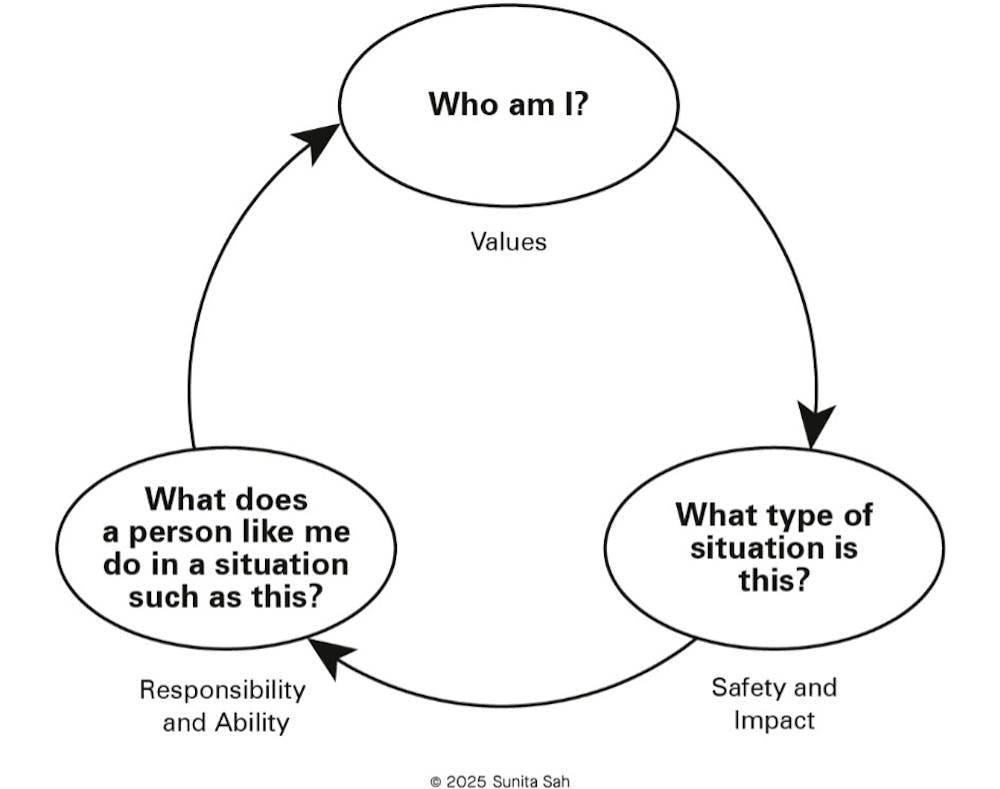
If compliance is the human default, how can you build the muscle of defiance? In my research, I’ve developed a simple actionable guide that I call the Defiance Compass. Like a navigation aid, it orients you in difficult situations by asking three questions:

  1. Who am I? What are the core values that matter most to me?
  2. What type of situation is this? Is it safe to resist? Will it have a positive impact?
  3. What does a person like me do in a situation like this? How can I take responsibility and act in a way that’s consistent with my identity and values?
circular chart with arrows connecting the three questions of the defiance compass
Three questions can help you zero in on whether the time is right for you to defy.
Sunita Sah

Asking these questions shifts defiance from a gut reaction to a conscious practice. And here’s what’s important: That third question (“What does a person like me do?”) circles back to the first (“Who am I?”), because how you act again and again becomes who you are.

Defiance doesn’t always mean open confrontation. Sometimes it means asking a clarifying question, buying time or quietly refusing. It can mean speaking up or walking away. The key is to start small, practice regularly and anchor your choices in your values. Like any skill, the more you practice, the more natural it becomes.

Why defiance matters now

Defiance may be risky, but it’s never been more relevant. At work, employees are pressured to meet targets at any cost. In politics, citizens face waves of misinformation and polarization. In everyday life, people struggle to set healthy boundaries. Across all these contexts, the temptation to comply for the sake of comfort is strong.

That’s why learning to defy strategically matters. It protects personal integrity, strengthens institutions and helps sustain democracy. And it doesn’t require being loud or confrontational.

Of course, not every act of defiance is safe or guaranteed to make a difference. Sometimes it comes at real personal cost and some people still choose to act even when the impact isn’t certain: think of Rosa Parks refusing to give up her seat, or Colin Kaepernick taking a knee. In those moments, the act itself becomes the message. Both of those individuals were deeply connected to their values and the assessment is personal: What feels worth the risk to one person might not to another.

Defiance does require practice: noticing when values are at stake, pausing before you nod along, and choosing actions that align with who you want to be. Each act of consent, compliance or defiance shapes not just your story but the stories of our societies.

If you practice defiance, and teach it and model it, you can imagine a different type of society. You can start to envision a world where, in that same alleyway from my childhood, one of the boys will step forward and tell his friends, “That’s not OK. Let them pass.”

The Conversation

Sunita Sah does not work for, consult, own shares in or receive funding from any company or organization that would benefit from this article, and has disclosed no relevant affiliations beyond their academic appointment.

ref. The science of defiance: A psychology researcher explains why people comply – and how to resist – https://theconversation.com/the-science-of-defiance-a-psychology-researcher-explains-why-people-comply-and-how-to-resist-264567

Rivers are heating up faster than the air − that’s a problem for aquatic life and people

Source: The Conversation – USA (2) – By Li Li (李黎), Professor of Civil and Environmental Engineering, Penn State

Rivers are also heating up as global temperatures rise. Darwin Fan/Moment via Getty Images

When you think about heat waves, you might picture sweltering cities, shimmering asphalt and unbearable summer afternoons. These heat waves dominate the headlines because we feel them directly.

Rivers, on the other hand, are often seen as cool refuges, places to escape the heat of summer.

Yet rivers are heating up, too. In fact, they’re heating up faster than the air.

New research from my team shows that riverine heat waves – periods of abnormally high water temperatures in rivers – are becoming more common, more intense and longer-lasting than they were 40 years ago. Their frequency, intensity and duration are also increasing at rates more than twice as fast as heat waves in the atmosphere.

The increased heat puts more stress on aquatic ecosystems, water quality, energy production and agriculture, and it can threaten species that rely on cool streams.

A hidden threat

Riverine heat waves are disruptive in ways that can cascade through aquatic ecosystems.

Cold-water fish such as trout and salmon are especially vulnerable: Extended periods of abnormally high water temperatures can impair reproduction, slow growth and trigger mass die-offs.

Warmer water also holds less oxygen, potentially suffocating aquatic life. In addition, hot water increases the likelihood of algae blooms and elevates the cost of treating water to make it safe for drinking. Warmer water can also create problems for energy production. Many thermoelectric fossil fuel plants and nuclear plants depend on river water for cooling, and warmer water reduces energy production efficiency, which could mean higher power costs.

A person stands in water and holds a net full of small fish.
Low water levels in California rivers have at times blocked young fish from swimming from river breeding grounds to the ocean, forcing wildlife officials to truck them toward the sea instead.
Justin Sullivan/Getty Images

Despite these serious risks, riverine heat waves have gone quietly unnoticed.

That’s due, in part, to the narrow width of rivers and streams. Oceans and lakes are large enough that they can be monitored consistently by satellites. Rivers, however, are harder to track, especially small rivers. Measuring the temperatures in narrow, winding streams requires high resolution that many satellite sensors lack.

Scientists with universities and government agencies have installed many sensors in streams to measure water temperature, and sensor numbers have proliferated since the 1990s. But the data has been patchy and inconsistent. Until recently, scientists lacked the tools to stitch these fragments into a coherent picture. We developed a way to do it.

AI helps create the full picture

To overcome this challenge, we trained a deep learning model to use scattered and inconsistent records to reconstruct continuous daily water temperatures across 1,471 river sites in the contiguous U.S. from 1980 to 2022.

The reconstructed histories of change enabled us, for the first time, to systematically compare the characteristics of riverine and air heat waves across a large and diverse set of rivers and reveal trends that might otherwise remain invisible.

A chart shows temperature tracking, with dots indicating observed data and AI predictions filling in the gaps based on existing patterns.
River water temperature observations don’t cover all days in this example from New Hampshire, but the AI model can fill the gaps by predicting temperatures. That can help identify river heat waves.
Li Li

The results reveal a troubling pattern.

On average, we found that riverine heat waves occur about half as often as air heat waves, and their temperature increases are a third as intense, but they last nearly twice as long.

More strikingly, their frequency is increasing faster than air heat wave events are. Compared to 1980, an average U.S. river experienced nearly two additional heat wave events in 2022. In 2022, those river heat waves lasted more than three extra days on average than in 1980 and were nearly 1 degree Fahrenheit (almost half a degree Celsius) hotter than in 1980.

Rivers in the Rockies and the Northeast showed some of the steepest increases, driven in part by shrinking snowpacks that once buffered streams with steady supplies of cold meltwater. The rivers are heating up quietly but faster than the air above them.

The drivers: Climate change and human infrastructure

We also wanted to find out whether these trends were mainly driven by climate change or by local infrastructure and other activity, such as dams and agriculture.

A machine learning model we developed to rank the importance of influential environmental factors that drive riverine heat waves found that rising air temperatures, particularly at night, were consistently the strongest factors behind river warming. Declines in snow and streamflow also played major roles, especially in mountain regions where dwindling snowpacks produce less meltwater.

Human infrastructure and other activities also play important supporting roles.

For example, the presence of large dams tends to lengthen heat waves, as warm reservoir water is released downstream. Agriculture shows more complex effects: In some areas, particularly the Midwest, irrigation and crop cover can actually cool rivers by altering local climate and hydrology. But these influences, whether harmful or helpful, are secondary compared to the overarching force of climate change.

What does the future hold?

In a warming world, riverine heat waves threaten to become a critical but underappreciated dimension of the global water–energy–food nexus.

Heat waves often coincide with low streamflows – a likely outcome as climate change reduces runoff from snowmelt. The risks compound. Low, slow-moving water warms more easily and holds less oxygen, creating dangerous conditions for aquatic life and increasing the chances of large-scale die-offs.

These are not just ecological problems. They also directly influence water and food supplies, along with energy reliability.

Unlike air heat waves, riverine heat waves currently remain largely absent from global monitoring systems and adaptation plans. Better understanding the changes and risks will require more coordinated data collection, better global data sharing across agencies and countries, and incorporating river temperature trends into climate risk assessments.

The Conversation

Li Li (李黎) does not work for, consult, own shares in or receive funding from any company or organization that would benefit from this article, and has disclosed no relevant affiliations beyond their academic appointment.

ref. Rivers are heating up faster than the air − that’s a problem for aquatic life and people – https://theconversation.com/rivers-are-heating-up-faster-than-the-air-thats-a-problem-for-aquatic-life-and-people-263718

Religion often shapes someone’s view of abortion – but what about a woman’s actual decision?

Source: The Conversation – USA (3) – By Amy Adamczyk, Professor of Sociology and Criminal Justice, City University of New York

A patient prepares to take mifepristone, the first of two pills, for a medication abortion during a visit to a clinic in Kansas City, Kan., in 2022. AP Photo/Charlie Riedel

Many factors can shape how someone views abortion – gender, age and education, to name a few. Around the world, however, religious belief is the most powerful predictor that someone will disapprove, as I document in my 2025 book, “Fetal Positions.” Faith traditions’ teachings about abortion vary – and there is diversity of opinions within faiths, too. On average, though, people who say that religion is important in their lives are far more likely to think abortion is morally wrong.

But here’s the paradox: There’s a difference between abstract views and personal decisions. On average, strong religious beliefs and involvement in a religious community do not make an American woman less likely to terminate her first pregnancy, so long as she conceives without a potential marriage partner.

The picture becomes even more complex when we consider not just how religious someone is but which tradition they belong to. Young American women in conservative Protestant churches are about half as likely to say they have aborted a premarital pregnancy than Catholics and mainline Protestants, regardless of how devout they are, according to my co-authored research. Other work has found similar differences among Christian groups. There were too few respondents from other religions to fully assess differences, though unmarried young Jewish women in the U.S. likewise appear to have higher odds of obtaining an abortion than conservative Protestants.

Religion’s role in women’s actual decisions about whether to have an abortion is far more nuanced than abortion attitudes alone would suggest. Understanding these relationships can help lawmakers, advocates and the public develop policies that reflect lived realities, rather than relying on assumptions about ideology alone.

Beyond the clinic

Using the National Longitudinal Study of Adolescent to Adult Health, I followed approximately 5,000 women over six years. The data covers a period from the mid-1990s, when the women were teenagers, to the early 2000s, when they were in their early 20s.

My goal was to examine their views about abortion, their sexual behavior, whether they had a premarital pregnancy, and whether they gave birth. The survey also asked respondents to indicate their religious affiliation; how much they regularly attended services, participated in youth group activities and prayed; and how important religion was in their lives.

Longitudinal data is especially useful for sorting out patterns between religion and abortion, compared to surveys that look at a single moment in a woman’s life. For example, if someone is seeking an abortion, but their faith tradition disapproves, that cognitive dissonance may affect how she answers questions about her beliefs.

These six years of data form the basis of my earlier studies and contribute to my recent book. I was particularly interested in decisions about first pregnancies, which are especially pivotal. They can derail a college education, limit career opportunities, and reshape long-term goals in ways that can feel irreversible at a young age.

A brunette woman, her face unseen, sits on a bed as she holds a pregnancy test in two hands.
There’s often a gap between abstract views of abortion and actual decisions.
Viktoriya Skorikova/Moment via Getty Images

I focused only on unmarried young women who were pregnant for the first time. Approximately 25% of the women who had a premarital pregnancy during the six-year period said that they had terminated it. This percentage was roughly the same regardless of how important faith was to them, how much they prayed, or how often they participated in religious activities.

Sociologists Lexie Milmine and Tina Fetner analyzed 2017 data from Canadian women and came to a similar conclusion. They found that neither religious affiliation nor religious service attendance was significantly associated with the odds that a woman reported one or more abortions.

Type, not intensity

There is one religious factor that makes a difference, though: the type of tradition women report belonging to when they were teenagers.

Although various faiths hold different views of abortions, conservative Christian groups, which are influential in the U.S., generally oppose it – including the Southern Baptist Convention, America’s largest Protestant denomination. The Catholic Church also officially disapproves of abortion, though 6 in 10 U.S. Catholics say it should be legal in all or most cases.

Therefore, in addition to researching strength of religious belief and involvement, I also examined whether the type of Christian religious affiliation mattered in shaping abortion decisions.

Focusing on the same group of unmarried young women, I found that regardless of how much they attended religious activities, prayed or reported that religion was very important in their lives, those who affiliated with a conservative Protestant faith when they were teenagers were less likely to terminate their first pregnancies than Catholics or mainline Protestants, which is similar to findings from other research.

A crowd of women in coats hold signs, one of which reads 'Christ is Lord.'
Anti-abortion activists walk past the Supreme Court during the annual March for Life in Washington, D.C., on Jan. 24, 2025.
AP Photo/J. Scott Applewhite

The attitude-behavior gap

My research highlights the disconnect between religion’s role in shaping public opinion about abortion versus its influence on women’s actual decisions.

When it comes to attitudes, the relationship is clear and powerful. Regardless of which specific faith they affiliate with, people who say religion is important in their lives on average express stronger opposition to abortion.

But when women face the reality of an unintended pregnancy, religion’s influence is more nuanced. The strength of her personal devotion fails to explain whether a woman will actually choose to terminate her first pregnancy. In the U.S., the more influential religious factor seems to be which specific religious tradition she belongs to.

Decisions about later pregnancies may be more complicated. For example, around 6 in 10 U.S. abortion patients have had at least one child. It’s not clear how religion shapes mothers’ decisions about how an unexpected pregnancy would affect their family.

In the U.S., public opinion about reproductive rights is largely driven by different religious factors. When it comes to individual decisions about pregnancy, though, which religious tradition someone is affiliated with seems to hold the most sway – at least for first pregnancies outside of marriage.

The Conversation

Amy Adamczyk has received funding from a range of organizations, including the Robert Wood Johnson Foundation, Department of Homeland Security, Society for the Scientific Study of Religion, Association for the Sociology of Religion, and the Chiang Ching-kuo Foundation for International Scholarly Exchange.

ref. Religion often shapes someone’s view of abortion – but what about a woman’s actual decision? – https://theconversation.com/religion-often-shapes-someones-view-of-abortion-but-what-about-a-womans-actual-decision-265330

Gen Z protests brought about change in Nepal via the powers — and perils — of social media

Source: The Conversation – Canada – By Luna KC, Assistant Professor, Global and International Studies, University of Northern British Columbia

Youth protesters in Nepal are in the global spotlight for their angry response to the government’s sweeping social media ban in an apparent attempt to silence their dissent. The government’s actions ignited mass protests — led largely by Gen Z, a cohort made up of young people born between 1997 and 2012.

The Gen Z movement represents a turning point for Nepal politics. The protesters had three key demands: end corruption, end nepotism and reform the country’s political systems.

Their uprising led to the resignation of Prime Minister K.P. Sharma Oli and several government ministers. Sushila Karki was then appointed interim prime minister, and the protests have since died down.

Why is the Gen Z protest unique?

Nepal’s Gen Z movement is different from other movements in Nepal.

First, it is led by young people. Second, social media is their main means of communicating their dissent and their agenda.

These protesters are angry that working-class young people are struggling to meet basic everyday needs (food, shelter, jobs, health care, etc.) and facing rising inequality, discrimination and poverty.

That’s in contrast to the children and grandchildren of Nepal’s high-profile elite politicians, accused by the protesters of living in the lap of luxury. Gen Z protesters have demanded information about the source of income of Nepal’s ultra-rich politicians and their families, and called for a thorough investigation.

A segment on how Nepal’s Gen Z protesters targeted #nepokids. (Sky News)

Why are Gen Zs so frustrated?

For a long time, Nepal, with a population of 29.5 million, has been trapped in a poverty cycle. It is ranked 143rd globally in the Human Development Index (2024).

The unemployment rate in 2024 for youth aged 15-24 was 20.82 per cent, and it’s growing. Reports also suggest that more than 1,500 adults leave the country every day in search of work.

In 2021, the Nepal census found that 7.1 per cent of the population was working outside the country and has a median age of 28.

In 2023, Nepali workers sent remittances of US$11 billion back home. In fact, estimates suggest that almost 25 per cent of Nepal’s GDP is from remittances.

There is also growing concern about Nepali worker deaths as people take dangerous jobs; more than 700 workers died from 2018 to 2019 Gen Z frustrations are linked to how their parents leave the country in search of work and do the most high-risk and lowest-paid jobs abroad, which they believe is in stark contrast to the lives of #NepoBabies and #NepoKids.

Gen Z’s digital tactics

Some Gen Z social media users tracked the accounts (on Instagram, TikTok and Facebook) of the children and grandchildren of ultra-rich politicians and shared or reposted images and videos of their luxurious lifestyles.

That included photos taken on high-end vacations in Europe, shopping for designer brands like Louis Vuitton, Prada, Gucci and Cartier, as well as their stays in family properties worth billions.

Social media engagement surged on posts with these images and with hashtags that included #Nepobaby, #NepoKids, #PoliticiansNepoBabyNepal and #Corruption.

Some Gen Zs also made short videos on TikTok and Facebook highlighting corruption, inequality, poverty and nepotism; those videos also went viral.

All of these issues resonated with many Nepali Gen Zs, spurring them to join the protest movement.

Social media ban

Before Sept. 8, Gen Z’s protests were peaceful and mostly took place online. But when the government instituted a ban on social media, Gen Z erupted, with many claiming that the decision was aimed at silencing their voices.

Gen Z is the social media generation, and the ban was regarded as a violation of their rights. They soon took their demands to the streets from the screen, calling for the resignation of the prime minister.

The protest turned into a battlefield as police killed 19 school-aged students on the same day; hundreds were also injured. As of now, the Gen Z protester death toll is 72.

Aftermath

The prime minister resigned on Sept. 9, but the situation further worsened. Protesters burned down key government buildings, including parliament and court buildings, private businesses, banks and the homes of politicians and business people across the country.

After a series of talks between the chief of the Nepal army, Ashok Raj Sigdel, Nepali President Ram Chadra Poudel and Gen Z leader Sudan Gurung, an interim six-month government was formed. Karki was appointed the first female prime minister of the country.

The interim cabinet’s priorities include the upcoming election in March 2026, tackling corruption, investigating the killings of Gen Z protesters as well as the destruction of public and private property.

The power and perils of social media

Before the Nepal protests, dissenting youth in countries that include Bangladesh, Sri Lanka and Myanmar have used social media to air their grievances.

A study has shown how social media plays a role in empowering youth, amplifying marginal voices and building transnational solidarity. Examples include some of the most popular global social movements like #BlackLivesMatter, #MeToo, #MahsaAmini.


Read more:
A year after Mahsa Amini’s death, Iran’s women continue their long fight for ‘women, life, freedom’


But its role in protest movements can also be problematic.

Amid the Gen Z protests in Nepal, reports of disinformation and misinformation are spreading. A video claiming 35 human skeletons were found in a store was posted on Sept. 13 by a Facebook user with 63,000 followers, fuelling panic among the protesters. The claim was determined to be false.

Gen Z protesters in Nepal and beyond are clearly having some success in bringing about social and political change. But with the growth of artificial intelligence, creating fake content is no longer difficult, and false information can proliferate quickly amid this generation.

The Conversation

Luna KC does not work for, consult, own shares in or receive funding from any company or organisation that would benefit from this article, and has disclosed no relevant affiliations beyond their academic appointment.

ref. Gen Z protests brought about change in Nepal via the powers — and perils — of social media – https://theconversation.com/gen-z-protests-brought-about-change-in-nepal-via-the-powers-and-perils-of-social-media-265365

Cars versus kids: How resistance to change limits children’s right to the city

Source: The Conversation – Canada – By Patricia Collins, Associate Professor, Queen’s University, Ontario

Many Canadians over the age of 40 likely remember spending their childhoods playing on the street and moving around their communities on their own or with friends. And, according to the United Nations’ Sustainable Development Goal 11, cities should in fact be places where all residents, including children, can thrive — they have as much right to occupy and use urban streets as motorists do.

However, children today are less active and independently mobile and aren’t engaging in as much outdoor free play.

In Canada, a major reason for this trend is that we’ve deprived children of their right to the city, including the freedom to safely play and move about on the streets near their homes and schools without the need for adult supervision.

Innovative interventions such as School Streets are critically needed. School Streets are temporary, car-free zones created in front of schools during peak drop-off and pick-up times to improve student safety and encourage walking and cycling

Yet, our research has found that they often face stiff resistance. By closing streets adjacent to schools to cars, School Streets confront drivers with a reimagined and restructured public space they may not be ready to embrace.

Planning cities for cars, not kids

The stripping of children’s rights to the city is a centuries-old project in North America.

Prior to the mass production of the automobile, children could often be found playing on city streets. But as automobile ownership became commonplace, growing numbers of children were being injured and killed by motorists.

Rather than limit where automobiles could travel, urban planners and public health officials advocated for the creation of other places for children to play, hidden away from traffic, such as neighbourhood parks.

This automobile-centric approach to city planning created a societal shift in attitudes about the kinds of spaces considered appropriate for kids to play and move about. Consequently, we now view it as normal not to see or hear children on city streets.

By disempowering children in terms of where they can go in cities, our society has developed assumptions that children are not sufficiently responsible or competent to navigate their communities.

Children’s mobility in car-centric cities

Ironically, as we have become more fearful of allowing children to move about freely, driving children to their destinations has increased in response to this fear. We have largely confined children’s movement in cities to vehicles.

Consequently, we now face an immense societal challenge in enabling children to move independently in their communities, particularly in spaces commonly occupied by children, like outside of primary schools.

In terms of the journey to school, research has shown that risky driving behaviours by parents during morning drop-off times — like letting them out in unsafe areas, obstructing views, making U-turns and speeding — are commonplace.

These behaviours are associated with an increased risk of children being struck by motorists. Hazardous conditions around schools, combined with widespread perceptions that children do not belong on the street and are incapable of getting to school on their own, reinforce the already low rates of walking or bicycling to school among children in Canada.

Innovating cities for children

School Streets can address both issues: reducing the real dangers posed by automobiles in spaces occupied by children while also helping all citizens reimagine how, and by whom, streets can be used.

Typically implemented by municipal governments or not-for-profits, School Streets enable children to come and go safely from school. Though they’re common in many European cities, their uptake in Canada has been slower.

From 2020 to 2024, we led a study entitled Levelling the Playing Fields, in which we systematically evaluated School Street interventions operating in Kingston, Ont. and Montréal. The findings from this study helped launch the National Active School Street Initiative (NASSI).

Funded by the Public Health Agency of Canada, NASSI helps Canadian cities learn about and implement School Streets. Through NASSI, year-long School Streets were launched in September 2025 in Kingston, Mississauga, Ont. and Vancouver.

In September 2026, additional year-long School Streets are expected to launch in Kingston, Mississauga, Vancouver and Montréal, while four-week pilots are planned for Ottawa, Peterborough, Ont., Markham, Ont., Toronto, Winnipeg, Edmonton and Calgary.

Reactions to innovating cities for children

Launching and sustaining School Streets requires support from a broad range of people, including municipal councillors and staff, school administrators, teachers, parents, residents, and police departments.

In our work in Kingston and Montréal, we encountered many champions of School Streets whose support was instrumental in launching and sustaining these interventions. However, we also faced resistance to varying degrees. In some cases, this resistance came after interventions were launched, and in other cases, it was sufficient to prevent the intervention from launching at all.

Rather than acknowledging the benefits School Streets could offer, the resistance was often framed around risks to children — precisely the problem School Streets aim to address.

We were told that School Streets would diminish children’s awareness of road safety, put children at risk of being run over by rogue motorists and was inherently risky because children don’t belong on the street. We suspect these arguments were not truly about risks to children, but rather an unwillingness to share power, space and opportunities with children in urban settings.

We also heard a range of arguments shaped by what’s known as motonormativity — a form of unconscious bias in automobile-centric societies that assumes car usage as a universal norm and aligns solutions with the needs of motorists.

In this vein, we heard that School Streets excluded children whose parents needed to drive their child to school; that residents and visitors would be unacceptably delayed by the street closure; that school staff would be deprived of nearby parking; that children occupying the street would be too noisy and cause damage to parked vehicles; and that automobile congestion would be pushed to other streets.

The most troubling argument made against School Streets was that there were more deserving children in other neighbourhoods, presenting a thinly veiled Not-In-My-Backyard attitude.

School Streets are intended to enable children to reclaim their right to the city. Many members of our society, however, are not yet ready to afford children these rights because they conflict with strongly held perceptions about the places children are meant to occupy.

The Conversation

For the Levelling the Playing Fields Study, Patricia Collins received funding from the Canadian Institutes of Health Research (project grant number PJT-175153). For the National Active School Streets Initiative, Patricia Collins receives funding from the Public Health Agency of Canada.

Patricia Collins was previously affiliated with Kingston Coalition for Active Transportation, a not-for-profit group that was responsible for overseeing the implementation of the School Streets in Kingston. She is no longer a member of that group.

For the Levelling the Playing Fields project Katherine L. Frohlich received funding from the Canadian Institutes of Health Research Funding numer PJT175153. For the NASSI project Katherine Frohlich receives funding from the Public Health Agency of Canada.

ref. Cars versus kids: How resistance to change limits children’s right to the city – https://theconversation.com/cars-versus-kids-how-resistance-to-change-limits-childrens-right-to-the-city-263254