‘Trump said what?!’ — How satire helps us navigate disorienting politics

Source: The Conversation – Canada – By Pascal Michelberger, Postdoctoral Scholar, Western Academy for Advanced Research, Western University

In the context of the temporary suspension of Jimmy Kimmel’s late-night show on ABC, commentators have rightfully raised concerns about free speech, First Amendment rights and press freedom, linking them to the larger issue of American democracy in decline.

But it’s also important to consider how political satire helps defend democracy in ways that go beyond speaking truth to power.

For example, political satire can serve as a source of knowledge about current affairs and has even found its way into political-science classrooms. As a storytelling form, it can also equip citizens with the tools to navigate moments of crisis in real time.


Read more:
‘Pax Americana’ in Toronto: How speculative art can help us navigate threats


Multiple facets of political satire

To better understand the multifaceted power of satire in times of political turmoil, we can turn to the work of Sophia A. McClennen, professor of international affairs and comparative literature and an expert on the connections among satire, democracy and the public sphere.

In her 2023 book Trump Was a Joke: How Satire Made Sense of a President Who Didn’t, McClennen argues that while political satire offers citizens ways to critique those in power, it also helps to inform the public, encourages audiences to engage critically with the issues at stake and uses humour to lower audience barriers, especially in difficult or unpleasant contexts.

She also points to studies that suggest political satire can build community and even set the public and political agenda.

Satire in unprecedented times

According to McClennen, this variety of important functions allows satire to serve as an effective tool to make sense of unprecedented political times, such as the first Trump presidency from 2017 to 2021.

Trump and his grotesque public persona, notes McClennen, presented political satire with a considerable challenge when reality itself seemed like a bad joke.

As other commentators also noted, Trump already seemed a caricature of himself and therefore resistant to satire. For some, this problem raised questions about the genre’s effectiveness.


Read more:
How Trump’s America changed political satire – for both liberals and conservatives


The solution, McClennen explained, came in the form of overhauling the way satire works, essentially moving toward producing irony that made “the bizarre real while also revealing how bizarre reality had become.”

Split-screen video from The Washington Post: SNL vs. Reality | Trump emergency declaration vs. Alec Baldwin on SNL

As one particularly effective example of this new approach, McClennen cites Alec Baldwin’s acclaimed portrayal of Trump on Saturday Night Live. The character worked so well, she argues, precisely because it did not go far beyond the original.

Because of that, the portrayal effectively exposed both the performative nature of Trump’s persona and the anti-democratic features of his platform.

Canadian satire

McClennen’s book covers Trump’s first term; as we know, things have turned arguably even more absurd and unprecedented during his ongoing second term.

Faced with a trade war and recurring annexation threats, Canadians have now officially become part of this equation.

During these times, McClennen’s assertions about the power of political satire perhaps become even more apparent. In order to understand how, we can turn to Canadian political satire.

Take CBC’s This Hour Has 22 Minutes: in a segment from the show’s Jan. 28, 2025 episode, we witness two Canadian shoppers (played by Mark Critch and Chris Wilson) grappling with the new reality of tariff and annexation threats.

‘There’s only one winner in a trade war…’ ‘This Hour Has 22 Minutes’ sketch.

The skit acknowledges Canadians’ confusion and disorientation in the face of this new conflict, provides them with concrete and useful information that can help them navigate the current situation — and invites them to reflect on their own roles as citizens affected by conflict on a deeper level.

As The Globe and Mail TV critic, J. Kelly Nestruck, noted, the clip resonated with many Canadians and went viral, racking up 11 million Tik Tok views within a week. It’s also among the most popular This Hour YouTube videos uploaded in recent months.

A 22 Minutes segment aired only a few weeks after the grocery store sketch also has Critch in role as Ontario Premier Doug Ford. The sketch shows Critch’s Ford restock American liquor in an Ontario booze store, in the wake of a trade war “pause,” only to frantically remove it again.

‘Doug Ford restocks American booze! Wait… Trump said what?!’ This Hour Has 22 minutes sketch.

The sketch acknowledges the absurdly fast-moving and unpredictable trade war situation, but it also explains Ontario’s particular role in the conflict by pointing to the province’s purchasing power, while also touching on the province’s cancellation of an earlier deal made with Elon Musk’s Starlink.

Another 22 Minutes sketch from May portrays a self-help group where Canadians confess shopping at American chain stores or purchasing American products.

‘Canadians address their American shopping habits…”’ ‘This Hour Has 22 Minutes’ sketch.

The clip can be understood as a logical follow-up to the grocery store sketch, reinforcing how difficult and even confusing it can be to change buying habits during the ongoing trade war. But the sketch also informs viewers about potentially misleading grocery labelling practices, and it invokes a certain sense of community by emphasizing that Canadians are all in this together.

Deeper engagement

All of these examples underline that while satire is often thought of primarily as a stage for critical political commentary, it also has a vital function of informing the public and encouraging deeper engagement with the issues at stake.

In the Canadian context, satirical formats such as 22 Minutes are also part of distinct Canadian cultural and political commentary in a sea of voluminous American media.


Read more:
Should global media giants shape our cultural and media policy? Lessons from satellite radio


Political satire creates opportunities for public action and engagement that go far beyond speaking truth to power. It also enables citizens to navigate disorienting and fast-moving circumstances more effectively, which proves particularly useful in times of political turmoil.

Limiting the reach of satire by way of regulatory action would have consequences far greater than just the silencing of critical voices.

The Conversation

Pascal Michelberger does not work for, consult, own shares in or receive funding from any company or organisation that would benefit from this article, and has disclosed no relevant affiliations beyond their academic appointment.

ref. ‘Trump said what?!’ — How satire helps us navigate disorienting politics – https://theconversation.com/trump-said-what-how-satire-helps-us-navigate-disorienting-politics-266557

Trump’s National Guard deployments reignite 200-year-old legal debate over state vs. federal power

Source: The Conversation – USA – By Andrea Katz, Associate Professor of Law, Washington University in St. Louis

Demonstrators in Portland, Ore., protest on Oct. 4, 2025, against President Donald Trump’s plan to deploy the National Guard to the city. Spencer Platt/Getty Images

If you’re confused about what the law does and doesn’t allow the president to do with the National Guard, that’s understandable.

As National Guard troops landed in Portland, Oregon, in late September 2025, the state’s lawyers argued that the deployment was a “direct intrusion on its sovereign police power.”

Days before, President Donald Trump, calling the city “a war zone,” had invoked a federal law allowing the government to call up the Guard during national emergencies or when state authorities cannot maintain order.

The conflict throws into relief a question as old as the Constitution itself: Where does federal power end and state authority begin?

One answer seems to appear in the 10th Amendment’s straightforward language: “The powers not delegated to the United States by the Constitution, nor prohibited by it to the States, are reserved to the States respectively, or to the people.” This text is considered to be the constitutional “hook” for federalism in our democracy.

The founders, responding to anti-Federalist anxieties about an overbearing central government, added this language to emphasize that the new government possessed only limited powers. Everything else – including the broad “police power” to regulate health, safety, morals and general welfare – remained with the states.

Yet from the beginning, the text has generated plenty of confusion. Is the 10th Amendment merely a “truism,” as Justice Harlan Fiske Stone wrote in 1941 in United States v. Darby, restating the Constitution’s structure of limited powers? Or does it describe concrete powers held by the states?

Turns out, there’s no simple answer, not even from the nation’s highest court. Over the years, the Supreme Court has treated the 10th Amendment like the proverbial magician’s hat, sometimes pulling robust state powers from its depths, other times finding it empty.

The roofline with carvings on it of a large, white, pillared building.
Will the Supreme Court justices weigh in on the Trump administration’s attempts to deploy the National Guard?
Win McNamee/Getty Images

10th Amendment’s broad range

The arguments over the 10th Amendment for almost 200 years have applied not only to the National Guard but to questions about how the federal and state governments share powers over everything from taxation to government salaries, law enforcement and regulation of the economy.

For much of the 19th century, the 10th Amendment remained dormant. The federal government’s weakness and limited ambitions, especially on the slavery question, meant that boundaries were rarely tested before the courts.

The New Deal era brought this equilibrium crashing down.

The Supreme Court initially resisted the expansion of federal power, striking down laws banning child labor in Hammer v. Dagenhart in 1918, setting a federal minimum wage in 1923 in Adkins v. Children’s Hospital, and offering farmers subsidies in U.S. v. Butler in 1937. All these decisions were based on the 10th Amendment.

But this resistance wore down in the face of economic crisis and political pressure. By the time of the Darby case in 1941, which concerned the Fair Labor Standards Act and Congress’ power to regulate many aspects of employment, the court had relegated the 10th Amendment to “truism” status: The Amendment, wrote Stone, did nothing more than restate the relationship between the national and state governments as it had been established by the Constitution before the amendment.

The 1970s marked an unexpected revival. In the 1976 decision in National League of Cities v. Usery, a dispute over whether Congress could directly exercise control over minimum wage and overtime pay for state and local government employees, the court held that Congress could not use its commerce power to regulate state governments.

But that principle was abandoned nine years later, with the court doubling back on its position. Now, if the states wanted protection from federal overreach, they would have to seek it through the political process, not judicial intervention.

Yet less than a decade later, the court reversed course again. The modern federalism renaissance began in the ’90s with a pair of divided opinions stating that the federal government cannot force the states to enforce federal regulatory programs: this was the “anti-commandeering principle.”

The 10th Amendment’s meandering path

In recent decades, the court, led by Chief Justice John Roberts, has invoked the amendment to protect state power in varied, even surprising contexts: states’ entitlement to federal Medicaid spending; state authority over running elections, despite patterns of voter exclusion; even legalization of sports gambling.

On the other hand, in 2024, Colorado was barred by the court from excluding Trump from the presidential ballot as part of its power to administer elections.

That brings us back to the present, where Trump has deployed National Guard troops to Los Angeles to quell protests against immigration enforcement, and bids to send them to Portland and Chicago as well.

From the point of view of federalism, two factors lend this conflict some constitutional complexity.

One is the National Guard’s dual state-federal character. Most Guard mobilizations, including disaster relief, take place under Title 32 of the U.S. Code, which maintains state control of troops with federal funding.

By contrast, Title 10 allows the president to assert federal control over Guard units in case of “a rebellion or danger of a rebellion” against the government or where “the President is unable with the regular forces to execute the laws of the United States.”

The other factor is political.

Since World War II, the National Guard has been deployed only 10 times by presidents, mostly in support of racial desegregation and the protection of civil rights. All but one of these mobilizations came at the governor’s request – the lone exception, pre-Trump, being President Dwight Eisenhower’s 1957 mobilization of the Arkansas National Guard to desegregate schools in Little Rock over the wishes of Gov. Orval Faubus.

In sharp contrast, Trump has now attempted three times to send troops to large cities over the explicit objection of Democratic governors. Such is the case in Portland.

A man with sandy hair dressed in a blue jacket, white shirt and red tie.
President Donald Trump has faced lawsuits when deploying the National Guard to states with Democratic governors.
AP Photo/Evan Vucci

National Guard deployments and constitutional stakes

Oregon’s lawsuit argues that there is no national emergency in the city, and that deploying Guard troops to the state without Gov. Tina Kotek’s consent – indeed, over her explicit objection – and absent the extraordinary circumstances that might justify Title 10 federalization, is illegal. The National Guard, asserts the lawsuit, remains a state institution that federal authorities cannot commandeer.

The two deployments, in Oregon and Illinois, are making their way through the federal courts, and the Trump administration has asked the Supreme Court to intervene to authorize the deployments. What the court will do, if the cases reach it, is uncertain. Roberts has proved willing to invoke state sovereignty in some contexts while rejecting it in others.

For now, the court has upheld several Trump administration actions while constraining others, suggesting a jurisprudence driven more by specific contexts than categorical rules.

Whether Oregon’s challenge succeeds may depend less on the long and changing history of 10th Amendment doctrine than on how the court views immigration enforcement, presidential authority and the consequences of Trump’s frequent invocations of emergency power for American democracy.

The Conversation

Andrea Katz does not work for, consult, own shares in or receive funding from any company or organization that would benefit from this article, and has disclosed no relevant affiliations beyond their academic appointment.

ref. Trump’s National Guard deployments reignite 200-year-old legal debate over state vs. federal power – https://theconversation.com/trumps-national-guard-deployments-reignite-200-year-old-legal-debate-over-state-vs-federal-power-267259

Pour les villes, finis les projets flamboyants, l’ère est à l’entretien, la consolidation et la résilience

Source: The Conversation – in French – By Juste Rajaonson, Professeur agrégé, Université du Québec à Montréal (UQAM)

Pénurie de main-d’œuvre, de logements, manque de mobilité interrégionale, banlieues galopantes, gestion déficiente des déchets, et nos infrastructures, qui ont cruellement besoin d’entretien… À l’approche des élections municipales, nous avons analysé au Département d’études urbaines et touristiques de l’Université du Québec à Montréal six indicateurs clés pour mieux cerner les défis socioéconomiques et environnementaux qui attendent les prochains élus et les prochaines élues.

Le bilan ? Les réalités locales sont contrastées, mais partout, il faudra en faire plus… et surtout mieux. Mieux entretenir, mieux anticiper, mieux collaborer. Et les solutions adaptées aux défis locaux exigeront non seulement de nouvelles approches, mais aussi de nouveaux alliés.


À lire aussi :
Élections municipales : les enjeux des villes changent, mais pas leurs pouvoirs


Cet article fait partie de notre série Nos villes d’hier à demain. Le tissu urbain connait de multiples mutations, avec chacune ses implications culturelles, économiques, sociales et — tout particulièrement en cette année électorale — politiques. Pour éclairer ces divers enjeux, La Conversation invite les chercheuses et chercheurs à aborder l’actualité de nos villes.

1. Vitalité économique : entre résilience et dépendance régionale

Entre 2020 et 2024, le taux de chômage a diminué dans plusieurs régions : de 11,3 % à 7,8 % à Montréal, de 7,7 % à 4,5 % au Bas-Saint-Laurent, jusqu’à 2,8 % en Chaudière-Appalaches. Le revenu disponible par habitant, quant à lui, a progressé de 23 % à 25 % selon les régions.

Toutefois, l’indice de vitalité économique de l’Institut de la statistique du Québec confirme que la prospérité reste concentrée autour de Québec, Montréal et Ottawa-Gatineau, tandis que la Gaspésie, la Côte-Nord et le Bas-Saint-Laurent stagnent.


À lire aussi :
Relance économique : il faut tenir compte des différentes réalités régionales


La rareté de main-d’œuvre persiste, surtout en dehors des grands centres. En 2024, on compte 1,6 chômeur par poste vacant en région, contre 2,7 à Montréal. Faciliter la mobilité interrégionale devient donc crucial, particulièrement dans les secteurs agroalimentaire, manufacturier et minier. Seulement le tiers des 1107 municipalités ont mis en place des services de transport collectif, souvent sous-financés et insuffisants face à l’ampleur des besoins en zones rurales ou périurbaines.

2. Vieillissement : une nouvelle réalité qui façonne les territoires

Le vieillissement démographique accentue ces pressions. Dans plusieurs MRC du Bas-Saint-Laurent, de la Gaspésie et de la Côte-Nord, l’âge médian dépasse 50 ans. Or, ces régions forment la base de notre économie : énergie, ressources, alimentation, tourisme. Le ratio de soutien démographique, nombre d’actifs pour chaque personne âgée de 65 ans et plus, y est tombé à 2,5, contre 3,5 dans la région métropolitaine de Montréal.

Ce déséquilibre crée des besoins accrus en soins et services de proximité et fragilise la relève. D’ici 2051, plus du tiers de la population sera âgée de plus de 65 ans dans plusieurs régions. Déjà, les trois-quarts des municipalités participent à la démarche Municipalité amie des aînés (MADA), mais il faut aller plus loin : attirer les jeunes familles, adapter les logements et surtout améliorer la mobilité entre les régions.

3. Abordabilité du logement : un frein à la vitalité

La crise du logement compromet ces stratégies de revitalisation et d’attractivité. En 2023, le taux d’inoccupation était sous la barre critique des 3 % dans l’ensemble des 43 centres urbains du Québec. Pire : les trois-quarts d’entre eux affichaient un taux de 1 % ou moins, notamment Trois-Rivières (0,4 %), Rimouski (0,8 %) et Prévost (0 %). Si les grands centres sont à saturation, les municipalités de plus petite taille peinent à loger des travailleurs qu’elles cherchent à attirer.


À lire aussi :
Le logement est bien plus qu’un bien marchand. Et la crise actuelle ne se réduit pas à équilibrer l’offre et la demande


Résultats ? Les distances domicile-travail s’allongent, le parc automobile augmente et les coûts explosent pour les ménages comme pour les municipalités. Entre 2022 et 2023, les loyers ont bondi de 7,4 %, atteignant 1 074 $ à Montréal, 1 198 $ à Gatineau et 1 002 $ à Québec. Le tiers des locataires y consacrent plus de 30 % de leur revenu. Dans ce contexte, planifier l’habitation ne peut plus être dissocié des politiques économiques, sous peine de freiner la revitalisation des territoires.

4. Infrastructures : l’ère de l’entretien et de l’adaptation

Sur le plan physique, les municipalités entrent dans un cycle d’entretien, de priorisation et d’adaptation. Selon le Plan québécois des infrastructures, 65 % des investissements d’ici 2035 serviront à maintenir les actifs existants. À Saguenay par exemple, plusieurs ponts arrivent en fin de vie. À Trois-Rivières, le tiers des conduites d’eau datent d’avant 1975.


Déjà des milliers d’abonnés à l’infolettre de La Conversation. Et vous ? Abonnez-vous gratuitement à notre infolettre pour mieux comprendre les grands enjeux contemporains.


Les événements climatiques aggravent la situation : fortes pluies, vagues de chaleur, gel-dégel… Chaque inondation alourdit la facture. Il faudra près de 2 G$ de plus par an pour renforcer les infrastructures municipales à l’horizon 2055, soit plus de 500 $ par habitant par an dans plusieurs régions. C’est le temps d’entretenir, pas de promettre des projets flamboyants ou de geler les investissements.

5. Artificialisation du territoire : un choix coûteux

Le Québec perd environ 4 000 hectares de milieux naturels chaque année, surtout dans les couronnes périurbaines de la Montérégie, Lanaudière et les Laurentides. Depuis 2000, 60 % des nouvelles superficies bâties s’y concentrent. Cette expansion complexifie l’entretien des réseaux et accroît la vulnérabilité aux inondations dans les zones sensibles, tout en menaçant la biodiversité.


À lire aussi :
La densification des villes est bonne pour l’environnement… et l’économie


Limiter l’artificialisation devient donc une mesure de saine gestion. Dans les villes en croissance, cela passe par une densification cohérente avec la capacité des réseaux, sans imperméabilisation excessive (un processus qui protège des structures contre l’eau et l’humidité, par exemple). Dans les milieux déjà denses, il faut au contraire désimperméabiliser et restaurer les milieux naturels. Ce virage est soutenu par les nouvelles orientations gouvernementales en aménagement du territoire.

6. Matières résiduelles : essoufflement de la transition

Depuis 2015, la quantité de matières éliminées au Québec a très légèrement diminué, mais reste extrêmement élevée : près de 4,6 millions de tonnes de matières résiduelles ont été éliminées en 2023 (par enfouissement ou incinération). Les écarts régionaux sont frappants pour les ordures ménagères : certains territoires affichent une performance d’élimination par habitant bien inférieure à la moyenne provinciale d’environ 330 kg/habitant (en 2023), tandis que d’autres la dépassent largement.


À lire aussi :
Nos villes seront-elles à l’avant-garde de la lutte contre le gaspillage ? Il n’en tient qu’à elles !


Partout, les coûts grimpent. Mais récupérer coûte encore plus cher qu’éliminer, ce qui incite encore trop souvent à enfouir plutôt qu’à valoriser. Les citoyens se découragent face à un système souvent peu clair ou mal équipé, ce qui fait qu’une part importante des déchets éliminés est en réalité valorisable (le tiers de matières recyclables et le quart de matières organiques en 2023).

La gestion des matières résiduelles représente environ 3 à 5 % des dépenses municipales, une part variable selon les territoires et en hausse constante avec la complexification de la gestion. Il faut donc se projeter : et si l’enfouissement devenait sérieusement impossible dans 10 ans ? Planifier aujourd’hui, c’est éviter de subir demain.


À lire aussi :
Pour préserver la biodiversité, il faut rendre les villes plus compactes, circulaires et vertes


Le statu quo n’est plus une option

Et on n’a même pas encore abordé la culture, l’énergie, le tourisme, la souveraineté alimentaire ou la sécurité. Mais les indicateurs abordés ici suffisent déjà à démontrer que le statu quo n’est plus une option. Aucune municipalité n’est épargnée. Ce n’est plus une question de « si », mais de « quand » et « comment » investir. C’est précisément l’objet de nos travaux à la nouvelle Chaire AdapT-UMQ sur les infrastructures municipales résilientes : mieux outiller les villes pour faire face à ces défis.

Les décideurs qui entreront en poste devront donc changer de posture. Pas de promesses simples ni de projets flamboyants. Il faut prioriser des investissements essentiels, en combinant données financières et extrafinancières pour éclairer les décisions.

Cette posture exige aussi de mobiliser de nouveaux alliés : les grands employeurs devront contribuer à la mobilité et au logement ; le secteur philanthropique peut appuyer les projets structurants ; les programmes provinciaux et fédéraux doivent être conçus à partir des besoins locaux et non l’inverse.

Enfin, renforcer les capacités internes devient une priorité. Le manque de personnel ou d’expertise ne peut plus servir de prétexte. Si c’est là que ça bloque, c’est là qu’il faut investir. Il en va de notre capacité collective à répondre aux défis de demain.

La Conversation Canada

Juste Rajaonson a reçu du financement des Fonds de recherche du Québec via le partenariat entre l’Institut AdapT et l’Union des municipalités du Québec ainsi que du Conseil de recherche en sciences humaines du Canada.

Gabriel Arès ne travaille pas, ne conseille pas, ne possède pas de parts, ne reçoit pas de fonds d’une organisation qui pourrait tirer profit de cet article, et n’a déclaré aucune autre affiliation que son organisme de recherche.

ref. Pour les villes, finis les projets flamboyants, l’ère est à l’entretien, la consolidation et la résilience – https://theconversation.com/pour-les-villes-finis-les-projets-flamboyants-lere-est-a-lentretien-la-consolidation-et-la-resilience-267477

La fin du programme de prédédouanement frontalier entre le Canada et les États-Unis est-elle proche ?

Source: The Conversation – in French – By Emily Gilbert, Professor, Canadian Sudies and Geography & Planning, University of Toronto

Lors de la réunion du 25 septembre à Banff, l’ambassadeur américain au Canada, Pete Hoekstra, s’est interrogé sur l’avenir du prédédouanement au Canada. Il s’est plaint de la baisse du nombre de voyages transfrontaliers, laquelle rend le coût du programme moins attrayant pour les Américains.

Les commentaires d’Hoekstra ont été perçus comme une menace, voire comme l’exigence que les Canadiens recommencent à voyager aux États-Unis.

Mais les Canadiens devraient-ils continuer à rester à l’écart ? Il est peut-être temps de repenser le programme de prédédouanement du Canada avec les États-Unis et la manière dont il peut porter atteinte aux droits civils et à la souveraineté du Canada.

D’abord informel, puis élargi

Les origines du programme de prédédouanement américain au Canada remontent à 1952. Il s’agissait au départ d’un accord informel conclu à la demande d’American Airlines, qui souhaitait développer ses activités au Canada.

Depuis, le programme s’est étendu à huit aéroports internationaux canadiens, dont l’Aéroport international Montréal-Trudeau (YUL) qui offre le prédédouanement américain, et au terminal ferry de l’Alaska Marine Highway System à Prince Rupert, en Colombie-Britannique. Les États-Unis ont également étendu leurs installations de prédouanement aux Bahamas, aux Bermudes, à l’Irlande et aux Émirats arabes unis.

Dans le cadre de l’accord de prédédouanement entre le Canada et les États-Unis, des agents frontaliers américains sont présents au Canada afin que les voyageurs puissent passer les contrôles douaniers, d’immigration, de santé publique et de sécurité, ainsi que les inspections agricoles avant leur départ. Cela offre une sécurité supplémentaire aux États-Unis, car ils peuvent contrôler les voyageurs beaucoup plus tôt dans leur voyage et arrêter les voyageurs suspects avant qu’ils ne montent à bord de leur avion.

Pour les voyageurs canadiens, cela accélère le passage de la frontière. En passant la douane au Canada, ils n’ont pas besoin de faire la queue à leur arrivée aux États-Unis. Il est ainsi beaucoup plus facile de prendre des vols en correspondance et cela signifie également que les compagnies aériennes peuvent desservir des aéroports américains plus petits depuis le Canada, ce qui peut être moins cher et plus pratique.

Pouvoirs de police

Le prédédouanement au Canada est devenu si courant qu’il n’a pas fait l’objet d’un examen approfondi, même si la législation récente soulève des préoccupations pressantes.

En 2015, les États-Unis et le Canada ont signé un nouveau traité sur le précontrôle des transports terrestres, ferroviaires, maritimes et aériens. Cette législation a ouvert la voie à un élargissement du prédédouanement avec de nouvelles installations à l’Aéroport international Jean-Lesage de Québec (YQB) et à l’aéroport Billy Bishop sur les îles de Toronto, dont l’ouverture est prévue prochainement. Des projets pilotes ont également été mis en place dans les gares ferroviaires et les ports, ce qui soulève des questions particulières, car ces installations sont souvent situées en centre-ville.

Par la suite, le Canada a adopté sa nouvelle loi sur le prédouanement, qui est entrée en vigueur en 2019. Cette loi a mis à jour les conditions du prédouanement, mais a également introduit de nouveaux pouvoirs policiers inquiétants et étendus pour les agents américains sur le sol canadien.

Les agents frontaliers américains ont désormais le pouvoir de procéder à des fouilles à nu si aucun agent canadien n’est disponible ou n’est disposé à participer. Les agents frontaliers américains ont également le droit de porter des armes.

En vertu de la législation précédente de 1999, les agents frontaliers américains étaient autorisés à utiliser « toute la force nécessaire pour accomplir leurs tâches de prédouanement » s’ils le faisaient « pour des motifs raisonnables ». Mais en vertu de la législation récente, les agents américains sont « autorisés à faire ce qu’ils sont tenus ou autorisés à faire en vertu de la présente loi et à utiliser toute la force nécessaire à cette fin ». En d’autres termes, le recours à la force est désormais légitimé.


Déjà des milliers d’abonnés à l’infolettre de La Conversation. Et vous ? Abonnez-vous gratuitement à notre infolettre pour mieux comprendre les grands enjeux contemporains.


De plus, alors qu’auparavant les voyageurs pouvaient se soustraire à l’inspection sans préjudice, en vertu de la législation de 2017, leur retrait du processus frontalier pourrait être interprété comme un motif de suspicion.

Le fait de se retirer devient suspect, le refus de répondre étant considéré comme une obstruction, ce qui constitue une infraction pénale tant aux États-Unis qu’au Canada. Cela peut empêcher une personne d’entrer aux États-Unis à une date ultérieure.

Si une personne est soupçonnée d’avoir commis une infraction, les agents frontaliers américains peuvent également la placer en détention, à condition que cela ne « retarde pas de manière déraisonnable le retrait du voyageur » du processus. Or, il n’y a pas de limite de temps pour ce qui est considéré comme un « retard déraisonnable ».

Modifications législatives préoccupantes

Lorsque la nouvelle loi sur le prédouanement a été présentée, le premier ministre Justin Trudeau a tenté d’apaiser les inquiétudes en expliquant que le prédouanement offrait davantage de protections aux voyageurs, car la Constitution canadienne s’appliquerait au Canada.

La loi elle-même stipule :

L’exercice de tout pouvoir et l’exécution de toute fonction ou tâche en vertu de la législation américaine au Canada sont soumis à la législation canadienne, y compris la Charte canadienne des droits et libertés, la Déclaration canadienne des droits et la Loi canadienne sur les droits de la personne.

Mais ces protections peuvent-elles vraiment être garanties lorsqu’il y a chevauchement de compétences ?

Prenons l’exemple de la dernière interdiction de voyager en 2025 qui interdit totalement l’entrée sur le territoire américain aux ressortissants de 12 pays et partiellement à ceux de sept autres pays.

Comme le souligne Amnesty International, les interdictions de Trump « visent des personnes en fonction de leur race, de leur religion ou de leur nationalité, issues de pays à population majoritairement noire, brune et musulmane ». Pourtant, ces interdictions sont appliquées au Canada via ces zones de prédouanement, ce qui signifie que les droits et les protections contre la discrimination prévus par les lois canadiennes ne sont pas respectés.

En vertu des termes du traité de 2015, les agents de prédouanement bénéficient également d’une immunité pour les infractions civiles et administratives dans leur pays d’accueil. De plus, les États-Unis ont adopté une loi un an plus tard stipulant que les États-Unis ont compétence sur les infractions commises par le personnel américain en poste au Canada.

Comme l’a déclaré le commissaire à la protection de la vie privée du Canada, cette absence de responsabilité au Canada signifie qu’il existe peu de recours pour une personne au Canada qui est victime d’un incident avec des agents frontaliers américains lors du contrôle préalable. S’il n’y a pas de responsabilité, les lois canadiennes sont essentiellement sans signification.

Politique frontalière

Pour ces raisons, il est urgent que le Canada réévalue le programme de prédédouanement. D’autant plus que des efforts sont en cours pour déployer le prédédouanement canadien aux frontières terrestres avec les États-Unis.

En janvier 2025, avant l’investiture de Trump, un projet pilote de deux ans a été annoncé à l’installation de Cannon Corners, à la frontière entre New York et le Québec. Ce projet serait quelque peu différent des pouvoirs de police accordés aux agents frontaliers américains dans les aéroports canadiens, mais les objectifs du Canada sont similaires aux directives de sécurité américaines : déterminer l’admissibilité avant l’entrée au Canada.

En d’autres termes, le Canada met en place des initiatives de prédédouanement qui rendent plus difficile les demandes d’asile lorsqu’elles sont émises par des personnes traversant la frontière canado-américaine.

Hoekstra a remis en question l’avenir du prédédouanement. Cela offre une excellente occasion de se demander si les coûts du programme l’emportent sur les avantages dans le climat politique actuel. En effet, aussi pratiques et efficaces que puissent être les programmes de prédouanement, ils soulèvent des questions délicates concernant la souveraineté canadienne et les droits des citoyens canadiens.

La question devrait plutôt être de savoir si le Canada souhaite adopter une politique frontalière à l’américaine plutôt que d’essayer de mettre en place des politiques et des pratiques frontalières plus humaines.

La Conversation Canada

Emily Gilbert a reçu un financement du Conseil de recherches en sciences humaines.

ref. La fin du programme de prédédouanement frontalier entre le Canada et les États-Unis est-elle proche ? – https://theconversation.com/la-fin-du-programme-de-prededouanement-frontalier-entre-le-canada-et-les-etats-unis-est-elle-proche-267595

Rethinking polygamy – new research upends conventional thinking about the advantages of monogamous marriage

Source: The Conversation – USA – By David W. Lawson, Professor of Anthropology, University of California, Santa Barbara

Most polygamous marriages are “polygynous,” a union between one husband and multiple wives. HerminUtomo/iStock via Getty Images Plus

In July 2025, Uganda’s courts swiftly dismissed a petition challenging the legality of polygamy, citing the protection of religious and cultural freedom. For most social scientists and policymakers who have long declared polygamy a “harmful cultural practice,” the decision was a frustrating but predictable setback in efforts to build healthier and more equal societies.

In the vast majority of cases, polygamy takes the form of one husband and multiple wives – more precisely referred to as polygyny, originating from the Greek words “poly” (“many”) and “gynē” (“woman or wife”). The opposite arrangement of one wife and multiple husbands is referred to as polyandry (from “anēr” meaning “man” or “husband”) and is exceedingly rare worldwide.

Critics of polygyny present two main arguments. First, they contend it squeezes low-status men out of the marriage market, fostering social unrest, crime and violence against women by frustrated unwed men. Second, it harms women and children by dividing limited resources among more dependents.

This logic has led leading political scientist Rose McDermott to describe polygyny as evil. Other researchers, such as anthropologist Joseph Henrich, even go as far as to credit Christianity’s derision of polygyny as a driving force of Western prosperity.

However, a trio of new studies, all relying on the highest standards of data analysis, contend that these arguments are misguided.

I have spent my career working at the intersection of anthropology and global health, researching how and why family structure varies – and what this diversity means for human well-being. Much of this work has been carried out with colleagues in Tanzania where, like Uganda, polygyny is relatively common. This new wave of work underscores the value of our research, effectively demonstrating that good intentions and intuition are no substitute for cultural sensitivity and evidence.

Map of countries showing that countries in West and Central Africa have higher proportions of people living in polygamous households than other regions.
Only about 2% of the global population lives in polygamous households, and in most places the proportion is less than 0.5%.
Pew Research Center

Does polygyny lock men out of marriage?

A new study published in October 2025 in the Proceedings of the National Academy of Sciences presents the first comprehensive, large-scale analysis of polygyny and men’s marriage prospects. The project is a collaboration between demographer Hampton Gaddy and evolutionary anthropologists Rebecca Sear and Laura Fortunato.

The researchers drew on demographic modeling and an extraordinary trove of census data – over 84 million records from 30 countries in Africa, Asia and Oceania, plus the entire U.S. census from 1880, when polygyny was practiced in some American communities. They demonstrate that polygyny does not lock large numbers of men out of marriage. In fact, in many contexts, men are actually more likely to marry where polygyny is common than where it is rare.

The narrative that polygyny leads to lonely bachelors is intuitive. In a community with equal numbers of men and women, if one man marries two wives, then another man must remain unmarried. Expand that across a whole society, and polygyny looks like a recipe for an army of resentful, single men.

Parallel arguments have been made about the rise of incel – a portmanteau of “involuntary” and “celibate” – subcultures within monogamous nations, including the U.S. Here, the argument is that high-status men leave low-status men sexless and frustrated, ultimately leading to violence.

The trouble is that real demography is not so simple. Women typically live longer than men, men frequently marry younger women, and populations in many parts of the world are growing, ensuring younger spouses are available for older cohorts. These factors, which are characteristic of many contemporary African nations, tilt the marriage market toward a surplus of women. Under many realistic conditions, a sizable proportion of men can have multiple wives without leaving their peers out in the cold.

In fact, in nearly half of the countries examined, higher rates of polygyny were associated with fewer, not more, unmarried men. Only a handful of countries showed the expected positive relationship, and even then inconsistently over time.

The case of historical Mormon communities in North America is equally revealing. When the researchers compared counties with documented Mormon polygyny to others in the 1880 census, they found lower rates of unmarried men in polygynous areas. Gaddy and his colleagues contend that this is explained by the tendency for cultural norms that favor polygyny to also be relatively pronatalist, driving marriage rates upward for all.

Do women and children get a smaller share?

What about the argument that polygyny harms women and children by dividing male-owned wealth among more mouths to feed? There certainly are studies that have demonstrated associations between polygyny and poor health. But another line of thinking argues that correlation should not be equated with causation.

Ten years ago, my colleages and I documented that polygyny is associated with higher food insecurity and poor child health when comparing outcomes across over 50 Tanzanian villages. However, this pattern was an artifact of polygyny being most common in marginalized Maasai communities, which tend to live in drought-prone areas with inadequate health care. Moreover, when comparing families within communities, polygynous households were typically wealthier, a key factor in making polygyny attractive to women, and children were not disadvantaged.

Echoing these results, anthropologist Riana Minocher and her colleagues recently published a study that uses a detailed, longitudinal dataset from a 20-year prospective study in another region of Tanzania. Analyzing survival, growth and education for thousands of children, they found no evidence that monogamous marriage is advantageous.

Together, these results support a theory known as the polygyny threshold model. Simply put, provided women have choice in marriage, sharing a husband is unlikely to be economically detrimental, since they will prioritize marrying men with sufficient wealth to offset any cost. This scenario may not fit all contexts, but these studies clearly undercut claims that polygyny is unequivocally harmful.

Hidden advantages of polygyny

Another recent study, published in August 2025 by economist Sylvain Dessy and his colleagues, goes further, suggesting that polygyny has unrecognized advantages when times are tough.

Drawing on crop yield data from over 4,000 farm households across Mali, census data on marriage patterns and detailed meteorological records, they found that in villages where polygyny is rare, droughts cut harvests dramatically. But in villages where polygyny is common, that blow is softened.

The researchers argue that polygynous marriage, by increasing the number of in-laws, creates stronger networks of social support. Furthermore, with wives often coming from different villages and regions, extended kin are well positioned to send food, money or labor when local crops fail. Such support helps to explain both the resilience of polygynous communities during drought and the continued endurance of the marriage practice from one generation to the next.

So, is polygyny harmless?

These studies don’t mean that polygyny is harmless. Indeed, allowing men but not women to have multiple spouses is clearly unequal and entwined with patriarchal ideology that positions women as subordinate or inferior to men. Recent studies, for example, have suggested that polygynous marriages are more prone to intimate partner violence.

In short, there remain multiple ways polygyny can be harmful.

Nevertheless, the best evidence suggests that polygyny is unlikely to be a root cause of social unrest. Moreover, within wider patriarchal systems that afford few women, regardless of marital status, economic and social security, polygyny may not just be a tolerable choice but in some contexts a preferred arrangement with tangible benefits for both genders.

Simplistic stories about the dangers of polygyny can be compelling and intuitive, but they risk misleading the public, reinforcing stubborn notions of Western cultural superiority and disrupting effective global health policy by sidelining more pertinent initiatives. Building healthier societies necessitates paying attention to the evidence and remaining open to the possibility that all family structures have capacity to cause harm.

The Conversation

David W. Lawson does not work for, consult, own shares in or receive funding from any company or organization that would benefit from this article, and has disclosed no relevant affiliations beyond their academic appointment.

ref. Rethinking polygamy – new research upends conventional thinking about the advantages of monogamous marriage – https://theconversation.com/rethinking-polygamy-new-research-upends-conventional-thinking-about-the-advantages-of-monogamous-marriage-267201

Astronauts can get motion sick while splashing back down to Earth – virtual reality headsets could help them stay sharp

Source: The Conversation – USA – By Taylor Lonner, Ph.D. Candidate in Aerospace Engineering, University of Colorado Boulder

Between adjusting to gravity and floating through choppy waves, returning to Earth from space can be nauseating. Keegan Barber/NASA via Getty Images

When learning about the effects of spaceflight on human health, you typically will hear about the dangers of radiation, bone density loss and changes in eyesight. While these long-term risks are important, a less frequently discussed concern is motion sickness.

As a child, one of us (Taylor) was highly prone to motion sickness – whether in the backseat of a car, sitting on a train or riding a bus. At the time, she considered it a cruel twist of fate, but as an adult – and a scientist to boot – Taylor can tell you with confidence that it was entirely her fault.

You see, like most children during long car rides, Taylor would get bored. So, to combat this boredom, she would either read a book or play on her Gameboy. She would stare down at whatever form of entertainment was in her lap that day until the familiar creeping sensation of nausea developed.

Sometimes, looking out the side window would help, but more often than not, Taylor’s dad would have to pull over at the next gas station for a short break, or else they’d all suffer the consequences.

Now, she understands what was happening on a more fundamental level. As children, you are taught about the five senses: sight, hearing, smell, taste and touch. However, there is a hidden sixth sense that helps your body understand how you are moving – the vestibular system. The brain takes information from all these senses and compares it to what it might expect when moving, based on past experiences.

Optimally, any disagreement between your vestibular senses and your brain’s expectations would be small. But when there are large, sustained conflicts, you get sick.

While reading in the car, Taylor was staring at nonmoving words on a page while her vestibular system told her brain she was traveling down a road. This discrepancy confused her brain since usually, when Taylor felt movement, she should see the world shifting around her in the same way – hence her motion sickness. Had she been looking out the window and watching the world pass by, she would have been fine. Even better, had she been in the front seat, she would have been able to see the road ahead and predict how she would move in the future.

The view from the driver's seat of a car, showing the top of a steering wheel, the windshield view and the rearview mirror.
Looking out the front window while driving can help mitigate motion sickness by aligning your vestigial senses with how your brain expects to be moving.
EyeEm Mobile GmbH/iStock via Getty Images

The sensory conflict between what you experience and what your brain expects doesn’t cause only carsickness. It is also the leading suspect behind cybersickness from using virtual reality headsets, seasickness on ships and spaceflight-driven motion sickness. Our team of aerospace engineers is particularly interested in the latter.

Motion sickness during spaceflight

To date, all astronauts have grown up on Earth. So, their brains expect any motion cues to include the presence of Earth’s gravity. But when they get to orbit in space, that is no longer the case.

When in orbit around Earth in microgravity, the vestibular system does not have any gravitational input. The conflict between the brain’s expectation of Earth’s gravity and the reality of no gravity causes space motion sickness.

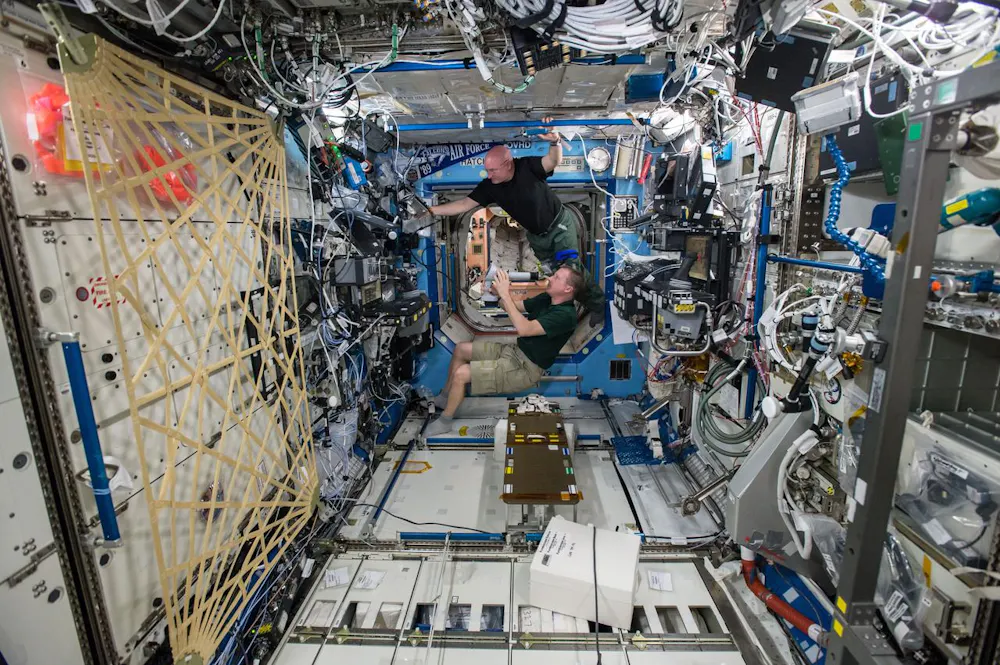
Two astronauts working with equipment in a room in the ISS.
The International Space Station is equipped with medical equipment to keep its residents well and in case any suffer illness during their stay. Space motion sickness is a common malady to experience in orbit.
Johnson Space Center

Thankfully, the brain’s expectations can change over time, after enough exposure to a new environment. Often referred to as “getting your sea legs” in the nautical community, astronauts also eventually overcome space motion sickness while in space. However, overcoming it introduces another problem when they return.

If an astronaut’s brain expects microgravity, what happens when they come back to Earth? As you might expect, the process starts again, and astronauts are now prone to terrestrial readaptation motion sickness. To make matters worse, since the retirement of the space shuttle, crew vehicles frequently land in the water, which means astronauts may deal with choppy waves until their capsule is recovered. Seasickness can potentially exacerbate terrestrial readaptation motion sickness.

A capsule, with buoys attached, floating through the ocean with a large vessel in the background.
Crew capsules splash down into the ocean, which can exacerbate motion sickness.
Anthony W. Gray/Kennedy Space Center

These conditions are not rare. Over half of all astronauts experience some symptoms of space motion sickness when they first get to space, and terrestrial readaptation motion sickness occurs at a similar incidence rate when they come back down.

Dangers to astronauts

If you have ever experienced motion sickness, you know how hard it is to do anything other than close your eyes and take deep breaths to expel the creeping urge to vomit. As a passenger in a car, that may be OK, since you aren’t expected to jump into action at a moment’s notice. But while isolated on the water in a return capsule, astronauts need to remain focused and clearheaded. In case of an emergency, they’ll need to respond rapidly.

If the astronauts need to get out of the capsule prior to pickup up by the recovery team, any motion sickness they have could delay their response time and impede evacuation attempts.

Potential solutions

Presently, most astronauts rely on medication that interrupts the brain’s ability to use hormones to trigger motion sickness. However, as with many commercial products, these drugs can cause side effects such as drowsiness and can lose efficacy over time.

Our research team completed two experiments to investigate how we might be able to manipulate visual information to mitigate motion sickness in astronauts, without relying on pharmaceuticals.

Our participants were exposed to motions meant to simulate transitions between gravity environments and then ocean wavelike motion. During the hour of wavelike motion, we investigated whether a “virtual window” could reduce the incidence of motion sickness.

When in a capsule on the ocean, astronauts are strapped into their seats and likely cannot see out of the small windows built into the capsule. In place of windows, we used virtual reality headsets to create a full-view virtual window.

In our control group, the subjects received no visual cues of motion – akin to Taylor’s poorly advised backseat reading. Meanwhile, one countermeasure group got to see a visual scene that moved naturally with their motion, like looking out the side window of the car at the surrounding world. The other countermeasure group saw a scene that moved appropriately and was provided an overlay showing future motion, like looking out the front window and seeing the road ahead.

The device moving in a wavelike motion.

As expected, the group with no cues of motion got the sickest. Two-thirds of the subjects needed to stop prior to finishing an hour of wavelike motion, due to excessive nausea. Only about one-fifth of the group that was given the side window view needed to stop early. Only one-tenth of the front window group that received present and future visual cues dropped out.

These results mean that by tracking the capsule motion and projecting it on a headset for the astronauts inside, our team may be able to reduce debilitating motion sickness by roughly half. If we could figure out how to predict how the capsule would move, we could give them that front window experience and improve the landing even more. In case of emergency, they could always take off the headsets.

This work shows promise for motion sickness interventions that do not rely on pharmaceuticals, which are currently used to combat these effects. Our solutions don’t have the same concerns around shelf life, stability or side effects. In addition to the benefits for astronauts, such approaches could help those prone to motion sickness here on Earth, particularly in scenarios where looking out the front window at the road isn’t feasible, such as on planes, trains, buses or high-speed transportation.

The Conversation

This work was supported by the National Aeronautics and Space Administration Human Research Program under Grant No. 80NSSC21K0257.

Torin Clark receives funding from NASA, the Office of Naval Research and the National Institutes for Health, and he receives fellowships from the Charles Stark Draper Laboratory and the National Science Foundation.

ref. Astronauts can get motion sick while splashing back down to Earth – virtual reality headsets could help them stay sharp – https://theconversation.com/astronauts-can-get-motion-sick-while-splashing-back-down-to-earth-virtual-reality-headsets-could-help-them-stay-sharp-263706

Flying is safe thanks to data and cooperation – here’s what the AI industry could learn from airlines on safety

Source: The Conversation – USA – By James Higgins, Professor of Aviation, University of North Dakota

Flying is routine and safe. Hard lessons were learned to make it that way. Vernon Yuen/NurPhoto via Getty Images

Approximately 185,000 people have died in civilian aviation accidents since the advent of powered flight over a century ago. However, over the past five years among the U.S. airlines, the risk of dying was almost zero. In fact, you have a much better chance of winning most lotteries than you do of dying as a passenger on a U.S. air carrier.

How did flying get so safe? And can we apply the hard-earned safety lessons from aviation to artificial intelligence?

When humanity introduces a new paradigm-shifting technology and that technology is rapidly adopted globally, the future consequences are unknown and often collectively feared. The introduction of powered flight in 1903 by the Wright brothers was no exception. There were many objections to this new technology, including religious, political and technical concerns.

It wasn’t long after powered flight was introduced that the first airplane accident occurred – and by not long I mean the same day. It happened on the Wright brothers’ fourth flight. The first person to die in an aircraft accident was killed five years later in 1908. Since then, there have been over 89,000 airplane accidents globally.

I’m a researcher who studies air travel safety, and I see how today’s AI industry resembles the early – and decidedly less safe – years of the aviation industry.

From studying accidents to predicting them

Although tragic, each accident and each fatality represented a moment for reflection and learning. Accident investigators attempted to recreate every accident and identify accident precursors and root causes. Once investigators identified what led up to each crash, aircraft makers and operators put safety measures into effect in hopes of preventing additional accidents.

For example, if a pilot in the earlier era of flight forgot to lower the landing gear prior to landing, a landing accident was the likely result. So the industry figured out to install warning systems that would alert pilots about the unsafe state of the landing gear – a lesson learned only after accidents. This reactive process, while necessary, is a heavy price to pay to learn how to improve safety.

Over the course of the 20th century, the aviation world organized and standardized its operations, procedures and processes. In 1938, President Franklin Roosevelt signed the Civil Aeronautics Act, which established the Civil Aeronautics Authority. This precursor to the Federal Aviation Administration included an Air Safety Board.

The fully reactive safety paradigm shifted over time to proactive and eventually predictive. In 1997, a group of industry, labor and government aviation organizations formed a group called the Commercial Aviation Safety Team. They started to look at the data and attempted to find trends and analyze user reports to identify risks and hazards before they became full-blown accidents.

The group, which includes the FAA and NASA, decided early on that there would be no competition among airlines when it came to safety. The industry would openly share safety data. When was the last time you saw an airline advertising campaign claiming “our airline is safer than theirs”?

It’s down to data

The Commercial Aviation Safety Team helped the industry transition from reactive to predictive by adopting a data-driven, systemic approach to tackling safety issues. It generated this data using reports from people and data from aircraft.

Every day, millions of flights occur worldwide, and on every single one of those flights, thousands of data points are recorded. Aviation safety professionals now use Flight Data Recorders – long used to investigate accidents after the fact – to analyze data from every flight. By closely examining all this data, safety analysts can spot emerging and troublesome events and trends. For example, by analyzing the data, a trained safety scientist can spot if certain aircraft approaches to runways are becoming riskier due to factors like excessive airspeed and poor alignment – before a landing accident occurs.

Two orange metal containers, one a horizontal cylinder and the other a rectangular box
Flight voice and data recorders are well known from accident investigations, but the data from ordinary flights is invaluable for preventing accidents.
YSSYguy/Wikimedia Commons, CC BY-SA

To further increase proactive and predictive capabilities, anyone who operates within the aviation system can submit anonymous and nonpunitive safety reports. Without guarantees of anonymity, people might hesitate to report issues, and the aviation industry would miss crucial safety-related information.

All of this data is stored, aggregated and analyzed by safety scientists, who look at the overall system and try to find accident precursors before they lead to accidents. The risk of dying as a passenger onboard a U.S. airline is now less than 1 in 98 million. You are more likely to die on your drive to the airport than in an aircraft accident. Now, more than 100 years since the advent of powered flight, the aviation industry – after learning hard lessons – has become extremely safe.

A model for AI

AI is rapidly permeating many facets of life, from self-driving cars to criminal justice actions and hiring and loan decisions. The technology is far from foolproof, however, and errors attributable to AI have had life-altering – and in some cases even life-and-death – consequences.

Nearly all AI companies are trying to implement some safety measures. But they appear to be making these efforts individually, just like the early players in the aviation field did. And these efforts are largely reactive, waiting for AI to make a mistake and then acting.

What if there was a group like the Commercial Aviation Safety Team where all AI companies, regulators, academia and other interested parties convened to start the proactive and predictive processes of ensuring AI doesn’t lead to calamities?

From a reporting perspective, imagine if every AI interface had a report button that a user could click to not only report potentially hallucinated and unsafe results to each company, but also report the same to an AI organization modeled on the Commercial Aviation Safety Team. In addition, data generated by AI systems, much like we see in aviation, could also be collected, aggregated and analyzed for safety threats.

Although this approach may not be the ultimate solution to preventing harm from AI, if Big Tech adopts lessons learned from other high-consequence industries like aviation, it just might learn to regulate, control and, yes, make AI safer for all to use.

The Conversation

James Higgins receives funding from the FAA to conduct research regarding flight safety topics. He is also the co-founder of two companies, one is HubEdge, which is a company that helps airlines optimize their ground operations. The other is Thread, which helps utilities operate drones to collect information about their assets.

ref. Flying is safe thanks to data and cooperation – here’s what the AI industry could learn from airlines on safety – https://theconversation.com/flying-is-safe-thanks-to-data-and-cooperation-heres-what-the-ai-industry-could-learn-from-airlines-on-safety-265960

Even before they can read, young children are visualizing letters and other objects with the same strategies adults use

Source: The Conversation – USA (2) – By Shannon Pruden, Professor of psychology, Florida International University

A student looks at different images, as eye-tracking technology monitors how she is visualizing the objects. Chris Necuze/FIU, CC BY

What do puzzles, gymnastics, writing and using maps all have in common?

They all rely on people’s ability to visualize objects as they spin, flip or turn in space, without physically moving them. This is a spatial skill that developmental psychologists call mental rotation.

Whether a person is navigating a new city or doing a cartwheel, they must use mental rotation skills to move shapes or objects in their mind and make sense of where their bodies are going and what surrounds them.

When children play with puzzles, building blocks or pattern games, they are also practicing mental rotation.

Over time, these skills support learning in math, science and reading. This can look like visualizing pulley systems in physics or seeing the differences between similar-looking letters such as b and d, which young children often confuse.

Strong mental rotation skills also lay the foundation for doing well in school and developing interest in careers in science, technology, engineering and math.

Most preschool-age children are not yet learning to read – but it turns out they are still using some of these same spatial reasoning skills as they think about the world around them.

We are scholars of, developmental science and were curious to find out how children as young as 3 years old mentally rotate objects.

While there is research on the age at which children can mentally rotate objects, less is understood about how children are solving mental rotation problems. We found in our research, conducted from 2022 to 2023, that young children are using the same problem-solving strategies as adults when they solve a mental rotation task.

Children think visually, just like adults

We used eye-tracking technology to understand how a sample of 148 children, all between 3 and 7 years old, solved different mental rotation problems. Eye-trackers use harmless infrared light to capture eye movements. This technology lets us observe how children solve these problems in real time.

As part of our study, we showed each child a large picture of items such as a fire truck, as well as two smaller pictures of the same truck, one placed above the other and positioned slightly differently.

Children were asked to say which small picture on the right matched the large one on the left. In this example, the correct answer is the top picture, because that top fire truck can be rotated to match the large fire truck. The bottom fire truck was a mirrored image, and no matter how much you rotate it, it will never match the large fire truck.

Children looked at pictures of fire trucks as part of a research study to assess how they manipulated the object in their heads.
Karinna Rodriguez

While the children thought about their response, the eye-tracker, mounted right below the computer screen, recorded their eye movements.

By looking at where and for how long children looked at each image, we figured out what kind of strategy they were using.

Some children focused on fewer parts of the object and spent less time studying its details. This suggests they used a holistic strategy, meaning they took in the whole image at once, instead of breaking it into pieces. These children mentally rotated the entire object to solve the task.

Other children focused on parts of the object and spent more time studying its details. This suggests they broke the image down into pieces instead of visualizing the image as a whole, known as a piecemeal strategy. Our findings support prior work showing that children generally use these two visual approaches to solve mental rotation problems.

This study helped us learn where children look while solving puzzles and identify how they solve these problems – without ever having to ask the child, who might be too young to explain, about their process.

Children were more likely to turn the whole image instead of breaking it down into pieces, a pattern of problem solving adults typically also use. This means that even very young children are already thinking about how objects move and turn in space in ways that are more advanced than expected.

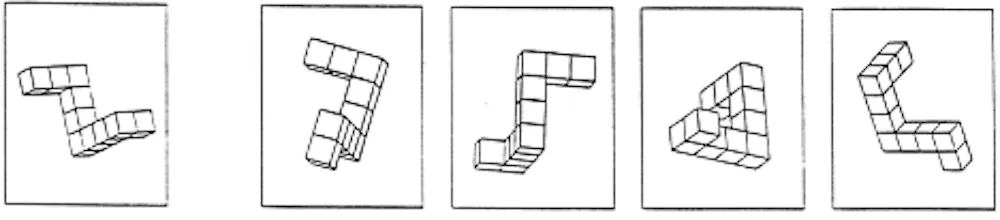
White blocks are seen in different configurations in a drawing.
An example of a mental rotation task that can show how people are visually moving objects in their minds.
Angie Mackewn, CC BY

Supporting children’s visual skills

Knowing how young children mentally rotate objects may help researchers, teachers and parents understand why some children struggle with learning to read.

Children who break an image down into pieces, instead of visualizing it as a whole, to solve mental rotation problems may be the very same children who struggle with discriminating similar-looking letters such as p and q and may later be diagnosed with dyslexia.

Parents can play an important role in building their child’s mental rotation skills. Parents can help children by offering them opportunities to practice rotating real objects with toys such as three-dimensional puzzles or building blocks. Tangrams – flat, colorful puzzles that come in different shapes – can be used to practice breaking down shapes of animals into pieces. Parents can encourage their child to look for shapes that match parts of the animal or object they are building.

Nov. 8 is International STEM Day, a celebration of all things science, technology, engineering and mathematics.

Research like ours provides valuable guidance for designing early STEM activities and educational tools. By directly observing children’s problem solving in real time, we can develop better ways for educators and toy makers to support strong spatial thinking from an early age. To celebrate, we encourage people to engage in activities that test their spatial skills, such as ditching the GPS for the day or playing a game of Tetris.

Mental rotation is a powerful skill that helps us understand and interact with the surrounding physical world. From solving puzzles to reading maps, mental rotation plays a role in many everyday activities. Building mental rotation abilities can improve children’s performance in subjects such as reading, math and science and may inspire future careers in STEM fields.

The Conversation

Shannon Pruden receives funding from National Institutes of Child Health and Human Development and National Science Foundation.

Karinna Rodriguez does not work for, consult, own shares in or receive funding from any company or organization that would benefit from this article, and has disclosed no relevant affiliations beyond their academic appointment.

ref. Even before they can read, young children are visualizing letters and other objects with the same strategies adults use – https://theconversation.com/even-before-they-can-read-young-children-are-visualizing-letters-and-other-objects-with-the-same-strategies-adults-use-264532

Gender is not an ideology – but conservative groups know learning about it empowers people to think for themselves

Source: The Conversation – USA (2) – By Victoria Pitts-Taylor, Professor of Feminist, Gender, and Sexuality Studies; Sociology; Science and Technology Studies, Wesleyan University

Who is afraid of gender and why? AP Photo/Alastair Grant

Political attacks on teaching about gender in colleges and universities are about more than just gender: They are part of a grander project of eroding civil and human rights, limiting personal freedoms and undermining democracy in the name of “traditional” values.

On the first day of his second term, President Donald Trump issued an executive order declaring there are two sexes determined solely by the kind of reproductive cells the body makes, and that the federal government would recognize nothing else. The order claims to protect the “freedom to express the binary nature of sex” and bans the use of federal funds to “promote gender ideology.” Legal experts have criticized the directive as unconstitutional and are challenging it in the courts.

Yet the order has provided fuel for conservatives, right-wing politicians and activists trying to remove so-called gender ideology from many places in American society, including classrooms. Right-wing activists are pushing for censorship of educational curricula in K-12 schools and in colleges and universities, and they have succeeded in Texas, Florida and other red states.

Why are conservative politicians so determined to control how Americans define sex and understand gender?

As sociologists who research and teach about gender, we know that gender across disciplines is understood to be a complex topic of study, not an ideology. The study of gender represents the kind of free inquiry that allows people to decide for themselves how to live, free of coercion or government control.

What is ‘gender ideology’?

“Gender ideology” is a catch-all term conservative Catholics initially promoted in the 1990s in response to the United Nations’ promotion of women’s equality.

In 2004, pushing back on the global women’s and gay rights movements, the Vatican declared in a letter to bishops that men and women are different by nature “not only on the physical level, but also on the psychological and spiritual.” The letter stated that the idea of gender “inspired ideologies” that sanction alternatives to the traditional two-parent family headed by men and treated homosexuality on par with heterosexuality.

Over the following decades, evangelical groups and far-right parties across the globe – from Hungary and Russia to Peru, Brazil and Ghana – have used the language of combating “gender ideology” to counter a host of social policies, including sex education in schools, the legalization of gay marriage and same-sex adoption, reproductive rights and transgender rights.

Crowd of people, center of which is a sign depicting silhouette figures of a man and a woman holding an umbrella shielding two children from a rainbow
Anti-gender protestors during a 2018 Equality March in Kraków, Poland.
Silar/Wikimedia Commons, CC BY-SA

The anti-gender movement is no longer fringe but rather well funded, organized and transnational. For example, 40 countries have signed the Geneva Consensus Declaration, an international pact proposed by the first Trump administration and supported by anti-gender campaigners as a way to deny abortion rights internationally.

In the U.S., where the majority of Americans support gay marriage and abortion rights, targeting trans rights has become one of the conservative movement’s galvanizing issues. A flood of state bills not only ban books and discussions of gender, sexuality and race in schools but also criminalize abortion, ban gender-affirming health care and legalize discrimination in housing and employment on religious grounds.

What we talk about when we talk about gender

How gender is researched and taught in universities has become a key target of anti-gender campaigns across the globe, in part because the study of gender raises questions about the universality of traditional social roles and the inequalities that can result from them.

Gender is a focus of inquiry not only in gender studies classes but in literature, sociology, law, government, history, anthropology and cultural geography, among many other fields.

Anti-gender campaigners argue there is nothing to understand about it because gender is given by nature or God. For them, gender is equivalent to sex, which is taken to be straightforward and without exception male or female.

Scientific evidence suggests, however, that sex is not always binary. In biology, sex refers to genes, reproductive organs, hormone systems and observable physical characteristics; different combinations of these lead to variations in sex. Far from straightforward, then, sex is complicated.

And a person’s assigned sex at birth does not always align with their deeply held sense of self – their gender identity.

Gender is both a feature of individual people and a mode of organizing social life. At the individual level, people have a subjective sense of and embody their gender by dressing and behaving in ways that encourage other people to see them as they want to be seen. A man might wear a tie at the office to convey masculinity. People will interact differently with a woman when she is wearing high heels and makeup than when she goes barefaced or dons a swimsuit. Someone who is gender fluid may appear more masculine or feminine at different times and experience prejudice and discrimination.

Gender roles shape society and culture in both subtle and glaring ways.

Gender shapes societies through norms and rules on everything from what you wear to how families operate, whom you are allowed to partner with and what jobs you are likely to hold. Whether in the spheres of culture, family, economic or civic life, gender roles and norms intersect with class, race and other social differences and shift across cultures and historical eras. Indigenous societies across the globe have long recognized more than two gender categories, and historical and contemporary examples of gender diversity abound.

A ban on learning about gender would sweep aside all this variation in favor of a homogeneous worldview that deliberately ignores biology, history and lived experience. Denying the diversity of gender makes it easier to impose a conservative worldview and roll back rights.

Education as a political target

Anti-gender campaigners view education as a major battleground in the fight over societal values. In the U.S., conservative efforts to ban the study of gender and sexuality initially centered on K-12 education, exemplified in bills such as Florida’s 2022 “Don’t Say Gay” law. But the movement has also affected colleges and universities.

Texas A&M’s president fired a professor in September 2025 after a student recorded her confrontation with her for discussing gender diversity in a literature course. The student alleged the course was “not legal” because it contradicted “our president’s laws” and her own religious beliefs. The university president also later resigned under pressure.

The same month, the chancellor of the Texas Tech University system, citing Trump’s executive order on “gender ideology,” banned all faculty members across its five universities from recognizing “more than two sexes” in any course or classroom.

Crowd of protestors holding signs inside a capitol building
Controlling thought is a means of repressing social movements.
AP Photo/Charlie Neibergall

As the Texas chapter of the American Association of University Professors reminds its members, faculty have a constitutional right to teach and discuss “all matters related to the subject matter of a class” without interference from administrators, politicians or government officials. Despite this, states led by conservative lawmakers have used a range of tactics to eliminate gender studies programs or curriculum from colleges.

These attacks on universities are attempts to control thought, subdue social movements advocating for change and promote an orthodoxy that upholds those in power.

Person reading the book 'Genderqueer' atop a stack of other challenged books
Books on gender are among those conservatives are purging from libraries and classrooms.
AP Photo/Rick Bowmer

Restricting rights, eroding democracy

These attacks on education are not only academic matters. They disempower women and marginalized groups that have achieved some legal protection or rights in recent decades. And they contribute to the erosion of democracy.

Authoritarian approaches to governing rely on scapegoating people, policing thought and speech, and punishing dissent. This is true whether it’s Viktor Orban’s Hungary, Vladimir Putin’s Russia or Donald Trump’s United States. By prohibiting questions and challenges, autocrats gain the power to limit how people think and control their bodies.

The Conversation

Victoria Pitts-Taylor is a member of the American Association of University Professors and the National Women’s Studies Association.

Elizabeth Anne Wood a senior strategist with the Woodhull Freedom Foundation. This is a volunteer position.

ref. Gender is not an ideology – but conservative groups know learning about it empowers people to think for themselves – https://theconversation.com/gender-is-not-an-ideology-but-conservative-groups-know-learning-about-it-empowers-people-to-think-for-themselves-265549

Does the full moon make us sleepless? A neurologist explains the science behind sleep, mood and lunar myths

Source: The Conversation – USA (3) – By Joanna Fong-Isariyawongse, Associate Professor of Neurology, University of Pittsburgh

How much does the moon cycle affect sleep? Probably less than your screen time at night. Muhammad Khazin Alhusni/iStock via Getty Images Plus

Have you ever tossed and turned under a full moon and wondered if its glow was keeping you awake? For generations, people have believed that the Moon has the power to stir up sleepless nights and strange behavior – even madness itself. The word “lunacy” comes directly from luna, Latin for Moon.

Police officers, hospital staff and emergency workers often swear that their nights get busier under a full moon. But does science back that up?

The answer is, of course, more nuanced than folklore suggests. Research shows a full moon can modestly affect sleep, but its influence on mental health is much less certain.

I’m a neurologist specializing in sleep medicine who studies how sleep affects brain health. I find it captivating that an ancient myth about moonlight and madness might trace back to something far more ordinary: our restless, moonlit sleep.

What the full moon really does to sleep

Several studies show that people really do sleep differently in the days leading up to the full moon, when moonlight shines brightest in the evening sky. During this period, people sleep about 20 minutes less, take longer to fall asleep and spend less time in deep, restorative sleep. Large population studies confirm the pattern, finding that people across different cultures tend to go to bed later and sleep for shorter periods in the nights before a full moon.

The most likely reason is light. A bright moon in the evening can delay the body’s internal clock, reduce melatonin – the hormone that signals bedtime – and keep the brain more alert.

The changes are modest. Most people lose only 15 to 30 minutes of sleep, but the effect is measurable. It is strongest in places without artificial light, such as rural areas or while camping. Some research also suggests that men and women may be affected differently. For instance, men seem to lose more sleep during the waxing phase, while women experience slightly less deep and restful sleep around the full moon.

Young adult woman lying in bed wide awake, staring out the window toward a bright light.
Sleep loss from a bright moon is modest but measurable.
Yuliia Kaveshnikova/iStock via Getty Images Plus

The link with mental health

For centuries, people have blamed the full moon for stirring up madness. Folklore suggested that its glow could spark mania in bipolar disorder, provoke seizures in people with epilepsy or trigger psychosis in those with schizophrenia. The theory was simple: lose sleep under a bright moon and vulnerable minds might unravel.

Modern science adds an important twist. Research is clear that sleep loss itself is a powerful driver of mental health problems. Even one rough night can heighten anxiety and drag down mood. Ongoing sleep disruption raises the risk of depression, suicidal thoughts and flare-ups of conditions like bipolar disorder and schizophrenia.

That means even the modest sleep loss seen around a full moon could matter more for people who are already at risk. Someone with bipolar disorder, for example, may be far more sensitive to shortened or fragmented sleep than the average person.

But here’s the catch: When researchers step back and look at large groups of people, the evidence that lunar phases trigger psychiatric crises is weak. No reliable pattern has been found between the Moon and hospital admissions, discharges or lengths of stay.

But a few other studies suggest there may be small effects. In India, psychiatric hospitals recorded more use of restraints during full moons, based on data collected between 2016 and 2017. In China, researchers noted a slight rise in schizophrenia admissions around the full moon, using hospital records from 2012 to 2017. Still, these findings are not consistent worldwide and may reflect cultural factors or local hospital practices as much as biology.

In the end, the Moon may shave a little time off our sleep, and sleep loss can certainly influence mental health, especially for people who are more vulnerable. That includes those with conditions like depression, bipolar disorder, schizophrenia or epilepsy, and teenagers who are especially sensitive to sleep disruption. But the idea that the full moon directly drives waves of psychiatric illness remains more myth than reality.

The sleep/wake cycle is synchronized with lunar phases.

Other theories fall short

Over the years, scientists have explored other explanations for supposed lunar effects, from gravitational “tidal” pulls on the body to subtle geomagnetic changes and shifts in barometric pressure. Yet, none of these mechanisms hold up under scrutiny.

The gravitational forces that move oceans are far too weak to affect human physiology, and studies of geomagnetic and atmospheric changes during lunar phases have yielded inconsistent or negligible results. This makes sleep disruption from nighttime light exposure the most plausible link between the Moon and human behavior.

Why the myth lingers

If the science is so inconclusive, why do so many people believe in the “full moon effect”? Psychologists point to a concept called illusory correlation. We notice and remember the unusual nights that coincide with a full moon but forget the many nights when nothing happened.

The Moon is also highly visible. Unlike hidden sleep disruptors such as stress, caffeine or scrolling on a phone, the Moon is right there in the sky, easy to blame.

A woman staring at her cellphone while lying in the dark.
Screen-time habits are far more likely to have detrimental effects on sleep than a full moon.
FanPro/Moment via Getty Images

Lessons from the Moon for modern sleep

Even if the Moon does not drive us “mad,” its small influence on sleep highlights something important: Light at night matters.

Our bodies are designed to follow the natural cycle of light and dark. Extra light in the evening, whether from moonlight, streetlights or phone screens, can delay circadian rhythms, reduce melatonin and lead to lighter, more fragmented sleep.

This same biology helps explain the health risks of daylight saving time. When clocks “spring forward,” evenings stay artificially brighter. That shift delays sleep and disrupts circadian timing on a much larger scale than the Moon, contributing to increased accidents and cardiovascular risks, as well as reduced workplace safety.

In our modern world, artificial light has a much bigger impact on sleep than the Moon ever will. That is why many sleep experts argue for permanent standard time, which better matches our biological rhythms.

So if you find yourself restless on a full moon night, you may not be imagining things – the Moon can tug at your sleep. But if sleeplessness happens often, look closer to home. It is likely a culprit of the light in your hand rather than the one in the sky.

The Conversation

Joanna Fong-Isariyawongse does not work for, consult, own shares in or receive funding from any company or organization that would benefit from this article, and has disclosed no relevant affiliations beyond their academic appointment.

ref. Does the full moon make us sleepless? A neurologist explains the science behind sleep, mood and lunar myths – https://theconversation.com/does-the-full-moon-make-us-sleepless-a-neurologist-explains-the-science-behind-sleep-mood-and-lunar-myths-267528