Nonetheless, legislative and policy shift in multiple provinces in the past year threaten this principle — with little meaningful political resistance. It is important to closely examine the conditions and public narratives that have made this renewed use of psychiatric coercion possible.
In all four provinces, professionals operating within these coercive frameworks are afforded immunity from legal proceedings.
‘Compassionate intervention’
These examples highlight an acceleration in overt coercive intervention provisions being added to provincial mental health and addictions legislation.
This acceleration, however, is simply a continuation of mental health and addictions legislation across Canada that makes it easier for citizens to be detained, treated and controlled without their consent (for example, Brian’s Law in Ontario, the Nunavut Mental Health Act and the Maureen Breau Act in Québec).
Across Alberta, Manitoba, British Columbia and Québec, parliamentary debates and media coverage consistently portray coercive intervention for addiction and mental health as an act of compassionate intervention.
Even governments with differing ideological orientations — like the NDP versus the Conservatives — converge around the argument that the state has a moral obligation to “protect the most vulnerable.”
Media coverage amplifies this messaging, emphasizing crisis conditions, public disorder and the visible consequences of addiction or mental health. This coverage legitimizes the need for new legal tools.
Coercion is articulated as care and involuntary treatment is presented not as a restriction of liberty but as a necessary response to incapacityand risk.
This appeal to compassion functions as a unifying political language, enabling cross-partisan support despite differing ideological stances.
By portraying these policies as pragmatic, humane and long overdue, policymakers limit opposition. They also reconfigure the boundaries of acceptable state intervention, illustrating how compassion can be mobilized to normalize coercion. After all, who could be against compassion?
Furthermore, this compassion-focused public discourse — and the legislation flowing from it — greatly expands the role of policing in medical matters, often with few limits. At the same time, it extends the reach of medicine and social services into policing.
It also signals a modern return of the asylum — not as a single institution, but as a system of confinement, surveillance and control spread across multiple sectors. Indeed, despite being presented as new, recent and proposed legislative changes are anything but. Forced detention, incarceration and treatment reflect older, deeply rooted correctional approaches with origins dating back at least to the 17th century.
These legislative developments do not suggest a novel policy response. Instead, they reconfigure longstanding patterns of confinement and control under the guise of compassion. If left unchallenged, they will normalize coercion as care and erode fundamental rights in the name of protection.
Canadian legislators should resist responding to complex social and health crises with coercive measures that lack a sound scientific basis and risk doing more harm than good.
Jean-Laurent Domingue is a Registered Nurse in Ontario, and receives funding from the Social Sciences and Humanities Research Council and the Law Commission of Canada.
Axel Ounis is affiliated with the federal liberal party.
Emmanuelle Bernheim receives funding from the Canada Research Chair program, the Social Sciences and Humanities Research Council and the Law Commission of Canada.
Most Canadians have had relatively little experience with major economic downturns. Since the early 1990s, Canada has largely been spared the boom-and-bust cycles common in the United States. The country avoided the worst of the 2008 global financial crisis, and until COVID-19, had not experienced a major economic shock in a generation.
In that long stretch of time, Canadians have grown accustomed to relative stability, which makes the current moment feel especially disorienting. We are, as the saying goes, living in “interesting times,” and that is rarely good news for prices, employment prospects, government budgets, business investment or productivity.
This ongoing economic angst has several overlapping sources that are both global and domestic in nature.
Geopolitical conflicts, including the ongoing war involving the United States, Israel and Iran, are increasing the costs of everyday items like food and gas. These disruptions ripple through global supply chains, feeding into higher input costs for Canadian businesses and, ultimately, higher prices for consumers.
At the same time, tariff disputes led by the U.S. are causing inflationary pressure and discouraging long-term business investment. This, in turn, weighs on productivity and wage growth.
Some governments have responded to these shocks with industrial policies, attempting to support or protect specific sectors such as clean energy, manufacturing or technology. However, some economists warn against this approach, arguing that governments cannot reliably “pick winners” better than markets can.
Political fault lines are also contributing to uncertainty at home. Rising anti-immigration sentiment and the separatist rhetoric in Alberta are adding another layer of social turbulence. Without a social consensus, economic planning becomes more difficult and volatility often follows.
Canada’s safety net has limits
Canada does retain an important advantage: its social safety net. Canada spends roughly 18 to 20 per cent of GDP on public social programs — around the the Organisation for Economic Co-operation and Development (OECD) average. That’s below the levels of France, Germany and most Scandinavian countries, but meaningfully above the United States.
Canadians have access to relatively accessible employment insurance by North American standards. The country’s combination of publicly funded health care and income support programs provides important protection during periods of disruption that American households do not have.
Economic theory identifies three ways households can build resilience against a negative income or wealth shock. The first is cutting back spending. This includes spending on both durable goods (such as vehicles or appliances) and non-durable goods (anything with a short lifespan). This can involve delaying large purchases or scaling back discretionary expenses like dining out, travel or subscription services.
The second is shifting spending to lower-cost alternatives, even within the “needs” category. Households rarely have complete flexibility to cut essentials, but they can often substitute within them. This can involve switching to lower-cost brands, using public transit more frequently or seeking more affordable housing options where feasible.
The third — the toughest one of all — is aggressively reducing unsecured debt. Canadian households owe roughly $1.77 for every dollar of disposable income, the highest household debt burden in the G7. Much of that is mortgage debt, which at least builds equity. But revolving debt — credit cards, lines of credit, car loans and the like — carries higher interest rates and greater risk.
Households can do this by paying down the highest-interest balances first, consolidating debts into lower-interest products where possible or redirecting windfalls such as tax refunds toward repayment. Avoiding the accumulation of new high-interest debt is equally important.
Building a buffer
Once those balances are under control, households should build a financial buffer and maintain it even if the economic outlook improves.
A common guideline is saving three to six months of household expenses in case of an emergency. This typically requires setting aside 20 per cent or more of take-home income, depending on household circumstances and obligations.
Canadians have access to several tax-advantaged tools to support this process. The Tax-free Savings Account allows tax-free growth with no restrictions on withdrawals, while the First Home Savings Account offers first-time homebuyers an annual contribution room of $8,000 and a lifetime cap of $40,000. The Registered Education Savings Plan helps families save for post-secondary education.
If you are able to consistently put away funds and invest them based on your risk tolerance, these accounts can significantly improve long-term financial resilience.
Income risk in a changing economy
The harder challenge, of course, is income stability in an age of uncertainty. Canada is primarily a natural resources exporter, and rapid technological change — particularly the rise of artificial intelligence — is reshaping labour markets across other sectors.
Workers face growing uncertainty about which skills will remain valuable and how stable their employment will be.
Because of this, households may need to get creative about diversifying their income sources. This can include investing in additional training or certification programs, developing side income through freelance or contract work, monetizing existing skills through consulting, or building small entrepreneurial ventures.
The current period is unsettling. But households that reduce their debt exposure, build savings and treat the safety net as the partial buffer it actually is will be in a better position to absorb whatever comes next.
Chetan Dave does not work for, consult, own shares in or receive funding from any company or organisation that would benefit from this article, and has disclosed no relevant affiliations beyond their academic appointment.
The European soil monitoring directive, adopted by the European Union at the end of 2025, aims to achieve healthy soils by 2050. Brussels’ directive is centred on an environmental DNA based approach. France’s experience in measuring soil quality could be used advantageously, particularly as the best monitoring tools are those that integrate several complementary approaches at the same time.
Yet, while eDNA is a powerful tool for detecting biodiversity at scale, it is not enough on its own for interpreting observed changes and identifying their causes. This is because bacterial and fungal communities only represent part of the soil biodiversity, which also includes many organisms with crucial and varied ecological roles.
Abundance, biomass and the activity of living organisms – dimensions that cannot be assessed by molecular detection alone also determine how soils function. A graduated approach combining several complementary protocols is therefore required to produce robust and useful indicators for field work.
France’s track record via its soil quality measurement network (Réseau de Mesures de la Qualité des Sols (RMQS) and GIS Sol, constitutes, as such, a benchmark for interpreting results and an established operational framework for monitoring soil biodiversity. This could usefully complement the basis of the European legislation.
Environmental DNA: necessary but not sufficient
DNA works with a molecular approach and, as such, offers advantages in environmental monitoring in other words – broad and standardised biodiversity analysis, strong spatial and temporal comparability. Such methods provide a particularly effective tool for detecting changes in the composition of biological communities.
However, the molecular signatures derived from eDNA do not always allow us to correctly identify the taxa that is present in soil. They may show representativeness biases. They are often poorly correlated with other biological characteristics that are essential for characterising biodiversity and soil ecosystem functioning, such as the abundance of organisms, their biomass, their demographic structure or even their activities. They will thus offer an incomplete and sometimes distorted view of soil health.
However, beyond the simple detection of changes in diversity, monitoring devices must also make it possible to interpret these developments, that is to say, to understand what they imply for soil functionality in agriculture, for example, and to identify their causes. This is what will allow us to assess the effectiveness of public policies and management practices. In this context, reducing biological and ecological soil complexity to this single component carries a risk related to interpretation difficulties.
However, the EU directive stipulates that member states may supplement mandatory indicators with other biological indicators in their national monitoring arrangements, thus opening up the possibility of more integrated approaches.
A support tool for policymaking
Environmental monitoring has two distinct and complementary objectives: detecting changes in the state of ecosystems and attributing these changes to environmental pressures, land uses or management practices. These two dimensions are closely linked by the biological and ecological processes that structure how ecosystems function.
Beyond their scientific scope, the indicators used for monitoring soil biodiversity are instrumental in public decision-making. It is not only a question of identifying the dynamics within biological communities, but also understanding their causes. Therefore, this primarily concerns policymakers. The aim is to guide planning and sustainable management practices, identify situations presenting degradation, implement policies to remedy them, and be able to assess their effectiveness.
A monitoring system that would be limited to detecting changes in soil biodiversity without taking into account interpretation and attribution related to environmental pressures would provide a limited basis for evaluating public policies and the implementation of suitable management strategies.
Biodiversity is not just about the number of taxa
Ecological soil functions – such as regulating water and contaminants, providing nutrients, storing carbon, maintaining structure, or supporting biodiversity itself are not static states, but dynamic processes. They are based on the activity of living organisms, their biomass and their functional characteristics (physiology, behaviour), as well as their interactions (competition, symbiosis, parasitism). They are expressed through renewal flows and speeds rather than mere stocks.
In this context, molecular approaches provide valuable information on the presence of organisms, but by themselves do not allow us to assess these dynamic processes or their actual intensity. A correct interpretation of soil functioning therefore requires additional measures as well as interpretation references linking biological indicators to different land use contexts and environmental conditions.
eDNA data is increasingly used for developing new approaches, such as those based on interaction networks, which show how biological soil communities are organised. When these networks are built only on presence or co-occurrence data, they mainly reflect how ecological conditions or environmental niches are shared by different species.
This only provides indirect information on the biological activities at work and on matter and energy flows, which also determine soil functioning. Ecological interpretation requires additional information, particularly on the abundance or biomass of organisms. This is how biological communities can be linked to the ecological processes supporting soil functions.
A graduated and complementary approach
In order to reconcile operational efficiency and ecological relevance, soil biodiversity monitoring benefits from combining several types of approaches, each providing specific information on the condition and functioning of biological communities.
eDNA-based approaches enable broad and standardised detection of microbial biodiversity, and could be extended to other organisms, such as invertebrates.
Other methods are based on direct observation of soil fauna organisms, estimation of their abundance or biomass, or analysis of their functional characteristics. They provide essential information on the biological structure and ecological role of soil communities.
These approaches should not be seen as mutually exclusive, but as complementary tools. They allow us to link the composition of biological communities (taxonomic and functional structure) to the ecological processes that support soil functions. Their combination is, as such, particularly interesting for building a monitoring strategy with different levels of information.
This logic of complementary is already implemented in some existing monitoring tools as it the case in the framework of France’s national soil monitoring network (RMQS) or in the mountain biodiversity observatory Orchamp. These approaches are not meant to be deployed everywhere, but their combination is essential for correctly interpreting the condition and evolution of soil biodiversity.
Suggested guidelines for national implementation of the EU directive
Preserving our ability to understand, explain and take action requires us to recognise that the biological complexity of soils calls for a controlled diversity of monitoring approaches.
With the support of GIS Sol, France is among the nations at the forefront of soil biodiversity monitoring. It has been experimenting with this approach, combining several protocols within RMQS for several years. This experience, which is rare on a European scale, should be the basis for building the country’s future national soil monitoring network.
In addition to the mandatory indicators, the directive enables member states to supplement their own systems with optional indicators. This flexibility gives them the opportunity to set up a monitoring system that’s not only capable of detecting trends in changing soil biodiversity, but interpreting the causes and possibilities for remediation. This finally allows us to assess the implications for public policy.
With this in mind, several principles should be taken into consideration when implementing the EU directive at national level:
Do not restrict national soil biodiversity monitoring to a single eDNA-derived measure, which limits our ability to interpret observed changes.
Implement a combination of complementary measures in order to link the detection of biodiversity to community structure and ecological processes that support soil functions, with the support of protocols and measures developed across Priority Research Programmes and Equipments (PEPR) Dynabiod and SolsVivants in France, for example.
Develop open interpretation frameworks and analytical frameworks to assess whether the observed variations are significant, in order to link biological indicators to land uses and environmental pressures.
Take advantage of existing analysis mechanisms, in particular France’s soil quality measurement network supported by GIS Sol, to ensure consistency, comparability and the scientific robustness of any given future national monitoring system.
This article was a collaborative effort by RMQS Biodiversité, several PEPR by SolsVivants, Dynabiod and RNEST and their respective co-authors. Other contributers included: Apolline Auclerc, Nolwenn Bougon, Miriam Buitrago, Philippe Hinsinger, Claudy Jolivet, Antoine Lévêque, Gwenaël Magne, Florence Maunoury-Danger, Jérôme Mathieu, Christian Mougin, Laurent Palka, Benjamin Pauget, Guénola Pérès, Sophie Pouzenc, Sophie Raous, Claire Salomon, Marie-Françoise Slak, Wilfried Thuiller, Cécile Villenave, Quentin Vincent.
A weekly e-mail in English featuring expertise from scholars and researchers. It provides an introduction to the diversity of research coming out of the continent and considers some of the key issues facing European countries. Get the newsletter!
Mickaël Hedde a reçu des financements de différents organismes français (OFB, ANR, ADEME) et de l’Union Européen (Horizon Europe) pour mener ses recherches au sein de l’INRAE.
Antonio Bispo est directeur de l’unité de recherche INRAE Info&Sols basée à Orléans. Il a reçu des financements de différents organismes français (Ministères, OFB, ANR, ADEME, Région Centre Val de Loire) et de l’Union Européen (Horizon Europe) pour mener ses recherches. L’unité de recherche pilote, pour le compte du GIS Sol (www.gissol.fr), les programmes nationaux d’inventaire et de surveillance des sols, elle gère également le système national d’information sur les sols.
Claire Chenu est membre de l’Association Française pour l’Etude des Sols (AFES), membre correspondant de l’Académie d’Agriculture et membre de l’Académie des Technologies. Elle co-préside le Comité Scientifique, Technique et d’Innovation du Réseau National d’Expertise Scientifique et Technique sur les Sols (CSTI RNEST). Elle a reçu des financements Européens (en particulier European Joint Programme SOIL) pour mener des recherches au sein d’INRAE et AgroParisTech
Flavien Poincot est ingénieur à l’Acta qui accompagne, anime et représentante le réseau des 19 instituts techniques agricoles, organismes de recherche appliquée travaillant pour l’ensemble des productions agricoles, animales et végétales.
Jérôme Cortet est membre de la Société française d’Écologie Évolution (SFE2) et de l’Association française pour l’Étude du Sol (AFES). Il co-préside actuellement le Comité Scientifique Technique et d’Innovation du Réseau National d’Expertise Scientifique et Technique sur les Sols (CSTI RNEST). Il a reçu des financements de différents organismes français (ANR, ADEME, Région Occitanie) pour mener ses recherches au sein du Centre d’Écologie Fonctionnelle et Évolutive, laboratoire rattaché à l’Université de Montpellier Paul-Valéry
Source: The Conversation – in French – By Paul Rouveyrol, Ecologue, expert en évaluation des politiques d’aires protégées, Muséum national d’histoire naturelle (MNHN)
Il ne suffit pas de créer des aires protégées : encore faut-il s’assurer qu’elles ont un effet positif sur la biodiversité. Comment réaliser ce suivi ? Les difficultés sont d’ordre méthodologique : comment avoir la certitude que ce que l’on observe est bien, et seulement, lié à la création de l’aire protégée ? Et comment pallier l’absence de données de suivi plusieurs décennies en arrière ? Éléments de réponse.
Dès 2020, la France s’est engagée au niveau international à couvrir 30 % de son territoire par des aires protégées, ce qui était l’un des objectifs fixés par les négociations internationales sur la biodiversité. Aujourd’hui, le chiffre visé est atteint : les aires protégées représentaient, en 2025, 33,5 % du territoire terrestre et maritime français.
Cependant, au-delà de la surface couverte, les textes internationaux demandent explicitement que ces aires soient « effectivement conservées et gérées », comprendre : que les aires protégées le soient réellement. En effet, désigner un espace ne suffit pas pour garantir qu’il produise des effets positifs sur la biodiversité.
Mais comment évaluer l’efficacité des aires protégées ? Intuitivement, on pourrait être tenté de comparer l’état des écosystèmes entre l’intérieur des aires protégées et le reste du territoire. Si les aires protégées sont « efficaces », alors on peut s’attendre à ce que cet état soit meilleur en leur sein.
Le problème, c’est qu’on peut certes considérer qu’une aire protégée n’est efficace que si cette différence existe, mais que la réciproque n’est pas vraie : les aires protégées ne sont jamais disposées au hasard. Des méthodes statistiques s’appuyant sur le suivi dans le temps de zones protégées et non protégées (sites témoins) permettent de s’affranchir de cette limite, mais ne sont pas parfaites pour autant. Il est donc urgent de multiplier les approches pour garantir la robustesse du suivi.
Quand comparer avec les zones non protégées ne suffit pas
Comparer l’intérieur et l’extérieur des aires protégées est nécessaire mais non suffisant. Cela peut paraître paradoxal, mais il y a plusieurs explications à cela :
d’une part, les aires protégées sont généralement créées pour permettre la conservation d’un patrimoine naturel jugé remarquable, doté par conséquent d’une biodiversité plus riche ou abritant plus d’espèces rares que le reste du territoire. Il est donc logique que, dès leur création, et avant même qu’elles aient produit un effet, les écosystèmes s’y portent mieux qu’ailleurs.
Les aires protégées sont davantage présentes dans des secteurs reculés comme les régions montagneuses (ici, le parc national des Écrins, dans les Alpes). Pline/Wikicommons, CC BY-SA
D’autre part, la création d’une aire protégée génère souvent des conflits avec certaines catégories d’acteurs, notamment économiques, qui s’attendent à ce que leurs activités y soient contraintes. Ces difficultés d’acceptabilité se traduisent par un évitement, lors de la mise en place des aires protégées, des zones à fort niveau d’activités humaines. Il a été démontré que les aires protégées étaient davantage présentes dans les secteurs reculés, ou peu peuplés, comme les régions montagneuses.
Ce second biais se traduit également par une biodiversité moins dégradée au sein des aires protégées dès leur création, renforçant la difficulté à tirer des conclusions d’une simple comparaison dedans/dehors.
Ce que l’évolution des milieux dit de l’efficacité des aires protégées
Comment s’affranchir des biais liés à la localisation des aires protégées pour évaluer leur efficacité ? En sciences expérimentales, cette difficulté se traite avec un dispositif spécifique, appelé BACI, acronyme de Before After Control Impact (soit en français : « avant après témoin traité »).
Le principe est simple : il s’agit non pas de comparer l’état actuel d’un site protégé avec celui d’un site non protégé, mais de suivre l’évolution dans le temps de chacun de ces deux sites, et ce, depuis la création de l’aire protégée.
Ainsi, un site protégé sera considéré comme « efficace » si son évolution depuis sa création est plus favorable que celle du site non protégé, dit « témoin ». Comme il n’y aurait pas de sens à comparer, par exemple, une aire protégée forestière avec un site témoin en plaine céréalière, on fait également en sorte que l’aire protégée suivie et la zone témoin soient aussi similaires que possible. L’objectif est de limiter l’incidence de facteurs d’influence autres que la création et la gestion de l’aire protégée.
En appliquant ce modèle au réseau Natura 2000 en France, il a pu être montré que l’évolution des populations d’oiseaux communs des milieux agricoles était plus favorable dans le réseau qu’au-dehors.
Nous savions déjà, grâce à une précédente étude, que ces populations étaient plus abondantes dans le réseau. Comme expliqué précédemment, cela montrait surtout que les sites Natura 2000 avaient été placés sur des territoires plus riches en oiseaux que la moyenne. Cela constitue d’ailleurs une condition préalable essentielle à ce que ces sites puissent jouer un rôle pour la conservation de ces espèces.
Il est intéressant de remarquer que l’étude mobilisant l’approche BACI pour le réseau Natura 2000 ne concluait pas que les populations d’oiseaux liés aux milieux agricoles augmentaient au sein des sites labellisés Natura 2000. C’est uniquement en comparant avec le reste du territoire, où la chute de ces mêmes populations était vertigineuse sur la période, que l’analyse a permis de conclure à une « efficacité » des sites Natura 2000.
Savoir croiser les sources et prendre de la hauteur sur les chiffres
Pour autant, même lorsqu’il mobilise le BACI, ce type d’étude n’est pas exempt de limites. Souvent, on ne dispose pas de données remontant suffisamment loin dans le temps pour bien décrire l’évolution de la biodiversité. Même les données utilisées pour choisir les sites « témoins », qui doivent être similaires aux sites protégés au moment de leur création, sont trop parcellaires et manquent de précision.
Or, les aires protégées françaises sont, pour la plupart, très anciennes. Elles existent souvent depuis plusieurs décennies, parfois une centaine d’années, ce qui complique encore la donne.
Dans ces conditions, on peine à constituer un vrai BACI :
d’abord parce que l’image « avant » ne remonte que rarement à la date de création de la zone protégée et ne s’affranchit donc pas complètement des biais de localisation,
mais aussi parce que le « témoin » n’est que vaguement semblable à l’aire protégée, et cela, à une époque trop récente, pas nécessairement lors de sa création.
Ces difficultés sont difficiles à surmonter. Dans la plupart des cas, l’absence de données historiques environnementales ne peut pas être compensée.
Ces résultats imparfaits sont-ils pour autant inutiles ? Non. Certes, ils doivent être interprétés avec prudence, mais ils livrent des informations précieuses, par exemple sur un effet plus marqué dans un type de milieu naturel ou d’espace protégé. Ainsi, l’effet de Natura 2000 démontré sur les oiseaux liés aux milieux agricoles n’a pas été observé sur les espèces forestières, ce qui peut indiquer un effort de gestion insuffisant sur ces milieux.
Ils ne constituent donc qu’une partie de l’évaluation et peuvent être utilement complétés avec d’autres approches, notamment qualitatives. Toujours au sein du réseau Natura 2000, de façon contre-intuitive, il a ainsi été mesuré que plus les sites étaient initialement soumis à des pressions humaines susceptibles de les dégrader, moins les moyens mis en place concernant ces pressions étaient importants.
Ce résultat ne présage pas entièrement de l’effet de la politique, mais il donne une information sur ce qui pourrait expliquer qu’il ne soit pas aussi important qu’attendu. Au-delà de la question de l’effet produit, on peut ainsi vérifier la pertinence des efforts de gestion menés dans les aires protégées.
Localisation des zones Natura 2000 en France hexagonale, en avril 2024. MNHN
Évaluer l’efficacité des aires protégées est donc difficile. Cet exercice doit composer avec toute la complexité des écosystèmes, mais également celle des sociétés avec lesquelles ils interagissent. Il s’agit pourtant d’un travail indispensable.
Plutôt que de se baser sur un modèle unique, forcément limité, il y aurait tout à gagner à multiplier les approches, les questions, les données et les disciplines scientifiques. C’est en construisant un faisceau d’indices en croisant les sources qu’on peut dessiner l’image la plus juste, mais aussi la plus utile, de l’effet qu’ont les aires protégées sur la biodiversité.
Paul Rouveyrol ne travaille pas, ne conseille pas, ne possède pas de parts, ne reçoit pas de fonds d’une organisation qui pourrait tirer profit de cet article, et n’a déclaré aucune autre affiliation que son organisme de recherche.
Peut-on apprendre la géopolitique en jouant aux Lego ? Une expérimentation menée auprès d’étudiants d’une école de management explore la piste de l’utilisation de la méthode Lego Serious Play pour enseigner cette discipline.
Les tensions et conflits géopolitiques occupent une place centrale dans notre société. Une pleine compréhension des mécanismes qui les sous-tendent est une nécessité pour les décideurs politiques et économiques, mais aussi pour les citoyens, en leur qualité d’électeurs comme de consommateurs. Y parvenir n’est cependant pas chose aisée, principalement pour deux raisons.
D’abord, l’apprentissage de la géopolitique oblige l’étudiant à mobiliser des connaissances issues d’une variété de domaines – histoire, économie, géographie ou encore relations internationales – qu’il a abordés séparément au fil de son parcours académique. Lorsque ces domaines se trouvent soudainement combinés dans un même cours, l’exercice peut devenir déroutant pour un étudiant habitué à raisonner par silos disciplinaires.
Ensuite, il faut intégrer le fait qu’un étudiant est aussi un jeune citoyen. Les questions géopolitiques – conflits, rivalités de puissance, tensions internationales – peuvent entrer en résonance avec les convictions politiques, idéologiques ou morales qu’il est encore en train de construire. Pour l’enseignant, l’exercice peut s’avérer délicat car il s’agit de former à des outils d’analyse objective là où l’étudiant peut être tenté de s’engager dans de vifs débats se réduisant à des oppositions sourdes de convictions.
Face à ces défis pédagogiques, de nombreux enseignants expérimentent des méthodes d’apprentissage plus actives, afin d’aider les étudiants à appréhender avec objectivité la complexité des situations géopolitiques. C’est dans cette perspective que nous avons mené une expérimentation originale dans le cadre de nos cours de géopolitique, en utilisant la méthode Lego Serious Play, une méthode de résolution de problèmes en 3D reposant sur la manipulation des fameuses briques danoises.
Construire des enjeux géopolitiques avec des briques
Le principe de la méthode Lego Serious Play consiste à faire faire, par l’ensemble des participants d’un atelier Lego, des constructions en briques Lego pour représenter leurs idées, puis à leur faire expliquer la signification de leurs constructions aux autres participants. L’approche favorise ainsi une forme d’écoute, de respect et d’approche collaborative de résolution de problèmes.
L’enseignement de la géopolitique nous a semblé être un domaine particulièrement adapté à cette méthode. En effet, comprendre une situation géopolitique implique d’identifier une diversité d’acteurs, de territoires, de ressources ou de représentations et, surtout, de comprendre comment ces variables interagissent entre elles et en considérant une hétérogénéité d’échelles d’analyse.
Forts de ce constat, nous avons supposé que permettre aux étudiants de construire physiquement un paysage géopolitique pouvait les aider à mieux appréhender ces interactions.
Pour tester cette approche, nous avons mené une expérimentation auprès de 139 étudiants de troisième année d’une école de management. Tous suivaient un cours de géopolitique identique en termes d’objectifs pédagogiques, de cas étudiés et de durée.
Les étudiants ont été répartis en deux groupes. Dans le premier, des étudiants ont étudié des problématiques géopolitiques en participant à un atelier Lego Serious Play. Dans le second, le groupe témoin, les étudiants ont analysé les mêmes problématiques mais sans recours à la méthode.
À la fin du cours, nous avons évalué deux dimensions, à savoir, d’une part, l’expérience vécue par les étudiants lors des ateliers et, d’autre part, leur compréhension des concepts de l’analyse géopolitique.
Des étudiants engagés dans l’activité
Un premier constat : les ateliers Lego Serious Play suscitent un fort engagement des étudiants. Les participants ont déclaré être fortement immergés dans l’activité et avoir éprouvé un sentiment de contrôle et de bien-être pendant l’atelier.
Autrement dit, l’expérience a été perçue comme stimulante, plaisante et motivante.
En revanche, lorsque nous comparons les résultats des étudiants des deux groupes sur des tests de connaissances, nous observons que les étudiants ayant participé aux ateliers n’obtiennent pas systématiquement de meilleurs scores que ceux du groupe témoin. Si les étudiants ayant participé aux ateliers semblent cependant mieux comprendre certaines dimensions de l’analyse géopolitique, notamment les représentations subjectives, culturelles des acteurs géopolitiques, sur d’autres dimensions, les résultats sont légèrement inférieurs.
Autre observation intéressante : la distribution des résultats est plus dispersée dans le groupe ayant expérimenté la méthode. Certains étudiants obtiennent de très bons résultats, tandis que d’autres rencontrent davantage de difficultés.
Le résultat peut sembler paradoxal. En effet, comment une activité perçue comme engageante peut-elle produire des effets aussi nuancés sur l’apprentissage ?
Le rôle de l’« effet waouh » dans l’apprentissage
Une piste d’explication tient à la manière dont la méthode a été utilisée dans cette expérimentation. En l’occurrence, la méthode Lego Serious Play peut mobiliser jusqu’à six techniques différentes de construction. Dans notre expérimentation, seules trois d’entre elles ont pu être mises en œuvre, en raison de contraintes logistiques.
Les techniques qui n’ont pas été employées dans l’expérimentation auraient peut-être pu jouer un rôle critique dans la compréhension des dynamiques de situations complexes, car elles consistent à construire des connexions, des systèmes et à simuler des scénarios en faisant bouger les constructions selon un protocole défini.
Dans notre expérimentation, les étudiants ont construit ce que l’on peut nommer des « paysages géopolitiques », mais pas des systèmes géopolitiques. Autrement dit, ils ont construit les différentes variables d’une situation géopolitique mais pas les interactions entre celles-ci et surtout, ils n’ont pas fait bouger ces variables en faisant bouger les briques une fois des connexions construites entre elles.
Cette limitation pourrait expliquer l’absence de ce que les praticiens de la méthode décrivent parfois comme un « effet waouh », un moment où la visualisation d’un système complexe de briques en mouvement provoque une prise de conscience par une forme d’émerveillement, une émotion spécifique liée au fait de voir les briques et les constructions s’animer.
Ce que nous apprend cette expérimentation
Cette expérimentation ne permet pas de tirer des conclusions définitives sur l’intérêt de la méthode Lego Serious Play en tant qu’outil pédagogique. Notre échantillon reste relativement limité et d’autres recherches sont nécessaires pour mieux comprendre les effets pédagogiques de la méthode, les travaux sur le sujet demeurant encore en nombre limité.
Cela étant dit, notre expérimentation nous a permis d’observer l’intérêt de la méthode Lego Serious Play, même partiellement appliquée, pour analyser la complexité de situations géopolitiques. Nos résultats nous invitent à supposer que la méthode doit être employée dans son intégralité pour permettre à des étudiants de comprendre les dynamiques systémiques caractérisant les relations géopolitiques.
À l’heure où les enjeux géopolitiques occupent une place centrale dans le débat économique, social et politique, identifier des moyens efficaces d’enseigner la géopolitique à nos futurs – voire actuels – décideurs constitue plus que jamais un défi majeur pour l’enseignement.
Les auteurs ne travaillent pas, ne conseillent pas, ne possèdent pas de parts, ne reçoivent pas de fonds d’une organisation qui pourrait tirer profit de cet article, et n’ont déclaré aucune autre affiliation que leur organisme de recherche.
L’idéal des années 1960 s’est retourné en un paradoxe contemporain : plus la culture circule librement, moins les auteurs peuvent revendiquer la propriété de leurs œuvres. Le champ culturel a connu durant les quarante dernières années la révolution du numérique puis celle de l’intelligence artificielle générative. Le support physique est devenu quasiment obsolète, le fichier numérique de l’or. Retour historique sur les mutations des industries culturelles.
Le développement des industries culturelles au XXᵉ siècle s’est fondé sur la reproduction des œuvres d’art sur des supports physiques. Le premier facteur de changement s’est traduit par la substitution des technologies analogiques – ensemble de composants électroniques – par des technologies numériques pour le codage, le transport et le stockage des contenus.
Avec la numérisation, tout contenu, quelle qu’en soit la nature – texte, son, image fixe ou animée –, peut être codé sous la forme d’une suite de nombres et encapsulé dans un fichier informatique. Ce format d’encodage commun a favorisé le traitement algorithmique des données recueillies, ainsi que l’émergence de nouveaux acteurs dans les industries culturelles, comme Spotify, Deezer ou Netflix, ainsi que l’apparition de géants du numérique, comme Amazon ou Alphabet (Google), lorgnant sur l’assiette appétissante de leur voisin.
Les perdants : les auteurs et autrices, souvent privés de leur droit de propriété. Alors, qu’ont apporté ces révolutions aux industries culturelles ?
Du lieu physique au fichier numérique
Le point de bascule est la naissance en 1969 d’Arpanet, l’ancêtre d’Internet, avec la connexion de deux ordinateurs de l’université de Californie échangeant des informations. Une innovation majeure, non sur le plan technologique, mais sur le plan topologique.
Nous sommes passés d’une organisation pyramidale, centralisée et hiérarchique (comme le sont les organisations militaires), à une organisation décentralisée et non hiérarchique – horizontale, de pair-à-pair (peer-to-peer) –, caractéristique de la société post-industrielle. Cette innovation a entraîné une véritable révolution à la fois dans la circulation des contenus culturels, ainsi que dans leur mode de consommation et de légitimation.
La première conséquence de ce phénomène est la globalisation et la déterritorialisation des industries culturelles. Alors que les industries traditionnelles dépendaient pour leur diffusion d’installations matérielles implantées localement – librairies, cinémas, disquaires ou grandes surfaces –, il est désormais techniquement possible d’envoyer n’importe quel contenu culturel – un fichier numérique – de n’importe quel endroit dans le monde à un autre. Par exemple, l’entreprise Amazon a été créée en 1994 autour de la vente en ligne de livres.
Ces phénomènes favorisent l’émergence de plateformes mondiales de diffusion numérique de contenus culturels. Si certains de ces acteurs se développent spécifiquement dans le domaine culturel – Netflix, Spotify –, les plus puissants d’entre eux ont un cœur de métier qui lui est étranger : les GAFA aux États-Unis – Google, Amazon, Facebook et Apple – ou leurs équivalents chinois BATX – Baidu, Alibaba, Tencent et Xiaomi.
Le pouvoir de marché et les ressources financières de ces derniers sont incomparables avec ceux des entreprises des industries culturelles traditionnelles.
Révolution du peer-to-peer
Une autre transformation radicale : l’affaire Napster qui a éclaté en 1999 en constitue le point de bascule. Service illégal de partage de fichiers musicaux en peer-to-peer, Napster a révélé que, dans un monde où règne l’abondance, où les fichiers peuvent être téléchargés rapidement et à coût quasiment nul, l’achat du support des œuvres qui était la norme dans le monde analogique est devenu inutile ; seule compte la capacité d’accès au catalogue, moyennant un forfait généralement assez bas.
Le développement du numérique s’est traduit par la remise en question des pouvoirs institutionnels – partis politiques, élus, etc. – et, dans le domaine qui nous intéresse, par le transfert du pouvoir aux consommateurs au détriment des intermédiaires traditionnels. Les instances de légitimation – académies, critiques littéraires et cinématographiques – dont le rôle est de produire des normes esthétiques – définir ce qui est « bon » et/ou « beau ») sont remises en question.
Plus de 106 000 titres mis en ligne chaque jour
Cette opposition a été considérablement renforcée par la puissance des réseaux sociaux. Ces derniers reposent sur une logique de communication peer-to-peer entre consommateurs échangeant leurs opinions et leurs jugements, même si, pour faire face au problème de l’hyperchoix, le consommateur peut recourir au jugement de nouveaux influenceurs ou aux recommandations des algorithmes.
La situation d’abondance, voire de surabondance, intégrée dans des offres d’accès (plateformes par abonnement), participe d’une banalisation des œuvres, auxquelles on accède selon les mêmes modalités que l’eau ou l’électricité. Un chiffre clé du rapport concerne la saturation de l’offre : plus de 106 000 nouveaux titres sont mis en ligne chaque jour sur les plateformes. Près de 20 % sont créés par l’IA générative.
Des choix dictés par les algorithmes
La révolution numérique est à l’origine de la première mutation civilisationnelle. L’intelligence artificielle en annonce la seconde.
Sans remonter à Alan Turing, on peut dater la naissance de l’intelligence artificielle (IA) à 1956 avec le Dartmouth Summer Research project on Artifical Intelligence. Il faudra attendre la croissance exponentielle des données disponibles (big data) et la croissance tout aussi importante de la puissance de calcul des microprocesseurs pour en constater l’efficacité. Les nouveaux modes de distribution des contenus culturels permettent en effet une connaissance sans précédent du comportement du consommateur.
Les données recueillies, au-delà des questions relatives au respect de la vie privée ou du droit d’auteur, peuvent être exploitées de deux manières : en renforçant les choix routiniers des consommateurs grâce aux algorithmes de recommandation, mais également en concevant des contenus basés sur l’anticipation de leurs réactions. Sur Netflix, près de 80 % des contenus sont suggérés par son algorithme.
Plus radicalement, le développement des techniques d’intelligence artificielle générative peut conduire à un changement de paradigme en mettant à bas le modèle romantique de l’autonomie de l’artiste. De Van Gogh, peintre maudit (de son vivant), au génie Mozart, l’artiste créait uniquement selon sa propre inspiration, quelle que soit la réaction de son public ou de ses mécènes. Avec l’IA générative, la technologie supplante l’artiste (totalement ou partiellement) dans l’acte de création.
L’économie de la culture avait longtemps été la loi de l’offre et de la demande. Chaque produit étant unique, c’est le règne du « Nobody knows » : personne n’a la recette du succès. L’aléa commercial est la norme, avec l’espoir que les profits engendrés par les rares succès compensent les pertes des nombreux échecs. Le rôle du producteur ou de l’éditeur avait un rôle (intuitif) de ce que peut accepter le marché, fondé sur leur expérience. Un modèle aujourd’hui battu en brèche par l’intelligence artificielle générative qui peut connaître les goûts des consommateurs grâce aux données.
La création au cœur de l’innovation technologique
Avec les algorithmes, le numérique est devenu le « principe organisateur du monde ». Il facilite les échanges, rend les êtres et les choses disponibles de façon immédiate et quasi illimitée. La technologie a perdu l’attribut qui lui était jusqu’alors réservé, celui de rendre, sous le contrôle de l’humain, la vie plus facile. Elle est devenue, comme le souligne la docteure en science politique Charleyne Biondi « une extension de soi » :
« La relation instrumentale de l’homme à son outil se transforme en relation organique dans laquelle il se crée une forme de réciprocité indissociable entre l’homme et la machine. »
Que devient notre libre arbitre quand nos choix sont dictés par des algorithmes qui se basent largement sur l’observation de nos propres routines ? Pouvons nous encore observer le monde lorsque sa représentation numérique, la carte (le GSP) est devenue plus importante pour nous orienter que le territoire qui est devant nos yeux ?
Dans le domaine culturel, le point de rupture n’est pas là. Avec l’émergence de l’intelligence artificielle et en particulier des IA génératives, c’est la création même qui est, pour la première fois dans l’histoire, au cœur de l’innovation technologique. Après avoir orienté les consommations et, par rebond, la nature des œuvres produites, elle touche à l’essence même de la production culturelle, c’est-à-dire l’acte créatif.
Processus de remplacement
L’IA générative commence à pénétrer toutes les étapes de la chaîne de valeur des industries culturelles et créatives, simplifiant les procédures et réduisant les coûts. Il est possible de pointer un double paradoxe :
la révolution numérique et ses derniers avatars, fondée à l’origine sur un désir d’émancipation, conduit à un monde, où, pour des raisons d’efficacité, la volonté humaine est peu à peu remplacée par celles des algorithmes.
Le partage libre proposé par la contre-culture libertaire des années 1960, où la connaissance, le code et la création doivent circuler librement avait conduit à une volonté d’abolir le droit d’auteur.
L’idéal des années 1960 s’est retourné en un paradoxe contemporain : plus la culture circule librement, moins les auteurs peuvent revendiquer la propriété de leurs œuvres et vivre de leur art.
Il est encore trop tôt pour savoir si ce processus de « remplacement » ira à son terme, ou si l’IA générative, du fait de la volonté de ses utilisateurs, restera cantonnée à un rôle de support plus ou moins imaginatif.
Alain Busson ne travaille pas, ne conseille pas, ne possède pas de parts, ne reçoit pas de fonds d’une organisation qui pourrait tirer profit de cet article, et n’a déclaré aucune autre affiliation que son organisme de recherche.
Source: The Conversation – in French – By Arnaud Mercier, Professeur en Information-Communication à l’Institut Français de presse (Université Paris-Panthéon-Assas), Université Paris-Panthéon-Assas
Pendant des mois, la commission parlementaire sur l’audiovisuel public a donné lieu à des passes d’armes tendues et confuses entre son rapporteur, Charles Alloncle, député ciottiste, proche de Jordan Bardella, et les responsables et vedettes de la télévision. Que retenir de cette commission, sur la forme et le fond ?
Le fonctionnement de la commission parlementaire sur l’audiovisuel public aura été inhabituel jusqu’à son terme. En effet, le 27 avril 2026, à huis clos, les 31 députés qui la composent devront voter à la majorité simple sur la publication ou non du rapport, après avoir eu le droit de le lire dans des conditions rigoureuses de confidentialité. Procédure prévue dans les textes et qui n’aboutit presque jamais à un refus de publication. Mais cette fois, l’incertitude règne.
Le rapporteur, Charles Alloncle (Union des droites pour la République, groupe créé sous l’impulsion d’Éric Ciotti), a, dès le mois de février, fait état de « risques » de voir son rapport enterré. Opinion née des nombreuses tensions entre lui et le président Jérémie Patrier-Leitus (groupe Horizons) et des critiques d’autres membres quant à la façon de conduire, à charge, et souvent de façon plutôt véhémente, les auditions.
Les membres de la commission sont d’ailleurs conscients d’être aujourd’hui face à un piège. S’ils décident de voter contre la publicité du rapport, cela permettrait à son rapporteur d’endosser une flatteuse posture de victimisation, celle de l’homme qu’on veut faire taire car toutes les vérités ne seraient pas bonnes à dire en matière d’audiovisuel public. S’ils laissent publier, ils entérinent de facto une conduite des auditions très contestée.
Revenons donc sur les enseignements qu’on peut tirer de cette séquence si controversée.
Alloncle en rupture avec les conventions parlementaires
Le rapporteur a endossé une posture anti-service public, aux accents populistes, en mettant en avant des frais qui seraient indus, des situations présentées comme abusives, des propos tenus dans des contextes totalement différents qui seraient scandaleux. Ce proche de Jordan Bardella, encore très peu connu, est ambitieux, et quoi de mieux, pour crever le plafond de verre médiatique, que de bousculer des vedettes de l’audiovisuel, en donnant le sentiment de jouer à égalité, alors qu’il ne bénéficie ainsi que d’une notoriété d’emprunt ?
Loin du ton compassé qui sied à ce type de dispositif, les altercations répétées entre le président et le rapporteur (au point parfois de suspendre les travaux ou avec les auditionnés, ont sonné comme l’importation dans l’hémicycle d’une culture du clash. D’ailleurs, Charles Alloncle a régulièrement rendu compte de ces passes d’armes, dans une logique autopromotionnelle, à coup de montages nerveux sur ses réseaux sociaux, et pas toujours d’une véracité irréprochable. La PDG de Radio France Sibyle Veil a d’ailleurs écrit une lettre au président de la commission pour dénoncer ce qu’elle qualifie de « déformations publiques » de ses propos. L’animateur Samuel Étienne s’en est plaint également ouvertement, accusant la recherche du buzz de virer au harcèlement en ligne.
À ce jeu de la dénonciation à charge, le sentiment dominant pour tous, observateurs comme parlementaires, est celui de la confusion, entre « coups de sang, mensonges et débats houleux ». Les débats sont régis par un grand mélange des genres, où la comptabilité (parfois mal comprise) se mêle à la dénonciation de propos d’humoristes, associée à la mise en cause salariale ou politique nominative de personnalités très connues, ou à des jugements aussi politiques que dépréciatifs.
On peut surtout voir dans ces travaux, une « CNewsisation » de la commission, animée par la volonté du rapporteur de s’offrir une tribune pour diffuser ses idées, inlassablement répétées, en espérant qu’elles deviennent vraies dans l’esprit d’une partie du public, tout en dénonçant les supposées dérives d’élites. Dans leurs discours, nombre de députés de droite et d’extrême droite partagent une grande défiance vis-à-vis des médias d’information du service public, véhiculant l’idée que la majorité des journalistes seraient hostiles à la droite, donc pas neutres du tout. C’est l’application en France d’un vieil argumentaire de défiance tenu par la droite conservatrice américaine, dénonçant depuis les années 1980, un « liberal bias » qui ferait de tout journaliste un quasi-gauchiste. Pour une partie des électeurs, c’est donc une gourmandise de voir les responsables de l’audiovisuel public et leurs stars être (enfin) secoués, rabaissés, sommés de s’expliquer.
Alors que retenir des 67 auditions, et des réponses des 234 personnes auditionnées ?
Les réponses des auditionnés face aux mises en cause
Concernant le traitement de l’information, de la PDG de France TV aux journalistes mis en cause, chacun s’est employé à réaffirmer l’importance du pluralisme et des équilibres exigibles pour un média de service public. Ainsi, lorsque le rapporteur mettait en doute les choix éditoriaux de l’émission Complément d’enquête, son rédacteur en chef rappelait : « En cinq saisons, on a fait dix portraits politiques et on est sur une égalité parfaite. On a fait Jean-Luc Mélenchon, Sophia Chikirou, Sandrine Rousseau, Anne Hidalgo, Édouard Philippe, Alexis Köhler, Éric Dupont-Moretti, Rachida Dati, Éric Zemmour et Jordan Bardella », donc « autant de personnes à gauche qu’à droite [et] qu’au centre ».
Concernant certains dérapages à l’antenne (Gaza qualifié de possible Riviera par exemple), rappelés par la commission, on notera que toutes les affaires avaient déjà été traitées en interne, avec des sanctions.
Parmi les échanges tendus, Léa Salamé a pu avancer qu’une femme n’était pas obligée de penser comme son mari et de lui obéir (« Jamais personne n’a pu entendre que mon compagnon ou quiconque tenait mon stylo ») et qu’elle s’engageait (non sous pression mais comme une évidence déontologique pour elle et sa rédaction) à suspendre sa présentation du 20 heures si son compagnon, Raphaël Glucksmann, était candidat à la présidentielle de 2027 (« S’il est candidat, je sors de l’antenne »).
Sur le plan des affaires comptables et financières, les débats et passes d’arme ont été ou très techniques ou très polarisés, chacun campant sur ses positions. On a compris que le rapport de la Cour des comptes de 2025, souvent cité, avait pointé des soucis et des voies d’amélioration à emprunter. Pourtant, le rapporteur Alloncle a plusieurs fois été contredit lorsqu’il évoquait une « quasi-faillite » de l’audiovisuel public par mauvaise gestion. Ses interlocuteurs ont, eux, pointé des restrictions budgétaires répétées et assez fortes qui ont mis à mal le fonds de roulement notamment.
Le statut de la société de production Mediawan a aussi été très débattu, les données produites par ses responsables indiquant qu’il s’agissait bien d’une société majoritairement française contrairement aux soupçons répétés du rapporteur. La présentation des contrats passés avec les principales sociétés de production comme des « arrangements entre copains », a pu être relativisée par la production de données internes indiquant que les parts de ces contrats dans le chiffre d’affaires global de ces sociétés ne leur permettaient pas de se « gaver » sur le dos du service public.
Le rapporteur a dénoncé des « frais de cocktails et de réceptions » de près d’un million d’euros en 2020. Le mot cocktail fleurant la gabegie d’élites indécentes pendant que les Français se serrent la ceinture. Pourtant, il s’agissait de frais de repas et « d’achats alimentaires » destinés à tous les salariés, quel que soit leur statut, travaillant alors que les cantines du groupe étaient fermées à cause du Covid-19.
Un projet fourre-tout depuis le début
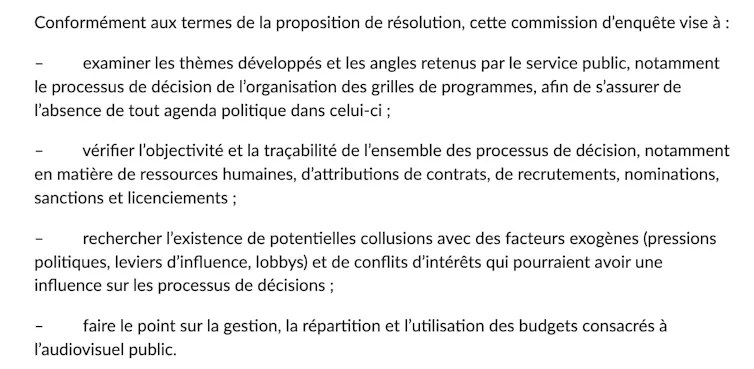
Voici les missions de cette commission présentées sur le site de l’Assemblée nationale :
On est donc amené à penser que la volonté de traiter, dans un grand tout indifférencié, tant de sujets divers, comme cela a été justifié dès le démarrage des travaux, ne pouvait que conduire à ce patchwork décousu et confus. Loin de défendre un véritable contre-projet pour l’audiovisuel public, ce qui transparaît finalement de tous ces moments de tension, c’est que la commission, et son rapporteur en particulier, ont procédé par picorage d’exemples disparates, pointant des faits déjà connus ou mis au jour par d’autres instances, afin d’accréditer l’idée préconçue que tout partait à vau-l’eau. Comme si le but était en fait d’éroder l’édifice à coups de pioche de-ci de-là. Certaines mises en cause (frais de taxi croissants, pantouflage de licenciés vers des sociétés de production travaillant pour France TV, amélioration incomplète de la comptabilité analytique…) ont pu en effet placer des auditionnés en difficulté.
Au final, on a surtout la sensation que les débats et les attaques de cette commission visaient à jeter la suspicion sur l’audiovisuel public afin sans doute de préparer les esprits, un jour, à accepter sa privatisation ou la fermeture de plusieurs de ses branches.
Arnaud Mercier ne travaille pas, ne conseille pas, ne possède pas de parts, ne reçoit pas de fonds d’une organisation qui pourrait tirer profit de cet article, et n’a déclaré aucune autre affiliation que son organisme de recherche.
Source: The Conversation – in French – By Imad Khillo, Maître de conférences de droit public à Sciences Po Grenoble / Université Grenoble Alpes. Chercheur au Centre d’études et de recherche sur la diplomatie, l’administration publique et le politique (CERDAP²). Codirecteur du séminaire de recherche « Construction nationale et religions en Méditerranée » au Collège des Bernardins., Sciences Po Grenoble – Université Grenoble Alpes
En Irak, depuis l’adoption du nouveau Code du statut personnel en 2025, la condition des femmes se détériore. Entre mariages précoces et transferts automatiques de la garde de l’enfant au père, les effets de la réforme sont de plus en plus visibles dans la société irakienne. La mort de Yanar Mohammed, militante pour les droits des femmes, en mars 2026, symbolise cette répression de la voix des femmes.
La militante irakienne et présidente de l’Organization of Women’s Freedom in Iraq (OWFI), Yanar Mohammed, a été abattue le 2 mars 2026 devant son domicile à Bagdad. Cet assassinat s’inscrit dans un climat de tensions accrues, marqué par des tentatives de réduction au silence des voix engagées en faveur des droits des femmes.
Un an après son adoption par le Parlement irakien, le 21 janvier 2025, et son entrée en vigueur le 17 avril suivant, le nouveau Code du statut personnel commence à produire ses effets, tout en suscitant d’importantes controverses. Ce texte, qui rompt avec l’équilibre juridique instauré par la loi de 1959, encadre des dimensions essentielles de la vie privée – mariage, divorce, filiation, garde des enfants ou encore successions – dans un contexte politique particulièrement sensible. Depuis les années 2000, l’Irak connaît une recomposition progressive de ses institutions, marquée par le renforcement des logiques confessionnelles et par un rôle accru des autorités religieuses dans l’organisation de la vie sociale. Dans cet environnement, les droits des femmes, déjà fragilisés par des structures patriarcales persistantes, se trouvent d’autant plus exposés.
La réforme adoptée en 2025 dépasse largement le cadre d’un simple ajustement du droit de la famille. Elle traduit une inflexion plus profonde dans la manière dont l’État articule ses relations avec le fait religieux et la diversité de la société irakienne. Si ses partisans y voient une reconnaissance des identités confessionnelles, ses détracteurs soulignent les risques qu’elle fait peser sur la cohérence du système juridique et, plus encore, sur la protection des droits des femmes.
Une transformation profonde du droit familial : vers une pluralisation confessionnelle du système juridique
Pour mesurer l’impact de cette réforme, il est essentiel de rappeler que le droit du statut personnel en Irak reposait historiquement sur la loi n° 188 de 1959. À l’époque, ce texte fut considéré comme l’un des cadres juridiques les plus progressistes du monde arabe, malgré certaines dispositions inégalitaires. Son objectif principal fut d’unifier les règles relatives au mariage, au divorce, à la garde des enfants et aux successions, indépendamment des distinctions confessionnelles.
S’inspirant à la fois de la charia islamique et du droit civil moderne, il introduisait certaines protections pour les femmes, tout en maintenant des dispositions discriminatoires. La polygamie, par exemple, restait possible mais soumise à l’autorisation d’un juge (article 3). La répudiation n’était pas totalement abolie, même si l’article 40 permettait à la femme de demander le divorce pour préjudice. L’article 7 fixait par ailleurs un âge minimum de 18 ans pour le mariage, sous contrôle judiciaire. Malgré ces avancées, des inégalités structurelles subsistaient, notamment en matière d’héritage, où les règles de la charia continuaient de s’appliquer.
La réforme de 1990 a introduit certains ajustements procéduraux – notamment en matière de divorce et de reconnaissance du consentement des époux – sans remettre en cause les fondements patriarcaux du système. À partir de 2003, dans un contexte de recomposition politique consécutive à la chute du régime de Saddam Hussein, des projets plus ambitieux ont cherché à instaurer des régimes juridiques distincts selon les appartenances religieuses.
La résolution n° 137 du 29 décembre 2003, adoptée par le Conseil de gouvernement irakien, proposait de confier à chaque communauté la gestion de son propre droit familial. Elle fut toutefois rapidement suspendue, puis abandonnée. La société civile, les organisations de défense des droits des femmes et la communauté internationale s’y opposèrent, dénonçant les risques de fragmentation juridique et les atteintes possibles aux droits des femmes, notamment à travers la reconnaissance de pratiques comme le mariage précoce ou la garde unilatérale des enfants (la garde accordée exclusivement au père).
La réforme de 2025 s’inscrit dans le prolongement de ces évolutions, tout en opérant un changement d’ampleur. Elle rompt totalement avec la logique d’unification en instaurant une pluralité de régimes juridiques et en plaçant les juridictions religieuses au cœur du système. Les rites jafarites chiites sont désormais explicitement admis comme référentiel juridique en matière de statut personnel, aux côtés d’autres traditions confessionnelles. Les citoyens peuvent ainsi choisir le système applicable à leur situation, introduisant une diversification sans précédent du droit familial.
« Mariages forcés en Irak : la parole des jeunes filles se libère », Paris Match, 23 novembre 2025.
Ce choix s’opère lors de l’enregistrement du mariage ou à l’occasion d’un litige devant la juridiction compétente. Les parties peuvent déterminer le référentiel religieux applicable, soit d’un commun accord, soit à l’initiative de l’une d’elles. Dans la pratique, ce choix peut également dépendre de l’appartenance confessionnelle déclarée ou de la juridiction saisie. Une fois le référentiel retenu, toutes les règles (mariage, divorce, garde des enfants) sont appliquées selon l’interprétation religieuse correspondante, entraînant des différences notables dans les droits et obligations des individus.
Cette réforme traduit une décentralisation normative majeure. Dès lors, l’État n’impose plus un cadre unique, mais organise la coexistence de plusieurs systèmes parallèles, dans lesquels les conditions du mariage, du divorce, les droits des époux, la garde des enfants et les successions peuvent varier selon la tradition religieuse choisie. Présentée comme une reconnaissance de la diversité et une extension de la liberté de choix, cette flexibilité crée en réalité une incertitude juridique accrue, complexifie l’accès au droit, rend les décisions judiciaires moins prévisibles et fragilise le principe d’égalité devant la loi.
Plus largement, le nouveau Code marque une évolution vers un modèle pluraliste et confessionnel du droit familial, où la religion devient un critère central de régulation sociale. Les conséquences sont profondes : complexification du système juridique, affaiblissement des garanties offertes aux individus – surtout aux femmes et aux enfants – et renforcement des dynamiques de fragmentation sociale. Loin de se limiter à un simple ajustement législatif, cette réforme constitue une recomposition structurelle du rapport entre l’État, le droit et le religieux en Irak.
Une réforme controversée : risques de fragmentation et régressions pour les droits des femmes
Les critiques du nouveau Code du statut personnel se concentrent principalement sur les droits fondamentaux, et plus particulièrement sur les droits des femmes. De nombreuses ONG, ainsi que des juristes et acteurs de la société civile mettent en garde contre un recul notable, et des exemples récents montrent concrètement ces dangers.
En octobre 2025, Human Rights Watch rapporte le cas de Ghazal H., une femme assignée en justice après que son ex-mari a demandé l’application rétroactive à leur mariage du nouveau code jafarite, sans son accord, afin de lui retirer la garde de leur fils de 10 ans. Cette affaire illustre comment la réforme peut devenir un instrument de contrôle sur la vie des femmes et des enfants.
Sous la loi de 1959, la garde des enfants, en cas de divorce, était en principe confiée à la mère, dans une logique de protection de l’intérêt de l’enfant, avec un contrôle judiciaire pour apprécier les conditions concrètes de prise en charge. Ce système permettait, au moins en théorie, de maintenir la garde maternelle au-delà d’un certain âge, si cela correspondait au bien-être de l’enfant.
Avec le nouveau Code, certaines interprétations autorisent désormais un transfert automatique de la garde au père à partir d’un âge fixé (généralement autour de 7 ans), sans examen judiciaire individualisé de la situation. Ainsi, une mère qui assurait jusque-là la garde quotidienne peut la perdre au profit du père, même si les conditions de vie de ce dernier sont moins favorables. Ce changement réduit le rôle du juge et relègue au second plan le critère de l’intérêt supérieur de l’enfant, au profit de normes rigides basées sur l’autorité paternelle.
À ce sujet, Sarah Sanbar, chercheuse sur l’Irak pour Human Rights Watch, affirme :
« Le nouveau Code du statut personnel institutionnalise davantage la discrimination à l’égard des femmes, les reléguant légalement au rang de citoyennes de seconde classe. Il prive les femmes et les filles de leur capacité à décider de leur vie et transfère ce pouvoir aux hommes. Il devrait être abrogé immédiatement. »
Plusieurs organisations féministes ont réclamé l’abrogation de ces dispositions, dénonçant leur impact délétère sur les droits des femmes et la protection des enfants. La World March of Women (organisation féministe internationale) a publié le 27 janvier 2025 (peu après l’adoption du nouveau Code), une déclaration condamnant ces modifications et alertant sur les menaces qu’elles font peser sur les droits humains fondamentaux. De son côté, Amnesty International avait déjà exhorté en 2024 le Parlement irakien à rejeter ces amendements avant même leur adoption.
Malgré ces alertes, en septembre 2025, la Cour suprême fédérale d’Irak a rejeté une action intentée par des organisations de défense des droits des femmes et des droits humains contestant la validité des amendements adoptés par le Parlement. La Cour suprême a estimé que la procédure législative était conforme à la Constitution irakienne, garantissant aux citoyens la liberté de choisir la loi religieuse applicable à leur statut personnel. Elle a validé les amendements, y compris ceux reconnaissant l’application de la jurisprudence jafarite, consolidant ainsi leur mise en œuvre et mettant fin aux principaux recours judiciaires. Cette décision renforce la position du Parlement et des partisans de cette réforme, montrant que, malgré les critiques, elle reste dans les limites constitutionnelles.
Les premiers effets concrets de la réforme se sont manifestés dès février 2026. Un tribunal de Bagdad avait validé le mariage d’une fille de 17 ans avec un homme de 20 ans, sans examiner le consentement ni le bien-être de la mariée. Si le nouveau Code maintient en principe 18 ans comme âge minimal pour le mariage, il ménage la possibilité d’y déroger selon le référentiel religieux choisi. Ainsi, dans le cadre des rites jafarites, l’âge légal du mariage peut être inférieur à 18 ans et descendre jusqu’à 9 ans pour les filles (alors qu’il est fixé à 14 ans pour les garçons). Ces situations montrent comment une réforme d’apparence neutre peut en réalité engendrer des régressions sociales significatives.
Yanar Mohammed, jusqu’à son assassinat, se trouvaient au premier rang des mobilisations contre ces changements législatifs. Avocats, médecins et experts de la société civile ont également exprimé leur opposition, estimant que la loi amendée « victimise » les enfants et « sape les droits des femmes ». Certains juristes ont averti que l’attribution automatique de la garde au père et la restriction de l’accès des femmes à la propriété ou à l’héritage risquent de déstabiliser profondément les familles. Des experts des Nations unies ont dénoncé les amendements. En critiquant l’absence de débat transparent et inclusif avant l’adoption, ils ont affirmé qu’ils pouvaient « ébranler les droits des femmes et des enfants ».
Au-delà des effets individuels, la réforme soulève une question structurelle : en instituant des régimes différenciés selon les appartenances confessionnelles, elle accentue la fragmentation juridique et politique de l’Irak. Ce passage progressif d’un modèle unifié encadré par l’État à une organisation fragmentée et confessionnelle du droit fragilise la cohésion nationale et complique l’accès au droit pour les citoyens.
Les partisans de la réforme mettent en avant la reconnaissance des identités religieuses et la liberté de choix qu’elle offre. Cependant, les cas concrets de mariages précoces, de changements unilatéraux du droit et de transferts automatiques de garde montrent que ces arguments peinent à convaincre. Les risques pour l’égalité des droits et la protection des femmes et des enfants sont aujourd’hui évidents.
Un débat qui reflète les interrogations de la société irakienne
L’adoption du nouveau Code du statut personnel en Irak marque une étape majeure dans l’évolution juridique et institutionnelle du pays. Si elle reflète une volonté de reconnaître les identités confessionnelles, elle soulève de graves questions en matière d’égalité, de cohésion nationale et de respect des droits fondamentaux.
Les risques de fragmentation juridique et de recul pour les droits des femmes constituent les principales sources de tension. Ils illustrent les dilemmes auxquels l’Irak est confronté aujourd’hui dans la construction de son ordre juridique moderne. Dans un contexte régional en mutation, marqué par les guerres, cette évolution interroge la capacité de l’État irakien à concilier pluralisme religieux et protection effective des libertés individuelles, en particulier celles des femmes.
Comme dans l’ensemble du monde arabe, les femmes irakiennes avancent sur un chemin semé d’obstacles, où chaque droit conquis résulte d’une lutte incessante…
Imad Khillo ne travaille pas, ne conseille pas, ne possède pas de parts, ne reçoit pas de fonds d’une organisation qui pourrait tirer profit de cet article, et n’a déclaré aucune autre affiliation que son organisme de recherche.
Lorsque l’on descend en profondeur au-delà de la zone éclairée par le soleil, la palette de couleurs se fait plus restreinte, le rouge et le noir dominent. (Sur ces clichés, les méduses des profondeurs _Pandea rubra_, _Atolla wyvillei_ et _Crossota norvegica_.)NOAA/Wikipédia, CC BY
Dans l’ouvrage Secrets de l’océan profond, tout juste publié aux éditions Quae, Juliette Ravaux, maîtresse de conférences à Sorbonne Université en biologie animale, et Sébastien Duperron, professeur au Muséum national d’histoire naturelle et spécialiste d’écologie microbienne, nous font découvrir des espèces animales mystérieuses et des ressources mal connues de l’océan profond. Leur but est de mieux comprendre ce bien commun, pour mieux le préserver. Dans cet extrait, ces spécialistes nous donnent à voir ce que perçoivent les curieuses espèces vivant dans les abysses, qu’ils ont tous deux pu observer lors de leurs plongées à bord du Nautile, sous-marin de la flotte scientifique à la fois unique… et exigu.
La vie dans l’océan profond s’accompagne d’un panel de contraintes environnementales, parmi lesquelles l’absence de lumière solaire et la rareté de la nourriture. À elles seules, ces deux conditions affectent des fonctions essentielles des organismes telles que l’orientation dans leur environnement à la recherche de nourriture ou de partenaires, mais aussi le métabolisme, la croissance et la reproduction. En conséquence, les espèces des profondeurs possèdent une vaste diversité d’adaptations dont certaines sont présentées ici, mais dont beaucoup restent encore à découvrir !
Descendons sur la dorsale de l’océan Atlantique, à plus de 2 000 mètres de fond, au plus près des fumeurs noirs qui crachent un fluide brûlant. Là, sur les parois des cheminées hydrothermales, des crevettes se rassemblent par milliers en nuées grouillantes. Ce sont des crevettes aveugles, Rimicaris exoculata, une espèce emblématique de ces environnements atlantiques. Les adultes ne possèdent pas les yeux pédonculés typiques des crevettes, ce qui leur vaut ce surnom. Et pourtant, elles possèdent bien des yeux, difficilement reconnaissables car ils sont très modifiés : ce sont des plaques rosées en forme de V qui se situent sur leur dos. Ces plaques ne leur permettent pas de voir leur environnement sous forme d’une image comme le font nos yeux.
Mais elles sont très sensibles à la lumière et détectent des sources lumineuses de très faible intensité, invisibles pour l’œil humain. Elles sont constituées d’une couche très épaisse de cellules photoréceptrices, sous laquelle se trouve une couche réfléchissante de cellules blanches qui renvoie la lumière vers les photorécepteurs, augmentant ainsi la quantité de lumière perçue.
Grâce à ces capteurs hypersensibles, les crevettes Rimicaris sont donc spécialisées dans la détection de lumière ténue. Reste encore à déterminer quels signaux lumineux elles perçoivent dans leur environnement parmi les sources potentielles, comme celle émise par le fluide hydrothermal sous forme de rayonnement thermique.
Les animaux bioluminescents, ou pourquoi il ne fait pas totalement noir dans les abysses
À l’instar de Rimicaris, les espèces abyssales évoluent dans des environnements obscurs dépourvus de lumière solaire. Il existe cependant une autre source lumineuse majeure : la bioluminescence. Plus faible que la lumière solaire, elle n’est apparente que la nuit dans les eaux de surface, mais elle est nettement visible en profondeur grâce au contraste avec le fond noir. Cette lumière émise par les organismes révèle la présence de partenaires, de prédateurs, de sources de nourriture, et peut aussi servir de défense, de leurre ou de camouflage. Dans la zone crépusculaire, diverses espèces arborent ainsi un ventre bioluminescent qui les rend moins visibles aux prédateurs et aux proies situés en dessous. Cette contre-illumination leur permet en effet de se fondre dans la faible luminosité provenant de la surface.
Au-delà de 1 000 mètres, la bioluminescence constitue la principale, sinon la seule, source de lumière. Elle apparaît de façon intermittente sous forme d’éclairs lumineux, le plus souvent de couleur bleue ou verte, qui durent quelques dixièmes de secondes à quelques secondes. Des observations menées au large de New York dans les années 1950 rapportent des fréquences de signaux bioluminescents allant jusqu’à 94 éclairs par minute dans le champ de vision du photomètre pour des profondeurs au-delà de 1 000 mètres. Dans les années 2000, un inventaire de la faune au large de la côte californienne, de la surface jusqu’à 3 900 mètres de profondeur, a révélé que plus de trois quarts des individus de la colonne d’eau émettent de la lumière. Les océans crépitent d’un feu d’artifice silencieux et le paysage lumineux des profondeurs se présente comme un fond noir piqueté d’étincelles bleutées.
Les yeux adaptés aux paysages obscurs
Dans ces paysages obscurs, les animaux sont-ils aveugles ? Les yeux des poissons téléostéens peuplant les profondeurs sont souvent décrits comme étant « régressés » ou « dégénérés ». Pourtant, ces yeux existent bel et bien et les poissons des profondeurs ne sont généralement pas aveugles, bien au contraire. Les yeux des poissons bathypélagiques présentent une grande variété de morphologies : ils sont parfois clairement régressé avec une rétine absente ou défectueuse, comme chez les « poissons-baleines » du genre Cetomimus, ou au contraire très grands et développés, comme ceux de l’alépocéphale à bec (Alepocephalus rostratus).
Dans l’ensemble, à quelques exceptions près, les yeux des espèces bathypélagiques ont toutefois tendance à être plus petits (par rapport à la taille du corps) que ceux de leurs cousins de la zone mésopélagique. Ils sont néanmoins parfaitement fonctionnels et particulièrement efficaces pour détecter des éclairs de bioluminescence ponctuels, grâce à deux caractéristiques notables : une large pupille et une rétine riche en photorécepteurs très sensibles à la lumière. Le record est actuellement détenu par la dirette argentée, une espèce abyssale qui possède un nombre exceptionnel de pigments responsables de la détection de faible luminosité, les rhodopsines. Alors que l’humain ne possède qu’un seul exemplaire de rhodopsine, la dirette en possède 38 ! Chacune de ces rhodopsines serait capable de détecter une couleur dans la gamme des bleus et des verts. Cet exceptionnel répertoire de pigments permet donc à la dirette de distinguer davantage de nuances de lumière bleue et de lumière verte que l’être humain, ce qui s’avère très utile pour identifier différentes sources de bioluminescence, et ainsi distinguer les prédateurs et les proies.
Comme la dirette, la majorité des poissons des grands fonds possède une vision limitée aux longueurs d’onde bleues et vertes. Ils ne peuvent percevoir les autres couleurs, et sont de ce fait daltoniens ! Les poissons bathypélagiques seraient en théorie capables de voir un flash bioluminescent à une distance pouvant aller jusqu’à 100 mètres dans une eau limpide. Cependant, cette distance est en réalité inatteignable pour la plupart des poissons pélagiques, qui n’ont pas l’énergie suffisante pour nager jusqu’à une source lumineuse à une telle distance en un laps de temps court. Ainsi, même si les poissons des profondeurs peuvent voir des éclairs lointains, ils ne réagissent probablement qu’à ceux produits à une distance plus proche.
Tout comme les poissons bathypélagiques, les crustacés de ces profondeurs présentent une grande variété de morphologie des yeux. Là encore, on retrouve des exemples d’yeux particulièrement sensibles à la lumière et adaptés à la détection de la bioluminescence. Le record revient probablement aux grands yeux de l’ostracode Gigantocypris muelleri, qui possèdent des réflecteurs qui ressemblent à des phares de voiture et des photorécepteurs géants qui lui confèrent une sensibilité à la lumière impressionnante. Il est ainsi capable de distinguer les silhouettes de proies et de prédateurs qui se profilent contre la faible lumière descendant dans la colonne d’eau au-dessus de lui, et il peut déjouer le camouflage en contre-illumination des espèces bioluminescentes de la zone crépusculaire. S’il est capable de détecter efficacement la bioluminescence, ce crustacé ne peut en revanche voir avec précision l’organisme qui la produit, car ses yeux possèdent une faible résolution, ce qui fait qu’il voit flou !
Dans les grands fonds, on trouve donc des espèces dont la vision s’est adaptée pour percevoir de très faibles intensités lumineuses, et dans un répertoire de couleurs spécialisé, plutôt que pour produire une image nette et détaillée de leur environnement.
Les auteurs ne travaillent pas, ne conseillent pas, ne possèdent pas de parts, ne reçoivent pas de fonds d’une organisation qui pourrait tirer profit de cet article, et n’ont déclaré aucune autre affiliation que leur organisme de recherche.
Larvae of the mopane moth (Gonimbrasia belina), on a mopane tree (Colophospermum mopane).By SAplants – Own work, CC BY-SA 4.0, CC BY
South Africa’s Limpopo province borders Zimbabwe, Botswana and Mozambique. It is one of the poorest provinces in the country. This is due to a combination of historical underdevelopment, a high unemployment rate, heavy reliance on government grants and a rural-based economy with limited industrial diversification.
It’s an interesting place for a geographer like me. My work brings together the themes of traditional ecological knowledge, environmental geography, conservation and society. My research looks at sustainable environmental outcomes by recognising the role of local culture, sacred sites and community practices in managing natural resources in southern Africa.
In two recent studies I explored how local communities in Limpopo are commercialising the harvesting of local insects to manage extreme poverty.
In one I explored the process involved in the commercialisation of mopane worms. Mopane worms (Gonimbrasia belina) are a nutritious, high-protein seasonal delicacy for many communities in Limpopo.
In a similar study, I turned to the harvesting and commercialisation of termite alates in Limpopo.
These resources are important for food security and poverty relief. Mopane worms and alate termites offer both high-quality nutrition and substantial income-generating opportunities for rural households. Both foods are traded in local and regional, formal and informal markets.
This enterprise is largely driven by unemployment, economic hardship, and the need for cash income in rural areas.
My research shows clearly that these resources play an important part in rural households and it’s important to manage them sustainably. One way of ensuring this happens is to tap into local knowledge.
As a separate study I did shows, traditional knowledge can help manage scarce resources by integrating customary rules, taboos and seasonal monitoring to prevent over-exploitation.
Mopane harvesting and trade
The mopane worm study took place in June and July 2023 in Muyexe and Nsavulani villages, Mopani District, Limpopo. The area is dominated by mopane woodlands, trees which are the main food of mopane worms (caterpillars). These villages have not benefited from development in the past and people depend heavily on natural resources for survival.
The processing of mopane worms (from harvesting to a marketable commodity) involves a series of traditional, manual steps to ensure quality. They are degutted (squeezing the caterpillar to remove stomach contents or frass), washed, boiled and dried to allow them to be stored for long periods. They are then graded and sold at home or in towns.
Dried cooked mopane worms. By Mark Marathon, Wikimedia Commons, CC BY
I chose 161 households in Muyexe village and 82 households in Nsavulani village as respondents, and interviewed villagers using a questionnaire. The questions covered:
the socio-economic profile of respondents
the availability and procurement, processing, marketing, trading and livelihood benefits of mopane worms.
The study found that most of the harvesters in Muyexe (69%) and Nsavulani (59%) villages were women. Almost all processed the worms at home. They collected the worms for both household consumption and trade. Those who traded worms reported making between R1,000 (US$54) and R3,000 (US$163) per season. There are two mopane seasons in Limpopo: November to January and April to May.
The study found that 55% of households in Muyexe village and 70% in Nsavulani village derived income only from mopane worm sales. (Individuals were under 60 and didn’t qualify for a social grant, or administered grants for children, nor for themselves.) Although the income earned from the sale of mopane worms is seasonal, communities appreciate it. Commercialising mopane worms contributed significantly to rural livelihoods. It is a crucial source of food security and cash income. This helps alleviate poverty and improves the lives and livelihoods of those involved in the business.
Termite harvesting and trade
Termite alates. Tim Cowley, Wikimedia Commons, CC BY
In a similar study, I turned to the harvesting and commercialisation of termite alates in Limpopo. I interviewed 71 respondents in Thohoyandou and Sibasa towns (who came mainly from villages), as well as Mukula and Tshidzivhe villages, and found that these insects were harvested to eat at home and to sell.
Women of all ages were more involved than men in this enterprise, making up 75% of the respondents. Almost half had secondary education and 23% had tertiary education; 63% were self-employed. The majority lived below the upper bound poverty line of R1,558 (about US$95) per person per month. About 31% of the traders indicated that over the selling season (October to December), alates contributed up to 100% of the income in their households.
Management for the future
While commercialisation puts pressure on resources, traditional rules and local management protect the trees. In the study on traditional ecological knowledge, I found that the communities imposed rules that:
prohibited cutting of green branches
restricted harvesting during specific seasons to allow for maturity
prohibited tree damage during the mopane worm harvest.
Traditional ecological knowledge regulated the timing of harvest, protected host tree health, and ensured long-term livelihood security for local communities.
This shows that integrating local traditional ecological knowledge into harvesting practices is crucial for managing these resources sustainably.
Management strategies should be integrated into local and regional planning efforts. Efforts should also be made to communicate these strategies to relevant authorities to foster cooperation and raise awareness about the importance of mopane trees for all user groups.
To ensure the sustainable future of this woodland species, I recommend that the government work with traditional leaders and communities to support and enforce existing traditional practices.
Ndidzulafhi Innocent Sinthumule does not work for, consult, own shares in or receive funding from any company or organisation that would benefit from this article, and has disclosed no relevant affiliations beyond their academic appointment.