La lune glacée Europe, un phare scintillant dans l’infrarouge ?

Source: The Conversation – France in French (2) – By Cyril Mergny, Postdoctoral research fellow, Université Paris-Saclay
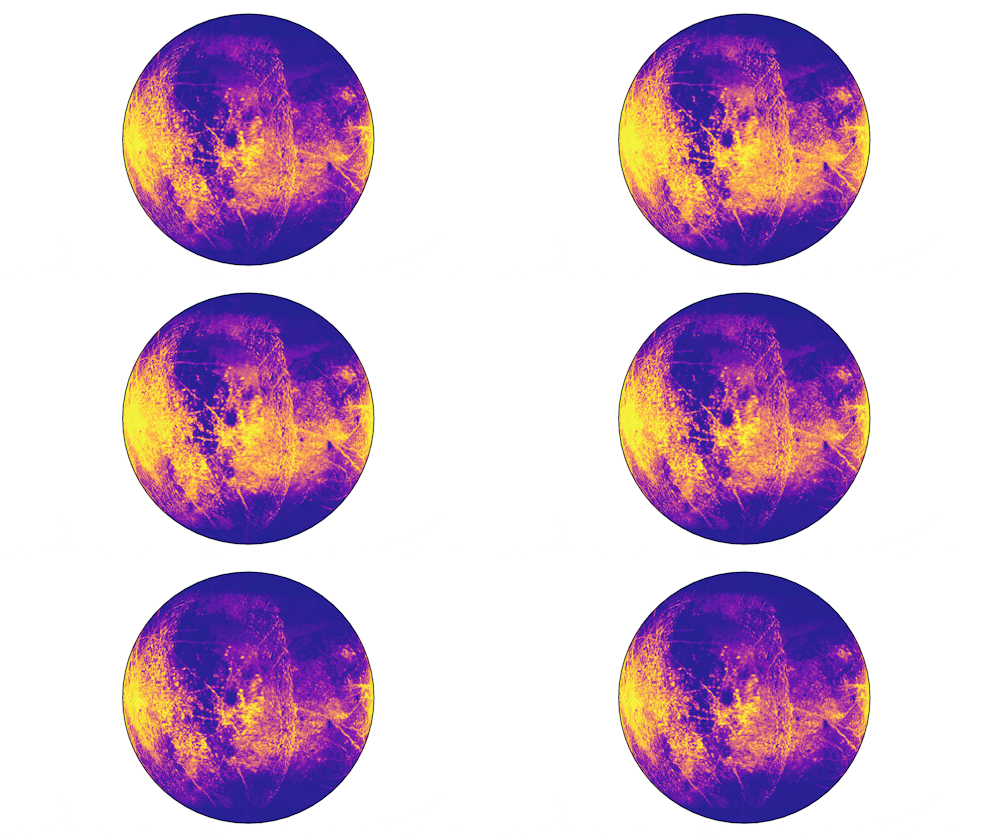
La glace d’eau à la surface d’Europe change au cours des saisons – ici, le taux de glace cristalline sur le premier micromètre d’épaisseur de glace au cours d’un cycle de saisons de 12 ans. Fourni par l’auteur

Europe est une lune de Jupiter entièrement recouverte d’une épaisse croûte de glace. Sous cette carapace, tout autour de la lune, se trouve un océan global d’eau liquide.

Cette lune intéresse particulièrement les scientifiques depuis que les données de la sonde Galileo, à la fin des années 1990, ont révélé des conditions qui pourraient être propices à l’émergence de la vie dans cet océan sous-glaciaire. En effet, c’est le seul endroit dans le système solaire (en dehors de la Terre) où de l’eau liquide est en contact direct avec un manteau rocheux à la base de l’océan. S’il y a du volcanisme sous-marin sur Europe, cela fournirait une source d’énergie, qui, avec l’eau, est l’un des ingrédients essentiels pour générer les briques de base du vivant.

Mais il reste encore de nombreuses inconnues sur la glace en surface d’Europe. Deux nouvelles études lèvent le voile sur un phénomène inattendu.


Grâce à deux nouvelles études, l’une théorique et l’autre issue des observations du télescope James-Webb, nous comprenons aujourd’hui mieux la surface glacée d’Europe. Nous avons notamment montré que la structure atomique de la glace change au fil des saisons, ce que l’on peut voir dans la lumière réfléchie par cette lune, un peu comme un phare qui scintillerait dans la nuit.

Ces nouvelles connaissances seront utiles pour, un jour, envisager de poser un atterrisseur sur Europe, mais aussi pour mieux comprendre les processus géologiques qui façonnent la surface – on ne sait toujours pas, par exemple, bien expliquer l’origine des « rayures » qui façonnent la surface d’Europe.

Dans les prochaines années, nous espérons que le scintillement du « phare atomique » d’Europe pourra être réellement observé, notamment par la sonde Europa Clipper de la Nasa ainsi par que la mission JUICE de l’ESA.

La glace sur Terre et la glace dans l’espace sont différentes

Sur Terre, la glace d’eau dans son environnement naturel se présente sous une seule forme : une structure cristalline, communément appelée « glace hexagonale ».

Cependant, dans l’espace, comme sur Europe, c’est une autre histoire : il fait tellement froid que la glace d’eau peut adopter des formes plus exotiques avec différentes propriétés.

Ainsi, la forme de glace la plus répandue dans l’Univers est la glace dite « amorphe ».

C’est une forme de glace où l’arrangement des molécules d’eau ne présente aucun ordre à grande échelle, contrairement à la glace cristalline qui, elle, possède des motifs répétitifs.

Une analogie à notre échelle humaine serait un étalage d’oranges. Dans le cas cristallin, les éléments sont tous bien rangés, sous la forme d’un réseau périodique. Dans le cas amorphe, les éléments sont en vrac sans aucune position régulière.

des tas d’agrumes
Les agrumes, un peu comme les atomes et molécules, peuvent être disposés de façon plus ou moins organisée. À gauche, il s’agit d’un analogue d’une organisation cristalline à l’échelle atomique, avec des atomes « bien rangés » ; à droite, l’organisation est aléatoire, analogue à une organisation amorphe à l’échelle atomique.
Jen Gunter et Maria Teneva/Unsplash, CC BY

Notre vie quotidienne comprend des exemples de versions amorphes ou cristallines d’un même matériau : par exemple, la barbe à papa contient une forme amorphe du sucre, alors que le sucre de cuisine usuel est cristallin.

En fait, nous nous attendons à ce que le système solaire externe ait de la glace principalement sous une forme amorphe, en premier lieu parce qu’à très faible température (-170 °C sur Europe), les molécules n’ont pas assez d’énergie pour s’organiser correctement ; mais également parce que la structure cristalline a tendance à se briser sous l’effet des bombardements de particules en provenance du Soleil, déviées par la magnétosphère de Jupiter, comme si on envoyait une orange perturbatrice dans un étal bien rangé.

Comparaison de structure de la glace
La glace d’eau peut prendre différentes formes : structure cristalline à gauche et structure amorphe à droite.
Cyril Mergny, Fourni par l’auteur

Les observations spatiales précédentes des années 1990 puis dans la décennie 2010 avaient montré que la glace d’Europe est un mélange de formes amorphes et cristallines. Mais, jusqu’à présent, aucun modèle n’expliquait pourquoi.

Une structure qui change avec les saisons

Pour la première fois, nous avons quantifié la compétition entre la cristallisation, due à la température pendant les heures les plus chaudes de la journée, et l’amorphisation induite par le bombardement en surface de particules issues de la magnétosphère de Jupiter.

Nous avons ainsi montré que la cristallinité est stratifiée sur Europe : une très fine couche en surface est amorphe, tandis que la couche en profondeur est cristalline.

Plus remarquable encore, la simulation a révélé que la cristallinité de la glace en surface pouvait varier selon les saisons ! Bien que les variations saisonnières n’affectent pas la quantité de particules qui bombardent Europe, il fait plus chaud en été, ce qui rend la cristallisation plus efficace et fait ainsi pencher la balance en sa faveur. En été, il fait en moyenne 5 °C plus chaud qu’en hiver, ce qui rend la glace jusqu’à 35 % plus cristalline qu’en hiver dans certaines régions.

Nous en avons conclu que si l’on observait Europe au fil des saisons à travers un spectroscope, cela donnerait l’impression que la surface « scintille » sur une période de douze ans (la durée d’une année sur Europe), comme un phare dans la nuit.

Comment fait-on pour connaître la structure atomique de la glace à une distance de 700 millions de kilomètres ?

Simultanément à notre étude, des astronomes de la Nasa ont observé Europe avec le puissant télescope James-Webb. Leur étude vient de montrer que les résultats de nos simulations sont en accord avec leurs observations. En effet, bien que les deux approches utilisent des méthodes radicalement différentes, elles aboutissent aux mêmes conclusions.

Grâce au spectromètre du James-Webb, les chercheurs ont pu estimer, à distance, la structure atomique de la glace à la surface d’Europe (sur le premier micromètre d’épaisseur). Pour cela, ils ont analysé la lumière réfléchie par Europe dans l’infrarouge (légèrement plus rouge que ce que notre œil peut percevoir) à la longueur d’onde de 3,1 micromètres qui reflète l’état de cristallisation de la glace d’eau.

Ils ont ainsi établi une carte de cristallinité de la lune glacée. En comparant leur carte observée avec celle que nous avons simulée, nous constatons un très bon accord, ce qui renforce notre confiance dans ces résultats.

Sur Europe, la surface est donc parsemée de régions avec de la glace d’eau amorphe et d’autres avec de la glace d’eau cristalline, car la température varie selon les zones. Globalement, les régions les plus sombres absorbent davantage les rayons du Soleil, ce qui les réchauffe et, comme sur Terre, les températures sont plus élevées près de l’équateur et plus basses près des pôles.

comparaison des résultats des deux études
Comparaison de la cristallinité sur l’hémisphère arrière d’Europe : observations versus simulation. À gauche : l’observation par le télescope James-Webb de la profondeur de bande à la longueur d’onde 3,1 micromètres, caractéristique de la glace cristalline. À droite, les résultats de cristallinité de nos dernières simulations sur la même zone. Les deux études indiquent qu’en proche surface, les régions Tara et Powys sont composées de glace cristalline, tandis que la glace amorphe est dominante dans les latitudes nord environnantes.
Cartwright et collaborateurs 2025 ; Mergny et collaborateurs 2025, Fourni par l’auteur

Cependant, l’étude observationnelle utilisant le télescope James-Webb a capturé une photo d’Europe. Elle ne peut donc pas, pour le moment, détecter les scintillements dans l’infrarouge, car il faudrait observer la surface au cours de plusieurs années pour distinguer un changement. Ces fluctuations de la surface sont une nouveauté que nous avons découverte dans notre étude de simulation, et elles restent à être confirmées par des observations.

Nous espérons que les sondes JUICE et Europa Clipper pourront bientôt observer ces oscillations saisonnières de la lumière réfléchie par Europe dans l’infrarouge.

Notre intérêt se porte désormais aussi sur d’autres lunes glacées de Jupiter, où une cohabitation entre glace amorphe et glace cristalline pourrait exister, comme sur Ganymède et sur Callisto, mais aussi sur d’autres corps tels qu’Encelade, en orbite autour de Saturne, ou encore sur des comètes.

The Conversation

Frédéric Schmidt est Professeur à l’Université Paris-Saclay, membre de l’Institut Universitaire de France (IUF). Il a obtenu divers financements publics (Université Paris-Saclay, CNRS, CNES, ANR, UE, ESA) ainsi que des financements privés (Airbus) pour ses recherches.

Cyril Mergny ne travaille pas, ne conseille pas, ne possède pas de parts, ne reçoit pas de fonds d’une organisation qui pourrait tirer profit de cet article, et n’a déclaré aucune autre affiliation que son organisme de recherche.

ref. La lune glacée Europe, un phare scintillant dans l’infrarouge ? – https://theconversation.com/la-lune-glacee-europe-un-phare-scintillant-dans-linfrarouge-261435

AI in universities: How large language models are transforming research

Source: The Conversation – Canada – By Ali Shiri, Professor of Information Science & Vice Dean, Faculty of Graduate & Postdoctoral Studies, University of Alberta

Generative AI, especially large language models (LLMs), present exciting and unprecedented opportunities and complex challenges for academic research and scholarship.

As the different versions of LLMs (such as ChatGPT, Gemini, Claude, Perplexity.ai and Grok) continue to proliferate, academic research is beginning to undergo a significant transformation.

Students, researchers and instructors in higher education need AI literacy knowledge, competencies and skills to address these challenges and risks.

In a time of rapid change, students and academics are advised to look to their institutions, programs and units for discipline-specific policy or guidelines regulating the use of AI.

Researcher use of AI

A recent study led by a data science researcher found that at least 13.5 per cent of biomedical abstracts last year showed signs of AI-generated text.


Read more:
AI-detection software isn’t the solution to classroom cheating — assessment has to shift


Large language models can now support nearly every stage of the research process, although caution and human oversight are always needed to judge when use is appropriate, ethical or warranted — and to account for questions of quality control and accuracy. LLMs can:

  • Help brainstorm, generate and refine research ideas and formulate hypotheses;

  • Design experiments and conduct and synthesize literature reviews;

  • Write and debug code;

  • Analyze and visualize both qualitative and quantitative data;

  • Develop interdisciplinary theoretical and methodological frameworks;

  • Suggest relevant sources and citations, summarize complex texts and draft abstracts;

  • Support the dissemination and presentation of research findings, in popular formats.

However, there are significant concerns and challenges surrounding the appropriate, ethical, responsible and effective use of generative AI tools in the conduct of research, writing and research dissemination. These include:

  • Misrepresentation of data and authorship;

  • Difficulty in replication of research results;

  • Data and algorithmic biases and inaccuracies;

  • User and data privacy and confidentiality;

  • Quality of outputs, data and citation fabrication;

  • And copyright and intellectual property infringement.

AI research assistants, ‘deep research’ AI agents

There are two categories of emerging LLM-enhanced tools that support academic research:

1. AI research assistants: The number of AI research assistants that support different aspects and steps of the research process is growing at an exponential rate. These technologies have the potential to enhance and extend traditional research methods in academic work. Examples include AI assistants that support:

  • Concept mapping (Kumu, GitMind, MindMeister);

  • Literature and systematic reviews (Elicit, Undermind, NotebookLM, SciSpace);

  • Literature search (Consensus, ResearchRabbit, Connected Papers, Scite);

  • Literature analysis and summarization (Scholarcy, Paper Digest, Keenious);

  • And research topic and trend detection and analysis (Scinapse, tlooto, Dimension AI).

2. ‘Deep research’ AI agents: The field of artificial intelligence is advancing quickly with the rise of “deep research” AI agents. These next-generation agents combine LLMs, retrieval-augmented generation and sophisticated reasoning frameworks to conduct in-depth, multi-step analyses.

Research is currently being conducted to evaluate the quality and effectiveness of deep research tools. New evaluation criteria are being developed to assess their performance and quality.

Criteria include elements such as cost, speed, editing ease and overall user experience — as well as citation and writing quality, and how these deep research tools adhere to prompts.

The purpose of deep research tools is to meticulously extract, analyze and synthesize scholarly information, empirical data and diverse perspectives from a wide array of online and social media sources. The output is a detailed report, complete with citations, offering in-depth insights into complex topics.

In just a short span of four months (December 2024 to February 2025), several companies (like Google Gemini, Perplexity.ai and ChatGPT) introduced their “deep research” platforms.

The Allen Institute for Artificial Intelligence, a non-profit AI research institute based in Seattle, is experimenting with a new open access research tool called Ai2 ScholarQA that helps researchers conduct literature reviews more efficiently by providing more in-depth answers.

Emerging guidelines

Several guidelines have been developed to encourage the responsible and ethical use of generative AI in research and writing. Examples include:

LLMs support interdisciplinary research

LLMs are also powerful tools to support interdisciplinary research. Recent emerging research (yet to be peer reviewed) on the effectiveness of LLMs for research suggests they have great potential in areas such as biological sciences, chemical sciences, engineering, environmental as well as social sciences. It also suggests LLMs can help eliminate disciplinary silos by bringing together data and methods from different fields and automating data collection and generation to create interdisciplinary datasets.

Helping to analyze and summarize large volumes of research across various disciplines can aid interdisciplinary collaboration. “Expert finder” AI-powered platforms can analyze researcher profiles and publication networks to map expertise, identify potential collaborators across fields and reveal unexpected interdisciplinary connections.

This emerging knowledge suggests these models will be able to help researchers drive breakthroughs by combining insights from diverse fields — like epidemiology and physics, climate science and economics or social science and climate data — to address complex problems.


Read more:
The world is not moving fast enough on climate change — social sciences can help explain why


Research-focused AI literacy

Canadian universities and research partnerships are providing AI literacy education to people in universities and beyond.

The Alberta Machine Intelligence Institute offers K-12 AI literacy programming and other resources. The institute is a not-for profit organization and part of Canada’s Pan-Canadian Artificial Intelligence Strategy.

Many universities are offering AI literacy educational opportunities that focus specifically on the use of generative AI tools in assisting research activities.

Collaborative university work is also happening. For example, as vice dean of the Faculty of Graduate & Postdoctoral Studies at the University of Alberta (and an information science professor), I have worked with deans from the University of Manitoba, the University of Winnipeg and Vancouver Island University to develop guidelines and recommendations around generative AI and graduate and postdoctoral research and supervision.

Considering the growing power and capabilities of large language models, there is an urgent need to develop AI literacy training tailored for academic researchers.

This training should focus on both the potential and the limitations of these tools in the different stages of the research process and writing.

The Conversation

Ali Shiri does not work for, consult, own shares in or receive funding from any company or organisation that would benefit from this article, and has disclosed no relevant affiliations beyond their academic appointment.

ref. AI in universities: How large language models are transforming research – https://theconversation.com/ai-in-universities-how-large-language-models-are-transforming-research-260547

Ghana has a rare treasure, a crater made when a meteor hit Earth: why it needs to be protected

Source: The Conversation – Africa – By Marian Selorm Sapah, Senior lecturer, University of Ghana

Impact craters are formed when an object from space such as a meteoroid, asteroid or comet strikes the Earth at a very high velocity. This leaves an excavated circular hole on the Earth’s surface.

It is a basic geological process that has shaped the planets from their formation to today. It creates landscapes and surface materials across our solar system. The moon is covered with them, as are planets like Mercury, Mars and Venus. On Earth, impacts have influenced the evolution of life and even provided valuable mineral and energy resources. However, very few of the impact craters on Earth are visible because of various processes that obscure or erase them.

Most of the recognised impact craters on Earth are buried under sediments or have been deeply eroded. That means they no longer preserve their initial forms.

The Bosumtwi impact crater in Ghana is different, however. It is well preserved (not deeply eroded or buried under sediments). Its well-defined, near-circular basin, filled by a lake, is surrounded by a prominent crater rim that rises above the surface of the lake and an outer circular plateau. This makes it a target for several research questions.

As an Earth scientist, I joined a research team from 2019 to better understand the morphology of the crater. We carried out a morphological analysis of the crater (a study of its form, structure and geological features).

This study concluded that the activities of illegal miners are a threat to the sustainability of the crater. We also discovered that the features of the Bosumtwi impact crater can be considered as a terrestrial representation for a special type of impact crater known as rampart craters. These are common on the planets Mars and Venus and are found on icy bodies of the outer solar system (like Ganymede, Europa, Dione, Tethys and Charon).

For future studies, the Bosumtwi impact crater can be used to help understand how rampart craters form on Mars and Venus. So the Bosumtwi impact crater should be protected and preserved.


Read more:
Curious Kids: Why are there so few impact craters on Earth?


The crater

The Bosumtwi impact crater is in Ghana’s mineral-rich Ashanti gold belt. It is the location of the only natural inland lake in Ghana. As one of the world’s best-preserved young meteorite impact craters it is designated as an International Union of Geological Sciences geoheritage site.

It is one of only 190 confirmed impact crater sites worldwide, one of only 20 on the African continent. Its lake is one of six meteoritic lakes in the world, recognised for their outstanding scientific value.

At almost 1.07 million years old, the crater offers unparalleled opportunities for studying impact processes, climate history and planetary evolution. It’s an irreplaceable natural laboratory for researchers and educators.

Beyond its scientific importance, the crater holds cultural significance for the Ashanti people of Ghana. The lake at its centre serves as a sacred site and spiritual landmark. The crater’s breathtaking landscape also supports eco-tourism and local livelihoods, contributing to Ghana’s economic development while maintaining exceptional aesthetic value.

The research

As part of further research work on the 2019 study, in 2025 we have discovered through field work and satellite data analysis that illegal artisanal mining is prevalent in the area and threatening the crater. This refers to informal, labour-intensive extraction of minerals, primarily gold. It is conducted by individuals or small groups using basic tools and rudimentary machinery. The use of toxic chemicals such as mercury and cyanide, and practices such as river dredging, cause severe environmental harm.

Illegal miners are encroaching on and around the crater rim, posing severe threats to its environment and sustainability. Their activities have become more prevalent over the course of less than 10 years, indicating a growing problem. If unchecked, it could lead to irreversible damage to the crater.

These mining operations risk contaminating the lake with toxic heavy metals. The consequences of these are grave. They include destroying critical geological evidence, accelerating deforestation, and degrading the land. All this damages the crater’s scientific, cultural and economic value.

The International Union of Geological Sciences geoheritage designation of the crater underscores the urgent need for protection measures. The loss of this rare geological wonder would represent not just a national tragedy for Ghana, but a blow to global scientific heritage.

Immediate action is required. This includes enhanced satellite monitoring (tracking illegal mining, deforestation and environmental changes) using optical imagery (such as Sentinel-2, Landsat, PlanetScope). These tools can detect forest loss, identify mining pits and sediment runoff, and analyse changes over time.

Stricter enforcement of mining bans, and community engagement programmes, will help preserve the Bosumtwi impact crater’s unique attributes for future generations of scientists, students, tourists and local communities who depend on its resources.

The Conversation

Marian Selorm Sapah does not work for, consult, own shares in or receive funding from any company or organisation that would benefit from this article, and has disclosed no relevant affiliations beyond their academic appointment.

ref. Ghana has a rare treasure, a crater made when a meteor hit Earth: why it needs to be protected – https://theconversation.com/ghana-has-a-rare-treasure-a-crater-made-when-a-meteor-hit-earth-why-it-needs-to-be-protected-260600

Africa’s minerals are being bartered for security: why it’s a bad idea

Source: The Conversation – Africa (2) – By Hanri Mostert, SARChI Chair for Mineral Law in Africa, University of Cape Town

A US-brokered peace deal between the Democratic Republic of Congo (DRC) and Rwanda binds the two African nations to a worrying arrangement: one where a country signs away its mineral resources to a superpower in return for opaque assurances of security.

The peace deal, signed in June 2025, aims to end three decades of conflict between the DRC and Rwanda.

A key part of the agreement binds both nations to developing a regional economic integration framework. This arrangement would expand cooperation between the two states, the US government and American investors on “transparent, formalized end-to-end mineral chains”.

Despite its immense mineral wealth, the DRC is among the five poorest countries in the world. It has been seeking US investment in its mineral sector.

The US has in turn touted a potential multi-billion-dollar investment programme to anchor its mineral supply chains in the traumatised and poor territory.

The peace that the June 2025 deal promises, therefore, hinges on chaining mineral supply to the US in exchange for Washington’s powerful – but vaguely formulated – military oversight.

The peace agreement further establishes a joint oversight committee – with representatives from the African Union, Qatar and the US – to receive complaints and resolve disputes between the DRC and Rwanda.

But beyond the joint oversight committee, the peace deal creates no specific security obligations for the US.

The relationship between the DRC and Rwanda has been marred by war and tension since the bloody First (1996-1997) and Second (1998-2003) Congo wars. At the heart of much of this conflict is the DRC’s mineral wealth. It has fuelled competition, exploitation and armed violence.

This latest peace deal introduces a resources-for-security arrangement. Such deals aren’t new in Africa. They first emerged in the early 2000s as resources-for-infrastructure transactions. Here, a foreign state would agree to build economic and social infrastructure (roads, ports, airports, hospitals) in an African state. In exchange, it would get a major stake in a government-owned mining company. Or gain preferential access to the host country’s minerals.

We have studied mineral law and governance in Africa for more than 20 years. The question that emerges now is whether a US-brokered resources-for-security agreement will help the DRC benefit from its resources.

Based on our research on mining, development and sustainability, we believe this is unlikely.

This is because resources-for-security is the latest version of a resource-bartering approach that China and Russia pioneered in countries such as Angola, the Central African Republic and the DRC.

Resource bartering in Africa has eroded the sovereignty and bargaining power of mineral-rich nations such as the DRC and Angola.

Further, resources-for-security deals are less transparent and more complicated than prior resource bartering agreements.

DRC’s security gaps

The DRC is endowed with major deposits of critical minerals like cobalt, copper, lithium, manganese and tantalum. These are the building blocks for 21st century technologies: artificial intelligence, electric vehicles, wind energy and military security hardware. Rwanda has less mineral wealth than its neighbour, but is the world’s third-largest producer of tantalum, used in electronics, aerospace and medical devices.

For almost 30 years, minerals have fuelled conflict and severe violence, especially in eastern DRC. Tungsten, tantalum and gold (referred to as 3TG) finance and drive conflict as government forces and an estimated 130 armed groups vie for control over lucrative mining sites. Several reports and studies have implicated the DRC’s neighbours – Rwanda and Uganda – in supporting the illegal extraction of 3TG in this region.

The DRC government has failed to extend security over its vast (2.3 million square kilometres) and diverse territory (109 million people, representing 250 ethnic groups). Limited resources, logistical challenges and corruption have weakened its armed forces.

This context makes the United States’ military backing enormously attractive. But our research shows there are traps.

What states risk losing

Resources-for-infrastructure and resources-for-security deals generally offer African nations short-term stability, financing or global goodwill. However, the costs are often long-term because of an erosion of sovereign control.

Here’s how this happens:

Examples of loss or near-loss of sovereignty from these sorts of deals abound in Africa.

For instance, Angola’s US$2 billion oil-backed loan from China Eximbank in 2004. This was repayable in monthly deliveries of oil, with revenues directed to Chinese-controlled accounts. The loan’s design deprived Angolan authorities of decision-making power over that income stream even before the oil was extracted.

These deals also fragment accountability. They often span multiple ministries (such as defence, mining and trade), avoiding robust oversight or accountability. Fragmentation makes resource sectors vulnerable to elite capture. Powerful insiders can manipulate agreements for private gain.

In the DRC, this has created a violent kleptocracy, where resource wealth is systematically diverted away from popular benefit.

Finally, there is the risk of re-entrenching extractive trauma. Communities displaced for mining and environmental degradation in many countries across Africa illustrate the long-standing harm to livelihoods, health and social cohesion.

These are not new problems. But where extraction is tied to security or infrastructure, such damage risks becoming permanent features, not temporary costs.

What needs to change

Critical minerals are “critical” because they’re hard to mine or substitute. Additionally, their supply chains are strategically vulnerable and politically exposed. Whoever controls these minerals controls the future. Africa must make sure it doesn’t trade that future away.

In a world being reshaped by global interests in critical minerals, African states must not underestimate the strategic value of their mineral resources. They hold considerable leverage.

But leverage only works if it is wielded strategically. This means:

  • investing in institutional strength and legal capacity to negotiate better deals

  • demanding local value creation and addition

  • requiring transparency and parliamentary oversight for minerals-related agreements

  • refusing deals that bypass human rights, environmental or sovereignty standards.

Africa has the resources. It must hold on to the power they wield.

The Conversation

Hanri Mostert receives funding from the National Research Foundation (NRF) of South Africa. She is a member of the Expropriation Expert Group and a steering committee member of the International Bar Association’s (IBA) Academic Advisory Group (AAG) in the Sector for Energy, Environmental, Resources and Infrastructure Law (SEERIL).

Tracy-Lynn Field receives funding from the Claude Leon Foundation. She is a non-executive director of the Wildlife and Environment Society of South Africa.

ref. Africa’s minerals are being bartered for security: why it’s a bad idea – https://theconversation.com/africas-minerals-are-being-bartered-for-security-why-its-a-bad-idea-260594

La salud mental de los adolescentes: un síntoma de una sociedad vulnerable

Source: The Conversation – (in Spanish) – By Marino Pérez Álvarez, Psicólogo, académico y ensayista, Universidad de Oviedo

La crisis de salud mental es ya una característica del siglo XXI, identificado también como “el siglo de la soledad”. En un principio, las personas mayores eran quienes más sufrían las crisis de salud mental y soledad por razones que parecían obvias. También resultaba esperable en otras franjas de la vida adulta (los 30, 40 y 50 años); a cada década, su crisis: trabajos precarios, hipotecas, primeros divorcios, chequeos médicos, etcétera.

Sin embargo, hoy en día la crisis de salud mental por antonomasia se asocia principalmente con los niños, los adolescentes y jóvenes, edades cada vez más fluidas entre sí y las que peor están ahora (no en vano son conocidas como la “generación ansiosa”).

Los estudios muestran que del 35 % al 50 % de los escolares y estudiantes universitarios presentan síntomas de ansiedad y depresión. Otros problemas –como las adicciones, anorexia, bulimia, conductas autolesivas, ideas suicidas y suicidios o TDAH– van igualmente en aumento. La hospitalización de adolescentes por salud mental crece y empieza en edades más tempranas.

La crisis de salud mental que afecta a la infancia, la adolescencia y la juventud es doblemente paradójica. Por un lado, ocurre en la sociedad del bienestar y, por otro, aflige a las mejores edades de la vida, que reciben cuidados de bienestar emocional como nunca.

Una explicación común enfatiza el estrés al que, se supone, están sometidas las nuevas generaciones. Se suele invocar la presión escolar (tareas, exámenes, evaluaciones), el cambio climático (ecoansiedad) y las redes sociales.

Es difícil ver la presión escolar como explicación, ya que los contextos educativos cuidan de que nada perturbe el bienestar de los escolares, evitando correcciones y suspensos y, en su lugar, prodigando beneplácitos.

Las propias universidades se han convertido en “espacios seguros” para que nada contravenga las opiniones de los estudiantes, cuando debieran ser precisamente lugares “inseguros” para las opiniones previas en aras de nuevos conocimientos, incluidos aquellos que desafían lo dado por sabido.

La ecoansiedad –en realidad ansiedad ante las noticias, sin duda preocupantes, sobre el cambio climático– es también difícil de ver como explicación de la crisis de salud mental, pese a que la refieren el 84 % de los jóvenes de 16 a 25 años. La ecoansiedad es más una posición ética y política que propiamente un padecimiento psicológico.

Las redes sociales sí, efectivamente, están exacerbando el malestar psicológico de los niños, adolescentes y jóvenes notablemente desde 2012, cuando se generaliza su uso. Sin embargo, las redes sociales no explican la crisis, que ya venía de antes. La recrudecen, pero no la crean.

Estrés y vulnerabilidad

El estrés siempre es relativo a la vulnerabilidad, de modo que una misma situación puede ser estresante para unos e irrelevante, o incluso un reto, para otros. La vulnerabilidad se suele entender en términos de predisposición genética y del neurodesarrollo, lo que da lugar a la explicación vulnerabilidad-estrés.

La vulnerabilidad en esta explicación se deduce a partir de los malestares dados. Tienes depresión porque eres vulnerable y eres vulnerable porque tienes depresión. Una explicación tautológica.

Sin embargo, las nuevas generaciones parecen ser ciertamente más vulnerables que las anteriores. Más allá de la genética, del neurodesarrollo y de cualquier supuesta avería mental, la vulnerabilidad se ha de buscar en otro sitio: en la sociedad. Vivimos en una sociedad que nos hace vulnerables.

La sociedad puede estar haciendo vulnerables a las nuevas generaciones sin querer, incluso queriendo lo contrario: que no sean vulnerables, sino que tengan autoestima y sean felices. Los problemas no se deben a averías de la mente o el cerebro infantil. Los mal llamados “trastornos mentales” no están dentro de los niños, adolescentes y jóvenes, sino dentro de la sociedad en la que se crían y desarrollan: una sociedad vulnerable. La propia crisis de salud mental sería un síntoma de la sociedad.

La sociedad vulnerable se define por dos características que se retroalimentan entre sí: por un lado, la sobreprotección (cómo se cría y educa a los niños) y, por otro, la cultura del diagnóstico (conforme a la cual, cualquier malestar entra fácilmente en el radar clínico).

La sobreprotección a base de consentimiento, el allanamiento del camino para que el niño no tenga tropiezos, la insuflación de autoestima mediante la adulación (“eres especial”, etcétera) suele justificarse en la idea (cierta) de que los niños son vulnerables.

Sin embargo, si tratas a alguien como vulnerable, acaba siéndolo. Como dice Goethe:

“Trata a un ser humano tal como es, y seguirá siendo lo que es; trátalo como puede y debe ser, y se convertirá en lo que puede y debe ser”.

Sin ninguna base científica, y contra el sentido común, nuevas generaciones de padres han asumido que todo lo que no sea satisfacer los deseos de los niños podría causarles algún trauma. Partiendo de la idea de que los niños saben lo que quieren, educar se ha convertido en acompañar.

Se prepara el camino para el niño, pero no al niño para el camino de la vida que siempre tendrá piedras, charcos, subidas, bajadas, encrucijadas, etcétera. Se tienen, por así decirlo, niños inflados de autoestima, sobreprotegidos, sin apenas haberse expuesto a las dificultades que siempre depara la vida. Vulnerables a los inconvenientes de turno.

De forma creciente –desde la década de 1990– se ha ido estableciendo toda una cultura del diagnóstico (también conocida como cultura de la terapia), que facilita la entrada de malestares propios de la vida en el radar clínico. Hitos de esta cultura se encuentran en la serie Los Soprano (1999-2007) y en la película Una terapia peligrosa (1999), donde los hombres más duros de la mafia van a psicoterapia, así como en el célebre show televisivo estadounidense de Oprah Winfrey (1986-2011) con un formato tipo “sesión de psicoterapia”. Más que un hito, The Oprah Winfrey Show crea toda una “cultura de confesión” de problemas psicológicos que parecía tener un efecto terapéutico en sí misma.

Desde entonces, tener problemas psicológicos e ir a psicoterapia dejó de ser un estigma para ser una moda en nuestros días. Está por ver el impacto de la miniserie Adolescencia; si, por ejemplo, su enfoque centrado en el entramado social –en vez de en la víctima– supondrá una mirada social más que únicamente psicológica individual.

Lo cierto es que hoy por hoy el idioma clínico se ha apoderado del sufrimiento en detrimento de otros idiomas posibles como el social, el político, el moral y el existencial, que podrían abordar los problemas en otra dimensión menos centrada en el individuo como “enfermo mental”.

Permítase responder a esta pregunta retórica. Los diagnósticos tranquilizan a los padres porque suponen que sus hijos tienen algo –ansiedad, depresión, trastorno de déficit de atención e hiperactividad– que explicaría su malestar (inexplicable de otro modo, pues no les falta de nada). En los centros escolares cobra nuevo protagonismo el bienestar emocional.

Los profesionales de la salud están desbordados. Los niños, adolescentes y jóvenes están encantados con los diagnósticos, ya que los hacen visibles. “Antes diagnosticado que invisible”, pareciera ser el lema. Para los políticos, nada como tener ciudadanos diagnosticados de algo, de modo que ya tienen bastante con lo suyo. Y para la sociedad es perfecto, puesto que así se privatizan problemas que ella misma genera como algo que tienen los individuos. ¿Dónde está el problema?

¿Qué hacer?

Por lo pronto, pensar más allá de la crisis misma como si fuera algo que nos ha caído no se sabe de dónde y ni por qué. De acuerdo con lo expuesto, la crisis se explicaría por la sociedad vulnerable que hemos creado. Mientras que, por un lado, se sobreprotege a los niños haciéndolos más vulnerables –en vez de menos, como se supone–, por otro el idioma clínico se ha apoderado de malestares que nunca faltan. Por si fuera poco, el diagnóstico pasó de estigma a moda, siendo ahora poco menos que un privilegio.

Como quiera que el malestar es real –otra cosa es cómo se ha hecho real–, las ayudas psicológicas son necesarias. Hay dos frentes: el inmediato del caso y el preventivo. El caso dado debe ser atendido y valorado. La mejor ayuda sería una que trate de normalizar el malestar, situándolo en el contexto de las circunstancias y cambiar estas en lo posible, en vez de centrarse en explorar sentimientos y supuestos traumas, lo que no dejaría de ser una forma más de “mirarse el ombligo”.

Con miras a la prevención –pensando ya en las generaciones futuras–, sería hora de revisar la educación sobreprotectora y la cultura clínica que tiende a patologizar problemas inherentes a la vida sin tratar de cambiar la sociedad.

Una cosa es segura: la solución no pasa por más psicólogos y psiquiatras, que siempre serán pocos.


Este artículo se publicó originalmente en la Revista Telos de la Fundación Telefónica, y forma parte de un número monográfico dedicado a la Generación Alfabeta.


The Conversation

Marino Pérez Álvarez colabora con Telos, la revista que edita Fundación Telefónica.

ref. La salud mental de los adolescentes: un síntoma de una sociedad vulnerable – https://theconversation.com/la-salud-mental-de-los-adolescentes-un-sintoma-de-una-sociedad-vulnerable-261228

Pourquoi tant d’efforts pour faire renaître le mammouth laineux ?

Source: The Conversation – in French – By Rebecca Woods, Associate Professor, Institute for the History & Philosophy of Science & Technology, University of Toronto


Photographie d’un mammouth des steppes exposée à l’Australian Museum de Sydney.
(Unsplash/April Pethybridge), CC BY

Ces derniers mois, le concept de « désextinction », qui consiste à ramener des espèces disparues en leur redonnant vie ou en créant des organismes qui leur sont apparentés, est passé de science-fiction à réalité scientifique.

Colossal Biosciences, une jeune entreprise américaine à but lucratif spécialisée dans la désextinction et dirigée par les généticiens George Church et Beth Shapiro, a annoncé coup sur coup deux grandes réalisations.

Pour la première, des chercheurs ont introduit une partie du génome du mammouth laineux dans des souris pour donner lieu à des « souris laineuses », des rongeurs très mignons qui ressemblent à des pompons et chez qui on a fait des modifications permettant d’exprimer des gènes de mammouths laineux.

Reportage de Reuters sur les souris laineuses développées par Colossal Biosciences.

Quelques semaines plus tard, l’entreprise a annoncé une réalisation encore plus importante : elle aurait ressuscité le loup sinistre, un contemporain du mammouth laineux qui, comme ses compagnons proboscidiens de la période glaciaire, a disparu il y a environ 10 000 ans.


À lire aussi :
Nous avons séquencé l’ADN de mammouths vieux d’un million d’années et révolutionné ce que l’on croyait savoir d’eux


La popularité du mammouth

Les efforts controversés de désextinction sont particulièrement axés sur le mammouth laineux. Bien que de nombreuses espèces récemment disparues, telles que le dodo, le moa, la tourte voyageuse, le bouquetin des Pyrénées, le couagga, le tigre de Tasmanie, l’aurochs et bien d’autres, pourraient intéresser les chercheurs dans le cadre de ces essais, les mammouths laineux occupent l’avant-scène dans les récits de désextinction, qu’ils soient scientifiques ou populaires.

Les mammouths laineux ont une place de choix dans l’imagerie de Revive & Restore, un conglomérat de scientifiques et de futurologues spécialisé dans le « sauvetage génétique » et dirigé par le gourou de la technologie Steward Brand. En 2021, Colossal s’est approprié le projet de résurrection de ces animaux préhistoriques. Le logo de l’entreprise représente le CRISPR, la technologie d’édition du génome qui permet de ramener des espèces éteintes à la vie, ainsi que les défenses en spirale caractéristiques du mammouth laineux.


À lire aussi :
De l’ADN ancien révèle que les mammouths laineux vivaient sur Terre plus récemment qu’on ne le croyait


Le mammouth est une source de fascination depuis plusieurs siècles dans la culture populaire. À la fin du XVIIe siècle, Thomas Jefferson espérait qu’on trouve des mammouths vivants au-delà des frontières coloniales américaines. Les premières fouilles menant à la découverte de mastodontes aux États-Unis ont été des événements majeurs au début du XIXe siècle. Le peintre américain Charles Willson Peale a immortalisé la première fouille dans un tableau, puis a utilisé le squelette du mastodonte pour attirer les visiteurs dans son musée de Philadelphie.

Plus récemment, le mammouth Manny est apparu dans la série de films d’animation L’Ère de glace, lancée en 2002.

Un animal emblématique

Le mammouth laineux est également devenu un emblème de la crise climatique actuelle. Dans le cadre de la récente série d’actes de vandalisme visant des œuvres d’art célèbres pour attirer l’attention de la population sur la crise climatique, des militants écologistes ont peint en rose vif les défenses (heureusement artificielles) du modèle de mammouth laineux du musée royal de la Colombie-Britannique.


Déjà des milliers d’abonnés à l’infolettre de La Conversation. Et vous ? Abonnez-vous gratuitement à notre infolettre pour mieux comprendre les grands enjeux contemporains.


En 2023, l’entreprise australienne Vow, spécialisée dans la viande cultivée, a réalisé un coup publicitaire en créant une boulette de viande de mammouth à partir du génome de cet animal et de cellules de mouton. La boulette n’était pas destinée à la vente et a été dévoilée devant le public du musée des sciences néerlandais Nemo.

Ce coup d’éclat visait à attirer l’attention sur l’urgence climatique, l’insoutenabilité des systèmes alimentaires industrialisés et le potentiel de la viande cultivée en laboratoire pour tenter de résoudre ce problème.

Des licornes ou des rongeurs ?

Pour une créature qu’aucun être humain n’a jamais vue vivante, le mammouth laineux reçoit beaucoup d’attention médiatique. Comment cette espèce éteinte depuis longtemps est-elle devenue le symbole de l’extinction et de la désextinction ?

Depuis des centaines d’années, les humains sont en contact avec des restes de mammouths laineux. Il suffit de creuser un trou assez profond n’importe où dans l’hémisphère Nord pour tomber sur des os, voire des défenses de mammouths ou de mastodontes disparus.

Au début de l’Europe moderne, on croyait que les os fossilisés de mammouths provenaient de licornes ou de géants. Vers 1700, on a compris qu’ils avaient appartenu à des créatures semblables à des éléphants. Et ce n’est que vers 1800 que le mammouth a été identifié comme une espèce distincte et éteinte de proboscidiens.

Dans les régions arctiques, notamment en Sibérie, les peuples autochtones étaient familiers des restes de mammouths préservés par le pergélisol. Lors du dégel annuel des rivières et de leurs affluents, des carcasses entières de cet animal (et du rhinocéros laineux) pouvaient apparaître.

Les populations locales, qui ont découvert ces restes d’animaux paraissant être morts récemment tout en appartenant à des créatures qu’elles n’avaient jamais vues vivantes à la surface de la Terre, ont supposé qu’il s’agissait de grands animaux fouisseurs ressemblant à des rongeurs, qui creusaient des tunnels dans le sol et mouraient s’ils entraient en contact avec l’atmosphère.

Près de l’Arctique, notamment en Alaska, le pergélisol a empêché la fossilisation des défenses et des carcasses de mammouths. Cet ivoire de glace demeure un élément important des économies de la région. Il est taillé localement, puis a été échangé, auparavant sur des marchés régionaux, et aujourd’hui, à l’échelle mondiale.

Toujours d’actualité

Malgré leur association à un passé lointain, les mammouths laineux trouvent depuis longtemps un écho dans les cultures humaines modernes, leurs restes fossilisés ou conservés faisant partie de pratiques économiques et de systèmes de connaissance. Mais lorsqu’on a pris conscience du risque d’extinction d’espèces autrefois nombreuses, telles que la tourte voyageuse, le bison d’Amérique ou l’éléphant d’Afrique, vers la fin du XIXe siècle, les mammouths laineux ont pris une nouvelle importance en lien avec les extinctions modernes et une compréhension accrue de l’évolution humaine.

Une murale représentant des mammouths laineux
Peinture murale du paléoartiste Charles R. Knight représentant des mammouths laineux exposée au Musée américain d’histoire naturelle.
(United States Geological Survey)

Les avancées dans les domaines de la géologie, de l’archéologie, de la paléontologie et d’autres disciplines connexes ont remis en question les anciennes théories sur l’origine de l’humanité.

Les récits de l’émergence de « l’homme chasseur » ont été relayés par des institutions telles que le Musée américain d’histoire naturelle et le Field Muséum de Chicago. Ces récits des origines ont été reliés à l’extinction des mammouths laineux et de leurs cousins, les mastodontes.

Cela a donné lieu à certaines des représentations visuelles de mammouths les plus impressionnantes, comme les fresques et les tableaux du célèbre paléoartiste Charles R. Knight.

Au début du XXe siècle, on a découvert les peintures rupestres de France, d’Espagne et d’ailleurs. Ainsi, les fresques de Rouffignac, en France, vieilles de 40 000 ans et illustrant clairement des mammouths laineux ont été interprétées comme une preuve supplémentaire de ce lien historique profond et puissant.

C’est ce lien — l’association entre l’essor de l’humanité moderne et le déclin, puis l’extinction du mammouth laineux — qui fascine aujourd’hui. L’idée que l’être humain ait joué un rôle dans l’histoire des extinctions fait partie de la compréhension scientifique moderne depuis longtemps. Il n’est donc pas surprenant que les mammouths laineux occupent une place centrale dans les projets de désextinction et dans la lutte contre le changement climatique.

La Conversation Canada

Rebecca Woods a reçu un financement du Conseil de recherches en sciences humaines du Canada.

ref. Pourquoi tant d’efforts pour faire renaître le mammouth laineux ? – https://theconversation.com/pourquoi-tant-defforts-pour-faire-renaitre-le-mammouth-laineux-261236

Johannesburg’s creative hubs are booming: how artists are rejuvenating a failing inner city

Source: The Conversation – Africa – By Mariapaola McGurk, Lecturer in Innovation & Entrepreneurship, University of Auckland, Waipapa Taumata Rau

Johannesburg is weathering a storm of crises. Nowhere is its complex tangle of challenges more visible than in the inner city, where crime, overcrowding, and infrastructure collapse – such as roads literally exploding – paint a grim picture. Cultural institutions haven’t been spared either, with long-standing landmarks like the Johannesburg Art Gallery caught in cycles of neglect and crisis.


Read more:
South Africa doesn’t need new cities: it needs to focus on fixing what it’s got


Yet, while many avoid the inner city or speak only of its decline, the creative and cultural practitioners of Johannesburg never left. In fact, artists, architects, fashion designers, animators, musicians and the like have been hard at work. They’re building, dreaming and shaping a new urban reality that could become the beacon of hope this city needs.

As a researcher and visual artist, I recently completed a PhD study that focused on Johannesburg’s cultural and creative industries. My research revealed that a clear understanding of the existing structures and dynamics within this industry is essential for developing effective strategies to strengthen its role in local economic development.

Here I explore one such opportunity: creative hubs. I argue that they represent a low-hanging fruit for the inner city’s growth and revitalisation.

Urban renewal

Numerous articles have explored strategies for the city’s economic development and urban renewal. One group of scholars recently outlined four critical focus areas: coordinated efforts across government levels; an active civil society; a shift in political culture; and restored leadership in a revitalised administration.

These are vital interventions, but they still beg a deeper question. What is the new “gold” of the “City of Gold”, the mining town founded in 1886 and on track to become a megacity by 2030?

What is it that truly sets Johannesburg apart, nationally and globally? What strengths already exist that, if nurtured, could help address the city’s challenges? The answer may not lie in building something entirely new, but in recognising and investing in what already thrives. The city’s people, its culture, and its extraordinary creativity.

In 2004, Unesco launched the Creative Cities Network. Today it comprises 246 cities in 80 member states. South Africa has three cities in the network: Cape Town (design), Durban (literature) and Overstrand (gastronomy). Johannesburg has never applied to belong.

Cities are acknowledging the economic and social value of the cultural and creative industries, particularly in addressing challenges such as youth unemployment, micro-enterprise growth, equity and community development.

Yet cities globally are grappling with how to retain creative professionals. This is the case in cities like Toronto, Sydney, Los Angeles, Cologne or Barcelona. Rising property prices, the redevelopment of industrial areas into commercial or luxury spaces, and short-term rental agreements are displacing these professionals from the urban cores they help energise. Cities are coming up with incentives and programmes to correct this.

A recent World Cities Cultural Forum report offers a solution in the form of Creative Land Trusts. These permanently hold land and assets at affordable rates for creatives. They take property out of speculative real estate markets. They’re designed to support not galleries or theatres, but the studios and workspaces where creative production actually happens.

Similar initiatives are happening in London, Helsinki and San Francisco.

Mapping Johannesburg’s creative hubs

Unlike cities that are trying to reverse the exodus of creatives, Johannesburg’s inner city has seen a recent surge in creative hub development.

A creative hub is a physical or digital space (in this case physical) designed to bring together cultural and creative professionals for studio space, collaboration, networking and the exchange of ideas.

Over the last year, 21 creative hubs have been mapped in the city, the majority newly established. Notable examples include Transwerke Studios, Asisebenze Art Atelier, Victoria Yards and Oovookoo. Remarkably, 19 of the 21 hubs identified in my open-source mapping process are in the inner city. Only two are government run – Transwerke and Downtown Music Hub.

Across Johannesburg, creative hubs buzz with independent activity, yet share a common commitment to cultivating talent, business support and community impact. They are evidence of innovative partnerships between creatives and property developers.

Inside these spaces, artists and creatives get opportunities through gallerist and investor visits (access to markets). They build practical and entrepreneurial skills through tailored workshops. And they collaborate on projects that place social upliftment at their heart.

Some hubs focus on offering studio spaces, while others extend their reach beyond their walls, blending artistic expression with community development and public engagement.

By actively building community and opportunity, creative hubs are becoming

lighthouses for the new urban economy.

They are small business incubators, urban beautification engines and potential cultural tourism hotspots. An event like Contra Fair opens the doors of art studio hubs once a year. Entrepreneur and social activist Tebogo Moalusi has now taken the lead in the establishment of Creative20. This will become a platform for revitalising Johannesburg’s creative cities campaign.

Neglected by the city

And yet the cultural and creative industries remain almost entirely absent from the city’s strategic planning. The Johannesburg 2040: Growth and Development Strategy fails even to mention the sector.

This is despite Gauteng, the province that houses Johannesburg, being the epicentre of South Africa’s creative economy. It contributes 46.3% of the industry’s gross domestic product and generates the highest employment impact. Johannesburg hosts the majority of creative businesses in the province.


Read more:
The real Johannesburg: 6 powerful photos from a gritty new book on the city


The Gauteng 2030 Strategy highlights three high-growth sectors: agro-processing, cultural and creative industries, and high-tech/knowledge sectors, including digital and gaming. Two of these directly involve the creative economy. Yet there’s been little effort to integrate them into Johannesburg’s urban development agenda.

If Johannesburg is serious about inclusive economic development and sustainable urban growth, it must recognise and invest in the cultural and creative industries which are already thriving within its borders.

The Conversation

Mariapaola McGurk consults to Creative20 Organisation

ref. Johannesburg’s creative hubs are booming: how artists are rejuvenating a failing inner city – https://theconversation.com/johannesburgs-creative-hubs-are-booming-how-artists-are-rejuvenating-a-failing-inner-city-260224

African media are threatened by governments and big tech – book tracks the latest trends

Source: The Conversation – Africa – By Hayes Mabweazara, Senior Lecturer in Sociological & Cultural Studies (Media, Culture & Society), University of Glasgow

Media capture happens when media outlets lose their independence and fall under the influence of political or financial interests. This often leads to news content that favours power instead of public accountability.

Media Capture in Africa and Latin America: Power and Resistance is a new book edited by news media scholars Hayes Mawindi Mabweazara and Bethia Pearson. It explores how this dynamic plays out in the global south and how journalists and citizens are resisting it. We asked them four questions.


What is media capture and how has it reshaped itself in recent times?

Media capture describes how media outlets are influenced, manipulated or controlled by powerful actors – often governments or large corporations – to serve their interests. It’s an idea that helps us understand how powerful groups in society can have a negative influence on news media. While this idea isn’t new, what has changed is how subtly and pervasively it now operates.

These groups include big technology organisations that own digital media platforms – such as X, owned by xAI (Elon Musk), and Instagram and Facebook, owned by Meta. But it’s also important to consider Google as a large search engine that shapes the news content and audience of many other platforms.

This matters because the media are important for the functioning of democratic societies. Ideally, they provide information, represent different groups and issues in society, and hold powerful actors to account.

For example, one of the key roles of the media is to provide accurate information for citizens to be able to decide how to vote in elections. Or to decide what they think about important issues. One big concern, then, is the effect of inaccurate or biased information on democracy.

Or it might be that accurate information is harder to access because algorithms and platforms make it easier to access inaccurate or biased information. These can be intended and unintended consequences of the technology itself, but algorithms can amplify misinformation and fake news – especially if this content has the potential to go viral.

So, what’s particular about media capture in the global south?

This is a really interesting question that is still being investigated, but we have some ideas.

First of all, it’s useful to know that media capture scholarship from the global north emerged around the time of the 2008 financial crisis. The influence of financial institutions on business journalists was one of the first areas of study. Since then, research in the US has focused on the capture of government-funded media organisations like Voice of America. And on how digital platforms like Google and Facebook can lead to capture.

In the global south, scholars have drawn attention to the importance of large media corporations in understanding media capture. For example, in Latin America, there’s a high level of what’s called “media concentration”. This is when many media outlets are owned by a few companies. These companies often own companies in other sectors, which means that critical reporting on business interests presents a conflict of interest.


Read more:
Public trust in the media is at a new low: a radical rethink of journalism is needed


But to focus on Africa, scholars have drawn attention to governments as a source of pressure on journalists and editors. This can be through direct pressure or what we might call “covert” pressure. Withholding advertising that helps to fund media outlets is an example, or offering financial incentives to stop investigating certain topics.

Researchers are also concerned about the influence of big tech in Africa. Digital platforms like Google and Facebook can shape the news and information that citizens have access to.

Can you share some of the studies from the book?

Our book includes many interesting studies – from Colombia, Brazil and Mexico in Latin America to Ethiopia and Morocco in Africa. We’ll share a few African cases here to give an overview of the issues.

The book’s contribution on Ghana warns us that although more overt “old” types of media capture may have subsided, transitional democracies can feature messier, more nuanced forms of media control. This can be evident in government pressures and through capture of regulators.

In the Morocco chapter, we see the threat to media freedom presented by digital platforms owned by global tech giants. This is known as “infrastructural capture”. It means news organisations become dependent on tech giants to set the rules of the game for democratic communication.

Another compelling case is Nigeria, where researchers explore ties between media ownership and political patronage. The authors argue that the Nigerian press is failing in its democratic duty because of its reliance on advertising and sponsorship income from the state. Added to this are ineffective regulatory mechanisms and close relationships with some big businesses that own newspapers and printing presses.

How can media capture be resisted in the global south?

The studies in the book show some ways forward and we do think it’s important to be optimistic! Resistance takes many forms. Sometimes it comes through legal and policy reform aimed at increasing transparency and media diversity. In other cases, it’s driven by social movements, investigative journalists and independent media who continue to operate under pressure.

The chapter on Uganda shows that journalist groups working with media advocacy organisations can strategically act to resist government media capture and harmful regulations. For example, to push back against one legislative change, several groups formed a temporary network called Article 29 (named after the article in the Ugandan constitution protecting free speech) and the African Centre for Media Excellence produced a report criticising the proposed changes.


Read more:
Western media outlets are trying to fix their racist, stereotypical coverage of Africa. Is it time African media did the same?


One of the chapters on Ghana also shows how networks such as journalists, media associations, human rights groups and legal organisations can mobilise to push back against government influence. Organisations including the Ghana Journalists Association and Ghana Independent Broadcasters Association have played key roles in, for example, taking the media regulator to court to overturn laws that would have led to censorship. These findings are echoed in Latin America, where research on Mexico and Colombia also found professional journalism to be a strong source of resistance.

The conversation must also include rethinking how we define capture itself. If we frame it only as total control, we risk missing the everyday ways influence operates – and the spaces where it can be resisted. We would also say it’s really important that citizens are aware and alert to the issues when they think about how they access news media and what platforms they use. This is sometimes called “media literacy” and is about people being more knowledgeable about where trustworthy news comes from.


You can listen to a podcast about the book over here.

The Conversation

The authors do not work for, consult, own shares in or receive funding from any company or organisation that would benefit from this article, and have disclosed no relevant affiliations beyond their academic appointment.

ref. African media are threatened by governments and big tech – book tracks the latest trends – https://theconversation.com/african-media-are-threatened-by-governments-and-big-tech-book-tracks-the-latest-trends-258017

Microbes in deep-sea volcanoes can help scientists learn about early life on Earth, or even life beyond our planet

Source: The Conversation – USA – By James F. Holden, Professor of Microbiology, UMass Amherst

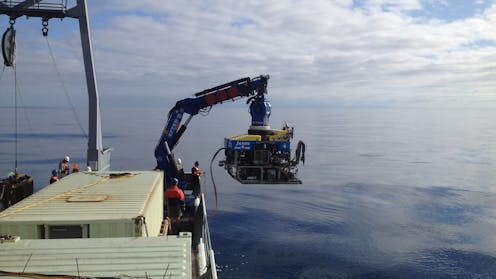
A submersible, which travels to the seafloor to collect rock and microbe samples, is lifted by the arm of a research vessel. James F. Holden

People have long wondered what life was first like on Earth, and if there is life in our solar system beyond our planet. Scientists have reason to believe that some of the moons in our solar system – like Jupiter’s Europa and Saturn’s Enceladus – may contain deep, salty liquid oceans under an icy shell. Seafloor volcanoes could heat these moons’ oceans and provide the basic chemicals needed for life.

Similar deep-sea volcanoes found on Earth support microbial life that lives inside solid rock without sunlight and oxygen. Some of these microbes, called thermophiles, live at temperatures hot enough to boil water on the surface. They grow from the chemicals coming out of active volcanoes.

Because these microorganisms existed before there was photosynthesis or oxygen on Earth, scientists think these deep-sea volcanoes and microbes could resemble the earliest habitats and life on Earth, and beyond.

To determine if life could exist beyond Earth in these ocean worlds, NASA sent the Cassini spacecraft to orbit Saturn in 1997. The agency has also sent three spacecraft to orbit Jupiter: Galileo in 1989, Juno in 2011 and most recently Europa Clipper in 2024. These spacecraft flew and will fly close to Enceladus and Europa to measure their habitability for life using a suite of instruments.

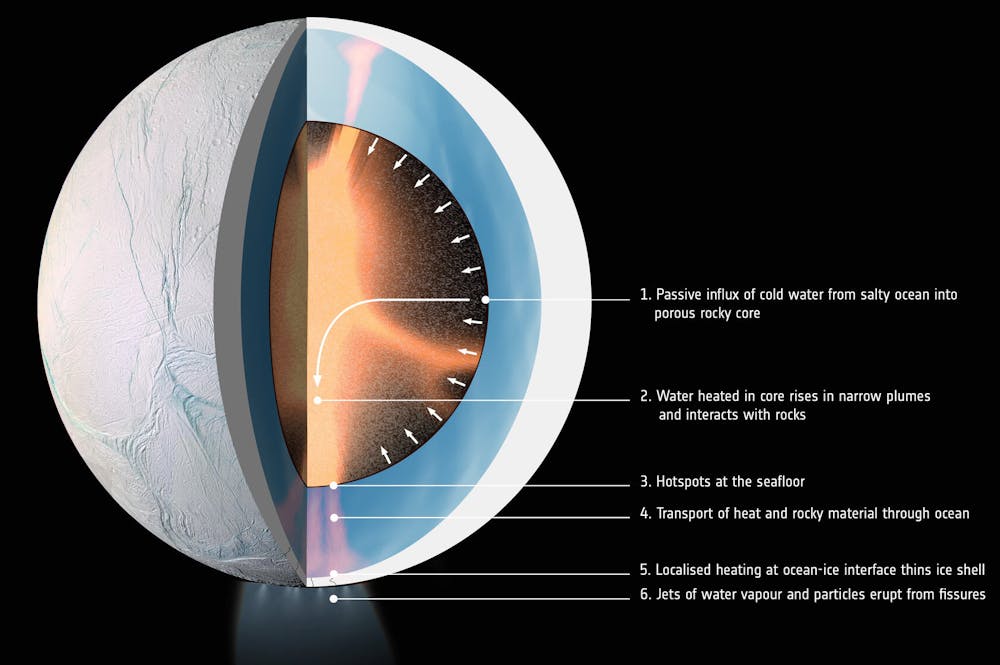
A diagram showing the inside of a gray moon, which has a hot, rocky core.
A diagram of the interior of Saturn’s moon Enceladus, which may have hot plumes beneath its ocean.
Surface: NASA/JPL-Caltech/Space Science Institute; interior: LPG-CNRS/U. Nantes/U. Angers. Graphic composition: ESA

However, for planetary scientists to interpret the data they collect, they need to first understand how similar habitats function and host life on Earth.

My microbiology laboratory at the University of Massachusetts Amherst studies thermophiles from hot springs at deep-sea volcanoes, also called hydrothermal vents.

Diving deep for samples of life

I grew up in Spokane, Washington, and had over an inch of volcanic ash land on my home when Mount St. Helens erupted in 1980. That event led to my fascination with volcanoes.

Several years later, while studying oceanography in college, I collected samples from Mount St. Helens’ hot springs and studied a thermophile from the site. I later collected samples at hydrothermal vents along an undersea volcanic mountain range hundreds of miles off the coast of Washington and Oregon. I have continued to study these hydrothermal vents and their microbes for nearly four decades.

A small, cylindrical capsule with equipment attached to the top travels underwater.
Crewed submarines travel deep underwater to collect samples from hydrothermal vents.
Gavin Eppard, WHOI/Expedition to the Deep Slope/NOAA/OER, CC BY

Submarine pilots collect the samples my team uses from hydrothermal vents using human-occupied submarines or remotely operated submersibles. These vehicles are lowered into the ocean from research ships where scientists conduct research 24 hours a day, often for weeks at a time.

The samples collected include rocks and heated hydrothermal fluids that rise from cracks in the seafloor.

The submarines use mechanical arms to collect the rocks and special sampling pumps and bags to collect the hydrothermal fluids. The submarines usually remain on the seafloor for about a day before returning samples to the surface. They make multiple trips to the seafloor on each expedition.

Inside the solid rock of the seafloor, hydrothermal fluids as hot at 662 degrees Fahrenheit (350 Celsius) mix with cold seawater in cracks and pores of the rock. The mixture of hydrothermal fluid and seawater creates the ideal temperatures and chemical conditions that thermophiles need to live and grow.

Tall clouds of smoke rising from rocks in the ocean.
Plumes rising from hydrothermal vents in the Atlantic Ocean.
P. Rona / OAR/National Undersea Research Program; NOAA

When the submarines return to the ship, scientists – including my research team – begin analyzing the chemistry, minerals and organic material like DNA in the collected water and rock samples.

These samples contain live microbes that we can cultivate, so we grow the microbes we are interested in studying while on the ship. The samples provide a snapshot of how microbes live and grow in their natural environment.

Thermophiles in the lab

Back in my laboratory in Amherst, my research team isolates new microbes from the hydrothermal vent samples and grows them under conditions that mimic those they experience in nature. We feed them volcanic chemicals like hydrogen, carbon dioxide, sulfur and iron and measure their ability to produce compounds like methane, hydrogen sulfide and the magnetic mineral magnetite.

A microscope image of a microbe, which looks like a big, circular dot.
The thermophilic microbe Pyrodictium delaneyi isolated by the Holden lab from a hydrothermal vent in the Pacific Ocean. It grows at 194 degrees Fahrenheit (90 Celsius) on hydrogen, sulfur and iron.
Lin et al., 2016/The Microbiology Society

Oxygen is typically deadly for these organisms, so we grow them in synthetic hydrothermal fluid and in sealed tubes or in large bioreactors free of oxygen. This way, we can control the temperature and chemical conditions they need for growth.

From these experiments, we look for distinguishing chemical signals that these organisms produce which spacecraft or instruments that land on extraterrestrial surfaces could potentially detect.

We also create computer models that best describe how we think these microbes grow and compete with other organisms in hydrothermal vents. We can apply these models to conditions we think existed on early Earth or on ocean worlds to see how these microbes might fare under those conditions.

We then analyze the proteins from the thermophiles we collect to understand how these organisms function and adapt to changing environmental conditions. All this information guides our understanding of how life can exist in extreme environments on and beyond Earth.

Uses for thermophiles in biotechnology

In addition to providing helpful information to planetary scientists, research on thermophiles provides other benefits as well. Many of the proteins in thermophiles are new to science and useful for biotechnology.

The best example of this is an enzyme called DNA polymerase, which is used to artificially replicate DNA in the lab by the polymerase chain reaction. The DNA polymerase first used for polymerase chain reaction was purified from the thermophilic bacterium Thermus aquaticus in 1976. This enzyme needs to be heat resistant for the replication technique to work. Everything from genome sequencing to clinical diagnoses, crime solving, genealogy tests and genetic engineering uses DNA polymerase.

A diagram showing a double helix strand of DNA, with a polymerase enzyme pulling the two strands apart and helping them become two new strands.
DNA polymerase is an enzyme that plays an essential role in DNA replication. A heat-resistant form from thermophiles is useful in bioengineering.
Christinelmiller/Wikimedia Commons, CC BY-SA

My lab and others are exploring how thermophiles can be used to degrade waste and produce commercially useful products. Some of these organisms grow on waste milk from dairy farms and brewery wastewater – materials that cause fish kills and dead zones in ponds and bays. The microbes then produce biohydrogen from the waste – a compound that can be used as an energy source.

Hydrothermal vents are among the most fascinating and unusual environments on Earth. With them, windows to the first life on Earth and beyond may lie at the bottom of our oceans.

The Conversation

James F. Holden receives funding from NASA.

ref. Microbes in deep-sea volcanoes can help scientists learn about early life on Earth, or even life beyond our planet – https://theconversation.com/microbes-in-deep-sea-volcanoes-can-help-scientists-learn-about-early-life-on-earth-or-even-life-beyond-our-planet-260977

Why is heart cancer so rare? A biologist explains

Source: The Conversation – USA – By Julie Phillippi, Associate Professor of Cardiothoracic Surgery and Bioengineering, University of Pittsburgh

When heart cancer does happen, it can be particularly serious. Olga Pankova/Moment via Getty Images

Curious Kids is a series for children of all ages. If you have a question you’d like an expert to answer, send it to CuriousKidsUS@theconversation.com.


Why is heart cancer so rare? – Jackson, age 12, Davis, California


You probably know someone who is affected by cancer. This disease results when cells divide uncontrollably and can make a person sick, sometimes very seriously.

Cancer can occur anywhere in the body because every tissue and organ is made up of billions or even trillions of cells. But there are some parts of the body where cancer doesn’t happen as often, such as the heart. Studies show 3 in 10,000 people develop heart cancer. In comparison, 1 in 20 women are expected to develop breast cancer. Why is that?

I’m a biologist who specializes in the blood vessels of the cardiovascular system. A big part of my work focuses on how cells interact with their environment to regulate the function of tissues and organs. Disease can develop when things go wrong.

Turns out, heart cells have unique features that make them super resistant to cancer.

How cancer starts

Cells produce more cells to grow, replace older or worn-out cells or to repair damaged tissues. This process is called cell division. Each type of cell in the body divides at different rates based on multiple factors, including what their function is and a person’s age.

For example, the cells of a growing human embryo divide extremely fast, undergoing four divisions in three days. The cells that make up the skin, nails and hair regularly replenish across your lifespan. Bone cells divide at a rate that will give you an entirely new skeleton approximately every 10 years.

Whether and how often a cell divides is tightly regulated by a series of molecular checkpoints. During cell division, genes within DNA are duplicated and evenly distributed into two daughter cells. Damage to these genes caused by exposure to harmful chemicals, ultraviolet light or radiation can result in mutations that cause disease. Mutations can just happen randomly, too. When there are mutations on the genes regulating cell division, cancer can develop.

Diagram of cell cycle, with checkpoints at the two cell growth phases and the DNA synthesis phase
Cells move through a series of checkpoints before division.
OpenStax, CC BY-SA

What protects heart cells from cancer?

Even though the heart is the first organ to form and start working during early development, cells in the adult heart divide very few times after birth, with division dramatically declining after age 20. In fact, less than 50% of heart cells are replaced over the course of an average human life. That means half of the heart cells you’re born with will be helping pump blood for your entire life.

This low rate of cell division in the adult heart likely serves as its primary defense against cancer. The less often a cell divides, the fewer opportunities there are for mistakes during DNA replication.

Diagram illustrating cross-section of chest cavity, showing heart nestled between the lungs and ribs
The heart’s location in the body gives it more protection from certain cancer-causing factors.
OpenStax, CC BY-SA

The heart is also less directly exposed to cancer-causing factors, such as UV light on the skin or inhaled substances in the lung, due to its protected location in the chest.

Unfortunately, the heart’s low rate of cell division has some downsides, such as a reduced ability to repair and replace cells damaged by disease, injury or aging.

Why heart cancer still happens

Even with the heart’s resistance to cancer, tumors may still form.

When cancer is found in the heart, it’s often the result of cancer cells migrating from another part of the body to the heart. This process is called metastasis. Certain types of skin cancers or cancers in the chest are more likely to spread to the heart, though this is still rare.

When they do happen, heart tumors can be quite serious and more aggressive than other cancers. A study analyzing more than 100,000 heart cancer cases in the United States found that patients who underwent surgery and chemotherapy to treat their heart cancer survived longer than those who did not.

Successful cancer care spans multiple areas of medicine. These include palliative care, which focuses on relieving pain and addressing symptoms, and integrative medicine, which considers the mind-body-spirit connection.

Heart cancer holds clues to heart regeneration

Understanding how heart cells divide and what causes that process to change offers clues about disease and shapes ideas for new treatments.

For example, research into how heart cells divide helps scientists better understand why the heart doesn’t heal well after a heart attack. Researchers found that although failing hearts have more dividing cells than healthy hearts, they need help to recover fully.

New technologies, such as the ability to reprogram blood cells into heart cells, have allowed researchers to develop new heart disease models to study and one day achieve heart regeneration. This opens doors for new treatments for heart diseases, including cancer.

Understanding why cancer doesn’t happen is just as important for developing new and better treatments as knowing why it does. The answers to both questions lie truly at the heart.


Hello, curious kids! Do you have a question you’d like an expert to answer? Ask an adult to send your question to CuriousKidsUS@theconversation.com. Please tell us your name, age and the city where you live.

And since curiosity has no age limit – adults, let us know what you’re wondering, too. We won’t be able to answer every question, but we will do our best.

The Conversation

Julie Phillippi receives funding from the National Heart Lung and Blood Institute.

ref. Why is heart cancer so rare? A biologist explains – https://theconversation.com/why-is-heart-cancer-so-rare-a-biologist-explains-256055