Cities aren’t built for older people – our study shows many can’t walk fast enough to beat a pedestrian crossing

Source: The Conversation – UK – By Max Western, Associate Professor of Behavioural Science, Co-Director, Centre for Motivation and Behaviour Change, University of Bath

Multishooter/Shutterstock

To many people, crossing a road at a traffic light is a mundane task requiring little thought or effort. But for the growing population of senior citizens with limitations to their mobility, strength or balance, crossing the road can be a stressful and sometimes life-threatening experience.

The reason? Cities simply aren’t designed for older people and others with restricted mobility – as our latest research demonstrates. We found that only 1.5% of the older people with reduced mobility in our study – just 17 out of 1,110 participants who had an average age of 77 – could cross the road faster than the 1.2 metres per second walking speed that is programmed into many UK pedestrian crossings.

They told us how “hurried”, “rushed” and “unsafe” they felt being out and about in a city. All lived independently across seven English cities: Bristol, Bath, Birmingham, Cardiff, Exeter, Manchester and Stoke.

Our latest study is part of our community-led active ageing programmes, designed to help adults over 65 with reduced mobility to improve their physical function. From the outset, we were struck by just how slowly many of the people we met walked. The task of trying to time them move four metres from a standing start with a stopwatch could be rather uncomfortable, such was the struggle of walking for some.

To test what this meant when they were faced with crossing the road at a pedestrian crossing, we made a simple comparison between the speed (1.2m/s) programmed into “standard” UK pedestrian crossings and the participants’ normal walking speed. While their average speed was significantly slower at 0.77m/s, many of our participants with reduced mobility were much slower than that – meaning they had no chance of crossing the road safely within the time allowed.

In fact, the majority would have needed to walk nearly twice as fast as their comfortable walking speed to cross a road without significant risk.

Distribution of walking speeds of older adults with limited mobility:

Chart showing walking speeds in metres per second for a total of 1,110 participants.
Walking speeds in metres per second for a total of 1,110 participants. Only 17 could walk faster than the standard UK pedestrian crossing setting.
Max Western/Centre for Motivation and Behaviour Change, CC BY-NC-SA

As many of our participants told us, this mismatch between urban design and the capabilities of the growing ageing population can have catastrophic consequences.

First, there is a risk that a failure to take account of inadequate mobility in street features such as pedestrian crossings lowers confidence in older people for staying active and walking outdoors. This often leads to further reductions in physical function and greater social isolation.

Second, those who do keep walking around their local town or city can feel rushed. This places them at risk of a fall when they cross roads quicker than feels comfortable – made worse by wet or windy conditions.

A fall in older adults increases the likelihood of disability and the need for hospital care. It can have a significant impact on life expectancy.

How to make cities truly age-friendly

Pedestrian crossings are one of many features of towns and cities that can affect the physical activity of a mobility-limited older population. In reviewing determinants of physical activity in older adults, we found that the aesthetic quality of the environment, a reduction in noise and air pollution, and the availability of places to rest were all aspects that can lead to greater walkability.

The Centre for Urban Wellbeing has partnered with older adults and local communities and companies to explore how Birmingham, the UK’s second-largest city, can better support its ageing population and move closer to becoming truly age-friendly.

Graphic of an urban pedestrian crossing.
Graphic from Active Travel England’s report: Critical safety issues for walking, wheeling and cycling (November 2025).
Active Travel England

Our research has highlighted the critical role of accessible infrastructure – well-maintained pavements, ramps, benches and public toilets make a big difference. Just as important are safe, welcoming spaces such as parks, gardens, and community hubs that encourage social connection and active living.

Much of our effort to improve quality of life in later years has centred on improving, or at least slowing the decline in, physical function and mobility. The benefits go beyond personal wellbeing: they translate into significant savings for the NHS and social care, largely through reduced hospital admissions.

But for these gains to last, older people need more than exercise programmes. They need safe, inviting communities that motivate them to get out and about. Walking to local destinations is one of the simplest ways to boost daily activity – yet it depends on environments that feel secure and accessible.

To be fair, there is some variability in the way pedestrian crossings work. Some wealthier districts have crossings with sensors that will hold traffic before a road is cleared of walkers.

Other use countdown timers to give some indication of how long a pedestrian has to cross, aiding a judgement on when to start their crossing of a road. But one thing that seems to be consistent is that green signals are programmed based on an assumed walking speed of 1.2 metres per second, which is clearly inappropriate for many people.

The onus should not rest on individuals with reduced mobility to keep pace in a fast-moving world. Rather, we urge cities to prioritise urban design that puts pedestrians first – creating environments that enable physical activity, especially among vulnerable groups.

When it comes to road crossings, simple measures such as extending green signal times at locations frequently used by older adults could make a big difference.

The Conversation

The authors do not work for, consult, own shares in or receive funding from any company or organisation that would benefit from this article, and have disclosed no relevant affiliations beyond their academic appointment.

ref. Cities aren’t built for older people – our study shows many can’t walk fast enough to beat a pedestrian crossing – https://theconversation.com/cities-arent-built-for-older-people-our-study-shows-many-cant-walk-fast-enough-to-beat-a-pedestrian-crossing-271874

Stakeknife: should the British government reveal the real name of its top IRA informer?

Source: The Conversation – UK – By Samantha Newbery, Reader in International Security, University of Salford

Of the countless people who provided intelligence to help the British state fight terrorism during the Troubles in Northern Ireland (1968-98), Agent Stakeknife was the best known. He had a reputation for having been involved in the most violent offences as a member of the IRA while simultaneously providing the British Army with intelligence.

While the identities of many of the informers who provided intelligence of this kind remain unknown, agent Stakeknife’s alleged identity as a man called Freddie Scappaticci was first made public in 2003.

The final report of a lengthy independent investigation into this case is now calling for the UK government to confirm Stakeknife’s identity. Operation Kenova, set up by the Police Service of Northern Ireland, found that Stakeknife was named as a suspect in dozens of crimes, including murders.

Although he denied it up until his death in 2023, Scappaticci is widely believed to have provided intelligence to the British Army from the late 1970s into the 1990s. Throughout this time he was also an active member of the IRA, something his handlers in the British Army – the people he reported to – were well aware of.

Agent Stakeknife was able to provide intelligence on the IRA’s members and activities across Northern Ireland. He was privy to a huge amount of sensitive information because he was part of – and may even have led – the IRA’s “nutting squad”. This unit’s aim was to find suspected informers within the IRA and punish or even kill them. Yet he himself was an informer.

The nutting squad has been described as being “like an electrical junction box through which every wire must flow”. It gave Stakeknife access to people and information across the IRA, making him particularly useful to the British Army.

But in this role, he was suspected of being involved in multiple counts of conspiracy to murder, conspiracy to unlawfully imprison and other potential charges in connection with the abduction, interrogation, torture and murder of people suspected, wrongly or rightly, of being informants.

Arguments for and against naming informers

Without the final piece of information on Stakeknife’s identity, the families of those who died feel they are not getting the whole truth.

Since Scappaticci’s death, there has been no attempt to refute claims he was Agent Stakeknife. While alive, a peer named him in the House of Lords as Stakeknife – a claim that was quickly retracted.

Scappaticci was never charged or convicted with any Troubles-related offences and now never will. Civil action is likely to continue, however. The High Court’s highly unusual ruling that Scappaticci’s will should be sealed rather than made public is likely to be challenged.

The Kenova investigators argued strongly that agent Stakeknife’s identity should be revealed. While they don’t confirm their belief that Stakeknife is Scappaticci, they do list the extensive list of reasons that have left many others thinking he was. Naming Stakeknife, they argue, is essential for victims and families, public discussion and debate, media freedom, open justice and public confidence in state authorities and the criminal justice system.

The British government has long maintained a policy regarding informers known as “neither confirm nor deny”. This protects informers’ lives as well as ensuring the government can continue to access intelligence that could save other lives.

Confirming that a particular individual is, or has been, an informer puts that person at risk of being killed by their associates to deter potential future informers and as a punishment. While Scappaticci is dead, others are still alive.

Naming informers also demonstrates to anyone considering becoming an informer that they may not be protected by whichever state organisation they come to work for, whether that be the police, the army or intelligence agencies such as MI5. This therefore reduces their chances of coming forward to provide intelligence.

On the other hand, to deny that Scappaticci or anyone else was an informer would create a situation where if someone else was later alleged to be an informer, if the government did not issue a denial for them, they would be assumed to be an informer. So while there is no harm to Scappaticci in either scenario, others could be put at risk.

Although this nine-year investigation has delivered some new nuggets of information about Agent Stakeknife, it is no surprise that there is disappointment from some quarters that the government still refuses to name Agent Stakeknife. This situation demonstrates the sometimes competing needs of truth, justice, accountability and intelligence work.

The Conversation

Samantha Newbery does not work for, consult, own shares in or receive funding from any company or organisation that would benefit from this article, and has disclosed no relevant affiliations beyond their academic appointment.

ref. Stakeknife: should the British government reveal the real name of its top IRA informer? – https://theconversation.com/stakeknife-should-the-british-government-reveal-the-real-name-of-its-top-ira-informer-271699

The UAE is leaving Saudi Arabia squeezed in Yemen

Source: The Conversation – UK – By Andreas Krieg, Associate Professor, Defence Studies Department, King’s College London

Fighters aligned with the Southern Transitional Council (STC), a separatist group in southern Yemen, raised their flags in the provinces of Hadramout and Marah in early December. The seizures mean the STC now controls all eight of the provinces that make up the south of the country.

The new status quo looks like a fait accompli for the creation of a separate southern state. It has left Yemen’s internationally recognised government, the Presidential Leadership Council (PLC), squeezed between a pole in the south and a state run by the Iran-backed Houthi militia in the north.

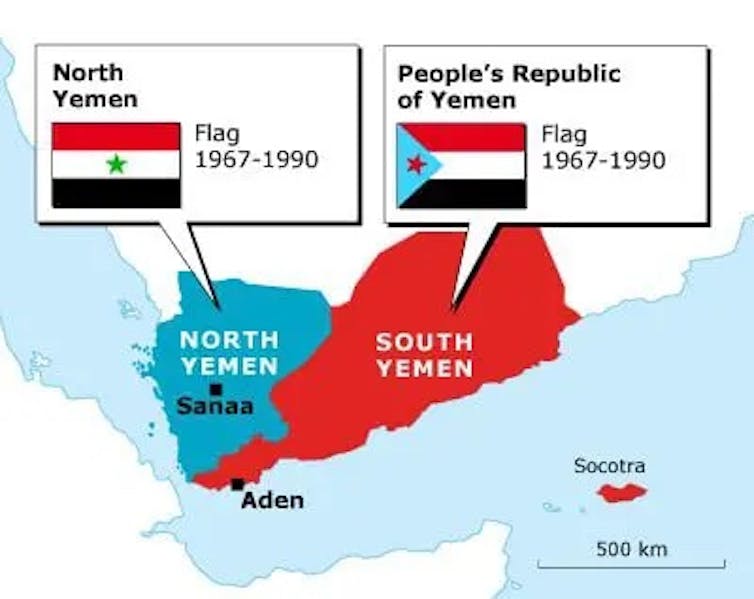
The STC taps into memories of the People’s Democratic Republic of Yemen which, until 1990, gave southerners their own state. Yemen’s 1990 unification produced one flag, but many people in the south never felt they joined a shared political project.

These grievances led to a brief civil war in 1994. This war ended with northern victory, purges of southern officers and civil servants, and what many in the south still describe as an occupation rather than integration.

A map showing North Yemen and South Yemen before unification.
Yemen unified in 1990, with Sana’a as its capital.
FANACK, CC BY-NC-ND

By the mid-2000s, retired officers and dismissed civil servants in the south were marching for pensions and basic rights. Those protests turned into al-Hirak al-Janoubi, a loose southern movement running from reformists to hardline secessionists.

And when the 2015 Saudi-led intervention began against the Houthis, which had seized the Yemeni capital of Sana’a the previous year, southern fighters were folded into a campaign to restore a “national” government that had never addressed their grievances.

The STC was formed in 2017 to try and give this crowded field in the south a recognisable leadership. It has a formal president, Aidarus al-Zubaidi, and councils. But in practice it sits at the centre of a web of armed units, tribal groups and businessmen.

Through sustained financial and material backing for the southern armed groups, the United Arab Emirates (UAE) emerged as the midwife of the organisation’s creation. Against the backdrop of widespread failed governance in Yemen, the STC project seems to deliver relatively well on security and public services.

In April 2022, several years after the STC’s formation, the PLC was created to unite the forces fighting the Houthis. Yemen’s Saudi Arabia-based president, Abd-Rabbu Mansour Hadi, resigned and handed his powers over to an eight-member body backed by Riyadh.

The PLC was designed to bridge the various tribal, ideological and political divides in the country. It also aimed to create a platform to coordinate governance and statecraft with a view to engaging the Houthis through diplomacy.

But as it mixes northern and southern leaders, including those from the STC, the PLC has never emerged as a viable hub to merge competing agendas. The inability of the PLC to deliver on its promise to consolidate governance across Yemen has incrementally eaten away at its legitimacy.

A Gulf proxy war

Yemen has turned into a quiet scorecard for two Gulf projects. Saudi Arabia intervened to defeat the Houthis, rescue a unified Yemeni state and secure its own borders. The UAE went in to secure reliable partners, access to ports and sea lanes and control of resources as part of its regional policy.

A glimpse at a map of Yemen today shows it is the UAE whose vision seems to have been realised. Through the STC and a web of allied units, the UAE has helped stitch together a power base that runs across nearly all of former South Yemen. STC-aligned forces hold the city of Aden, sit on much of Yemen’s limited oil production and control long stretches of the Arabian and Red Sea coasts.

Control of terrain in Yemen

A map showing control of terrain in Yemen.
Pink or blue shaded areas depict territory controlled by the PLC or allied forces, yellow or orange depict territory controlled by the STC or allied forces, green depicts areas controlled by the Houthis.
NordNordWest / Wikimedia Commons, CC BY-NC-SA

Key national infrastructure in southern Yemen is now guarded by men whose salaries, media platforms and external ties flow through Abu Dhabi. In return, the UAE enjoys a loyal surrogate on the Gulf of Aden and the approaches to the Bab al-Mandab strait. Saudi Arabia, by contrast, has been left propping up a fragile PLC.

The Houthis remain the nominal enemy for everyone. But, in reality, UAE-aligned units have poured more bandwidth into sidelining Saudi-backed rivals in southern Yemen than engaging the insurgent-turned-state in the north. The UAE now holds leverage over Yemen’s crown jewels in the south, while Saudi Arabia shoulders the burden of the narrative of a “united Yemen” with few dependable allies inside the country.

Two-and-a-half Yemens

For decades, neighbours Saudi Arabia and Oman as well as most foreign capitals have sworn by a single Yemeni state. The UAE-backed STC project cuts directly across that line, with an entrenched southern order making a formal split far more likely.

If Yemen is carved in two, the Houthi structure in the north does not evaporate; it gains borders, time and eventually a stronger claim to recognition. That would cement a heavily armed ideological authority at the mouth of the Red Sea, tied to Tehran and Hezbollah and ruling over a population drained by war and economic collapse.

Yet, confronted with the multilayered network created by Iran and the UAE in Yemen, Saudi Arabia has few cards to play. It may eventually be forced to concede to a UAE-backed government-in-waiting in the south while the north settles into Houthi rule and territory held by the PLC gets increasingly squeezed.

Oman keeps arguing for a shared table that brings all parties – including the Houthis – into one system. But every new southern flag raised undercuts that goal. For outside powers, a southern client that keeps ports open and hunts Islamist militants is tempting.

The price is to freeze northern Yemen as a grey zone: heavily armed, ideologically rigid and wired into regional confrontation. That outcome cuts against the very unity project Saudi Arabia and Oman have endorsed for years. What is left today are two-and-a-half Yemens – with the half, territory administered by the PLC, looking the least sustainable moving forward.

The Conversation

Andreas Krieg does not work for, consult, own shares in or receive funding from any company or organisation that would benefit from this article, and has disclosed no relevant affiliations beyond their academic appointment.

ref. The UAE is leaving Saudi Arabia squeezed in Yemen – https://theconversation.com/the-uae-is-leaving-saudi-arabia-squeezed-in-yemen-271777

One sperm donor fathered 200 children and passed on a deadly mutation – and it could easily happen again

Source: The Conversation – UK – By Nicky Hudson, Professor of Medical Sociology, De Montfort University

Billion Photos/Shutterstock

Around 200 children in several countries were conceived with sperm from a single donor who unknowingly carried a rare genetic mutation linked to early onset cancers, it has been revealed. The consequences have been devastating. Several children have already died and many families across Europe are now facing a risk they never expected.

The case has prompted urgent questions. How was one donor used so widely? Why did standard safeguards fail to identify a mutation that can have such severe consequences? And how did a system created to create families allow a tragedy of this scale?

When someone donates sperm or eggs they are screened for a set of common inherited conditions before being accepted by a clinic. The exact process varies by country and it has limitations. Screening depends heavily on accurate family history, yet many people have incomplete information about their relatives.

Some conditions emerge later in adulthood, which means a young donor may appear healthy. Clinics also focus primarily on established, higher frequency conditions rather than the vast number of rare variants that exist.

Ordinarily, donors complete a detailed questionnaire covering their medical background and their family’s health history. If the information suggests a possible inherited risk, the donor may be offered further testing or, more commonly, they may be declined.

More recently, clinics have begun to use expanded genetic screening. These tests can examine hundreds of genes linked to childhood or early adulthood conditions.

However, the technology is still developing and cannot detect every possible disease-causing variant. Many rare mutations are not part of routine panels, either because they have only recently been identified or because the evidence base is still small.

That context matters in this case. The donor had no family history of the condition and showed no symptoms. A person can carry a harmful mutation without being affected themselves, so nothing in his medical history raised concerns. The newer, broader screening was not used, but even if it had been, the variant is so rare that it may not have been included or detectable.

The donor provided sperm to the European Sperm Bank in Denmark for around 17 years. His donations were used to create roughly 200 children across multiple European countries, although experts say the true number could be higher.

This scale was possible because there is no international law limiting how widely donor sperm can be distributed. Many countries have rules on how many families can be created from a single donor.

The United Kingdom, for instance, permits no more than ten families. These limits, however, apply only within national borders. A donor can be used in several countries without any system to flag that the overall number has far exceeded what any one country would allow.

A recent unrelated case showed how extreme this can become. A different donor was found to have fathered around 1,000 children in several countries. There were no known health issues in that situation, but it revealed how donor use can expand rapidly without oversight.

The challenges in the current case are profound. Families are dealing with grief and uncertainty. Some have lost children. Others face a very high likelihood that their child will develop cancer before the age of 60, often in infancy or childhood.

There has been little public discussion about the sperm donor himself, although the emotional impact of learning these outcomes is likely to be significant.

Because the mutation was so rare, additional routine testing would probably not have prevented what happened. In truth, every person carries some genetic variants that remain undetected and harmless in everyday life.

There have been earlier examples of donors unknowingly passing on inherited conditions, such as cystic fibrosis or fragile X syndrome, but those cases typically involved far fewer families. What makes this case stand out is the sheer number of children affected.

For this reason, simply calling for more screening is unlikely to be the full answer. The more pressing issue is the lack of limits and monitoring on how many families can be created from one donor across borders.

In this case, families were created in several countries and in some places even the national limits were breached. Belgium, for example, permits only six families per donor, yet reports indicate that about 38 families were created.

What is needed is a robust system for tracking and tracing donor use both within and between countries. Without coordinated oversight, national limits are easily bypassed. Establishing international upper limits will be difficult and politically complex, but the conversation has to begin if further tragedies are to be prevented.

As more people use commercial DNA testing to find donor relatives, large networks of siblings connected across countries are becoming increasingly visible. The implications for those families are significant. A coordinated global approach is overdue and would help prevent another case like this one, where families are left facing consequences they could never have foreseen.

The Conversation

Nicky Hudson receives funding from the Economic and Social Research Council on expanded carrier screening and gamete donation (reference: ES/W012456/1, ES/N010604/1, ES/V002430/1. She is a member of the NICE Guideline Committee on Fertility and a member of the British Fertility Society’s Law Policy and Ethics Special Interest Group.

ref. One sperm donor fathered 200 children and passed on a deadly mutation – and it could easily happen again – https://theconversation.com/one-sperm-donor-fathered-200-children-and-passed-on-a-deadly-mutation-and-it-could-easily-happen-again-271856

Eleanor the Great: a tonally uncertain Holocaust drama with a wonderful central performance

Source: The Conversation – UK – By Matt Jacobsen, Senior Lecturer in Film History in the School of Society and Environment, Queen Mary University of London

Despite a wonderful central performance from June Squibb, Scarlett Johansson’s directorial debut is a sentimental, tonally uncertain drama about grief and holocaust survival

Eleanor Morgenstein, a 94-year-old Midwesterner living in Florida, moves to New York after the death of her close friend and roommate Bessie, a Holocaust survivor. She joins a Jewish seniors group and accidentally finds herself part of a meeting of Holocaust survivors.

Eleanor, at first buoyed by the prospect of new friends, fabricates past experiences based on the Bessie’s stories, claiming harrowing recollections as her own.

Nina (Erin Kellyman), a journalism student writing a piece on Holocaust survivors, attends the meetings and is moved by Eleanor’s stories. Having recently lost her mother she connects with Eleanor through shared grief.

Eleanor starts out with ambiguously good intentions of preserving the memory of a dear friend. However, she is soon out of her depth when Nina’s article is taken up by Nina’s news anchor father (Chiwetel Ejiofor) as a human interest story for his show.

Early in the film, a comic exchange in a supermarket aisle telegraphs the film’s central theme. An acquaintance in his 90s tells Eleanor crossly: “You were born in New York. You can’t feel bad about the Holocaust. You weren’t there.”

The film wants to probe the ways in which grief is processed individually and collectively, asking us to consider what drives Eleanor to appropriate her friend’s traumatic life history.

At the centre of the film is the wonderful performance by Squibb, then 94 but now 96, who had a sturdy but unspectacular stage and screen career for more than 60 years before her breakthrough performance in Alexander Payne’s superb Nebraska in 2013.

Eleanor the Great is not a film specifically concerned with ageing and we are not so conscious of the vivacious Squibb’s age until a care home subplot is shoehorned in.

Scarlett Johansson was motivated to direct this film after her own investigations into her family’s history of Holocaust survival. She may have the highest grossing body of work in Hollywood for action films like The Avengers series, but she has a considerable track record of excellent low key independent films – from her breakthrough in Ghost World to Noam Baumbach’s powerful Marriage Story. Eleanor the Great most clearly takes its inspiration from that kind of American character drama.

There is little technical flair or stylistic character to distinguish Johansson as a director in this first feature. The gently sentimental scenes of New York City, its diners, crosswalks and ranks of yellow taxis are clearly inspired by the work of Baumbach as well as Woody Allen, Johansson’s director in two films (Vicky Cristina Barcelona, Match Point).

The film is at its strongest in the Allen-esque day-to-day moments in the city that let Squibb embody her character with gentle acidity and likeable crankiness. Johansson, like many actors-turned-directors, has a strength when it comes to allowing performers space to breathe and inhabit their characters. Scenes unfold quietly and unhurriedly.

The script, by Tory Kamen, could be wittier, sharper and more engaging, as there is a promise in character interactions that never quite take flight. When the film reaches what should be its narrative peak with the unravelling of Eleanor’s fabrications it is neither emotional nor funny.

Instead the climax’s tone is uncertain, sentimental and lands flat. What follows is a series of fraught conversations where the actors gamely try to mine emotional heft from a dreary screenplay.

The cultural memory of the Holocaust and the enormity of its legacy on Jewish descendants has been probed with considerably more success elsewhere. Jesse Eisenberg’s impressive, Bafta-winning and Oscar-nominated A Real Pain featured a pair of cousins on a tour of Jewish Poland, confronting its young characters with the memory of the Holocaust.

That film takes a well-executed midway tonal turn from broad character comedy to unexpected powerful poignancy. This happens in a scene where the usually motor-mouthed, bickering men are silenced in the face of a visit to the Majdanek concentration camp. Eleanor the Great doesn’t possess a moment like this that would drive its well-intentioned message home.

The film attempts to sidestep the callousness of Eleanor’s appropriation of Bessie’s stories by switching to flashbacks. In these memories we see Eleanor hear these stories for the first time in the middle of a sleepless night. These scenes, where the words come directly from Bessie, are well acted and moving, especially in a longer, emotional monologue towards the film’s climax.

When the film’s attention turns in the final third to the issue of whether Eleanor should be placed in a retirement home, the tone similarly skirts between humour and pathos – neither of which connect.

The film has admirable intentions but its script and plotting are not worthy of the excellent performance at the film’s heart. It also can’t quite bear the seriousness or the potential power of its central themes, leading to a disappointingly hollow experience.


Looking for something good? Cut through the noise with a carefully curated selection of the latest releases, live events and exhibitions, straight to your inbox every fortnight, on Fridays. Sign up here.


The Conversation

Matt Jacobsen does not work for, consult, own shares in or receive funding from any company or organisation that would benefit from this article, and has disclosed no relevant affiliations beyond their academic appointment.

ref. Eleanor the Great: a tonally uncertain Holocaust drama with a wonderful central performance – https://theconversation.com/eleanor-the-great-a-tonally-uncertain-holocaust-drama-with-a-wonderful-central-performance-271895

Le sort de Warner Bros suspendu au duel Netflix–Paramount

Source: The Conversation – in French – By Julien Jourdan, Professeur, HEC Paris Business School

Ce pourrait être un épisode d’une série américaine sur le monde des affaires. Qui, de Paramount ou de Netflix, mettra la main sur la Warner Bros ? Les deux projets n’ont pas les mêmes motivations. Surtout, l’un et l’autre devront faire avec le droit de la concurrence aux États-Unis, mais aussi en Europe, mondialisation oblige. Résumé des premiers épisodes, si vous avez manqué le début…


La nouvelle a frappé Hollywood de stupeur. Le 4 décembre dernier, Netflix annonçait l’acquisition des studios Warner Bros. (WB) pour 83 milliards de dollars, coiffant au poteau le favori Paramount. La situation s’est depuis compliquée : le patron de Paramount, David Ellison, a surenchéri avec une offre hostile à 108 milliards de dollars pour l’ensemble du groupe WB Discovery, incluant les studios ainsi qu’un bouquet – en déclin – de chaînes de télévision, dont la célèbre chaîne d’information CNN.

L’issue de cette bataille est incertaine à l’heure actuelle. Les deux opérations sont de nature différente. Un achat par Paramount impliquerait une triple fusion entre deux studios, deux plates-formes de streaming – Paramount+ (79 millions d’abonnés) et HBO+ (128 millions d’abonnés) – et deux bouquets de chaînes de télévision (dont CNN et CBS). Ce serait une fusion horizontale entre des acteurs en concurrence directe sur leurs marchés. L’impact social pourrait être très lourd : l’opération prévoit 6 milliards de dollars de synergies, en grande partie via la suppression de postes en doublon.


À lire aussi :
Netflix, une machine à standardiser les histoires ?


Si Netflix mettait la main sur WB, ce serait principalement pour acquérir le vaste catalogue de WB et de HBO, les chaînes du câble étant exclues de l’offre du géant du streaming. Les synergies anticipées, de l’ordre de 3 milliards, concerneraient les dépenses technologiques pour les deux tiers et seraient constituées, pour le reste, d’économies sur les achats de droits de diffusion. Netflix pourrait ainsi librement diffuser Game of Thrones ou Harry Potter auprès de ses 302 millions d’abonnés dans le monde. Ce serait une fusion verticale combinant un producteur de contenus, WB, et un diffuseur, Netflix, qui éliminerait au passage un concurrent notable, HBO+.

Des précédents coûteux

Ce type d’opération pourrait rendre nerveux quiconque se rappelle l’histoire des fusions de Warner Bros. Déjà en 2001, le mariage de WB et d’AOL célébrait l’alliance du contenu et des « tuyaux » – pour utiliser les termes alors en vogue. L’affaire s’était terminée de piteuse manière par le spin-off d’AOL et l’une des plus grosses dépréciations d’actifs de l’histoire – de l’ordre de 100 milliards de dollars. Quinze ans plus tard, AT&T retentait l’aventure. L’union fut de courte durée. En 2021, le géant des télécoms se séparait de WB, qui se voyait désormais associé au groupe de télévision Discovery, sous la direction de David Zaslav, aujourd’hui à la manœuvre.

Pourquoi ce qui a échoué dans le passé marcherait-il aujourd’hui ? À dire vrai, la position stratégique de Netflix n’a rien à voir avec celle d’AOL et d’AT&T. Les fusions verticales précédentes n’ont jamais produit les synergies annoncées pour une simple raison : disposer de contenu en propre n’a jamais permis de vendre plus d’abonnements au téléphone ou à Internet. Dans les deux cas, le château de cartes, vendu par les dirigeants, et leurs banquiers, s’est rapidement effondré.

Un catalogue sans pareil

Une fusion de Netflix avec WB délivrerait en revanche des bénéfices très concrets : le géant du streaming ajouterait à son catalogue des produits premium – films WB et séries HBO – dont il est à ce jour largement dépourvu. L’opération permettrait de combiner l’une des bibliothèques de contenus les plus riches et les plus prestigieuses avec le média de diffusion mondiale le plus puissant qui ait jamais existé. L’ensemble pourrait en outre attirer les meilleurs talents, qui restent à ce jour largement inaccessibles à Netflix.

En pratique, certains contenus, comme la série Friends, pourraient être inclus dans l’offre de base pour la rendre plus attractive et recruter de nouveaux abonnés. D’autres films et séries pourraient être accessibles via une ou plusieurs options payantes, sur le modèle de ce que fait déjà Amazon Prime, augmentant ainsi le panier moyen de l’abonné.

Le rapprochement de deux stars du divertissement ferait à coup sûr pâlir l’offre de leurs concurrents, dont Disney mais aussi… Paramount. Et c’est là que le bât blesse. Les autorités de la concurrence, aux États-Unis et en Europe, approuveront-elles la formation d’un tel champion mondial ? Si la fusion est confirmée, les procédures en recours ne tarderont pas à arriver.

CNN dans le viseur

C’est l’argument avancé par David Ellison, le patron de Paramount, qui agite le chiffon rouge de l’antitrust pour convaincre les actionnaires de WBD : que restera-t-il du studio si la fusion avec Netflix est rejetée après deux ans de procédures ? Ted Sarandos, le co-PDG de Netflix, pourrait lui retourner la pareille, car une fusion horizontale avec Paramount ne manquerait pas d’éveiller, elle aussi, des inquiétudes – d’autant plus qu’elle serait largement financée par des capitaux étrangers venant du Golfe.

France 24 2025.

Le fils de Larry Ellison, deuxième fortune mondiale, réputé proche du président américain, s’est assuré le soutien financier du gendre de ce dernier, Jared Kushner. Si Donald Trump se soucie probablement assez peu du marché du streaming, il pourrait être sensible au sort réservé à la chaîne CNN, une de ses bêtes noires. En cas de victoire de Paramount, CNN pourrait être combinée avec CBS et sa ligne éditoriale revue pour apaiser le locataire de la Maison-Blanche. Du côté du vendeur, David Zaslav laisse les enchères monter. Il pourrait empocher une fortune – on parle de plus de 425 millions de dollars.

À cette heure, le sort de WB est entre les mains de cette poignée d’hommes. Des milliers d’emplois à Los Angeles, et ailleurs, sont en jeu. Une fusion WB/Netflix pourrait par ailleurs accélérer la chute de l’exploitation des films en salles, dans un contexte d’extrême fragilité : le nombre de tickets vendus dans les cinémas en Amérique du Nord a chuté de 40 % depuis 2019. Netflix pourrait choisir de diffuser directement sur sa plateforme certains films de WB, qui représente environ un quart du marché domestique du cinéma. Pour les films qui conserveraient une sortie en salle, la fenêtre d’exclusivité réservée aux exploitants pourrait se réduire à quelques semaines, fragilisant un peu plus leur économie. Hollywood retient son souffle.

The Conversation

Julien Jourdan ne travaille pas, ne conseille pas, ne possède pas de parts, ne reçoit pas de fonds d’une organisation qui pourrait tirer profit de cet article, et n’a déclaré aucune autre affiliation que son organisme de recherche.

ref. Le sort de Warner Bros suspendu au duel Netflix–Paramount – https://theconversation.com/le-sort-de-warner-bros-suspendu-au-duel-netflix-paramount-271954

Le smic protège-t-il encore de la pauvreté ?

Source: The Conversation – in French – By Hugo Spring-Ragain, Doctorant en économie / économie mathématique, Centre d’études diplomatiques et stratégiques (CEDS)

Vendredi 12 décembre 2025, le Groupe d’experts sur le smic publie un rapport sur l’impact du salaire minimum sur l’économie française. Son impact sur la pauvreté n’est cependant pas univoque. Le smic ne suffit pas à expliquer les trajectoires personnelles de plus en plus diverses. Le revenu disponible qui prend en compte les aides perçues et les dépenses contraintes est un critère plus juste.


La question revient cette année encore avec le rapport du Groupe d’experts du smic publié ce vendredi 12 décembre : le salaire minimum protège-t-il encore réellement de la pauvreté ? Pourtant, comme l’ont rappelé l’Insee et l’Institut des politiques publiques (IPP) dans plusieurs travaux plus ou moins récents, le salaire brut, seul, ne détermine pas la pauvreté. Ce qui importe, c’est le niveau de vie, c’est-à-dire le revenu disponible après transferts sociaux de toutes sortes (qui s’ajoutent), impôts et charges contraintes (qui se soustraient). Dans un contexte de renchérissement du logement (13 % d’augmentation de l’indice de référence des loyers, IRL) et d’hétérogénéité croissante des situations familiales, la question ne doit plus être posée en termes uniquement macroéconomiques.

La littérature académique reprend ce constat. Antony B. Atkinson souligne que la pauvreté ne renvoie pas simplement à un « manque de salaire », mais à un insuffisant accès aux ressources globales ; Patrick Moyes rappelle que la structure familiale modifie profondément le niveau de vie relatif. Quant à France Stratégie et l’Insee, après sa publication faisant l’état des lieux de la pauvreté en France, ils documentent la montée de ce qu’on appelle la pauvreté laborieuse, c’est-à-dire le fait de travailler sans pour autant dépasser les seuils de pauvreté et sans possibilité de profiter de l’ascenseur social.


À lire aussi :
La pauvreté de masse : symptôme d’une crise de la cohésion sociale


Un amortisseur d’inflation ?

Notre premier graphique compare l’évolution du smic, des salaires et des prix depuis 2013. On y observe très nettement que le salaire minimum a servi d’amortisseur pendant la séquence inflationniste récente : ses revalorisations automatiques l’ont fait progresser aussi vite, souvent plus vite, que l’indice des prix à la consommation.

Figure 1 – Évolution du smic, du salaire mensuel de base (SMB), du salaire horaire de base des ouvriers et des employés (SHBOE) et de l’indice des prix à la consommation (IPC) hors Tabac – Sources : Dares, Insee, Rapport GES 2025 – Graphique de l’auteur.

Ce mouvement contraste avec celui des salaires moyens, dont la progression a été plus lente. Comme le soulignent plusieurs analyses de France Stratégie et de l’Organisation de coopération et de développement économiques (OCDE), cela a eu pour effet de resserrer la hiérarchie salariale, une situation déjà documentée lors de précédentes périodes de rattrapage du smic.

L’influence du temps de travail

Mais ce constat ne dit rien d’une dimension pourtant déterminante : l’accès au temps plein car une partie des salariés au smic n’y est pas à temps complet. Comme l’ont montré plusieurs travaux de l’Insee et de la direction de l’animation de la recherche, des études et des statistiques (Dares, ministère du travail), une proportion importante de travailleurs rémunérés au salaire minimum occupe des emplois à temps partiel, et souvent non par choix mais parce qu’aucun temps plein n’est disponible. C’est ce que les économistes appellent le temps partiel contraint.

Ce temps partiel modifie radicalement l’interprétation du smic : on parle d’un salaire minimum horaire, mais, concrètement, les ressources mensuelles ne reflètent pas ce taux. Un salaire minimum versé sur 80 % d’un temps plein ou sur des horaires discontinus conduit mécaniquement à un revenu inférieur et donc à une exposition accrue à la pauvreté.

Mais si l’on s’en tenait à cette comparaison, on pourrait conclure que le smic protège pleinement les salariés les plus modestes. Or, c’est précisément ici que la question se complexifie. Car la pauvreté ne dépend pas du seul salaire : elle dépend du revenu disponible et donc de l’ensemble des ressources du ménage. C’est ce que montrent les travaux sur la pauvreté laborieuse, un phénomène en hausse en France selon l’Observatoire des inégalités, environ une personne en situation de pauvreté sur trois occupe un emploi mais les charges familiales, le coût du logement ou l’absence de second revenu maintiennent le ménage sous les seuils de pauvreté.

Du smic au revenu disponible

Pour comprendre la capacité réelle du smic à protéger de la pauvreté, il faut observer ce qu’il devient une fois transformé en revenu disponible grâce aux données de l’Insee et de la Dares, c’est-à-dire le revenu après impôts, aides et charges incompressibles.

Le graphique suivant juxtapose trois situations familiales : une personne seule, un parent isolé avec un enfant et un couple avec un enfant dont les deux adultes perçoivent le smic.

Figure 2 – Revenu disponible et seuils de pauvreté selon trois profils de ménages rémunérés au smic Sources : Dares, Insee, Rapport GES 2025 – Graphique de l’auteur.

Dans le premier panneau, on observe qu’une personne seule rémunérée au smic dispose d’un revenu disponible supérieur au seuil de pauvreté à 60 % du revenu médian. La prime d’activité joue un rôle important, mais c’est surtout l’absence de charge familiale et de coûts fixes élevés qui explique ce résultat.

Ce profil correspond à la représentation classique du smic comme filet de sécurité individuel. Comme le confirment les données de l’Insee et les travaux de France Stratégie, la pauvreté laborieuse y est encore relativement limitée. Cependant, même seul, un actif au smic pourrait avoir des dépenses contraintes extrêmement élevées dans des zones à forte demande locative.

La pauvreté laborieuse

Le deuxième panneau raconte une histoire totalement différente. Le parent isolé, même à temps plein au smic se situe clairement en dessous du seuil de pauvreté, plus grave encore, son revenu disponible ne compense plus le salaire net via les transferts. C’est ici que la notion de pauvreté laborieuse prend tout son sens. Malgré un emploi et malgré les compléments de revenu, le ménage reste dans une situation de fragilité structurelle.

Selon l’Insee, les familles monoparentales sont aujourd’hui le groupe le plus exposé à la pauvreté et notamment à la privation matérielle et sociale, non parce qu’elles travaillent moins, mais parce qu’elles cumulent un revenu unique, des charges plus élevées et une moindre capacité d’ajustement.

Dans le troisième panneau, un couple avec un enfant et deux smic vit lui aussi en dessous de la ligne de pauvreté. Ce résultat laisse penser que la composition familiale, même accompagnée de deux smic crée une pauvreté structurelle sur les bas revenus ; aussi le graphique montre-t-il que la marge est finalement assez limitée. Une partie du gain salarial disparaît en raison de la baisse des aides et de l’entrée dans l’impôt, un phénomène bien documenté par l’IPP et par le rapport Bozio-Wasmer dans leurs travaux sur les « taux marginaux implicites ». Dans les zones de loyers élevés, un choc de dépense ou une hausse de charges peut faire basculer ces ménages vers une situation beaucoup plus précaire.

ICI France 3 Hauts-de-France, 2024.

Situations contrastées

Une conclusion s’impose : le smic protège encore une partie des salariés contre la pauvreté, mais ce résultat est loin d’être uniforme. Il protège l’individu à plein temps et sans enfant, mais ne suffit plus à assurer un niveau de vie décent lorsque le salaire doit couvrir seul les charges d’un foyer, notamment dans les configurations monoparentales. Cette asymétrie est au cœur de la montée de la pauvreté laborieuse observée par l’Insee et documentée par l’Institut des politiques publiques.

Ces résultats rappellent que la pauvreté n’est plus seulement un phénomène d’exclusion du marché du travail. Elle touche des travailleurs insérés, qualifiés et en contrat stable, mais dont le salaire minimum, appliqué sur un volume horaire insuffisant ou absorbé par des dépenses contraintes, ne permet plus un niveau de vie supérieur aux seuils de pauvreté. Le smic se révèle alors davantage un plancher salarial individuel qu’un instrument de garantie sociale familiale.

À l’heure où la question du pouvoir d’achat occupe une place centrale et où la revalorisation du smic reste l’un des outils majeurs d’ajustement, ces conclusions invitent à réorienter le débat. Ce n’est pas seulement le niveau du smic qu’il faut interroger, mais sa capacité à constituer un revenu de référence pour des configurations familiales et territoriales très hétérogènes. Autrement dit, le smic joue encore sa fonction de stabilisateur individuel, mais il n’est plus suffisant seul pour protéger durablement certains ménages.

La question devient alors moins « De combien augmenter le smic ? » que « Comment garantir que le revenu disponible issu d’un emploi au smic permette effectivement d’éviter la pauvreté ? ».

The Conversation

Hugo Spring-Ragain ne travaille pas, ne conseille pas, ne possède pas de parts, ne reçoit pas de fonds d’une organisation qui pourrait tirer profit de cet article, et n’a déclaré aucune autre affiliation que son organisme de recherche.

ref. Le smic protège-t-il encore de la pauvreté ? – https://theconversation.com/le-smic-protege-t-il-encore-de-la-pauvrete-271245

England’s synthetic phonics approach is not working for children who struggle to read

Source: The Conversation – UK – By Dominic Wyse, Professor of Early Childhood and Primary Education, UCL

JPC-PROD/Shutterstock

Since 2012, England has taken an increasingly narrow approach to how primary school teachers should teach reading.

The policies on teaching reading have insisted that an approach called “systematic synthetic phonics” is the only way to teach reading. Synthetic phonics involves teaching children the 44 sounds, or “phonemes”, of language and how they are represented by letters in words.

England’s approach to teaching reading was alleged to have created “the best readers in the Western world” by the previous government, when England rose up the rankings of an international reading assessment.

Other countries and regions are now following England’s lead. For example, Australia is following many aspects of England’s approach to phonics. The US has moved towards a much greater emphasis on synthetic phonics. And New Zealand has abandoned the programme called Reading Recovery in favour of more emphasis on phonics.

These regions claim to be basing their new teaching approaches on “the science of reading”. But an accurate reading of the science shows that there are a range of different evidence-based approaches that can be taken to teaching children about phonemes and letters. If countries are following England’s lead, then we need to be sure that England’s approach is based on the most up to date research evidence.

Unfortunately the outcomes for children with reading difficulties in England, over more than a decade, tell a different story from those who claim that narrow synthetic phonics is the only approach. The proportion of children struggling to read has remained at a similar level for many years. The percentage of children not at the expected standards in reading at the age of ten or 11 has remained at about 25% since 2017.

As part of new research my colleagues and I conducted, we surveyed a group of 133 experienced teachers and special educational needs specialists in England. We also carried out a new analysis of already published research. We examined the findings of studies that tested which approaches work best for children with reading difficulties, including those with particular problems such as dyslexia.

There are hundreds of well-conducted studies that have examined how children with reading difficulties can best be taught to read. We found more than 40 systematic reviews of all of these studies. There is clear evidence that flexible teaching approaches are more effective than a narrow emphasis on synthetic phonics.

This means that teachers emphasise a range of components – such as the meanings of words and sentences to contextualise learning about phonemes and letters in real purposes for reading, and teaching writing to help reading.

Little boy reading next to adult
Motivation is a key part of children’s progression as readers.
Sokor Space/Shutterstock

Another of the components that is vital to attend to is children’s motivation for reading. The kinds of books that are used as part of the teaching is connected to this.

Systematic synthetic phonics is taught using “decodable” books that often have very limited content. But using real books is a way to motivate children through the imaginative ways that stories, poems and information are portrayed in these books. And my own research with Charlotte Hacking shows that phonics can be taught using real books.


Read more:
Phonics isn’t working – for children’s reading to improve, they need to learn to love stories


I argue that teaching reading should explicitly focus on motivating children to read. This involves understanding more about children’s interests and providing reading materials that are likely to motivate them. It also requires teachers to actively assess children’s levels of motivation, and take steps to address this as needed.

Deviating from the script

Some of the teachers that we surveyed said that if synthetic phonics was not working to teach a child to read they would try a different approach, including multi-component approaches. But more than 20% of our respondents said they would continue with synthetic phonics even if it wasn’t working, because that was the government’s policy.

Some teachers are more confident than others to innovate with their teaching, and they will have the support of head teachers to innovate. But in education systems with great pressures to conform to one particular approach all teachers find it harder to innovate.

The previous Conservative government used a variety of ways to require teachers to use only synthetic phonics for all children, including those with reading difficulties.

The phonics screening check, taken by all children in year one, and associated targets for schools, encourage a narrow focus on teaching phonics. Ofsted inspections reinforce government messages about synthetic phonics. Teachers in training and new teachers also have new tight requirements on synthetic phonics.

The Labour government has not said it will change any of this. England has just reviewed its national curriculum. No changes were proposed for the teaching of reading in primary schools.

Unless action is taken this will be a missed opportunity that will probably mean that some of our children most in need will not get the teaching based on robust research evidence that they need. However, children and schools cannot wait. The evidence shows that when synthetic phonics is not working, multi-component approaches should be tried.

The Conversation

Dominic Wyse currently receives funding from the Helen Hamlyn Trust and The Welsh Government.

ref. England’s synthetic phonics approach is not working for children who struggle to read – https://theconversation.com/englands-synthetic-phonics-approach-is-not-working-for-children-who-struggle-to-read-271344

‘Rage bait’ is the Oxford Word of the Year, showing how social media is manufacturing anger

Source: The Conversation – Global Perspectives – By Laurence Grondin-Robillard, Professeure associée à l’École des médias et doctorante en communication, Université du Québec à Montréal (UQAM)

It shouldn’t come as a surprise that the Oxford Dictionary has named “rage bait” its Word of the Year. The quantity of live-streamed drama in 2025 has made it clear that outrage is now fuelling much online content.

The death of French streamer Raphaël Graven, alias Jean Pormanove, was particularly striking in this respect. Before dying live on Kick after streaming for 298 hours, Graven had been subjected to humiliating scenes and psychological abuse from two co-streamers, according to an investigation by French news outlet Médiapart.

Although the recording of the live stream leading up to his death is no longer available, excerpts from previous broadcasts that show Pormanove being ridiculed or mistreated continue to circulate online.

A Q&A with Jean Pormanove in July 2021. He reveals a side of himself that is sometimes awkward, but also touching. (YouTube).

As an associate professor and doctoral student at UQAM’s École des médias (School of Media), I closely study the dynamics that shape digital platforms. Increasingly, platforms use rage bait to turn anger into a tool for attracting attention and advancing their commercial goals.

The Kick platform, comparable to Twitch, has been blamed for Graven’s death, and rightly so. A lack of moderation and the encouragement of gambling and games of chance are among the most frequent criticisms directed at it.

The aftermath of Graven’s death

Just a few days after Graven’s death, 23-year-old Iryna Zarutska was stabbed to death on the subway in the North Carolina city of Charlotte. Images and surveillance footage of her death went viral via X, Instagram and TikTok in a matter of hours, showing the young woman wounded, alone and without help.

The fascination with Zarutska’s slaying is nothing new. What’s more unusual, and turns this into rage bait, is how it was exploited.

Conservative YouTuber Benny Johnson accused the news media of ignoring the case, claiming that “if she were black and her killer white, the media would be talking about it non-stop.” His statement was intended to elicit a strong emotional reaction from both sides.

Beyond the reappropriation of news items to produce content designed to provoke outrage, the past year was also marked by the strategic use of videos generated by artificial intelligence for the same purpose.

One example is the sequence depicting the the president of the United States as a “king” flying over a “No Kings” protests and dropping a brown liquid resembling excrement onto the crowd. It was even shared by Donald Trump himself last October.

Word of the Year

In this highly charged context, rage bait became Oxford Dictionary’s Word of the Year, with its use reportedly tripling over the last 12 months. The term is defined as “online content deliberately designed to elicit anger,” which is “typically posted in order to increase traffic to or engagement with a particular web page or social media account.”

Oxford Words of the Year have been linked to digital culture for several years now. In 2022, it was “goblin mode,” in 2023, “rizz” won the vote and in 2024, it was “brain rot.”

This year, more than 30,000 people voted to elect the 2025 Word of the Year. The term was in competition with “aura farming” — cultivating one’s aura — and “biohack”, a set of practices aimed at optimizing the health and performance of the body and mind through changes in lifestyle, diet and technology.

From click bait to rage bait

From online clickbait, we are now moving towards rage bait, with the same objective: to gain online visibility.

The problem lies not only with content creators who use this type of bait, but also with social media platforms themselves. A decade ago, platforms were described as echo chambers, spaces where users were exposed almost exclusively to content that confirmed their interests, opinions and beliefs. It’s getting harder to say that today.

Beyond the case of the platform X — which Elon Musk has already significantly revamped since acquiring Twitter — both Meta CEO Mark Zuckerberg and TikTok CEO Shou Zi Chew also relaxed their terms of service in 2025 in the name of freedom of expression.

Zuckerberg is seeking to reconnect with the American Republican political class, while Chew is attempting to maintain TikTok’s access to the American market, which is under threat from legislative pressure. This new approach is leading to the emergence of digital spaces where controversial content, particularly rage bait, is acceptable.

TikTok claims to prohibit bloody or disturbing content, even if it is in the public interest, in addition to having a mission to “inspire creativity and bring joy.”

But this type of content generates engagement. As a result, it circulates and continues to be recommended. It remains visible thanks to its profitability.

This paradox lies at the heart of the problem: different platforms say they want to limit violence, but they profit from the elements that make violence go viral. So we’re therefore trapped in an ecosystem where outrage becomes an economic resource and where the most intense emotions fuel visibility.

A profound change in the web

In this sense, the shift from clickbait to rage bait is not just an evolution in visibility techniques. It highlights a profound change in social media.

This dynamic calls for a rethinking not only of moderation rules, but also of the business models that maintain this cycle of exposure, outrage and profitability.

In light of France’s commission of inquiry into the psychological effects of TikTok on minors and other similar work, the Oxford Dictionary’s choice seems less like a lexical tribute than an acknowledgement of social media’s failures.

The recent Words of the Year illustrate an online environment where mental exhaustion, numbness and outrage have become commonplace. Graven’s death reminds us that human lives are caught up in systems that turn vulnerability into spectacle and suffering into a product.

La Conversation Canada

Laurence Grondin-Robillard ne travaille pas, ne conseille pas, ne possède pas de parts, ne reçoit pas de fonds d’une organisation qui pourrait tirer profit de cet article, et n’a déclaré aucune autre affiliation que son organisme de recherche.

ref. ‘Rage bait’ is the Oxford Word of the Year, showing how social media is manufacturing anger – https://theconversation.com/rage-bait-is-the-oxford-word-of-the-year-showing-how-social-media-is-manufacturing-anger-271584

West Bank violence is soaring, fueled by a capitulation of Israeli institutions to settlers’ interests

Source: The Conversation – Global Perspectives – By Arie Perliger, Director of Security Studies and Professor of Criminology and Justice Studies, UMass Lowell

Israeli settlers gather near the Kiryat Arba settlement in Hebron on Dec. 10, 2025. Mosab Shawer/Middle East Images/AFP via Getty Images, CC BY

Owais Hammam was walking near his home in Khirbet Bani Harith in the West Bank on Dec. 3, 2025, when, according to media reports, he was kidnapped by Jewish settlers. Over several hours at a nearby settlement, the 18-year-old Palestinian is alleged to have endured repeated beatings, humiliation and harassment.

Israel military soldiers were reportedly involved in the incident, before they eventually released him the next morning. Hamman was hospitalized with multiple injuries and severe psychological trauma.

The alleged attack is far from isolated. The post-Oct. 7, 2023, environment has seen an escalation in settler violence, which has gone from primarily involving vandalism and property destruction to now being marked by kidnapping, prolonged abuse and apparent military complicity. In the two years to October 2025, more than 3,200 Palestinians were “forcibly displaced by settler violence and movement restrictions,” according to United Nations figures.

Violence has increased to an extent that the U.N. said October 2025 was the worst month for West Bank settler violence since it started recording incidents in 2006.

As a scholar who has studied Israeli extremist groups for over two decades, I contend that the dramatic escalation of settler violence in the West Bank reveals a profound transformation within Israel’s state institutions. Rather than serving as purported neutral enforcers of law and order, the military, Israeli police and the broader governmental apparatus have become increasingly aligned with — and at times directly complicit in — violent settler actions against Palestinians.

This institutional reluctance to address settler violence is not merely a failure of enforcement, I would argue, but a deliberate outcome of deep social, political and cultural changes that have reshaped Israeli society since at least the mid-1990s.

Settlers’ dream government

The most visible manifestation of this transformation is the composition of Israel’s current government, formed in December 2022.

For the first time, key ministerial positions are held by individuals with explicit pro-settler ideologies and personal ties to some of the most violent streams of the settlement movement. Hence, it is not surprising that prominent figures such as Finance Minister Bezalel Smotrich and National Security Minister Itamar Ben-Gvir — both settlers with what has been described as extremist ideologies — have actively implemented policies that facilitate and legitimize settler violence.

For instance, Ben-Gvir has significantly eased firearm regulations, issuing over 100,000 new gun licenses since October 2023, with settlers receiving preferential access.

Smotrich, meanwhile, has publicly distributed security equipment to illegal outposts and allocated substantial budgets for settler militias. This political backing fosters a climate in which settlers feel emboldened to act with impunity.

Men in suits gesticulate with their hands.
Itamar Ben-Gvir, left, and Bezalel Smotrich, center, talk to reporters as they visit the Sheikh Jarrah neighborhood in East Jerusalem on May 10, 2021.
Gil Cohen-Magen/AFP via Getty Images

Beyond individual ministers, the Israeli government has pursued structural reforms that systematically undermine institutional checks on settler violence.

The transfer of the main Israeli governing body in the West Bank — the Civil Administration authority — from military central command to Smotrich’s Finance Ministry represents a fundamental shift in governance. For decades, the Civil Administration coordinated the provision of West Bank services such as health and education. It also served as an instrument for coordinating with the Palestinian Authority, the body entrusted per the Oslo Accords with limited self-rule over parts of the occupied West Bank.

By placing the Civil Administration under political control rather than independent military command, the government has weakened one of the few mechanisms capable of restraining settler expansion.

Similarly, plans to subordinate the West Bank Border Police to Ben-Gvir’s Ministry of National Security threaten to dismantle the unified command structure that has been instrumental in managing tensions in the occupied West Bank since 1967.

Capitulation to settlers

Concurrent to these developments has been a blurring of lines between civilian settlers and uniformed security personnel. After Oct. 7, 2023, Israeli authorities distributed 8,000 army rifles to so-called civilian settlement defense squads and regional defense battalions.

These armed settler groups now operate alongside — and are increasingly indistinguishable from — official security forces. Settlers frequently wear official uniforms and carry army-issued weapons during attacks on Palestinians.

Security infrastructure such as police stations is often physically located within settlements, fostering close relationships between law enforcement and settler communities.

I would suggest that this geographic and institutional proximity makes neutral policing nearly impossible.

The cultural and social dimensions of this phenomenon run even deeper. Many settlers serve as army reservists, creating overlapping identities between civilian and military personnel.

Civilian security coordinators, who are responsible for coordination between the military and the settlements’ own “defense squads,” actively shape military operational policy. They help define settlement boundaries, determine areas prohibited to Palestinians and occasionally command soldiers.

Soldiers typically interpret clashes as friction between civilians rather than crimes requiring intervention. When violence intensifies, they often declare an “emergency situation” and defend settlers rather than protecting Palestinian victims.

Societal shifts

The transformation of Israeli institutions reflects broader societal changes where the settler movement has evolved from one of many societal factions to a dominant political force.

Settlers hold key positions in government and military leadership and exercise considerable political influence.

As a result, settler violence has become increasingly embedded in the operational logic of state institutions, turning law enforcement bodies from ostensibly neutral arbiters into what international observers increasingly describe as enablers or participants in systematic violence against Palestinians.

It represents, I would argue, a fundamental reorientation of state power in explicit service of settler expansionism.

Moreover, the failure to hold perpetrators of settler violence to account reveals the extent of the institutional capture. Between 2005 and 2023, more than 93% of police investigations into settler violence were closed without indictment – and only 3% resulted in convictions.

In 2021, the last year for which I was able to obtain data, Israeli authorities opened just 87 investigations for “ideologically motivated offenses,” while U.N. monitors documented 585 incidents.

The Israeli police chief in the West Bank has gone so far as to claim that reports of settler violence are fabricated by “radical left-wing anarchists.”

The erosion of judicial scrutiny

The Israeli Supreme Court has formally acknowledged that the West Bank constitutes occupied territory under international law.

Nonetheless, the judicial architecture historically accommodates settlement expansion. Settlers are subject to Israeli civilian law, including the ability to vote in Israeli elections while Palestinians face military law, producing vastly asymmetrical outcomes in cases involving violence and property rights.

The country’s Supreme Court, while occasionally striking down discriminatory measures against Palestinians, has bowed to security rationales that permit the broader settlement enterprise to proceed. For example, in 2022, the court rejected a petition to return Palestinian land in the city of Hebron, ruling that an
Israeli presence is part of the military’s “regional security doctrine.”

Three soldiers stand in front of a mechanical digger
Israeli soldiers stand by as Israeli construction vehicles destroy agricultural lands and uproot centuries-old olive trees in the village of Karyut, West Bank, on Dec. 8, 2025.
Issam Rimawi/Anadolu via Getty Images

Similarly, in many petitions against military policy of house demolitions, the Supreme Court has adopted a deferential stance toward security authorities.

Impact on the peace process

The implications of this institutional capitulation to settlers’ interests extend far beyond the West Bank itself. Settlers have explicitly viewed the war in the Gaza Strip as an opportunity to accelerate their agenda, forcing over 1,000 Palestinians from at least 18 communities since Oct. 7, 2023.

In addition to the humanitarian concerns, this pattern of violence-driven displacement undermines the viability of a two-state solution, which has returned to international discourse as the centerpiece of “day after” planning for Gaza. It also undermines any claim Israel might make that in lieu of a two-state solution, it can enforce the rule of law equally across people living in territories under its control.

So while international actors focus on ceasefire negotiations and reconstruction, the violence in the West Bank undermines the territorial and demographic foundations necessary for Palestinian statehood and makes the prospect of a lasting ceasefire more distant. The implications of that for a just future are indeed dire.

The Conversation

Arie Perliger does not work for, consult, own shares in or receive funding from any company or organization that would benefit from this article, and has disclosed no relevant affiliations beyond their academic appointment.

ref. West Bank violence is soaring, fueled by a capitulation of Israeli institutions to settlers’ interests – https://theconversation.com/west-bank-violence-is-soaring-fueled-by-a-capitulation-of-israeli-institutions-to-settlers-interests-269162