« Querer », « Adolescence »… les séries sont-elles plus efficaces que les campagnes de sensibilisation ?

Source: The Conversation – France in French (2) – By Mélanie Bourdaa, Professeure en Sciences de l’Information et de la Communication, Université Bordeaux Montaigne

Dans la série _Querer_, dont le rôle principal est interprété par l’actrice espagnole Nagore Aranburu, les représentations débordent de l’écran. Nicolás de Assas/Movistar Plus+/Stars, CC BY-ND

À travers Querer et Adolescence, deux miniséries venues d’Espagne et du Royaume-Uni, 2025 aura vu la fiction européenne s’attaquer de front aux violences de genre et aux modèles de masculinité. Au-delà de leurs récits, ces œuvres posent une question cruciale : que peut la fiction pour sensibiliser à ces enjeux, dans les écoles, dans la sphère privée, comme dans l’espace public ?


On entend souvent que les séries influencent celles et ceux qui les regardent. Et généralement cette influence est décrite comme négative : les séries traduiraient et amplifieraient les stéréotypes, les violences, etc. Ce postulat est très éloigné des travaux de recherche. D’une part, ceux-ci démontrent que le public est (inégalement) actif, notamment en créant du discours face à ces imaginaires. D’autre part, les séries ne participent pas qu’à la diffusion de stéréotypes : elles les transforment et les tordent également.

Masculinité, violences sexistes… des séries qui permettent d’« en parler »

Adolescence est une minisérie britannique de quatre épisodes qui a été diffusée en mars 2025 sur Netflix. Elle suit la mise en accusation pour meurtre (d’une camarade de classe) d’un garçon de 13 ans. Abordant simultanément les questions de masculinité, de féminicide et de l’impact des réseaux sociaux, la série reçoit un fort écho en France et devient le centre d’une discussion sur l’éducation des garçons et le rôle de l’école dans la déconstruction de la masculinité.

Bande-annonce de la série Adolescence.

Querer est également une minisérie de quatre épisodes, mais tournée et conçue en Espagne. Elle a été diffusée en France en juin 2025 sur Arte. Elle suit Miren, qui porte plainte contre son mari pour viols répétés, après trente ans de mariage. La série met notamment en lumière les réactions et le soutien contrastés des proches, la difficulté de ce type de procès et la normalisation des violences au sein des couples. Diffusée peu après le procès médiatisé de Mazan, la série bénéficie d’un important bouche-à-oreille.

Bande-annonce de la série Querer.

Les séries participent de la mise à l’agenda politique et médiatique de ces questions. C’est d’ailleurs l’un de leurs objectifs assumés. Le réalisateur de Querer, Eduard Sala, a déclaré que la série visait « non seulement à divertir mais aussi à changer le monde ». Le scénariste d’Adolescence, Stephen Graham, a déclaré souhaiter que « la série provoque des dialogues entre les parents et leurs enfants », considérant qu’elle « n’est que le début du débat ».

Un rôle actif du public

Querer comme Adolescence sont des dispositifs efficaces pour parler des violences et harcèlements sexistes et sexuels (VHSS) car elles ont su trouver des relais médiatiques importants dans la presse, à la radio et à la télévision.

Mais ce n’est pas tout, si la sensibilisation par les séries se fait, c’est également que le public en parle, notamment le public le plus engagé : les fans. La série devient un levier pour entamer des conversations dans les communautés en ligne, pour sensibiliser à ces questions ou pour partager son expérience et ainsi mettre en lumière les réalités des VHSS.

A contrario, la série peut également provoquer des réactions de cyberviolence et de cyberharcèlement de la part de publics toxiques. Il suffit pour cela de regarder les commentaires des posts Facebook sur la série Querer, où féministes et masculinistes argumentent sur les thèmes de la série. Pour la série Adolescence, les commentaires sur les comptes Instagram de fans mentionnent le besoin de voir la série pour mieux comprendre les adolescents et leur vie privée et sociale.

Des pouvoirs publics qui se saisissent des séries

En juin 2025, s’inspirant d’une mesure prise au Royaume-Uni, la ministre de l’éducation nationale Élisabeth Borne a proposé que la série Adolescence soit utilisée comme support pédagogique à partir de la classe de quatrième. Querer (qui a reçu le grand prix au festival Séries Mania) semble emprunter le même chemin, notamment dans des formations en psychologie ou en criminologie.

Ce n’est pas la première fois que des séries sont mobilisées pour porter un discours de politique publique. En 2017, la série 13 Reasons Why, qui traite du harcèlement allant jusqu’au suicide d’une adolescente, avait bénéficié d’un site ressource avec des dispositifs de prévention et d’un documentaire post-série (Beyond the Reasons).

Dans la série britannique Sex Education (2019), une scène aborde le thème de la thérapie du traumatisme causé par une agression sexuelle.

Utilisée dans des collèges et lycées anglophones avec des guides d’accompagnement pour éducateurs et parents, la série emboîte le pas d’une autre, plus connue encore : Sex Education. Celle-ci est la première teen serie portant aussi explicitement sur les questions de sexualité et de relations amoureuses, dans une approche sex-positive, très tolérante et ayant toujours à cœur la question du consentement. Un guide, « Le petit manuel Sex Education », a été mis à disposition pour des ateliers de prévention et de sensibilisation. Il est utilisé dans certains établissements scolaires. Bref, l’implémentation de séries dans des politiques éducatives ou de prévention : ce n’est pas tout à fait nouveau.


Du lundi au vendredi + le dimanche, recevez gratuitement les analyses et décryptages de nos experts pour un autre regard sur l’actualité. Abonnez-vous dès aujourd’hui !


Sensibiliser par ou avec les séries

Mais ne nous trompons pas : les séries, seules, ne constituent pas des supports de sensibilisation autonomes. Encore faut-il penser autour d’elles des dispositifs de médiation.

Les séries sont de plus en plus nombreuses à avertir de scènes de violences et à renvoyer vers des centres d’aide. Par exemple à partir de la saison 2, chaque épisode de 13 Reasons Why commence par un message d’avertissement : « Cet épisode contient des scènes qui peuvent heurter la sensibilité de certains spectateurs. » Un avertissement vidéo avec les acteurs précède également la diffusion : « Si vous êtes concerné par ces sujets, parlez-en à un adulte ou consultez le site 13reasonswhy.info ».

La série Sex Education s’est aussi prêtée à cet exercice : lors d’un épisode montrant une agression sexuelle dans un bus, des ressources officielles ont été diffusées sur les réseaux sociaux de la série et de la BBC, renvoyant notamment vers le centre d’aide britannique aux victimes de viol.

Premier épisode de la saison 4 de la websérie Skam (France TV, 2019).

Les séries françaises sont plus discrètes dans l’intégration directe de liens dans les épisodes. Dans Skam, une série Slash/France Télévision qui suit le quotidien d’élèves de lycée, des messages apparaissent avec des liens vers le 3018 (cyberviolences), le 3919 (violences conjugales) ou vers SOS Homophobie à la fin de certains épisodes (notamment dans les saisons 4, 5 et 6, qui traitent respectivement de l’islamophobie, de la santé mentale et des violences contre partenaire intime). Le site Slash propose une page complète « Besoin d’aide », mentionnée dans les dialogues ou dans l’habillage final de la série.

Proposer des séries plutôt que des politiques publiques ?

Si sensibiliser aux questions de violences, de discrimination ou de santé mentale semble commencer à faire partie du « cahier des charges » implicite des séries qui abordent ces thématiques, séries et campagnes de sensibilisation publique ne sont pas en concurrence. Les séries résonnent avec le cadre légal de chaque pays de diffusion : la législation contre les violences de genre n’est pas la même en Espagne, en France ou au Royaume-Uni, et sa réception est propre à chaque contexte.

Dans certains cas, séries et politiques publiques peuvent gagner à jumeler leurs discours et leurs actions en matière de prévention et de sensibilisation. L’une des conditions est que les personnes en charge des actions de sensibilisation soient formées.

L’annonce aux agents de l’éducation nationale de l’arrivée d’Adolescence parmi les supports de sensibilisation pose ainsi question. Chez un grand nombre d’enseignants et d’infirmiers scolaires, les séries ne font pas partie de la culture pédagogique en routine. Sans culture commune (on pense notamment à des formations à l’outil sériel), il paraît abrupt de prétendre qu’une série puisse lutter efficacement contre les violences. D’autant plus que la série agit comme un révélateur de la parole, mais aussi des souvenirs – y compris post-traumatiques.

À cet égard, l’outil qu’est la série nécessite un double accompagnement par des encadrants formés à la fois à ce support mais aussi à l’accueil et à l’accompagnement de la parole.

The Conversation

Les auteurs ne travaillent pas, ne conseillent pas, ne possèdent pas de parts, ne reçoivent pas de fonds d’une organisation qui pourrait tirer profit de cet article, et n’ont déclaré aucune autre affiliation que leur organisme de recherche.

ref. « Querer », « Adolescence »… les séries sont-elles plus efficaces que les campagnes de sensibilisation ? – https://theconversation.com/querer-adolescence-les-series-sont-elles-plus-efficaces-que-les-campagnes-de-sensibilisation-259957

Une avancée québécoise dans le traitement de la schizophrénie

Source: The Conversation – France in French (2) – By Nicola Thibault, Étudiant au PhD en neuropsychologie, Université Laval

La recherche en santé mentale exige aujourd’hui des ressources spécialisées, des bases de données robustes, des infrastructures de pointe et des expertises diversifiées. (Shutterstock)

La schizophrénie figure parmi les maladies mentales les plus stigmatisées et les plus incommodantes.

Bien que certains de ses symptômes, dits « positifs » – tels que les hallucinations ou les idées délirantes – soient bien connus du grand public, d’autres restent dans l’ombre. Et ce, souvent tant pour l’équipe soignante que pour l’entourage de la personne.

Ces symptômes sont qualifiés de « négatifs », puisqu’ils sous-tendent une diminution des fonctions psychologiques normales. On peut par exemple penser à la perte de motivation, une grande fatigabilité, une difficulté à ressentir ou à exprimer des émotions, ainsi qu’un retrait social important.

Ce sont souvent ces symptômes qui contribuent au maintien de la souffrance à long terme chez les patients atteints de schizophrénie et à leur isolement.

À ce jour, les traitements disponibles ciblent davantage les symptômes positifs que négatifs. Les approches pharmacologiques, bien qu’efficaces sur les symptômes positifs, demeurent limitées lorsqu’il faut agir sur les symptômes négatifs.

Dans ce contexte, la recherche en santé mentale est confrontée à un défi de taille : trouver des interventions novatrices qui agissent là où les approches traditionnelles échouent.

Traiter la schizophrénie, autrement

C’est précisément l’ambition d’un projet de recherche dirigé par le Dr David Benrimoh et le Dr Lena Palaniyappan, chercheurs au centre de recherche Douglas. Leur équipe s’intéresse à une piste prometteuse : la stimulation magnétique transcrânienne répétitive, mieux connue sous le nom de rTMS.

Déjà utilisée et réputée comme traitement pour la dépression, la rTMS est une forme de neuromodulation, dite non invasive. Autrement dit, cette technique agit sur l’activité de certaines zones du cerveau en utilisant un champ magnétique puissant pour créer un courant dans les neurones, le tout sans avoir besoin de chirurgie ni de procédure douloureuse.

Elle consiste à appliquer des impulsions magnétiques sur des régions prédéfinies du cerveau à l’aide d’un appareil posé sur le cuir chevelu. Ce champ magnétique induit un courant de faible intensité qui module l’activité des neurones de la région ciblée.

Dans le cas de la dépression, où les symptômes négatifs sont au premier plan, plusieurs études ont montré que ce traitement pouvait contribuer à améliorer l’humeur, l’énergie et la motivation des patients.

Or, son application sur les symptômes négatifs dans la schizophrénie apporte son lot de défis et demeure une technique émergente.

Un protocole accéléré et personnalisé

À ce jour, la littérature scientifique montre des effets modestes de la rTMS sur les symptômes négatifs de la schizophrénie.

De plus, l’administration de la rTMS sur une période de plusieurs semaines pose de nombreux obstacles techniques pour les patients. Notamment, ces derniers doivent se déplacer plusieurs fois par semaine afin d’obtenir leur traitement, ce qui peut avoir des impacts importants sur la vie de ces derniers. Sans oublier qu’il peut être difficile pour les individus souffrant d’une diminution de la motivation et d’un manque d’énergie, soit les symptômes négatifs, de se déplacer jusqu’au centre où ils reçoivent leur traitement. Ces défis peuvent mener à l’abandon du traitement de la rTMS.

L’étude du Dr Benrimoh et du Dr Palaniyappan propose donc deux innovations majeures : (1) réduire la durée du traitement à cinq jours seulement et (2) optimiser la précision du traitement en utilisant l’imagerie cérébrale afin de mieux cibler les régions du cerveau impliquées dans la motivation et l’émotion.

Ce protocole accéléré et personnalisé de la rTMS sera comparé à une simulation placebo, c’est-à-dire sans champ magnétique.

Si les résultats sont concluants, cette approche pourrait transformer la prise en charge des personnes vivant avec la schizophrénie en leur offrant une option thérapeutique sécuritaire, bien tolérée et plus accessible.

patient passe un test d’imagerie médicale
L’imagerie médicale permet d’optimiser la précision du traitement en ciblant les régions du cerveau impliquées dans la motivation et l’émotion.
(Shutterstock)

Une visée beaucoup plus large

Mais ce projet de recherche ne se développe pas en vase clos.

Il est le résultat d’une collaboration active entre trois centres de recherche en santé mentale de pointe au Québec : le centre de recherche Douglas, le centre CERVO à Québec, et l’Institut universitaire en santé mentale de Montréal (IUSMM).

Cette collaboration fructueuse est chapeautée par l’Alliance Santé Mentale Québec (ASMQ), une initiative soutenue par le Fonds de recherche du Québec – Santé (FRQ-S) et lancée en 2024 pour stimuler l’innovation en santé mentale.

L’ASMQ repose sur une conviction simple et à la fois ambitieuse : c’est en partageant nos données, nos outils, nos compétences et nos perspectives que l’on peut relever les défis complexes de la santé mentale.

La recherche en santé mentale exige aujourd’hui des ressources spécialisées, des bases de données robustes, des infrastructures de pointe et des expertises diversifiées.

Aucun centre de recherche ne peut à lui seul répondre à toutes ces exigences. En misant sur la mise en commun de ces ressources, l’ASMQ accélère le développement de traitements novateurs. Elle assure aussi une meilleure validité scientifique grâce à un partage d’accès à des échantillons vastes et diversifiés à travers la province.

Au total, plus de 60 personnes collaborent au sein de l’ASMQ, dont une quarantaine de chercheurs et chercheuses.

Explorer, comprendre et soigner

Outre l’étude de la rTMS accélérée chez les personnes vivant avec la schizophrénie, deux autres projets scientifiques au sein de l’ASMQ illustrent la richesse de cette collaboration.

Le premier, dirigé par le Dr Lionel Caihol (IUSMM), évalue l’efficacité d’une autre technique de neuromodulation, la stimulation transcrânienne à courant direct (tDCS), qui pourrait être administrée à domicile chez des personnes vivant avec un trouble de la personnalité limite. Cette approche, peu coûteuse et facilement accessible, pourrait élargir les options de traitement pour les personnes vivant dans les régions éloignées.

Un deuxième projet, mené par le Dr Sébastien Brodeur (CERVO), analyse plus de dix ans de données cliniques sur l’usage de la rTMS au Québec. L’objectif est de mieux comprendre l’impact réel d’une telle technique dans la pratique, au-delà des essais cliniques, et de guider les décisions en matière de traitement.

Dans chacun de ces projets, des patients partenaires, des patients partenaires, c’est-à-dire des personnes ayant une expérience vécue du système de santé et qui contribuent activement à la recherche, et des étudiants aux cycles supérieurs, dont les auteurs de cet article, participent activement à la démarche de recherche.

Cette collaboration intersectorielle permet non seulement d’ancrer les projets dans la réalité vécue des personnes concernées, mais aussi de former une relève scientifique sensible aux enjeux cliniques.

L’ASMQ incarne ainsi un nouveau modèle de recherche en santé mentale, encore plus ancré sur la collaboration, l’ouverture et l’innovation.

En misant sur le travail collectif, elle favorise un véritable transfert des connaissances vers les soins.

Mais par-dessus tout, elle donne corps à une promesse : celle de traitements plus efficaces, plus accessibles et plus humains pour les personnes composant avec un trouble de santé mentale.

La Conversation Canada

Nicola Thibault a reçu des financements du Conseil de recherches en sciences naturelles et en génie du Canada.

Enzo Alexandre Cipriani a reçu des financements du Conseil de Recherche en Sciences Humaines du Canada (CRSH). Il est étudiant au sein du Centre de Recherche de l’Institut Universitaire en Santé Mentale de Montréal qui fait partie de l’Alliance en Santé Mentale du Québec.

Parsa Afrooz a reçu des financements de Centre for Research on Brain, Language and Music (CRBLM).

ref. Une avancée québécoise dans le traitement de la schizophrénie – https://theconversation.com/une-avancee-quebecoise-dans-le-traitement-de-la-schizophrenie-254367

Célébrités, jeans et haute couture : comment Anna Wintour a changé la mode pendant ses 37 ans chez « Vogue »

Source: The Conversation – France in French (2) – By Jye Marshall, Lecturer, Fashion Design, School of Design and Architecture, Swinburne University of Technology

Papesse de la mode, Anna Wintour, 75 ans, quitte la toute-puissante rédaction en chef de l’édition américaine de Vogue. Icône de la pop culture, la directrice artistique a inspiré le personnage de diva hautaine du livre le Diable s’habille en Prada (2003) et est citée dans les chansons des rappeurs Azealia Banks ou Jay Z. Sachant joué de son image, la journaliste britanno-américaine a fait un caméo dans le film Ocean’s Eleven, une apparition dans Zoolander 1 puis 2 et a même son personnage chez les Simpsons. Éternelle figure d’influence, Anna Wintour conservera un poste de direction au sein du groupe de presse Condé Nast.


Après trente-sept ans de règne, Anna Wintour, poids lourd de l’industrie de la mode, quitte ses fonctions de rédactrice en chef de l’édition états-unienne du magazine Vogue.

Il ne s’agit toutefois pas d’une retraite, puisque Mme Wintour conservera ses fonctions de responsable du contenu de toutes les marques, au niveau mondial, du groupe de presse de mode et style de vie Condé Nast (propriétaire de Vogue et d’autres publications telles que Vanity Fair et Glamour) et de directrice de l’édition internationale du magazine de mode, Vogue World.

Néanmoins, le départ de Mme Wintour de l’édition américaine du magazine est un fait marquant pour l’industrie de la mode qu’elle a, à elle seule, changée à jamais.

La fièvre des magazines de mode

Les magazines de mode tels que nous les connaissons aujourd’hui ont été formalisés pour la première fois au XIXᵉ siècle. Ils ont contribué à établir la « théorie du ruissellement de la mode », selon laquelle les tendances étaient traditionnellement dictées par certaines élites de l’industrie, notamment les rédacteurs en chef des principaux magazines.

Le Vogue états-unien lui-même a été créé à New York en 1892 par l’homme d’affaires Arthur Baldwin Turnure. Le magazine s’adressait à l’élite de la ville et couvrait initialement divers aspects de la vie de la haute société. En 1909, Vogue est racheté par Condé Nast. Dès lors, le magazine s’impose de plus en plus comme une pierre angulaire de l’édition de mode.

Couverture d’une édition de 1921 de Vogue.
Wikimedia, CC BY

La période qui a suivi la Seconde Guerre mondiale a particulièrement ouvert les portes au consumérisme de masse de la mode et à l’expansion de la culture des magazines de mode.

Wintour a été nommée rédactrice en chef du Vogue US en 1988. Le magazine a alors pris un tournant moins conservateur et a vu son influence sur le plan culturel grandir.

Elle n’a pas peur de briser le moule

Les choix éditoriaux audacieux de Wintour ont refaçonné la presse de mode, notamment les couvertures de magazines. Ses choix ont à la fois reflété et dicté l’évolution de la culture de la mode.

La première couverture de Vogue, publiée en 1988, mélangeait des vêtements de haute couture (Christian Lacroix) et des marques grand public (jeans Guess délavés), ce qui n’avait encore jamais été fait. C’était aussi la première fois qu’une paire de jeans apparaissait en couverture de Vogue, ce qui a parfaitement planté le décor d’une longue carrière passée à pousser le magazine à explorer de nouveaux domaines.

Wintour a aussi été une des premières à avoir placé les célébrités (et pas simplement les mannequins et les modèles) au centre du discours sur la mode. Tout en s’appuyant sur de grands noms tels que Beyoncé, Madonna, Nicole Kidman, Kate Moss, Michelle Obama et Oprah Winfrey, elle a donné sa chance à des stars montantes, àdes jeunes mannequins qu’elle mettait en couverture et dont elle propulsait les carrières.

L’héritage de Wintour à Vogue a consisté à faire passer la mode d’un défilé frivole à une industrie puissante, qui n’a pas peur d’affirmer ses choix. C’est particulièrement vrai lors du Met Gala, qui se tient chaque année pour célébrer l’ouverture d’une nouvelle exposition sur la mode au Metropolitan Museum of Art’s Costume Institute (New York).

Au départ, en 1948, c’était une simple soirée annuelle de collecte de fonds pour le Met, et c’est en 1974 que l’évènement a été pour la première fois associé à une exposition de mode.

Wintour a repris les rênes du Met Gala en 1995 et a fait d’une soirée de charité un rendez-vous prestigieux, haut lieu de brassage entre l’histoire et la mode, notamment en invitant des artistes en vue du cinéma ou de la mode.

Cette année, le thème du gala et de l’exposition Superfine : Tailoring Black Style porte sur le stylisme noir à travers l’histoire. À une époque où les États-Unis sont confrontés à une grande instabilité politique, Wintour a été célébrée pour le rôle qu’elle a joué dans l’élévation de l’histoire des Noirs grâce à cet événement.

Pas sans controverse

Cependant, si son influence culturelle ne peut être mise en doute, l’héritage de Wintour au Vogue états-unien n’est pas sans controverses. Ses querelles sans fin avec l’organisation de défense des animaux PETA en particulier – en raison de son soutien indéfectible à la fourrure – ont été longtemps minimisées.

En 2005, Wintour a été directement visée par les militants anti-fourrure : a elle été entartée alors qu’elle quittait un défilé de Chloé. Cette affaire n’a jamais vraiment été réglée. Vogue a continué à présenter des vêtements en fourrure, alors même que les consommateurs ont tendance à se détourner des matières animales, les fourrures en premier lieu.

La mode devient de plus en plus politique. Il reste à voir comment des magazines tels que Vogue vont réussir à appréhender et embrasser ce virage.

blogs de mode au cours des dernières décennies a donné naissance à une vague d’influenceurs de la mode, avec des foules d’adeptes, qui remettent en question la structure unidirectionnelle du « ruissellement » de l’industrie de la mode.

Aujourd’hui, les réseaux sociaux ont dépassé l’influence des médias traditionnels, tant à l’intérieur qu’à l’extérieur du secteur de la mode. Le pouvoir des rédactrices de mode telles qu’Anna Wintour s’en voit considérablement diminué.

Le départ de Mme Wintour de son poste de rédactrice en chef fera couler beaucoup d’encre, mais jamais autant que celle qui aura permis d’imprimer tous les textes dont elle a supervisé la parution, aux manettes du plus grand magazine de mode du monde.

The Conversation

Rachel Lamarche-Beauchesne a été affiliée au Animal Justice Party (Parti de la justice animale en Australie)

Jye Marshall ne travaille pas, ne conseille pas, ne possède pas de parts, ne reçoit pas de fonds d’une organisation qui pourrait tirer profit de cet article, et n’a déclaré aucune autre affiliation que son organisme de recherche.

ref. Célébrités, jeans et haute couture : comment Anna Wintour a changé la mode pendant ses 37 ans chez « Vogue » – https://theconversation.com/celebrites-jeans-et-haute-couture-comment-anna-wintour-a-change-la-mode-pendant-ses-37-ans-chez-vogue-260115

Sexualité : les allergies au liquide séminal, un problème sous-estimé ?

Source: The Conversation – France in French (2) – By Michael Carroll, Reader / Associate Professor in Reproductive Science, Manchester Metropolitan University

La survenue de symptômes allergiques après les rapports sexuels non protégés par préservatif doit faire soupçonner une hypersensibilité au plasma séminal. Yuriy Maksymiv/Shutterstock

Démangeaisons, brûlures, œdème, voire difficultés respiratoires… chez certaines femmes, ces symptômes se manifestent quelques instants après les rapports sexuels. En cause, une allergie particulière, l’hypersensibilité au liquide séminal (HLS). Parfois confondue avec d’autres problématiques, cette réaction pourrait concerner un nombre de femmes plus important qu’on ne l’imaginait jusqu’ici.


L’hypersensibilité au liquide séminal (HLS) est un trouble rare, quoique probablement sous-diagnostiqué. Cette réaction n’est pas provoquée par les spermatozoïdes, mais par les protéines présentes dans le liquide séminal, le liquide qui transporte ces derniers. L’hypersensibilité au liquide séminal a été documentée pour la première fois en 1967, après l’hospitalisation d’une femme victime d’une « violente réaction allergique » survenue durant un rapport sexuel. Elle est aujourd’hui reconnue comme une hypersensibilité de type I, ce qui la place dans la même catégorie que le rhume des foins et les allergies aux cacahuètes ou aux poils de chat.

Les symptômes qui en résultent s’étendent sur un large spectre, qui va de manifestations bénignes à des troubles graves. Certaines femmes souffrent de réactions locales : brûlures, démangeaisons, rougeurs et œdème au niveau de la vulve ou du vagin. D’autres présentent des symptômes généralisés : urticaire, respiration sifflante, vertiges, nez qui coule, voire choc anaphylactique, une réaction immunitaire potentiellement mortelle.

Jusqu’en 1997, on estimait que l’HLS touchait moins de 100 femmes dans le monde. Mais une étude dirigée par l’allergologue Jonathan Bernstein a montré que, parmi les femmes rapportant des symptômes après avoir eu des rapports sexuels, près de 12 % présentaient un tableau compatible avec une HLS. J’ai moi-même mené une petite enquête en 2013 (résultats non publiés) et obtenu un taux similaire.

Mais le chiffre réel pourrait être encore plus élevé. En effet, de nombreux cas ne sont pas signalés, ou sont mal diagnostiqués, les symptômes étant attribués à tort à des infections sexuellement transmissibles, à des problèmes de mycose, voire à une « sensibilité générale ». Un indice révélateur permet cependant d’orienter le diagnostic : les symptômes disparaissent lorsqu’un préservatif est utilisé. En 2024, une revue de littérature a corroboré ces résultats, suggérant que l’HLS est à la fois plus fréquente et plus souvent méconnue qu’on ne le pensait.

Un allergène présent dans le liquide séminal

L’allergène principal semble être la kallicréine prostatique ou antigène spécifique de la prostate (PSA) : une protéine présente dans le liquide séminal. Celle-ci est systématiquement présente, quel que soit le partenaire. Autrement dit, une femme souffrant cette allergie présentera une réaction au sperme de n’importe quel homme, pas seulement à celui d’un compagnon spécifique.

Des preuves de l’existence d’une réactivité croisée ont également été mises en évidence. Ainsi, Can f 5, une protéine présente dans les squames des chiens, est structurellement similaire à l’antigène PSA humain. De ce fait, certaines femmes allergiques aux chiens peuvent également présenter une allergie au sperme. En 2007, des cliniciens ont également décrit le cas d’une jeune femme ayant développé une urticaire diffuse ainsi que des difficultés à respirer après avoir eu un rapport sexuel avec son compagnon. Celui-ci avait consommé peu de temps auparavant des noix du Brésil, souvent impliquées dans les réactions allergiques. Il semblerait que la réaction de la jeune femme ait été provoquée par la présence de protéines de noix dans le sperme de son partenaire.

Les hommes aussi peuvent être concernés

La première étape pour poser un diagnostic de HSP consiste à établir un historique sexuel et médical détaillé. Celui-ci est ensuite généralement suivi par la réalisation d’analyses sanguines destinées à détecter les anticorps IgE anti-PSA, ou de tests cutanés avec le liquide séminal du partenaire.

Lors de nos travaux de recherche, nous avons démontré que des tests effectués avec des spermatozoïdes lavés, donc dépourvus de liquide séminal, n’ont pas engendré de réaction chez des femmes présentant habituellement des symptômes allergiques. Ces résultats confirment que le déclencheur allergique n’est pas la cellule spermatozoïde elle-même, mais bien les protéines du liquide séminal.

Soulignons que les femmes ne sont pas les seules susceptibles de développer ce type d’allergie. Certains hommes peuvent aussi être allergiques à leur propre sperme. Cette pathologie, connue sous le nom de syndrome de la maladie post-orgasmique, provoque des symptômes pseudo-grippaux – fatigue, brouillard cérébral et courbatures – immédiatement après l’éjaculation. On suppose qu’il s’agit d’une réaction auto-immune ou allergique. Le diagnostic reste complexe à poser, cependant il arrive qu’un test cutané mettant en œuvre le sperme puisse se révéler positif.

Qu’en est-il de la fertilité ?

L’hypersensibilité au liquide séminal n’engendre pas directement l’infertilité, mais elle peut compliquer le projet de conception. En effet, éviter l’allergène – ce qui constitue la solution la plus efficace pour lutter contre la plupart des allergies – n’est pas envisageable pour un couple qui souhaite concevoir…

Parmi les traitements possibles figurent la prise d’antihistaminiques en prophylaxie (qui consiste à prendre des médicaments antiallergiques avant l’exposition supposée à l’allergène, afin de prévenir ou d’atténuer les réactions), les traitements anti-inflammatoires et la désensibilisation (par administration progressive de liquide séminal dilué). Dans les cas les plus sévères, les couples peuvent recourir à une fécondation in vitro effectuée avec des spermatozoïdes lavés, ce qui permet d’éviter le contact avec les allergènes à l’origine de la réaction.

Il est important de souligner que l’hypersensibilité au liquide séminal n’est pas une cause d’infertilité. De nombreuses femmes qui en sont atteintes ont pu avoir des enfants, certaines naturellement, d’autres en ayant recours à une assistance médicale.

Pourquoi cette allergie est-elle si peu connue ?

La méconnaissance de l’hypersensibilité au liquide séminal tient probablement au fait que les symptômes liés aux rapports sexuels sont souvent passés sous silence par les patientes. La gêne, la stigmatisation et le manque de sensibilisation des médecins à cette question font que bien des femmes souffrent en silence.

Dans l’étude de menée en 1997 par Bernstein et ses collaborateurs, près de la moitié des femmes présentant des symptômes après des rapports sexuels n’avaient jamais été testées pour une hypersensibilité au liquide séminal. Durant des années, elles se sont donc vues poser un diagnostic erroné, et prescrire un traitement inadapté.

En définitive, si vous ressentez systématiquement des démangeaisons, des douleurs ou une sensation de malaise après un rapport sexuel et que ces symptômes ne surviennent pas lors d’un rapport protégé par préservatif, il est possible que vous souffriez d’hypersensibilité au liquide séminal.

Il est temps de braquer les projecteurs sur cette affection trop méconnue, pour que cette question soit enfin abordée en consultation.

The Conversation

Michael Carroll ne travaille pas, ne conseille pas, ne possède pas de parts, ne reçoit pas de fonds d’une organisation qui pourrait tirer profit de cet article, et n’a déclaré aucune autre affiliation que son organisme de recherche.

ref. Sexualité : les allergies au liquide séminal, un problème sous-estimé ? – https://theconversation.com/sexualite-les-allergies-au-liquide-seminal-un-probleme-sous-estime-260123

Grilling with lump charcoal: Is US-grown hardwood really in that bag?

Source: – By Adriana Costa, Assistant Professor of Sustainable Bioproducts, Mississippi State University

When you’re getting ready to cook, do you know what’s burning underneath? Alexandr Baranov/iStock/Getty Images Plus

People dedicated to the art of grilling often choose lump charcoal – actual pieces of wood that have been turned into charcoal – over briquettes, which are compressed charcoal dust with other ingredients to keep the dust together and help it burn better.

The kinds of wood used to make lump charcoal affect how it burns and how the food tastes when grilled. Dedicated grillers are often willing to pay a premium for higher heat, no additives, particular flavors and the cleaner burn they get from particular wood species in lump charcoal.

Buyers probably expect the label to accurately report how much charcoal they are getting, what kind of wood it is, and where the wood was grown.

A spot-check I helped conduct on lump charcoal for sale in the U.S. has revealed that the information on the label does not always match what is inside the bag. Customers might not know what they are actually buying, potentially affecting their purchasing choices and even their grilling experience.

Origin matters

Charcoal is made from wood heated in a low-oxygen environment to remove water and volatile compounds. This process leaves behind a carbon-rich material that burns hotter and more cleanly than raw wood, making it ideal for grilling.

The origin of the trees used affects charcoal’s ecological sustainability. Some charcoal produced in Mexico, Paraguay and Brazil has been linked to deforestation and unsustainable logging practices. Charcoal from hardwood trees harvested in the U.S. is generally considered to be more sustainable.

We decided to investigate more deeply what consumers are actually getting when they buy a bag of lump charcoal.

We looked at a range of products, some of which were labeled as from the U.S., some from other countries and others that did not specify a country of origin.

We purchased one bag each of 15 major U.S. lump charcoal brands online. We did not identify the specific producers. Instead, we wanted to give an overall sense of the products available on the market and evaluate how closely product claims on the packaging matched what was actually in the bags.

Kinds of charcoal we found

We determined the type of wood the charcoal was made from by examining each lump under a microscope or handheld magnifying lens and matching the patterns in the wood structure with the ones in our collection.

Identifying the species allowed us to broadly infer the origin of the charcoal based on where those kinds of trees typically grow.

Nearly half of all the lump charcoal we examined was oak or mesquite, which are both hardwoods that grow in North America, including in the U.S. and Mexico.

In two out of five bags claiming their charcoal had come from the U.S., 15% or more of the material was actually tropical woods, such as ipe, which are not native to the U.S. These woods may have been harvested unsustainably. Other species we found included pine and sweet gum, which perform poorly as grilling woods.

Much of the tropical wood was in small fragments, which made us think it might have been intentionally used as cheap filler.

We found one bag that was labeled “One ingredient: Oak hardwood” that contained no oak at all. Instead, it was a mix of at least six tropical woods.

Two textures of wood side by side, one darker and clearly burned and the other brighter and not burned.
At left, a cross section of a piece of red oak lump charcoal under magnification, beside a cross section of a piece of raw red oak wood.
Wiedenhoeft and Costa

What else was in the bag?

We also discovered concerns related to product weight and the quantity of extraneous material in the bags. The Fair Packaging and Labeling Act is a U.S. law that requires product containers to carry labels that accurately describe the contents. The National Institute of Standards and Technology has specific methods for measuring and characterizing contents of packaged goods.

These requirements do allow some variations in weight, but nearly half the bags we examined were underfilled, and one-third were far enough underweight that their label claims fell outside what is legally acceptable.

Also, in every bag we found bark and tiny charcoal fragments, which burn quickly and unevenly. Six bags had rocks in them. Without those extra materials, all 15 bags were underweight, and none gave buyers as much effective grilling fuel as they promised.

So when consumers pay more for what they think is a premium charcoal product, they may, in fact, be getting nothing of the sort.

The Conversation

Adriana Costa has received funding from the USDA National Institute of Food and Agriculture, McIntire Stennis, USDA Agricultural Research Service, and the USDA Forest Products Laboratory. Any opinions, findings, conclusions, or recommendations expressed in this publication are those of the author(s) and should not be construed to represent any official USDA or U.S. Government determination or policy.

ref. Grilling with lump charcoal: Is US-grown hardwood really in that bag? – https://theconversation.com/grilling-with-lump-charcoal-is-us-grown-hardwood-really-in-that-bag-258157
Hurricane Helene set up future disasters, from landslides to flooding – cascading hazards like these are now upending risk models

Source: – By Brian J. Yanites, Associate Professor of Earth and Atmospheric Science. Professor of Surficial and Sedimentary Geology, Indiana University

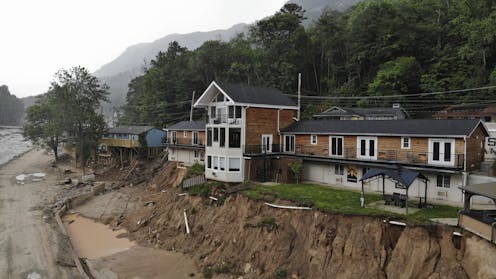
The Carter Lodge hangs precariously over the flood-scoured bank of the Broad River in Chimney Rock Village, N.C., on May 13, 2025, eight months after Hurricane Helene. AP Photo/Allen G. Breed

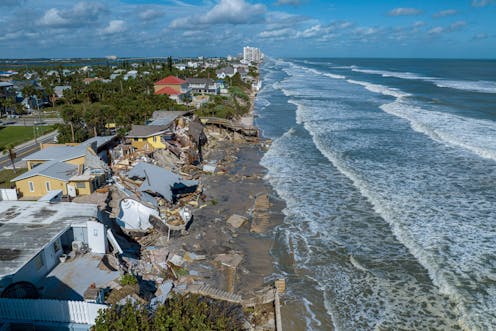
Hurricane Helene lasted only a few days in September 2024, but it altered the landscape of the Southeastern U.S. in profound ways that will affect the hazards local residents face far into the future.

Mudslides buried roads and reshaped river channels. Uprooted trees left soil on hillslopes exposed to the elements. Sediment that washed into rivers changed how water flows through the landscape, leaving some areas more prone to flooding and erosion.

Helene was a powerful reminder that natural hazards don’t disappear when the skies clear – they evolve.

These transformations are part of what scientists call cascading hazards. They occur when one natural event alters the landscape in ways that lead to future hazards. A landslide triggered by a storm might clog a river, leading to downstream flooding months or years later. A wildfire can alter the soil and vegetation, setting the stage for debris flows with the next rainstorm.

Two satellite maps of the same location. One shows changes to the river, loss of trees and landslides.
Satellite images before (top) and after Hurricane Helene (bottom) show how the storm altered landscape near Pensacola, N.C., in the Blue Ridge Mountains.
Google Earth, CC BY

I study these disasters as a geomorphologist. In a new paper in the journal Science, I and a team of scientists from 18 universities and the U.S. Geological Survey explain why hazard models – used to help communities prepare for disasters – can’t just rely on the past. Instead, they need to be nimble enough to forecast how hazards evolve in real time.

The science behind cascading hazards

Cascading hazards aren’t random. They emerge from physical processes that operate continuously across the landscape – sediment movement, weathering, erosion. Together, the atmosphere, biosphere and the earth are constantly reshaping the conditions that cause natural disasters.

For instance, earthquakes fracture rock and shake loose soil. Even if landslides don’t occur during the quake itself, the ground may be weakened, leaving it primed for failure during later rainstorms.

That’s exactly what happened after the 2008 earthquake in Sichuan Province, China, which led to a surge in debris flows long after the initial seismic event.

A volunteer carrying a shovel over his shoulder walks past boulders and a severely damaged building.
A strong aftershock after a 7.8 magnitude earthquake in Sichuan province, China, in May 2008 triggered more landslides in central China.
AP Photo/Andy Wong

Earth’s surface retains a “memory” of these events. Sediment disturbed in an earthquake, wildfire or severe storm will move downslope over years or even decades, reshaping the landscape as it goes.

The 1950 Assam earthquake in India is a striking example: It triggered thousands of landslides. The sediment from these landslides gradually moved through the river system, eventually causing flooding and changing river channels in Bangladesh some 20 years later.

An intensifying threat in a changing world

These risks present challenges for everything from emergency planning to home insurance. After repeated wildfire-mudslide combinations in California, some insurers pulled out of the state entirely, citing mounting risks and rising costs among the reasons.

Cascading hazards are not new, but their impact is intensifying.

Climate change is increasing the frequency and severity of wildfires, storms and extreme rainfall. At the same time, urban development continues to expand into steep, hazard-prone terrain, exposing more people and infrastructure to evolving risks.

The rising risk of interconnected climate disasters like these is overwhelming systems built for isolated events.

Yet climate change is only part of the equation. Earth processes – such as earthquakes and volcanic eruptions – also trigger cascading hazards, often with long-lasting effects.

Mount St. Helens is a powerful example: More than four decades after its eruption in 1980, the U.S. Army Corps of Engineers continues to manage ash and sediment from the eruption to keep it from filling river channels in ways that could increase the flood risk in downstream communities.

Rethinking risk and building resilience

Traditionally, insurance companies and disaster managers have estimated hazard risk by looking at past events.

But when the landscape has changed, the past may no longer be a reliable guide to the future. To address this, computer models based on the physics of how these events work are needed to help forecast hazard evolution in real time, much like weather models update with new atmospheric data.

An aerial view of a river with evidence of a landslide. Broken trees look like toothpicks scattered about, and the river flow is partially blocked.
A March 2024 landslide in the Oregon Coast Range wiped out trees in its path.
Brian Yanites, June 2025
An aerial view of a river with evidence of a landslide. Broken trees look like toothpicks scattered about, and the river flow is partially blocked.
A drone image of the same March 2024 landslide in the Oregon Coast Range shows where it temporarily dammed the river below.
Brian Yanites, June 2025

Thanks to advances in Earth observation technology, such as satellite imagery, drone and lidar, which is similar to radar but uses light, scientists can now track how hillslopes, rivers and vegetation change after disasters. These observations can feed into geomorphic models that simulate how loosened sediment moves and where hazards are likely to emerge next.

Researchers are already coupling weather forecasts with post-wildfire debris flow models. Other models simulate how sediment pulses travel through river networks.

Cascading hazards reveal that Earth’s surface is not a passive backdrop, but an active, evolving system. Each event reshapes the stage for the next.

Understanding these connections is critical for building resilience so communities can withstand future storms, earthquakes and the problems created by debris flows. Better forecasts can inform building codes, guide infrastructure design and improve how risk is priced and managed. They can help communities anticipate long-term threats and adapt before the next disaster strikes.

Most importantly, they challenge everyone to think beyond the immediate aftermath of a disaster – and to recognize the slow, quiet transformations that build toward the next.

The Conversation

Brian J. Yanites receives funding from the National Science Foundation.

ref. Hurricane Helene set up future disasters, from landslides to flooding – cascading hazards like these are now upending risk models – https://theconversation.com/hurricane-helene-set-up-future-disasters-from-landslides-to-flooding-cascading-hazards-like-these-are-now-upending-risk-models-259502

What Trump’s budget proposal says about his environmental values

Source: – By Stan Meiburg, Executive Director, Sabin Center for Environment and Sustainability, Wake Forest University

The president’s spending proposal doesn’t leave much behind. Alexey Kravchuk/iStock / Getty Images Plus

To understand the federal government’s true priorities, follow the money.

After months of saying his administration is committed to clean air and water for Americans, President Donald Trump has proposed a detailed budget for the U.S. Environmental Protection Agency for fiscal year 2026. The proposal is more consistent with his administration’s numerous recent actions and announcements that reduce protection for public health and the environment.

To us, former EPA leaders – one a longtime career employee and the other a political appointee – the budget proposal reveals a lot about what Trump and EPA Administrator Lee Zeldin want to accomplish.

According to the administration’s Budget in Brief document, total EPA funding for the fiscal year beginning October 2025 would drop from US$9.14 billion to $4.16 billion – a 54% decrease from the budget enacted by Congress for fiscal 2025 and less than half of EPA’s budget in any year of the first Trump administration.

Without taking inflation into account, this would be the smallest EPA budget since 1986. Adjusted for inflation, it would be the smallest budget since the Ford administration, even though Congress has for decades given EPA more responsibility to clean up and protect the nation’s air and water; handle hazardous chemicals and waste; protect drinking water; clean up environmental contamination; and evaluate the safety of a wide range of chemicals used in commerce and industry. These expansions reflected a bipartisan consensus that protecting public health and the environment is a national priority.

The budget process in brief

Federal budgeting is complicated, and EPA’s budget is particularly so. Here are some basics:

Each year, the president and Congress determine how much money will be spent on what things, and by which agencies. The familiar aphorism that “the president proposes, Congress disposes” captures the Constitution’s process for the federal budget, with Congress firmly holding the “power of the purse.”

EPA’s budget can be difficult to understand because individual programs may be funded from different sources. It is useful to consider it as a pie sliced into five main pieces:

  • Environmental programs and management: the day-to-day work of protecting air, water and land.
  • Science and technology: research on pollution, health effects and new environmental tools.
  • Superfund and trust funds: cleaning up contaminated sites and responding to emergency releases of pollution.
  • State and Tribal operating grants: supporting local implementation of environmental laws.
  • State capitalization grants: revolving loans for water infrastructure.

The Trump administration’s budget proposals for EPA represent a striking retreat from the national goals of clean air and clean water enacted in federal laws over the past 55 years. In the budget document, the administration argues that the federal government has done enough and that the protection of gains already achieved, as well as any further progress, should not be paid for with federal money.

This budget would reduce EPA’s ability to protect public health and the environment to a bare minimum at best. Most dramatic and, in our view, most significant are the elimination of operating grants to state governments, drastic reductions in funding for science of all kinds, and elimination of EPA programs relating to climate change and environmental justice, which addresses situations of disproportionate environmental harm to vulnerable populations. It would cut regulatory and enforcement activities that the administration sees as inconsistent with fossil energy development. Other proposed changes, notably for Superfund and capitalization grants, are more nuanced.

These changes to EPA’s regular budget allocation are separate from changes to supplementary EPA funding that have also been in the news, including for projects specified in the Inflation Reduction Act and other specific laws.

Environmental programs and management

Funding for basic work to protect the environment and prevent pollution would be cut by 22%. The reductions are not spread equally, however. All activities related to climate change would be eliminated, including the Energy Star program and greenhouse gas reporting and tracking. Funding for civil and criminal enforcement of environmental laws and regulations would be cut by 69% and 50%, respectively.

The popular Brownfields program would be cut by 50%. Since 1995, $2.9 billion in federal funds have produced public and private investments totaling $42 billion for cleaning and redeveloping contaminated sites, and created more than 200,000 jobs.

A program to set standards and conduct training for safe removal of lead paint and other lead-containing materials from homes and businesses would be eliminated.

The administration has been clear that EPA will no longer do environmental justice work, such as funding to monitor toxic air emissions in low-income neighborhoods adjacent to industrial areas. This budget is consistent with that.

Science and technology

Scientific support functions would be cut by 34%. The Office of Research and Development would go from about 1,500 staff to about 500 and would be redistributed throughout the agency. This would diminish science that supports not just EPA’s work but that of organizations, industries, health care professionals and public and private researchers who benefit from EPA’s research.

A stretch of barren land, marked by dirt roads around a bright yellow pond.
A former uranium mill in Colorado is just one of the nation’s extremely contaminated Superfund sites awaiting federal money for cleanup.
RJ Sangosti/MediaNews Group/The Denver Post via Getty Images

Superfund and other trust funds

Superfund is by far the largest of EPA’s cleanup trust funds. It allows EPA to clean up contaminated sites. It also forces the parties responsible for the contamination to either perform cleanups or reimburse the government for EPA-led cleanup work. When there is no viable responsible party, Superfund gives EPA the funds and authority to clean up contaminated sites.

Prior to 2021, Superfund was funded through EPA’s annual budget. In 2021 and 2022, Congress restored taxes on selected chemicals and petroleum products to help pay for Superfund. During the Biden administration, EPA reduced the Superfund’s line in the general budget, with the expectation that the Superfund tax revenues would more than make up for the reduction. Administrator Zeldin, who has said that site cleanup is a priority, is proposing to shift virtually all funding for cleanups to these new tax revenues.

There is risk in this approach, however. The Superfund tax expires in 2031 and has raised less than Treasury Department predictions in both 2023 and 2024. In fiscal year 2024, available tax receipts were predicted to be $2.5 billion, but only $1.4 billion was collected. Future funding is uncertain because it depends on the amounts of various chemicals that companies actually use. Experts disagree on whether this is significant for the Superfund program. The petrochemical industry, on whom this tax largely falls, is lobbying for its repeal.

Funds to address leaks at gas station tanks would be cut nearly in half. Funds to clean up oil and petroleum spills would be cut by 24%.

State operating grants

The budget proposal seeks to reset the EPA’s relationship with state agencies, which implement the vast majority of environmental regulations.

EPA has long delegated some of its powers to state environmental agencies, including permitting, inspections and enforcement of regulations that govern air, water and soil pollution. Since the 1970s, EPA has helped fund those activities through basic operating grants that require minimum state contributions and reward larger state investments with additional federal dollars.

The proposed budget would eliminate all of those grants to states – totaling $1 billion. The document itself explains that federal funding over decades has totaled “hundreds of billions of dollars” and has resulted in programs that “are mature or have accomplished their purpose.”

States disagree. They note that EPA has delegated 90% of the nation’s environmental protection work to state authorities, and states have accepted that workload based on the expectation of federal funding. The states say reduced funding would greatly diminish the actual work of environmental protection – site inspections, air and water monitoring, and enforcement – across the country.

State capitalization grants

Since 1987, EPA has given states money for revolving loan programs that provide low-interest loans to state and local governments to clean up waterways and provide safe drinking water. The proposed budget would cut that funding by 89%, from $2.8 billion to $305 million.

These capitalization grants were originally envisioned as seed money, with future loans available as the initial and subsequent loans were repaid. But the need for water infrastructure continues to grow, and Congress has for many years allocated additional money to the program.

In protecting the environment, you get what you pay for. In past years, Congress has refused to accept proposed drastic cuts to EPA’s budget. It remains to be seen whether this Congress will go along with these proposed rollbacks.

The Conversation

Stan Meiburg is a volunteer with the Environmental Protection Network. He was an employee of the Environmental Protection Agency from 1977 to 2017.
i have worked at the US EPA twice. During the Obama Administration, i was first principal deputy to the Assistant Administrator of the Office of Air and Radiation and then Acting Assistant Administrator. During the Biden Administration, I was Deputy Administrator. I am also a volunteer with the Environmental Protection Network.

ref. What Trump’s budget proposal says about his environmental values – https://theconversation.com/what-trumps-budget-proposal-says-about-his-environmental-values-258962

What’s at risk for Arctic wildlife if Trump expands oil drilling in the fragile National Petroleum Reserve-Alaska

Source: – By Mariah Meek, Associate Professor of Integrative Biology, Michigan State University

Teshekpuk caribou graze in the National Petroleum Reserve-Alaska. Bob Wick/BLM, CC BY

The largest tract of public land in the United States is a wild expanse of tundra and wetlands stretching across nearly 23 million acres of northern Alaska. It’s called the National Petroleum Reserve in Alaska, but despite its industrial-sounding name, the National Petroleum Reserve-Alaska, or NPR-A, is much more than a fuel depot.

Tens of thousands of caribou feed and breed in this area, which is the size of Maine. Migratory birds flock to its lakes in summer, and fish rely on the many rivers that crisscross the region.

The area is also vital for the health of the planet. However, its future is at risk.

The Trump administration announced a plan on June 17, 2025, to open nearly 82% of this fragile landscape to oil and gas development, including some of its most ecologically sensitive areas.

Some of the extraordinary wildlife in the wetlands around Teshekpuk Lake, a fragile “special area” in the National Petroleum Reserve-Alaska that the Trump administration would open to further drilling.

I am an ecologist, and I have been studying sensitive ecosystems and the species that depend on them for over 20 years. Disturbing this landscape and its wildlife could lead to consequences that are difficult – if not impossible – to reverse.

What is the National Petroleum Reserve-Alaska?

The National Petroleum Reserve-Alaska was originally designated in 1923 by President Warren Harding as an emergency oil supply for the U.S. Navy.

In the 1970s, its management was transferred to the Department of Interior under the Naval Petroleum Reserves Production Act. This congressional act requires that, in addition to managing the area for energy development, the secretary of the interior must ensure the “maximum protection” of “any significant subsistence, recreational, fish and wildlife, or historical or scenic value.”

The Bureau of Land Management is responsible for overseeing the reserve and identifying and protecting areas with important ecological or cultural values – aptly named “special areas.”

A map of the NPR-A shows five large areas currently set aside as
The Trump administration plans to open parts of the ‘special areas,’ shown here, that were designated to protect wildlife in the National Petroleum Reserve-Alaska, including in the fragile Colville River and Teshekpuk Lake regions.
U.S. Bureau of Land Management

The Trump administration now plans to expand the amount of land available for drilling in the NPR-A from about 11.7 million acres to more than 18.5 million acres – including parts of those “special areas” – as part of its effort to increase U.S. oil drilling and reduce regulations on the industry.

I recently worked with scientists and scholars at The Wilderness Society to write a detailed report outlining many of the ecological and cultural values found across the reserve.

A refuge for wildlife

The reserve is a sanctuary for many Arctic wildlife, including caribou populations that have experienced sharp global declines in recent years.

The reserve’s open tundra provides critical calving, foraging, migratory and winter habitat for three of the four caribou herds on Alaska’s North Slope. These herds undertake some of the longest overland migrations on Earth. Infrastructure such as roads and industrial activity can disrupt their movement, further harming the populations’ health.

The NPR-A is also globally significant for migratory birds. Situated at the northern end of five major flyways, birds come here from all corners of the Earth, including all 50 states. It hosts some of the highest densities of breeding shorebirds anywhere on the planet.

An estimated 72% of Arctic Coastal Plain shorebirds – over 4.5 million birds – nest in the reserve. This includes the yellow-billed loon, the largest loon species in the world, with most of its U.S. breeding population concentrated in the reserve.

A black and white bird with a yellow bill sits on a nest mostly surrounded by water.
A yellow-billed loon sits on a nest in the National Petroleum Reserve-Alaska. These migratory birds, along with many other avian species, summer in the reserve.
Bob Wick/BLM, CC BY

Expanding oil and gas development in the National Petroleum Reserve-Alaska could threaten these birds by disrupting their habitat and adding noise to the landscape.

Many other species also depend on intact ecosystems there.

Polar bears build dens in the area, making it critical for cub survival. Wolverines, which follow caribou herds, also rely on large, connected expanses of undisturbed habitat for their dens and food. Moose browse along the Colville River, the largest river on the North Slope, while peregrine falcons, gyrfalcons and rough-legged hawks nest on the cliffs above.

A large stretch of the Colville River is currently protected as a special area, but the Trump administration’s proposed plan will remove those protections. The Teshekpuk Lake special area, critical habitat for caribou and migrating birds, would also lose protection.

Two brown bears walk through low-level brush. The big one looks back at the camera.
Brown bears, as well as polar bears, rely on the National Petroleum Reserve-Alaska for habitat and finding food.
Bob Wick/BLM, CC BY

Indigenous communities in the Arctic, particularly the Iñupiat people, also depend on these lands, waters and wildlife for subsistence hunting and fishing. Their livelihoods, food security, cultural identity and spiritual practices are deeply intertwined with the health of this ecosystem.

Oil and gas drilling’s impact

The National Petroleum Reserve-Alaska is vast, and drilling won’t occur across all of it. But oil and gas operations pose far-reaching risks that extend well beyond the drill sites.

Infrastructure like roads, pipelines, airstrips and gravel pads fragment and degrade the landscape. That can alter water flow and the timing of ice melt. It can also disrupt reproduction and migration routes for wildlife that rely on large, connected habitats.

Networks of winter ice roads and the way exploration equipment compacts the land can delay spring and early summer thawing patterns on the landscape. That can upset the normal pattern of meltwater, making it harder for shore birds to nest.

Caribou migrating
The Western Arctic Caribou herd population has fallen significantly in recent years. Here, some of the herd cross a river outside the NPR-A.
Kyle Joly/NPS

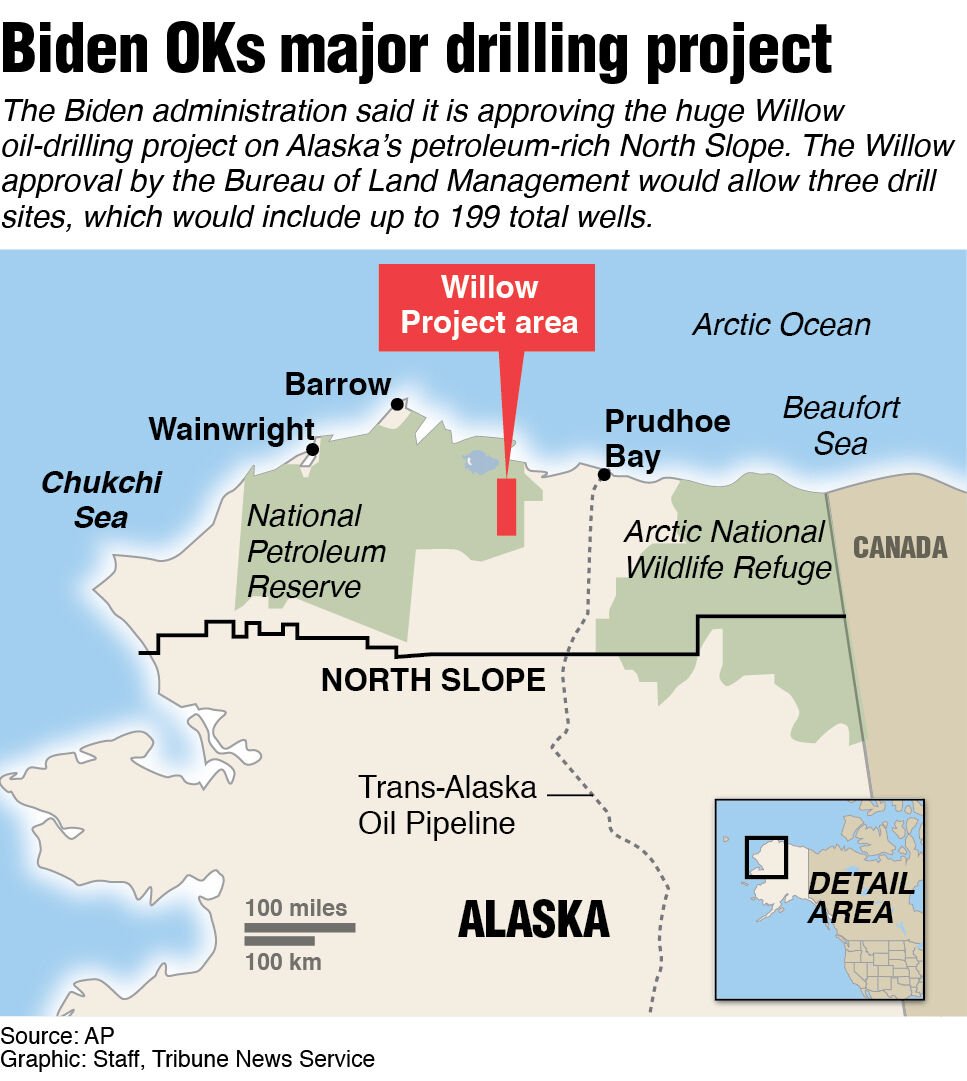
ConocoPhillips’ Willow drilling project, approved by the Biden administration in 2023 on the eastern side of the reserve, provides some insight into the potential impact: An initial project plan, later scaled back, included up to 575 miles (925 kilometers) of ice roads for construction, an air strip, more than 300 miles (nearly 485 kilometers) of new pipeline, a processing facility, a gravel mine and barge transportation, in addition to five drilling sites.

Many animals will try to steer clear of noise, light and human activity. Roads and industrial operations can force them to alter their behavior, which can affect their health and how well they can reproduce. Research has shown that caribou mothers with new calves avoid infrastructure and that this impact does not lessen over time of exposure.

Industrial buildings in the snow have several roads and pipelines running to them and three wells with flares and blackened areas around them.
Oil production facilities, like this one in Prudhoe Bay, require miles of road and pipeline, in addition to the wells and facilities.
Simon Bruty/Anychance/Getty Images

At Alaska’s Prudhoe Bay, the largest oilfield in the U.S., decades of oil development have led to pollution, including hundreds of oil spills and leaks, and habitat loss, such as flooding and shoreline erosion, extensive permafrost thaw and damage from roads, construction and gravel mining. In short, the footprint of drilling is not confined to isolated locations — it radiates outward, undermining the ecological integrity of the region. Permafrost thaw now even threatens the stability of the oil industry’s own infrastructure.

Consequences for the climate

The National Petroleum Reserve-Alaska and the surrounding Arctic ecosystem also play an outsized role in regulating the global climate.

Vast amounts of climate-warming carbon is currently locked away in the wetlands and permafrost of the tundra, but the Arctic is warming close to three times faster than the global average.

Roads, drilling and development can increase permafrost thaw and cause coastlines to erode, releasing carbon long locked in the soil. In addition, these operations will ultimately add more carbon dioxide to the atmosphere, further warming the planet.

The decisions made today will shape the future of the Arctic – and one of the last wild ecosystems in the United States – for generations to come.

The Conversation

Mariah Meek has received funding from the National Science Foundation, the US Fish and Wildlife Service, and several state agencies. In addition to being a professor, she is also the director of research for The Wilderness Society, where she supervises a team of scientists doing research to understand ecological interactions in the Alaskan Arctic.

ref. What’s at risk for Arctic wildlife if Trump expands oil drilling in the fragile National Petroleum Reserve-Alaska – https://theconversation.com/whats-at-risk-for-arctic-wildlife-if-trump-expands-oil-drilling-in-the-fragile-national-petroleum-reserve-alaska-259493

Hurricane forecasters are losing 3 key satellites ahead of peak storm season − a meteorologist explains why it matters

Source: – By Chris Vagasky, Meteorologist and Research Program Manager, University of Wisconsin-Madison

Many coastal communities rely on satellite data to understand the risks as hurricanes head their way.
Ricardo Arduengo/AFP via Getty Images

About 600 miles off the west coast of Africa, large clusters of thunderstorms begin organizing into tropical storms every hurricane season. They aren’t yet in range of Hurricane Hunter flights, so forecasters at the National Hurricane Center rely on weather satellites to peer down on these storms and beam back information about their location, structure and intensity.

The satellite data helps meteorologists create weather forecasts that keep planes and ships safe and prepare countries for a potential hurricane landfall.

Now, meteorologists are about to lose access to three of those satellites.

On June 25, 2025, the Trump administration issued a service change notice announcing that the Defense Meteorological Satellite Program, DMSP, and the Navy’s Fleet Numerical Meteorology and Oceanography Center would terminate data collection, processing and distribution of all DMSP data no later than June 30. The data termination was postponed until July 31 following a request from the head of NASA’s Earth Science Division.

How hurricanes form. NOAA

I am a meteorologist who studies lightning in hurricanes and helps train other meteorologists to monitor and forecast tropical cyclones. Here is how meteorologists use the DMSP data and why they are concerned about it going dark.

Looking inside the clouds

At its most basic, a weather satellite is a high-resolution digital camera in space that takes pictures of clouds in the atmosphere.

These are the satellite images you see on most TV weather broadcasts. They let meteorologists see the location and some details of a hurricane’s structure, but only during daylight hours.

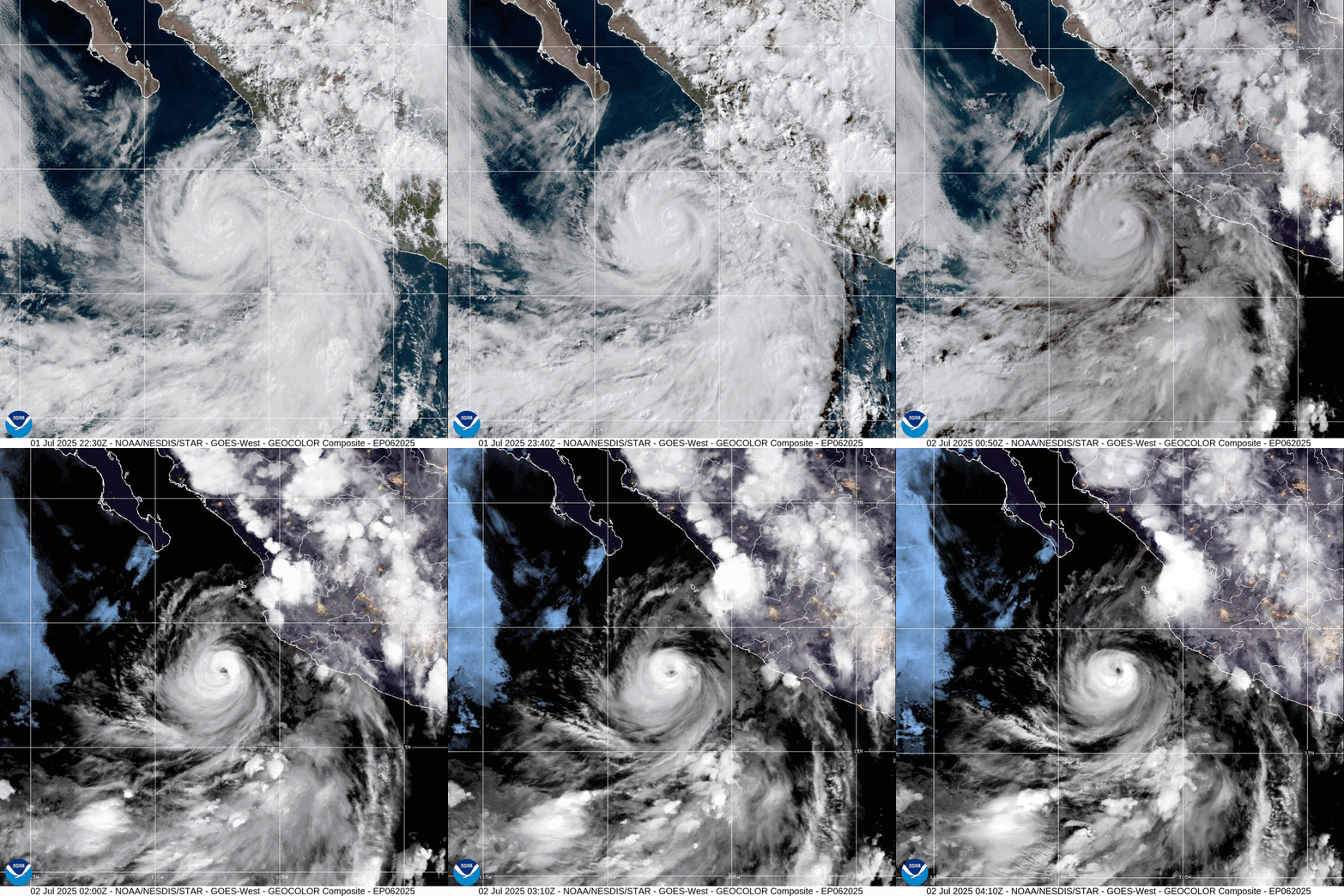
Hurricane Flossie spins off the Mexican coast on July 1, 2025. Images show the top of the hurricane from space as day turns to night. NOAA GOES

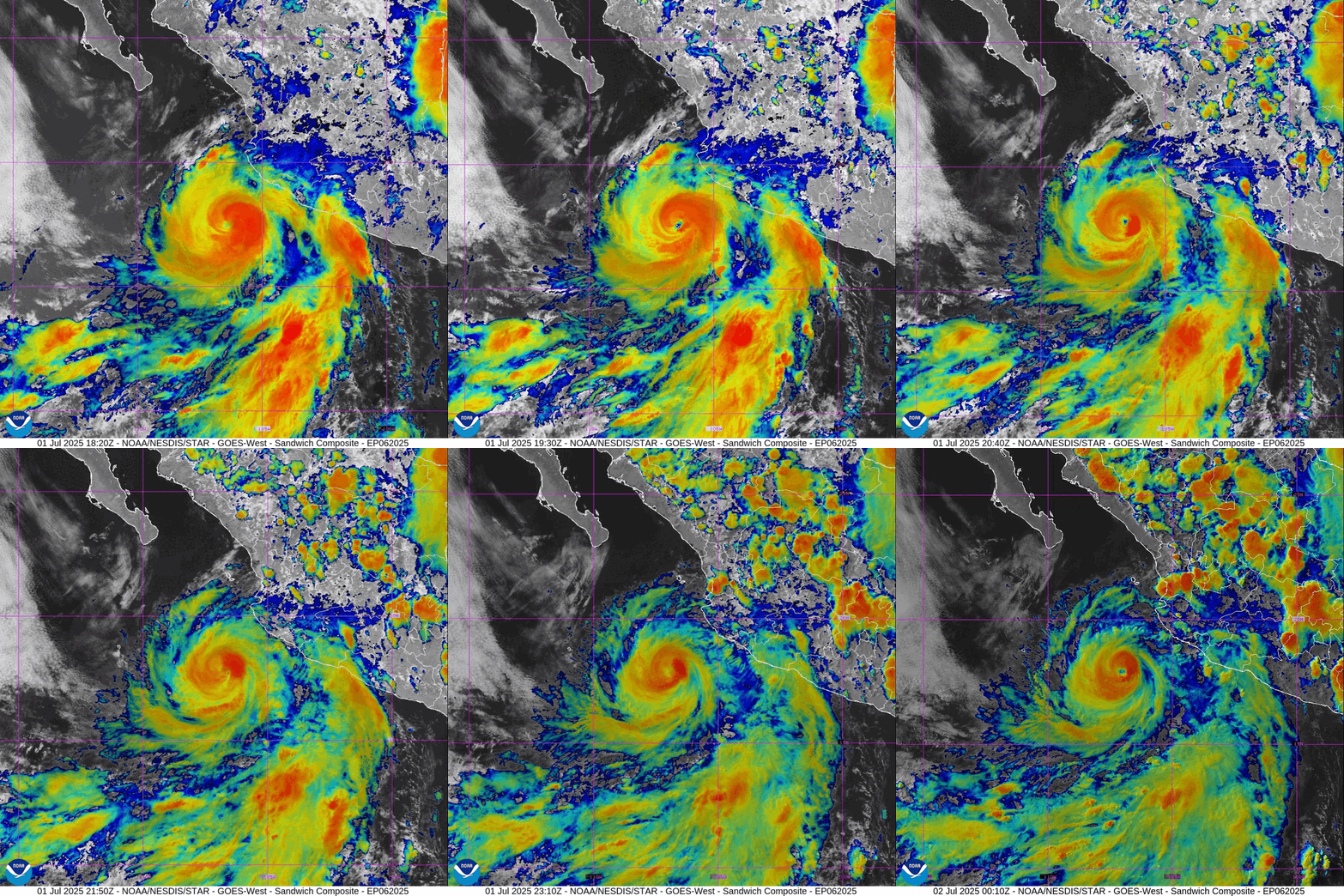
Meteorologists can use infrared satellite data, similar to a thermal imaging camera, at all hours of the day to find the coldest cloud-top temperatures, highlighting areas where the highest wind speeds and rainfall rates are found.

But while visible and infrared satellite imagery are valuable tools for hurricane forecasters, they provide only a basic picture of the storm. It’s like a doctor diagnosing a patient after a visual exam and checking their temperature.

Infrared bands show more detail of Hurricane Flossie’s structure on July 1, 2025. NOAA GOES

For more accurate diagnoses, meteorologists rely on the DMSP satellites.

The three satellites orbit Earth 14 times per day with special sensor microwave imager/sounder instruments, or SSMIS. These let meteorologists look inside the clouds, similar to how an MRI in a hospital looks inside a human body. With these instruments, meteorologists can pinpoint the storm’s low-pressure center and identify signs of intensification.

Precisely locating the center of a hurricane improves forecasts of the storm’s future track. This lets meteorologists produce more accurate hurricane watches, warnings and evacuations.

Hurricane track forecasts have improved by up to 75% since 1990. However, forecasting rapid intensification is still difficult, so the ability of DMPS data to identify signs of intensification is important.

About 80% of major hurricanes – those with wind speeds of at least 111 mph (179 kilometers per hour) – rapidly intensify at some point, ramping up the risks they pose to people and property on land. Finding out when storms are about to undergo intensification allows meteorologists to warn the public about these dangerous hurricanes.

Where are the defense satellites going?

NOAA’s Office of Satellite and Product Operations described the reason for turning off the flow of data as a need to mitigate “a significant cybersecurity risk.”

The three satellites have already operated for longer than planned.

The DMSP satellites were launched between 1999 and 2009 and were designed to last for five years. They have now been operating for more than 15 years. The United States Space Force recently concluded that the DMSP satellites would reach the end of their lives between 2023 and 2026, so the data would likely have gone dark soon.

Are there replacements for the DMSP satellites?

Three other satellites in orbit – NOAA-20, NOAA-21 and Suomi NPP – have a microwave instrument known as the advanced technology microwave sounder.

The advanced technology microwave sounder, or ATMS, can provide data similar to the special sensor microwave imager/sounder, or SSMIS, but at a lower resolution. It provides a more washed-out view that is less useful than the SSMIS for pinpointing a storm’s location or estimating its intensity.

Two satellite views of the same storm from different instruments. The SSMIS provides higher resolution of the storm.
Images of Hurricane Erick off the coast of Mexico, viewed from NOAA-20’s ATMS (left) and DMPS SSMIS (right) on June 18 show the difference in resolution and the higher detail provided by the SSMIS data.
U.S. Naval Research Laboratory, via Michael Lowry

The U.S. Space Force began using data from a new defense meteorology satellite, ML-1A, in late April 2025.

ML-1A is a microwave satellite that will help replace some of the DMSP satellites’ capabilities. However, the government hasn’t announced whether the ML-1A data will be available to forecasters, including those at the National Hurricane Center.

Why are satellite replacements last minute?

Satellite programs are planned over many years, even decades, and are very expensive. The current geostationary satellite program launched its first satellite in 2016 with plans to operate until 2038. Development of the planned successor for GOES-R began in 2019.

Similarly, plans for replacing the DMSP satellites have been underway since the early 2000s.

Scientists and engineers in protective white lab clothing use a lift to move a satellite vertical for loading aboard a rocket for launch.
Scientists prepare a GOES-R satellite for packing aboard a rocket in 2016.
NASA/Charles Babir

Delays in developing the satellite instruments and funding cuts caused the National Polar-orbiting Operational Environmental Satellite System and Defense Weather Satellite System to be canceled in 2010 and 2012 before any of their satellites could be launched.

The 2026 NOAA budget request includes an increase in funding for the next-generation geostationary satellite program, so it can be restructured to reuse spare parts from existing geostationary satellites. The budget also terminates contracts for ocean color, atmospheric composition and advanced lightning mapper instruments.

A busy season remains

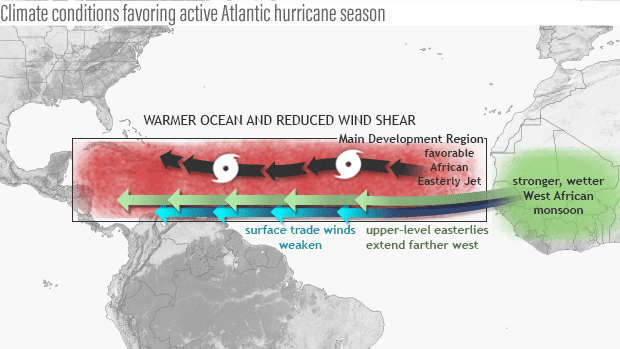
The 2025 Atlantic hurricane season, which runs from June 1 to Nov. 30, is forecast to be above average, with six to 10 hurricanes. The most active part of the season runs from the middle of August to the middle of October, after the DMSP satellite data is set to be turned off.

Hurricane forecasters will continue to use all available tools, including satellite, radar, weather balloon and dropsonde data, to monitor the tropics and issue hurricane forecasts. But the loss of satellite data, along with other cuts to data, funding and staffing, could ultimately put more lives at risk.

The Conversation

Chris Vagasky is a member of the American Meteorological Society and the National Weather Association.

ref. Hurricane forecasters are losing 3 key satellites ahead of peak storm season − a meteorologist explains why it matters – https://theconversation.com/hurricane-forecasters-are-losing-3-key-satellites-ahead-of-peak-storm-season-a-meteorologist-explains-why-it-matters-260190

Trump administration’s conflicting messages on Chinese student visas reflect complex US-China relations

Source: – By Meredith Oyen, Associate Professor of History and Asian Studies, University of Maryland, Baltimore County

The U.S. announced plans to scrutinize and revoke student visas for students with ties to the Chinese Communist Party or whose studies are in critical fields, but appears to have reconsidered. The decision and apparent about-face could have a wide-ranging impact on both nations. LAW Ho Ming/Getty Images

President Donald Trump appears to have walked back plans for the U.S. State Department to scrutinize and revoke visas for Chinese students studying in the country.

On June 11, 2025, Trump posted on his social media platform TruthSocial that visas for Chinese students would continue and that they are welcome in the United States, as their presence “has always been good with me!”

The announcement came weeks after Secretary of State Marco Rubio announced that his department would begin scrutinizing and revoking student visas for Chinese nationals with ties to the Chinese Communist Party, or whose studies are in critical fields.

The contradictory moves have led to confusion among Chinese students attending college or considering studying in the United States.

Over time, Chinese nationals have faced barriers to studying in the U.S. As a scholar who studies relations between the two nations, I argue that efforts to ban Chinese students in the United States are not unprecedented, and historically they have come with consequences.

Student visas under fire

Two students sit side by side studying in a library.
The Trump administration laid out the terms for revoking or denying student visas to Chinese nationals but then backtracked.
STAP/Getty Images

Since the late 1970s, millions of Chinese students have been granted visas to study at American universities. That total includes approximately 277,000 who studied in the United States in the 2023-2024 academic year.

It is difficult to determine how many of these students would have been affected by a ban on visas for individuals with Chinese Community Party affiliations or in critical fields.

Approximately 40% of all new members of the Chinese Communist Party each year are drawn from China’s student population. And many universities in China have party connections or charters that emphasize party loyalty.

The “critical fields” at risk were not defined. A majority of Chinese students in the U.S. are enrolled in math, technology, science and engineering fields.

A long history

A student holding chalks writes Mandarin text on a blackboard.
Since the late 1970s, the number of Chinese students attending college in the U.S. has increased dramatically.
Kenishiroite/Getty Images

Yung Wing became the first Chinese student to graduate from a U.S. university in 1852.

Since then, millions of Chinese students have come to the United States to study, supported by programs such as the “Chinese Educational Mission,” Boxer Indemnity Fund scholarships and the Fulbright Program.

The Institute for International Education in New York estimated the economic impact of Chinese students in the U.S. at over US$14 billion a year. Chinese students tend to pay full tuition to their universities. At the graduate level, they perform vital roles in labs and classrooms. Just under half of all Chinese students attending college in the U.S. are graduate students.

However, there is a long history of equating Chinese migrants as invaders, spies or risks to national security.

After the outbreak of the Korean War in 1950, the U.S. Department of Justice began to prevent Chinese scholars and students in STEM fields – science, technology, engineering and math – from returning to China by stopping them at U.S. ports of entry and exit. They could be pulled aside when trying to board a flight or ship and their tickets canceled.

In one infamous case, Chinese rocket scientist Qian Xuesen was arrested, harassed, ordered deported and prevented from leaving over five years from 1950 to 1955. In 1955, the United States and China began ambassadorial-level talks to negotiate repatriations from either country. After his experience, Qian became a much-lauded supporter of the Communist government and played an important role in the development of Chinese transcontinental missile technology.

During the 1950s, the U.S. Department of Justice raided Chinatown organizations looking for Chinese migrants who arrived under false names during the Chinese Exclusion Era, a period from the 1880s to 1940s when the U.S. government placed tight restrictions on Chinese immigration into the country. A primary justification for the tactics was fear that the Chinese in the U.S. would spy for their home country.

Between 1949 and 1979, the U.S and China did not have normal diplomatic relations. The two nations recognized each other and exchanged ambassadors starting in January 1979. In the more than four decades since, the number of Chinese students in the U.S. has increased dramatically.

Anti-Chinese discrimination

The idea of an outright ban on Chinese student visas has raised concerns about increased targeting of Chinese in the U.S. for harassment.

In 1999, Taiwanese-American scientist Wen Ho Lee was arrested on suspicion of using his position at Los Alamos National Laboratory in New Mexico to spy for China. Lee remained imprisoned in solitary confinement for 278 days before he was released without a conviction.

In 2018, during the first Trump administration, the Department of Justice launched its China Initiative. In its effort to weed out industrial, technological and corporate espionage, the initiative targeted many ethnic Chinese researchers and had a chilling effect on continued exchanges, but it secured no convictions for wrongdoing.

Trump again expressed concerns last year that undocumented migrants from China might be coming to the United States to spy or “build an army.”

The repeated search for spies among Chinese migrants and residents in the U.S. has created an atmosphere of fear for Chinese American communities.

Broader foreign policy context

two puzzle pieces — one representing the United States flag and the other the Chinese flag — stand separated against a neutral background
An atmosphere of suspicion has altered the climate for Chinese international students.
J Studios/Getty Images

The U.S. plan to revoke visas for students studying in the U.S. and the Chinese response is being formed amid contentious debates over trade.

Chinese Ministry of Foreign Affairs spokesperson Lin Jian accused the U.S. of violating an agreement on tariff reduction the two sides discussed in Geneva in May, citing the visa issues as one example.

Trump has also complained that the Chinese violated agreements between the countries, and some reports suggest that the announcement on student visas was a negotiating tactic to change the Chinese stance on the export of rare earth minerals.

When Trump announced his trade deal with China on June 11, he added a statement welcoming Chinese students.

However, past practice shows that the atmosphere of uncertainty and suspicion may have already damaged the climate for Chinese international students, and at least some degree of increased scrutiny of student visas will likely continue regardless.

The Conversation

Meredith Oyen does not work for, consult, own shares in or receive funding from any company or organization that would benefit from this article, and has disclosed no relevant affiliations beyond their academic appointment.

ref. Trump administration’s conflicting messages on Chinese student visas reflect complex US-China relations – https://theconversation.com/trump-administrations-conflicting-messages-on-chinese-student-visas-reflect-complex-us-china-relations-258351