Darts: the surprising amount of athletic skill it takes to hit a bullseye

Source: The Conversation – UK – By Dan Baumgardt, Senior Lecturer, School of Psychology and Neuroscience, University of Bristol

The 2025 darts World Grand Prix is currently well underway. One of the favourites to win the title is Luke “The Nuke” Littler, who in January became the youngest World Champion in history at just 17-years-old.

Anyone who has beheld Littler’s stellar abilities on the darts circuit will have seen the exceptional talent he displays. But what does it actually take to become a professional darts player? Many may be wondering whether darts skills are simply innate in some people – or if Littler is just an exceptionally quick learner.

Elite technique requires a combination of both physical and mental athleticism. You need to have the skills to hit very small targets when stepping up to the oche, all while maintaining the mental strength needed to stay composed under pressure – knowing that even the smallest miss can have big consequences.

1. Coordination

There are lots of different ways in which coordination – one of the critical functions of our nervous system – lends itself to success in darts. Every single throw requires a smooth and accurate trajectory.

Coordination is controlled by the cerebellum, which is located at the back of the brain. This complex region, sometimes referred to as “the little brain,” helps regulate both fine muscle control and posture. It’s a key region when it comes to darts skills.

For instance, the cerebellum helps with hand-eye coordination. To hit a perfect 180, you’re aiming for that tiny treble 20 on the inner ring, three times over. It requires the player to set that target, judge the distance from the board and calculate an appropriate angle at which to throw. It’s also critical in the learning process of how to improve your aim over time.

Stance, posture and balance are paramount too, and also coordinated by the cerebellum. Even the slightest wobble can affect the trajectory of the dart on release.

2. Arm mechanics

A recipe for success also involves a honed and accurate throw.

The mechanics of a good throw include the transition between taking aim, the pullback move to gather energy, through to a smooth release and eliminating any jerks which might send the dart off course.

The chief muscle groups that allow for this are found in the
hand, wrist and forearm. They contain multiple smaller muscles which flex and extend the wrist and fingers. These are capable of working together to enable a wide variety of precise movements in gripping, aiming and releasing the dart.

It’s generally quite difficult to target these small muscles by working out in the gym, so this is where training through repetition is key to nailing the right throw.

The throw is also governed by rhythm: the target setting, the speed of the pullback stroke and the timing of the release.

Every professional dart player has their own throw technique. For instance, Phil Taylor demonstrated a fast, yet measured throw, while Luke Littler favours a relaxed, instinctive rhythm. But the individual rhythm all goes back to those intricate nerve pathways and the small muscles which coordinate it.

3. A ‘quiet eye’

Obviously vision is also fundamental to darts – but it’s not as simple as just regarding the board.

This is where the concept of a “quiet eye” comes in – where the eyes lock in upon the target just before a throw is made. A quiet eye ensures the gaze remains fixed upon the target, ensuring the throw is accurate.

A quiet eye is a technique important in many sports other than darts – including clay shooting, snooker and archery. A quiet eye lends important visual information to the motor system, which allows for maximum synchronisation between the brain and body.

Several studies have explored the effect the quiet eye phenomenon has on target sports and what underpins it. First, there’s evidence that shows expert players typically have a longer quiet eye phase than amateurs. Although this usually only amounts to half a second longer or so, this is still significant in coordinating between the brain and body, allowing the player to execute that perfect shot.

Second, the measured gaze of professional players appear to be more stable and unwavering – with no eye flicking or deviation from the target.

Through target fixation, critically timing their movements and repeating their shots, players can train their quiet eye.

4. The brain and body connection

The connection between brain and body appears to be key – and is exemplified by players who lost their ability in darts.

There’s actually a condition referred to as “dartitis,” which is defined by an inability to throw. Dartitis is often associated with stress, fatigue or burnout.

It can even affect top players – most notably multiple World Champion Eric Bristow, who had to retrain in order to play normally again after developing dartitis. This can involve going back to basics and rebuilding the throw – sometimes even switching to the other hand.

But if, like me, you’re completely devoid of any talent in darts, there are a few things you can do to give yourself a better chance of hitting a bullseye (instead of the wall or ceiling).

A few starting points for training involve establishing a good stance, grip and throw. Equipping yourself with the right kit is also essential. Then you can move onto blocking out all that external noise – mostly jeers from your mates at your feeble efforts.

Practice makes perfect. Both mental and physical training are needed to be a champion darts player.

The Conversation

Dan Baumgardt does not work for, consult, own shares in or receive funding from any company or organisation that would benefit from this article, and has disclosed no relevant affiliations beyond their academic appointment.

ref. Darts: the surprising amount of athletic skill it takes to hit a bullseye – https://theconversation.com/darts-the-surprising-amount-of-athletic-skill-it-takes-to-hit-a-bullseye-266730

Environmental defenders are being killed for protecting our future – the law needs to catch up

Source: The Conversation – UK – By Damien Short, Director of the Human Rights Consortium and Reader in Human Rights, School of Advanced Study, University of London

Three environmental defenders – people who take action against the exploitation of natural resources – are murdered or disappeared somewhere in the world every week. The latest report by Global Witness, an NGO that investigates environmental and human rights abuses, has recorded more than 2,250 such cases since 2012.

The vast majority of the 146 land and environmental defenders killed in 2024, according to the report, were murdered in Latin America. Many were opposing large-scale mining, logging or agribusiness projects.

Colombia recorded the highest number of deaths, with 48 defenders killed across the country. But Guatemala proved the most dangerous country per capita, with 20 killings that year. Indigenous people and small-scale farmers in Latin America are particularly exposed. Their lives and livelihoods place them in direct conflict with extractive and criminal interests.

Afro-descendant communities there face the same elevated risk. Many, including Brazil’s Quilombola communities, hold collective ancestral territories and have safeguarded forests and rivers for generations. This custodianship makes them targets.

Women accounted for approximately 10% of victims in 2024, with cases concentrated in Mexico. And multiple attacks killed entire families, including children, suggesting systematic intimidation rather than isolated violence.


Wars and climate change are inextricably linked. Climate change can increase the likelihood of violent conflict by intensifying resource scarcity and displacement, while conflict itself accelerates environmental damage. This article is part of a series, War on climate, which explores the relationship between climate issues and global conflicts.


In a conflict-affected context, or a situation where information is tightly controlled, killings and disappearances are hard to document. Families and witnesses also often stay silent for fear of reprisals. Impunity compounds the problem.

The Global Witness report notes that in Colombia, where environmental defenders have been at risk for decades, only 5% of killings since 2002 have resulted in convictions. Without justice, deterrence is absent, and cycles of violence continue.

Violence against environmental defenders also persists because it works. Removing a community leader, for example, can disrupt resistance for months or years. For corporations, defending against a lawsuit that arises due to violence against environmental defenders costs less than losing a mining concession. And for governments dependent on resource revenues, silencing critics preserves foreign investment.

According to the Global Witness report, nearly one-third of the murders in 2024 were linked to criminal networks. State security forces were directly implicated in others. This dual threat of criminal violence and official complicity is enabled in part by a shrinking ability for people to participate freely in public life.

Civicus, an alliance of civil society organisations that works to strengthen citizen action and civil rights globally, rates more than half of the countries where defenders were killed as “repressed” or “closed”. This means the authorities actively restrict freedoms of association, assembly and expression.

Violence is predictable in such environments. Defenders face not only physical attacks but also criminalisation, harassment and strategic lawsuits designed to exhaust resources and silence dissent. Ecuador demonstrates how quickly this repression can escalate.

In September 2025, the government charged people protesting fuel subsidy cuts and mining expansion with terrorism and froze the bank accounts of dozens of environmental activists without warning. Efraín Fueres, an Indigenous land defender, was shot and killed by security forces during the protests.

The Ecuadorian government is also moving to rewrite the country’s constitution, the world’s only charter recognising nature’s intrinsic rights, ostensibly to combat drug trafficking. But defenders say the real aim is to eliminate legal barriers to extractive industries.

Regional protection

Regional protection mechanisms do exist. But they remain incomplete. The Escazú agreement, a binding treaty signed in 2018 covering Latin America and the Caribbean, requires that states guarantee public access to environmental information, ensure meaningful participation in decisions and actively protect defenders.

Eighteen of the region’s 33 states have ratified the agreement. In April 2024, parties also adopted an action plan that includes free legal aid for defenders, legal training and monitoring through to 2030.

Whether Escazú can reduce killings depends on implementation. Brazil and Guatemala, both high-risk countries where defenders face lethal threats, have not ratified the treaty. Without participation from the deadliest jurisdictions, regional frameworks offer limited protection.

Protection mechanisms frequently fail, not because they are poorly designed but because they operate within systems that structurally favour extractive industries. Police assigned to protect defenders may be drawn from the same units that secure mining sites or suppress protests.

Prosecutors tasked with investigating attacks often depend on governments whose economic prospects rely on the very projects defenders oppose. Judges hearing cases against corporations, for example, may face political pressure when ruling against major investors. Around half of judges in Latin America are political appointees.

Mining and logging companies also fund local employment, infrastructure and sometimes entire regional economies. This creates dependencies that make meaningful accountability nearly impossible. Even well-intentioned protection schemes cannot compensate for the fact that defending land often means obstructing projects that generate revenue for underfunded state institutions.

There is also a critical legal gap at the international level. When severe environmental destruction occurs during peacetime, existing law struggles to hold individuals accountable.

The International Court of Justice addresses state responsibility but cannot prosecute individuals. And while the International Criminal Court prosecutes genocide, crimes against humanity, war crimes and aggression, environmental harm outside armed conflict falls beyond its reach.

A growing coalition led by Vanuatu, Fiji and Samoa is urging recognition of ecocide as a fifth international crime under the Rome Statute. The proposed definition, developed by an independent expert panel in 2021, would criminalise “unlawful or wanton acts committed with knowledge of a substantial likelihood of severe and either widespread or long-term damage to the environment”.

This would create personal criminal liability for individuals in positions of authority whose decisions lead to mass environmental harm. The theory is that when individual decision-makers face prosecution risk, projects relying on violence and intimidation become personally dangerous to authorise.

Ecocide law would not replace existing regulation or regional treaties but would serve as a backstop when harm reaches catastrophic scale. For defenders, the promise is accountability that reaches beyond hired security to the individuals who profit from or politically enable destruction.

People will always stand up for the places that sustain them. If environmental defenders can operate without fear, everyone benefits. Protecting environmental defenders is not idealism, it is the most pragmatic investment a civilisation can make.

The Conversation

Damien Short is a member of the Green party in the UK.

ref. Environmental defenders are being killed for protecting our future – the law needs to catch up – https://theconversation.com/environmental-defenders-are-being-killed-for-protecting-our-future-the-law-needs-to-catch-up-266396

Do British people want to leave the ECHR? What a decade of polls reveals

Source: The Conversation – UK – By Jacques Hartmann, Professor of International Law and Human Rights, University of Dundee

Withdrawing the UK from the European Convention on Human Rights (ECHR), once a fringe idea, has become a defining issue for political parties. Conservative leader Kemi Badenoch, who previously opposed leaving, has now said the Conservatives will take the UK out of the convention if they win an election.

Nigel Farage’s Reform UK has arguably made an ECHR exit central to its political identity. Even the Labour government has said it could reform the convention, or change how UK courts interpret the law.

The case for leaving is often framed as one of “sovereignty”, particularly in relation to immigration laws and deportation powers.

Politicians argue that the Strasbourg-based European Court of Human Rights, which enforces the ECHR, overrides “the will of the British people” and that democratic legitimacy demands withdrawal.

But evidence shows that “the people” don’t actually want to leave.

We examined more than a dozen opinion polls conducted by polling agencies, such as YouGov, since 2013. The first, that year, found 48% in favour of withdrawal and 35% in favour of remaining in the ECHR. A year later, the public was evenly split (41% leave, 38% stay), and by 2016, following the Brexit referendum, 42% said Britain should stay in the ECHR while 35% wanted to leave. Since then, the balance has shifted steadily towards remain.

By 2023, half of respondents said the UK should remain a member, while only around a quarter favoured leaving the ECHR. A poll from June 2025 produced similar results: 51% in favour of staying, 27% for leaving and 22% unsure.

The most recent YouGov data, published October 8, found that 46% of the public are opposed to leaving the ECHR, and 29% say the UK should withdraw.

Even when polls tie the ECHR to issues such as deportations to Rwanda, support for withdrawal among the general public has not exceeded 38% since 2014.

Conversely, when respondents were given more nuanced options, support for withdrawal fell. In a 2024 survey, outright support for leaving was just 16% when respondents were offered alternatives such as “always abide by the ECHR even if that frustrates Parliament” or “remain committed to the ECHR but give Parliament the final word”. With such options, 66% supported some form of continued engagement with the ECHR.

What is also clear from the polling is that Conservative and Reform voters are much more in favour of leaving the ECHR than Labour and Liberal Democrats voters. In the June YouGov poll on this issue, 54% of Conservative voters and 72% of Reform voters were in favour of leaving the ECHR while 75% of Labour and Liberal Democrats voters were against leaving.

The general results from polling are reinforced by parliamentary petitions. Since 2023, at least seven petitions have called for withdrawal from the ECHR or a referendum on membership. None has come close to the 100,000 signatures required for debate.

The most recent, which remains open until January 2026, had fewer than 19,000 signatures at the time of writing. By contrast, a petition against digital ID cards quickly amassed 2.8 million signatures.

The evidence is clear: withdrawal commands neither majority support nor political urgency.

The paradox of popular democracy

For its critics, the ECHR embodies foreign interference. Strasbourg judges are cast as overriding Westminster’s authority and undermining sovereignty. That framing is powerful in political campaigns, particularly when attached to emotive issues like asylum or terrorism.

But if democracy means following “the will of the people”, the evidence does not support the claim. At most, over the past decade, only a quarter of the electorate has supported leaving the ECHR.

And even if public opinion did shift, there is a deeper question: should such constitutional decisions rest on fluctuating majorities at all?

The ECHR was created after the second world war precisely to prevent democracy from collapsing into unchecked majority rule. Britain played a leading role in drafting it, ensuring that popular sovereignty would be balanced by entrenched rights.


Read more:
Treaties like the ECHR protect everyone in the UK, not just migrants


That is why human rights protections are deliberately counter-majoritarian, safeguarding individuals and minorities from the excesses of majority impulses.

Yet today’s political rhetoric often inverts that logic. By invoking the language of popular sovereignty to justify withdrawing from the ECHR – despite evidence that the public does not support it – politicians risk undermining the very stability those rights were designed to protect. This is an especially serious concern for the UK, which lacks the constitutional safeguards found in many other democracies.

An empty dinghy sits on a beach in Kent
The ECHR is often discussed in relation to the government’s ability to deport people who arrive in the UK illegally.
Sean Aidan Calderbank/Shutterstock

A large share of respondents to the polls examined were “unsure” about withdrawal – ranging from 15 to 25% across the surveys. It’s therefore possible that true support for remaining in the ECHR may be higher than headline polls imply.

The latest YouGov survey asked respondents how much they know about the ECHR, and found just 5% of respondents claimed to know “a great deal” about the convention, while 49% said they do not know very much, and 15% said they know nothing at all.

Research shows that attitudes towards human rights grow more positive as knowledge of human rights increases. A Scottish Human Rights Commission study in 2018 found that indifference often masks confusion rather than hostility.

The Independent Review of the Human Rights Act in 2021 reached a similar conclusion, stressing that greater public understanding of human rights institutions strengthens support.

This is why it is important for people and politicians to understand that conventions like the ECHR are not just about migrants and asylum seekers. They protect the rights of everyone in matters that affect us all – from privacy at home and fair treatment in court, to freedom of speech, protection from discrimination and dignity in care.

The growing political momentum for withdrawal from the ECHR is not matched by popular demand. Instead, politicians are proposing to amend Britain’s constitutional order in the name of “the people” while ignoring what a majority of people actually want, undoing constitutional safeguards and democratic institutions in the process.

The lesson of postwar Europe is clear: constitutional safeguards against majority rule are not an obstacle to democracy, but one of its foundations. To abandon them would not only place the UK alongside Russia and Belarus – the only European states outside the ECHR – but also risk repeating the very errors the convention was created to prevent.

The Conversation

Jacques Hartmann has received external research funding from a range of government and charitable sources, including the European Commission (Horizon 2020), NordForsk, the British Academy, and private foundations such as Dreyer’s Trust and the Max Sørensen Foundation. None of these funders had any role in the conception, research, or writing of this article, which was undertaken independently and without specific project funding.

Dr Edzia Carvalho has received funding from the British Academy, the Scottish Government, the Carnegie Foundation, and FIDH. None of these funders had any role in the conception, research, or writing of this article, which was undertaken independently and without specific project funding.

Dr Samuel White has previously received funding from the Carnegie Trust for the Universities of Scotland and the Royal Society of Edinburgh. He represents the Law Society of Scotland on the Scottish Government’s Human Rights Incorporation and Implementation Oversight Board; this article is written in a personal capacity.

ref. Do British people want to leave the ECHR? What a decade of polls reveals – https://theconversation.com/do-british-people-want-to-leave-the-echr-what-a-decade-of-polls-reveals-266682

Without proper support, a diagnosis of dyslexia risks being just a label

Source: The Conversation – UK – By Penelope Hannant, Assistant Professor in Educational Inclusion, University of Birmingham

PeopleImages/Shutterstock

Whether and when to use the label “dyslexia” has been a perennial debate in education.

Some experts and academics argue that there is too much focus on the diagnosis of dyslexia, rather than on providing support for all children who struggle to learn to read. Others argue that children with the most significant difficulties have to fight to get the recognition they need.

Public figures, including celebrity chef Jamie Oliver, have called for all children to receive early screening for dyslexia.

We work together as researchers in psychology and education, with expertise in how children learn to read, dyslexia, neurodiversity, and how children with special educational needs should be supported. While calls for universal dyslexia screening are well intentioned, we believe this approach could lead to more problems than solutions.

One concern is the lack of accuracy in many screening tools, which can result in unclear or misleading outcomes.

Literacy difficulties are complex. Dyslexia is just one of many possible reasons a child might struggle with reading and writing. Focusing too narrowly on dyslexia risks missing other important learning needs.

Screening also has other limitations. A dyslexia screener is a tool used to flag potential indicators of dyslexia, which may involve one or more approaches such as teacher observations, structured audits, questionnaires or digital assessments. It offers only a brief snapshot of a child’s abilities, rather than a full picture of how they learn.

Small children raising hands in class
A range of factors influence how children learn.
PeopleImages/Shutterstock

Another crucial issue is what happens after screening. Without enough resources to follow up on screening results, teachers, parents and children may be left feeling frustrated and unsupported.

If there’s no clear plan for what happens next, it can raise expectations without delivering real help. This can leave families and educators disillusioned and children without the support they need to succeed.

We both strongly believe in the value of a dyslexia diagnosis in the right context. One of us (Julia Carroll) recently led a project to gain consensus about the most appropriate definition of dyslexia and the best approach to assessment.

On the basis of this research, we believe a multi-phase process should be used. For younger children, the focus should be on needs rather than diagnosis. Extra help should be available for any children starting to fall behind. Some of these children will progress well. Others will continue to struggle, and an assessment for dyslexia may be warranted.

This approach relies on a thorough understanding of a child’s needs, rather than prematurely categorising young children.

Holistic approaches

One of us (Penny Hannant) has developed a broad-based questionnaire to measure and aid development in early schooling. By gathering information about a child’s development, such as how they respond to sounds, move their body, react to sensory input and process what they see, we can build a clearer picture of what kind of support they might need.

This approach allows for teachers to intervene before educational gaps emerge, offering a more refined and responsive foundation for learning.

A full profiling of strengths and weaknesses is also crucial to diagnostic assessment. Recent research indicates that developmental disorders such as dyslexia tend to have multiple causes, and that there is a great deal of overlap between different disorders.

Research suggests that a significant proportion of children with dyslexia also meet criteria for developmental language disorder or attention deficit hyperactivity disorder, which can significantly influence how dyslexia develops.

This means that any diagnostic process must take into account the whole child rather than relying on narrow or isolated criteria. To ensure this, schools need in-house specialists who are equipped to conduct holistic assessments and guide tailored support. A well-informed diagnosis not only helps children do better at school, but means they can continue to get the right support as they transition into adulthood.

The Conversation

Penelope Hannant is on the board of trustees with PATOSS, the dyslexia charity.

Julia M. Carroll receives funding from the Education Endowment Foundation and from the Economic and Social Research Council. She is on the board of trustees with PATOSS, the dyslexia charity.

ref. Without proper support, a diagnosis of dyslexia risks being just a label – https://theconversation.com/without-proper-support-a-diagnosis-of-dyslexia-risks-being-just-a-label-264153

Research suggests rich people tend to be more selfish – but why is that?

Source: The Conversation – UK – By Steve Taylor, Senior Lecturer in Psychology, Leeds Beckett University

North Monaco/Shutterstock

From Disney’s Scrooge McDuck and Cruella de Vil to DC Comics’ Lex Luthor to and Mr Burns in the Simpsons, there are plenty of examples of wealthy people using their money and power in evil ways. But is there any truth to the stereotype that rich people are mean?

There are many rich people who act benevolently, including philanthropists who give a lot of their money away. However, research in psychology has found a clear link between wealth and unethical behaviour, including an increased tendency to cheat and steal.

One study found that wealthy upper class people were more likely to have a selfish focus on their interests. Conversely, another study found that people from lower social classes were more likely to feel compassion for other people’s suffering.

Researchers have also established that drivers of expensive cars are less likely to behave altruistically than other drivers. They are less likely to slow down to let pedestrians cross or to let other drivers join the road.

They are also more likely to drive aggressively and disobey traffic rules. One study found that the likelihood of the drivers slowing down to let pedestrians cross the road decreased by 3% for every US$1,000 (£738.50) that their car was worth.

But it’s not just that these people are bad drivers. A study by Finnish psychologists found that owners of luxury cars had a higher prevalence of negative personality traits such as being disagreeable, stubborn and lacking in empathy.

In simple terms, it seems that rich people are less likely to be altruistic.

What could explain this link? Perhaps wealth turns people bad, isolating them from others and making them more selfish. Or is it that people who are already ruthless and selfish are more likely to become extremely wealthy?

One way of clarifying this is to think in terms of what psychologists refer as dark triad personalities. These are people who have combined traits of psychopathy, narcissism and machiavellianism (acting immorally to get power). These traits – which all involve selfishness and low empathy – almost always overlap and can be difficult to distinguish from one another. They exist on a continuum in the population as a whole.

Research shows that dark triad personalities tend to possess higher levels of status and wealth. A study following participants for 15 years found that people with dark triad traits gravitated towards the top of the organisational hierarchy and were wealthier.

Man portrait with evil look isolated on black background.
Research suggests financially successful people are more likely to have dark traits.
CebotariN/Shutterstock

In line with those findings, according to some estimates, the base rate for clinical levels of psychopathy is three times higher among corporate boards than in the overall population. Research also indicates that young people with dark triad traits are more highly represented on business courses at university or college.

Why do mean people seek wealth?

In my view, the correlation between wealth and nastiness is quite easy to explain. In my book The Fall, I suggest that some people experience a state of intense psychological separation. Their psychological boundaries are so strong that they feel disconnected from other people and the world, which can come with a lack of empathy or emotional connection.

One effect of this state of disconnection is a sense of psychological lack. People feel incomplete, as if something is missing. In turn, this generates an impulse to accumulate wealth, status and power, as a way of compensating.

On the flip side, people who feel a sense of connection others and to the world don’t feel a sense of incompleteness and so don’t tend to have a strong desire for power or wealth.

At the same time, a lack of empathy can make it easier to attain success. It means you can be ruthless in your pursuit of wealth and status, manipulating and exploiting others. If other people suffer as the result of your actions – and lose their livelihood or reputation – it doesn’t concern you as much. Without empathy, you can’t sense the suffering you cause.

So psychological disconnection has two disastrous effects: it generates a strong desire for wealth and status, together with the ruthlessness that makes wealth and success easily attainable.

Wealth and wellbeing

Of course, I’m not claiming that all wealthy people are mean. Some people become wealthy by accident, or because they have brilliant ideas, or even because they want to use their wealth to benefit others. But given the factors described above, it is not surprising that there is a high incidence of meanness among the wealthy.

The studies cited above imply that the link seems to be proportional, in that the more wealthy a person is, the more likely they are to possess dark triad traits. And we know that most dark traits, such as psychopathy are linked to similar or lower levels of happiness to others. An exception is a certain type of narcissism, called grandiose narcissism, which is linked to higher happiness.

A great deal of research in psychology has shown only a weak correlation between wealth and wellbeing. A 2010 study by Nobel laureate Daniel Kahneman and Angus Deaton found that happiness increased in line with income up to around US$75,000 (£54,9612) a year (equivalent to US$110,000 in 2025). However, this is where the correlation ended. According to the study, after US$110,000 a year, it doesn’t matter how rich you become; it won’t make you any happier.

Newer research, however, has found slightly different results. A recent study by Kahneman and colleagues indicated that happiness continues to increase with income for a proportion of rich people – but not for an unhappy minority. A 2022 study also found that the threshold at which happiness plateaus depends on the country – in societies with greater inequality, there was a higher threshold.

What’s more, another study by Kahneman and other colleagues found that, for people who were preoccupied with striving for financial success, life satisfaction actually decreased as income increased.

Overall though, evidence suggests that wealthy people are unlikely to attain the contentment they seek through money alone. Their wealth and status don’t take away their sense of incompleteness.

This might be another reason why extremely rich people tend to act unethically – as their sense of disconnection grows stronger. In contrast, research shows a strong link between altruism and wellbeing. So perhaps that is where we should focus our attention – not on becoming rich, but becoming kind.

The Conversation

Steve Taylor does not work for, consult, own shares in or receive funding from any company or organisation that would benefit from this article, and has disclosed no relevant affiliations beyond their academic appointment.

ref. Research suggests rich people tend to be more selfish – but why is that? – https://theconversation.com/research-suggests-rich-people-tend-to-be-more-selfish-but-why-is-that-265794

Le marketing viral du chocolat de Dubaï

Source: The Conversation – France (in French) – By Anne Parizot, Professeur des universités en sciences de l’information et de la communication émérite, Université Bourgogne Europe

Le chocolat de Dubaï illustre les dilemmes contemporains : entre innovation culinaire et marketing viral, entre authenticité et imitation, entre inspiration et contrefaçon. KatMoys/Shutterstock

Une tablette de chocolat artisanal, née à Dubaï et popularisée sur TikTok, est devenue en quelques mois un phénomène mondial. Entre marketing viral, copies industrielles, le « chocolat de Dubaï » illustre les tensions contemporaines entre authenticité, imitation et contrefaçon dans l’alimentation mondialisée. Plus encore qu’un produit, c’est un nom qui fait vendre.


Chocolat de Dubaï ? Si vous n’en n’avez jamais entendu parler, peut-être n’êtes-vous ni gourmand ni accro aux réseaux sociaux. Pourtant, il fait le buzz depuis 2024.

Le « Dubai chocolate », créé par l’entrepreneuse anglo-égyptienne Sarah Hamouda, associe chocolat au lait, crème pistache-tahini et cheveux d’ange (kadayif). Ce qui frappe : son goût, sa texture onctueuse et croustillante, mais surtout la rapidité avec laquelle il s’est imposé comme un symbole culinaire de Dubaï. Baptisé « Can’t get knafeh of It » signifiant « On ne peut plus s’en passer », il a explosé en popularité après une vidéo TikTok devenue virale, de Maria Vehera (2023).

Sur les réseaux sociaux, le chocolat de Dubaï est conçu comme un spectacle visuel relevant du « food porn ». Gros plans, ralentis et zooms exaltent textures, couleurs et gestes rituels : ouverture de l’emballage, cassure de la tablette, coulants et craquants. L’esthétisation extrême transforme la dégustation en scène sensuelle, associée à l’exotisme d’une expérience rare, presque interdite.

Du luxe artisanal à la copie industrielle

Face à l’engouement de ce produit à l’origine artisanal, les marques se sont emparées du concept : en France, Lindt, la célèbre marque de chocolat suisse, Lidl propose sa propre version à prix bas, relayée sur TikTok ou Jeff de Bruges développe des déclinaisons de la tablette classique.

Une trajectoire typique : un produit culinaire innovant, viral et artisanal bascule vers une industrialisation massive, avec ses imitations et risques de contrefaçon. Si certains s’attachent à ces saveurs, d’autres ont senti un autre goût. « Ça a le goût de l’argent », a plaisanté le présentateur Al Roker dans l’émission « Today » après l’avoir goûté en direct. Plaisantait-il vraiment ?

Buzz ou tromperie ?

L’importance des mots du chocolat a été soulignée par les chercheurs Laurent Gautier, Angelica Leticia Cahuana Velasteguí et Olivier Méric, et ici c’est le nom de ce chocolat qui suscite le débat. « Chocolat de Dubaï » peut laisser croire que les tablettes sont produites aux Émirats. Or, beaucoup viennent en réalité de Turquie ou d’Europe et peuvent donc induire le consommateur en erreur.

La justice allemande a rendu deux jugements contradictoires. À Cologne, l’appellation « Dubai Chocolate » sur des tablettes turques a été jugée trompeuse. À Francfort, au contraire, les juges ont estimé qu’il renvoyait à une recette culinaire plus qu’à une origine géographique. En France, le Code de la consommation est clair : une pratique commerciale trompeuse est interdite si l’emballage suggère une origine fausse ou ambiguë. Pour éviter ce risque, certaines marques comme Lindt utilisent la formule prudente « Dubaï Style ».

Le buzz a engendré une économie parallèle avec des versions contrefaites ; les douanes autrichiennes saisissent plus de 2 500 tablettes lors de contrôles frontaliers. Ces copies exposent les consommateurs à des risques sanitaires que souligne la revue UFC-Que choisir. Le succès du produit repose plus sur le marketing viral des réseaux sociaux que sur ses qualités gustatives.

Quand le nom fait vendre

Au-delà des saveurs, c’est le nom qui alimente le succès – et parfois la confusion. « Dubaï » agit comme une marque imaginaire, synonyme de luxe, de prestige et d’exotisme. Le produit original mise sur un storytelling sophistiqué : mélange gourmand, raffiné, savoir-faire, texture fondante, masse de cacao… Chocolat Dubaï c’est partager un peu de la magie de Dubaï, une saveur nouvelle, expérience gustative.

Trois formulations circulent aujourd’hui, porteuses d’un sens implicite différent. Le jeu sur les prépositions et sur les adjectifs est au cœur du storytelling culinaire. Comme l’a montré le sémiologue Roland Barthes, la nourriture est aussi un discours.

« Dubaï » fonctionne comme une marque imaginaire :

  • « Chocolat de Dubaï » : la préposition « de » suggère une origine géographique et une authenticité. Comme pour « vin de Bordeaux », le consommateur attend un produit provenant effectivement des Émirats. Cette formulation pose des problèmes juridiques lorsque le chocolat est fabriqué ailleurs. Les marques doivent donc être déposées pour être protégées et l’indication géographique (IG) est essentielle.

  • « Chocolat Dubaï » (sans préposition) fonctionne comme un raccourci puissant associant un toponyme immédiatement reconnaissable à une catégorie universelle – chocolat. Le nom n’est pas une marque déposée, mais un surnom collectif, facile à retenir et à partager. On est dans l’onomastique – ou étude des noms propres – marketing, où la référence territoriale glisse vers l’imaginaire. La juxtaposition franco-anglaise – « Dubai chocolate » ↔ « Chocolat Dubaï » – crée un effet de résonance interlinguistique qui facilite la viralité.

  • « Chocolat Dubaï Style » insiste sur l’inspiration culinaire sans revendiquer l’origine. D’un point de vue linguistique, l’ajout de « style » signale l’inspiration culinaire et protège le fabricant du risque de tromperie, en signalant une imitation assumée. Mais le consommateur en est-il toujours conscient ?

Ces variations linguistiques révèlent un glissement métonymique : de la référence au lieu réel à un imaginaire global du luxe et de l’excès.

Le nom propre comme storytelling

L’onomastique alimentaire, ou étude des noms propres devient un instrument de storytelling, mais aussi un champ de bataille juridique et économique. Une entreprise joue clairement sur le nom sur un registre humoristique : la marque française Klaus et son « Doubs by Chocolate » détourne l’imaginaire du Golfe pour l’ancrer dans le terroir du Haut-Doubs.

L’entreprise franc-comtoise a bien compris le rôle essentiel de l’onomastique. Ce « Doubs by Chocolate » surfe sur la vague, mais le nom identifie clairement le chocolat comme un produit régional. L’origine signalée ne crée pas de risque juridique, tout en conservant une homophonie parfaite avec le fameux « Dubai chocolate ». En référence directe à Dubaï et à l’imaginaire idyllique de luxe et de volupté, avec toutes les précautions prises pour qu’il n’y ait pas mégarde, l’entreprise Klaus met en place un marketing déroutant évoquant le décalage.

Publicité pour la tablette Doubs By Chocolate de l’entreprise française Klaus.
Klaus, FAL

Du viral au patrimonial ?

Traditionnellement, les produits alimentaires deviennent patrimoine à travers le temps, consolidés par des générations d’usage, protégés par des labels (AOP, IGP). Le Dubai chocolate inverse la logique. Son patrimoine n’est pas hérité, mais produit par la viralité. Les millions de vues et de partages jouent le rôle de validation. Ce n’est pas l’État ni l’Unesco qui consacrent le produit, mais l’algorithme et les réseaux sociaux. Ce phénomène illustre une tendance nouvelle : la patrimonialisation accélérée.

Autre singularité : le Dubai chocolate n’est pas lié à un terroir rural, comme le vin de Bordeaux. Il est rattaché à une « ville-monde ». Il devient l’équivalent culinaire d’un gratte-ciel ou d’un centre commercial : un symbole urbain. Cette urbanisation du patrimoine alimentaire montre que les métropoles ne sont plus seulement consommatrices de traditions, mais aussi créatrices d’icônes gastronomiques.

Confrérie culinaire mondiale

Mais peut-on parler de patrimoine pour un produit si récent ?

Oui, si l’on considère le patrimoine comme un ensemble de signes partagés et valorisés par une communauté. Dans ce cas, TikTok joue le rôle de confrérie culinaire mondiale. Mais ce patrimoine est fragile. Ce qui est consacré par la viralité peut être supplanté demain par une nouvelle mode.

Le chocolat de Dubaï illustre parfaitement les dilemmes contemporains : entre innovation culinaire et marketing viral, entre authenticité et imitation, entre inspiration et contrefaçon.

The Conversation

Anne Parizot ne travaille pas, ne conseille pas, ne possède pas de parts, ne reçoit pas de fonds d’une organisation qui pourrait tirer profit de cet article, et n’a déclaré aucune autre affiliation que son organisme de recherche.

ref. Le marketing viral du chocolat de Dubaï – https://theconversation.com/le-marketing-viral-du-chocolat-de-duba-264641

Pénuries, marges en berne, diversification difficile… Pourquoi les pharmacies françaises vacillent

Source: The Conversation – France (in French) – By Frédéric Jallat, Professor of Marketing and Academic Director of MSc. in Biopharmaceutical Management, ESCP Business School

Les pharmacies françaises se trouvent aujourd’hui au cœur d’un paradoxe : dernier maillon de proximité d’un système de santé sous tension, elles subissent de plein fouet les choix budgétaires et politiques liés au prix des médicaments. Entre fermetures accélérées, marges érodées, pénuries répétées, leur fragilité dit beaucoup des difficultés que traverse la politique de santé au plan national.


Au cœur de l’hiver 2024, de nombreux patients ont eu la désagréable surprise de se voir refuser à l’officine un antibiotique pourtant banal, l’amoxicilline. « Rupture de stock », expliquaient alors les pharmaciens, contraints de trouver des alternatives ou de renvoyer les malades vers leur médecin. Ces incidents, fréquemment répétés au niveau national, illustrent une réalité mal connue : les pharmacies, maillon de proximité du système de santé, se trouvent aujourd’hui aux prises avec un mouvement combinant politiques de prix, stratégies industrielles et arbitrages budgétaires dont elles ne maîtrisent pas les évolutions.

Derrière le comptoir, c’est un acteur économique et social qui subit directement les choix de l’État, les complexités de l’Assurance-maladie et certaines des contraintes auxquelles les laboratoires pharmaceutiques sont désormais confrontés. La pharmacie n’est pas seulement un commerce : elle est devenue le miroir des tensions qui traversent la politique du médicament en France.

Un système très régulé : le prix du médicament, une décision politique

Contrairement à d’autres produits, le prix des médicaments en France ne relève pas du marché, mais d’un arbitrage centralisé. C’est en effet le Comité économique des produits de santé (Ceps) qui fixe les tarifs, à l’issue de négociations complexes avec les laboratoires pharmaceutiques.

Cette régulation poursuit, en réalité, plusieurs objectifs contradictoires :

  • garantir l’accès aux traitements des patients par un remboursement de l’Assurance-maladie ;

  • maîtriser les dépenses publiques de santé, dans un contexte de déficit chronique de la Sécurité sociale ;

  • soutenir l’innovation des laboratoires, grâce au développement de thérapies coûteuses issues de la biotechnologie notamment.

L’équilibre est difficile à tenir. Favoriser l’innovation implique d’accepter des prix élevés pour certains médicaments, tout en imposant des baisses régulières sur les molécules plus anciennes ou les génériques. Ce mécanisme place les officines dans une position de dépendance totale : leur rentabilité est directement conditionnée par ces décisions politiques qu’elles ne contrôlent aucunement.


À lire aussi :
Médicaments innovants : la France face à la guerre des prix lancée par Trump


Un jeu d’acteurs sous tension

La politique du médicament ne se joue donc pas seulement dans les antichambres du ministère de la santé ou dans les couloirs du Parlement, mais au cœur d’un rapport de forces permanent et plus ample entre acteurs :

  • l’État cherche à contenir le coût du médicament, en incitant la substitution des produits princeps par les génériques, notamment ;

  • les laboratoires mènent un lobbying intense pour préserver leurs marges, tout en menaçant parfois de délocaliser ou de réduire la production sur le territoire – plus encore dans un climat international délétère où le président Trump utilise les droits de douane comme une arme de déstabilisation massive des politiques de développement régional des laboratoires au profit des États-Unis ;

  • l’Assurance-maladie pousse à rationaliser la consommation, à réduire les volumes et à encadrer les prescriptions ;

  • les syndicats de pharmaciens défendent la survie du réseau officinal, dénonçant l’érosion continue des marges de la profession ;

  • les patients-citoyens, enfin, se retrouvent au centre de ce jeu d’influence : leurs perceptions des prix, du reste à charge et des génériques est régulièrement mobilisée comme argument par les uns et par les autres.

Chaque décision de baisse de prix ou de modification des taux de remboursement devient ainsi l’objet de conflits où se croisent intérêts économiques, enjeux budgétaires et considérations politiques que les pharmaciens ne maîtrisent nullement.

Les officines, révélateurs des contradictions du système

Dans ce contexte complexe et perturbé, les pharmacies apparaissent donc comme des victimes collatérales de la politique du médicament, et ce, d’un triple point de vue.

1. Des marges sous pression

Leur modèle économique est extrêmement encadré. Les marges sur les médicaments remboursables sont fixées par décision politique, non par une libre concurrence. Les baisses décidées par le Ceps se répercutent immédiatement sur la trésorerie des pharmaciens.

2. Une difficile gestion des pénuries

À cette contrainte financière s’ajoute la multiplication des ruptures de stock. Les pénuries ont été multipliées par 30 en dix ans, au point de devenir un phénomène structurel, selon la feuille de route ministérielle 2024–2027.

En 2023, l’Agence nationale de sécurité du médicament et des produits de santé (ANSM) recensait près de 5 000 ruptures de stock ou risques de rupture, soit un tiers de plus qu’en 2022 et six fois plus qu’en 2018.

À chaque fois, les pharmaciens sont contraints d’expliquer aux patients pourquoi certains produits sont indisponibles, et doivent improviser dans l’urgence en ayant parfois à gérer des situations psychologiquement difficiles. Une mission chronophage, source de frustration voire d’agressivité de la part de leurs patients-clients.

3. Une diversification insuffisante

Pour compenser ce manque à gagner, les pharmacies ont développé de nouvelles activités : vaccination, tests, conseils en prévention, vente de parapharmacie. Mais ces relais de croissance ne suffisent pas à stabiliser un modèle économique fragilisé par la régulation.

En France, en effet, le réseau officinal se délite d’année en année : au 1ᵉʳ janvier 2025, on comptait 20 242 pharmacies, soit 260 de moins qu’en 2024 et 1 349 de moins qu’en 2015. En une décennie, plus de 6 % des officines ont disparu…

Les territoires ruraux, déjà fragilisés par un ample phénomène de désertification médicale, sont les plus touchés. Faute de repreneur, de nombreuses officines ferment, accentuant les inégalités d’accès aux soins. Dans certains villages, la pharmacie peut souvent représenter le dernier service de santé disponible. Comme le bureau de poste ou l’épicerie locale, la fermeture d’une pharmacie est aussi un lieu de vie sociale qui disparaît.

Une dimension sociale, politique et symbolique

La pharmacie n’est pas un commerce comme les autres. Elle incarne un service de santé de proximité, accessible (car encore sans rendez-vous) présent dans de nombreux quartiers. Et c’est précisément cette valeur symbolique et sociale qui rend le débat explosif.

Chaque ajustement tarifaire est scruté par les syndicats, repris par les médias et discuté au Parlement. La récente décision du gouvernement de réduire le taux de remboursement des médicaments courants de 65 % à 60 % a suscité une vive inquiétude. Derrière ces chiffres, ce sont à la fois les patients (qui voient leur reste à charge augmenter) et les officines (qui anticipent une nouvelle pression sur leurs marges) qui sont concernés.

En 2024, la marge brute moyenne est passée sous les 30 % du chiffre d’affaires, un seuil historiquement bas, alors même qu’elle se situait encore à 32 % quelques années plus tôt. Si le chiffre d’affaires moyen des officines s’est élevé à plus de 2,5 millions d’euros, en hausse de 5 % par rapport à 2023, cette progression a surtout été portée par des médicaments coûteux à faible marge, représentant déjà 42 % des ventes remboursables. Dans le même temps, les charges ont bondi de près de 12 %.

Une enquête syndicale affirme que 75 % des pharmacies ont vu leurs disponibilités baisser en 2024, et qu’une sur cinq fonctionne désormais en déficit de trésorerie. Selon Philippe Besset, président de la Fédération des syndicats pharmaceutiques de France (FSPF), « les officines ne peuvent pas survivre si les pouvoirs publics continuent de rogner [les] marges [de celles-ci] tout en [leur] confiant de nouvelles missions ».

La colère des pharmaciens : un signal politique

En mai 2024, les pharmaciens ont décidé de faire entendre leur voix. Près de 90 % des pharmacies (de France hexagonale et ultramarine, ndlr) ont baissé le rideau le temps d’une journée, dans une mobilisation massive et inédite destinée à alerter les pouvoirs publics sur la dégradation de leurs conditions économiques.

Leur message était clair : dénoncer des marges insuffisantes, une explosion des charges et une gestion des pénuries devenue insupportable. Au-delà, s’exprimait aussi la peur d’une dérégulation accrue – via la vente en ligne ou l’arrivée de nouveaux acteurs de la distribution.

Plusieurs collectifs de pharmaciens ont exprimé l’idée de ne pas être relégués au rang de simples intermédiaires, mais bien d’être reconnus comme des acteurs de santé publique indispensables et spécifiques. Plusieurs actions ont été menées l’été dernier qui ont fait suite à la première mobilisation professionnelle inédite de 2024. À l’initiative de l’appel de l’Union des syndicats de pharmaciens d’officine (USPO) du 23 juin 2025, trois actions majeures ont été entreprises :

Grâce à cette mobilisation professionnelle sans précédent, les pharmaciens ont remporté une victoire symbolique importante. Le premier ministre d’alors, François Bayrou, a choisi de les écouter et a suspendu, pour un minimum de trois mois, l’arrêté sur le plafond des remises génériques, malgré l’opposition de Bercy.

Les officines françaises incarnent à elles seules le dilemme du système de santé national : concilier innovation pharmaceutique, maîtrise des dépenses publiques et équité d’accès aux soins. Elles sont à la fois le dernier commerce de proximité dans bien des territoires et le révélateur des contradictions d’une politique du médicament soumise à de multiples pressions, parfois contradictoires.

Leur fragilité croissante – marges érodées, fermetures multipliées en zone rurale, gestion quotidienne des pénuries – n’est pas une question marginale, mais un enjeu politique et social majeur. Comme l’a montré la mobilisation historique de mai 2024 et de l’été 2025, les pharmaciens refusent d’être réduits à de simples distributeurs. Leur avenir dépend désormais de la capacité des pouvoirs publics à inventer un compromis durable entre logiques économiques et exigences de santé publique.

On peut donc, à bon escient, se poser la question de savoir si la survie des officines n’est pas devenue le véritable baromètre de la santé démocratique de notre système de soins.

The Conversation

Frédéric Jallat ne travaille pas, ne conseille pas, ne possède pas de parts, ne reçoit pas de fonds d’une organisation qui pourrait tirer profit de cet article, et n’a déclaré aucune autre affiliation que son organisme de recherche.

ref. Pénuries, marges en berne, diversification difficile… Pourquoi les pharmacies françaises vacillent – https://theconversation.com/penuries-marges-en-berne-diversification-difficile-pourquoi-les-pharmacies-francaises-vacillent-266258

Gaza peace plan risks borrowing more from Tony Blair’s failures in the Middle East than his success in Northern Ireland

Source: The Conversation – Global Perspectives – By Dana El Kurd, Assistant Professor of Political Science, University of Richmond

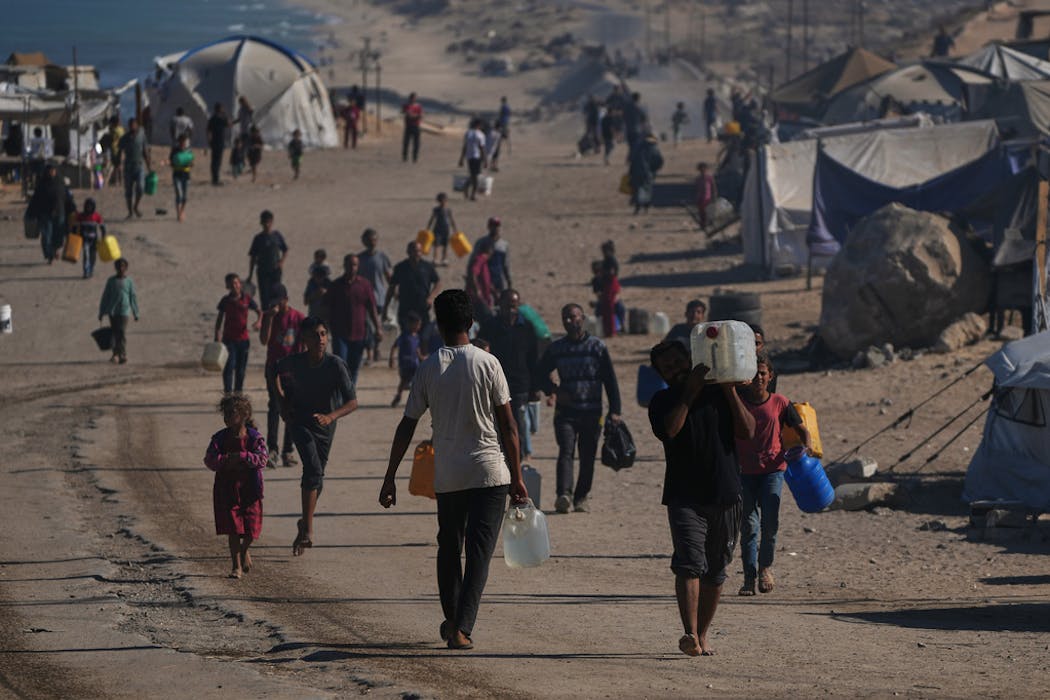
As negotiators meet in Egypt to discuss a Trump-backed peace proposal, displaced Gazans make a daily trek to find drinking water. AP Photo/Abdel Kareem Hana

Tony Blair, the man being tapped by U.S. President Donald Trump to help oversee governance of a postwar Gaza, has ample experience with peace processes.

As British prime minister, Blair helped usher through the 1998 Good Friday Agreement that did much to end decades of sectarian violence in Northern Ireland. After leaving office, he was also special envoy to the so-called Quartet – a diplomatic effort to find a lasting solution to the Israeli-Palestinian conflict.

As Hamas’ Oct. 7, 2023, attack on Israel and the subsequent devastation in Gaza, described recently as genocide by a U.N. body, make clear, that attempt failed.

The 20-point peace plan that negotiators are currently discussing in Egypt is light on details. But it outlines the return of the remaining Israeli hostages held by Hamas, the demilitarization of the Gaza Strip and the creation of an international security force to operate on the ground. Notably, the plan does not support the removal of Palestinians from Gaza – something that was present in previous proposals by the Trump administration and which human rights advocates noted amounts to ethnic cleansing.

On Oct. 8, 2025, Trump announced that an initial phase involving the exchange of hostages for prisoners and a pause in fighting had been agreed upon. But negotiations continue on sticking points, including the disarming of the militant group.

Among other things, the deal also provisions a postwar Gaza governed by an interim “technocratic” and “apolitical” Palestinian committee. This temporary body will be overseen by a “Board of Peace” run by Trump himself. Other unspecified members will be added, but the only one mentioned in the proposals is Blair, who according to reports had been in talks with the Trump administration for some time crafting the current peace plan.

As a scholar of international relations and Palestinian politics, I fear the proposal contains the same limitations and failings that plagued previous peace plans pushed on Palestinians from outside bodies – including both Blair’s Quartet efforts and the earlier Oslo Accords – and too little of what made Northern Ireland peace stick.

A plan rooted in ‘illiberal peace’

The biggest shortcoming critics find with the current plan is that it does nothing to definitively address the right of Palestinians to self-determination and sovereignty – a right enshrined in international law.

Nor does the plan include any meaningful Palestinian input, either through legitimate representatives of the Palestinian people or through mechanisms to ensure the Palestinian public’s buy-in.

Instead, the new framework is asymmetric, providing the Israeli government many of its political objectives while imposing multiple layers of international control on and vague assurances to the Palestinian people – and only if they comply.

As such, the plan continues the trend of what political scientists describe as “illiberal peace” in conflict resolution.

In a 2018 paper, scholars described an “illiberal peace” as one in which “cessation of armed conflict is achieved in ways that are … unashamedly authoritarian.” Such a peace is achieved through “methods that eschew genuine negotiations among parties to the conflict, reject international mediation and constraints on the use of force, disregard calls to address underlying structural causes of conflict, and instead rely on instruments of state coercion and hierarchical structures of power.”

Past examples include conflict management in the Kurdish region of Turkey, Chechnya under Russian control and the ethnic cleansing of Nagorno-Karabakh.

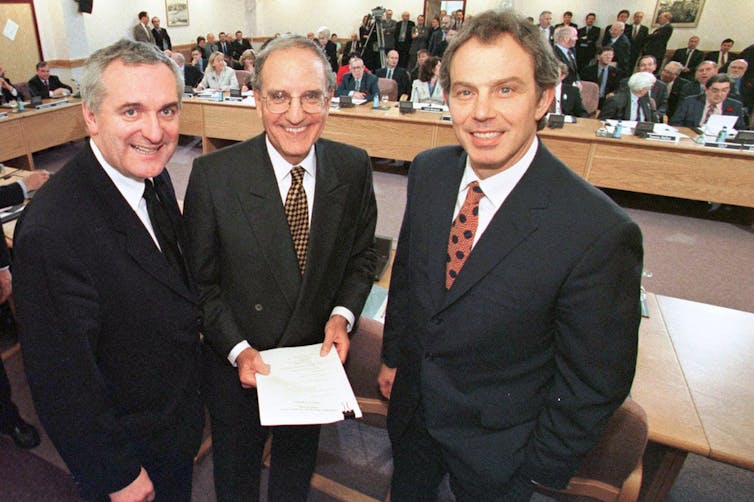
Three men pose together for a photo.
From left, Irish Prime Minister Bertie Ahern, U.S. Sen. George Mitchell and British Prime Minister Tony Blair pose together after signing the Good Friday Agreement on April 10, 1998.
Dan Chung/Pool Photo via AP, File

The Northern Ireland case study

That stands in contrast to peace agreements that have succeeded elsewhere using more inclusive diplomatic frameworks, like in Northern Ireland.

For 30-plus years, the territory was engulfed in sectarian violence between the mainly Protestant “loyalists” who wanted to remain part of the U.K. and the Catholic minority that wished to be part of a united, independent Irish republic.

To end this armed conflict, the peace process included all relevant parties, including militant groups on all sides.

The Northern Ireland peace process also explicitly engaged with the Irish public and offered the people input through two separate referendum votes. People in Northern Ireland voted on whether to support the plan, and people in the Republic of Ireland voted on whether to authorize the Irish state to sign the agreement.

This inclusive and democratic process has been able to sustain a cessation of conflict for the past 27 years.

While Blair didn’t start the Northern Ireland peace process, his government played a pivotal role, and it was he who memorably noted “the hand of history” on the shoulder of those involved in the final days of negotiation.

A failed Oslo counterexample

The Northern Ireland process stands in direct contrast to many of the failed peace processes attempted in the Middle East, which fall more in line with the “illiberal peace” concept.

The most serious push for lasting peace was the Oslo Accords in 1993, in which the Palestine Liberation Organization accepted Israel’s right to exist, forgoing its claims to much of historic Palestine, in return for Israel’s acknowledgment of the PLO as the legitimate representative of the Palestinian people.

That process led to the creation of the Palestinian Authority, which was meant to exercise limited governance on an interim basis, and presidential and parliamentary elections in order to facilitate the input of the Palestinian public. But as many former U.S. officials have since admitted, the accords were asymmetric: They offered Palestinians recognition under the PLO but little pathway to achieve a negotiated solution under conditions of occupation by a far more powerful sovereign country.

Three men stand together at a ceremony.
U.S. President Bill Clinton applauds as Israeli Prime Minister Yitzhak Rabin, left, and Palestine Liberation Organization Chairman Yasser Arafat look on after the signing of the Oslo Accords in 1993.
AP Photo/Dennis Cook

That peace process fell apart when that asymmetry became clear. The two parties meant very different things when they used the word “state.” The Israel government envisioned some form of limited self-governance for the Palestinians and continued its settlement expansion and military occupation. The Palestinians, on the other hand, envisioned a legitimate state exercising sovereignty.

Adding to the problems, Palestinians never had equal negotiating power, and the accords lacked a neutral arbiter in the U.S., the leading mediator.

Oslo was intended to be a time-limited process to give negotiators space to resolve outstanding conflict issues. In practice, it served to give long-term diplomatic cover for a status quo in which Israeli governments moved away from a two-state solution while Palestinians became more politically and geographically fragmented under worsening hardship and violence.

The Oslo peace process fell apart in the early years of Blair’s government, at the same time as he was helping put the finishing touches on the Good Friday Agreement.

The necessity of public buy-in and an inclusive process was evident to many onlookers to the divergent fortunes of both peace processes.

Repeating failed lessons in Gaza?

In the Israeli-Palestinian context today, Blair risks repeating the mistakes of Oslo. He is poised to sit on an undemocratic international body overseeing a people under a de facto military occupation.

A man waves to a camera.
As a representative for the Quartet, Tony Blair waves to the media in front of Palestinian officials in Ramallah in the West Bank in 2012.
AP Photo/Majdi Mohammed

Further, while the Trump plan is reliant on Hamas’ approval, there is no role for the group after the initial stage. In fact, the framework explicitly states that Hamas must be excised from any future discussions of postwar Gaza. Moreover, no other Palestinian group has any direct involvement; Hamas’ main rival Fatah – the party that is in control of the Palestinian Authority in the occupied West Bank – is only briefly mentioned. As for that Palestinian Authority, there is only a vague line about reforming the body.

Similarly, there has been no mention of what the Palestinian people might actually want. In this way, the body being proposed recalls the creation of the U.S.-led Coalition Provisional Authority during the invasion of Iraq. That body governed Iraq immediately following the invasion and was criticized for corruption and lack of transparency.

The failure of the Iraq War, and the U.K.’s involvement in it, contributed to Blair’s resignation as prime minister in 2007, after which he took on the role of special envoy to the Quartet. Led by the U.N., U.S., EU and Russia, the Quartet was tasked with preserving some form of the two-state solution and implementing economic development plans in Palestinian cities.

But it, too, failed to address the changing political realities on the ground as Israeli settlements expanded and the military occupation deepened.

The underlying assumption about the Quartet, critics contend, is that it largely ignored the Palestinian right to self-determination and sovereignty; rather, it focused on marginally improving economic conditions and Band-Aid initiatives.

The latest U.S.-backed proposal cribs heavily from the approach. Even if it does bring about a welcome respite from the suffering in Gaza in the short term, I believe a durable, mutually agreed upon resolution to the decades-long Israeli-Palestinian conflict requires what Trump’s plan sidelines: Palestinian self-determination.

In Northern Ireland, Blair once understood the importance of neutral mediation and the buy-in of all parties to the conflict and the people themselves. The plan he is involved with now appears to be operating with a far different calculus.

The Conversation

Dana El Kurd is affiliated with the Arab Center Washington.

ref. Gaza peace plan risks borrowing more from Tony Blair’s failures in the Middle East than his success in Northern Ireland – https://theconversation.com/gaza-peace-plan-risks-borrowing-more-from-tony-blairs-failures-in-the-middle-east-than-his-success-in-northern-ireland-266742

In 1776, Thomas Paine made the best case for fighting kings − and for being skeptical

Source: The Conversation – USA – By Matthew Redmond, Lecturer, Université de Lille

Were these protesters in Washington, D.C., on Aug. 16, 2025, inspired by Thomas Paine? Alex Brandon/AP

In one of his stand-up sets, comedian David Cross rejects all political commentary that tries to answer the question, “What would America’s Founding Fathers think if they were alive today?”

For Cross, it is pointless to speculate about the present-day views of men who could not have imagined cotton candy, let alone the machine that makes it.

“What’s a machine? What’s a machine???” he screams in their collective voice, recoiling from the sorcery of the state fair.

The first time I saw this bit, something odd happened. Having just read the 1776 political pamphlet “Common Sense,” I could hear its author, one of America’s founders, laughing louder than anybody.

That would be Thomas Paine, the man credited with turning the American Revolution from a complicated Colonial fracas into a titanic struggle for the soul of liberty itself.

If Cross is skeptical that anything 250 years old still holds up, Paine, were he alive today, could probably name one thing: skepticism. Ways of thinking and being do not grow out of the ground; we make them ourselves, then hand them down as best we can. Paine would smile to see his favorite heirloom, the skeptical worldview, still intact.

Saying “no” – especially to those in power – is an underrated American pastime, and Paine was its Babe Ruth. If you plan on joining No Kings rallies and have yet to find a slogan for your sign, Paine’s got you covered: “In America, the law is king!” “No King! No Tyranny!” “Monarchy hath poisoned the republic.”

I could go on. Because he did.

A yellowed copy of a short publication with the title 'Common Sense.'
Published in 1776, Thomas Paine’s pamphlet ‘Common Sense’ inveighed against monarchy and hereditary privilege and in favor of independence for the Colonies.
Smithsonian National Museum of American History

Birth of a revolutionary

Where did all this anti-monarchical fire come from? Originally, from a small town in Norfolk, England, in 1737. Turning from his father’s trade of corset-making, Paine tried his hand at business, met and impressed Benjamin Franklin in London, sailed to America, and there found his true metier as a pamphleteer and radical.

Using simple yet incandescent prose, Paine renounced, repudiated and ridiculed at a clip seldom witnessed in print before or since. Hereditary privilege, colonialism, the supernatural: no, no, no.

But what Paine made his name lambasting – what he knocked out of the park with almost steroidal force – were kings. All of them, from the figures of ancient legend and Scripture to those who warmed England’s throne during his lifetime.

Common Sense,” his first major work, was an urgent wake-up call to every light-sleeping lover of liberty within earshot. In that pamphlet, Paine labels kingship “the most prosperous invention the Devil ever set on foot for the promotion of idolatry.” He never minced words; he wanted the right people to choke on them.

Lawn signs that quote 'No King! No Tyranny!' and 'In America, the Law is King!'
Thomas Paine quotes in Lexington, Mass., not far from where the American Revolution began.
Photo: Joel Abrams, CC BY

‘Simple facts, plain arguments’

Exactly what was Paine’s problem with kings?

The same problem you’ll have, “Common Sense” promises, when you examine the evidence.

This is partly the secret of Paine’s rhetorical power: It’s hard to imagine any wordsmith demanding more vigorously that you not take his word for it.

Paine was a student of history, and history is chock-full of receipts. It shows that abuses of kingly power extend back to the “early ages of monarchy,” when some “principal ruffian” first took power, and “it was very easy, after the lapse of a few generations, to trump up some superstitious tale, conveniently timed … to cram hereditary right down the throats of the vulgar.”

Since that time, says Paine, even those fortunate enough to live under benevolent rule have seldom been more than one generation away from yet another dreadful monarch.

“One of the strongest NATURAL proofs of the folly of hereditary right in kings, is, that nature disapproves it, otherwise she would not so frequently turn it into ridicule by giving mankind an ASS FOR A LION.” What a tweet this would have made, caps and all.

Bring the Paine

The only thing Paine liked less than monarchical rule was its enablers, anyone who relinquished their freedom willingly to an aspiring tyrant.

This is not only wrong, Paine insists, but against nature, since all of us are created equal.

A somewhat puckish-looking middle-aged man from the 18th century, holding a
A somewhat puckish-looking Thomas Paine – with the wrong first name and a different spelling of his last one.
National Portrait Gallery, Smithsonian Institution

But even that’s not the worst part. Those who sacrifice their own freedom on the altar of monarchy also sacrifice that of future generations. Their “unwise, unjust, unnatural compact might (perhaps) in the next succession put them under the government of a rogue or a fool.” Ouch.

“Most wise men,” Paine adds, “in their private sentiments, have ever treated hereditary right with contempt; yet it is one of those evils, which when once established is not easily removed; many submit from fear, others from superstition, and the more powerful part shares with the king the plunder of the rest.”

Federal worker firings, court settlements, a government shutdown. Paine would loathe how right the U.S. is proving him.

Besides criticizing both tradition and manipulative elites for their role in abetting monarchs, Paine’s writing gestures toward a more widely accessible sense of false freedom that comes with getting what you want from whoever happens to wear the crown.

This kind of pleasure obscures a painful reality: that the tyrant can strike as well as stroke.

The problem of unchecked power is not nearly counterbalanced by any number of indulgences the wielder of that power deigns to bestow. Freedom, Paine insists, is not transactional; whatever price you name, you’re getting fleeced.

Or, to put it his way: “O ye that love mankind! Ye that dare oppose, not only the tyranny, but the tyrant, stand forth!”

The Conversation

Matthew Redmond does not work for, consult, own shares in or receive funding from any company or organization that would benefit from this article, and has disclosed no relevant affiliations beyond their academic appointment.

ref. In 1776, Thomas Paine made the best case for fighting kings − and for being skeptical – https://theconversation.com/in-1776-thomas-paine-made-the-best-case-for-fighting-kings-and-for-being-skeptical-266448

Refinery fires, other chemical disasters may no longer get safety investigations

Source: The Conversation – USA (2) – By Philip Steenstra, Ph.D. Candidate in Toxicology, University of Michigan

A Chevron refinery in El Segundo, Calif., burns on Oct. 3, 2025. Allen J. Schaben/Los Angeles Times via Getty Images

When fire erupted at the Intercontinental Terminals Co. bulk liquid petroleum storage terminal, large plumes of dark smoke billowed into the clear skies over Deer Park, Texas. Despite the efforts of site staff and local firefighters, more than 70 million gallons of petroleum products burned or were otherwise released into the environment over the following three days in March 2019.

Even while the fire was still burning, investigations began looking into what had happened and what was still happening. The Environmental Protection Agency tested air and water samples to determine how much pollution was being released – both to determine cleanup efforts and to assess fines. The Occupational Safety and Health Administration reviewed what had happened, but found that with no workers injured, there was no reason to investigate further or impose fines or other penalties on the company.

A third federal agency, the Chemical Safety and Hazard Investigation Board, often known as the CSB, got to work figuring out what had gone wrong, without assigning legal or financial responsibility, but rather seeking to learn from this disaster how to prevent future accidents. It’s an approach much like the National Transportation Safety Board takes toward airplane crashes, train derailments and other transportation-related tragedies: document what happened and identify every opportunity to prevent or reduce the chances of it happening again.

That deep investigative process reportedly will not happen in the wake of the October 2025 explosion and fire at a Chevron refinery in El Segundo, California, because of the federal government shutdown and lack of funding for the organization.

As scholars of chemical disasters, we believe this absence – and the potential for the board to be eliminated entirely under the proposed 2026 federal budget – raises the risk of more, and more serious, chemical disasters, not just in the U.S. but around the world.

A fire at several large round buildings sends dark black smoke into the sky.
A fire burns at Intercontinental Terminals Co. in Deer Park, Texas, in March 2019.
AP Photo/David J. Phillip

Many serious incidents

The CSB investigation of that 2019 fire that burned 15 petroleum tanks at the Intercontinental Terminals Co., near the Port of Houston, yielded key recommendations to the company, OSHA and the EPA. They included necessary updates to safety management systems, the need for flammable-gas detectors to identify leaks, and remotely operated emergency shutoff valves so workers could close tanks containing hazardous material without exposing themselves to danger. The company has addressed the first recommendation and is reportedly working on the next two.

The board also recommended to the petroleum industry that storage tanks be spaced farther apart so they would be less likely to catch each other on fire – a recommendation that is still under review.

And the Texas fire was just one of several disasters the Chemical Safety and Hazard Investigation Board investigated that year. Since its activation in 1998, the board has conducted in-depth investigations of 102 chemical disasters in the chemical and industrial sectors – an average of about four per year. And its reports are regularly used worldwide, including in France, South Korea and China.

A U.S. Chemical Safety and Hazard Investigation Board video summarizes the agency’s findings about a March 2019 petrochemical terminal fire in Texas.

Creation and goals of the CSB

The U.S. Chemical Safety and Hazard Investigation Board was created by Congress in a 1990 amendment to the Clean Air Act, in the wake of several high-profile chemical disasters around the world.

Those included the 1976 dioxin release in Seveso, Italy, which caused skin lesions on over 600 people and contaminated nearly 7 square miles of land; the deaths of thousands in Bhopal, India, from the 1984 release of methyl isocyanate from a Union Carbide pesticide plant; and the Chernobyl nuclear plant disaster in 1986 in what was then the Soviet Union. The goal was to prevent similar accidents from occurring on U.S. soil by investigating the causes of incidents and providing recommendations for improvement.

Specifically designed to be independent of other organizations and political influence, the CSB cannot be forced to modify its findings by other agencies, branches or political parties, ensuring its impartiality.

It has no power to issue regulations, nor any authority to impose fines or other punishments for wrongdoing. Rather, it is a fact-finding, investigative body designed to learn from past disasters and issue voluntary recommendations so chemical companies can improve their equipment and processes to prevent future tragedies. The vast majority of its recommendations are adopted by the industries affected, usually by the investigated company, though sometimes recommendations become industry standards. These recommendations can range from changes in procedure, the addition of safety devices or even overall facility design recommendations.

What does the board do?

There are several kinds of events companies must report to the federal government, including deaths and releases of particular chemicals, such as chlorine, naphthalene and vinyl chloride.

The board reviews those reports and decides on its own which to investigate. When an inquiry is opened, a group of experts who work for the board travel to the incident site to gather evidence to understand not only what happened in the big picture but a detailed view of how events unfolded.

After the investigation, the board issues a report detailing what it found and recommending specific changes to the company to reduce the risk of that sequence of events happening again. The board also delivers its information to other federal agencies, such as the EPA and OSHA, which can determine whether changes would be appropriate to federal regulations that apply to all companies in an industry.

The board’s value

The board had a US$14 million annual budget for 2025, which is a tiny part of the more than $6 trillion the U.S. government spends each year.

The current administration’s justification for eliminating the CSB is that its capabilities are duplicated by agencies such as the EPA and OSHA. But the EPA focuses specifically on environmental violations and potential threats to human life. OSHA investigates regulatory violations leading to personal injury.

In fact, the CSB has helped the EPA and OSHA evaluate and improve regulations, such as for the open burning of waste explosives, and improved methods of investigating accidental chemical releases and implementing new emergency response rules.

The CSB is the only organization that looks into improving processes to prevent future accidents instead of punishing past acts. It’s the difference between investigating who robbed a bank to hold the robbers accountable and improving bank security so another robbery can’t occur.

The Conversation

The authors do not work for, consult, own shares in or receive funding from any company or organization that would benefit from this article, and have disclosed no relevant affiliations beyond their academic appointment.

ref. Refinery fires, other chemical disasters may no longer get safety investigations – https://theconversation.com/refinery-fires-other-chemical-disasters-may-no-longer-get-safety-investigations-265546