Friday essay: I loved being a ‘90s rock journalist, but sometimes it was a boys’ club nightmare

Source: The Conversation – Global Perspectives – By Liz Evans, Adjunct Researcher, English and Writing, University of Tasmania
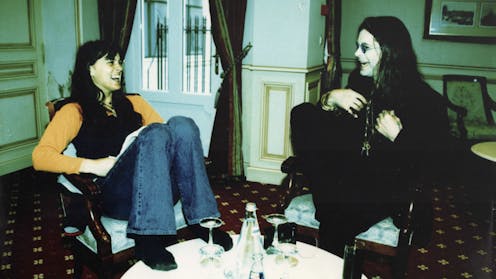
Liz Evans interviewing Ozzy Osbourne in Paris.

In the 1990s, I was a rock journalist striving to assert myself as a young woman, working at the heart of the United Kingdom’s male-dominated music press. I loved my job. I met and interviewed all my favourite bands, and spent my twenties and early thirties in a whirl of parties, clubs, gigs and all-expenses trips to America and Europe.

I began my career through a combination of ignorance, bloody-mindedness, and good timing. With no idea about the protocol of editorial commissions, I was annoyed when a music paper failed to publish my unsolicited live review of a friend’s band. Determined to succeed, I followed a tipoff from an artist who lived in a squat with a media contact (this was London in the 1980s), and soon found myself writing for a bi-monthly heavy metal magazine.


Review: Men Of A Certain Age: My Encounters with Rock Royalty – Kate Mossman; Maybe I’m Amazed: A Story of Love and Connection in Ten Songs – John Harris (John Murray)


The editor, Chris Welch, was a softly spoken, conservatively dressed man in his late forties whose office walls were lined with photos of himself hanging out with Marc Bolan, Led Zeppelin’s Jimmy Page and Eric Clapton, in his days as a young reporter. I rarely saw him during my year at the magazine, but I’ve never forgotten his gentle demeanour and the trust he placed in my inexperienced, 22-year-old self. Without his support, my life may have taken a very different turn.

Chris was one of a kind. Other than him, respectful, benevolent older men did not figure in my work for the music press.

Kate Mossman’s debut is ‘a meditation on the powerful archetype of the ageing rock star’.
Bonnier

By contrast, Kate Mossman is a British arts and music writer whose debut book is presented as “a meditation on the powerful archetype of the ageing rock star”. Her fixation with rock’s fading old guard provides a compelling premise for Men Of A Certain Age: My Encounters with Rock Royalty, but the blurb is a little misleading. This is essentially a collection of republished interviews and personal reflections, rather than an in-depth analysis.

That said, Mossman has produced a thoughtful and entertaining retrospective. Her conversations with the likes of Wilko Johnson, Terence Trent D’Arby, Ray Davies (The Kinks), Jeff Beck and Kevin Ayers are humorous, perceptive and beautifully composed.

She describes the Happy Mondays’ and Black Grape’s Shaun Ryder as resembling “a Russian Mafia boss in the corner, whisky in hand, arms elevated by the pressure of a thick leather jacket”. She chats with Paul Stanley of KISS while he applies his makeup before a show.

“Here is my clown white,” he says softly, picking up a pot of the thick, sweat-resistant foundation he discovered in the ‘70s. “And here are my puffs.”

These encounters afford the reader a certain insight into Mossman’s idiosyncratic predilection for wrinkly rock stars twice her age. Yet while the book affectionately probes her strange, decidedly gendered interest, it avoids the glaring issue of structural misogyny that contaminates the music industry.

It’s not as if Mossman is unaware of the sexual politics at play. She positively delights in the “exciting father-daughter energy” of the older man-younger woman dynamic, intentionally exaggerating her youth and assumed innocence in the presence of ageing rockers. She knows men like Tom Jones and Gene Simmons will respond openly to her coltish, unthreatening persona, because what could be safer than “just a pretty lady”? It’s a clever and effective strategy.

I fully appreciate the quality of Mossman’s profiles, but her attempts to lean into the patronising attitudes of rock’s elders land uncomfortably with me. And having once had my own tender skin in the game, I can’t help seeing the book’s negation of sexism as a missed opportunity.

When I was a rock journalist, I never felt advantaged by my gender or energised by the older male rocker’s entrenched misogyny. Quite the opposite.

At Jarvis Cocker’s house party

Twenty or so years before Mossman began pursuing her beloved senior rockers across the US, I was being reprimanded by my editor for my “unprofessional” rejection of the creepy advances of a famous middle-aged musician.

Liz Evans in a shaving cream fight with Martin McCarrick from Therapy?.

In 1989, I was a staff writer for a fortnightly rock magazine based in London’s Carnaby Street. We smoked and drank at our desks, played loud metal on the stereo, took half-day lunches on record company money and hosted a constant stream of visiting rock stars in all manner of altered states throughout the working day.

One of my regular jobs was to review the singles with a handful of guest musicians, depending on who was in town. This was often a riotous affair that occasionally descended into chaos. One time, a German drummer, old enough to be my dad, asked me to sit on his lap while we listened to the records. When I didn’t see the funny side, he sniggered at my rebuttal and asked if I was having my period. So I walked out, leaving him with his embarrassed band mate in a room shocked into silence.

A year or so later, the editor who scolded me would help bring about my eventual redundancy after I started to retaliate against a toxic male colleague. This man, previously a friend who’d tried to date me, bullied and ostracised me for the entire duration of my employment. I put on a brave face, cried in the toilets and still managed to enjoy my work. But when I eventually reacted, I was blamed for aggravating the situation, and the magazine let me go.

I spent the next eight years escalating my freelance career and writing books. I waded in the ocean with The Verve’s Richard Ashcroft, toasted a Chicago sunrise on tour with Alice in Chains, went snowboarding with a young British band in California, tripped over Jarvis Cocker at his own house party, and gratefully received a pair of secondhand John Fluevog sandals from the closet of Sonic Youth’s Kim Gordon in New York. But my confidence remained dented until I published my first academic article in the early 2000s.

Liz Evans in Los Angeles to interview L7, with Dom Wills from Melody Maker.
Liz Evans

Forgive me then, for baulking when Mossman describes herself as “a small girl sitting on the knee of Father Rock” at her first job for the now-defunct UK music monthly, The Word.

While I’m sure she’s attempting to describe a more supportive, paternalistic workplace environment than the one I endured, she is nevertheless referring to a situation in which she, too, was the only woman in a small team of men. In her case, a generational divide reinforced the sense of male authority which left her wondering “who I was without these men, and who I would be”.

Years before Mossman met him, one of the men she mentions reportedly claimed women were unable to write effectively about music. I once encountered him too, and found him to be smooth, charming and arrogant, with the ruthless attitude of a tabloid journalist.

Working with men like this produced some of the worst experiences of my career. Luckily, such occasions were rare, but could be significant. Bands never saw the bigger picture, of manipulated stories and doctored headlines, but their lives were directly affected by decisions made by people they’d often never met.

I remember once having a conversation with Kurt Cobain about power and the media, and telling him journalists like me could only do so much. Ultimately, we were at the mercy of our editors, which is why I tried to pick mine wisely. Musicians don’t have the choice. Under contract with record labels, they are legally obliged to engage with the media and must take what’s on offer. I’d known Nirvana before they were famous, and watching Kurt develop from a shy, goofy kid into a cynical megastar persecuted by the press was heartbreaking.

Part of the reason Mossman’s book sits uneasily with me is because it appears to ignore the hard-won heritage of female music journalists, and the struggles women like me had in the workplace. Deferring to big daddy editors and accommodating the fragile egos of doddery rock gods feels too much like turning the clock back.

More interested in her

Interestingly, at the back of her book, an intriguing detail lies almost buried in the acknowledgments. Here, Mossman says she recently learned her mother was responsible for introducing a bunch of records she thought had belonged to her dad into the family home.

This untold chapter of Mossman’s story speaks volumes about women and rock culture. Swinging like a loose thread, it threatens to unravel so much of what we have come to accept about the world of rock and the stories of its appointed gods.

Hence my other frustration with the book. While Mossman is a critically acclaimed journalist and former Mercury prize judge, nothing can fire my interest in men such as former Journey singer Steve Perry, or the insufferable Sting. I simply don’t care about them. I’m much more interested in her.

Had Mossman developed the snippets of memoir she uses to contextualise her interviews, and foregrounded herself instead of her tired old giants, I believe her book would have been much more powerful. The strongest, most illuminating passages are when she interrogates her past and mines her personal experiences for clues to her adult obsession with the old guys.

Her teenage infatuation with Queen, her discomfort with the irreverence of 1990s pop culture, her desperate need for parental approval, the peculiar sense of shame she feels in writing about people she loves. The way she listens to music through her father’s “imaginary ears”, the energy writing affords her. All of this outshines the perpetually recycled male rock-star myths, no matter how well Mossman interprets them.

Perhaps in trying to convince the reader to share her love for middle-of-the-road musicians, Bruce Hornsby and Glen Campbell, both of whom had their heyday before she was born, Mossman is still trapped in her teenage cycle of needing her parents to approve of Queen. If so, I hope she manages to shake this off and step more fully into her own story with conviction and faith. With her talent, a full-blown memoir would be a runaway bestseller.

In many ways, Mossman’s book highlights the limits of music journalism as a genre. Her long-form profiles are detailed sketches rather than complex studies, reflecting the fleeting nature of the interview format. Ultimately, even with a fascinating subject, this type of interaction will always be a superficial exercise and therefore something of a game.

For Mossman, with her obsessive fan tendencies, this may be hard to accept, but faced with Sting’s smooth professionalism, she has no choice. “There is a desire for connection that drives every interview,” she writes, “and with Sting, it was a connection I never got.”

For me, ten years of music journalism was enough. By 1998, I’d met everyone I wanted to meet and there were only five or six bands I still wanted to hang out with. I was ready to expand my writing skills and deepen my understanding of the human psyche. Funnily enough, given Mossman’s interest in Jungian theory, I retrained as a Jungian psychotherapist.

Liz Evans writes ‘ten years of journalism was enough’. Here, she’s pictured with Art Alexakis from Everclear.
Liz Evans

An elitist boys’ club

I wasn’t the only one to quit music journalism after the 1990s. With magazines folding left, right and centre, many writers moved onto other careers. One of them was John Harris, now a political and arts columnist for The Guardian. We met briefly at the NME during my six-month stint as its rock correspondent, and occasionally ran into each other at Britpop gigs with mutual friends.

Now, NME is an online platform full of celebrity gossip and brimming with ads. But in the early 1990s it still held currency, for emerging bands and music fans alike. So when the editor invited me to interview Alice in Chains and Screaming Trees on tour in America, I was excited.

I arrived at the NME office fresh from the friendly clamour of Kerrang! magazine, and the first thing that struck me was the silence. Everywhere I looked, studious-looking guys with neat haircuts sat typing furiously away at their desks. There was no music, no talking – and, apart from the secretary, no women.

I soon discovered the few female writers who managed to find a way in were either resented (like me), or given “special dispensation”, whatever that meant.

It all seemed so weirdly petty, like an elitist boys’ club. I hated it.

On one occasion, I refused to disclose the location of a secret Hole gig – at the band’s request. I was punished for my disloyalty to the paper by not being allowed to review it. Another time, a couple of journalists offered to “help” me with a two-part feature on the Riot Grrrl movement, even though I’d single-handedly managed to gain the trust of some of the key women on the scene, all of whom despised the male-dominated music press.

The final straw came in the form of a commission to interview Aerosmith. Asked to “get the drug stories”, I argued for a more original angle: by then, the band was clean. But I was shut down and told to be “more humble”.

Needless to say, after spending a lovely afternoon laughing about outlandish but predictable druggy adventures with Aerosmith band members Joe Perry and Steven Tyler (who tried to steal my fake fur coat), I filed my copy and walked away from the NME with my head held as high as it would go.

Autistic and thriving with music

After freelancing for the NME, Harris went on to work for monthly music titles Q and Select. Now, he’s an award-winning journalist with a string of books to his name. His latest one, Maybe I’m Amazed: A Story of Love and Connection in Ten Songs, is his fifth, and arguably his most important work to date.

Harris’ memoir is a beautiful, heartwarming, enlightening and uplifting book that chronicles the profound impact of music on the life of an autistic child. It captures the grief and frustration of two loving parents as they struggle with the UK’s broken education system and underfunded health services, on behalf of their son. And it details the individual nature of autism and the multiple, miraculous ways an autistic person can flourish when given the right support.

As first-time parents, Harris and his partner Ginny, a former press officer with Parlophone Records, are not aware of any issues with their baby, James. He’s a little slow to speak and has some cute, characterful quirks, but nothing seems out of the ordinary until their daughter Rosa is born and the family moves from Wales to Somerset.

Slow to adapt to the new changes in his life, James begins to exhibit ritualistic behaviours that concern Harris. Three weeks after James starts attending his new nursery, Ginny is told her son might be autistic. Suddenly, she and Harris are plunged into a brutal spin of fear, anxiety, guilt, denial and fundamental uncertainty.

Together, the family embarks on a punitive round of tests and assessments as the tyranny of diagnosis takes hold. At first, supportive frameworks carry the weight of a heavy sentence. But Harris and Ginny immerse themselves in research and fact-finding missions to educate themselves about autism. After investing a significant amount of time and money, they manage to establish a viable routine to help James thrive.

It’s not an easy journey. Setbacks, personnel changes and bureaucratic complications are ever-present, but with a small team of specially trained, caring individuals, James makes progress. Meanwhile, as a lifelong music lover, Harris becomes increasingly aware of the profound relationships his son is developing with certain songs by particular bands. Kraftwerk, The Beatles and Mott the Hoople all exert a steadying influence on James, enabling him to communicate in ways he cannot through verbal language.

A visit from musician Billy Bragg, with whom Harris organises an annual talks tent for Glastonbury Festival, results in James actually making music himself. This leads to keyboard lessons and a slot at the school concert. By the time he enters his teens, James is playing bass, and looking every inch the rock star.

Structurally, Harris has produced a masterclass in memoir, seamlessly blending the past with the present. Cleverly shifting between his own life in music and his son’s, he charts his teenage years as a mod, his ill-fated band’s only performance and his forays into music journalism – all of which he now values anew in the context of parenting James.

He describes how the pair share their joy in gigs and experience the deep bond of making music together, sometimes with Rosa on drums. Watching his child come alive through rhythm and melody, Harris finds himself re-enchanted by music and uncovers the wonder of parenting through unexpected and creative channels.

The book delivers a wealth of information about the vast and complicated spectrum of autism, taking a deep dive into medical theories and the world of neurology. By weaving this complex material into his personal experience of huge emotional and practical challenges, Harris keeps it relatable. In many ways, he has forged a map, complete with a beacon of hope: albeit an individualised one. Informative, enriching and engaging, his story of love, persistence and hard-won daily miracles is music writing at its absolute best.

Wildly disparate in content, both Harris’ and Mossman’s books show how music can define us. In this way, their narratives speak to us all.

They remind me of a time when I couldn’t leave home without a Walkman and a spare set of batteries. They take me back to when I was a teenager, when music shaped my social life, determined my image and gave me the courage to withstand an emotionally abusive upbringing. And they return me to my twenties, when music powered my glamorous first career and launched me into a lifelong creative practice.

Ultimately, they remind me the pulse beneath my writing still belongs to music. And who knows? Maybe I’ll expand on that one day.

The Conversation

Liz Evans does not work for, consult, own shares in or receive funding from any company or organisation that would benefit from this article, and has disclosed no relevant affiliations beyond their academic appointment.

– ref. Friday essay: I loved being a ‘90s rock journalist, but sometimes it was a boys’ club nightmare – https://theconversation.com/friday-essay-i-loved-being-a-90s-rock-journalist-but-sometimes-it-was-a-boys-club-nightmare-256474

From a naked rider to icon of resistance, the legend of Lady Godiva lives on

Source: The Conversation – Global Perspectives – By Elizabeth Reid Boyd, Senior Lecturer School of Arts and Humanities, Edith Cowan University

Lady Godiva – an icon of protest, myth and sensual defiance – has galloped through centuries of our cultural imagination. She is most widely known for the legend of her naked horse ride, in which she supposedly rode through the city of Coventry, England, in nothing but her cascading hair.

According to the popular tale, Godiva pleaded with her husband, Lord Leofric of Mercia, to lift an oppressive tax that threatened to impoverish the people of Coventry.

Leofric issued a provocative challenge: he would only revoke the tax if she rode unclothed through the town. In a gesture of defiance and compassion, she undertook the ride.

The townspeople, in respect, shuttered their windows, except for one man named Tom, who was struck blind. This is where we get the phrase “peeping Tom”. Moved by her courage, Leofric kept his word and abolished the tax – or so the story goes.

While many historians believe this naked ride never actually took place, Godiva, the 11th century noblewoman, was real – as is her enduring influence.

Godiva has been endlessly remixed, from appearances in literature, to art, to music, to comics, and even chocolate.

Artist John Collier’s 1897 oil painting of Lady Godiva depicts her as holding her head down in shame.
Wikimedia

Although Godiva has historically been objectified, her legacy is ever-evolving. Through parades and processions, political protest, and philanthropic campaigns, fans and activists alike have transformed Godiva into a symbol of resistance.

The lady behind the legend

Countess Godgyfu (meaning “God’s gift” in Old English) was born around 990 CE and died sometime after 1066. She was the only female Anglo-Saxon landowner listed as “tenant-in-chief” in the Domesday book.

According to historian Daniel Donoghue, this implies an exceptionally high noble status and independent authority, suggesting Godiva held her estate by birth, rather than through marriage.

She married Lord Leofric of Mercia, a powerful Saxon military leader. Her Christian piety and philanthropic influence are credited with inspiring the foundation of the monastic site of Coventry’s original cathedral.

Her will included a string of prayer beads – an early reference to the rosary.

Fanning herstory

The legend of the naked horse ride draws from older mythological traditions.

In his book The White Goddess (1948), English writer Robert Graves interprets Godiva as a medieval manifestation of a pagan goddess. Her symbolic nudity and ritualistic ride echo fertility rites and goddess worship.

Like many medieval legends of pagan or folkloric origin, it was transformed into a Christian narrative over time, intertwined with the real history of the philanthropic Countess Godgyfu.

Fandom offers a compelling lens through which to view Godiva, and the ways her story continues to resonate in contemporary culture.

A Lady Godiva-themes clock in Broadgate, Coventry. A ‘peeping Tom’ looks at her from the window.
Wikimedia, CC BY-SA

In the 2016 book I’m Buffy and You’re History, author Patricia Pender explores how fandom enables playful and subversive representations of femininity. For instance, Buffy – a female character who nonchalantly slayed vampires, rather than running screaming – subverted expectations. By riding naked, Godiva, too, subverts expectations.

At the same time, feminist scholars have critiqued representations of nude women in culture and the arts as catering to the male gaze, rather than being subversive. Researcher Melisa Yilmaz argues Godiva has been moulded into a passive symbol of erotic spectacle, rather than female empowerment.

Godiva’s image is also commodified globally, most notably by the Godiva chocolatier.

Yet, reinterpretations of her legend through centuries of fandom offer a counter-narrative.

Women who refuse to be shamed

Godiva became very popular in the 19th century. She is featured in a poem by Alfred Tennyson, in pre-Raphaelite paintings, in works by Salvador Dali, and even in a statuette gifted to Prince Albert by Queen Victoria.

She gained renewed popularity through women writers, activists and suffragists. For instance, in the 1870s, British political activist Harriet Martineau told women who feared exposure and condemnation for taking up controversial causes to “think of the Lady Godiva”.

Once such cause at the time was the campaign against the Contagious Diseases Act. This act, which applied only to women, meant police could arrest women assumed to be prostitutes and have them medically examined.

Similarly, social reformist Josephine Butler entitled her 1888 political play The New Godiva. In it, she wrote about the need for a female campaigner to

compare her[self] to Godiva, stripping herself bare of the very vesture of her soul […] exposing herself to something worse than physical torture.

Radical reclamation

Lady Godiva is widely referenced in film and TV. She was the subject of the historical 1955 film Lady Godiva of Coventry, starring Hollywood starlet Maureen O’Hara, and has appeared as a character in shows such as Charmed (1998–2006) and Fantasy Island (1977–84).

Irish-American actress Maureen O’Hara portrayed Lady Godiva in the 1955 film Lady Godiva of Coventry.
Wikimedia

Contemporary women authors have also offered up various twists of Godiva’s tale.
In Judith Halberstam’s young adult novel Blue Sky Freedom (1990), for example, Godiva is the name given to an anti-apartheid resistance leader.

In the DC Comics, the character Godiva is a beautiful woman with powerful hair she can control to her advantage.

She shows up in music, too. The cover of Beyonce’s 2022 album, Renaissance, shows the singer astride a holographic horse in a seemingly Godiva-inspired pose – boldly facing the camera.

In Queen’s song Don’t Stop Me Now, Lady Godiva is likened to a racing car:

I’m a racing car, passing by like Lady Godiva
I’m gonna go, go, go, there’s no stopping me.

Coventry city has had an official Lady Godiva, Pru Porretta, for more than three decades. Porretta’s role involves a range of community and philanthropic work.

Godiva’s legacy in Coventry continues through archaeological sites such as the Coventry Cathedral, guided Godiva-themed walks, and public celebrations including the annual three-day Godiva Festival.

The Conversation

Elizabeth Reid Boyd does not work for, consult, own shares in or receive funding from any company or organisation that would benefit from this article, and has disclosed no relevant affiliations beyond their academic appointment.

– ref. From a naked rider to icon of resistance, the legend of Lady Godiva lives on – https://theconversation.com/from-a-naked-rider-to-icon-of-resistance-the-legend-of-lady-godiva-lives-on-264347

Ce qu’avoir un chat fait à votre cerveau (et au sien)

Source: The Conversation – in French – By Laura Elin Pigott, Senior Lecturer in Neurosciences and Neurorehabilitation, Course Leader in the College of Health and Life Sciences, London South Bank University

L’ocytocine, surnommée l’” hormone de l’amour », envahit-elle les cerveaux du chat et de l’humain ? Zhenny-zhenny/Shutterstock

Caresser un chat, l’entendre ronronner n’a rien d’anodin : derrière ces instants se cache une réaction chimique qui renforce la confiance et diminue le stress, autant chez l’humain que chez l’animal.

Les chats ont beau avoir la réputation d’être indépendants, des recherches récentes suggèrent que nous partageons avec eux un lien unique, alimenté par la chimie du cerveau.

Au cœur du processus se trouve l’ocytocine, fréquemment désignée comme l’« hormone de l’amour ». Cette même substance neurochimique est libérée lorsqu’une mère berce son bébé ou lorsque des amis s’étreignent ; elle a un effet bénéfique sur la confiance et l’affection. Et aujourd’hui, des recherches indiquent qu’elle joue également un rôle important dans la relation entre les chats et les humains.

L’ocytocine est au cœur des liens sociaux, c’est-à-dire de la capacité d’entrer en contact avec les autres et de leur faire confiance, ainsi que de la régulation du stress, et ce tant chez les animaux que chez les humains. Une expérience menée en 2005 a montré qu’elle rendait des volontaires humains nettement plus enclins à faire confiance aux autres dans des opérations boursières fictives.

Cette hormone a aussi des effets apaisants, chez les humains comme chez les animaux : elle réduit le cortisol, l’hormone du stress, et active le système nerveux parasympathique — celui du repos et de la digestion — pour aider le corps à se détendre.

Les scientifiques savent depuis longtemps que les interactions amicales entre les chiens et leurs propriétaires déclenchent la libération d’ocytocine, créant une véritable boucle de rétroaction affective. Mais chez les chats, ce phénomène restait moins étudié.

Moins démonstratifs que les chiens, les chats expriment leur affection de façon plus subtile. Pourtant, leurs propriétaires décrivent souvent les mêmes bénéfices : chaleur, réconfort, baisse du stress. Les recherches confirment peu à peu ces témoignages. Ainsi des chercheurs japonais ont montré en 2021 que de brèves séances de caresses avec un chat augmentaient le taux d’ocytocine chez de nombreux propriétaires.

Dans le cadre de cette étude, des femmes passaient quelques minutes à interagir avec leur chat pendant que les scientifiques mesuraient leurs niveaux hormonaux. Résultat : le contact amical (caresser, parler doucement) entraînait une hausse d’ocytocine dans la salive.

Beaucoup trouvent apaisant de caresser un chat qui ronronne, et ce n’est pas qu’une question de douceur du pelage. Le simple fait de caresser un chat — ou même d’entendre son ronronnement — stimule la production de cette hormone dans le cerveau. Une étude de 2002 a montré que ce pic d’ocytocine, déclenché par le contact, contribue à réduire le cortisol, ce qui peut ensuite faire baisser la tension artérielle, et même la douleur.

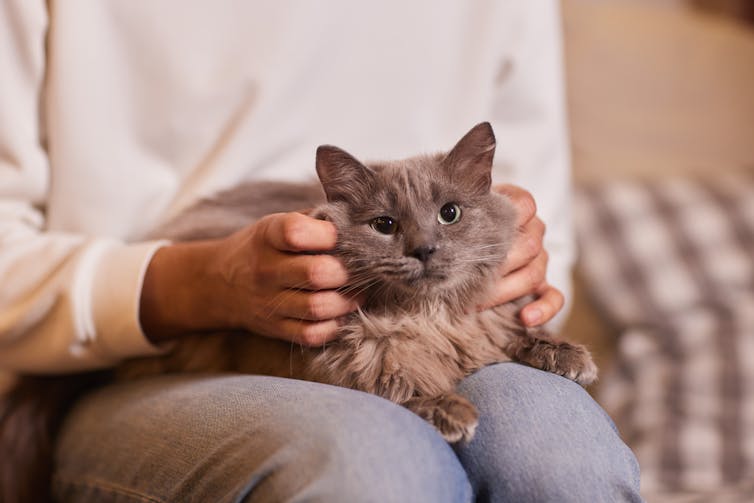
Homme tenant un chat gris sur ses genoux
Se blottir contre un chat peut aider à réduire le cortisol, l’hormone du stress.
Vershinin89/Shutterstock

Quand l’ocytocine circule-t-elle entre les chats et les humains ?

Les chercheurs commencent à identifier les moments précis qui déclenchent cette hormone de l’attachement dans la relation humain-chat. Le contact physique doux semble être le facteur principal.

Une étude publiée en février 2025 montre que lorsque les propriétaires caressent, câlinent ou bercent leurs chats de manière détendue, leur taux d’ocytocine a tendance à augmenter, tout comme celui des félins, à condition cependant que l’interaction ne soit pas forcée.

Les chercheurs ont surveillé le taux d’ocytocine chez les chats pendant 15 minutes de jeu et de câlins à la maison avec leur propriétaire. Quand les chats étaient à l’initiative du contact, par exemple en s’asseyant sur les genoux ou en donnant des petits coups de tête, ils présentaient une hausse significative d’ocytocine. Plus ils passaient de temps auprès de leur humain, plus l’augmentation était marquée.

Qu’en est-il des félins moins câlins ? La même étude a noté des schémas différents chez les chats ayant des styles d’attachement plus anxieux ou distants. Les chats dits « évitants », qui gardent leurs distances, ne présentaient aucun changement significatif de leur taux d’ocytocine, tandis que les chats anxieux (toujours en quête de leur maître, mais vite submergé) avaient un taux d’ocytocine élevé dès le départ.

Chez ces derniers, comme chez les chats évitants, les câlins imposés faisaient baisser le niveau d’ocytocine. Autrement dit : quand l’interaction respecte le rythme du chat, le lien s’approfondit ; quand elle est forcée, l’hormone de l’attachement diminue.

Les humains pourraient en tirer une leçon : la clé pour créer un lien fort avec un chat est de comprendre son mode de communication.

Contrairement aux chiens, les chats ne s’appuient pas sur un contact visuel prolongé pour créer des liens. Ils utilisent des signaux plus subtils, comme le clignement lent des yeux — un « sourire félin » qui exprime sécurité et confiance.

Le ronronnement joue aussi un rôle central. Son grondement grave est associé non seulement à l’autoguérison chez le chat, mais aussi à des effets apaisants chez les humains. L’écouter peut réduire la fréquence cardiaque et la tension artérielle et l’ocytocine contribue à ces bienfaits.

Ainsi, la compagnie d’un chat — renforcée par toutes ces petites poussées d’ocytocine issues des interactions — peut agir comme un véritable bouclier contre le stress, l’anxiété et parfois même la dépression, offrant un réconfort proche dans certains cas de celui d’un soutien humain.

Les chats sont-ils moins affectueux que les chiens ?

Les études montrent en effet que l’ocytocine est généralement plus fortement libérée dans les interactions homme-chien. Dans une expérience célèbre menée en 2016, des scientifiques ont mesuré l’ocytocine chez des animaux de compagnie et leurs propriétaires avant et après dix minutes de jeu. Les chiens ont montré une augmentation moyenne de 57 % après avoir joué, contre environ 12 % chez les chats.

Chez l’humain aussi, l’ocytocine grimpe davantage quand les interactions sociales sont fortes. Des études montrent que le contact avec un être cher produit des réponses plus fortes en ocytocine que le contact avec des étrangers. Cela explique pourquoi l’accueil enthousiaste d’un chien peut ressembler à l’émotion ressentie face à un enfant ou un partenaire.

Les chiens, animaux de meute domestiqués pour vivre aux côtés des humains, sont quasiment programmés pour rechercher le contact visuel avec nous, nos caresses et notre approbation — autant de comportements qui stimulent l’ocytocine des deux côtés. Les chats, eux, descendent de chasseurs solitaires et n’ont pas développé les mêmes signaux sociaux démonstratifs. Ils libèrent donc de l’ocytocine plus rarement, souvent seulement quand ils se sentent en sécurité.

La confiance d’un chat ne s’acquiert pas automatiquement, elle se mérite. Mais une fois acquise, elle est renforcée par la même molécule qui unit parents, partenaires et amis humains.

Ainsi, la prochaine fois que votre chat clignera doucement des yeux depuis le canapé ou se pelotera en ronronnant sur vos genoux, souvenez-vous : il ne se passe pas seulement quelque chose de tendre. Dans vos deux cerveaux, l’ocytocine circule, renforçant la confiance et apaisant le stress. Les chats, à leur manière, ont trouvé comment activer en nous la chimie de l’amour.

The Conversation

Laura Elin Pigott ne travaille pas, ne conseille pas, ne possède pas de parts, ne reçoit pas de fonds d’une organisation qui pourrait tirer profit de cet article, et n’a déclaré aucune autre affiliation que son organisme de recherche.

– ref. Ce qu’avoir un chat fait à votre cerveau (et au sien) – https://theconversation.com/ce-quavoir-un-chat-fait-a-votre-cerveau-et-au-sien-265594

Les États-Unis de l’après-Charlie Kirk, ou l’apogée de la polarisation affective

Source: The Conversation – in French – By Frédérique Sandretto, Adjunct assistant professor, Sciences Po

Dans le débat démocratique, il est normal que les tenants de positions politiques différentes expriment leurs divergences avec une certaine virulence. Mais les États-Unis ont dépassé ce stade depuis longtemps. Le pays est en proie à une profonde « polarisation affective », c’est-à-dire que les deux grands camps politiques se considèrent non plus comme des adversaires qui méritent le respect, mais comme des ennemis. Charlie Kirk, qui avait de son vivant largement participé à ce processus, a été la victime de ce contexte délétère – un contexte que l’instrumentalisation de son assassinat par Donald Trump et ses partisans dégrade chaque jour un peu plus.


Le 10 septembre 2025, Charlie Kirk, activiste conservateur et fondateur de l’organisation Turning Point USA, est mort assassiné alors qu’il s’exprimait lors d’un débat en plein air à l’Université de l’Utah Valley.

Cette disparition brutale ne saurait être interprétée uniquement comme un fait divers tragique. Elle s’inscrit dans un moment politique particulier où chaque acte violent est immédiatement instrumentalisé et réinscrit dans une guerre culturelle qui structure l’espace public américain et le polarise davantage.

Dès les premières heures, Donald Trump a publiquement accusé ce qu’il appelle « la gauche radicale » d’avoir créé un climat de haine propice à ce type de passage à l’acte.

Cette assertion a été reprise par le vice-président J. D. Vance qui a dénoncé, lors de l’émission The Charlie Kirk Show jusqu’ici animée par le défunt et dont il a exceptionnellement pris les rênes cinq jours après l’assassinat, « l’extrémisme de gauche incroyablement destructeur qui s’est développé au cours des dernières années et qui […] fait partie de la raison pour laquelle Charlie a été tué », soulignant que l’unité nationale est impossible avec ceux qui célèbrent le meurtre et appelant à la dénonciation de tels comportements. Vance a également promis qu’une répression sévère serait mise en œuvre contre les organisations de gauche qu’il considère comme « responsables de la violence politique ».

Ces mots ne sont pas anodins : ils condensent une manière de lire l’événement qui ne cherche pas à l’expliquer par des causes individuelles, mais à le transformer en preuve supplémentaire de la menace existentielle que représenterait le camp opposé. En ce sens, l’assassinat de Kirk devient le miroir d’une société qui ne se contente plus de débattre, mais qui pense et vit la politique en termes de survie collective.

La polarisation des réactions – expressions d’un deuil traumatisant, de nombreux rassemblements ayant été organisés partout dans le pays ; accusations mutuelles ; mais aussi appels à la vengeance – laisse présager une escalade dangereuse et une exacerbation de la polarisation politique américaine.

Qu’est-ce que la polarisation en politique ?

La polarisation se définit comme un durcissement et un éloignement croissant des positions entre deux camps opposés. Ce terme s’impose dans le vocabulaire politologique dans les années 1960 et 1970 à un moment où l’on commence à mesurer plus finement les comportements électoraux et à analyser la cohésion idéologique des partis. Mais c’est véritablement à partir des travaux de Keith Poole et Howard Rosenthal (1984), puis de Nolan McCarty (2019), que la notion devient un concept central.

Selon McCarty, la distance idéologique entre républicains et démocrates n’a cessé de croître depuis les années 1980, au point de créer deux blocs quasiment étanches. Elle s’est progressivement installée depuis plusieurs décennies, alimentée par l’évolution des partis politiques, la transformation du paysage médiatique et l’émergence de clivages culturels et sociétaux devenus inconciliables.

Du fait de ce processus de polarisation, la distinction entre les deux grands partis et leurs sympathisants respectifs ne se limite plus à des divergences programmatiques. Des identités antagonistes ont été façonnées, si bien que le camp adverse n’est plus seulement perçu comme un rival politique mais comme une menace existentielle.

Vers une polarisation affective

La polarisation idéologique ou politique n’est pas en soi catastrophique : des désaccords profonds peuvent exister sans détruire la démocratie. Ce qui est dangereux, c’est la polarisation affective, celle qui transforme l’adversaire en ennemi existentiel. Cette dernière nourrit la peur, le ressentiment et la haine, au point que l’on en vient à justifier, voire à applaudir, la souffrance de l’autre côté de l’échiquier politique.

Le terme de polarisation affective a été introduit par le politologue Shanto Iyengar au début des années 2010. Il désigne l’hostilité et l’antipathie ressenties envers les membres du parti opposé, indépendamment des divergences idéologiques relatives aux politiques publiques. S’inspirant de la théorie de l’identité sociale – qui postule notamment que la seule division d’un groupe initial en deux groupes distincts entraîne, au sein de chacun des deux groupes ainsi constitués, une hostilité à l’encontre de l’autre groupe –, Iyengar montre que l’affiliation partisane fonctionne comme un marqueur social générant des émotions négatives envers l’autre camp et des sentiments positifs envers le sien.

Cette polarisation influence les comportements sociaux, les relations interpersonnelles et la perception de menace politique. La polarisation affective explique pourquoi des électeurs proches idéologiquement peuvent néanmoins éprouver de la méfiance et du rejet envers l’autre parti. Elle ne se limite pas aux désaccords politiques, mais traduit une dimension émotionnelle et identitaire des divisions.

L’attentat contre Charlie Kirk est donc à la fois un symptôme – il apparaît que son assassin, Tyler Robinson, l’a pris pour cible par détestation pour ses idées et pour l’impact négatif que celles-ci avaient sur la société – et un accélérateur de cette dynamique.

La grande majorité des Américains n’a pas perçu la mort violente de l’activiste conservateur seulement comme la disparition d’un individu, mais comme une attaque dirigée contre tout un courant idéologique. L’émotion qu’elle a suscitée a immédiatement été récupérée par les discours partisans. Dans les heures qui ont suivi, les réseaux sociaux et les médias se sont enflammés, les uns accusant la gauche radicale d’avoir alimenté un climat propice à cette violence, les autres dénonçant au contraire l’exploitation de la tragédie à des fins politiques. Cet enchaînement montre à quel point la société américaine est enfermée dans une logique où chaque événement, aussi tragique soit-il, devient un nouvel argument dans une guerre de récits.

L’événement comme surcodage politique

Ce qui frappe également avec l’assassinat de Charlie Kirk, c’est la rapidité avec laquelle l’événement a immédiatement été surcodé politiquement. La mort de Kirk n’est pas d’abord racontée comme l’aboutissement du parcours criminel individuel de Tyler Robinson, mais comme une pièce supplémentaire dans une chaîne narrative de confrontation entre deux Amériques irréconciliables.

C’est précisément ce qui rend cet épisode fécond pour la réflexion académique : il nous invite à analyser la polarisation non seulement comme un état objectif de divergence politique, mais comme un processus performatif, alimenté par des discours, des symboles et des récits. La polarisation ne se constate pas seulement dans les sondages ou dans la distance programmatique entre élus ; elle se manifeste dans la manière dont chaque fait social ou chaque drame est saisi, déformé et redéployé dans une logique de combat partisan.

L’assassinat de Charlie Kirk est une tragédie individuelle qui révèle une tragédie collective. Il montre à quel point la société américaine est fracturée, à quel point chaque événement est interprété à travers le prisme de la polarisation affective. Mais il montre aussi la puissance performative des récits : ce ne sont pas seulement les balles qui tuent, ce sont aussi les mots qui prolongent l’acte et attisent la haine. La polarisation affective américaine, ce n’est pas un simple état de fait : c’est une dynamique, une spirale, une machine à produire de l’hostilité.

Pour la briser, il faudrait peut-être repenser les institutions, réinventer les récits et reconstruire la confiance. Sans cela, chaque nouvelle tragédie ne fera qu’ajouter une pierre au mur de la division.

The Conversation

Frédérique Sandretto ne travaille pas, ne conseille pas, ne possède pas de parts, ne reçoit pas de fonds d’une organisation qui pourrait tirer profit de cet article, et n’a déclaré aucune autre affiliation que son organisme de recherche.

– ref. Les États-Unis de l’après-Charlie Kirk, ou l’apogée de la polarisation affective – https://theconversation.com/les-etats-unis-de-lapres-charlie-kirk-ou-lapogee-de-la-polarisation-affective-265613

How I tracked the biggest hidden sources of forever chemical pollution in our rivers – new study

Source: The Conversation – UK – By Patrick Byrne, Professor of Water Science, Liverpool John Moores University

Patrick Byrne samples the water in the Mersey catchment. Patrick Byrne, CC BY-NC-ND

The amount of toxic “forever chemicals” flowing into the River Mersey in north-west England has reached some of the highest levels recorded anywhere in the world.

My team’s research links much of this contamination to old landfills, waste facilities and past industrial activity. Even if these chemicals were banned tomorrow, they would continue polluting our rivers for decades, possibly centuries.

But there is a path forward. We’ve developed a new method
to track and prioritise the largest sources for clean-up, giving regulators a clearer picture of where to act first.

Per- and polyfluoroalkyl substances (PFAS), more commonly known as “forever chemicals”, are a large family of human-made chemicals found in everyday products like food packaging, water-repellent clothes and fire-fighting foams. They are valued for their ability to resist very high temperatures and to repel water and oil, but these same properties make them extremely persistent.

Once released, some PFAS could take thousands of years to break down. They accumulate in the environment, build up – with different compounds accumulating at different rates – inside the bodies of wildlife and people, and have been associated with harms to health. The most studied types have been linked to cancers, hormone disruption and immune system problems.

Patrick Byrne has been measuring PFAS ‘loads’ in rivers over a period of time, not just the concentration at one moment.
CC BY-NC-ND

Last year, my research team discovered that the amount of two potentially cancer-causing PFAS chemicals washing off the land and into the Mersey was among the highest in the world. In our follow-on research, we travelled upstream to try and locate where these PFAS are coming from. But with hundreds of potential PFAS sources, how do we isolate the largest ones?

The secret is measuring something called the PFAS load – the total amount of PFAS flowing through the river at a given point, rather than just the concentration in the water.

Here’s why that matters: a small stream can have high concentrations but carry only a small total amount, while a large river with lower concentrations can be transporting far more PFAS overall. If we only look at concentration, we risk missing the really heavy polluters.

By measuring PFAS loads at multiple points along the Mersey system, we could see exactly where the largest increases occurred. That told us both the location and the scale of PFAS inputs.

We detected PFAS chemicals at 97% of our sample sites, even in supposedly pristine streams draining from the Peak District national park. But the big breakthroughs came when we matched the largest PFAS load increases to specific areas.

PFBS (a type of PFAS) was coming in huge amounts from land draining old landfills in the Glaze Brook watershed near Leigh, west of Manchester. PFOA, a globally banned and cancer-causing PFAS, appeared to originate from a waste management facility on the River Roch, north of Manchester. PFOS, another banned PFAS, was entering the River Bollin, with strong evidence pointing to historic firefighting foam use at Manchester Airport.

What’s most striking to me is that all these sources are rooted in the past – old landfills, waste sites or historic industrial use. These chemicals are no longer in production, but they are still escaping into the environment, decades later.

alt text
This unmanned survey vessel is packed with sensors that measure PFAS loads in large rivers.
credit, CC BY-NC-ND

This is where PFAS load measurements make a real difference. Instead of chasing the highest concentrations – which might lead to cleaning up small streams that contribute little overall – we can target the sites releasing the largest total amounts of PFAS into our rivers.

It’s a simple idea with major implications. In a world where environmental regulators face tight budgets and limited monitoring capacity, knowing exactly which sites are the biggest sources is vital.

The Mersey is just one example. Around the world, PFAS contamination follows a similar pattern: numerous potential sources scattered across the landscape, many of them historical. The chemicals’ extreme persistence means they will continue cycling through rivers, soils and wildlife for generations unless active steps are taken to remove or contain them.

Our latest study shows that measuring PFAS load can help solve one of the toughest challenges in managing chemical pollution: working out where to start. By identifying and prioritising the biggest sources, regulators have a realistic chance of reducing the flow of forever chemicals into our rivers – and perhaps one day, making that nickname a little less true.


Don’t have time to read about climate change as much as you’d like?

Get a weekly roundup in your inbox instead. Every Wednesday, The Conversation’s environment editor writes Imagine, a short email that goes a little deeper into just one climate issue. Join the 45,000+ readers who’ve subscribed so far.


The Conversation

Patrick Byrne receives funding from the Natural Environment Research Council.

– ref. How I tracked the biggest hidden sources of forever chemical pollution in our rivers – new study – https://theconversation.com/how-i-tracked-the-biggest-hidden-sources-of-forever-chemical-pollution-in-our-rivers-new-study-261967

Pourquoi la situation politique rend les Français malheureux

Source: The Conversation – France in French (3) – By Mickaël Mangot, Docteur en économie, enseignant, spécialiste d’économie comportementale et d’économie du bonheur, ESSEC

Avec déjà cinq gouvernements depuis le début du second mandat d’Emmanuel Macron, la France est rattrapée par l’instabilité politique. Est-ce de nature à rendre les Français malheureux ? ou le bonheur est-il seulement une affaire privée, imperméable aux évolutions du monde en général, et aux tribulations de la vie démocratique en particulier ?


Si les sciences du bonheur s’intéressent avant tout aux ressorts individuels du bonheur – comme la santé, les revenus, les relations sociales ou les croyances religieuses –, elles regardent également, et de plus en plus, si l’environnement commun joue un rôle significatif. La situation politique et les institutions sont particulièrement scrutées. Et les résultats très instructifs.

Sensibilité à la politique

Premier enseignement : les citoyens ne sont pas insensibles à l’actualité politique.

Son exposition par les médias est documentée comme ayant, en général, un effet négatif sur la balance émotionnelle, en augmentant la proportion d’émotions négatives ressenties durant une journée. Le « spectacle démocratique » n’est apparemment pas le meilleur des divertissements.

Le seul fait de penser à la vie politique dégrade l’évaluation que l’on fait de sa propre vie. L’institut de sondage Gallup a remarqué que lorsqu’il posait des questions sur la satisfaction de la vie politique, juste avant de poser la question sur la satisfaction de la vie (de l’individu), les sondés se disaient beaucoup moins satisfaits de leurs vies. L’effet est ressenti massivement : -0,67 sur une échelle de 0 à 10, soit l’équivalent de l’effet du chômage…

Au bruit de fond négatif s’ajoute l’effet des élections sur le moral des électeurs. Le verdict des urnes contribue positivement au bonheur des électeurs – précisément le bien-être émotionnel et la satisfaction de la vie – du camp vainqueur et inversement pour le camp défait. Cet effet est très similaire à ce qui est observé lors des compétitions sportives. Même les élections étrangères peuvent influencer le bonheur. L’élection de Donald Trump en novembre 2024 a entraîné une baisse significative du bonheur à travers l’Europe, selon une étude de la Stockholm School of Economics.

Implication politique

Deuxième enseignement : être impliqué politiquement n’est pas la voie royale vers le bonheur.

À la différence du bénévolat dans les associations (apolitiques), le militantisme politique n’augmente pas systématiquement le bonheur. Les études n’aboutissent pas à un effet consensuel : le militantisme peut aider au bonheur individuel, comme y nuire.

Les effets positifs apparaissent surtout quand l’action politique est porteuse de sens et permet d’affirmer l’identité de la personne. Les effets négatifs prédominent quand l’action est conflictuelle ou conduit à un isolement social.

Qualité des décisions publiques

Troisième enseignement : la qualité de la gouvernance politique est cruciale pour le bonheur individuel.

Les indices composites de qualité de la gouvernance qui agrègent les six dimensions répertoriées par la Banque mondiale – voix et responsabilité, stabilité politique et absence de violence/terrorisme, efficacité du gouvernement, qualité de la réglementation, État de droit et contrôle de la corruption – sont positivement corrélés aux niveaux de bonheur au plan national.

La qualité des décisions publiques semble l’emporter sur la qualité du processus démocratique. Précisément, c’est lorsque les décisions publiques ont atteint une qualité suffisante que le processus démocratique apporte un plus en permettant aux individus de s’exprimer et de ressentir une sensation de contrôle (collectif) sur les événements. Le bonus démocratique est plus significatif dans les pays riches que dans les pays en développement, en miroir d’aspirations à l’expression individuelle supérieures dans ces pays.

Bonus démocratique

Quatrième enseignement : les régimes autoritaires affichent en général un niveau de bonheur inférieur à celui des démocraties, mais l’effet dépend de la confiance dans le gouvernement. Quand la confiance – laquelle est liée, entre autres, à la qualité des politiques mises en place – est très élevée (ou très faible), on n’observe pas de différence notable entre les différents types de régimes. Le bonheur est alors élevé (ou faible), quel que soit le régime.

C’est seulement lorsque la confiance est intermédiaire que le bonus démocratique se fait sentir.

De même, le bonus démocratique disparaît lorsque les sentiments antidémocratiques ou illibéraux augmentent.

Ce qui est le cas actuellement en France. Le baromètre de la confiance politique du Cevipof a mis en évidence une montée de l’attrait pour un pouvoir plus autoritaire :

  • 48 % des Français estiment que « rien n’avance en démocratie, il faudrait moins de démocratie et plus d’efficacité » ;

  • 41 % approuvent l’idée d’un « homme fort qui n’a pas besoin des élections ou du Parlement », un score au plus haut depuis 2017 ;

  • 73 % souhaitent « un vrai chef en France pour remettre de l’ordre », contre 60 % en Allemagne et en Italie.


À lire aussi :
Mesurer le bonheur pour mieux penser l’avenir : l’initiative du Bonheur Réunionnais Brut


Bonheur des contre-pouvoirs

Rien n’indique que l’efficacité politique soit la norme parmi les régimes autoritaires. Si l’on prend l’exemple de la croissance économique, les travaux des Prix Nobel d’économie 2024 Daron Acemoglu, Simon Johnson et James Robinson montrent au contraire un avantage de croissance pour les démocraties. Au-delà d’une croissance moyenne supérieure, la variabilité de la croissance est également réduite chez les démocraties grâce à de meilleures institutions et à des contre-pouvoirs qui encadrent les décisions politiques.

Tous ces résultats montrent qu’il est difficile de s’affranchir du climat politique, aussi anxiogène et décevant soit-il. Ce que rappelait déjà le comte de Montalembert dans la seconde moitié du XIXe siècle :

« Vous avez beau ne pas vous occuper de politique, la politique s’occupe de vous tout de même. »

The Conversation

Mickaël Mangot ne travaille pas, ne conseille pas, ne possède pas de parts, ne reçoit pas de fonds d’une organisation qui pourrait tirer profit de cet article, et n’a déclaré aucune autre affiliation que son organisme de recherche.

– ref. Pourquoi la situation politique rend les Français malheureux – https://theconversation.com/pourquoi-la-situation-politique-rend-les-francais-malheureux-261329

The Lady from the Sea: a fierce play that shies from the wonderful unknowability of Henrik Ibsen’s original

Source: The Conversation – UK – By Dan Rebellato, Professor of Contemporary Theatre in the Department of Drama, Theatre and Dance Creative Writing and Practice-based Research, Royal Holloway University of London

Henrik Ibsen’s 19th-century play about a woman caught between a stormy past and respectable present has been reimagined for the 21st century in a new production at the Bridge Theatre, London.

This new adaptation arrives bristling with contemporary relevance. Writer and director Simon Stone has included references to Beyoncé and Just Stop Oil activism. It also features a millennial protagonist wrestling with climate anxiety.

Ellida is married to Edward, a doctor, who has two daughters, Asa and Hilda, from a first marriage that ended in their mother’s suicide. But Ellida has secrets, and they’re starting to come out. The first is a history of teenage climate activism. The second is an older man, Finn (Brendan Cowell), someone who was both guru and predator to her in her youth. When he returns, Ellida has a decision to make.

Simon Stone has a distinctive method when working on classics, transplanting the action to different places and times, and working with the actors to find contemporary equivalents to the original language, characters and story.

This play has been transplanted from Norway to England and from the 19th century to the 21st. This works well (even if the Yorkshire coast is hardly the Norwegian fjords). The family is, if anything, wealthier than in Ibsen’s original, though this gives them all a fragile sense of entitlement that makes the family’s disruption all the more potent.


Read more:
What’s next for Afghanistan? Two experts make predictions


The production is set in the round, with the stage in the middle of the audience. This choice places the vivid action under intense scrutiny, but it raises a problem: where is the sea?

The sea is an insistent presence in the play, a source of danger and seduction, luring Ellida back from her settled life. Lizzie Clachan’s design offers some elegant solutions – particularly the interval transformation from white to black, suggesting watery depths beneath shiny surfaces – but the format loses a sense of the ocean, when the ocean is nowhere to be seen. This Ellida feels less like a woman haunted by the sea’s mysteries than an advocate of wild swimming.

Alicia Vikander brings a touching vulnerability to Ellida, her awkwardness cutting through this family’s banter. I might have liked to see a less contained performance; we hear about her inner strength without quite seeing it, so we never feel the pull of the sea and the force of her decision.

Andrew Lincoln is a fine Edward – charming, intelligent, confident bordering on complacent, dangerously slow to recognise the disintegration of his world. The triangle of Ellida, Edward, and Finn feels genuinely dangerous, capable of tilting this world off its axis.

The daughters, exuberantly played by Gracie Oddie-Jones and Isobel Akuwudike, embody a cracklingly funny gen Z self-righteousness and bring a sense of generational change and discontent that broadens the political landscape of the production. The archly knowing dialogue is performed with pleasing, overlapping off-handedness by the ensemble cast.

The production’s relationship with Ibsen is rich and interesting, extending beyond this single play. Ibsen brought back one of the characters from The Lady from the Sea four years later in The Master Builder, an otherwise quite separate play. Stone has clearly sensed Ibsen’s breaking of boundaries between his plays in this decision, which allowed us to glimpse an expanded Ibsen universe.

Running with this shared universe idea, in 2017, Stone created the play Ibsen House for Internationaal Theater Amsterdam, a collage of Ibsen narratives in a three-dimensional glass-sided house. He’s at it again here, nicking bits of other plays to enrich this one.

Ellida’s confrontation with Finn (the climate activist with whom she had a sexual relationship aged 15) borrows from a similar confrontation in The Master Builder (1893). In the character of her family friend Heath (Joe Alwyn), Stone combines the terminal illness of Dr Rank from A Doll’s House (1879) with the sculptural ambitions of Rubek from When We Dead Awaken (1900).

But this adaptation shies away from the alien strangeness that makes Ibsen genuinely radical. Ibsen’s plays wrestle uncompromisingly with themselves. Many of his mature plays seem transformed by the forces unleashed by their stories, such that works like A Doll’s House, An Enemy of the People (1882), Hedda Gabler (1891), or John Gabriel Borkman (1897) start as one kind of play and end as quite another.

The Lady from the Sea is the same, beginning as a bucolic family play and ending somewhere mythological and elemental. But Stone’s version, for all its contemporary references, remains a family drama. The last scene, in which everyone explains their feelings at length is the kind of neat and tidy playwriting that Ibsen worked hard to abolish.

There are choices here that echo those made when A Doll’s House first reached Britain in 1884. Then, its title was changed to Breaking a Butterfly and its protagonists, Nora and Torvald Helmer, were domesticated as Flossy and Humphrey Goddard. The original’s radical ending of Nora’s shattering departure was replaced with Humphrey rescuing his wife and burning an incriminating document. He does this while mansplaining that: “Flossy was a child yesterday: today she is a woman.”

Stone’s adaptation isn’t so egregious, but does share a bit of that impulse. The production makes Ibsen relatable, but Ibsen’s plays are always strange, always challenging audiences to confront compelling difference. By translating Ibsen’s environmental and psychological radicalism into familiar contemporary anxieties, Stone is leaving some of the challenge behind.

Perhaps we think we know Ibsen so well and he needs updating. But, as with this year’s Ghosts (Lyric Hammersmith) and My Master Builder (West End), the updating sometimes lightens and tames their dark strangeness. I worry that a generation will only ever see smart versions of Ibsen but will never get a chance to know the originals.

This is a fierce, powerful evening of theatre. But should we not sometimes, like Ellida, meet the challenge of the alien stranger from across the sea?


Looking for something good? Cut through the noise with a carefully curated selection of the latest releases, live events and exhibitions, straight to your inbox every fortnight, on Fridays. Sign up here.


The Conversation

Dan Rebellato does not work for, consult, own shares in or receive funding from any company or organisation that would benefit from this article, and has disclosed no relevant affiliations beyond their academic appointment.

– ref. The Lady from the Sea: a fierce play that shies from the wonderful unknowability of Henrik Ibsen’s original – https://theconversation.com/the-lady-from-the-sea-a-fierce-play-that-shies-from-the-wonderful-unknowability-of-henrik-ibsens-original-265515

Who gets to do science? A demand for English is hurting marginalised researchers

Source: The Conversation – Global Perspectives – By Tatsuya Amano, Associate Professor, School of the Environment, The University of Queensland

Nikita Palenov/Unsplash

Despite growing calls for diversity, equity and inclusion in science, a new study reveals how deep-rooted disparities continue to shape who gets to contribute to science.

We surveyed 908 environmental scientists from eight countries with varying levels of income and English proficiency. In our study, published in PLOS Biology today, we found that the gender, language and economic background of scientists significantly affect their ability to publish their work, especially in English.

The results are striking. Women publish up to 45% fewer papers in English than men. Female non-native English speakers from lower-income countries publish up to 70% fewer papers in English, compared with a male native English speaker from a high-income country.

This gap doesn’t necessarily reflect individual productivity. Evidence shows it stems from systemic barriers that limit fair participation in science.

Scientific productivity gap based on English-language peer-reviewed papers. Shown are the maximum % differences in the number of peer-reviewed papers published by female native English speakers from a high-income country (-45%), female non-native English speakers from a high-income country (-60%), and female non-native English speakers from a lower-middle income country (-70%), compared to male native English speakers from a high-income country (red flag).
Tatsuya Amano, CC BY

The triple disadvantage

Scientific productivity is often measured by the researcher’s number of publications in English. But this metric overlooks the challenges faced by many researchers around the world.

Women already publish fewer articles, receive fewer citations and win fewer grants than men. They are also more likely to take career breaks for caregiving, and are less likely to be involved in collaboration compared with men.

As English is now the common language of science, non-native English speakers face additional hurdles. They spend more time writing papers, and are more likely to have their work rejected and returned for revision due to issues with English. They also often experience anxiety, imposter syndrome and lower satisfaction when conducting science.

Researchers from lower-income countries also struggle with limited funding, fewer opportunities for international collaboration, and travel restrictions.

When these three attributes intersect, the impact is overwhelming.

Taking English out of it

Importantly, when we looked at publications in English and in other languages combined, the productivity gap narrowed significantly.

Non-native English speakers and scientists from lower-income countries often publish more papers overall compared with their native English-speaking, high-income counterparts at the same career stage.

Scientific productivity gap narrows significantly when we look at total publications including those in non-English languages. Shown are the maximum % differences in the number of English-language and non-English-language peer-reviewed papers published by female native English speakers from a high-income country (-45%), female non-native English speakers from a high-income country (-35%), and female non-native English speakers from a lower-middle income country (-25%), compared to male native English speakers from a high-income country (red flag).
Tatsuya Amano, CC BY

Levelling the playing field

The findings have serious implications for how we should measure the performance of scientists. Metrics based solely on publications in English can misrepresent the true productivity of researchers who face language and economic barriers.

This is especially problematic in hiring, promotion and funding decisions. The number of publications in English often play a dominant role in these, even in countries where English is not widely spoken.

The Declaration on Research Assessment, a worldwide initiative, advocates that research assessment should focus on what is published rather than where it is published. Including publications in languages other than English in research assessment aligns with this policy.

In fact, publications in non-English languages can provide valuable knowledge, especially in fields such as biodiversity conservation. Recognising the importance of publications in various languages would also enrich global scientific understanding and allow us to tackle global challenges more effectively.

Institutions and funders should also consider disadvantages related to linguistic and economic backgrounds in research assessments. For example, the Australian Research Council has a policy that allows researchers to declare career interruptions due to factors such as caregiving or illness.

To level the playing field, this policy should also account for the systemic disadvantages experienced by non-native English speakers and scientists from lower-income countries.

Toward a more inclusive science

Recording the numbers on these disparities is just the first step. Making a real difference in dismantling these systemic barriers will likely require a fundamental shift in how we conduct science.

For example, artificial intelligence (AI) translation is rapidly improving and becoming more widely available. Would we still need to use English as the common language of science in, say, ten years’ time? We can start envisioning a future where everyone, regardless of linguistic background, can write papers in their own language and read any paper in their own language with the help of AI translation.

Two futures for academic publishing using AI language tools. (A) In Future 1, scientific papers continue to be published in English. AI is used by those with limited English proficiency to translate information between their preferred language and English. (B) In Future 2, scientific papers are published in any language of the authors’ choice (English or Japanese in this example). AI is used by those without proficiency in the publication language (e.g., Japanese) to translate information between that language and their preferred language (e.g., English).
Amano et al. (2025) PLOS Biology, CC BY

If you find yourself struggling in science as a woman, a non-native English speaker, or someone from a lower-income country, remember it’s not just you. The challenges you face often come from bigger systemic barriers in science, not personal shortcomings.

Science is fun. Everyone, no matter their background, should have an equal chance to enjoy it. But as science becomes increasingly global, embracing diversity is not just a matter of equity. It’s essential for fostering innovation and addressing the complex challenges facing our world.

The Conversation

Tatsuya Amano receives funding from the Australian Research Council Future Fellowship and Discovery Project.

– ref. Who gets to do science? A demand for English is hurting marginalised researchers – https://theconversation.com/who-gets-to-do-science-a-demand-for-english-is-hurting-marginalised-researchers-264493

What will the UN’s Gaza genocide report achieve?

Source: The Conversation – UK – By Jonathan Este, Senior International Affairs Editor, Associate Editor, The Conversation

This article was first published in The Conversation UK’s World Affairs Briefing email newsletter. Sign up to receive weekly analysis of the latest developments in international relations, direct to your inbox.


The report of the UN’s independent international commission of inquiry on Palestine, released this week, makes for gruelling reading. It found that Israel’s 23-month campaign in Gaza is being waged “with intent to destroy, in whole or in part, a national, ethnic, racial or religious group”. This, according to the commission, amounts to genocide under the Geneva conventions.

The detailed 72-page report has found that Israel’s military, under the direction of its political leaders, satisfy four of five acts specified by the convention as genocidal. This includes the genocidal act of “imposing measures intended to prevent births within the group”. This, the report said, was due to the Israel Defense Forces’ (IDF) attack on Gaza’s only IVF clinic at the end of 2023, destroying an estimated 4,000 embryos and 1,000 sperm samples.

The key issue in arguments around genocide, and the reason why charges are so rarely brought, is the word “intent”. To show the intent to destroy the Palestinian people, the report quotes Israeli prime minister Benjamin Netanyahu, his former defence minister Yoav Gallant, Israeli president Isaac Herzog and other political and military leaders using “inciting, provocative, dehumanising language”. The report gives several examples of this language. It concludes: “The statements were received by the Israeli security forces as an order to destroy Palestinians in Gaza and such order was indeed executed through military operations.”

Malak Benslama-Dabdoub, an expert in international human rights law at Royal Holloway, University of London, walks us through the report and summarises its findings. But crucially she asks: will this report make any difference? Attempts to condemn the violence and call for an end to the campaign in the UN security council have always fallen foul of America’s use of its security council veto.

Neither Israel not the US are signatories to the International Criminal Court, which has issued warrants against Netanyahu and Gallant. So Netanyahu has been able to visit the US without fear of arrest and the death toll in Gaza continues to rise daily. While Israel continues to be protected by its allies, writes Benslama-Dabdoub, it will continue to act with impunity.


Read more:
Israel is committing genocide in Gaza, says UN commission. But will it make any difference?


And so it goes on. Israel has just launched a major new ground offensive on Gaza City, where scores are already reported to have been killed and thousands have been forced to flee for their lives.

It’s hard to tell how many people lived in Gaza City before the assault began, but some estimates put it at around 590,000. A large proportion of these people will now be forced south, along with much of the rest of the population of the Strip.

It’s not hard to divine that the intention of the Netanyahu government is to push many, if not all, of these displaced people through the Rafah crossing into Egypt. Rory McCarthy, a Middle East expert and former Guardian correspondent in Jerusalem, says this much should be clear from a recent statement by the Israeli prime minister that: “The Egyptian foreign ministry prefers to imprison residents in Gaza who would prefer to leave the war zone.”

Egypt will not accept this, writes McCarthy. It already hosts around 150,000 displaced Palestinians and reacted very strongly against a suggestion by the US president, Donald Trump, that the population of Gaza could be relocated to Egypt and Jordan. (Jordan, which has more than 2 million Palestinians displaced in various conflicts, was also vehemently opposed to the idea.)

This is all putting Egypt’s relationship with Israel under severe pressure and destabilising the regime of Egypt’s strongman leader, Abdel Fattah al-Sisi, as well, McCarthy writes.


Read more:
Why Egypt is not bowing to pressure to accept Palestinian refugees


Relations between the two countries have been under pressure since the war began two years ago. It has reached the point that, at an emergency summit of Arab states after Israel launched an airstrike against Hamas leaders who were discussing a peace deal in Doha, the capital of Qatar earlier this month, the Egyptian leader referred to Israel – technically Egypt’s ally – as “the enemy”.

The strike against Qatar is likely to have serious repercussions across the region and is a disaster for diplomacy and mediation, writes M. Waqas Haider, an expert in Middle East diplomacy at Lancaster University. Qatar had built up a reputation as a safe haven in which warring parties could meet in safely for talks. Israel’s strike on Hamas in Qatar risks destroying that at a stroke.


Read more:
Israel’s strike on Qatar was a serious blow against diplomacy in the Middle East


Trump’s vision of a Gaza ‘Riviera’

The US president’s intention to move displaced Palestinians from Gaza to Egypt and Jordan was made clear in February shortly after the news emerged of a proposal to turn the post-war Gaza Strip into an enormous real estate investment. Trump posted a video, which few took too seriously at the time as it featured a large golden statue of the US president himself.

But last week the Washington Post published a 38-page document, resembling a property developer’s prospectus, which lays out in some detail a plan to turn Gaza from “a demolished Iranian proxy to a prosperous Abrahamic ally”. Any Palestinians left in the Strip would be given cash incentives to leave or tokens in return for their land entitling them to an apartment in one of the shiny new high-rise apartment blocks the plan envisages.

Artists impression of the Gaza Reconstitution, Economic Acceleration and Transformation plan.
A real estate developer’s dream: Gaza ‘Riviera’.
Image supplied.

Rafeef Ziadah says it’s a part of an ambitious plan to reposition the Middle East as part of a new US-led order linking India to Europe. Imec (the India–Middle East–Europe Economic Corridor) is envisaged as a counterweight to China’s belt and road initiative, writes Ziadah, who researches regional politics at King’s College London and has made something of a speciality of the politics of major infrastructure plans.


Read more:
Donald Trump’s vision for Gaza’s future: what a leaked plan tells us about US regional strategy


The forced relocation of people as a result of conflict is considered to be a war crime under international law. But once again, it is difficult to make such judgments unless they are tested in court. Another category of war crime arguably taking place regularly across Palestinian areas is collective punishment. This is defined as “a form of sanction imposed on persons or a group of persons in response to a crime committed by one of them or a member of the group”.

Leonie Fleischmann asserts that Israel has been using this tactic as a form of deterrence for years. Just last week the IDF detained 1,500 Palestinian men in retaliation for a bomb which went off in Jerusalem, injuring two. Days before two gunmen boarded a bus in the same city and started shooting, killing six people. Israel imposed harsh penalties against the shooters’ villages.

Fleischmann, an expert in Israeli politics at City St George’s, University of London, says Israel argues that this is legal, as an occupying power it has the right to protect its own security against what is likely to be a hostile population. But there are flaws to this argument, says Fleischmann, who explains how the laws against collective punishment work.


Read more:
What international law says about Israel’s collective punishments against Palestinian civilians


With the UK expected to recognise Palestinian statehood as soon as this weekend, the latest edition of our podcast, The Conversation Weekly, is a history of the Palestinian people’s aspirations for an independent state. Podcasts editor Gemma Ware interviews Maha Nassar, a US-based Palestinian historian, about the Palestinian liberation movement.


Read more:
From resistance to intifada to recognition: the origins of an independent Palestinian state – podcast


Sign up to receive our weekly World Affairs Briefing newsletter from The Conversation UK. Every Thursday we’ll bring you expert analysis of the big stories in international relations.


The Conversation

– ref. What will the UN’s Gaza genocide report achieve? – https://theconversation.com/what-will-the-uns-gaza-genocide-report-achieve-265617

How the spiritual sound of the shofar shapes the Jewish New Year – a Jewish studies scholar explains

Source: The Conversation – USA (3) – By Sarah Pessin, Professor of Philosophy, University of Denver

Mark Lipof blows a shofar during the lead-up to Yom Kippur at Temple Ohabei Shalom in Brookline, Mass., in 2010. Michael Fein/MediaNews Group/Boston Herald via Getty Images

It’s the Jewish High Holiday season, and Jews the world over are preparing to visit their local synagogues – for community, for prayer, and to hear the arresting, soulful sounds of the shofar.

An animal horn – typically a ram’s horn – used as a wind instrument, the shofar is featured over 70 times in the Torah. In ancient Jewish tradition, horns were sounded for everything from calls to action to royal coronations. In the spirit of both, the Bible calls upon Jews to raise forth shofar blasts on Rosh Hashana, which literally means the “head,” or start, of the year.

The holiday is a time of communitywide soul-searching. Beyond marking the Jewish new year, it also commemorates the world’s birthday, the creation of humans, and the sovereignty and majesty of God. Marking the start of the High Holiday season, Rosh Hashana kicks off a 10-day period of reflection that culminates in Yom Kippur, the Day of Atonement, whose last moments are also marked by the shofar’s call.

According to the Talmud, a central collection of rabbinic teachings on Jewish law and theology, three divine books are opened on Rosh Hashana. Each person is inscribed into one of the three: one book for the righteous, one for the wicked and one for those in between, who are given till Yom Kippur to set their hearts straight.

Rabbis say the shofar’s sounds cause God to move from his “throne of judgement” to his “throne of mercy.” They also say that shofar sounds can penetrate human hearts, prompting them toward repentance – while mimicking the broken-hearted cries of someone recognizing just how much they need to repent.

A man in a black skullcap and white shirt, who has a long white beard, blows into a large animal horn.
A Jewish man preparing for Rosh Hashana tests the sound of a shofar before buying it.
Menahem Kahana/AFP via Getty Images

As a scholar of Jewish tradition, I’ve worked extensively on the downright esoteric writings of Moses Maimonides, a 12th-century Jewish philosopher. When it comes to the meaning of the shofar’s call, though, Maimonides offers a refreshingly down-to-earth take in the Mishneh Torah, his guide to Jewish law: “Wake up you sleepy ones from your sleep and you who slumber, arise. Inspect your deeds, repent, remember your Creator.”

Sonic-spiritual pause

The sound of the shofar is uniquely rich and searching, somewhere between a human cry and an otherworldly hum. It fills the room as well as one’s entire body – inviting a moment of pause, of existential reckoning.

During the High Holidays there are three varieties of shofar blasts, which are combined into a series of sound constellations throughout the prayer service.

The first kind of blast is a single, solid sounding called “tekiah.” This one also comes in a “tekiah gedolah,” or “big tekiah,” version that stretches on for a longer stint. The second sound pattern is called “shevarim,” made up of three medium blares. And the third is called “teruah,” consisting of at least nine staccato soundings – or, for Jews of Yemenite heritage, another single tone.

The shofar is sounded throughout the two days of Rosh Hashana – in some congregations, 100 times per day. The constancy and repetition enhance the sounds’ capacity to engage participants’ minds, hearts and spirits.

Three types of shofar blasts are combined during High Holiday services.

Sourcing shofars

To make a shofar, a horn is boiled to soften its innards for removal. Using heat to straighten part of the horn, the craftsman carefully drills a hole and carves a mouthpiece at one end. Heat can be used to further straighten the horn, and the finish can range from natural to polished.

As for the species and shape of shofars, there are differences of opinion – and of culture. Amid rabbinic debates over straight shofars or curved ones for Rosh Hashana, Maimonides says only a curved ram’s horn will do. Jews of Yemenite heritage use the kudu antelope, whose spectacularly long horns produce a strikingly deep sound. And the “Moroccan shofar” is said to have emerged during the Spanish Inquisition: Because Jews needed to hide their shofars to avoid persecution, they were crafted to be flat and straight.

The hollowness of the shofar is what produces its unique sound, so it needs to be made of a horn, not an antler. And it will need to come from a kosher animal, an animal permissible to eat under Jewish law – which, for land animals, means having split hooves and chewing its cud.

On both counts, only certain animals will do, including goats, antelopes and rams. And regardless of the kind of shofar it is, it takes some practice to get a sound to come out of it at all.

A woman in a blue dress and white prayer shawl blows into a large animal horn.
Rabbi Carolyn Braun plays a shofar during a ceremony at The Cedars retirement community in Portland, Maine, in September 2013.
Carl D. Walsh/Portland Press Herald via Getty Images

Holy covenant

The popular use of rams’ horns is also a nod to the biblical story of the binding of Isaac, which is traditionally read during Rosh Hashana services.

According to the Book of Genesis, God commanded Abraham to sacrifice Isaac, his beloved son. After nearly going through with the killing, Abraham has a heavenly vision in which he is thanked for his loyalty to God and instructed to spare Isaac after all. Abraham sees a ram caught in a nearby thicket, which he sacrifices to God instead. The next verses describe God blessing Abraham and all his future descendants – which Jews read as a key moment in their identity as a people.

In the Talmud and across a number of other Jewish texts, blowing a ram’s horn for the new year invokes this same redemptive energy: God’s willingness to watch over not just Abraham and Isaac but the entire Jewish community, in a spirit of mercy and blessing.

Using a bull’s horn as a shofar, on the other hand, doesn’t fly. Rabbis rule it out because the term for a cow horn in the bible is “keren,” not “shofar.” The bull’s horn is also seen as too much of a reminder of another key story from the Torah: the Sin of the Golden Calf.

As the Book of Exodus describes it, God led the people of Israel out of slavery in Egypt. He then shares that he would reveal his law to them as a form of everlasting covenant, working through Moses as his spokesperson.

To make the point, God called Moses up to Mt. Sinai, accompanying him in the form of thunder, lightning and fire. Together with pillars of smoke, and louder and louder shofar blasts, the experience left the people awestruck. While details are debated, the text says that they then assented to God’s law – including the commandment not to worship idols.

Yet when Moses heads back to the mountaintop, the Israelites fear he’s abandoned them. Eager for immediate spiritual support, and in spite of having just agreed to God’s law, they built a bovine idol and proceed to worship at its feet.

God considers destroying the people. Yet Moses reminds God of the promise to protect Abraham and his descendants – a direct loop back to the binding of Isaac.

What’s in a word

It appears that the origin of the term “shofar” is “šappāru,” a word in the Akkadian language of the ancient Near East that originally referred to types of rams, deer or wild goats. But there is also a rabbinic commentary connecting the word “shofar” to the Hebrew term for beauty and improvement – suggesting the shofar inspires people to beautify their souls, aligning their actions with their values.

Regardless of the historical etymology of the word, this reading certainly captures the tenor and texture of hearing the shofar during the High Holidays. Its sounds inspire Jews to take spiritual inventory, surveying where the previous year has led them and planning the paths upon which they will next embark.

The Conversation

Sarah Pessin does not work for, consult, own shares in or receive funding from any company or organization that would benefit from this article, and has disclosed no relevant affiliations beyond their academic appointment.

– ref. How the spiritual sound of the shofar shapes the Jewish New Year – a Jewish studies scholar explains – https://theconversation.com/how-the-spiritual-sound-of-the-shofar-shapes-the-jewish-new-year-a-jewish-studies-scholar-explains-263687