Suicide-by-chatbot puts Big Tech in the product liability hot seat

Source: The Conversation – USA – By Brian Downing, Assistant Professor of Law, University of Mississippi

AI companies are finding that chatbots don’t have the same liability shield that internet platforms do. Westend61 via Getty Images

It is a sad fact of online life that users search for information about suicide. In the earliest days of the internet, bulletin boards featured suicide discussion groups. To this day, Google hosts archives of these groups, as do other services.

Google and others can host and display this content under the protective cloak of U.S. immunity from liability for the dangerous advice third parties might give about suicide. That’s because the speech is the third party’s, not Google’s.

But what if ChatGPT, informed by the very same online suicide materials, gives you suicide advice in a chatbot conversation? I’m a technology law scholar and a former lawyer and engineering director at Google, and I see AI chatbots shifting Big Tech’s position in the legal landscape. Families of suicide victims are testing out chatbot liability arguments in court right now, with some early successes.

Who is responsible when a chatbot speaks?

When people search for information online, whether about suicide, music or recipes, search engines show results from websites, and websites host information from authors of content. This chain, search to web host to user speech, continued as the dominant way people got their questions answered until very recently.

This pipeline was roughly the model of internet activity when Congress passed the Communications Decency Act in 1996. Section 230 of the act created immunity for the first two links in the chain, search and web hosts, from the user speech they show. Only the last link in the chain, the user, faced liability for their speech.

Chatbots collapse these old distinctions. Now, ChatGPT and similar bots can search, collect website information and speak out the results – literally, in the case of humanlike voice bots. In some instances, the bot will show its work like a search engine would, noting the website that is the source of its great recipe for miso chicken.

When chatbots appear to be just a friendlier form of good old search engines, their companies can make plausible arguments that the old immunity regime applies. Chatbots can be the old search-web-speaker model in a new wrapper.

a computer screen showing a small amount of text
AI chatbots engage users in open-ended dialog, and in many cases don’t provide sources for the information they provide.
AP Photo/Kiichiro Sato

But in other instances, it acts like a trusted friend, asking you about your day and offering help with your emotional needs. Search engines under the old model did not act as life guides. Chatbots are often used this way. Users often do not even want the bot to show its hand with web links. Throwing in citations while ChatGPT tells you to have a great day would be, well, awkward.

The more that modern chatbots depart from the old structures of the web, the further away they move from the immunity the old web players have long enjoyed. When a chatbot acts as your personal confidant, pulling from its virtual brain ideas on how it might help you achieve your stated goals, it is not a stretch to treat it as the responsible speaker for the information it provides.

Courts are responding in kind, particularly when the bot’s vast, helpful brain is directed toward aiding your desire to learn about suicide.

Chatbot suicide cases

Current lawsuits involving chatbots and suicide victims show that the door of liability is opening for ChatGPT and other bots. A case involving Google’s Character.AI bots is a prime example.

Character.AI allows users to chat with characters created by users, from anime figures to a prototypical grandmother. Users could even have virtual phone calls with some characters, talking to a supportive virtual nanna as if it were their own. In one case in Florida, a character in the “Game of Thrones” Daenerys Targaryen persona allegedly asked the young victim to “come home” to the bot in heaven before the teen shot himself. The family of the victim sued Google.

Parents of a 16-year-old allege that ChatGPT contributed to their son’s suicide.

The family of the victim did not frame Google’s role in traditional technology terms. Rather than describing Google’s liability in the context of websites or search functions, the plaintiff framed Google’s liability in terms of products and manufacturing akin to a defective parts maker. The district court gave this framing credence despite Google’s vehement argument that it is merely an internet service, and thus the old internet rules should apply.

The court also rejected arguments that the bot’s statements were protected First Amendment speech that users have a right to hear.

Though the case is ongoing, Google failed to get the quick dismissal that tech platforms have long counted on under the old rules. Now, there is a follow-on suit for a different Character.AI bot in Colorado, and ChatGPT faces a case in San Francisco, all with product and manufacture framings like the Florida case.

Hurdles for plaintiffs to overcome

Though the door to liability for chatbot providers is now open, other issues could keep families of victims from recovering any damages from the bot providers. Even if ChatGPT and its competitors are not immune from lawsuits and courts buy into the product liability system for chatbots, lack of immunity does not equal victory for plaintiffs.

Product liability cases require the plaintiff to show that the defendant caused the harm at issue. This is particularly difficult in suicide cases, as courts tend to find that, regardless of what came before, the only person responsible for suicide is the victim. Whether it’s an angry argument with a significant other leading to a cry of “why don’t you just kill yourself,” or a gun design making self-harm easier, courts tend to find that only the victim is to blame for their own death, not the people and devices the victim interacted with along the way.

But without the protection of immunity that digital platforms have enjoyed for decades, tech defendants face much higher costs to get the same victory they used to receive automatically. In the end, the story of the chatbot suicide cases may be more settlements on secret, but lucrative, terms to the victims’ families.

Meanwhile, bot providers are likely to place more content warnings and trigger bot shutdowns more readily when users enter territory that the bot is set to consider dangerous. The result could be a safer, but less dynamic and useful, world of bot “products.”

The Conversation

I worked for Google for 16 years, and thus received compensation from them to protect against external liability.

– ref. Suicide-by-chatbot puts Big Tech in the product liability hot seat – https://theconversation.com/suicide-by-chatbot-puts-big-tech-in-the-product-liability-hot-seat-265550

Naming and categorizing objects is part of how young kids develop executive function skills – new research

Source: The Conversation – USA – By Aaron Buss, Associate Professor of Psychology, University of Tennessee

Understanding how young kids develop executive function could be key to teaching children these skills in the future. University of Tennessee, Knoxville

Parents of young children probably recognize the hectic mornings filled with reminding the kids to eat breakfast, brush their teeth and put on their shoes – and hurry up, you’re gonna be late!

Most little kids can’t manage these morning routines on their own because they lack the necessary executive function: the set of skills that affect how people make purposeful decisions that align with their goals. It’s these skills that allow you to set and pursue short-term goals, such as making breakfast, and long-term goals, such as pursuing a successful career.

Early childhood marks a period of significant development in executive function ability. Research shows that children with better executive function tend to grow up to be financially stable, healthy and productive adults. For this reason, many psychologists and educators are seeking ways to help kids develop these skills in early childhood, potentially setting them up for later success.

As important as these skills are, though, attempts to understand where they come from and how to train them have been mostly unsuccessful – until now.

We are psychologists at the University of Tennessee in the Attention, Brain and Cognition Lab, and our recent study provides new insights into how executive function develops.

Where previous attempts failed

There have been many attempts to teach children executive function, in hopes that improvements will translate to other cognitive skills. But these have largely been unsuccessful for two reasons.

First, while children in these experiments learned specific tasks, they didn’t learn skills that would translate to the real world. It’s like how studying for your ACT may make you better at taking the ACT but not necessarily better at the skills you need for your future job.

Second, on the more technical side, measuring brain activity in young children is notoriously difficult. MRIs are too restrictive – not to mention scary – to be used on children while they perform tasks.

Child wearing hat with sensors on it next to cards with shapes of different colors
We fitted children in our lab with lightweight caps with near-infrared sensors in them to measure which parts of the brain were active during the sorting tasks.
University of Tennessee, Knoxville

New tools offer new insights

Many researchers now use a more child-friendly neuroimaging machine called functional near-infrared spectroscopy, which involves placing sensors on a child’s head – typically in the form of a lightweight cap – to track their brain function. This laser system monitors blood flow in the outer layer of the brain, known as the cortical surface. Blood flow indicates neural activity and reveals areas of the brain that are most busy.

This technology is a step in the right direction, but it’s still difficult to ensure that the sensors are placed in exactly the same way from one session to the next, and from one kid to the next. This challenge is particularly pronounced in longitudinal studies, because children’s heads grow over time.

To solve this problem, our team developed 3D-image reconstruction techniques that allow us to keep track of where brain activation is happening. With the 3D model, we are able to map and measure each child’s individual brain regions.

Our advanced analysis tools allowed us to collect multiple recordings from the same children over several years, confident the sensors were in the correct, consistent spots on their heads for each study phase.

By administering a wide range of tasks that tap into different aspects of neurocognitive function, we were able to pinpoint which regions of a child’s brain are active as they develop executive function skills.

Understanding the nature of executive function

One important aspect of executive function is the ability to filter what information is relevant for completing your goals. Based on previous executive function studies and our mathematical model of the brain’s connections, our team believes that the key is the process of what we call learning labels – that is, learning to name and sort the objects in your environment based on various categories they fit into.

Label learning allows you to move through your world finding tools you need to accomplish your goals and flexible uses for the objects around you. For instance, understanding the labels “smooth” and “concave” would help you identify a spoon. Knowing how the features of a spoon relate to other objects or processes such as “mixing,” “shoveling” or “slinging” can encourage flexible uses of the spoon, so that you recognize you can use the spoon to stir your chocolate milk, eat your cereal or even catapult a bit of breakfast onto your sibling.

So all that learning in a child’s early years of fundamentals such as color, shape and basic sounds and words is preparing them for a life where they can identify what they need to set and meet their goals, small and large.

Further, understanding how to identify and label items in your environment can help you be flexible and notice different aspects of an object when your goals change. For example, if there’s no cow’s milk available, but you know almond milk falls into the same category, you can use it as a substitute. In this way, learning labels for categories of objects lets you identify and act on goal-relevant information around you.

What we found

Using our near-infrared spectroscopy tools, we examined the brain function of 20 children during a series of tasks. We first assessed their label understanding at age 2½ by asking them simple questions about objects, such as, “Which one is red?” or “What color is this one?”

Two years later, when the children were 4½, we brought them back to the lab for an executive function task. First, they would play a few rounds of a shape-sorting game. Then the research assistant would ask them to switch to sorting the same objects by color. This task requires thinking flexibly about the objects and making different decisions about them when the rules change.

We found that brain activity differed before versus after children learned to categorize objects by shape and color. In addition, we found that children who showed stronger activation in their brain’s frontal cortex region during the simpler color and shape labeling tasks at age 2½ performed better on the complex task at 4½. We think this indicates that those children at 2½ were further along in the developmental trajectory of learning categories for objects around them, and thus had richer neurocognitive resources available at 4½ when performing the complex executive function task.

Our findings suggest that label learning extends beyond language and affects how kids can control and regulate their behavior. That is, by having ways of labeling different aspects of objects or the environment, children have ways to cognitively focus on that information in order to guide their behavior.

What’s next?

Our results open the door to finding ways to teach children executive function skills. Scientists can now try to create interventions focused on label learning and grouping objects based on their physical characteristics. Training would likely build on the sort of learning that naturally occurs during play time with caregivers, as well as via children’s books and edutainment videos.

Our team has already begun the next step in this work, examining how to facilitate these learning processes. Our goal is to develop interventions aimed at improving executive function skills in early childhood that will improve broad development outcomes as kids get older.

The Conversation

Aaron Buss received funding from the Eunice Kennedy Shriver National Institute of Child Health and Human Development.

Alexis McCraw does not work for, consult, own shares in or receive funding from any company or organization that would benefit from this article, and has disclosed no relevant affiliations beyond their academic appointment.

– ref. Naming and categorizing objects is part of how young kids develop executive function skills – new research – https://theconversation.com/naming-and-categorizing-objects-is-part-of-how-young-kids-develop-executive-function-skills-new-research-255943

Nuclear in your backyard? Tiny reactors could one day power towns and campuses – but community input will be key

Source: The Conversation – USA – By Aditi Verma, Assistant Professor of Nuclear Engineering and Radiological Sciences, University of Michigan

Factories could one day produce and ship small nuclear reactors across the country. U.S. Department of Energy Office of Nuclear Energy

You might imagine nuclear power plants as behemoth facilities spanning hundreds of acres. Nuclear microreactors, by contrast, could sit on land the size of a football field and power a whole town.

However, after decades of fraught relationships between the nuclear industry and communities in many parts of the U.S., building these tiny reactors requires reckoning with the complex history of nuclear technology and rebuilding public trust.

Microreactor technology for use in towns or cities hasn’t been developed yet, but many researchers have been building the case for its use.

For example, this technology could benefit college campuses, remote communities in Alaska primarily powered by oil and diesel, tech companies looking for reliable electricity for AI data centers, companies in need of high-temperature heat for manufacturing and industrial processes, mining operations that need a clean energy source and even military bases in search of a secure source of energy.

I’m a nuclear engineer who has been exploring nuclear microreactors’ potential. My research and teaching focuses on some of the questions that would come with placing miniature nuclear reactors close to where people live.

Microreactors: A history

Nuclear microreactors as a technology are both new and old. In the 1940s and ’50s, the American military and government began developing small reactors and nuclear batteries to power submarines and spacecraft.

After developing these small-scale reactors and batteries for various missions, the nuclear industry’s focus shifted to power reactors. They began to rapidly scale up their designs from producing tens of megawatts to the gigawatt-scale systems common around the world today.

These historical reactors were small because scientists were still learning about the physics and engineering underlying these systems. Today, engineers are deliberately designing microreactors to be small.

Microreactors aren’t to be confused with small modular reactors – these are often scaled-down, modularized versions of large reactors. Small, modular reactors can be built as single units or in clusters to achieve the same capacity as a full-size reactor. Microreactors would be smaller than these, with a power capacity under 20 megawatts.

A diagram showing three types of reactors – large, conventional reactors, labeled '700+MW(e)', small modular reactors, labeled 300+MW(e) and microreactors, labeled 'up to 10 MW(e)'
Microreactors are the smallest type of reactor.
A. Vargas/IAEA

Manufacturing and cost

Because they’re small, microreactors wouldn’t require a massive, multiyear construction project like large nuclear power reactors. Several units could be assembled in a factory each year and shipped off to their final destinations in a truck or on a barge.

A diagram of a semi truck. Its trailer is translucent, showing a microreactor inside.
Microreactors could be small enough to fit in the trailer of a truck.
Idaho National Laboratory

Large reactors are not inherently flawed – in many ways, they remain the more economic nuclear energy option. However, electric utility companies have recently hesitated to invest in large reactors because of the multibillion-dollar nature of these projects.

Microreactors require a different but equally significant kind of investment. Though individual units will have a significantly lower price tag, building a factory to produce these microreactors is a massive undertaking. Reactor companies are waiting for their order books to fill up before investing in factories.

It’s a catch-22. Without orders, technology developers are unlikely to build microreactor factories. And future users of these new reactors are unlikely to place orders until this new style of production has been tested and the initial units built.

An infographic reading 'Microreactors: Small reactors BIG potential' listing features and benefits of microreactors, and showing trucks driving microreactors from a factory to a plane and boat.
Microreactors could be built in a factory and shipped to their site.
U.S. Energy Information Association, U.S. Department of Energy Office of Nuclear Energy

Future users are also waiting to see what the microreactors will actually cost. Reactor developers have put forward many cost estimates, but in the past, estimates for nuclear reactors haven’t always been reliable. Developers likely won’t know the true numbers until the reactors are actually built.

Initial “first of a kind” units will undoubtedly cost significantly more than later units. As manufacturers learn the best production processes, they’ll be able to make more reactors for less.

In this paradoxical situation in which developers are waiting for orders and users are waiting to see the economics of initial reactors, government funding for building demonstration projects could help usher microreactor technology from early designs to the market.

First movers such as national laboratories, universities, data centers and military bases that are willing to buy these initial reactors also have a role to play in validating the economic feasibility of these new reactors.

Today’s microreactors

In a nuclear reactor, the combination of nuclear fuel and coolant – which is the substance used to both cool the fuel and transport the heat generated by it – used in its design determines what situations it will work best in. Many nonwater coolants can allow reactors to operate at lower pressures, which is a little more safe.

The microreactors being developed today are based on a wide range of reactor technologies and make use of many different combinations of nuclear fuels and coolants.

Some reactors, such as the submarine propulsion reactors, are small, pressurized water reactors – the same basic technology used in most large-scale nuclear power plants. Others use configurations that resemble the small reactors in spacecraft. Still others make use of nuclear fuel and coolant combinations previously attempted in much larger reactors, such as high-temperature gas reactors, sodium fast reactors and even molten salt reactors.

Though encompassing a range of technologies, microreactors are all significantly simpler than the large reactors in use today. In many cases, they have few to no moving parts.

Microreactor technology holds potential but isn’t ready for commerical use yet.

Microreactors, by virtue of being significantly simpler, are going to be more knowable. Because they’re easier to study and understand, simpler reactor systems have fewer points of failure and safety concerns.

Complex systems, such as the large nuclear power reactors, can be fundamentally unknowable, with unexpected entanglements of “unknown unknowns” creating instabilities, safety concerns and potential for failure. Large reactors operate safely today because we have learned about these unknown unknowns over decades of operation. Microreactors, because of their simplicity, will fundamentally be safer and more predictable than the large reactors were when they were first built.

Siting microreactors

Although the Department of Energy oversees microreactor demonstration projects, commercial deployment of microreactors requires approval from the U.S. Nuclear Regulatory Commission, which could take several years and may ultimately determine how soon commercial reactors can be built. Several designs are now approaching or in the early stages of review.

To keep people safe, large reactors have designated emergency planning zones – usually 10 and 50 miles around – which require different degrees of planning and protection to enter. The 10-mile zone has specific shelters and evacuation plans in place, while people in the 50-mile zone may need to take precautions about what they eat and drink in the event of a catastrophic accident but will not need to evacuate.

A diagram showing a nuclear plant, with three rings around it. One has a 2 mile radius, one a 10 mile radius and one a 50 mile radius.
Nuclear plants designate emergency planning zones around the facility. These may demarcate where evacuation plans are in place, where people might be exposed and where researchers will take samples to make sure the surrounding environment and potential food sources are not contaminated.
U.S. Nuclear Regulatory Commission

Because microreactors are smaller and simpler, developers and regulators may significantly reduce their emergency planning zones. The zones could extend only to the facility’s site boundary, or perhaps a few hundred meters beyond it.

A reduced emergency planning zone could mean that microreactors could be built in towns and cities, or embedded in remote communities. They might one day become as ubiquitous as the solar panels and windmills you see when driving through the countryside. And like the submarine reactors that can power a small underwater community of 100, one microreactor could power a rural town.

But even if siting a nuclear microreactor near a town is technically feasible, would the community accept it?

Public engagement

My lab’s ongoing research suggests that the answer to this question is contingent on how technology developers engage with the communities that may host a microreactor. If they attempt to unilaterally decide, announce and defend their decision to build a microreactor without input, communities will likely push back.

However, if developers work with communities to understand their hopes, concerns and priorities, they will likely find that many people are receptive to hyperlocal nuclear energy facilities.

My team’s initial findings suggest that there isn’t a one-size-fits-all approach for designing these facilities. Each community will have its own set of preferences that developers will need to navigate alongside the engineering questions.

In our discussions with community members in southeast Michigan, my research team has seen interest in designing these small energy facilities as a feature of the community that’s easily accessible to local residents. Community members designing hypothetical microreactor facilities with us have proposed shared spaces, recreational facilities, onsite visitor centers or science museums, and public art projects. Instead of hiding these facilities out of sight, they want these places to be inviting and beautiful.

The Conversation

Aditi Verma receives research funding from the U.S. Department of Energy.
She is a board member for the Good Energy Collective and serves on various expert working groups of the OECD Nuclear Energy Agency.

– ref. Nuclear in your backyard? Tiny reactors could one day power towns and campuses – but community input will be key – https://theconversation.com/nuclear-in-your-backyard-tiny-reactors-could-one-day-power-towns-and-campuses-but-community-input-will-be-key-261225

Thousands of flies keep landing on North Sea oil rigs then taking off a few hours later – here’s why

Source: The Conversation – UK – By Toby Doyle, Research Associate, Centre for Ecology and Conservation, University of Exeter

On a North Sea oil rig several years ago, an engineer noticed a strange phenomenon. A cloud of insects would descend from the sky and land on the upper reaches of the platform.

There were thousands of them, carpeting the superstructure and barely moving. They would sit there for a few hours, then suddenly they would all rise up into the sky and fly off again.

The engineer, whose name was Craig Hannah, was also a keen naturalist and photographer. He saw the same thing happening repeatedly and wondered if it would be of interest to insect researchers. This led him to the University of Exeter’s Centre for Ecology and Conservation, to which we are both affiliated.

Craig diligently collected small specimen-tubes of flies at the rig, which is in the UK Britannia oil field, and they started arriving regularly on our desks. We’ve spent the past few years studying them, and the results have now been published for the first time.

The insect cloud mostly consisted of hoverflies. Hoverflies are a stripey little class of winged insects that sometimes get mistaken for wasps or hornets. They play an unsung role as nature’s pest controllers, gobbling up aphids on plants, and also have another important claim to fame: they are the second most important pollinators after bees.

Unlike bees, which are territorial creatures that generally stay in their patch, hoverflies can move over great distances. If you’re wondering why they don’t become the king pollinators as a result, it’s to do with their larvae.

Bee larvae depend on nectar and pollen, so when bees land on flowers, they are collecting for the hive. Infant hoverflies, on the other hand, eat aphids, leaving adult hoverflies to gorge on all the pollen and nectar themselves.

Long insect journeys

It has been shown before that insects can carry pollen for many miles. Painted Lady butterflies, for instance, have been shown to travel from west Africa all the way to French Guiana in South America.

The evidence about hoverflies has been more limited. There was a 2019 paper from our centre that used radar to show billions of them carrying pollen across the English Channel. But for the first time, our paper shows this happening over much greater lengths.

We focused on the marmalade hoverfly, so-called because of its distinctive orange and black stripes, which made up a large proportion of the flies landing on the rig. There were also a lot of other hoverflies, particularly the common hoverfly, as well as some blowflies and root-maggot flies. (It’s not unusual for different insect species to move together in this way; we’ve previously observed it in mountain passes in the Pyrenees, for instance).

From analysing the pollen on the bodies of the marmalade hoverflies, we showed that they were carrying it from as far as 500km away. This was only part of a much bigger journey, however.

Just like birds, some species of hoverfly migrate with the seasons. They move to southern Spain in the early autumn and then as far north as Norway in spring (the northern leg is less well understood, and seems to take place over several generations, since each fly only actually lives for a few weeks).

This migration is an incredible feat of nature: hoverflies don’t go all the way to sub-Saharan Africa in the way that, say, swallows would, but they move much more slowly so there’s perhaps an even greater effort involved overall.

We know from previous research that many insects will make these trips by burning carbohydrates and stores of body fat. Thankfully their pollen luggage is at least light, so it’s not making the journey much more arduous. That said, the flies seem exhausted when they land on the oil platforms. Craig was able to coax them into specimen tubes with a little nudge.

The pollen count

The flies’ pollen came from a much wider range of plants than might have been expected – more than 100 species in all – which demonstrates why these insects are such good pollinators. The most common types on their bodies were common nettle, black elder and meadowsweet, all of which are ubiquitous from one end of Europe to the other.

One thing that isn’t yet clear is whether by the time it has been carried long distances, this pollen is viable for pollination (it may have been degraded by UV light for instance). There weren’t ideal conditions for preserving the insects on the oil rig, meaning that the pollen was always dead by the time it reached us.

We’re aiming to remedy that in future either by finding a better way to store the flies or by collecting them ourselves on another site. We also have a PhD student looking at the physiology of hoverflies, to get a better understanding of how they are able to migrate such long distances.

Meanwhile, Craig is still sending us regular samples, and now even has a friend providing a similar service from a neighbouring rig. This is enabling us to study all the species of hoverflies that land on the rig to see if they have the same pollen preferences as their marmalade cousins. It’s a great example of how fruitful a collaboration can be between researchers and members of the public. If anyone else is encountering bugs behaving unusually, we’d love to hear from you.

The Conversation

Toby Doyle is affiliated with The University of Exeter.

Eva Jimenez-Guri is affiliated with The University of Exeter.

– ref. Thousands of flies keep landing on North Sea oil rigs then taking off a few hours later – here’s why – https://theconversation.com/thousands-of-flies-keep-landing-on-north-sea-oil-rigs-then-taking-off-a-few-hours-later-heres-why-265622

How diamonds, gold and platinum became medical gamechangers

Source: The Conversation – UK – By Adam Taylor, Professor of Anatomy, Lancaster University

Imagine a world where dangerous conditions in unborn babies can be treated with diamonds smaller than a virus, where gold can find and destroy cancer cells with laser-like precision, and where platinum can change the genetic code of tumours. This isn’t science fiction – it’s happening in modern medicine.

For example, scientists are developing a way to treat a rare but often fatal condition in babies called congenital diaphragmatic hernia using nanodiamonds. At just five nanometres wide – about 10,000 times narrower than a human hair – the diamonds can slip through cell walls to deliver hormones to help babies’ lungs grow while they are still in the womb – giving them a better chance at survival.

So far, the treatment has only been tested on lab-grown mini-lungs.

Nanodiamonds are just the latest example of how gemstones, precious metals and rare elements are being harnessed to save lives. They are a potential answer to the problem of finding materials that the body can handle safely – ones that don’t cause immune reactions or toxicity, or break down in the body.

Gold

Gold has been used in medicine for centuries. Archaeologists have found evidence of gold treatments dating back to AD300. Today, gold is still used in surprising ways.

You might even encounter gold at your doctor’s office without realising it. Rapid tests for COVID, flu, malaria and HIV rely on tiny amounts of gold to produce the lines that show test results.

Gold nanoparticles can also help detect cancer early, when treatments work best. They can even act as tiny heat weapons for tumours. Exposed to near-infrared light, they heat up and destroy cancer cells while leaving healthy cells unharmed.

Gold is still used in dentistry, though less often as patients prefer tooth-coloured fillings. And, until a few years ago, gold-based drugs were prescribed to treat rheumatoid arthritis, though newer drugs with fewer side-effects have replaced them.

Gold in its pure form is inert in the body, meaning it doesn’t interfere with bodily processes. In fact, the average human body contains about 0.2mg of gold, mainly found in the liver, blood, brain and joints. It enters the body through the water we drink and the air we breathe.

Platinum

Platinum, which is 20 times rarer than gold, is key in cancer drugs like carboplatin, cisplatin and oxaliplatin.

These drugs enter cancer cells, and the platinum molecule attaches to the cancer cells’ DNA, stopping the cells from multiplying. In effect, the drugs rewrite the tumour’s genetic instructions. They work against cancers of the blood, breast, head and neck, stomach, testicles, ovaries and more.

The downside is that platinum can’t always tell cancer cells from healthy ones, which can cause serious side-effects. Still, for many patients, the benefits outweigh the risks.

It isn’t just cancer cells that platinum is killing; it is being used in alloys as an antimicrobial coating for prosthetics that go into the body, such as knees and hips, where it has been shown to kill germs such as Staphylococcus and E coli.

Platinum also helps the heart. The electrodes in implantable cardioverter defibrillators – devices that shock the heart back into rhythm if it falters – use platinum-iridium alloys to deliver lifesaving pulses.

A prosthetic hip joint on a table, with bones in the background showing a worn-out hip socket.
Hip prostheses are sometimes coated with a platinum alloy to kill germs.
joel bubble ben/Shutterstock.com

Rare metals

Other rare elements are transforming medicine, too. Gadolinium is used in over a third of all MRI scans. As a contrast agent, it highlights inflammation, cancers, blood vessels and certain organs, making them stand out more clearly against surrounding tissue.

A cutting-edge approach called “theranostics” combines therapy and diagnostics. It uses the same target to both find and treat diseases, often cancer. For example, thyroid cancer can be located with technetium-99 and treated with radioactive iodine. Other metals like scandium and yttrium are being tested to detect and destroy cancer using different versions of the same element.

The future treasure hunt

As medicine becomes more precise and personalised, the demand for these rare materials will grow. This raises questions about mining, sustainability and how far we’ll go to get elements that save lives.

From ancient gold remedies to tomorrow’s designer elements, some of Earth’s rarest treasures are most valuable not in jewellery or investment, but in healing people.

Next time you see a diamond ring or gold necklace, remember: similar materials might be quietly working inside someone’s body, fighting cancer, imaging organs or saving an unborn child’s life. In medicine, real value isn’t measured in carats or cash, but in lives saved and improved.

The Conversation

Adam Taylor does not work for, consult, own shares in or receive funding from any company or organisation that would benefit from this article, and has disclosed no relevant affiliations beyond their academic appointment.

– ref. How diamonds, gold and platinum became medical gamechangers – https://theconversation.com/how-diamonds-gold-and-platinum-became-medical-gamechangers-264075

The tech prosperity deal is huge. But will the UK reap the benefits?

Source: The Conversation – UK – By Richard Whittle, University Fellow in AI and Human Decision Making, University of Salford

The much-lauded UK-US tech deal landed to coincide with President Donald Trump’s state visit to the UK. It has been dubbed the “tech prosperity deal”, but who, exactly, is set to prosper? After all, the deal will make the UK more reliant on US tech and may hasten the embedding of US artificial intelligence (AI) throughout the UK economy.

Having said all that, it is a significant investment by a variety of US firms in the UK. Headline announcements include a £10 billion commitment from private equity firm Blackstone supporting an AI growth zone in the north-east of England; Palantir to invest up to £1.5 billion to help make the UK a defence innovation leader, a £22 billion commitment from Microsoft (with half of this for capital expenditure for AI and cloud services); and an £11 billion injection into the UK economy from chip maker Nvidia.

Further announcements include CoreWeave (a data centre company) investing £1.5 billion in UK data centre sites, software firm Salesforce investing £1.4 billion in the UK; Google’s parent company Alphabet investing £5 billion in AI; and further investment from Nvidia in UK AI startups.

A record-breaking £150 billion of investment has been announced in total. All of this is also expected to bring forward billions of pounds of investment into nuclear energy to power this tech explosion.


Read more:
Can the UK fast-track nuclear power without cutting corners on safety?


It’s impressive stuff – investment at the size and scale to make a difference. It is clear that the UK government sees AI as a way to bring jobs, productivity and economic growth. From the government’s perspective, AI is a panacea for the UK’s economic woes.

This deal signals confidence in the UK’s tech sector. Nvidia’s CEO Jensen Huang has predicted that the country will become an “AI superpower”, noting that the UK has the expertise and research facilities to excel. But he added that what is currently missing from the UK is the infrastructure. This deal could build that.

It could be that the puzzle pieces are slotting into place. The UK’s world-leading research and expertise, long hamstrung by the lack of infrastructure is finally getting the boost it needs. AI is boom and bust in nature, but these long-term strategic investments should outlast an AI hype cycle.

Money in people’s pockets?

However, a thriving AI tech sector does not automatically translate to Prime Minister Keir Starmer’s promise to put more money in people’s pockets and spread the economic and employment benefits across the UK. Even those high up in the industry concede that capturing the upside of the AI boom is not guaranteed.

Many of the announcements are of investment that the AI firms need to make. They could invest in other countries – these firms need data centres and are building them globally – and so capturing the investment for the UK is an achievement. There is a sense that Trump’s state visit has allowed the firms to garner US political capital by promising UK investment at the same time.

The UK’s technology secretary Liz Kendall has said the deal did not include guarantees on scrapping a tax for big tech or on copyright for AI companies. But on the other hand, is this the same as guaranteeing the tax won’t be scrapped or watered down?

The Trump administration has argued that the UK’s new Online Safety Act (which obliges tech companies to protect users from harmful content) and its digital services tax erode free speech rights and unfairly target American tech giants.

And the UK’s former deputy prime minister Nick Clegg, also a former executive at Facebook parent company Meta, has argued that the deal will simply make the UK more reliant on US technology. The UK, he has argued, will be “defanged” as it is not building its own AI capacity.

Indeed, these considerable investments show US companies harnessing the latent potential (and ownership) of UK artificial intelligence. For example the announcements also include Huang’s £500 million equity stake in NScale – a UK cloud computing company – which he predicts will have revenues of up to £50 billion over the next six years.

Of course those who invest and take the risk should get their returns. But if AI is seen as the technology to revitalise the UK economy, and if the prime minister’s AI Opportunities Action Plan talks of sovereign AI, should this investment not come from the UK itself?

The same could be said for much of the capital investment that has been announced. Data centres may have significant environmental costs – certainly questions are being asked about their water usage and burden on the grid.

US ownership of these facilities could leave the UK dealing with the negatives and not receiving maximum benefits from the returns. And will they create long-term employment for the regions that may suffer the impacts? The evidence is mixed. Data centres certainly create jobs in their construction (some are very large indeed and they are generally getting bigger). But once they are operational they need far fewer staff.

The US-UK tech deal may take the UK a step closer to achieving its tech ambitions. But even if it does become an AI superpower, the country will need to do more if it really wants to feel the widespread benefits.

The Conversation

Richard Whittle receives funding from numerous sources including Research England, UKRI and local government. It is unlikely any organisation would benefit from the content of this article.

– ref. The tech prosperity deal is huge. But will the UK reap the benefits? – https://theconversation.com/the-tech-prosperity-deal-is-huge-but-will-the-uk-reap-the-benefits-265621

The nuance of flags – why one symbol can have many meanings

Source: The Conversation – UK – By John Byrom, Associate Dean, School of Management, University of Liverpool

Across England, flags are visible like never before. They are being hoisted on lamp-posts. Hastily painted representations of the St George’s flag, typically little more than a couple of red lines painted on an available white background, are popping up on mini-roundabouts and other surfaces.

For some, this impromptu flagging of England’s streets is a celebration of patriotism. For others, it’s a far-right, borderline-racist provocation. In 2012, a survey by the thinktank British Future found that around a quarter of the English consider their flag to be racist, presumably as a result of its appropriation by rightwing groups.

To be sure, debates about what flags mean have been around for years. The association of the English flag with a particular type of politics and thinking has certainly generated heat in the past.

One notable example occurred during 2014’s Rochester and Strood by-election, when Labour MP Emily Thornberry tweeted a photo of a house with St George’s flags and a white van, captioning it “Image from Rochester”. The post was widely criticised as Thornberry supposedly being snobbish towards precisely the type of voter Labour was seen to have lost touch with. She was forced to resign from the shadow cabinet.

But it’s not only in England where we see debates over flags and their political meanings. In the US, the Confederate flag is viewed by some as a racist symbol connected with slavery and the oppression of black Americans, while for others it remains a source of pride in the historical defiance of the southern states.

The territorial marking of communities through the flying of flags, or the painting of constituent colours on kerbs, has long been recognised as a visual manifestation of political divisions in Northern Ireland. And in Scotland, the Saltire – which, after the 2014 referendum, had come to be associated by many with the independence movement – has assumed new meanings as the country’s flag has proliferated in urban settings, mirroring events south of the border.

In a 2019 paper focusing on the social and spatial dimensions of flags and flag performances, my co-authors and I showed that we need to recognise that flags are complex signs open to multiple interpretations and meanings. In turn, these interpretations are affected by how, why and where a flag is being displayed. It also matters who or what organisation or movement is displaying the flag.

Of equal importance is the intended audience. Different people will interpret the same flag in various ways, according to their socio-political beliefs and perspectives. Any such interpretation can be influenced not only by the facts people have about a particular display but also by their assumptions, correct or otherwise.

There may be more than one interpretation of how a flag relates to the space around it – characterised by what is known as semiotic “slippage”.

A St George’s flag flying on an Anglican church tower, for example, projects a different meaning to one flown on an English municipal building in an area with a Reform-led council. Similarly, a flag painted on the face of an England football fan at an international fixture is attached to a different kind of emotion than one held by a Britain First supporter at a protest rally.

What’s more, an inability to recognise this semiotic nuance can inflame debate and entrench societal divisions. When we assume we all see the flag in the same way, we find it harder to tolerate different perspectives. This is evident in the current flag debate.

Certainly, it is not always possible to know the exact motivations of those hoisting flags. It’s also difficult to prosecute a convincing case to police their activities.

But what is clear is that no one benefits from a national moral panic about flags, other than those who wish to sow political and social division. Instead, it might be best to let people hang their flags, whatever their motivations, and have their moment of semiotic free speech.

In any case, as with many other contemporary concerns, the issue may soon fade into the background and be left, like the flags themselves, to hang in the breeze.


Want more politics coverage from academic experts? Every week, we bring you informed analysis of developments in government and fact check the claims being made.

Sign up for our weekly politics newsletter, delivered every Friday.


The Conversation

John Byrom does not work for, consult, own shares in or receive funding from any company or organisation that would benefit from this article, and has disclosed no relevant affiliations beyond their academic appointment.

– ref. The nuance of flags – why one symbol can have many meanings – https://theconversation.com/the-nuance-of-flags-why-one-symbol-can-have-many-meanings-265253

More Americans meet criteria for high blood pressure under new guidelines

Source: The Conversation – USA (3) – By William Cornwell, Associate Professor of Cardiology, University of Colorado Anschutz Medical Campus

Under the new guidelines, more Americans qualify as having high blood pressure. Peter Dazeley/The Image Bank via Getty Images

Nearly half of all Americans have high blood pressure – a condition called hypertension.

Hypertension is the No. 1 risk factor for heart disease and stroke. In addition, hypertension increases risk of dementia and cognitive decline. Heart disease, stroke and dementia are the first-, fourth- and sixth-leading causes of death in the U.S. Unfortunately, only 1 in 4 people with a history of high blood pressure have this condition under control.

In August 2025, the American Heart Association and the American College of Cardiology released new guidelines on prevention and management of hypertension, based on a comprehensive analysis of literature published over the past 10 years.

The Conversation U.S. asked cardiologist Dr. William Cornwell of the University of Colorado Anschutz Medical Campus to explain what the new guidelines mean and how you can work with your doctor to manage your blood pressure.

What are the primary takeaways of the new guidelines?

The most recent guidelines prior to this new statement were in 2017. Since that time, the medical community has learned a lot about hypertension and the best way to control it. The new guidelines provide a great deal of new information.

First, the definition of hypertension has changed. The criteria are more strict, and the target blood pressures are lower than in the past.

The criteria depend on the values of the “systolic” and the “diastolic” pressure. Systolic blood pressure, the top number, represents the pressure in the blood vessels when the heart is squeezing blood into the body. Diastolic blood pressure, the bottom number, is the pressure in the blood vessels when the heart is relaxing. Both numbers are important when determining the severity of hypertension and how it is most appropriately managed.

The new guidelines have removed the category of “prehypertension,” which was defined by a systolic pressure of 120-139 millimeters of mercury (mm Hg), or a diastolic pressure of 80-99 mm Hg. Now, patients are categorized as having “elevated blood pressure” if their blood pressure is 120-129 over less than 80 mm Hg, or stage 1 hypertension if they are 130-139/80-89.

A reading of 140/90 or more is considered stage 2 hypertension, and a reading of 180/120 or greater is a hypertensive crisis. In essence, the bar has been lowered, and this change may impact millions of Americans.

People need to ask their doctors if they have hypertension based on these new criteria and whether or not they should be treated. It is also very important for patients to get advice from their doctors about lifestyle habits that they can incorporate into their daily routine, like diet, exercise and healthy sleep habits to help lower blood pressure.

In addition, the guidelines encourage providers to use a risk calculator, called PREVENT – short for Predicting Risk of Cardiovascular Disease EVENTS – to determine a patient’s overall risk of cardiovascular disease and heart failure. This tool represents a significant advance in personalizing medical care, since it incorporates risk factors unique to the individual, allowing for a tailored approach to medical care.

Three-dimensional medical concept of narrowing of an artery
Alcohol consumption can lead to narrowing of the arteries, which can cause or worsen high blood pressure.
Chinnachart Martmoh/iStock via Getty Images Plus

What is the link between alcohol intake and high blood pressure?

The guidelines encourage people to limit alcohol intake because alcohol increases blood pressure.

A 2023 meta-analysis of seven studies with nearly 20,000 people showed that systolic blood pressure will increase by about 1mmHg for every 10 grams of alcohol consumed. A standard beer contains about 14 grams of alcohol, so regular alcohol consumption may increase blood pressure by several points over time. For people who have been drinking an excessive amount of alcohol but stop, their blood pressure may come back down.

That might not sound like much, but when combined with other unhealthy and risky behaviors, like sedentary behavior, excessive weight, inadequate sleep, psychological stress and smoking, the risk factors start to add up quickly. Together, they can very quickly increase the risk of heart disease, stroke and dementia.

The new guidelines encourage patients to reduce or eliminate alcohol consumption entirely compared with the old guidelines. For people who do want to drink alcohol, the new guidelines recommend that men should drink no more than two drinks per day, and women should drink no more than one drink per day.

What other lifestyle factors did the new report focus on?

The new guidelines also emphasize the fact that diet can have a major impact on blood pressure. They recommend that all adults – with or without hypertension – consume less than 2,300 milligrams of salt, or approximately 1 teaspoon, per day, and more ideally, less than 1,500 milligrams per day. For a comparison, the average American eats more than 3,300 milligrams of salt per day. Patients may also consider potassium-based salt substitutes to further lower blood pressure.

The guidelines recommend a specific diet called the DASH diet, short for Dietary Approaches to Stop Hypertension, for patients with or without hypertension to prevent or treat elevated blood pressure. The DASH diet emphasizes fruits, vegetables, low-fat or nonfat dairy and whole grains. This diet may lead to a reduction in blood pressure by up about 10 mm Hg.

The guidelines also emphasize the need to increase physical activity. On average, for every additional 30 minutes of aerobic exercise a person gets per week, systolic blood pressure decreases by 2 mm Hg and diastolic blood pressure drops by 1 mm Hg, with the largest reduction occurring at 150 minutes of dynamic exercise per week.

Regular exercise also helps you live longer and reduces the risk of cardiovascular disease, stroke and dementia.

Woman using blood pressure meter to check her blood and heart rate pressure at home.
The new guidelines recommend that doctors encourage patients to check their blood pressure at home.
Kmatta/Moment via Getty Images

What are the main preventive strategies in the report?

The PREVENT risk calculator that the new guidelines recommend incorporates several factors, including demographics, cholesterol levels, medical history and blood pressure, to determine risk. This risk calculator is free and available online to the general public. The PREVENT calculator may be a helpful tool for all Americans since it reliably provides patients and providers with an assessment of overall risk assessment. But it is particularly helpful for people with multiple chronic conditions, like hypertension, high cholesterol, overweight/obesity or diabetes.

The American Heart Association recommends eight essential health behaviors for controlling blood pressure and reducing risk of cardiovascular disease overall. These include healthy diet, regular exercise, stopping or avoiding smoking, sleeping seven to nine hours per night, and controlling weight, cholesterol, blood sugar and blood pressure.

Will the new guidelines change how doctors address high blood pressure?

One of the greatest advances with these new guidelines is the personalized approach to medical care through the use of the PREVENT calculator.

The guidelines recommend that doctors encourage their patients to check blood pressure at home to better understand the fluctuations in pressure that occur throughout the day.

Finally, the guidelines encourage physicians to be more aggressive about treating blood pressure. This may be an important change since uncontrolled blood pressure is a major risk factor for eventual development of heart disease and stroke.

The Conversation

William Cornwell does not work for, consult, own shares in or receive funding from any company or organization that would benefit from this article, and has disclosed no relevant affiliations beyond their academic appointment.

– ref. More Americans meet criteria for high blood pressure under new guidelines – https://theconversation.com/more-americans-meet-criteria-for-high-blood-pressure-under-new-guidelines-263507

New website tracks how Pennsylvania’s $2.2B in opioid settlement funds is being spent

Source: The Conversation – USA (3) – By Jonathan Larsen, Legal Technology Manager, Beasley School of Law Center for Public Health Law Research, Temple University

There were about 3,330 overdose deaths in Pennsylvania in 2024, down from over 4,700 in 2023. Frazao Studio Latino/E+ Collection via Getty Images

Pennsylvania is due to receive US$2.2 billion dollars from the national opioid settlements, and a new database shows the public where that money is going.

Starting in 2021, a national, bipartisan coalition of attorneys general, including now-Pennsylvania Gov. Josh Shapiro, reached settlements with opioid manufacturers and distributors who had directly contributed to the opioid addiction crisis.

That year, over 5,000 Pennsylvanians died from unintended drug overdoses. That number has since dropped, falling to about 3,300 in 2024.

The opioid settlement payments, which began in 2022 and are slated to continue until 2038, are supposed to fund opioid overdose prevention, treatment, harm reduction, recovery support and other programs. This includes a broad array of interventions in Pennsylvania, from first-responder training for law enforcement to handle people who have overdosed to stigma reduction education and support for medication-assisted treatment, to name just a few.

We are researchers from Penn State University, Temple University and the University of Pittsburgh who helped build a website, which launched in August 2025, that publishes and tracks opioid settlement fund spending data in Pennsylvania.

We are partnering with the Pennsylvania Opioid Misuse and Addiction Abatement Trust, the County Commissioners Association of Pennsylvania and the Pennsylvania Career Development Association. Our team receives funding through the Pennsylvania Opioid Misuse and Addiction Abatement Trust to help the trust with data collection, analysis and web design. However, our website is separate and independent from the trust.

Here are five things we believe Pennsylvania residents ought to know about the spending data, and how it can be used to improve public health:

1. Counties are in the driver’s seat

Out of the 48 states that have received settlements so far, Pennsylvania is one of nine states that have given majority control of settlement spending to local governments.

In Pennsylvania’s case, 70% of the funding goes to counties. Cities and other organizations that were involved in the lawsuits, such as county district attorney offices, get 15%. The remaining 15% goes to the state.

This means that in Pennsylvania, it is mostly up to counties to determine how to best spend the US$2.2 billion. Counties must interact directly with their communities through requests for proposals to distribute funds. They will face critical decisions about how to invest the funds in ways that move beyond pilot programs to sustainable, system-level change.

Requirements from the opioid settlement to spend at least 85% of the money on opioid abatement aim to avoid pitfalls of the 1990s tobacco settlement, when funds were often diverted to general budgets and spent on programs unrelated to getting people to quit smoking.

States that have not given majority control of settlement spending to local governments have created a variety of ways to spend the money. These include a mix of state and local disbursement, as well as special fund-governing bodies charged with deciding how settlement funds are distributed. In some states, the state is the primary decision-maker about how settlement funds are used.

The requirement in Pennsylvania that opioid settlement funds are primarily sent to counties creates an opportunity for local innovation. It will also, eventually, allow experts to evaluate the effectiveness of this local control of funds compared with state control or other structures.

A screenshot from a website that shows data in map, bar chart and table form
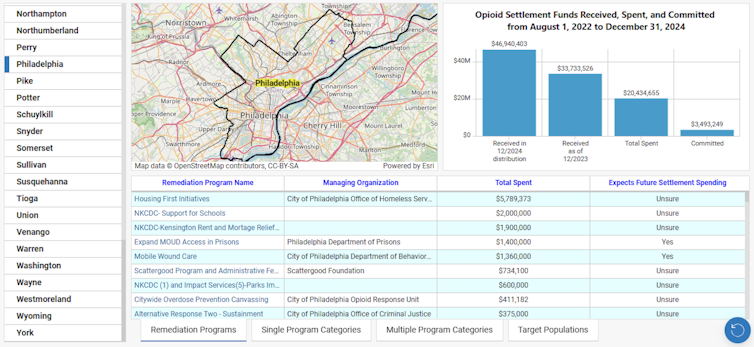
A screenshot from the Pennsylvania Opioid Settlement Data dashboard shows that Philadelphia has so far spent about $20 million of the $80 million it has received, with nearly $6 million going toward the city’s housing programs for people experiencing homelessness.
Pennsylvania Opioid Settlement Data

2. Website improves transparency and accountability

When members of the public can see where the money is going, they can hold systems accountable for using the funds effectively. County leaders, meanwhile, can see what programs are currently being funded in other counties that they may want to replicate or scale up.

3. Spending is a marathon, not a sprint

Settlement dollars are just beginning to be distributed and spent. According to the tracker, over $80 million had been spent on approved opioid remediation programs as of Dec. 31, 2024. Settlement payments will continue over the next seven to 18 years, varying by company.

This is a marathon and not a sprint, so communities and decision-makers will have to balance spending that produces short- and longer-term objectives.

Additionally, not all counties are receiving the same amount of money, and that affects what they can do with it.

A red package labeled 'Kama 7-hydroxy + pseudoindoxyl' contains eight pills
Kratom-derived products are increasingly available in smoke shops and gas stations. The products, which are largely unregulated, mimic opioids and can lead to addiction and cause withdrawal symptoms.
Alejandra Villa Loarca/Newsday RM via Getty Images

4. New challenges will arise in opioid crisis

Emerging issues in the opioid crisis will continue to evolve, such as how contaminants like the animal tranquilizers xylazine and medetomidine, or products derived from kratom, a tropical tree, have entered the street drug supply in recent years.

Systematically tracking data will help expand our knowledge base of all programs in Pennsylvania that aim to address the opioid crisis. Some of these programs are based on strong existing evidence, while others will help to build new evidence, especially considering the ever-changing landscape of the crisis.

5. Funding gaps will remain

Opioid settlement funds are an important opportunity to address the opioid crisis, but will not on their own cover all funding gaps needed to address the crisis or the broader public health crises that are its major drivers. These include food and housing insecurity, unemployment, lack of access to mental health care, and so many other related issues.

As the country faces major and rapid federal disinvestment in states and communities, these funding gaps will grow and increase the pressure on local decision-makers to make the most of each dollar while demonstrating evidence of impact.

Read more of our stories about Philadelphia and Pennsylvania, or sign up for our Philadelphia newsletter.

The Conversation

Jonathan Larsen receives funding from the Pennsylvania Opioid Misuse and Addiction Abatement Trust. He is the Chair of the Haverford Township Democratic Committee.

Amy Yeung receives funding from the Pennsylvania Opioid Misuse and Addiction Abatement Trust

Dennis Scanlon receives funding from the Pennsylvania Opioid Misuse and Addiction Abatement Trust.

Renee Cloutier receives funding from the Pennsylvania Opioid Misuse and Addiction Abatement Trust.

– ref. New website tracks how Pennsylvania’s $2.2B in opioid settlement funds is being spent – https://theconversation.com/new-website-tracks-how-pennsylvanias-2-2b-in-opioid-settlement-funds-is-being-spent-263765

Political witch hunts and blacklists: Donald Trump and the new era of McCarthyism

Source: The Conversation – Global Perspectives – By Shannon Brincat, Senior Lecturer in Politics and International Relations, University of the Sunshine Coast

A modern-day political inquisition is unfolding in “digital town squares” across the United States. The slain far-right activist Charlie Kirk has become a focal point for a coordinated campaign of silencing critics that chillingly echoes one of the darkest chapters in American history.

Individuals who have publicly criticised Kirk or made perceived insensitive comments regarding his death are being threatened, fired or doxed.

Teachers and professors have been fired or disciplined, one for posting that Kirk was racist, misogynistic and a neo-Nazi, another for calling Kirk a “hate-spreading Nazi”.

Journalists have also lost their jobs after making comments about Kirk’s assassination, as has the late-night television host Jimmy Kimmel.

A website called “Expose Charlie’s Murderers” had been posting the names, locations and employers of people saying critical things about Kirk before it was reportedly taken down. Vice President JD Vance has pushed for this public response, urging supporters to “call them out … hell, call their employer”.

This is far-right “cancel culture”, the likes of which the US hasn’t seen since the McCarthy era in the 1950s.

The birth of McCarthyism

The McCarthy era may well have faded in our collective memory, but it’s important to understand how it unfolded and the impact it had on America. As the philosopher George Santayana once said, “Those who cannot remember the past are condemned to repeat it.”

Since the 1950s, “McCarthyism” has become shorthand for the practice of making unsubstantiated accusations of disloyalty against political opponents, often through fear-mongering and public humiliation.

Joseph McCarthy.
Library of Congress/Wikimedia Commons

The term gets its name from Senator Joseph McCarthy, a Republican who was the leading architect of a ruthless witch hunt in the US to root out alleged Communists and subversives across American institutions.

The campaign included both public and private persecutions from the late 1940s to early 1950s, involving hearings before the House Un-American Activities Committee and the Senate’s Permanent Subcommittee on Investigations.

Millions of federal employees had to fill out loyalty investigation forms during this time, while hundreds of employees were either fired or not hired. Hundreds of Hollywood figures were also blacklisted.

The campaign also involved the parallel targeting of the LGBTQI+ community working in government – known as the Lavender Scare.

And similar to doxing today, witnesses in government hearings were asked to provide the names of communist sympathisers, and investigators gave lists of prospective witnesses to the media. Major corporations told employees who invoked the Fifth Amendment and refused to testify they would be fired.

The greatest toll of McCarthyism was perhaps on public discourse. A deep chill settled over US politics, with people afraid to voice any opinion that could be construed as dissenting.

When the congressional records were finally unsealed in the early 2000s, the Permanent Subcommittee on Investigations said the hearings “are a part of our national past that we can neither afford to forget nor permit to reoccur”.

Another witch hunt under Trump

Today, however, a similar campaign is being waged by the Trump administration and others on the right, who are stoking fears of the “the enemy within”.

This new campaign to blacklist government critics is following a similar pattern to the McCarthy era, but is spreading much more quickly, thanks to social media, and is arguably targeting far more regular Americans.

Even before Kirk’s killing, there were worrying signs of a McCarthyist revival in the early days of the second Trump administration.

After Trump ordered the dismantling of public Diversity, Equity and Inclusion (DEI) programs, civil institutions, universities, corporations and law firms were pressured to do the same. Some were threatened with investigation or freezing of federal funds.

In Texas, a teacher was accused of guiding Immigration and Customs Enforcement (ICE) squads to suspected non-citizens at a high school. A group called the Canary Mission identified pro-Palestinian green-card holders for deportation. And just this week, the University of California at Berkeley admitted to handing over the names of staff accused of antisemitism.

Supporters of the push to expose those criticising Kirk have framed their actions as protecting the country from “un-American”, woke ideologies. This narrative only deepens polarisation by simplifying everything into a Manichean world view: the “good people” versus the corrupt “leftist elite”.

The fact the political assassination of Democratic lawmaker Melissa Hortman did not garner the same reaction from the right reveals a gross double standard at play.

Another double standard: attempts to silence anyone criticising Kirk’s divisive ideology, while being permissive of his more odious claims. For example, he once called George Floyd, a Black man killed by police, a “scumbag”.

In the current climate, empathy is not a “made-up, new age term”, as Kirk once said, but appears to be highly selective.

This brings an increased danger, too. When neighbours become enemies and dialogue is shut down, the possibilities for conflict and violence are exacerbated.

Many are openly discussing the parallels with the rise of fascism in Germany, and even the possibility of another civil war.

A sense of decency?

The parallels between McCarthyism and Trumpism are stark and unsettling. In both eras, dissent has been conflated with disloyalty.

How far could this go? Like the McCarthy era, it partly depends on the public reaction to Trump’s tactics.

McCarthy’s influence began to wane when he charged the army with being soft on communism in 1954. The hearings, broadcast to the nation, did not go well. At one point, the army’s lawyer delivered a line that would become infamous:

Until this moment, Senator, I think I never really gauged your cruelty or your recklessness […] Have you no sense of decency?

Without concerted, collective societal pushback against this new McCarthyism and a return to democratic norms, we risk a further coarsening of public life.

The lifeblood of democracy is dialogue; its safeguard is dissent. To abandon these tenets is to pave the road towards authoritarianism.

The Conversation

Frank Mols received ARC funding

Gail Crimmins and Shannon Brincat do not work for, consult, own shares in or receive funding from any company or organisation that would benefit from this article, and have disclosed no relevant affiliations beyond their academic appointment.

– ref. Political witch hunts and blacklists: Donald Trump and the new era of McCarthyism – https://theconversation.com/political-witch-hunts-and-blacklists-donald-trump-and-the-new-era-of-mccarthyism-265389