One cure for sour feelings about politics − getting people to love their hometowns

Source: The Conversation – USA – By Sean Richey, Professor, Georgia State University

A young girl holds Old Glory at an Independence Day celebration. SDI Productions/E+ via Getty Images

Eileen Higgins won a historic victory in December. She became the first woman ever elected mayor of Miami, as well as its first Democratic mayor since 1997.

Although the stakes in the city’s Dec. 9, 2025, runoff election were high, interest was not − 4 in 5 registered voters stayed home.

Low turnout is common in municipal elections across the country. While much of the nation’s political attention stays focused on Washington, the leaders who control the nation’s streets, schools and neighborhoods are typically chosen by a small fraction of citizens.

Although many Americans can identify their U.S. senators or members of Congress, far fewer can name even one of their local elected officials, such as a city council member. To cite one example, a North Carolina study, found that 86% of state residents could not identify their own elected leaders, including local government officials.

Turnout in local elections regularly falls below 20%, often leaving critical decisions in the hands of small, unrepresentative groups, creating an electorate that’s disproportionately white, elderly and affluent.

My research as a political scientist suggests an overlooked factor explains why some people engage with their communities while others tune out: local patriotism, or how they feel about their town.

The power of local patriotism

For my book “Patriotism and Citizenship,” I commissioned a nationally representative survey of 500 Americans. We asked a simple question: How do you feel about the town you live in? Those who responded could choose from five options, ranging from “hate it” to “love it.”

About half said they “liked” their town, 20% loved it, but a full quarter expressed no positive feelings whatsoever; 3% said they outright “hated” where they lived.

Such attitudes have real-world effects. Even after accounting for factors such as age, education, income and general interest in politics, loving one’s town strongly predicted participation in local politics.

People who loved their town were more likely to attend city council meetings, contact local officials, volunteer for campaigns and discuss local issues with friends. The same pattern held for civic participation – from volunteering with community groups to organizing neighborhood cleanups.

Local patriotism also correlated strongly with trust in local government.

Determining the stakes

To test whether these feelings actually change civic behavior, I ran two experiments.

Participants were first asked to identify the biggest problem facing their town. Some mentioned traffic congestion, others cited crime or homelessness. Then came the test: Would they donate $1 they’d earned for taking the survey to help solve that problem?

In the first experiment, one group was asked “Thinking about feelings of love or hate toward your town, would you like to donate this $1 to help your town solve the problem that you just listed above?” The other group received no such prompt about their feelings and was just asked to donate to solve the problem.

The results were striking. Among those primed to consider their feelings about their town, 18% gave away their payment. In the control group, just 3% donated – a sixfold difference.

A second experiment replicated this finding. When people were prompted to think about loving their town, 8% donated. Even asking them to consider feelings of hate led 5% to give. But in the control group with no emotional prompt? No one donated.

Why this matters for democracy

Local patriotism appears to address a fundamental puzzle in political science: why anyone participates in local politics at all. The time and effort required almost always exceed any tangible benefit an individual would receive.
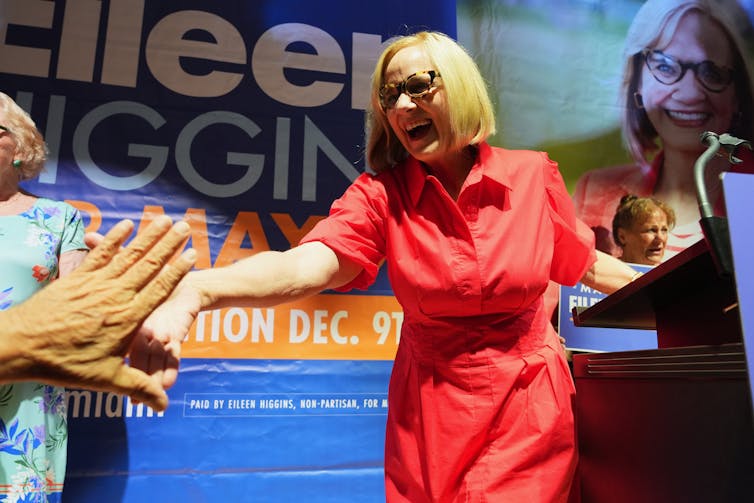
Eileen Higgins, newly elected mayor of Miami, reaches out to grasp a supporter's hand.
Because election turnout was low, Eileen Higgins was elected mayor of Miami by just a small fraction of residents.
Lynne Sladky/AP

But when people care deeply about their community, the calculation changes. The emotional reward of helping a place you love becomes a plus. The sacrifice feels worthwhile not because it will definitely make a difference, but because you’re investing in something that matters to you.

This has important implications. The positive feelings people have toward their community translate directly into civic engagement, without the risk of increasing negative feelings such as jingoism or xenophobia.

For local leaders frustrated by low turnout and apathy, the message is clear: Before asking residents to show up, give them reasons to care. Build pride of place, and engagement will follow.

The good news is that local attachment isn’t fixed. My experiments showed that simply prompting people to think about their feelings toward their town could motivate civic action.

A few ways to foster local patriotism

Here are some strategies that can help foster local patriotism:

• Create civic rituals: Regular community events, from farmers markets to fireworks, build emotional ties to place.

• Celebrate iconic places: Whether it’s a waterfall, clock tower or mountain view, promote the landmarks that symbolize your community. These shared images give residents a common point of pride and visual shorthand for what makes their town special.

A fruit vendor talks with a customer by his display at a farmers market.
Holding local events such as farmers markets can foster a sense of community, increasing residents’ sense of attachment to their town.
Thomas Barwick/DigitalVision via Getty Images

• Bring children to community events and have them participate in local organizations: Parents who take their kids to town festivals, parades and events, or sign them up for youth art and sports programs, aren’t just keeping them entertained. They’re building the next generation’s emotional connection to place and creating civic habits that can last a lifetime.

The evidence shows that emotional connection to community is a powerful but largely untapped resource for strengthening democracy from the ground up.

In an era of declining civic engagement and deepening partisan divisions, fostering local patriotism might be exactly what the country needs.

The Conversation

Sean Richey does not work for, consult, own shares in or receive funding from any company or organization that would benefit from this article, and has disclosed no relevant affiliations beyond their academic appointment.

ref. One cure for sour feelings about politics − getting people to love their hometowns – https://theconversation.com/one-cure-for-sour-feelings-about-politics-getting-people-to-love-their-hometowns-272876

Supreme Court likely to reject limits on concealed carry but uphold bans on gun possession by drug users

Source: The Conversation – USA – By Morgan Marietta, Professor of American Civics, University of Tennessee

The Supreme Court recognizes an individual right to self-defense with firearms in public spaces. wildpixel/Getty Images

The U.S. Supreme Court in early 2026 will hear oral arguments in two cases testing the limits of gun rights under the Constitution.

Can a state outlaw carrying a concealed weapon in businesses or restaurants unless the owners post a sign allowing it? And can the federal government criminalize the possession of firearms by a habitual drug user?

The plaintiffs in both cases claim that these laws violate their Second Amendment rights. As a close observer of the Supreme Court, I suspect the rulings will split. The court will likely strike down the limitation on concealed carry and uphold the law denying gun rights to drug users.

History will tell

The Supreme Court recognizes an individual right to self-defense with firearms in public spaces. But it has also upheld the power of the government to enforce legitimate limits on that right.

The question is how can Americans know which limits are constitutional and which are not.

In 2022, the Supreme Court answered that question in a ruling, New York State Rifle & Pistol Association v. Bruen, that struck down several states’ limitations on issuing what’s called “concealed carry” licenses. That ruling set a new standard for defining the boundaries on a constitutional right: if the right was allowed at the time of America’s founding and the early republic.

In the view of originalists, who see the meaning of the U.S. Constitution and the subsequent amendments as fixed by the understanding of its authors and ratifiers, the Second Amendment recognizes a preexisting individual right of self-protection. That self-protection right can be restricted but not removed. It can be limited but not eliminated.

In the Bruen ruling, Justice Clarence Thomas wrote that current laws must be “consistent with the Nation’s historical tradition of firearm regulation.” The appropriate method, he wrote, is to examine “how and why” the regulation functions, and see if the same kinds of laws were accepted by the founders.

If so, the current laws in question are legitimate limits to the right. If not, they are unconstitutional infringements.

The first test of the new standard for a constitutional regulation came in the United States v. Rahimi case in 2024. The court upheld the federal law criminalizing gun possession by someone subject to a domestic violence restraining order.

The court examined the historical record and found several examples of laws removing firearms from people who threatened others. The record revealed established law in four states at the time of the founding that fit the same general reason and mechanism as the current federal regulation targeting domestic abusers.

Concealed carry

On Jan. 20, the court will hear arguments in Wolford v. Lopez about what the historical record reveals regarding limitations on carrying concealed firearms in public.

After the Bruen decision, Hawaii and a few other states enacted laws restricting citizens from bringing a licensed firearm on private property held open to the public unless the owner gives permission. Usually that is accomplished by posting “clear and conspicuous signage at the entrance.”

The plaintiffs, Jason and Alison Wolford, argue that the Hawaii ban makes it “impossible as a practical matter to carry a firearm.” Most establishments will not post any sign, meaning it would be a criminal offense to conduct normal errands such as entering a grocery store or shop.

tktk
Hawaii Gov. Josh Green signs gun control legislation in Honolulu on June 2, 2023. The law prohibits people from taking guns to a wide range of places, including beaches, hospitals, bars and movie theaters.
AP Photo/Audrey McAvoy, File

The U.S. Court of Appeals for the 9th Circuit in 2024 upheld the Hawaii law on the grounds that a 1771 New Jersey law and an 1865 Louisiana law are historical “dead ringers” for the Hawaii law. The court found that those laws meet the requirement of “an established tradition” limiting citizens from carrying firearms onto private property without consent.

The Republican-appointed majority on the Supreme Court, I believe, is likely to conclude that this is a misunderstanding of Justice Thomas’ method described in Bruen.

The standard the court has set is not to find any one or two similar laws that were not struck down as unconstitutional. Instead, the standard is to demonstrate a clear pattern of a recognized form of accepted regulation. If the law existed for only a short period of time, in a limited geography, or for reasons we would now see as unacceptable, this does not demonstrate a tradition of legitimate legal limitation.

Advocates for the plaintiff argue that the New Jersey law from the 1770s was intended to deal with the problem of hunters using private land without permission. They say it did not apply to businesses open to the public.

The Louisiana law enacted immediately after the Civil War was part of the Black Codes designed to keep firearms out of the hands of freed slaves. The law was not intended to be enforced against whites but had the clear intent to restrict the civil rights of freedmen. The plaintiffs argue that it is wrong to cite an openly racist post-Civil War regulation as a justification for contemporary law.

A man stretches on a beach
Todd Yukutake, a director of the Hawaii Firearms Coalition, stretches before exercising in a beach park in Honolulu on June 29, 2023. The coalition sued to block a Hawaii law that prohibits carrying guns in sensitive locations, including parks and beaches.
AP Photo/Jennifer Sinco Kelleher

The court is likely to agree. The majority of the court will likely rule that these laws are exceptions and not a legitimate pattern of historical regulation.

The legal scholar Neal Katyal describes the objections to these two examples as “flyspecking” – nitpicking small details.

But the historical analogies have clear flaws. If the majority follows the doctrine laid out in Bruen and Rahimi over the past few years, the court will strike down the Hawaii law.

Drug use

The second challenge to gun regulations will be heard in March.

United States v. Hemani addresses the federal law criminalizing firearm possession by anyone “who is an unlawful user” or “addicted to any controlled substance.”

Ali Hemani argues that his prosecution is unconstitutional because U.S. tradition only disarms citizens who are currently drunk or high, not alcohol abusers or addicts who may be clearheaded at other times.

History does not seem to be on Hemani’s side. While illicit drugs such as cocaine or heroin were largely unknown at the time of the nation’s founding, drunkenness was common and alcohol consumption was dramatic.

An amicus brief submitted for the case by a group of Colonial historians argues that “at the Founding, alcohol consumption, unlike drug use, was commonplace, and the Founders were aware of the risk that alcohol could cause a lapse in judgment.”

More importantly, the historians argue that “numerous laws disarmed those under the influence, recognizing that alcohol, which impedes judgment and self-control, is a dangerous combination with guns.”

These laws also applied to habitual drunkards, the mentally ill and others determined to be dangerous to the public.

Given the conservative leanings of the current court, it seems likely that the majority will find these historical laws on alcohol and guns to be close enough in purpose and method to uphold the current federal law on drugs and guns.

These two rulings may come down at the end of term in June 2026, when the most controversial cases tend to be announced. The court’s historical focus seems likely to yield nuanced results, striking down some regulations and upholding others.

Perhaps most importantly, we will see what the historical emphasis reveals about the balance between the constitutional right to self-defense and the collective power to ensure public safety.

The Conversation

Morgan Marietta does not work for, consult, own shares in or receive funding from any company or organization that would benefit from this article, and has disclosed no relevant affiliations beyond their academic appointment.

ref. Supreme Court likely to reject limits on concealed carry but uphold bans on gun possession by drug users – https://theconversation.com/supreme-court-likely-to-reject-limits-on-concealed-carry-but-uphold-bans-on-gun-possession-by-drug-users-270122

How mountain terraces have helped Indigenous peoples live with climate uncertainty

Source: The Conversation – USA (2) – By Stephen Acabado, Professor of Anthropology, University of California, Los Angeles

Farmers during harvest season in Batad, Ifugao, Philippines. Paul Connor and the Ifugao Archaeological Project, CC BY

Indigenous communities have lived with changes to the climate for centuries. Their adaptations over those many years are based on their close observation of weather, water, soils and seasonal change, and they have been refined through generations of learning.

That knowledge, though developed deep in the past, is increasingly useful in the modern world. As global temperatures rise, climate pressures are intensifying, with longer dry spells, stronger storms and more erratic rainfall. Terrace systems reflect Indigenous peoples’ long experience of living with environmental uncertainty in specific places and historical contexts. They offer ways of thinking about risk and long-term land use based on observation and intergenerational learning.

My research focuses on one particular strategy for adapting to a changing climate: terrace agriculture. It’s found in mountainous regions worldwide, where people have reshaped steep slopes into level steps that slow runoff and allow water to infiltrate the soil.

By slowing water without blocking its flow, terraces reduce erosion, keeping soil where crops can grow and preserving the moisture they need. They require constant maintenance, which leaves traces in the landscape, such as accumulated repair layers and sediment deposits associated with crops. I study those traces to learn how communities responded to environmental stress over time. The walls and soils are not only fertile agricultural land but also archives of adaptation, documenting past decisions about water, labor and crops.

Ifugao terraces and adaptation to wet and dry years

I have worked as an anthropological archaeologist in the Ifugao rice terraces of the northern Philippines for nearly two decades. These landscapes are often described as ancient and unchanging, but archaeological and historical research shows that most were constructed around the 17th century, during a period of political and economic pressure linked to Spanish colonial expansion. Highland communities modified their landscapes, expanded settlement and shifted rice farming to higher elevations, reconfiguring their societies to protect themselves.

A large hillside is covered in small parcels of flat land.
The Batad Rice Terraces in Ifugao are arranged in an amphitheater-like form and are recognized as part of a UNESCO World Heritage listing.
Paul Connor and the Ifugao Archaeological Project, CC BY

Rainfall in the Cordillera, the region where the terraces are located, varies widely. In some valleys, more than 6 feet (2 meters) of rain fall per year, while higher elevations commonly receive closer to 13 feet (4 meters). In both settings, rain comes down in short, intense downpours. Without intervention, water flows off the steep slopes in torrents, rapidly stripping away soil.

Terraces help avoid erosion by capturing rainfall on each level and allowing it to infiltrate gradually. Measurements contrasting terraced fields with nearby nonterraced soils find the terraces retain significantly more moisture – often 15% to 30% higher, and in some cases substantially more – than sloping fields. This increased moisture availability helps crops endure short dry spells between storms.

Crop choice is another example of adaptation. Ifugao farmers maintain multiple rice varieties suited to different microenvironments. One locally recognized group of traditional rice varieties, collectively referred to as Tinawon, is widely cultivated. The different farmer-selected tinawon varieties are adapted to varying elevations, temperatures and moisture conditions. Some perform better in cooler and wetter areas, while others tolerate shallow soils or brief dry periods.

By planting different, locally selected rice varieties on different terraces matched to specific conditions, farmers spread risk rather than relying on a single harvest strategy.

Farmers also read subtle environmental signals. When we talk with farmers, they describe year-to-year changes, such as springs flowing more slowly than usual in late winter and increased earthworm activity before the rains. These observations guide decisions about when to adjust terrace features – such as reinforcing walls, clearing canals or modifying water gates – or when to shift planting dates in response to delayed rains or shorter wet seasons. Over generations, these adaptations have allowed farmers to continue to grow crops despite difficult periods of flooding or drought.

Today, climate stress interacts with economic pressure. Major typhoons in 2018 and 2022 brought intense rainfall that damaged terraces across the Cordillera.

A muddy swath down the hillside shows where terrace walls were damaged.
A landslide during the peak of a super typhoon on Nov. 10, 2025, damaged the Batad Rice Terraces.
Courtesy of Rae Macapagal, CC BY

In the past, farmers responded to storm damage by adjusting water flow within irrigation canals and field-to-field outlet channels, and by staggering planting dates so that shared irrigation systems were not stressed all at once.

Today, fewer workers and a modernizing economy mean that government support has become increasingly important to sustain these systems, particularly funding for terrace and irrigation repair and programs that support farmer participation. Even so, these systems continue to show how coordinated water management and crop diversity can reduce risk under variable climates.

Climate history written into Moroccan terraces

New research in Morocco, which I’m working on with the Université Internationale de Rabat, focuses on terrace systems in the Anti-Atlas Mountains, where intermittent heavy rains and recurring droughts motivated people to build terraces to slow runoff and keep water in the soil.

Many of these terraces remained active from their construction in the late 16th to 17th centuries until the 20th century, when out-migration reduced the local labor force needed for routine maintenance.

Hillside slopes are marked by partitions making the otherwise steep ground level in sections.
Terraces in the town of Aouguenz, in Morocco’s Chtouka Aït Baha Province, show that nearly every slope that can be worked has been terraced, an example of long-term environmental modification.
E.J. Hernandez, CC BY

Even partially abandoned terraces record past responses to climate changes. Stone walls and leveled platforms demonstrate how people slowed runoff and retained moisture in dry environments. Collapsed edges and eroded channels mark episodes of heavy rainfall. Channel layouts and their alignment with terrace walls and natural terrain indicate how scarce water was directed toward priority fields.

These physical traces correspond with well-documented drought cycles in Morocco, including multiyear dry periods in recent decades that have reduced reservoir levels and lowered groundwater tables. Former terraced landscapes show how earlier communities coped with similar pressures.

A stone tower sits atop a rocky hill.
A fortified agadir (communal granary) is built on a rocky promontory and used for storing grain and valuables.
Stephen Acabado, CC BY

Crop selection was central to adaptation throughout the period when terraces were actively maintained, and it continues to shape farming decisions today. Farmers in Morocco relied heavily on drought-tolerant barley, which can germinate with limited moisture and mature before peak summer heat.

Research on barley varieties from North Africa and similar arid environments shows that these traditional variants can still produce a majority of their usual yields during severe droughts, while high-yield modern varieties, bred for irrigated or well-watered conditions and shorter growing cycles, often experience sharp yield declines or crop failure under the same conditions.

Dirt and low plants cover a group of terraced fields.
A terrace system lies seasonally fallow in Morocco’s Anti-Atlas Mountains, where long-standing land-use practices are now shifting toward cash crops such as onions and beans.
M. Yakal, CC BY

In oral histories and interviews, elders in these regions recalled collective maintenance practices, including annual cleaning of channels and coordinated planting after the first dependable rains. Communities adapted to the changing climate together, coordinating efforts and activities.

Lessons across continents

Although the Philippines and Morocco have different climates and histories, their terrace systems demonstrate common principles. In both regions, people focused on capturing water and minimizing the risk of soil loss or crop failure.

Where terraces remain intact, studies show they tend to retain more soil and moisture and produce more consistent harvests than nearby unmodified slopes.

Aerial views show aspects of the highland ecology of Morocco. Video courtesy of Anass Marzouki, UIR.

At the same time, terraces show limits. As labor availability declines because younger generations leave rural areas for cities or overseas work, and economic priorities shift toward wage labor and other nonagricultural livelihoods, even basic maintenance becomes difficult.

These cases show that Indigenous strategies for living with climate uncertainty are often shaped by long-term observation and cooperation. They do not provide simple solutions or universal models, but they do demonstrate the value of designing systems that spread risk and prioritize durability over short-term efficiency.

The Conversation

Stephen Acabado receives funding from the Henry Luce Foundation.

ref. How mountain terraces have helped Indigenous peoples live with climate uncertainty – https://theconversation.com/how-mountain-terraces-have-helped-indigenous-peoples-live-with-climate-uncertainty-271599

Science is best communicated through identity and culture – how researchers are ensuring STEM serves their communities

Source: The Conversation – USA (2) – By Evelyn Valdez-Ward, Postdoctoral Fellow in Science Communication, University of Rhode Island

Personal experiences can help foster a sense of belonging for aspiring scientists from underrepresented backgrounds. kali9/E+ via Getty Images

Lived experiences shape how science is conducted. This matters because who gets to speak for science steers which problems are prioritized, how evidence is translated into practice and who ultimately benefits from scientific advances. For researchers whose communities have not historically been represented in science – including many people of color, LGBTQ+ and first-generation scientists – identity is intertwined with how they engage in and share their work.

As researchers who ourselves belong to communities that have been underrepresented in science, we work with scientists from marginalized backgrounds to study how they navigate STEM – science, technology, engineering and math – spaces. What happens when sharing science with the public is treated as relationship-building rather than a one-way transfer of information? We want to understand the role that identity plays in building community in science.

We found that broadening the ways scientists work with the public can bolster trust in science, expand who feels they belong in STEM spaces and ensure that science is working in service of community needs.

STEM spaces as an obstacle course

Science communication involves bridging knowledge gaps between scientists and the broader community. Traditionally, researchers do it through public lectures, media interviews, press releases, social media posts or outreach events designed to explain science in simpler terms. The goals of these activities are often to correct misconceptions, increase scientific literacy and encourage the general public to trust scientific institutions.

However, science communication can look different for researchers from marginalized backgrounds. For these scientists, the ways they engage with the public often focus on identity and belonging. The researchers we interviewed spoke about hosting bilingual workshops with local families, creating comics about climate change with Indigenous youth and starting podcasts where scientists of color share their pathways into STEM.

Instead of disseminating science information through traditional methods that leave little room for dialogue, these researchers seek to bring science back to their communities. This is in part because scientists from historically marginalized backgrounds often face hostile environments in STEM, including discrimination, stereotypes about their competence, isolation and a lack of representation in their fields. Many of the researchers we talked to described feeling pressure to hide aspects of their identities, being seen as the token minority, or having to constantly prove they belong. These experiences reflect well-documented structural barriers in STEM that shape who feels welcome and supported in scientific environments.

Illustration of garbage dump site with 'discrimination' and 'stereotypes' written on tires and other objects. The caption reads 'Scientists from marginalized backgrounds often experience STEM spaces as an obstacle course'

Nic Bennett, CC BY-NC-ND

We wanted to see if a broader definition of science communication that incorporates identity as an asset can expand who feels welcomed in scientific spaces, strengthen trust between scientists and communities, and ensure scientific knowledge is shared in culturally relevant and accessible ways.

Transforming STEM communication

Prior studies have found that scientists tend to prioritize communication focused on conveying information, placing much less emphasis on understanding audiences, building trust or fostering dialogue. Our research, however, suggests that marginalized scientists adopt communication styles that are more inclusive.

Our team set out to create training spaces for researchers from communities that have been historically marginalized in science. Since 2018, we have been facilitating ReclaimingSTEM workshops both in-person and online, where over 700 participants have been encouraged to explore the intersections of their identities and science through interactive modules, small-group activities and community-building discussions.

Expanding what counts as science communication is essential for it to be effective. This is particularly relevant for scientists whose work and identities call for approaches grounded in community connection, cultural relevance and reciprocity. In our workshops, we broadly defined science communication as community engagement about science that could be both formal and informal, including through media, art, music, podcasts and outreach in schools, among others.

While some participants mentioned using traditional science communication approaches – like making topics concise and clear, as well as avoiding jargon – most used communication styles and methods that are more audience-centered, identity-focused and emotion-driven.

Illustration of people picking up trash in a dump site. Caption reads 'Marginalized scientists can better see these obstacles and bring unique styles and methods to their communication

Nic Bennett, CC BY-NC-ND

Some participants drew on their audience’s cultural backgrounds when sharing their research. One participant described explaining biological pattern formation by connecting it to familiar artistic traditions in her community, such as the geometric and floral designs used in henna. Using imagery that her audience recognized helped make the scientific concepts more relatable and encouraged deeper engagement.

Rather than portray science as something neutral or emotionless, participants infused empathy and feeling into their community engagement. For example, one scientist shared with us that his experiences of exclusion as a multiracial gay man shaped how he approached his interactions. These feelings helped him be more patient, understanding and attentive when others struggled to grasp scientific ideas. By drawing on his own sense of not belonging, he aimed to create an environment where people could connect emotionally to his research and feel supported in the learning process.

Participants found it important to incorporate their identities into their communication styles. For some, this meant not assimilating into the dominant norms of science spaces and instead authentically expressing their identities to be a role model to others. For example, one participant explained that openly identifying as disabled helped normalize that experience for others.

Many felt a deep sense of responsibility to have their science engagement be of service to their communities. One scientist who identified as a Black woman said she often thinks about how her research may affect people of color, and how to communicate her findings in ways that everyone can understand and benefit from.

Illustration of playground with 'belonging,' 'advocacy' and 'representation' inscribed on the play structure. Caption reads: 'And they wield science communication goals that transform STEM spaces for the better'

Nic Bennett, CC BY-NC-ND

Making STEM more inclusive

While the participants of our workshop had a variety of goals when it came to science communication, a common thread was their desire to build a sense of belonging in STEM.

We found that marginalized scientists often draw on their lived experiences and community connections when teaching and speaking about their research. Other researchers have also found that these more inclusive approaches to science communication can help build trust, create emotional resonance, improve accessibility and foster a stronger sense of belonging among community members.

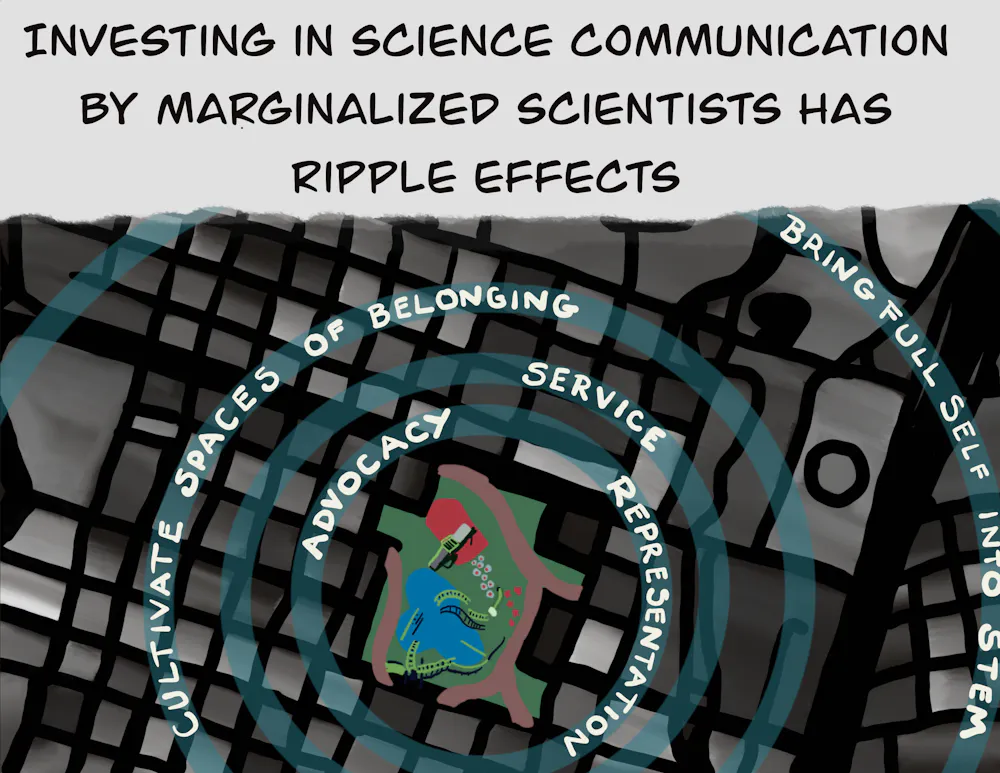
Illustration of a map with ripple effects superimposed. Caption reads 'Investing in science communication by marginalized scientists has ripple effects'

Nic Bennett, CC BY-NC-ND

Centering the perspectives and identities of marginalized researchers would make science communication training programs more inclusive and responsive to community needs. For example, some participants described tailoring their science outreach to audiences with limited English proficiency, particularly within immigrant communities. Others emphasized communicating science in culturally relevant ways to ensure information is accessible to people in their home communities. Several also expressed a desire to create welcoming and inclusive spaces where their communities could see themselves represented and supported in STEM.

One scientist who identified as a disabled woman shared that accessibility and inclusivity shape her language and the information she communicates. Rather than talking about her research, she said, her goal has been more about sharing the so-called hidden curriculum for success: the unwritten norms, strategies and knowledge key to secure opportunities, and thrive in STEM.

Identity for science communication

Identity is central to how scientists navigate STEM spaces and how they communicate science to the audiences and communities they serve.

For many scientists from marginalized backgrounds, the goal of science communication is to advocate, serve and create change in their communities. The participants in our study called for a more inclusive vision of science communication: one grounded in identity, storytelling, community and justice. In the hands of marginalized scientists, science communication becomes a tool for resistance, healing and transformation. These shifts foster belonging, challenge dominant norms and reimagine STEM as a space where everyone can thrive.

Helping scientists bring their whole selves into how they choose to communicate can strengthen trust, improve accessibility and foster belonging. We believe redesigning science communication to reflect the full diversity of those doing science can help build a more just and inclusive scientific future.

The Conversation

Evelyn Valdez-Ward is executive director of ReclaimingSTEM Institute.

Nic Bennett is a volunteer board member of Reclaiming STEM and People’s Science Network.

Robert N. Ulrich is the Associate Director of the ReclaimingSTEM Institute.

ref. Science is best communicated through identity and culture – how researchers are ensuring STEM serves their communities – https://theconversation.com/science-is-best-communicated-through-identity-and-culture-how-researchers-are-ensuring-stem-serves-their-communities-246475

Before Venezuela’s oil, there were Guatemala’s bananas

Source: The Conversation – USA (2) – By Aaron Coy Moulton, Associate Professor of Latin American History, Stephen F. Austin State University

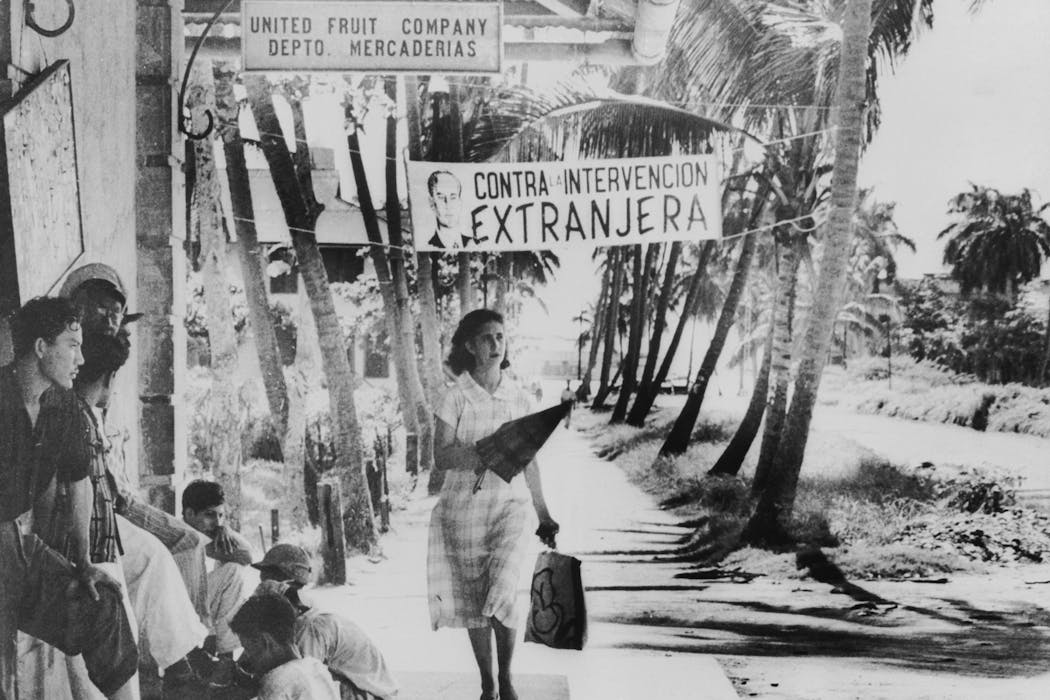
A woman walks past a banner that says ‘against foreign intervention,’ in Spanish, in Guatemala in 1954. Bettmann/Getty Images

In the aftermath of the U.S. military strike that seized Venezuelan President Nicolás Maduro on Jan. 3, 2026, the Trump administration has emphasized its desire for unfettered access to Venezuela’s oil more than conventional foreign policy objectives, such as combating drug trafficking or bolstering democracy and regional stability.

During his first news conference after the operation, President Donald Trump claimed oil companies would play an important role and that the oil revenue would help fund any further intervention in Venezuela.

Soon after, “Fox & Friends” hosts asked Trump about this prediction.

We have the greatest oil companies in the world,” Trump replied, “the biggest, the greatest, and we’re gonna be very much involved in it.”

As a historian of U.S.-Latin American relations, I’m not surprised that oil or any other commodity is playing a role in U.S. policy toward the region. What has taken me aback, though, is the Trump administration’s openness about how much oil is driving its policies toward Venezuela.

As I’ve detailed in my 2026 book, “Caribbean Blood Pacts: Guatemala and the Cold War Struggle for Freedom,” U.S. military intervention in Latin America has largely been covert. And when the U.S. orchestrated the coup that ousted Guatemala’s democratically elected president in 1954, the U.S. covered up the role that economic considerations played in that operation.

A powerful ‘octopus’

By the early 1950s, Guatemala had become a top source for the bananas Americans consumed, as it remains today.

The United Fruit Company owned over 550,000 acres of Guatemalan land, largely thanks to its deals with previous dictatorships. These holdings required the intense labor of impoverished farmworkers who were often forced from their traditional lands. Their pay was rarely stable, and they faced periodic layoffs and wage cuts.

Based in Boston, the international corporation networked with dictators and local officials in Central America, many Caribbean islands and parts of South America to acquire immense estates for railroads and banana plantations.

The locals called it the “pulpo” – octopus in Spanish – because the company seemingly had a hand in shaping the region’s politics, economies and everyday life. The Colombian government brutally crushed a 1928 strike by United Fruit workers, killing hundreds of people.

That bloody chapter in Colombian history provided a factual basis for a subplot in “One Hundred Years of Solitude,” an epic novel by Gabriel García Márquez, who won the Nobel Prize in literature in 1982.

The company’s seemingly unlimited clout in the countries where it operated gave rise to the stereotype of Central American nations as “banana republics.”

United Fruit included the Chiquita brand of bananas that it widely advertised, including with this commercial produced in the 1940s.

Guatemala’s democratic revolution

In Guatemala, a country historically marked by extreme inequality, a broad coalition formed in 1944 to overthrow its repressive dictatorship in a popular uprising. Inspired by the anti-fascist ideals of World War II, the coalition sought to make the nation more democratic and its economy more fair.

After decades of repression, the nation’s new leaders offered many Guatemalans their first taste of democracy. Under Juan José Arévalo, who was democratically elected and held office from 1945-1951, the government established new government benefits and a labor code that made it legal to form and join unions and established eight-hour workdays.

He was succeeded in 1951 by Jacobo Árbenz, another democratically elected president.

Under Árbenz, Guatemala implemented a land reform program in 1952 that gave landless farmworkers their own undeveloped plots. Guatemala’s government asserted that these policies would build a more equitable society for Guatemala’s impoverished, Indigenous majority.

United Fruit denounced Guatemala’s reforms as the result of a global conspiracy. It alleged that most of Guatemala’s unions were controlled by Mexican and Soviet communists and painted the land reform as a ploy to destroy capitalism.

Lobbying Congress to intervene

In Guatemala, United Fruit sought to enlist the U.S. government in its fight against the elected government’s policies. While its executives did complain that Guatemala’s reforms hurt its financial investments and labor costs, they also cast any interference in its operations as part of a broader communist plot.

It did this through an advertising campaign in the U.S. and by taking advantage of the anti-communist paranoia that prevailed at the time.

United Fruit executives began to meet with officials in the Truman administration as early as 1945. Despite the support of sympathetic ambassadors, the U.S. government apparently wouldn’t intervene directly in Guatemala’s affairs.

The company turned to Congress.

It hired the lobbyists Thomas Corcoran and Robert La Follette Jr., a former senator, for their political connections.

Right away, Corcoran and La Follette lobbied Republicans and Democrats in both chambers against Guatemala’s policies – not as threats to United Fruit’s business interests but as part of a communist plot to destroy capitalism and the United States.

The banana company’s efforts bore fruit in February 1949, when multiple members of Congress denounced Guatemala’s labor reforms as communist.

Sen. Claude Pepper called the labor code “obviously intentionally discriminatory against this American company” and “a machine gun aimed at the head of this American company.”

Two days later, Rep. John McCormack echoed that statement, using the exact same words to denounce the reforms.

Sen. Henry Cabot Lodge Jr., Sen. Lister Hill and Rep. Mike Mansfield also went on the record, reciting the talking points outlined in United Fruit memos.

No lawmaker said a word about bananas.

Lobbying and propaganda campaigns

This lobbying and communist talk culminated five years later, when the U.S. government engineered a coup that ousted Árbenz in a covert operation.

That operation began in 1953, when the Eisenhower administration authorized the Central Intelligence Agency to unleash a psychological warfare campaign that manipulated Guatemala’s own military to overthrow its democratically elected government.

CIA agents bribed members of Guatemala’s military. Anti-communist radio broadcasts and religious pronouncements about communist designs to destroy the nation’s Catholic church spread throughout the country.

Meanwhile, the U.S. armed anti-government organizations inside Guatemala and in neighboring countries to further undermine the Árbenz government’s morale.

And United Fruit enlisted public relations pioneer Edward Bernays to spread propaganda, not in Guatemala but in the United States. Bernays provided U.S. journalists with reports and texts that portrayed the Central American nation as a Soviet puppet.

These materials, including a film titled “Why the Kremlin Hates Bananas,” circulated thanks to sympathetic media outlets and members of Congress.

United Fruit’s quest to oust Guatemala’s democratically elected government got a boost from this anti-communist propaganda film.

Destroying the revolution

Ultimately, the record shows, the CIA’s efforts prompted military officers to depose their elected leaders and install a more pro-U.S. regime led by Carlos Castillo Armas.

Guatemalans who opposed the reforms slaughtered labor leaders, politicians and others who had supported Árbenz and Arévalo. At least four dozen people died in the immediate aftermath, according to official reports. Local accounts recognized hundreds more deaths.

Military regimes ruled Guatemala for decades after this coup.

One dictator after another brutally repressed their opponents and fostered a climate of fear. Those conditions contributed to waves of emigration, including countless refugees, as well as some members of transnational gangs.

Blowback for bananas

To shore up its claims that what happened in Guatemala had nothing to do with bananas, exactly as the company’s propaganda insisted, the Eisenhower administration authorized an antitrust suit against United Fruit that had been temporarily halted during the operation so as not to cast further attention on the company.

This would be the first in a series of setbacks that would break up United Fruit by the mid-1980s. After a series of mergers, acquisitions and spinoffs, the only constant would be the ubiquitous Miss Chiquita logo stuck to the bananas the company sells.

And, according to many foreign policy experts, Guatemala has never recovered from the destruction of its democratic experiment due to corporate pressure.

The Conversation

Aaron Coy Moulton’s research received funding from the Truman Library Institute, Phi Alpha Theta, the Society for Historians of American Foreign Relations, the Roosevelt Institute, the Eisenhower Foundation, the Massachusetts Historical Society, the Bentley Historical Library, the American Philosophical Society, the Dirksen Congressional Center, the Hoover Presidential Foundation, and the Frances S. Summersell Center for the Study of the South.

ref. Before Venezuela’s oil, there were Guatemala’s bananas – https://theconversation.com/before-venezuelas-oil-there-were-guatemalas-bananas-272973

New Year’s resolutions usually fall by the wayside, but there is a better approach to making real changes

Source: The Conversation – USA (3) – By Michele Patterson Ford, Lecturer in Psychology, Dickinson College

Resolutions often rely on willpower to push through or follow through, but research shows they usually don’t work. Guillermo Spelucin Runciman/iStock via Getty Images

How are your New Year’s resolutions going? If you’ve given up on them, you’re not alone.

Every January, people across the world seek a fresh start and set goals for the year to improve their health and quality of life. Dry January and new gym memberships accompany a desire to shake off the stress and holiday pounds.

But research shows that resolutions typically don’t last. As a practicing psychologist and professor of counseling psychology, I have seen many people start off the new year with lofty self-improvement goals, only to become frustrated and give up early into the new year.

This happens so frequently that popular media has even coined the name “Quitter’s Day” for the second Friday in January –when most people have given up on their resolutions.

However, there is a way to continue your self-improvement goals and find success by making changes that offer incremental rewards instead of frustration. My students and clients are consistently surprised by how small actions and practices bring about big rewards. Below are a few manageable and meaningful practices to adopt that can last well after the new year’s motivation fades.

One of the reasons resolutions tend to fail is that they usually involve putting a metric on success.
A major reason for failure in New Year’s resolutions is that people set unrealistic goals.

Why don’t resolutions work?

Most New Year’s resolutions tend to be restrictive or rely on willpower, such as eliminating alcohol and sugar from your diet, or exercising every morning.

The problem is that these types of commitments force us to do something we don’t really want to do. And success takes time: It can take more than six weeks before improvements from exercise become apparent.

It comes as no surprise, then, that these goals are often short-lived and unsuccessful in the long term – it is hard to be successful when we are battling ourselves to do things that don’t come naturally, without immediate rewards. In reality, people prefer immediate gratification and simultaneously tend to downplay the benefit of waiting for longer-term rewards.

Be kind – to yourself

We are often much nicer to our friends, and even to strangers, than we are to ourselves.

Kristin Neff, a psychologist and leader in self-compassion research, teaches that by mindfully quieting our inner critic and being as compassionate to ourselves as we would be to a friend, we can significantly improve our well-being.

Research shows that people who practice being their own partner or teammate – rather than an opponent – feel happier and more confident. The rewards from this type of self-compassion can be seen and felt faster than the results of diet and exercise, and can help us make better choices in multiple aspects of our daily lives.

In my personal and professional life, I have seen people succeed most often when they change how they relate to themselves. In other words, instead of being intensely critical of our emotions and what we are thinking, we are able to be gentler with our experience and be more accepting of our own thoughts and feelings. When we receive these emotional rewards, we feel relief and happiness – payoffs that make it far easier to enthusiastically repeat the pattern.

Engaging in this kind of self-compassion also allows us to better cope with stress and our emotions.

Small shifts in gratitude and outward kindness go a long way

Another evidence-based way to improve overall well-being is to focus on the what’s going well for you and what you are grateful for – in the moment, or more broadly, in your life.

Instead of focusing on whether you succeeded on your initial resolutions, try journaling three good things at the end of each day. In doing so, focus less on the big successes – though they count, too – and instead on the small moments you enjoyed, such as the hug from a friend, the quiet moment with coffee or the smile from a stranger.

Practice random acts of kindness to boost mood and well-being. Reach out to a friend you haven’t talked to in a while or buy coffee for a stranger in the coffee shop. These activities provide an emotional boost that can last for hours, if not days.

Making these small shifts can help stave off the stress and guilt that can thwart your self-improvement goals.

Two girls sitting on a bench at school, one reassuring the other,
Acts of kindness provide an emotional boost to both the giver and the recipient.
10’000 Hours/DigitalVision via Getty Images

Mindful eating

The well-known practice of mindfulness encourages paying attention – without judgment – to the present moment.

Research shows that taking time to slow down and savor the moment has substantial physical and psychological benefits, such as lowering stress and improving focus, among others. In fact, mindfulness even has the power to change brain connections, leading to greater control over our emotions.

This approach can also be applied to meal-time and diet, a popular focus of New Year’s resolutions. Using the practice of mindfulness can also help us shift from a judgmental and restrictive view of food to a focus on enjoyment and savoring.

So instead of eliminating certain foods or thinking of foods as either good or bad, slow down and savor your food. This can look like taking a moment to take in what your food looks and smells like, and chewing your food slowly, noticing the taste and texture – like a wine-tasting experience but with your meal.

My clients often tell me how eating more mindfully helped change their relationship with food. One client said that instead of thinking about how much she was eating, she instead experienced how much she liked the taste of her meal and the sense of fullness when she felt she had eaten enough.

So perhaps this year, instead of focusing on willpower or restriction, choose connection with yourself and others instead.

Doing so will improve your happiness and your overall well-being, long after the New Year’s resolutions fade.

The Conversation

Michele Patterson Ford does not work for, consult, own shares in or receive funding from any company or organization that would benefit from this article, and has disclosed no relevant affiliations beyond their academic appointment.

ref. New Year’s resolutions usually fall by the wayside, but there is a better approach to making real changes – https://theconversation.com/new-years-resolutions-usually-fall-by-the-wayside-but-there-is-a-better-approach-to-making-real-changes-272319

The hidden power of grief rituals

Source: The Conversation – USA (3) – By Claire White, Professor of Religious Studies, California State University, Northridge

Shared rituals of grief bring people together. onuma Inthapong/E+ via Getty Images

In Tana Toraja, a mountainous region of Sulawesi, Indonesia, villagers pour massive resources into funeral rituals: lavish feasts, ornate effigies and prized water buffaloes for sacrifice.

I witnessed this funeral ritual in 2024 while accompanying scholar Melanie Nyhof on her fieldwork. Families were expected to stage funerals that matched the social standing of the dead, even if it meant selling land, taking out loans or calling on distant kin for help.

In my own work of studying communal mourning rituals, I take part in ceremonies to see how they unfold.
At one of the ceremonies I attended in Tana Toraja, hundreds gathered as gongs echoed through the valley. Guests were served meals over several days, dancers in bright headdresses performed for the crowd, and water buffalo – the most valuable gift a family can give – were led into the courtyard for sacrifice. Mourners described these acts as ways of honoring the deceased.

It wasn’t just in the villages of Tana Toraja that families and clans used rituals to express loyalty for people they knew personally. I saw the same dynamics in cities, where national funerals can draw millions of strangers into a shared experience of unity and loss for a person they never met.

As a scholar who also studies the psychology of rituals, I found that rituals can be one of the most powerful ways humans bond with one other.

How rituals unite

In 2022, my colleagues and I surveyed more than 1,600 members of the British public a few days after Queen Elizabeth II’s funeral – both those who had traveled to London to be part of the crowds, and others who had watched the ceremony live on television.

Spectators reported intense grief and a connection with fellow mourners when they viewed the ceremony. On average, they described their sadness as intense. Most also said they felt a strong sense of unity – not only with people standing alongside them, but even with strangers across the nation who shared in the moment.

The effects were especially pronounced for those who had attended in person.

To see whether that sense of unity translated into action, we also used a behavioral measure using a mild deception task. All participants would receive a digital £15 (US$20) voucher for completing the survey, which would be emailed to them 48 hours later.

Toward the end of the survey, however, participants were asked whether they would be willing to donate money from their voucher for taking part in the survey. They indicated this via a sliding scale, from £0-£15 ($0 to $20.25) in £1 ($1.35) increments. Participants were led to believe that the funds would go to a new U.K. charity designed to educate future generations about the importance of the monarchy.

At the end of the study, participants were debriefed: The charity was fictional, and no money was actually taken; so regardless of how much they thought they were donating, all participants received the full compensation.

The results were striking. Those who felt the strongest grief also reported greater connection to both fellow mourners and fellow citizens; they were more likely to pledge to the monarchist cause. We later tested whether these effects fade quickly or leave a lasting imprint.

In a forthcoming study, we followed British spectators for up to eight months after Queen Elizabeth II’s funeral. Those who experienced the most sadness during the ceremony formed especially vivid emotional memories, which prompted months of reflection. That reflection, in turn, reshaped how people saw themselves – a personal identity shift that predicted enduring feelings of unity with others who had shared the experience.

Crucially, this sense of “we-ness” was strongest among those who had been physically present together and continued to predict willingness to volunteer long after the funeral ended.

In other words, grief didn’t just wash over people passively; it mobilized them toward concrete acts of loyalty and generosity. And importantly, this wasn’t limited to those who had traveled to London. Even people who only watched the funeral on television still showed some of the same effects, though less strongly.

Anthropologists have long reported that funerals and other rituals can create a profound sense of bonding that can outlive the ceremony itself. Our research suggests that shared rituals of mourning can foster unity at scale, reaching far beyond those physically present.

Furthermore, shared suffering forges identity and binds people together long after the ritual itself has passed.

Anthropologist Harvey Whitehouse’s research shows that when people endure intense suffering together, they don’t just feel closer – they come to see one another as if they were family. This kinlike bond helps explain why groups who undergo hardship together often display extreme loyalty and self-sacrifice. This is true even for strangers.

When rituals divide

But are those bonds always open-ended? Or do they sometimes channel generosity inward, toward one’s own group?

At Pope Francis’ funeral in 2025, we surveyed 146 people immediately after they had viewed his body lying in state in St. Peter’s Basilica. We asked them to rate the extent of their discomfort waiting in line.

A large crowd with bowed heads gathers near a fountain, beside tall white columns.
Mourners at Pope Francis’ funeral felt motivated to offer more to charities.
Andrew Medichini/AP Photo

Some had waited overnight without food or water, and all had queued for hours in the unrelenting Roman sun. At the end of the survey, participants were invited to donate to one of two charities: a new Catholic aid organization or the International Red Cross.

As we predicted, the people who rated their experience waiting in line as the most uncomfortable also pledged the most money. But there was a twist. Almost all of that generosity flowed to the Catholic charity. Donations to the Red Cross were strikingly low, even though Red Cross volunteers had been circulating through the crowd, offering water and assistance. The difference in giving was not due to a difference in awareness or salience. What mattered was whether the cause felt part of the shared experience people had just endured.

This finding aligns with the work of my collaborator, anthropologist Dimitris Xygalatas, who has demonstrated that group rituals both “bind and blind.” These ceremonial rituals blind by narrowing generosity, channeling it mainly toward one’s own group, such as through the funerary ritual studies we conducted.

When shared suffering bridges divides

But shared suffering can sometimes do the opposite – not narrowing solidarity, but expanding it.

In other research I conducted after the catastrophic earthquakes in Turkey in 2023, with my colleague, anthropologist Sevgi Demiroglu, we surveyed 120 survivors across some of the most heavily impacted regions. Nearly half had lost a loved one, a third had lost their homes, and the vast majority showed signs of post-traumatic stress.

Participants were asked how intensely they had felt negative emotions such as fear and anxiety during the quakes; crucially, how much they believed those emotions were shared by others – whether family members, other Turkish survivors or Syrian refugees who were also affected.

Survivors who felt their suffering was shared reported a stronger sense of oneness, with those groups. And that sense of bonding predicted action. Even after losing nearly everything, many said they were just as willing to volunteer time to help fellow Turkish survivors as if they were their own families. Strikingly, this willingness extended even to ethnic communities often regarded with suspicion, suggesting that shared suffering can temporarily override social and political divides.

In this case, there were no collective grief rituals to help process loss. Yet the same underlying mechanism was visible: Shared suffering brought people together like kin. Grief rituals can take this raw bond and stabilize it – giving shared loss a durable social form.

Perhaps, grief rituals remind us that in grief, as in life, we are not alone.

The Conversation

Claire White receives funding from Templeton Religion Trust TRT-2021-10490.

ref. The hidden power of grief rituals – https://theconversation.com/the-hidden-power-of-grief-rituals-260393

Génèse et déclin d’un État : le chercheur Mahmood Mamdani décrypte l’histoire politique de l’Ouganda

Source: The Conversation – in French – By Mahmood Mamdani, Herbert Lehman Professor of Government, Department of Anthropology, Columbia University

Dans son dernier ouvrage, Slow Poison: Idi Amin, Yoweri Museveni, and the Making of the Ugandan State (Poison insidieux: Idi Amin, Yoweri Museveni et la génèse de l’État ougandais), l’anthropologue Mahmood Mamdani analyse les facteurs et les figures – Idi Amin et Yoweri Museveni – qui ont façonné l’Ouganda après son indépendance.

Dans cet entretien avec The Conveersation Africa, il explique qu’il existe des différences frappantes entre ces deux hommes.

Museveni est au pouvoir depuis près de quatre décennies. Amin a duré huit ans. Comment expliquer la longévité de Museveni ?

J’essaie d’expliquer dans mon livre les principales raisons qui ont permis à Museveni de rester au pouvoir pendant plus de quatre décennies. Je pense que ces raisons sont à la fois internes et externes.

Il n’a pas seulement fait comme les Britanniques qui prenaient des groupes éthniques existants et les politisaient en structures tribales. Il est allé plus loin: il a pris des sous-groupes éthniques et en a fait des tribus.

Pas seulement comme l’ont fait les Britanniques, en prenant les groupes ethniques existants et en les politisant pour en faire des structures politiques que nous appelons tribus. Mais plus que cela, en prenant certains sous-groupes ethniques et en les transformant en tribus. Ainsi, à partir de moins de 20 tribus, il en a créé plus de 100. C’est un processus sans fin.

Et puis il y a la raison externe. Contrairement à Amin, qui était l’ennemi juré des grandes puissances occidentales, Museveni s’est imposé comme leur allié privilégié et protégé.

**Certains analystes semblent suggérer que ce n’est que maintenant, en particulier depuis que son fils a commencé à faire des déclarations politiques, que la politique ougandaise se militarise. Mais un thème qui ressort clairement de votre livre est que, sous Amin comme sous Museveni, l’armée s’est substituée à l’organisation politique…

Je pense que c’est une lecture correcte du livre. Maintenant, dans le cadre de cette comparaison très large, il existe des différences importantes dans la voie empruntée par Amin.

Amin a été recruté comme enfant soldat par les Britanniques à l’âge de 14 ans environ. Il a été formé à ce qu’ils appellent les arts de la contre-insurrection, ce qui est en réalité un terme poli pour désigner le terrorisme d’État. Il avait l’habitude de démontrer publiquement, en particulier aux chefs d’État africains, par exemple lors de leur réunion au Maroc, comment il pouvait étouffer quelqu’un avec un mouchoir.

Et Amin a subi une sorte de transformation au cours de la première année qui a suivi son accession au pouvoir.

Il a accédé au pouvoir grâce à l’aide directe des Britanniques et des Israéliens. Les Israéliens, en particulier, ont conseillé à Amin qu’il ne pouvait pas se contenter de renverser le premier président de l’Ouganda après l’indépendance Milton Obote et penser que l’affaire était close. Il devait aussi s’occuper de ses acolytes, les personnes qu’il avait placées à des postes clés, et le retour de bâtons devait arriver d’un moment à l’autre.

Pour éviter cela, il avait choisi de les éliminer. Sa première année au pouvoir fut brutale. Il a tué des centaines de personnes dans différents camps militaires. Il s’agissait de massacres, il n’y a pas d’autre mot pour les qualifier.

Puis, après cela, il s’est rendu en Israël et en Grande-Bretagne avec une liste de demandes. Il pensait avoir rendu service aux Israéliens et aux Britanniques et s’attendait qu’ils fassent de même. Mais ceux-ci ont trouvé cela amusant, et il s’est senti humilié. Il a cherché une alternative, et c’est ainsi qu’il a rencontré, par l’intermédiaire du président égyptien Anwar Sadat, puis par le dirigeant libyen Mouammar Kadhafi, le leader soudanais, Gaafar Muhammad Nimeiry. Amin, avec l’empereur éthiopien Haile Selassie, a joué un rôle clé dans l’accord d’Addis-Abeba de 1972 qui a mis fin à la première guerre civile au Soudan.

Au cours des deux années qui ont suivi son arrivée au pouvoir, je n’ai pas eu connaissance de nouveaux massacres. Il a continué à tuer ses opposants, mais il n’a pas étendu les meurtres à la famille, aux amis, aux clans ou simplement aux groupes auxquels la personne était identifiée ou associée. Ses meurtres ressemblaient davantage à ceux d’un dictateur qui recourt à la violence pour écraser ses opposants.

C’est très différent dans le cas de Museveni. Museveni est arrivé au pouvoir avec la conviction que la violence est essentielle à la politique, et particulièrement à la politique de libération. Museveni est un fervent adepte de Frantz Fanon, en particulier Les Damnés de la Terre. Et la principale leçon qu’il tire de Fanon est le caractère essentiel de la violence dans toute politique d’émancipation.

J’essaie donc de retracer le cheminement qui a conduit Museveni à considérer la violence comme un élément central du démantèlement d’un État oppressif, pour aboutir à l’idée que la violence est un élément central de la construction d’un État. Il arrive ainsi à la conclusion inverse. Et cela bien avant que son fils n’entre en scène.

J’ai consacré tout un chapitre de mon livre aux premières décennies qui ont suivi 1986, lorsque Museveni est arrivé au pouvoir, à ses opérations dans le nord et aux massacres et meurtres successifs, Il affirmait poursuivre la guerre contre le terrorisme, qui avait commencé après les attentats du 11 septembre 2001 aux États-Unis.

Et ces affirmations ont été acceptées telles quelles par la communauté internationale, c’est-à-dire les puissances occidentales.

Diriez-vous donc que la guerre contre le terrorisme a été une aubaine pour Museveni, l’aidant à faire avancer son agenda ?

Tout à fait. Depuis le programme d’ajustement structurel de la fin des années 1980, il a compris que s’il voulait étouffer l’opposition dans son pays, il aurait besoin d’un soutien étranger, et que ce soutien lui serait accordé s’il se présentait comme un acteur central dans la guerre contre le terrorisme.

Museveni était suffisamment intelligent pour comprendre que la politique étrangère américaine et l’intervention militaire américaine avaient des limites politiques, notamment le nombre de pertes américaines acceptables. Et lorsque ces meurtres ont eu lieu en Somalie, lors de l’incident Black Hawk Down (La chute d’un faucon noir), Museveni a proposé ses services.

Il a envoyé ses soldats en Somalie. Vous vous souvenez de ce slogan, « des solutions africaines pour les problèmes africains ». Museveni a proposé cette solution africaine au Soudan du Sud, au Rwanda, dans l’est du Congo. La solution africaine n’était qu’un nom sophistiqué pour désigner le massacre d’Africains par des Africains au service des puissances impériales. Et c’est ce qui s’est finalement produit.

Vous recommandez une fédération comme la solution la plus susceptible de réussir dans l’Ouganda post-Museveni. Existe-t-il actuellement une base politique pour cela ? Ou faudrait-il que quelque chose se produise pour que la fédération proposée aboutisse ?

Ceux d’entre nous qui sont des nationalistes militants et des indépendants ont compris que la fédération était un projet britannique. Nous savions que la droite favorable à la création de fiefs tribaux utilisait la fédération comme écran pour masquer son agenda. Nous avons compris que c’était leur façon de saper toute tentative de construire un État nationaliste fort.

Mais depuis lors, avec la construction d’un État fort, nous avons compris que les conditions et les temps avaient changé. L’organisation locale, l’autonomie locale, ont pris une signification très différente.

C’est un moyen de résister au développement de l’autocratie du pouvoir central et je pense que les gens commencent à en tirer des leçons.

Maintenant, la question est de savoir quel type de fédération, car Museveni a également promu quelque chose qui ressemble à une fédération. Mais il a, comme en Éthiopie, promu ce que l’on peut appeler un fédéralisme ethnique.

Ainsi, dans chaque entité, il a séparé la majorité de la minorité: la majorité appartenant au groupe éthnique considéré comme “historique” sur le territoire et la minorité issue d’autres groupes éthniques, qui, bien que vivant dans le pays et y étant nés, se voient toujours privés de droits.

C’est ce qui s’est passé en Éthiopie. Si vous regardez l’Éthiopie, si vous regardez le Soudan, vous verrez que les Britanniques ont politisé les groupes ethniques et les ont transformés en tribus. Et puis, après le colonialisme, nous avons militarisé ces tribus. Nous avons donc créé des milices tribales. C’est ce qu’ils ont fait en Éthiopie. Ce sont les combats entre différentes milices tribales. C’est ce qu’ils ont fait au Soudan. Ils ont créé des milices tribales, d’abord au Darfour, puis dans d’autres endroits. C’est l’armée nationale qui a dirigé la création de ces milices tribales. Ce sont ensuite les milices tribales qui ont commencé à engloutir l’État.

La guerre civile qui sévit actuellement oppose donc l’armée nationale et les milices tribales. C’est le même processus que celui observé en Ouganda. Nous n’en sommes pas encore arrivés à créer des milices tribales, mais nous avons fabriqué tribu après tribu afin de fragmenter le pays.

Certaines des tendances que vous décrivez à propos de l’Ouganda se retrouvent dans la plupart des pays africains. Quelles leçons peut-on en tirer pour l’avenir du reste du continent africain ?

D’une manière générale, on observe ces tendances dans de nombreux pays africains. Le modèle colonial britannique est devenu le modèle colonial dominant. Même les Français, connus pour leurs préférences assimilationnistes, ont adopté la domination indirecte lorsqu’ils sont passés de l’assimilation à ce qu’ils appelaient l’association dans les années 1930. Et les Portugais ont suivi les Français.

Les Sud-Africains ont été les derniers à suivre le mouvement – ils ont appelé cela apartheid. Mais c’était la même chose, la création de homelands, la tribalisation des différences locales. C’est donc une tendance dans la pensée du continent.

L’alternative a souvent été la centralisation. Le continent oscille ainsi entre pouvoir autocratique et centralisé et des pouvoirs tribaux fragmentés.

Je propose une troisième voie. Je propose une fédération plus ethnique. Je propose une fédération davantage basée sur le territoire, davantage basée sur le lieu où vous vivez. Ainsi, peu importe d’où vous venez, le simple fait que vous viviez là signifie que vous avez lié votre destin à celui des autres personnes qui y vivent pour créer un avenir commun.

Et ce qui importe en politique, plus que votre origine, c’est la décision de construire un avenir commun. La migration est une caractéristique de la société humaine. La société humaine n’est pas née des patries. La patrie est donc une fiction coloniale.

L’idée que les Africains ne se déplaçaient pas, qu’ils étaient liés à un territoire particulier, est absurde, car les Africains se déplaçaient plus que quiconque. Nous savons que l’humanité est née en Afrique et s’est répandue dans le reste du monde. Alors, où se trouve la patrie ? Vous pouvez avoir une patrie pour cette génération, pour les générations précédentes, mais tous les Africains ont une histoire de migration. C’est, je pense, un élément central.

La voie à suivre : l’une est une fédération qui consolide la démocratie plutôt que de l’éroder.

La deuxième voie à suivre consiste à réfléchir de manière critique à l’ensemble du modèle économique néolibéral et à l’autonomisation des élites, qu’elles soient raciales, ethniques ou autres.

Je pense que nous devons trouver un modèle économique différent. Mais comme vous le dites, le livre n’est pas consacré à la recherche de solutions. Il est consacré à l’idée que nous devons comprendre le problème avant de nous précipiter vers des solutions.

Et chaque pays aura ses propres nuances qui sont ifférentes de celles de l’Ouganda.

The Conversation

Mahmood Mamdani does not work for, consult, own shares in or receive funding from any company or organisation that would benefit from this article, and has disclosed no relevant affiliations beyond their academic appointment.

ref. Génèse et déclin d’un État : le chercheur Mahmood Mamdani décrypte l’histoire politique de l’Ouganda – https://theconversation.com/genese-et-declin-dun-etat-le-chercheur-mahmood-mamdani-decrypte-lhistoire-politique-de-louganda-273487

Irán, una revuelta y dos relatos: cómo cada bando ha intentado adaptar a sus intereses la narrativa de las protestas

Source: The Conversation – (in Spanish) – By Ali Mamouri, Research Fellow, Middle East Studies, Deakin University

Desde el estallido de la actual ola de protestas en Irán han surgido dos narrativas muy contrapuestas para explicar lo que está ocurriendo en las calles.

Para el poder iraní, los disturbios se presentan como un complot orquestado desde el extranjero. Argumentan que se trata de un intento impulsado desde fuera para desestabilizar al Estado mediante la manipulación, la infiltración y las operaciones psicológicas sobre la ciudadanía.

Para la oposición, los mismos acontecimientos se enmarcan como un levantamiento nacional arraigado en agravios de larga data. Argumentan que las protestas señalan una ruptura entre la sociedad y el sistema político.

La forma en que se cuenta un conflicto es un componente clave en la guerra. Las protestas en Irán tienen dos relatos muy diferentes.

La elaboración de narrativas como guerra psicológica

En la era digital, la guerra psicológica ha ido más allá de la propaganda convencional y ha entrado en el ámbito de lo que los académicos Ihsan Yilmaz y Shahram Akbarzadeh llaman operaciones estratégicas de información digital.

Las operaciones psicológicas funcionan como instrumentos diseñados por el poder no solo para suprimir la disidencia sino también para alterar la forma en que los individuos perciben la realidad, la legitimidad y las posibilidades políticas. Su objetivo es cognitivo y emocional pues:

  • Inducen al miedo, la incertidumbre y la impotencia.

  • Sirven para desacreditar a los oponentes.

  • Construyen una sensación de inevitabilidad en torno a un determinado escenario político.

Estas técnicas son empleadas no solo por los Estados sino también, y cada vez más, por actores no estatales.

Las plataformas de redes sociales se han convertido en los principales escenarios de esta lucha psicológica. Los hashtags, los memes, las imágenes manipuladas y los comentarios coordinados, a menudo amplificados por cuentas automatizadas, se utilizan para enmarcar acontecimientos, señalar culpables y moldear respuestas emocionales a gran escala.

Es necesario subrayar que el público no es un receptor pasivo de estas narrativas. Las personas que simpatizan con un determinado encuadre lo reproducen, refuerzan y controlan activamente dentro de las cámaras de eco digitales. De este modo, florece el sesgo de confirmación y se descartan o atacan las interpretaciones alternativas.

Por ello, el control de la narrativa no es una dimensión secundaria del conflicto sino un campo de batalla central. La forma en que se enmarca un levantamiento puede determinar su trayectoria. Puede determinar si sigue siendo pacífico o se vuelve violento, y si la represión interna o la intervención extranjera se consideran justificadas o inevitables.

La narrativa del régimen iraní

El régimen iraní ha enmarcado sistemáticamente el levantamiento actual como un complot orquestado por Israel, Estados Unidos y los servicios de inteligencia aliados. En esta narrativa, las protestas no serían una expresión de descontento interno, sino una continuación del enfrentamiento entre Israel e Irán. Esto, según se argumenta, forma parte de una campaña más amplia para derrocar al régimen y sumir al país en el caos.

Dos semanas después del inicio de las protestas, el Estado organizó grandes manifestaciones a favor del régimen. Poco después, el líder supremo, el ayatolá Alí Jamenei, declaró que estas manifestaciones habían «frustrado el plan de los enemigos extranjeros que iban a llevar a cabo mercenarios nacionales».

El mensaje era claro: la disidencia no solo era ilegítima, sino traicionera. Se describía a quienes participaban en ella como instrumentos de potencias externas, en lugar de ciudadanos con reivindicaciones políticas.

Demonizar la disidencia tiene un doble propósito. No solo es un método para silenciar a la oposición sino también una herramienta para manipular la percepción y moldear las respuestas emocionales.

Al presentar a los manifestantes como agentes extranjeros, el régimen busca fabricar conformidad, desanimar a los partidarios indecisos y proyectar una imagen de popularidad generalizada. El objetivo no es simplemente castigar a los críticos, sino señalar que la disidencia pública tendrá graves consecuencias.

Para reforzar esta narrativa, las cuentas de las redes sociales favorables al régimen han difundido contenidos que mezclan el encuadre ideológico con material factual selectivo. Los análisis que sostienen que los acontecimientos en Irán siguen un conocido «manual de cambio de régimen», así como declaraciones israelíes que sugieren operaciones de inteligencia dentro de Irán. Una característica común de este enfoque es la selección selectiva de comentarios de expertos o datos aislados para justificar la represión.

El momento y la amplificación de este tipo de contenidos también son significativos. Las redes sociales se utilizan mediante manipulación algorítmica para que el discurso del régimen se vuelva viral y margine las opiniones contrarias.

Al mismo tiempo que se va desarrollando, esta campaña digital se ve reforzada por formas más tradicionales de control. Las restricciones y los cortes de internet limitan el acceso a fuentes de información alternativas. Esto permite a los medios de comunicación estatales dominar las comunicaciones y frustrar los desafíos a la narrativa oficial.

En este entorno, la historia del régimen funciona tanto como propaganda como instrumento estratégico. Su objetivo es redefinir el levantamiento, deslegitimar la disidencia y preservar la autoridad, controlando la forma en que se interpretan los acontecimientos.

La narrativa de la oposición

Aunque la oposición está dividida, dos grupos principales se han mostrado activos en la formulación de la narrativa de la oposición: los que apoyan la depuesta monarquía iraní y el grupo armado disidente Mojahedin-e-Khalq (MEK). A pesar de sus diferencias, ambos han contribuido a la misma historia.

Han elaborado una narrativa persuasiva, enmarcando el levantamiento como una emergencia moral que requiere intervención externa, en particular por parte de Estados Unidos e Israel. Esta narrativa no representa todas las voces de la oposición, pero ha ganado visibilidad a través de las redes sociales, los medios de comunicación en el exilio y las redes de activistas. Su objetivo principal es llamar la atención internacional sobre el conflicto y defender, y luego provocar, un cambio de régimen en Irán.

Una técnica central ha sido la legitimación y el fomento de la violencia. Los llamamientos a la protesta armada y la confrontación directa con las fuerzas de seguridad marcan un claro cambio de las movilizaciones civiles reclamando mejoras hacia un levantamiento violento de la población.

El elevado número de víctimas entre las fuerzas estatales –hasta el 11 de enero, se hablaba de más de 114– es un ejemplo de la eficacia de esta técnica. Esta escalada se justifica a menudo como necesaria para mantener vivo el movimiento y generar un nivel de derramamiento de sangre que obligue a la intervención internacional.

Según observadores internacionales, los enfrentamientos entre manifestantes armados y fuerzas estatales han provocado un número significativo de víctimas en ambos bandos.

Una segunda estrategia ha sido la de engordar las cifras de víctimas. El número de muertos que dan las plataformas de la oposición son mucho mayores que las cifras aportadas por organismos independientes.

Esta exageración tiene un claro propósito psicológico y político. Su objetivo es conmocionar e influir en la opinión internacional, presentar la situación como genocida o excepcional, y aumentar la presión sobre los gobiernos extranjeros para que actúen militarmente.

Un tercer elemento ha sido el uso de la intimidación y la coacción retórica. En algunas apariciones en los medios, opositores de alto perfil han amenazado a los comentaristas favorables al régimen, advirtiendo de represalias una vez que el poder cambie de manos.

Este lenguaje tiene múltiples funciones. Busca silenciar los puntos de vista alternativos, proyectar confianza e inevitabilidad, y presentar la situación como una lucha entre el bien y el mal. Al mismo tiempo, esta retórica corre el riesgo de alienar al público indeciso y reforzar las afirmaciones del régimen de que el levantamiento conducirá al caos o a una política de venganza.

Estas prácticas revelan cómo parte de la oposición también ha adoptado la guerra narrativa como herramienta estratégica. Esta narrativa se utiliza para amplificar la violencia, exagerar los daños y suprimir las interpretaciones contrarias. Su objetivo es redefinir el levantamiento no solo como una revuelta interna, sino como una crisis humanitaria y de seguridad que exige la intervención extranjera.

Al hacerlo, refleja el propio esfuerzo del régimen por convertir la narración en un arma en un conflicto en el que la percepción es tan importante como el poder.

De diferentes maneras, ambas narrativas acaban marginando a los propios manifestantes. Reducen un movimiento popular diverso a un instrumento de lucha por el poder, ya sea para legitimar la represión en el país o para justificar la intervención del extranjero.

The Conversation

Ali Mamouri no recibe salario, ni ejerce labores de consultoría, ni posee acciones, ni recibe financiación de ninguna compañía u organización que pueda obtener beneficio de este artículo, y ha declarado carecer de vínculos relevantes más allá del cargo académico citado.

ref. Irán, una revuelta y dos relatos: cómo cada bando ha intentado adaptar a sus intereses la narrativa de las protestas – https://theconversation.com/iran-una-revuelta-y-dos-relatos-como-cada-bando-ha-intentado-adaptar-a-sus-intereses-la-narrativa-de-las-protestas-273598

La cara oculta de la nueva pirámide nutricional estadounidense

Source: The Conversation – (in Spanish) – By Juan Alfonso Revenga Frauca, Profesor asociado de nutrición humana y dietética, Universidad San Jorge

La nueva edición de las Guías Dietéticas para Estadounidenses (en adelante, GDA) de 2025-2030 ha generado un importante revuelo en medios y redes sociales, provocando una polarización entre seguidores y detractores. Su propuesta es, cuando menos, disruptiva, tanto en su representación gráfica como en sus recomendaciones. Pero apenas se ha hablado del fondo del asunto: por primera vez desde 1980, tras nueve ediciones en cuarenta y cinco años, se ha eludido el procedimiento científico estándar establecido para su elaboración.

Cambio radical

El aspecto más llamativo de las GDA 2025-2030 es su representación gráfica, que rompe radicalmente con MyPlate (guía representada en forma de plato y vigente desde 2010) y con cualquier propuesta “piramidal” típica, desde sus orígenes en 1992 a sus evoluciones. Su actual plasmación es una suerte de pirámide invertida que crea un gradiente visual, de más a menos, entre los alimentos más recomendados, en la parte superior, y los menos, abajo.

Representación gráfica de las nuevas guías nutricionales estadounidenses.
Dietary Guidelines For Americans

No es un formato novedoso. En 2017, el Instituto Flamenco de Vida Saludable hizo una propuesta idéntica, pero con dos diferencias claras: además de explicar el porqué de este gráfico y su interpretación, sus contenidos eran netamente diferentes –e incluso contradictorios– con las actuales GDA.

La proteína animal asciende a lo más alto

En lo que se refiere a sus contenidos, las nuevas guías incluyen evidentes autocontradicciones y mensajes cuestionables a la luz de la ciencia:

  • El texto recomienda no superar el 10 % del valor calórico total con las grasas saturadas. Sin embargo, al mismo tiempo, aconseja el consumo habitual de carne y sebo de vacuno, mantequilla y lácteos enteros. El gráfico refuerza esta idea.

  • En la pirámide, los cereales integrales son los más perjudicados (vértice inferior) sin embargo, cuando se comparan las raciones/día propuestas con las raciones de los alimentos más destacados resultan ser idénticas: entre 2 y 4.

  • Las legumbres no aparecen en la representación gráfica a pesar de su papel central en los patrones dietéticos saludables. Esta omisión simbólica refuerza la centralidad de la proteína animal en el nuevo relato.

Giro de guion

Estas guías se actualizan cada cinco años mediante un riguroso procedimiento supervisado por el Departamento de Agricultura de Estados Unidos (USDA) y el Departamento de Salud y Servicios Humanos (HHS). Durante dos años, y a través de un mecanismo de total transparencia que incluye un periodo de consulta pública, un panel independiente de 10 a 20 expertos, denominado Comité Asesor de las Guías Alimentarias, analiza la evidencia y elabora un informe. Una vez finalizado, este se remite al USDA y al HHS, que redactarán las GDA en base a sus recomendaciones.

Pero todo cambió en la edición actual. Una vez que la administración Trump recibió el informe de 421 páginas del Comité Asesor, se implantó un proceso de revisión inédito y exprés (de menos de 6 meses) para “corregir las deficiencias” del documento original. Un panel alternativo de expertos emitió su propio informe –The Scientific Foundation For The Dietary Guidelines For Americans– sin los habituales mecanismos de transparencia y participación pública. En apenas 90 páginas, expone las preocupaciones sobre el dosier original, las recomendaciones que acepta o rechaza de él y la “evidencia” que dará forma a las actuales GDA.

Nada ilustra mejor este giro que la tabla inicial de este informe alternativo: una lista de verificación o checklist que muestra, una a una, qué se ha hecho con las 56 recomendaciones del Comité Asesor (aceptarlas, aceptarlas parcialmente o rechazarlas). El resultado es elocuente: solo 14 se aceptan íntegramente, 12 parcialmente y 30 se rechazan por completo.


Leer más:
Pautas para seguir una verdadera dieta mediterránea


De esta manera, la administración hace una ostentación clara e inequívoca de lo que le parece el informe original del Comité Asesor, en lo que podría interpretarse como una manifestación de “malismo”. El checklist funciona como un “mira lo que hago con tus recomendaciones” elevado a categoría de mensaje. También se dedica medio folio a “apoyar la salud de la testosterona en los hombres” (página 64), un elemento innecesario a la luz de las necesidades en salud pública, pero que encaja con una exaltación ideológica de la masculinidad.

El informe alternativo también añade otras capas de inquietud: muchos de sus autores presentan importantes vínculos con la industria láctea y del ganado vacuno (como se puede comprobar consultando las páginas 11-18 del informe alternativo), sectores particularmente beneficiados por las nuevas GDA.

La justificación y la falacia

En un episodio de instrumentalización científica, las guías actuales sostienen que la crisis de salud de los estadounidenses es consecuencia de las propias recomendaciones federales promovidas durante décadas. Esta argumentación constituye una falacia post hoc ergo propter hoc: asumir que, porque algo ocurre después, fue causado por lo anterior. Según su lógica, las antiguas GDA habrían impulsado alimentos de muy baja calidad y altamente procesados, responsables de la epidemia de obesidad y enfermedades crónicas.

En realidad, ninguna versión previa de las GDA ha recomendado refrescos, snacks dulces o salados, bollería, cereales de desayuno azucarados ni otros ultraprocesados; más bien al contrario, los ha desaconsejado o relegado claramente. Además, la evidencia disponible muestra que el seguimiento de los estadounidenses de las guías ha sido históricamente bajo. Por tanto, culpar a las ediciones previas de ser la causa de la mala alimentación y de sus consecuencias es, como mínimo, un ejercicio de demagogia.

En definitiva, las GDA 2025-2030 no solo resultan científicamente controvertidas y contradictorias, sino también hacen gala de un radicalismo procedimental importante, aportando una receta que combina unos pocos ingredientes saludables con generosas dosis de ideología e intereses corporativos.

The Conversation

Juan Alfonso Revenga Frauca es consultor de la Interprofesional de los aceites de orujo de oliva (ORIVA)

José Miguel Soriano del Castillo no recibe salario, ni ejerce labores de consultoría, ni posee acciones, ni recibe financiación de ninguna compañía u organización que pueda obtener beneficio de este artículo, y ha declarado carecer de vínculos relevantes más allá del cargo académico citado.

ref. La cara oculta de la nueva pirámide nutricional estadounidense – https://theconversation.com/la-cara-oculta-de-la-nueva-piramide-nutricional-estadounidense-273475