One uprising, two stories: how each side is trying to frame the uprising in Iran

Source: The Conversation – Global Perspectives – By Ali Mamouri, Research Fellow, Middle East Studies, Deakin University

Since the outbreak of the current wave of protests in Iran, two sharply competing narratives have emerged to explain what is unfolding in the streets.

For the ruling establishment, the unrest is portrayed as a foreign-engineered plot. They argue it is an externally-driven attempt to destabilise the state through manipulation, infiltration, and psychological operations.

For the opposition, the same events are framed as a nationwide uprising rooted in long-standing grievances. They argue the protests signal a rupture between society and the political system.

How the “story” of a conflict is told is a key component in warfare. The Iran protest are offering two very different stories.

Narrative crafting as psychological warfare

In the digital age, psychological warfare has moved beyond conventional propaganda into the realm of what academics Ihsan Yilmaz and Shahram Akbarzadeh call Strategic Digital Information Operations (SDIOs).

Psychological operations function as central instruments of power, designed not only to suppress dissent but reshape how individuals perceive reality, legitimacy, and political possibility. Their objective is cognitive and emotional:

  • to induce fear, uncertainty, and helplessness
  • to discredit opponents
  • to construct a sense of inevitability around a certain political scenario.

These techniques are employed not only by states, but increasingly by non-state actors as well.

Social media platforms have become the primary theatres of this psychological struggle. Hashtags, memes, manipulated images, and coordinated commenting – often amplified by automated accounts – are used to frame events, assign blame, and shape emotional responses at scale.

Crucially, audiences are not passive recipients of these narratives. Individuals sympathetic to a particular framing actively reproduce, reinforce, and police it within digital echo chambers. In this way, confirmation bias flourishes and alternative interpretations are dismissed or attacked.

Because of this, narrative control is not a secondary dimension of conflict but a central battleground. How an uprising is framed can shape its trajectory. It can determine whether it remains peaceful or turns violent, and whether domestic repression or foreign intervention comes to be seen as justified or inevitable.

The Iranian regime’s narrative

The Iranian regime has consistently framed the current uprising as a foreign-engineered plot, orchestrated by Israel, the United States and allied intelligence services. In this narrative, the protests are not an expression of domestic grievance but a continuation of Israel’s recent confrontation with Iran. This, it argues, is part of a broader campaign to overthrow the regime and turn the country into chaos.

Two weeks after the protests began, the state organised large pro-regime demonstrations. Shortly afterward, supreme leader Ayatollah Ali Khamenei declared these rallies had “thwarted the plan of foreign enemies that was meant to be carried out by domestic mercenaries”.

The message was clear: dissent was not only illegitimate but treasonous. Those participating in it were portrayed as instruments of external powers rather than citizens with political demands.

Demonising dissent serves a dual purpose. It is not only a method of silencing opposition, but also a tool for engineering perception and shaping emotional responses.

By portraying protesters as foreign agents, the regime seeks to manufacture compliance, discourage wavering supporters, and project an image of widespread popularity. The objective is not simply to punish critics, but to signal that public dissent will carry heavy costs.

To reinforce this narrative, pro-regime social media accounts have circulated content that blends ideological framing with selective factual material. Analyses arguing that events in Iran follow a familiar “regime change playbook” – have been widely shared, as have Israeli statements suggesting intelligence operations inside Iran. Cherry-picking expert commentary or isolated data points to justify repression is a common feature of this approach.

The timing and amplification of such content are also significant. Social media networks are deployed via “algorithmic manipulation” to make the regime’s framing go viral and marginalise counter views.

As this digital campaign unfolds, it is reinforced by more traditional forms of control. Internet restrictions and shutdowns limit access to alternative sources of information. This allows state media to dominate communications and thwart challenges to the official narrative.

In this environment, the regime’s story functions not merely as propaganda, but as a strategic instrument. It aims to redefine the uprising, delegitimise dissent, and preserving authority by controlling how events are understood.

The opposition narrative

Though the opposition is divided, but two main groups have appeared active in framing the opposition narrative: those who support an Iranian monarchy, and dissenting armed group Mojahedin-e-Khalq (MEK). Despite their differences, the two have contributed to the same story.

They have crafted a persuasive narrative, framing the uprising as a moral emergency requiring external intervention, particularly by the United States and Israel. This narrative does not represent all opposition voices, but it has gained visibility through social media, exile media outlets, and activist networks. Its core objective is to bring international attention to the conflict and put the case for, then bring about, regime change in Iran.

One central technique has been the legitimisation and encouragement of violence. Calls for armed protest and direct confrontation with security forces mark a clear shift away from demand-based, civilian mobilisation toward a violent uprising.

A high number of state forces casualties – reportedly more than 114 by January 11 – is an example of the effectiveness of this technique. This escalation is often justified as necessary to “keep the movement alive” and generate a level of bloodshed that would compel international intervention.

According to external conflict-monitoring assessments, clashes between armed protesters and state forces have in fact resulted in significant casualties on both sides.

A second technique involves the strategic inflation of casualty figures. Opposition platforms have claimed the death toll to be far higher than figures cited by independent estimates.

Such exaggeration serves a clear psychological and political purpose. It is intended to shock and sway international opinion, frame the situation as genocidal or exceptional, and increase pressure on foreign governments to act militarily.

A third element has been the use of intimidation and rhetorical coercion. In some high-profile media appearances, opposition figures have openly threatened pro-regime commentators, warning of retribution once power changes hands.

This language serves multiple functions. It seeks to silence alternative viewpoints, project confidence and inevitability, and present the situation as one of good versus evil. At the same time, such rhetoric risks alienating undecided audiences and reinforcing regime claims the uprising will lead to chaos or revenge politics.

These practices reveal how parts of the opposition have also embraced narrative warfare as a strategic tool. This narrative is used to amplify violence, inflate harm, and suppress competing interpretations. It aims to redefine the uprising not merely as a domestic revolt, but as a humanitarian and security crisis that demands foreign intervention.

In doing so, it mirrors the regime’s own effort to weaponise storytelling in a conflict where perception is as consequential as power.

In different ways, both narratives ultimately sideline the protesters themselves. They reduce a diverse, grassroots movement into an instrument of power struggle, either to legitimise repression at home or justify intervention from abroad.

The Conversation

Ali Mamouri does not work for, consult, own shares in or receive funding from any company or organisation that would benefit from this article, and has disclosed no relevant affiliations beyond their academic appointment.

ref. One uprising, two stories: how each side is trying to frame the uprising in Iran – https://theconversation.com/one-uprising-two-stories-how-each-side-is-trying-to-frame-the-uprising-in-iran-273573

What next for Iran as Trump pulls back?

Source: The Conversation – UK – By Jonathan Este, Senior International Affairs Editor, Associate Editor, The Conversation

This newsletter was first published in The Conversation UK’s World Affairs Briefing email. Sign up to receive weekly analysis of the latest developments in international relations, direct to your inbox.


For anyone who has watched Iranians take to the streets before, as they have at reasonably regular intervals over the years, this week’s protests had a depressingly familiar feel – viewed from the safety and comfort of the UK, that is.

What started as angry bazaar traders complaining about the economic mismanagement that had led to surging inflation and the collapse of the Iranian rial spread quickly across the country and to almost every level of society at the beginning of January. Tens of thousands of people, desperate to break free from the stifling oppression of the theocracy, took to the streets to call for an end to the Islamic Republic and for a system that would respect their fundamental rights and democratic freedoms.

For a while it felt as if this might be their chance. The Islamic Republic is close to breaking point, with an ageing Ayatollah presiding over a sclerotic regime, a parlous economy and a military weakened and demoralised by the 12-day war with Israel and the virtual destruction of its proxies across the Middle East.

But as has happened so many times before, the bravery of the protesters was met with the savagery of a regime with its backs to the wall, for whom the only response seems to be to massacre, rather than listen to, the people it should be protecting.

Many of those following the story had mixed feelings when the US president, Donald Trump, signalled the US would get involved. Maybe US intervention might be what was needed to collapse the regime and set the people of Iran free, or – at the very least – force the regime to negotiate and agree to some much-needed democratic reforms. On the other hand, a US military intervention in Iran had (and has) the potential to be an utter disaster.

Nevertheless, when Trump posted a message, “Iranian Patriots, keep protesting – take over your institutions!!! … help is on its way,” it felt as if this might be the moment of change. But the US pulled back – unready to act and uncertain of what intervention could achieve. Now the forces of repression are once again taking over Iran’s streets.

We spoke with Scott Lucas, a Middle East expert at the Clinton Institute, University College Dublin and a regular commentator on The Conversation, who addressed several of the key issues that will affect the future of Iran.


Read more:
Iran protests: Trump stalls on US intervention leaving an uncertain future for a bitterly divided nation – expert Q&A


It’s clear that the vast majority of Iranians reject the theocracy. And not just from the fact that there have been so many massive protests calling for democratic change. They’ve repeatedly told researchers the same thing. In the latest survey conducted late last year by Ammar Maleki of Tilburg University and Pooyan Tamimi Arab of the University of Utrecht they found the 80% of Iranians reject the regime.

But, interestingly, there was less of a consensus about what Iranians want to replace it. Only about one-third support the exiled crown prince Reza Pahlavi (although that number appears to be growing) and about twice as many felt that protests and strikes were more likely to force change than elections. The second most popular option for change was foreign pressure or intervention, but as we’ve seen this week, foreign intervention seems unlikely, for the present at least.


Read more:
Iran protests 2026: our surveys show Iranians agree more on regime change than what might come next


Bamo Nouri, meanwhile, believes that a US military intervention is pretty much the last thing that Iran needs right now. Experience has shown that the threat of foreign intervention has actually had the opposite effect, allowing the feared Islamic Revolutionary Guard Corps to consolidate its domestic power.

And Iranians tend to be wary of western interventions. Everyone knows about the coup of 1953 in which the US, with British help, unseated the democratically elected prime minister Mohammad Mosaddegh for the crime of nationalising Iran’s oil industry (as we’ve seen recently in Venezuela, this still goes down badly with energy superpowers).


Read more:
The use of military force in Iran could backfire for Washington


Soon after the protests started to really spread across Iran (and before the killing started in earnest) the regime employed a tactic they have used before to great effect. They shut down the internet. In a tech-savvy country like Iran, word of protests spreads like wildfire, so preventing people’s access to social media meant that it was far more difficult to organise online.

In theory, at least. But between 80 and 90% Iran’s aforementioned tech savvy population now uses a VPN to access the internet. This, writes Konstantinos Mersinas and Francesco Ferazza, tech experts at Royal Holloway, University of London, meant that the regime was forced to actually shut down the infrastructure that supports all communications networks in Iran.

It’s a measure of how seriously the authorities were taking these protests that the Islamic Republic was happy to live with the consequences of the shutdown, write Mersinas and Ferazza, that they were willing to suffer a breakdown in banking, payments, logistics and all the other facets of everyday life that depend on online communications.


Read more:
Iran: how the Islamic Republic uses internet shutdowns as a tool of repression


Greenland under pressure

The US president, meanwhile, continues to covet Greenland. Whether for its mineral wealth, its vital strategic position or just the fact that by acquiring it for the US would mean he has added more territory to the map of the US than any of his predecessors.

There’s no getting away from the fact that Greenland is slap bang in the middle of one of the Earth’s most contested regions. And Trump is right when he says it’s important for US national security to have a robust Nato military presence there. As Caroline Kennedy-Pipe, professor of war studies at Loughborough University, points out, Russia has spent the past decade beefing up its assets in the region and far outmatches western military capabilities across the Arctic.


Read more:
Whether or not US acquires Greenland, the island will be at the centre of a massive military build-up in the Arctic


This is only going to increase as the Arctic continues to warm, writes geopolitics specialist Klaus Dodds of Middlesex University. The region is at the heart of what he refers to as the “new great game” between global superpowers.

Vector map of the Arctic
Contested: the Arctic is increasingly seen as a potential area of conflict as the competition for great power status between Russia, China and the US develops.
Dimitrios Karamitros/Shutterstock

Dodds is concerned that 2026 may see a series of cynical but expedient territorial swaps, whereby Trump’s America is happy to see Putin’s Russia take the Norwegian archipelago of Svalbard in return for a free hand in Greenland (we’ll say nothing about Ukraine at this point). Taking a bigger picture view, Dodds concludes that: “The ground would thus be prepared for a new world order in which Putin, China’s president Xi Jinping and Trump all have their spheres of domination, not just influence.”


Read more:
As the Arctic warms up, the race to control the region is growing ever hotter


Danish foreign Minister, Lars Lokke Rasmussen, and his Greenlandic counterpart, Vivian Motzfeldt, went to the White House on January 14 to meet US vice-president, J.D. Vance, and secretary of state, Marco Rubio, to discuss the future of the world’s largest island. The meeting reportedly lasted less than an hour, ending when it was clear, as Rasmussen told journalists, that there is still a “fundamental disagreement” over the future of Greenland.

Still, at least Greenland was represented at the meeting. The island’s 57,000 people have been angered at times by Denmark’s failure to include them in some of the discussions about their future. As they say in Greenland: “nothing about Greenland without Greenlanders”.


Read more:
As US and Denmark fight, Greenland’s voices are being excluded once again


Ukraine observes a bitter landmark

There was a bitter landmark for Ukraine this week. On Tuesday Vladimir Putin’s “special military operation” moved beyond the 1,418 days it took the Soviet Union under Joseph Stalin to beat Hitler’s Germany.

Comparing the two conflicts, Stefan Wolff notes the unqualified support offered by the US under its president Franklin D. Roosevelt, compared to the vacillations of the current occupant of the White House. And free Europe had a rather more impressive leader in Winston Churchill.

As the fourth anniversary of the full-scale Russian war in Ukraine approaches, Wolff takes stock of the situation and worries that Ukraine is a long way from becoming another much-needed example of the maxim that “aggression never pays”.


Read more:
Russia’s full-scale invasion of Ukraine outlasts the Soviet fight with the Nazis – here’s what history tells us about Kyiv’s prospects


Sign up to receive our weekly World Affairs Briefing newsletter from The Conversation UK. Every Thursday we’ll bring you expert analysis of the big stories in international relations.


The Conversation

ref. What next for Iran as Trump pulls back? – https://theconversation.com/what-next-for-iran-as-trump-pulls-back-273622

China’s new condom tax will prove no effective barrier to country’s declining fertility rate

Source: The Conversation – Global Perspectives – By Dudley L. Poston Jr., Professor of Sociology, Texas A&M University

A Chinese visitor looks at condoms at the Beijing International Sex Supplies Exhibition. Zhang Peng/LightRocket via Getty Images

Once the world’s most populous nation, China is now among the many Asian countries struggling with anemic fertility rates. In an attempt to double the country’s rate of 1.0 children per woman, Beijing is reaching for a new tool: taxes on condoms, birth control pills and other contraceptives.

As of Jan. 1, such items were subject to a 13% value-added tax. Meanwhile, services such as child care and matchmaking remain duty-free.

The move comes after China last year allocated 90 billion yuan (US$12.7 billion) for a national child care program giving families a one-off payment of around 3,600 yuan (over $500) for every child age three or under.

I have studied China’s demography for almost 40 years and know that past attempts by the country’s communist government to reverse slumping fertility rates through policies encouraging couples to have more children have not worked. I do not expect these new moves to have much, if any, effect on reversing the fertility rate decline to one of the world’s lowest and far below the 2.1 “replacement rate” needed to maintain a stable population.

In many ways, the 13% tax on contraceptives is symbolic. A packet of condoms costs about 50 yuan (about $7), and a month supply of birth control pills averages around 130 yuan ($19). The new tax is not at all a major expense, adding just a few dollars a month.

Compare that to the average cost of raising a child in China – estimated at around 538,000 yuan (over $77,000) to age 18, with the cost in urban areas much higher. One 36-year-old father told the BBC he is not concerned over the price hike. “A box of condoms might cost an extra five yuan, maybe 10, at most 20. Over a year, that’s just a few hundred yuan, completely affordable,” he said.

Pronatalist failings

China is one of many countries to adopt pronatalist policies to address low fertility. But they are rarely effective.

The Singapore government has been concerned about the country’s very low fertility rate for a couple of decades. It tried to devise ways to boost it through programs such as paid maternity leave, child care subsidies, tax relief and one-time cash gifts. Yet, Singapore’s fertility rate – currently at 1.2 – remains one of the lowest in the world.

The government there even started limiting the construction of small, one-bedroom apartments in a bid to encourage more “family-friendly” homes of two bedrooms or more – anyone with children will appreciate the need for more space, right? Yet even that failed to budge the low fertility rate.

The Singaporean government got a helping hand in 2012 from candymaker Mentos. In a viral ad campaign, the brand called on citizens to celebrate “National Night” with some marital boom-boom as they “let their patriotism explode” – with a hoped-for corresponding burst in births in nine months’ time. Even with the assistance from the private sector, it appears, reversing declining fertility rates is a tricky thing.

South Korea, the country with the world’s lowest fertility rate – 0.7 – has been providing financial incentives to couples for at least 20 years to encourage them to have more children.

It boosted the monthly allowance already in place for married couples to become parents. In fact, since 2006 the South Korean government has spent well over $200 billion on programs to increase the Korean birth rate.

But South Korea’s fertility rate has continued to drop from 1.1 in 2006 to 1.0 in 2017, to 0.9 in 2019, to 0.7 in 2024.

Unfavorable headwinds

The plight of China is partly of its own doing. For a couple of decades the country’s one-child policy pushed to get fertility rates down. It worked, going from over 7.0 in the early 1960s to 1.5 in 2015.

That is when the government again stepped in, abandoning the one-child policy and permitting all couples to have two children. In May 2021, the two-child policy was abandoned in favor of a three-child policy.

The hope was that these changes would lead to a baby boom, resulting in sizable increases in the national fertility rate. However, the fertility rate continued to decline – to 1.2 in 2021 and 1.0 in 2024.

While China’s historic programs to push down fertility rates were successful, they were aided by wider societal changes: The policies were in force while China was modernizing and moving toward becoming an industrial and urbanized society.

It’s policies aimed at increasing the birth rate now find unfavorable societal headwinds. Modernization has led to better educational and work opportunities for women – a factor pushing many to put off having children.

In fact, most of China’s fertility reduction, especially since the 1990s, has been voluntary – more a result of modernization than fertility-control policies. Chinese couples are having fewer children due to higher living costs and educational expenses involved in having more than one child.

Plus, China is one of the world’s most expensive countries in which to raise a child, when compared to average income. School fees at all levels are higher than in many other countries.

The ‘low-fertility’ trap

Another factor to take into consideration is what demographers refer to as the “low-fertility trap.” This hypothesis, advanced by demographers in the 2000s, holds that once a country’s fertility rate drops below 1.5 or 1.4 – far higher than China’s now stands – it is very difficult to increase it by 0.3 or more.

The argument goes that fertility declines to these low levels are largely the result of changes in living standards and increasing opportunities for women.

Accordingly, it is most unlikely that China’s three-child policy will have any influence at all on raising the fertility rate. And all my years of studying China’s demographic trends lead me to believe that making contraceptives marginally more expensive will also have very little effect.

The Conversation

Dudley L. Poston Jr. does not work for, consult, own shares in or receive funding from any company or organization that would benefit from this article, and has disclosed no relevant affiliations beyond their academic appointment.

ref. China’s new condom tax will prove no effective barrier to country’s declining fertility rate – https://theconversation.com/chinas-new-condom-tax-will-prove-no-effective-barrier-to-countrys-declining-fertility-rate-273333

Environment issues have never been so fiercely debated in a Welsh election campaign as they will be in 2026

Source: The Conversation – UK – By Michael Woods, Professor of Human Geography, Aberystwyth University

Wales prides itself in being a pioneer in environmental policy. It was the first country in the world to adopt a statutory duty for public bodies to make development sustainable, in 2015. Yet, environmental issues have rarely featured prominently in elections to the Senedd (the Welsh parliament).

This year is different. Wales votes for a new Senedd in May and parties are using contentious statements around environmental issues to differentiate themselves. Issues including windfarms, expansion of pylons and support for farmers are already starting to be fiercely debated.

For the first time, Reform UK is a major player in Welsh politics, and is using the urban-rural divide as part of its messaging. Recent polling has been suggesting that Senedd control could be a close fought battle between Reform and Plaid Cymru, a centre-left Welsh nationalist party.

But one new poll by YouGov for ITV Cymru Wales and Cardiff University has just suggested Plaid is now pulling ahead, up seven percentage points since September. Analysis suggests this could be most significant election in Wales for 100 years, with a major shift away from Labour.

The Senedd has been led by a Labour government since its creation in 1999, when it was known as the National Assembly. Labour has traditionally held the vote in the urban areas of Wales, while the less populated rural areas historically voted Conservative, Liberal or Plaid.

Farming and the environment

One big issue that shows how the campaign battle is unfolding is around the Welsh government’s new sustainable farming scheme (SFS). Designed as a post-Brexit replacement for the common agricultural policy (which provided support for UK farmers when the UK was an EU member), the SFS ties financial assistance for farmers more strongly to environmental objectives than the EU assistance did.

The original plans proposed that farmers would be required to plant 10% of their land with trees to qualify for support. The proposal provoked vociferous opposition from farmers, who feared that the viability of small farms would be threatened, with several protests across Wales. Over half of farms in Wales are small, under 20 hectares, and typically operate on tight margins.

On average, farms in Wales are the least profitable of farms in the four UK nations. The average farm income for all farm types in Wales was £34,300 in 2021. This compared to £34,402 in Northern Ireland, £39,347 in Scotland and £51,900 in England.


Read more:
Farmers and supermarkets worry that extreme weather will stop food getting to consumers – here’s what needs to change


While the Welsh government backed down and moderated the SFS requirements, the episode has reinforced a perception that Labour doesn’t understand the countryside. The perception has been both stoked and exploited by opposition parties, notably Reform UK, which is targeting Welsh farmers for support.

Reform leader Nigel Farage attracted large crowds when he appeared at the Royal Welsh Show in July 2025 and used a rally in Llandudno in November to attack Labour’s agricultural and environmental policies. Reform’s strategy in Wales is primarily aimed at converting voters from the Conservatives, who have also been vocal critics of the SFS, but rural discontent with Labour could threaten First Minister Eluned Morgan’s chances of re-election in the rural Ceredigion Penfro constituency.

A Welsh government decision to cut the speed limit to 20mph in some areas caused controversy. This is one of many environmental issues being discussed in the campaign.

Reform’s messaging to Welsh farmers includes statements opposing mass tree planting and rewilding and backing livestock farming. These positions refer to wider debates in Wales around the contribution of livestock farming to climate change as well as different approaches to land management and food production.

Protesting pylons

Among the most contentious issues is the conversion of land in Wales for renewable energy generation. According to the Campaign to Protect Rural Wales there were over 50 planned onshore windfarm projects in early 2025, many accompanied by local opposition.

Campaign groups are also protesting against plans for new lines of pylons to connect windfarms in upland Wales with urban centres, especially in Powys and Carmarthenshire. Both the Conservatives and Reform UK have backed pylon campaigners but opposition is not limited to those parties.

Plaid has also outlined some opposition to pylon projects, favouring more expensive underground cabling. This position, along with alignment with farmers on the SFS, reflects the importance of rural areas as heartlands for the party.

Yet, some commentators argue that there is a contradiction between these stances and Plaid Cymru’s strong green rhetoric on climate change, that could be targeted by a Labour party willing to defend its policies as necessary pro-climate actions.

Rivers and roads

Several other locally significant issues have potential to be amplified nationally in the campaign. Pollution of the River Wye, which runs along the Welsh-English border, from intensive poultry units helped the Greens to win North Herefordshire across the border in the 2024 UK general election.

It is also a concern in the Senedd constituencies through which it runs, Brycheiniog Tawe Nedd and Sir Fynwy Torfaen. The former is the top target for the Liberal Democrats, who campaigned on water quality in Brecon, Radnor and Cwmtawe during the UK election in 2024.

The long-running issue of the Newport relief road could also be resurrected by parties seeking to advocate a pro-motorist platform. Plans to relieve congestion on the M4 by building a new motorway through the Gwent Levels split the Labour party and were cancelled in 2019 as incompatible with Wales’s sustainable development commitments.

The rise of the Greens

One factor that could help to further propel environment issues to prominence is increased support for the Green party in Wales. The January YouGov poll put the Greens ahead of Labour, in third place on 13%. If that polling trend holds, the Greens could have a decisive role in the formation of the next administration.

The Greens are in competition with Plaid for disaffected Labour voters, but with their key targets in urban south Wales they are less beholden to appeasing rural voters. As such, emphasising more radical positions on agriculture, renewable energy, and river pollution could help to differentiate the Greens from Plaid and set up potential wins in post-election negotiations between the parties.

In May environment issues are likely to play a bigger part in shaping the outcome of the election in Wales than they ever have done before.


Don’t have time to read about climate change as much as you’d like?

Get a weekly roundup in your inbox instead. Every Wednesday, The Conversation’s environment editor writes Imagine, a short email that goes a little deeper into just one climate issue. Join the 47,000+ readers who’ve subscribed so far.


The Conversation

Michael Woods receives funding from UKRI. He is a member of the Liberal Democrats.

ref. Environment issues have never been so fiercely debated in a Welsh election campaign as they will be in 2026 – https://theconversation.com/environment-issues-have-never-been-so-fiercely-debated-in-a-welsh-election-campaign-as-they-will-be-in-2026-273161

Northern England’s rail upgrade could signal change in direction fo public transport

Source: The Conversation – UK – By Marcus Mayers, Visiting Research Fellow, Manchester Metropolitan University

M Barratt/Shutterstock

The UK government says it has learned valuable lessons from the expense, delays and political embarrassment of HS2. And now it has laid out detailed plans for train passengers in northern England who have been so badly “let down” in the past.

Northern Powerhouse Rail will apparently bring new and upgraded routes from east to west of the region, linking Liverpool, Manchester, Bradford, Leeds, Sheffield and Hull. Major capacity and journey time improvements have been promised.

Away from the actual tracks though, the scheme could come to represent a welcome change in the direction of travel for public transport more generally.

Funding for example, will follow a new hybrid model – with central government retaining overall control but with local authorities also contributing through devolved transport budgets and regional investment plans.

Delivery of the project will also involve a large amount of collaboration between the London-based Department for Transport (DfT) and politicians in the north of England. This could signal a welcome political commitment to a nationally significant scheme being shaped through regional collaboration.

But it could also prove to be quite a test for a government department that is often criticised for being too centralised and overly complex. So is the DfT ready to implement a genuinely devolved transport system?

As it is, the department has a fairly broad range of responsibility. Apart from railways, it covers roads and local transport, maritime issues and security, and decarbonisation and technology.

Over the years, each of these areas within the department has developed close relationships with the industries they oversee. And while such collaboration can be beneficial, it also risks creating a revolving door between government and industry.

This can distract from the fundamental objective of delivering an efficient transport system, as decisions are made which benefit industries rather than the travelling public.

Moving forward

An alternative approach for the department would be to redefine transport outputs more clearly in terms of social or economic value. After all, if journeys do not create value, why are they being made?

The department could then be reorganised to focus on specific demands and needs rather than particular modes of transport. There could be a section focused on commuting and local travel for example, with another specialising in intercity travel, and another devoted to international passengers.

For instance, suppose there is a departmental goal to support 150,000 business meetings and 150,000 social interactions each day between Manchester and Birmingham. A broad mix of tactics to achieve this might include high-speed rail, intercity coaches, private car travel and digital connectivity through virtual meetings.

Some devolved regions are already experimenting with this kind of demand-based approach. Manchester’s “Bee network” initiative – the first mayoral authority to take buses back from commercial operators – is one example.

Railway track stretches ahead to horizon.
On the right tracks?
semen semyonitch/Shutterstock

What is certain is that the DfT must adapt if it is to serve the UK population effectively, especially as regional powers grow and digital technology continues to reshape how people connect.

As the transport pioneer Henry Ford observed: “If you always do what you’ve always done, you’ll always get what you’ve always got.”

New links

The challenge for the UK government, beyond a plan to improve rail travel in northern England, is to configure the DfT’s resources in a way that ensures both physical and digital transport are fit to support the people and economy of the UK.

Northern Powerhouse Rail therefore becomes a test not just of investment ambition, but of institutional and operational design. Had the DfT been organised more clearly around outcomes or needs (rather than modes of transport), a more integrated set of solutions might have emerged sooner, combining rail, road and digital connectivity as a single system.

Even so, the programme signals a long overdue and welcome shift in direction. By forcing new ways of working between Whitehall and the regions, it creates the conditions for a more integrated approach to transport over time.

If the department is willing to learn from this experiment in devolution, Northern Powerhouse Rail could mark not just a new railway for the north, but the beginning of a more adaptive and effective transport system across the whole of England.

The Conversation

Marcus Mayers receives is a transport advisor to the MP JJulia Buckley.

David Bamford does not work for, consult, own shares in or receive funding from any company or organisation that would benefit from this article, and has disclosed no relevant affiliations beyond their academic appointment.

ref. Northern England’s rail upgrade could signal change in direction fo public transport – https://theconversation.com/northern-englands-rail-upgrade-could-signal-change-in-direction-fo-public-transport-273516

I was a designer for RuneScape – its comeback reveals how old games can be rejuvenated

Source: The Conversation – UK – By Matthew Holland, Senior lecturer in game design and development, Anglia Ruskin University

RuneScape experienced a surge of popularity over the 2025 holiday season. While fan nostalgia for a game that is now 25 years old plays a role, the revival more clearly reflects recent changes to RuneScape’s controversial monetisation – changes that appear to be drawing players back.

I worked at RuneScape from 2008 until 2014. First as a content developer – a designer, writer and implementer for the frequent updates – then as a senior designer, design lead and product owner for non-subscription monetisation.

Runescape is a multiplayer fantasy roleplaying video game, originally played via web browser but now downloadable. It was venerable even when I joined, and the questions that were on my team’s minds at the time are still relevant now – particularly around risks and benefits of courting player nostalgia, preserving versus modernising the game, and how to monetise in a sensitive way.

Reliable player numbers for RuneScape are hard to come by. The game’s publisher Jagex publishes real-time concurrent player counts, which show clear long-term trends, but does not release monthly active user figures. While exact revenue breakdowns are not public, changes in active players still matter because engaged players are the most likely to subscribe or spend.

The RuneScape franchise includes the main game, which has been live since 2001, and Old School RuneScape. The latter was launched in 2013 as a deliberately preserved version of the game as it existed in 2007, aimed at nostalgic players.

A comparison of active players shows that Old School RuneScape doesn’t share the current surge in RuneScape’s popularity. It had a peak in April 2025, which is difficult to attribute because Sailing – Old School RuneScape’s first new skill since 2013 – was added later in the year.

The skill allows players to captain custom ships, explore vast oceans and discover new islands. Sailing itself highlights the fascinating dichotomy of making substantial additions to a game whose tradition and timelessness were such a selling point.

There’s much to be said about nostalgia as a player motivation; including players long absent from RuneScape returning to it, and those travelling back via Old School RuneScape. Research on World of Warcraft and World of Warcraft Classic suggests that nostalgia may be tied less to game mechanics than to social presence – the experience of a densely populated world. Returning players may find that this social dimension no longer exists in the same form.

RuneScape – balanced more toward modernisation than Old School RuneScape’s respect for long-standing players – is experiencing a revival of its own. Nostalgia may be a factor, but a more immediate explanation for December’s player spike lies in one of the game’s enduring development tensions: how far Jagex can modernise and monetise the game without alienating its most loyal players.

The influence of monetisation

In 2012, RuneScape added options for microtransactions – additional payments on top of or alongside subscriptions. These included a conventional store and a game of chance for cosmetic upgrades or gameplay-affecting items.

An additional revenue stream is important to a publisher; a subscription limits how much can be earned from players with greater spending power and generates nothing from those who cannot afford it.

Resistance to microtransactions is well documented in western markets, particularly when players perceive them as double charging or as granting unfair competitive advantages. Publishers often continue despite negative reactions, as seen in the controversy around the Blizzard game Diablo Immortal in 2022.

This secondary monetisation was often heavily adjusted, even while I worked on the original implementation and oversaw that group in 2013-14. Since 2014, RuneScape also had a polls system and a remarkably powerful programme of letting player choice influence development.

October 2025 introduced a poll for players to approve a considerable rework to reduce and stabilise the impact of microtransactions on player progression. It passed the required 100,000 votes on the first day. The vote wasn’t left to chance, though. For Jagex, under new CEO Jon Bellamy, it’s part of a strategy to “restore” RuneScape “even if it hurts the bottom line”. The result of the vote was predictable but valuable in proving this viewpoint isn’t just a vocal minority.

The surge suggests it’s working so far. Whether these players remain active and subscribed remains to be seen: some may be returning from 2012, and their nostalgia for RuneScape as it was may not fit the current game. Others might have been long-term players had it not been for the monetisation. It may attract new players, familiar with the game but deterred by the billing model.

Also unpredictable is whether additional subscriptions will restore the lost revenue. Some of the key monetisation features remain – including Bonds, which allow cash-rich players to buy game-time that can be sold for in-game currency to time-rich players – so Jagex’s financial flexibility remains better than subscriptions alone. The move is “something most games wouldn’t dare” according to gaming news platform Polygon, and should be very popular with players. But will that goodwill translate into enough shifted revenue?

I’m pleased with the outcome and I suspect others who’ve worked on RuneScape monetisation would share that. That balance between happy players and the bottom line – which can easily fail in either direction – was always difficult to maintain. While contributing to studio health is satisfying, I hope there are several developers soon being freed up to work on other content.


Looking for something good? Cut through the noise with a carefully curated selection of the latest releases, live events and exhibitions, straight to your inbox every fortnight, on Fridays. Sign up here.


The Conversation

Matthew Holland does not work for, consult, own shares in or receive funding from any company or organisation that would benefit from this article, and has disclosed no relevant affiliations beyond their academic appointment.

ref. I was a designer for RuneScape – its comeback reveals how old games can be rejuvenated – https://theconversation.com/i-was-a-designer-for-runescape-its-comeback-reveals-how-old-games-can-be-rejuvenated-273308

One in five Britons say losing their pet was worse than losing a person – new study

Source: The Conversation – UK – By Fiona Brook, Lecturer, Psychology, Birmingham City University

New Africa/Shutterstock.com

For one in five people, losing a pet has been more distressing than losing a human loved one. New research has revealed that 21% of those who experienced both types of bereavement found their pet’s death harder to bear.

The findings challenge how society views pet loss. It’s often dismissed as “disenfranchised grief” – a type of mourning that isn’t socially recognised or validated in the same way as other bereavements.

Yet for most pet owners, their animals are family. A 2025 survey by the animal charity RSPCA found that 99% consider their pets part of the family rather than “just a pet”. On Instagram, #dogsarefamily alone has 3.4 million posts.

The latest study of 975 British adults revealed something striking. Around 7.5% of people who’d lost pets met clinical criteria for “prolonged grief disorder” – comparable to rates following many human deaths.

A depressed woman staring out of a window.
Many suffer from prolonged grief disorder.
fizkes/Shutterstock.com

Grief typically involves a range of emotions including anger, denial, relief, guilt and sadness. Prolonged grief disorder, however, is more severe – the psychiatrists’ diagnostic manual, the DSM-V, defines it as “intense and persistent grief symptoms which are not only distressing in themselves but also associated with problems in functioning” lasting 12 months or more after a loss.

Currently, only human deaths qualify for this diagnosis. But the research, led by Philip Hyland of Maynooth University in Ireland, found no measurable differences in how prolonged grief disorder symptoms manifest, whether the loss involves a person or a pet.

Pet loss actually accounted for 8.1% of all prolonged grief disorder cases in the study – a higher proportion than many types of human losses. Those who had lost a pet were 27% more likely to develop prolonged grief disorder symptoms than those who hadn’t.

That figure sits between the rates for losing a parent (31%) and losing a sibling (21%). It’s higher than the rates for losing a close friend or other family member.

The findings suggest diagnostic criteria may be missing something important. What matters most isn’t who has died, but the quality and meaning of the relationship with the deceased.

One major risk factor for prolonged grief disorder is lack of social support after loss. People grieving pets often face this difficult period without adequate understanding from those around them, potentially leading to the disorder developing.

Many participants expressed embarrassment and shame about sharing their feelings. This can lead to isolation and make it harder to process the loss.

Lack of recognition and support

By excluding pet loss from diagnostic criteria, some people may struggle to access support or workplace adjustments during this difficult time. The lack of recognition can compound an already painful experience.

Pet death also comes with unique challenges. Owners may be involved in the decision to euthanise their pet – something that doesn’t happen with human loss.

For some, this brings comfort, feeling they’ve supported their pet at the end. For others, it’s traumatic – particularly if they’ve felt excluded from the decision by the vet or worried they acted too early. Traumatic circumstances are another risk factor for prolonged grief disorder.

While the study suggests the DSM-V diagnostic criteria may need updating, help is available now for those grieving a pet. The RSPCA offers a pet bereavement toolkit to help people navigate their loss.

Specialist counsellors also work with pet bereavement. Getting support from professionals who understand the significance of the bond between people and their pets could help reduce the risk of prolonged grief disorder, offering the understanding and compassion needed during such a painful time.

The Conversation

Fiona Brook runs a small private psychotherapy practice, Fiona Brook Counselling and Psychotherapy

ref. One in five Britons say losing their pet was worse than losing a person – new study – https://theconversation.com/one-in-five-britons-say-losing-their-pet-was-worse-than-losing-a-person-new-study-273410

Why restoring nature can work so much more effectively when led by local people

Source: The Conversation – UK – By Neil Dawson, Research Fellow in International Development, University of East Anglia

Tree planting in Vietnam. Michael Habana Coronel/Shutterstock

The success of restoration efforts hinges on involving local communities. That was the finding of our recent study which explored restoration programmes around the world.

From the English fens, where soils are degraded from decades of intensive farming, to the cattle rangelands of the Brazilian state of Rondônia where the Amazon rainforest clearance has been extensive, the best option for nature may not be conservation, but restoration.

Conservation involves preventing harm to existing nature, while restoration is the repair of ecosystems that have degraded over long periods or due to specific events like an oil spill.

Our research found that many restoration projects are run by governments or private organisations with a target-driven focus on planting trees, improving soils or reintroducing species, with limited local input. This often fails to achieve lasting results because of the mismatch with the lives and livelihoods of those most connected to the landscape.

Restoration can more effectively reverse degradation, address its causes and benefit local people if communities can shape and lead initiatives to align with their own needs, knowledge and aspirations.

Restoration programmes are being established around the world at a staggering rate. For example, 196 nations are signatories to a UN target to start restoring 30% of the world’s degraded land and sea by 2030. Worldwide, pledges have already been made to restore over a billion hectares – an area bigger than the US.

This level of ambition is welcome, but there are social and political challenges to be confronted.

Degraded lands and seas are nearly always occupied, most often by farming communities. Some are cherished, like the UK’s much-loved “sheep-wrecked” uplands where high numbers of livestock suppress the diversity of vegetation in many places.

Restoration may sound universally desirable. Who could be against planting lots of trees or restoring fisheries? But people actively resist restoration that’s imposed on them without their involvement. They might experience harms as well as benefits.

In Wales, plans to require farmers to have trees on 10% of their land were dropped after protests. The Scottish government also dropped plans to designate 10% of its seas as highly protected marine areas (areas of the sea where certain activities – usually fishing – are banned), due to a lack of community input and protests.

A promising alternative centres on local communities shaping the restoration process. We have identified four levels of involvement for Indigenous and local communities in ecological restoration: exclusionary (fully imposed), managerial (with limited consultation or incentives), collaborative (a more genuine partnership) and just and transformative (led by local ideas and values).

Four levels of community involvement

With a short-term focus on environmental results such as area of trees planted, exclusionary restoration projects may ignore local perspectives or even displace Indigenous people or local communities with rights to the land.

In Kenya, logging and charcoal production destroyed parts of the Mau forest affecting downstream water supplies. Since 2009, the government has tried to restore the area, but measures included evicting many Indigenous Ogiek who had sought to protect their forest home. Despite a 2017 ruling of the African Court on Human and Peoples’ Rights supporting their ancestral claim, the Ogiek’s struggle continues.

Sometimes locals are invited to consultations or to manage land for nature, but cannot influence decisions. One example of this managerial approach is Vietnam’s 30-year tree planting programme. While tree planting was performed by smallholders, these farmers had little input and many lacked land rights. The focus on growing commercial trees to fell and sell also meant forests were not native and did not mature, so benefits for nature were limited.

In collaborative approaches, a more balanced negotiation means locals may influence what is to be restored as well as where, how, by whom and how any benefits will be allocated. In northern India, forest planting projects have involved both the Himachal Pradesh Forest Department and communities. In some areas, local people selected which tree species would be most suitable for fuelwood and livestock fodder, or have planted trees and monitored their progress.

people planting mangrove saplings on foreshore by water
Mangrove restoration in Indonesia.
U.S. Department of State via Flickr

“Just and transformative” restoration approaches centre around local values, decisions and stewardship. This tends to be more successful for people and nature. The Miawpukek First Nation in Newfoundland, Canada, based restoration around species that are culturally significant to them, like the caribou, blueberries and Labrador tea.

Women in India’s Western Ghats are carefully nurturing the plants, creepers and mosses that hold the forest ecosystem together. And community networks lead mangrove restoration in Thailand’s Phang-Nga Bay.

Restoring the ability of local communities to be the custodians of nature is a promising approach to both ecological and social recovery – and ultimately environmental justice.


Don’t have time to read about climate change as much as you’d like?

Get a weekly roundup in your inbox instead. Every Wednesday, The Conversation’s environment editor writes Imagine, a short email that goes a little deeper into just one climate issue. Join the 47,000+ readers who’ve subscribed so far.


The Conversation

Neil Dawson is affiliated with the Commission on Environmental, Economic and Social Policy of the International Union for the Conservation of Nature.

Adrian Martin receives funding from the UK Natural Environment Research Council

Iokiñe Rodríguez works for the University of East Anglia (UEA). She receives funding from the UK Research Councils.

ref. Why restoring nature can work so much more effectively when led by local people – https://theconversation.com/why-restoring-nature-can-work-so-much-more-effectively-when-led-by-local-people-272289

Data suggests Labour would be making a mistake if it ousted Keir Starmer after May elections

Source: The Conversation – UK – By Paul Whiteley, Professor, Department of Government, University of Essex

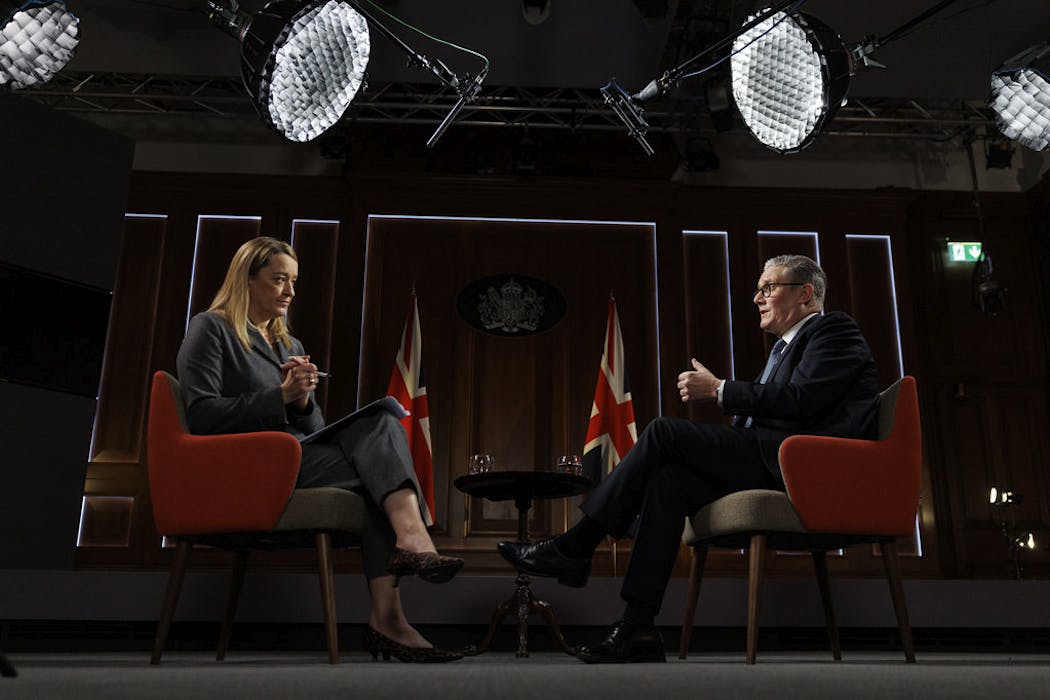
The prime minister insisted he was staying in the job during an interview with Laura Kuenssberg at the start of the year. Number 10/Flickr, CC BY-NC-ND

British electoral politics in the 1980s were dominated by Margaret Thatcher, the prime minister for the whole of that decade. Similarly, Tony Blair dominated elections when he was in Downing Street from 1997 to 2007. In sharp contrast, the decade from 2015 to 2025 saw no fewer than six prime ministers come (and mostly go) – five Conservatives and Keir Starmer for Labour.

Traditionally, Labour has been reluctant to sack its leader, but if the May elections turn out to be as bad as the polls suggest, the party might well adopt the Conservative strategy of changing its leader as frequently as premier league football managers.

However, the data suggests that sacking Starmer after those elections would be a mistake. This is because voters focus much more on the performance of the government overall than the prime minister when it comes to casting a ballot.

If he were removed, it would also trigger a serious internal conflict in the party on the scale of the turmoil in the Conservative party over Brexit. This played a major role in explaining the Tories’ massive defeat in the 2024 general election.

Trends in voting intentions, satisfaction with governments and with prime ministers for governing parties, 2015 to 2025:

A chart showing how satisfaction with parties and with governments has fluctuated over the years, tracked against voting behaviour.
How satisfaction with parties and PMs relates to voting.
P Whiteley, CC BY-ND

To see why this is the case, we can examine polling data on perceptions of the performance of incumbent governments and prime ministers alongside data on voting intentions for their parties over the decade since 2015. The key comparison is between the effects of the performance of governments with that of prime ministers on the vote.

The relationship between these variables is very strong, with correlations all greater than 0.80. It is tricky to find out which of the satisfaction measures is most important for predicting the vote, but this can be done with the help of multiple regression. This is a statistical technique that can predict changes in vote intentions from the satisfaction measures together with some other variables which also influence voting for governing parties.

These other variables in the analysis relate to challenger parties affecting both Conservative and Labour governments. The three national challenger parties are Reform, the Liberal Democrats and the Greens.

In the case of Reform, I’ve included vote intentions for its ancestor parties, UKIP and the Brexit party, since it did not officially exist until 2021. The focus is on explaining voting intentions for the Conservative government from 2015 to 2024 and subsequently the Labour government up to 2025.

The effects of the satisfaction measures and the challenger parties on support for the governing parties appear in the chart below. The analysis identifies the impact of each variable on changes in vote intentions for the governing party.

To illustrate, a score of 1.0 would mean that a 1% increase in the satisfaction with government would produce a 1% increase in voting intentions for the governing party. In fact, the coefficient is 0.2, a lot less than 1.0 but nonetheless highly significant. An increase of 10% in government satisfaction increases government vote intentions by 2%.

Impact of variables on voting intentions for governing parties:

A chart showing How votes for smaller parties interact with government and PM satisfaction.
How votes for smaller parties interact with government and PM satisfaction.
P Whiteley, CC BY-ND

The same cannot be said about the effects of satisfaction with the prime minister. This had a negligible impact on voting for the government. It’s not surprising that polling on the popularity or unpopularity of the prime minister attracts a lot of media attention. After all, they are the main spokesperson for the party. But when it’s time to vote, this evidence shows people judge the government in general rather than the spokesperson.

A clear example of this is the fact that the rapid changes in the leadership of the Conservative party had little overall effect on the party’s support in the long run. They ended up losing terribly in 2024 despite the tendency to replace their leaders.

To be fair, there were exceptions to this, as can be seen in the first chart. After David Cameron resigned following the Brexit referendum his successor, Theresa May, was more popular than her party.

Satisfaction with her government rose, but satisfaction with her performance rose faster. However, she was subsequently brought down by her decision to break a promise and call an early election in 2017.

She nearly lost that election and as a result was unable to get a “soft” Brexit deal through Parliament and had to resign. Boris Johnson did win the 2019 general election, but his chaotic government prepared the ground for the electoral rout for the Conservatives in 2024

The challenger parties

Challenger parties all influence voting for the governing party. The strongest impact is seen in vote intentions for Reform and its ancestor parties. Reform took votes away from both Labour and the Conservatives when each was in government. An increase of 10% in the Reform vote reduces the support for the governing party by 2.5%.

The impact of the Liberal Democrats on the governing party has been negative when they are looked at without considering the complex interactions of voting in a five-party system in England and six-party systems in Scotland and Wales.

These complexities ensured that Liberal Democrat support increased with government support as some voters were drawn to Reform, or when Labour took over as the governing party. Finally, the impact of the Greens on government support was negligible.

These results suggest that a change of leadership in the Labour party will not have any significant effects on vote intentions for the party. The only way to improve things is for Labour to deliver on its manifesto promises, particularly on economic growth and so change the mood of the country.

The Conversation

Paul Whiteley has received funding from the British Academy and the ESRC.

ref. Data suggests Labour would be making a mistake if it ousted Keir Starmer after May elections – https://theconversation.com/data-suggests-labour-would-be-making-a-mistake-if-it-ousted-keir-starmer-after-may-elections-273048

The UK spends millions on services for homeless people. Housing them could make more economic sense

Source: The Conversation – UK – By Anton Roberts, Sociologist and Social Policy Researcher at the Policy Evaluation and Researcher Unit at Manchester Metropolitan University, Manchester Metropolitan University

Jon C 303/Shutterstock

The government’s recently announced grand plan to end homelessness in England is the latest instalment in a long line of promises (and failures) by governments across the UK. This latest strategy, published in December, promises billions in investment in rough sleeping services, alongside a previous commitment to build 1.5 million new homes by the end of this parliament.

It’s an attempt to address the UK’s acute housing crisis. On the surface, there is plenty to praise in the plan, and these proposals are already receiving support from the wider sector.

For example, the scrapping of the two-child benefit limit will lift many vulnerable children out of poverty. And the strategy hints at more preventative approaches to the problem of homelessness.

But there’s a problem. Can the government achieve this objective within the narrow political window that this parliament offers? If not, perhaps it should consider whether this is the most effective use of public money.

One striking omission in the strategy is the absence of a commitment to the “housing first” model which, as the name suggests, would provide immediate access to housing for a homeless person. This omission is surprising, given the report’s repeated emphasis on housing as a solution.

Housing first combines an unconditional home with range of wraparound services for things like mental health problems or addiction. It’s distinct in being a genuinely long-term housing intervention, catering to those with multiple and complex needs. It is one of the most robustly evidenced homelessness interventions.

There are some isolated case studies of housing first mentioned in the report, but responsibility once again falls to the third sector. Charitable organisations are already forced to compete for insufficent funding pots, while also working alongside cash-strapped local authorities.

The average cost of housing first support per person is highly economical, according to the government’s own cost-and-benefit analysis data. The expected benefits to society have been calculated at £15,880 per person, which is more than double the £7,737 average cost.

According to a recent report from the charity Crisis evaluating housing first trials, a national roll out would cost £226 million per year. But this would be offset by reductions in provision burdens, equivalent to £280 million per year. This equates to total cost of £17,068 per individual per year, with a related saving surplus of £3,313.

The false economy of ‘business as usual’

Moral and human costs aside, homelessness is astoundingly expensive. Temporary accommodation alone costs billions each year. Although exact data on this is sparse, people experiencing rough sleeping are often referred to as “frequent flyers” through public services such as A&E departments, police and the courts.

The most recent calculation from Crisis, which goes back to 2015, estimated the annual cost of rough sleeping to be around £20,000 per person (or £27,872 when adjusted for inflation). This is due to things like use of NHS services, policing and the courts system. As seen with the government’s own rough sleeping snapshot, it continues to rise in the UK.

Arguably, business as usual isn’t working. There is little point in diverting funding to services that don’t work, or funding housing programmes for people with complex needs who may not be ready for a tenancy. If the aim is to reduce or end homelessness sustainably, the answer is not more short-term funding, but significant structural reform.

mobile phone screen showing universal credit login page alongside some pound coins and notes.
Benefit sanctions can hit people who are already at rock-bottom.
AndrewMcKenna/Shutterstock

In my research with my colleague, Joanne Massey, we explored some of these wider structural constraints facing people in poverty. We framed these constraints as forms of intentional and unintentional harms by the state. They include a welfare system where, despite annual rises, the range of benefits remains out of touch with living costs, alongside things like universal credit sanctions that make already difficult lives even more challenging.

Without confronting these, homelessness cannot be prevented or reduced. As such, the report falls short. For this to be a pragmatic and cost-effective strategy, the system must change from one of economically wasteful short-termism. There is no shortage of impactful and evidence-based examples – including housing first.

However, merely increasing funding will not achieve the necessary changes. The government must also commit to a public health approach. This means prioritising prevention through early intervention, as well as tackling the causes of homelessness at their structural root. Homelessness is a problem for all of society to address.

And merely listing poverty as a cause of homelessness does nothing to address it permanently, nor replace what has been lost from hundreds of billions of pounds of cuts to public services. A public health approach to homelessness would address challenges like these at the individual, community and societal levels simultaneously. It would also be a better use of taxpayer funds.

As an example, efforts in Wales to improve health with a prevention strategy produced a £14 return for every £1 invested using a public health approach. There was an annual saving of £9,266 per person when using preventative homelessness programmes. This approach combines the third sector, council services, education, health and the criminal justice system into one coherent strategy.

The government’s homelessness strategy is a positive start, but it will not replace what has been lost. Nor, as it stands, will it address the complex reasons why homelessness persists.

The Conversation

Anton Roberts does not work for, consult, own shares in or receive funding from any company or organisation that would benefit from this article, and has disclosed no relevant affiliations beyond their academic appointment.

ref. The UK spends millions on services for homeless people. Housing them could make more economic sense – https://theconversation.com/the-uk-spends-millions-on-services-for-homeless-people-housing-them-could-make-more-economic-sense-272569