How water fuels conflict in Pakistan

Source: The Conversation – UK – By Daanish Mustafa, Professor in Critical Geography, King’s College London
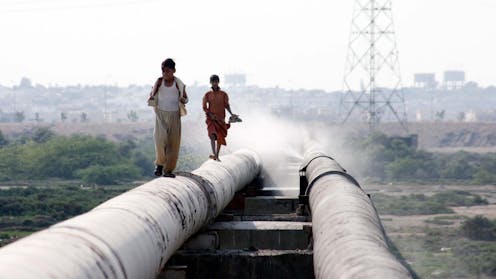
Two children walk along a burst water pipeline in Karachi, southern Pakistan. Asianet-Pakistan / Shutterstock

For ten days in April 2025, Pakistan almost came to a standstill. No freight was moving from its only port city, Karachi, towards the population centres in the north. The cause was the government’s announcement of a project to build six canals to irrigate the Cholistan Desert in the east of the country.

Protesters in the southern Sindh province, fearing diminished water supplies, demanded the immediate cancellation of the project and blocked all highways running northwards. The government soon relented, with prime minister Shehbaz Sharif announcing the project’s suspension in early May.

This was probably, at least in part, because the government was anticipating Indian military action. India blamed Pakistan for the Pahalgam terrorist attack, in which 26 people were killed in Indian-administered Kashmir the previous month. Internal squabbles had to be diffused in the face of external threats.

Geopolitics handed a temporary victory to the protesters. But the potential of water to cause conflict in Pakistan remains a live issue, from households using suction pumps to draw more than their share, to large inter-provincial disputes.


Wars and climate change are inextricably linked. Climate change can increase the likelihood of violent conflict by intensifying resource scarcity and displacement, while conflict itself accelerates environmental damage. This article is part of a series, War on climate, which explores the relationship between climate issues and global conflicts.


As someone who has researched water scarcity in Pakistan for 30 years, I argue that water conflict there is entirely avoidable. It is largely a function of the state’s obsession with supply-side mega projects and a lack of attention to questions of equitable access and quality.

At a time when the effects of climate change are becoming more severe, Pakistan can ill afford to continue its engineering-based approach to water if it is to ensure sufficient access for all.

According to the Pakistani government’s own figures, more than 95% of the available water in Pakistan is devoted to agriculture. It is used to cultivate water-guzzling crops, including rice and sugarcane. Pakistan is the fifth-largest producer and fourth-largest exporter of these crops.

Meanwhile the country’s teeming commercial centre of Karachi, with a population of 18 million, suffers from acute water shortages. Affluent neighbourhoods have water intensive date palms, exotic gardens, golf courses and swimming pools.

But for more than 80% of the city’s poorer neighbourhoods, there is almost complete dependence on water from tankers at up to 30 times the price richer neighbourhoods pay for regular piped water.

Water mains often become battle fronts in Karachi. My own research has documented many instances of violent conflict between different ethnicities and groups around manipulating water mains to gain access.

The minority Christian community in the Gujjar Nala neighbourhood of Karachi, for example, has engaged in violent clashes with the neighbouring Pashtun community over the operation of the regulating valve for allocating water to the two communities.

Conflict has also arisen between the city’s predominantly Urdu-speaking communities of Orangi Town and Altafnagar. Orangi residents attacked and destroyed the overhead water dispenser at the Altafnagar pumping station in early 2015 as it was siphoning water for Orangi to commercial water tankers.

Conflict between provinces

Pakistan is dependent on the Indus River and its tributaries for water. The system recharges the extensive Indus aquifer, which provides up to 80% of the water required for crops in the country.

Inter-provincial conflict over the distribution of Indus River water between upstream Punjab province, where several of Pakistan’s largest cities are located, and downstream Sindh province is an ongoing saga.

Sindh resents any new water mega projects in the powerful Punjab province. Along with the central government, Punjab wants to push forward dams and infrastructure projects in the name of development.

The Sindh-Punjab water conflict had a resolution of sorts in 1991, when the Inter-provincial Water Accord was signed. The agreement allocated water from the Indus River system among Pakistan’s four provinces.

However, Sindh’s civil society and government frequently accuse Punjab of violating the agreement by diverting water from the Indus River without the permission of the chief minister of Sindh, as required by the accord.

Sindhi and Punjabi nationalist politics heavily feature the water conflict in their rhetoric, which is proving corrosive for the federation of Pakistan.

Numerous dams and mining projects in the restive Balochistan province have also alienated the populace against the Pakistani government. They argue that dams are built with little local consultation and become hazards when they are swept away in flash floods. Around 30 dams in Balochistan were swept away during the 2022 floods.

At the same time, massive amounts of water are appropriated by foreign-owned mining operations there. These operations are of little benefit to local populations. The ongoing insurgency in the province, and the associated human rights abuses by the Pakistani state, are not divorced from the politics of water.
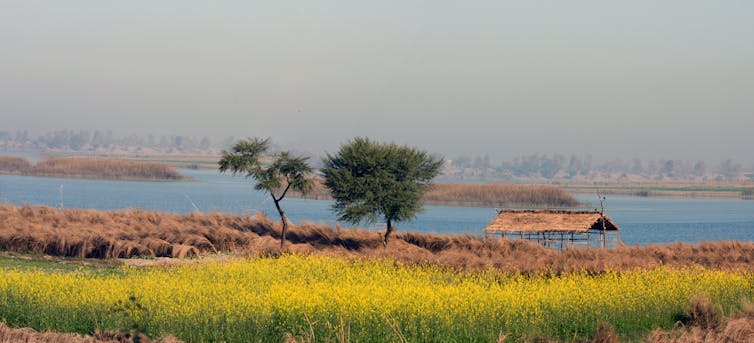
A thatched shelter on the banks of the Indus River.
The Indus River has been a source of conflict between Pakistan’s Sindh and Punjab provinces.
thsulemani / Shutterstock

Pakistan’s water development paradigm is based on engineering and infrastructure. But under the greater uncertainty of climate change, what is needed is more adaptive and flexible management of water at the local scale.

The current approach locks the state into fixed management based on assumptions underlying the design parameters of the infrastructure.

During flood season, which typically runs from July to September, the design parameters of dams and other infrastructure are now routinely exceeded. Water has to be released to save the infrastructure, thereby accentuating flood peaks.

The bulk of agricultural water also comes from groundwater, but all the investment is in surface water. It is a common lament in Pakistan that groundwater has been left for unregulated exploitation by private electric pumps, with all the attention devoted to surface water.

In domestic water supply, the obsession for photogenic urban green spaces and mega supply projects also take away water from poor areas and resources from the much-needed maintenance of the distribution infrastructure.

Climate change is a wicked problem that defies centralised decision making in a country the size and diversity of Pakistan. Local knowledge and democratic decision making are the best arbiter of adjustment to climate change and equitable water access.

Yet, in a praetorian state like Pakistan, military-dominated governance is unfortunately moving in exactly the opposite direction.

The Conversation

The research cited in this article emerged from grants funded by United States Institute for Peace (USIP) & Royal Geographical Society.

ref. How water fuels conflict in Pakistan – https://theconversation.com/how-water-fuels-conflict-in-pakistan-262628

Nigel Farage’s pledge to end indefinite leave could hurt the economy even before an election

Source: The Conversation – UK – By Tom Montgomery, Lecturer in Work and Organisations, University of Stirling

Nigel Farage’s proposal to abolish indefinite leave to remain is a shifting of the goalposts for those who have already come to the UK legally and settled.

Framing issues of migration as a crisis has been beneficial for Farage and other British politicians as a political strategy. However, on this occasion there are early indications that these proposals may provoke a more negative reaction from the British public.

The idea that even those already granted leave to remain would have to reapply creates insecurity for thousands of people who have come to call the UK home, which speaks to some of the human costs of such proposals.

We should also consider the potential implications for the economy. Reform claims billions could be saved by ending the right to apply for permanent residency in the UK – a claim that was called into question within days.

This indicates a pressing need for scrutiny of the economic impact a Reform government would have, particularly given that the party leading in polls.

Polls are not just indicators of who may next occupy 10 Downing Street. They also send signals to key actors in the economy about the country’s potential future direction of travel. And these signals matter. To understand how, we can turn our attention to the questions that an end to indefinite leave to remain may pose for the UK labour market.

There is already a problem with skills investment in the UK. Decisions to invest in skills and training often require a commitment to long-term investment before the employer and the employee realise the benefits.

But what happens to such investment when employers are unsure if their staff may be forced to leave? This is particularly relevant for those key sectors where there is a greater reliance on migrant workers.

Then there is the issue of job creation. If an employer is currently deciding where to invest and create new jobs, one aspect they will consider is access to the skills they need.

We know that there are key areas where employers are concerned about skills shortages in the UK. Would the potential end of leave to remain make it riskier to invest in creating jobs in the UK? This is a question employers will already be asking.

And if you are a worker from another country with skills that are in high demand, would these proposals make the UK more, or less attractive as a destination to bring skills?

These economic implications lead us to a key political question: who did Reform consult before making this announcement?

Reform has consistently sought to position itself as on the side of British business. Did they speak to the Confederation of British Industry about whether scrapping indefinite leave to remain would be a good idea? The Federation of Small Businesses? Did they speak to industry federations in the care sector, the hospitality sector, the education sector, or the health sector, where employers rely upon migrant workers?

Farage has also been keen to present himself as standing up for British workers and has in the past year been seeking to win support of grassroots union members. Did he consult any of the trade unions that represent millions of workers across the UK? Or did he consult trade union representatives in sectors that may be affected by these new proposals?

What type of consultation has informed these new proposals matters because it sends an important signal on the approach to governing that Farage intends to adopt should he become the next prime minister. Such signals are also likely to inform decisions made before the next election by employers and workers sustaining the UK economy.

Perhaps owing to the rapid rise of the Reform party and the dominance of two parties in government for generations, it has not received the same degree of scrutiny that previous “governments-in-waiting” have received. But given its dominance in the polls, careful consideration of the impact of its proposals is more necessary than ever.

If we look closer at these latest proposals, we see that they will create a more hostile and uncertain environment for those who have lived and worked in the UK for some years and those considering coming to the country. That may have already created risks for the UK economy.


Want more politics coverage from academic experts? Every week, we bring you informed analysis of developments in government and fact check the claims being made.

Sign up for our weekly politics newsletter, delivered every Friday.


The Conversation

Tom Montgomery works in higher education. He has conducted research on issues of social care, migration and labour markets that has been funded by the European Commission.

ref. Nigel Farage’s pledge to end indefinite leave could hurt the economy even before an election – https://theconversation.com/nigel-farages-pledge-to-end-indefinite-leave-could-hurt-the-economy-even-before-an-election-266174

Développement personnel : pourquoi faudrait-il « se ressourcer » ?

Source: The Conversation – in French – By Yael Dansac, Anthropologue et collaboratrice scientifique, Université Libre de Bruxelles (ULB)

« Se ressourcer », un leitmotiv des pratiques spirituelles contemporaines. Pexels, CC BY

Séjour de yoga restauratif à Saint-Malo, bain de forêt rééquilibrant à Rambouillet, retraite de méditation harmonisante à Chamonix… le marché des spiritualités contemporaines regorge d’options pour retrouver sa maîtrise de soi, amplifier sa productivité ou cultiver son bien-être. Ces vingt dernières années, le terme « se ressourcer » est devenu un verbe fourre-tout très présent sur le marché du développement personnel, dans la sphère des thérapies alternatives et dans le monde du travail. Mais qu’est-ce que cette expression désigne précisément, et à quels besoins répond-elle ?


La forme pronominale « se ressourcer » a une résonance francophone qui ne correspond pas tout à fait au sens des expressions, comme replenishing, (réapprovisionnement) ou recharging (rechargement), elles aussi très répandues sur le marché des spiritualités contemporaines des sociétés anglophones.

Dans le dictionnaire, « se ressourcer » signale l’action de « revenir à ses sources ». Cette expression porte l’idée d’un retour à un espace-temps où, selon l’anthropologue Stéphanie Chanvallon, l’être humain serait capable de rencontrer une partie perdue de son essence ou de son énergie.

« Se ressourcer » semble correspondre à une tâche perpétuelle ou sisyphéenne : celle de réacquérir de manière répétitive des potentialités perdues au cours d’une trajectoire personnelle, mais qui demeurent à l’intérieur de chacun. De même, il s’agirait d’un moyen privilégié pour surmonter l’épuisement physique et mental que nous subissons depuis notre passage à une société d’accélération, telle que théorisée par le philosophe allemand Hartmut Rosa.


À lire aussi :
La pédagogie de la résonance selon Hartmut Rosa : comment l’école connecte les élèves au monde


La source en question

Les adeptes des spiritualités contemporaines s’approprient ce terme pour évoquer l’existence d’une « source », comme l’illustre le témoignage d’une psychothérapeute, recueilli au cours de l’une de nos enquêtes sur les pratiques holistiques dans le Morbihan (Bretagne), en 2018 :

« La source, pour moi, est une borne d’énergie, sur laquelle je dois me connecter de temps en temps afin de recharger mes batteries. Il n’y en a pas qu’une. Votre source peut également se trouver dans la méditation, le yoga ou la marche dans la forêt. Votre bien-être intérieur est le premier indice qui vous indique que vous avez trouvé le bon moyen pour vous ressourcer. »

Localiser la « source » est une tâche dirigée par les émotions et par les subjectivités. Cela lui permet d’adopter les formes les plus variées, dans le temps et dans l’espace. Elle peut se matérialiser dans des milieux naturels tels que la forêt ou les bords de mer, dans des contextes urbains comme les cabinets de médecine alternative ou les parcs, à des dates précises telles que les solstices ou les équinoxes, ou encore à travers des activités diverses comme les retraites méditatives, les pratiques psychocorporelles ou les stages de découverte du néo-chamanisme.

Le choix de « retourner à la source » passe avant tout par une décision personnelle d’accorder une importance non négociable au maintien de son propre bien-être, comme l’exprime cet autre témoignage recueilli, en 2023, auprès d’un spécialiste en pratiques holistiques :

« Le jour où vous décide[re]z que le retour à la source fait partie essentielle de votre vie, vous réaliserez à quel point le fait de vous arrêter par moments et de vous retrouver ici avec vous-même vous rend beaucoup plus efficace dans tous les aspects de votre vie. »

D’après les témoignages recueillis, « se ressourcer » n’est pas envisagé comme une activité isolée ou une pratique précise, mais plutôt comme la quête d’un état émotionnel souvent exprimé par les formules « centré », « ancré » ou « équilibré ».

Cette quête, étroitement liée à la consommation de produits pour travailler sur soi-même, s’inscrit dans une modernité tardive marquée par l’individualisme et la culture de consommation. Dans un monde où la quête de sens est devenue le leitmotiv, le fait de « se ressourcer » a évolué en outil formateur de notre identité.

Entre quête de soi et dynamique d’auto-engendrement

L’essor de pratiques spirituelles séculières est emblématique de cette fascination pour des expériences valorisées pour leurs vertus « ressourçantes ». Ces activités permettent aux participants de se livrer à une quête de soi susceptible d’être éprouvée comme une expérience intense et inattendue. Cette quête peut être désirée comme une rencontre avec ses racines, un retour sans limites à une essence « pure », ou un processus continu de réactualisation des connaissances sur soi-même et sur autrui.

La dimension cyclique est au centre des activités qui supposent un retour aux sources. Ce caractère répétitif est constitutif des pratiques rituelles occidentales où l’injonction de « renaître à soi-même » façonne les expériences des participants. Plutôt que d’être vécue comme la quête d’un « soi véritable » une fois pour toutes, cette prescription est éprouvée comme une dynamique d’auto-engendrement, qui n’a pas une durée déterminée et qui inclut la consommation régulière des produits et des formations ressourçantes.

Entre quête d’un état affectif et expérience métaphysique

Si l’acte de « se ressourcer » est tellement estimé au sein de nos sociétés, c’est notamment à cause de son potentiel eudémonique  : c’est-à-dire qu’il est associé aux expériences d’épanouissement personnel, d’acceptation de soi, d’établissement de relations positives avec les autres, et d’identification du sens de la vie.

Les pratiques ressourçantes sont également vues comme propices au développement des émotions positives, telles que la compassion, la gratitude et la reconnexion à une nature envisagée comme « vivante ». Le passage d’un état affectif négatif (marqué par l’angoisse, le stress ou la colère) à un état affectif positif est un des principaux bénéfices recherchés par les participants, comme l’exprime ce témoignage d’un enseignant recueilli, en 2024, lors d’une enquête sur les pratiques spirituelles fondées sur la nature, en Wallonie (Belgique) :

« Ce stage m’a permis de réaliser un véritable tournant dans ma vie et de cultiver l’humilité et la compassion. Je me sens infiniment chanceux d’avoir fait cette expérience qui favorise l’ancrage et la gratitude. »

Le ressourcement peut également être apprécié comme un processus qui s’exprime mieux dans un langage « énergétique », caractéristique des religions métaphysiques étudiées par la spécialiste en sciences des religions Catherine L. Albanese. Il s’agit de systèmes de croyances qui empruntent au langage du monde scientifique. C’est pourquoi l’acte de se ressourcer se traduit parfois par des expressions comme « faire le plein d’énergie » ou « réaligner nos énergies », qui désignent un processus de synchronisation et reconditionnement des couches d’énergies subtiles, censées entourer toute matière. Ceci est exposé de la manière suivante par un ingénieur qui a fait l’expérience d’un stage de guérison énergétique en Bretagne :

« La visite de ces hauts lieux permet notamment de ressentir diverses énergies au niveau physique, psychique ou spirituel, sur des sites particuliers. Ainsi, j’ai pu décharger une grande partie des énergies qui me dérangent habituellement, et me ressourcer de bonnes énergies qui m’ont apporté de l’équilibre. »

En somme, l’expression « se ressourcer » et les pratiques qu’elle recouvre sont devenues des outils formateurs des dynamiques relationnelles entre nous, nous-mêmes et autrui. Elles ouvrent la voie à l’engendrement d’un « soi-même » susceptible d’être renouvelé sans limite.

Dans une ère marquée par des crises multiformes, « se ressourcer » est également valorisé par un discours dominant qui exhorte les individus à devenir « la meilleure version d’eux-mêmes ».

The Conversation

Yael Dansac ne travaille pas, ne conseille pas, ne possède pas de parts, ne reçoit pas de fonds d’une organisation qui pourrait tirer profit de cet article, et n’a déclaré aucune autre affiliation que son organisme de recherche.

ref. Développement personnel : pourquoi faudrait-il « se ressourcer » ? – https://theconversation.com/developpement-personnel-pourquoi-faudrait-il-se-ressourcer-263739

La très longue feuille de route pour être un « bon patron »

Source: The Conversation – in French – By Michel Offerlé, Sociologie du politique, École normale supérieure (ENS) – PSL

« Patron », un terme qui a le plus souvent une charge péjorative. Que peut être alors un « bon patron » ? Les demandes adressées à celui qui préfère aujourd’hui être appelé « chef d’entreprise » ou « entrepreneur » sont multiples. Revue des principales qualités qui leur sont demandées.


Être patron, cela a-t-il à voir avec le ou la politique ? Jusqu’où la revendication de l’entreprise au « service du bien commun » (entre entreprise providence et « Laissez-nous faire nous-mêmes ») peut-elle impacter le métier ?

En France, le terme « patron » est plus souvent associé à des désinences fortement péjoratives : pas seulement mauvais (du point de vue gestionnaire) mais plutôt « salaud de », « pourri », « con », « voyou » ; quant aux adjectifs : « autoritaire » et « tyrannique » se le disputent à « hautain », « caractériel » ou « inabordable ».

Dans tous les cas, être patron suppose de se placer dans une relation de domination à l’égard de ses salariés qui sont, eux, dans un état de subordination économique et juridique à l’égard de leur employeur. L’employeur est le chef de l’entreprise et, comme tel, c’est lui qui peut se réserver les tâches les plus gratifiantes, et déléguer le travail, et notamment « le sale boulot » à ses « collaborateurs ».

Indispensables patrons

Cette présentation négative a été contrée depuis longtemps par un ensemble de dénégations argumentatives et de pratiques qui entendent montrer que le patron est indispensable dans une économie de marché, soit le système économique le plus efficace dans lequel se crée de la richesse et des emplois.

Et le mot « patron » tend à être refoulé dans des siècles antérieurs (le patron « à la Zola »). Le terme est entré en déshérence au profit de ceux de « chef d’entreprise », d’« entrepreneur » ou, dans un langage international, de « manager » voire de CEO (pour chief executive officer, dans la langue de Steve Jobs). En 1995, le changement du nom de l’organisation interprofessionnelle du Conseil national du patronat français (CNPF) en Mouvement des entreprises de France (Medef) marque aussi cet objectif de modifier et de moderniser les représentations patronales.


À lire aussi :
« Patron incognito », ou quand la télé-réalité façonne une vision morale de l’entreprise


Par ailleurs, des techniques très différentes de mise au travail et d’acceptation ou d’assentiment de la subordination s’inventent tous les jours, de manière parfois cosmétique, pour établir ou rétablir un management qui peut être alors :

Paternalisme de proximité ?

Cela peut aller du réinvestissement du paternalisme de proximité (il vient dire bonjour tous les matins, il connaît les problèmes de ses salariés) à des expérimentations, comme l’entreprise libérée, en passant par des pratiques vertueuses que peuvent mettre en œuvre des patrons de l’économie sociale et solidaire ou certains innovateurs patronaux.

La question du ratio d’équité, soit le rapport entre le salaire médian ou moyen des salariés et celui des plus hauts dirigeants, reste un sujet relativement confidentiel. Certains rares patrons pratiquent le 1 à 4 quand d’autres acceptent un salaire mensuel à 7 chiffres, ce qui peut amener le ratio à plus de 200.

HEC Paris, 2016.

Un bon patron serait celui qui paye bien, qui embauche des CDI, comme, par exemple Axyntis qui assure des conditions de travail optimales à ses salariés, hommes et femmes, qui a de la considération pour eux et pour leur travail, qui les traite comme des co-équipiers, qui les associe à la réflexion voire à la décision, et, au-delà de toutes ces contraintes, qui sait assurer la rentabilité financière de l’entreprise, sa viabilité et sa pérennité.

Des marges de manœuvre vertueuses

En poussant au maximum les rapports sociaux dans un cadre de capitalisme de marché, les marges de manœuvre vertueuses sont possibles et encore à inventer. Quelques entreprises, mais beaucoup moins qu’aux États-Unis avant la nouvelle présidence de Trump, ont pris l’initiative de politiques de diversité (égalité entre femmes et hommes, diversité d’origine des salariés).

La taille de l’entreprise est parfois discriminante, mais pas toujours. Un grand patron pourrait arriver à une forme d’harmonie conjuguée aux pièces du puzzle d’une multinationale et un petit patron peut aussi se révéler tout à fait tyrannique, qu’il s’agisse d’une entreprise conventionnelle ou d’une start-up, une catégorie d’une fluidité exemplaire où le up or out ainsi que l’agilité et la flexibilité maximales peuvent mener à l’arbitraire et à la précarité.

Jugé par ses pairs… et par la société

Être un bon patron, c’est l’être aussi à l’égard de ses pairs, qui se jaugent et se reconnaissent entre eux, et qui peuvent à tous les gradins des patronats entrer en concurrence pour obtenir des prix et des trophées sur certaines scènes et défendre des causes communes sur d’autres. Mais être « un bon patron » ne s’arrête pas à la porte de l’entreprise ou des clubs de sociabilité patronale.

Depuis plusieurs années, la thématique de l’entreprise a resurgi dans les débats socioéconomiques et politiques. Pour autant, on ne va plus jusqu’à prôner, comme cela a précédemment été fait, une « réforme de l’entreprise » ou encore la nécessité d’avoir un permis de diriger une entreprise (comme il existe un permis de conduire), ni même une nationalisation des moyens de production et d’échange qui serait couronnée par une autogestion.

Les propositions les plus audacieuses, en matière de transformation des directions d’entreprises, vont à l’instauration de conseils des parties prenantes et à l’introduction (partielle) de la Mitbesttimung (ou, cogestion paritaire) allemande, soit la présence des salariés dans les organes de direction des entreprises à quasi parité avec les porteurs de capitaux.

Loi Pacte

À la suite du rapport Notat-Senard (2018), la loi Pacte a entériné certaines modifications et a amendé l’article 1833 du Code civil en y définissant de manière dynamique le but d’une société commerciale étant gérée « dans son intérêt social, en prenant en considération les enjeux sociaux et environnementaux de son activité ». Ainsi, le but n’est pas, comme l’écrivait Milton Friedman, de faire uniquement du profit.

Désormais il ne s’agit pas de satisfaire seulement les actionnaires (sans qui rien n’existerait, estiment les libéraux) en matière de rentabilité économique, mais aussi de tenir compte des parties prenantes que sont les salariés et, plus largement, la collectivité. Les entreprises sont désormais responsables des conséquences que leur activité produit sur la société et sur son environnement.

Exercices domestiques

Cette loi a donné lieu à des débats nombreux, dans le pas assez ou le beaucoup trop, et l’on a vu fleurir des raisons d’être entrepreneuriales qui sont allées des exercices purement cosmétiques jusqu’à une réflexion orchestrée sur les finalités de telle entreprise. De ce fait, les entreprises à mission, pour lesquelles des contraintes diverses de résultats selon l’exigence de certification ne sont pas très nombreuses, et encore moins parmi les très grandes entreprises.

Pourtant, certaines organisations, le Crédit mutuel Alliance fédérale et la Maif ont, par exemple, mis en place, en 2023, le dividende écologique et le dividende sociétal, qui ne sont pas suivis par d’autres grandes entreprises. Ces dividendes consistent à reverser une partie de leurs résultats à des projets écologiques ou sociaux.

Fondation nationale pour l’enseignement de la gestion des entreprises (Fnege) médias, 2022.

S’arrêter là serait négliger une large partie du problème, car la responsabilité sociale et environnementale (RSE) des entreprises est loin de ne renvoyer qu’à des initiatives isolées. Elle est désormais mesurée par un ensemble d’indicateurs (obligatoires ou facultatifs) parfois très sophistiqués et en concurrence, et doit aussi se conjuguer avec d’autres types d’implication.

Un « bon patron » est celui qui, idéalement, ne s’intéresse pas seulement à ses éventuels actionnaires, à ses salariés, à ses consommateurs (qualité/prix/utilité sociale et environnementale), mais aussi à ses fournisseurs et à ses sous-traitants pour lesquels il doit appliquer les mêmes règles et, pour les grandes entreprises, qu’il ne doit pas pressurer en matière de coûts (qui se répercutent obligatoirement sur la qualité du produit et sur les conditions de travail des salariés) ni jouer sur la trésorerie et les délais de paiement.

Un « bon patron » est aussi celui qui « tient » au travail dans des dimensions pratiques. Autrement formulé, il participe directement aux activités de l’entreprise qu’il s’agisse de la gérer quotidiennement, de créer des emplois, d’étendre son activité ou même de contribuer parfois directement à des activités de production.

Reste à ajouter la dernière responsabilité, à l’égard de l’État qui apparaît chez beaucoup d’entre eux comme un prédateur inefficace. Un « bon patron » devrait aussi avoir une politique fiscale transparente et éthique, mais elle est bien souvent en concurrence avec une saine gestion des utilités qui impliquent optimisations, voire exils fiscaux. Quant aux patrons catégorisés comme « exilés fiscaux » ou encore « surexploiteurs » des ressources de la planète, on retrouve là notre oxymore initial faisant d’eux des « mauvais » patrons plutôt que des « bons ».

On n’oubliera pas dans cette énumération à 360 degrés du métier patronal, le rôle que peut jouer « la femme du patron » dans la maisonnée économique que constitue l’aventure entrepreneuriale (héritée, achetée, créée ou assumée temporairement pour les patrons de grandes entreprises). On pourrait parler aussi du mari de la patronne car, si le métier de patron, bon ou mauvais, est encore masculin principalement, la féminisation très différentielle selon les secteurs est en marche.

The Conversation

Les auteurs ne travaillent pas, ne conseillent pas, ne possèdent pas de parts, ne reçoivent pas de fonds d’une organisation qui pourrait tirer profit de cet article, et n’ont déclaré aucune autre affiliation que leur organisme de recherche.

ref. La très longue feuille de route pour être un « bon patron » – https://theconversation.com/la-tres-longue-feuille-de-route-pour-etre-un-bon-patron-263560

Don’t cut them out: lymph nodes may be key to cancer treatment

Source: The Conversation – UK – By Justin Stebbing, Professor of Biomedical Sciences, Anglia Ruskin University

Oleksandra Bolotina/Shutterstock.com

Removing lymph nodes during cancer surgery has saved countless lives in many tumour types. Yet recent research is challenging parts of this long-standing practice.

Imagine your body’s immune defences as a city, and lymph nodes as the hubs where police and firefighters gather fresh intel to launch their attack on criminals. What happens if you remove too many of these hubs? This is a new question at the centre of modern cancer surgery.

When surgeons remove lymph nodes, it’s usually for two reasons: to find out whether cancer has spread, and to prevent further spread to other organs. For decades, this approach represented the best standard of care.

If a tumour escapes its original site, cancer cells often travel through lymph vessels and settle in the nearest lymph nodes, which act as biological filters. Detecting cancer cells in lymph nodes signals that a patient’s disease may be more likely to return after treatment.

Removing these nodes allows doctors to “stage” the disease accurately, and potentially increase the chances of eradicating all tumour cells – while also telling oncologists like me to treat the cancer more aggressively.

But lymph nodes are not just passive waystations. They play an active role in the body’s immune response, acting as meeting points for immune cells to share information about cancer. Recent scientific discoveries have led researchers to rethink how crucial these hubs are for sparking powerful, lasting immune reactions.

One of the newest studies shows lymph nodes help maintain a special type of immune cell called “CD8 positive T cells”, which can destroy cancer cells. These immune cells are primed and kept ready to act by the environment inside the lymph nodes.

Without these hubs, the body’s anti-cancer immune response, especially during immunotherapy treatment, may be weaker than previously imagined. The research shows how the specific cells in the lymph nodes make an initial anti-cancer burst of activity. However, this has only been demonstrated in the laboratory, not in humans as yet.

Removing lymph nodes is not without drawbacks. Patients can experience swelling (lymphoedema), increased risk of infection in the affected limb, and sometimes chronic pain or mobility problems. There’s also concern that removing lymph nodes, while reducing short-term risks of cancer spread, might inadvertently weaken the body’s long-term immune defences – especially as modern treatments increasingly rely on the patient’s natural immunity. This is in line with the new study findings.

How lymph nodes work.

Why do surgeons still remove lymph nodes, then?

For many types of solid tumour, the risk of metastatic spread remains high, and lymph node involvement is one of the best predictors of cancer recurrence.

Lymph node removal also provides vital information for choosing the most effective post-surgical treatments. In breast cancer, doctors often use a “sentinel node biopsy”. This means removing only the first lymph node that fluid from the tumour drains into. Checking just this sentinel node helps doctors see if the cancer has spread, while reducing the number of nodes removed and lowering the risk of side-effects.

Medical researchers are learning more about how lymph nodes work during long-term illnesses. The new study shows that lymph nodes aren’t just passive filters; they’re active training grounds where special immune cells grow, multiply and become powerful fighters. This is especially important during treatments that boost the immune system, such as checkpoint blockade treatments which are now used for many types of cancer.

These results suggest that taking out lymph nodes doesn’t just block cancer’s spread; it also removes important hubs where the immune system monitors the body and gets reactivated to fight disease.

Over the last decade, hospitals have adopted gentler, more targeted lymph node surgeries. Instead of removing all the nodes in a region, the focus is now on minimising disruption: taking only the nodes most likely to harbour cancer.

This approach reduces complications for patients and may help keep their immunity strong. Some patients with early-stage cancers may even avoid node removal altogether, instead relying on imaging and biopsies to monitor for spread.

For those worried about the consequences of major lymph node removal, emerging therapies offer hope. Immunotherapy drugs, targeted treatments and even cancer vaccines are being developed that can “re-educate” the immune system, even if some lymph nodes have been lost.

Still, there is growing evidence that patients do best when at least some hubs remain – preserving the body’s ability to mount and sustain a defence against lingering cancer cells.

In the future, cancer surgery may become even more personalised. By mapping the activity inside lymph nodes – tracking which ones are essential for immune function and which are most likely to seed new tumours – doctors can tailor surgery so each patient gets maximum benefit with minimum harm.

The recent discoveries challenge surgeons and oncologists to weigh every decision carefully: not just for what is removed today, but for the immunity and future defences left behind.

Is removing lymph nodes in cancer surgery a bad idea? The answer is complex. For many patients, it’s still a good idea and can be lifesaving. But new science teaches us that lymph nodes are more than just staging posts; they may be indispensable for long-term immune protection. The future promises smarter, more strategic surgery, keeping more of the body’s natural defence system intact while targeting cancer with precision.

The Conversation

Justin Stebbing does not work for, consult, own shares in or receive funding from any company or organisation that would benefit from this article, and has disclosed no relevant affiliations beyond their academic appointment.

ref. Don’t cut them out: lymph nodes may be key to cancer treatment – https://theconversation.com/dont-cut-them-out-lymph-nodes-may-be-key-to-cancer-treatment-265557

When mental health apps become worry engines: how digital ‘care’ can hijack our anxieties

Source: The Conversation – UK – By Mikael Klintman, Professor of Sociology, Lund University

voronaman/Shutterstock

It’s 2:47 am and your phone buzzes on the nightstand. The notification suddenly glows in the darkness: “You’re on a 7-day streak!”; “Don’t break your streak!”. You feel the need to open the app right away for an emergency breathing exercise. Half-awake, you fumble for the device, chest tightening. Another buzz: “What’s your positive intention for the day?”

The app that promised to ease your anxiety has just jolted you into a state of micro-panic. Have you fallen prey to some kind of toxic, digital positivity?

Research shows that smartphone notifications from various types of apps can contribute to stress, anxiety and depression, with users receiving dozens of push notifications daily.

A recent meta-analysis found that while mental health apps can help improve clinical outcomes, there are some concerns around too much engagement leading to frustration and stress.

These apps, sometimes marketed as “therapist in your pocket” and “a sort of 24-7 mobile therapist” are employing strategies closely resembling what social media platforms use to maximise psychological engagement. But when the product is mental wellbeing, what happens when the cure becomes part of the disease?

To understand why app design choices matter, we need to consider how our minds process threats, whether positively or negatively framed. In my new book Framing – The Social Art of Influence, I examine topics ranging from caviar ads to public‑health campaigns, asking which kinds of signalling strike a chord with different audiences in particular situations. While mental‑health apps are not directly investigated in my book, there are plenty of parallels to them backed up by research.

One key idea is the distinction between “rough” and “smooth” textures of framing in communication. Rough framing uses threat cues, surveillance language and urgency to capture attention. It’s the difference between a gentle reminder and a fire alarm. These apps systematically deploy rough framing through their notification systems.

Consider how these notifications exploit what evolutionary psychologists call our “hypervigilance bias” — the ancient tendency to overreact to potential threats that once kept our ancestors alive. Research shows that throughout human evolution, diverse environmental threats shaped our brain’s fear response, resulting in cognitive mechanisms that prioritised survival.

When an app warns that your stress is spiking, it’s using the same neural pathways that once alerted us to predators. But unlike a rustling bush that might hide a tiger, these digital warnings can create threats where none existed.

By sending alerts about “detected stress” or “mood dips,” mental health apps create micro-crises that only the app can resolve. User reviews consistently praise the “instant reassurance” these apps provide, yet studies tell a different story about long-term engagement patterns.

Research on mental health app notification timing and frequency reveals concerning patterns. One study found that people using a certain app receiving daily notifications showed higher engagement initially. Still, some users described experiencing frustration with repetitive notification content, with one participant noting: “n the end it got me a bit annoyed, ‘cause I was like, ‘Oh, I’ve done this already.’”

Analysis of push notifications showed that frequent users become less responsive to suggestion-based prompts over time.

Hot and cold framing

In my book’s framework of social influence, I also distinguish between “hot” and “cold” framing temperatures. Hot framing creates urgency and emotional intensity — think breaking news alerts or emergency warnings. Cold framing allows space for reflection and considered response.

Mental health apps have become masters of hot framing. Haptic buzzes accompany streak warnings. Red badges accumulate on home screens. Animation effects show wilting flowers when you miss a meditation session. One popular app even sends notifications styled like text messages: “Hey! Your anxiety score is climbing. Let’s chat?”

The informal tone masks the manipulative design — you’re not chatting with a friend but with an algorithm optimised for engagement.

This matters because mental health recovery often requires the opposite approach. Decades of research in cognitive behavioural therapy emphasise the importance of creating distance from anxious thoughts, not constant monitoring of them. When we’re repeatedly prompted to check our stress levels, we’re training ourselves to become more, not less, aware of every physiological fluctuation.

How to improve design

The solution isn’t to demonise technology or abandon digital mental health tools altogether. Instead, we need to reframe how these apps operate radically. Research suggests several promising approaches that shift from hot to cool, rough to smooth framing.

First, notification caps work. A study on smartphone notification batching found that limiting alerts to three times daily reduced stress and increased wellbeing. Moreover, research on mental health app notifications warns that “a lot of annoying reminders can lead to disengagement” and recommends allowing users to customise reminder frequency and timing.

Second, opt-in rather than default biometric monitoring reduces the surveillance feel while maintaining functionality for those who genuinely benefit. Third, what designers call “intentional friction” — small barriers to obsessive checking — can break compulsion cycles. Such barriers may include limiting how often data is refreshed or using batching notifications.

Colour psychology matters too. Research on healthcare design shows that blue environments can lower blood pressure, reduce heart rate and decrease cortisol levels. A study on mental health app design found that young people “favoured a subtle use of colour” for wellbeing apps, warning against “overly intense colours”.

Language shifts make a difference. “When you’re ready, you might enjoy a breathing exercise” lands differently than “URGENT: Manage your stress NOW!”

What you can do

The next time your mental health app sends an urgent notification, pause before responding. Ask yourself: is this alert serving my wellbeing or the app’s engagement metrics? Are these “insights” about my stress creating more worry than wisdom? The power to reframe these digital interactions lies first in recognising how they frame us.

Perhaps the most radical act of digital self-care is the simplest: turning off notifications altogether. True mental wellness might begin not with another app alert, but with the confidence to trust our own minds, in their own time, at their own pace. Now that would be revolutionary — an app that knows when to stay quiet.

The Conversation

Mikael Klintman does not work for, consult, own shares in or receive funding from any company or organisation that would benefit from this article, and has disclosed no relevant affiliations beyond their academic appointment.

ref. When mental health apps become worry engines: how digital ‘care’ can hijack our anxieties – https://theconversation.com/when-mental-health-apps-become-worry-engines-how-digital-care-can-hijack-our-anxieties-263930

Starmer has enabled the far-right – promises of ‘progressive patriotism’ are no longer enough

Source: The Conversation – UK – By George Newth, Lecturer in Politics and member of Reactionary Politics Research Network, University of Bath

Faced with an insurgent UK far right backed by a billionaire oligarch, Prime Minister Keir Starmer’s pledge to lead the progressive fightback is long overdue. If Starmer’s speech, however, is to be anything but empty rhetoric, he must abandon his failed strategy of chasing the Reform vote in favour of a bolder, more hopeful narrative.

Based on his government’s actions and discourse so far, the signs are far from promising. He has helped embolden the very politics he claims to oppose.

Starmer’s speech comes hot on the heels of Britain’s largest ever far-right mobilisation. Between 110,000 and 150,000 people descended on London for the so-called “Unite The Kingdom” march, organised by Stephen Yaxley-Lennon (better known as Tommy Robinson).

In line with far-right great replacement theory, the principal target of those speaking at the event was Islam and immigration – but there were plenty of examples of placards targeting other marginalised groups such as LGBTQ+ people.

Appearing via video link, the billionaire oligarch Elon Musk warned of the need “to fight back or die” in the face of “massive uncontrolled migration”. Starmer’s home secretary, Shabana Mahmood labelled Musk’s words as abhorrent and Starmer said some of the views expressed at the rally did not reflect a “nation proudly built on tolerance, diversity and respect”. The government, however, arguably shares significant responsibility for legitimising the politics behind the rally.

Starmer’s denunciation of “loutish behaviour” mimics his decision to attribute the summer 2024 riots to “far-right thuggery”. Countering far-right figures such as Yaxley-Lennon is vitally important. However, on its own, such reactive discourse is not enough. Associating far-right ideas with the margins of society ignores the way in which so-called mainstream politicians have normalised such politics .

The Unite the Kingdom march was the climax of “operation raise the colours”, which saw people all over the country putting up flags wherever they felt like doing so. Bearing all the hallmarks of a carefully coordinated “astroturf” campaign (stimulating grassroots support for a cause and then using that support to legitimise other activities), raise the colours contributed to an emboldening of the far right.

Further to “just” raising the union flag and St George’s cross, there were acts of vandalism against mosques and ethnic food restaurants as well as racist graffiti. It is hard not to also see the link between those putting up flags in the streets and those waving them outside so-called “asylum hotels”.

Most of this has since been condemned by Starmer, yet he initially embraced raise the colours wholeheartedly, even calling himself a “big supporter of flags”. Meanwhile, the (at the time) home secretary Yvette Cooper made the somewhat bizarre assertion that her entire home was bedecked with St George’s crosses and Union Jacks and said that people should “put ‘em up anywhere”.

The violent rhetoric and actions on display at the rally reveal the severe limitations of this attempt to co-opt the flag waving initiative to attract its backers.

I would argue this also illustrates how Starmer’s attempt to pivot towards a more “progressive” form of patriotism is doomed to fail. Because patriotism is so often tied to exclusion and the policing of national boundaries, it ultimately undermines broader commitments to empathy, equality and solidarity.

A losing game

In the longer term, Starmer’s own policies since taking office have tried to outflank Reform on the right. Starmer has framed Reform as Labour’s official opposition. In line with this, the Labour party has made immigration, and Channel boat crossings in particular, one of its top priorities.

On taking office, Labour’s prioritisation of “secure borders” has been encapsulated by the violent slogan of “smash the criminal gangs”. Starmer has accused past Conservative governments of running an “open-borders experiment” and has allowed images of deportations to be made public – a technique most notoriously used in the Trump administration’s racially charged deportation videos that are shared with the public in the knowledge that they will be widely circulated on social media.

Starmer cannot defeat the far right by using its language and tactics. This much is evident not only in the chants and placards which target him at far-right rallies, but also his disastrous polling figures.

In the words of journalist Nesrine Malik, “we need new stories” when addressing the socioeconomic and sociopolitical challenges facing the UK. A key example is the way we talk about immigration. It is telling that just 5% of overall migration to the UK is classified as illegal yet it almost entirely dominates the national conversation.

Starmer has done nothing to counter that imbalance. Indeed, his speech, intended to mark a fightback of progressive values, has doubled-down on anti-migrant rhetoric.

In particular, the introduction of digital ID cards is framed as a way of ensuring Britain takes back control of its borders. Claiming Britain has been “squeamish” about talking about illegal immigration, Starmer has said ID cards would help protect working people’s wages against those who “slip into the shadow economy and remain here illegally”.

Academic research consistently illustrates that the way in which immigration is framed by politicians and the media has a significant impact on how and whether people view it as a “legitimate concern”. It is incumbent on a supposedly “social democrat” prime minister to lead this change in narrative.

Starmer’s intervention on the side of progressive values might be a welcome one, were it not premised on a dead duck narrative of “progressive patriotism”. It is, though, effectively meaningless if he continues to lead a government which oversees and manages the “division” he ostensibly seeks to address.

The Conversation

George Newth is a Lecturer in Politics at University of Bath and is a member of the Green Party

ref. Starmer has enabled the far-right – promises of ‘progressive patriotism’ are no longer enough – https://theconversation.com/starmer-has-enabled-the-far-right-promises-of-progressive-patriotism-are-no-longer-enough-266036

Why Charli XCX might be Gen Z’s answer to the Romantic poets

Source: The Conversation – UK – By Katie MacLean, PhD Student, University of Stirling

Popstar Charli XCX is turning her hand to acting in the new film Erupcja. In it, she recites Lord Byron’s poem Darkness. Charli and Byron may be 200 years apart, but the legacies of Romantic poetry are alive in Brat, the singer’s sixth studio album.

Byron has often been described as the first modern celebrity, notorious in regency England for rumours of incest, homosexuality and vampirism. Irish writer Marguerite Gardiner, Countess of Blessington, wrote in 1823 that “Byron had so unquenchable a thirst for celebrity, that no means were left untried that might attain it.”


Read more:
Brat by Charli XCX is a work of contemporary imagist poetry – and a reclamation of ‘bratty’ women’s art


Brat is similarly concerned with the self-construction of identity and celebrity in Charli’s “party girl” image. Her interest in fame is reflected both in her album’s extensive branding and in lyrics like, “When I go to the club I wanna hear those club classics/I wanna dance to me”.

In Might say Something Stupid, Charli admits that she is “famous but not quite” and doesn’t know if she “belong[s] here anymore”. This echoes John Keats’ 1818 poem When I have fears that I may cease to be, in which he laments that he might die before he experiences true literary achievement and fame. Charli has inherited the identity of lonely artist obsessed with creative genius from the Romantics.

Anxieties around legacy resurface in Apple. Charli uses the apple as a Gothic metaphor for inheritance and cursed fate, not unlike Byron’s On Leaving Newstead Abbey, in which he imagines his ancestors haunting him until death. Romantic poetry is full of this tension between inheritance and decay, and Charli’s lyrics show how those anxieties still haunt us today.

Romantic poets were obsessed with the archaic and classical through Greek and Roman mythology, ruins, and medievalism, like John Keats’ poem Ode to a Grecian Urn. Similarly, Brat frequently looks back with references to Y2K aesthetics and early 2000s culture.

Charli romanticises nostalgia in the song Rewind:

Used to burn CDs full of songs I didn’t know
Used to sit in my bedroom, puttin’ polish on my toe
Recently, I’ve been thinkin’ ‘bout a way simpler time
Sometimes, I really think it would be cool to rewind.

In both cases, romantic nostalgia becomes a creative lens to explore our relationship with the past.

Romantic poets were fascinated by the sublime, characterised as the overwhelming power of nature. In Wordsworth’s Lines Composed A Few Miles Above Tintern Abbey, he contrasts “the din/Of towns and cities” against awe-inspiring “steep and lofty cliffs”.


Read more:
How to resolve friendship tension like Lorde and Charli XCX


In the song, Everything is Romantic, Charli instead finds beauty in juxtaposing symbols: the man-made (“Bad tattoos on leather tan skin/Jesus Christ on a Plastic sign”) contrasts nature (“Lemons on thе trees and on the ground/[…] Pompeii in the distance”). Where the Romantics rejected the artificial, Charli embraces it, extending Romantic ideas into the 21st century.

The most explicitly romantic song on Brat is So I, an elegy for the producer Sophie, who died suddenly in 2020. Just as in romantic elegies, Charli laments the loss of genius: “Your star burns so bright/ […] You had a power like a lightnin’ strike”.

Percy Shelley’s elegy Adonais, written on the death of Keats, concludes that the genius of Keats lives on through his poetry. Similarly, Charli sings: “Your sounds, your words live on, endless.” The influence of Romantic elegies can still be seen in popular culture through music, particularly songs which immortalise fellow artists and explore contemporary understandings of grief.

The media studies academic David Tetzlaff argues that, “Romanticism remains the common language of middle-class rebelliousness.” Brat rebels most obviously in its neon green branding, hyperpop tracks and aggressive autotune, becoming one of Rolling Stone’s 250 greatest albums of the 21st century so far. So, Brat Summer’ may been a neon green Tik-Tok trend, but the album perfectly showcases how Romanticism influences art and culture today.

As Matt Sangster, an expert in 18th-century literature and material culture, writes in David Bowie and the Legacies of Romanticism, “[t]he ways that texts happened in the past are hugely important, but texts and the idea clusters they spawn are also fascinating for the complex ways that they continue to happen in our lives.” Concerns inherited from the Romantics are evident in Brat, with its exploration of celebrity, nostalgia, nature, legacy and loss. Romanticism isn’t stuck in the 19th century – it is alive today in the very places you may least expect.


Looking for something good? Cut through the noise with a carefully curated selection of the latest releases, live events and exhibitions, straight to your inbox every fortnight, on Fridays. Sign up here.


The Conversation

Katie MacLean does not work for, consult, own shares in or receive funding from any company or organisation that would benefit from this article, and has disclosed no relevant affiliations beyond their academic appointment.

ref. Why Charli XCX might be Gen Z’s answer to the Romantic poets – https://theconversation.com/why-charli-xcx-might-be-gen-zs-answer-to-the-romantic-poets-266088

Booker shortlist 2025: six novels (mostly) about middle age that are anything but safe and comfortable

Source: The Conversation – UK – By Jenni Ramone, Associate Professor of Postcolonial and Global Literatures, Nottingham Trent University

The Times has described the 2025 Booker Prize shortlist as “revenge of the middle-aged author”“. If the phrase sounds derogatory, it isn’t meant that way: the review also describes the shortlist as “novels for grown-ups”, with the prize privileging “maturity over novelty” and supporting “unpretentious, old-fashioned literary fiction”.

This is reinforced by the Booker Prize website, which highlights the previous winner (Kiran Desai) and two previously shortlisted authors (Andrew Miller and David Szalay) on the list, while noting that all six authors have long-established literary careers.

A book prize should reward novelty, though – and the Booker is, after all, a book prize, not an author prize like the Nobel. But if novelty isn’t obvious from the authors themselves, it can be detected in their books.

Their ages should not be a big surprise. Several literary prizes focus on older writers, including the newly launched Pioneer Prize for female writers over 60, established by Bernardine Evaristo to “acknowledge and celebrate pioneering British women writers” in all genres. Evaristo notes that the prize intends to correct the problem that “older women writers tend to be overlooked” – 91-year-old Maureen Duffy was its first recipient.

Perhaps these prizes and Booker nominations respond in part to society’s emphasis on youth, reflected in publishing initiatives such as Granta’s best young novelists, Penguin’s authors under 35 to watch and previously, The New Yorker’s 20 under 40 list.

It will be interesting to see whether the Booker winner this year reflects the suggested trend of overlooking older women writers, or responds to it. Three of the shortlisted authors are women, and according to my students and the bookies’ odds, Desai’s The Loneliness of Sonia and Sunny and Susan Choi’s Flashlight are likely contenders for the prize, with Ben Markovits’ The Rest of Our Lives behind them.

My students were drawn to the specific historical context of Flashlight, which conveys the lives of several generations of a family beginning in 1940s Japan, then moving through suburban America and North Korea. They valued the less-documented migration story, and suggested the mystery fiction aspect added wide appeal.

Markovits’ The Rest of Our Lives was seen as a typical Booker shortlist by my students, who identified the extra-marital affair, the road trip across America, and the internal-monologue narration of the eloquent and thoughtful university lecturer protagonist as factors which might make the book very popular.

Beyond this, the plot shares with Flashlight a fundamental uncertainty, with characters feeling out of place in their own lives. In The Rest of Our Lives, Tom’s life is gradually unbuttoned when he and his wife decide to stay together until their youngest child leaves home, following her affair. Rather than a dramatic upheaval, the narrator decides to undertake a picturesque road trip.

An extra-marital affair is also at the centre of Miller’s The Land in Winter, in which the harsh winter of 1962-63 in England’s West Country forces two couples to confront their uncomfortable relationship dynamics, when they are forced to stay indoors to avoid the weather.

Disaster looms in the countryside through unpredictable people like Alison Riley, who is “the kind of person who might choose to bring the house down simply to find out what kind of noise it made”.

The uncertainty of individual identity, driven by unconventional and challenging family relationships, is the fundamental connecting factor between all six books, and Katie Kitamura’s Audition expresses this most directly.

Written in two parts, the novel considers the relationship between its protagonist and a younger adult male who may or may not be her son. The novel suggests, as the Booker judges note, that we play roles every day, like the actor protagonist of this novel – who first rejects the suggestion that the young man is her son, then later changes position to live alongside him as if he were.

But perhaps the novel that stands out most to me is Szalay’s Flesh. While this book likewise conveys the unravelling of life into uncertainty and risk, its plot concerns a 15-year-old boy in a relationship with a woman of his mother’s age. Flesh is written in lengthy dialogue, rendering the story sparse and sharp.

Having written about both of Desai’s previous novels as a scholar of post-colonial studies, I am eager to read The Loneliness of Sunny and Sonia, which was published on the day of the Booker shortlist announcement – an auspicious sign perhaps.

Only her third novel in a long career, it is described as a romance. Publishers have recently pointed to an upturn in the popular romance genre fiction, including subgenres like romantasy. This might offer favourable conditions for the book – helped by judge Sarah Jessica Parker’s association with romance, and a new wave of literary romance screen adaptations including Emerald Fennell’s Wuthering Heights and a new Netflix series of Pride and Prejudice in 2026.

The Loneliness of Sunny and Sonia begins with a 55-year-old protagonist whose parents control minute details of her life, but is centrally concerned with the epic and transnational love affair of its two eponymous characters.

The novel maintains Desai’s trend of changing literary direction between novels. Having herself lamented Hullaballoo in the Guava Orchard as “exoticist”, she responds to that accusation in The Loneliness of Sunny and Sonia, where protagonist Sonia is accused of writing “orientalist nonsense”. In a Guardian interview, Desai explained that the character expresses her own concern about how to write about India for a western readership.

Desai’s second novel, The Inheritance of Loss, was set in the aftermath of violence resulting from the claim for a separate state in post-Partition India. It won the Booker Prize in 2006 when Desai was 35, then the youngest woman to win the award – in 2013, it went to an even younger Eleanor Catton. This statistic suggests the Booker winner, at least, tends to be an older author.

The novels in this year’s shortlist all convey the overwhelming impact of uncertainty and change, and privilege introspective responses to disruptions that are sometimes hidden for decades. While (mostly) stories about middle age, they are anything but safe and comfortable.


Looking for something good? Cut through the noise with a carefully curated selection of the latest releases, live events and exhibitions, straight to your inbox every fortnight, on Fridays. Sign up here.


The Conversation

Jenni Ramone does not work for, consult, own shares in or receive funding from any company or organisation that would benefit from this article, and has disclosed no relevant affiliations beyond their academic appointment.

ref. Booker shortlist 2025: six novels (mostly) about middle age that are anything but safe and comfortable – https://theconversation.com/booker-shortlist-2025-six-novels-mostly-about-middle-age-that-are-anything-but-safe-and-comfortable-266184

Jimmy Kimmel is back, but how much longer will late-night comedy last?

Source: The Conversation – UK – By Gregory Frame, Teaching Associate in Film and Television Studies, University of Nottingham

Champions of free speech will have breathed a sigh of relief when The Walt Disney Company returned Jimmy Kimmel Live! to air on its US broadcast network, ABC, on September 23. Disney claims to have made this decision for the “right reasons” – but it was also driven by reports that creatives and, perhaps more importantly, consumers would abandon it in droves if the late-night US TV host was not restored. As always, the economic considerations had as much weight as political ones – if not more.

In the short term, Disney’s change of heart was rewarded. Kimmel’s return created a roughly threefold bump in its ratings – this despite 70 of ABC’s affiliated networks, owned by Sinclair and Nexstar, refusing to broadcast it. While it’s just one show with considerable news currency behind it, this bucks a long-term trend that has seen the decline of late-night political comedy on US broadcast television.

Falling advertising revenue was CBS’s stated reason for not renewing Stephen Colbert’s contract to host the Late Show when it expires in June 2026. But Colbert has been a longstanding critic of Donald Trump, and his show’s cancellation in August 2025 occurred alongside the finalisation of a merger between CBS’s parent company, Paramount, and Skydance Media, which required the approval of the Trump administration’s Federal Communications Commission (FCC).

In an article about topical political comedy in the UK, we argued that the cancellation of BBC shows such as Mock the Week, The Mash Report and Frankie Boyle’s New World Order were driven by the UK’s public broadcaster desire to neutralise claims it was too left-wing or “woke” in the eyes of the right-wing press and the then-Conservative government.

But while this pressure remains real, these shows also fit uncomfortably in a television ecosystem dominated by streaming where the moment of broadcast is of rapidly diminishing importance. Topical comedy’s connection to a particular time and space means it struggles to capture attention from, and remain relevant to, audiences who are used to binge-watching and time-shifting.

So, while the return of Jimmy Kimmel Live! to ABC may be good news for those who fear the US’s descent into authoritarianism, we should consider what other factors may have been at stake in the decision.

For now, Disney cannot afford to offend the creative community that produces content for the more lucrative areas of its business, from Walt Disney Studios and Marvel to Star Wars. Nor can it alienate its consumers who subscribe to Disney+ or visit its theme parks every year. Many members of both groups are not fans of Donald Trump or Maga.

But in the medium and long term, Disney might question whether going all-in for late-night comedy hosts is worth it when this could harm other, more valuable parts of its business. For example, Disney is unlikely to sacrifice its ability to get FCC approval for future acquisitions – such as the rights to broadcast live sports on ESPN – for the sake of satirical critique of the Trump administration.

Free speech flourishes online

Tellingly, Kimmel’s opening monologue on his return broke records on YouTube, with more than 15 million views in its first 16 hours. There remains a significant audience for satirical political content, even if not through traditional linear broadcast. Whatever Disney decides in future about Jimmy Kimmel Live! or its ownership of ABC (which is not for sale at present), this trend is likely to continue.

In this age of political polarisation and cultural fragmentation, topical political comedy and satire in the US and beyond are arguably better suited to the online environment. This is – for now – a safe space outside the purview of Trump’s FCC, where commentators and other content creators can say the unsayable largely unencumbered by regulatory oversight on social media and YouTube.

Whatever the right-wing suggests, free speech is alive and well – for good or ill – online. Recommendation algorithms can find content for you whatever your political proclivities.

The Walt Disney Company does not want to be part of a culture war. It has sought to avoid it in these first months of Trump’s second term, from settling his defamation lawsuit against TV anchor George Stephanopoulos and ABC to the tune of US$15 million (£11.23 million) in December 2024, to erasing queer and environmentalist themes from Pixar’s Summer 2025 release Elio.

Despite taking meaningful steps towards diversity and inclusion in recent years, Disney has responded to the US’s rightward turn by concluding that politics is bad for business.

So while it is heartening that, in this instance, Disney has chosen to back free speech and liberal values against right-wing authoritarianism, it would be naive to think this portends a major sea-change in its approach. As former CEO Michael Eisner said in an internal memo in 1981: “We have no obligation to make history. We have no obligation to make art. We have no obligation to make a statement. To make money is our only objective.”

The future of topical political comedy and satire on broadcast television will be decided by this cold, hard reality. Indeed, while this particular battle may have been won by Kimmel and his fans, the larger war may already be over.

The Conversation

The authors do not work for, consult, own shares in or receive funding from any company or organisation that would benefit from this article, and have disclosed no relevant affiliations beyond their academic appointment.

ref. Jimmy Kimmel is back, but how much longer will late-night comedy last? – https://theconversation.com/jimmy-kimmel-is-back-but-how-much-longer-will-late-night-comedy-last-266013