Donald Trump’s recent state visit to the UK ended without the removal of steel tariffs, which the host nation had been hoping for. For months, the US president’s array of “liberation day” tariffs have sparked controversy and caused chaos for America’s trading partners.
Ultimately, the US expects to collect more than US$50 billion (£37 billion) a month in revenues from these tariffs. This figure, from US commerce secretary Howard Lutnick, might sound like a fiscal triumph – a rare instance of a government growing revenue without raising taxes. But behind the headline lies a far more complex, and troubling, economic reality.
Tariffs are not free money. They are taxes on trade, and their costs ripple through the economy in ways that disproportionately burden the people they claim to protect.
The US has increasingly treated tariffs as a first rather than last resort. Under Trump, they are deployed to punish adversaries (trading partners that run large trade surpluses, for example), reshore manufacturing and generate revenue. The message from the president is clear: economic interdependence will be weaponised. And this shift is being enabled by a growing bipartisan consensus that the old model of unfettered free trade has left the US economy exposed.
Many Democrats and Republicans now agree that decades of offshoring and integrating into global supply chains have made the US vulnerable. This was seen not only during crises such as the COVID pandemic, when shortages of medical supplies and semiconductors disrupted everything from healthcare to car production, but also in the face of geopolitical threats from rivals like China.
In response, there is rising support for industrial policies that promote economic nationalism, often under the banner of national security. This means tariffs are no longer seen as an exceptional measure, but a permanent fixture of American economic statecraft.
Even though this political logic is gaining traction, the economic consequences remain regressive. The burden of tariffs is not borne by foreign exporters or large corporations – it is passed directly to consumers in the form of higher prices.
Research on tariffs imposed during Trump’s first term (in 2018-19) and more recently confirms this. It found that the full cost of US import tariffs was borne by domestic consumers and importing firms, with no change in the prices received by foreign exporters.
Similarly, another study demonstrated that the costs of US tariffs on Chinese goods were almost entirely passed through to American consumers and businesses.
The illusion of a win for the US through tariffs is based on the assumption that there will be no retaliation from other countries. But that is not the case.
Tariffs may indeed decrease the US trade deficit, and bring a modest boost to consumer welfare if tariff revenues reduce the income tax burden for Americans, as Trump has suggested. But it has been shown that reciprocal tariffs which increase the prices of many household goods would more than offset these welfare gains, making US households worse off in the end.
Raising tariffs unilaterally as Trump has done, combined with a global trade war, has been found to lead to a sharp contraction in US GDP, rising inflation, and a widening trade deficit. The same analysis confirmed that any US welfare gains from tariffs vanish when the rest of the world retaliates.
The cost for Americans
So why does Trump continue to champion tariffs? His persistence points to a deeper political economy puzzle, and suggests boosting the welfare of average Americans might not be part of his policy calculus.
Tariffs may be economically inefficient and socially regressive, but they are politically potent. They generate headlines, feed narratives of national strength, and allow leaders to cast themselves as defenders of American workers. All the while, the true costs are diffuse, delayed, and buried in monthly grocery and retail bills.
In this light, tariffs are less about economics and more about optics. It is a performance of power that sidesteps the realities of global supply chains and consumer vulnerability.
So, who wins and who loses? The evidence paints a nuanced picture. Losers are easy to identify: American consumers, especially low- and middle-income households who spend a larger share of their income on manufactured goods. While boasting about collecting billions in tariff revenues, Trump is yet to outline any specific plan to redistribute those revenues to low- and middle-income households.
Then there are the small businesses reliant on imported products, and the farmers and exporters caught in retaliatory crosshairs. US soybean exports to China, for example, plummeted in 2018 and again in 2025, with zero orders coming from China so far this year.
The winners are narrower and more concentrated. Large-scale domestic producers, such as those in sectors shielded by tariffs (for example, steel, aluminium and car parts) gain through reduced foreign competition and higher prices. Big agricultural businesses and politically connected firms also benefit, thanks to substantial bailout packages during tariff wars – as, of course, does the US Treasury, which pockets the tariff revenue.
But the global economy as a whole faces increased uncertainty, disrupted supply chains, and reduced trade volumes as a result of these tariffs. This dampens overall growth prospects.
Ever since the pandemic, foreign producers have been adapting, shifting supply chains from China to Vietnam, Mexico and India amid growing US-China tensions. This has left US tariffs increasingly ineffective at reshoring industry from across the globe, but highly effective at inflating prices.
The projected US$50 billion in monthly tariff revenue is not a victory lap. It signals a world where the costs of political symbolism are offloaded on to citizens. Tariffs don’t create wealth, they redistribute it – often from the vulnerable to the powerful through higher prices.
As the US continues its march into a new age of protectionism, one question should guide the debate. When the next tariff is announced to great fanfare, who will really be paying the bill?
Jiao Wang does not work for, consult, own shares in or receive funding from any company or organisation that would benefit from this article, and has disclosed no relevant affiliations beyond their academic appointment.
Source: The Conversation – UK – By Will Shüler, Vice-Dean of Education and Senior Lecturer, School of Performing and Digital Arts, Royal Holloway University of London
Warning: this article contains spoilers.
Indhu Rubasingham has begun her tenure as the director of the National Theatre with her production of Bacchae, playwright Nima Taleghani’s new version of Euripides’ ancient Greek tragedy. A play about the Greek god of theatre, it’s a bold choice that makes a clear statement about Rubasingham’s thoughts on the power of the theatre and what audiences might expect under her leadership at the National.
Dionysus and his celebrants, the Bacchae, are travelling west from Asia to Thebes, where the god’s cousin Pentheus rules as king. When Pentheus refuses to acknowledge Dionysus’ divinity, the god exacts revenge by driving the women of Thebes – including Pentheus’ mother, Agave – into divine madness.
The women join the Bacchae on the mountains outside of Thebes to celebrate his rites by drinking wine, hunting and participating in orgies. In disguise as a human, Dionysus leads Pentheus – dressed as a woman to blend in with the Bacchae – to retrieve his mother. In the grip of this divine madness Agave mistakes her son for a lion, and tears off Pentheus’ head.
She triumphantly returns to Thebes to show off her prowess, only to discover in a moment of devastating clarity what she has done. Meanwhile, a rift within the Bacchae themselves has emerged from internal disagreements about the needs of their group and how far Dionysus is taking things.
Tragedy and contemporary concerns
The production employs a range of different performance styles. The opening scene of Bacchae is a powerful, rhythmically chanted choral ode performed as rap. The introduction of Dionysus is done as a showy musical theatre number, and for the first half of the play Pentheus is performed in the style and costume of a panto villain. Perhaps these different styles are intended to show the versatility of drama, as a nod to doing a play about the god of theatre. In practice, they jar with each other, falling a bit flat.
Starting an artistic directorship with a Greek tragedy could be criticised for contributing to the idea that theatre began in 6th-century BC Athens. While the performance traditions of ancient Greece have been very influential in the course of theatre history, there are several theatrical traditions which predate this, such as those in China and Africa.
That said, Taleghani’s adaptation takes the story in a direction that is clearly tapping into contemporary concerns such as decolonising culture, feminism, race and LGBTQ issues. At times, however, these interventions are overly didactic or treated superficially.
For example, towards the end of the play, some of the Bacchae decide that they would like to make a home in Thebes, rather than continue to travel and spread the word of Dionysus. Dionysus advocates for this to Pentheus and does not settle for the king’s offer of a sanctuary on the outskirts of Thebes – he wants the Bacchae to be integrated within the city.
But because this scene happens just five minutes before Pentheus’ beheading, this dialogue feels like an underdeveloped thread, shoe-horned into the plot to make an overt political statement about migration and asylum.
Had this been a nuanced and developed thread throughout, like the Young Vic production of Aeschylus’s Suppliants (2017) in which thoughtful connections between the suppliant women and contemporary asylum seekers are developed from the beginning, it might not have come across as virtue-signalling.
Greek tragedy was intended to educate its audience. But rather than specifically making a political point, it presented challenging scenes intended to provoke reflection on social and cultural issues of the time.
This happens in the National Theatre’s Bacchae when it is most subtle in its politics. Kera, leader of the zealous Bacchae breakaway faction, claims Thebes, Dionysus’ motherland, as a religious promised land. And she is willing to resort to extreme violence in order to take it.
Perhaps because of the sensitivity around the war in Gaza, the topic of religion and violence is folded into Bacchae in a subtle, more nuanced way. This choice entrusts the audience to draw their own connections between the world of the play and world we live in, rather than having a particular stance clearly outlined for us.
One overt critique that lands well comes at the end of the play, when the leader of the Bacchae, Vida (brilliantly performed by Clare Perkins), comments: “Perhaps there was always a flaw in our plan; the liberation of women … being led by a man”. This allows the audience to reflect on Dionysus as leader of the Bacchae’s drive for freedom since the start of the play. Indeed, it calls into question the flaw in the narrative dating back to Euripides’ original in BC405 and many other versions staged since.
In many ways Bacchae is meta-theatrical, meaning it draws attention to the fact that it is a piece of theatre. Several times Vida tells the audience what theatre can and should do. This rings clearest at the end of the play, when her words read as Rubasingham’s stance as new director: “After the god of drama steps in, ur Royal National Theatre shit’ll never be the same”.
But the play shines most when instead of telling us what theatre can do, it just actually does it.
Bacchae is at the National Theatre until November 1
Looking for something good? Cut through the noise with a carefully curated selection of the latest releases, live events and exhibitions, straight to your inbox every fortnight, on Fridays. Sign up here.
Will Shüler does not work for, consult, own shares in or receive funding from any company or organisation that would benefit from this article, and has disclosed no relevant affiliations beyond their academic appointment.
Source: The Conversation – UK – By Helena Gillespie, Associate Pro Vice Chancellor for Student Inclusion and Professor of Learning and Teaching in Higher Education, University of East Anglia
Keir Starmer’s recent speech at the Labour conference placed the UK at a “fork in the road”, telling the audience that there is a choice between “renewal or decline”.
Schools, colleges and higher education providers might be pleased to hear that the prime minister sees that education has an important role to play in this renewal. However, the details of the plans contain some challenges – as well as opportunities – for universities, colleges and young people.
Starmer’s vision for a changed education sector in England attempts to use the same measures to tackle two separate problems. On the one hand, proposed reforms attempt to remedy gaps in skills in the workforce. On the other, they address the need to promote social mobility. This is a precarious path to walk.
A key announcement that preceded Starmer’s speech was the limited return of student maintenance grants. At present, students from disadvantaged backgrounds are able to access a maintenance loan to support their study.
This must be paid back once the recipient starts to earn above the threshold of £25,000 for students starting their degree since 2023. The threshold is higher for those who began their studies earlier. The proposed grants will not need to be repaid, lowering student debt for those who are eligible.
However, these grants will only be available to students from lower-income backgrounds studying “priority” courses. These include computing, engineering, the mathematical sciences and health and social care.
This announcement has received a cautious welcome from some quarters. A spokesperson for the Access Project, an organisation focused on improving access to higher education, said: “While we welcome the decision to reintroduce maintenance grants for priority subjects, we hope future funding extends grant eligibility to all higher education courses.”
But some responses have been distinctly negative. These grants seem to be based on taking funding directly from universities in the form of a levy on international student fees. This has resulted in much concern in the already cash-strapped higher education sector.
This is now accompanied by the scrapping of Labour’s long-standing target of half of all young people entering university – now a reality. This will perhaps not be unexpected for those in higher education, who have seen the sector and its students struggle with decreasing resources in the last decade.
Instead, Starmer announced that the aim is now for two-thirds of young people to enter either higher education or an apprenticeship by the age of 25. Starmer spoke directly about attempting to change perceptions about further education, which he described as “the Cinderella service, ignored because politicians’ kids don’t do it”.
This is a valuable and welcome initiative. A more integrated approach to funding and regulation for further and higher education also provides opportunities for the education sector to undergo meaningful renewal.
But again, there is a focus on skills: 14 new technical excellence colleges will concentrate on “high-growth sectors such as advanced manufacturing, clean energy, and digital”.
A social shift that would raise the status of further education to equal that of university will take significant time to achieve – especially when so many careers now require a degree. It is likely to be well into the next parliament and beyond before the target of two-thirds of young people in apprenticeships or higher education can be realised.
What’s more, widespread concerns about the value of university and especially of the worth of “rip-off” degrees can be misplaced. Higher education remains an incredibly powerful tool for social mobility for young people from poor backgrounds.
I believe that many parts of the higher education sector are ready to adapt to become part of the “renewal” the government seeks. Extra funding and opportunities for further education are also to be welcomed.
However, the funding problems colleges and universities face remain serious, despite the government’s investment. And a focus on specific skills means that education in the arts, for instance, remains far more accessible for wealthier young people.
While I appreciate the ambition of trying to address the thorny problem of a skills gap alongside social mobility, there is a risk that in trying to do both, the government achieves neither.
At a press conference announcing that the suspect in the shooting of Charlie Kirk had been detained, FBI director Kash Patel ended his speech with a personal message to his “brother”, saying: “We have the watch, and I’ll see you in Valhalla.”
Many people commenting on the press conference reacted to this confusing reference to Valhalla with a mixture of amusement and disdain, with some pointing out the contradiction of eulogising a Christian nationalist with reference to the pagan afterlife.
For scholars of the Vikings, Patel’s reference to Valhalla looked like something far more sinister. To understand why, we need to know both what Valhalla meant to the Vikings, and what it means in political discourse today.
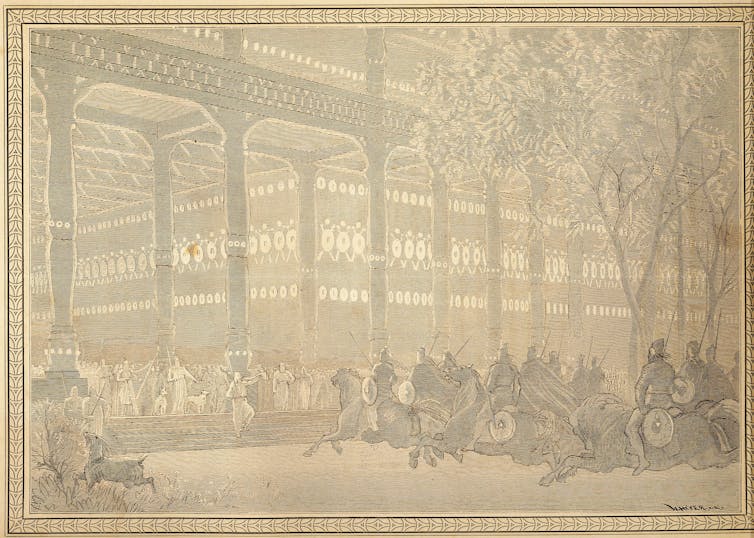
The Norse peoples had a developed concept of the afterlife. The desirable destination for Norse warriors was Valhalla, the hall of the slain, where Odin watched over his band of chosen warriors as they prepared for Ragnarök, the world-destroying battle against the giants. Only those who died a heroic death in combat were brought to Valhalla by the Valkyries.
Those who died by sickness, old age or accident – or who had committed murder and other dishonourable crimes – seem to have been excluded from this martial afterlife. Some believed that you could cheat the Norse gods by arranging to be buried with deliberately worn and damaged weapons as if you had seen heavy combat. There’s a lot we don’t know.
Valhalla by August Malmström (1880) from Wikimedia Commons
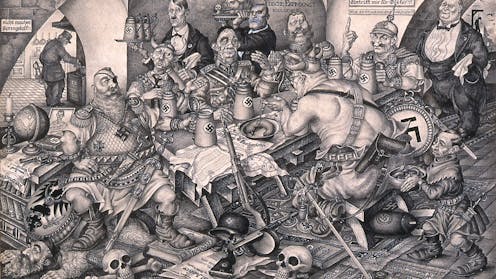
What we do know is that in the 1930s the concept of Valhalla, along with the image of the heroic Viking and many of the symbols of Norse mythology, had a profound appeal to Nazi thought leaders. They looked to Norse mythology as a survival of a wider “Germanic” culture that had been erased by Judeo-Christian dominance.
The Nordic “race” was held up as the Aryan ideal. Norse cultural remnants were used to add legitimacy to the idea of a glorious German past. Heinrich Himmler in particular repurposed Norse symbols for use by the SS.
Today, many white supremacist and neo-Nazi groups continue to brand themselves using a widening range of symbols taken from Norse mythology. One aspect of Norse culture that has gained increasing prominence in the past few decades is the specific co-opting of Valhalla by those who are prepared to kill, and die, in the cause of “protecting” an endangered white supremacy.
Valhalla in terrorist manifestos
The most chilling example of the co-option of the phrase “see you in Valhalla” is found in the manifestos published by far-right terrorists in the wake of their atrocities.
In 2019, Brenton Tarrant carried out mass shootings at two mosques in Christchurch, New Zealand, in which 51 people were killed. He published a rambling manifesto in which he attempted to justify his actions, and touted the “great replacement” conspiracy theory which holds that Jewish elites are deliberately engineering the replacement of white populations through immigration.
This has since become a far-right talking point and was pushed by Charlie Kirk on his show. Tarrant signed off his diatribe against multiculturalism and “white genocide” by saying “Goodbye, god bless you all and I will see you in Valhalla.”
Tarrant in turn influenced other far-right terrorists. One such terrorist, Peyton Gendron, was convicted of the Buffalo mass shooting in 2022 in which ten black Americans were murdered. Gendron plagiarised much of his 180-page manifesto, and similarly ends his screed with the statement: “I hope to see you in Valhalla.”
By invoking Valhalla, these terrorists are attempting to cast themselves as warriors in the Viking tradition. There is, of course, nothing remotely heroic about gunning down unarmed civilians.
But the point is that this reference doesn’t require any understanding of the Norse tradition. In this context it comes directly from the Nazi’s fetishisation of violent death to secure the racial purity of Germany.
From terrorists to the FBI
Rather than borrowing from extremist discourse, Patel may have been influenced by the use of “til Valhalla” by the US marines to honour fallen comrades – including those who died by suicide. This is a use which has been traced back to the influence of Norwegian Nato forces in Afghanistan, who may have used “til Valhalla” as a kind of battle cry. Of course, the optics of using a military honorific to commemorate the assassination of a civilian is problematic in itself.
FBI director, Kash Patel, speaks at Charlie Kirk’s memorial.
Patel’s “see you in Valhalla” was much closer in its wording to the sign off used by far-right terrorists – but even this phrasing was unlikely to have been lifted directly from extremists. It is more likely an example of a phenomenon often observed in the study of the far-right online ecosystem, which is the seepage of extreme right discourse into more mainstream spaces.
Neo-Nazi groups use memes, shitposting and humour as a deliberate strategy to seed increasingly extreme ideas into groups amenable to their message.
It isn’t hard to find references to Valhalla commercialised, repackaged as inspirational Viking quotes for Maga consumption, referencing cancel culture, or even using Norse video games as a gateway to white supremacy. In this way, the more mainstream right often ends up sharing and amplifying extremist messaging.
Patel’s reference to Valhalla was at the very least a huge misstep by a government official trying to appeal to the Maga base and elevate Kirk’s tragic killing into a heroic warrior’s death.
While he may not have made his reference to Valhalla in knowledge of its association with far-right terrorism, it nevertheless served as a signal to white supremacists. As reported elsewhere, there was a lot of engagement from the extreme right on social media, but their posts tended to ridicule Patel.
His words prompted memes on social media playing on the apparent absurdity of someone of Patel’s ethnicity cosplaying as a Viking. And among this racially tinged mockery, there was also some revelling in the fact that a stock phrase of violent white supremacy had found its way into the mouth of the director of the FBI.
Tom Birkett receives funding from the European Union (ERC, NorseMap, Project Number 101169706). Views and opinions expressed are however those of the author only and do not necessarily reflect those of the European Union or the European Research Council. Neither the European Union nor the granting authority can be held responsible for them.”
Source: The Conversation – France – By Hélène Bourdeloie, Sociologue, maîtresse de conférences en sciences de l’information et de la communication à l’université Sorbonne Paris Nord et chercheuse au LabSIC et associée au Centre Internet et Société (CIS– CNRS), Université Sorbonne Paris Nord
In January 2019, the plight of Rahaf Mohammed al-Qunun captured global attention. The young Saudi woman, attempting to escape her family, found herself stranded in Thailand after her passport was confiscated. Armed with her smartphone, she used social media to alert international organisations about the fate awaiting her. Canada eventually granted her asylum. The Saudi chargé d’affaires in Thailand then declared that the authorities should have deprived her of her phone, thereby revealing the unprecedented power of this connected device.
That same year, activist Manal al-Sharif, known for cofounding the Women2Drive movement in 2011 and popularising it on social networks, closed her Twitter and Facebook accounts. The very social media platforms that had first allowed her to liberate her voice had become a trap, serving Saudi propaganda and misinformation efforts. Instruments of resistance and feminist mobilisation that resonated worldwide, social media platforms also proved to be oppressive weapons.
The kingdom presents a fascinating paradox: religious conservatism coupled with technological innovation. It ranks among the world’s most connected nations, boasting exceptional penetration rates for microblogging and social media, particularly YouTube. Introduced in the 2000s, the smartphone rapidly took root in this society, which has made digitisation and investment in tech one of its new political banners.
It is true that the tribal heritage and Wahhabi doctrine, dominant in the country, long imposed a strict framework that shaped women’s place in society. But paradoxically, it was the oil boom of the 1970s that reinforced and institutionalised gender segregation, constituting both an obstacle and a lever for women’s emancipation.
However, in the 2000s, progressive reforms took place: since 2014, Saudi women have been able to work in many sectors without requiring their guardian’s approval; since 2018, they have been allowed to open their own businesses and drive without male consent; and since 2019, they have been able to travel independently, no longer bound by guardianship restrictions. The Vision 2030 plan further accelerated this movement by placing economic and social liberalisation at the heart of Saudi political projects.
Saudi society nevertheless remains sexist and hierarchical, with gender relations embedded in a patriarchal system where men hold authority and define female honour as a property to be protected. This hierarchy manifests itself in the family, public space, law, and even in language, which enshrines male domination.
It is in this context of a segregated society, where Saudi women were long confined to the domestic sphere, but also within the framework of reforms in favour of women’s rights, that the smartphone exerts its polyvalent and paradoxical role.
Smartphones disrupting gender boundaries
Saudi women quickly appropriated the Internet and, even more so, the smartphone. Initially more connected than men – 96% of them used the Internet in 2015, compared to 88% of men (according to the Communications and Information Technology Commission, now the Space and Technology Commission) – Saudi women also spent more time online, and connected more often from home and via their smartphones. These practices were linked both to the social construction of gender identity, which confined them to the domestic sphere, and to the ban on driving, which reinforced their reliance on the smartphone.
Far from being a simple technical tool, the smartphone was thus invested as a medium of visibility and self-expression to compensate for an invisibility engendered by gender segregation.
Always at hand, the smartphone also became a fashion accessory, highly visible for women dressed in an abaya and niqab – all the more so before Crown Prince Mohammed bin Salman, the strongman of the kingdom, declared in 2018 that the abaya was no longer mandatory.
In this stratified society where objects carry distinctive power – a latest-generation iPhone being a social and aesthetic marker – the smartphone becomes an ostentatious ornament, an instrument of stylisation and self-presentation displayed in public spaces, particularly in shopping malls where women can stroll with confidence.
Beyond its symbolic role, the smartphone opened up a space for emancipation through photography and social networks, even though human imagery remains controversial in Islam and photographs were long proscribed in Saudi Arabia, to the extent that the first camera-equipped phones were banned. These prohibitions gradually gave way, despite persistent restrictions.
In 2016, the rise of Snapchat played a decisive role. Very popular in Saudi Arabia – the kingdom ranked among the world’s top users – the app allowed young women to make themselves visible through selfies and retouched portraits. Filters served as strategies to circumvent Islamic censorship, as a modified face or body was no longer considered a human representation. These playful uses could be transgressive: showing one’s hair or face, even altered, amounted to defying norms.
The smartphone thus enabled Saudi women to negotiate with codes, assert female presence in digital spaces, and, at times, contest the established social order.
The smartphone: a tool for or against feminism?
For Saudi women, who were prevented from driving until 2018, the smartphone became a tool of mobility through ride-hailing apps such as Uber or Careem, allowing them to move without relying on a male family member or a private driver. Geolocation apps, meanwhile, reassured relatives and facilitated outings for young women.
More broadly, in a country where the political scene is non-existent, it is on social media that feminist debates and mobilisations take place. It is also thanks to the development of digital services that Saudi women have been able to circumvent some of the rules of the guardianship system. Thus, the government application Absher, created in 2015, simplified women’s daily lives and their guardians’ administrative tasks, even opening up a way to bypass the system by allowing women to grant themselves travel authorisations.
Yet, the smartphone can also work against feminism. The very same Absher app, initially designed to streamline administrative procedures, has been denounced as a surveillance tool reinforcing control over women. Furthermore, instrumentalised by the regime, smartphones have become tracking devices through their IMEI numbers, used to monitor dissidents or women attempting to escape their possible tragic fate.
Both a tool of emancipation and empowerment, the smartphone in Saudi Arabia, then, is also an instrument of control. Beyond the cases of Rahaf Mohammed or Manal al-Sharif mentioned above, it has enabled women to develop entrepreneurial activities on Instagram, or Muslim preachers to defend women’s rights in digital spaces by advocating for the preservation of the guardianship system, which some of them see as a protective framework for Saudi women.
In service of feminism – a look away from the West reveals the plurality of feminism’s faces, irreducible to a model of resistance based on Western experiences – the smartphone in Saudi Arabia can both advance and undermine women’s causes. It has reinforced the control of dissident voices, developed spying and tracking practices, and consolidated, through social media platforms, a culture of surveillance already embedded in the social fabric. Neither a simple tool of emancipation nor a pure instrument of oppression, the smartphone remains an object and a space of tension where power relations and gender norms are redrawn.
This text draws on a presentation at the XXIe Congress of the Association internationale des sociologues de langue française (AISLF) held in 2019.
A weekly e-mail in English featuring expertise from scholars and researchers. It provides an introduction to the diversity of research coming out of the continent and considers some of the key issues facing European countries. Get the newsletter!
Hélène Bourdeloie ne travaille pas, ne conseille pas, ne possède pas de parts, ne reçoit pas de fonds d’une organisation qui pourrait tirer profit de cet article, et n’a déclaré aucune autre affiliation que son organisme de recherche.
Source: The Conversation – in French – By Vincent Bricart, Doctorant au Center for International Relation Studies de l’Université de Liège. Spécialisé dans l’étude des relations transatlantiques EU-USA et dans la politique étrangère des Etats-Unis., Université de Liège
Les prédécesseurs de Donald Trump ont tous assumé, chacun à sa façon, la notion d’« exceptionnalisme américain ». Lors de son discours prononcé à l’ONU, le 24 septembre dernier, le locataire actuel de la Maison Blanche a présenté une vision très différente de ce concept, ancrant la politique étrangère conduite par Washington dans les principes de nationalisme et de souverainisme, et y ajoutant une forte composante personnelle. De l’exceptionnalisme américain, on semble être passés à un « exceptionnalisme trumpien ».
Mercredi 24 septembre 2025, Donald Trump a pris la parole devant l’Assemblée générale des Nations unies (AGNU) pour la première fois depuis sa réélection. D’une durée d’un peu moins d’une heure, cette intervention a marqué les esprits autant par sa forme – un langage singulier pour un discours adressé à ses pairs internationaux – que par le fond du message. Trump y a vanté son bilan et défendu sa vision de l’Amérique (c’est-à-dire, des États-Unis) sur la scène mondiale, s’en prenant largement au passage à l’institution onusienne, aux politiques migratoires et environnementales de l’Union européenne, au bilan de son prédécesseur Joe Biden, ou encore à certaines figures étrangères comme le maire de Londres Sadiq Khan et le président du Brésil Lula.
Plus qu’une simple série de règlements de comptes, le discours de Trump visait surtout à exposer les succès de son Amérique et à affirmer l’avènement d’un nouveau modèle américain, marqué par une forme d’exceptionnalisme proprement trumpien : une Amérique illibérale, centrée sur le leadership personnel du président, en rupture avec la conception traditionnelle du rôle des États-Unis dans le monde.
Retour sur l’exceptionnalisme et le modèle américains post-guerre froide
Pour comprendre la rupture que constitue ce discours, il faut d’abord comprendre ce que sont l’« exceptionnalisme américain » et le modèle qui en découle.
L’exceptionnalisme américain repose sur trois postulats ou croyances constitutifs de l’identité nationale états-unienne. D’une part, les États-Unis se perçoivent comme une société distincte des autres dans l’histoire, car investie d’un destin singulier : la « destinée manifeste ». D’autre part, leur organisation politique, leurs institutions, leur démocratie et la liberté individuelle qui en résulte sont considérées comme supérieures à celles des autres pays du monde. Enfin, prévaut la conviction que l’Amérique constitue une référence, un modèle à diffuser – par l’exemple ou par l’action – à l’ensemble de l’humanité.
Ces idées sont profondément ancrées aussi bien dans une partie de la population que dans la grande majorité de la classe politique américaine. La notion d’exceptionnalisme américain se trouve ainsi au cœur de l’identité nationale des États-Unis. Elle repose non pas sur une histoire ou un peuple homogène, mais sur un patrimoine de valeurs partagées (liberté, autodétermination, destin unique) qui sert de mythe fondateur et de refuge en période de crise. Portant une dimension religieuse et émotionnelle, elle agit comme un ciment fédérateur pour les citoyens.
American Progress (1872), du peintre états-unien John Gast (1842-1896), illustrant la destinée manifeste des États-Unis. Wikimedia
Dans le domaine de la politique étrangère, l’exceptionnalisme sert d’outil de légitimation et de justification. Deux grandes doctrines s’en dégagent : une approche messianique, visant à exporter le modèle américain à l’échelle mondiale, par la persuasion ou par la force ; et une approche exemplaire, qui consiste à laisser ce modèle rayonner et inspirer sans chercher à l’imposer.
Sa souplesse en fait un concept en constante évolution, que les dirigeants du pays adaptent selon leurs besoins pour affirmer leur vision du leadership et du rôle des États-Unis dans le monde. Le locataire de la Maison Blanche occupe une place décisive dans ce processus. En tant que commandant en chef des armées et de la garde nationale et principal porte-parole du pays, il façonne la doctrine de politique étrangère et incarne les valeurs de l’exceptionnalisme. Ses discours sont des instruments privilégiés pour reformuler et actualiser ce récit, en fonction de sa propre lecture du contexte international et de ses objectifs politiques. À travers ses allocutions, il construit une stratégie narrative qui lie les valeurs américaines à l’affirmation de la puissance et au maintien du leadership mondial.
Depuis la fin de la guerre froide, l’exceptionnalisme américain et le modèle qu’il promeut dans les instances internationales, notamment à l’AGNU, ont évolué dans leurs modalités.
Dans les années 1990, sous George H. W. Bush et Bill Clinton, Washington a cherché à orienter le système multilatéral tout en multipliant les interventions militaires dites « humanitaires » : première guerre du Golfe en 1990-1991, opération Restore Hope en Somalie en 1992-1993, participation aux frappes de l’Otan contre les forces serbes en Bosnie en 1995 et en Serbie en 1999, pour n’en citer que quelques-unes. Les États-Unis se posaient alors comme « puissance indispensable », garante de la stabilité mondiale, promouvant un exemple cosmopolite et multilatéraliste.
Au début des années 2000, George W. Bush a durci cette posture. Inspirée par les néoconservateurs et le traumatisme du 11-Septembre, son administration a adopté une politique messianique, interventionniste, fondée sur la supériorité morale et militaire des États-Unis. Le recours à la force fut justifié par l’indispensable « démocratisation » du Moyen-Orient et la lutte contre les « États voyous ». Ces interventions – en particulier la guerre en Irak, illégale au regard du droit international car non autorisée par le Conseil de sécurité – ainsi que les propos et la vision très critique de l’administration Bush (la plus hostile envers l’ONU jusqu’à l’arrivée de Donald Trump) à l’égard du multilatéralisme ont considérablement fragilisé la crédibilité du modèle américain promu à l’international.
L’Amérique des néoconservateurs, documentaire de Georges Nizan et Michel Rivlin (2004).
À partir de 2009, Barack Obama a cherché à redéfinir cette notion d’exceptionnalisme : tout en affirmant la singularité du modèle américain, il a privilégié l’exemplarité interne et le multilatéralisme, rejetant le messianisme guerrier de ses prédécesseurs. Son approche relevait d’un leadership se voulant adapté à une ère « post-américaine » dans laquelle les États-Unis, en tant que puissance majeure, assumeraient davantage un rôle de soutien qu’une position de leader systématique.
Après le premier mandat Trump (nous y reviendrons), Joe Biden a entrepris de relancer l’exceptionnalisme américain, réaffirmant le leadership des États-Unis sur la scène mondiale en s’érigeant en chef de file indispensable des démocraties face à la montée de l’autoritarisme global. La guerre déclenchée par la Russie contre l’Ukraine en février 2022 est venue conforter sa vision d’un affrontement décisif entre démocratie et autocratie. Cependant, les événements consécutifs aux massacres du 7 octobre 2023 ont mis en lumière les contradictions de ce modèle : le soutien presque indéfectible apporté à Israël malgré la catastrophe humanitaire imposée aux habitants de Gaza a fragilisé le leadership moral américain et le modèle démocratique que Biden cherchait à réaffirmer. Par ailleurs, l’évolution progressive du contexte politique intérieur a infléchi sa rhétorique, recentrant son discours sur le modèle de résilience de la démocratie américaine face aux menaces internes portées par le mouvement MAGA.
Malgré ces variations et leurs interprétations parfois ambiguës, une constante demeure dans les discours des présidents américains à l’AGNU : la valorisation d’un ordre international fondé sur la coopération, l’État de droit, la démocratie, les droits humains, la libre concurrence et la bonne gouvernance selon les principes néolibéraux – même si les États-Unis n’ont pas toujours respecté l’exemple qu’ils défendaient eux-mêmes.
Le discours de Trump à l’AGNU : l’exceptionnalisme trumpien
Lors de son discours à la 80eAssemblée générale de l’ONU, Donald Trump a abordé plusieurs thèmes marquants. Nous revenons ici sur les plus polémiques.
« Donald Trump à l’ONU : l’intégralité de son discours traduit en français », Le Figaro, 24 septembre 2025.
Trump a ensuite martelé sa défense de la souveraineté nationale comme principe cardinal des relations internationales, en rupture frontale avec l’héritage multilatéraliste et universaliste de ses prédécesseurs. Cette posture nationaliste et identitaire l’a conduit à affirmer que le christianisme était désormais « le culte le plus menacé au monde » et à fustiger la politique migratoire européenne, accusée de fragiliser la cohésion des sociétés.
Il a également réaffirmé son déni du changement climatique, qu’il a qualifié d’« escroquerie », et a rejeté toute régulation environnementale, inscrivant ainsi son discours dans une logique productiviste et consumériste caractéristique de sa vision économique.
Enfin, l’allocution s’est distinguée par un ton particulièrement vindicatif. Trump a multiplié les attaques personnelles, mentionnant Joe Biden à sept reprises pour critiquer son bilan, et s’en prenant à d’autres figures politiques comme le maire de Londres, le travailliste Sadiq Khan – accusé de vouloir « imposer la charia » –, ou encore le président brésilien Lula da Silva. Tout en soulignant qu’il avait une bonne relation personnelle avec lui, il a reproché au gouvernement de Lula, parmi autres, d’instrumentaliser la justice – une référence à peine voilée à la récente condamnation à vingt-sept ans de prison de Jair Bolsonaro, le prédécesseur de Lula, pour tentative de coup d’État en 2023.
En parallèle, l’hôte de la Maison Blanche a longuement insisté sur les « succès » de son administration, se targuant notamment d’avoir mis fin à « sept guerres », et affirmant que les États-Unis vivaient leur « Âge d’or », portés par la puissance de leur économie, de leurs frontières, de leur armée, de leurs amitiés et de leur esprit national.
Jamais dans l’histoire de l’AGNU un président états-unien ne s’était autant vanté de ses succès, tout en critiquant ouvertement ses prédécesseurs et des dirigeants de pays amis démocratiquement élus. Une telle approche est d’autant plus atypique qu’elle relève davantage de la dynamique d’un discours sur l’état de l’Union, traditionnellement prononcé chaque mois de janvier devant le Congrès américain, que d’une allocution solennelle devant ses pairs à l’ONU.
Comment comprendre ce discours ?
Le discours de Donald Trump consolide la remise en cause, entamée durant son premier mandat, de la place et de la fonction de l’exceptionnalisme américain traditionnel dans la politique étrangère de Washington. Contrairement à ses prédécesseurs, il rejette l’idée que les États-Unis incarneraient nécessairement le « monde libre » ou qu’ils seraient investis d’une mission universelle au service de la démocratie et des droits humains.
À ses yeux, l’héritage multilatéral des dernières décennies a affaibli la puissance américaine et son image internationale. Son propos vise autant les dimensions symboliques de l’exceptionnalisme – leadership systématique, vocation morale – que les politiques concrètes qui en découlaient.
Dès lors, sa critique des Nations unies, sa promotion de la souveraineté des États, le rejet des politiques migratoires et le soutien au matérialisme dans le rapport de force traditionnel entre États (où les États-Unis partent avantagés) s’inscrivent dans une volonté de rupture. C’est une réorientation franche, assumée, qui s’oppose au modèle libéral et multilatéral de l’Amérique post-guerre froide pour laisser place à une vision américaine illibérale, qui a vocation à s’exporter à travers le monde et notamment en Europe. Sa critique des politiques conduites par l’Union européenne doit se comprendre selon la même logique.
Toutefois, Trump ne nie pas la supériorité et le caractère exceptionnel de l’Amérique : sa perspective nationaliste et protectionniste est centrée sur la défense prioritaire des intérêts américains et sur une glorification de la puissance matérielle. Dans une logique de rapport de force, il veut prouver que son Amérique est la plus forte, au-dessus des autres nations et modèles et, pour cela, il valorise la puissance tangible – ressources, poids économique, budget militaire – et les victoires concrètes qu’il présente comme des wins (accords politiques, succès économiques ou militaires favorables aux États-Unis).
Le modèle trumpien se traduit ainsi par une surreprésentation de l’affirmation de la supériorité des États-Unis et de leur puissance matérielle, une puissance que les politiques vertes et les énergies renouvelables pourraient, selon lui, entraver. Plus qu’un simple déni du changement climatique, Trump critique toute mesure limitant le marché et la prospérité. En outre, derrière ses attaques contre l’achat de pétrole russe se profile la volonté de promouvoir les exportations américaines de GNL.
Parallèlement, Trump individualise cet exceptionnalisme en l’associant directement à sa propre personne. Il met en avant le modèle non pas de l’Amérique en général, mais bien de son Amérique – celle de son administration et de son leadership personnel. Cette appropriation s’accompagne d’une défiance marquée à l’égard des autres modèles – qu’il s’agisse de celui des démocrates tels que Joe Biden, celui des Européens ou celui des leaders de gauche au niveau international comme Lula da Silva.
Il se présente comme l’unique acteur capable de restaurer la grandeur américaine : c’est une forme d’« auto-exceptionnalisme », qui souligne le caractère singulier et supérieur des aptitudes du président actuel à incarner et à réaffirmer la singularité américaine.
Le discours de Donald Trump à l’AGNU de septembre 2025 illustre ainsi la reconfiguration du modèle américain vers une approche axée sur le souverainisme, sur le protectionnisme, sur le nationalisme et sur un leadership fortement personnalisé, au détriment de la tradition multilatéraliste, néolibérale et universaliste, qui caractérisait jusque-là la projection américaine dans les affaires mondiales. Cette orientation s’accompagne d’une défense prioritaire, assumée et sans compromis des intérêts nationaux dans un rapport de force global ouvert. Déjà, ce modèle américain inspire des émules en Europe comme ailleurs dans le monde, et tout indique qu’il est appelé à encore se renforcer au cours des prochaines années.
Vincent Bricart ne travaille pas, ne conseille pas, ne possède pas de parts, ne reçoit pas de fonds d’une organisation qui pourrait tirer profit de cet article, et n’a déclaré aucune autre affiliation que son organisme de recherche.
Cancellation, elimination, subtraction, removal, invalidation — these synonyms describe a core, pervasive principle in our current political moment.
A common fantasy from those on all positions of the ideological spectrum is the belief that if one group, or several groups, of people were simply removed from public discourse, problems would be solved and politics would become functional.
The animating belief of a politics of cancellation is that a functional society just beneath the surface will emerge if only the right people are removed.
But this is largely political theatre, not a constructive form of collective problem-solving.
Removing homeless people from Washington, D.C., or any other city may make urban streets appear “clean” or “safe” to some, but the structural and moral issues represented by homelessness will persist and metastasize out of sight. The unhoused still won’t have homes.
Remove Trump, and J.D. Vance becomes president, amplifying the hard right turn of the last year in the U.S. In politics, collective problems cannot be solved by cancellation or removal.
Perhaps even more importantly, democracy cannot survive the practice of cancellation, nor will it produce the stability imagined once one group of people is eliminated from public discourse.
Cancellation or subtraction are moves to eliminate the possibility of persuasion in favour of silence. To eliminate the practice of persuasion is to transform a society from democracy to authoritarianism.
Reconciling differences
In interpersonal communication, we know that when partners stonewall, silence or turn away from their significant other, the relationship runs into deep trouble.
The same is true for the kinds of constructive relationships between strangers required by democracy — when we turn away from our fellow citizens or silence them, functional communication processes and the possibility of persuasion are no longer available.
Even if we managed to cancel or subtract some group, the challenge of collective decision-making remains. There is no utopia just beyond successful cancellation, nor could there be given the requirements of democracy to reconcile differences in productive ways.
In interpersonal relationships, we know how damaging the Ziegarnik effect can be, which is the way unprocessed negative interactions stick with people and gradually erode trust. In other words, a problem unresolved is like a pebble stuck in our shoe, digging at us and causing additional problems.
The ideas and perspectives of people who face cancellation continue to circulate, stuck in our collective public discourse, causing deeper, future problems. Inclusion is a prerequisite for persuasion, transformation and change because it allows us to deal squarely with the problems we confront instead of leaving them unresolved.
Cancellation is a primary tool of fascism and authoritarianism. To blame and demonize one group of people for society’s ills is an easy way to explain away problems and consolidate power.
But the antidote to cancellation cannot be more cancellation. Jimmy Kimmel actively showed the way in his monologue upon returning from temporary cancellation. He offered a sophisticated defence of free speech that practised the inclusion of voices he usually criticized. Kimmel was civil in a deep way that is essential for democracy.
Jimmy Kimmel’s monologue after his brief cancellation. (Jimmy Kimmel Live!)
We poke fun to let others know we disagree, sometimes vehemently, but that kind of engagement keeps the conversation going and opens possibilities for change.
Those on the left, the remaining defenders of democracy, make a mistake when they attempt to practise a politics of cancellation, as do those on the right. A politics of inclusion is always the antidote and the best method of problem-solving.
The grief that attended American political activist Charlie Kirk’s murder was not solely poured out by the political right. Liberal commentators also participated; journalist Ezra Klein expressed grief in an essay for The New York Times (“I was and am grieving for Kirk himself”), while Manitoba Premier Wab Kinew stated that “we have to have empathy for other people in our society.”
Kirk would likely be surprised, and perhaps a bit put off, by this display of empathy by his opponents: “I can’t stand the word empathy, actually. I think empathy is a made-up, New Age term that does a lot of damage, but it is very effective when it comes to politics. Sympathy I prefer more than empathy.”
Empathy, to Kirk, meant trying to feel someone else’s pain or sorrow as if it were your own. He cited Bill Clinton as an example of phony and opportunistic use of empathy. Sympathy, on the other hand, means acknowledging another’s pain without claiming to actually share or internalize that pain. Sympathy keeps the suffering of others at arm’s length.
What troubled Kirk about empathy was its fixation on people “out there” instead of those who should be the focus of Americans’ concern:
Empathy, according to Kirk, ought to have limits; it should be directed to those being “mutilated” by vaccines and “devastated” by fentanyl.
Global News covers Charlie Kirk’s memorial service in Glendale, Ariz. on Sept. 21, 2025.
Empathy as a vice
What does the rhetoric of one’s own versus another’s pain signal? And how can empathy for another’s pain possibly be conceived as a Christian vice, as it has been portrayed by political leaders in the United States?
For a more developed theological critique of empathy from the right, we need to turn to Kirk’s close friend, JD Vance, who offers what he takes to be a distinctly Catholic perspective on empathy. Vance cites the Catholic doctrine originating from Saint Thomas Aquinas, ordo amoris, or order of love or charity.
“Your compassion should first and foremost be with your fellow citizens,” Vance asserted. “That doesn’t mean you hate people from outside our borders, but your priority should be the safety and well-being of Americans.”
According to Vance, Americans on the left have inverted the ordo amoris:
“You love your family, and then you love your neighbor, and then you love your community, and then you love your fellow citizens in your own country. And then after that, you can focus and prioritize the rest of the world.”
During a Fox News interview, Vance used Catholic theology to justify ICE’s cruel arrests and detention of undocumented immigrants, including children, in centres lacking basic standards of care or human rights.
True ordo amoris
As one of his last acts before his death, Pope Francis, observing the growing cruelty against immigrants in the U.S. and in response to Vance’s evocation of the teaching of ordo amoris, made a surprisingly direct intervention in American politics.
In a letter addressed to U.S. Catholic Bishops, Francis elaborated the true meaning of the ordo amoris:
“The true ordo amoris … is that which we discover by meditating constantly on the parable of the ‘Good Samaritan’ … by meditating on the love that builds a fraternity open to all, without exception.”
In other words, the ordo amoris is a rooting of love in justice. Neither mere empathy nor a concern for one’s own first, mercy involves perception of the other’s pain no matter whose pain it is. It is open to all, without exception.
In his encyclical (a papal letter sent to Catholic bishops) titled Fratelli Tutti, Francis expands: “Mercy is a call to acknowledge the dignity of every human being and to build a society where that dignity is not only respected but honored.”
Mercy demands not only a feeling of sorrow for a person who is suffering, but a political response that is rooted in justice.
Empathy, mercy, justice
Empathy is indeed only partial in Catholic thought, but it is partial not because of the ordo amoris, as Vance understands it, but for the precise opposite reasons. Empathy must become mercy, and mercy involves justice for all. Mercy is not selective; indeed, according to Francis: “The name of God is Mercy.”
One may rightly counter that the Catholic Church has, like American politicians, been far too selective in the mercy it has shown. We would be right to question such mercy as it has gone so horrifically awry, as in the case of residential schools in Canada.
But perhaps, in this case, theology nevertheless is a reproof against the church’s own unmerciful acts. For mercy — construed as love and justice — calls the church, and its many errant members, to a profound and urgent moral reckoning.
As for the rest of us, in the aftermath of Kirk’s murder, we should refrain from mere empathy — we should display mercy instead. For mercy cries for justice, even while it weeps with those deprived of it.
Jane Barter does not work for, consult, own shares in or receive funding from any company or organisation that would benefit from this article, and has disclosed no relevant affiliations beyond their academic appointment.
Source: The Conversation – USA (2) – By Ivis García, Associate Professor of Landscape Architecture and Urban Planning, Texas A&M University
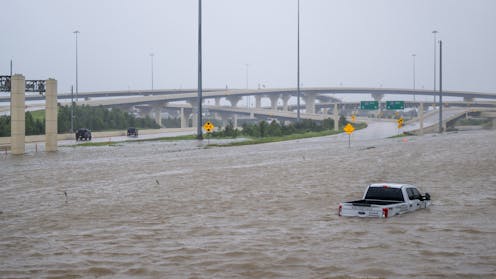
A roadside assistance vehicle is swamped by floodwaters on a Houston highway in 2024.Brandon Bell/Getty Images
Eight years after Hurricane Harvey devastated Houston in 2017, flooding hundreds of thousands of homes, the city still awaits a comprehensive flood protection system. The local flood control district estimates that at least one major flood occurs within its service area every two years.
There are two competing potential options to contain these floods with tunnels to direct excess water out of the city to the coast – one from the local flood control district board and one from Elon Musk’s Boring Company, with the backing of a local member of Congress. The two proposals differ significantly in size, capacity, cost and expected completion time.
The choice between these three options involves a balancing act between taxpayer dollars, engineering and forecasting about future storms and flooding.
As researchers at Texas A&M University who study disaster resilience – including engineering, community planning, coastal geotechnics and hurricane surge modeling – we bring complementary expertise to analyzing this complex discussion. Here are what we see as the key factors for the city to consider.
In 2022, the Harris County Flood Control District released a report describing a US$30 billion system of eight tunnels, totaling about 130 miles in length, buried 40 to 140 feet underground. Construction would take between 10 and 15 years.
Those tunnels would run along existing drainage areas through the city and its surroundings, carrying water from various collection points around the city to the ocean, with discharge points near the Houston Ship Channel and Galveston Bay.
A system of eight tunnels in Harris County, Texas, is proposed as one way to address significant flooding problems during storms. Harris County Flood Control District
This project would cost an estimated $760 million. The timeline is unclear – the company says it can bore as much as a mile a month, though its fastest boring project to date, in Las Vegas, averaged 49 feet per day, which would be more than three months per mile. The company has previously been contracted to build transportation tunnels, but it has never built flood control tunnels. It seems reasonable to conclude that boring the proposal’s combined 72 miles of tunnels would take several years.
The engineering reality: Size matters
A tunnel’s ability to carry water increases exponentially with its diameter: A tunnel with a 30-foot diameter can carry roughly 39 times as much water as a 12-foot-diameter tunnel. Even two 12-foot-diameter tunnels, combined, would carry less than one-fifth as much water as a single 40-foot-diameter tunnel.
Houston experiences flash flooding multiple times per year from routine storms that drop 4 to 6 inches of rain in a few hours. Even moderate storms cause problems: Storms that statistically occur every two years cause flooding in areas such as the Second Ward and Greater Fifth Ward because of outdated storm sewers. And storm severity is increasing: Rain amounts that once were expected once every 100 years now happen every 25 years.
The release of water from Addicks Reservoir in Houston during Hurricane Harvey flooded homes and neighborhoods. Erich Schlegel/Getty Images
Our analysis of the projects’ capacities finds that they would all be overwhelmed in a Harvey-scale event delivering over 50 inches of rain, with most of Houston experiencing a 1,000-year storm.
We have calculated that Musk’s two tunnels could handle only about 0.9% of Harvey’s water, while the county’s full eight-tunnel system would handle roughly 39% of Harvey’s rainfall. Without technical details, the best we can say is that the third tunnel option would likely fall in between those two capacities.
All the systems could provide protection against more routine flooding. The price tag for Musk’s proposal is significantly lower and could have some benefits, but it might divert funding from approaches that could handle even more water.
The Harris County Flood Control District’s feasibility study found that the eight large-diameter tunnels could significantly reduce the severity of 120,000 instances of flooding over the next 100 years across 11 of 23 major watersheds in Harris County. The other 12 watersheds would need separate projects to address their vulnerabilities. Smaller tunnels, or fewer of them, would provide proportionally less protection.
Musk’s proposal would primarily benefit areas near the Addicks and Barker reservoirs, helping to drain them quickly during major rain events. But most of Houston’s flooding problems are not a result of reservoir overflows. Rather, they happen in older neighborhoods with storm sewers that are too small to handle the amount of rain Houston regularly receives.
Houston’s geological challenge
While all the projects would have the bulk of the tunnels below utility lines, Houston’s geology still makes tunnel construction complex.
The area’s high groundwater table would increase water pressure on the tunnels themselves, with more complex soil conditions the deeper a tunnel went. Initial excavation, access shafts from the surface to the tunnels, and pumping stations would all cost more than they would in harder soil with a lower water table.
Musk’s proposal faces several engineering limitations. The 12-foot tunnels cannot handle Harvey-scale flooding due to insufficient capacity. The shallow boring approach through Houston’s unstable soils presents significant geological challenges. The limited scope addresses only two of the county’s 23 watersheds, leaving most flood-prone areas unprotected.
The flood control district’s plan would offer more protection, but not to the whole area nor in a way that would prevent another Harvey-level flooding disaster.
The hybrid option being studied by county commissioners could provide a middle ground, offering better capacity than Musk’s tunnels while potentially being cheaper and faster to build than the full district plan. But its pros and cons remain largely theoretical until detailed engineering studies are completed.
All three options would provide some flood protection, but none would completely solve Houston’s flooding challenges. The question becomes whether to invest in incremental improvements that help with routine flooding or pursue more expensive and more comprehensive solutions that provide greater protection against catastrophic events.
As Houston’s vulnerable communities face intensifying storms, we believe the city needs solutions that work when catastrophe strikes – not just during routine flooding.
Dr. Ivis García has received funding from the National Science Foundation; the U.S. Department of Housing and Urban Development; the U.S. Department of Transportation’s National Institute for Transportation and Communities; the Centers for Disease Control and Prevention; the Environmental Protection Agency; the National Academies of Sciences, Engineering and Medicine; JPB Foundation; Ford Foundation, Pritzker Traubert Foundation; Chicago Community Trust, SBAN, Texas Appleseed, Fundación Comunitaria de Puerto Rico, Urban Institute & UNIDOS, and Natural Hazards Center.
James M. Kaihatu received funding from National Academies and Environmental Protection Agency.
Shannon Van Zandt does not work for, consult, own shares in or receive funding from any company or organization that would benefit from this article, and has disclosed no relevant affiliations beyond their academic appointment.
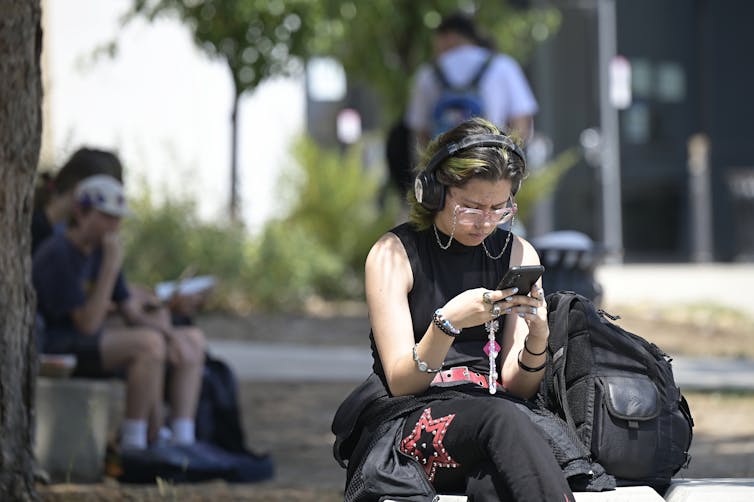
The scale of the issue is significant. According to a 2023 report from Common Sense Media, 97% of students between the ages of 11 and 17 use their cellphones at least once during the school day. These students spend a median of 43 minutes online each day during school hours. Social media, YouTube and gaming were the students’ top cellphone uses.
Schools have already begun taking action. Data from the National Center for Education Statistics published in 2025 shows that 77% of public schools ban cellphones during classes. Thirty-eight percent of schools have cellphone policies that restrict use outside of class as well – including during free periods, between classes or during extracurricular activities.
Policymakers in different states and educators in school districts across the country are putting into place a variety of solutions. Some rely on partial restrictions, while others enforce complete bans.
Many are still searching for the balance between technology access and minimizing distraction.
What is clear, however, is that cellphones have become one of the central issues shaping today’s classroom environment.
The role of technology in the classroom
As researchers and professors who study the integration of technology for teaching and learning – and who are also parents of school-aged children – we firmly believe that digital technologies are no longer optional add-ons. They have become indispensable in modern classrooms, acting as versatile instruments for instruction, collaboration and student engagement.
Students’ access to digital devices has improved significantly as schools across the United States continue investing in technology infrastructure. A 2023 report from the National Center for Education Statisitics indicates that 94% to 95% of public schools now provide devices to students who need them – although disparities exist between states.
A growing number of districts are adopting 1:1 initiatives, ensuring that every student has access to a personal device such as a laptop or tablet. These initiatives accelerated after the COVID-19 pandemic made clear the need for reliable access to learning technologies in schools for all students. They highlight the central role technology now plays in shaping everyday classroom instruction.
These technologies hold great educational potential. Yet, when not integrated thoughtfully and regulated effectively, they can inadvertently reduce focus and undermine learning.
Technology-related factors included constant social networking, texting and cellphone addiction. These accounted for over half of the reported distractions.
Personal needs, such as entertainment, made up more than one-third.
Instructional environment, including classroom instruction that isn’t engaging, poor classroom management and difficult course content, accounted for the rest.
To address these challenges, the authors of the papers we reviewed suggested strategies such as teaching students how to control their own behavior and focus, silencing notifications, issuing clear device policies or banning devices.
The studies in our review also drew a clear distinction between school-provided and personally owned mobile devices. Devices provided by schools are typically equipped for instructional purposes, enhanced with stronger security and designed to restrict distracting uses. Personal devices are far less regulated and more prone to off-task use.
As schools increasingly provide devices designed for learning, the role of personal cellphones in classrooms becomes harder to justify as they present more risks of distraction than educational benefits.
Laws and policies regarding cellphone use
Several states in the U.S. have passed laws banning or restricting cellphone use in schools, with some notable differences.
States vary in how they define wireless communication devices. In Michigan, Senate Bill 234, passed in May 2025, describes a wireless communication device as an “electronic device capable of, but not limited to, text messaging, voice communication, entertainment, navigation, accessing the internet, or producing email.”
While most of the states have several technology types listed under wireless communication devices, a Colorado bill passed in May 2025 clearly identified that laptops and tablets did not fall under the list of restricted wireless communication devices.
Most state laws don’t specify whether the bans apply to both personally owned devices and school-owned devices. One exception is the bill Missouri passed in July 2025, which clearly specifies its ban refers only to personal devices.
North Carolina made exceptions in a bill approved in July 2025, allowing students to use wireless communication devices for instructional purposes. Other exceptions in the North Carolina bill include an emergency, when students’ individual education programs call for it, and a documented medical condition.
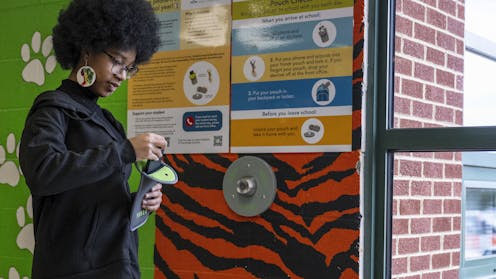
In their bills, most states provide recommendations for school districts to create cellphone use policy for their students. To take one typical example, the policy for Wake County in North Carolina, one of the state’s largest school districts, specifically refers to personal wireless communication devices. For elementary and middle school students, they must be silenced and put away between morning and afternoon bells, either in a backpack or locker. For high school students, teachers may allow them to be used for lessons, but they must otherwise be silenced and put away during instructional time. They can be used on school buses with low volume and headphones.
The authors do not work for, consult, own shares in or receive funding from any company or organization that would benefit from this article, and have disclosed no relevant affiliations beyond their academic appointment.













._The_Nibelungen_series,_Valhalla_(1942),_New_York_(cropped).jpg)
.jpg)