Quand « équité » devient « appartenance » : un recul déguisé de l’EDI

Source: The Conversation – in French – By Simon Blanchette, Lecturer, Desautels Faculty of Management, McGill University

Depuis 2024, la contestation des initiatives en matière de diversité, d’équité et d’inclusion (EDI) a pris de l’ampleur en Amérique du Nord. Cette année, ce recul prend une nouvelle forme : le remplacement du mot « équité » au profit de termes plus abstraits, comme « appartenance » ou « communauté ».

À l’Université de l’Alberta, par exemple, il n’y a plus de vice‑provost à l’équité, à la diversité et à l’inclusion. L’établissement dispose désormais d’un bureau de « l’accès, de la communauté et de l’appartenance ».

De même, la société Alberta Investment Management Corporation (AIMCo) a éliminé son poste de direction consacré à l’EDI lors d’une restructuration. Un porte‑parole a soutenu que « le départ de la personne responsable du programme officiel d’EDI n’a en rien diminué l’engagement ferme d’AIMCo envers ces principes ». Permettez-moi d’en douter.

Un virage similaire est en cours à l’Université de Lethbridge, qui a créé en décembre un bureau de « l’accessibilité, de l’appartenance et de la communauté. »

Si la langue évolue naturellement, ce changement ressemble davantage à un repli déguisé qu’à un véritable progrès, car il manque l’engagement délibéré nécessaire à l’équité.

Un repli déguisé en progrès

Les appels à rebaptiser les démarches d’EDI existent depuis des années et sont légitimes, y compris au sein du milieu lui‑même. Mais les changements actuels vers l’« appartenance » manquent souvent de véritable engagement communautaire et de la participation des parties concernées.

Les efforts actuels de rebranding relèvent davantage de l’apaisement que du progrès. Ce sont des gestes réactifs, dictés par des pressions externes, plutôt que des réponses aux besoins et aux demandes des communautés les plus concernées.

Autrefois reconnu comme essentiel pour s’attaquer à la discrimination systémique, le terme « équité » est devenu aujourd’hui un paratonnerre politique.

Certaines institutions subissent désormais des pressions politiques, d’actionnaires ou de donateurs qui présentent les initiatives d’EDI comme clivantes ou idéologiquement extrêmes, les poussant à s’en distancier.

Dans le monde des affaires, la tendance est frappante. Les mentions d’« EDI » dans les dépôts réglementaires des sociétés du S&P 500 ont chuté de 70 % depuis 2022, remplacées par des termes plus consensuels comme « appartenance » et « culture inclusive ».

Ce changement permet aux organisations d’échapper à leurs responsabilités, de masquer les inégalités et de remplacer les cadres d’équité mesurables par des platitudes vagues.

Pourquoi est-ce important ?

En adoucissant les termes utilisés, les organisations s’assurent un moyen socialement acceptable de se soustraire à la difficile mission qu’est l’équité. Comme si elles avaient « dépassé » l’équité, alors qu’elles n’ont jamais fait le travail nécessaire. C’est en quelque sorte une illusion.

Supprimer l’équité du langage organisationnel a des conséquences tangibles. Tout d’abord, cela compromet l’imputabilité. Les cadres d’équité efficaces créent des objectifs mesurables et vérifiables. Des termes tels que « appartenance » sont plus difficiles à définir et plus faciles à abandonner. Ils permettent aux organisations de prétendre s’engager en faveur de l’inclusion sans avoir à fournir les efforts nécessaires à un réel changement systémique.

Ensuite, cela risque de laisser des gens de côté. L’équité se concentre sur ceux qui font face à de vrais obstacles structurels : femmes, personnes noires et racisées, Autochtones, communautés 2ELGBTQI+ et personnes en situation de handicap. Si ce terme disparaît, ces groupes risquent de perdre toute visibilité dans les politiques, le financement et la reddition de comptes.

Enfin, les organisations elles‑mêmes s’exposent à des risques. Les reculs en matière d’EDI nuisent au moral, à la rétention, à l’innovation et à la performance, et peuvent même accroître le risque juridique.

Un sondage de 2025 du Meltzer Center for Diversity, Inclusion, and Belonging (NYU) révèle que 80 % des dirigeants estiment que la réduction des efforts en équité augmente les risques réputationnels et juridiques. Il fait aussi état d’un large consensus selon lequel les initiatives d’EDI améliorent la performance financière des entreprises.

Le mythe de la méritocratie

Une justification fréquente pour abandonner le mot « équité » est le souhait de revenir à la « méritocratie ». La méritocratie repose sur l’idée que les individus devraient être récompensés selon leur talent et leurs efforts.

Mais la méritocratie suppose l’égalité des chances et occulte le fait que le « mérite » est une construction sociale qui dépend du contexte. Elle ignore que des barrières inégales – comme l’accès à l’éducation et aux réseaux – influencent la réussite individuelle, et ce outre les réalisations de la personne.

La méritocratie suppose également que la diversité est privilégiée au détriment des qualifications, ce qui n’est pas le cas. Nous pouvons, et devons, nous concentrer à la fois sur les compétences et sur l’inclusion.

Les travaux du professeur Emilio J. Castilla, du Massachusetts Institute of Technology (MIT), ont montré que les organisations se réclamant de la méritocratie renforcent souvent les biais – c’est ce qu’on appelle le « paradoxe de la méritocratie ».

Par exemple, dans une étude réalisée auprès de 445 participants ayant une expérience en gestion, les chercheurs ont demandé aux participants de prendre des décisions concernant les primes, les promotions et les licenciements d’employés fictifs. Lorsque la culture d’une organisation mettait l’accent sur la méritocratie, les hommes recevaient des primes plus élevées que les femmes ayant les mêmes qualifications.

À l’inverse, lorsque la culture d’entreprise mettait plutôt l’accent sur le pouvoir discrétionnaire des dirigeants, le biais s’inversait en faveur des femmes. Cela s’explique vraisemblablement par le fait que l’énoncé signalait un biais de genre potentiel, déclenchant une sur‑correction.

Dans un troisième scénario, où ni la méritocratie ni la discrétion managériale n’étaient mises de l’avant, il n’y avait pas de différence significative dans les primes accordées.

Bien que le dernier scénario semble prometteur, la plupart des environnements de travail privilégient la méritocratie, consciemment ou non. La rémunération basée sur le mérite ou la performance demeure la norme dans la plupart des organisations, ce qui signifie que le premier scénario est le plus fréquent.

Sans transparence, le discours sur « qui mérite » une promotion/un bonus a tendance à renforcer les inégalités. Le népotisme, les avantages liés aux réseaux et la visibilité sélective comblent souvent le vide lorsque les cadres d’équité sont abandonnés. Les réseaux et la visibilité comptent, mais ils ne doivent pas être confondus avec le mérite.

Ironiquement, les critiques les plus virulents des initiatives en matière d’équité demeurent muets lorsque ce sont les privilèges hérités ou les relations privilégiées qui déterminent qui accède à des postes de direction.

Que peuvent faire les organisations ?

Alors que certaines institutions reculent sur leurs engagements en matière d’EDI, d’autres au Canada et en Europe maintiennent le cap en intégrant l’équité à leur stratégie, à leur leadership et à leurs cadres de performance.

Pour faire progresser l’équité dans le contexte actuel, il faut à la fois une stratégie et une mobilisation continue. Voici par où les organisations peuvent commencer :

  1. Établir et intégrer des objectifs explicites et mesurables en matière d’équité, alignés sur la stratégie de leur entreprise.

  2. Améliorer la transparence des données en collectant et en partageant publiquement des informations désagrégées sur le recrutement, la promotion, l’équité salariale, le taux de rotation du personnel et l’expérience des employés.

  3. Donner un véritable pouvoir décisionnel aux voix issues de la diversité dans l’élaboration des politiques et des initiatives. Les groupes‑ressources d’employés constituent un excellent point de départ.

  4. Tenir les leaders imputables en les formant à promouvoir l’équité et en liant leurs incitatifs à des résultats concrets en matière de diversité, d’équité et d’inclusion.

  5. Communiquez de manière transparente et authentique sur les impacts de l’EDI en partageant des témoignages et des indicateurs qui montrent comment les efforts en matière d’équité ont amélioré les performances de l’organisation.

Ces solutions fonctionnent déjà. Dans ma pratique de consultant, j’ai accompagné des organisations qui progressent en bâtissant la confiance, en dynamisant leurs équipes et en stimulant l’innovation. Au final, elles sont plus performantes et plus résilientes.

L’argument économique pour l’équité, la diversité et l’inclusion est bien établi : L’EDI stimule la performance, soutient la croissance et constitue un impératif de leadership. Dans le climat politique actuel, il est crucial de rester concentré sur les résultats plutôt que de se laisser entraîner par un discours qui présente l’équité comme inutile ou clivante.

La voie à suivre

Rebaptiser « l’équité » en « appartenance » ne fait pas avancer la justice, surtout en l’absence d’une définition partagée de ce que signifie réellement « appartenance ». Cela nie poliment la nécessité de démanteler de véritables barrières systémiques. Pour les personnes qui font face à ces barrières, cela sonne comme une promesse creuse.


Déjà des milliers d’abonnés à l’infolettre de La Conversation. Et vous ? Abonnez-vous gratuitement à notre infolettre pour mieux comprendre les grands enjeux contemporains.


Personne ne choisit sa race, son sexe, son milieu socio-économique, son orientation sexuelle, ni de vivre avec un handicap ou les séquelles durables du service militaire (par exemple, un trouble de stress post-traumatique). En revanche, les institutions peuvent choisir de s’attaquer aux inégalités liées à ces expériences et de démanteler les obstacles auxquels les individus sont confrontés.

Ce moment invite également à une réflexion honnête au sein même du secteur de l’EDI. Certaines initiatives ont dépassé les limites ou perdu de vue leur objectif, ce qui a contribué au contrecoup actuel. Reconnaître ouvertement ces faux pas fait partie du travail de reconstruction de la crédibilité de l’EDI.

L’essence de l’équité consiste à assurer la dignité et une chance réelle et égale de réussir. Abandonner le travail en faveur de l’équité – ou l’édulcorer au point de le rendre insignifiant – ne peut pas être une solution.

Pour progresser, il est nécessaire de réduire la polarisation, d’ouvrir le dialogue, et de mieux coordonner les actions afin que chaque personne ait une chance équitable de s’épanouir et de réussir.

La Conversation Canada

Simon Blanchette ne travaille pas, ne conseille pas, ne possède pas de parts, ne reçoit pas de fonds d’une organisation qui pourrait tirer profit de cet article, et n’a déclaré aucune autre affiliation que son organisme de recherche.

ref. Quand « équité » devient « appartenance » : un recul déguisé de l’EDI – https://theconversation.com/quand-equite-devient-appartenance-un-recul-deguise-de-ledi-263480

De Chirac à Macron, comment ont évolué les dépenses de l’État

Source: The Conversation – in French – By François Langot, Professeur d’économie, Directeur adjoint de l’i-MIP (PSE-CEPREMAP), Le Mans Université

Pour stabiliser la dette publique de la France, l’État doit réduire son déficit. Outre la hausse des prélèvements, il doit aussi de diminuer ses dépenses. Mais avant de les réduire, il importe de savoir comment ces dépenses ont évolué ces trente dernières années.


L’analyse historique des dépenses de l’État peut être utile pour prendre aujourd’hui des décisions budgétaires. Qu’ont-elles financé ? Les salaires des agents ? Des achats de biens et services ? Des transferts ? Quels types de biens publics ont-elles permis de produire (éducation, santé, défense…) ?

Le futur budget de l’État doit tenir compte de ces évolutions passées, des éventuels déséquilibres en résultant, tout en réalisant que ces choix budgétaires auront des impacts sur la croissance et les inégalités spécifiques à la dépense considérée.

Près de 30 milliards d’économies annoncées

Le projet de loi de finances actuellement discuté pour l’année 2026 prévoit 30 milliards d’euros d’économies, ce qui représente 1,03 % du PIB. Ces économies sont obtenues avec 16,7 milliards d’euros de réduction de dépenses (0,57 point de PIB), et 13,3 milliards d’euros de hausse de la fiscalité. Le déficit public, prévu à 5,6 % en 2025 (163,5 milliards d’euros pour 2025) ne serait donc réduit que de 18,35 %. Pour atteindre l’objectif de stabiliser la dette publique, il faudra amplifier cet effort les prochaines années pour économiser approximativement 120 milliards d’euros (4 points de PIB), soit quatre fois les économies prévues dans le PLF 2026.

Ces réductions à venir des dépenses s’inscrivent dans un contexte. En moyenne, dans les années 1990, les dépenses publiques représentaient 54 % du PIB. Dans les années 2020, elles avaient augmenté de 3 points, représentant alors 57 % du PIB, soit une dépense annuelle additionnelle de 87,6 milliards d’euros, ce qui représente plus de cinq fois les économies inscrites dans le PLF pour 2026. Depuis 2017, ces dépenses ont augmenté d’un point de PIB, soit une hausse annuelle de 29,2 milliards d’euros (1,75 fois plus que les économies du PLF 2026). Étant données ces fortes hausses passées, des réductions de dépenses sont possibles sans remettre en cause le modèle social français. Mais, quelles dépenses réduire ?


À lire aussi :
L’endettement de l’État sous Chirac, Sarkozy, Hollande, Macron… ce que nous apprend l’histoire récente


De plus en plus de transferts sociaux

Chaque poste de dépense se compose d’achats de biens et services (B & S) utilisés par l’État (au sens large, c’est-à-dire l’ensemble des administrations publiques centrales, locales et de sécurité sociale) pour produire, de salaires versés aux agents, et de transferts versés à la population. Quel poste a fortement crû depuis 1995 ?

Le tableau 1 montre qu’en 1995, 40,2 % des dépenses étaient des transferts (soit 22,05 points de PIB), 35,5 % des achats de B & S (soit 19,45 points de PIB) et 24,3 % des salaires (soit 13,33 points de PIB). En 2023, 44,1 % étaient des transferts (+ 3,06 points de PIB), 34,5 % des achats de B & S (- 0,15 point de PIB) et 21,4 % des salaires (- 1,07 points de PIB). Le budget s’est donc fortement réorienté vers les transferts. Les dépenses consacrées aux salaires ont évolué moins vite que le PIB, le poids de ces rémunérations dans les dépenses baissant fortement.

Lecture : En 1995, les transferts représentaient 22,05 points de PIB, soient 40,2 % des dépenses totales. Le chiffre entre parenthèses indique la part de cette dépense dans les dépenses totales. Δ : différence entre 2023 et 1995 en points de PIB et le chiffre entre parenthèses l’évolution de la part.

L’État a donc contenu ces achats de B & S et réduit sa masse salariale, quand bien même les effectifs croissaient de plus de 20 % (données FIPECO). Simultanément, l’emploi salarié et non salarié du secteur privé augmentait de 27 % (données Insee). Des effectifs augmentant moins que dans le privé et une part de la production de l’État dans le PIB progressant révèlent une plus forte hausse de la productivité du travail du secteur public. Mais, ceci ne s’est pas traduit par une augmentation des rémunérations du public. Au contraire, l’écart de salaire entre le public et le privé s’est fortement réduit sur la période, passant de +11,71 % en 1996 en faveur du public (données Insee (1999) pour le public et Insee (1997) pour le privé), à 5,5 % en 2023 (données Insee (2024a) pour le privé et Insee (2024b) pour le public).

Cette première décomposition montre que l’organisation de la production de l’État (achat de B & S et salaires) n’a pas dérivé, mais que les hausses des dépenses de redistribution (+ 3,06 points de PIB en trente ans) ont fortement crû. Ces hausses de transferts correspondent aux trois quarts des économies nécessaires à la stabilisation de la dette publique.

De moins en moins d’argent pour les élèves et la défense

Les dépenses de l’État se décomposent en différents services, c’est-à-dire, en différentes fonctions (l’éducation, la défense, la protection sociale…). La figure 1 montre que les dépenses des services généraux, d’éducation et de la défense ont crû moins vite que le PIB depuis 1995 (surface rouge). En effet, leurs budgets en points de PIB ont respectivement baissé de 2,14 points, 0,78 point et 0,68 point de PIB. Si la baisse du premier poste peut s’expliquer, en partie, par la rationalisation liée au recours aux technologies de l’information, et la seconde par l’arrêt de la conscription, celle de l’éducation est plus surprenante.

Elle l’est d’autant plus que Aubert et al. (2025) ont montré que 15 % de ce budget incluait (soit 0,75 point de PIB) des dépenses de retraites qu’il « faudrait » donc réallouer vers les pensions pour davantage de transparence. La croissance constante de cette contribution aux pensions dans le budget de l’éducation indique que les dépenses consacrées aux élèves sont en forte baisse, ce qui peut être mis en lien avec la dégradation des résultats des élèves de France aux tests de type Pisa. Enfin, dans le contexte géopolitique actuel, la baisse du budget de la Défense peut aussi sembler « peu stratégique ».

Lecture : En 1995, les dépenses de protection sociale représentaient 21,41 points de PIB, dont 18,14 points de PIB en transferts, 1,16 point en salaires et 2,11 points en B&S ; en 2023, elles représentaient 23,33 points de PIB dont 20,16 points, 1,12 point en salaire et 2,0 points en B&S.

De plus en plus pour la santé et la protection sociale

La surface verte de la figure 1 regroupe les fonctions qui ont vu leurs budgets croître plus vite que le PIB, de la plus faible hausse (ordre public/sécurité, avec + 0,24 point de PIB) aux plus élevées (santé, + 1,72 point de PIB, et protection sociale, + 1,92 point de PIB). Ces deux postes de dépenses représentent 65,3 % des hausses. Viennent ensuite les budgets sport/culture/culte, environnement et logement qui se partagent à égalité 24 % de la hausse totale des dépenses (donc approximativement 8 % chacun). Enfin, les budgets des affaires économiques et de l’ordre public/sécurité expliquent les 10,7 % restant de hausse des dépenses, à hauteur de 6,4 % pour le premier et 4,3 % pour le second.

Si l’on se focalise sur les plus fortes hausses, c’est-à-dire, la santé et la protection sociale, les raisons les expliquant sont différentes. Pour la protection sociale, les dépenses de fonctionnement sont quasiment stables (B&S et salaires) alors que les prestations sont en forte hausses (+ 2 points de PIB). Les dépenses de santé voient aussi les prestations offertes croître (+ 1 point de PIB), mais se caractérisent par des coûts croissants de fonctionnement : + 0,6 point pour les B&S, et + 0,12 point de PIB pour les salaires des personnels de santé, alors que les rémunérations baissent dans le public, ceux des agents de l’éducation, par exemple, passant de 4,28 à 3,47 points de PIB (-0,81 points de PIB).

Dans la protection sociale, de plus en plus pour la maladie et les retraites

La protection sociale, premier poste de dépense (23,33 % du PIB), regroupe différentes sous-fonctions représentées dans la figure 2. À l’exception des sous-fonctions maladie/invalidité (+ 0,07 point de PIB), exclusion sociale (+ 0,43 point du PIB) et pensions (+ 2,41 points de PIB), les budgets de toutes les sous-fonctions de la protection sociale ont vu leur part baisser (surface en rouge). Les réformes des retraites ont donc été insuffisantes pour éviter que les pensions soient la dépense en plus forte hausse.

Enfin, si on ajoute aux dépenses de santé la partie des dépenses de protection sociale liée à la maladie et à l’invalidité (voir la figure 2), alors ces dépenses globales de santé ont crû de 1,79 point de PIB entre 1995 et 2023.

Quels enseignements tirer ?

Ces évolutions suggèrent que les budgets à venir pourraient cibler les économies sur les dépenses de santé et les pensions, ces deux postes ayant déjà fortement crû dans le passé. Évidemment, une partie de ces hausses est liée à l’inévitable vieillissement de la population. Mais une autre vient de l’augmentation des prestations versées à chaque bénéficiaire. Par exemple, la pension de retraite moyenne est passée de 50 % du salaire moyen dans les années 1990 à 52,3 % en 2023. Le coût de la prise en charge d’un infarctus du myocarde est passé de 4,5 Smic dans les années 1990 à 5,6 Smic dans les années 2020

France 24, octobre 2025.

En revanche, un rattrapage portant sur l’éducation et la Défense semble nécessaire au vu du sous-investissement passé et des défis à venir. Les rémunérations des agents du public doivent aussi être reconsidérées. Le tableau 2 montre que le PLF 2026 propose des mesures répondant en partie a ce rééquilibrage en réduisant les dépenses de protection sociale et en particulier les pensions. Enfin, le PLF 2026 prévoit une hausse du budget de la défense, alors que la réduction de 8,6 milliards d’euros des budgets des fonctions hors défense et ordre public épargne l’éducation.

Au-delà de ces arguments de rééquilibrage, les choix budgétaires doivent aussi reposer sur une évaluation d’impact sur l’activité (croissance et emploi). Les analyses de Langot et al. (2024) indiquent que les baisses de transferts indexés sur les gains passés (comme les retraites) peuvent avoir un effet positif sur la croissance, facilitant alors la stabilisation de la dette publique, au contraire des hausses des prélèvements.

Privilégier la production des biens publics aux dépens des transferts se justifie aussi au regard des enjeux géopolitiques et climatiques, et permet également de réduire les inégalités (voir André et al. (2023)).

The Conversation

Les auteurs ne travaillent pas, ne conseillent pas, ne possèdent pas de parts, ne reçoivent pas de fonds d’une organisation qui pourrait tirer profit de cet article, et n’ont déclaré aucune autre affiliation que leur organisme de recherche.

ref. De Chirac à Macron, comment ont évolué les dépenses de l’État – https://theconversation.com/de-chirac-a-macron-comment-ont-evolue-les-depenses-de-letat-268520

Women folk healers were branded as witches, but their treatments may have been medically sound

Source: The Conversation – UK – By Anthony Booker, Reader in Ethnopharmacology, University of Westminster

AlexShevchenko78/Shutterstock

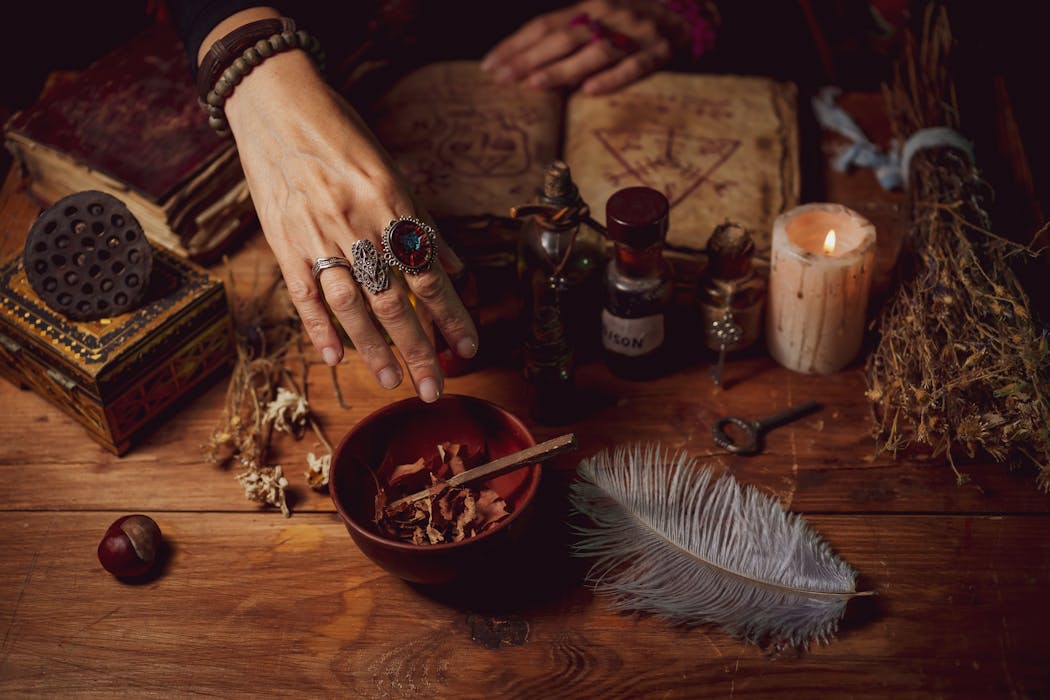
“Hubble bubble toil and trouble” is a quote from Shakespeare’s Macbeth that conjures images of evil witches making potions in giant cauldrons. But the truth was that women persecuted as witches were probably legitimate healers of the time.

Prior to the 14th century, women healers were generally tolerated throughout Europe, offering one of the only kinds of medicine available at the time. But from the 14th to the mid-18th century, with the rise of university education, coupled with the increasing power of the church, women healers were often demonised.

University graduates were favoured instead. Women folk healers were now commonly labelled as “witches” and subjected to torture and execution.

Valuable medicinal knowledge may have gotten lost along the way. To rediscover this ancient knowledge, researchers are looking in more detail at some of the major ingredients used in these medicines and assess their scientific worth through a modern lens.

Some of the most famous potions documented in records of medieval treatments were said to contain exotic ingredients such as eye of newt, toe of frog, wool of bat, tongue of dog and adder’s fork. But these were actually synonyms for plants and not animal parts.

Although, animal parts such as frogs and toads were indeed also used in other recipes used by the healers of the time, often for their psychoactive properties.

The majority of the plants folk healers used were native to Europe. But there were also some exotic ingredients, obtained through the spice trade, which began as early as the fifth century.

Eye of newt is mustard seed, most likely the European species Sinapis alba. Modern research has shown it has anti-cough, anti-asthma, anti-inflammatory, anti-nerve damage, anti-androgenic, cardioprotective and anti-tumour effects.

The classical formulations containing dried mustard seed, handed down from ancient medical books or ethnic medical experience, are now widely used in herbal clinics.

Wool of bat is common holly leaves, and has been shown to reduce high levels of fats in the blood, including high cholesterol. It also contains some compounds that are toxic and so self-medication isn’t recommended.

Tongue of dog is actually a plant known as hound’s tongue, attributed to the long leaf shape. It has a history of use across the world for a variety of ailments including malaria, hepatitis and tuberculosis.

The presence of group of natural compounds called pyrrolizidine alkaloids render it highly toxic to the liver. This means that any research showing medicinal promise has to be viewed with some caution.

Plant with small blue flowers.
Hound’s tongue is really a wildflower.
Giulumian/Shutterstock

Adder’s fork refers most likely to the fern, English adder’s tongue, primarily used in folk medicine for wound healing and for promoting healthy blood circulation. It has also been exploited for its skin-enhancing properties by the cosmetic industry.

Witches’ brews

Witchcraft and folk healing are two different arts. However, medieval folk healing did involve elements of superstition, astrological lore and even pagan ritual and so the line between compassionate healer and witch could easily be misrepresented by those in power.

Flight ointments, sleep potions and love potions are often mentioned both in historical records and fictional literature. Commonly containing a potent class of chemical compounds called tropane alkaloids (a class that also includes cocaine), these concoctions would have had some interesting effects.

Flight ointments were applied to a broomstick and to parts of the body with blood vessels close to the surface to aid absorption. There has been much colourful debate as to the exact parts of the body that these ointments were applied to, but the extremities are most frequently mentioned.

This could be viewed as an early form of transdermal application, now found in the delivery of some drugs such as nicotine patches.

These alkaloids, derived from plants of the Solanaceae (potato) family, including deadly nightshade and henbane have intoxicating psychoactive effects, including feelings of lightness, delirium and hallucinations. These effects could easily be experienced as feelings of flying.

Sleep potions often used extracts from foxglove and extracts from the plant Indian snakeroot, containing the drug reserpine, the world’s first drug treatment for high blood pressure. It was reportedly rediscovered after the founder of the Indian herbal medicine company, Himalaya, observed its calming effects on restless elephants during a trip to Burma in the 1930s, hundreds of years after its use in medieval times.

Foxgloves growing in forest
Foxgloves are more than a country garden flower.
backcornermedia/Shutterstock

Together these plants and their compounds produce symptoms such as reduced heartbeat, inhibition of adrenaline release and drowsiness, all things that might aid in a restful night’s sleep.

Love potion recipes called for ingredients such as the mandrake plant Mandragora officinalis. The root is a rich source of the same alkaloids found in the sleep potions.

This may appear counter-intuitive but higher doses of these compounds are known to produce increased heartbeat, palpitations and sweating rather than drowsiness. Other plants such as Ephedra sinica (containing a stimulant called ephedrine) and psychoactive Areca catechu (betel nut) have stimulant and euphoric effects linked to increases in adrenaline and serotonin.

A sleep potion can be transformed into a love potion, and should love turn to hate, a further increase in dosage would transform these plants into poisons. So it’s unsurprising that accusations associated with poisoning and witchcraft were more commonplace during the heightened witch hunts of the 16th and 17th centuries as a means to prosecute women healers under the law.

Prosecutions for witchcraft didn’t come to an end in England until the early 18th century when the 1736 witchcraft act repealed earlier legislation and made it a crime to either pretend to be a witch or to accuse someone of practising witchcraft.

Following the 1736 act, the witches (and folk healers) were left alone for a while although still encountered difficulties from the church and establishment at times. Nonetheless the act of prescribing potions continued.

The practice of prescribing herbal pills, potions and salves as a herbal medicine practitioner eventually became a legitimate occupation. It’s one still dominated by women to this day.

The Conversation

Anthony Booker is affiliated with The British Pharmacopoeia, The Medicines and Healthcare Products Regulatory Agency, The American Botanical Council, The British Herbal Medicine Association and The European Scientific Cooperative on Phytotherapy.

ref. Women folk healers were branded as witches, but their treatments may have been medically sound – https://theconversation.com/women-folk-healers-were-branded-as-witches-but-their-treatments-may-have-been-medically-sound-266406

Special educational needs reform could be a bureaucratic nightmare – here’s how to put families first

Source: The Conversation – UK – By Paty Paliokosta, Associate Professor of Special and Inclusive Education, Kingston University

PeopleImages/Shutterstock

Plans to reform support for children with special educational needs in England have been delayed after the government announced its new policy would not be unveiled until 2026, rather than autumn 2025.

However, there has already been some indication of what the government will do. The education secretary, Bridget Phillipson, recently promised to set “clear expectations for schools” on how they work together with pupils’ parents. She also outlined her intention to overhaul the process by which parents can make complaints.

In a statement, Phillipson said: “To help us deliver the most effective set of reforms we can, I have taken the decision to have a further period of co-creation, testing our proposals with the people who matter most in this reform – the families – alongside teachers and other experts.”

The additional wait for the schools white paper that will set out the policy will be disappointing to those who are keen to see change in the system. But it also creates an opportunity to ensure the government gets reform right.

As an expert in inclusive education, I argue the call for closer collaboration and the explicit mention of family involvement are excellent signs. However, the government should rethink its framing of parental engagement as a set of expectations that schools must meet.

On paper, this approach looks as if it could safeguard the support children are entitled to. But in reality it risks reducing what can be a mutually respectful and beneficial partnership to a transactional checklist and added bureaucracy.

What is needed instead is effective partnerships with families based on authentic engagement and courageous conversations, based on respect, openness and compassion.

This change in culture can be supported by improved teacher training. This should promote inclusion as a shared responsibility, rather than as sheer accountability.

For example, for children with additional needs, transitions in their educational journey are important and potentially difficult moments. These include starting school, moving between primary and secondary, between mainstream and alternative educational provision, and into adulthood.

Making family involvement happen

Parents and carers can and should play an important role in their children’s education, and their voices should have power. This is particularly vital for children with special educational needs and disabilities.

Parents know their children best. They see their strengths, struggles, and the little things that make a big difference. Irrespective of this, they are routinely excluded or sidelined from decisions about their child’s education.

A recent House of Commons committee report on special educational needs highlights that many parents feel treated as inconvenient or unreasonable. These adversarial dynamics have severely eroded trust in the system.

Findings from an all-party parliamentary group inquiry into “loss of the love of learning” reveal that parents lose confidence in formal education: it’s perceived as a source of anxiety, stress and exclusion for children whose needs may require different teaching and learning approaches.

For these reasons, parental involvement must be central to reform of special educational needs support. Joint planning, emotional support, and coordination at every stage with teachers and others involved in the child’s journey is needed. This can help children adjust and reach emotional and developmental milestones.

We need to move away from a situation where parents are seen only as receivers of expertise, not as experts themselves.

Parents’ knowledge and experiences of disability and difference can lead to real change. It’s right that they are involved in decision making, at school and community level and in national consultations on education policy.

Father helping girl with homework
Parents’ experiences and knowledge can offer real value.
Rido/Shutterstock

Without real input in decision making, the risk is that parental involvement becomes tokenistic rather than transformative, especially when deep-rooted systemic injustices remain in education for children with special educational needs.

Decent parental engagement requires other changes to the system. Children with special educational needs and disabilities often receive support from different services. These need to be coherent so that parent and carer involvement does not become fragmented. The Education Select Committee’s call for a joint workforce strategy on special educational needs and disabilities, including health and care services, must be taken seriously.

Equally, trust and respect needs to be reinstated towards teachers and Sencos: teachers who have an additional role as their school’s special educational needs coordinator. Despite often working in extremely hard conditions and with limited resources, teachers often absorb demonising attitudes and blame.

Sencos are not allocated the time and continued training required for their role. They also do not have the power to make strategic decisions on inclusion.

The Labour manifesto promised to “light the fire” of opportunity for every child. By truly bringing families into their children’s education, the upcoming white paper on schools could be that spark. Otherwise, it risks becoming another layer of bureaucracy in an already overwhelmed system.

The Conversation

Paty Paliokosta does not work for, consult, own shares in or receive funding from any company or organisation that would benefit from this article, and has disclosed no relevant affiliations beyond their academic appointment.

ref. Special educational needs reform could be a bureaucratic nightmare – here’s how to put families first – https://theconversation.com/special-educational-needs-reform-could-be-a-bureaucratic-nightmare-heres-how-to-put-families-first-264313

The Rose Field takes Philip Pullman’s ‘Dust’ to its philosophical conclusions

Source: The Conversation – UK – By Samuel Jesse Cox, Postdoctoral Fellow and Visiting Lecturer in English Literature, University of Tübingen

The Rose Field, the third and final volume in Philip Pullman’s The Book of Dust trilogy is finally in the hands of his readers.

This trilogy accompanies Pullman’s earlier series, His Dark Materials, and tells stories that happen both before and after those original books. Both trilogies follow Lyra Belacqua and her daemon, Pantalaimon – a manifestation of her soul in animal form. In The Rose Field, Lyra journeys deep into the desert for one final discovery about the mysterious substance that connects both series: Dust.

The title of Pullman’s first trilogy comes from John Milton’s 17th-century epic poem Paradise Lost, which tells the story of Satan’s rebellion against Heaven. In it, Milton wrote: “Unless th’ Almighty Maker them ordain / His dark materials to create more worlds.”

In Milton’s poem, the “dark materials” are the chaotic and primordial matter from which God could create new worlds. In Pullman’s stories, however, “dark materials” take the form of Dust – also called shadow particles, Rusakov particles, or dark matter.

Unlike Milton’s lifeless matter, Dust is alive and connected to consciousness and creativity. Through this idea, Pullman turns Milton’s vision upside down, rejecting divine authority and celebrating human imagination.

Across both trilogies, two opposing views of Dust exist. A restrictive theocratic organisation known as the Magisterium declares Dust original sin: “an emanation from the dark principle itself.” Yet due to Dust’s association with daemons and consciousness, Lyra, Pan and their allies remain convinced that Dust must be “good”.

To fully understand Pullman’s Dust we must go beyond Paradise Lost, back to the foundational story in the Judeo-Christian tradition: Genesis.

Dust thou art?

Northern Lights (1995) describes how Dust takes its name from a “curious verse” in the story of Adam and Eve’s fall in Genesis. In it, God curses Adam for eating forbidden fruit saying: “For dust thou art, and unto dust shalt thou return.”

In this moment, Adam and Eve leave behind their innocent, harmonious life with nature. Pullman pinpoints this as the moment in the Bible where a rift opens between humanity and the material world. From then on, humans move from living in unity with the material world to feeling separate from it, forced to struggle against nature instead of living alongside it.

The scholar Mary talking to Dust in the BBC adaptation of The Amber Spyglass.

In Pullman’s inversion, the Authority (God) did not simply create using Dust, but was, like all angels, formed from it. As one of the rebel angel characters explains in the final book of the original trilogy, The Amber Spyglass (2001): “Dust is only a name for what happens when matter begins to understand itself. Matter loves matter. It seeks to know more about itself and Dust is formed.”

This line reveals that Dust is not just connected to the human spirit – our thoughts, feelings, imagination and soul – but also presents a view of reality shaped by matter itself. Through Dust, ideas about the soul are linked to a sense of wonder at the material world.

This echoes the ancient Greek and Roman philosophers who first imagined the universe as made up of moving atoms. Yet throughout His Dark Materials, there is still a sense that humans are special, as human consciousness appears as the culmination of matter understanding itself.

New forms of alienation

In the Book of Dust trilogy, this shifts radically. Pullman has acknowledged that his new books are increasingly shaped by our current times, in which our detachment from our world is enabling the destruction of Earth.

For Pullman, belief in God has passed onto belief in another entity which will save us from the world and its toil: technology. If the split between humans and matter estranged us from the material world, now we face being alienated even from ourselves.

In this new context of alienation, Pullman’s concept of Dust evolves. It moves from being primarily associated with human creativity to implying that human consciousness is intrinsically linked to all matter.

As he writes in La Belle Savage (2017), the first instalment in the Book of Dust trilogy: “There is a field of consciousness that pervades the entire universe, and which makes itself apparent most fully – we believe – in human beings.”

After boldly overthrowing the figure of God (the Authority) in The Amber Spyglass, Pullman seems intent on challenging today’s dominant way of thinking by helping people rediscover a deeper, more imaginative relationship with the physical world.

If we see matter as just lifeless stuff that can only be measured or used, then humans aren’t really powerful – instead, we become spiritually and creatively impoverished.

Philip Pullman speaking about Dust.

In The Secret Commonwealth (2019), the second book in the Book of Dust trilogy, Lyra has fallen victim to this new disease, which grips the young of her world. A belief that: “Nothing is any more than what it is.” This separates her from her daemon Pan, who must set off in search for her “imagination”.

His Dark Materials offered a story of the endless battle against authoritarian and restrictive structures. Lyra and Pan’s final adventure in The Rose Field, meanwhile, is an allegorical search for those most human of qualities, in which society now holds a faltering faith: feeling and imagination.

Dust becomes a rich symbol that shows how deeply and permanently we’re connected to everything in the world – that we’re part of it, not separate from it.

The beauty of Pullman’s “Dust” is that we don’t need to inhabit Lyra’s world to see that this is true. The physical qualities of Dust tells us we are deeply connected to everything and everyone. We have the remnants of stars within us, as do even the most seemingly inert objects in our world.

The Roman poet Horace once declared: “We are but dust and shadow.” But in a world in a crisis of narration, we need storytellers like Pullman to illuminate our forgotten particles and darkest materials with light.


Looking for something good? Cut through the noise with a carefully curated selection of the latest releases, live events and exhibitions, straight to your inbox every fortnight, on Fridays. Sign up here.


This article features references to books that have been included for editorial reasons, and may contain links to bookshop.org. If you click on one of the links and go on to buy something from bookshop.org The Conversation UK may earn a commission.

The Conversation

Samuel Jesse Cox does not work for, consult, own shares in or receive funding from any company or organisation that would benefit from this article, and has disclosed no relevant affiliations beyond their academic appointment.

ref. The Rose Field takes Philip Pullman’s ‘Dust’ to its philosophical conclusions – https://theconversation.com/the-rose-field-takes-philip-pullmans-dust-to-its-philosophical-conclusions-268435

The Scottish king who wrote a treatise on demonology and obssessed over witches

Source: The Conversation – UK – By Gemma Ware, Host, The Conversation Weekly Podcast, The Conversation

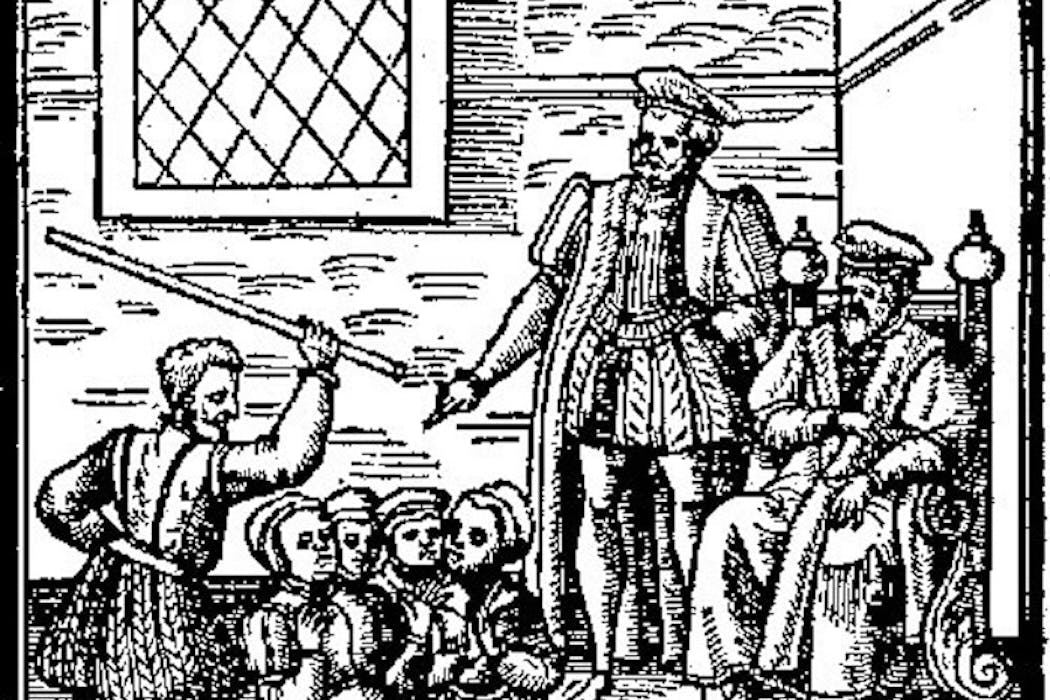
Suspected witches kneeling before James VI in Daemonologie, his 1597 treatise on witches. Wikimedia Commons

In the 16th century, witches and demons weren’t just for Halloween. People were terrified and preoccupied with them – even kings.

In 1590, James VI of Scotland – who was later also crowned James I of England – travelled by sea to Denmark to wed a Danish princess, Anne. On the return journey, the fleet was hit by a terrible storm and one of the ships was lost.

James, a pious Protestant who would go on to sponsor the translation of the King James bible, was convinced he’d been the target of witchcraft. On his return, he set in motion the brutal North Berwick witch trials.

A few years later, James decide to write a treatise called Daemonologie, setting out his views on the relationship between witches and their master, the devil.

Meanwhile, another firm Halloween favourite – ghosts – had fallen out of favour in the wake of the Protestant Reformation because they were seen as a hangover from Catholicism.

In this episode of The Conversation Weekly podcast, Penelope Geng, an associate professor of English at Macalester College in the US who teaches a class on demonology, takes us back to a time when beliefs around witches, ghosts and demons were closely tied to religious politics. She explains how these beliefs  have come to influence the way witches and ghouls have been portrayed in popular culture ever since:

It seemed that at a very grassroots level, people believed in the existence of witches and devils. At a very high theological level, writers were talking about it. So I think, compared to today, the early modern period really was a moment in which people were somewhat obsessed with thinking about this eternal struggle between good and evil and their own place in this warfare.

You can also read an article Penelope Geng wrote on the difference between ghosts and demons, and the way they were portrayed in literature, as part of The Conversation’s Curious Kids series.

This episode of The Conversation Weekly was written and produced by Katie Flood, Mend Mariwany and Gemma Ware. Mixing by Eleanor Brezzi and theme music by Neeta Sarl.

Listen to The Conversation Weekly via any of the apps listed above, download it directly via our RSS feed or find out how else to listen here. A transcript of this episode is available on Apple Podcasts or Spotify.

The Conversation

Penelope Geng does not work for, consult, own shares in or receive funding from any company or organisation that would benefit from this article, and has disclosed no relevant affiliations beyond their academic appointment.

ref. The Scottish king who wrote a treatise on demonology and obssessed over witches – https://theconversation.com/the-scottish-king-who-wrote-a-treatise-on-demonology-and-obssessed-over-witches-268595

Plastic packaging could be a greater sin than food waste

Source: The Conversation – UK – By James Cronin, Professor in Marketing and Consumer Culture Studies, Lancaster University

Miljan Zivkovic/Shutterstock

Food waste has long been reviled as an immoral, largely preventable feature of our consumer society.

An estimated 4.7 million tonnes of edible food is thrown away by households each year in the UK, according to the Waste and Resources Action Programme, an environmental charity that runs the Love Food Hate Waste campaign. This wastage seems especially wrong at a time when escalating food prices have driven many British households to become reliant on food banks.

Meanwhile, the single-use plastic packaging used to reduce food wastage poses a more insidious problem. Once discarded, the single-use plastics that cushion, seal, protect and extend the shelf life of our groceries can linger in landfills, beneath the ground, in rivers and on the seabed for centuries.

This mounting plastic waste could disrupt ecosystems, negatively effect food security through declining animal health and cause health issues in people. If binning good-to-eat food has historically been reviled as consumers’ great moral failing, their over-reliance on single-use plastic food packaging could be a longer-lasting sin.


Read more:
Most food waste happens at home – new research reveals the best ways to reduce it


UK households throw away approximately 90 billion pieces of plastic packaging a year. In 2024, the UK achieved a recycling rate of approximately 51%-53.7% for plastic packaging waste.

The rest was incinerated, land-filled, or shipped abroad, typically to countries with weaker waste management systems. There it is buried, burned or haphazardly stored with the risk of leaking into rivers and seas.

Traces of plastic have been detected everywhere from Arctic ice to the hottest deserts, from the bellies of seabirds to human blood, lungs and placentas. Unlike food waste, the damage of plastic waste is cumulative, slowly imparting a toxic legacy throughout ecosystems for future generations.

The scale of the single-use plastics problem is not to diminish the problem of food waste. Throwing out a pack of mackerel fillets or a tub of smashed avocado from the fridge is not only disrespectful to the third of UK children under five living in food insecure homes. It disregards the huge amount of carbon emissions needed to produce, preserve, transport, retail and store those items from producer to consumer.


Read more:
How the pollution of today will become the ‘technofossils’ of the far future


An estimated 16 million tonnes of carbon dioxide is produced from UK households’ wasted consumable food and drink. But damaging as it is, food waste has an end point: it decomposes, breaks down, then returns to the soil.

In contrast, plastic packaging persists indefinitely, slowly fragmenting into smaller parts and disintegrating into stubborn chemical constituents that stick around. Each plastic bottle, crisp packet and meat tray that ends up in the natural environment represents a long-term alteration of the material world.

Food waste decays, plastic stays

Why then does binning plastic packaging rarely invite as fervent a reaction as scraping a plate of uneaten dinner into the bin? Our research suggests that part of the answer lies in how each act of wastage is morally framed.

Food is very visible, desirable and morally loaded – it is something held dear in most religions and communities. Several faiths explicitly denounce the wasting of food as sinful or wrong. Secular British history too is replete with memories of food shortages, rationing, rising prices and austerity periods which have led to strong moral attitudes against food waste.

According to the anti-poverty charity Trussell Trust’s research, approximately 14 million people in the UK faced hunger in the past year leading up to September 2025.

food waste in brown bin bag, white background
Binning good-to-eat food is usually considered morally unacceptable.
5PH/Shutterstock

By comparison, plastic is more abstract. Plastic food packaging is hidden in plain sight, often serving as a “passenger” rather than a driver of our consumption. After we remove the food, we toss plastic packaging into the trash – ideally the recycling bin – without a further thought.

Where food is deep-seated in moral and even sacred meanings around nourishing the body, sharing and caring, identity and celebration, plastic is devoid of such values. Throwing food away can feel like an affront to the communities we identify with, but binning plastic does not carry the same stigma. We do not view ourselves as “wasting” plastic, we merely “dispose” of it.

Among the members of 27 households we interviewed, many expressed their frustration about good-to-eat food ending up in bins or landfills. Most cited the usefulness of plastic packaging in keeping food fresh and helping to reduce waste.

For them, the consequences of binning plastics are dispersed and delayed. No great cautionary tale from our collective memory exists to warn us of the complex, longer-term challenges that will follow.

To overcome the challenges of tomorrow, we must reassess the hierarchy of things that we, as consumers, feel guilty about. Food waste certainly matters, but so too does plastic packaging. The problem is that plastics have not been a part of our moral economy for very long.

Plastics arrived as a modern convenience, not as a moral appendage to our sense of identity or community like food has been for millennia. There are no ancient and collective traumas tied to plastics’ wanton consumption, abuse or scarcity, no prayers of gratitude for plastic packaging, and no great piety or moral proverbs condemning its thoughtless disposal.

Our existing moral frameworks are coloured with images of hunger, famine, bread lines and emaciated bodies that provide us with the imagination to condemn the wasting of food.

But we require new stories and perspectives to position plastic waste as an evil that will outlive us, haunt our waterways, crowd the stomachs of wildlife, leach into our food systems, and poison our bodies long after our shopping habits have changed.


Don’t have time to read about climate change as much as you’d like?

Get a weekly roundup in your inbox instead. Every Wednesday, The Conversation’s environment editor writes Imagine, a short email that goes a little deeper into just one climate issue. Join the 45,000+ readers who’ve subscribed so far.


The Conversation

James Cronin received funding from the UKRI Natural Environment Research Council as co-investigators of the ‘Plastic Packaging in People’s Lives’ (PPiPL) project. Project Reference: NE/V010611/1. More can be read about the PPiPL project here: https://www.lancaster.ac.uk/ppipl/

Alexandros Skandalis received funding from the UKRI Natural Environment Research Council as co-investigators of the ‘Plastic Packaging in People’s Lives’ (PPiPL) project. Project Reference: NE/V010611/1. More can be read about the PPiPL project here: https://www.lancaster.ac.uk/ppipl/

Charlotte Hadley received funding from the UKRI Natural Environment Research Council as co-investigators of the ‘Plastic Packaging in People’s Lives’ (PPiPL) project. Project Reference: NE/V010611/1. More can be read about the PPiPL project here: https://www.lancaster.ac.uk/ppipl/

ref. Plastic packaging could be a greater sin than food waste – https://theconversation.com/plastic-packaging-could-be-a-greater-sin-than-food-waste-267162

Trick or treatment: Halloween health hazards hiding in plain fright

Source: The Conversation – UK – By Adam Taylor, Professor of Anatomy, Lancaster University

yurakrasil/Shutterstock.com

While Halloween offers a chance to embrace all things spooky and supernatural, the real terrors this season aren’t confined to ghost stories. From pumpkin-carved fingers to contact lens infections that can lead to life-threatening heart conditions, the festivities come with genuine medical hazards – some surprisingly severe.

In the US, 44% of Halloween-related injuries stem from pumpkin carving, ranging from minor scratches to lacerations that slice through major nerves, blood vessels and tendons. Specific pumpkin carving knives or tools have been shown to be much safer, though not risk-free.

Pumpkins pose additional dangers when candles are lit inside them. The flames can ignite property or costumes, often leaving victims with severe burns. There is a notable spike in burn-related injuries each year around Halloween, particularly among children. One high-profile case involved TV personality Claudia Winkelman’s daughter, Matilda, who suffered life-changing injuries in 2014, aged eight, when her Halloween costume caught fire.

Costumes themselves create multiple hazards beyond burns. Ill-fitting outfits can lead to broken bones from slips and trips, while masks and heavy headwear obscure vision. Latex allergies from costume materials represent another risk, causing anything from irritation and rashes through, in very rare cases, to death .

The combination of dark October evenings and dark costumes creates a particularly dangerous scenario. Data from the UK covering 27 years revealed that on Halloween, the risk of children being killed or seriously injured in traffic accidents is higher than on any other day – and 34% higher between 5pm and 6pm, probably coinciding with rush hour.

In the US, childhood pedestrian deaths are fourfold higher on Halloween than any other day. A separate study found there are four additional pedestrian deaths on Halloween compared with other days.

On Halloween, appearances can be deceiving – sometimes literally. Coloured contact lenses present significant risks to eye health and overall wellbeing. They can cause irritation and redness, eye injury when they snap and cut into the eye, or even a life-threatening heart infection.

Damage to the eye, from ill-fitting or poor quality contact lenses, can promote bacterial growth. These bacteria can migrate from the eye, often in the bloodstream, to elsewhere in the body. One location they can set up camp is in the heart, causing conditions such as infective endocarditis, which kills about one in five people with the condition. This condition is challenging to treat because medicines and immune cells struggle to reach the heart lining.

In the UK, contact lenses, including novelty or non-prescription ones, are classified as medical devices and require a prescription.

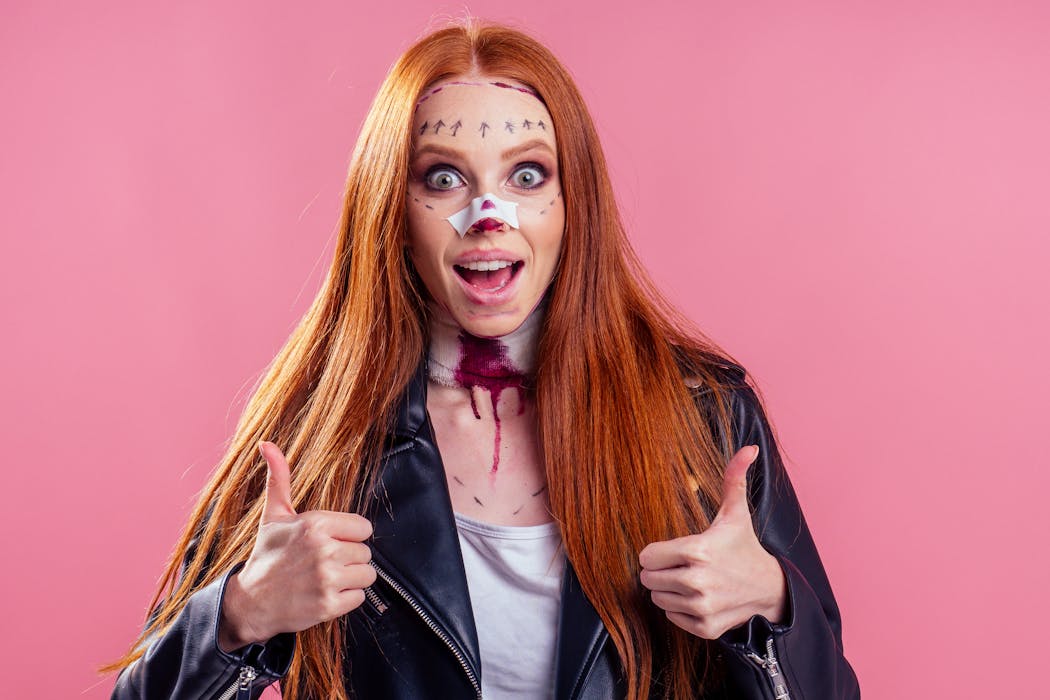
Face paints carry both short- and longer-term risks. Skin irritation and pore-blocking can be an immediate annoyance, along with corneal scratches if paint enters the eyes. Ingestion and prolonged or repeated exposure can increase the risk of absorbing potentially toxic elements such as heavy metals and arsenic, which increase cancer risk.

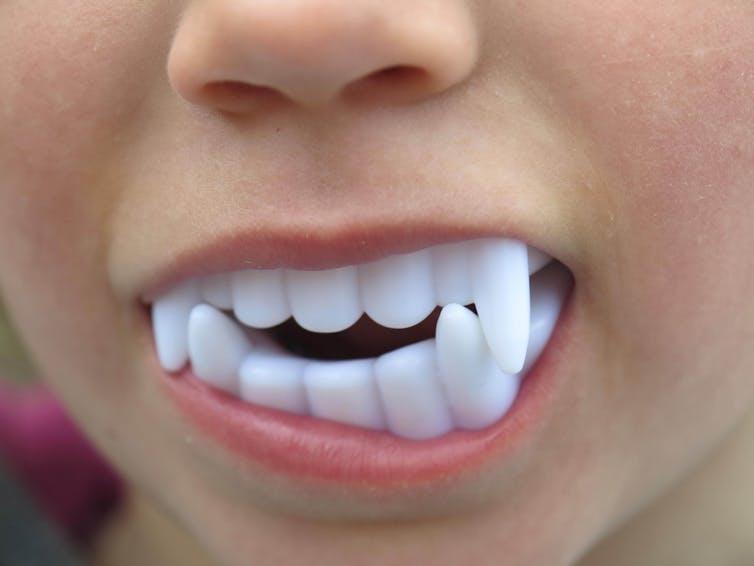
Plastic fangs and other teeth-modifying sets can damage teeth. Designed as one-size-fits-all products, they’re likely to loosen teeth and exacerbate existing looseness. If using adhesive to hold them in place, ensure it’s approved for dental use. Products like superglue and nail glues will damage tooth enamel – a layer that cannot regenerate – and can burn the gums and inside of the mouth.

A child wearing plastic fangs.
Watch out! You could lose your real teeth.
Menna/Shutterstock.com

Halloween diarrhoea

The obvious concern on Halloween is feeling unwell from consuming excessive sweets or chocolate. However, other consumption hazards have emerged in recent years. Hospital admissions for children who’ve ingested gummies containing THC or otherbanned substances have increased noticeably in countries that have legalised or decriminalised cannabis.

For those watching their calorie intake, sugar-free options may backfire – a phenomenon sometimes referred to as “Halloween diarrhoea”. Sorbitol, an artificial sweetener used in sugar-free products, is only about 60% as sweet as sucrose, meaning more must be added to achieve the desired taste. As little as 20g of sorbitol can have a laxative effect in 50% of healthy people. For context, a stick of sugar-free chewing gum contains roughly 1.25g.

Hard sweets present a choking risk year-round, but particularly to younger children, and the increased sweet consumption around Halloween elevates this risk further. Children with nut allergies face additional jeopardy – the incidence of nut-related anaphylaxis increases by approximately 70% on Halloween.

Beyond food, other Halloween traditions carry risks. Trauma to the eye from eggs used as projectiles is commonly seen during the festivities, with some victims losing their sight from such injuries.

Certain crimes and resulting injuries also increase around Halloween, with assaults showing a significant increase. The commercialisation of Halloween celebrations is thought to play a role, with promotional drink offers partly to blame.

Sensible precautions – wearing lights or reflective strips when out with children, moderating sweet intake, and supervising tasks like pumpkin carving – can substantially reduce the risk of becoming another Halloween hospital statistic.

The Conversation

Adam Taylor does not work for, consult, own shares in or receive funding from any company or organisation that would benefit from this article, and has disclosed no relevant affiliations beyond their academic appointment.

ref. Trick or treatment: Halloween health hazards hiding in plain fright – https://theconversation.com/trick-or-treatment-halloween-health-hazards-hiding-in-plain-fright-263698

The surprising ways Halloween treats can interact with your medications

Source: The Conversation – UK – By Dipa Kamdar, Senior Lecturer in Pharmacy Practice, Kingston University

Yta23/Shutterstock

As Halloween approaches, the air fills with excitement. Costumes are planned, pumpkins are carved, and the promise of sweet treats is everywhere. But while dipping into chocolates and colourful candies may seem harmless, some ingredients in these festive favourites can cause trouble for people taking certain medications or living with specific health conditions.

From artificial sweeteners to liquorice and chocolate, Halloween sweets can interact with medicines or worsen some conditions in ways that may reduce their effectiveness or even trigger harmful side effects. Here’s what the science says, and why you might want to glance in your medicine cabinet before raiding the treat bowl.

1. Chocolate

Chocolate treats are everywhere this time of year, but for people taking monoamine oxidase inhibitors (MAOIs), one of the older types of antidepressant, they can carry unexpected risks. MAOIs are usually prescribed when first line antidepressants have not been effective. These drugs work by blocking an enzyme in the body called monoamine oxidase, which helps control levels of brain chemicals linked to mood. When this enzyme is blocked, it also prevents the breakdown of a natural substance called tyramine, which is found in certain foods such as chocolate, cheese and cured meats.


Read more:
Five scary myths about sugar this Halloween – by a nutritionist


Too much chocolate could interfere with some of your meds.
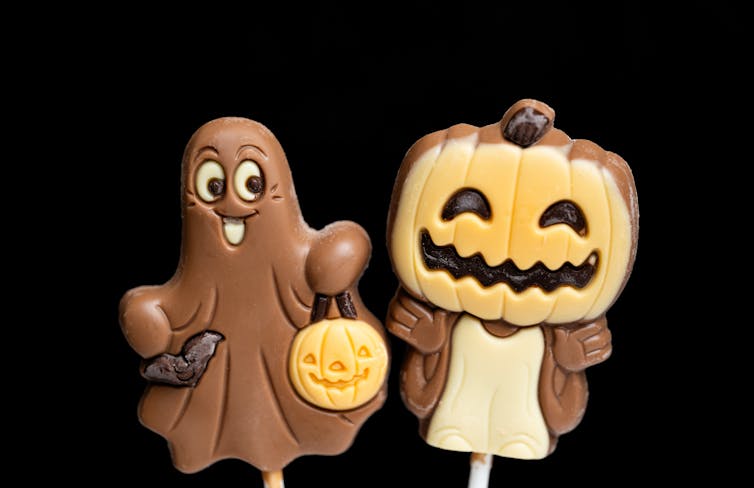
https://www.shutterstock.com/image-photo/chocolate-ghost-on-black-background-2488169573

When someone on MAOIs eats tyramine-containing foods such as chocolate, tyramine can build up to dangerous levels. This can cause blood vessels to tighten, leading to a sudden and severe spike in blood pressure, which is a medical emergency that can be fatal if untreated.

Exactly how much chocolate is risky depends on the dose and type of MAOI, as well as the kind of chocolate and your individual sensitivity. There’s no universally “safe” amount, but even small portions of dark chocolate, which contains more tyramine, can sometimes cause problems. Milk chocolate usually contains much less tyramine, but doctors generally advise caution or avoidance altogether, especially during the early stages of treatment or at higher doses. If in doubt, it’s safest to check with your pharmacist or prescriber before indulging.

2. Caffeine

Chocolate also contains caffeine, a stimulant that can interact with medicines used to treat attention-deficit hyperactivity disorder (ADHD), anxiety, and heart problems.

Caffeine and ADHD drugs such as methylphenidate (Ritalin) are both nervous system stimulants, although they work in slightly different ways. Together they can intensify each other’s effects, leading to jitteriness, insomnia, and a racing heartbeat. This can make it harder to manage ADHD symptoms effectively.

Caffeine may also reduce the calming effects of antidepressants and anti-anxiety medicines such as selective serotonin reuptake inhibitors (SSRIs). It can raise blood pressure and heart rate, which may cause problems for people taking beta-blockers for heart conditions.

A 50-gram bar of dark chocolate usually contains less than 25 milligrams of caffeine, while milk chocolate contains less than 10. That might not seem much, but when combined with coffee, tea, or energy drinks, caffeine intake can quickly add up. The Food Standards Agency advises that up to 400 milligrams a day is unlikely to cause side effects for most adults.

However, the safe limit during pregnancy is much lower: no more than 200 milligrams a day (about two cups of instant coffee). Exceeding that has been linked to increased risk of miscarriage and low birth weight. Sensitivity to caffeine can also vary depending on health conditions, medications, and individual metabolism, so people taking heart or mental health drugs may need to be especially cautious.

3. Liquorice

Liquorice is the ultimate love-it-or-hate-it treat. But if you’re a fan, it’s best to eat it sparingly. Black liquorice contains glycyrrhizin, a natural compound that acts like the hormone aldosterone. This can cause the body to hold on to sodium and lose potassium, leading to fluid retention, increased blood pressure and electrolyte imbalances.


Read more:
Is Halloween more trick than treat? The dangers of overeating sugar, liquorice and sherbet


These effects can be especially dangerous for people taking diuretics, antiarrhythmic drugs, or blood pressure medication, and for those with kidney disease. Even small amounts of liquorice can make a difference. A 2024 study found that just 100 milligrams of glycyrrhizic acid daily can raise blood pressure. That is the same as the upper limit recommended by the World Health Organization. If you have a heart or kidney condition, it’s safest to avoid large amounts altogether. Liquorice-flavoured sweets that do not contain real liquorice are usually fine.

4. Artificial sweeteners

Sugar-free sweets are often marketed as healthier, but they can come with their own risks. Many contain artificial sweeteners such as aspartame, which can be dangerous for people with phenylketonuria (PKU), a rare genetic disorder. Aspartame breaks down into a chemical called phenylalanine, which people with PKU cannot properly metabolise. This leads to a toxic buildup that can damage brain cells.

Phenylalanine may also be indirectly converted into tyramine, which means that consuming aspartame might contribute to higher tyramine levels. Like chocolate, this could interact with MAOI antidepressants and cause a dangerous rise in blood pressure, although more research is needed to confirm this link.

5. Food colourings

Halloween sweets are known for their bright colours, but those vibrant hues often come from synthetic dyes such as Red 40, Yellow 5, and Blue 1. These dyes have been linked to hypersensitivity reactions including hives, wheezing and itching. One study found that people who are allergic to aspirin may be more likely to react to Yellow 5.

The colourings in sweets could trigger allergies in some people.
Kabachki.photo/Shutterstock

For anyone taking antihistamines, these dyes can make things worse. They don’t clash chemically with the medicine, but they can trigger the body to release histamine – the very substance antihistamines are meant to block – or provoke allergic reactions of their own. To make matters worse, some antihistamines also contain artificial dyes, so the treatment can end up feeding the problem.

Research has also found a connection between artificial food colourings and increased hyperactivity in some children.

A few sweets won’t ruin your night, but if you take medication or have a medical condition, it’s worth being mindful. Read ingredient labels, go easy on chocolate, sugar-free sweets, or liquorice and check with your doctor or pharmacist if you are unsure.

After all, the scariest part of Halloween should be the costumes, not what’s hiding in your sweets.

The Conversation

Dipa Kamdar does not work for, consult, own shares in or receive funding from any company or organisation that would benefit from this article, and has disclosed no relevant affiliations beyond their academic appointment.

ref. The surprising ways Halloween treats can interact with your medications – https://theconversation.com/the-surprising-ways-halloween-treats-can-interact-with-your-medications-268523

The painting that haunts me – seven experts share their favourite scary artwork

Source: The Conversation – UK – By Chloe Ward, Senior Lecturer in the History of British Art, Queen Mary University of London

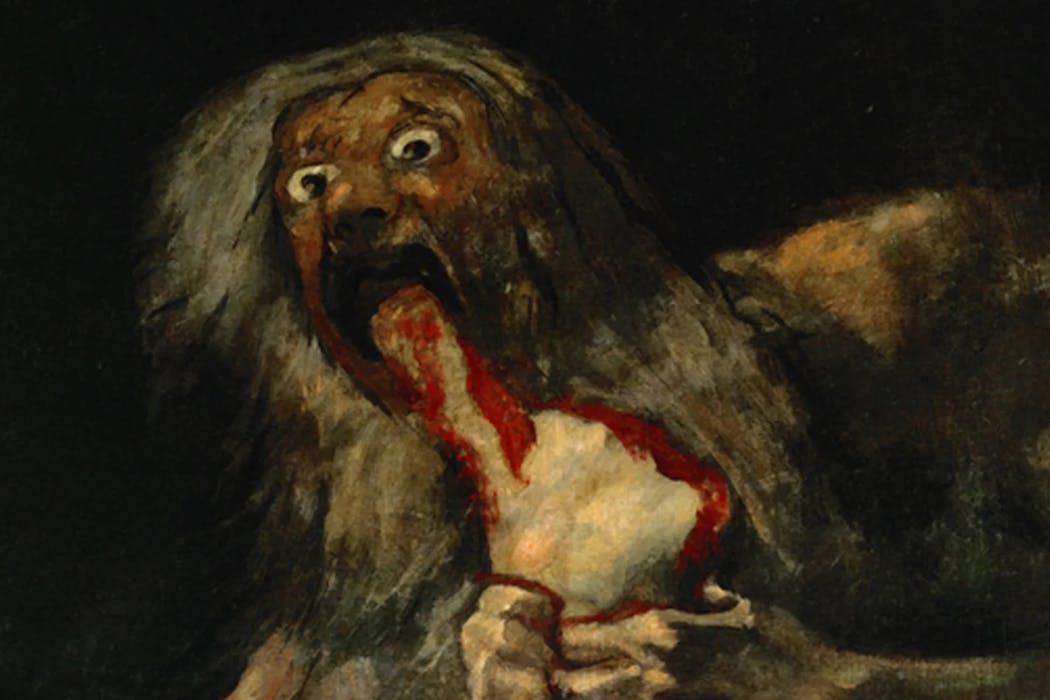
Saturn Devouring His Son by Francisco Goya (1820-1823). Museo del Prado

With Halloween approaching, we asked seven of our academic experts to tell us about the most unsettling artwork they’ve ever encountered. From gruesome portraits to creepy critters, these are the paintings that have stayed with them long after their first glimpse.

L’inhumation Précipitée by Antoine Wiertz (1854)

Hardly anything is more terrifying than the idea of being buried alive. In Antoine Wiertz’s painting, a cholera victim, presumed dead, revives in the crypt. Lifting the coffin lid, he glimpses a human skull through the gloom. A spider scrambles towards the open lid, while a rat slinks into an adjacent coffin. His face contorts with horror at his realisation: he has awakened into a nightmare worse than death.

A man crawls out of his coffin
L’inhumation Précipitée by Antoine Wiertz (1854).
Wiertz Museum

In 18th and 19th century Europe, the fear of premature burial was rife, and, while rarer than people imagined, the anxiety was not entirely unfounded. During epidemics, bodies were buried hastily and there were few accurate techniques for confirming death.

To guard against the grim possibility of being buried alive, some people specified that their arteries be cut or their heads severed before they were buried. Instant death was preferable to the horror of live burial that Wiertz so frighteningly portrayed.

Chloe Ward, senior lecturer in the history of British art, Queen Mary University of London

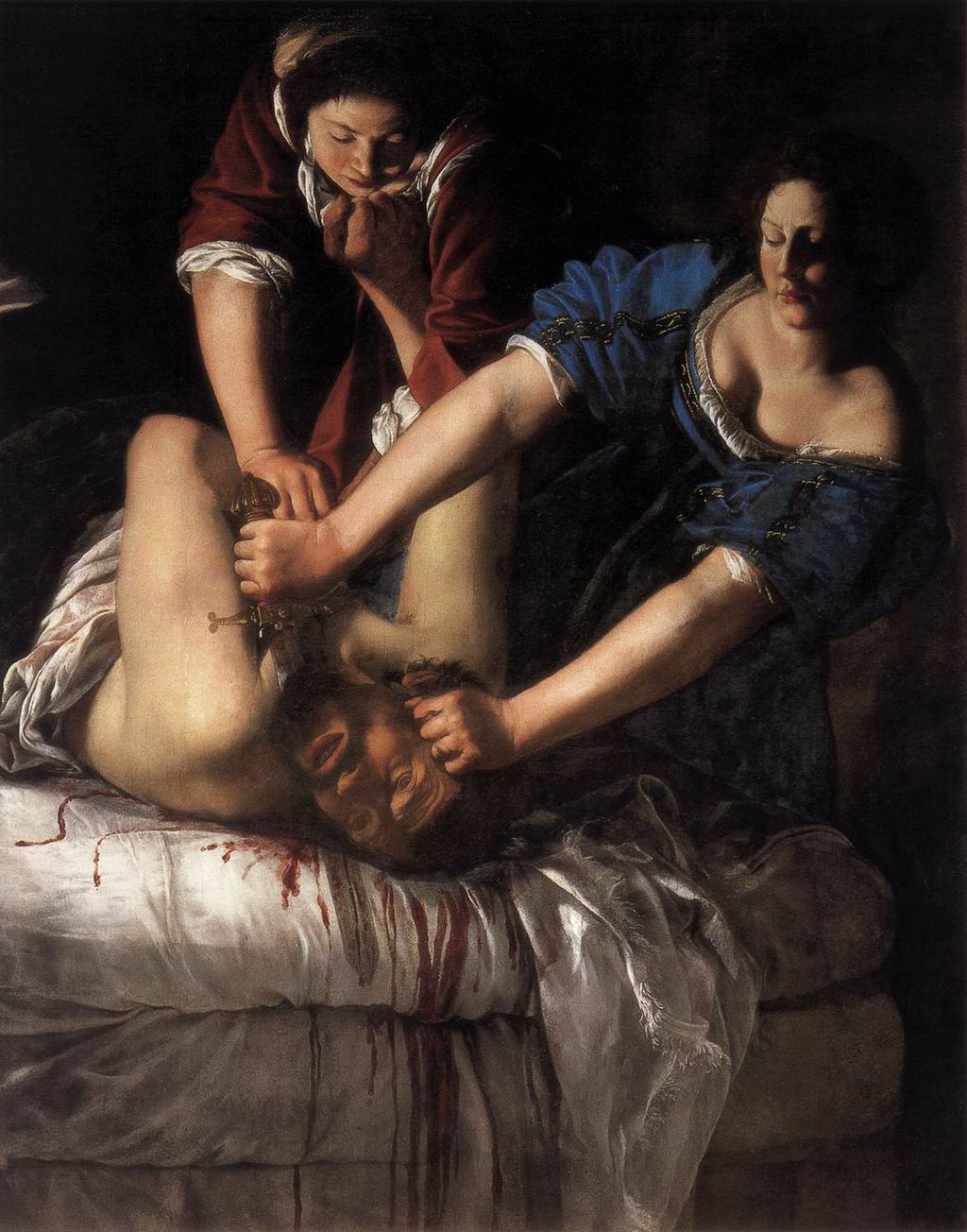
Judith Murdering Holofernes by Artemisia Gentileschi (1620)

The sheer visceral impact of this painting is heightened by its composition. Our eyes are drawn to the partially severed head of the still-struggling Holofernes.

The story comes from the Book of Judith, which is included in Catholic and Eastern Orthodox bibles. To save her city from this Assyrian general, Judith has set forth to seduce and murder him, aided by her servant Abra.

Painting showing two women beheading a man, who lies on a bed
Judith Murdering Holofernes by Artemisia Gentileschi (1620).
Uffizi Gallery

The vivid yellow and blue of the women’s dresses and the red of Holofernes’ bed contrast with the background chiaroscuro (an effect of contrasted light and shadow). This gives the artwork a claustrophobic intensity. Gentileschi painted this subject twice. But it is her 1620 version that is considered the more powerful.

In it she has shown blood spurting parabolically from Holofernes’ wounds, spattering Judith’s arms. Yet it is the grim determination of Judith and the death agonies of her victim that, for me, transports the viewer into the private moment of a gruesome murder.

Pippa Catterall, professor of history and policy, University of Westminster

Saturn Devouring His Son by Francisco Goya (1820-23)

Painted in the aftermath of the Napoleonic wars and during Spain’s revolution of 1820-23, this nightmarish image is the most powerful of Spanish painter Francisco Goya’s 14 “black paintings”.

Said to depict Saturn (or Cronus in Greek myth) eating one of his children to prevent a prophecy that one will usurp him, it gruesomely combines the taboos of cannibalism and filicide (killing your own child). The pure black background forces the viewer to fixate on the dismembered corpse, Saturn’s strangely angular body and the madness in his eyes.

A painting showing Satan eating his infant child
Saturn Devouring His Son by Francisco Goya (1820-23).
Museo del Prado

The title was not Goya’s, and the suggestion that this is a remote mythological scene or an allegory of time destroying youth may be attempts to distance ourselves from its darker meaning.

Beneath such efforts, this painting unflinching depicts the callousness of power, the urge to destroy rivals, the old exploiting the young. Two centuries on, it remains a chilling depiction of raw human instincts when the mask of civilisation is torn away.

Karl Bell, associate professor of cultural and social history, University of Portsmouth

Three Studies for Figures at the Base of a Crucifixion by Francis Bacon (1944)

Fleshy bioforms with outstretched, eel-like necks are writhing in an orange space. They are sightless, but two of them have toothy open mouths: one is snarling, the other is screaming. They are simultaneously human and not human.

These abject creatures are the creation of the Irish-British artist Francis Bacon in his work Three Studies for Figures at the Base of a Crucifixion (1944). The artist completed the triptych over two weeks, fuelled by alcohol and hangovers.

The figures are intended to represent the ancient Greek furies: deities of vengeance from the underworld. The work’s exhibition date is poignant: it was first shown to the public in the final days of the second world war in Europe. Terror leaps out of these paintings: they are at once a visceral reminder of our mortality and bodily materiality, and an expression of the horrors that humans have inflicted upon each other. And we cannot look away.

Daisy Dixon, lecturer in philosophy, Cardiff University


Read more:
Francis Bacon: Human Presence – a compelling look at how the artist redefined portraiture


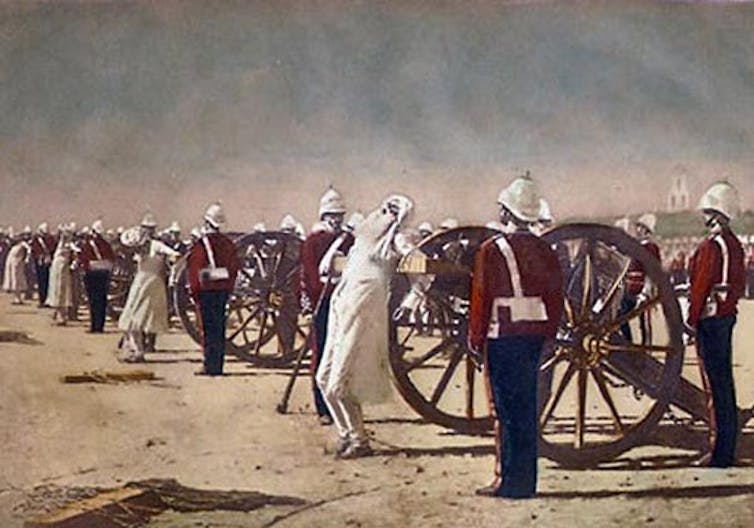
Blowing from Guns in British India by Vassily Vereshchagin (1884)

This painting by the Russian painter Vassily Vereshchagin depicts the execution of a group of rebels, the Kuka, after an uprising in Malerkotla, Punjab, in 1872. The British struck back harshly, executing the Kukas by blowing from guns. The rebels were tied to the mouths of cannons, which were then fired.

Painting showing Indian men and British troops
Blowing from Guns in British India by Vasily Vereshchagin (1884).
Wiki Commons

There is no indication that Vereshchagin witnessed the Kuka event himself. He had probably seen illustrations of the Indian rebellion of 1857, with similar compositions.

This painting was exhibited in London’s Grosvenor Gallery as part of a trilogy showing execution methods in different parts of the world. This framing is disturbing, at least to me – placing the brutal scene in combination with the detached, quasi-ethnographic mission. There is another disturbing dimension: the tension between the painting as a anti-colonial-violence statement or as a piece of political propaganda targeting the rule of the British empire.

The original painting, in storage at University of California, Berkeley, was destroyed due to water damage around 1950. A photogravure in grayscale of the work still exists, as does as a colour sketch, now exhibited at the Russian Museum in St Petersburg.

Åsa Harvard Maare, senior lecturer in visual communication, Malmö University

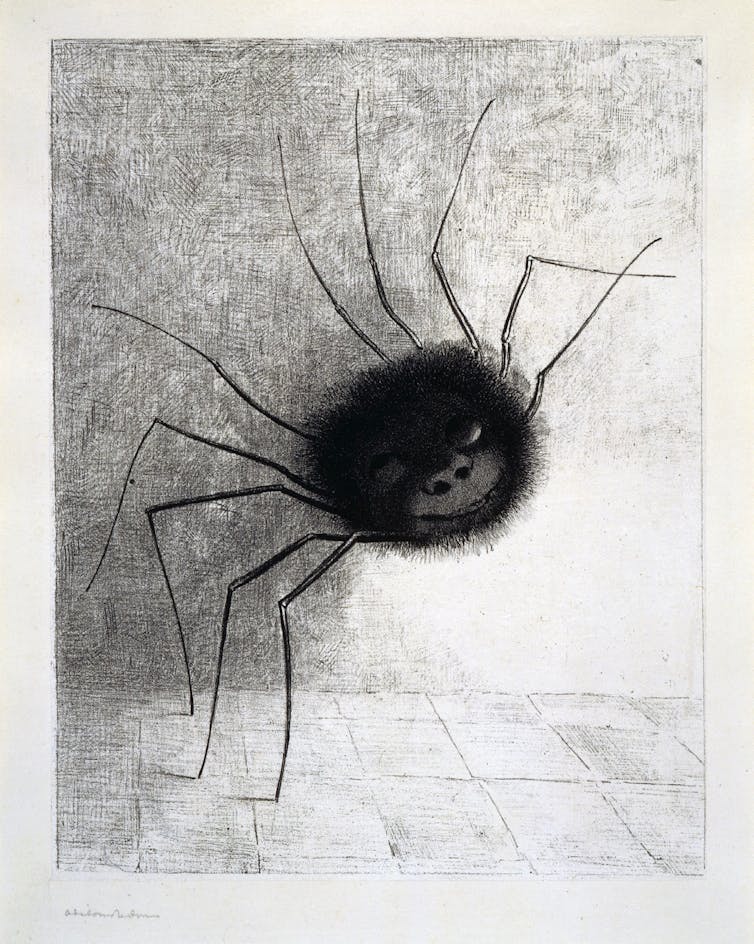
The Spider by Odilon Redon (1881)

Imagine a giant spider with ten legs and a grinning, human face emerging from the shadows in the corner of your room. The French artist Odilon Redon created this nightmarish anthropomorphic creature largely from his imagination, but was also inspired by the experience of viewing nature through a microscope.

Drawing of a smudgey black spider with a smiling face
The Smiling Spider by Odilon Redon (1881).
Musée du Louvre

Melancholic and introspective from childhood, he was introduced to the world of bugs by the botanist Armand Clavaud. Redon’s imagination was also fuelled by decadent literature such as Charles Baudelaire’s The Flowers of Evil (1857) or Edgar Allan Poe’s gothic poem The Raven (1845).

Working mainly in charcoal and lithograph, he was inspired to produce a whole series of black-and-white images – monstrous creatures and giant, floating eyes – that expressed his subconscious fears. Known as his “Noirs” (black pictures), they evoked his obsession with the terrifying, nightmarish visions that are invisible by day. The writer Joris Karl Huysmans defined them as: “A new type of fantasy, born of sickness and delirium.”

Frances Fowle, emeritus professor of 19th-century art, University of Edinburgh

Disasters and Fairy Tales by Cindy Sherman (1980s)

The artist Cindy Sherman uses her own body as the blank canvas for her art: she dresses up in makeup, prosthetics, wigs and disguises and photographs the results against carefully staged backdrops. The resulting images are often deliberately unsettling.

In her series Disasters and Fairy Tales from the 1980s, she played a series of characters from horror films and nightmarish folklore. The image that I find most difficult to look at is not the goriest or most grotesque, but Untitled #165 (1986), in which a hybrid, part-human, part-animal creature in a gingham dress lurks bashfully behind a tree.

What does it want? Is it malevolent, or just lonely? This creature seems to embody the dark things we don’t want to acknowledge in our psyche, that we push away, but which linger on the edges of our consciousness. As Sherman’s self-portraiture implies, these nightmarish things are not monsters from elsewhere, but versions of ourselves.

Catherine Spooner, professor of literature and culture, Lancaster University

Is there a petrifying painting that has stuck in your imagination? Let us know in the comments below.


Looking for something good? Cut through the noise with a carefully curated selection of the latest releases, live events and exhibitions, straight to your inbox every fortnight, on Fridays. Sign up here.


This article features references to books that have been included for editorial reasons, and may contain links to bookshop.org. If you click on one of the links and go on to buy something from bookshop.org The Conversation UK may earn a commission.

The Conversation

The authors do not work for, consult, own shares in or receive funding from any company or organisation that would benefit from this article, and have disclosed no relevant affiliations beyond their academic appointment.

ref. The painting that haunts me – seven experts share their favourite scary artwork – https://theconversation.com/the-painting-that-haunts-me-seven-experts-share-their-favourite-scary-artwork-266288