What do spiders really get up to on Halloween?

Source: The Conversation – UK – By Alex Dittrich, Senior Lecturer in Zoology, Nottingham Trent University

Incy wincy hasn’t got time for witchcraft. thatmacroguy/Shutterstock

If you’re scared of spiders, Halloween certainly doesn’t help. People decorate their homes with monstrous-looking fake cobwebs and horror movies depict giant spiders hunting humans or creeping around spooky abandoned houses. Spiders’ long association with witches can also make their presence seem a little ominous.

In reality though, spiders are much more likely to be minding their own business than trying to pester humans.

The UK is home to more than 600 species of spider, with only a few of these common indoors. You might not notice them much through the year, but come autumn, more seem to start appearing in our homes.

This time of year we are focused on getting warm, sheltering from the weather outside. We may think that those animals we associate with our garden have similar ideas, and want to move in and share our cosy accommodation. However, the odds are they haven’t come in from the outside. The spiders you’re noticing have in fact probably always been there.

It’s just they are more active. Male spiders of many species are trying to find mates at this time of year. They cease to build webs and become roving individuals that are more easily spotted.

Mating for male spiders is a risky process as females often respond aggressively to male advances. So male spiders invest a lot of time and energy into finding the right mate. When spiders mate they fill specialised organs in front of their mouths, called palps, with sperm, that they then deposit into the sexual organ (epigynum) of the female.

Prior to this the male will go through a literal song and dance to make sure that the female is receptive and won’t eat him. This often involves a lot of leg tapping and sending vibratory signals sent down the female’s web. Only when she accepts these signals from the male will she mate with him.

Slowing down

Indoor female spiders are less active this time of year, often waiting in their homes, feeding and readying themselves for the mating season.

In early autumn indoor spiders are mostly nocturnal, with both males and females becoming more active at night when they are safer from potential predators, and maybe us humans.

While they rest during the day, some spider species even show signs of dreaming. A 2022 US paper found jumping spiders show bouts of eye movement and limb twitching that suggest phases of rapid eye movement (REM) sleep. REM sleep is associated with vivid dreaming.

Getting the munchies

The males may slow down the web-building but the females don’t. Spiders don’t just build webs randomly. They spend time finding the right spot based on the availability of prey as well as safety and structure.

One common species you may encounter, particularly in the UK, is the common house spider Tegenaria domestica one of Britain’s bigger spiders. It is well known for its funnel like webs which differ from classic cobwebs in the corners of rooms. These webs provide a secure home for the web dweller and surface for dispatching any potential prey that may fall on it.

Depending on the species, different webs evolved for catching different types of prey, or to provide a suitable home for the spider. There are some weird examples, such as Hyptiotes paradoxus which builds a triangular web – shaped much like a pizza slice. You are less likely to see this species in the home but you may find them on a graveyard yew tree.

Tegenaria Domestica spider walking through its funnel web.
Wirestock Creators/Shutterstock

Although not all species of spiders make complex webs, all spiders make silk that can be used for storing prey, or safety lines. For those that do make webs, depending on the species, this can take a few minutes, hours or days. It is of course a big investment taking a lot of energy to build a web. Some spiders ingest broken webs, to recycle the lost energy.

The tangled webs we find in our houses are often produced by what we refer to as synanthropic species, meaning that they have adapted well to a human-centred existence. Or rather many of them find our homes a nice facsimile to the habitat that they evolved within. Their natural habitats are similar to our homes in that they have stable temperature and humidity, with warm and dry corners and crevices.

Some synanthropic species such as the cellar spider Pholcus phalangioides are common inside. They are often seen hanging upside down waiting for their prey to fall victim to their delicate webs, in the corners of rooms, where they do a good job of eating other spiders that may enter your house. This species, however, is not native and was introduced to the UK and US from Asia in the 1800s.

Although we share our homes with many species of spider, they don’t eat crumbs or human food. But those crumbs can attract insects, which in turn attract spiders.

What can we do for spiders in the house?

There are movies on the tele at the moment that have done a good job of reinforcing people’s arachnophobia. But spiders aren’t out to get you. They just want to raise a family.

So my appeal to you is, maybe leave some of those cobwebs up (it’s great decoration for Halloween), drape a towel over the side of your bath so spiders can escape. And if you do need to remove a spider from your house, do it carefully and remember it is bad luck to kill a spider. To recite an old folk saying,“if you wish to live and thrive, let a spider run alive”.

The Conversation

Alex Dittrich does not work for, consult, own shares in or receive funding from any company or organisation that would benefit from this article, and has disclosed no relevant affiliations beyond their academic appointment.

ref. What do spiders really get up to on Halloween? – https://theconversation.com/what-do-spiders-really-get-up-to-on-halloween-265520


Scary stories for kids: All About Ghosts is a non-fiction book that gave me all the knowledge to spot spectres

Source: The Conversation – UK – By Catherine Bannister, Visiting Researcher at The University of Sheffield, Social research of children’s play and cultural worlds / archives of cultural tradition and childhood, University of Sheffield

Usborne

All About Ghosts by Christopher Maynard is a non-fiction book for children curious about spectral beings. First published in 1977, this book grabbed many children with the vice-like grip of a reanimated hand from a mouldering grave.

The book is one of several 1970s spooky releases that left many British children of the time with an abiding curiosity about all things unnerving. They are known as the “haunted generation”, a name coined by writer and broadcaster Bob Fischer.

One member of this haunted generation who went on to craft their own creepy contributions is actor and writer Reece Shearsmith, famous for The League of Gentlemen and Inside No.9, who introduces the 2019 edition of All About Ghosts. I too am a member, with an attraction to the mysterious that I can chart back to the original book – and which led me to become a folklorist.


Read more:
Scary stories for kids: these tales of terror made me a hit at sleepovers as a pre-teen


Despite the supernatural being an unusual topic for a factual book from an educational publisher such as Usborne, the writing addresses its younger readers with a straight face and without condescension. It presents its stories of eerie encounters succinctly and informatively, while indulging in just enough gruesome detail to have you sleeping with the light on.

The book’s whistlestop tour of the dark side opens by asking: “What is a ghost?” It provides definitions across the spectral spectrum before introducing the earliest recorded ghost sightings, beginning with the Babylonian Epic of Gilgamesh, dating from 2000BC.


This article is part of a series of expert recommendations of spooky stories – on screen and in print – for brave young souls. From the surprisingly dark depths of Watership Down to Tim Burton’s delightfully eerie kid-friendly films, there’s a whole haunted world out there just waiting for kids to explore. Dare to dive in here.


All About Ghosts leads its young readers through a landscape of graveyards and battlefields. It takes them out to a sea of doomed vessels and pirate wraiths. It wends its way through a haunted house with a bricked-up skeleton, and to the English village of Pluckley, which counts 12 ghosts among its population.

While its engaging style and clear prose indicate a younger readership, the information in the book’s brief, spooky vignettes owes a lot to research. In writing this guide to ghosts, Maynard consulted the folklorist Eric Maple, as well as organisations and archives including the Harry Price Library of Magical Literature and the Society for Psychical Research.

What resonates most are the evocative illustrations accompanying these yarns. The one-eyed phantom dog Black Shuck dripping drool is terrifying. The spectral submarine officer warning living comrades of incipient danger conveys a weird melancholy.

But the one I find most scary is Tom Colley’s ghost glowing by a gibbet – a cage in which the rotting remains of criminals were put on public display to warn against such crimes. Seeing this picture takes me back to being a child, sprawled on my bedroom carpet to read, pleasantly terrified and almost too nervous to turn the next page.

The book also invites its readers to participate in the hunt, sharing details of the equipment needed to track down apparitions and catch out frauds: “A thin layer of flour or powder … will show up any footprints or fingerprints made by fake ‘ghosts’.”

My younger self certainly took some of this advice on board. Even if I didn’t actively hunt ghosts, this book taught me to look out for the tell-tale signs of their presence: a sudden drop in temperature, strange draughts, objects moved by unseen hands. I would know a ghost was about.

Book cover

Usborne

These tips for ghost hunting in the style of other practical guides has the potential to encourage children to see themselves as daring researchers. And if the kit is a little outdated, today’s ghost hunters can always switch up a notepad and graph paper for digital tools.

The book’s examples of clever fakes and its ambiguous language – “ghosts are supposed to haunt the scene of death” – enable it to walk the line between belief and scepticism.

Children can sometimes be perceived by adults as being too ready to believe, growing into rationality later. However, folklorists of childhood Iona and Peter Opie – who have surveyed schoolchildren around the country from the mid-20th century onward on their play and games, language, beliefs and customs – describe the more nuanced phenomenon of “half belief”.

While children are drawn to the unexplained, their responses to tales of ghosts and summoning rituals, to good and bad luck, and to charms and omens, indicate they could also be taking part out of playful fun and exploration, curiosity and friendship. In subtly approaching its readers as critical thinkers as much as thrill-seekers, this book confirms its classic status for the spooky season and beyond.

All About Ghosts is suitable for children aged 10+.

This article features references to books that have been included for editorial reasons, and may contain links to bookshop.org. If you click on one of the links and go on to buy something from bookshop.org The Conversation UK may earn a commission.


Looking for something good? Cut through the noise with a carefully curated selection of the latest releases, live events and exhibitions, straight to your inbox every fortnight, on Fridays. Sign up here.


The Conversation

Catherine Bannister does not work for, consult, own shares in or receive funding from any company or organisation that would benefit from this article, and has disclosed no relevant affiliations beyond their academic appointment.

ref. Scary stories for kids: All About Ghosts is a non-fiction book that gave me all the knowledge to spot spectres – https://theconversation.com/scary-stories-for-kids-all-about-ghosts-is-a-non-fiction-book-that-gave-me-all-the-knowledge-to-spot-spectres-268244

Why ‘green’ finance isn’t always as sustainable as it seems

Source: The Conversation – UK – By Maud Borie, Senior Lecturer in Environment, Science & Society, King’s College London

VectorMine/Shutterstock

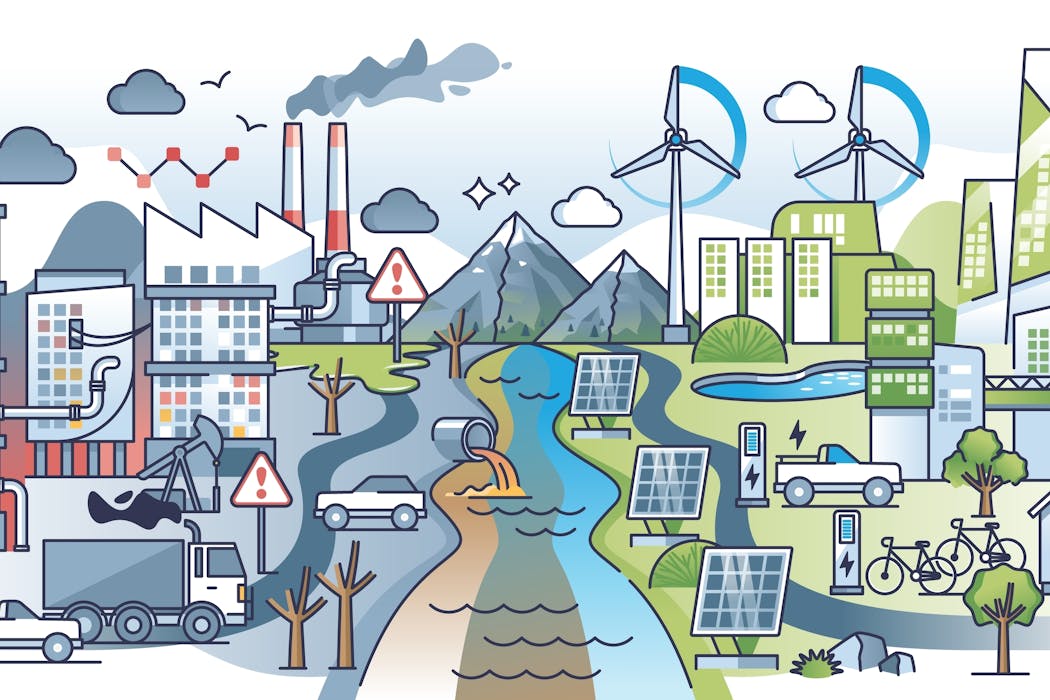
In the wake of the 2007-08 global financial crisis, green finance has been increasingly celebrated as a way to tackle environmental challenges. Banks, investment funds and insurers have rolled out a growing range of green products, from green bonds to sustainability-linked loans. This momentum is encouraged by international environmental efforts such as the Paris climate agreement.

By aligning financial flows with sustainability goals, the world can supposedly “green finance” its way into a sustainable future.

But beneath this green spectacle lies a more complicated reality. Green finance refers to a wide-ranging mix of private and public funds, products and practices. For example, there’s no consensus regarding what makes a bond green.

There is also little clarity around what current environmental, social, governance (ESG) frameworks – which encourage businesses and authorities to disclose and monitor their environmental and social performance – are truly achieving.


Ever wondered how to spend or invest your money in ways that actually benefit people and planet? Or are you curious about the connection between insurance and the climate crisis?

Green Your Money is a new series from the business and environment teams at The Conversation exploring how to make money really matter. Practical and accessible insights from financial experts in the know.


In 2015, the former Bank of England governor and current Canadian prime minister, Mark Carney, insisted that finance can and must urgently account for climate risks. Meanwhile, Stuart Kirk, former global head of responsible investments at high street bank HSBC, argued that these risks were overstated and too far in the future to be material.

Environmental issues have become a concern for financiers, but not necessarily out of commitment to improving planetary health – rather due to reporting costs, transition risks and reputational pressure. High-profile greenwashing scandals, such as “green bonds” allegedly linked to deforestation in Sumatra, have further eroded trust. This raises questions about whether green finance is more a branding exercise than transformation.

ESG investing explained.

In the face of these ambiguities, the environmental sciences are involved in the expansion of green finance. As social scientists we have been following these developments, wondering whether they may help us pin down robust ways to develop green finance.

Some companies are now using science-based targets (emission reduction goals aligned with climate science), net zero transitions pathways or roadmaps, and high-integrity carbon credits (verified purchases of direct air capture credits to offset greenhouse gas emissions).

Most of these claim to rely on rigorous calculations. The language of science grants objectivity and legitimacy. At its most basic level, this “sciencewashing” uses the vocabulary and authority of science to claim sustainability outcomes.


Read more:
Green bonds can help finance clean energy – as long as the projects they fund are transparent


Green finance also provides many employment opportunities for environmental scientists who can work as consultants, auditors and certifiers, to assess the quality of green claims. Many startups have emerged, offering a range of high-tech services to provide environmental data to companies. That includes monitoring deforestation through remote sensing or using sounds to analyse wildlife activity.

Green finance-related industries are flourishing and more and more environmental graduates are being recruited to quantify emissions, build risk metrics, monitor changes in biodiversity and verify credits.

Sciencewashing

Drawing on five years of research and combining data emerging from participation in green finance conferences and seminars, interviews and document analysis, our study warns against different forms of sciencewashing.

london city skyline with green trees
Financial centres, like London, thrive on green finance but beyond them the benefits are unclear.
Taljat David/Shutterstock

Mounting evidence suggests a gap between the suggested possibilities and the actual outcomes of green finance. Many green finance products appear to serve financial markets and the wealthiest investors more than nature or vulnerable communities.

Even more concerning are the unintended consequences. Far from levelling the playing field, green finance can exacerbate inequality. For example, communities have been displaced to make room for renewable energy projects or offset schemes.

This creates what are known as green sacrifice zones: areas where environmental harm or social costs are tolerated in the name of advancing “green” goals.

Poorer countries often face higher borrowing costs in the name of climate risk, while wealthy economies continue to access cheaper capital. Insurance premiums are also rising in climate-vulnerable regions, pricing out those least able to afford them. So green finance can make the situation for the most vulnerable populations worse.

In its current form, green finance will most likely sustain business as usual, leaving the causes of environmental crisis untouched.

For green finance to deliver the transformative change its advocates promise, it must address the deeper political and social issues, such as the role of public authorities in regulating finance, or the relationship between green investment and global inequality.

If green finance is to serve collective wellbeing rather than the interests of a privileged few, we need rigorous and proactive public regulations and better public debates on what green finance ought to account for.


Don’t have time to read about climate change as much as you’d like?

Get a weekly roundup in your inbox instead. Every Wednesday, The Conversation’s environment editor writes Imagine, a short email that goes a little deeper into just one climate issue. Join the 45,000+ readers who’ve subscribed so far.


The Conversation

The authors do not work for, consult, own shares in or receive funding from any company or organisation that would benefit from this article, and have disclosed no relevant affiliations beyond their academic appointment.

ref. Why ‘green’ finance isn’t always as sustainable as it seems – https://theconversation.com/why-green-finance-isnt-always-as-sustainable-as-it-seems-265240

How to green your money

Source: The Conversation – UK – By Anna Turns, Senior Environment Editor, The Conversation

Studio Romantic/Shutterstock

This roundup of The Conversation’s climate coverage was first published in our award-winning weekly climate action newsletter, Imagine.

Have you recycled today? Opted to walk or get public transport instead of taking the car? We all make dozens of small choices every day, each with environmental pros and cons. Very often, these choices come down to how and where we as consumers spend our money. But one thing we probably don’t think about much is what our cash is doing when we’re not spending it.

Everyday bank deposits by “ordinary” people are a quiet powerhouse of potential for environmental change. In the UK alone, billions of pounds are deposited every month. Most of this cash is swirling around in the global economy, supporting industry and innovation, as well as individuals. The uncomfortable truth, though, is that this investment might be pumped into environmentally or socially damaging sectors that we wouldn’t support in our day-to-day lives.


Ever wondered how to spend or invest your money in ways that actually benefit people and planet? Or are you curious about the connection between insurance and the climate crisis?

Green Your Money is a new series from the business and environment teams at The Conversation exploring how to make money really matter. Practical and accessible insights from financial experts in the know.


When it comes to shifts towards greener living, consumers wield huge amounts of power. After all, they can determine which companies – and cultures – thrive. But beyond consumer spaces like the supermarket or the car showroom, it’s banks that decide how and where much of the world’s money enters the economy and which sectors benefit.

Styliani Panetsidou and Angelos Synapis are finance experts at the Centre for Resilient Business and Society at Coventry University. They say that in this age of climate crisis, decisions on where banks lend our money are immensely powerful. “To put it simply,” they say, “lending for housing can expand the property market, financing renewable energy can support low-carbon infrastructure, while funding coal mines or oil and gas extraction may risk locking in future carbon emissions over decades.”

Banks want returns, though. Historically, oil and gas have provided these. But in this sector too, the power of the consumer is becoming more evident and transparency around investments is slowly improving. Panetsidou and Synapis add: “With this in mind, perhaps it is time to consider whether the bank we select could subtly influence environmental outcomes.”


Read more:
Your essential guide to climate finance


Misplaced loyalty?

But still, investments in low-carbon energy companies fall short of those pumped into oil, gas and coal. There are banks out there that exclude fossil fuels from their loans and investments, but they’re not the default. Part of the problem could be that the consumer-bank relationship is often settled quite early in life. It’s even been said that we’re more likely to break up with our partner than with our bank.

This psychological inertia around banking has a strong grip, despite the potential for a simple switch to cut our environmental impact. Marcel Lukas, banking and finance expert at the University of St Andrews, says that despite systems that make changing banks easy and secure, it’s still not a transition that most consumers are likely to make. “The process works, but behaviour lags.”

He suggests three psychological hacks to rewire our preference for stability – and these behavioural changes can extend beyond banking. Lukas says they can “also shape decisions about savings products, energy tariffs and mobile contracts – choices that all come with environmental consequences”.

aerial shot of damaged houses on tropical island with palm trees
Hurricane damage on Jamaica in 2024.
Deron Levy/Shutterstock

Paying a premium

The intersection between climate and finance is rarely so evident as in the world of insurance. Extreme weather events aren’t just devastating for households and property owners, surging levels of weather-related claims are pushing the insurance industry to breaking point.

Repeated claims can leave homeowners sitting in a property that’s uninsurable and unmortgageable. The knock-on from this is falling house values, and a looming threat to the wider financial system worldwide.


Read more:
How extreme weather will affect the insurance and energy sectors


Meilan Yan, financial economist, and water engineer Qiuhua Liang, of Loughborough University, say the clear warning signs aren’t being heeded. “Unless lenders adopt climate-adjusted risk models that integrate physical hazards such as flooding, storms and heatwaves,” they explain, “they risk underestimating the true exposure of their mortgage portfolios.”

The consequences go beyond the individual tragedy of a flood-ravaged home, while at the same time extreme weather events are no longer exceptional: “Traditional financial crises follow cycles of growth, downturn and recovery, but climate risk moves in only one direction.”


Don’t have time to read about climate change as much as you’d like?

Get a weekly roundup in your inbox instead. Every Wednesday, The Conversation’s environment editor writes Imagine, a short email that goes a little deeper into just one climate issue. Join the 45,000+ readers who’ve subscribed so far.


The Conversation

ref. How to green your money – https://theconversation.com/how-to-green-your-money-268142

Why healthcare’s ‘do no harm’ ethic must include the planet

Source: The Conversation – UK – By Muireann McMahon, Associate Professor, School of Architecture & Product Design, University of Limerick

Roman Larchikov/Shutterstock

Every product we touch has a footprint. A phone, a fridge, a hospital syringe. Each begins and ends in the same place: the planet’s resources.

The EU’s recent ecodesign for sustainable products regulation aims to break the cycle of take, make, waste by forcing manufacturers to think circularly. Products will need to last longer, be easier to repair and feed back into the economy instead of the landfill.

It represents a major shift for most industries. But for healthcare, where safety and sterility come first, it could be revolutionary.

The healthcare industry is responsible for roughly 4.4% of global carbon emissions, with 71% coming from the production, provision, and disposal of medical technology (medtech) products and services.

In the UK alone, the NHS generates approximately 156,000 tonnes of waste each year from hospitals and specialist clinics, equivalent to more than 5,700 40ft containers. Up to 90% of such waste comes from single-use disposable products or components.


Read more:
Reusing medical equipment is good for the planet. But is it safe?


Although medical products are included under the ecodesign regulation, the rules will only apply where patient health and safety are not compromised. Products that pose a risk to patients, such as those where infection, contamination, or reduced effectiveness could occur, may be exempt.

But are considerations for human health and environmental protection really at odds with one another? Or can we expand the principle of “do no harm” to include the planet itself?

In the US, climate commitments are being rolled back. The Trump administration’s withdrawal from the Paris climate agreement has slowed progress toward a more sustainable medtech industry. Implementation of new emissions standards has also been delayed, including rules to reduce ethylene oxide, a cancer-causing chemical used to sterilise surgical kits and medical devices.

These setbacks stall innovation in cleaner, safer alternatives such as CO₂ and UV light sterilisation. This matters because reusing devices, when safely sterilised, could dramatically reduce waste and resource use.

Fortunately, many sustainability gains in medtech are already within reach. By examining the full lifecycle of devices, from production to disposal, it is possible to identify where the biggest improvements can be made.

Green public procurement policies can immediately encourage healthcare providers to make more sustainable purchasing choices. Smarter research and development decisions can improve repairability, reduce material use and waste, and simplify components for easier assembly and disassembly.

Standardisation also enables interchangeable parts across devices, as seen with consumer products’ universal power supplies. This approach extends product lifespans and allows parts to be recovered and reprocessed for use in future devices, provided they meet the necessary medical standards.

Using consistent materials across devices also ensures they are directed into the correct waste, recycling, or reuse streams rather than ending up in landfill. Even sterile packaging can be reimagined to minimise volume, avoid mixed materials, and favour fully recyclable mono-materials.

Some of the world’s leading medtech companies are already proving what is possible. Medtronic is aiming for net-zero emissions by 2030 through designing smaller, longer-lasting products, investing in new materials and enforcing responsible sourcing across its supply chain.

Johnson and Johnson is cutting waste by recycling and using closed-loop systems to recapture valuable materials from single-use devices. The company also measures and publicly shares the environmental footprint of its products.

Abbott, a global healthcare and medical devices company, has committed to a 90% reduction in waste across its product lifecycles, with a particular focus on minimising the environmental impact of packaging.

The path to a sustainable medtech industry is not without challenges, but it is achievable. As regulations advance, companies innovate and healthcare professionals push for change, the sector has an opportunity to redefine what innovation really means. It is no longer just about safer, more efficient care – it is about care that protects the planet too.

With the medtech industry valued at US$587 billion in the US (£459 billion) alone, and 8% of that investment directed toward research and development, the potential for transformation is enormous. Imagine the progress if even a fraction of that funding were channelled into responsible innovation – empowering every stakeholder through education, engagement and sustainable action.

By aligning environmental responsibility with patient safety, and investing in circular design, smarter procurement, connected infrastructures and genuine collaboration, medtech can show that health and sustainability are not competing priorities. They are, in fact, inseparable.

The Conversation

Muireann McMahon does not work for, consult, own shares in or receive funding from any company or organisation that would benefit from this article, and has disclosed no relevant affiliations beyond their academic appointment.

ref. Why healthcare’s ‘do no harm’ ethic must include the planet – https://theconversation.com/why-healthcares-do-no-harm-ethic-must-include-the-planet-262908

When the dam broke: the 1925 disaster that reshaped a Welsh community and a country’s safety laws

Source: The Conversation – UK – By Lynda Yorke, Associate Professor (Senior Lecturer) in Critical Physical Geography, Bangor University

Nestled between the Caerneddau mountains and the Afon (River) Conwy, the small village of Dolgarrog in north Wales looks peaceful. But the huge hydro-electric pipes that run down the hillside are a constant reminder of the village’s history, and of how the same source of power that once brought prosperity also unleashed disaster.

On November 2 1925, the dam at Llyn Eigiau burst. A torrent of water and boulders thundered down the valley, sweeping through the northern part of Dolgarrog and destroying the small settlement of Porth Llŵyd. Sixteen people were killed.

One hundred years later, Dolgarrog’s story is not just one of tragedy. The village has become what its residents call a living memorial. It’s a place where disaster is not only remembered, but woven into the landscape, the law and the community’s sense of itself.

At 8pm on that night, the inhabitants of Dolgarrog felt the force of a catastrophic sequential engineering failure in the mountains above.

Two reservoirs, Llyn Eigiau and lower Coedty, supplied electricity to the local aluminium works, an industry that sustained the village. But the upper dam at Eigiau had been built on a foundation of glacial clay and boulders. After a dry summer, the clay had cracked. When autumn rains came, water seeped through. The dam wall gave way, unleashing a surge down the afon Porth Llŵyd.

This flood rapidly reached the lower Coedty dam, overwhelming its embankment. As the second dam failed, the water rushed like a massive tsunami wave down the steep gorge of afon Porth Llŵyd. Ripping out the hydro-electric pipeline, it created a deadly flow of water, debris and boulders that destroyed homes, and swept villagers into the afon Conwy.

Newsreel footage depicting the aftermath of the Dolgarrog dam disaster.

From local tragedy to national protection

The Dolgarrog disaster was not the first dam failure in the UK, but it was the one that forced government action. Public outrage over the deaths of 16 villagers led directly to the Reservoirs (Safety Provisions) Act 1930, the first law in the UK to regulate dam safety.

For the first time, large reservoirs had to be inspected and supervised by qualified, independent engineers. This ended the era when private companies could self-regulate. It marked a major shift in how the UK governed risk and infrastructure.

The event was codified into national law and updated in 1975. It created an invisible, yet mandatory, safety structure that continues to protect people today.

If the law is an unseen memorial, the land around Dolgarrog is a visible one. The remnants of the Llyn Eigiau dam wall still stand, a stark reminder of the engineering flaws that caused the disaster.

Downstream toward the Coedty dam, the torn-up peat moorland is barely visible. But the afon Porth Llŵyd gorge still shows the impact of the powerful flood, constrained by its bedrock walls. As the flood waters thundered down the gorge, they shattered, split and tore at the bedrock walls, ripping huge boulders from their rest.

The boulders dumped at the gorge’s outlet, formed a huge fan of rock debris still visible at the roadside – a chilling, preserved record of the suffering.

That landscape tells a story, not just of destruction but of recovery. The village’s memorial walk, created in 2004 around the boulder field, traces the path of the flood and symbolises the community’s ability to reclaim the space. It is both a site of reflection and an everyday walking route. This is cultural resilience and proof that remembrance and daily life coexist.

Disasters are not just events of the past: shape how we individually and collectively experience places, politics and society. Dolgarrog’s residents are marking the centenary with a programme of events under the banner “Dolgarrog Past, Present and Future”. These include commissioned art, musical performances, history projects and a lantern parade – acts of remembrance that also look forward.

Lessons for today

The lessons of Dolgarrog are as urgent now as they were a century ago. In an age of climate change, when extreme rainfall and flood risks are rising, the need for strong safety standards and accountable infrastructure has never been greater.

The 1925 disaster shows why state oversight of private infrastructure is vital when public lives depend on it. It also offers a model of resilience, one that is legislative as well as communal.

A hundred years on, the memory of the 16 villagers who died is not only preserved in stone and ceremony, but in the law itself, and in the ongoing safety of every major reservoir across the UK. Dolgarrog remains a living memorial to both the dangers of neglect and the power of collective renewal.

The Conversation

Lynda Yorke receives funding from NERC, British Council and Learned Society of Wales.

Giuseppe Forino has received funding from NERC, British Council and Learned Society of Wales.

ref. When the dam broke: the 1925 disaster that reshaped a Welsh community and a country’s safety laws – https://theconversation.com/when-the-dam-broke-the-1925-disaster-that-reshaped-a-welsh-community-and-a-countrys-safety-laws-267701

Sharia law isn’t taking over Britain – it’s an inevitable legacy of its colonial legal history

Source: The Conversation – UK – By Femi Owolade, Research Associate, Sheffield Hallam University

Kam Hus/shutterstock

Every few years, a familiar anxiety resurfaces in British public discourse: that sharia law is establishing a parallel legal system and threatening the sovereignty of English law. Those fears were reignited following Donald Trump’s recent speech to the UN, where he claimed that London wants “to go to sharia law”.

Such claims ignore two realities. First, that the English legal system is adaptive and capable of accommodating diversity. And second, that having multiple legal systems is – far from undermining British law – an inevitable legacy of Britain’s colonial history. Looking to that history, it should be no surprise that it is a feature of modern, multicultural Britain.

My research shows how British colonial administrators deliberately designed plural legal systems to sustain imperial rule. The colonial state recognised that it could not rule diverse populations by imposing English law on multicultural societies.

In northern Nigeria, this approach became a defining feature of colonial governance. English law operated alongside Islamic courts, which handled family disputes and aspects of land tenure. Allowing limited autonomy for Africans under sharia was both a pragmatic and political strategy. It maintained local legitimacy while ensuring that English law remained supreme in cases of conflict.

A similar arrangement existed in British India. This legacy continues to shape how law functions in postcolonial, multicultural Britain today.

How sharia operates in Britain today

There is no separate sharia legal system in the UK. What exist are sharia councils and the Muslim Arbitration Tribunal. The sharia councils have no statutory authority under English law. They may be used to resolve personal disputes such as marriage, divorce and inheritance.

The Muslim Arbitration Tribunal, in existence since the early 2000s, operates under the Arbitration Act 1996. This law allows private arbitration between consenting adults in civil disputes. But such tribunals must operate within the boundaries of English law.

Sharia councils have a slightly longer history, dating back to the 1980s. Their number and activities are difficult to track: in 2009, rightwing thinktank Civitas approximated at least 85, while a 2012 study by a researcher at the University of Reading identified 30.

No comprehensive survey has been conducted since, leaving the exact number uncertain. This lack of official oversight fuels the perception that the councils pose a challenge to Britain’s legal sovereignty.

But, as a 2018 Home Office review confirmed, sharia councils hold no legal jurisdiction in England and Wales.

The review did acknowledge concerns raised by women’s rights groups about gender inequality and lack of representation of women in some councils. It concluded that these issues called for better regulation and oversight, and that the “state would be justified in intervening” in bad practices by sharia councils that disadvantage women.

It also found that public fears are fuelled by misleading terms, used in both the media and sometimes by councils themselves. For example, referring to the councils as “courts” and their members as “judges” reinforces misconceptions about the existence of a parallel legal system.

Multifaith Britain and the law

English law is capable of accommodating and regulating diverse legal practices without losing its sovereignty. Besides sharia councils, other faith-based arbitration bodies exist in Britain.

The Beth Din courts, for example, serve the Jewish community, offering guidance on issues of marriage and divorce. While they cannot compel a divorce, they can encourage or persuade a husband to grant a religious divorce certificate.

The Roman Catholic Church, which complies with the Marriage Act 1949, operates its own tribunals to consider annulments under canon law. None of these institutions undermine the authority of English courts.

The same applies to sharia councils. Participation is voluntary: individuals choose to use these forums, often to resolve family or inheritance matters in line with their faith. English civil courts remain fully available to them.

Following concerns about the protection of women’s rights in the councils, the 2018 Home Office review recommended stronger safeguards. These include requiring civil registration of marriages, greater transparency in decision-making, and education about legal rights.

The review found that nearly all users of the sharia councils were women, with over 90% seeking an Islamic divorce. Many were unable to obtain a civil divorce because their marriages had never been registered under English law, leaving them without legal recourse in the civil legal system.

The review stressed that its proposed safeguards were designed to protect vulnerable women, rather than suppress or prohibit sharia councils from operating. This recognises that the demand for religious divorce will continue regardless of sharia prohibition.

The UK government accepted the review’s findings but has not established a regulatory body. This suggests that most safeguards are currently dependent on voluntary good practice within the councils.

Postcolonial legal pluralism

In a postcolonial, multifaith society like Britain, legal pluralism is not a sign of a fragmented legal sovereignty – it’s an acknowledgement of social reality. The persistence of sharia in modern Britain reflects a society still negotiating how to govern cultural and religious difference through law, as the empire once did.

Other postcolonial societies have accepted this. In India, different personal law systems for Hindus, Muslims and Christians coexist under one constitution. There is an ongoing debate in the country about how to balance faith-based identity with the rights guaranteed by the secular state.

The same question now faces Britain. The challenge is not whether to recognise the arbitrating powers of sharia councils, but how to regulate them fairly – ensuring that every citizen, regardless of faith, can exercise their rights within the boundaries of English law.

The Conversation

Femi Owolade does not work for, consult, own shares in or receive funding from any company or organisation that would benefit from this article, and has disclosed no relevant affiliations beyond their academic appointment.

ref. Sharia law isn’t taking over Britain – it’s an inevitable legacy of its colonial legal history – https://theconversation.com/sharia-law-isnt-taking-over-britain-its-an-inevitable-legacy-of-its-colonial-legal-history-267262

New ‘miniature T rex’ rewrites the history of the world’s largest predator

Source: The Conversation – UK – By Abi Crane, Postgraduate Researcher in Palaeontology, University of Southampton

A pack of Nanotyrannus attacks a juvenile T. rex Anthony Hutchings, CC BY-NC-ND

A new specimen of one of the most controversial species of dinosaur has the
potential to overturn decades of research on the T rex.

Nanotyrannus, the “miniature T rex”, has been the centre of one of the fiercest debates in palaeontology. Scientists have long argued over whether the Nanotyrannus is a separate species or just a young T rex.

The controversy was ignited in 1999 when the only known fossil of a Nanotyrannus was found to belong to a juvenile. More complete fossils have since failed to produce any conclusive answers because they were all also found to be juvenile.


Read more:
Five things you probably have wrong about the T rex


But the debate surrounding the identity of Nanotyrannus may finally be settled. A new fossil specimen, described in the journal Nature, is the smoking gun researchers have been looking for: an adult Nanotyrannus.

Woman sitting on large dinosaur fossil
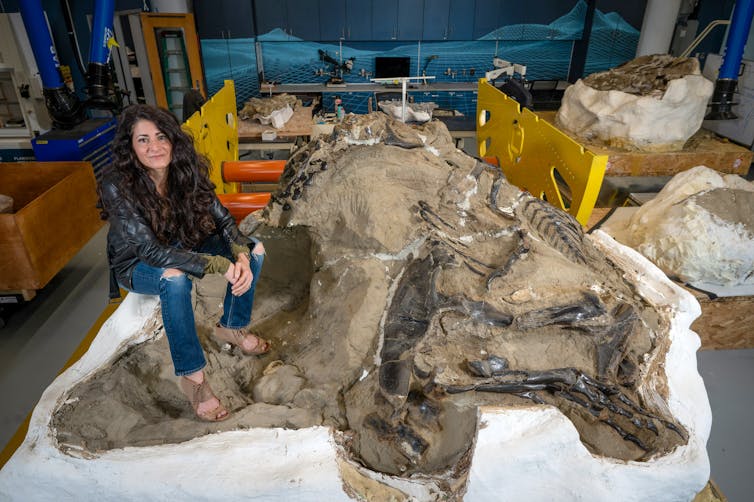
Lindsay Zanno, associate research professor at North Carolina State University, with the dueling dinosaurs fossil.
N.C. State University, CC BY-NC-ND

Known as the duelling dinosaurs, this fossil preserves an almost-complete
Nanotyrannus and Triceratops entombed together. They seem frozen in combat (whether they were actually fighting when they became buried in the Earth’s sediment remains to be tested). Although the fossil was discovered in Montana, US back in 2006, it was under private ownership until the North Carolina Museum of Natural Sciences purchased it in 2020. Now accessible to scientists, the true nature of this remarkable fossil can be revealed for the first time.

The researchers have confirmed that Nanotyrannus is a separate miniature type of tyrannosaur by demonstrating this specimen belonged to a near fully-grown adult. The age and maturity of dinosaurs can be assessed by looking at the inside of their bones. Dinosaurs grew in cycles of faster and slower growth which produced distinct layers of bone. When cut open and examined under a microscope, these marks can be counted like rings in a tree.

Using this method, the researchers could determine that the Nanotyrannus in the duelling dinosaurs was at least 14 years old when it died. The researchers also found its rate of growth had slowed significantly in its final years, indicating that this individual was nearly at full body size.

So just how small was this miniature T rex? Nanotyrannus is only around one tenth of the size of a fully grown T rex. Being one of the largest predators to ever walk the Earth, however, T rex would make most animals look small. The duelling dinosaurs Nanotyrannus is over four metres long and estimated to have weighed over 700kg – that’s as heavy as some of the very largest polar bears.

Other specimens of Nanotyrannus are even bigger. The almost complete skeleton known as Jane, discovered in 2001 also in Montana, is estimated at over a ton, larger than any land predator alive today.

Fossil dinosaur skull
Nanotyrannus lancensis skull shows its teeth are not serrated.
N.C. Museum of Natural Sciences, CC BY-NC-ND

The researchers have found enough differences in the shape of bones in the skulls of the duelling dinosaurs fossil and the larger Jane to separate them into two different species; Nanotyrannus lancensis and the newly-named Nanotyrannus lethaeus.

Other than small size, another feature that the researchers have used to distinguish Nanotyrannus from T rex is the number of teeth. Despite its much smaller mouth, Nanotyrannus could no doubt pack a powerful bite with its over 60 teeth. T rex had 40-50 teeth in its jaws.

The teeth themselves are also different. Nicknamed “lethal bananas”, the teeth of T rex are curved and serrated like steak knives. These unique teeth are perfect for slicing into flesh and could crush bone. By contrast, some of the teeth of Nanotyrannus are straight, chisel-like and without serrations, more closely resembling those of other types of carnivorous dinosaur.

T rex had famously tiny arms, the source of many jokes and dinosaur impressions. Nanotyrannus does not

ref. New ‘miniature T rex’ rewrites the history of the world’s largest predator – https://theconversation.com/new-miniature-t-rex-rewrites-the-history-of-the-worlds-largest-predator-268678

Latin America is reviving the ‘iron fist’ approach to law enforcement

Source: The Conversation – UK – By Adriana Marin, Lecturer in International Relations, Coventry University

A massive anti-drug raid in Rio de Janeiro left 132 people dead in the early hours of October 28 as Brazil’s security forces confronted one of the country’s biggest crime gangs. It was one of the deadliest security operations in modern Brazilian history.

Around 2,500 officers descended on the favelas of Complexo do Alemão and Complexo da Penha, strongholds of Brazil’s oldest criminal group, Comando Vermelho. There were more than 80 arrests.

Authorities described the operation as the country’s “biggest gang raid in history”. Human Rights Watch in Brazil called the episode “a huge tragedy”.

Beyond the immediate shock, the operation raises deeper questions about the resurgence of militarised policing models across Latin America. These are often labelled under the banner of mano dura – the “iron-fist” approach.

Mano dura policies prioritise forceful state intervention, military-style policing and mass incarceration as mechanisms to reassert territorial control and deter organised crime. These strategies have a long history in Latin America, particularly in central America during the early 2000s, when governments in El Salvador, Honduras and Guatemala adopted militarised responses in the face of rising gang violence.

What distinguishes the current wave is its intensity and the geopolitical narratives that accompany it. Rather than being seen as exceptional, mano dura is increasingly treated as a legitimate and even necessary model of governance in the face of criminal insurgency and institutional fragility.

The Rio raid appears to be part of this broader shift. Brazil has long grappled with powerful criminal factions. The gangs control territory, levy taxes and provide informal governance in the favelas and prison systems of Rio.

As fears of gang power have risen, so has support for militarised intervention. Many see a hardline approach as the only viable means of restoring order. The electoral success of Jair Bolsonaro in 2018, built on promises of aggressive policing and the expansion of military influence in civilian affairs, reflected this sentiment.

The current president, Luiz Inácio “Lula” da Silva, has positioned himself as a moderate alternative. But this week’s raid suggests that the structural pressures driving mano dura politics persist across administrations, regardless of their ideology.

International political dynamics have played a significant role in the resurgence of militarised security strategies. The rhetoric of “law and order” popularised globally by figures such as Donald Trump has reframed domestic security – not as a social or economic challenge, but as a war requiring overwhelming force.

Trump’s statements praising extrajudicial killings of drug traffickers and his advocacy for deploying the military to “take back” American cities have resonated beyond the US.

It would be inaccurate to claim that US politics directly cause security crackdowns in Latin America. But it contributes to a widely accepted narrative which frames displays of state violence as decisive leadership rather than as democratic backsliding.

Militarised policing

This phenomenon aligns with a broader global trend in which states use militarised policing as a tool of political legitimacy. In Latin America, leaders across the political spectrum have capitalised on public fear of crime to justify extraordinary security measures.

Nayib Bukele, El Salvador’s strongman leader, has achieved record approval ratings after implementing mass detentions and militarised crackdowns on gangs. In Brazil, the Rio raid may be interpreted in this light. It was a demonstration of state authority designed to reassure voters that the government is willing to use force to restore order.

But there are significant risks to this approach. Historical evidence from Latin America indicates that mano dura policies often deliver only temporary reductions in violence. Meanwhile they tend to undermine institutional legitimacy in the long term.

Mass raids and lethal confrontations can fragment criminal organisations, leading to splinter groups that generate further instability. Militarised policing can deepen mistrust between communities and the state.

This is particularly the case in marginalised areas where residents already feel excluded from formal institutions. Excessive use of force without due process risks normalising extrajudicial killings and diminishing accountability, eroding democratic norms.

The Rio raid also reflects a changing power dynamic in the region. Criminal organisations such as Comando Vermelho have evolved beyond their drug-trafficking origins. They now operate as parallel governance systems.

They control territory and the provision of welfare. Many of these gangs wield considerable political influence.

In this context, mano dura is not only a security policy. It’s become more of a response to perceived challenges to the state’s power.

The use of large-scale force can be understood as a performative attempt to reassert territorial dominance. This aligns with what some scholars describe as the “punitive turn” in Latin America. Countries like Brazil increasingly use coercive power to demonstrate authority rather than to resolve underlying drivers of violence.

Cycles of violence

There is a broader question. Will this approach achieve lasting security or will it merely reproduce cycles of violence? In countries where judicial systems are weak and prisons are overcrowded, militarised operations often funnel recruits into criminal networks rather than dismantling them. Brazil’s own experience illustrates this.

Many of the country’s most powerful criminal factions, including Comando Vermelho itself, originated within the prison system during periods of mass incarceration.

It is also important to recognise that mano dura policies are often implemented in the absence of viable alternatives. Policymakers face immense pressure from citizens to deal with this security crisis. In some cases, communities themselves may call for military intervention, viewing it as the only way to dislodge criminal control.

This creates a security paradox. While forceful interventions may be politically popular, they can inadvertently reinforce the very conditions that allow criminal organisations to thrive.

The Rio raid therefore presents a critical moment for reassessing security governance in Latin America. It highlights the challenges governments face in balancing public demands for safety with the need to preserve democratic institutions and human rights. It also raises questions about the role of international influence in shaping security policy.

The global resurgence of punitive approaches, legitimised by leaders like Trump, has helped reshape the boundaries of what is considered acceptable in state responses to crime. As governments face growing security challenges, the appeal of mano dura will continue to grow.

Yet the question remains whether these tactics represent a solution to violence or a symptom of deeper institutional crisis.

The Conversation

Adriana Marin does not work for, consult, own shares in or receive funding from any company or organisation that would benefit from this article, and has disclosed no relevant affiliations beyond their academic appointment.

ref. Latin America is reviving the ‘iron fist’ approach to law enforcement – https://theconversation.com/latin-america-is-reviving-the-iron-fist-approach-to-law-enforcement-268596

The Scottish king who wrote a treatise on demonology and obsessed over witches

Source: The Conversation – UK – By Gemma Ware, Host, The Conversation Weekly Podcast, The Conversation

Suspected witches kneeling before James VI in Daemonologie, his 1597 treatise on witches. Wikimedia Commons

In the 16th century, witches and demons weren’t just for Halloween. People were terrified and preoccupied with them – even kings.

In 1590, James VI of Scotland – who was later also crowned James I of England – travelled by sea to Denmark to wed a Danish princess, Anne. On the return journey, the fleet was hit by a terrible storm and one of the ships was lost.

James, a pious Protestant who would go on to sponsor the translation of the King James bible, was convinced he’d been the target of witchcraft. On his return, he set in motion the brutal North Berwick witch trials.

A few years later, James decided to write a treatise called Daemonologie, setting out his views on the relationship between witches and their master, the devil.

Meanwhile, another firm Halloween favourite – ghosts – had fallen out of favour in the wake of the Protestant Reformation because they were seen as a hangover from Catholicism.

In this episode of The Conversation Weekly podcast, Penelope Geng, an associate professor of English at Macalester College in the US who teaches a class on demonology, takes us back to a time when beliefs around witches, ghosts and demons were closely tied to religious politics. She explains how these beliefs  have come to influence the way witches and ghouls have been portrayed in popular culture ever since:

It seemed that at a very grassroots level, people believed in the existence of witches and devils. At a very high theological level, writers were talking about it. So I think, compared to today, the early modern period really was a moment in which people were somewhat obsessed with thinking about this eternal struggle between good and evil and their own place in this warfare.

You can also read an article Penelope Geng wrote on the difference between ghosts and demons, and the way they were portrayed in literature, as part of The Conversation’s Curious Kids series.

This episode of The Conversation Weekly was written and produced by Katie Flood, Mend Mariwany and Gemma Ware. Mixing by Eleanor Brezzi and theme music by Neeta Sarl.

Listen to The Conversation Weekly via any of the apps listed above, download it directly via our RSS feed or find out how else to listen here. A transcript of this episode is available on Apple Podcasts or Spotify.

The Conversation

Penelope Geng does not work for, consult, own shares in or receive funding from any company or organisation that would benefit from this article, and has disclosed no relevant affiliations beyond their academic appointment.

ref. The Scottish king who wrote a treatise on demonology and obsessed over witches – https://theconversation.com/the-scottish-king-who-wrote-a-treatise-on-demonology-and-obsessed-over-witches-268595