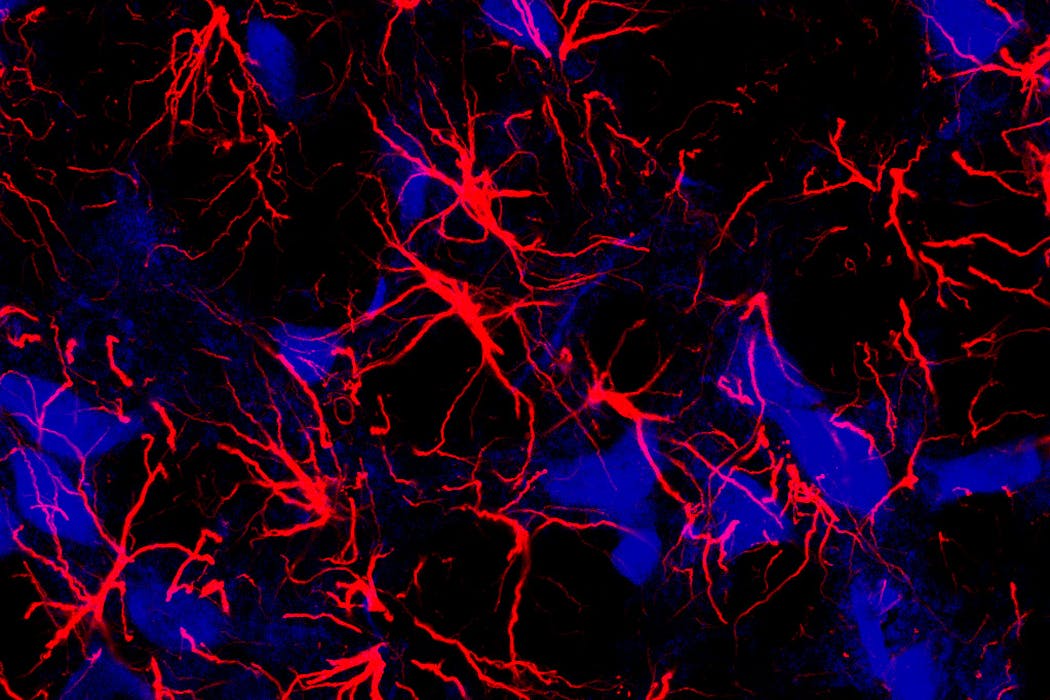
Delivering a connection-building protein to star-shaped cells in the brain could reverse changes to neural circuits seen in Down syndrome, according to new research my colleagues and I published in the journal Cell Reports.
Down syndrome is caused by an error in cell division during development. Individuals receive three copies of chromosome 21 instead of the typical two copies, resulting in duplicates of the genes encoded on chromosome 21. This trisomy leads to a multitude of changes to heart and immune function as well as neurodevelopmental impairments.
Changes to the structure of neurons in people with Down syndrome alter how they connect with each other. One major type of brain cell called astrocytes helps form connections between neurons. These star-shaped cells have many thin arms that extend into the spaces between neurons. They also secrete various proteins that are vital to forming the proper neural connections necessary for brain function.
Researchers have found that mouse models of several neurodevelopmental disorders, including Down syndrome, have altered levels of astrocyte proteins during development. My colleaguesand I hypothesized that these changes might contribute to the changes in neural connections seen in Down syndrome. Could restoring the proper levels of some of these astrocyte proteins “rewire” the brain?
Identifying an astrocyte protein
First, we needed to pick a candidate astrocyte protein to test our hypothesis. A previous study had identified a list of astrocyte proteins that were altered in a mouse model of Down syndrome. We focused on proteins present in lower levels in Down syndrome astrocytes compared to astrocytes without the condition. We thought there might not be enough of these proteins available to help form neural connections.
Among the top 10 proteins we identified was a molecule called pleiotrophin, or Ptn. This protein is known to help guide axons – long extensions that neurons use to send information to each other – to their targets during development. So it made sense that it might also help neurons form the branching arms they use to receive information.
We found that mice unable to produce Ptn had neurons with fewer branching arms, similar to what we saw in mice with Down syndrome. This correlation implies that proper Ptn levels are necessary to affect neuron branching during brain development.
Restoring neurons in Down syndrome
Next, we wanted to know if delivering Ptn to astrocytes changes neural connections in mice with Down syndrome.
To answer that question, we packaged the gene for Ptn into a small virus with its replication genes removed. Called adeno-associated viruses, these tools allow researchers to deliver genetic material to specific targets in the body and are used for applications like gene therapy. We delivered the Ptn gene into astrocytes throughout the entire brain of adult mice with Down syndrome so we could evaluate its effects.
We focused on the visual cortex and the hippocampus, areas of the brain involved in vision and memory that are both critically affectedin Down syndrome. After enhancing the ability of astrocytes to produce Ptn, we found that both regions recovered levels of neural branching density similar to those of mice without Down syndrome.
Finally, we wanted to see if we could actually restore electrical activity levels in the hippocampus by increasing astrocyte Ptn levels. Measuring electrical activity can indicate whether neurons are functioning properly. After delivering the Ptn gene to the astrocytes of mice with Down syndrome, we found the electrical activity of their hippocampus restored to levels no different from mice without Down syndrome.
Together, our findings show that delivering Ptn to the astrocytes of mice can reverse changes to neuron structure and function seen in Down syndrome. While our findings are far from ready to be used in the clinic, more research could help us understand whether and how Ptn could help improve the health of human patients.
Rewiring the brain
More broadly, our findings suggest that astrocyte proteins have the potential to rewire the brain in other neurodevelopmental conditions.
Typically, adult brains have low plasticity, meaning they have a decreased capacity to form new connections between neurons. This means it can be difficult to change neural circuits in adults. Our hope is that further exploration on how astrocyte proteins can alter the adult brain could lead to new treatments for neurodevelopmental disorders like Fragile X syndrome or Rett syndrome, or to neurodegenerative diseases like Parkinson’s disease.
Ashley Brandebura receives funding from NIH NINDS and NIA.
Source: The Conversation – USA (3) – By Paul L. Morgan, Director, Institute for Social and Health Equity, University at Albany, State University of New York
Black, Hispanic and Native American students are more likely than white or Asian students to struggle with reading – and that gap emerges early, according to our new research. During kindergarten, they are more likely to score in the lowest 10% on assessments measuring skills such as letter recognition, vocabulary and recognizing common sight words. Large racial and ethnic differences in the risks for reading difficulties continue as students move through elementary school – a pattern largely explained by family income and early academic skills.
Our study, published online in November 2025 in the Journal of School Psychology, finds that about 15% of Black, Hispanic and Native American kindergartners score in the lowest 10% of reading scores, compared to 6% and 8% of white and Asian students, respectively. By fifth grade, 18%, 16% and 10% of Black, Hispanic and Native American students are struggling. The contrasting rate for white and Asian students is about 5%.
We analyzed data collected by the U.S. Department of Education’s National Center for Education Statistics from 2010-2016. This data includes direct academic assessments as well as surveys of the students and their parents, teachers and school administrators.
We used standard statistical methods to explore how a wide range of factors across homes and schools – measured during kindergarten – helped explain whether students later experienced reading difficulties. A key factor, according to our analysis, is the family’s socioeconomic status: a measure including household income and parental education levels and occupations.
Kindergartners who struggled with initial reading, math and science skills, as well as more general learning abilities such as working memory, were also at higher risk for reading difficulties throughout elementary school.
Why it matters
U.S. elementary students’ reading achievement has been declining in recent years. The gap between the highest- and lowest-scoring readers is increasing too.
Supporting these children is important. Students who wrestle with reading are more likely to later experience anxiety and depression. Adults with reading difficulties are also more likely to be incarceratedand unemployed. In one study, for example, about half of Texas prisoners were poor readers.
Because our findings suggest Black, Hispanic and Native American students are at higher risk for reading difficulties by kindergarten, students from these groups may have greater needs for early reading interventions that provide extra help with phonics, vocabulary and reading fluency. Some of these students may also have unrecognized learning disabilities.
How economic and educational policies and practices can best help lower the risks of reading difficulties is poorly understood. There is some evidence that cash transfers to financially struggling families may increase children’s later reading achievement. Poverty is also associated with lower exposure to age-appropriate books and other early literacy materials and fewer opportunities to acquire a larger vocabulary.
Our longitudinal research adds to the very limited understanding of the early economic, environmental, cognitive, academic and behavioral factors that help shape elementary students’ reading abilities. Most other studies have focused on a single grade and examined a limited set of specific skills – such as how children process sounds – instead of multiple grades and a more general set of risk factors.
More research is needed to identify the full range of reasons why elementary students begin to struggle in reading and what can be done to best help them.
The Research Brief is a short take on interesting academic work.
Paul L. Morgan receives funding from the National Science Foundation, the National Institute of Child Health and Human Development, and the Institute of Education Sciences.
Eric Hengyu Hu does not work for, consult, own shares in or receive funding from any company or organization that would benefit from this article, and has disclosed no relevant affiliations beyond their academic appointment.
Every year on Remembrance Day, I think about my grandfathers — my American grandfather who flew his Stinson L-5 along the coast of Burma and my Hungarian grandfather who fought in the Second World War.
I also reflect upon my grandmothers, one of whom used her language skills to translate for army officers and the other who suffered the loss of her first child while her husband was overseas.
These stories are often shared in our family as remembrances of young people who served and sacrificed during difficult times.
But if Canada hopes to see its current generation of young people thrive, it must ensure that youth employment and youth service programs are expanded.
The only way this will happen, given the investments outlined in the federal government’s budget, is if organizations dedicated to youth employment issues and youth service work closely together to ensure the Canadian Armed Forces (CAF) figures out how to recruit and meaningfully retain young Canadians.
An important part of this rebuilding will require recruiting and retaining new members, which is being facilitated by a significant pay increase for the lowest paid recruits.
The Youth Employment and Skills Strategy investment in the budget was up slightly from 2025-2026, but down significantly from 2024-2025 and far below investments made in 2019-2020.
The most generous read of investments in youth employment-related programs in the 2025 budget would suggest the government is investing approximately $220 million more per year. But this pales in comparison to the $20.4 billion over five years that the government has committed to investing in recruiting and retaining “a strong fighting force” for the CAF.
When it comes to youth service, supporting young people who are struggling to enter the job market — and providing them with opportunities to serve their communities — can be achieved in part through the Youth Climate Corps and the Canada Service Corps. Combined, their budgets represent a moderate increase in spending of about $20 million per year.
But it’s unclear whether the Canada Service Corps will receive additional funding in the future, parallel to the Youth Climate Corps funding, or whether it will be phased out and replaced.
Despite it being touted as a budget containing generational investments, the government has made minimal investments to seriously tackle the youth employment crisis in the 2025 budget.
Recruitment challenges
It’s no secret that recruiting and retaining new members is a significant challenge for the CAF. A 2025 Auditor General of Canada’s report outlines how the CAF is not recruiting and training enough candidates to meet its operational needs.
To make matters worse, even when a recruit does join, a recently leaked internal report suggests that many leave in frustration shortly after joining due to their inability to get trained and to secure roles within the CAF that they’re interested in.
Adding to this is the CAF’s well-documented issues with radicalization and hate speech, racial discrimination and sexual harassment. As an external monitor outlined in a recent report, “a culture that is largely misogynistic has created an environment that allows and sometime encourages unprofessional conduct to persist.”
There is also the perception that joining the army means going into active combat. Around 65.2 per cent of CAF members ever deploy — and deploying doesn’t necessarily mean active combat. In fact, it can very often mean humanitarian missions either domestically or internationally.
Making the CAF attractive to youth
All of this presents a unique opportunity for Canadian policymakers.
There are many organizationsin Canada working to tackle youth employment — and the CAF has just been given what can actually be called a generational investment. That investment could significantly enhance existing government initiatives aimed at addressing the youth employment crisis and preparing young people for the future of work.
For this to happen, youth employment and service organizations must leverage the government’s investment in the CAF to expand their impact. At the same time, the CAF will need to engage with civilian organizations that specialize in recruiting and supporting young people. CAF recruiters should adopt best practices in youth-focused recruitment, training and retention to ensure meaningful participation and long-term success.
Young people will only be attracted to and stay in the CAF if they feel valued, if they’re offered meaningful opportunities to contribute and if intergenerational collaboration is prioritized.
In a time of multiples crises, none of them can be viewed in isolation. Disparate groups need to work together to address their unique challenges.
Canadian young people have a lot to offer — they’re the most educated generation in Canadian history, they have the desire to make a difference, their brains are wired to be bold problem solvers and they have diverse and relevant lived experiences.
This is a generation Canada can’t afford to leave on the sidelines of its economy or in the fight for Canadian sovereignty.
Ilona Dougherty does not work for, consult, own shares in or receive funding from any company or organisation that would benefit from this article, and has disclosed no relevant affiliations beyond their academic appointment.
Source: The Conversation – Canada – By Jason Walker, Program Director & Associate Professor Master of Psychology Health and Wellness & Master of Industrial-Organizational Psychology, Adler University
You did everything they told you to do. You earned the credentials, spent hours on your resume and revised multiple cover letters. You worked side gigs, volunteered, learned new software and perfected your LinkedIn profile. Yet, you can’t get a callback for an interview.
You are likely wondering what you’re missing, but it’s not you — it’s the system. Across the United States, Canada and United Kingdom, automation now does the screening before a human ever has a look. Companies say they can’t find talent, yet many have stopped training people.
On paper, the labour market looks healthy, but in practice, it feels impossible to navigate. However, there are ways through it, backed by data and success stories. Here’s how to outsmart a system that seems to have forgotten the people part of hiring.
No one’s 20s and 30s look the same. You might be saving for a mortgage or just struggling to pay rent. You could be swiping dating apps, or trying to understand childcare. No matter your current challenges, our Quarter Life series has articles to share in the group chat, or just to remind you that you’re not alone.
Whether you’re in London, New York or Toronto, the pattern is the same: a generation of qualified people blocked from the job market, and companies insisting they can’t find talent.
In Canada, job vacancies have dropped by half from approximately 984,000 in 2022 to roughly 505,000 by mid-2025. Unemployment has skyrocketed to 7.1 per cent, the highest in the last four years.
In the U.S., a similar story rings true. Unemployment hovers around 4.1 per cent — what economists call “full employment,” but the reality behind the statistics is less than stable. Job openings have fallen dramatically since the post-pandemic peak from 12 million in 2022 to about 8.8 million this year. That means fewer employment opportunities and more qualified candidates competing for the same positions.
The International Labour Organization estimates 262 million young people — nearly one in four — are outside both work and education. The jobs exist, but the access and opportunity don’t.
Entry-level jobs no longer exist
If it feels like getting hired is impossible, there’s a reason for that. The “entry-level job” is effectively dead — the bridge between education and work has literally vanished.
In the U.S., more than 65 per cent of employers are expecting “prior experience” for entry-level roles. Meanwhile, the OECD reports that corporate spending on education and training has stagnated across almost all advanced economies.
Employers want it all — the education, the certifications and the experience — but rarely invest in developing it. As I wrote recently in Forbes: “We’ve built a work culture that glorifies resilience while quietly producing exhaustion.”
That pressure now starts long before people even get an interview. Candidates are somehow expected to be flexible, adaptable and endlessly qualified even before they’ve earned their first paycheque.
The National Bureau of Economic Research notes that time-to-hire has doubled since 2010, with most delays happening before human review. In other words, most candidates have lost before they ever enter the race.
5 ways to beat the modern job market
The new hiring landscape rewards strategy, not volume. Here are five evidence-based approaches that will increase your odds of breaking through the job search barriers:
1. Stop applying to everything, and start applying smarter.
Sending 100 resumes isn’t a strategy, nor is it productive. Refocus on 10 to 15 roles that align with your skills and expertise. Customization still matters: one study found tailored applications triple response rates.
2. Build proof, not promises.
Applications that provide real-world work examples are twice as likely to receive a callback for an interview, even if they don’t quite have all the competencies being asked for. You can achieve this by building a visible portfolio: think of a dashboard, a writing sample or anything that demonstrates what you can do.
3. Make the algorithm work for you.
Pay attention to the job descriptions, use the exact keywords, avoid columns and keep it simple — remember, AI isn’t looking for how fancy your resume looks. The same Harvard Business School report showed that formatting alone disqualifies thousands of strong applicants every day.
4. Bypass AI and talk to humans.
Your network will typically save you. Sixty to 70 per cent of hires happen through networking and direct referrals. Get on people’s radars by reaching out to peers and building your network.
Career breaks are not a risk nor an indicator of someone’s performance, but that’s often how employers see it. Flip the narrative by talking about the skills you gained during gaps, like a new certification or volunteering. Interestingly, non-linear career paths are the norm, not the exception, in every major economy today.
If you’re an employer, the way forward is also data-driven: start reinvesting in training, invest in mentorship and rethink what you need from a new employee.
OECD data shows that organizations offering early-career development gain measurable returns in productivity and retention within two years. The solution isn’t finding ready-made talent — it’s creating it.
We need to get back to being human. Many organizations are demanding to “do more with less” and complaining about lack of talent, but we have to remember that talent, like a fine wine, takes time.
The bottom line
The old rules — get the degree, work hard and wait your turn — no longer apply. Today, what actually matters isn’t how many jobs you apply to, but how clearly you can show your value and connect with people.
If you’re job hunting in 2025, don’t wait for a system to discover you. Instead, make it impossible to be ignored. Show your worth publicly, tangibly and confidently. Remember, although the screening process may be automated, hiring decisions are still made by humans.
The problem isn’t a lack of talent. It’s a lack of vision — from the systems that stopped looking for potential and started chasing perfection.
Jason Walker does not work for, consult, own shares in or receive funding from any company or organisation that would benefit from this article, and has disclosed no relevant affiliations beyond their academic appointment.
If all the scheduled executions are carried out, that would make 2025 the year with the most executions since 2010, when 46 inmates were put to death. That year, Texas led the way with 17 executions, while Florida carried out only one.
But this year, the Sunshine State is leading the charge. Florida has executed 15 prisoners in 2025 – the most ever in a single year since 1976, when a brief national moratorium on the death penalty was lifted. Two of the five remaining executions scheduled for 2025 are set to happen in Florida. Texas and Alabama are tied for a distant second, with five executions each.
As someone who has studied the death penalty for decades, what is happening in Florida right now seems to me to be especially important. While in some ways the state is distinctive, in many others it is a microcosm of America’s death penalty system.
Almost 100 years later, in 1923, Florida replaced hanging with the electric chair as its method of execution. After a brief pause in the use of capital punishment in the 1970s, it was one of the first states to get back in the death penalty business.
Over the years, the U.S. Supreme Court has taken the state to task for various constitutional defects in its death penalty laws and practices. In its 1982 decision in Enmund v. Florida, the court ruled that Florida could not use the death penalty to punish people who were minor participants in a crime that led to a murder. And in 2014, the Supreme Court found that Florida was unconstitutionally denying the kind of intellectual disability claims by people with low IQ scores that made them ineligible to be given death sentences.
But these rulings have not stopped the state from continuing to go its own way in death penalty cases. In 2020, the Florida Supreme Court ended the practice of having a court review capital sentences. This review was meant to ensure that those sentences met the U.S. Constitution’s requirements that they be meted out only in cases that truly warrant them and that they be proportional. To determine proportionality, the court undertaking such a review would compare the case in front of them with similar cases in the same jurisdiction in which the death penalty had been imposed.
Then in 2023, Florida enacted legislation ending the requirement of jury unanimity in death cases. Now, it takes only eight out of 12 jurors to send someone to death row. Only three other death penalty states do not require jury unanimity. In Missouri and Indiana, a judge may decide if the jury’s decision isn’t unanimous, and in Alabama, a 10-2 decision is sufficient.
This is actually lower than the approximately 40% of inmates on death row who are Black nationwide, despite the fact that Black people make up just 14% of the U.S. population.
Across the nation, 13 of the 41 inmates executed so far in 2025 have been Black or Latino men.
As Florida’s governor, Ron DeSantis is responsible for issuing death warrants. In 2025, he has signed a record-setting 15 so far. That’s the most death warrants in the state in a single year since 2014, when Gov. Rick Scott signed off on putting eight people to death.
Though he is Catholic, DeSantis does not subscribe to the church’s staunch opposition to the death penalty. The Florida Catholic Conference of Bishops has been outspoken in taking him to task for his position on capital punishment and for presiding over an execution spree. But that has not stopped him.
Critics of Florida Gov. Ron DeSantis, seen here speaking during the 2024 Republican National Convention, allege that his record-setting number of executions in 2025 is a bid for attention on the national political stage. Matt Rourke/AP Photo
Indeed, on Nov. 3, 2025, the governor said that capital punishment is “an appropriate punishment for the worst offenders.” He added that it could be a “strong deterrent” if the state carried out executions more quickly.
DeSantis has served as governor since 2019, and prior to 2025, he had signed nine death warrants. He says that he was focused on other priorities early in his term and during the COVID-19 pandemic.
The governor, who is term limited, is in his second and last term. DeSantis’ critics allege that the recent uptick in executions is an attempt to garner attention and prove his tough-on-crime bona fides to a national audience.
Florida: Setting the trend, or bucking it?
The total number of executions in the U.S. went from a high of 98 executions in 1999 to a low of 11 in 2021. But that number has increased every year since.
While only one state, Indiana, has resumed executions after a long hiatus, no other state has increased its use of the death penalty as quickly as Florida has. Elsewhere, the common pattern of allowing people to languish on death row for decades, and in some states seemingly permanently, has held.
And although the problems that have long plagued Florida’s death penalty system remain unaddressed, it now stands alone in dramatically escalating its own pace of executions and is leading America to its own 2025 execution revival.
Read more stories from The Conversation about Florida.
Austin Sarat does not work for, consult, own shares in or receive funding from any company or organization that would benefit from this article, and has disclosed no relevant affiliations beyond their academic appointment.
Source: The Conversation – UK – By Tory Young, Associate Professor in Department of English Literature, Anglia Ruskin University
Canadian-born, Hungarian-British writer David Szalay has won the Booker prize for his novel, Flesh. It follows the eventful life of one Hungarian, István, from his teen years to middle age.
The novel begins when István, aged 15, and his mother move to a new town – “it’s not an easy age to do that”. Although he struggles to make friends, he hangs out with “another solitary individual” who asks him if he’s “ever done it”. This new friend sets him up with “a girl” but nothing happens. István is confused by this and his blank passivity sets the tone for the novel and his life.
Within only a few pages, an older woman neighbour for whom he’s undertaking chores at the behest of his mother, grooms him into a sexual relationship. It ends in tragedy when he falls in love with her and pushes her husband down the stairs, to his death.
Put crudely, István is motivated by sex and acts with violence. But this misrepresents the novel and its power. Rather than presenting a cliché of brute manhood, Szalay portrays a man who is simply responsive to the world around him. István’s emotions and tragedies are often left out of the third-person storytelling, as if they cannot be explained. Other men in the novel are equally uncommunicative.
It’s a propulsive novel that’s quite quick to read because sparse dialogue is interspersed with István’s blank thoughts. He responds to declarations of love and desire with a mere “OK” or acknowledgement that: “He hadn’t actually known what he was about to say.” This is what is so singular about the storytelling of Flesh; it is spare rather than voluptuous, trimmed to the bone rather than fleshy.
There are jumps between chapters. We don’t hear about István’s time in a young offenders’ institution or anything at all about his father, for example. But we learn during an exit interview from the army that he’s “a brave man” and it’s clear that he is attractive to women, who perhaps perceive his taciturnity as masculine. We don’t hear what they think either.
David Szalay wins the Booker prize 2025.
Flesh wouldn’t pass the Bechdel test – a criteria for films that stipulates they should feature at least two named women who have a conversation about something other than a man. The novel is entirely focused on István’s point of view and all the women, apart from his mother, are those he chances upon – other men’s wives, the nanny employed by the family he works for – and then has a sexual relationship with. Sex comes his way; women try and fail to get him to talk.
Good fortune arrives along with the tragedies. István moves to London, working as a bouncer until, in another chance encounter and moment of fearlessness, he helps a man who wishes to repay this act. He offers to employ him in his private security agency. Like the women in the novel, men are also eager to exploit István’s physicality. This man grooms him for “higher-end work”, by paying for expensive suits and the necessary training courses, which István finds populated half by “foreigners, mainly from Eastern Europe”. It’s the start of his ascent into wealthy, sometimes corrupt, London society.
“Flesh” then refers to the way István is seen, as only a body, a member of the new working classes whose lives are defined by precarity. Kept outside, overhearing only his bare responses – “OK” – readers become complicit in this failure to consider all that man is. And it is precisely this innovative, spare narration that makes the novel so deeply affecting.
Looking for something good? Cut through the noise with a carefully curated selection of the latest releases, live events and exhibitions, straight to your inbox every fortnight, on Fridays. Sign up here.
This article features references to books that have been included for editorial reasons, and may contain links to bookshop.org. If you click on one of the links and go on to buy something from bookshop.org The Conversation UK may earn a commission.
Tory Young does not work for, consult, own shares in or receive funding from any company or organisation that would benefit from this article, and has disclosed no relevant affiliations beyond their academic appointment.
On entend souvent dire que l’effort est perçu comme désagréable, chacun étant enclin à céder aux sirènes du moindre effort. Mais alors, comment expliquer que tant de personnes se lancent, par exemple, dans des marathons, en dépit de l’effort évident qu’implique cette activité physique ? En décryptant les trois phases de l’effort (avant, pendant et après), nous pouvons lutter contre notre tendance naturelle à la paresse.
Se creuser la tête sur un puzzle, monter un escalier, pratiquer une activité physique intense… l’effort est consubstantiel à nombre de nos actions. Sa perception influence non seulement notre motivation immédiate à agir, mais aussi notre engagement durable dans le temps.
Souvent vu comme un coût, l’effort peut constituer une barrière majeure à l’engagement dans des tâches exigeantes, qu’elles soient physiques ou mentales.
L’effort, une composante essentielle de nos comportements
Pourtant, cette vision demeurait incomplète. Dans un même contexte donné, pourquoi certains d’entre nous s’adonnent-ils régulièrement – et parfois excessivement – à une activité physique, tandis que d’autres peinent à traduire leurs louables intentions en actions ? Certainstravauxmontrent que, si l’effort est souvent perçu comme aversif, il peut, chez certaines personnes et en fonction des situations, devenir une source de motivation, voire de plaisir.
Ce contraste illustre le « paradoxe de l’effort » : l’effort est à la fois perçu comme un coût et comme quelque chose de valorisé. Pour mieux comprendre ce paradoxe, et enrichir la théorie de la minimisation de l’effort en activité physique (TEMPA), nous avons proposé dans une publication scientifique récente de distinguer trois phases clé au cours desquelles la perception de l’effort influence de manière spécifique la régulation de nos comportements : avant, pendant et après l’action.
Avant l’effort physique : l’anticiper freine l’action
Avant de passer à l’action, notre cerveau évalue si le bénéfice potentiel vaut l’effort requis. Ainsi, entre monter un escalier ou prendre l’escalator, la tendance automatique de la plupart des personnes est d’éviter l’effort physique.
En conditions de laboratoire, des participants manifestent aussi une préférence spontanée envers les actions demandant moins d’effort, même sans percevoir consciemment la différence. Dans la vie quotidienne, cela se traduit par des comportements très concrets : plus de 90 % des individus optent pour l’escalator plutôt que l’escalier lorsqu’ils ont le choix.
Mais dans la vie réelle, le choix entre deux comportements ne se résume pas à la seule différence d’effort à fournir. Certaines activités exigeantes sur le plan physique, comme la course, la danse ou le jardinage, ou sur le plan mental, comme les mots croisés, les échecs ou le sudoku, sont aussi choisies en raison des récompenses qu’elles procurent, telles que le plaisir, la fierté, le bien-être, le sentiment d’accomplissement. Dans ces cas, l’effort anticipé peut certes constituer un frein, mais il ne suffit généralement pas à dissuader l’engagement dans une activité désirée.
Pendant l’effort : économiser l’énergie
Une fois engagés dans l’action, nous cherchons à limiter notre dépense énergétique en réduisant l’effort fourni – tout en atteignant nos buts. Par exemple, lorsque l’on court pour attraper un bus, on ralentit dès qu’on est sûr de l’attraper. Ce mécanisme, hérité de l’évolution, s’inscrit dans un héritage évolutif crucial à la survie.
Dès l’enfance, ce mécanisme d’économie d’énergie émerge. Les tout-petits passent d’une démarche maladroite à un pas nettement plus économe. En laboratoire. Des chercheurs ont même équipé des adultes d’un exosquelette – un cadre robotisé fixé aux jambes – pour rendre leur marche habituelle plus coûteuse. Ils ont alors observé que très rapidement ces derniers réajustent la fréquence et l’amplitude de leurs pas pour réduire l’effort à fournir, même lorsque les gains d’énergie sont minimes.
Ce résultat souligne comment notre système moteur s’adapte aux contraintes environnantes pour converger vers un optimum énergétique. Chez les coureurs d’élite, la foulée, le balancement des bras et la répartition de l’effort sont finement calibrés, démontrant l’importance de cette stratégie tant ici pour la performance sportive que plus largement pour la survie.
Ainsi, minimiser l’effort ne signifie pas refuser l’effort, mais l’employer judicieusement pour atteindre ses objectifs sans gaspiller d’énergie.
Après l’effort, la récompense perçue est renforcée
Après l’action, nous avons tendance à accorder d’autant plus de valeur au résultat que l’effort fourni a été important. Imaginez gravir une montagne à la force de vos mollets. Le sentiment d’accomplissement en magnifie la vue, alors qu’un trajet en téléphérique, aussi spectaculaire soit-il, laisse souvent un souvenir moins marquant. Cet effet, baptisé « Ikea effect » en référence à la satisfaction d’avoir soi-même monté ses meubles, montre que les récompenses gagnées au prix d’un effort paraissent plus gratifiantes.
En laboratoire, cet effet se vérifie par des mesures de l’activité encéphalographique. Lorsque les participants choisissent entre tâches à faible ou intense effort pour obtenir une récompense, l’activité neuronale associée à la récompense est plus intense après un effort élevé. Autrement dit, même si nous cherchons à éviter l’effort, une fois celui‑ci accompli, nous jugeons les gains obtenus d’autant plus gratifiants.
Ce phénomène, appelé justification de l’effort, est une forme de dissonance cognitive décrite il y a plus de soixante ans par le psychologue américain Leon Festinger. Ce mécanisme illustre comment, par réinterprétation, pour atténuer l’inconfort ressenti lors d’une tâche exigeante, nous justifions l’effort important consenti en attribuant une valeur supérieure au résultat obtenu. Cette théorie aide à comprendre le paradoxe de l’effort : bien que nous évitions généralement l’effort, il peut aussi être activement recherché car il signale l’obtention de récompenses potentielles.
Exploiter le rôle dynamique de l’effort pour promouvoir l’engagement dans des tâches exigeantes
En jouant sur les trois phases de l’effort, il est possible de remodeler la perception de l’effort et d’encourager, entre autres comportements, la pratique régulière d’activité physique.
Avant l’effort, ajuster les attentes liées à l’effort permettrait de lever les freins associés la surestimation de l’effort. De courtes séances d’initiation, un retour d’expérience personnalisé, ou une progression graduelle, aide à calibrer ces attentes, surtout chez les personnes les plus sédentaires. Attention toutefois : sous-estimer l’effort réel risquerait de provoquer une déception et de freiner les tentatives suivantes.
Pendant l’effort, détourner l’attention des sensations désagréables (fatigue, inconfort) à l’aide d’éléments externes (musique, environnement perçu comme agréable…), ou se projeter mentalement ailleurs, peut diminuer la perception de l’effort et améliorer les ressentis émotionnels. De même, adapter l’intensité, la durée et le type d’exercice aux préférences de chacun rend l’expérience plus agréable et renforce la motivation.
Après l’effort, il convient d’encourager la prise de conscience des efforts réalisés et des bénéfices immédiats (meilleure humeur, énergie, sentiment de vitalité et de bien-être…). En associant systématiquement l’effort à ces récompenses, on crée une dynamique vertueuse qui incite à persévérer.
Contrairement au fait d’évoquer les bénéfices à long terme sur la santé – même s’ils sont réels –, ce sont ces expériences affectives positives qui constituent l’un des leviers les plus puissants pour encourager une pratique régulière de l’activité physique.
L’effort, souvent vu comme un coût, peut aussi accroître la valeur que l’on perçoit d’une activité donnée, surtout quand cette activité procure in fine des bénéfices tangibles. Ce type d’associations pourrait expliquer pourquoi certaines personnes valorisent plus que d’autres, les tâches exigeantes, que ce soit mentalement ou physiquement.
La théorie de « l’ardeur apprise » suggère que l’effort devient gratifiant quand il est associé à des récompenses répétées, même simples comme des encouragements. Desétudesmontrent que des participants récompensés pour des tâches difficiles tendent à persévérer dans d’autres efforts, même une fois que les récompenses en ont été tirées.
Cependant, l’effort peut-il une récompense en soi ? D’un point de vue évolutif, économiser l’énergie est essentiel, et choisir l’option la plus économique semble logique. Chercher l’effort sans bénéfice peut être contre-productif, voire devenir pathologique (addiction, anorexie). L’effort devient valorisé quand il est associé à des expériences positives (fierté, sentiment de compétence). Ce n’est donc pas l’effort lui-même qui est gratifiant, mais ce qu’il permet d’atteindre, en dépit de son coût.
Apprendre à exploiter l’effort pour les bénéfices qu’il procure
L’effort guide nos comportements à chaque étape de l’action : avant, il façonne nos décisions ; pendant, il guide la manière dont nous allouons notre énergie ; après, il peut renforcer la valeur du résultat obtenu.
En jouant sur cette dynamique – recalibrer nos attentes, alléger le ressenti de l’effort en temps réel et souligner les récompenses glanées – on peut transformer l’effort en moteur durable d’engagement, voire susciter le goût de l’effort.
Plutôt que d’en subir le coût, nous apprendrions ainsi à exploiter l’effort pour apprécier les bénéfices qu’il procure.
Boris Cheval a reçu des financements de Rennes Métropole et de l’Union Européenne
Florent Desplanques et Silvio Maltagliati ne travaillent pas, ne conseillent pas, ne possèdent pas de parts, ne reçoivent pas de fonds d’une organisation qui pourrait tirer profit de cet article, et n’ont déclaré aucune autre affiliation que leur poste universitaire.
Jane Austen’s Paper Trail is a podcast from The Conversation celebrating 250 years since Jane Austen’s birth. In each episode, we’ll be investigating a different aspect of Austen’s personality by interrogating one of her novels with leading Austen researchers. Along the way we’ll visit locations important to Austen to uncover a particular aspect of her life and the times she lived in. In episode 2, we look at Jane the romantic, through the pages of Pride and Prejudice.
Every heroine in a Jane Austen novel ends up married. It is the bow on the end of every story that ties up all the loose threads – seemingly the ultimate happy ending. However, while marriage is an conclusion she chose for her characters, it is not one she chose for herself.
Austen did have suitors – most famously the dashing Irishman Thomas Lefroy, with whom she had a brief but intense flirtation. There were even proposals, notably one in 1802 from Harris Bigg-Wither, the wealthy brother of a friend, which she accepted only to promptly break off the very next morning.
It seems likely that Austen chose singledom, even though she was clearly preoccupied with romance and marriage. Many readers consider her one of history’s greatest writers of romance.
That her novels centre on love and marriage has sometimes led critics to dismiss them as light or frivolous. But beneath every courtship and proposal lies a sharp commentary on class, money, morality and the limited choices available to women in Georgian England.
Austen’s heroines are smart, capable women – often more so than the men in their lives, many of whom have made choices that have left their families in financial straits. But these middle-class women are unable to work and so must pursue the only option really available to them, marriage.
Nowhere is this tension clearer than in Austen’s second novel, Pride and Prejudice. Published in 1813, it follows Elizabeth Bennet – bright, outspoken, and sceptical of society’s conventions. Unluckily for her, she has a mother who is obsessed with securing suitable marriages for her and her four sisters – an obsession that is sent into overdrive when the eligible Mr Bingley moves into the neighbourhood, bringing his arrogant but equally eligible friend Mr Darcy with him.
In the second episode of Jane Austen’s Paper Trail, as we explore romance in the world of Jane Austen, Naomi Joseph visits a Regency ball at the Grand Assembly Rooms in York with Meg Kobza. An expert in the Georgian social calendar, at Newcastle University, Kobza has produced similar recreations at the Bath Assembly Rooms – where Austen attended balls and was courted by several men.
As dancers in all manner of Regency dress attempt a minuet in the soft candlelight of the main ballroom, Kobza helps us understand the complicated relationship Austen had with romance.
Over the course of Pride and Prejudice, Lizzie, and the other women in her life, must navigate their feelings on the whole institution of marriage. There are marriages of convenience, potentially socially ruinous unions, hasty weddings, quiet passions and, of course, love matches – and Austen seems to have opinions on them all.
“Jane herself was dependent on her father and then later her brothers for financial security. And we see in many of her novels financial security is driving a lot of her heroines to opt for or against certain matches,” says Kobza. “If you didn’t get married at all, you became a spinster, you’re a burden to your family.”
Later on in the episode, Anna Walker takes a deeper dive into Austen’s view of romance in Pride and Prejudice with two more experts. Octavia Cox is a lecturer in 18th and 19th century literature at the University of Oxford, and founder of the popular YouTube channel All Things Classic Literature. Joining her round the table is Adam J. Smith, an associate professor in English literature at York, St. John University who researches satire and the gothic, romantic and sentimental genres.
As Cox explains, Pride and Prejudice is “a joyful love story in that the two central characters, Darcy and Lizzie talk about and value happiness and how to achieve happiness. But there’s a lot more going on too.” Smith agrees: “The more I read Austen, the more I feel that all of the books are really about how to read and understand and interpret the world.”
Listen to episode 2 of Jane Austen’s Paper Trail wherever you get your podcasts. If you’re craving more Austen, check out our Jane Austen 250 page for more expert articles celebrating the anniversary.
Disclosure statement:
Meg Kobza recieved funding from the Leverhulme Trust and the British Academy and the Society of Antiquaries funded the Bath fancy dress pop up ball and exhibition.
Adam J Smith sits on the Senate of the British Society for Eighteenth-Century Studies, which is a registered charity.
Octavia Cox does not work for, consult, own shares in or receive funding from any company or organisation that would benefit from this article, and have disclosed no relevant affiliations beyond their academic appointment.
Jane Austen’s Paper Trail is hosted by Anna Walker with reporting from Jane Wright and Naomi Joseph. Senior producer and sound designer is Eloise Stevens and the executive producer is Gemma Ware. Artwork by Alice Mason and Naomi Joseph.
Listen to The Conversation Weekly via any of the apps listed above, download it directly via our RSS feed or find out how else to listen here.
In the home, the lab and the factory, electric fields control technologies such as Kindle displays, medical diagnostic tests and devices that purify cancer drugs. In an electric field, anything with an electrical charge – from an individual atom to a large particle – experiences a force that can be used to push it in a desired direction.
Figuring out how to control the tiny charged particles as they travel through these environments can make them faster and more efficient in existing technologies. It can also enable entirely new smart functions.
Ultimately, scientists are aiming to make particles like these serve as tiny nanorobots. These could perform complex tasks in our bodies or our surroundings. They could search for tumors and deliver treatments or seek out sources of toxic chemicals in the soil and convert them to benign compounds.
To make these advances, we need to understand how charged nanoparticles travel through porous, spongy materials under the influence of an electric field. In a new study, published Nov. 10, 2025, in the Proceedings of the National Academy of Sciences, our team of engineering researchers led by Anni Shi and Siamak Mirfendereski sought to do just that.
Weak and strong electric fields
Imagine a nanoparticle as a tiny submarine navigating a complex, interconnected, liquid-filled maze while simultaneously experiencing random jiggling motion. While watching nanoparticles move through a porous material, we observed a surprising behavior related to the strength of the applied electric field.
A weak electric field acts only as an accelerator, boosting the particle’s speed and dramatically improving its chance of finding any exit from a cavity, but offering no directional guidance – it’s fast, but random.
In contrast, a strong electric field provides the necessary “GPS coordinates,” forcing the particle to move rapidly in a specific, predictable direction across the network.
This discovery was puzzling but exciting, because it suggested that we could control the nanoparticles’ motion. We could choose to have them move fast and randomly with a weak field or directionally with a strong field.
The former allows them to search the environment efficiently while the latter is ideal for delivering cargo. This puzzling behavior prompted us to look more closely at what the weak field was doing to the surrounding fluid.
This diagram shows how a particle moves through a porous material over time in a weak or strong electric field. The darkest color indicates the starting point of the particle, and successively lighter colors represent the particle’s position after more time has passed. The particle in a weak field moves randomly, while the particle in a strong field gradually moves in the direction determined by the electric field. Anni Shi
By studying the phenomenon more closely, we discovered the reasons for these behaviors. A weak field causes the stagnant liquid to flow in random swirling motions within the material’s tiny cavities. This random flow enhances a particle’s natural jiggling and pushes it toward the cavity walls. By moving along walls, the particle drastically increases its probability of finding a random escape route, compared to searching throughout the entire cavity space.
A strong field, however, provides a powerful directional push to the particle. That push overcomes the natural jiggling of the particle as well as the random flow of the surrounding liquid. It ensures that the particle migrates predictably along the direction of the electric field. This insight opens the door for new, efficient strategies to move, sort and separate particles.
Tracking nanoparticles
To conduct this research, we integrated laboratory observation with computational modeling. Experimentally, we used an advanced microscope to meticulously track how individual nanoparticles moved inside a perfectly structured porous material called a silica inverse opal.
A scanning electron micrograph of a silica inverse opal, showing a cross section of the engineered porous material with cavities, 500 nanometers in diameter, set in small holes, 90 nanometers in diameter. Anni Shi
We then used computer simulations to model the underlying physics. We modeled the particle’s random jiggling motion, the electrical driving force and the fluid flow near the walls.
By combining this precise visualization with theoretical modeling, we deconstructed the overall behavior of the nanoparticles. We could quantify the effect of each individual physical process, from the jiggling to the electrical push.
This high-resolution fluorescence microscope, in the advanced light microscopy core facility at the University of Colorado Boulder, obtained three-dimensional tracks of nanoparticles moving within porous materials. Joseph Dragavon
Devices that move particles
This research could have major implications for technologies requiring precise microscopic transport. In these, the goal is fast, accurate and differential particle movement. Examples include drug delivery, which requires guiding “nanocargo” to specific tissue targets, or industrial separation, which entails purifying chemicals and filtering contaminants.
Our discovery – the ability to separately control a particle’s speed using weak fields and its direction using strong fields – acts as a two-lever control tool.
This control may allow engineers to design devices that apply weak or strong fields to move different particle types in tailored ways. Ultimately, this tool could improve faster and more efficient diagnostic tools and purification systems.
What’s next
We’ve established independent control over the particles’ searching using speed and their migration using direction. But we still don’t know the phenomenon’s full limits.
Key questions remain: What are the upper and lower sizes of particles that can be controlled in this way? Can this method be reliably applied in complex, dynamic biological environments?
Most fundamentally, we’ll need to investigate the exact mechanism behind the dramatic speedup of these particles under a weak electric field. Answering these questions is essential to unlocking the full precision of this particle control method.
Our work is part of a larger scientific push to understand how confinement and boundaries influence the motion of nanoscale objects. As technology shrinks, understanding how these particles interact with nearby surfaces will help design efficient, tiny devices. And when moving through spongy, porous materials, nanoparticles are constantly encountering surfaces and boundaries.
The collective goal of our and others’ related research is to transform the control of tiny particles from a process of trial and error into a reliable, predictable science.
Daniel K. Schwartz receives funding from the US Department of Energy, the National Science Foundation, and the National Institutes of Health.
Ankur Gupta receives funding from the National Science Foundation and the Air Force Office of Scientific Research.
Who is really responsible for the longest government shutdown in history?iStock/Getty Images Plus
The United States was founded on the idea that government exists to serve its people. To do this, government must deliver services that promote the common good. When the government shuts down, it fails to meet its fundamental purpose.
When the government shuts down for such a long time, it inflicts hardships, anxieties and irritations on its citizens. You might wonder why elected officials allow lengthy disruptions to happen.
It is common to blame the politicians for the shutdown. However, as a philosopher who researches democracy, I think the fault lies also with us, the citizens. In a democracy, we generally get the politics we ask for, and the electorate has developed a taste for political spectacle over competent leadership.
Understandably, politicians have embraced obstruction. They have learned that deadlock can pay, because they have the support of their voters in behaving this way. Politics is no longer about representation and policy, it’s now about vanquishing and even humiliating the other side.
U.S. Sen. Maggie Hassan speaks at a press conference with other Senate Democratic caucus members who voted to restore government funding, in Washington, D.C., on Nov. 9, 2025. Nathan Posner/Anadolu via Getty Images
First is political polarization. It measures the divide between the U.S.’s two major parties. When political polarization is severe, the common ground among the parties falls away. This naturally undermines cooperation. That Republicans and Democrats are politically polarized is certainly part of the explanation for the shutdown.
Unlike political polarization, which measures the distance between opposing groups, belief polarization occurs within a single group. In belief polarization, like-minded people transform into more extreme version of themselves: Liberals become more liberal, conservatives become more conservative, Second Amendment advocates become more pro-gun, environmentalists become more green, and so on.
Importantly, this shift is driven by the desire to fit in with one’s peers, not by evidence or reason. Hence, we become more fervent but no better informed.
Additionally, our more extreme selves are also more tribal and conformist. As we shift, we become more antagonistic toward outsiders. We also become more insistent on uniformity within our group, less tolerant of differences.
Animosity and obstruction
The combination of intensifying antagonism toward those on the “other side” and escalating cohesion among those on “your side” turns all aspects of life into politics.
This paints a grim portrait of U.S. democracy. Note that this condition incentivizes politicians to amplify their contempt for political rivals. Politicians seek to win elections, and stoking negative feelings such as fear and indignation are potent triggers of political behavior, including voting.
Consequently, when citizens are belief polarized, animosity and obstruction become winning electoral strategies. Meanwhile, politicians are released from the task of serving the common good.
U.S. Speaker of the House Mike Johnson speaks during a news conference with House Republican leadership at the U.S. Capitol on Nov. 6, 2025. Saul Loeb/AFP via Getty Images
Channeling contempt
It is no surprise that discussions of the shutdown have consistently focused on blame.
At the beginning of the shutdown, House Speaker Mike Johnson claimed that there was “literally nothing to negotiate” with congressional Democrats.
But there’s the rub. Democratic government is fundamentally a matter of negotiation. Neither winning an election nor being a member of the majority party means that you can simply call the shots. The constitutional procedures by which our representatives govern are designed to force cooperation, collaboration and compromise.
The key to avoiding this kind of failure is to become a citizenry that demands competent government over partisan domination.
Robert B. Talisse does not work for, consult, own shares in or receive funding from any company or organization that would benefit from this article, and has disclosed no relevant affiliations beyond their academic appointment.