Source: The Conversation – in French – By Guillaume Dezecache, Directeur de recherche en sciences de la durabilité, psychologie et sciences comportementales, Institut de recherche pour le développement (IRD)
Comment un groupe réagit-il face à un danger de mort ? L’analyse des témoignages de 32 victimes de l’attentat du Bataclan du 13 novembre 2015 montre que les comportements d’entraide, de réconfort émotionnel ou de soutien physique ont été nombreux. Cette stratégie de défense collective est souvent plus efficace que celle du « chacun pour soi ».
Le soir du 13 novembre 2015, six attentats quasi simultanés avaient ensanglanté les abords du Stade de France à Saint-Denis (Seine-Saint-Denis), des terrasses des dixième et onzième arrondissements de Paris ainsi que l’enceinte, la fosse et les coursives du Bataclan (XIᵉ). Dans cette célèbre salle de concert, trois individus armés de fusils d’assaut font feu, tuent 90 personnes et en blessent plusieurs dizaines.
Dans un contexte marqué par de nombreux attentats en France, en Europe et ailleurs, le CNRS avait souhaité, fin novembre 2015, financer des projets de recherche permettant notamment d’appréhender les répercussions sociétales de ces nombreux événements meurtriers. Avec des collègues psychiatres, neuroscientifiques et psychologues sociaux, nous nous sommes penchés sur la question de ce que deviennent les conduites sociales (la façon dont nous nous comportons avec et face à autrui) lorsque la survie est en jeu.
Cette question est cruciale pour préparer au mieux les communautés aux situations d’urgence, et notamment pour articuler les dispositifs de secours institutionnels avec la tendance des populations à prendre les devants en se protégeant mutuellement dans l’attente ou à la place des secours.
Les comportements « antisociaux » sont rares
Depuis les années 1960 et grâce notamment aux travaux des sociologues du Disaster Research Center de l’Ohio State University (États-Unis), nous savons que la « panique » (définie comme un intense affect négatif, une croyance qu’un danger est présent mais qu’on peut en réchapper, et une motivation à atteindre la sécurité à tout prix) est rare. Évidemment, les personnes qui se sentent mortellement menacées ont peur et fuient. Mais elles le font sans volonté de nuire à autrui. Face au danger mortel, de tels comportements dits « antisociaux » (une action qui a un effet résolument délétère sur autrui) sont ainsi sans doute peu courants. Un survivant à l’attentat de Londres en 2005 raconte notamment « qu’il n’a constaté aucun comportement non coopératif », qu’il a « juste vu certaines personnes tellement absorbées par leurs propres émotions qu’elles étaient davantage concentrées sur elles-mêmes », mais « personne qui ne coopérait pas » ; il n’avait d’ailleurs « constaté aucun mauvais comportement ».
De fait, les comportements prosociaux (entraide, réconfort émotionnel, soutien physique) sont nombreux. Un témoin de la bousculade mortelle lors de la Love Parade de 2010 à Duisbourg (Allemagne) raconte qu’une personne (probablement décédée) l’avait sauvé de la mort en maintenant son bras au-dessus de sa tête, de façon à la protéger des piétinements.
Pourquoi nous montrerions-nous plutôt prosociaux face au danger mortel ? Selon la littérature scientifique, il y aurait trois grandes raisons à cela : d’abord, les normes sociales de l’ordinaire (ne pas marcher sur les autres, respecter leur intimité physique, protéger les personnes blessées, etc.) sont si importantes dans la vie quotidienne qu’elles sont maintenues. De même, la réponse au danger perçu est largement affiliative : face au danger, nous cherchons ce qui est sûr, par le rapprochement voire le contact physique. Enfin, le fait de se trouver avec d’autres face à un élément menaçant crée un sentiment de « destin commun » qui favorise des normes de protection du groupe.
Ces explications ont leur mérite, mais ne nous satisfont pas en ce qu’elles semblent présupposer que les réponses sociales au danger ne dépendent pas également des circonstances matérielles dans lesquelles se trouvent les individus. Serions-nous tout aussi prosociaux si nous avions d’abord l’occasion de nous échapper ? Faut-il se sentir en sécurité physique même minimale avant de vouloir aider autrui ? La prosocialité est-elle la réponse spontanée ou met-elle du temps à émerger ? Nous souhaitions, par un travail empirique, mieux comprendre la dynamique des réponses sociales face au danger mortel.
Après nous être assurés que chacun·e des participant·e·s se sentait en capacité de revivre par le récit sa soirée au Bataclan, nous avons discuté avec elles et eux autour d’un questionnaire portant sur leur position dans l’enceinte du Bataclan, leur perception de la menace, les comportements d’autrui et leurs propres comportements à trois moments clés de l’attentat : le moment où ils ont compris que quelque chose de grave se produisait ; lorsqu’ils prenaient conscience qu’il s’agissait d’une attaque terroriste ; enfin, les suites de l’attentat. Puisque certain·e·s participant·e·s ne se retrouvaient pas dans une telle partition du récit (nous disant notamment qu’elles ou ils n’avaient jamais pris conscience qu’il s’agissait d’un attentat), nous avons très vite abandonné l’idée d’analyser la temporalité des comportements prosociaux – à savoir s’ils émergeaient précocement ou tardivement face au danger.
Pour autant, nous avons pu analyser le rôle des contraintes spatiales et matérielles sur 426 actions sociales (réconfort autrui, pousser quelqu’un, appeler à l’aide, etc.) provenant des 32 participant·e·s (environ 13 épisodes narrés par participant·e), à savoir si elles étaient réalisées lorsqu’il était possible de s’échapper et si les agents de l’action étaient alors protégés par une paroi.
Que nous ont raconté les participant·e·s ? Évidemment, on nous a raconté l’usage de la force et des coudes pour se frayer un chemin jusqu’à la sortie.
Un participant nous a dit :
« On s’est levés, et il y a eu un mouvement de foule à ce moment-là […] on s’est fait un petit peu marcher dessus… »
On nous a aussi raconté des paroles difficiles échangées ainsi que des ordres donnés de manière violente et brutale :
« Y’a un mec (un autre spectateur) qui est arrivé derrière la porte […] et j’entendais : “Si tu n’ouvres pas la porte, je vais te b*, je vais te b*, tu vas le regretter toute ta vie, je vais te… tu vas mourir, je vais te’…” Il était complètement fou. »
Enfin, on nous a parlé de négligence des autres :
« La menace est toujours là […] je lâche la main de mon mari, enfin, le truc hyper égoïste […] je me barre et voilà. Et… euh ben, je marche sur des corps, mais je peux pas faire autrement. […] Les corps, les corps qui sont dans le hall, euh, je je, bah pour moi ils sont morts, mais je vais pas vérifier s’ils sont morts ou pas… »
Cependant, on nous a plus souvent raconté le réconfort donné aux autres :
« Je me retrouve allongée par terre, avec des gens empilés donc, je me retrouve avec un couple en face de moi, avec le mari qui couvre sa femme, et elle [est] terrorisée, et euh… […] je lui parle et je lui dis “Pleure pas… pleure pas… comment tu t’appelles ?” »
Il y eut également des transmissions d’information importante pour la survie d’autrui, en dépit du risque de se faire repérer par un terroriste :
« Quand je me suis retourné, y’avait un des assaillants […] qui était en train d’achever des gens au sol. […] Quand il a levé son arme pour recharger, j’ai demandé… et j’ai dit aux gens “Cassez-vous ! Cassez-vous, il recharge”. Et ma compagne me tenait la main elle était en pleurs, je lui ai dit “Tu te casses !” »
Des personnes témoignent de la collaboration physique :
« Ils tenaient la porte, ils ont arraché le néon, ils se sont occupés de la blessée, lui ont donné de l’eau. »
Notre analyse de la distribution des actions sociales en fonction de la position des participant·e·s suggère que les actions prosociales apparaissent plus fréquemment lorsque les individus ne peuvent pas fuir et bénéficient d’une protection minimale. Les contraintes physiques – murs, recoins, impossibilité de fuite – façonnent un espace d’action où les individus, privés d’alternatives, se tournent les uns vers les autres. La prosocialité devient alors une stratégie de survie collective, lorsque d’autres options ne sont pas ou plus aussi disponibles.
Face au danger, nous ressentons un fort besoin d’affiliation et de contact physique, davantage à l’égard des personnes qui nous sont familières, mais aussi sans doute avec le tout-venant. De fait aussi, des facteurs matériels nous empêchent parfois de nous échapper, nous obligeant à faire avec les autres. Cela tombe bien, la présence d’autres personnes est aussi souvent très rassurante.
La prosocialité face au danger peut donc être envisagée comme une stratégie de défense collective fondée sur un principe plus élémentaire : l’interdépendance. Lorsque nos chances de survie sont liées à celles des autres, agir pour soi revient à agir pour autrui – et inversement.
Guillaume Dezecache a reçu des financements du programme CNRS Attentats-Recherche.
Apprendre une nouvelle langue, c’est s’initier à de nouvelles sonorités et façons de prononcer. Mais cela suppose-t-il de gommer son accent ? La recherche montre qu’enseigner le français en tant que langue étrangère ne consiste pas forcément à imposer un modèle unique mais s’enrichit de la diversité de ses locuteurs. Explications.
Pourquoi entend-on si peu d’accents dans les médias français ? C’est une question qui a interrogé l’Institut national de l’audiovisuel (INA) à l’occasion des derniers Rendez-vous de l’histoire, organisés à Blois, en octobre 2025. Le mythe d’une langue « standard » s’oppose à la diversité des parlers français dits régionaux, de la francophonie et plus largement à la pratique du français dans le monde.
Exercices de prononciation et « surdité » phonologique
La didactique de la prononciation a particulièrement évolué au cours du temps au regard des technologies disponibles permettant à la phonétique, l’étude des sons, de se perfectionner. Enrica Galazzi, professeure à l’Université catholique du Sacré-Cœur (Italie), souligne que, même si la phonétique expérimentale allait devenir essentielle pour l’étude de la parole, sa naissance à la fin du XIXe siècle a été accueillie avec méfiance par les chercheurs français de l’époque. L’usage d’appareils scientifiques semblait alors mystérieux et suscitait la prudence, alors même que cette approche reposait sur un projet profondément humaniste.
Très tôt, l’étude systématique des sons de la parole dans une vision comparée s’est focalisée sur les difficultés rencontrées par les locuteurs d’une langue qui apprennent le français, par exemple de l’espagnol au français. Ces travaux vont permettre de sensibiliser à ce que le chercheur Nikolaï Troubetzkoy a appelé le « filtre » ou la « surdité » phonologique. Cette dernière fait référence à la difficulté à percevoir et donc à produire de nouveaux sons d’une langue étrangère.
Cependant, cette approche a partiellement été remise en question par des modèles ultérieurs qui démontrent – de manière contre-intuitive – qu’il est parfois plus difficile d’acquérir des sons qui se rapprochent de ceux de sa langue première plutôt que ceux qui sont très différents. Toutefois, la plupart des manuels de prononciation en français langue étrangère continuent de se focaliser sur des exercices de répétition qui postulent que répéter permet d’apprendre.
« Joey Can’t Learn French », (série Friends).
En parallèle, d’autres méthodes ont mis l’accent sur des techniques spécifiques : association des voyelles et de couleurs, modulation des gestes du corps pour aider à l’articulation ou à l’intonation, répétition rapide de texte en même temps qu’un locuteur, etc.
De récentes méta-analyses ont montré que l’enseignement de la prononciation en langue étrangère est globalement efficace, surtout lorsqu’il est sur le temps long, accompagné de retours formatifs individualisés et mené par des enseignants avec un recours raisonné aux technologies numériques.
Toutefois, les études se concentrent encore majoritairement sur des sons isolés (des voyelles ou des consonnes), ne permettant pas de s’assurer d’une capacité à réinvestir ce travail dans des interactions en situation réelle. Produire des phonèmes ne garantit pas la capacité à être compris et à faire vivre le discours.
Être à l’écoute de la diversité des accents
En parallèle de ces techniques de correction, certains chercheurs en appellent à une médiation de la prononciation qui partirait de l’apprenant lui-même et des ses envies plutôt que d’imposer un seul modèle à atteindre, souvent celui imaginaire du « natif ».
Il s’agit de reconnaître que chaque individu qui apprend le français devient un locuteur légitime de cette langue et contribue donc à enrichir l’éventail des accents de la francophonie. Il peut donc déterminer son propre objectif en termes d’accents. Des auteurs comme Jacques Maurais défendent l’idée de la nécessité d’accepter toute la diversité en francophonie pour se décentrer d’une norme standardisée de la France hexagonale.
En effet, loin de compliquer la communication entre francophones (toute personne qui parle français), ces perspectives pourraient élargir les capacités du français à constituer un pont entre de nombreuses langues, et de nombreux individus.
Dans sa thèse de doctorat, Aleksandra D. Savenkova a montré qu’il était possible d’intégrer des variations régionales du français (Sud-Ouest, Québec, Mauritanie, Guadeloupe, etc.) dans l’enseignement du français langue étrangère en Roumanie, même chez des débutants. Il est important de noter que des chercheurs comme Munro et Derwing ont démontré que tout ce qui contribue à la perception d’un accent dans une langue étrangère n’affecte pas forcément l’intelligibilité (capacité à transcrire ce qui est dit) ou la compréhensibilité (le sentiment d’effort pour comprendre).
Ils défendent l’idée de mieux éduquer tous les locuteurs à percevoir la diversité dans les langues plutôt que de se focaliser sur la seule correction de celui qui parle. Cela peut prendre, par exemple, la forme d’exercices d’écoute dans différentes langues présentant une variété d’accents. Le cerveau apprend ainsi à réduire le poids cognitif de la variation et facilite donc la compréhension.
Quelle place pour l’intelligence artificielle ?
La didactique de la prononciation est impactée par l’intelligence artificielle (IA) au même titre que les autres domaines. La plupart des plateformes d’apprentissage en ligne promettent de travailler sur votre prononciation via des modèles de reconnaissance de la parole offrant un retour formatif en temps réel.
Or ces modèles – majoritairement privés – ne permettent pas de savoir ce qui s’y cache en termes d’algorithme et de données d’entraînement. En effet, très souvent ce sont des modèles de voix à texte – une transcription de l’oral. Le retour formatif est fait à partir d’une comparaison de l’audio ainsi transcrit avec un modèle lui aussi écrit.
« Les multiples prononciations de la lettre R » (TV5 Monde Info, mars 2024).
Actuellement, les recherches sur le langage tendent à mieux valoriser le fait que les locuteurs plurilingues mélangent les langues qu’ils maitrisent (le translanguaging) et qu’ils disposent d’un éventail de sons qu’ils mobilisent en fonction de leurs interlocuteurs et des contextes (la pluriphonie). Cela va donc dans le sens de faire entrer la diversité des accents dans les classes, les manuels et les applications de nos téléphones.
Penser la diversité des prononciations et des accents, c’est aussi réfléchir aux rapports de pouvoir entre les personnes. Mélanger les langues n’est pas neutre : le français, langue dominante marquée par une histoire coloniale, peut parfois affaiblir des langues minorisées ou menacées. Valoriser la diversité des sons des langues, c’est donc permettre à chacun d’être légitime dans le français qu’il apprend ou d’autres langues qu’il parle.
Grégory Miras ne travaille pas, ne conseille pas, ne possède pas de parts, ne reçoit pas de fonds d’une organisation qui pourrait tirer profit de cet article, et n’a déclaré aucune autre affiliation que son organisme de recherche.
Apprendre une nouvelle langue, c’est s’initier à de nouvelles sonorités et façons de prononcer. Mais cela suppose-t-il de gommer son accent ? La recherche montre qu’enseigner le français en tant que langue étrangère ne consiste pas forcément à imposer un modèle unique mais s’enrichit de la diversité de ses locuteurs. Explications.
Pourquoi entend-on si peu d’accents dans les médias français ? C’est une question qui a interrogé l’Institut national de l’audiovisuel (INA) à l’occasion des derniers Rendez-vous de l’histoire, organisés à Blois, en octobre 2025. Le mythe d’une langue « standard » s’oppose à la diversité des parlers français dits régionaux, de la francophonie et plus largement à la pratique du français dans le monde.
Exercices de prononciation et « surdité » phonologique
La didactique de la prononciation a particulièrement évolué au cours du temps au regard des technologies disponibles permettant à la phonétique, l’étude des sons, de se perfectionner. Enrica Galazzi, professeure à l’Université catholique du Sacré-Cœur (Italie), souligne que, même si la phonétique expérimentale allait devenir essentielle pour l’étude de la parole, sa naissance à la fin du XIXe siècle a été accueillie avec méfiance par les chercheurs français de l’époque. L’usage d’appareils scientifiques semblait alors mystérieux et suscitait la prudence, alors même que cette approche reposait sur un projet profondément humaniste.
Très tôt, l’étude systématique des sons de la parole dans une vision comparée s’est focalisée sur les difficultés rencontrées par les locuteurs d’une langue qui apprennent le français, par exemple de l’espagnol au français. Ces travaux vont permettre de sensibiliser à ce que le chercheur Nikolaï Troubetzkoy a appelé le « filtre » ou la « surdité » phonologique. Cette dernière fait référence à la difficulté à percevoir et donc à produire de nouveaux sons d’une langue étrangère.
Cependant, cette approche a partiellement été remise en question par des modèles ultérieurs qui démontrent – de manière contre-intuitive – qu’il est parfois plus difficile d’acquérir des sons qui se rapprochent de ceux de sa langue première plutôt que ceux qui sont très différents. Toutefois, la plupart des manuels de prononciation en français langue étrangère continuent de se focaliser sur des exercices de répétition qui postulent que répéter permet d’apprendre.
« Joey Can’t Learn French », (série Friends).
En parallèle, d’autres méthodes ont mis l’accent sur des techniques spécifiques : association des voyelles et de couleurs, modulation des gestes du corps pour aider à l’articulation ou à l’intonation, répétition rapide de texte en même temps qu’un locuteur, etc.
De récentes méta-analyses ont montré que l’enseignement de la prononciation en langue étrangère est globalement efficace, surtout lorsqu’il est sur le temps long, accompagné de retours formatifs individualisés et mené par des enseignants avec un recours raisonné aux technologies numériques.
Toutefois, les études se concentrent encore majoritairement sur des sons isolés (des voyelles ou des consonnes), ne permettant pas de s’assurer d’une capacité à réinvestir ce travail dans des interactions en situation réelle. Produire des phonèmes ne garantit pas la capacité à être compris et à faire vivre le discours.
Être à l’écoute de la diversité des accents
En parallèle de ces techniques de correction, certains chercheurs en appellent à une médiation de la prononciation qui partirait de l’apprenant lui-même et des ses envies plutôt que d’imposer un seul modèle à atteindre, souvent celui imaginaire du « natif ».
Il s’agit de reconnaître que chaque individu qui apprend le français devient un locuteur légitime de cette langue et contribue donc à enrichir l’éventail des accents de la francophonie. Il peut donc déterminer son propre objectif en termes d’accents. Des auteurs comme Jacques Maurais défendent l’idée de la nécessité d’accepter toute la diversité en francophonie pour se décentrer d’une norme standardisée de la France hexagonale.
En effet, loin de compliquer la communication entre francophones (toute personne qui parle français), ces perspectives pourraient élargir les capacités du français à constituer un pont entre de nombreuses langues, et de nombreux individus.
Dans sa thèse de doctorat, Aleksandra D. Savenkova a montré qu’il était possible d’intégrer des variations régionales du français (Sud-Ouest, Québec, Mauritanie, Guadeloupe, etc.) dans l’enseignement du français langue étrangère en Roumanie, même chez des débutants. Il est important de noter que des chercheurs comme Munro et Derwing ont démontré que tout ce qui contribue à la perception d’un accent dans une langue étrangère n’affecte pas forcément l’intelligibilité (capacité à transcrire ce qui est dit) ou la compréhensibilité (le sentiment d’effort pour comprendre).
Ils défendent l’idée de mieux éduquer tous les locuteurs à percevoir la diversité dans les langues plutôt que de se focaliser sur la seule correction de celui qui parle. Cela peut prendre, par exemple, la forme d’exercices d’écoute dans différentes langues présentant une variété d’accents. Le cerveau apprend ainsi à réduire le poids cognitif de la variation et facilite donc la compréhension.
Quelle place pour l’intelligence artificielle ?
La didactique de la prononciation est impactée par l’intelligence artificielle (IA) au même titre que les autres domaines. La plupart des plateformes d’apprentissage en ligne promettent de travailler sur votre prononciation via des modèles de reconnaissance de la parole offrant un retour formatif en temps réel.
Or ces modèles – majoritairement privés – ne permettent pas de savoir ce qui s’y cache en termes d’algorithme et de données d’entraînement. En effet, très souvent ce sont des modèles de voix à texte – une transcription de l’oral. Le retour formatif est fait à partir d’une comparaison de l’audio ainsi transcrit avec un modèle lui aussi écrit.
« Les multiples prononciations de la lettre R » (TV5 Monde Info, mars 2024).
Actuellement, les recherches sur le langage tendent à mieux valoriser le fait que les locuteurs plurilingues mélangent les langues qu’ils maitrisent (le translanguaging) et qu’ils disposent d’un éventail de sons qu’ils mobilisent en fonction de leurs interlocuteurs et des contextes (la pluriphonie). Cela va donc dans le sens de faire entrer la diversité des accents dans les classes, les manuels et les applications de nos téléphones.
Penser la diversité des prononciations et des accents, c’est aussi réfléchir aux rapports de pouvoir entre les personnes. Mélanger les langues n’est pas neutre : le français, langue dominante marquée par une histoire coloniale, peut parfois affaiblir des langues minorisées ou menacées. Valoriser la diversité des sons des langues, c’est donc permettre à chacun d’être légitime dans le français qu’il apprend ou d’autres langues qu’il parle.
Grégory Miras ne travaille pas, ne conseille pas, ne possède pas de parts, ne reçoit pas de fonds d’une organisation qui pourrait tirer profit de cet article, et n’a déclaré aucune autre affiliation que son organisme de recherche.
Source: The Conversation – Canada – By Jean-Charles Pelland, Postdoctoral Researcher, Department of Psychosocial Science, University of Bergen
Most of us have little trouble working out how many millilitres are in 2.4 litres of water (it’s 2,400). But the same can’t be said when we’re asked how many minutes are in 2.4 hours (it’s 144).
That’s because the Indo-Arabic numerals we often use to represent numbers are base-10, while the system we often use to measure time is base-60.
Expressing time in decimal notation leads to an interaction between these two bases, which can have implications at both the cognitive and cultural level.
Such base interactions and their consequences are among the important topics covered in a new issue of the Philosophical Transactions of the Royal Society journal, which I co-edited with colleagues Andrea Bender (University of Bergen), Mary Walworth (French National Centre for Scientific Research) and Simon J. Greenhill (University of Auckland).
The themed issue brings together work from anthropology, linguistics, philosophy and psychology to examine how humans conceptualize numbers and the numeral systems we build around them.
What are bases, and why do they matter?
Despite using numeral bases on a daily basis, few of us have reflected on the nature of these cognitive tools. As I explain in my contribution to the issue, bases are special numbers in the numeral systems we use.
Because our memories aren’t unlimited, we can’t represent each number with its own unique label. Instead, we use a small set of numerals to build larger ones, like “three hundred forty-two.”
That’s why most numeral systems are structured around a compositional anchor — a special number with a name that serves as a building block to form names for other numbers. Bases are anchors that exploit powers of a special number to form complex numerical expressions.
The English language, for example, uses a decimal system, meaning it uses the powers of 10 to compose numerals. So we compose “three hundred and forty-two” using three times the second power of 10 (100), four times the first power of 10 (10) and two times the zeroth power of 10 (one).
This base structure allows us to represent numbers of all sizes without overloading our cognitive resources.
Languages affect how we count
Despite the abstract nature of numbers, the degree to which numeral systems transparently reflect their bases has very concrete implications — and not just when we tell time. Languages with less transparent rules will take longer to learn, longer to process and can lead to more calculation and dictation errors.
Take French numerals, for example. While languages like French, English and Mandarin all share the same base of 10, most dialects of French have what could politely be called a quirky way of representing numbers in the 70-99 range.
Seventy is soixante-dix in French, meaning “six times 10 plus 10,” while 80 uses 20 as an anchor and becomes quatre-vingts, meaning “four twenties” (or “four twenty,” depending on the context). And 90 is quatre vingt dix, meaning “four twenty ten.”
French is far from being alone in being quirky with its numerals. In German, numbers from 10 to 99 are expressed with the ones before the tens, but numbers over 100 switch back to saying the largest unit first.
Even in English, the fact that “twelve” is said instead of “ten two” hides the decimal rules at play. Such irregularities spread far beyond languages.
For example, one study found that lack of base transparency slows down the acquisition of some numerical abilities in children, while another found similar negative effects on how quickly they learn how to count.
Another study found that children from base-transparent languages were quicker to use large blocks worth 10 units to represent larger numbers (for example, expressing 32 using three large blocs and two small ones) than children with base-related irregularities.
While Mandarin’s perfectly transparent decimal structure can simplify learning, a new research method suggests that children may find it easier to learn what numbers are if they are exposed to systems with compositional anchors that are smaller than 10.
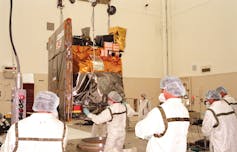
Technicians lower the Mars Climate Orbiter onto its work stand in the Spacecraft Assembly and Encapsulation Facility-2 in 1998. (NASA)
At a cultural level, base representation influences our ability to collaborate with scientists across disciplines and across cultures. This was starkly illustrated by the infamous Mars Climate Orbiter incident, when a mix-up between metric and imperial units caused a $327 million spacecraft to crash into Mars in 1999.
Why understanding bases matters
Numeracy — the ability to understand and use numbers — is a crucial part of our modern lives. It has implications for our quality of life and for our ability to make informed decisions in domains like health and finances.
For example, being more familiar with numbers will influence how easily we can choose between retirement plans, how we consider trade-offs between side-effects and benefits when choosing between medications or how well we understand how probabilities apply to our investments.
And yet many struggle to learn what numbers are, with millions suffering from math anxiety. Developing better methods for helping people learn how to manipulate numbers can therefore help millions of people improve their lives.
Research on the cognitive and cultural implications of bases collected in the Philosophical Transactions of the Royal Society journal can help make progress towards our understanding of how we think about numbers, marking an important step towards making numbers more accessible to everyone.
Jean-Charles Pelland’s work has been made possible by financial support from the ‘QUANTA: Evolution of Cognitive Tools for Quantification’ project, which has received funding from the European Research Council (ERC) under the European Union’s Horizon 2020 research and innovation programme (grant agreement No 951388).
Source: The Conversation – UK – By Matt Jacobsen, Senior Lecturer in Film History in the School of Society and Environment, Queen Mary University of London
Nearly four decades after Arnold Schwarzenegger’s muscle-bound version sprinted across screens, The Running Man returns to cinemas. In Edgar Wright’s hands, this adaptation is a sharper, smarter reflection of a culture that still can’t look away from spectacle.
Following The Long Walk, this is the second film adaptation in 2025 of a Stephen King novel originally published under the pseudonym Richard Bachman. Both films are set in a near-future America under a totalitarian regime whose oppressed population glue themselves to violent televised contests.
Schwarzenegger’s dreadful version of The Running Man in 1987 used the title of King’s novel and the concept of deadly game shows in a future America – but the similarities ended there. Director Edgar Wright’s hugely entertaining new adaptation is more faithful to the plot of King’s book, if not the tone.
In The Running Man, America is effectively run by television syndicate The Network. They keep the population entertained and obedient through life-and-death TV game shows. Participants in the most popular show play a game of hide-and-seek against a team of armed hunters. The public are promised cash rewards if they report a sighting of the contestant that leads to their capture and killing.
Ben Richards (Glenn Powell) is a blue-collar worker who wants to compete to win money for his sick daughter’s medication. The film follows Richards as he encounters eccentric citizens (with cameos by Michael Cera, William H Macy and an unhinged Sandra Dickinson) who are either keen to help or hinder him as he flees north from New York City along the east coast of America.
Trailer for The Running Man.
The Running Man’s opening scenes vividly show a stratified America, a vast poverty gap dividing the complacent ultra rich from a working class without basic comfort and sustenance. Richards, like many of King’s Bachman book protagonists (and King himself when writing the first draft of this novel in 1972) is driven by a deep-seated rage at the injustices in the American system.
The Network’s oily executive Dan Killian (a typically brilliant Josh Brolin) knows Richards will make great cathartic TV for an impotent, rage-filled population – he’s “the angriest man he’s ever seen”. The overarching theme is that the populace likes it this way and can’t imagine an alternative. The Network’s programming offers a satisfying pound of flesh to their frenzied viewers, whose primal urges are kept at bay by the spectacle of violence. As Killian hammily asserts, for Americans: “Bloodlust is our birthright!”
Tuning into current debates, The Network heavily edits its programmes with use of seamless AI. The film suggests the population is uninterested in whether their entertainment and news are authentic or faked. As clearly doctored footage of Richards is screened, the crowd bays aggressively for his blood. In the film’s final act, there is the suggestion that this fervour could be redirected with hostility towards the hand that feeds.
The film’s early depiction of the technology saturated sprawl of New York City is a superbly realised absurdist vision of an oppressive media-run state. It strongly evokes the style and tone of influential weekly British Science Fiction comic 2000 AD (1977-present), with its towering, neon-lit concrete structures. The overpowered and excessively violent police force particularly resembles the futuristic satire of the comic’s most famous character, Judge Dredd.
Wright and frequent collaborator Simon Pegg have expressed their admiration for the comic and its amplified visions of contemporary politics and society. Like 2000 AD, The Running Man is social commentary that delivers its message through aggressive, fast-paced action and explosive violence.
Edgar Wright and genre cinema
This is a great year for King adaptations, and while The Long Walk’s publicity campaign promoted his name heavily, The Running Man features Wright’s name and rising star Powell with no mention of the writer. This choice is likely to avoid misconceptions that this could be a horror film. Rather this is a breathless, hyper-kinetic action film that, like the smaller scale Baby Driver (2017) showcases Wright’s ability to beautifully direct explosive car chases and gun battles.
At the heart of Wright’s films is a love of genre cinema. In his last film, Last Night in Soho (2021), he paid tribute to gothic London films and to the cinematic myth of the swinging 60s. Here he shifts gears and celebrates the uncomplicated pleasures of the high-speed thrills of 1980s and 1990s action films in the vein of Die Hard (1988). It is an interpretation of King’s work that replaces the dour, bitter tragedy of the source material with a satirical, cartoonish absurdism.
This comedic approach works superbly in the film’s first half but can’t quite sustain the more serious critiques of American politics and media culture that the script tries to deliver in the final act.
The Running Man loses tension and nuance in its second half, especially with the late introduction of poorly conceived character Amelia Williams (Emilia Jones). She’s a young woman and member of society’s comfortable class who is embroiled in Richards’ escape plans. Her encounter with Richards leads her unconvincingly to reflect on her privilege and the injustices of her society.
The film wants viewers to imagine that there is potential for the entitled and complacent to reflect and for resistance against totalitarian control to blossom with the right catalyst. This is a deliberate choice to run counter to King’s original nihilistic vision. But it does not ring true in the face of what we’ve been shown about the film’s grim world. The final act messaging feels rote and unearned. Richards delivers a clunky, didactic dialogue that sits at odds with the film’s more interesting questions around the nature of violent spectacle and human nature – and our own enjoyment of the film’s violence.
Taken as a feather-light, fugitive-on-the-run film, this is an extraordinarily entertaining piece of mainstream action cinema. If you overlook messy plotting in the final act, it’s the most fun you are likely to have in the cinema this year. As a more focused and coherent critique of the threat of totalitarianism and media dominance, however, The Long Walk has the distinct edge over this film. Those looking for a more revealing social commentary may be left disappointed.
Looking for something good? Cut through the noise with a carefully curated selection of the latest releases, live events and exhibitions, straight to your inbox every fortnight, on Fridays. Sign up here.
Matt Jacobsen does not work for, consult, own shares in or receive funding from any company or organisation that would benefit from this article, and has disclosed no relevant affiliations beyond their academic appointment.
Source: The Conversation – UK – By Basil Germond, Professor of International Security, School of Global Affairs, Lancaster University
China’s new Fujian aircraft carrier, unveiled recently by president Xi Jinping with great fanfare, has been hailed by Chinese state media as a major milestone in the country’s naval modernisation programme and a key development in the counry’s aspirations to become a maritime power.
In the context of Beijing’s sustained seapower strategy, the long-term implications for the security and leadership of the global maritime order are certainly significant and enduring.
The launch means China now has three aircraft carriers in service and is capable of maintaining a continuous carrier presence at sea. And there have been reports of satellite images which suggest construction has already begun on China’s fourth carrier.
This will increase Beijing’s ability to preventatively deploy warships to faraway locations it considers important. It gives China the potential to control the airspace wherever their battle group is operating, as well as the ability to project air power in more distant theatres of conflict.
The new carrier also means China can launch heavier and specialist aircraft, for example with airborne early-warning systems and fighter jets equipped with greater fuel and payload capacity.
This expands Beijing’s operational options. It elevates China into a select group of four nations (US, UK, France, China) capable of independently operating a carrier battle group with the capacity to generate substantial strategic advantages from the sea.
Among this group, however, the US remains far ahead. It enjoys a significant lead in terms of carrier fleet size, technological sophistication, operational experience, global reach and sustained carrier strike capabilities.
Aircraft carriers are obviously key naval assets in confrontations between comparable nations in open ocean environments – known as “blue-water engagements”. But they are also important in controlling the maritime battlespace – particularly through air superiority – and in projecting power ashore.
The Fujian does not dramatically shift the global balance of power in China’s favour. But its enhanced land-attack capabilities nonetheless expand Beijing’s operational toolkit, allowing a more flexible and assertive naval strategy.
A strong symbolic power
Since the second world war, aircraft carriers have replaced battleships as the capital ships, the principal and most powerful warships in any country’s navy that are designed to form the core of a fleet and deliver decisive combat power.
Such capital ships carry strong symbolic weight. They signal a state’s ability to mobilise the resources required to procure, sustain and operate such complex platforms, as well as its intent to function as an ocean-going naval power.
In this light, China’s aircraft carrier programme has considerable symbolic resonance. It reflects both Beijing’s intrinsic naval capabilities and its extrinsic power – that is, its increasingly elevated status within the international pecking order.
China’s comprehensive seapower strategy
China’s carrier programme needs to be understood as part of Beijing’s wider seapower strategy. Unlike other authoritarian states such as Russia or Iran, the power base of China’s regime is much more dependent on international trade and so on freedom of navigation. Consequently, China does not seek to disrupt the global maritime order. It wants to lead it and initiate a new cycle of global dominance.
To that end, Beijing is not only expanding its naval power but, perhaps more significantly, its civilian seapower. This includes a robust shipbuilding industry, a large and growing merchant marine registered as Chinese. And it has made substantial direct investments in critical western infrastructure, such as ports.
Many of these investments have been made via private Chinese firms which maintain close ties with the state. This gives Beijing additional leverage to exercise civilian seapower to further its political interests. For example, it can use Chinese shipping companies to circumvent western sanctions on Russia, or interfere in European ports owned by Chinese firms.
In the South China Sea, Beijing aggressively uses its fishing fleet, backed by its coastguard and navy to achieve a degree of control over contested areas it considers to have economic or strategic importance.
So the commissioning of the Fujian is more than a technical milestone for the Chinese navy – it is a signal of intent. It reinforces China’s growing capacity and willingness to shape the maritime domain. As part of a broader seapower strategy, it reflects Beijing’s ambition not just to contribute to, but to lead, the global maritime order.
Basil Germond does not work for, consult, own shares in or receive funding from any company or organisation that would benefit from this article, and has disclosed no relevant affiliations beyond their academic appointment.
After years of disciplined reform and painful sacrifice, Jamaica had done what few global debt specialists thought possible. Through tough and sometimes controversial spending cuts and fiscal discipline, it slashed its debt from a staggering 150% of GDP in 2013 to just 62% by 2024.
By 2025, Jamaica was hitting its stride. One internationally recognised credit rating agency upgraded the country’s credit ratings from category BB- to BB (slightly less vulnerable in the near term to adverse economic conditions).
This gives the country more leeway to borrow on the international market. Unemployment and crime rates were falling. Jamaica’s economy was on track for one of its best years in decades.
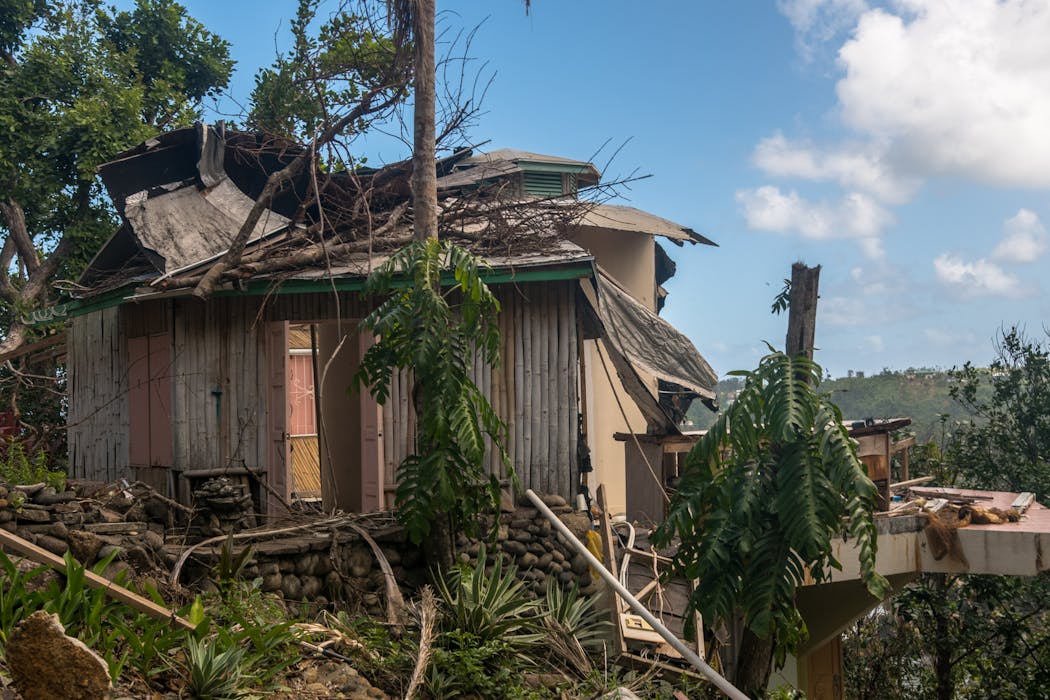
However, in late October Hurricane Melissa, a Category 5 storm, tore across the island, leaving catastrophic destruction in its wake. The island nation was prepared, but not protected.
Preliminary estimates put the damage at a staggering US$7 billion (£5.3 billion) – equivalent to 28-32% of last year’s GDP. Jamaica has a multi-layered financial safety net: a contingency fund, catastrophe insurance through the Caribbean Catastrophe Risk Insurance Facility – which will pay out US$91.9 million, its largest ever payout – and a US$150 million catastrophe bond.
But these buffers barely make a dent in the US$7 billion recovery bill. There is a shortfall of more than US$6 billion. Given the scale of the destruction, Jamaica will likely have to borrow to fund its recovery – deepening its debt, just as it had emerged from a debt crisis.
This loop of disaster, debt, recovery and the another disaster does not just affect Jamaica. Increasingly frequent climate disasters wipe out years of progress in small island developing states, forcing them into increasingly costly borrowing to fund their recovery.
One study shows that climate destruction is becoming more expensive for small island developing states such as Fiji, Guyana and the Dominican Republic, because these nations typically rely on expensive private external debt to cover their disaster recovery costs.
Our team at the thinktank ODI Global estimates that between 2000 to 2022, extreme weather events in small island developing states may have caused an estimated total of US$141 billion in economic loss and damage, of which US$53 billion (38%) could be attributed to climate change.
For severe tropical cyclones and hurricanes, the estimated total economic loss and damage during the same period could be as high as US$122 billion. Climate change may have been responsible for US$52 billion of that. This translates to a total loss of US$5.3 billion from hurricanes, with US$2 billion attributable to climate change each year.
For countries with fragile economies and limited fiscal space, these shocks are existential. Each dollar spent on rebuilding is a dollar not spent on healthcare, education or infrastructure. To meet their development goals, small island developing states would need to raise social spending by 6.6% of GDP by 2030.
Yet disaster recovery and debt repayments continue to consume their limited budgets. The ODI global study found that among 23 small island developing states, external debt service payments are now growing faster than spending on education, health and capital investment combined.
What is loss and damage? An expert explains.
A wake-up call
Jamaica’s story is a preview of what’s to come if the world doesn’t change course.
As global leaders gather for the UN climate summit, Cop30, Jamaica’s devastation should be a wake-up call. The promise of the fund for responding to loss and damage, launched in 2023 to help developing countries pay for the damage from climate-related events caused by global warming, remains largely unfulfilled, woefully undercapitalised, and a low priority for developed countries.
Indeed, loss and damage issues are being currently sidelined at Cop30, with the overall 2035 climate finance goal, national pledges known as nationally determined contributions, and adaptation indicators being top of the agenda. Small islands such as Jamaica, represented by the Alliance of Small Island States (a coalition of leaders of these most vulnerable nations), flagged concerns before the conference had even begun that loss and damage finance has fallen off the radar completely.
Fiji Red Cross has provided thousands of people with emergency relief since Cyclone Winston made landfall in Fiji on Feb 2016. ChameleonsEye/Shutterstock
Developed countries can help ensure the viability of small island developing states in a harsh climate context by offering predictable and accessible grant finance for loss and damage to support recovery and reconstruction. By providing debt relief for climate-vulnerable countries after disasters, they can also ensure that rebuilding does not result in deeper debt.
Without these commitments, the loss and damage fund risks drifting into obscurity as a symbolic gesture rather than the lifeline small island developing states desperately need.
Hurricane Melissa’s impact on Jamaica, Hurricane Maria’s devastation in Dominica in 2017 and several other climate disasters demonstrate that even with fiscal discipline, prudent planning, strong institutions and improved governance, these small island nations remain just one storm away from fiscal collapse and unsustainable debt – the repayment of which diverts critical resources from health, education, and sustainable development.
Without decisive action, Cop30 will fail the world’s most climate-vulnerable nations. Small island developing states need real systemic change, not unfulfilled pledges.
Don’t have time to read about climate change as much as you’d like?
Source: The Conversation – UK – By Stewart Lansley, Visiting Fellow, School of Policy Studies, University of Bristol
In the run-up to the 2024 election, future prime minister Keir Starmer labelled wealth creation Labour’s number one mission. “It’s the only way our country can go forward,” he declared. “We should nourish and encourage that – not just individuals but businesses.”
Starmer was right, in theory. But wealth creation is a slippery concept. Essential for economic and social progress, it can also work against both. It’s therefore vital to distinguish between “good” and “bad” wealth.
According to one definition, increases in “good” wealth come from innovation, investment and more productive business methods. Such activity boosts economic resilience, social strength and the size of the economic cake.
Examples include investment in medical and scientific technology – but also, crucially, in the activities that provide vital everyday services and goods to sustain our daily lives. Improvements in the quality of local shops, transport, services for children, adult care and decent hospitality all expand a country’s resources in ways that see the gains shared widely across society.
However, over the past half-century, a rising share of economic activity in the UK and other rich countries has been connected with “bad” wealth accumulation, which actively hampers and harms a country’s prospects.
The Conversation and LSE’s International Inequalities Institute have teamed up for a special online event on Tuesday, November 18 from 5pm-6.30pm. Join experts from the worlds of business, taxation and government policy as they discuss the difficult choices facing Chancellor Rachel Reeves in her budget. Sign up for free here
Bad wealth is especially associated with non-productive or low social-value activities geared to personal enrichment. In Britain and elsewhere, decades of privatisation and wider tax, benefit and monetary economic policies have
fuelled rising inequality while handing much of the command over resources to corporate boardrooms, top bankers and the very rich – with damaging effects for societies and economies alike.
A central source of bad wealth has been a rise in the level of economic “extraction” or “appropriation”. This occurs when capital owners use their power to capture excessive shares of economic gains through activity which weakens economic strength and social resilience. Examples include the rigging of financial markets and manipulation of corporate balance sheets, a range of anti-competitive devices such as the rise in aggressive acquisitions and mergers, and the skimming of returns from financial transactions – a process City of London traders like to call “the croupier’s take”.
Bad wealth is also the product of passive activity unrelated to merit, skill or prescient risk-taking. Over half of the increase in household wealth in the UK since 2010 has come from rising asset prices – in particular relating to property – rather than from more productive activity. This means a huge amount of that wealth is trapped in property and other assets which are not available for reinvestment in the economy.
Britain’s economic record since the 2008 financial crisis has been dismal, with a collapse in the rate of economic growth amid much hand-wringing about its “productivity puzzle”. Yet over the same period, private wealth holdings have surged. In total, UK wealth – comprising property, physical and financial assets – is now more than six times the size of the country’s economy, up from three times in the 1970s. Other rich countries have seen similar trends.
This surge in levels of personal wealth is not the product of more dynamic and innovative economies and record rates of investment. As an editorial in UK financial investment magazine MoneyWeek argued in 2019, too much personal wealth is the result of “mismanaged monetary policy, politically unacceptable rent-seeking, corruption, asset bubbles, a failure of anti-trust laws, or some miserable mixture of the lot”.
It is these activities which account for the burgeoning bank accounts of the already super-rich. Around the world, from the mid-1990s to 2021, the top 1% of wealth holders captured 38% of the growth in personal wealth, while the bottom 50% received just 2%. In the UK, the average wealth of the richest 200 people grew from 6,000 times the average person in 1989 to 18,000 times in 2023.
One of the most important outcomes of the rise of bad accumulation, and the associated surge in the concentration of personal wealth, has been the way opulence and plenty sit beside social scarcity and growing impoverishment. It has brought a significant shift in how national resources are used – away from meeting basic needs to serving the demands of corporate elites, a growing billionaire class, and private markets.
“The test of our progress is not whether we add more to the abundance of those who have much,” declared US president Franklin D. Roosevelt during his second inaugural address in January 1937. “It is whether we provide enough for those who have too little.”
By most metrics, Britain and many other wealthy countries are failing that test.
A key explanation for Britain’s low private investment, low productivity and slow growing economy is the disproportionate share of the rising profit levels of Britain’s biggest companies that has gone in payments to shareholders and executives in recent times. Dividend payments in the UK and globally have greatly outstripped wage rises over the last 40 years. In 2020, aggregate dividend payouts by the FTSE 350 companies made up some 90% of pre-tax profits.
Often, these heightened dividend payments have been financed through borrowing, thus undermining corporate strength. In the case of Thames Water – stripped of much of its value by an aggressive profit strategy by its overseas owners – this has brought near-bankruptcy.
Meanwhile, far from the promise of a property-owning society, large sections of the UK population have – outside of pension provision – no, or only a minimal, stake in the way the economy works. Those with few assets lose out from rising property prices and higher interest rates on savings.
How a nation’s productive resources – land, labour and raw materials plus physical, social and intellectual infrastructure – are owned and used is key to its productive power, social stability, and distribution of life chances. “Money is like muck – not good except it be spread,” wrote the English philosopher and statesman Francis Bacon in 1625.
In the UK, the more egalitarian politics after the second world war led to a more equal sharing of private wealth, and a much higher level of public ownership of key utilities and land. Then in 1979, newly elected prime minister Margaret Thatcher launched her drive for a “property owning democracy”. The windfall gains from council house sales and the selling of cut-price shares in her great privatisation bonanza initially benefited many ordinary people.
But today, the balance sheet looks markedly different. While the sale of council houses initially boosted levels of home ownership in the UK, the number of first-time home buyers is now less than half its mid-1990s rate. As a result, the rate of home ownership has shrunk from a peak of 71% in 2000 to 65% in 2024, with the most marked decline among those aged 25-34.
Getting on the housing ladder is now heavily dependent on having rich parents. The proportion of young people aged 18-34 living with their parents reached 28% in 2024 – a significant rise since the millennium.
At the same time, today’s much more heavily privatised economy has eroded Britain’s holdings of common wealth. Publicly owned assets as a share of GDP have fallen from around 30% in the 1970s to about a tenth. This is one of the principal causes of the deterioration in the UK’s public finances, while handing more control over the economy to private company owners.
The French economist Thomas Piketty has argued that today’s model of corporate capitalism has a natural, inbuilt tendency to generate ever-growing levels of inequality – “a fundamental force for divergence”, as he termed it.
When the return on capital from dividends, interest, rents and capital gains exceeds the overall growth rate, asset holders accumulate wealth at a faster rate than that at which the economy expands, thereby securing an ever-greater slice of the pie – and leaving less and less for everyone else.
In his 2014 book, Capital in the Twenty-First Century, Piketty offered an essentially pessimistic conclusion that breaking this inequality cycle has only happened across history through war or serious social conflict. In response to critics, he modified this position and now seems to accept that there are democratic mechanisms for delivering more equal societies – whatever the undoubted hurdles of implementation.
Suppressing the profiteering and excessive returns that have driven higher levels of inequality is one of the biggest challenges of our time. But such an alignment of growth and rates of return on capital was broadly achieved in the post-war era, and there are several routes for achieving such convergence again – even in today’s very different conditions.
1. Shift the tax focus from income to wealth
Despite the scale of today’s wealth boom, Britain’s tax system is still heavily biased to earnings. Income from work is taxed at an average of around 33% and wealth at less than 4%. Through political inertia, the UK tax system has failed to catch up with the growing importance of wealth over income in the way the economy operates, and does little to dent the growing concentration of wealth holdings at the top.
In her first budget in October 2024, the chancellor, Rachel Reeves, took steps to raise revenue through changes to inheritance and capital gains tax (the profits made on selling shares or property other than your home). But these were too modest to alter the imbalance in the taxation of wealth and earnings.
A more fundamental shift would be to reform the existing system of council tax with a larger number of tax bands at the top. Still based on 1991 property values, this is perhaps the least defensible tax in Britain. Households in poorer areas pay more than better off households in the richest.
In Burnley, the typical household pays some 1.1% of the value of their home in council tax every year. In a typical property in Kensington and Chelsea, it is 0.1%. The most effective alternative would be to replace council tax and stamp duty – the tax on the purchase of homes – with a single progressive or proportionate “property tax”. Any serious reform requires a long overdue property revaluation and an extension in the number of tax bands.
A modest and phased rise in capital taxation would also help to break up today’s wealth concentrations and reduce the passive – and often malign – role played by wealth holdings. Even small changes would release funds which could be used to improve social infrastructure from schools to hospitals.
One such change, as recommended by the Office for Tax Simplification, should be to raise the rates on capital gains tax so that they are equal to income tax rates. In 2024, 378,000 people paid UK capital gains tax worth a total of £12.1 billion – a decrease of 19% on the previous year.
Measures to limit asset inflation could include extending the Bank of England’s remit on inflation to limit rises in property prices, which have led to historically high rents and priced a rising proportion of young people out of home ownership.
2. Reduce how much wealth gets passed on
“A power to dispose of estates forever is manifestly absurd,” the Scottish economist Adam Smith declared 250 years ago. “The Earth and the fulness of it belongs to every generation, and the preceding one can have no right to bind it up from posterity. Such extension of property is quite unnatural.”
Despite Smith’s exhortations, birth and inheritance remain the most powerful indicators across most countries of where you end up in the wealth stakes and the pattern of life chances.
Importantly, inheritance does little to boost productive activity. Higher ratios of inheritance in wealth holdings – and recent decades have seen an upward shift – tend to be associated with reduced economic dynamism. Assets tied up in large wealth pools are often little more than “dead money”: idle resources that could be put to use funding public services or productive investment.
Yet, helped by light taxation, social privileges continue to be handed on in perpetuity. Only 4.6% of deaths in the UK resulted in an inheritance tax charge in the 2023 financial year, contributing a tiny 0.7% of all tax receipts.
Around 36% of all wealth is stored in property, and there is a strong public attachment to people retaining their inherited housing wealth – even among those who are not beneficiaries. In part, inheritance tax is widely perceived as unfair because of the way the richest are able to avoid it.
Of people born in the UK in the 1980s, those in the poorest fifth by wealth will enjoy an average 5% boost to their lifetime income through inheritance, compared with 29% for the top fifth. Clearly, those on the wrong side of this gap will be left even further behind by the end of their lives.
And the divide is widening sharply. The scale of intergenerational wealth transfer is on a steeply upward trend, with projected levels of inheritance set to dwarf all previous wealth transfers in the coming decade. Little of this process contributes to more productive activity, with one of its primary and malign effects being to fuel higher house prices.
3. Introduce a ‘whole wealth’ tax
Another much-debated option would be to levy a new tax on whole wealth holdings, rather than just the revenue these assets generate. An annual 1% tax on wealth over £2 million – affecting some 600,000 people in the UK – could raise around £16 billion a year, according to the 2020 Wealth Tax Commission report.
Such taxes would be easier to levy on immobile assets like buildings and land taxes than on liquid assets, such as financial holdings. But this complexity is not insurmountable – and nor is public opinion. Such a measure could be sold politically as a “solidarity tax” to help pay for key under-resourced but high social-value services – such as a proper social care system and improved services for children.
While many governments have been wary of the political reaction to higher taxes on wealth, YouGov’s most recent survey suggests around three-quarters of the public now support such a tax, with more than half strongly supporting it.
The Inequality Crisis – a talk by the article’s author, Stewart Lansley, in March 2013. Video: RSA.
4. Increase public ownership of utilities and services
Tackling inequality and profiteering also require a greater level of common and social ownership. Britain is a heavily privatised and marketised economy. Few other developed countries have handed over such control of key utilities to private firms.
Privatised in 1989, Britain’s water industry has been turned into a potent example of profiteering. Under private ownership, it has delivered leaky and unrepaired pipes, the illegal dumping of sewage spills into rivers and beaches, and two decades of under-investment in large part because of the disproportionate share of profits going in dividend payments to mostly overseas owners.
Another significant trend has been the private takeover of a range of public services – from social care to children’s services. According to the Competition and Markets Authority (CMA), the UK has “sleepwalked” into a dysfunctional system with widespread profiteering in privately run children’s homes. It found operating profit margins averaging 22.6% from 2016-20, driven by escalating charges and cost-cutting.
These examples of bad accumulation have hollowed out some of the UK’s most vital industries. A mix of public and social ownership and much more effective regulation are necessary to turn these industries into effective service providers rather than cash machines for investors.
Regulatory reforms are also needed to moderate the way some markets work. The CMA suggests that anti-competitive behaviour and “oligopolistic structures” are hallmarks of a rising volume of business activity. For example, it has accused the UK’s seven largest housebuilders of collusion on issues from pricing to marketing.
Price gouging – when firms exploit emergencies such as the COVID pandemic and Russia’s invasion of Ukraine to charge excessively high prices for essential goods – is another area ripe for tougher intervention.
5. Establish citizens’ wealth funds
Alongside greater social ownership, all citizens need to be given a more direct stake in the gains from economic activity. As one heckler put it during the Brexit referendum: “That’s your bloody GDP, not ours.”
One route would be to build models of “people’s capital” through a new strategy of asset redistribution to individuals. This would extend the principle of income redistribution that has been one of the main, if now much weakened, pro-equality instruments of the post-war era. A medium to long-term plan would be to create one or more national and local “citizens’ wealth funds”, owned collectively by all on an equal basis.
Originally advanced by the British economist and Nobel laureate James Meade, such funds would be created by the state but owned by society, with returns distributed either as universal dividends or as investment in public services. Such a fund could be financed from a mix of sources including long-term government bonds; the transfer of several highly commercial state-owned enterprises, such as the Land Registry, Ordnance Survey or Crown Estate; part of the proceeds from higher wealth taxes; and new equity stakes in large corporations.
Anchorage, capital of the US state of Alaska, which operates a permanent fund for its citizens. TripWalkers/Shutterstock
Perhaps the most notable example of citizen-owned capital is the Alaska Permanent Fund. This was created in 1976 from oil revenues and effectively owned by all of the US state’s citizens. It has since paid out a highly popular annual dividend which averages about US$1,150 (£875) a year.
The UK has its own example: also in 1976, the Shetland Islands Council established a charitable trust from “disturbance payments” paid by oil companies in return for operational access to the seas around the islands. The returns from this trust have been used to fund social projects, from leisure centres to support for the elderly.
Another possibility is to establish a national pension fund that would eventually pay for the cost of state pensions. Australia’s Future Fund, for example, is an independently managed sovereign wealth fund to meet future civil service pension obligations. Established in 2006 by receipts of AUS$50 billion (£20 billion) from the sale of Telstra, the national telecoms company, it has since been supplemented by direct government grants and is projected to reach a value of AUS$380 billion by 2033.
The UK government has launched the Community Wealth Fund, a £175 million initiative aiming to “transform neighbourhoods with long-term financing”. Working with local communities the initiative will fund projects in local communities across England. Despite its modest finances, this establishes the principle of collectively owned social funds. This is funded through the government’s Dormant Assets Scheme, which unlocks old bank accounts and other financial products that have been left untouched.
6. Spread access to the nation’s assets across society
Any meaningful redistribution of wealth across society requires a suite of deep structural reforms from improving access to affordable housing to reducing levels of corporate extraction.
One of the most important issues is finding ways of extending access to assets to all citizens as a condition of democratic opportunity. The Child Trust Fund, introduced by New Labour in 2005, was an ambitious attempt to address wealth inequality by giving every child a modest financial stake – a kind of citizen’s inheritance. Yet the scheme was abolished in 2010 by the incoming coalition government.
In the event, it only achieved a modest impact. Average payouts when children reached 18 were around £2,000, with a quarter of all accounts being forgotten or lost. The desired shift in household saving habits tended to be limited to more affluent parents paying extra into the trust funds, meaning the policy reinforced some of the inequalities it had aimed to challenge.
Bold decisions required
While recent years have seen a growing debate about the impact of ever higher concentrations of wealth in the UK, few proposals for real change – beyond a mere tampering at the edges of inheritance and capital gains tax – are yet on the political agenda. Some of these measures would take longer to achieve, and some, such as citizens’ wealth funds, are more ambitious and potentially transformative than others. All would require bold decisions by government.
In the run-up to her much-anticipated November 26 budget, the chancellor has hinted that higher taxes on the wealthy will be “part of the story” – although a manifesto-busting rise in the base rate of income tax is also on the cards.
Against this, Reeves has ruled out a standalone wealth tax, and there appear to be no plans for more radical measures to rein in excessive profiteering. This means that the wealth gap is probably set to widen.
Yet history suggests the idea of limiting high concentrations of wealth is far from utopian. Limits operated relatively effectively among nations including the UK and US in the post-war decades, through a combination of regulation, highly progressive taxation and changes in cultural norms.
The highest personal fortunes were more modest in part because of the destructive effect of war on the size of asset holdings. There was also a new social and cultural climate that would not have tolerated today’s towering fortunes, and which allowed the post-war progressive tax systems to be maintained for decades.
Restructuring the process of wealth accumulation is never going to be straightforward politically. The protests over the adjustment to inheritance tax in 2024, in particular its impact on farmers, demonstrates how sensitive these issues are – particularly when stoked by those seeking to make political capital out of pro-equality reforms.
But Britain stands at a historic moment. Failure to tackle mounting wealth-driven inequality will have harmful consequences for the social and economic stability of generations to come. Amid rising public anxiety about the future and a widespread sense that the economy is “rigged” against ordinary people, a more ambitious political agenda that addresses inequality and economic stagnation could win public backing, if any government is brave enough to try.
The Conversation and LSE’s International Inequalities Institute have teamed up for a special online event on Tuesday, November 18 from 5pm-6.30pm. Join experts from the worlds of business, taxation and government policy as they discuss the difficult choices facing Chancellor Rachel Reeves in her budget. Sign up for free here
To hear about new Insights articles, join the hundreds of thousands of people who value The Conversation’s evidence-based news. Subscribe to our newsletter.
Stewart Lansley is a fellow of the Academy of Social Sciences. His latest book, The Richer, The Poorer: How Britain Enriched the Few and Failed the Poor, is published by Bristol University Press.
In October 2025, members of the European Parliament voted in favour of a bill to reserve terms such as “burger” and “sausage” for meat products. If this bill is approved by most EU member states, products made from meat alternatives or vegetables will no longer be allowed to have “burger” on their packaging.
This bill would change the words on the packaging, but it is not enough to change the words that people use in their everyday lives. A push to change the meaning of a word from a government body is unlikely to be successful, linguistically speaking, because of how the human brain processes and stores the meaning of words.
People often think that the meaning of a given word is a single, unchanging definition, much like you would expect to find in a dictionary. However, the linguistic part of the brain that stores words and their meanings is actually a lot more dynamic – and a lot more vague – than that.
Our understanding of meaning is a lot more “I’ll know it when I see it”. Consider the word “milk”. Attached to that word are a number of qualities that you, personally, find relevant to its meaning. These qualities might include its source (from a cow, a pint carton from the supermarket), its appearance (white, liquid) and its function (a drink, a component in coffee or tea, poured over cereal, as an ingredient in baking, or processed into cheese/yoghurt/cream).
It is these qualities that are stored in the brain under the category “milk”. These qualities, or meanings, are continuously edited, upgraded and discarded over time as we gain new information. By this process, the brain learns how to categorise new experiences or unusual examples, such as chocolate-flavoured milk.
Plant-based alternatives have many of the same qualities as their dairy equivalent. Garna Zarina/Shutterstock
Now consider a dairy alternative, such as one made from oat or soya. This plant-based product has many of the same qualities as its dairy equivalent. The milk alternatives fit the appearance and function of milk, and so they are stored under the category “milk” in the brain.
If oat milk is something you drink regularly, then your meanings will update to reflect this: oat milk will become the prototypical “milk” in your brain. Even if oat milk is not a common occurrence in your everyday life, your brain will likely store it under the linguistic category of “milk”, albeit as a fringe example of milk.
When is a burger not a burger?
Now let us consider the meanings associated with a word like “burger”. Its source (beef, turkey, chicken, pork, bean, falafel, meat alternatives), its appearance (a processed disc patty, presented in a bun) and its function (a patty placed in a bun, usually with some accompanying salad or sauces).
There aren’t any non-burger products that have been processed into the prototypical burger-shaped disc. Tatjana Baibakova/Shutterstock
The first thing you might notice is how many options there are for the source of the burger. Most of these sources are quite common and well-known. Even if you yourself have a strong preference for beef burgers, you probably wouldn’t consider a chicken burger an unusual example of a burger.
In other words, our linguistic category of “burger” allows a lot more flexibility and a wider range of sources than “milk”. On the other hand, the shape of the burger (a processed disc patty) and its function (between two buns) are both very important and more restrictive qualities of a burger.
This is in part because there aren’t any non-burger products that have been processed into the prototypical burger-shaped disc. Similarly, there aren’t any sausage-shaped products that aren’t sausages. The shape of the burger is reinforced in our mental linguistic definitions every time we see a burger, and is never undermined by seeing a non-burger patty. This is why we feel very strongly that the very essence of a burger is tied to its function and its shape.
The meaning of the word “burger” doesn’t come from the dictionary definition, or from being told what a burger is by a government. In fact, there isn’t one single meaning for “burger”.
Instead, in the linguistic database in our brain, we have a collection of meanings that we associate with burgers. This linguistic ability allows us to confidently categorise burgers from non-burgers, even if it is, ironically, hard for us to put into words. What is a burger? I’ll know it when I see it.
Don’t have time to read about climate change as much as you’d like?
Victoria-Elliot Bush does not work for, consult, own shares in or receive funding from any company or organisation that would benefit from this article, and has disclosed no relevant affiliations beyond their academic appointment.
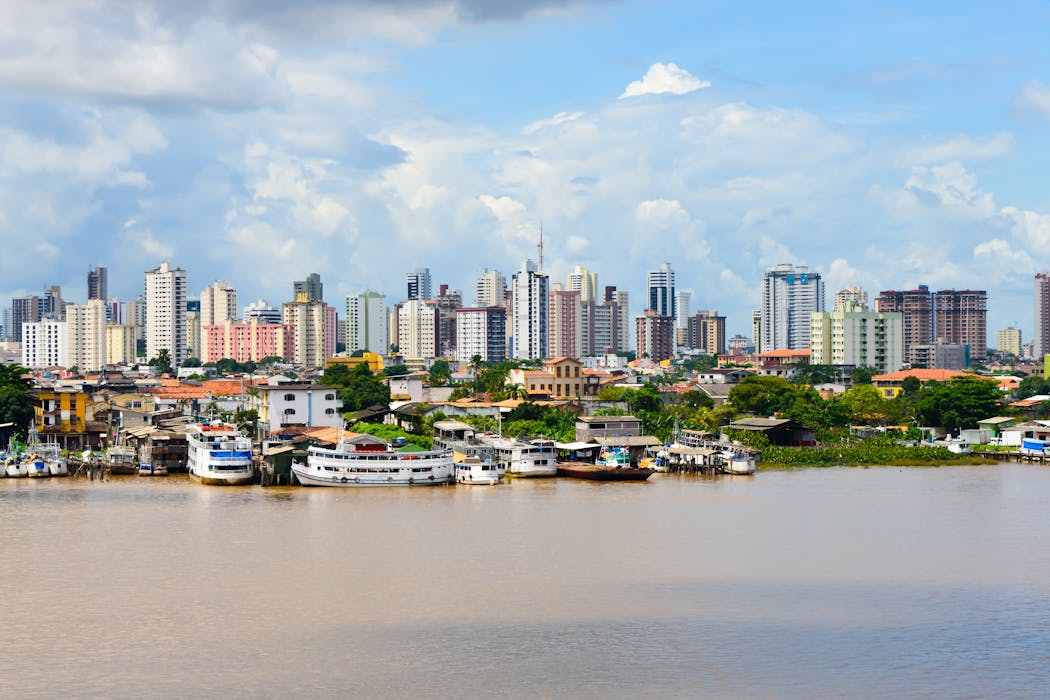
Belém has more than 1 million people yet is too small for a modern ‘Cop’. Maritime Art Blog / shutterstock
If you’re still heading to this year’s UN climate conference in Belém, Brazil, I hope you booked early. Hotels long sold out, and latecomers face extortionate rates – or the prospect of a dubious “love hotel”.
The incredible cost and variable quality of accommodation have sparked outrage. It’s been the subject of high-level meetings and dialogues. But it’s also a symptom of a wider problem: these climate summits have grown so large they’re no longer fit for purpose.
I have been to 11 of these summits over the years, and follow them closely for my academic work, and with the Earth Negotiations Bulletin – a free, curated summary of global environmental negotiations. Cop30, which started on November 10 in Belém, is the first I have missed since Cop18 in Doha in 2012.
I have seen first hand how these annual negotiations and accompanying summit and events (together, broadly called Cops) have grown. They are now MegaCops – enormous conglomerations of events, parallel workshops, receptions, exhibitions and photo ops that attract over 50,000 people. They are the largest events on the UN calendar.
Even with a population of 1 million, Belém is too small. Most cities are. Only a handful of wealthy countries can hope to host them. Many negotiators from poorer countries, along with Indigenous and civil society groups, simply can’t afford to attend this summit.
All this means power is subtly shifting further towards those with the money to participate and host. This bodes poorly for global climate governance.
Prestige and power, for those who can pay
Cities and countries big enough to host a Cop gain some soft power in exchange for the large bill they foot. For instance Paris hosted 25,000 people for the summit in 2015, which cost around €187 million (£164m). In return, the city got its name on a climate treaty we’ll be talking about for decades.
Other MegaCop hosts have also pushed to have an outcome with their name, like the UAE Consensus or Glasgow Climate Pact. It’s hard to imagine a Majuro Pact simply because the Marshall Islands capital won’t be hosting 50,000 diplomats anytime soon, despite the island nation’s climate leadership.
The host countries also set the themes for high-level events and gain support for political declarations of their choosing. The UAE-hosted Cop in 2023 featured declarations on health, renewable energy, peace and gender (among others). None mentioned phasing out fossil fuels. This was no accident – the UAE was reluctant to push its fellow oil-producing states towards such language in the negotiations.
Recent Cop hosts have been oil-producing and exporting states such as the UAE, UK, and Azerbaijan. It’s perhaps little wonder that they spearhead declarations outside the negotiation space on peace or forests, and not fossil fuels.
Too big for small countries
Far fewer declarations have focused on loss and damage (UN jargon for the permanent consequences of climate change), at a time when lives and livelihoods are at risk. Small island states – some of the most climate-vulnerable nations in the world – could get this message across, but these efforts require diplomatic capacity.
Successful Cop hosts have networks of ambassadors or professional diplomats to sound out ideas from negotiators. They can rally consensus in negotiations and support for the president’s various legacy initiatives and declarations. Small countries often lack this capacity. Last year, 39 small island states together sent 261 negotiators to the summit (an average of six or seven people each, compared to the UK’s 37 diplomats).
Cop hosts sometimes find donor money to hire consultants to manage public relations and provide legal and technical advice. Many of these consultants are from developed countries, which has led to questions about their influence.
Inequality in the pavilion
It’s a pervasive myth that a bigger Cop is a more inclusive Cop. It just means more people. At Cop27, there were twice as many fossil fuel lobbyists as Indigenous peoples’ representatives, for instance.
Richer Cop participants can also pay to get their messages across. In Brazil, space in the pavilion – the exhibition zone that runs alongside the main negotiations – starts at US$1,250 (£856) per square meter, excluding additional costs for audio and visual equipment, coffee machines, and decor. These pavilions are offered on a commercial basis by the host countries to help recoup costs.
Governments, corporations and NGOs with deep pockets buy space to host events, distribute their reports, and push their preferred solutions. From the WWF’s Panda Hub to the Gulf Cooperation Council’s space, the pavilion usually focuses on the issues of richer countries and organisations.
In smaller spaces, youth and Indigenous peoples are afforded their own pavilions, paid for by donors or donated by the Cop presidencies. These groups are disproportionately affected by climate change. Yet they struggle to be heard above the din.
If the global climate process could shed its obsession with ever-larger Cops, it would be to its benefit. Smaller countries could help set the agenda, and climate-vulnerable voices might not be outnumbered or outspent.
One practical solution would be to split up the three different events: the main negotiations, the summit for political leaders, and the exhibition zone. Negotiations could take place somewhere smaller and less glamorous, perhaps the UN campus in Bonn, Germany. Political summits and climate action showcases could rotate or sometimes be held online.
We could also limit delegation sizes and centre the talks on implementing the rules we already have rather than new rule-making. These changes would reduce costs and make it easier for smaller and poorer countries to have their say. True climate equity demands a rethink of the very process meant to deliver it.
Don’t have time to read about climate change as much as you’d like?