A 2,000-year-old building site reveals the raw ingredients for ancient Roman self-healing concrete

Source: The Conversation – Global Perspectives – By Ray Laurence, Professor of Ancient History, Macquarie University

A detail of the neatly aligned ceramic roof tiles and tuff blocks in a newly excavated site in Pompeii, documenting the storage of building materials during renovation. Archaeological Park of Pompeii

Roman concrete is pretty amazing stuff. It’s among the main reasons we know so much about Roman architecture today. So many structures built by the Romans still survive, in some form, thanks to their ingenious concrete and construction techniques.

However, there’s a lot we still don’t understand about exactly how the Romans made such strong concrete or built all those impressive buildings, houses, public baths, bridges and roads.

Scholars have long yearned for more physical evidence from Roman worksites to provide clues.

Now, a new study – led by researchers from the Massachusetts Institute of Technology (MIT) and published in the journal Nature Communications – sheds new light on Roman concrete and construction techniques.

That’s thanks to details sifted from partially constructed rooms in Pompeii – a worksite abandoned by workers as Mount Vesuvius erupted in 79 CE.
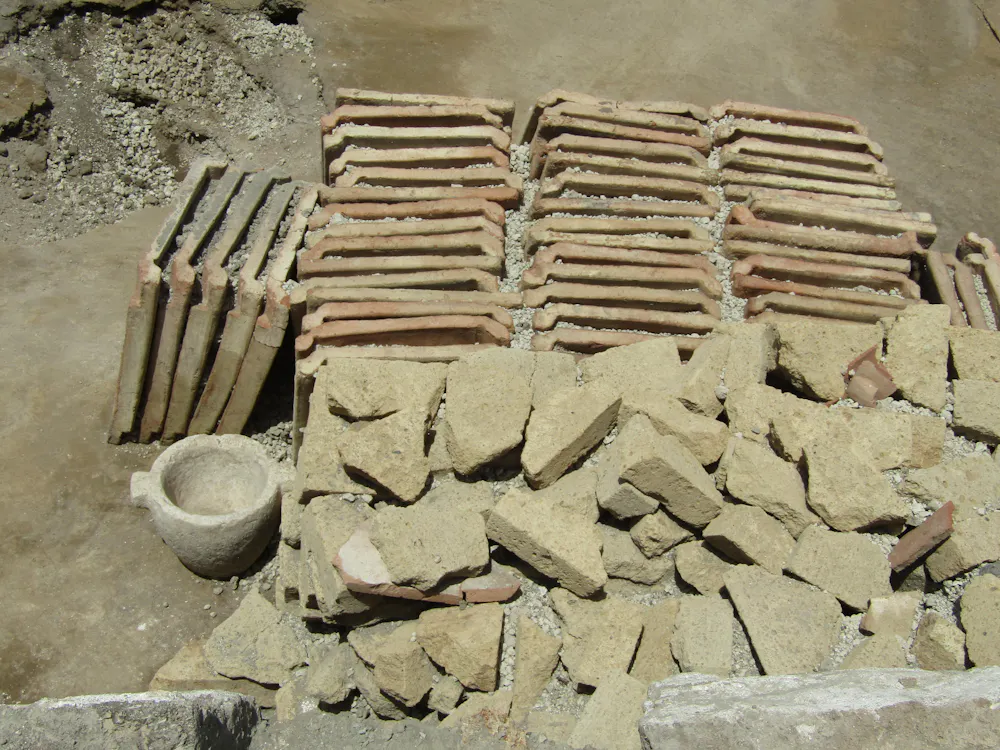
Neatly aligned ceramic roof tiles and tuff blocks at a newly excavated site in Pompeii, documenting the organised storage of building materials ready for reuse during renovation.
Archaeological Park of Pompeii

New clues about concrete making

The discovery of this particular building site hit the news early last year.

The builders were quite literally repairing a house in the middle of the city, when Mount Vesuvius blew up in the first century CE.

This unique find included tiles sorted for recycling and wine containers known as amphorae that had been re-used for transporting building materials.

Most importantly, though, it also included evidence of dry material being prepared ahead of mixing to produce concrete.

It is this dry material that is the focus of the new study. Having access to the actual materials ahead of mixing represents a unique opportunity to understand the process of concrete making and how these materials reacted when water was added.

This has re-written our understanding of Roman concrete manufacture.

Self-healing concrete

The researchers behind this new paper studied the chemical composition of materials found at the site and defined some key elements: incredibly tiny pieces of quicklime that change our understanding of how the concrete was made.

Quicklime is calcium oxide, which is created by heating high-purity limestone (calcium carbonate).

The process of mixing concrete, the authors of this study explain, took place in the atrium of this house. The workers mixed dry lime (ground up lime) with pozzolana (a volcanic ash).

When water was added, the chemical reaction produced heat. In other words, it was an exothermic reaction. This is known as “hot-mixing” and results in a very different type of concrete than what you get from a hardware store.

Adding water to the quicklime forms something called slaked lime, along with generating heat. Within the slaked lime, the researchers identified tiny undissolved “lime clasts” that retained the reactive properties of quicklime. If this concrete forms cracks, the lime clasts react with water to heal the crack.

In other words, this form of Roman concrete can quite literally heal itself.

Pompeii Archeological Park site map, with showing where the ancient building site is located, with colour coded piles of raw construction materials (right): purple: debris; green: piles of dry pre-mixed materials; blue: piles of tuff blocks.
Masic et al, Nature Communications (2025)

Techniques old and new

However, it is hard to tell how widespread this method was in ancient Rome.

Much of our understanding of Roman concrete is based on the writings of the ancient Roman architect Vitruvius.

He had advised to use pozzolana mixed with lime, but it had been assumed that this text did not refer to hot-mixing.

Yet, if we look at another Roman author, Pliny the Elder, we find a clear account of the reaction of quicklime with water that is the basis for the exothermic reaction involved in hot-mixing concrete.

So the ancients had knowledge of hot-mixing but we know less about how widespread the technique was.

Maybe more important is the detail in the texts of experimentation with different blends of sand, pozzolana and lime, leading to the mix used by the builders in Pompeii.

The MIT research team had previously found lime clasts (those tiny little bits of quicklime) in Roman remains at Privernum, about 43 kilometres north of Pompeii.

It’s also worth noting the healing of cracks has been observed in the concrete of the tomb of noblewoman Caecilia Metella outside Rome on the Via Appia (a famous Roman road).

Now this new Pompeii study has established hot-mixing happened and how it helped improve Roman concrete, scholars can look for instances in which concrete cracks have been healed this way.

Questions remain

All in all, this new study is exciting – but we must resist the assumption all Roman construction was made to a high standard.

The ancient Romans could make exceptional concrete mortars but as Pliny the Elder notes, poor mortar was the cause of the collapse of buildings in Rome. So just because they could make good mortar, doesn’t mean they always did.

Questions, of course, remain.

Can we generalise from this new study’s single example from 79 CE Pompeii to interpret all forms of Roman concrete?

Does it show progression from Vitruvius, who wrote some time earlier?

Was the use of quicklime to make a stronger concrete in this 79 CE Pompeii house a reaction to the presence of earthquakes in the region and an expectation cracking would occur in the future?

To answer any of these questions, further research is needed to see how prevalent lime clasts are in Roman concrete more generally, and to identify where Roman concrete has healed itself.

The Conversation

Ray Laurence does not work for, consult, own shares in or receive funding from any company or organisation that would benefit from this article, and has disclosed no relevant affiliations beyond their academic appointment.

ref. A 2,000-year-old building site reveals the raw ingredients for ancient Roman self-healing concrete – https://theconversation.com/a-2-000-year-old-building-site-reveals-the-raw-ingredients-for-ancient-roman-self-healing-concrete-271405

We watched these coral colonies succumb to black band disease. 6 months later, 75% were dead

Source: The Conversation – Global Perspectives – By Shawna Foo, Senior Research Fellow, School of Life and Environmental Sciences, University of Sydney

During the last global coral bleaching event in 2023 and 2024 , the Great Barrier Reef experienced the highest temperatures for centuries and widespread bleaching. With bleaching events becoming more frequent, the very existence of coral reefs is under threat.

This, in case it’s not clear, is a major problem. Coral reef ecosystems are essential for many species of plants and animals to survive. They provide humans with essential food security (many fish can’t survive without them), prosperity (via tourism and fisheries) and shoreline protection.

But heat stress can weaken corals, making them vulnerable to disease. At the same time, warm conditions can make the pathogens that cause disease stronger and more virulent.

For our research, published today in Proceedings of the Royal Society B, we tracked hundreds of coral colonies on One Tree Reef in the southern Great Barrier Reef in Australia during a 2024 heatwave. Weakened by heat stress, one particular type of boulder coral, Goniopora, developed a disease called black band disease.

These corals are old – probably at least 100 years old – and are like the old growth forest of the reef.

Six months later, 75% of these coral colonies in the reef community we monitored were dead.

This is especially worrying because these massive corals are normally quite resilient to heat stress. Even the strong are now struggling to survive.

And their huge, dead bodies can detach from the reef and hurtle around, crushing and destroying other corals in their path.

What we found on the Great Barrier Reef

We were originally tracking multiple sites on One Tree Reef in response to an extreme heatwave. We wanted to understand which coral species were more resistant and which were more sensitive to heat stress.

It was a surprise to see the bleached boulder corals quickly get infected by black band disease.

Black band disease is caused by a group of pathogenic microbes that kill coral tissue. These pathogens naturally occur in the environment but this is the first time such a disease epidemic has been observed on the Great Barrier Reef.

The disease appears as a black band, leaving behind bare skeleton as it destroys the coral tissue and spreads throughout the colony. Around the world, black band disease has been recorded on many different coral species. This disease has wiped out reefs in the Caribbean and fundamentally altered reef structure and function.

A review of coral diseases on the Great Barrier Reef shows that black band disease is mostly found on branching corals. Branching corals are more delicate and tree-like in comparison to sturdy, boulder corals.

Our findings are curious because on One Tree Reef only one particular species, a normally resilient boulder-like coral, was affected.

Black band disease virtually wiped out these corals at the site we were monitoring.

In other words, ordinarily strong and resilient corals are now succumbing to this disease. This is extremely troubling.

Why is this worrying?

This boulder-like coral, specifically from the genus Goniopora, has long, flower-like tentacles that sway with the currents.

A key reef-building coral on the Great Barrier Reef, it is very slow-growing compared to branching corals. Goniopora tends to be more resistant to disturbance and is often found in areas of lower water quality.

Living for hundreds of years, it can form extensively large coral patches supporting a wide range of organisms. These long-lived corals form the backbone structure of reefs providing refuge for a range of invertebrates and fish. Because of their size, they help buffer coastlines from waves.

We found that six months after the 2024 heatwave, the colonies we were tracking had been all but wiped out. At least 75% were dead.

Of the surviving colonies, 64% had experienced partial coral tissue death due to black band disease. While other species of corals showed signs of recovery after the heatwave, we didn’t see any recovery at all for the boulder corals.

Killer bowling balls

One Tree Reef is one of the most protected coral reefs on the Great Barrier Reef.

Previously, outbreaks of black band disease have been linked to coastal stressors such as pollution and high nutrients. Given One Tree Reef is 80 km offshore in open ocean, its isolation protects it from land-based pressures.

This makes the disease prevalence and rapid spread at One Tree Reef particularly concerning.

Once the coral tissue is killed by the disease, the skeleton is quickly covered by algae (and other organisms) that eat away at the skeleton. We noticed the breakdown of the boulder coral skeleton began surprisingly fast after the colony died.

This process usually takes many months to years. By six months, though, we found these boulder corals were unstable and began to detach from the reef.

This is dangerous as they can act like bowling balls if moved by waves and tropical cyclones, destroying surrounding reef.

These large structural corals that have survived for hundreds of years are now lost from this reef, resulting in a potentially permanent change to the ecosystem.

Black band disease is one of the earliest recorded coral diseases, first identified in the Caribbean. There, it has driven high mortality in corals and reshaped entire coral communities. Our results are beginning to echo these devastating disease outbreaks seen in the Caribbean.

With coral disease expected to rise with climate change, our findings reinforce the need for urgent global action and for ambitious climate and reduced emissions targets.

The Conversation

Shawna Foo receives funding from the Australian Research Council, Westpac Scholars Trust and the University of Sydney.

Maria Byrne receives funding from the Australian Research Council and the Reef Trust.

ref. We watched these coral colonies succumb to black band disease. 6 months later, 75% were dead – https://theconversation.com/we-watched-these-coral-colonies-succumb-to-black-band-disease-6-months-later-75-were-dead-264895

Australia’s social media ban is now in force. Other countries are closely watching what happens

Source: The Conversation – Global Perspectives – By Lisa M. Given, Professor of Information Sciences & Director, Social Change Enabling Impact Platform, RMIT University

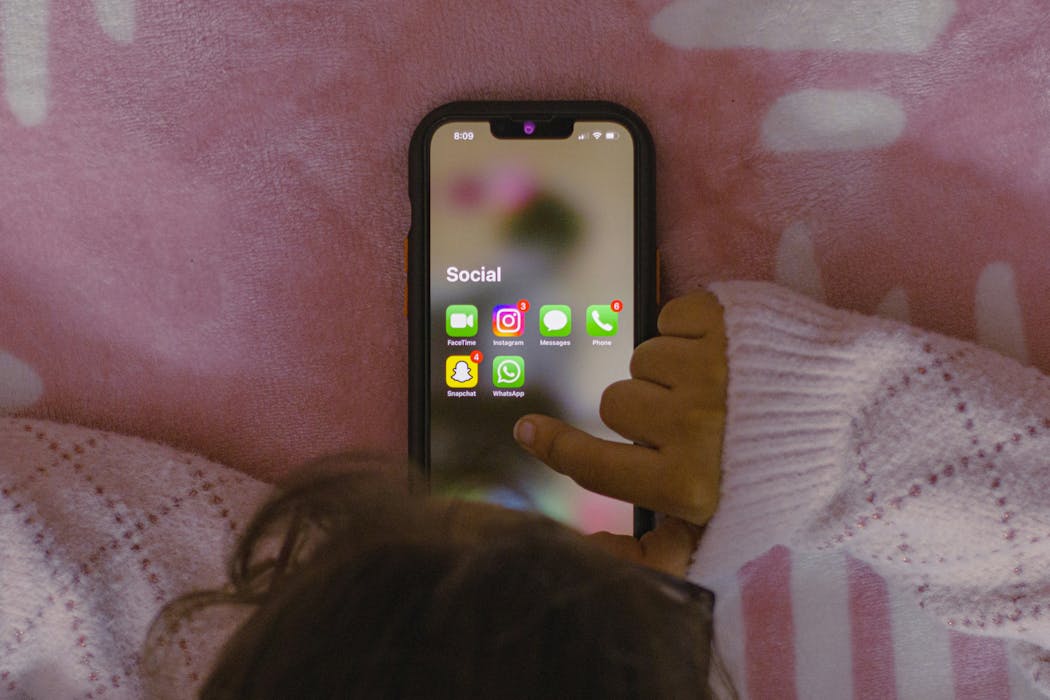
Sanket Mishra/Unsplash

After months of anticipation and debate, Australia’s social media ban is now in force.

Young Australians under 16 must now come to grips with the new reality of being unable to have an account on some social media platforms, including Instagram, TikTok and Facebook.

Only time will tell whether this bold, world-first experiment will succeed. Despite this, many countries are already considering following Australia’s lead.

But there are other jurisdictions that are taking a different approach to try and keep young people safe online.

Here’s what’s happening overseas.

A global movement

In November, the European parliament called for a similar social media ban for under 16s.

The President of the European Commission, Ursula von der Leyen, said she has been studying Australia’s restrictions and how they address what she described as “algorithms that prey on children’s vulnerabilities”, leaving parents feeling powerless against “the tsunami of big tech flooding their homes”.

In October, New Zealand announced it would introduce similar legislation to Australia’s, following the work of a parliamentary committee to examine how best to address harm on social media platforms. The committee’s report will be released in early 2026.

Pakistan and India are aiming to reduce children’s exposure to harmful content by introducing rules requiring parental consent and age verification for platform access, alongside content moderation expectations for tech companies.

Malaysia has announced it will ban children under 16 from social media starting in 2026. This follows the country requiring social media and messaging platforms with eight million or more users to obtain licenses to operate, and use age verification and content-safety measures from January 2025.

France is also considering a social media ban for children under 15 and a 10pm to 8am curfew for platform use for 15- to 18-year-olds. These are among 43 recommendations made by a French inquiry in September 2025, which also recommended banning smartphones in schools, and implementing a crime of “digital negligence for parents who fail to protect their children”.

While France introduced a requirement in 2023 that platforms obtain parental consent for children under 15 to create social media accounts, it has yet to be enforced. This is also the case in Germany. There, children aged between 13 and 16 can only access platforms with parental consent, but without formal checks in place.

And, in Spain, the minimum age for social media accounts will rise from 14 to 16, unless parents provide consent.

Norway announced plans in July to restrict access to social media for under 15s. The government explained the law would be “designed in accordance with children’s fundamental rights, including freedom of expression, access to information, and the right to association”.

In November, Denmark announced it would “ban access to social media for anyone under 15”. However, unlike Australia’s legislation, parents can override the rules to enable 13- and 14-year-olds to retain platform access. Yet there is no date for implementation, with lawmakers expected to take months to pass the legislation.

It’s also unclear how Denmark’s ban will be enforced. But the country does have a national digital ID program that may be used.

In July, Denmark was named as part of a pilot program (with Greece, France, Spain, and Italy) to trial an age verification app that could be launched across the European Union for use by adult content sites and other digital providers.

Some pushback

The implementation of similar restrictions is not being taken up everywhere.

For example, South Korea has decided against a social media ban for children. But it will ban the use of mobile phones and other devices in classrooms starting in March 2026.

In the city of Toyoake (south-west of Tokyo, Japan), a very different solution has been proposed. The city’s mayor, Masafumi Koki, issued an ordinance in October, limiting the use of smartphones, tablets, and computers to two hours per day for people of all ages.

Koki is aware of Australia’s social media restrictions. But as he explained:

If adults are not held to the same standards, children will not accept the rules.

While the ordinance has faced backlash, and is non-binding, it prompted 40% of residents to reflect on their behaviour, with 10% reducing their time on smartphones.

In the United States, the opposition to Australia’s social media restrictions has been extremely vocal and significant.

American media and technology companies have urged President Donald Trump to “reprimand” Australia over its legislation. They argue American companies are being unfairly targeted and have lodged formal complaints with the Office of US Trade.

President Trump has stated he would stand up to any countries that “attacked” American technology companies. The US recently called eSafety Commissioner Julie Inman-Grant to testify in front of Congress. US Republican Jim Jordan claimed her enforcement of Australia’s Online Safety Act “imposes obligations on American companies and threatens speech of American citizens”, which Inman-Grant strongly denied.

The world will keep watching

While much of the world seems united in concern about the harmful content and algorithmic features children experience on social media, only one thing is clear – there is no silver bullet for addressing these harms.

There is no agreed set of restrictions, or specific age at which legislators agree children should have unrestricted access to these platforms.

Many countries outside Australia are empowering parents to provide access, if they believe it is right for their children. And many countries are considering how best to enforce restrictions, if they implement similar rules.

As experts point to the technical challenges in enforcing Australia’s restrictions, and as young Australians consider workarounds to maintain their accounts or find new platforms to use, other countries will continue to watch and plan their next moves.

The Conversation

Lisa M. Given receives funding from the Australian Research Council and Australia’s eSafety Commission. She is a Fellow of the Academy of the Social Sciences in Australia and the Association for Information Science and Technology.

ref. Australia’s social media ban is now in force. Other countries are closely watching what happens – https://theconversation.com/australias-social-media-ban-is-now-in-force-other-countries-are-closely-watching-what-happens-271407

Hustle, muscle and grift: how the manosphere has grown into a money-making machine

Source: The Conversation – Global Perspectives – By Vivian Gerrand, Associate Lecturer, Australian National University; Deakin University

The manosphere is big business today. Once a niche network lurking on the margins of the internet, this diverse community of male supremacist cultures has grown into a transnational profit-making enterprise.

Our new review of the growing body of research on the manosphere reveals how it’s evolved.

It used to be largely special interest men’s rights groups, such as pick-up artists and incels (involuntary celibates). It’s now a widely mainstreamed and commercialised ecosystem, led by high-profile influencers or “manfluencers”.

Here’s how the manosphere has found ways to cash in on the insecurities of men and boys, expand its reach, and how doing so has ensured the movement’s longevity online.


The manosphere is a dark, but growing part of the internet that’s harming everyone who gets sucked into it. In this three-part series, Mapping the Manosphere, we’ve asked leading global experts how it works, what the dangers are and how this online phenomenon is playing out in real life.


Grifting their way to glory

Manosphere grift often takes the form of financial, health and relationship advice.

Platforms, driven by recommending similar content to consumers to keep them online longer, then push this content further.

Charged by anti-feminism, social media algorithms push apparent solutions for younger male internet users’ insecurities. This monetises them without providing true support.

The “thought leaders” of the manosphere maintain and grow their audiences by tapping into boys’ concerns about looks, economic futures and ability to attract women.

The solution they present is two-fold: urge viewers to direct their anger and resentment toward women and feminism, and buy the manfluencer’s products.

For example, many manfluencers have their own subscription-based “academies”, which they promote as an alternative to school or college. These can cost thousands of dollars.

Followers can buy one-on-one dating advice or access to networking groups of like-minded men.

There’s also manosphere podcast merchandise, including books.

Some sell supplements, like turmeric capsules, or swear by testosterone injections. Others peddle wellness-adjacent tech, such as water filters.

Manfluencers push an array of pseudoscientific ‘solutions’ to increase masculinity.

Many men and boys buying into this content have been raised on neoliberal ideas of winners and losers, hustle culture and individual choice.

In the manosphere, there’s no space for the collective, or discussions of systems and structures that negatively affect most of us. In this worldview, your perceived failings are all your own fault.

And so, manfluencers promise solutions to the isolation, alienation and precarity of existence under capitalism by offering up more of the same.

The rise of the manfluencer

In addition to its overtly anti-women messaging, today’s manosphere often operates through subtler forms of sexism.

Many creators promote gender essentialism: the idea that men and women are born with significant cognitive and personality differences, determined biologically rather than culturally.

This shift towards “alpha” masculinity marks a significant shift in men’s rights politics. It’s helped the movement have more mainstream appeal beyond the smaller corners of the web it used to occupy.

Male supremacists can now use influencer culture to gain substantial personal wealth, while promoting right-wing reactionary politics.

For example, Black manfluencers Myron Gaines and Walter Weekes regularly feature white supremacist guests and debates on their podcast, Fresh and Fit.

At the same time, mainstream platforms such as TikTok and YouTube Shorts have been instrumental for increasing commercialisation.

Experimental studies using sockpuppet accounts have looked at how quickly and how often young male users are being served manosphere content.

In the study conducted by Dublin City University, all of the accounts, whether they sought out the manosphere or not, were fed toxic content within the first 23 minutes of the experiment. Manosphere content appeared within the first 26 minutes.

New ways to monetise grievance

As the manosphere has expanded and shifted, it has also diversified. More users can find self-help advice from people who look like them.

There’s greater visibility of ethnic diversity and non-white actors in the male supremacist ecosystem.

Gaines and Weekes use language to appeal to Black men. They selectively invoke the discourse of social justice while maintaining a misogynist, frequently homophobic and transphobic outlook.

Other manfluencers, such as Andrew Tate and Sneako, say they’ve converted to Islam. This has also broadened the manosphere’s appeal.

It’s clear the movement can shape-shift to reach ever-changing moods and markets. By being agile and adaptable, the manosphere is entrenching itself in the online landscape.

The female equivalent

There’s also a growing presence of anti-feminist “trad” women accounts.

While previously associated exclusively with white women, Black women creators have become big tradwives and “pick-me” girls (a derogatory term for anti-feminist women). They tailor their content strategically for Black manosphere men.

These successful women digital entrepreneurs encourage their followers to reject hustle culture and instead embrace traditional marriage through service to their husbands.

As with most manosphere trends we observed in our review, the phenomenon of pick-mes and tradwives is heavily influenced by socioeconomic conditions. Women in these situations reject the “strong Black woman” stereotype of economic struggle in favour of finding dignity in marriage and homemaking.

In a patriarchal bargain, husbands become “bosses” for these women, to whom they willingly submit.

Ideology meets industry

To fully confront the socioeconomic forces shaping digital gender politics, it’s essential to consider the manosphere as both ideology and industry.

Manfluencers, self-styled gurus and ideological entrepreneurs operate within a digital attention economy that converts human insecurity into capital.

As the manosphere becomes more diverse and ideologically unstable (driven predominantly by the whims of algorithmic capitalism), there is an increasingly urgent need to educate boys and men. They need to know more about gendered disinformation, mental health, gender-based abuse and the mechanics of social media and influencer culture.

By better understanding this monetisation of grievance and equipping boys to respond critically to it, we can build healthier and more gender-equitable online cultures.

The Conversation

Vivian Gerrand receives funding from the Australian Research Council.

Josh Roose receives funding from The Australian Research Council and Department of Home Affairs.

Michael Flood receives funding from the Australian Research Council.

Debbie Ging does not work for, consult, own shares in or receive funding from any company or organisation that would benefit from this article, and has disclosed no relevant affiliations beyond their academic appointment.

ref. Hustle, muscle and grift: how the manosphere has grown into a money-making machine – https://theconversation.com/hustle-muscle-and-grift-how-the-manosphere-has-grown-into-a-money-making-machine-262432

Sous pression : la charge émotionnelle méconnue des emplois administratifs

Source: The Conversation – in French – By Jacynthe Angers-Beauvais, Étudiante au doctorat interdisciplinaire en santé et société, Université du Québec à Montréal – Université du Québec à Rimouski, Université du Québec à Rimouski (UQAR)

On parle souvent des infirmières, des médecins, des préposés aux bénéficiaires épuisés… Mais les employés des secteurs administratifs du réseau de la santé sont aussi exposés à une charge émotionnelle élevée. Une nouvelle étude révèle des résultats inattendus.

Le personnel en gestion médico-administrative en santé et sécurité au travail (SST) occupe un poste hybride : à la fois administratif et profondément humain.

Leur quotidien dépasse largement la gestion de formulaires. Les employés en gestion médico-administrative doivent concilier les droits des travailleurs (maladie, invalidité, lésions professionnelles) avec les contraintes de l’organisation. Cela suppose de recueillir de l’information, poser des questions délicates, analyser et enquêter, tout en accompagnant les employés dans leur retour au travail.

Leur rôle comporte aussi une forte dimension humaine : ils sont en contact avec des personnes en détresse – souffrance physique, psychologique, précarité ou maladie. Il leur arrive d’annoncer qu’une demande d’assurance salaire n’est pas admissible, même si l’employé se considère incapable de travailler, ou de traiter des dossiers de travailleurs gravement malades, menacés de perdre leur emploi malgré leur volonté de rester en poste. Ni gestionnaires ni simples administratifs, ils agissent au nom de l’employeur et occupent un rôle de médiateur, entre logique organisationnelle et soutien humain. Chaque situation exige tact, empathie et une grande retenue émotionnelle.

Les risques psychosociaux au travail – comme la reconnaissance, l’autonomie décisionnelle ou les exigences émotionnelles – au travail sont bien documentés dans certains corps de métier, notamment chez le personnel de soins. En revanche, peu se sont consacrés à d’autres catégories d’emploi, notamment ceux des secteurs administratifs. Pourtant, la pandémie de Covid-19 a démontré à quel point chaque rouage du système compte. Et la Loi modernisant le régime de santé et sécurité au travail exige désormais d’élargir la prévention des RPS à l’ensemble des travailleurs.

Mais encore faut-il avoir les données pour agir.

Une étude pour combler un angle mort

Pour mieux comprendre cette réalité, une étude quantitative a été menée à l’automne 2024 auprès de 71 employés en gestion médico-administrative en SST, répartis dans sept établissements du réseau de la santé et des services sociaux (RSSS).

L’objectif principal : déterminer si ce personnel est exposé à des exigences émotionnelles élevées, un risque psychosocial encore peu étudié dans les milieux de travail et qui désigne l’effort requis pour gérer ses émotions au travail (garder son calme, cacher ses réactions, faire preuve d’empathie, etc.).

Les résultats ont été comparés avec ceux d’une étude réalisée auprès d’une population hétérogène de travailleurs canadiens. Comme l’échantillon du personnel en gestion médico-administrative en SST comptait 96 % de femmes, la population de travailleuses canadiennes a été retenue pour l’analyse comparative.

Les exigences émotionnelles ont été mesurées à l’aide d’un questionnaire reconnu pour évaluer l’environnement psychosocial au travail.

Des résultats qui interpellent

Les employés du secteur étudié obtiennent un score moyen de 60 % à la dimension des exigences émotionnelles, comparativement à 51 % chez la population de travailleuses canadiennes. Les tests statistiques ont démontré que la différence entre les deux groupes est hautement significative et non attribuable au hasard.

Concrètement, cela signifie qu’en moyenne, ce personnel administratif vit une charge émotionnelle plus élevée que dans l’ensemble de la population active.

Comprendre les exigences émotionnelles au travail

Les risques psychosociaux menacent à la fois la santé mentale et la santé physique. Ils découlent du travail et sont issus de mécanismes sociaux et psychiques. Ils peuvent être liés aux pratiques de gestion, à l’organisation du travail, aux conditions d’emploi et aux relations sociales.

Les exigences émotionnelles constituent un risque psychosocial encore peu pris en compte dans les programmes de prévention. Elles renvoient à l’intensité des émotions induites dans le cadre du travail, et résultent d’un effort nécessaire pour exprimer, moduler ou réprimer une émotion, qu’il s’agisse d’un processus volontaire ou d’une réaction somatique.

Elles peuvent provenir de sources variées : les relations avec le public, le contact avec la souffrance (physique, psychologique ou sociale), l’obligation de dissimuler ses émotions, la peur ou encore des rapports professionnels difficiles.

Les conséquences des exigences émotionnelles sur la santé mentale sont variées. Une synthèse de revues systématiques et de méta-analyses a déterminé, avec une certitude élevée, que les exigences émotionnelles peuvent mener à un épuisement professionnel, et avec une certitude limitée, à des troubles du sommeil, des troubles dépressifs, des troubles anxieux et de l’anxiété.


Déjà des milliers d’abonnés à l’infolettre de La Conversation. Et vous ? Abonnez-vous gratuitement à notre infolettre pour mieux comprendre les grands enjeux contemporains.


Inclure aussi les employés « de l’ombre » ?

À priori, nous pourrions croire que les emplois des secteurs administratifs sont à l’abri des risques émotionnels. Au contraire, les résultats de l’étude montrent qu’ils doivent faire partie intégrante des démarches de prévention des RPS. Seule une mesure réelle des risques, par exemple à l’aide d’un questionnaire reconnu, permet d’obtenir un portrait fidèle de chaque situation.

Inclure l’ensemble des employés dans ces démarches, c’est aussi une marque de reconnaissance de leur contribution, un élément clé pour renforcer la santé psychologique au travail.

Il est primordial que l’organisation considère la charge émotionnelle et ses impacts comme un risque réel pouvant affecter les employés. Pour mieux soutenir ce personnel, plusieurs mesures peuvent être envisagées : une communication claire sur la réalité du poste dès l’embauche, des formations en gestion des relations humaines, la mise en place d’espaces de dialogue, ainsi que des temps de récupération après des situations à forte charge émotionnelle. Il est également essentiel de favoriser le soutien entre collègues et d’adapter ces pratiques aux réalités du télétravail, qui concerne de plus en plus d’employés.

La Conversation Canada

Les auteurs ne travaillent pas, ne conseillent pas, ne possèdent pas de parts, ne reçoivent pas de fonds d’une organisation qui pourrait tirer profit de cet article, et n’ont déclaré aucune autre affiliation que leur organisme de recherche.

ref. Sous pression : la charge émotionnelle méconnue des emplois administratifs – https://theconversation.com/sous-pression-la-charge-emotionnelle-meconnue-des-emplois-administratifs-263487

Et si l’IA générative ne valait rien ? Ce ne serait pas forcément un problème

Source: The Conversation – in French – By Fenwick McKelvey, Associate Professor in Information and Communication Technology Policy, Concordia University

Dans la ruée vers l’or de l’intelligence artificielle générative, un scénario rarement évoqué reste à considérer : que se passerait-il si la technologie ne parvenait jamais à remplacer vos collègues, si les entreprises ne savaient pas l’exploiter efficacement, ou si la plupart des jeunes entreprises spécialisées dans l’IA échouaient purement et simplement ?

Les estimations actuelles suggèrent que les grandes entreprises d’IA sont confrontées à un manque à gagner de 800 milliards de dollars américains.

Jusqu’à présent, les gains de productivité de l’IA générique sont minimes et concernent principalement les programmeurs et les rédacteurs publicitaires. L’IA générative (GenAI) fait des choses intéressantes et utiles, mais ce n’est pas encore le moteur d’une nouvelle économie.

Ce futur est loin d’être désastreux, mais il diffère de celui présenté dans les médias. Et c’est un avenir qui ne correspond pas au récit que les entreprises d’IA veulent raconter. Le battage médiatique alimente de nouveaux cycles d’investissement promettant des profits futurs colossaux.

Peut-être que l’IA générative s’avérera inutile, et peut-être que ce n’est pas grave.

Indispensable ou indéfendable ?

Les services genAI gratuits et les services d’abonnement bon marché comme ChatGPT et Gemini coûtent très cher à exploiter. À l’heure actuelle, cependant, de plus en plus de questions se posent sur la manière dont les entreprises d’IA vont gagner de l’argent.

Le PDG d’OpenAI, Sam Altman, a été franc sur les dépenses de son entreprise, affirmant avec humour que chaque fois que les utilisateurs disent « s’il vous plaît » ou « merci » à ChatGPT, cela coûte des millions. Personne ne sait exactement combien OpenAI perd par chat, mais Sam Altman a précisé que même les comptes pro payants génèrent des pertes à cause des coûts informatiques élevés liés à chaque requête.

Comme beaucoup de start-up, les entreprises genAI ont adopté la stratégie classique : dépenser sans compter pour attirer et retenir les utilisateurs avec un produit jugé indispensable. Mais la plupart des géants de la technologie n’ont pas réussi en créant des produits coûteux, mais plutôt en fabriquant des produits à bas prix dont les utilisateurs ne peuvent se passer, financés en grande partie par la publicité.

Lorsque les entreprises tentent de trouver une nouvelle valeur, le résultat est ce que le journaliste et auteur Cory Doctorow a appelé « l’enshittification », c’est-à-dire le déclin progressif des plates-formes au fil du temps. Dans ce cas, l’« enshittification » signifie que le nombre de publicités augmente pour compenser la perte liée à l’offre d’un service gratuit.


À lire aussi :
The internet is worse than it used to be. How did we get here, and can we go back?


OpenAI envisage d’introduire des publicités dans ChatGPT, mais l’entreprise assure qu’elle le fera avec prudence et discernement.

Il est encore trop tôt pour dire si cette stratégie fonctionnera pour l’IA générative. Il est possible que la publicité ne génère pas suffisamment de revenus pour justifier les dépenses massives nécessaires à son fonctionnement. En effet, l’IA générative est en train de devenir un véritable fardeau.

Les coûts cachés des modèles d’IA

Un autre problème qui se profile pour l’IA générative est celui des droits d’auteur. La plupart des entreprises d’IA sont soit poursuivies en justice pour avoir utilisé du contenu sans autorisation, soit contraintes de conclure des contrats coûteux pour obtenir des licences sur du contenu.

La GenAI a « appris » de nombreuses manières douteuses, notamment en lisant des livres protégés par le droit d’auteur et en collectant presque tout ce qui est dit en ligne. Un modèle peut même se souvenir « de mémoire » de 42 % du premier roman Harry Potter.

Les entreprises font face à un casse-tête financier : elles doivent négocier des exemptions sur les droits d’auteur et rémunérer éditeurs et créateurs pour protéger leurs modèles, ce qui pourrait finir par peser lourdement sur elles.

Anthrophic, start-up américaine spécialisée dans l’IA, a tenté de payer les auteurs environ 3 000 $ par livre pour entraîner ses modèles, soit un règlement total de 1,5 milliard de dollars. Ce plan a rapidement été rejeté par les tribunaux pour cause de simplicité excessive, et la valorisation actuelle d’Anthropic, de 183 milliards de dollars, pourrait être rapidement affectée par les poursuites.

Au final, l’IA est trop coûteuse pour être possédée et devient un actif toxique : utile, mais sans vraie valeur.

Une IA générative bon marché

Meta, peut-être de manière stratégique, a publié son modèle d’IA générique, Llama, en open source (code source ouvert). Que ce soit pour contrarier ses concurrents ou afficher une position éthique, cela permet à quiconque disposant d’un ordinateur suffisamment performant d’exécuter gratuitement sa propre version locale.

Les modèles OpenAI représentent une stratégie pour conserver des parts de marché, avec quelques effets secondaires inattendus. Moins avancés que Gemini ou ChatGPT, ils restent suffisamment performants et gratuits – ou du moins moins chers que les modèles commerciaux.

Les modèles ouverts bouleversent les valorisations élevées attribuées aux entreprises d’IA. La start-up chinoise DeepSeek a fait chuter temporairement les actions des entreprises d’IA lorsqu’elle a lancé un modèle ouvert aussi performant que les modèles commerciaux. Ses motivations restent floues, mais son succès nourrit les doutes sur la valeur réelle de l’IA générative.

Les modèles ouverts, fruits de la concurrence industrielle, se multiplient et deviennent faciles d’accès. S’ils rencontrent le succès, les entreprises commerciales d’IA pourraient peiner à vendre leurs services face à des alternatives gratuites.

Les investisseurs pourraient également devenir plus sceptiques à l’égard de l’IA commerciale, ce qui pourrait potentiellement tarir les sources de financement initial. Même si les modèles en libre accès finissent par être poursuivis en justice et tombent dans l’oubli, il sera beaucoup plus difficile de les supprimer d’Internet.

L’IA appartient-elle à quelqu’un ?

La valeur de l’IA générative est indissociable de celle de la connaissance, une ressource à la fois partagée et difficile à quantifier. Les meilleurs modèles d’IA générative s’appuient sur l’ensemble des connaissances mondiales, si vastes que leur valeur réelle est difficile à estimer.

Ironiquement, ces efforts déployés par les entreprises d’IA pour capturer et commercialiser les connaissances mondiales pourraient bien être ce qui condamne leurs produits : une ressource si précieuse qu’il est impossible de lui attribuer un prix. Ces systèmes dépendent tellement du travail intellectuel collectif que leurs résultats échappent à toute forme de propriété.


Déjà des milliers d’abonnés à l’infolettre de La Conversation. Et vous ? Abonnez-vous aujourd’hui à notre infolettre pour mieux comprendre les grands enjeux contemporains.


Si l’IA générative ne produit pas de profits durables, les conséquences seront limitées. Les créateurs espérant des accords lucratifs avec OpenAI, Anthropic ou Google pourraient être déçus : si les modèles s’avèrent être des passifs, les chèques ne tomberont pas.

Les progrès de l’IA générative pourraient ralentir, laissant aux consommateurs des outils « suffisamment bons » et gratuits. Les entreprises d’IA perdraient alors en importance, la technologie continuerait à progresser légèrement, et cela pourrait très bien marcher. Les utilisateurs bénéficieraient d’outils accessibles et fonctionnels, sans subir une nouvelle vague de promesses exagérées vouées à l’échec.

La menace d’une IA moins rentable que prévu pourrait être la meilleure défense contre le pouvoir croissant des géants technologiques. Si le modèle économique de l’IA générative s’avère non viable, quel meilleur endroit pour voir un tel empire s’effondrer que dans ses bilans financiers ?

La Conversation Canada

Fenwick McKelvey reçoit des financements du Conseil de recherches en sciences humaines du Canada et du Fonds de recherche du Québec.

ref. Et si l’IA générative ne valait rien ? Ce ne serait pas forcément un problème – https://theconversation.com/et-si-lia-generative-ne-valait-rien-ce-ne-serait-pas-forcement-un-probleme-266641

How Canada’s emergency communications still exclude Indigenous languages

Source: The Conversation – Canada – By Sara Wilson, PhD Candidate, Communications, Simon Fraser University

When life-saving information is not provided in a language people understand, it can delay protective action and put communities at unnecessary risk.

This was evident during the 2023 Yellowknife wildfire evacuation, one of the largest climate-related displacements in Canadian history, when nearly 20,000 residents were ordered to leave the city of Yellowknife with little warning.

Despite the Northwest Territories (N.W.T) recognizing nine Indigenous languages under its Official Languages Act, emergency alerts were issued only in English and French. For Indigenous-language-first speakers from the Yellowknives Dene First Nation and neighbouring Indigenous communities — particularly Elders — this meant relying on relatives, radio hosts or social media to interpret urgent instructions during a fast-moving wildfire.

At the very moment when clarity matters most, official alerts are not delivering.

Indigenous languages, though acknowledged symbolically in legislation, are not implemented in emergency communication protocols. This structural imbalance reflects a longstanding colonial assumption that English and French are the default languages of safety, even in regions where they are not the languages most widely spoken.

The recent magnitude 7.0 earthquake in the Yukon was the strongest on Canadian soil in 79 years. While there were thankfully no reports of injuries or building damages, the incident highlights the urgent need for an efficient emergency communications system.

Emergency alerts through a colonial lens

For my master’s thesis on the inclusion of Indigenous languages in emergency messaging, I examined public communications, government documents and after-action records. I found that the absence of Indigenous-language alerts was not a technical failure, but a predictable outcome of systems designed without Indigenous-language access in mind.

The scale of linguistic diversity in Canada underscores why this matters. According to Statistics Canada, more than 189,000 people speak an Indigenous language at home and more than 243,000 report being able to speak one.

During the Yellowknife evacuation, many residents — nearly one in five of whom report an Indigenous mother tongue — waited for translated information to appear on Facebook or relied on community broadcasters to interpret English alerts, causing delays that can be significant when roads, flights and services are rapidly shifting.

Policy choices and communication strategies during emergencies can have immediate and profound consequences. But this isn’t just a technical gap, it’s part of a much longer history of exclusion — one that continues to undermine Indigenous safety.

What international disasters teach us

After the 2011 Tōhoku earthquake and tsunami in Japan, researchers documented that unclear or linguistically inaccessible messaging contributed to evacuation delays, especially for those relying on informal interpretation networks.

In Aotearoa New Zealand, civil defence messaging routinely includes te reo Māori as part of national commitments to shared authority and revitalization. In Hawaii, emergency communication systems were strengthened after the 2018 false missile alert, and alerts are now issued in both ʻŌlelo Hawaiʻi and English.

While Canada’s context differs, the lesson is consistent: people act more quickly and confidently when emergency instructions are delivered in languages they understand. Nunavut, for example, issues emergency alerts in Inuktut using pre-translated templates and partnerships with Inuit broadcasters, demonstrating that multilingual alerting is entirely feasible with political will and basic planning.

Canada’s National Public Alerting System (NPAS), which sends alerts to phones, televisions and radios, currently supports message delivery only in English and French. There is no federal mechanism requiring or enabling translation into Indigenous languages or into widely used newcomer languages such as Punjabi, Mandarin or Arabic.

According to the Canadian Radio-television and Telecommunications Commission, 1,307 broadcast and wireless immediate emergency alerts were issued in Canada between 2019 and 2022. Despite this volume, none were issued in Indigenous languages.

In recent years, in Lytton, West Kelowna, Manitoba and across the North, wildfire seasons have reminded us that climate hazards are accelerating. If alerts are to do their job, they must be intelligible to the people who need them most. That is what linguistic equity means in practice.

Officials often claim translation takes too long, yet the technology and methods already exist. Pre-scripted templates, partnerships with community broadcasters and training for emergency managers could all be implemented now.

What’s missing, it seems, is policy direction and the will to act.

Reimagining a safety system for everyone

The same logic applies to newcomers building lives in Canada. If a wildfire or flood order arrives in a language someone cannot read, people are not safe.

Multilingual communication is not political correctness; it’s competent governance. People cannot protect themselves from threats they cannot understand. A multilingual alert system would reimagine safety through inclusion, rather than just cluttering screens with text. Policies of exclusion, especially in this context, put lives at risk.

Responsible use of AI translation tools could also help generate alerts in multiple languages, but always under Indigenous and community oversight to ensure accuracy and cultural integrity.

Canada has committed to both reconciliation and climate resilience, yet neither goal can be realized if life-saving information remains accessible only to those fluent in English or French. Whether future wildfire seasons unfold with safe and timely evacuations may depend on whether Indigenous Elders, Indigenous-language-first speakers and multilingual families can comprehend the alerts intended to protect them.

No one in Canada should be left in danger because of the language they speak.

The Conversation

Sara Wilson does not work for, consult, own shares in or receive funding from any company or organisation that would benefit from this article, and has disclosed no relevant affiliations beyond their academic appointment.

ref. How Canada’s emergency communications still exclude Indigenous languages – https://theconversation.com/how-canadas-emergency-communications-still-exclude-indigenous-languages-267193

‘If I must die’: poetry from Gaza creates an alternative archive of testimony

Source: The Conversation – UK – By Clodagh Philippa Guerin, PhD Candidate in Refugee World Literature, University of Limerick

In times of war and crisis, poetry can become more than just art: it can become testimony. For the people of Palestine living under siege, poetry is not a mere reflection of their suffering, but rather an act of resistance which campaigns for survival and remembrance.

Poetry has adopted these functions throughout history. Most famously in the west, the poetry of the first and second world wars still haunts cultural and sociological imaginations, from Wilfred Owen’s depictions of the trenches to Primo Levi’s poetic recollections of surviving the Holocaust.

But survivors from across history and the wider world have turned to the poetic form in an attempt to distil chaos into meaning, and to offer a language to witnessing where oppressive silence threatens to prevail.

For more than two years our phones, newspapers and televisions have displayed an onslaught of imagery documenting the violence in Palestine. The images that we have come to expect from the bitter conflict, while recording the realities of survivors on the ground, can also often portray Palestinian people as the passive victims of what has become a largely decontextualised violence.

While coverage of crisis in the media aims to elicit empathy and immediate action, it relies on portraying displaced people as hopeless victims. This re-enforces their position as outsiders while attempting to rekindle a sense of urgency in audiences who have grown desensitised to crises across the globe that are protracted and countless.

This is a common trope in the portrayal of refugees and displaced people. Many have come to expect bleak images of destruction, starving children with crying mothers, and people in camps without basic necessities.

In the era of 24-hour news cycles and never-ending scrolling, why does poetry in times of crisis still matter? I believe it is because the enduring nature of poetry slows us down.

Where headlines and TikToks flash and vanish, poetry lingers, demanding contemplation. Social media no doubt plays a role in the wider dissemination of poetry. After their deaths, Alareer’s and Abu Nada’s poems have been shared millions of times for example. However, the poem as a form itself resists the fleeting, disposable nature of digital content.

Poetry offers something that news and visual imagery cannot in times of crisis: depth over immediacy and meaning over spectacle. The poetry being penned by Palestinian people is an alternative archive of their experience of Israel’s two-year assault on Gaza, preserving their voices and identity against erasure.

The deaths of Refaat Alareer and Hiba Abu Nada in Israeli airstrikes underscores the stakes of this literary resistance. Posthumously, their work has transformed from the art of witnessing into enduring evidence and history from below.

Examples of Palestinian poetry

Alareer’s “If I Must Die” centres around the use of conditionality: language that expresses possibility or uncertainty. The titular phrase might first signal the poet’s resignation but also highlights his resistance.

The poem does not focus on the trauma porn of violence and death but rather focuses on the practicalities and imperative nature of remembrance.

If I must die,

you must live

to tell my story

If I must die

let it bring hope

let it be a tale.

The transformation of the poet’s impending mortality into narrative immortality and continuity situates individual loss within a collective horizon for Palestinian people.

By framing his death in this conditional way, and by using simplistic language to belie the complexity of his poetic message, Alareer asserts agency in what was to become his final moments.

Similarly, Abu Nada’s I Grant You Refuge uses the conceit of shelter to complicate the concepts of safety and asylum.

The poem’s central theme of offering refuge creates a powerful paradox: the destruction of homes and lives in Palestine has created mass displacement and precarity, yet I Grant You Refuge attempts to create a symbolic space for community where literal, physical safety is unachievable.

Nada’s persistent repetition of the phrase “I grant you refuge” inverts the normative dynamic of refugee and host, where the displaced person has become the one who grants refuge, creating a new social dynamic for the Palestinian people. Nada’s death in October 2023 renders the poem tragically self-reflexive. The promise of refuge collapses under bombardment yet endures through poetic testimony.

I grant you refuge in knowing

that the dust will clear,

and they who fell in love and died together

will one day laugh.

In contrast to If I Must Die and I Grant You Refuge, Abu Toha’s Under the Rubble sidesteps metaphor in favour of stark imagery, cataloguing painful scenes of mutilation and violence. For example, a mother collecting her daughter’s flesh “in a piggy bank”, a father killed while fetching bread, a child’s drawings on a wall ending at four feet high because “the painter has died in an air strike”.

Toha’s use of imagery imbues the minutiae details of everyday life with suffering. The poem’s short lines create a fractured structure and a crotchety sense of time, where mundane routine is interrupted by unpredictable violence.

These three poems are but a selection of many testimonial works emerging from Palestine. They illustrate that poetry in times of crisis is neither incidental nor ornamental. Digital platforms accelerate the circulation of images, stories and data, but the rapid, incessant flow of information can make them seem temporary and disconnected from their original meaning.

Poetry, by contrast, demands interpretive engagement and reflection. The viral dissemination of crisis poetry creates a paradox: social media at once amplifies poetry’s reach while its richness of meaning keeps it from feeling as fleeting as other online material.


Looking for something good? Cut through the noise with a carefully curated selection of the latest releases, live events and exhibitions, straight to your inbox every fortnight, on Fridays. Sign up here.


The Conversation

Clodagh Philippa Guerin does not work for, consult, own shares in or receive funding from any company or organisation that would benefit from this article, and has disclosed no relevant affiliations beyond their academic appointment.

ref. ‘If I must die’: poetry from Gaza creates an alternative archive of testimony – https://theconversation.com/if-i-must-die-poetry-from-gaza-creates-an-alternative-archive-of-testimony-271138

Three things that might trigger massive ice sheet collapse

Source: The Conversation – UK – By Inès Otosaka, Assistant Professor in Physical Geography and Environmental Science, Northumbria University, Newcastle

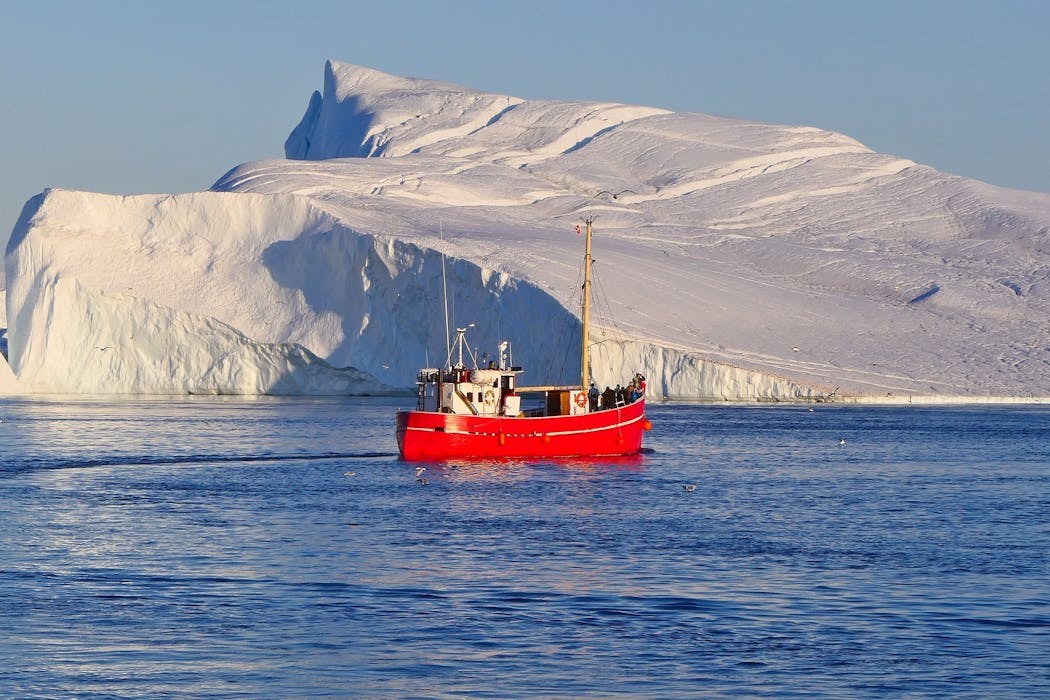
Icebergs in Disko Bay, Greenland. iralgo74/Shutterstock

The Greenland and Antarctic ice sheets are highly vulnerable to global warming and scientists are being increasingly worried about the possibility of large parts of the ice sheets collapsing, if global temperatures keep on rising.

Scientists have identified three elements that could be triggered, putting the ice sheets in Greenland and Antarctica at further risk.

These three instabilities are marine ice sheet instability (Misi), marine ice cliff instability (Mici) and surface elevation melt instability (Semi).

The first one (Misi) occurs when the seafloor beneath the ice sheet slopes downwards toward the interior of the ice sheet. The floating platforms of ice that fringe the Antarctic continent, ice shelves, are too weak to help slow down the ice from flowing into the ocean.

Because of this, the retreat of the ice sheet will happen at an accelerated pace and might become irreversible. When this happens, ice thickness increases inland, meaning that more ice is transported from the ice sheet to the ocean, causing the ice sheet to thin and further retreat.

The second factor (Mici) is linked with the collapse of ice cliffs, left after the disintegration of an ice shelf. These ice cliffs, if they become taller than a 30-storey building, are structurally unstable and would collapse through hydrofracturing.

This is a process through which surface meltwater fills crevasses, forcing fractures to rip open and causing the ice shelves to disintegrate. Their collapse would trigger a rapid retreat of the ice sheet as further, taller ice cliffs – also prone to failure – would become exposed behind.

The third one (Semi) relates to when the melting of the ice sheet causes its surface elevation to decrease, exposing it to higher air temperatures and further increasing melt.

An illustration of the three main factors that may cause ice sheet instability
Illustration of the three main factors causing ice sheet instability.
Illustration by Ricarda Winkelmann based on the Global Tipping Point Report

Which regions are most vulnerable?

West Antarctica, which is home to some of the fastest moving glaciers in the world including Pine Island and Thwaites glaciers, is particularly vulnerable to global warming.

Satellite observations have revealed that these glaciers have retreated, thinned and are flowing faster to the ocean, indicating that Misi is potentially already under way in this region. At the same time, computer models have shown that the retreat of these glaciers will continue in the future.

So far, marine ice cliff instability has been simulated in an ice sheet model but has never been observed in the real world. The conditions that might lead to the formation of such tall ice cliffs and whether their collapse would lead to such dramatic consequences are still poorly understood.

But more glaciers could be at risk if they were to lose their ice shelves, potentially exposing unstable ice cliffs.

Ice melts at Thwaites Glacier.

Surface melt instability is of particular concern in Greenland where surface melt has increased in the past decade and is becoming the main driver of ice losses.

What would happen?

If one (or several) of these instabilities are triggered, there would be an irreversible retreat of parts of the ice sheets, raising sea levels much faster than currently planned. It would still take centuries for the ice across whole regions to fully retreat.

But it could take just under 300 years, under a catastrophic Mici-driven retreat in west Antarctica. So we would already see a much higher contribution of the ice sheets to rising sea levels by 2300, with more frequent coastal flooding worldwide.

As a rule of thumb, for every centimetre of sea level rise, an additional 6 million people are at risk of coastal flooding.

According to the latest IPCC report, sea levels are predicted to rise between 0.3 and 1.6 metres by 2100, depending on future greenhouse gas emissions. However, an increase of more than 15 meters by 2300 cannot be ruled out.

Satellite observations and computer models help us understand how Greenland and Antarctica are changing and how they will continue to do so in the future. Analysis of satellite records shows that regions of both ice sheets are thinning and flowing more rapidly than before. Using computer models, self-sustaining mechanisms that could lead to increased ice sheet melting in the future have been identified.

My international team, supported by the European Space Agency, is bringing together experts in satellite remote sensing and numerical modelling to determine how close the polar ice sheets are to crossing “tipping points”, beyond which their retreat will become irreversible.

However, there is still much to understand and to research around the triggers of these instabilities, and some computer simulations suggest that
ice cliff failure might not lead to the dramatic outcome that some researchers have predicted.

Understanding more about what this means for future sea level rise will help reduce future risks so that we can avoid the dramatic human, social, and economic consequences that would come with more frequent and severe coastal flooding, storm surging and coastal population relocation.


Don’t have time to read about climate change as much as you’d like?

Get a weekly roundup in your inbox instead. Every Wednesday, The Conversation’s environment editor writes Imagine, a short email that goes a little deeper into just one climate issue. Join the 47,000+ readers who’ve subscribed so far.


The Conversation

Inès Otosaka receives funding from the European Space Agency and the UK Natural Environment Research Council.

ref. Three things that might trigger massive ice sheet collapse – https://theconversation.com/three-things-that-might-trigger-massive-ice-sheet-collapse-267275

Should the UK follow Australia’s under-16s social media ban? It could do more harm than good

Source: The Conversation – UK – By Jessica Ringrose, Professor of the Sociology of Gender and Education, Institute of Education, UCL

Drazen Zigic/Shutterstock

A ban on social media for under-16s in Australia comes into effect on December 10 2025. Young people will see their accounts deactivated, with social media companies responsible for enacting the ban.

In the UK, the government has committed to addressing young people’s use of the internet through the Online Safety Act rather than enforcing an outright ban.

However, children’s use of devices is often limited. Bans on smartphones in schools, as well as parent pledges to delay their children’s smartphone use, have gained widespread traction in the UK. They are based on assumptions including that smartphone use is addictive, distracting and leads to children doing worse in school.

On the other hand, though, research suggests the cause and effect may not be so clearcut. Studies have found that phone banning in schools does not significantly increase academic attainment or improve wellbeing.

We are academics with decades of experience exploring young people’s use of digital media. Our ongoing research suggests that an outright ban on social media platforms for under-16s is problematic. It neglects young people’s rights and voice and penalises them rather than targeting social media platforms.

Boy and mum looking at phone
Bans may deter children from talking to adults if they do see something harmful online.
VH-studio/Shutterstock

Bans could erode trust between young people and the adults in their lives. Children may be put off telling adults about something harmful they’re not supposed to have seen. This could lead to them being less able to access support.

Our ongoing study is exploring the implications of banning smartphones in schools in England. Survey data suggests that most schools in the UK do not allow phones to be used at all during the school day.

Previous research by one of us (Jessica Ringrose) explored young people’s experiences with smartphones and social media at school. This research found that girls were being sent nude images by boys at their schools and were exposed to misogynistic messages originating from the manosphere.

Nevertheless, our ongoing work shows widespread opposition to phone school bans among young people. There’s a generational divide: 75% of young people opposed school phone bans, while most parents (88%) and teachers (87%) supported them.

A problem with strict bans in school settings is that issues and harms young people may encounter online, including those that originate from their classmates, are displaced from school.

One of us (Jessica) has previously carried out research on the challenges of combating digital harms in schools that found schools lacked victim support and young people feared reporting online abuse. “No phone” policies may perpetuate this. Young people may be put off showing teachers something online that upset them when they know they’re not supposed to get out their phone.

For parents, too, phone bans may be a way of pushing away a problem they don’t feel equipped or supported to deal with. Interviews with mothers in the US who had signed pledges to delay giving young people smartphones revealed this uncertainty.

Smartphone avoidance strategies delayed the need to engage in other, more nuanced, forms of parental mediation of digital devices. Simply deferring young people’s use of smartphones may not deal with the doubts and fears that parents feel around their children’s use of technology.

Interviews with parents and carers from our ongoing study show they feel overwhelmed and unsupported when it comes to their children’s smartphone use. “When you’re a busy parent, making sure you’re on top of monitoring what they’re doing seems like quite a hard task,” one mother said. “There’s just not enough guidance,” another commented.

What teens think

Our ongoing work is focused on hearing what young people have to say about phone bans. It suggests that bans make young people feel a loss of autonomy and agency, and that they want guidance from adults on smartphone and social media use.

This need for support is something that research has consistently found that young people want. They want to be able to talk to adults and to be listened to without judgement.

We are not dismissing parents’ or teachers’ concerns, nor their hopes for safer smartphone futures. We are also not suggesting students use phones during lessons when it is not appropriate. Rather we argue that listening to young people’s and families’ views about and hopes for tech is crucial.

Research from the House of Lords shows an urgent need for critical thinking and analytical skills to access, evaluate, create and act on media, for both children and adults. Teachers have pointed to major gaps in media literacy education, especially around social media and AI.

But without addressing this at school, online harms are not reduced. Instead, responsibility for them is shifted onto parents, who already feel ill-equipped to address children’s online lives.

By focusing on media literacy in both policies and the curriculum, schools can address children’s experiences and views. This could include covering issues such as AI and social media business models, algorithms, misinformation, surveillance, privacy and consent in the use of technology.

It’s best if schools and parents are able to work together to address rapidly shifting technology concerns such as AI, instead of shifting responsibility back and forth. Parents and families need support to help children navigate responsible use of social media and issues including AI and consent.

The Conversation

Rebecca Coleman receives funding from the Economic and Social Research Council (ESRC).

Jessica Ringrose does not work for, consult, own shares in or receive funding from any company or organisation that would benefit from this article, and has disclosed no relevant affiliations beyond their academic appointment.

ref. Should the UK follow Australia’s under-16s social media ban? It could do more harm than good – https://theconversation.com/should-the-uk-follow-australias-under-16s-social-media-ban-it-could-do-more-harm-than-good-269754