Even after the Second World War ended, sovereignty over Taiwan was never formally settled. China believes Taiwan must be “reunified” with the motherland, if necessary by force.
Most countries, including Canada and the United States, engage with Taiwan in a non-official capacity and simply “acknowledge” China’s insistence that Taiwan is part of China.
China often asserts the 1943 Cairo Declaration as the legal basis for its claim over Taiwan. However, this unsigned media communiqué lacks legal force under international law, something pointed out by British Prime Minister Winston Churchill in 1955.
At the outbreak of the Korean War, U.S. President Harry Truman stated unequivocally that the “determination of the future status of (Taiwan) must await the restoration of security in the Pacific, a peace settlement with Japan or consideration by the United Nations.”
The 1951 Treaty of San Francisco, which ended the war between Japan and the Allied powers, is a legally binding treaty. While Japan renounced “all right, title and claim” to Taiwan, there was no mention of the People’s Republic of China — established only two years earlier — in terms of Taiwanese sovereignty.
The United Nations has never considered, let alone decided upon, the issue of sovereignty over Taiwan. China often cites the UN’s General Assembly Resolution 2758 in 1971 as another legal basis for its assertion of sovereignty over Taiwan. But that resolution only addresses the status of the People’s Republic of China as the legitimate representative of China and makes no mention of Taiwan.
Takaichi’s remarks are simply a reiteration of the late Japanese Prime Minister Shinzo Abe’s remarks that “a Taiwan emergency is a Japan emergency (台湾有事は日本有事).”
With great power comes great responsibility, and this is true for all states. Threats of invasion, the use of force and non-peaceful means of settling disputes are all prohibited under international law. Undiplomatic rhetoric and distortions of history and the law is also detrimental to peace.
As the recent G7 statement states, the international community has “an interest in the preservation of peace and stability across the Taiwan Strait” as China’s military drills and threats of war jeopardize “global security and prosperity.”
In a world beset by conflict in the Middle East and an enduring war in Ukraine, tensions are again heating up in East Asia. Will cooler heads prevail?
Kuan-Wei Chen is the recipient of a Australian Government Research Training Program scholarship.
The Zambezi is Africa’s fourth longest river, flowing through six countries: Angola, Zambia, Namibia, Botswana, Zimbabwe and Mozambique, where it becomes the largest river to flow into the Indian Ocean.
The entire length of the river is referred to as the Zambezi Valley region and it carries with it a rich history of movement, conquest and commerce.
Great Britain colonised Zambia, Botswana and Zimbabwe; Germany colonised Namibia. The beginning and the end of the Zambezi, in Angola and Mozambique, were Portuguese colonies.
Malyn Newitt is a historian of Portuguese colonialism in Africa and has written numerous books on the subject, and one on the Zambezi in particular. We asked him about this history.
When and how did the Portuguese encounter the Zambezi?
The Portuguese were the first Europeans to establish permanent relations with the peoples of sub-Saharan Africa. After the explorer Vasco da Gama’s successful return voyage from Europe to India (1497-1499) the Portuguese heard about the gold trade being carried on in the ports of the Zambezi River. By the middle of the 1500s they were trading there, from their bases on the coast of modern Mozambique. From Sofala and Mozambique Island, they sent agents to the gold trading fairs inland.
The Zambezi is the dark blue line. MellonDor, CC BY-SA
Between 1569 and 1575 a Portuguese military expedition tried to conquer the gold producing regions of what became known as Mashonaland (today part of Zimbabwe). This failed, but permanent settlements were made in the Zambezi valley from which Portuguese control was gradually extended over the river up to the Cahora Bassa gorge in modern Mozambique.
Portuguese adventurers, with their locally recruited private armies, began to control large semi-feudal land holdings known as prazos. These reached their greatest extent in the mid-1600s.
During the 1700s and early 1800s the area of Portuguese control was limited to the Zambezi valley. Here the elite of Afro-Portuguese prazo holders traded gold and slaves.
The first half of the 1800s saw drought, the migrations of the Nguni (spurred by Zulu-led wars in southern Africa) and the continuing slave trade. During these disturbed conditions, Afro-Portuguese warlords raised private armies and extended their control up the river. They went as far as Kariba (on the border between modern Zambia and Zimbabwe) and through much of the escarpment country north and south of the river.
This eventually brought them into conflict with Britain, whose agents were expanding their activities from South Africa. It resulted in an 1891 agreement which drew the frontiers in and around the Zambezi valley which still exist today.
Who are the people who live along the river?
The people who have inhabited the length of the Zambezi valley have often been generically referred to as Tonga. For the most part they’ve organised their lives in small, lineage-based settlements. Their economy is based on crop growing and occupations relating to trade and navigation on the river.
Because of the lack of any centralised political organisation, the valley communities were often dominated by the powerful kingdoms on the north and south of the river. This might involve raiding and enslavement or simply paying tribute to the kings. On the upper reaches of the river in Zambia, populations became subject to the large Barotse kingdom in the 1800s.
The Zambezi where Zambia and Zimbabwe meet. Diego Delso, CC BY-SA
On the lower river many of the people came under the overlordship of prazos. They worked as carriers, artisans, boatmen and soldiers. Because of the extensive gold and ivory trade, a fine tradition of goldsmith work developed and men became skilled elephant hunters.
Throughout history, valley communities have often been loosely organised around spirit shrines with mediums. These are very influential in providing stability and direction for people’s lives.
How did the Portuguese understand these cultures?
For 400 years the Portuguese controlled the lower reaches of the Zambezi, in Mozambique. They wrote many accounts of the people of the region which show a complex interaction. Portugal’s administration and system of land law controlled matters at the apex of society, but could not control African culture.
An old Portuguese map of the region. Discott, CC BY-NC-SA
The Portuguese were few in number and intermarried to some extent with the local population. This produced a hybrid Afro-Portuguese society in which everyday life was carried on according to African traditional practice. Agriculture, transport, artisan crafts, mining and warfare reflected local traditions.
Although the Portuguese tried to introduce Christianity, it failed to attract many people away from the spirit cults. It became diluted with local religious ideas.
The Portuguese built square, European-style houses in the river ports and on the estates along the river. But most of the population retained the traditional African hut design. Afro-Portuguese were often literate but literacy did not penetrate far and the Portuguese language never replaced the local languages.
How did silver play a role in all this?
Late in the 1500s the Portuguese became obsessed with the idea that there were silver mines in Africa comparable to those discovered by the Spanish in the New World. Considerable effort was made to locate these mines in Angola and in the Zambezi valley.
Military expeditions were dispatched and skilled miners were sent from Europe to test the ores that had allegedly been discovered. Attempts to find the mines throughout the 1600s helped to sustain Portuguese interest in the Zambezi settlements. No silver was ever discovered – not surprisingly, as there is no silver in southern Africa.
Can you bring us up to today? What impact has development had on the river?
Until the 1900s the Zambezi defied most attempts at development. The river was difficult to navigate – too shallow in the dry season, too dangerous during the floods. These fluctuations determine the pattern of migrations and agricultural production.
Moreover, as the river passed through a series of gorges which blocked navigation it was only on its upper reaches, beyond the Victoria Falls, on the borders of Zimbabwe and Zambia, that it was able to act as a major highway.
And the river constituted a major obstacle to any contact between people north and south of it. The first bridge was only built in 1905, to carry the railway from South Africa to the copper belt. In the 1930s, British engineers built a second rail bridge across the lower Zambezi. But the first road bridge was only built in 1934, at Chirundu at the border between Zambia and Zimbabwe. This at last linked the areas north and south of the river.
Meanwhile the floods of the Zambezi came to be contained by the building of the Kariba Dam (opened in 1959) and the Cahora Bassa Dam (1974). As a result much of the Zambezi below the Victoria Falls has altered drastically and been turned into a succession of large inland seas.
Large sectors of the population have been forcibly removed and the floods no longer keep sea water from invading the delta. Meanwhile water extraction for irrigation, and increasingly frequent droughts, have endangered the river’s very existence.
The Zambezi has become an example of what happens when the natural resources of a great river have been thoughtlessly over-exploited.
Malyn Newitt does not work for, consult, own shares in or receive funding from any company or organisation that would benefit from this article, and has disclosed no relevant affiliations beyond their academic appointment.
A dynamic new “consumer class” emerging from Africa is attracting international attention. With the prospect of rising incomes and a young population, international consulting firms see the continent as the next frontier for consumer goods. Global entrepreneurs even warn of the increasing savviness of African buyers.
But the influence of African consumers on global markets is far from a new thing. In the 1800s, the continent’s consumer demand called the tune for European factories.
We’re a team of economic and social historians, anthropologists, and African studies specialists. Our research project investigates the roots of these dynamics.
Focusing on the African demand for goods like arms, beads and cloth, our research calls into question the Eurocentric idea that Africa was just a supplier of cheap labour and raw materials before the “Scramble for Africa” by colonial powers.
Instead, in the 1800s, the continent was a key driver of industrial production, compelling manufacturers to tailor their goods to African preferences.
This challenges the conventional view of globalisation as a flow of goods and ideas from dominant economies to so-called peripheral regions. In fact globalisation has always been a connected process – one in which African consumers, though often overlooked, played a decisive role in shaping global markets.
Arms
Analysis of the arms trade takes us to the Congo River estuary in the late precolonial era. Before the late 1800s and colonialism, this region was free of direct European political control.
The illegal slave trade lasted at least until the mid-1850s, when the export of legitimate goods finally began to gather momentum. From roughly the 1850s, one of the products most consistently favoured by consumers in the Congo estuary was the so-called “trade gun”.
These rugged, muzzle-loading muskets were deemed outdated by European manufacturers and traders. In the Congo estuary these firearms remained in high demand.
Trade guns could be flintlocks (using a flint to ignite gunpowder) or percussion guns (using a small, explosive cap to ignite it). Flintlocks were more popular because flintstones were more readily available in Africa.
Moreover, smoothbore muzzle-loaders, commonly made from “soft” wrought iron rather than “hard” steel, were not only cheaper but also a more accessible technology than rifles for African consumers. Although flintlocks were sometimes not effective for big-game hunting, they had substantial military value.
Understanding the role of these weapons in African history, however, requires looking beyond just their function. Imported firearms were also commonly given symbolic meanings shaped by local norms and power structures.
For example, among Kikongo speakers in the lower Congo, gunfire was used as a sign of rejoicing during celebrations and funerals. Noise was believed to drive away bad spirits and aid passage into the spirit world.
Although the gun trade in the lower Congo is not always easy to quantify, it is documented, for example, that the Nieuwe Afrikaansche Handels Vennootschap imported an annual average of about 24,000 guns between 1884 and 1888. The majority of these were discarded French percussion guns that had been modified into flintlocks in Liège.
The development of the arms trade in the lower Congo also mirrors broader changes within the European firearms industry. African consumer demand was not just driven by European industrial output, but was rather an active force that shaped and sustained global economic integration throughout the 1800s.
Beads
Venetian glass bead producers were well aware that their specialised industry depended on demand from Africa and Asia. It is almost impossible to find out exactly how many glass beads were poured into the African continent in the 19th century. Glass beads went through many different hands (in many different ports) before they reached the shores of Africa, and the available information on Venetian production is not consistent.
Historians have shown that, during the 1800s, beads produced in Venice were a key commodity exchanged for ivory along the east African caravan routes connecting the Swahili coast to the Great Lakes. These routes were established by Arab traders and Nyamwezi traders (from today’s Tanzania) on expeditions financed by Gujarati merchants from India.
As demand for ivory grew in European and American markets, these traders began penetrating deeper into the continent to discover new sources of elephant tusks and rhino horns. They established new market centres in the process.
Glass beads were portable and relatively cheap. This made them especially suitable as a form of money in everyday transactions. Beads had a major importance in securing food for caravan porters. Bringing the wrong type of beads could spell disaster for an expedition. This required an updated knowledge of the kinds of beads that were more in demand along specific routes.
Through the caravan leaders, information was gathered by European agents in major commercial hubs such as Zanzibar. This was mailed or telegraphed to their companies’ headquarters, allowing producers to respond to demand as promptly as possible.
Today, sample cards displaying the most requested kinds of glass beads, preserved in European and American museums, are the most tangible product of this information chain.
Cloth
African demand also influenced technological innovation. On the coast of east Africa and in Sudan, people eagerly imported millions of yards of American unbleached cotton cloth. This helped build the fortunes of US industries – so much so that “merikani” (from “American”) became a general term for this product – and, later, of Indian manufacturers.
Its spread, however, was limited by transport costs. Ethiopian markets were supplied mainly by local production, with a robust tradition of cotton spinning and weaving. The cloth was distinctively white and soft – praised by travellers as comparable to the finest European textiles. In Ethiopia, the only clear technological advantage enjoyed by western producers was dyes, especially after the introduction of synthetic colours in the 1870s.
Ethiopian weavers eagerly sought coloured yarn from Europe and India to pair with their own white cloth. This demand stimulated the spread of new dying technology abroad. The situation changed significantly after the unification of Ethiopia under Menelik II, whose reign brought stability and infrastructure development.
Coarse, unbleached cotton became widely available even in the interior, offering a cheap and easily washable option for ordinary people: 12 million square yards from the US were imported in 1905-1906 alone. Meanwhile, Ethiopian elites continued to favour local cotton but complemented it with imported accessories like felt hats and umbrellas. Coloured cloth, once a luxury, became a popular consumer good.
The big picture
The story of how arms, glass beads and cloth were commercialised in Africa and how production and distribution had to adapt to the continent’s needs provides a more nuanced picture of how global trade as we know it took shape.
Our research emphasises that globalisation was not ignited in the global north, but depended on consumers located far from the centres of production.
Nigerians have been waiting anxiously for the economy to “turn a corner”, following economic reform initiatives undertaken by President Bola Tinubu in 2023. These included removing the country’s fuel subsidy and freeing up its foreign exchange market.
There have been signs of improvement. Key among these are stronger economic growth, and a rise in capital inflows and diaspora remittances. Foreign reserves have risen to the highest level in seven years. Core inflation has declined and the foreign exchange market is less volatile.
But ordinary Nigerians aren’t feeling the benefits. There’s anger and resentment, as evident in the nationwide protest in June 2025 against hunger and insecurity.
How might one explain this mismatch?
The answer lies in living conditions, which have not improved and may well have deteriorated since the economic reforms.
Many Nigerians are still without jobs – the unemployment rate has been estimated at about 30%. But this is an underestimate, considering that millions of under-employed Nigerians in the informal sector are counted as employed.
Because of the lack of jobs, about 93% are engaged in low-income informal sector activities. Public spaces and highways in the country have been taken over by roadside hawkers and other informal sector workers.
Nigerians are also chronically poor and food insecure. According to the World Bank, the number of poor people in Nigeria rose from 81 million in 2019 to 139 million in October 2025. Most have no safety net or means of protection from unforeseen events like illness, natural disasters or loss of jobs.
As an economist who has studied the Nigerian economy for over four decades, I argue that Nigeria needs a radical shift in its economic policy approach. Macroeconomic stability can’t be expected to automatically create jobs and alleviate poverty. Time and again, trickle-down economics has been shown to be a flawed economic philosophy.
It is time for the Tinubu administration to take decisive and unprecedented steps to translate macroeconomic improvements into better living conditions for Nigerians.
Why reforms aren’t feeding through
Most Nigerians have not felt the impact of improvements in macroeconomic performance because of the following:
Economic growth is not robust enough: Growth needs to be 6%-8% a year for at least five years, for most Nigerians to feel the impact of an improved economy. Much of that growth must come from labour-intensive sectors of the economy, particularly manufacturing and agro-processing.
Jobless growth: Employment-intensive sectors of the economy haven’t been affected by the reforms. The manufacturing sector, for instance, remains weak due to the high cost of imported raw materials, poor infrastructure, competition from cheap imported goods, and the high cost of borrowing.
Income stagnation and declines in real purchasing power: The few Nigerians with jobs have found that their income lags behind the rate of inflation. The fact that Nigeria’s inflation rate has fallen does not mean that prices have decreased. It simply means that prices are rising more slowly than they did before. And the minimum wage in Nigeria is one of the lowest in the world.
Non-inclusivity of growth: The gains from macroeconomic stability in Nigeria have not been broadly shared. There are two reasons. First, the main drivers of growth are sectors that are not labour-intensive: oil and gas, financial services, digital services, hospitality, music, art and design. Second, many Nigerians don’t have the skills and competencies to be employed in these sectors.
Perverse sectoral distribution of capital inflows: Although foreign capital has increased, much of it is portfolio investment in bonds, government treasury bills, and the stocks of financial institutions. The opportunities for employment generation are therefore very limited.
Economic challenges that need to be addressed
To translate recent policy reforms into better living standards, more needs to be done.
Job creation: The government should work with the private sector to resuscitate the manufacturing sector and agro-processing. Incentives should be given to foreign and domestic investors to invest in manufacturing and agro-processing. A rejuvenated manufacturing sector will integrate the Nigerian economy into global value chains.
Only about 2% of capital inflows this year is foreign direct investment. The rest is portfolio investment in government bonds and securities, as well as corporate stocks – especially in banking. Portfolio investment does not create jobs. Equity investment in manufacturing, agro-processing and even agriculture is preferable for job creation.
Cash transfers: Reduce the huge cost of running the country and use the savings for cash transfers for vulnerable Nigerians. Only about 8.4 million households (out of a population of 238 million) have received cash transfers of between N25,000 and N75,000. This is grossly inadequate. Giving more people cash would represent a big change for many Nigerians, no matter how small the transfer. Cash transfers that are paid for by a reduction in governance cost will not create inflation but enable Nigerians to invest in economic activities and be productive.
Public works: The government should accelerate the rate of job creation by using direct labour for targeted public works projects. Nigeria has many bad roads and dilapidated public buildings.
Streamline the foreign exchange market: There is still a gap between the official and parallel rates of exchange. There are many black-market foreign currency traders. In a well-functioning foreign exchange market, a sprawling black market should not exist.
Reduce the size of the informal sector: This can be done through the development of the manufacturing sector, which will draw surplus labour from the informal sector.
Economic development should be about people, their well-being and their economic dignity. While stabilising the economy, the government should intentionally put in place mechanisms to ensure that macroeconomic improvements result in better living conditions.
Stephen Onyeiwu does not work for, consult, own shares in or receive funding from any company or organisation that would benefit from this article, and has disclosed no relevant affiliations beyond their academic appointment.
Source: The Conversation – Africa (2) – By Anne Fitchett, Retired Honorary Associate Professor in the School of Civil and Environmental Engineering, University of the Witwatersrand
Every year, millions of tonnes of food end up in South Africa’s landfills. This is a wasted resource that deepens environmental damage, worsens food insecurity and costs the economy billions. But there are opportunities to turn what we throw away into value for people, the planet and local economies.
A new study investigates the true cost of current waste practices and the potential of alternative approaches. We spoke with one of the researchers, Anne Fitchett, about organic waste management and how the country can move towards a more sustainable, circular approach.
What are the challenges facing waste management, particularly food waste?
Globally, waste management is a serious challenge as waste increases and systems of production and consumption become more complicated. In South Africa, the most common approach to the disposal of waste is simply to dump it on landfill sites. This currently amounts to a staggering ten million metric tons annually. The country is rapidly running out of space for landfill. Adding to the problem are inadequate planning, weak implementation of recycling policy (such as separation at source), and high transport costs that encourage illegal dumping.
In particular, food waste carries additional ethical and environmental concerns. Hunger and food insecurity is widespread in South Africa, affecting an estimated 15 million people. Organic waste, which includes garden waste, farming waste and food waste, is a major contributor of greenhouse gas emissions through decomposition. Food waste on a landfill also creates odours and pest infestations. Vulnerable people are affected most: waste pickers and low-income households who have no choice but to live near waste dump sites.
What interested us was the opportunities that food waste offers. Instead of being a costly problem, from the viewpoint of economic, social and ecological effects, how can this waste be managed differently, to provide benefits instead?
How is it currently done in South Africa and how did you work out the cost?
In South Africa, organic waste forms the largest single fraction of general waste going to landfill, making up around 27% of all disposed waste. Food waste contributes about one-third of this category.
We explored different ways of calculating the costs of managing food waste, so that we could compare landfill dumping with other approaches. We decided on a social cost-benefit analysis, as this includes economic, social and environmental costs into a single calculation. This makes it much easier for policy makers and municipalities to make informed choices.
We determined the direct costs from municipal and national data sets. The social and environmental costs had to be monetised to integrate into the calculation. To do this, we used what are called hedonic pricing models. This is the price people are willing to pay to avoid a negative environmental impact, which we derived from the local and international research. We also used life-cycle cost analysis for some of the values. Here, we factor in all the different costs that a particular method needs, such as capital cost, operating cost, maintenance, and final residual or salvage value at the end of its useful life.
Through this analysis method, we calculated that landfill practices impose an estimated R8.7 billion (US$0.5 billion) annual burden on the economy, environment and communities across South Africa. Because much of this is a hidden cost, the real “dis-amenity” (the combination of negative values) is often undervalued and these costs materialise in other ways, to the detriment of the economy, society and the environment.
What alternative methods did you test and what were the outcomes?
We explored various means:
aerobic composting (decomposition with air circulation)
anaerobic digestion (decomposition in a sealed container)
processing through vermicomposting (harnessing the services of earthworms that eat the food waste and produce nutrient-rich deposits)
black soldier flies (the larvae of which feed on the waste and produce animal feed and organic fertiliser).
We calculated that windrow composting, where organic waste is placed in long rows and turned periodically to maintain oxygen levels, generates some benefits through the sale of the compost. It also saves in greenhouse gas emissions by replacing more costly fertilisers for farming.
In-vessel composting was the one method we analysed that had higher costs than benefits, even though it produces better quality compost and almost no air pollutants. (But this was still a marked improvement over landfilling.) In this method, the waste is in a closed environment, where air-flow, moisture and temperature can be controlled to speed up the composting process.
We also evaluated anaerobic digestion with bio-gas capture, which takes place in an enclosed environment, but with air excluded. The biogas percolates to the top of the tank where it is extracted for cooking and other uses. This has a much higher capital and operational cost, but generates saleable methane and carbon dioxide gases, as well as a digestate that can be sold for soil enhancement.
Vermicomposting is a process where organic waste is broken down by earthworms and microbes into material that can add nutrients to soil. It also produces worm biomass as a high-protein animal feed. This produces a higher net benefit than any of the other methods described so far.
The best performer from the social cost-benefit analysis was black soldier fly processing. The flies’ eggs are hatched and the larvae are transferred to the food waste, which the larvae feed on. When the larvae reach maturity, they are harvested for protein-rich animal feed and their deposits (called frass) are collected for use as fertiliser.
Studies agree that anaerobic digestion offers the best performance from a purely environmental appraisal.
Our study suggests that a combination of anaerobic digestion and black soldier fly processing could be the optimal solution, taking into account social and economic aspects.
How can these findings be used to shape policy?
Our study offers a number of pointers. It is essential to look at gate fees to landfill sites. Some of the sites are not charging at all, and the closest to charging an economic rate is the Western Cape province. This should be weighed against the possible avoidance of formal waste disposal altogether, inadvertently promoting illegal dumping. Linked to this is the lack of compliance with waste legislation that was identified at many of the sites across the country.
Municipalities should be encouraged, through government policies, to invest in alternative technologies, like vermicomposting and black soldier fly processing. A strategic combination of economic incentives, regulatory compliance and sustainable practices is essential to achieve long-term national waste management objectives.
The results of our study highlight the urgent need for an integrated strategy that incorporates economic, ecological, social and governance dimensions to transform food waste into a resource. The current default to landfill is simply not a sustainable option. With targeted policies and investments, food waste could shift from being a costly liability to serving as a cornerstone of South Africa’s circular economy and sustainable development agenda.
Gabriel Pereira, a master’s student, was a co-author on the research and article.
Anne Fitchett does not work for, consult, own shares in or receive funding from any company or organisation that would benefit from this article, and has disclosed no relevant affiliations beyond their academic appointment.
The recently struck memorandum of understanding (MOU) between Canada and Alberta is a high-stakes strategy that risks deepening already deep divides in Canadian politics.
While the MOU touches on a number of issues, at its heart is a shared vision for a new pipeline from Alberta to British Columbia’s protected northern coast.
It’s a vision negotiated without the involvement of either the B.C. government or the Indigenous Peoples affected by the plan. While the agreement calls for consultations with both groups, they are relegated to the status of secondary partners, with concerns to be addressed in the execution of the plan outlined by Ottawa and Alberta.
A policy solution for an identity issue
The deal is clearly meant to bridge the gap between populist voters centred in the Prairie provinces and the rest of the country. But both the content and the process risks widening that gap, even as it deepens divisions elsewhere in the country.
Simply put, Prime Minister Mark Carney is trying to find a policy solution to an identity problem, and doing so by picking sides rather than neutrally facilitating agreement.
It’s part of the polarized, populist identity in Alberta, in particular, to oppose Ottawa and Liberal governments. In fact, when Alberta Premier Danielle Smith referred to the MOU in front of the United Conservative Party (UCP) convention, she was roundly booed. Rather than being hailed as champion who had achieved valuable policy concessions, she was greeted as a traitor to the cause.
Given the rude reception, it’s not surprising that in recent days Alberta has sought ways to limit its environmental commitments.
Over the longer term, the agreement risks legitimizing the narrative of “Alberta aggrieved” by treating it as a distinct, sovereign jurisdiction entitled to special treatment.
In fact, the trappings and language of the agreement seem to reinforce the idea that “Alberta” is a natural negotiating partner with “Canada” rather than part of Canada.
The MOU’s signing ceremony in Calgary — not the provincial capital of Edmonton or Ottawa — bore all the hallmarks of international treaty-making, complete with flags and a formal text in both official languages. The symbolism reinforced the image of the deal as a kind of grand bargain between Ottawa and oil country.
While the federal government often strikes deals with provincial governments, this situation is quite different. It’s a deal only with Alberta but it primarily involves British Columbia. The agreement therefore elevates Alberta to the level of a quasi-sovereign jurisdiction to be treated as an equal with Canada. B.C., site of any future hypothetical pipeline terminals, has been rendered a deal-taker, not a deal-maker.
Unfortunately, that’s not how the federation is supposed to work. Just because the federal government has ultimate jurisdiction doesn’t mean other regions don’t get a say. It’s hard to imagine the federal government striking a deal with Ontario about what should happen in Québec without Québec’s involvement.
In leaving Eby out of the conversation, the federal Liberals have alienated a natural ally in their pursuit of economic development, forcing the premier to defend B.C.’s status within the federation, the rights of the province’s Indigenous communities and the province’s protected northern coast and Great Bear Rainforest.
Constitutional obligations to consult
Even more telling is the united reaction of First Nations. The Assembly of First Nations has unanimously voted in favour of a motion calling for the MOU to be scrapped. In fact, the federal government may have put itself in legal jeopardy over its failure to consult prior to the MOU.
At some point, it will likely have to explain in court how it could be serious about consulting in good faith with Indigenous Peoples in accordance with its obligations under Section 35 of the Constitution Act when the MOU gives the appearance of approving the project in principle before such conversations even begin.
Offering ownership stakes to Indigenous groups in a project devised without their involvement is not consultation. Simply put, unless governments can show they’re open to amending their plans in light of information they receive during consultations, they risk falling short of their obligations.
Cracks in the Liberal coalition
While polls suggest a majority of Canadians support the idea of a pipeline so far, the Liberals’ own coalition shows some signs of fraying.
Former environment minister Steven Guilbeault’s resignation from cabinet over the deal, along with the resignations of multiple environmental advisers to the Liberal government, suggest the party’s reputation for environmental progress has taken a hit given the slow and fuzzy approach to climate action outlined in the MOU.
Other federal parties sense an opportunity. The Bloc Québecois has strongly denounced the deal and has offered to support B.C. in its campaign to defend the province’s autonomy. The move underscores the sensitivities that remain in Québec around issues of provincial rights.
Even more tellingly, federal Conservatives, perhaps initially dismayed by a deal uniting federal Liberals and Alberta Conservatives, are now putting a motion before the House of Commons asking it to endorse the government’s position on the MOU and make good on its commitments. The Liberals, for their part, have vowed to vote against the motion, arguing that it only endorses part of the MOU.
In effect, the Conservatives are seeking to turn the government’s own MOU into a wedge issue against it. The Conservatives will likely continue to press the issue going forward given how the idea of a pipeline at any cost unites Conservatives and divide Liberals. Liberal MPs in B.C. and Québec, in particular, will also likely feel torn between loyalty to the party and deference to the views of constituents opposed to the deal.
In short, a pipeline intended to unify threatens to throw divisions into even sharper relief — even within the Liberal Party itself.
Stewart Prest does not work for, consult, own shares in or receive funding from any company or organisation that would benefit from this article, and has disclosed no relevant affiliations beyond their academic appointment.
La sécurité des utilisateurs doit être intégrée à la conception des plates-formes numériques. Elle n’est pas forcément complexe ou coûteuse, contrairement à ce que prétendent les entreprises numériques. Une expérience, menée sur la plateforme pornographique Pornhub, montre qu’un simple message adressé aux internautes cherchant des images pédopornographiques est fort dissuasif.
Le mot d’ordre officieux de l’industrie tech pendant deux décennies était « Move fast and break things », qu’on pourrait traduire par « aller vite quitte à tout casser ». Une philosophie qui a brisé bien plus que les seuls monopoles des taxis ou le modèle d’affaires des chaînes hôtelières. Elle a aussi façonné un monde numérique rempli de risques pour les plus vulnérables.
Pour la seule année fiscale 2024-2025, l’Australian Centre to Counter Child Exploitation a reçu près de 83 000 signalements de contenus d’exploitation sexuelle d’enfants en ligne (CSAM), principalement sur des plateformes grand public – une hausse de 41 % par rapport à l’année précédente.
En Australie, avec l’entrée en vigueur cette semaine de l’interdiction d’utiliser les réseaux sociaux pour les moins de 16 ans, ainsi que la mise en place de la vérification de l’âge pour les utilisateurs connectés aux moteurs de recherche le 27 décembre et pour les contenus réservés aux adultes le 9 mars 2026, nous atteignons un moment charnière – mais il faut bien comprendre ce que cette régulation permet et ce qu’elle laisse de côté. (Note du traducteur : En France, la loi du 7 juillet 2023 fixe à 15 ans l’âge minimal pour l’inscription et l’utilisation des réseaux sociaux).
L’interdiction empêchera une partie des enfants d’accéder aux plateformes (s’ils ne la contournent pas), mais elle ne corrige en rien l’architecture toxique qui les attend lorsqu’ils y reviendront. Elle ne s’attaque pas non plus aux comportements nocifs de certains adultes. Nous avons besoin d’un changement réel vers un devoir de vigilance numérique, qui obligerait légalement les plateformes à anticiper les risques et à les atténuer.
Le besoin de penser la sécurité dès la conception
Aujourd’hui, la sécurité en ligne repose souvent sur une approche dite « whack-a-mole », une référence à ce jeu d’arcade qui consiste à donner des coups de maillet sur la tête de taupes émergeant aléatoirement de quelques trous. De fait, les plateformes attendent que les utilisateurs signalent des contenus nocifs, puis les modérateurs les retirent. C’est une méthode réactive, lente, et souvent traumatisante pour les modérateurs humains qui y participent.
Pour remédier réellement au problème, il faut intégrer la sécurité dès la conception. Ce principe impose que les dispositifs de protection soient inscrits au cœur même de l’architecture de la plateforme. Il dépasse la simple restriction d’accès pour interroger les raisons pour lesquelles la plateforme permet, à l’origine, l’existence de mécanismes menant à des usages nocifs.
Au CSAM Deterrence Centre, dirigé par Jesuit Social Service en partenariat avec l’Université de Tasmanie, nos travaux contredisent le discours récurrent de l’industrie selon lequel assurer la sécurité serait « trop difficile » ou « trop coûteux ».
En réalité, nous avons constaté que des interventions simples et bien conçues peuvent perturber des comportements nocifs sans nuire à l’expérience des autres utilisateurs.
Perturber les comportements dangereux
L’une de nos découvertes les plus marquantes provient d’un partenariat avec l’un des plus grands sites pour adultes au monde, Pornhub. Lors de la première intervention de dissuasion évaluée publiquement, lorsqu’un utilisateur cherchait des mots-clés liés aux abus sur mineurs, il ne se retrouvait pas face à un écran vide. Un message d’avertissement s’affichait et un chatbot l’orientait vers une aide thérapeutique.
Ces données, cohérentes avec les résultats de trois essais contrôlés randomisés que nous avons menés auprès d’hommes australiens âgés de 18 à 40 ans, démontrent l’efficacité des messages d’avertissement.
Elles confirment également un autre constat : le programme Stop It Now (Australie) de Jesuit Social Service, qui propose des services thérapeutiques aux personnes préoccupées par leurs sentiments envers les enfants, a enregistré une forte augmentation des recommandations web après que le message d’avertissement affiché par Google dans les résultats de recherche liés aux contenus d’abus sur mineurs ait été amélioré plus tôt cette année.
En interrompant le parcours de l’utilisateur par un message clair de dissuasion, on peut empêcher qu’une pensée nocive se transforme en acte dangereux. C’est de la « safety by design » (« sécurité dès la conception »), utilisant l’interface même de la plateforme pour protéger la communauté.
Plutôt que de laisser les utilisateurs naviguer à leurs risques et périls, les plateformes en ligne seraient légalement tenues de repérer et de réduire les risques qu’ils créent, qu’il s’agisse d’algorithmes suggérant des contenus nocifs ou de fonctions de recherche permettant d’accéder à du matériel illégal.
Parmi les mesures possibles, figurent la détection automatique de comportements de grooming (repérer les personnes cherchant à exploiter des enfants), le blocage du partage d’images et de vidéos d’abus déjà connus ainsi que des liens vers les sites qui les hébergent, et la suppression proactive des voies permettant d’atteindre les personnes vulnérables – par exemple empêcher que des enfants en ligne puissent interagir avec des adultes qu’ils ne connaissent pas.
Comme le montre notre recherche, les messages de dissuasion jouent également un rôle : afficher des avertissements clairs lorsque les utilisateurs recherchent des termes dangereux est très efficace. Les entreprises technologiques devraient collaborer avec des chercheurs et des organisations à but non lucratif pour tester ce qui fonctionne, en partageant les données plutôt qu’en les dissimulant.
L’ère du « aller vite quitte à tout casser » est révolue. Il faut un changement culturel qui fasse de la sécurité en ligne une caractéristique essentielle, et non un simple ajout optionnel. La technologie pour rendre ces plateformes plus sûres existe déjà, et les données montrent qu’intégrer la sécurité dès la conception peut porter ses fruits. Il ne manque plus qu’une réelle volonté de le faire.
Joel Scanlan est le co-responsable académique du CSAM Deterrence Centre, un partenariat entre l’Université de Tasmanie et Jesuit Social Services, qui gèrent Stop It Now (Australie), un service thérapeutique offrant un soutien aux personnes préoccupées par leurs propres sentiments, ou ceux de quelqu’un d’autre, envers les enfants. Joel Scanlan a reçu des financements de l’Australian Research Council, de l’Australian Institute of Criminology, du eSafety Commissioner, de la Lucy Faithfull Foundation et de l’Internet Watch Foundation.
Between the public extravagances of today’s business icons and the recent trials of prominent CEOs, narcissistic managers have firmly taken the spotlight. In academia, the fascination with the potent mix of charisma and ego that defines narcissistic leaders has fuelled nearly two decades of extensive research and analysis. Yet one of the central challenges of this work is measurement: how can we identify and assess narcissism in managers outside a clinical setting? Since it’s rarely possible to administer traditional psychometric tests to top executives, management scholars have developed a range of clever, unobtrusive ways to identify narcissistic tendencies by observing behavior, language, and public presence.
Narcissism: its traditional measurement
According to the Diagnostic and Statistical Manual of Mental Disorders (DSM) of the American Psychiatric Association, “narcissistic personality disorder is defined as a pervasive pattern of grandiosity (sense of superiority in fantasy or behavior), need for admiration, and lack of empathy, beginning by early adulthood and occurring in a variety of contexts.” In their 2020 article in the Journal of Management, authors Ormonde Rhees Cragun, Kari Joseph Olsen and Patrick Michael Wright write that “despite its origin in clinical psychology, the DSM’s definition is also widely accepted for defining narcissism in its nonclinical form”.
Research in psychology traditionally assesses narcissism through self-report tests or third-party psychometric tests. As first outlined by R. A. Emmons in 1984, the basic principle of these tests is to link simple statements to the components of narcissism. The most widely used and empirically validated are the 40-item Narcissistic Personality Inventory (NPI) and its shorter version, the NPI-16. The NPI asks respondents to choose between paired statements such as “I really like to be the center of attention” versus “it makes me uncomfortable to be the center of attention”, and “I am much like everybody else” versus “I am an extraordinary person”.
While a few studies have administered the NPI directly to top managers – or adapted it for third-party evaluations, asking employees or stakeholders to rate managers based on daily interactions – such approaches remain extremely rare due to limited access to suitable participants. Faced with these limitations, researchers in management and organizational studies have sought alternative ways to detect narcissism in leaders. They began by identifying behavioral and linguistic cues in CEOs’ official communications that could reflect one or more dimensions of narcissism. More recently, however, the rise of social media has provided researchers with new, more direct opportunities to observe and measure narcissistic behavior in real time.
Spotting narcissistic traits in interviews and official communications
One of the first studies to measure managerial narcissism was developed by Arijit Chatterjee and Donald C. Hambrick in 2007. After consulting with corporate communication experts, they followed Emmons’ principle and identified four potential signs of narcissism in CEOs’ public behavior. These were the prominence of the CEO’s photograph in a company’s annual report; the CEO’s prominence in a company’s press releases; the CEO’s use of first-person singular pronouns (eg I, me and my) in interviews; and the CEO’s compensation divided by that of the second-highest paid executive in the firm.
Later research expanded this approach with new indicators, such as the number of lines in a CEO’s official biography or the number of awards listed in their self-description. Other studies zoomed in on more specific linguistic cues – such as the ratio of singular pronouns to plural pronouns (eg we, us and ours) in CEOs’ press releases.
Inspired by findings in psychology, some researchers have even used the size of a CEO’s signature as a proxy for narcissism – a larger, more flamboyant signature being linked to a higher level of narcissism.
Importantly, many of these studies have validated their unobtrusive measures against traditional personality tests, finding strong correlations with established tools like the NPI. This evidence suggests that we can reliably spot narcissistic tendencies in leaders by observing their behavior and communication.
How social media reveals narcissistic traits in managers
In recent years, the rise of social media has given researchers unprecedented opportunities to observe how managers present themselves to the public – opening a new window into their narcissistic behavior. For instance, a recent study by Sebastian Junge, Lorenz Graf-Vlachy, Moritz Hagen and Franziska Schlichte analysed managers’ LinkedIn profiles to develop a multidimensional index of narcissism. Building on the DSM’s components of narcissism, the authors identified five features of a profile that may signal narcissistic tendencies: the number of pictures of the executive; the length of the “About” section; the number of listed professional experiences; the number of listed skills; and the number of listed credentials. They then combined these indicators to create an overall index of managerial narcissism.
Admittedly, research that only uses social media profiles may focus on the most narcissistic managers, since less narcissistic executives may not maintain, for example, a LinkedIn presence. Moreover, social psychology research suggests that social media itself encourages exaggeratedly narcissistic communication by encouraging self-promotion. To help address these concerns, Junge et al. assigned managers without LinkedIn profiles the lowest possible narcissism score and included them in their overall analysis. Their study found strong correlations between the LinkedIn-based measure and earlier, unobtrusive measures of narcissistic CEO behavior, as well as traditional psychometric tests such as the NPI.
The takeaway is encouraging: we don’t always need a personality test to spot narcissistic leaders – their words, images and online profiles can reveal a great deal. These tools offer employees, investors and board members a way to better recognize narcissistic tendencies in managers and adjust their decisions and interactions accordingly. And there’s still huge potential for being creative: building on psychologists’ insights into narcissistic behaviors, we could explore psycholinguistic dictionaries of narcissistic rhetoric and even, more eccentrically, analyse facial features such as eyebrow distinctiveness.
A weekly e-mail in English featuring expertise from scholars and researchers. It provides an introduction to the diversity of research coming out of the continent and considers some of the key issues facing European countries. Get the newsletter!
Ivana Vitanova ne travaille pas, ne conseille pas, ne possède pas de parts, ne reçoit pas de fonds d’une organisation qui pourrait tirer profit de cet article, et n’a déclaré aucune autre affiliation que son organisme de recherche.
Source: The Conversation – in French – By Hugues Plisson, archéologue spécialisé en tracéologie (reconstitution de la fonction des outils préhistoriques par l’analyse de leurs usures), Université de Bordeaux
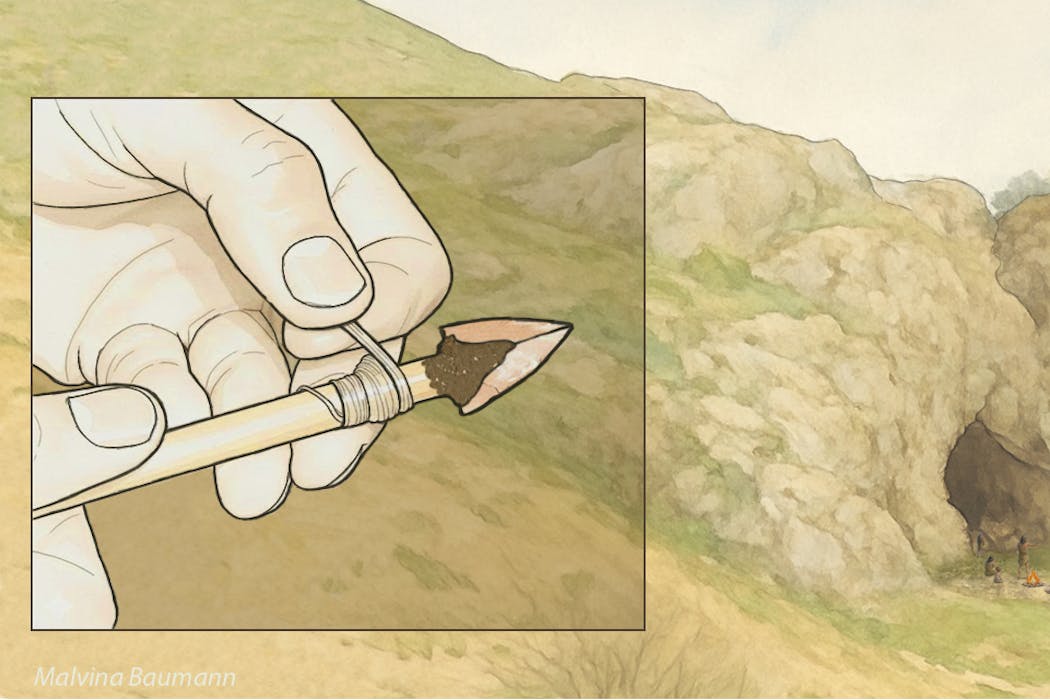
Des pointes de flèche retrouvées en Asie centrale.Malvina Baumann, Fourni par l’auteur
De minuscules pointes de projectile triangulaires ont été identifiées à partir de leurs fractures d’impact dans les plus anciennes couches d’occupation du site d’Obi-Rakhmat en Ouzbékistan, vieilles de 80 000 ans. Elles ont la dimension de pointes de flèches et sont identiques à celles découvertes dans une couche beaucoup plus récente d’un site de la vallée du Rhône, en France, à la toute fin du Paléolithique moyen, correspondant à une incursion d’Homo Sapiens en territoire néanderthalien il y a 54 000 ans. Cette nouvelle étude, publiée dans la revue « PLOS One », apporte un argument décisif pour la réécriture du scénario de l’arrivée d’Homo Sapiens en Europe.
Développés en Europe occidentale et plus particulièrement en France à partir de la seconde moitié du XIXe siècle, les cadres chrono-culturels et anthropologiques de la Préhistoire et les modèles évolutifs qu’ils inspirèrent furent d’abord linéaires et européocentrés : Cro-Magnon descendant de Néanderthal posait les fondements d’une supériorité civilisationnelle dont se prévalait alors cette partie du monde. Ce n’est qu’un siècle plus tard que sera mise en évidence l’origine africaine d’Homo Sapiens et des traits technologiques et sociaux structurants du Paléolithique supérieur occidental, de ~ 45 000 à 12 000 ans avant le présent (productions symboliques, réseaux à grande distance, outillages et armements lithiques et osseux diversifiés).
Les plus anciennes évidences de présence d’Homo Sapiens en Australie vers 65 000 ans précèdent de 10 millénaires celles de l’Europe dont les modalités du peuplement demeurent sujet de discussion. À ce jour, le calage chronologique des toutes premières occupations européennes du Paléolithique supérieur par rapport à celles de l’est du bassin méditerranéen, pourtant regardées comme les plus proches, demeure insatisfaisant. Soit les données sont issues de fouilles trop anciennes pour avoir été suffisamment précises, soit elles ne s’inscrivent pas dans la filiation directe supposée entre le Levant et l’Europe. Les racines mêmes du Paléolithique supérieur initial levantin, malgré la proximité africaine, sont incertaines. Une origine centre asiatique, a été suggérée par l’archéologue Ludovic Slimak en 2023.
Un site en Asie centrale
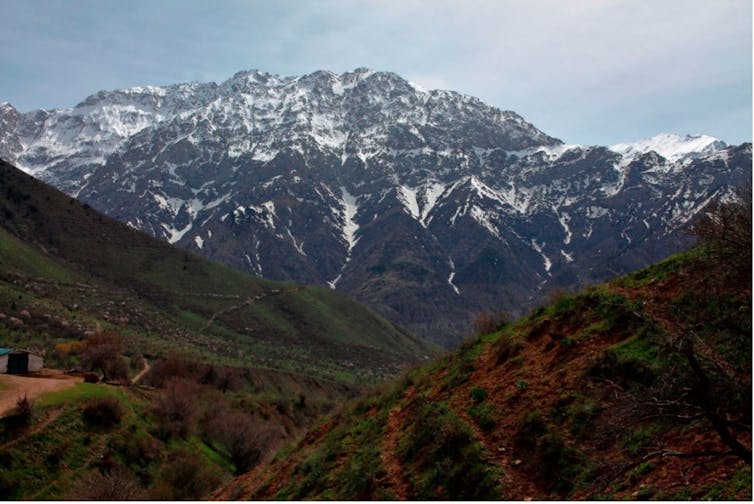
Vue depuis l’abri d’Obi-Rakhmat sur l’extrémité du Tien Shan. Fourni par l’auteur
Corridor entre l’ouest et l’est du continent ou zone refuge, selon les phases climatiques, l’Asie centrale n’est encore documentée que par quelques sites paléolithiques, mais qui sont autant de références de l’histoire de la Préhistoire.
Parmi ceux-ci figure l’abri sous roche d’Obi-Rakhmat en Ouzbékistan découvert en 1962. Ce gisement livre sur 10 mètres de stratigraphie, entre 80 000 et 40 000 ans, une industrie lithique qui par certains traits s’inscrit clairement dans la continuité du Paléolithique moyen ancien du Levant mais par d’autres fut rapprochée du Paléolithique supérieur initial. Ce Paléolithique moyen ancien du Levant, associé dans le site de Misliya à de l’Homo Sapiens archaïque, disparut du Proche-Orient vers 100 000 ans. À Obi-Rakhmat, les restes crâniens d’un enfant trouvés dans une couche à ~ 70 000 ans, présentent des caractères regardés comme néanderthaliens et d’autres comme anatomiquement modernes, combinaison pouvant résulter d’une hybridation.
Lames massives mais pointes microlithiques
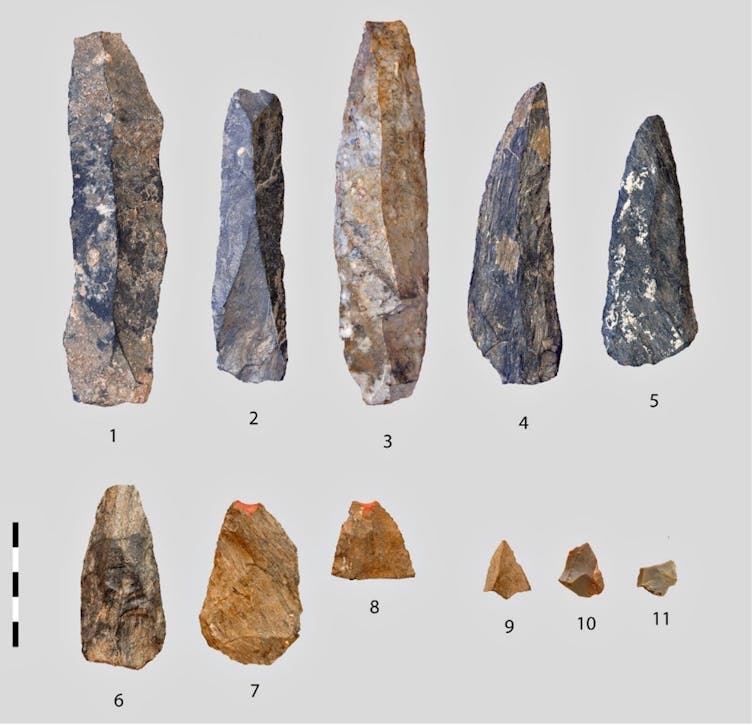
Éléments de l’industrie lithique de la couche 21 d’Obi-Rakhmat : lames brutes (1-2), grande lame retouchée (3), lames retouchées en pointe (4-5), pointes retouchées impactées (6-8), micro pointe Levallois brute (9), micro-pointes brutes impactées (10-11). Fourni par l’auteur
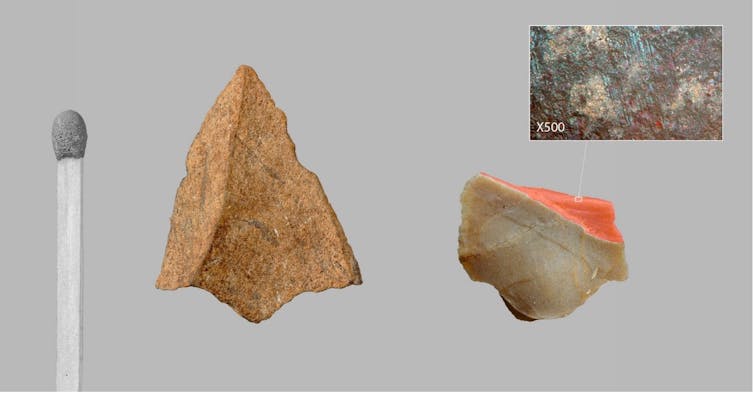
C’est dans ce contexte que notre équipe internationale, dirigée par Andrei I. Krivoshapkin, a identifié dans les couches les plus anciennes de minuscules pointes de projectiles triangulaires. Mesurant moins de 2 cm de large et ne pesant que quelques grammes, elles sont impropres par leurs dimensions et leur fragilité à avoir été montées sur des hampes de lances. Leur étroitesse correspond au diamètre (inférieur ou égal à 8 mm) des hampes documentées ethnographiquement sur tous les continents pour les flèches tirées à l’arc droit.
Deux micro-pointes brutes de la couche 21 du site d’Obi-Rakhmat, l’une intacte, l’autre brisée et rayée par son usage en armature de projectile. L’allumette matérialise leur minuscule dimension. Fourni par l’auteur
Question de balistique
Les armes perforantes projetées constituent des systèmes complexes dont les éléments ne sont pas interchangeables d’un type d’arme à l’autre, car répondant à des contraintes différentes en intensité et en nature.
L’importante force d’impact des lances tenues ou lancées à la main fait de la robustesse de l’arme un paramètre essentiel, aussi bien en termes d’efficacité que de survie du chasseur, la masse assurant à la fois cette robustesse, la force d’impact et la pénétration. À l’opposé, la pénétration des traits légers tirés à grande distance repose sur leur acuité, car l’énergie cinétique, beaucoup plus faible, procède là essentiellement de leur vitesse, laquelle, à la différence de la masse, décroit très rapidement sur la trajectoire et dans la cible. Cette vitesse ne pouvant être atteinte par la seule extension du bras humain, elle est obligatoirement tributaire de l’emploi d’un instrument de lancer. Les pointes de flèche et celles de lances ou de javelines ne sont donc pas conçues selon les mêmes critères et ne se montent pas sur les même hampes, les dimensions et le degré d’élasticité desquelles sont par ailleurs essentiels en terme balistique. Ainsi, comme en paléontologie où la forme d’une dent révèle le type d’alimentation et suggère le mode de locomotion, les caractéristiques d’une armature fournissent des indices sur le type d’arme dont elle est l’élément vulnérant.
Un armement propre à Sapiens ?
Le minuscule gabarit des pointes d’Obi-Rakhmat ne peut être regardé comme un choix par défaut, car non seulement la matière première lithique de bonne qualité dont on a tiré de grandes lames ne manque pas à proximité du site, mais l’inventaire des traces d’usage relevées à la loupe binoculaire et au microscope met en évidence au sein du même assemblage des pointes retouchées beaucoup plus robustes (15 à 20 fois plus lourdes et 3 à 4 fois plus épaisses) et du gabarit des têtes de lance ou de javeline.
En retournant à la bibliographie et à nos propres travaux sur des outillages du Paléolithique moyen, nous avons constaté que la présence dans un même ensemble d’armatures de divers types, pour partie microlithiques et produites à cette fin, n’était à ce jour connue que dans les sites à Homo Sapiens. Les plus anciennes occurrences documentées sont en Afrique du Sud dans les couches culturelles Pre-Still Bay (plus de 77 000 ans) et postérieures du gisement de Sibudu. Dans l’univers néanderthalien, les pointes lithiques endommagées par un usage en armature de projectile sont rares, elles sont de fort gabarit et ne se distinguent ni par leurs dimensions, leur facture ou leur type de celles employées à d’autres activités que la chasse, telles que la collecte de végétaux ou la boucherie. Cette distinction dans la conception des outillages et des armements prend valeur de marqueur anthropologique.
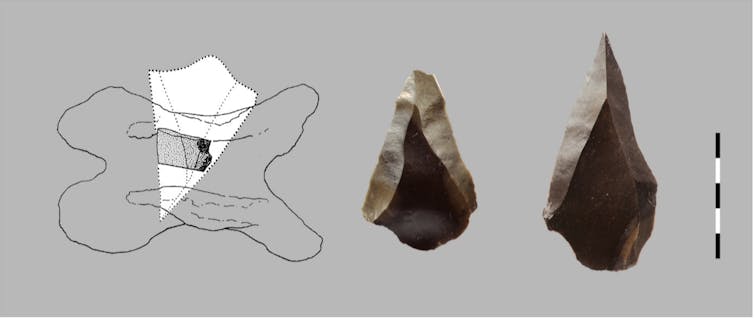
Pointes levallois du site d’Um el-Tlel en Syrie, Paléolithique Moyen récent levantin attribué à Néanderthal. De gauche à droite : reconstitution graphique à partir d’un fragment planté dans une vertèbre d’âne, lame de couteau à plante, lame de couteau de boucherie. Ces pointes polyvalentes sont 2 à 3 fois plus larges que les micro-pointes d’Obi-Rakhmat. Fourni par l’auteur
En raison de leurs dates respectives, de la distance entre l’Afrique du sud et l’Asie centrale (14 000 km) et de la différence de facture des armatures d’Obi-Rakhmat et de Sibudu (lithique brut de débitage vs lithique façonné ou retouché, osseux façonné), l’hypothèse de foyers d’invention indépendants est la plus vraisemblable.
Des piémonts du Tien Shan à la vallée du Rhône 25 000 plus tard
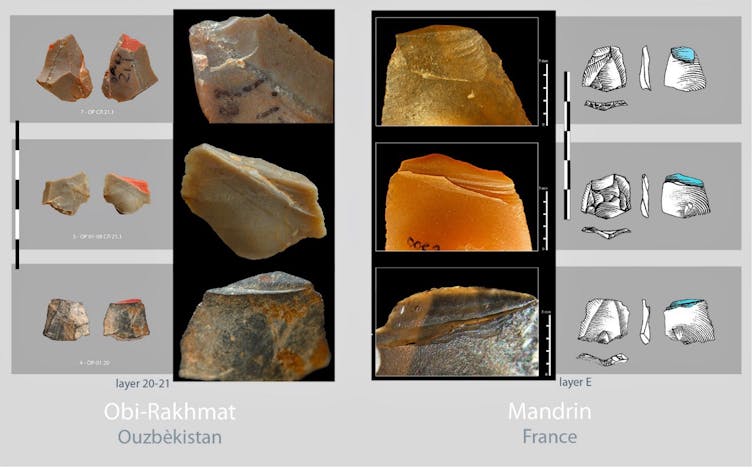
La seule forme d’armature miniature de projectile identique actuellement connue est beaucoup plus récente. Elle fut découverte par Laure Metz, sur le site de Mandrin, en vallée du Rhône en France, qui livra aussi une dent de lait d’Homo Sapiens déterminée par Clément Zanolli. L’ensemble est daté d’environ 54 000 ans, soit une dizaine de milliers d’années avant la disparition des Néanderthaliens locaux. La similitude des micro-pointes d’Obi-Rakhmat et de Mandrin, pourtant séparées par plus de 6 000 km et 25 millénaires, est telle que les unes et les autres pourraient être interchangées sans qu’aucun autre détail que la roche ne trahisse la substitution.
Similitude des micro-pointes d’Obi-Rakhmat et de Mandrin brisées par leur usage en armature de projectile. La localisation et l’extension de leur fracture (surlignement en rouge et en bleu et détail macroscopique) signent l’impact axial. Fourni par l’auteur
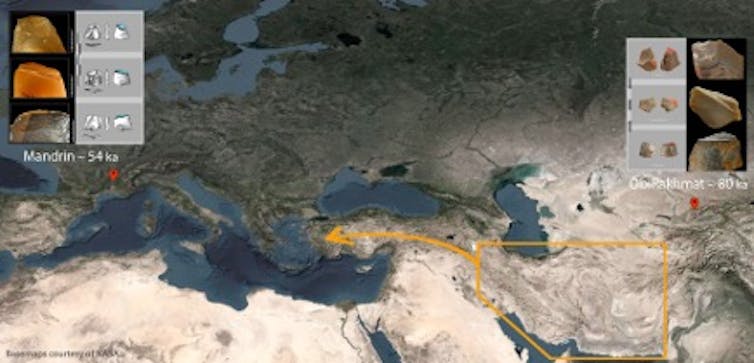
Des travaux récents publiés par Leonardo Vallini et Stéphane Mazières définissent le Plateau perse, à la périphérie nord-est duquel est situé Obi-Rakhmat, comme un concentrateur de population où les ancêtres de tous les non-Africains actuels vécurent entre les premières phases de l’expansion hors d’Afrique – donc bien avant le Paléolithique supérieur – et la colonisation plus large de l’Eurasie. Cet environnement riche en ressources pourrait avoir constitué une zone de refuge propice à une régénération démographique après le goulet d’étranglement génétique de la sortie d’Afrique, à l’interaction entre les groupes et par conséquent aux innovations techniques.
De part et d’autre du plateau perse (encadré orange), identifié génétiquement comme une aire refuge de concentration et développement démographique des Homo Sapiens sortis d’Afrique, Obi-Rakhmat et Mandrin ont en commun, à 25 000 ans et 6 000 km de distance, les mêmes micro-pointes de projectile. Fourni par l’auteur
Mandrin et Obi-Rakhmat représentent probablement deux extrémités géographiques et temporelles d’une phase pionnière de peuplement telle qu’entrevue par Ludovic Slimak, marquée par ce que les typologues qualifiaient jadis de fossile directeur et qui ici recouvrirait la propagation d’une invention fondamentale propre à Homo Sapiens. Jusqu’à présent passées inaperçues parce que brutes de débitage, minuscules et fragmentaires, il est à parier que les micro-pointes de projectile dont les critères de reconnaissance sont maintenant posés commenceront à apparaître dans des sites intermédiaires entre l’Asie centrale et la Méditerranée occidentale.
Prémisses d’un nouveau scénario du peuplement occidental d’Homo Sapiens
Cette découverte est stimulante à plusieurs titres. Elle valide la cohérence de l’étude du site de Mandrin qui concluait à une brève incursion en territoire néanderthalien de Sapiens armés d’arcs, mais dont plusieurs éléments avaient été critiqués – ce qui est cependant le jeu scientifique habituel lorsqu’une proposition nouvelle s’écarte par trop des connaissances admises – et dont la dimension prédictive n’avait alors pas été considérée.
La similitude des micro-pointes de Mandrin et d’Obi-Rakhmat ne peut être une simple coïncidence. Elle ne porte pas seulement sur leur forme, mais aussi sur leur mode de fabrication, qui requière un réel savoir-faire comme en témoigne la préparation minutieuse de leur plan de frappe avant débitage, et sur leur fonctionnement. On pourra débattre de l’instrument approprié au tir de flèche armées de si minuscules armatures, l’arc étant en filigrane, ou si l’on préfère garder une certaine réserve ne parler que de tir instrumenté, mais cela contraste déjà avec ce que l’on connait des armes de chasse de Néanderthal et de leur conception.
L’autre aspect remarquable, encore peu habituel, est la convergence et la complémentarité de données provenant de la culture matérielle et de la mémoire de nos gènes, qui ne purent s’influencer au regard des dates d’étude et de publication respectives. Les deux conjuguées esquissent la réécriture du scénario de l’arrivée d’Homo Sapiens en Europe : on le pensait venu directement d’Afrique par le chemin le plus court, il y a 45 000 ans, et on le découvre implanté depuis fort longtemps au cœur du continent eurasiatique, bien avant qu’il n’en sorte en quête de nouveaux territoires.
Plisson Hugues a reçu des financements du CNRS et de l’université de Bordeaux
Andrey I. Krivoshapkin ne travaille pas, ne conseille pas, ne possède pas de parts, ne reçoit pas de fonds d’une organisation qui pourrait tirer profit de cet article, et n’a déclaré aucune autre affiliation que son organisme de recherche.
Elisabeth Ravaud en train d’analyser une peinture au microscope dans son laboratoire.Antoine Merlet, Fourni par l’auteur
Vous l’ignorez peut-être, mais sous le Louvre, se cache un laboratoire un peu particulier, le Centre de recherche et de restauration des musées de France. Il a pour mission d’étudier, de documenter et d’aider à la restauration des œuvres des 1 200 musées de France. Benoît Tonson, chef de rubrique Science et Technologie, y a rencontré Elisabeth Ravaud. Elle est l’autrice d’un ouvrage de référence sur l’utilisation de la radiographie appliquée à l’étude des peintures « Radiography and Painting » et l’une des plus grandes spécialistes mondiales de cette discipline.
The Conversation : Vous êtes entrée au laboratoire du Louvre en 1993, pourtant à cette époque vous n’étiez ni historienne de l’art ni restauratrice…
Elisabeth Ravaud : À l’époque, je suis médecin, spécialisée en radiodiagnostic et imagerie médicale. J’ai fait mes études de médecine à Paris, à la Pitié-Salpêtrière, puis passé l’internat des hôpitaux de Paris. En parallèle de cette activité hospitalière, j’ai toujours cultivé un goût pour l’histoire de l’art. J’avais d’ailleurs entamé un cursus dans cette discipline, bénéficiant d’une équivalence en deuxième année grâce à ma thèse de doctorat : après sept ans de médecine, on y avait droit. Un jour, on m’a annoncé qu’il me fallait faire un stage. Et c’est comme ça, presque par hasard, que j’ai atterri ici.
Naturellement, je me suis intéressée à la radiographie, le seul point commun évident entre mes études médicales et l’examen des œuvres d’art. Dans le monde hospitalier, je pratiquais la radio conventionnelle, mais aussi l’échographie, l’écho-Doppler, la radiologie interventionnelle, le scanner, l’IRM… Tout un arsenal qui n’existe évidemment pas pour les œuvres. La radio, elle, constituait un vrai pont.
Quelles sont les grandes différences que vous avez pu remarquer entre l’hôpital et le laboratoire ?
E. R. : Très vite, un point m’a frappée : en lisant les rapports ou les articles produits à l’époque, j’ai eu l’impression que l’interprétation des radiographies d’œuvres se limitait aux signes les plus évidents. Par exemple, vous voyez trois personnages sur la radio, mais seulement deux sur le tableau, on en déduit qu’un personnage a été recouvert. Mais tout ce qui relevait d’une information plus subtile semblait laissé de côté. Or, je venais d’un milieu où l’image est examinée en long, en large et en travers. On n’aborde jamais l’examen d’un foie sans jeter un œil aux reins, aux poumons : l’interprétation est systématique, structurée. Cette différence méthodologique m’a immédiatement sauté aux yeux.
Autre surprise : dans les rapports, rien sur les supports, les essences de bois, la toile, les petits signes discrets… On se contentait des évidences. Et quand j’ai voulu me documenter, là où la médecine offre des bibliothèques entières, j’ai découvert qu’en imagerie d’œuvres d’art, il n’existait pratiquement aucun ouvrage. L’information était éparpillée : un peu ici, un peu là, un article isolé… rien de systématisé.
À la fin de mon stage, on m’a proposé de rester. Et si je n’avais pas perçu cette sous-exploitation de l’image, et cette absence d’outils méthodologiques, je ne suis pas sûre que j’aurais accepté : j’avais déjà un poste hospitalier. Mais je me suis dit que je pouvais peut-être apporter quelque chose, une forme d’expertise méthodologique, en faisant passer mes compétences de l’univers médical au monde du patrimoine. C’est ce sentiment qui m’a finalement convaincue.
Sur quels types d’œuvres avez-vous travaillé ?
E. R. : Avec mon parcours, tout portait à croire que je travaillerais sur des objets en volume, comme on travaille en imagerie 3D à l’hôpital, je travaillais sur des corps, donc ce qui aurait pu s’en rapprocher le plus étaient les statues. Mais non : on m’a mise sur… la peinture. Ça m’a surprise. Et en même temps, cela a eu un effet décisif : j’ai réalisé que les tableaux, que beaucoup considèrent comme des objets en deux dimensions (une hauteur et une largeur), possèdent en réalité une profondeur, essentielle à prendre en compte en radiographie. L’épaisseur de la couche picturale, les structures internes du support, l’accumulation des matériaux… tout cela forme une troisième dimension qui conditionne l’interprétation. Et c’est précisément cette profondeur, parfois réduite à quelques millimètres, qui rend l’analyse complexe. Chaque signe radiographique doit être rapporté à sa structure d’origine.
Radiographie de la Joconde. E. Ravaud/E. Lambert-C2RMF, Fourni par l’auteur
Finalement, ce retour à la radio conventionnelle, alors que je travaillais surtout en scanner et IRM, des techniques plus avancées, s’est révélé cohérent. Comme en médecine, la radiographie conventionnelle conserve son importance. Elle offre une première vision globale, oriente le diagnostic, et guide vers d’autres examens. Dans le domaine du patrimoine, elle joue ce même rôle fondamental.
Pouvez-vous nous rappeler le principe de la radiographie ?
E. R. : La radiographie est une technique d’imagerie fondée sur les rayons X, découverts en 1895 par Wilhelm Röntgen, physicien allemand travaillant à l’Université de Würzburg (Bavière). Elle consiste à produire, à partir d’un tube, un faisceau de rayons X qui traverse la matière en subissant une atténuation. Cette atténuation est décrite par la loi de Beer-Lambert. Il s’agit d’une décroissance exponentielle dépendant de l’épaisseur traversée, plus elle est grande, plus l’atténuation est forte, cette décroissance dépend également de la nature du matériau. Par exemple, un métal a un coefficient d’atténuation très élevé : en quelques dizaines de microns, il arrête presque totalement les rayons X. À l’inverse, l’air laisse passer les rayons X très facilement.
Voici le principe : un faisceau homogène traverse successivement le support, la préparation et la couche picturale. Chaque photon est atténué différemment selon les matériaux rencontrés, transformant le faisceau initialement homogène en un faisceau hétérogène. Cette hétérogénéité est ensuite enregistrée par les émulsions radiographiques ou les capteurs numériques.
Historiquement, sur film, plus l’énergie résiduelle est importante, plus l’émulsion devient noire ; à l’inverse, un matériau très absorbant, comme un clou, laisse très peu d’énergie au film, qui reste blanc. L’air apparaît donc noir, le métal blanc. La radio permet ainsi d’observer simultanément le support, la préparation et la couche picturale.
Radiographie de la Belle Ferronnière, de Léonard de Vinci. C2RMF, Elsa Lambert, Elisabeth Ravaud, Fourni par l’auteur
J’ai illustré cela avec la Belle Ferronnière, de Léonard de Vinci. On y voit les stries du bois de noyer, caractéristiques du support ; les stries transversales correspondant aux coups de pinceau de la préparation, destinée à régulariser la surface du support ; puis la couche picturale, reconnaissable par la forme du portrait et fortement influencée par la nature des pigments. Les carnations, en particulier, apparaissent très marquées en radiographie car elles contiennent un pigment utilisé depuis l’Antiquité jusqu’à la fin du XIXᵉ ou le début XXᵉ siècle : le blanc de plomb. Le plomb arrête fortement les rayons X, ce qui rend ces zones très lisibles.
C’est d’ailleurs parce que les peintres anciens utilisaient du blanc de plomb que la radiographie est si informative sur leurs œuvres. À l’inverse, les peintures acryliques contemporaines sont composées d’éléments organiques : elles se laissent traverser, ce qui rend la radiographie beaucoup moins performante.
Vous disiez qu’au moment de votre arrivée au laboratoire, on n’exploitait pas le plein potentiel de la radiographie, c’est-à-dire ?
E. R. : Ce qui m’a surprise, c’est que personne ne s’était réellement intéressé au bois. Pourtant, l’essence du panneau est essentielle, car elle constitue un véritable témoin de provenance. En Italie, les peintres utilisent généralement le peuplier ou le noyer (en Lombardie, notamment) tandis que les panneaux flamands sont réalisés en chêne. Ainsi, si on vous présente un tableau prétendument italien et que la radiographie révèle un support en chêne, on peut avoir de sérieux doutes quant à l’authenticité. Ces indices concernant les supports (bois, toile, papier) ne sont pas aussi spectaculaires que les repentirs.
Dans les années 1920–1930, la radiographie était perçue comme une « lanterne magique » : on faisait une radio et l’on découvrait trois personnages au lieu de deux, ou un bras levé au lieu d’un bras baissé. Ce caractère spectaculaire a beaucoup impressionné, et il continue d’impressionner : chaque fois que je vois une radio riche en informations cachées, il y a toujours ce « Waouh ! ». Mais paradoxalement, cette fascination pour l’effet spectaculaire a plutôt freiné l’intérêt pour des signes plus modestes.
Par exemple, je peux identifier qu’un panneau a été confectionné à partir de noyer. Je peux aussi déterminer le type de préparation utilisé pour préparer les panneaux avant de les peindre : à l’époque de Léonard de Vinci, par exemple, on utilisait surtout des préparations à base de calcium alors que Léonard, lui, utilisait des préparations au blanc de plomb. Ce sont ce type de signes, plus discrets, sur lesquels j’ai passé du temps.
L’examen lui-même est simple à réaliser : l’équipement nécessaire est accessible, et on pourrait même faire une radiographie en ville, chez un radiologue. Mais ce que j’ai surtout transféré de la médecine vers le patrimoine, c’est une méthodologie, une manière d’aborder l’image de façon systématique. Les techniques, elles, sont différentes. J’ai dû réapprendre l’anatomie du tableau : ses couches, comment il est fabriqué, avec quels pigments, quelles compositions. Et ensuite, comme en médecine, voir des cas, accumuler de l’expérience. Cela a été une aventure passionnante.
Au-delà de la radiographie, utilisez-vous d’autres techniques d’imagerie ?
E. R. : La radiographie ne se suffit pas à elle-même. On la croise avec de nombreuses autres techniques d’imagerie, que j’ai dû apprendre en arrivant ici, car elles diffèrent totalement de celles du milieu médical. On ne fait pas d’IRM ni de scanner, mais on utilise des infrarouges qui permettent de pénétrer la couche picturale et de révéler le dessin préparatoire. L’ultraviolet, lui, renseigne surtout sur les matériaux en surface, comme le vernis, ou sur les retouches qui apparaissent comme des taches noires sur la fluorescence du vernis ancien.
La Belle Ferronnière, de Léonard de Vinci éclairée avec différentes lumières. C2RMF, Elsa Lambert, Elisabeth Ravaud, Thomas Clot, Laval, Calligaro, Fourni par l’auteur
La micro-fluorescence X consiste à exciter la matière picturale avec un rayonnement X faible. La matière réémet alors un rayonnement qui est enregistré sous forme de spectre, révélant les éléments présents : calcium, plomb, fer, cuivre, étain, strontium, argent, or, etc. Chaque point fournit la composition de tous les éléments présents. Depuis les années 2010, grâce à l’informatique, on peut faire ces mesures en déplacement continu, générant une « image cube », c’est-à-dire une cartographie complète du tableau où, en chaque point, on peut lire le spectre et isoler la présence d’un élément particulier, par exemple le mercure du vermillon.
Cette technique permet de cartographier différents pigments, comme le plomb, le cuivre ou l’étain, de manière très précise sur la couche picturale.
L’usage combiné de ces techniques a profondément amélioré l’étude fine des couches picturales, permettant d’exploiter au maximum les informations disponibles, tout en gardant la radiographie pour ses informations complémentaires.
Et toutes ces techniques, vous les avez appliquées pour étudier des tableaux de Léonard de Vinci ?
E. R. : Il faut savoir que les collections françaises possèdent cinq œuvres de Léonard de Vinci sur une quinzaine existantes dans le monde. Avoir accès à ce corpus a été une occasion exceptionnelle pour comparer sa manière de travailler au fil du temps. En radiographie, je le rappelle, l’opacité de l’image est proportionnelle à la quantité de matière présente : beaucoup de matière rend l’image opaque, peu de matière la rend transparente.
En comparant la Belle Ferronnière, la Joconde et Saint Jean-Baptiste, on observe une transparence croissante dans les radios : au fil du temps, Léonard utilise la préparation comme réflecteur de lumière, plaçant la matière avec une économie croissante mais précise pour créer des modulations subtiles. Cette information sur la quantité de matière est spécifique à la radio.
Concernant les liants (les matières qui servent à donner de la cohésion et une tenue dans le temps au dépôt de pigments sur un support), il faut savoir que jusqu’au XVᵉ siècle, la peinture se faisait principalement à la tempera à l’œuf (on se servait de jaune d’œuf en guise de liant), liant rapide à sécher, qui obligeait à poser des coups de pinceau courts et qui produisait des couleurs opaques.
L’apparition de la peinture à l’huile a permis de poser des touches plus longues, de moduler la couleur et de créer des transparences impossibles avec la tempera. Elle est documentée dès le XIIIᵉ siècle dans le nord de l’Europe, car dans ces régions la tempera avait tendance à moisir à cause de l’humidité.
En Italie, où le climat était plus clément, l’huile s’est imposée plus tardivement, offrant aux artistes de nouvelles possibilités expressives. Léonard de Vinci, autour de 1472-1473, figure parmi les premiers peintres florentins à utiliser l’huile, marquant ainsi un tournant dans la peinture italienne et la manière de travailler les couches et les effets de lumière.
À l’époque de Léonard, les peintres ne maîtrisaient pas encore très bien le liant et les siccatifs (substances qui jouent un rôle de catalyseur en accélérant le séchage). Ils risquaient soit d’en mettre trop, soit pas assez, et le séchage pouvait devenir problématique : trop rapide, cela provoquait des craquelures prématurées et trop lent, il fallait attendre longtemps avant de poser la couche suivante.
Les écrits de Léonard témoignent de cette inventivité constante : ses recettes de peinture montrent un véritable inventaire de techniques et d’astuces, qu’il mélangeait à des notes sur d’autres domaines. En consultant ses manuscrits pour le travail sur Léonard que nous avons effectué en 2019, on découvre à quel point ces documents sont dispersés : certaines pages contiennent beaucoup d’informations sur la peinture, d’autres seulement trois lignes sur une recette, mêlées à des calculs mathématiques, des études d’hydraulique ou des croquis divers.
Sur une même feuille, il pouvait noter une ébauche pour une Vierge à l’Enfant, un calcul algébrique, un projet hydraulique, et bien d’autres idées, ce qui donne l’impression qu’il avait cent idées à la minute qu’il couchait toutes en vrac.
Grâce à toutes ces lectures, vous êtes capable de reproduire la peinture utilisée par Léonard ?
E. R. : Je me suis particulièrement intéressée à un aspect très spécifique des peintures de Léonard, les grains de verre. On savait déjà que certains peintres, notamment au XVIᵉ siècle, en ajoutaient dans leurs peintures, mais les publications existantes se contentaient de constater leur présence sans vraiment l’expliquer.
Cela m’a amené à me poser la question : à quoi servaient réellement ces grains de verre ? Pour y répondre, j’ai monté un projet de recherche visant à comprendre leur rôle, en testant trois hypothèses principales. La première était que les grains de verre pouvaient modifier la rhéologie de la peinture, c’est-à-dire la manière dont elle se comporte sous le pinceau. La deuxième supposait qu’ils favorisaient le séchage, ce qui était une problématique importante avec le nouveau liant à l’huile utilisé à l’époque. La troisième portait sur la transparence, car le verre est un matériau naturellement transparent et pourrait influencer l’effet visuel.
Les résultats ont montré que les grains de verre n’altèrent pas la texture de la peinture, ce qui est un avantage. Le peintre peut les incorporer sans modifier son geste ou son « écriture ». En revanche, ils favorisent un séchage doux, moins rapide et moins problématique que celui produit par d’autres siccatifs. Sur le plan de la transparence, les analyses optiques ont confirmé que l’ajout de verre fonctionne comme l’ajout d’huile, mais sans entraîner les complications de séchage : l’indice de réfraction du verre et de l’huile étant similaire, la peinture gagne en transparence tout en restant stable. Étant donné l’intérêt constant de Léonard pour la lumière et les effets optiques, je suis convaincue que cette transparence jouait un rôle central et constituait un argument important dans ses choix techniques.
Elisabeth Ravaud ne travaille pas, ne conseille pas, ne possède pas de parts, ne reçoit pas de fonds d’une organisation qui pourrait tirer profit de cet article, et n’a déclaré aucune autre affiliation que son organisme de recherche.