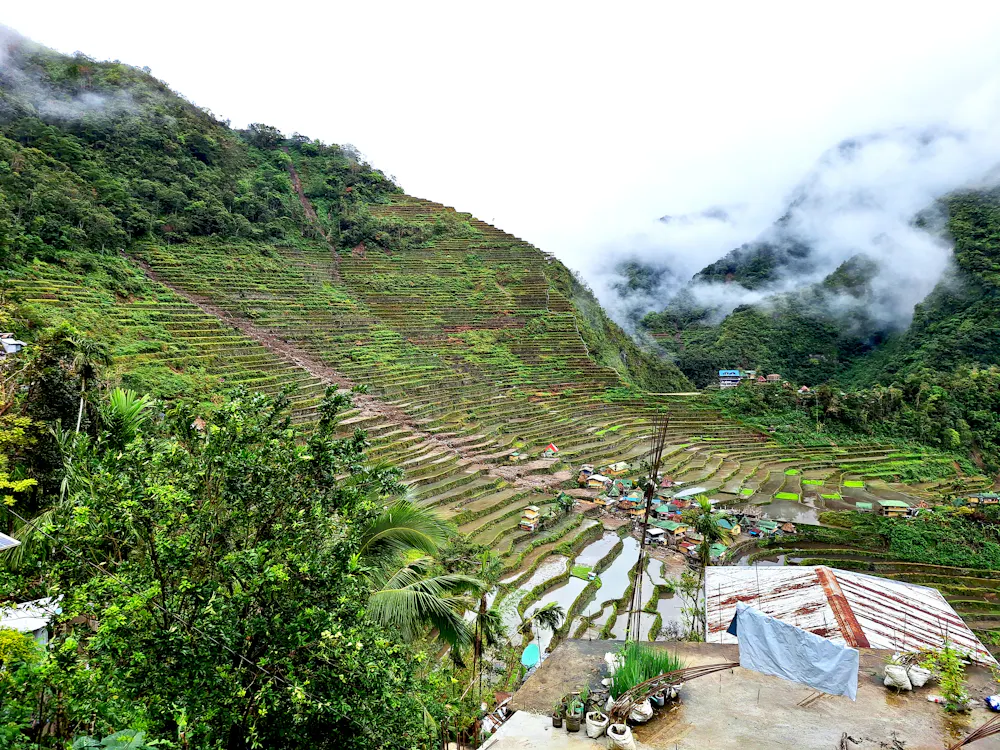
Farmers during harvest season in Batad, Ifugao, Philippines.Paul Connor and the Ifugao Archaeological Project, CC BY
Indigenous communities have lived with changes to the climate for centuries. Their adaptations over those many years are based on their close observation of weather, water, soils and seasonal change, and they have been refined through generations of learning.
That knowledge, though developed deep in the past, is increasingly useful in the modern world. As global temperatures rise, climate pressures are intensifying, with longer dry spells, stronger storms and more erratic rainfall. Terrace systems reflect Indigenous peoples’ long experience of living with environmental uncertainty in specific places and historical contexts. They offer ways of thinking about risk and long-term land use based on observation and intergenerational learning.
My research focuses on one particular strategy for adapting to a changing climate: terrace agriculture. It’s found in mountainous regions worldwide, where people have reshaped steep slopes into level steps that slow runoff and allow water to infiltrate the soil.
By slowing water without blocking its flow, terraces reduce erosion, keeping soil where crops can grow and preserving the moisture they need. They require constant maintenance, which leaves traces in the landscape, such as accumulated repair layers and sediment deposits associated with crops. I study those traces to learn how communities responded to environmental stress over time. The walls and soils are not only fertile agricultural land but also archives of adaptation, documenting past decisions about water, labor and crops.
Ifugao terraces and adaptation to wet and dry years
I have worked as an anthropological archaeologist in the Ifugao rice terraces of the northern Philippines for nearly two decades. These landscapes are often described as ancient and unchanging, but archaeological and historical research shows that most were constructed around the 17th century, during a period of political and economic pressure linked to Spanish colonial expansion. Highland communities modified their landscapes, expanded settlement and shifted rice farming to higher elevations, reconfiguring their societies to protect themselves.
The Batad Rice Terraces in Ifugao are arranged in an amphitheater-like form and are recognized as part of a UNESCO World Heritage listing. Paul Connor and the Ifugao Archaeological Project, CC BY
Rainfall in the Cordillera, the region where the terraces are located, varies widely. In some valleys, more than 6 feet (2 meters) of rain fall per year, while higher elevations commonly receive closer to 13 feet (4 meters). In both settings, rain comes down in short, intense downpours. Without intervention, water flows off the steep slopes in torrents, rapidly stripping away soil.
Terraces help avoid erosion by capturing rainfall on each level and allowing it to infiltrate gradually. Measurements contrasting terraced fields with nearby nonterraced soils find the terraces retain significantly more moisture – often 15% to 30% higher, and in some cases substantially more – than sloping fields. This increased moisture availability helps crops endure short dry spells between storms.
Crop choice is another example of adaptation. Ifugao farmers maintain multiple rice varieties suited to different microenvironments. One locally recognized group of traditional rice varieties, collectively referred to as Tinawon, is widely cultivated. The different farmer-selected tinawon varieties are adapted to varying elevations, temperatures and moisture conditions. Some perform better in cooler and wetter areas, while others tolerate shallow soils or brief dry periods.
Farmers also read subtle environmental signals. When we talk with farmers, they describe year-to-year changes, such as springs flowing more slowly than usual in late winter and increased earthworm activity before the rains. These observations guide decisions about when to adjust terrace features – such as reinforcing walls, clearing canals or modifying water gates – or when to shift planting dates in response to delayed rains or shorter wet seasons. Over generations, these adaptations have allowed farmers to continue to grow crops despite difficult periods of flooding or drought.
Today, climate stress interacts with economic pressure. Major typhoons in 2018and 2022 brought intense rainfall that damaged terraces across the Cordillera.
A landslide during the peak of a super typhoon on Nov. 10, 2025, damaged the Batad Rice Terraces. Courtesy of Rae Macapagal, CC BY
In the past, farmers responded to storm damage by adjusting water flow within irrigation canals and field-to-field outlet channels, and by staggering planting dates so that shared irrigation systems were not stressed all at once.
Today, fewer workers and a modernizing economy mean that government support has become increasingly important to sustain these systems, particularly funding for terrace and irrigation repair and programs that support farmer participation. Even so, these systems continue to show how coordinated water management and crop diversity can reduce risk under variable climates.
Climate history written into Moroccan terraces
New research in Morocco, which I’m working on with the Université Internationale de Rabat, focuses on terrace systems in the Anti-Atlas Mountains, where intermittent heavy rains and recurring droughts motivated people to build terraces to slow runoff and keep water in the soil.
Many of these terraces remained active from their construction in the late 16th to 17th centuries until the 20th century, when out-migration reduced the local labor force needed for routine maintenance.
Terraces in the town of Aouguenz, in Morocco’s Chtouka Aït Baha Province, show that nearly every slope that can be worked has been terraced, an example of long-term environmental modification. E.J. Hernandez, CC BY
Even partially abandoned terraces record past responses to climate changes. Stone walls and leveled platforms demonstrate how people slowed runoff and retained moisture in dry environments. Collapsed edges and eroded channels mark episodes of heavy rainfall. Channel layouts and their alignment with terrace walls and natural terrain indicate how scarce water was directed toward priority fields.
These physical traces correspond with well-documented drought cycles in Morocco, including multiyear dry periods in recent decades that have reduced reservoir levels and lowered groundwater tables. Former terraced landscapes show how earlier communities coped with similar pressures.
A fortified agadir (communal granary) is built on a rocky promontory and used for storing grain and valuables. Stephen Acabado, CC BY
Crop selection was central to adaptation throughout the period when terraces were actively maintained, and it continues to shape farming decisions today. Farmers in Morocco relied heavily on drought-tolerant barley, which can germinate with limited moisture and mature before peak summer heat.
Research on barley varieties from North Africa and similar arid environments shows that these traditional variants can still produce a majority of their usual yields during severe droughts, while high-yield modern varieties, bred for irrigated or well-watered conditions and shorter growing cycles, often experience sharp yield declines or crop failure under the same conditions.
A terrace system lies seasonally fallow in Morocco’s Anti-Atlas Mountains, where long-standing land-use practices are now shifting toward cash crops such as onions and beans. M. Yakal, CC BY
In oral histories and interviews, elders in these regions recalled collective maintenance practices, including annual cleaning of channels and coordinated planting after the first dependable rains. Communities adapted to the changing climate together, coordinating efforts and activities.
Lessons across continents
Although the Philippines and Morocco have different climates and histories, their terrace systems demonstrate common principles. In both regions, people focused on capturing water and minimizing the risk of soil loss or crop failure.
Aerial views show aspects of the highland ecology of Morocco. Video courtesy of Anass Marzouki, UIR.
At the same time, terraces show limits. As labor availability declines because younger generations leave rural areas for cities or overseas work, and economic priorities shift toward wage labor and other nonagricultural livelihoods, even basic maintenance becomes difficult.
These cases show that Indigenous strategies for living with climate uncertainty are often shaped by long-term observation and cooperation. They do not provide simple solutions or universal models, but they do demonstrate the value of designing systems that spread risk and prioritize durability over short-term efficiency.
Stephen Acabado receives funding from the Henry Luce Foundation.
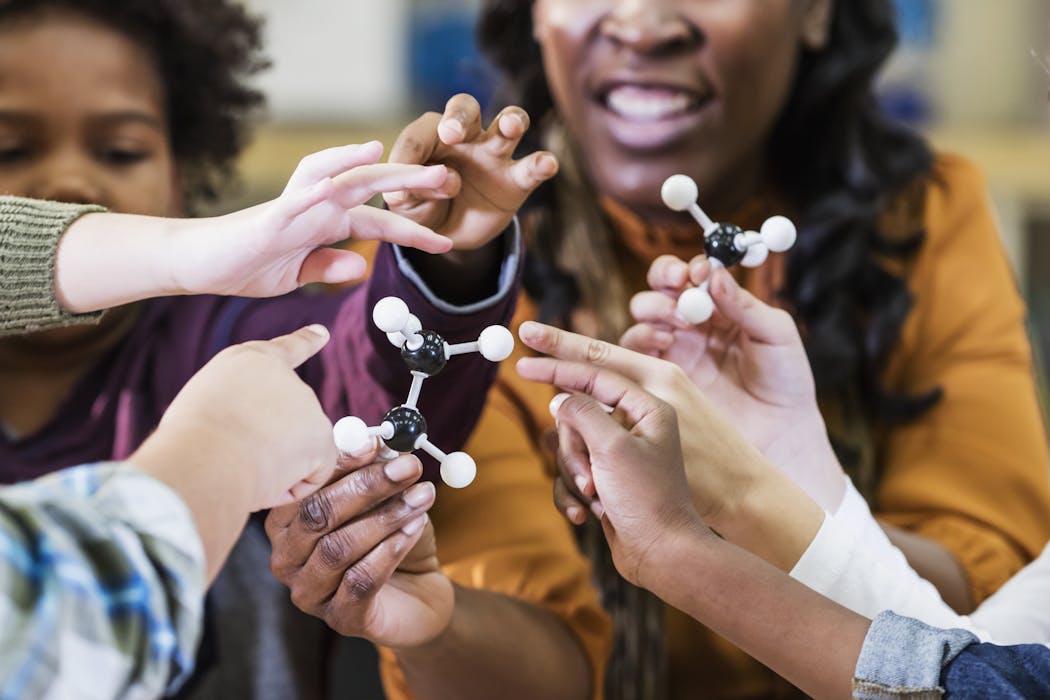
Personal experiences can help foster a sense of belonging for aspiring scientists from underrepresented backgrounds.kali9/E+ via Getty Images
Lived experiences shape how science is conducted. This matters because who gets to speak for science steers which problems are prioritized, how evidence is translated into practice and who ultimately benefits from scientific advances. For researchers whose communities have not historically been represented in science – including many people of color, LGBTQ+ and first-generation scientists – identity is intertwined with how they engage in and share their work.
As researcherswho ourselvesbelong to communities that have been underrepresented in science, we work with scientists from marginalized backgrounds to study how they navigate STEM – science, technology, engineering and math – spaces. What happens when sharing science with the public is treated as relationship-building rather than a one-way transfer of information? We want to understand the role that identity plays in building community in science.
We found that broadening the ways scientists work with the public can bolster trust in science, expand who feels they belong in STEM spaces and ensure that science is working in service of community needs.
STEM spaces as an obstacle course
Science communication involves bridging knowledge gaps between scientists and the broader community. Traditionally, researchers do it through public lectures, media interviews, press releases, social media posts or outreach events designed to explain science in simpler terms. The goals of these activities are often to correct misconceptions, increase scientific literacy and encourage the general public to trust scientific institutions.
However, science communication can look different for researchers from marginalized backgrounds. For these scientists, the ways they engage with the public often focus on identity and belonging. The researchers we interviewed spoke about hosting bilingual workshops with local families, creating comics about climate change with Indigenous youth and starting podcasts where scientists of color share their pathways into STEM.
Instead of disseminating science information through traditional methods that leave little room for dialogue, these researchers seek to bring science back to their communities. This is in part because scientists from historically marginalized backgrounds often face hostile environments in STEM, including discrimination, stereotypes about their competence, isolation and a lack of representation in their fields. Many of the researchers we talked to described feeling pressure to hide aspects of their identities, being seen as the token minority, or having to constantly prove they belong. These experiences reflect well-documented structural barriers in STEM that shape who feels welcome and supported in scientific environments.
We wanted to see if a broader definition of science communication that incorporates identity as an asset can expand who feels welcomed in scientific spaces, strengthen trust between scientists and communities, and ensure scientific knowledge is shared in culturally relevant and accessible ways.
Our team set out to create training spaces for researchers from communities that have been historically marginalized in science. Since 2018, we have been facilitating ReclaimingSTEM workshops both in-person and online, where over 700 participants have been encouraged to explore the intersections of their identities and science through interactive modules, small-group activities and community-building discussions.
Expanding what counts as science communication is essential for it to be effective. This is particularly relevant for scientists whose work and identities call for approaches grounded in community connection, cultural relevance and reciprocity. In our workshops, we broadly defined science communication as community engagement about science that could be both formal and informal, including through media, art, music, podcasts and outreach in schools, among others.
Some participants drew on their audience’s cultural backgrounds when sharing their research. One participant described explaining biologicalpatternformation by connecting it to familiar artistic traditions in her community, such as the geometric and floral designs used in henna. Using imagery that her audience recognized helped make the scientific concepts more relatable and encouraged deeper engagement.
Rather than portray science as something neutral or emotionless, participants infused empathy and feeling into their community engagement. For example, one scientist shared with us that his experiences of exclusion as a multiracial gay man shaped how he approached his interactions. These feelings helped him be more patient, understanding and attentive when others struggled to grasp scientific ideas. By drawing on his own sense of not belonging, he aimed to create an environment where people could connect emotionally to his research and feel supported in the learning process.
Participants found it important to incorporate their identities into their communication styles. For some, this meant not assimilating into the dominant norms of science spaces and instead authentically expressing their identities to be a role model to others. For example, one participant explained that openly identifying as disabled helped normalize that experience for others.
Many felt a deep sense of responsibility to have their science engagement be of service to their communities. One scientist who identified as a Black woman said she often thinks about how her research may affect people of color, and how to communicate her findings in ways that everyone can understand and benefit from.
While the participants of our workshop had a variety of goals when it came to science communication, a common thread was their desire to build a sense of belonging in STEM.
Centering the perspectives and identities of marginalized researchers would make science communication training programs more inclusive and responsive to community needs. For example, some participants described tailoring their science outreach to audiences with limited English proficiency, particularly within immigrant communities. Others emphasized communicating science in culturally relevant ways to ensure information is accessible to people in their home communities. Several also expressed a desire to create welcoming and inclusive spaces where their communities could see themselves represented and supported in STEM.
One scientist who identified as a disabled woman shared that accessibility and inclusivity shape her language and the information she communicates. Rather than talking about her research, she said, her goal has been more about sharing the so-called hidden curriculum for success: the unwritten norms, strategies and knowledge key to secure opportunities, and thrive in STEM.
Identity for science communication
Identity is central to how scientists navigate STEM spaces and how they communicate science to the audiences and communities they serve.
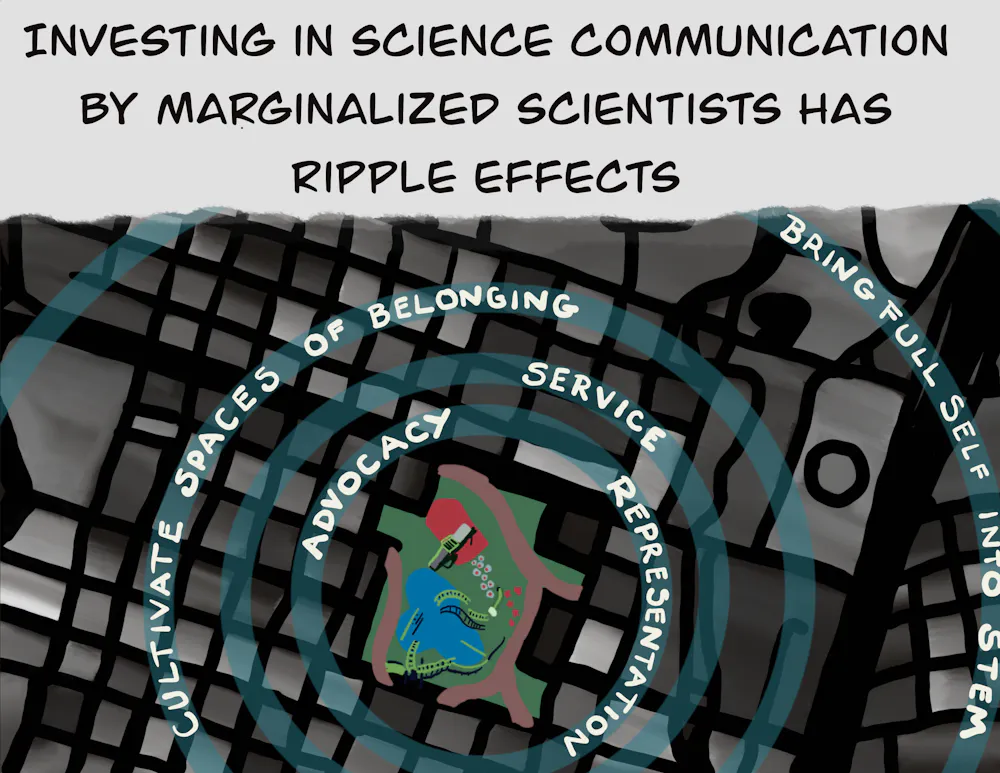
For many scientists from marginalized backgrounds, the goal of science communication is to advocate, serve and create change in their communities. The participants in our study called for a more inclusive vision of science communication: one grounded in identity, storytelling, community and justice. In the hands of marginalized scientists, science communication becomes a tool for resistance, healing and transformation. These shifts foster belonging, challenge dominant norms and reimagine STEM as a space where everyone can thrive.
Helping scientists bring their whole selves into how they choose to communicate can strengthen trust, improve accessibility and foster belonging. We believe redesigning science communication to reflect the full diversity of those doing science can help build a more just and inclusive scientific future.
Evelyn Valdez-Ward is executive director of ReclaimingSTEM Institute.
Nic Bennett is a volunteer board member of Reclaiming STEM and People’s Science Network.
Robert N. Ulrich is the Associate Director of the ReclaimingSTEM Institute.
Source: The Conversation – USA (2) – By Aaron Coy Moulton, Associate Professor of Latin American History, Stephen F. Austin State University
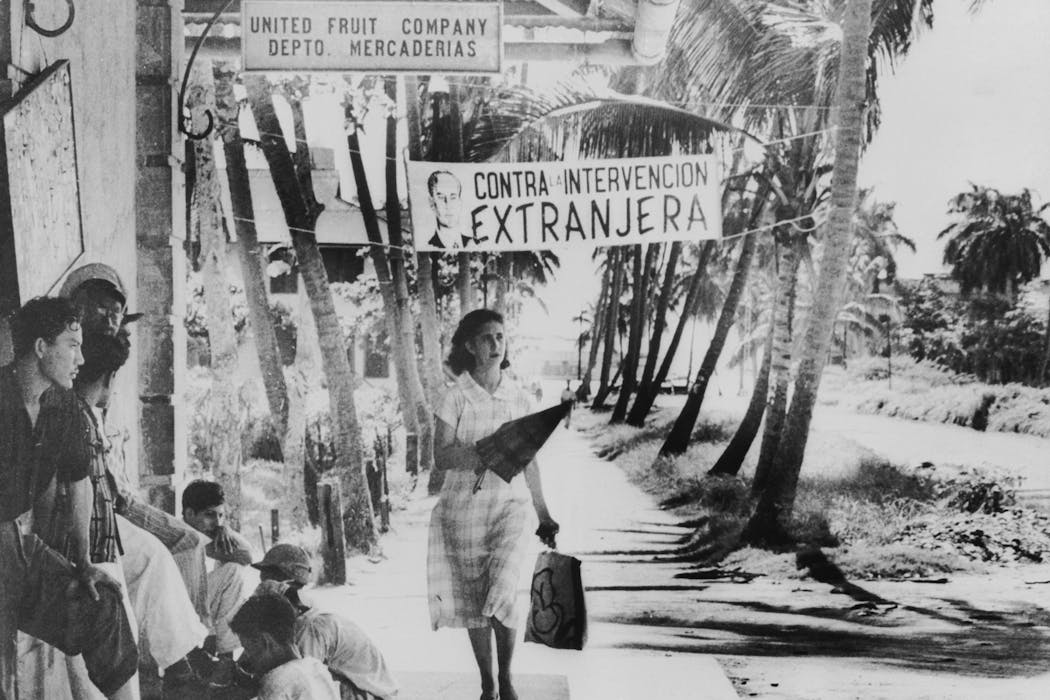
A woman walks past a banner that says ‘against foreign intervention,’ in Spanish, in Guatemala in 1954.Bettmann/Getty Images
In the aftermath of the U.S. military strike that seized Venezuelan President Nicolás Maduro on Jan. 3, 2026, the Trump administration has emphasized its desire for unfettered access to Venezuela’s oil more than conventional foreign policy objectives, such as combating drug trafficking or bolstering democracy and regional stability.
During his first news conference after the operation, President Donald Trump claimed oil companies would play an important role and that the oil revenue would help fund any further intervention in Venezuela.
Soon after, “Fox & Friends” hosts asked Trump about this prediction.
As a historian of U.S.-Latin American relations, I’m not surprised that oil or any other commodity is playing a role in U.S. policy toward the region. What has taken me aback, though, is the Trump administration’s openness about how much oil is driving its policies toward Venezuela.
As I’ve detailed in my 2026 book, “Caribbean Blood Pacts: Guatemala and the Cold War Struggle for Freedom,” U.S. military intervention in Latin America has largely been covert. And when the U.S. orchestrated the coup that ousted Guatemala’s democratically elected president in 1954, the U.S. covered up the role that economic considerations played in that operation.
A powerful ‘octopus’
By the early 1950s, Guatemala had become a top source for the bananas Americans consumed, as it remains today.
The United Fruit Company owned over 550,000 acres of Guatemalan land, largely thanks to its deals with previous dictatorships. These holdings required the intense labor of impoverished farmworkers who were often forced from their traditional lands. Their pay was rarely stable, and they faced periodic layoffs and wage cuts.
The company’s seemingly unlimited clout in the countries where it operated gave rise to the stereotype of Central American nations as “banana republics.”
United Fruit included the Chiquita brand of bananas that it widely advertised, including with this commercial produced in the 1940s.
Guatemala’s democratic revolution
In Guatemala, a country historically marked by extreme inequality, a broad coalition formed in 1944 to overthrow its repressive dictatorship in a popular uprising. Inspired by the anti-fascistideals of World War II, the coalition sought to make the nation more democratic and its economy more fair.
After decades of repression, the nation’s new leaders offered many Guatemalans their first taste of democracy. Under Juan José Arévalo, who was democratically elected and held office from 1945-1951, the government established new government benefits and a labor code that made it legal to form and join unions and established eight-hour workdays.
He was succeeded in 1951 by Jacobo Árbenz, another democratically elected president.
Under Árbenz, Guatemala implemented a land reform program in 1952 that gave landless farmworkers their own undeveloped plots. Guatemala’s government asserted that these policies would build a more equitable society for Guatemala’s impoverished, Indigenous majority.
In Guatemala, United Fruit sought to enlist the U.S. government in its fight against the elected government’s policies. While its executives did complain that Guatemala’s reforms hurt its financial investments and labor costs, they also cast any interference in its operations as part of a broader communist plot.
United Fruit executives began to meet with officials in the Truman administration as early as 1945. Despite the support of sympathetic ambassadors, the U.S. government apparently wouldn’t intervene directly in Guatemala’s affairs.
The company turned to Congress.
It hired the lobbyists Thomas Corcoran and Robert La Follette Jr., a former senator, for their political connections.
Right away, Corcoran and La Follette lobbied Republicans and Democrats in both chambers against Guatemala’s policies – not as threats to United Fruit’s business interests but as part of a communist plot to destroy capitalism and the United States.
The banana company’s efforts bore fruit in February 1949, when multiple members of Congress denounced Guatemala’s labor reforms as communist.
Sen. Claude Pepper called the labor code “obviously intentionally discriminatory against this American company” and “a machine gun aimed at the head of this American company.”
That operation began in 1953, when the Eisenhower administration authorized the Central Intelligence Agency to unleash a psychological warfare campaign that manipulated Guatemala’s own military to overthrow its democratically elected government.
CIA agents bribed members of Guatemala’s military. Anti-communist radio broadcasts and religious pronouncements about communist designs to destroy the nation’s Catholic church spread throughout the country.
Meanwhile, the U.S. armed anti-government organizations inside Guatemala and in neighboring countries to further undermine the Árbenz government’s morale.
And United Fruit enlisted public relations pioneer Edward Bernays to spread propaganda, not in Guatemala but in the United States. Bernays provided U.S. journalists with reports and texts that portrayed the Central American nation as a Soviet puppet.
These materials, including a film titled “Why the Kremlin Hates Bananas,” circulated thanks to sympathetic media outlets and members of Congress.
United Fruit’s quest to oust Guatemala’s democratically elected government got a boost from this anti-communist propaganda film.
Destroying the revolution
Ultimately, the record shows, the CIA’s efforts prompted military officers to depose their elected leaders and install a more pro-U.S. regime led by Carlos Castillo Armas.
Military regimes ruled Guatemala for decades after this coup.
One dictator after another brutally repressed their opponents and fostered a climate of fear. Those conditions contributed to waves of emigration, including countless refugees, as well as some members of transnational gangs.
Blowback for bananas
To shore up its claims that what happened in Guatemala had nothing to do with bananas, exactly as the company’s propaganda insisted, the Eisenhower administration authorized an antitrust suit against United Fruit that had been temporarily halted during the operation so as not to cast further attention on the company.
This would be the first in a series of setbacks that would break up United Fruit by the mid-1980s. After a series of mergers, acquisitions and spinoffs, the only constant would be the ubiquitous Miss Chiquita logo stuck to the bananas the company sells.
And, according to many foreign policy experts, Guatemala has never recovered from the destruction of its democratic experiment due to corporate pressure.
Aaron Coy Moulton’s research received funding from the Truman Library Institute, Phi Alpha Theta, the Society for Historians of American Foreign Relations, the Roosevelt Institute, the Eisenhower Foundation, the Massachusetts Historical Society, the Bentley Historical Library, the American Philosophical Society, the Dirksen Congressional Center, the Hoover Presidential Foundation, and the Frances S. Summersell Center for the Study of the South.
This happens so frequently that popular media has even coined the name “Quitter’s Day” for the second Friday in January –when most people have given up on their resolutions.
However, there is a way to continue your self-improvement goals and find success by making changes that offer incremental rewards instead of frustration. My students and clients are consistently surprised by how small actions and practices bring about big rewards. Below are a few manageable and meaningful practices to adopt that can last well after the new year’s motivation fades.
One of the reasons resolutions tend to fail is that they usually involve putting a metric on success.A major reason for failure in New Year’s resolutions is that people set unrealistic goals.
The problem is that these types of commitments force us to do something we don’t really want to do. And success takes time: It can take more than six weeks before improvements from exercise become apparent.
It comes as no surprise, then, that these goals are often short-lived and unsuccessful in the long term – it is hard to be successful when we are battling ourselves to do things that don’t come naturally, without immediate rewards. In reality, people prefer immediate gratification and simultaneously tend to downplay the benefit of waiting for longer-term rewards.
Be kind – to yourself
We are often much nicer to our friends, and even to strangers, than we are to ourselves.
Kristin Neff, a psychologist and leader in self-compassion research, teaches that by mindfully quieting our inner critic and being as compassionate to ourselves as we would be to a friend, we can significantly improve our well-being.
In my personal and professional life, I have seen people succeed most often when they change how they relate to themselves. In other words, instead of being intensely critical of our emotions and what we are thinking, we are able to be gentler with our experience and be more accepting of our own thoughts and feelings. When we receive these emotional rewards, we feel relief and happiness – payoffs that make it far easier to enthusiastically repeat the pattern.
Instead of focusing on whether you succeeded on your initial resolutions, try journaling three good things at the end of each day. In doing so, focus less on the big successes – though they count, too – and instead on the small moments you enjoyed, such as the hug from a friend, the quiet moment with coffee or the smile from a stranger.
Practice random acts of kindness to boost mood and well-being. Reach out to a friend you haven’t talked to in a while or buy coffee for a stranger in the coffee shop. These activities provide an emotional boost that can last for hours, if not days.
Making these small shifts can help stave off the stress and guilt that can thwart your self-improvement goals.
The well-known practice of mindfulness encourages paying attention – without judgment – to the present moment.
Research shows that taking time to slow down and savor the moment has substantial physical and psychological benefits, such as lowering stress and improving focus, among others. In fact, mindfulness even has the power to change brain connections, leading to greater control over our emotions.
This approach can also be applied to meal-time and diet, a popular focus of New Year’s resolutions. Using the practice of mindfulness can also help us shift from a judgmental and restrictive view of food to a focus on enjoyment and savoring.
So instead of eliminating certain foods or thinking of foods as either good or bad, slow down and savor your food. This can look like taking a moment to take in what your food looks and smells like, and chewing your food slowly, noticing the taste and texture – like a wine-tasting experience but with your meal.
My clients often tell me how eating more mindfully helped change their relationship with food. One client said that instead of thinking about how much she was eating, she instead experienced how much she liked the taste of her meal and the sense of fullness when she felt she had eaten enough.
So perhaps this year, instead of focusing on willpower or restriction, choose connection with yourself and others instead.
Doing so will improve your happiness and your overall well-being, long after the New Year’s resolutions fade.
Michele Patterson Ford does not work for, consult, own shares in or receive funding from any company or organization that would benefit from this article, and has disclosed no relevant affiliations beyond their academic appointment.
In Tana Toraja, a mountainous region of Sulawesi, Indonesia, villagers pour massive resources into funeral rituals: lavish feasts, ornate effigies and prized water buffaloes for sacrifice.
I witnessed this funeral ritual in 2024 while accompanying scholar Melanie Nyhof on her fieldwork. Families were expected to stage funerals that matched the social standing of the dead, even if it meant selling land, taking out loans or calling on distant kin for help.
In my own work of studying communal mourning rituals, I take part in ceremonies to see how they unfold.
At one of the ceremonies I attended in Tana Toraja, hundreds gathered as gongs echoed through the valley. Guests were served meals over several days, dancers in bright headdresses performed for the crowd, and water buffalo – the most valuable gift a family can give – were led into the courtyard for sacrifice. Mourners described these acts as ways of honoring the deceased.
It wasn’t just in the villages of Tana Toraja that families and clans used rituals to express loyalty for people they knew personally. I saw the same dynamics in cities, where national funerals can draw millions of strangers into a shared experience of unity and loss for a person they never met.
In 2022, my colleagues and I surveyed more than 1,600 members of the British public a few days after Queen Elizabeth II’s funeral – both those who had traveled to London to be part of the crowds, and others who had watched the ceremony live on television.
Spectators reported intense grief and a connection with fellow mourners when they viewed the ceremony. On average, they described their sadness as intense. Most also said they felt a strong sense of unity – not only with people standing alongside them, but even with strangers across the nation who shared in the moment.
The effects were especially pronounced for those who had attended in person.
To see whether that sense of unity translated into action, we also used a behavioral measure using a mild deception task. All participants would receive a digital £15 (US$20) voucher for completing the survey, which would be emailed to them 48 hours later.
Toward the end of the survey, however, participants were asked whether they would be willing to donate money from their voucher for taking part in the survey. They indicated this via a sliding scale, from £0-£15 ($0 to $20.25) in £1 ($1.35) increments. Participants were led to believe that the funds would go to a new U.K. charity designed to educate future generations about the importance of the monarchy.
At the end of the study, participants were debriefed: The charity was fictional, and no money was actually taken; so regardless of how much they thought they were donating, all participants received the full compensation.
The results were striking. Those who felt the strongest grief also reported greater connection to both fellow mourners and fellow citizens; they were more likely to pledge to the monarchist cause. We later tested whether these effects fade quickly or leave a lasting imprint.
In a forthcoming study, we followed British spectators for up to eight months after Queen Elizabeth II’s funeral. Those who experienced the most sadness during the ceremony formed especially vivid emotional memories, which prompted months of reflection. That reflection, in turn, reshaped how people saw themselves – a personal identity shift that predicted enduring feelings of unity with others who had shared the experience.
Crucially, this sense of “we-ness” was strongest among those who had been physically present together and continued to predict willingness to volunteer long after the funeral ended.
In other words, grief didn’t just wash over people passively; it mobilized them toward concrete acts of loyalty and generosity. And importantly, this wasn’t limited to those who had traveled to London. Even people who only watched the funeral on television still showed some of the same effects, though less strongly.
Anthropologists have long reported that funerals and other rituals can create a profound sense of bonding that can outlive the ceremony itself. Our research suggests that shared rituals of mourning can foster unity at scale, reaching far beyond those physically present.
Furthermore, shared suffering forges identity and binds people together long after the ritual itself has passed.
Anthropologist Harvey Whitehouse’s research shows that when people endure intense suffering together, they don’t just feel closer – they come to see one another as if they were family. This kinlike bond helps explain why groups who undergo hardship together often display extreme loyalty and self-sacrifice. This is true even for strangers.
When rituals divide
But are those bonds always open-ended? Or do they sometimes channel generosity inward, toward one’s own group?
At Pope Francis’ funeral in 2025, we surveyed 146 people immediately after they had viewed his body lying in state in St. Peter’s Basilica. We asked them to rate the extent of their discomfort waiting in line.
Mourners at Pope Francis’ funeral felt motivated to offer more to charities. Andrew Medichini/AP Photo
Some had waited overnight without food or water, and all had queued for hours in the unrelenting Roman sun. At the end of the survey, participants were invited to donate to one of two charities: a new Catholic aid organization or the International Red Cross.
As we predicted, the people who rated their experience waiting in line as the most uncomfortable also pledged the most money. But there was a twist. Almost all of that generosity flowed to the Catholic charity. Donations to the Red Cross were strikingly low, even though Red Cross volunteers had been circulating through the crowd, offering water and assistance. The difference in giving was not due to a difference in awareness or salience. What mattered was whether the cause felt part of the shared experience people had just endured.
This finding aligns with the work of my collaborator, anthropologist Dimitris Xygalatas, who has demonstrated that group rituals both “bind and blind.” These ceremonial rituals blind by narrowing generosity, channeling it mainly toward one’s own group, such as through the funerary ritual studies we conducted.
When shared suffering bridges divides
But shared suffering can sometimes do the opposite – not narrowing solidarity, but expanding it.
In other research I conducted after the catastrophic earthquakes in Turkey in 2023, with my colleague, anthropologist Sevgi Demiroglu, we surveyed 120 survivors across some of the most heavily impacted regions. Nearly half had lost a loved one, a third had lost their homes, and the vast majority showed signs of post-traumatic stress.
Participants were asked how intensely they had felt negative emotions such as fear and anxiety during the quakes; crucially, how much they believed those emotions were shared by others – whether family members, other Turkish survivors or Syrian refugees who were also affected.
Survivors who felt their suffering was shared reported a stronger sense of oneness, with those groups. And that sense of bonding predicted action. Even after losing nearly everything, many said they were just as willing to volunteer time to help fellow Turkish survivors as if they were their own families. Strikingly, this willingness extended even to ethnic communities often regarded with suspicion, suggesting that shared suffering can temporarily override social and political divides.
In this case, there were no collective grief rituals to help process loss. Yet the same underlying mechanism was visible: Shared suffering brought people together like kin. Grief rituals can take this raw bond and stabilize it – giving shared loss a durable social form.
Perhaps, grief rituals remind us that in grief, as in life, we are not alone.
Claire White receives funding from Templeton Religion Trust TRT-2021-10490.
Dans cet entretien avec The Conveersation Africa, il explique qu’il existe des différences frappantes entre ces deux hommes.
Museveni est au pouvoir depuis près de quatre décennies. Amin a duré huit ans. Comment expliquer la longévité de Museveni ?
J’essaie d’expliquer dans mon livre les principales raisons qui ont permis à Museveni de rester au pouvoir pendant plus de quatre décennies. Je pense que ces raisons sont à la fois internes et externes.
Il n’a pas seulement fait comme les Britanniques qui prenaient des groupes éthniques existants et les politisaient en structures tribales. Il est allé plus loin: il a pris des sous-groupes éthniques et en a fait des tribus.
Pas seulement comme l’ont fait les Britanniques, en prenant les groupes ethniques existants et en les politisant pour en faire des structures politiques que nous appelons tribus. Mais plus que cela, en prenant certains sous-groupes ethniques et en les transformant en tribus. Ainsi, à partir de moins de 20 tribus, il en a créé plus de 100. C’est un processus sans fin.
Et puis il y a la raison externe. Contrairement à Amin, qui était l’ennemi juré des grandes puissances occidentales, Museveni s’est imposé comme leur allié privilégié et protégé.
**Certains analystes semblent suggérer que ce n’est que maintenant, en particulier depuis que son fils a commencé à faire des déclarations politiques, que la politique ougandaise se militarise. Mais un thème qui ressort clairement de votre livre est que, sous Amin comme sous Museveni, l’armée s’est substituée à l’organisation politique…
Je pense que c’est une lecture correcte du livre. Maintenant, dans le cadre de cette comparaison très large, il existe des différences importantes dans la voie empruntée par Amin.
Amin a été recruté comme enfant soldat par les Britanniques à l’âge de 14 ans environ. Il a été formé à ce qu’ils appellent les arts de la contre-insurrection, ce qui est en réalité un terme poli pour désigner le terrorisme d’État. Il avait l’habitude de démontrer publiquement, en particulier aux chefs d’État africains, par exemple lors de leur réunion au Maroc, comment il pouvait étouffer quelqu’un avec un mouchoir.
Et Amin a subi une sorte de transformation au cours de la première année qui a suivi son accession au pouvoir.
Il a accédé au pouvoir grâce à l’aide directe des Britanniques et des Israéliens. Les Israéliens, en particulier, ont conseillé à Amin qu’il ne pouvait pas se contenter de renverser le premier président de l’Ouganda après l’indépendance Milton Obote et penser que l’affaire était close. Il devait aussi s’occuper de ses acolytes, les personnes qu’il avait placées à des postes clés, et le retour de bâtons devait arriver d’un moment à l’autre.
Pour éviter cela, il avait choisi de les éliminer. Sa première année au pouvoir fut brutale. Il a tué des centaines de personnes dans différents camps militaires. Il s’agissait de massacres, il n’y a pas d’autre mot pour les qualifier.
Puis, après cela, il s’est rendu en Israël et en Grande-Bretagne avec une liste de demandes. Il pensait avoir rendu service aux Israéliens et aux Britanniques et s’attendait qu’ils fassent de même. Mais ceux-ci ont trouvé cela amusant, et il s’est senti humilié. Il a cherché une alternative, et c’est ainsi qu’il a rencontré, par l’intermédiaire du président égyptien Anwar Sadat, puis par le dirigeant libyen Mouammar Kadhafi, le leader soudanais, Gaafar Muhammad Nimeiry. Amin, avec l’empereur éthiopien Haile Selassie, a joué un rôle clé dans l’accord d’Addis-Abeba de 1972 qui a mis fin à la première guerre civile au Soudan.
Au cours des deux années qui ont suivi son arrivée au pouvoir, je n’ai pas eu connaissance de nouveaux massacres. Il a continué à tuer ses opposants, mais il n’a pas étendu les meurtres à la famille, aux amis, aux clans ou simplement aux groupes auxquels la personne était identifiée ou associée. Ses meurtres ressemblaient davantage à ceux d’un dictateur qui recourt à la violence pour écraser ses opposants.
C’est très différent dans le cas de Museveni. Museveni est arrivé au pouvoir avec la conviction que la violence est essentielle à la politique, et particulièrement à la politique de libération. Museveni est un fervent adepte de Frantz Fanon, en particulier Les Damnés de la Terre. Et la principale leçon qu’il tire de Fanon est le caractère essentiel de la violence dans toute politique d’émancipation.
J’essaie donc de retracer le cheminement qui a conduit Museveni à considérer la violence comme un élément central du démantèlement d’un État oppressif, pour aboutir à l’idée que la violence est un élément central de la construction d’un État. Il arrive ainsi à la conclusion inverse. Et cela bien avant que son fils n’entre en scène.
J’ai consacré tout un chapitre de mon livre aux premières décennies qui ont suivi 1986, lorsque Museveni est arrivé au pouvoir, à ses opérations dans le nord et aux massacres et meurtres successifs, Il affirmait poursuivre la guerre contre le terrorisme, qui avait commencé après les attentats du 11 septembre 2001 aux États-Unis.
Et ces affirmations ont été acceptées telles quelles par la communauté internationale, c’est-à-dire les puissances occidentales.
Diriez-vous donc que la guerre contre le terrorisme a été une aubaine pour Museveni, l’aidant à faire avancer son agenda ?
Tout à fait. Depuis le programme d’ajustement structurel de la fin des années 1980, il a compris que s’il voulait étouffer l’opposition dans son pays, il aurait besoin d’un soutien étranger, et que ce soutien lui serait accordé s’il se présentait comme un acteur central dans la guerre contre le terrorisme.
Museveni était suffisamment intelligent pour comprendre que la politique étrangère américaine et l’intervention militaire américaine avaient des limites politiques, notamment le nombre de pertes américaines acceptables. Et lorsque ces meurtres ont eu lieu en Somalie, lors de l’incident Black Hawk Down (La chute d’un faucon noir), Museveni a proposé ses services.
Il a envoyé ses soldats en Somalie. Vous vous souvenez de ce slogan, « des solutions africaines pour les problèmes africains ». Museveni a proposé cette solution africaine au Soudan du Sud, au Rwanda, dans l’est du Congo. La solution africaine n’était qu’un nom sophistiqué pour désigner le massacre d’Africains par des Africains au service des puissances impériales. Et c’est ce qui s’est finalement produit.
Vous recommandez une fédération comme la solution la plus susceptible de réussir dans l’Ouganda post-Museveni. Existe-t-il actuellement une base politique pour cela ? Ou faudrait-il que quelque chose se produise pour que la fédération proposée aboutisse ?
Ceux d’entre nous qui sont des nationalistes militants et des indépendants ont compris que la fédération était un projet britannique. Nous savions que la droite favorable à la création de fiefs tribaux utilisait la fédération comme écran pour masquer son agenda. Nous avons compris que c’était leur façon de saper toute tentative de construire un État nationaliste fort.
Mais depuis lors, avec la construction d’un État fort, nous avons compris que les conditions et les temps avaient changé. L’organisation locale, l’autonomie locale, ont pris une signification très différente.
C’est un moyen de résister au développement de l’autocratie du pouvoir central et je pense que les gens commencent à en tirer des leçons.
Maintenant, la question est de savoir quel type de fédération, car Museveni a également promu quelque chose qui ressemble à une fédération. Mais il a, comme en Éthiopie, promu ce que l’on peut appeler un fédéralisme ethnique.
Ainsi, dans chaque entité, il a séparé la majorité de la minorité: la majorité appartenant au groupe éthnique considéré comme “historique” sur le territoire et la minorité issue d’autres groupes éthniques, qui, bien que vivant dans le pays et y étant nés, se voient toujours privés de droits.
C’est ce qui s’est passé en Éthiopie. Si vous regardez l’Éthiopie, si vous regardez le Soudan, vous verrez que les Britanniques ont politisé les groupes ethniques et les ont transformés en tribus. Et puis, après le colonialisme, nous avons militarisé ces tribus. Nous avons donc créé des milices tribales. C’est ce qu’ils ont fait en Éthiopie. Ce sont les combats entre différentes milices tribales. C’est ce qu’ils ont fait au Soudan. Ils ont créé des milices tribales, d’abord au Darfour, puis dans d’autres endroits. C’est l’armée nationale qui a dirigé la création de ces milices tribales. Ce sont ensuite les milices tribales qui ont commencé à engloutir l’État.
La guerre civile qui sévit actuellement oppose donc l’armée nationale et les milices tribales. C’est le même processus que celui observé en Ouganda. Nous n’en sommes pas encore arrivés à créer des milices tribales, mais nous avons fabriqué tribu après tribu afin de fragmenter le pays.
Certaines des tendances que vous décrivez à propos de l’Ouganda se retrouvent dans la plupart des pays africains. Quelles leçons peut-on en tirer pour l’avenir du reste du continent africain ?
D’une manière générale, on observe ces tendances dans de nombreux pays africains. Le modèle colonial britannique est devenu le modèle colonial dominant. Même les Français, connus pour leurs préférences assimilationnistes, ont adopté la domination indirecte lorsqu’ils sont passés de l’assimilation à ce qu’ils appelaient l’association dans les années 1930. Et les Portugais ont suivi les Français.
Les Sud-Africains ont été les derniers à suivre le mouvement – ils ont appelé cela apartheid. Mais c’était la même chose, la création de homelands, la tribalisation des différences locales. C’est donc une tendance dans la pensée du continent.
L’alternative a souvent été la centralisation. Le continent oscille ainsi entre pouvoir autocratique et centralisé et des pouvoirs tribaux fragmentés.
Je propose une troisième voie. Je propose une fédération plus ethnique. Je propose une fédération davantage basée sur le territoire, davantage basée sur le lieu où vous vivez. Ainsi, peu importe d’où vous venez, le simple fait que vous viviez là signifie que vous avez lié votre destin à celui des autres personnes qui y vivent pour créer un avenir commun.
Et ce qui importe en politique, plus que votre origine, c’est la décision de construire un avenir commun. La migration est une caractéristique de la société humaine. La société humaine n’est pas née des patries. La patrie est donc une fiction coloniale.
L’idée que les Africains ne se déplaçaient pas, qu’ils étaient liés à un territoire particulier, est absurde, car les Africains se déplaçaient plus que quiconque. Nous savons que l’humanité est née en Afrique et s’est répandue dans le reste du monde. Alors, où se trouve la patrie ? Vous pouvez avoir une patrie pour cette génération, pour les générations précédentes, mais tous les Africains ont une histoire de migration. C’est, je pense, un élément central.
La voie à suivre : l’une est une fédération qui consolide la démocratie plutôt que de l’éroder.
La deuxième voie à suivre consiste à réfléchir de manière critique à l’ensemble du modèle économique néolibéral et à l’autonomisation des élites, qu’elles soient raciales, ethniques ou autres.
Je pense que nous devons trouver un modèle économique différent. Mais comme vous le dites, le livre n’est pas consacré à la recherche de solutions. Il est consacré à l’idée que nous devons comprendre le problème avant de nous précipiter vers des solutions.
Et chaque pays aura ses propres nuances qui sont ifférentes de celles de l’Ouganda.
Mahmood Mamdani does not work for, consult, own shares in or receive funding from any company or organisation that would benefit from this article, and has disclosed no relevant affiliations beyond their academic appointment.
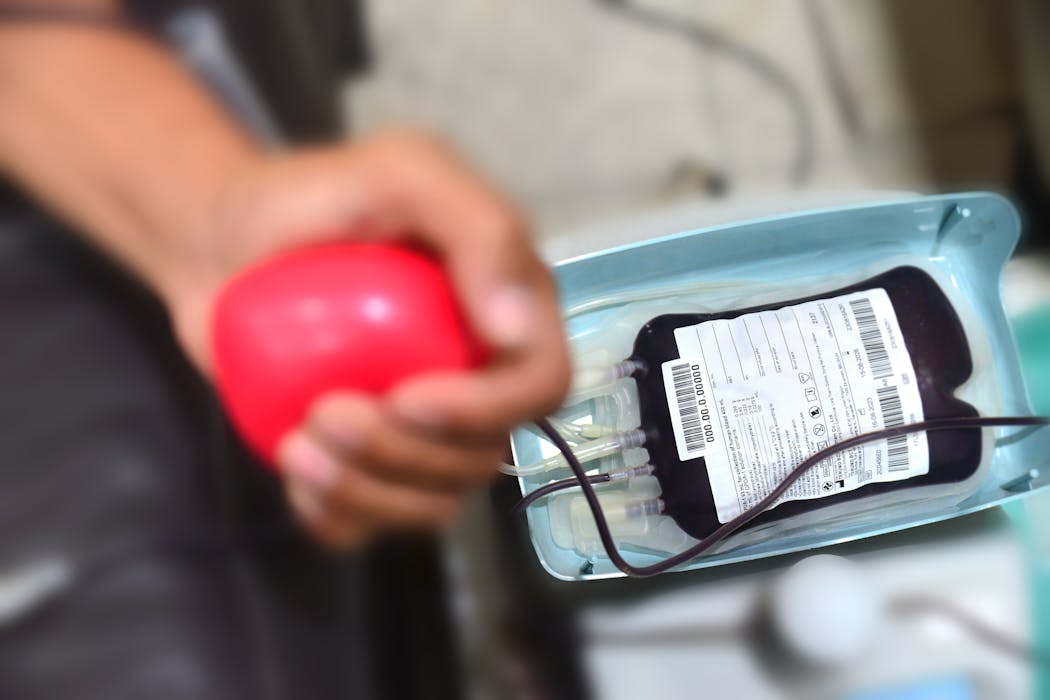
It is late, the ward is crowded, and the clock is moving faster than everyone would like. A doctor has stabilised the patient as best they can, but one thing is missing – blood.
A relative is asked to “try somewhere else”, and within minutes, the family is on the phone, calling friends, contacting church groups, posting in WhatsApp chats, hoping that someone nearby is eligible, willing and able to reach the hospital in time.
In that moment, healthcare stops being only about medicine. It becomes about networks, trust and whether a lifesaving resource can be found quickly enough.
This is not an unusual drama in Ghana. It is a recurring reality, quietly shaping outcomes in emergencies, childbirth, surgery and severe illness. Ghana has made progress, but the gap between what is needed and what is available remains wide.
In 2024, Ghana’s National Blood Service collected 187,280 units of blood. This falls far short of the World Health Organization recommended annual stock requirement of 308,000 units. The consequences are tangible, including delays to surgery, difficult clinical decisions, and families carrying the burden of searching for blood at the worst possible time.
One way to gauge the scale is the “blood collection index”, defined as donations per 1,000 people. Ghana’s index increased from 5.9 in 2023 to 6.1 in 2024, but it remains well below the ten per 1,000 level that is often cited as a basic benchmark by the WHO.
The contrast is stark. The WHO’s global figures show an average (median) donation rate of 31.5 per 1,000 in high-income countries, compared with 6.6 per 1,000 in lower- and middle-income countries and 5.0 per 1,000 in low-income countries. Ghana is a low-income country, yet its donation level remains below average for this group of countries, underscoring a persistent gap between demand and supply.
Why does this matter so much? Because blood availability is not a niche issue. It underpins everyday healthcare and becomes decisive in emergencies.
Few examples are more urgent than childbirth. Postpartum haemorrhage (severe bleeding after delivery) can escalate rapidly, and survival often depends on timely transfusion.
In 2025, the WHO highlighted that bleeding following childbirth causes nearly 45,000 deaths globally each year. When anaemia is common, the danger increases further: women have less physiological “buffer” against blood loss.
Women who enter labour with severe anaemia have around seven times higher odds of dying or becoming critically ill from heavy bleeding after childbirth, compared to those with moderate anaemia. In plain terms, they start with less room for error, and without fast access to transfusion, things can spiral quickly.
So why is Ghana’s blood supply so difficult to secure? Part of the answer is structural. Blood services require investment in collection, testing, transport at the right temperature and distribution networks.
These systems must work reliably every day, not only during crises. Yet the demand is rising with population growth and expanding clinical services, while resources remain constrained. The result is a system that is often stretched, especially outside major urban centres.
Another part of the story is how donations are sourced. In many settings, a stable supply depends on a large base of regular voluntary donors. Ghana is still working towards that goal.
In 2024, voluntary donations nationwide decreased from 40% to 29%, even as regional blood centres saw some improvement. That matters because heavy reliance on replacement donors (family members or friends recruited at the point of need) creates unpredictability. Emergencies do not wait for someone to finish work, travel across town and pass eligibility screening.
Then there is trust. People don’t donate in a vacuum; they donate into a system they believe in.
In our ongoing national survey in Ghana on people’s blood donation experiences, trust is clearly concentrated in familiar and formal sources. Around nine in ten respondents report trust in requests coming from a family member or close friend, and similarly high trust in requests issued by an official hospital or clinic.
Trust drops as the source becomes more distant or less verifiable, with markedly higher scepticism towards non-hospital community donation groups and, most of all, unknown people.
Yet high trust in hospitals does not automatically translate into action. When people are unsure how blood is used, whether it reaches patients fairly, or whether it might be diverted or sold, willingness can stall.
Even when people want to help, uncertainty can lead to hesitation: “Will this really go where they say it will?” In a high-stakes context, doubt is costly.
This gap points to a transparency problem, where confidence depends not only on who makes the request, but also on whether the system can credibly show where the blood goes.
Finally, communication channels shape outcomes. When a hospital lacks a rapid, reliable way to reach suitable donors, it falls back on what is available: phone calls, personal networks and social media posts.
But social feeds are noisy, messages get buried, and not everyone has the same connectivity or social reach. The ability to mobilise donors becomes uneven, depending on who you know, where you live, and how quickly information travels.
None of this means Ghana lacks goodwill. In fact, the opposite is often true: communities respond generously when they understand a need and feel confident their help will make a difference. The challenge is that goodwill alone cannot compensate for gaps in infrastructure, coordination and trust.
Telling people to “donate more” is not a strategy if the system cannot consistently reach donors, support them and show them that their contribution mattered.
The solution?
What would meaningful progress look like? It starts with stronger hospital services and blood-bank capacity, so that safe collection, testing and storage can happen consistently.
Alongside that, Ghana needs a more organised digital way to mobilise donors: a channel that can reach the right people quickly, rather than relying on broad social media appeals that get buried, skimmed past, or spread too widely without finding eligible donors nearby.
A well-run system could also keep clear, traceable records for each donation and request, making it easier to show where blood goes and to coordinate fast, accountable responses when an emergency hits.
That is exactly the gap our research is tackling. We’re developing a hospital-linked digital platform designed for Ghana’s realities. Here, urgent requests can be sent quickly to nearby eligible donors through a trusted channel, with location-aware matching and follow-up rather than blanket posts. It also builds in transparent, auditable donation-to-use tracking, helping hospitals coordinate emergencies more efficiently while giving donors clearer reassurance about where their blood goes.
Because, in the end, the story of blood in Ghana is not only about shortages. It is about a simple question with life-or-death consequences: when someone is bleeding, will help arrive in time?
This article was commissioned in conjunction with Prototypes for Humanity, a global initiative that showcases and accelerates academic innovation to solve social and environmental challenges. The Conversation is the media partner of Prototypes for Humanity 2025.
This article was commissioned in conjunction with Prototypes for Humanity, a global initiative that showcases and accelerates academic innovation to solve social and environmental challenges. The Conversation is the media partner of Prototypes for Humanity 2025.
Michael Head has previously received funding from the Bill & Melinda Gates Foundation, Research England and the UK Department for International Development, and currently receives funding from the UK Medical Research Foundation, and UK Research and Innovation
Honghui Shen receives funding from the NIHR Southampton Biomedical Research Centre.
Markus Brede receives funding from UK Research and Innovation and has previously received funding from the Royal Society and the Alan Turing Institute.
Growing up in Greece, wildfires were a constant presence each summer. In 2007, I remember watching TV footage of fires ravaging the Peloponnese peninsula and island of Evia, destroying forests and homes, taking lives. The sight of helicopters and firefighting aircraft crossing the smoky skies was both terrifying and awe-inspiring.
Then when I was 17, flames crept dangerously close to my home in Kavala, northern Greece. I recall standing outside with water-hose in hand, scanning the horizon and hoping our nearby treeless street would stop the fire’s advance. Thankfully, firefighting aircraft reached the area just in time – but the feeling of vulnerability at seeing how easily entire landscapes could be consumed stayed with me.
Those experiences shaped my curiosity about how people could better respond to such disasters. Wildfires are becoming more intense, frequent and harder to manage worldwide as fire seasons become longer, affecting communities from California to Australia.
According to the UN environment programme, longer droughts, heatwaves, and erratic winds are pushing ecosystems past their natural limits, endangering both human lives and biodiversity. Nasa reports that extreme wildfire activity has more than doubled worldwide over the past two decades.
In 2018, Greece suffered the deadliest wildfires in its modern history when fires in the southern seaside town of Mati and in the general Attica region claimed over 100 lives. The devastation renewed my determination to find better ways to combat fires.
The following year, while doing a master’s degree in robotics at the University of Bristol, I joined a hackathon event, organised by the UK government’s Defence Science and Technology Laboratory and the Lancashire Fire and Rescue Service, about using “swarm intelligence”, AI and drones to improve wildfire detection and response.
Swarm intelligence describes the exchange of information by decentralised, self-organised systems in order to solve complex problems. It is inspired by such collective behaviour in nature, for example by flocks of birds or swarms of insects. The competition sparked my interest to investigate how these tools could be used in such potentially catastrophic events.
After the hackathon, my supervisor Sabine Hauert, a professor of swarm engineering, and I were approached by Windracers, a UK company specialising in heavy-lift drones capable of carrying hundreds of kilograms of payloads including water to remote areas.
Transforming my childhood wildfire experiences into tangible technology through a PhD project was irresistible. The challenge was how to develop these drones into a swarm that could be used for quicker and more effective detection of, and response to, potentially catastrophic wildfires.
XPrize challenge
Today, I lead the Aura team (short for Autonomous Ubiquitous Response with Aware Robots), one of 15 semi-finalists in the wildfire section of XPrize – the series of competitions seeking technological solutions for the world’s “most urgent and complex challenges”. We were also chosen to be one of the Prototypes for Humanity exhibiting in Dubai in 2025.
Aura comprises experts from the universities of Bristol and Sheffield plus members of Lancashire Fire and Rescue. The challenge set by XPrize was simple to describe, but technologically demanding: monitor 1,000 square kilometres of land for a full day and, upon detecting a fire, extinguish it within ten minutes.
Aura’s technology stems in part from my PhD research during the pandemic lockdowns. Unable to work in the lab, I reached out to firefighters, foresters and emergency professionals worldwide for insights. Through interviews and focus groups including extensive collaboration with the Lancashire Fire and Rescue Service, who frequently use drones when responding to wildfires, we shaped the swarm system based on real operational needs.
The Aura team do a wildfire detection test using swarming drones, October 2025. Video: Aura.
Our approach uses commercially available drones, such as quadcopters, equipped with custom software that transforms them into a coordinated swarm. Like a flock of birds, they operate without a central leader, relying on interactions with one another about their location and other information to continuously adapt to their environment.
This allows a single operator to control multiple drones simultaneously, because the drones perform some tasks safely without any need for human intervention. This is an essential capability for large-scale, rapid responses.
The firefighters guided us on what truly matters in the field: reliability, usability and speed. They emphasised the human challenges of wildfire response: long shifts under extreme heat, difficult terrain, with a constant risk to their as well as other people’s lives.
Eradication is not always the answer
By offering firefighters an aerial support team that can scout, map and even deploy extinguishing material autonomously, Aura aims to extend their reach and safety rather than replace their expertise.
The fire practitioners we work with, in the UK and other countries such as Greece and Canada, often remind us their goal is not to eradicate every wildfire. Fire is a natural and necessary element of many ecosystems, so the challenge lies in managing it, preventing small fires from becoming catastrophic ones while allowing controlled burns that sustain biodiversity.
Our swarming drones system supports that balance by acting as an intelligent tool to help firefighters and land managers make faster, more informed decisions. Our vision is to see drones not only fighting fires but also assisting in disaster logistics: delivering supplies, monitoring hotspots, and supporting crews in the field.
A BBC news report on Lancashire Fire Service’s trial of Windracers’ drones, August 2024.
Despite the rapid pace of innovation, however, drone regulation still lags behind technology. In most countries, operating drones “beyond visual line of sight” (BVLOS) requires special authorisation. Dropping payloads of even small amounts of water on a wildfire also involves lengthy safety assessments. These restrictions make testing swarm systems such as Aura challenging.
But progress is on the horizon. Regulators are beginning to approve limited BVLOS operations for certified operators in the US, Australia, Canada and the UK. But a more flexible, data-driven approval process, one that builds cumulative safety cases from successful missions, could unlock greater potential for autonomous systems like ours.
We still have a long way to go to make these technologies a reality, but the ambition that drives me is the one that began when those flames threatened my childhood home. To protect lives and landscapes from preventable loss, while enabling people to live in balance with nature.
This article was commissioned in conjunction with Prototypes for Humanity, a global initiative that showcases and accelerates academic innovation to solve social and environmental challenges. The Conversation is the media partner of Prototypes for Humanity 2025.
This article was commissioned in conjunction with Prototypes for Humanity, a global initiative that showcases and accelerates academic innovation to solve social and environmental challenges. The Conversation is the media partner of Prototypes for Humanity 2025.
Georgios Tzoumas has received funding from Innovate UK, including the Future Flight challenges.
We were standing by a large white board in one of the prison’s educational areas, debriefing how our study on hope had gone when the man slipped into the room without a sound. Like the other participants he was over 60, and serving a life sentence. He had grey hair, and was very tall and slim.
He slowly picked up a chair before slamming it down. I invited him to join us, but he stayed still while the others watched. Then he dragged the chair across the floor with a piercing scrape. I could hear my own pulse.
As I began to speak I noticed he was crying. At first, it sounded like a whisper of sobs, but then it got louder. He rose abruptly, and came up close to me. I wrote in my fieldwork notes from that day:
My heart is racing. He asks, towering over me: ‘How dare you ask us about hope.’ The alarm blares. Guards escort him out. The others sit in stunned silence, eyes locked on us, waiting for a reaction.
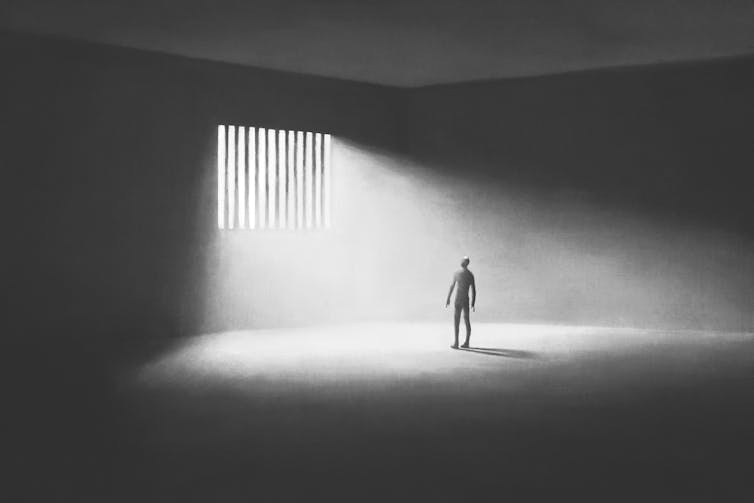
In the months that followed, I would meet many other men for whom hope was not necessarily a lifeline as is so commonly assumed, but a burden that they had to carry, sometimes painfully.
The Insights section is committed to high-quality longform journalism. Our editors work with academics from many different backgrounds who are tackling a wide range of societal and scientific challenges.
Hope is not a soft word in prison. It shapes how people cope with their sentence and it determines whether – and how – they engage with staff and other prisoners. It shapes whether they commit to vocational and educational activities, and it sustains connections with people on the outside.
For older life-sentenced prisoners specifically, hope becomes interlinked with accelerated ageing, with bullying from younger prisoners, and with the fear of release into an unknown world.
My project (In search of Hope: the case of elderly life-sentenced prisoners) began in August 2022. We were investigating how the “right to hope” – as defined by Judge Ann Power-Forde in her concurring opinion to the European Court of Human Rights judgment Vinter and others v the UK (2013)– translates behind prison walls for older people serving life sentences, many of whom face slim prospects of release due to their advanced age and the length of their prison sentence.
The research was carried out across three English prisons over 12 months by myself and research associate, Helen Gair, with a small team of research assistants. We conducted fieldwork in a Category A prison (reserved for people presenting the highest levels of risk), a Category C (mid-security level prison, often aimed at training and resettlement), and a Category D (open prison or the last stage before release).
Each facility had its own smell and sound. The spatial layout and daily rhythm varied too. For instance, the high security site was an old red brick Victorian building, and the wings were arranged in a half panopticon (circular) design. Outside the main block, guard dogs were walked on a strip of green that ran along a ten-metre-high wall. Inside it was loud; lockdowns were frequent, and it smelled of sweat and mould.
In the open prison, the smell of cannabis drifted through the grounds. Men greeted us in grey tracksuits, often carrying disposable cups of tea. There were ducks and a pond and a RAF plane on display.
In the Category C prison, we often got lost. The alphabetical alignment of buildings made little sense to us. We had our own set of keys which meant we could move around independently. However, rusty locks slowed us down often, and every gate and door had to be opened and closed behind us.
Men aged 50 and above and serving life sentences were invited to participate. We collected diaries, completed ethnographic prison observations, and ran one-to-one interviews with each participant.
Additionally, interviews were conducted with prison staff, both working in frontline and office-based roles, to get a sense of how those who work closest to ageing life-sentenced prisoners perceived hope and whether prison practices preserved or restrained it. Overall, we wanted to find out how hope was experienced by prisoners and how it was handled as a prison practice.
Idealised hope v prison reality
In the 2010s, a case was brought before the European Court of Human Rights by Jeremy Bamber, Douglas Vinter and Peter Moor. They had each been convicted of murder in the UK and been given whole-life orders – the most severe form of life sentence.
This means that by law, they were sentenced to spend the rest of their lives in prison with no minimum term set for parole or release. Only a small percentage of people get such severe sentences: Myra Hindley and the Yorkshire Ripper Peter Sutcliffe being two examples.
On July 9, 2013, the human rights court ruled that whole-life orders which do not include any prospect of release or review would amount to inhuman or degrading treatment, contrary to Article 3 of the European Convention on Human Rights. The notion of a “right to hope” was first mentioned by Judge Ann Power-Forde’s concurring judgment:
… Even those who commit the most abhorrent and egregious of acts … nevertheless retain their essential humanity and carry within themselves the capacity to change. Long and deserved though their prison sentences may be, they retain the right to hope that, someday, they may have atoned for the wrongs which they have committed. They ought not to be deprived entirely of such hope. To deny them the experience of hope would be to deny a fundamental aspect of their humanity and to do that would be degrading.
The right to hope is thus vested in a possibility of release and review. What this means is that there must be a realistic possibility that any prisoner sentenced to life imprisonment be considered, at some point in time, for release or that the justification for their continued detention needs to be reviewed.
But how does the right to hope account for the fact of ageing in prison?
The rapid and global “greying” of the prison population indeed complicates the human rights jurisprudencial understanding of a right to hope. As of March 2025, there were 87,919 people in prison in England and Wales, with nearly one in five (18%) aged 50 or older, according to the Ministry of Justice.
Compounding matters, life-sentenced prisoners now make up around 10% of the sentenced population, and this group is ageing rapidly. Almost a third of “lifers” are over 50. As a result, old, life-sentenced prisoners are the fastest-growing subgroup in the system.
This phenomenon combined with the current overcrowding crisis produces a range of managerial and ethical challenges: bed spaces are tied up for decades, healthcare and social care demands are on a steep rise, and the pressures on ill-equipped prison staff increase.
The myth of prison release
One important finding from our project is that parole and the possibility of release during a prisoner’s life span becomes somewhat of a myth for those serving life sentences at an advanced age. Usually, life-sentenced prisoners are given a minimum tariff, which is a period when they are not eligible for parole. This legal principle does not account for age however. Dean, 62 , was a life-sentenced prisoner at the Category A prison who had served six years. He told us how unrealistic parole felt in light of his age:
I will be 80 years old before my first parole hearing and in all honesty I don’t know if I will reach that milestone. Although my health is reasonable, I’m on all kinds of medication to keep me going but incarceration has a way of dragging you down so I am not optimistic.
Trevor was 73 when we interviewed him in the Category C prison and had been inside for 27 years. He was sat in a wheelchair and had an elastic band wrapped around his middle finger and thumb. He explained to us that it helped him hold a pen.
He described years of postponed parole hearings, medical delays, and transfers to lower security prisons being denied because his health needs could not be met in open prison conditions. He asked us simply:
If you were in my situation would you live in hope or would you resign yourself to your future?
The experience of no longer believing in release is supported by official data that shows that few prisoners sentenced to life get released during their lifetime.
One in five lifers are now beyond their tariff, often by several years with age-related barriers to parole contributing to prolonged incarceration. What we noticed during fieldwork was that older prisoners often struggled to access or complete accredited programmes because of mobility issues and cognitive impairment, but also due to managerial prioritisation of younger prisoners or those convicted of shorter sentences.
Rising deaths in England and Wales among older prisoners further underscores the illusory prospect of release.
Nearly nine in ten of the 192 deaths from natural causes in the year 2025 involved older prisoners and the number of people in prison requiring palliative care continues to grow.
From 2016 to 2020, hospitals recorded 190 admissions of older male prisoners with a palliative care diagnosis. In roughly 40% of those cases, cancer was the main condition on entry. The charity, Inquest, reported in 2020 that many of the deaths in prison were neither inevitable nor unforeseeable, pointing instead to systemic failings in healthcare provision, communication, emergency intervention, and medication management.
Building on this, academic scholars Philippa Tomczak and Ròisìn Mulgrew argued that classifying deaths in custody as “natural” obscure the ways in which prison environments contribute to deaths that might otherwise have been avoided.
Additionally, research has repeatedly linked self-harm and suicide patterns to experiences of hopelessness and social isolation. The participants in our study similarly tied the removal of hope to suicides, citing examples they had witnessed in prison.
In his prison diary, a participant with thick rectangular glasses called Ian, 65, who had served 33 years of his life sentence and was now held in a Category C prison, wrote:
With the absent (sic) of hope you have despair. I have known prisoners who have committed suicide, they had no hope or expectations only misery and despair.
So there appears to be a contradiction between the legal possibility of release and its practical improbability in the context of old and ageing, life-sentenced prisoners.
The fear of release
Beyond the practical improbability of release, many participants described how much they feared the world they would hypothetically re-enter one day. Several participants in their 60s and 70s reflected on how they no longer recognised the world outside.
For them, the time spent in prison combined with their physical and cognitive decline has institutionalised them. They felt they could not fare alone outside prison rules and environments. One man named Roy, who had spent decades in various Category A prisons wrote in his diary:
I have no hope of, or real wish to leave prison, where I am now completely institutionalised, I have no responsibilities other than abiding by prison rules, and few expenses.
Another frail-looking man named Russell, 68, described in his diary (which he completed from his Category C cell) how the very idea of a future had become hollow: “It’s difficult really because like I say, I haven’t got any hope of getting out of prison as far as I’m concerned. That is it. I’m in prison and that’s as far as it will go.”
Practical matters such as technological advances and housing also made the very thought of release overwhelming. Gary, 63, who had served 24 years, wrote poignantly about his fears of release, saying: “Release frightens me because of the label that has been firmly given to me and that brings its own problems. Where will I live? How will I live?”
A 73-year-old participant named Kevin, who was transferred during the project from a Category C to an open prison, spoke about how, after 21 years in prison, things will have changed too much on the outside for him to deal with. As he stood on the doorstep of freedom, he worried about getting his head around new technology and accessing simple things like his pension. He said: “Technology has moved on at a phenomenal pace, seems very scary to me … I should stay here in prison where everything is regulated and structured rather than going out to something that is quite alien to me.”
These feelings are exacerbated by the erosion of social networks, the death of family and friends, and the disappearance of any meaningful horizon. Social isolation means that the world they would be reintegrating into has become alien and they will have to navigate it mostly alone. Kevin added:
People that I used to call friends no longer want to know me or have died. One thing for sure that I can [say] is true, you certainly find out who your true friends are … when you come to prison and especially if you come to prison for a long time.
This sense of destroyed horizons, where release holds no promise and the outside world has become even more terrifying than the cell, has been dramatised in popular culture.
In The Shawshank Redemption (1994) the character Brooks, released after 50 years inside, finds himself unable to cope with the pace and impersonality of the modern world. His suicide becomes a haunting metaphor for the crushing effect of institutionalisation that hollows out the self and the possibility of meaningful social reintegration.
When hoping becomes harmful
Other prisoners we spoke to seemingly decided it was more beneficial for them to give up on hope altogether. Some – like Barry -– wondered if giving up on hope of release would be less torturous.
Barry was 65 when we spoke to him and has spent over four decades in prison on a life sentence. He’s tall and slim. When he walked in, we noticed he had a limp and used a cane. The first time we met, he sat with his hands clasped, speaking in a measured voice that occasionally broke into a laugh, not from humour but more from what I felt like was exhaustion. Though parole is technically available to him, he has come to see the pursuit of release not as hopeful but as harmful.
Over years of disappointments, Barry wondered if living with no hope would be less painful and felt it had become “pointless” to hope. He wrote in his diary:
Hope is when I want something to happen or something to be true … I often ask myself would it be kinder to live with no hope and just live with a ‘wait and see’ kind of attitude.
Indeed, every parole hearing postponed, every dashed expectation had eroded the value of hoping. Ultimately, giving up on hope is captured as something that eventually preserves mental health. As Barry added:
An empty case of hope is healthy, I say that because of the amount of men I have seen become ill; disappointment becomes despair, becomes depression, becomes mental ill health … then when you stop hoping, you start to recover and you no longer feel hopeless, as you are not hoping for anything. So hope is a paradox, it can disappoint or make you feel there is a real possibility of things to come.
He recalled reading about an American woman sentenced to life without parole who had begged for the death penalty instead. Her explanation (“I don’t just want to be alive, I want to be able to live”) resonated with him so powerfully that he said it, “almost knocked me off my chair”. He recognised in her plea the same cruel paradox he faced: that to prolong his existence in hopeless conditions was no life at all. His conclusion was irrevocable:
I understand more than most the need for hope, but all the years that I have been in prison and all the hopes I have had destroyed, I see hope as an enemy.
But then Barry equally admitted that he still hoped, no matter what. His hope was like a human natural reflex, over which he had no control, it just happened. He said: “We all hope … I hope I’ll get out on my next parole.”
What then, is hope in prison? Is it cruel and torturous or is it a human feature that brings relief and drive?
Recalibrating hope
We found hope meant different things to different people. It is not just about release. Some needed detailed plans, others focused on the day to day. Sometimes hope shifted towards modest goals that are tied to imagined places outside prison: a quiet retirement, a chance to study, to garden.
Terry was 65 and had served 38 years in category A prison. He told us that all he hoped for was “a quiet life in retirement”, while Russell, who was about the same age but had served over 12 years and was in a Category C when he wrote his diary, said that he hoped to, “… someday be released and to live the remaining years I have left in a small bungalow with a small garden in a village miles away from my old area of England. Have a pet cat.”
Others cast their hopes in more detailed and concrete plans about what the future would look like. Carl, 60, who enjoyed cooking and working out, for example, said he hoped to move in with his daughter and grandchildren for a while in an area where his ambition is to build his own house. He added: “I designed and roughly costed the development plan that helped to reinforce the hope that these plans were achievable.”
In the moment
But other participants recalibrated hope to more immediate aspirations set in the present, and in day-to-day encounters.
Barry said: “My hope is that I continue to live in the moment … You know, cause right now I’m in this office with you two guys, it’s calm. It’s nice. It’s peaceful. It’s a nice moment. But I’m not gonna think about what it’s gonna be like at 4pm because I might walk out that door and straight into a prison riot.”
Russell agreed, adding: “Looking for the future, I just go from one day to the next. It’s no good planning too far ahead.”
This shift of hope raises questions about how prisons shape and even limit the ways people can access and imagine their futures.
Another participant, Craig, who was 66 and had only served just over five years in the Category A prison when we met him wrote: “… you personalise hope to suit the circumstances.”
For the institution and those working in prison, these attitudes towards hope could be perceived as successful because prisoners sentenced to the longest sentences demonstrated a commitment to live a crime-free life, set in the present moment, focused on small menial things that will not raise any risk for management.
But when hope becomes so short-termist and bland, we are able to capture a shift in the very logic of imprisonment – one which is less about nourishing transformation aimed at resocialisation, and more about the life-long containment of decaying and dying bodies.
Hope matters
This article opened with a man telling my colleagues and I: “How dare you ask us about hope?” That moment has echoed throughout this study, both as an outburst that shows how prison research can be fraught with complexity but can also propel further and deeper reflection on humanitarian ideals such as hope.
When people in prison speak of the cruelty and fallacy of hope, you begin to wonder how much beauty and promise hope really holds in spaces of high control and constraint.
When transposed to prisons, hope no longer seems to be attached to an open horizon, evocative of lightness and liberty found anew. Instead, it represents dissociation from the outside world, and the cause of frustration, mistrust and a sense of abandonment.
Hope in prison exposes a disconnect between abstract legal humanitarian ideals and the empirical realities of ageing while incarcerated for long periods of time. And this claim could probably be extended to other settings of heightened regulation and tight monitoring, such as care homes, immigration detention centres, or even youth justice facilities.
The decision to depart from hope’s conventional, perhaps slightly romanticised meaning, and to recalibrate it towards real, daily conditions could nonetheless illustrate new ways for how older life-sentenced prisoners (and others under constraint) regain agency and keep going.
Ultimately, hope matters – not only for the people I met and interviewed – but also for broader society.
Imprisonment marked by hopelessness is linked to deteriorating mental and physical health, increasing pressure on prison healthcare and, upon release, on community health and social care services.
This is exacerbated for older prisoners released after decades inside. Hope is not a sentimental indulgence, but a condition that shapes whether imprisonment prepares people to live safely beyond prison or releases them with profound unmet needs. Regimes that erode hope risk merely displacing, rather than resolving, social harm.
To hear about new Insights articles, join the hundreds of thousands of people who value The Conversation’s evidence-based news. Subscribe to our newsletter.
Marion Vannier receives funding from the UK Research and Innovation Future Leader Fellowship.
Source: The Conversation – UK – By Catherine Wynne, Associate Dean for Research and Enterprise, Faculty of Arts, Social Sciences and Education, University of Hull
It is 1925 and the scene is Chimneys. It’s the English stately pile of the Caterham family, but the penurious Lady Caterham (Helena Bonham Carter), has been forced to rent it to the industrial magnate Sir Oswald Coote (Mark Lewis Jones).
Inside the house, a party is in full swing and the misanthropic Lady Caterham, a visitor in her own house, observes to her daughter, Lady Eileen “Bundle” Brent (Mia McKenna Bruce), that the guests are “industry, aristocracy, and the foreign office”.
Agatha Christie’s The Seven Dials Mystery, published in 1929, is now a lavish three-part Netflix series written by Chris Chibnall and directed by Chris Sweeney. This new adaptation uses Christie’s puzzle of the seven dials not just to entertain, but to confront the political and imperial world her novels often leave implicit.
During the party, the young men of the foreign office play a prank on their colleague by setting eight alarm clocks in his room timed to go off at 11.15am the next morning. Why? Because their colleague famously sleeps late.
When one of the clocks goes missing, later found by Bundle on the lawn, and the other seven are arranged neatly on the bedroom’s mantelpiece, Bundle is perplexed. And there’s a death – naturally.
Despite the suggestion that the victim was under stress in his work (a contemporary reference to the rapid rise in mental health issues in young men), Bundle rejects the verdict that he took his own life. Her certainty is compounded when she later comes upon another young male victim, whose final words are “seven dials”. But what is he really referring to? Bundle intends to find out.
The trailer for Seven Dials.
Trailed by a figure unknown to her, her pursuit of her shadow leads her to Scotland Yard and to Inspector Battle (Martin Freeman, no stranger to sleuthing having played Watson in the BBC Sherlock Holmes series). Bundle mirrors Irene Adler from Arthur Conan Doyle’s A Scandal in Bohemia (1891). In the story, Adler follows a disguised Holmes to Baker Street and becomes the only person ever to outwit the detective.
Like Adler before her, the intrepid Bundle is a feminist trailblazer. McKenna Bruce is superb, occupying the role with aplomb. In Christie’s novel Bundle cannot sit still. In the series she jumps out of an upper-storey window in Chimneys to avoid a proposal of marriage from a boring and older MP, George Lomax (Alex Macqueen), landing in the garden where Kettle is investigating the evidence. She has made her choice.
What Netflix adds to Christie’s original
The Netflix series is a more straightforward thriller than Christie’s novel. In the introduction to the 2026 signature edition of the novel, which comes with new cover art and design from Netflix, Val McDermid posits that Christie operates on the terrain of thriller pastiche, sending up the masculine John Buchan-type thrillers of the 1910s and 1920s. She is also Jane Austen-like with her ironic take on the aristocracy, the nouveaux riche and purposeless young men and women.
The series echoes Christie’s critique of the rigid social structures of the 1920s. Bonham Carter’s Lady Caterham observes that Lady Coote should not thank servants, Sir Oswald Coote declares that he can buy class. But it does more too: Christie avoided references to the first world war, writing in the decade after its ending. During the war, she worked dispensing medicines for the Voluntary Aid Detachment of the British Red Cross in Torquay (where she learned all about poison). By contrast war is embedded into the Netflix series.
Bundle has lost her brother in the conflict and her connection to the young foreign office men is a comradeship made through war. They are survivors of a sort. Life, Bundle says, is “far too short”. Her late brother Tommy served with the foreign office’s Gerry Wade (Corey Mylchreest), who recovered his body.
In the series’ climax, Lady Caterham, powerfully articulated by Bonham Carter, describes the war as an “abattoir” with no “glory”. She lives, Miss Havisham-like, in a house where a bucket catches the drops of water from a leaky roof and the footman doesn’t get paid. As Bundle discovers (in line with the thriller genre) no one is what they seem to be.
But the most chilling indictment of European empires and the social structures they support is articulated by Dr Cyril Matip (Nyasha Hatendi), a brilliant Cameroonian inventor whom Lomax tries to get to work for Britain by inviting him to his country pile.
When Lomax puts on a pheasant shoot to entertain Matip, the inventor refuses to participate – he has seen what guns can do. Meanwhile, Bundle’s eyes rest on a shot pheasant in the grass. At dinner, Matip describes the impact of war and his distrust of Europeans. He has seen how “Africans have fought other Africans for white Europeans”.
In homage to Christie’s most famous work, Murder on the Orient Express, the climax occurs on a train. But not all is over. The final secret – that of the seven dials – is still to be revealed. Seven Dials refreshes Christie for our times, and it does it admirably. Christie still has much to say. We underestimate her at our peril.
Looking for something good? Cut through the noise with a carefully curated selection of the latest releases, live events and exhibitions, straight to your inbox every fortnight, on Fridays. Sign up here.
This article features references to books that have been included for editorial reasons, and may contain links to bookshop.org. If you click on one of the links and go on to buy something from bookshop.org The Conversation UK may earn a commission.
Catherine Wynne does not work for, consult, own shares in or receive funding from any company or organisation that would benefit from this article, and has disclosed no relevant affiliations beyond their academic appointment.