On connaissait les crottes fossiles, appelées coprolithes. Mais une découverte récente montre que les régurgitations peuvent elles aussi se fossiliser. Sur le site paléontologique de Bromacker, en Allemagne, un fossile très particulier a été mis au jour : un régurgitalithe, c’est-à-dire un vomi fossile. Cette régurgitation regroupe des restes osseux appartenant à trois animaux différents et provient d’un prédateur appartenant aux synapsides (groupe d’animaux incluant les mammifères modernes), déjà découvert sur ce site.
Les roches de cette localité, âgées d’environ 290 millions d’années (Permien inférieur), ont déjà livré des plantes, des amphibiens et des reptiles exceptionnellement bien conservés, ainsi que de nombreuses traces de pas. Cette fois, notre équipe a découvert un petit amas d’os partiellement digérés, sans structure ni forme régulière, suggérant qu’il ne s’agissait pas d’un excrément mais bien de restes régurgités par un prédateur. Cette découverte vient d’être publiée dans Scientific Reports.
Comment avons-nous déterminé qu’il s’agissait de vomi fossilisé ?
Ce fossile se présente sous la forme d’un amas osseux compact. Un tel regroupement d’os n’a jamais été découvert à Bromacker, et suggère que ces restes ont été ingérés puis rejetés par un prédateur, soit par défécation ou régurgitation. Dans le cas des coprolithes (crottes fossilisées), les restes osseux sont généralement préservés à l’intérieur d’une matrice sédimentaire d’origine organique (matière fécale) visible, riche en phosphore, issu de l’activité bactérienne liée à la digestion des os. Or, dans le cas de ce spécimen, les restes osseux ne sont pas entourés d’une telle matrice. Une analyse des éléments chimiques par micro-XRF (Spectrométrie de fluorescence des rayons X) a confirmé une quasi-absence de phosphore dans cette matrice. Cette absence de phosphore est caractéristique des régurgitalithes (régurgitations fossilisées) comparé aux coprolithes, fortement concentré en phosphore, dû à un temps de digestion plus long.
Nous avons aussi scanné le fossile en 3D (CT-scan). Cette approche non destructive a permis de reconstituer virtuellement chaque os et de les identifier avec précision. Le régurgitalithe contient notamment :
un maxillaire d’un petit reptile quadrupède (Thuringothyris), avec la plupart des dents encore en position ;
un humérus appartenant à Eudibamus, un reptile bipède ;
un métapode (os du pied ou de la main) d’un diadectide, un herbivore de taille nettement plus grande.
Au total, trois animaux différents et de tailles variées, ont été ingérés puis partiellement régurgités par un même prédateur.
Pourquoi cette découverte est-elle importante ?
Les régurgitalithes sont très rares dans le registre fossile, et aucun n’avait encore été décrit dans un environnement terrestre aussi ancien. Cette découverte représente ainsi le plus ancien vomi fossile de vertébré terrestre connu.
Elle ouvre aussi une fenêtre inédite sur le comportement alimentaire des prédateurs du Permien inférieur. Deux carnivores suffisamment grands pour avoir ingéré ces proies sont connus à Bromacker : Dimetrodon, reconnaissable à sa crête dorsale, et un autre synapside carnivore de taille comparable, Tambacarnifex.
La diversité des restes contenus dans ce régurgitalithe suggère un comportement opportuniste, où ces prédateurs ingéraient tout ce qui était à leur portée. De plus, ce régurgitalithe agit comme une véritable capsule temporelle, renfermant les restes de plusieurs animaux ayant vécu exactement à la même période, peut être même au jour près. Ce spécimen nous permet ainsi de vérifier la coexistence réelle de ces trois animaux.
Quelles suites donner à cette recherche ?
Cette étude nous invite à reconsidérer certaines accumulations d’ossements fossiles, parfois interprétées comme des coprolithes ou des dépôts sédimentaires. Elle montre que les régurgitalithes pourraient être plus fréquents qu’on ne le pensait, mais encore largement sous-identifiés.
À l’avenir, la combinaison de scans 3D, d’analyses chimiques et de comparaisons anatomiques détaillées pourrait permettre de reconnaître d’autres vomis fossiles et de mieux relier ces vestiges aux prédateurs à leur origine. Ces travaux ouvrent de nouvelles perspectives pour reconstruire les réseaux trophiques (ensemble des interactions d’ordre alimentaire entre les êtres vivants d’un écosystème, ndlr) anciens et mieux comprendre le fonctionnement des écosystèmes terrestres il y a près de 300 millions d’années.
Tout savoir en trois minutes sur des résultats récents de recherches commentés et contextualisés par les chercheuses et les chercheurs qui les ont menées, c’est le principe de nos « Research Briefs ». Un format à retrouver ici.
Arnaud Rebillard ne travaille pas, ne conseille pas, ne possède pas de parts, ne reçoit pas de fonds d’une organisation qui pourrait tirer profit de cet article, et n’a déclaré aucune autre affiliation que son organisme de recherche.
Just four months ago, Timor-Leste formally became a member of the Association of Southeast Asian States (ASEAN).
This week, the tiny country took an unprecedented step: its judicial authorities appointed a prosecutor to examine the Myanmar military’s responsibility for war crimes and crimes against humanity. It’s believed to be the first time an ASEAN state has taken such an action against another member.
The case resulted from the persistence of a victims’ group, the Chin Human Rights Organisation, in pursuing justice for the Chin people, a minority group in Myanmar. In submitting the complaint, the head of the organisation expressed solidarity with Timor-Leste’s own historic efforts to secure justice and independence.
Timor-Leste authorities will now assess whether to bring charges against Myanmar’s military leaders, including junta chief Min Aung Hlaing.
Any prosecutions would be on the basis of “universal jurisdiction”. This is a legal principle that allows domestic courts to hear cases alleging international crimes, regardless of where the crimes occurred, or the nationality of the victims or perpetrators.
Limitations of international courts
This week, a major study of 23 conflicts around the globe said the international legal system designed to protect civilians is at a “breaking point”. Observers are also asking whether the United Nations has any future at all.
It has long been clear that international courts have limited efficacy in prosecuting cases of war crimes and crimes against humanity.
However, proponents of the court say it has been unfairly maligned and targeted, including by the Trump administration, which imposed sanctions on it last year.
Both the ICC and ICJ have investigations underway on Myanmar, but they deal with crimes allegedly committed against the Rohingya minority group before the coup. The ICC case covers incidents committed partly in Bangladesh.
The ICC’s chief prosecutor asked the court’s judges to issue an arrest warrant for Min Aung Hlang in November 2024. More than a year later, a decision has yet to be made.
Challenges for domestic courts
In this environment, universal jurisdiction could play a more important role. The United Nations has implicitly recognised this by establishing investigative mechanisms for Syria and Myanmar that gather evidence for future prosecutions in domestic, regional or international courts.
Many states have laws that allow them to prosecute international crimes like torture, genocide or war crimes. What is lacking are resources to fund investigations and transparent criteria or guidelines for how to undertake them.
There are other challenges once cases are underway, too. For one, domestic courts have limited reach. Arrests are difficult, as high-level officials can rely on diplomatic immunity or just avoid the countries where they believe they could face prosecution or extradition.
Prosecuting even lower-level or mid-level perpetrators can be politically awkward. Cases can be expensive and practically difficult, especially when witnesses and evidence are mostly overseas.
And if trials go ahead, victims can still find justice elusive, even if the cases have broader strategic or symbolic aims.
Still, there have been successes. Nearly 10 years ago, the former president of Chad, Hissène Habré, was convicted of international crimes in Senegal. The case was tried using universal jurisdiction, driven by civil society networks.
More countries need to step up
This latest initiative in Timor-Leste comes after victim groups have tried many different countries to seek justice for the people of Myanmar. This includes Argentina, where arrest warrants were issued for Myanmar’s leaders, Turkey, and Germany.
In the Asia-Pacific, lawyers have also attempted to bring cases in Indonesia and the Philippines.
While European countries are increasingly using universal jurisdiction to prosecute crimes, other countries have been less keen to take these cases on. For instance, some suggest Canada and Australia could do more to investigate war crimes cases, even though they both have the laws in place to do so.
This just leaves the heavy lifting of prosecutions to others, possibly in courts with more limited resources.
With atrocities continuing to be committed around the world, it’s become more vital than ever for governments to not just back international justice with strong words, but show a real commitment to investigating them at home.
Associate Professor Emma Palmer is the recipient of an Australian Research Council Australian Discovery Early Career Award (project number DE250100597) funded by the Australian Government. The views expressed herein are those of the author and are not necessarily those of the Australian Government or Australian Research Council. She is also affiliated with the Association of Mainland Southeast Asia Scholars.
Bad Bunny is on a roll. Among the three wins at the 68th Grammy Awards, DeBÍ TiRAR MáS FOToS (I should have taken more pictures) became the first Spanish-language record to win Album of the Year. On Sunday, Bad Bunny will be the first Latino and Spanish speaking artist to perform as solo headliner at the Super Bowl halftime show.
Born Benito Antonio Martínez Ocasio, and raised in Borinquen (the Taíno-language name for Puerto Rico), Bad Bunny’s life and music has been marked by political, social and economic crises affecting the archipelago: government corruption, failing infrastructure and debt.
Bad Bunny has used his voice to protest in both his music and public statements against national crises and the ongoing effects of colonialism, while celebrating Latinx and Puerto Rican identities.
Bad Bunny started posting songs on SoundCloud in 2016. In 2018, he released his first album, X 100PRE. Sung in Spanish, the album reached number 11 on the Billboard charts.
His third album, 2020’s El último tour del mundo (The Last World Tour), became the first Spanish-language album to reach number one in the Billboard charts. His fourth record, 2022’s Un Verano Sin Ti (A Summer Without You) also topped this chart, this time for 13 weeks.
DeBÍ TiRAR MáS FOToS stands out against Bad Bunny’s previous albums for its focus on Puerto Rican identity and ongoing fight against colonisation. This is reflected in the album through national symbols, genres and, of course, language. Bad Bunny addresses these themes through companion videos explaining central aspects to the collective memory of Puerto Rico.
In the current climate in the United States of interventionism and mass deportations, DeBÍ TiRAR MáS FOToS has made the domestic Puerto Rican experience resonate among global audiences.
Language and genre
Puerto Rico is an unincorporated territory that belongs to the US, and Puerto Ricans are US citizens, but the territory is not counted as one of the country’s states. The US exerts control over the military, politics and economy of the archipelago.
Spanish plays a complex role in Puerto Rico, as a colonial language that was imposed in the archipelago. More recently, Spanish has been embraced as a resistance to English dominance.
Bad Bunny speaks Puerto Rican Spanish, which combines influences from indigenous Taíno language, African languages, Spanish and English. Studies have found Spanish speakers may consider this variety as incorrect because its characteristics are seen as distant from the Castilian Spanish norm: perceptions anchored in colonial ideologies that privilege Castilian Spanish.
Among other genres, Bad Bunny sings reggaeton, a Caribbean genre that draws on Jamaican dancehall, American hip-hop and Dominican Republic dembow.
Reggaeton is popular music with underground roots and explicit lyrics. In the 1990s, Puerto Rican reggaeton was subject to government prosecution (including confiscation, fines and negative media campaigns) due to its alleged obscenity. That did not stop its increasing popularity among young audiences in the Caribbean, and beyond.
The international popularity of reggeaton artists such as Don Omar, Daddy Yankee, Young Miko, Ozuna and Bad Bunny has changed the perception of Puerto Rican Spanish from a history of deficit views to more social prestige. In the past, the distance from the Castilian Spanish norm was considered something negative, but there is now a strong interest among students of Spanish to learn this variety.
Fluid use of language
Bad Bunny’s language does not reflect a purist vision of language with rigid boundaries. Instead, he embraces a creative use of language with fluid boundaries.
The Puerto Rican slang Bad Bunny uses on DeBÍ TiRAR MáS FOToS features numerous Anglicisms, or words borrowed from English – a feature of Puerto Rican Spanish.
He uses unadapted borrowings – such as the words shot, pitcher, flashback, follow, blondie, glossy, brother, bestie, eyelash, underwater and movie. And he also uses hybrid realisations, compound words that combine English and Spanish components such as janguear (adapted from the English “hang out”), girla (girl), ghosteó (ghosted), stalkeándote (stalking) and kloufrens (close friends).
Bad Bunny embraces his Puerto Rican identity in the pronunciation of lyrics and in public commentary. For example, he pronounces the letter “r” as the letter “l” in songs like NUEVAYoL (New York) and VeLDÁ (Truth).
The letter “l” becomes a strong identity feature of NUEVAYoL when compared to other iconic renditions to the city, such as from Frank Sinatra.
By using his voice to celebrate characteristics of Puerto Rican Spanish previously not perceived as prestigious, Bad Bunny is contributing to the values of linguistic diversity and fighting language ideologies inherited from colonialism.
Music as defiance
The way Bad Bunny uses language has been described as an act of defiance and survival. Bad Bunny does not break down language and make it easier for listeners. Rather, listeners have to make the effort of decoding it.
Notably, the lexicographer Maia Sherwood Droz created a Spanish dictionary for DeBÍ TiRAR MáS FOToS, including definitions of words, phrases and cultural references to decode the meanings in the album.
In an album loaded with references to the ongoing fight to preserve Puerto Rican identity, he evokes community symbols of “pitorro de coco” (homemade clandestine rum) to “la bandera azul clarito” (the light blue flag, referring to a 1895 Puerto Rican emblem.
When accepting an award at the Grammys, Bad Bunny said:
We’re not savage. We’re not animals. We’re not aliens. We are humans, and we are Americans.
Bad Bunny’s acceptance speech is explicitly rejecting dehumanisation in a ceremony where, finally, music in language other than English and, importantly, in Puerto Rican Spanish, was honoured and celebrated as the best album of the year.
Beatriz Carbajal-Carrera does not work for, consult, own shares in or receive funding from any company or organisation that would benefit from this article, and has disclosed no relevant affiliations beyond their academic appointment.
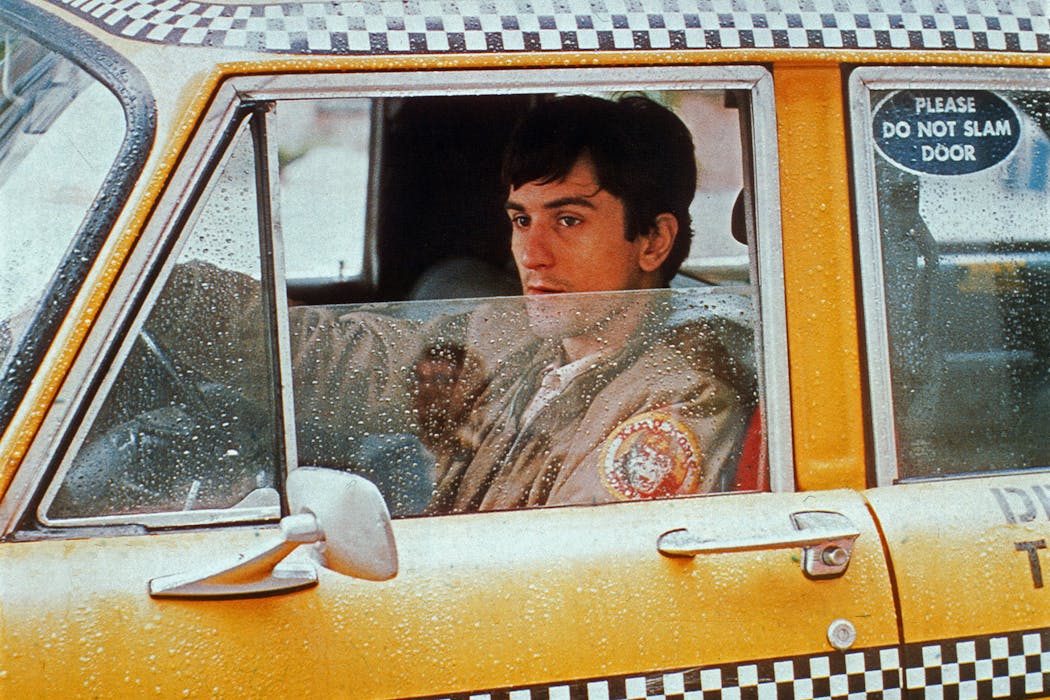
Martin Scorsese’s Taxi Driver turns 50 this month. Nominated for four Oscars and winner of the Palme d’Or at the 1976 Cannes Festival, Scorsese’s searing, hallucinatory portrait of urban alienation is widely regarded as one of the most important American films of all time.
It is also unquestionably one of the most troubling.
Taxi Driver channels the anger, paranoia and alienation of an American decade shaped by economic decline, imperialist violence and political scandal. Set in the dilapidated squalor of a rapidly deindustrialising New York, the film proffers a forlorn portrait of a society coming apart at the seams.
At its heart sits a deeply unsettling vision of masculinity, bound up in racism and misogyny.
Travis Bickle (portrayed with unnerving intensity by Robert De Niro) was the creation of screenwriter Paul Schrader, who drew heavily on his own experiences of isolation and emotional crisis. Schrader also looked to literature for inspiration, citing Fyodor Dostoevsky’s misanthropic Underground Man as a formative influence.
In placing the European existential hero in an American context, said Schrader:
you find that he becomes more ignorant, ignorant of the nature of his problem. Travis’ problem is the same as the existential hero’s, that is, should I exist? But Travis doesn’t understand that this is his problem, so he focuses it elsewhere: and I think that is a mark of the immaturity and the youngness of our country.
Schrader also drew on contemporary events, including the attempted assassination of right-wing politician George Wallace by Arthur Bremer. The result was a character who crystallised the violent confusions of the era.
Like Bremer, Travis keeps a diary. We see him writing in it at various points in the film and we hear excerpts from it in voiceover:
All the animals come out at night. Whores, skunk pussies, buggers, queens, fairies, dopers, junkies, sick, venal. Someday a real rain’ll come and wash all this scum off the streets.
Travis, a decidedly unreliable narrator who claims to have served in Vietnam, takes a job as a taxi driver because he has trouble sleeping. Working almost exclusively at night and wound impossibly tight, he rides through the city in a state of heightened unease.
One morning, after clocking off from a long shift, he notices a young woman through the window of a midtown Manhattan office. This is Betsy (Cybill Shepherd), an ambitious campaign worker employed by a presidential hopeful Charles Palentine (Leonard Harris).
Betsy quickly becomes the object of Travis’s fixation. He begins loitering in his cab outside her workplace, watching her from a distance. Eventually, he somehow persuades her to go on a date with him. It does not go well.
Socially inept, Travis’ idea of a good time is a trip to a Times Square porno theatre. He appears genuinely baffled when Betsy decides she has had enough and storms out, cutting off all contact with him. This only deepens Travis’ indignation and culminates in an angry confrontation at Betsy’s office, where he berates her in front of her coworkers.
Travis starts to spiral, confessing to a fellow cabbie that he’s got “some bad ideas” in his head. He settles on a plan of action. His diary entries become even more ominous.
He starts working out obsessively, loads up on guns and plots the public assassination of Betsy’s boss. Political violence becomes a way of giving shape to his discontent, transforming indignation into a pipe dream of historical consequence. He practices shooting in front of the mirror in his dingy apartment.
De Niro’s improvised line, “You talkin’ to me”, became (to borrow from film scholar Amy Taubin) “arguably the most quoted scene in movie history”.
When his plan to murder Palantine collapses, Travis redirects his attention to Iris, a 12-year-old sex worker played by Jodie Foster. He decides he must “help” her get away from her pimp, believing himself morally just. Carnage ensues – so ferocious that it initially led to the film being refused a commercial rating.
It ends on a bleakly ironic, ambiguous note.
A dark afterlife
Taxi Driver dividedcritics but proved an immediate hit with viewers.
Its disquieting power did not diminish with time; if anything, the film’s afterlife has been almost as troublesome as the work itself.
In 1981, John Hinckley Jr. – who had become obsessed with the film – attempted to assassinate Ronald Reagan in an effort to impress Jodie Foster. This incident shook Scorsese, who briefly considered giving up filmmaking altogether.
Travis Bickle has been repeatedly elevated to the status of anti-hero. The character has cast a long cultural shadow, most obviously in Todd Phillips’s Joker (2019).
A 2025 documentary series reflecting on Scorsese’s career returns to this question of legacy. Director Rebecca Williams puts it to Schrader that she gets the impression that “there are a lot of Travis Bickles, especially right now.” Schrader’s reply is blunt:
They’re all talking to each other on the internet. When I first wrote about him, he was talking to nobody. He really was, at that point, the Underground Man. Now he’s the Internet Man.
It is a sobering thought.
Alexander Howard does not work for, consult, own shares in or receive funding from any company or organisation that would benefit from this article, and has disclosed no relevant affiliations beyond their academic appointment.
Source: The Conversation – UK – By Jeremy Horder, Professor of Criminal Law, London School of Economics, London School of Economics and Political Science
Peter Mandelson, former UK ambassador to the United States, is currently under investigation by the Metropolitan Police concerning an allegation of criminal misconduct in public office.
The allegation centres on evidence that Mandelson passed sensitive, confidential information – received in his capacity as a minister – to Jeffrey Epstein and his associates.
If that is true, then it is, of course, not the first time that ministerial confidences have been breached. However, what makes this case potentially serious is the possibility that the information passed to Epstein was known to be likely to assist Epstein financially and that this favour may have been bound up with a relationship between the men in which Epstein conferred financial benefits on Mandelson.
The offence of misconduct in public office – described by famous legal commentator Sir William Blackstone in 1765 as “a crime of deep malignity” – dates back many centuries. It carries a maximum sentence of life imprisonment. In most cases, a significant prison sentence is imposed on a convicted offender – and there are around 25 to 50 convictions each year. Misconduct in public office is what lawyers call a common law offence. That is to say, it is an offence invented and developed (like the definition of murder) by judges, without parliamentary intervention.
In its modern form, the offence has three main elements. The accused must have been acting in an official capacity at the time of the alleged offence, they must have wilfully misconducted themselves and their conduct must have fallen “so far below acceptable standards that it amounts to an abuse of the public’s trust”.
Prosecutors must be confident that the evidence for these elements points to a reasonable prospect of conviction and separately that there is sufficient public interest in prosecution.
A typical case might be one in which a prison officer accepts money for passing information to a prisoner on the whereabouts of the latter’s former criminal associates. Such cases are ones in which the offence operates in a broadly top-down manner: servants of the state entrusted with powers are called to account for the knowing misuse of those powers.
However, the offence can also operate in a more bottom-up manner. Those holding the highest elected or judicial offices can themselves be criminally accountable for misuse of power, if need be, through a private prosecution launched by an ordinary citizen or a pressure group. For example, the MPs in the so-called expenses scandal who knowingly made false claims were convicted of false accounting, but they could all equally have been charged with misconduct in public office.
Corruption in public office?
In Mandelson’s case, there seems to be evidence that while acting in a public capacity as a minister (element one), he wilfully – knowingly – misconducted himself (element two). He must have known that it was wrong to share confidential information with Epstein if he received it in a ministerial capacity.
The key is probably element three: did his wilful misconduct fall so far short of what is expected of a holder of ministerial office as to amount to an abuse of the public’s trust? Misconduct in public office is a serious offence, and so this is a high bar to surmount. Central to the determination of element three will be whether information was wrongly disclosed for a purpose itself involving significant impropriety, such as benefiting a private individual financially.
There is also the possibility that such an improper purpose was also associated with corruption. If the information was disclosed as part of an exchange of favours, that makes the case stronger for saying that there was an abuse of the public’s trust. Corrupt activity has long been equated in law with the abuse of public trust. Proof of both improper purpose and corruption would be very serious indeed.
The lapse of time, and his political disgrace, may have diminished the public interest in prosecuting Mandelson; and it should be noted that public outrage is not the same as public interest. Even so, he would be well advised to find himself a first-rate lawyer.
Jeremy Horder does not work for, consult, own shares in or receive funding from any company or organisation that would benefit from this article, and has disclosed no relevant affiliations beyond their academic appointment.
Onéreux, contraints par le réchauffement climatique, survalorisant les pays riches du Nord : au moment où l’Italie de Giorgia Meloni ouvre les JO d’hiver 2026, dans un contexte marqué notamment par les contestations de la présence d’agents de l’ICE (la fameuse police de l’immigration des États-Unis) et par la polémique désormais récurrente sur l’absence des sélections nationales russe et biélorusse, le grand événement hivernal quadriannuel est confronté à de nombreuses crises internationales…
Les XXVe Jeux olympiques (JO) d’hiver seront bien plus que sportifs !
De même que les éditions précédentes des JO estivaux comme hivernaux, les XXVᵉ Jeux olympiques d’hiver mettront aux prises les stratégies de soft power des États-Unis (232 athlètes en Italie), de la Chine (125 athlètes) et de leurs rivaux (120 athlètes japonais et 71 de Corée du Sud). Comme pour les JO d’été, le palmarès des médailles sera considéré comme un attribut de puissance.
Organisés par la ville de Milan et la station de montagne de Cortina d’Ampezzo du 6 au 22 février 2026, ils constituent déjà un enjeu international, comme en attestent les nombreuses polémiques qu’ils ont déjà générées : le déploiement en Italie du service états-unien de lutte contre l’immigration, Immigration and Customs Enforcement (ICE), fait débat en Europe, car il est autorisé par un gouvernement Meloni proche de la présidence Trump ; les « éléphants blancs » – ces infrastructures sportives édifiées spécialement pour l’événement et qui risquent de ne plus être utilisées une fois les JO passés –, coûteux financièrement et écologiquement, défraient une nouvelle fois la chronique et irritent les opinions européennes, soucieuses de protection de l’environnement ; en outre, l’apparition dans l’affaire Epstein du nom de Casey Wasserman, président du Comité d’organisation des prochains JO d’été, qui se tiendront à Los Angeles en 2028, suscite le trouble ; classiquement, l’exclusion de la compétition des comités olympiques russe et biélorusse est au centre de l’attention, ainsi que la participation d’un contingent de neuf Israéliens, qui a déjà donné lieu à diverses actions de protestation ; enfin, les autorités italiennes sont vigilantes dans le cyberespace pour éviter intrusions, disruptions et sabotages. Autrement dit, des risques hybrides pèsent sur la très théorique trêve olympique.
Aussi importantes soient-elles, ces polémiques ne donnent pas la mesure des enjeux géopolitiques structurels propres aux Jeux olympiques d’hiver. Ceux-ci sont aujourd’hui confrontés à plusieurs défis mondiaux proprement politiques. Certains sont communs avec les JO d’été et les grandes Coupes du monde (bonne gouvernance, empreinte environnementale, exploitation commerciale, etc.). D’autres leur sont spécifiques : sous le blanc des pistes de ski et de patinage, le feu de la géopolitique contemporaine couve.
Une compétition condamnée à court terme par le réchauffement climatique et les transformations sociétales ?
La viabilité des Jeux olympiques d’hiver est aujourd’hui remise en cause non seulement par les militants écologistes, mais aussi par les citoyens et les édiles des villes potentiellement candidates à l’organisation de ces compétitions.
Non seulement les domaines skiables traditionnels s’amenuisent en Europe, terre de naissance des sports d’hiver, mais en outre, le Comité international olympique (CIO) a parfois bien du mal à recueillir suffisamment de candidatures pour accueillir la compétition en raison de son empreinte environnementale, de son coût financier et de son impact sociétal.
Comme les hôtes de ces événements sont des villes et non des États, la dimension locale est essentielle. Et le prestige des JO d’hiver éclipse de moins en moins leurs coûts environnementaux. En conséquence, les villes candidates sont désormais souvent de très grandes cités éloignées des montagnes : Sotchi en 2014, Pékin en 2022. Comme si les JO d’hiver pouvaient d’affranchir du climat et de la géographie !
Rareté de la neige, inquiétudes écologiques, réticences citoyennes et municipales, etc. : tout concourt à rendre obsolètes les Jeux d’hiver. Ils apparaissent comme une débauche financière et écologique très « XXᵉ siècle » et très « Trente Glorieuses ».
Toute la difficulté, pour les JO d’hiver, est de ne pas devenir les otages des débats internationaux entre climatosceptiques et climato-anxieux. Et, inversement, de trouver ce qui, dans l’esprit olympique d’hiver, est adapté aux aspirations des populations locales, de la Gen Z et du grand public en général : respect de la nature, pratique sportive de plein air, valorisation du local… À défaut, ils fondront comme neige au soleil. Les villes organisatrices sauront-elles dépasser le simple greenwashing ou plus exactement le snow-washing ?
Les JO d’hiver, un monde sans le Sud et sans la Russie (depuis 2018) ?
Le deuxième défi international des JO d’hiver est leur représentativité internationale, qui est contestée.
Créés à Chamonix en 1924, soit plus de vingt ans après les JO d’été, ils ont longtemps été une vitrine pour les sélections européennes, concurrencées par d’autres pays de l’hémisphère Nord – États-Unis, Russie et Canada, puis Japon et enfin Chine et Corée. Pour le géopoliticien, ils conservent une tonalité très « guerre froide », notamment marquée par les affrontements entre sélections états-uniennes, canadiennes et soviétiques sur la patinoire de hockey sur glace.
Les JO d’hiver semblent difficilement pouvoir remplir la mission olympique de contribuer au dialogue sportif mondial quand une bonne partie de l’humanité n’y est pas représentée. La mission revendiquée par le CIO de « promouvoir la paix (§ 4 des missions du CIO selon la Charte olympique) est aujourd’hui précaire tant les délégations du Sud sont réduites au symbole.
À cette division géographique et climatique s’ajoute, depuis plusieurs éditions, une fracture économique : les sports d’hiver sont onéreux, pour les pratiquants amateurs comme pour ceux de haut niveau. L’esprit olympique est, là aussi, écorné, car il est particulièrement difficile de faire des JO d’hiver un instrument du « sport pour tous » (§ 13 des missions du CIO selon la Charte olympique).
La représentativité internationale de l’événement est devenue encore plus contestée depuis l’exclusion du comité olympique russe pour les trois dernières éditions des JO d’hiver et du comité olympique biélorusse depuis deux éditions. Les scandales de dopage, la répression de l’opposition interne puis l’invasion de l’Ukraine ont conduit le CIO à n’admettre que des participations individuelles de ressortissants russes et biélorusses. Cela crée pour les anciennes Républiques socialistes soviétiques (RSS) en tension avec Moscou et Minsk une fenêtre d’opportunité. En Italie, les sélections nationales de l’Estonie (32 athlètes), de la Lettonie (67 athlètes), de la Lituanie (17 athlètes) et de l’Ukraine (46 athlètes) seront particulièrement visibles et donc valorisées.
Toute la difficulté, pour les JO d’hiver, est de cesser d’être un « événement pour pays riches » et « une compétition pour pays de l’hémisphère Nord ». L’intégration réussie du Japon et de la Corée du Sud (qui organisèrent l’événement respectivement en 1972 puis en 1998 et en 2018) est un gage d’ouverture et d’attractivité. Toutefois, loin de réunir le monde, pour le moment, les JO d’hiver soulignent sa division entre Nord et Sud ainsi qu’entre riches et pauvres.
Ce clivage s’est manifesté dans les audiences des derniers JO : alors que les JO d’été de Paris 2024 ont rassemblé au total près de 5 milliards de téléspectateurs, les JO d’hiver de Pékin 2022 n’ont, eux, attiré que 2,2 milliards de téléspectateurs, soit moins de la moitié.
Là encore, les villes organisatrices sont placées devant un défi planétaire : celui consistant à organiser des JO d’hiver réellement inclusifs.
Une vitrine pour les « puissances moyennes » ?
Le repositionnement international des JO d’hiver pourrait peut-être venir de la « sur-visibilité » dont y disposent des « puissances moyennes » pour reprendre l’expression traditionnelle de la géopolitique française, remise à l’honneur par le premier ministre canadien à Davos il y a peu. En effet, les superpuissances des JO d’hiver ne sont pas seulement les superpuissances économiques et militaires mondiales.
Les États-Unis et la Chine ont un palmarès impressionnant avec la 3ᵉ et la 4ᵉ place au classement des médailles pour les JO d’hiver de Pékin 2022. Quant à la Russie, elle obtenait à chaque édition, comme l’URSS avant elle, un solide socle de médailles avant son exclusion du CIO. Mais, aux JO d’hiver, les pays dominants sont les pays « petits » ou moyens » : Norvège (1ère au classement des médailles sur l’intégralité des JO d’hiver), Canada (2ᵉ délégation en 2026), Allemagne (2ᵉ au classement des médailles pour les JO 2022), France, Italie, Suisse, etc.
Au contraire, les palmarès des JO d’été reflètent fidèlement la hiérarchie économique et militaire mondiale. Aux JO d’hiver, les « petits » pays peuvent plus aisément déployer une stratégie d’influence. Les grandes délégations de puissances moyennes seront celles de l’Italie (196 athlètes), de l’Allemagne (185 athlètes), de la France (160 athlètes), de la Suède (110 athlètes), de la Finlande (103 athlètes) et de la Norvège (80 athlètes).
À défaut de pouvoir devenir universels, les JO d’hiver pourraient-ils devenir une enceinte où les « puissances moyennes », de moins en moins alignées sur les États-Unis, la Chine et la Russie, se montreraient et se valoriseraient ?
De 2026 à 2034 : réeuropéaniser les JO d’hiver ?
Pour répondre à ces défis mondiaux, les villes organisatrices d’Italie (pour l’édition 2026) et de France (pour l’édition 2030) ont commencé à infléchir les modalités d’organisation des JO. Elles ont essayé de se démarquer du gigantisme de l’édition 2022 organisée par Pékin en ventilant les compétitions entre plusieurs sites (sept pour l’édition 2026). Elles ont également intégré des sports moins consommateurs d’infrastructures comme le ski-alpinisme qui ne nécessite pas de remontées mécaniques. Et elles ont ouvert la compétition à des représentants (symboliques) du sud.
À long terme, ces deux éditions européennes des JO d’hiver réussiront-elles à infléchir la dynamique écologique, économique et politique de cette compétition ? Ou bien les JO d’hiver 2034, qui auront lieu dans l’Utah, reprendront-ils la trajectoire antérieure ? Au CIO comme dans le monde, les Européens réussiront-ils à endosser et promouvoir leur rôle d’avocats du développement durable ? Rappelons qu’en France, les Jeux d’hiver de Grenoble en 1968 et, encore plus, ceux d’Albertville en 1992 s’étaient distingués par ce qu’ils ont laissé en matière d’infrastructures de transport, permettant le désenclavement des Alpes…
Cyrille Bret ne travaille pas, ne conseille pas, ne possède pas de parts, ne reçoit pas de fonds d’une organisation qui pourrait tirer profit de cet article, et n’a déclaré aucune autre affiliation que son organisme de recherche.
Thanks to United States President Donald Trump, 2026 is shaping up to be an age of angst as groups and countries retreat turtle-like into protective economic and cultural shells. We’re trusting very few and are suspicious of many. As is generally the result of such tactics, the perpetrator is creating an environment of divide and conquer.
The global and local anxiety being created by Trump are illustrated by the Edelman Trust Barometer Global Report. It reveals the results of a 2025 survey of 33,000 respondents in 28 countries.
The results show that trust in institutions of all description, and our “shared reality,” has created a “crisis of grievance.” This in turn has produced a “heightened insularity, a reluctance to trust anyone who’s different from you.”
But Trump’s draconian anti-immigration agenda — enforced through masked, violent and unaccountable Immigration and Customs Enforcement (ICE) agents — appears to be fuelling active and successful citizen collaboration.
In the aftermath of the slayings in Minneapolis of two civilians, Renee Good and Alex Pretti, and the mass protests that ensued, Trump’s border czar has announced he’s withdrawing 700 ICE agents from the city. Trump himself has also indicated his administration is backing down from its hardline tactics.
The simmering state of protest violence
A disturbing finding in the Edelman survey is that 40 per cent of respondents approve of one or more hostile actions to bring about change. This includes “attacking people online, intentionally spreading disinformation, threatening of committing violence, damaging public or private property.”
In that survey, only 35 per cent globally said they “might” get involved in a peaceful protest, while 46 per cent “would never.” In Canada, 48 per cent said they would get involved in a peaceful protest; 29 per cent would never. In the U.S., 55 per cent of respondents reported they “might” and 34 per cent wouldn’t.
The Edelman report states that “as fears rise, trust goes local.” This means that as change becomes a bigger feature in our lives, the circle of trust shrinks. Organizational psychologists like Canada’s Jason Walker note that this turn of the emotional screw can create paranoia, emotional stress and workplace/homelife violence.
One way to gauge rising fear and public anger is through Google Trends. Throughout January 2026, more people worldwide than at any point in the past five years — including during the darkest months of the COVID-19 pandemic — searched on the phrases “I fear change” and “I am angry.”
The U.S. led all countries on Google Trends, registering a score of 100 — the maximum value on the platform’s index, which indicates the highest relative search interest among all locations measured. The only other country matching this level of fear of change search was the Philippines, which is going through its own political and social turmoil.
In Cincinnati, Ohio, searches on “I am angry” were hitting close to 90 on the index following Good’s slaying in Minneapolis on Jan. 7. Ohio is where the National Guard shot and killed four unarmed students and wounded nine others who were protesting the Vietnam War in 1970.
Fear, distrust growing
Surveys and web searches expose a world of growing protective isolationism; it’s a lot more difficult to bring a collective, trusted resistance together.
Decades of public order research by myself and colleagues, as well as extensive academic research about public order and protest, has revealed a predicable pattern.
As I found in my book The Age of Outrage, when people are afraid, their fear can turn to boiling anger. That anger then becomes an emotional catalyst for action, either collectively or singularly, passively or violently, to fix things.
In fact, fear, anger and a demand for action can instill the collectivism and mutual trust missing in the Edelman survey. That could be what’s currently happening with the anti-Trump and anti-ICE protests throughout the U.S.
The challenge is that large public protests are a very delicate, potentially volatile formula for change. Collective protests require drama and a saturation of news and social media coverage to raise awareness and support. But protest support can quickly evaporate if the public sees acts of violence and destruction by even a minority of demonstrators (one TV news shot of a burning building or smashed storefront window will usually do the trick).
Trump was betting on fear
Amid the anti-ICE protests, Trump was betting that fear and chaos would prevail. He and his operatives continually seeded the public consciousness with language like “domestic terrorists,” “weaponized her vehicle” and “paid agitators” to describe the victims of ICE agents and other anti-ICE protesters. So far, Trump’s propaganda campaign is failing.
Trump’s penchant for sowing fear is now in danger. If the “ICE Out” protests and strikes continue in their generally peaceful way, public fear, anger and a demand for public safety won’t be directed at demonstrators but at violent federal ICE officers.
How can protesters continue to build public support? My decades of research point to a consistent pattern among successful movements: a C.O.R.E. profile. Protesters remain committed, communicative, organized, resourceful and experienced — and above all else, non-violent.
What’s happening in the U.S. right now illustrates that public law-and-order initiatives are a double-edged sword. Just as over-zealous and violent protesters can quickly sour public opinion for their cause, so can the over-reaction of law enforcement and other authorities to peaceful protests — a lesson Trump is currently learning the hard way.
Eli Lawrence Sopow does not work for, consult, own shares in or receive funding from any company or organisation that would benefit from this article, and has disclosed no relevant affiliations beyond their academic appointment.
Source: The Conversation – UK – By Vikram Niranjan, Assistant Professor in Public Health, School of Medicine, Health Research Institute, University of Limerick
“House burping” is the latest thing cluttering people’s feeds: short clips of people flinging open every window and door, announcing they’re “burping” their home to get rid of stale, germ-filled air. Behind the playful name is a serious question: does this actually make a home healthier, or are people just swapping indoor germs for outdoor pollution?
In Germany, this trend looks less like a revolution and more like everyday life. Lüften – literally “airing out” – and Stoßlüften, or “shock ventilation”, have long involved opening windows wide for a few minutes to let fresh air race through, even in the depths of winter. Some German rental contracts even mention regular airing as part of looking after the property, mainly to prevent damp and mould.
The health logic is simple. Indoor air collects moisture from showers and cooking, smoke and particles from stoves and candles, chemicals from cleaning sprays and furniture, and tiny particles and viruses that people breathe out.
In a previous study my colleagues and I conducted, we found many diseases linked to indoor air pollution. Over time, these build up, especially in well-insulated homes that keep heat – and pollution – in. When the house is “burped”, the sudden rush of outdoor air dilutes this mixture and pushes a good chunk of it outside.
This is particularly important for infections that spread through the air. During the COVID pandemic, public health agencies stressed that better ventilation – including simply opening windows – could help cut the risk of catching the virus indoors. In one classroom study, opening all windows and doors dropped carbon dioxide levels by about 60% and reduced a simulated “viral load” by more than 97% over an eight-hour day, shrinking the area with higher infection risk to around 15% of the room.
Pets breathe the same air and can act as early warning signs of trouble. Veterinary studieslink poor indoor air to lung irritation in dogs and cats, especially near the floor where particles settle – a reminder that stale air harms the whole household.
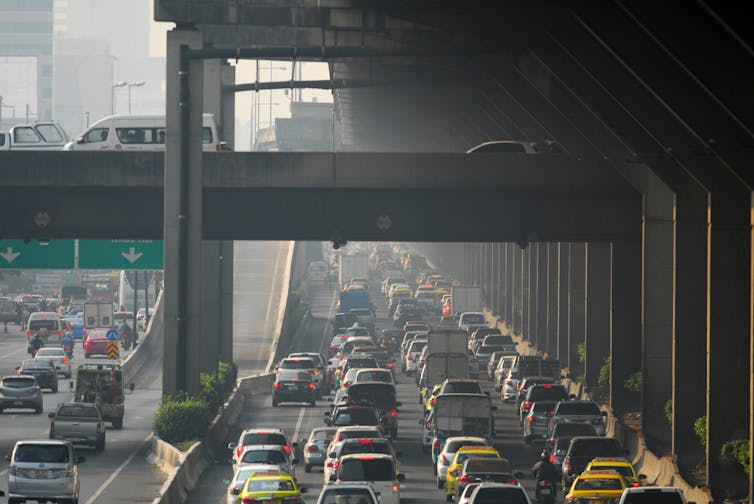
But the air outside is not always clean. Tiny particles from traffic and factories, and gases such as nitrogen dioxide, damage the heart, lungs and brain and are now recognised as major causes of illness and early death. In many cities, most of the fine particles inside homes and schools actually come from outside and seep in through gaps, vents and, of course, open windows.
Where you live shapes that trade-off. Homes close to busy main roads or motorways tend to have higher levels of traffic-related particles and nitrogen dioxide indoors, especially when windows facing the road are opened.
A study in inner-city schools found that the closer a school was to major roads, the higher the levels of traffic-related PM2.5 (microscopic air pollution particles small enough to be inhaled deep into the lungs), nitrogen dioxide and black carbon measured inside classrooms.
That means flinging open roadside windows at rush hour may bring in a surge of exhaust, tyre and brake dust just as traffic pollution peaks. For people with asthma, heart disease or chronic lung problems, that extra pollution can undo some of the health benefits of better ventilation.
The picture looks different in greener, quieter areas. When schools and homes are surrounded by more trees and green space and are further from main roads, indoor levels of traffic-related particles tend to be lower. Vegetation can help filter some particles from the air and break up plumes of pollution from nearby roads.
The right time to burp
Timing also matters. In many cities, outdoor pollution is highest during the morning and evening commute and lower late at night or in the middle of the day. Short bursts of house burping outside these peaks – or just after rain, which can temporarily wash some particles from the air – may offer a better balance between infection control and pollution exposure.
Poor indoor air does not stop at the lungs. Studies link higher levels of fine particles and carbon dioxide to poorer concentration, slower thinking and raised risks of anxiety and depression. A stuffy home quietly chips away at mood and mental sharpness for everyone inside.
How the burp is done makes a difference to comfort and energy bills. German-style Stoßlüften, where all windows are opened fully for a short time, rapidly exchanges air but does not cool walls and furniture as much as leaving a small window open all day. Cross-ventilation – opening windows on opposite sides of the home – usually shifts air faster.
Treating COPD (a chronic lung disease) from poor indoor air can cost thousands yearly in drugs and hospital stays – a lifelong burden once diagnosed. Opening windows for five minutes in winter loses just pennies in heat. Fresh air now beats massive medical bills later.
For most households, a practical middle ground is possible. House burping is more likely to be helpful when it is done in short bursts, away from busy traffic times, and on the sides of the home that face quieter streets or greener spaces.
So the social media trend has a point, even if the name raises a smile. A home that never burps is likely to have higher levels of indoor pollution and a greater build-up of exhaled air, especially during virus season. Give your home a mini spa break at the right time: throw open the windows, let it burp out the stale air, and invite a burst of fresh stuff in. Your lungs, brain and pets will thank you.
Vikram Niranjan does not work for, consult, own shares in or receive funding from any company or organisation that would benefit from this article, and has disclosed no relevant affiliations beyond their academic appointment.
The 2026 Winter Olympics have come at a turning point in sport in terms of how Olympians are allowed to monetise their performances. In December, the governing body the International Olympic Committee (IOC) announced that, for the first time, Olympians would have access to footage from their competitions to use for their personal branding and promotion.
In this pilot phase, the material will not be from these Milan Cortina Winter Olympics, but from the previous Games in Beijing in 2022. According to the new Olympian Highlights Programme, athletes who competed in China can have access to 60 seconds of their competition to use on their personal channels to celebrate their achievements during these Games.
But what does this mean, why does it matter, and why is it happening now?
While the permission might not sound like a big deal, the moving image of Olympic competition is the most valuable asset of the entire Olympic movement. It is highly protected due to the exclusive television rights agreements around the world, which have secured the economic fortunes of the Olympic industry for decades.
Today, the rights to the video content of the Games competitions is what makes money for the Olympic movement. The billions of pounds they generate contribute both to the Olympic programme, and also to schemes like Olympic Solidarity supporting federations and nations around the world. But this was not always the case.
In the early years of Olympic competition, broadcasters had free rein to cover the Games. This was seen as a great opportunity to share the Olympic message with the world. The sport then was treated more like news, whereas now it is predominantly entertainment, commercialised and exploited to grow the Olympic industry.
Tightly controlled media content remains the most effective way to monetise the Olympic programme. But this meant athletes could not use video material from their competitions, for fear that this could compromise the exclusivity agreed between the IOC and broadcasters.
Athletes’ frustrations
Similarly, Olympians have been severely restricted in what they can share from their Olympic experience, especially during Games time itself. The IOC Olympic Charter sets out these limitations to avoid things like ambush marketing (when a potential sponsor tries to use the Games period to promote their product in a way that undermines an official sponsor).
For Olympians with a personal sponsor, it means limiting the exposure of this affiliation during Games time, instead prioritising their official team partnership.
Loosening controls on competition videos is an important step to letting Olympians leverage their celebrity status at a time when they’re in the spotlight. Yet it also reflects a changing set of circumstances around media culture. For 20 years, there has been a steady transition of audience habits away from living room TVs towards mobile phones and social media.
This transition had caused the industry anxiety over whether it would hit viewing figures and reduce the value of rights deals. And so Olympic organisers have monitored web traffic and sent warnings to anyone infringing upon their intellectual property.
Torvill and Dean’s 1984 gold-medal winning performance was watched by around 24 million people in the UK alone. But Rowan Atkinson as Mr Bean at the London 2012 opening ceremony has had 142 million views on the Olympics YouTube channel.
Today, that mindset is different. There is a recognition that social media amplifies the opportunity to monetise Olympic assets. Video tracking technology can intervene directly when something is posted and limit exposure of unapproved content shares. Or it can simply monetise it with adverts. These capabilities are expanding – and becoming more complicated – with the rise of artificial intelligence (AI).
Provisions for social media sharing for athletes and others with accreditation have been evolving over recent Games. At the London 2012 Olympics, IOC social media guidelines did not allow any video from Olympic venues to be posted. In contrast, for Paris 2024, athletes were allowed to share video of their Olympic journey (but not their performance) with up to two minutes from each competition venue.
The guidance for Milan Cortina goes even further to encourage sharing. But it still prohibits athletes from posting this premium video content between one hour before competition and within one hour after, the crucial window for broadcasters.
Ultimately, giving permission to use video from the Games events is also about recognising the athletes’ own ability to attract audiences. On the days leading to Paris 2024, behind-the-scenes footage from athletes often became prominent social media posts, including viral footage of the athletes’ cardboard beds.
This showed candid moments from athletes before the TV coverage began. Audiences appeared to love this – and leaning into it is crucial for the Olympic movement in these changing times.
For decades, the IOC has shouted about how far the Olympic message travels during each Games, articulating this in terms of television hours watched across the world. Yet, television has changed too. After Rio 2016, there was a shift in the IOC’s language, moving from “television” to “live-streamed” hours, to reflect the new ways in which audiences are exposed to the Olympic Games.
The economic direction of international sport and the growing importance of non-traditional partnerships, such as those with Airbnb, Uber and Alibaba, show that the future of the Olympic Games is wedded to the technological culture of the time. While the technology of the 20th century was television, now sport is intimately connected to the rise of AI. Its integration within social media will be key to how users create and consume Olympic content.
In this way, 60 seconds of footage from a previous Olympic competition is not just a move towards empowering athletes. It is also a step towards safeguarding the future of the Olympic Games at a time of remarkable change in the media. The influencer economy is becoming the new unit of audience attraction and it’s crucial that the Olympic movement embraces this.
Andy Miah does not work for, consult, own shares in or receive funding from any company or organisation that would benefit from this article, and has disclosed no relevant affiliations beyond their academic appointment.
Source: The Conversation – UK – By Ivan Kourtchev, Associate Professor, Centre for Agroecology, Water and Resilience, Coventry University
Forever chemicals known as Pfas are often found in waterproof, stain-resistant or iron-easy clothing, including school uniforms. Pixel-Shot/Shutterstock
The UK government has published its first national plan to deal with per- and polyfluoroalkyl substances, better known as Pfas or “forever chemicals”. These chemicals have been used for decades in products such as firefighting foams, non-stick cookware, clothing, electronics and many industrial processes. Because many Pfas do not break down easily, they are now widely detected in the environment and in human blood and tissues.
The policy document, Pfas Plan: Building a Safer Future Together, follows growing public concern, media investigations and years of pressure from scientists calling for stronger controls. This marks an important moment for UK chemicals policy. The plan represents a step forward, but it avoids many of the hardest regulatory choices associated with Pfas.
In practical terms, this could include restricting Pfas-treated finishes from school uniforms and children’s clothing. In parts of the US, including California, state-level rules have already restricted or banned Pfas in textiles, effectively eliminating their use in everyday clothing, including school uniforms.
Unlike many pollutants, Pfas are not a single substance. There are several thousand Pfas in use or in circulation, each with different properties and behaviours. Some have been linked to health effects, such as liver toxicity, developmental problems and negative effects on the immune system. For many others, evidence remains sparse or uncertain.
Pfas are also highly mobile. They can be transported through air, deposited onto land or water, and then re-enter the atmosphere or food chain. Contamination measured in one location may originate from industrial activity, waste handling, consumer products or historic uses far away. This transboundary behaviour is well known in environmental science, but Pfas amplify the challenge because of their persistence.
In the UK, regulation has so far focused on a small number (fewer than a dozen) of well-studied Pfas, mainly through drinking water standards. This has left the wider group of Pfas, and their long-term accumulation in air and soil, largely outside the scope of formal regulation.
The new Pfas plan is intended to provide that framework. Rather than introducing sweeping new bans, it sets out how Pfas risks should be assessed and managed over time, with a strong emphasis on coordination across government, regulators, researchers and industry.
A central element of the plan is its focus on evidence. It recognises that Pfas pollution is not limited to water and soil, but also includes air emissions from manufacturing, industrial processes and waste treatment. Expanding monitoring across air, land and water is intended to improve understanding of sources, pathways and exposure, and to support more targeted controls in future.
The plan also commits to reviewing existing regulatory tools. This includes consultation on limits for Pfas in drinking water, closer scrutiny of industrial emissions and assessment of how current chemicals legislation could be applied more effectively to Pfas as a group. Research into the toxicity of Pfas in food and food packaging, plus more effective detection methods and safer alternatives forms part of this longer-term approach. Some Pfas uses such as medical devices are acknowledged as difficult to replace in the short term.
Until now, Pfas have traditionally been monitored and regulated through drinking water. Boris023/Shutterstock
A starting point
At the same time, the new plan leaves many hard decisions for later. It does not ban Pfas as a class, set timelines for phase-outs or define which uses should ultimately be considered essential. Much depends on future consultations and how quickly new evidence emerges.
This caution has attracted criticism, but it reflects a real constraint. New Pfas continue to enter the market, sometimes as replacements for substances that have already been restricted. Others occur as impurities or degradation products that are not routinely monitored. Regulating a group of chemicals that continues to evolve is inherently difficult, particularly when emissions are diffuse and exposure pathways complex.
In July 2025, the EU adopted a new Chemicals Industry Action Plan to support a transition away from Pfas through measures such as innovation, substitution, and improved data generation. In parallel, the European Chemicals Agency is assessing a proposed Pfas group restriction – its opinion is expected to be announced by the end of 2026 to inform a subsequent European Commission proposal to phase out Pfas.
The UK’s new plan acknowledges that historic Pfas contamination already exists and commits to developing guidance and technical tools to support its management. What remains unclear is how large-scale remediation would be prioritised or funded. Experience from heavily contaminated areas in Belgium, particularly around industrial hotspots near Antwerp, shows that cleaning up legacy Pfas pollution can take decades and involve very high costs.
Taken together, the UK’s Pfas plan is best seen as a starting point rather than a solution. It brings air, water and land into a single policy debate and recognises that Pfas pose a long-term challenge rather than a short-term compliance issue.
Whether it leads to meaningful reductions in exposure will depend on what follows: how quickly methods capable of addressing the many thousands of Pfas in commerce and the environment are developed and validated; how monitoring data is used; how rapidly regulatory reviews translate into enforceable standards; and whether future decisions prevent new Pfas problems from emerging.
For now, the plan does not solve the Pfas problem. But it makes clear that Pfas are no longer a peripheral issue, and that dealing with them will require sustained scientific effort and difficult policy choices over many years.
Don’t have time to read about climate change as much as you’d like?
Ivan Kourtchev does not work for, consult, own shares in or receive funding from any company or organisation that would benefit from this article, and has disclosed no relevant affiliations beyond their academic appointment.