Tariffs might seem manageable now – but they’ll quietly squeeze households later

Source: The Conversation – UK – By Umair Choksy, Senior Lecturer in Management, University of Stirling

BearFotos/Shutterstock

For more than a year, major institutions like the World Trade Organization (WTO) have been warning that rising tariffs and policy uncertainty would stifle global growth. This is reflected in the ways governments have been deploying tariffs unpredictably. Notably, the US has increasingly deployed threats and sudden tariff swings as tools in broader disputes.

Recent global trade updates from the likes of UN Trade & Development (UNCTAD) suggest this uncertainty is not fading. This reinforces the sense that trade volatility has become a lasting feature in the world economy rather than a temporary shock.

Contrast this unsettling picture with the strength of global trade and economic growth. One WTO report has noted that global trade volumes grew strongly in the first half of 2025, and projects that it will have been even stronger in late 2025. The IMF (International Monetary Fund) similarly notes that the global economy has shown “resilience” to trade shocks, even as the damage from shifting policies is starting to appear in more recent data.

While some interpret this as proof that the global economy can simply shrug off trade shocks, others have issued a warning. The global economy only appears resilient to tariffs; in reality, short-term offsets such as changing suppliers or altering supply chains have masked damage that will surface later through slower growth, higher costs and declining living standards. Over time, this damage will show up in everyday life – in what people pay, how secure their jobs feel, and how far their wages stretch.

My research on resilience in global supply chains has found that it is not something that businesses can achieve once and then forget about. What is happening now is not resilience, but temporary adjustments.

Imagine a supermarket that suddenly faces higher import costs on fruit because of tariffs or trade restrictions. At first, it does not redesign its entire supply network. Instead, it might buy from a different country for a few months or dip into existing stock in warehouses or distribution centres.

But if costs and availability remain in doubt, these temporary fixes stop working. Stock runs out. Emergency suppliers cost more. And when margins are squeezed for long enough, businesses respond by raising prices, freezing hiring, cutting hours, delaying pay rises or shedding jobs altogether. This is why resilience must be understood as a continuous process.

The same logic applies at national level. For countries like the UK, resilience to changing trade conditions means maintaining the ability to adjust repeatedly without exhausting households through ongoing cost-of-living pressures, income volatility and prolonged uncertainty about jobs and pay.

But when politicians interpret trade shocks as short-lived (as happened in the wake of Brexit), they tend to delay intervention. This could be holding back sector-specific support, postponing investment or relying on firms to absorb costs. This shifts the burden down the chain. Businesses protect their margins by passing costs on, and households become the shock-absorbers.

Tariffs and inequality

One lesson from my research is that some regions and communities are far more sensitive to tariffs and trade friction than others. This has the potential to deepen regional inequality, concentrating job losses and price pressures in already vulnerable areas.

For example, London and the south-east are less exposed to the direct impact of tariffs than many other parts of the country because their economies are dominated by services and finance.

Regions with more manufacturing and exports – such as the West Midlands, east of England, Northern Ireland and parts of northern England – rely more heavily on goods that face tariff barriers, such as cars and machinery. This means employment and business incomes can be more directly affected.

Addressing this imbalance requires more than a one-size-fits-all approach to trade policy. I have found that what matters is helping regions (and businesses in those regions) build resilience in ways that match the kind of disruption they face.

In practice, this depends on how often and how hard they are hit by tariffs. In places where trade costs rise repeatedly, businesses need support that helps them to keep operating without cutting jobs or squeezing pay every time costs increase. That means access to finance, help with managing cost pressures, and support that allows employers to retain workers when margins tighten.

In regions where tariff shocks are less frequent but still disruptive (as has happened to the US itself in its trade war with China), businesses need early signals about where pressures are emerging, and government support when costs spike. Without targeted backing, businesses pass costs on in the easiest way possible – through higher prices, delayed wage rises or job losses. When government treats resilience as a national average, it risks overlooking those places where adjusting is hardest and most costly.

Global trade uncertainty is going to continue. As such, policy needs to be designed for endurance rather than optimism. That involves shifting the focus away from short-term trade volumes and towards reducing the pressure of repeated tariff adjustments before they reach households. That means acting earlier in regions and sectors repeatedly exposed to disruption, rather than waiting for rising prices and job losses to hit households.

The Conversation

Umair Choksy does not work for, consult, own shares in or receive funding from any company or organisation that would benefit from this article, and has disclosed no relevant affiliations beyond their academic appointment.

ref. Tariffs might seem manageable now – but they’ll quietly squeeze households later – https://theconversation.com/tariffs-might-seem-manageable-now-but-theyll-quietly-squeeze-households-later-274594


Bolivia’s ‘capitalism for all’ project sparks backlash for selling-out on natural resources

Source: The Conversation – UK – By Enrique Castañón Ballivián, Lecturer in International Development, UCL

Bolivia’s political landscape has changed dramatically since August 2025, when a general election ended the Movement for Socialism (Mas) party’s rule after nearly two decades. Its presence in Congress has all but vanished, with rightwing parties now commanding an overwhelming majority.

The new president, Rodrigo Paz Pereira, campaigned with the rightwing populist slogan: fé, familia y patria (faith, family and homeland). He swept to victory in large part due to the widespread popularity of his running mate and now vice-president, Edmand Lara.

As the son of former Bolivian president Jaime Paz Zamora, who led Bolivia from 1989 to 1993, Paz Pereira represents a new generation of the country’s traditional political elite. But Lara, a former police captain who has become prominent on social media since 2023, comes from the popular classes.

The unlikely pair benefited from a strong desire among the Bolivian people for change amid a severe economic crisis marked by a shortage of US dollars and annual inflation of nearly 20%. They also took advantage of widespread distrust of reticence towards politicians from previous governments.

In his November inaugural address, Paz Pereira denounced that Mas had left what he called an estado tranca (obstructing state). He pledged to replace it with a smaller, technocratic state capable of attracting foreign investment. This model of state reform is part of his broader neoliberal project of “capitalism for all”, an ill-defined entrepreneurial vision that celebrates informality.

Paz Pereira’s government soon revealed the contours of its economic and political agenda in Decree 5503. The decree included over 100 articles covering numerous issues such as fuel subsidies, taxes, emergency powers, resource governance and fiscal and monetary policy.

The government presented the decree almost exclusively as a measure to end longstanding fossil fuel subsidies. These subsidies, which were introduced in 1997, had become largely unsustainable with the decline of Bolivia’s gas exports since 2017. The decree ended the subsidies, replacing them with modest increments to the minimum salary and state pensions.

Other, more problematic elements of the decree that overlooked established procedures and the stipulations of Bolivia’s constitution were soon exposed. These included measures to grant the government emergency powers without the required justification, as well as major changes to the nationwide tax regime without legislative approval.

The decree also introduced extraordinary powers for the central bank to acquire limitless external debt without mechanisms of democratic control. And it established a “fast track” mechanism for the approval of contracts for the extraction of strategic natural resources. Contracts would be awarded without legislative oversight or the required processes of environmental impact assessment and informed consent of Indigenous people.

Such a “fast track” mechanism openly revived what was known as the entreguista character of the Bolivian state, which had historically been prevalent under elite rule. This is a term used throughout Latin America to criticise governments or policies perceived as giving away a country’s national interests by, for example, surrendering control of natural resources.

Bolivia is home to the world’s largest known lithium deposit in the department of Potosí, estimated at 23 million tonnes. Lithium is a critical component in the batteries that power electric vehicles and smartphones, as well as in high-tech weapons systems. Bolivia is also well-endowed with other critical minerals such as tin, silver and antimony.

Nationalist movements have fiercely opposed entreguista policies in Bolivia before. These movements have inspired major political events, including a revolution in 1952 that overthrew the ruling oligarchy.

They also led to the so-called water and gas wars in 2000 and 2003. These were periods of social unrest arising over government plans to privatise the water supply in the central city of Cochabamba and export natural gas through Chile, respectively.

As noted in 2006 by Tom Perreault, a researcher at Syracuse University in New York, Bolivian people see tin or gas “not only as natural resources, but as national resources as well, that is, resources that properly belong to the nation and its people”.

This sentiment was captured recently by Bolivian researcher Gustavo Calle. In an article published on January 13, he said that by suggesting strategic resources will be exploited by foreign companies without meaningful control, Decree 5503 touched “the most sensitive vein of the popular nationalism”.

Repealing the decree

Two days after the government published the decree on December 17, Bolivia’s main workers’ organisation, the Bolivian Workers’ Centre, declared a general strike. It asked its members to mobilise, demanding the abrogation of the decree.

Then, on January 5, the largest Indigenous organisations joined the protests. They paralysed the country with more than 50 road blockades. And a march named “Bolivia is not for sale” later entered the capital city of La Paz, bringing together numerous sectors of society.

Paz Pereira portrayed the leaders of the mobilisation as reckless individuals defending their own privileges. He also pledged not to back down against “criminals”. But after nearly 28 days of protests, the government finally conceded and abrogated the decree on January 11.

The government’s image has taken a hit. However, unlike the government during the gas war, its legitimacy has not been challenged. That period of unrest ultimately resulted in the resignation of President Gonzalo Sánchez de Lozada.

Paz Pereira’s defeat is also only partial. The elimination of the fossil fuel subsidies has now been consolidated. And the government is currently preparing a new authoritarian law to sanction road blockages as criminal offences.

In a recent interview with the Financial Times, Paz Pereira also sought to portray the popular opposition to his entreguista policies as being carried out by a mere minority of former Mas leader Evo Morales’ followers.

In the absence of an alternative political project, the new government appears to be in a strong position to impose its agenda. Yet the strength and explosive potential of resource nationalist sentiments in the country should not be discounted.

The Conversation

Enrique Castañón Ballivián does not work for, consult, own shares in or receive funding from any company or organisation that would benefit from this article, and has disclosed no relevant affiliations beyond their academic appointment.

ref. Bolivia’s ‘capitalism for all’ project sparks backlash for selling-out on natural resources – https://theconversation.com/bolivias-capitalism-for-all-project-sparks-backlash-for-selling-out-on-natural-resources-275009

From bodybuilding to the local gym: how performance-enhancing drugs can damage the heart

Source: The Conversation – UK – By David Oxborough, Professor of Echocardiography and Cardiovascular Physiology, Liverpool John Moores University

Gym-goers who use IPEDs may not be aware of their heart harms. Andrii Iemelianenko/ Shutterstock

Image and performance-enhancing drugs (IPEDs), such as steroids and human growth hormone, can harm the heart – and it isn’t just elite bodybuilders who are at risk.

With a growing number of everyday gym-goers taking these drugs to improve their fitness or enhance their appearance, what was once a niche issue in competitive sports is quickly becoming a wider public health concern.

For decades, bodybuilders and athletes have used IPEDs including anabolic steroids, human growth hormone, peptides and selective androgen receptor modulators (SARMs), to increase muscle size, boost strength and improve physical appearance.

But in recent years, the number of regular gym-goers using IPEDs has become a growing concern. Estimates from 2014 suggested around 3% of regular gym-goers globally used IPEDs. These figures are now more than ten years old and probably underestimate current use.


Read more:
Peptides: performance-boosting, anti-ageing drugs or dangerous snake oil?


Although the demand to have an unrealistic, idealised body has existed for generations, social media has amplified these pressures. Social media has also made it easier to access IPEDs. These factors might help to explain why people who use apps such as TikTok and Instagram are more likely to use anabolic steroids.

But while social media may be normalising the use of IPEDs to achieve the perfect physique and peak fitness, it’s important gym-goers know about the serious costs these drugs can have on heart health.

Research from Italy shows that competitive male bodybuilders who use IPEDs have a ten-times higher risk of sudden cardiac death compared with athletes who don’t use performance-enhancing drugs.

Studies have shown that female athletes who use IPEDs also have a higher risk of sudden cardiac death compared to non-users – though their risk is slightly (7%) lower compared to men.

These deaths are linked to a range of heart conditions caused or worsened by IPED use. These include cardiomyopathy (disease of the heart muscle), myocardial fibrosis (scarring of the heart), abnormal thickening of the heart wall, early-onset coronary artery disease, heart rhythm disturbances and stroke.

Research shows anabolic steroids can alter cell signalling pathways involved in heart growth and remodelling, disrupt hormonal regulation and increase blood pressure. Steroids can also cause adverse changes in lipid (fat) levels that cause plaques (fatty deposits) to form in the arteries.

Together, these changes weaken the heart and make it less efficient at supplying the body with blood. Even in people who appear fit, this hidden damage can leave the heart more vulnerable to failure, rhythm problems and sudden cardiac events.

A fit man injects a small needle into his bicep.
It’s not just elite bodybuilders anymore who are putting their heart at risk.
George Rudy/ Shutterstock

These findings are deeply concerning – not just for elite bodybuilders, but for regular gym users who may be taking unregulated drugs with little awareness of the risks.

Heart changes

At Liverpool John Moores University, we have spent the past six years studying heart health in people who use IPEDs. Our research looked at around 100 users, most in their early 30s, ranging from elite bodybuilders to recreational gym users. These users were then compared against non-users.

We used electrocardiography (ECG), which records the heart’s electrical activity, and echocardiography, an ultrasound scan of the heart. These tools allowed us to assess all four chambers of the heart and detect early signs of heart problems that may not yet be causing symptoms.

We found that IPED users had a larger and heavier left ventricle (the main pumping chamber of the heart). This was due to having a bigger cavity and thicker heart muscle. Notably, these differences in heart shape and structure still existed, even after accounting for increased body size.

Importantly, these changes are linked to reduced heart function. Using advanced imaging techniques, we were then able to show subtle but significant impairments in how the left ventricle contracted and relaxed.

Our research has also identified increased stiffness of the left atrium (the chamber that receives blood from the lungs). This feature is often only seen in the early stages of heart disease.

Similar harmful effects are also seen on the right side of the heart, which plays a key role in pumping blood to the lungs – showing that IPED use affects all chambers of the heart.

Most of the participants in our studies had used a median weekly dose of 1108mg for around seven years – a dose consistent with the typical doses used by the bodybuilding community. The higher the dose and the longer these drugs are used are linked with more negative changes in the heart.

The next step of our research is to examine how a typical four to five month drug “cycle” – a period where users progressively increase the dose and number of substances they use to reach a peak in physique or dose – affects heart structure and function. We especially want to know how it affects the way the heart responds during exercise.

We also plan to look at female IPED users, a group that has largely been overlooked in previous research.


Read more:
More women are using steroids – and many don’t know the risks


Reducing risk starts with stopping IPED use – or avoiding them to begin with. While this is the most effective way to reduce risk, harm-reduction approaches such as reducing dose, avoiding black-market drugs, addressing psychological drivers of use, and regular heart screening may help limit damage and encourage safer choices.

However, we still know very little about whether heart damage improves after cessation, particularly after years of use. To address this, our research group plans to follow a group of users for the next ten to 20 years.

With more than one million IPED users in the UK, this is rapidly becoming a significant public health issue. Raising awareness of the harms of IPED use is critical.

The Conversation

The authors do not work for, consult, own shares in or receive funding from any company or organisation that would benefit from this article, and have disclosed no relevant affiliations beyond their academic appointment.

ref. From bodybuilding to the local gym: how performance-enhancing drugs can damage the heart – https://theconversation.com/from-bodybuilding-to-the-local-gym-how-performance-enhancing-drugs-can-damage-the-heart-273273

How diverse voices are transforming the UN’s climate science

Source: The Conversation – UK – By Hannah Cloke, Professor of Hydrology, University of Reading

Olena Illustrations/Shutterstock

An environmental expert from Nigeria, a climate policy consultant from Kenya, an oceanographer from Indonesia and an Indigenous social development specialist from the Philippines will are among dozens of experts in the UK this month as the UN’s top climate body meets to rewrite the the rules for compiling the world’s most important climate reports.

The workshops at the University of Reading from February 10 to 12 will lay the groundwork for bringing diverse knowledge into the next report by the UN climate science body, the Intergovernmental Panel on Climate Change (IPCC). The seventh assessment report, known as AR7, will be published in 2028 and finalised the following year.

There are two big themes under discussion. One workshop examines how artificial intelligence (AI) tools can help scientists review growing volumes of climate research. AI is revolutionising scientific research, with its ability to conduct faster analysis of complex data than traditional computer models. AI weather and climate models are already becoming integrated into the information provided through meteorological services such as the Met Office.

Another workshop explores how Indigenous and local knowledge can be integrated into these assessments alongside standard scientific findings. For decades, IPCC reports have been built primarily on peer-reviewed scientific papers from academic institutions, mostly in the world’s wealthier nations. These workshops explore how to better include Indigenous knowledge, local observations and expertise from communities that are experiencing climate change first hand.

This could not come at a more important time. A few weeks ago, the US withdrew its participation from the IPCC process. Now, a new cadre of experts from across the world are coming to the UK to make climate science more inclusive and AR7 preparation continues with 195 member countries. The work goes on, but the US absence leaves gaps in emissions reporting and funding.

graphic with colourful background, people of all races holding hands
Indigenous knowledge is being integrated into the UN’s climate reports.
melitas/Shutterstock

Credible, yet unconventional

Bringing in diverse voices is essential to the report’s success. If IPCC reports reflect only one way of understanding the world, they can miss crucial insights. As other sectors have found again and again, a lack of diversity in the workforce leads to a lack of insight. The environment sector remains one of the least diverse, with only 3.5% of people working in environmental jobs identifying as being from an ethnic minority. Diverse voices and critical discussions are key to making robust, inclusive and future-proof decisions.

Through my work developing flood forecasting systems across Africa, Asia and Latin America, I’ve learned this directly. After Cyclone Idai hit Mozambique in 2019, the Global Flood Awareness System, a service that provides openly accessible information about upcoming floods across the world, was used to help target relief where it was most needed.

In Uganda, working with the humanitarian agency Uganda Red Cross and the Red Cross Climate Centre, our forecasts helped 5,000 people evacuate before roads were cut. In Bangladesh’s river basins, improving forecasts meant understanding how communities interpret flood risk. In Kenya, choosing the right forecasting approach required learning from the people who have lived with these rivers for generations.

Climate science has traditionally valued certain types of expertise. Peer-reviewed papers and university credentials do matter. But expertise also comes from generations of farmers building up understanding of local weather patterns or Indigenous knowledge about the land, forests and rivers. Scientific models, combined with community knowledge, produce better outcomes than either alone.

For the result of its latest report to be credible, the IPCC needs the best evidence from all sources, because that is what produces the best science.

The Conversation

Hannah Cloke advises the Environment Agency, the European Centre for Medium-range Weather Forecasts, the Copernicus Emergency Management Service, local and national governments and humanitarian agencies on the forecasting and warning of natural hazards. She is a member of the UKRI Natural Environment Research Council and a fellow of the European Centre for Medium-range Weather Forecasts. Her research is funded by the UKRI Engineering & Physical Sciences Research Council, the UKRI Natural Environment Research Council, the Foreign, Commonwealth & Development Office and the European Commission.

ref. How diverse voices are transforming the UN’s climate science – https://theconversation.com/how-diverse-voices-are-transforming-the-uns-climate-science-275259

The brilliant and bizarre ways birds use their sense of smell – from natural cologne to pest control

Source: The Conversation – UK – By Joey Baxter, PhD Candidate in Biosciences, University of Sheffield

Blue tits sniff out herbs to line their nests with. taviphoto/Shutterstock

When we think about birds, we often picture their colourful plumage: the iridescence of a peacock’s tail or the electric blue flash of a kingfisher. Or we might consider how they use voices, from the song of the nightingale to the coo of a dove or the shriek of a jay.

So it’s easy to imagine that vision and hearing must be the senses these birds use to explore their environment and interact with each other. However, smell is also vital to birds for navigating, foraging and even communicating. Yet this sense is often underestimated or ignored entirely.

Some of the blame for this long-standing underestimation can be assigned to influential 19th century naturalists like John James Audobon, whose early experiments on turkey vultures led him to conclude that they could not smell and must use sight to locate their carcass suppers.

He presented vultures with paintings of dead sheep, which they pecked away at. But when he shrouded putrid carrion with plant material the vultures ignored it. However, later work revealed flaws in Audobon’s research – these birds prefer fresher meat and locate it using scent, even when it is visually obscured.

The turkey vulture’s keen sense of smell was put to use by oil company engineers in 1930s California. Workers were having trouble with leaks along a 42-mile-long natural gas pipeline but noticed that vultures would often congregate around these leaks. Natural gas alone is odourless, but a chemical called ethyl mercaptan is added so humans can detect its distinctive eggy smell at close range. Ethyl mercaptan is also released by decomposing meat, so vultures associate it with food. The engineers used this to their advantage, intentionally pumping through large doses of ethyl mercaptan and observing the vultures to pinpoint and repair leaks.

Image of small round bird with long tail perched on a twig.
Long-tailed tits are known for their family bonds.
SanderMeertinsPhotography/Shutterstock

More recently, research has explored the many ways that birds use their sense of smell in the wild. At the University of Sheffield, I am investigating whether long-tailed tits, a small UK garden bird, might use their sense of smell to recognise family members. Like we humans often help close family with childcare, long-tailed tits will feed chicks belonging to siblings, parents and children during the breeding season. How these little birds identify who is and isn’t a close relative is not entirely clear yet, but their scents may hold the key.

Starlings and blue tits, meanwhile, use scent to seek out aromatic plants such as yarrow, hogweed and elder, which they weave into their nests. The strong-smelling compounds in these plants defend their chicks against parasites, in the same way that we might use citronella to ward off mosquitoes.

Bird with big fluffy crest feeding chicks in tree.
Hoopoe chicks have a distinct pong.
Piotr Krzeslak/Shutterstock

Hoopoe chicks manufacture their own chemical defences. These are colourful birds with a long, curved bill and a distinctive orange crown of feathers. Young hoopoes produce a thick, dark, foul-smelling substance called preen oil from a gland just above their tail that contains bacteria. These beneficial bacteria break the preen oil down into pungent chemicals that keep germs at bay.

New Zealand’s national icon, the flightless kiwi, is mostly nocturnal and feeds on worms and insects found underground, so cannot rely on vision when foraging. Instead, kiwis have nostrils at the very tip of their long bills, which they probe the earth with to sniff out their subterranean prey.

Small fluffy bird with long beak,
Kiwi birds have nostrils at the end of their bills.
Mastak80/Shutterstock

Crested auklets are small, black seabirds that smell like tangerines. This odour is produced by special feathers and is involved in social communication. Both male and female auklets will rub their bills into the nape of another bird’s neck to get a good whiff, using this smell to assess their quality as a potential mate. So, it pays to produce a good strong dose of this natural cologne.

Petrels and shearwaters fly across hundreds of kilometres of open ocean in search of sustenance, using their sense of smell to detect dimethyl sulfide (DMS), a chemical produced by phytoplankton (microscopic plant-like organisms). The odour of this chemical, often compared to that of boiled cabbage, signals where in the sea is likely to be rich with food. Additionally, the varying intensity of this chemical allows them to create an olfactory map in their heads for navigating back to their nests on land.

Black birds with crest and orange beak perch on rock.
Can anyone else smell tangerine?
tryton2011/Shutterstock

Sadly, this impressive olfactory ability can land these birds in trouble. Ocean plastic causes blooms of phytoplankton, which pump DMS into the air in unusual quantities. Seabirds can be confused by these chemicals that are usually associated with food and will often consume the plastic, which can be fatal. Because of their reliance on scent for foraging, DMS-sensitive birds, which also include albatrosses, are nearly six times more likely than other species to ingest plastic.

Like birds, humans have been historically underappreciated when it comes to smell. An idea that – again – largely stems from the pontifications of 19th century scientists.

Humans, however, are sensitive to an enormous range of odours. One experiment showed that, when blindfolded, human participants could track the scent of chocolate across a field. We use our sense of smell all the time in our daily lives – sometimes without fully realising it – in avoiding danger (noticing the smell of smoke), selecting food (passing up off milk or picking a particularly ripe orange) or even choosing a partner. Research suggests people are often drawn to the odour of those with a very different set of immune genes to their own.

So, even for animals that don’t have a dominant sense of smell, odours form a key part of the way they interact with the world.

The Conversation

Joey Baxter receives funding from UK Research & Innovation (UKRI), via the Engineering and Physical Sciences Research Council (EPSRC).

ref. The brilliant and bizarre ways birds use their sense of smell – from natural cologne to pest control – https://theconversation.com/the-brilliant-and-bizarre-ways-birds-use-their-sense-of-smell-from-natural-cologne-to-pest-control-274571

CAN 2025 de football : pourquoi la CAF a sévi contre le Sénégal et le Maroc

Source: The Conversation – in French – By Professeur Abdoulaye Sakho, Professeur de droit, Université Cheikh Anta Diop de Dakar

La finale de la Coupe d’Afrique des nations (CAN) 2025 (21 décembre – 18 janvier) a basculé dans la la controverse dans les dernières minutes du match. Le penalty litigieux, le match interrompu, l’envahissement de la zone VAR (contrôle vidéo), l’usage de lasers dans les tribunes et les affrontements entre supporters sénégalais et policiers marocains ont marqué l’épilogue du tournoi. Quelques jours plus tard, les sanctions tombent sont tombées contre les fédérations du Sénégal et du Maroc.

Dans cet entretien, Abdoulaye Sakho, spécialiste en droit du sport, décrypte les infractions retenues, le fonctionnement indépendant du jury disciplinaire et pourquoi cette finale pourrait marquer un tournant dans la gouvernance du football africain.

Pourquoi les deux fédérations du Sénégal et du Maroc ont-elles été sanctionnées ?

Les deux fédérations ont été sanctionnées parce que le jury disciplinaire a estimé que chacune d’elles a été coupable d’infractions aux lois du jeu et au code disciplinaire en vigueur.

Le football, en tant qu’activité sportive, repose sur un ensemble de normes qui encadrent à la fois l’organisation des acteurs et leurs comportements sur et en dehors du terrain. Ces normes sont définies par des textes communs à toutes les organisations affiliées à la FIFA,

C’est en ce sens qu’il existe des textes de base qui sont communs à la totalité des organisations sportives qui relèvent de la FIFA. Parmi ces textes, je peux citer le code disciplinaire, le code éthique et le code électoral. Ces textes précisent non seulement les comportements attendus, mais aussi la nature des infractions, les sanctions applicables et le fonctionnement des instances chargées de trancher les litiges disciplinaires.

S’agissant des mesures prises contre les deux fédérations et les joueurs, elles relèvent de sanctions disciplinaires rendues par le jury compétent conformément au code de discipline.

Le comportement des acteurs du football lors d’une rencontre est également défini par les Lois du jeu de l’International Football Association Board (IFAB)
(l’organisme international chargé de définir et faire évoluer les règles du jeu), ainsi que par le code de discipline. Ces deux textes prévoient les infractions et les sanctions, ainsi que l’organisation et le fonctionnement des autorités responsables du règlement des litiges.

Concernant les infractions disciplinaires, comme toutes les autorités juridictionnelles de la Confédération africaine de football (CAF), le jury qui en traite est indépendant. Il est composé de personnalités indépendantes qui ne sont pas membres de la CAF.


Read more:
CAN 2025 de football : les réussites et les ratés de l’édition marocaine


Quelles sont les principales sanctions ?

Les deux fédérations ont été sanctionnées parce que le jury disciplinaire a estimé qu’elles étaient responsables d’infractions aux lois du jeu et au code disciplinaire en vigueur. La décision du jury disciplinaire comporte deux volets. Il y a d’abord des sanctions sportives à l’encontre des fédérations marocaine et sénégalaise, et de certains joueurs et officiels pour violations avérées du Code disciplinaire de la CAF. Ensuite, il y a le rejet de la réclamation introduite par la fédération royale marocaine de football (FRMF) qui plaidait un forfait technique du Sénégal. Autrement dit, selon la prétention marocaine devant le jury, fondée les articles 82 et 84 du règlement de la CAN le Sénégal devait perdre le match sur un score de trois à zéro (3-0).

Cette distinction est importante. Le rejet de la requête du Maroc constitue une qualification non retenue, distincte des faits qui ont servi de base aux sanctions retenues contre le Sénégal.

Pour le Sénégal, les sanctions reposent sur les infractions suivantes :

• comportement antisportif, violation des principes de fair-play et d’intégrité, et atteinte à l’image du football ;

• comportement antisportif envers l’arbitre ;

• comportement inapproprié de supporters ayant porté atteinte à l’image du football ;

• comportement antisportif des joueurs et de l’encadrement technique en violation des principes de fair-play, de loyauté et d’intégrité ;

• faute disciplinaire de l’équipe nationale, cinq joueurs ayant reçu des avertissements.

Ainsi, le sélectionneur Pape Bouna Thiaw a écopé d’une suspension de cinq matchs et d’une amende de 100 000 de dollars. Les joueurs Ilimane Ndiaye et Ismaïla Sarr sont suspendus deux matchs pour comportement antisportif envers l’arbitre. La FSF est en outre sanctionnée par trois amendes totalisant 615 000 USD pour le comportement de ses supporters, de ses joueurs, de l’encadrement technique et pour une faute disciplinaire collective liée aux avertissements reçus.

Du coté marocain, les sanctions reposent sur :

• des comportement antisportifs ;

• des comportements inappropriés des ramasseurs de balles du stade ;

• des comportement inappropriés des joueurs de l’équipe nationale et de l’encadrement technique, ayant envahi la zone d’examen de la VAR et entravé le travail de l’arbitre, en violation des articles 82 et 83 du Code disciplinaire de la CAF ;

• l’utilisation de lasers par ses supporters lors du match.

Par conséquent, Achraf Hakimi est suspendu deux matchs, dont un avec sursis, et Ismaël Saibari trois matchs, assortis d’une amende de 100 000 USD pour ce dernier. La FRMF est condamnée à 315 000 de dollars d’amendes pour le comportement des ramasseurs de balles, l’intrusion de joueurs et de membres du staff dans la zone VAR, et l’usage de lasers par des supporters.


Read more:
CAN 2025 de football : quand l’image du sport influence le business et l’économie


Ces sanctions sont-elles en cohérence avec les décisions habituelles de la CAF et auront-elles des effets concrets ?

En matière disciplinaire, chaque situation présente des spécificités qui rendent délicate toute comparaison avec des décisions antérieures. Il faut aussi rappeler qu’il ne s’agit pas d’une décision de la CAF en tant que telle, mais de l’exercice du pouvoir juridictionnel souverain d’un jury indépendant et de la sensibilité de celui-ci aux objectifs généralement attendus des sanctions juridiques. En droit, des sanctions jouent une triple fonction : punition des coupables, réparation des dommages causés aux victimes et dissuasion pour toute autre personne qui serait tentée de refaire la même infraction.

À cette étape de la procédure, il n’est pas aisé de se prononcer d’un point de vue scientifique. À mon avis, il appartient aux concernés, en fonction de leur perception de la réglementation, d’apprécier si ces sanctions sont ou non en phase avec ce que fait d’habitude le jury, si ces sanctions sont ou non « justes » à leurs yeux.

Par ailleurs, le dispositif disciplinaire prévoit le double degré de juridiction. Les parties sont donc libres de voir ou non si elles doivent aller en appel vers la commission de recours, une commission elle aussi indépendante, composée de personnalités indépendantes. La procédure peut même être poursuivie jusqu’au Tribunal arbitral du sport (TAS). D’ailleurs la fédération marocaine a déjà fait appel.

Quelles conséquences ces sanctions pourraient-elles avoir sur l’avenir des compétitions africaines ?

Il s’agit de sanctions que certains ont considérées comme sévères pendant que d’autres ont dit qu’il s’agit de compromis politique. Au-delà des sanctions, c’est le déroulement de cette CAN, le film de la finale et de son dénouement qui pourraient avoir des répercussions sur le futur du football africain et sur la gouvernance de la CAF. La CAN a révélé une absence de lisibilité de l’information où les récits diffusés sur les réseaux sociaux ont pris le pas sur ceux des journalistes.

Qu’on le veuille ou non quelque chose s’est produit en mondovision relativement à la gestion des matchs de football en Afrique.

Des réformes semblent attendues. Le président de la CAF, Patrice Motsepe, a annoncé plusieurs réformes visant à renforcer le cadre réglementaire et institutionnel de l’organisation.

Il a évoqué notamment une révision du code disciplinaire pour “garantir que les organes judiciaires de la CAF disposent de pouvoirs suffisants pour infliger des sanctions appropriées et dissuasives”. Il a aussi réitéré son engagement à veiller à ce que “les opérateurs VAR et les commissaires de match soient perçus, respectés et reconnus comme impartiaux, équitables et de niveau mondial.”

En tous les cas, une fois le chapitre débat autour des sanctions et
des recours clôturés, le football africain devrait ouvrir, de manière concertée et inclusive, le débat sur les réformes nécessaires pour préserver l’esprit sportif du jeu que l’Afrique conçoit de plus en plus comme une activité économique porteuse de croissance et de développement.

The Conversation

Professeur Abdoulaye Sakho does not work for, consult, own shares in or receive funding from any company or organisation that would benefit from this article, and has disclosed no relevant affiliations beyond their academic appointment.

ref. CAN 2025 de football : pourquoi la CAF a sévi contre le Sénégal et le Maroc – https://theconversation.com/can-2025-de-football-pourquoi-la-caf-a-sevi-contre-le-senegal-et-le-maroc-274823

Sport et luxe : les enjeux de l’élan olympique de Milano-Cortina

Source: The Conversation – in French – By Isabelle Chaboud, Professeur senior d’analyse financière, d’audit et de risk management – Directrice de Programme pour le MSc Fashion Design & Luxury Management- Responsable de la spécialisation MBA "Brand & Luxury Management", GEM

Plusieurs marques de luxe sont associées aux Jeux olympiques d’hiver qui débutent vendredi 6 février. Quels sont les enjeux pour ces marques ? Plus généralement, que traduit le lien croissant entre le monde du sport et celui du luxe ?


À l’aube des Jeux olympiques d’hiver de Milano-Cortina 2026, le marché du luxe, en pleine recomposition post-pandémique, cherche un second souffle. Confrontées à la pression des droits de douane américains, à la montée en puissance des marques chinoises locales et à la faiblesse persistante du dollar et du renminbi face à l’euro, les maisons européennes misent sur les sommets enneigés pour renouer avec l’éclat. Au travers de trois exemples du Vieux Continent (Moncler, Loro Piana et Omega), nous analyserons comment ces maisons se sont emparées de l’opportunité clé que constituent ces jeux pour réaffirmer leur positionnement, capitaliser sur leur héritage et attirer de nouvelles communautés. Comment transforment-elles l’engagement client passant d’une logique de possession à une expérience émotionnelle ?

L’héritage comme actif stratégique : le cas Moncler

Le 31 janvier 2026, Moncler a marqué les esprits avec un défilé spectaculaire à Aspen, dévoilant sa collection Moncler Grenoble automne/hiver 2026. La maison, désormais sponsor officiel du Comité olympique brésilien et partenaire technique de la fédération brésilienne des Sports de neige, s’apprête à habiller les athlètes de ce pays lors des cérémonies d’ouverture et de clôture. Ce retour aux Jeux d’hiver, près de soixante ans après ceux de Grenoble, est une plongée dans l’histoire même de la marque.


À lire aussi :
JO Milan-Cortina 2026 et Alpes 2030 : qui sont les « éléphants blancs » ?


Née à Monestier-de-Clermont, près de Grenoble, l’entreprise Moncler (d’où l’origine du nom Mon-Cler) s’est forgée une réputation grâce à l’excellence technique de ses produits. Après avoir équipé les vainqueurs du K2 en 1954, elle a connu son heure de gloire en 1968, lorsque Jean-Claude Killy, vêtu de ses doudounes, a remporté trois médailles d’or dans la capitale des Alpes. Tombée dans l’oubli, la marque renaît en 2003 sous l’impulsion de Remo Ruffini, qui en fait un symbole du sportswear urbain chic, incarné par la devise « Né dans les montagnes, vivant en ville » (Born in the mountains, lives in the city). Aujourd’hui, Moncler mise sur des ambassadeurs comme Lucas Pinheiro Braathen (skieur brésilien-norvégien) pour incarner cette dualité entre performance et style, tout en célébrant son héritage pour renforcer son authenticité auprès d’une clientèle exigeante.

Moncler s’inscrit dans une démarche de réancrage historique conciliant héritage technique et désirabilité urbaine. Néanmoins certains voient dans cette participation aux jeux un risque d’opportunisme événementiel et de « greenwashing ». En effet, ces jeux sont accusés de contribuer à la fonte de glaciers tout comme le défilé d’Aspen qui avait nécessité l’utilisation massive de canons à neige. Sans parler de son empreinte carbone liée au déplacement d’équipes, de célébrités et d’influenceurs du monde entier. Enfin malgré les reconnaissances obtenues en matière de développement durable, Moncler reste critiqué avec ses doudounes pour son utilisation de duvet d’oie (même si l’entreprise exige de ses fournisseurs les plus hauts standards de qualité et de bien-être animal).

Raffinement et performance : Loro Piana et l’art de la discretion luxe

A Cortina, Loro Piana a inauguré une boutique conçue comme un chalet, un écrin de sérénité à l’esthétique épurée et aux couleurs naturelles qui se fondent avec le nouveau Pantone 2026 11-4201Cloud Dancer, un blanc gris qui semble avoir été créé pour cet environnement entre neige, montagne et nuages. Elle y présente une collection capsule ski dans laquelle on retrouve tous les codes de la maison (couleurs, élégance intemporelle, cachemire, matières exceptionnelles) et propose également des pièces en textile technique, notamment le tissu Techno Bistretch 3L Storm qui stimule la microcirculation et régule la température corporelle grâce à la caféine contenue dans les couches intérieures. Loro Piana mise sur une expérience sensorielle et une communication subtile destinée à séduire une clientèle aisée représentée à « 90 % à 95 % de clients affluents », à savoir des clients disposant de plus de 250 000€ de patrimoine financier comme l’avait précisé Bernard Arnault lors de l’assemblée générale du 17 avril 2025.

Loro Piana crée du désir sans tomber dans l’excès, la discrétion devient un marqueur de luxe absolu. La maison italienne très dépendante de l’approvisionnement en fibres rares (cachemire « baby cachemire », vigogne) devra toutefois veiller à limiter sa croissance afin de toujours garantir une qualité exceptionnelle sans nuire à la survie des espèces animales. Pour cela, la maison d’origine piémontaise doit assurer la traçabilité de ses matières premières et surtout pouvoir préserver la rareté pour conserver sa clientèle fidèle et fortunée.

Précision et exclusivité : Omega, l’art de la mesure et de l’expérience

Léonard de Vinci disait « Les détails font la perfection et la perfection n’est pas un détail. » L’artisan comme l’athlète répète le geste jusqu’à atteindre la perfection. Sans précision, pas de performance ni d’excellence. Tout doit être calibré, millimétré. Omega, chronométreur officiel des Jeux olympiques depuis 1932, incarne cette philosophie. Pour Milano-Cortina, la marque suisse dévoile deux éditions limitées à destination des collectionneurs : la Seamaster 37 mm Milano Cortina 2026 et la Speedmaster 38 Milano Cortina 2026, où la typologie des jeux orne le cadran. Des modèles signature qui suscitent la désirabilité autant par le produit (design, cadran, finition, précision) que par l’émotion qu’elle génère (rareté, caractère historique, esprit des jeux et valeurs de l’olympisme).


De la possession à l’émotion

Mais Omega va plus loin et s’aventure dans l’hospitalité en ouvrant sa première Omega House à Milan au cœur même de la célèbre Galleria Vittorio Emanuele II dans le restaurant Cracco. Avec l’« Omega Café by Cracco », elle offre à ses membres et ambassadeurs l’opportunité de célébrer ensemble les valeurs olympiques. En choisissant ce lieu symbolique dont le chef est également ambassadeur Omega, la maison associe une expérience culinaire à l’identité de marque. Une très belle initiative réservée à un club d’invités triés sur le volet, une communauté de clients épicuriens et amoureux de belles expériences. Une initiative éphémère, aussi exclusive qu’inoubliable. De cette façon, Omega réussit à transformer un partenariat sportif en une plate-forme d’engagement communautaire tout en préservant l’exclusivité.

LVMH 2026.

Reste à savoir si le développement des nouveaux modèles et les investissements marketing permettront de toucher d’autres segments de clientèle. Et enfin, s’ils procureront le retour sur investissement espéré surtout dans un secteur horloger très concurrentiel avec notamment Rolex (perçu comme plus prestigieux) et des marques plus accessibles (Tudor, Grand Seiko), ou encore les smartwatches (Apple Watch) qui captent une partie du marché.

De l’utilitaire à l’hédonique : le luxe, miroir de nos aspirations

Les Jeux olympiques et plus largement le sport à (très) haut niveau offrent aux marques une tribune unique pour transcender la simple fonctionnalité. Les produits, tout en répondant à des exigences techniques, doivent aussi satisfaire une quête de sens et de plaisir – ce que les chercheurs appellent la « valeur hédonique ». Le luxe contemporain ne se contente plus de posséder : il se vit, s’éprouve, se partage.

Milano-Cortina 2026 s’annonce comme un laboratoire d’innovation pour le luxe européen. Des équipements techniques aux collections capsules, en passant par les montres d’exception et les expériences culinaires, les maisons affûtent leurs stratégies pour attirer et fidéliser les communautés prêtes à investir dans leurs passions. L’enjeu ? Aligner héritage et modernité, allier possession et émotion, et surtout, créer de l’émerveillement – non plus seulement par le produit, mais par l’expérience elle-même. 2026 sera-t-elle l’année où le luxe renoue avec l’authenticité, l’émotion et le frisson partagé ?

The Conversation

Isabelle Chaboud ne travaille pas, ne conseille pas, ne possède pas de parts, ne reçoit pas de fonds d’une organisation qui pourrait tirer profit de cet article, et n’a déclaré aucune autre affiliation que son organisme de recherche.

ref. Sport et luxe : les enjeux de l’élan olympique de Milano-Cortina – https://theconversation.com/sport-et-luxe-les-enjeux-de-lelan-olympique-de-milano-cortina-275241

Farcical peace talks in Abu Dhabi resolve nothing as Ukraine shivers under Russia’s winter onslaught

Source: The Conversation – UK – By Stefan Wolff, Professor of International Security, University of Birmingham

Russia, Ukraine and the US met for a second time this week for trilateral talks to discuss a possible cessation of hostilities. Once again little was resolved apart from a prisoner swap, something that has happened several times over the four years of the full-scale conflict between the two countries.

The lack of any substantive breakthrough was fairly predictable, given the circumstances. This week’s meeting got off to the same depressing start as the first one had the week before. On February 3, the night before the three sides gathered in Abu Dhabi, a massive barrage of 521 drones and cruise missiles once again targeted critical civilian infrastructure in Ukrainian cities, including the capital, Kyiv.

And while the talks were in full swing, Russia followed up on its nighttime strikes by deploying cluster munitions against a market in Druzhkivka, one of the embattled cities in what remains of Ukraine’s fortress belt in the Donetsk region.

Not the most auspicious start to talks that aim to stop fighting between the two sides. Add to that the fact that the basic negotiating positions of Moscow and Kyiv remain as far apart as ever, and any prospect of an imminent breakthrough to peace in Ukraine quickly evaporates.

The more technical discussions on military issues, including specifics of a ceasefire and how it would be monitored, appear to be generally more constructive. Apart from a prisoner exchange, no further agreement was reached. But even such small confidence-building steps are useful. And even where no agreement is feasible for now, identifying likely issues and mapping solutions that are potentially acceptable to Moscow and Kyiv is important preparatory work for a future settlement.

However, without a breakthrough on political issues it does not get the conflict parties closer to a peace deal. These political issues remain centred on the question of territory. Russia insists on the so-called “Anchorage formula”. Ukraine withdraws from those areas of Donetsk it still controls and Russia agrees to freezing the frontlines elsewhere.

Kyiv has repeatedly made clear that this is unacceptable. US mediation efforts, to date, have been unable to break this deadlock.

The political impasse, however, clearly extends beyond territory. Without naming any specific blockages to a deal, Yury Ushakov, a key advisor to the Russian president, Vladimir Putin, recently noted that there were other contested issues holding up agreement. Very likely among them are the security guarantees that Ukraine has been demanding to make sure that Russia will not renege on a settlement.

These future security guarantees appear to have been agreed between Kyiv and its European and American partners. They involve a gradual escalating response to Russian ceasefire violations, ultimately involving direct European and US military involvement.

Potholes in the road to peace

The Kremlin’s opposition to such an arrangement is hardly surprising. But it casts further doubt on how sincere Putin is about a durable peace agreement with Ukraine. In turn, it explains Kyiv’s reluctance to make any concessions, let alone those on the current scale of Russian demands.

What complicates these discussions further is the fact that the US is linking the provision of security guarantees for Kyiv to Ukrainian concessions on territory along the lines of the Moscow-endorsed Anchorage formula.

This might seem a sensible and fair compromise, but there are some obvious problems with it. First, it relies on the dependability of the US as an ultimate security backstop. But (particularly European) confidence in how dependable US pledges actually are has been severely eroded during the first 12 months of Donald Trump’s second term in the White House.

Second, Europe is moving painfully slowly to fill the void left by the US decision to halt funding to Ukraine. The details of a €90 billion (£78 billion) loan agreed in principle by EU leaders in December, have only just been finalised.

Doubts – as voiced by Nato secretary-general, Mark Rutte – also persist about whether, even in the long term, Europe has a credible prospect of developing sufficiently independent military capabilities outside the transatlantic alliance.

Few incentives to reach a deal

As a result, there are few incentives for Kyiv to bow to US pressure and give up more territory to Russia in exchange for security guarantees that may not be as ironclad in reality as they appear on paper. Likewise, it makes little sense for Moscow to accept even a hypothetical western security guarantee in exchange for territory that the Kremlin remains confident it can take by force if necessary.

Map of east Ukraine showing the battlelines.
Contested territory: Russia wants Ukraine to give up the remainder of the Donetsk region it currently occupies.
Institute for the Study of War, FAL

Following Xi Jinping’s public affirmation of Chinese support for Russia in a video call between the two countries’ presidents on the anniversary of the declaration of their “no-limits partnership” in February 2022, Putin is unlikely to feel any real pressure to change his position.

Putin will feel further reassured in his position by the fact that there is still no progress on a new sanctions bill in the US senate – four weeks after Trump allegedly “greenlit” the legislation. In addition, Trump’s top Ukraine negotiators – Steve Witkoff and Jared Kushner – are now also engaged in negotiations with Iran. This further diminishes US diplomatic capacity and is only going to reinforce Moscow’s intransigence.

Any claims of progress in the negotiations in Abu Dhabi are therefore at best over-optimistic and at worst self-deluding. And if such claims come from Putin’s envoy Kirill Dmitriev, they once more underscore that US mediation between Russia and Ukraine serves the primary purpose of restoring economic relations between Moscow and Washington. Like Kushner and Witkoff, Dmitriev is first and foremost a businessman.

Not only does this parallel track of Russia-US economic talks explain Trump’s reluctance to put any meaningful pressure on Putin, it also betrays the deep irony of the US approach to ending the war. As Europe painfully learned over more than two decades of engagement with Putin’s Russia, economic integration does not curb the Kremlin’s expansionism but enables it.

The Conversation

Stefan Wolff is a past recipient of grant funding from the Natural Environment Research Council of the UK, the United States Institute of Peace, the Economic and Social Research Council of the UK, the British Academy, the NATO Science for Peace Programme, the EU Framework Programmes 6 and 7 and Horizon 2020, as well as the EU’s Jean Monnet Programme. He is a Trustee and Honorary Treasurer of the Political Studies Association of the UK and a Senior Research Fellow at the Foreign Policy Centre in London.

ref. Farcical peace talks in Abu Dhabi resolve nothing as Ukraine shivers under Russia’s winter onslaught – https://theconversation.com/farcical-peace-talks-in-abu-dhabi-resolve-nothing-as-ukraine-shivers-under-russias-winter-onslaught-275138

Dans l’espace, le vieillissement du cœur des astronautes s’accélère

Source: The Conversation – France in French (3) – By Cyril Tordeur, PhD Candidate in Biomedical Sciences and Pharmacy (Space Cardiovascular Physiology), Université Libre de Bruxelles (ULB)

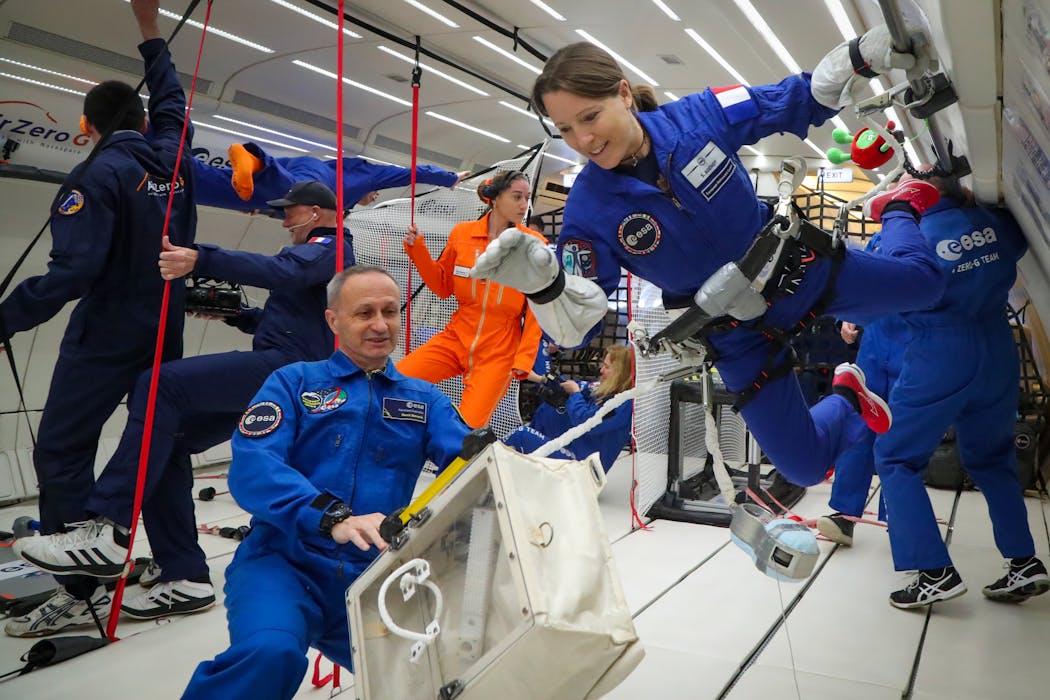
L’astronaute française Sophie Adenot s’entraîne lors d’un vol parabolique destiné à simuler l’état d’impesanteur. Les travaux révèlent que ce dernier entraîne l’atrophie rapide de petits muscles importants pour l’étanchéité des valves cardiaques. ESA – A. Conigli

De nouveaux travaux révèlent que, dans l’espace, certains muscles du cœur sont mis à rude épreuve par l’impesanteur. En quelques mois, cette dernière provoque leur atrophie. Les conséquences de ce processus, qui prend des décennies sur Terre, sur la santé des astronautes restent à évaluer. Point positif : ces résultats pourraient faire avancer notre compréhension de certains mécanismes à l’origine de l’insuffisance de la valve mitrale.


Considérons, d’un côté, un patient de 80 ans, essoufflé au moindre effort, dont le cœur affaibli laisse refluer le sang vers les poumons et, de l’autre, un astronaute âgé de 35 à 45 ans, entraîné, qui revient de six mois à bord de l’ISS, la Station spatiale internationale, et qui semble en parfaite santé. Que peuvent bien avoir en commun ces deux individus ? Plus qu’on ne le pense.

Pour la première fois, nos travaux ont mis en évidence l’existence chez l’humain d’un phénomène jusqu’alors observé uniquement chez l’animal : dans l’espace, certains petits muscles logés au sein des cavités cardiaques s’atrophient, malgré le sport que les astronautes pratiquent tous les jours.

En réalité, la mission de l’astronaute a donc imprimé sa marque sur son cœur. Derrière son apparente forme physique se cachent des modifications cardiaques subtiles qui miment, en accéléré, ce que le vieillissement a provoqué beaucoup plus lentement chez le patient terrestre. La coupable est l’impesanteur, cet état où la pesanteur du corps ne se fait plus ressentir, qui fait flotter ceux qui s’aventurent dans l’espace. Une situation qui pourrait compliquer les futurs voyages interplanétaires.

Le cœur de l’astronaute face à l’impesanteur

Sélectionnés parmi des milliers de candidats et candidates, les astronautes sont des professionnels soumis à des entraînements rigoureux, et suivis médicalement de manière continue. Pourtant, dès qu’ils quittent la Terre, leur système cardiovasculaire entre dans un processus de « déconditionnement ». Autrement dit, sa physiologie et ses caractéristiques physiques se modifient, parce qu’il n’a tout simplement plus besoin de travailler aussi dur.

En effet, en condition d’impesanteur, le cœur n’a plus la nécessité de lutter aussi difficilement pour propulser le sang vers le cerveau. Les fluides corporels se redistribuent vers la tête, le volume sanguin diminue, et le muscle cardiaque, moins sollicité, s’adapte.

Les scientifiques, qui étudient ces phénomènes depuis les premières missions spatiales, ont découvert que cette adaptation n’est pas sans conséquence. Des études antérieures avaient par exemple montré que le cœur pouvait perdre de la masse musculaire après quelques semaines en orbite, et que sa forme devenait plus sphérique.

Il y a plus de trente ans, une étude menée sur des rats avait aussi mis en évidence une diminution de la taille de petits muscles cardiaques très particuliers, les muscles papillaires.

Les muscles papillaires, essentiels, mais peu étudiés

La mission principale du cœur est de faire circuler le sang à travers les poumons et le corps. Pour cela, il est composé de quatre cavités se contractant à un rythme régulier. Des valves jouent le rôle de clapet antiretour et empêchent le sang de circuler dans le mauvais sens.

Pour accomplir leur fonction, elles reçoivent l’aide de petites structures musculaires, qui représentent moins de 10 % de la masse totale du cœur : les muscles papillaires. Ces derniers évitent que, lorsque le cœur se contracte, les valves ne se retournent comme un parapluie par grand vent. C’est d’ailleurs précisément ce qui se passe en cas d’insuffisance mitrale, une pathologie qui touche des millions de personnes – principalement âgées – dans le monde.

Gif animé du cycle cardiaque du ventricule gauche ; le rythme cardiaque a été ralenti, afin d’avoir le temps d’apprécier la mécanique existant entre le muscle papillaire (indiqué par une flèche jaune) et la valve mitrale (flèche bleue).
Cycle cardiaque du ventricule gauche ; le rythme cardiaque a été ralenti, afin d’avoir le temps d’apprécier la mécanique existant entre le muscle papillaire (indiqué par une flèche jaune) et la valve mitrale (flèche bleue).
Université Libre de Bruxelles, Fourni par l’auteur

En 1992, une étude menée sur des rats avait mis en évidence une diminution de la taille de ces muscles papillaires, après seulement deux semaines dans l’espace. Néanmoins, aucune étude de ce genre n’avait été menée chez l’humain, au cours de vols spatiaux de longue durée.

Pour combler cette lacune, nous avons utilisé l’imagerie par résonance magnétique (IRM) afin de mesurer précisément la masse de ces petits muscles chez des astronautes assignés à des missions spatiales de longue durée (de six à douze mois) à bord de l’ISS. Les mesures avaient lieu dans une période de quarante-cinq à soixante jours avant le décollage et environ une semaine après leur retour sur Terre.

Un risque de perte d’étanchéité de la valve mitrale

Nos résultats ont mis en évidence une réduction moyenne de 14 % de la masse des muscles papillaires après le vol spatial. Cette atrophie sélective, combinée à la sphéricité accrue du cœur observée en impesanteur ainsi qu’à une augmentation de 6 % du diamètre de la valve mitrale (située entre l’oreillette gauche et le ventricule gauche), crée des conditions anatomiques qui pourraient théoriquement favoriser un manque d’étanchéité de ladite valve.

Dans un tel cas de figure, le sang n’est plus expulsé correctement : au lieu de se diriger en direction de l’aorte, une partie reflue vers l’oreillette gauche, dans le sens contraire de la circulation normale. On parle de « régurgitation mitrale ».

En aigu, cette fuite de sang vers l’oreillette gauche et vers les poumons peut provoquer une détresse respiratoire. À long terme, le cœur, contraint de compenser cette insuffisance progressive, se remodèle petit à petit, jusqu’à ne plus être en mesure de maintenir une fonction suffisante : c’est l’insuffisance cardiaque.

Jusqu’à présent, aucune fuite de ce genre n’a été observée dans le cœur des astronautes, principalement parce que cet aspect n’a pas encore été étudié en détail. D’autres travaux devront être menés pour évaluer les potentielles implications cliniques de ce constat en situation spatiale.

Cette nouvelle étude soulève autant de questions qu’elle apporte de réponses. Nous ne savons pas encore si l’atrophie des muscles papillaires est réversible après le retour sur Terre, ni si elle s’aggrave lors de missions plus longues. Nous ignorons également si elle affecte réellement la fonction de la valve mitrale à long terme.

Des protocoles d’imagerie plus spécifiques, consacrés à l’évaluation valvulaire, et des suivis à long terme seront nécessaires pour répondre à ces interrogations, car les régurgitations mitrales peuvent rester asymptomatiques pendant des années avant que des dommages irréversibles ne surviennent.

L’espace, une « machine à voyager dans le temps » physiologique

Cette découverte prend tout son sens quand on la replace dans le contexte du vieillissement terrestre. Sur Terre, l’inactivité physique prolongée et le vieillissement physiologique sont associés à un risque accru d’insuffisance mitrale. Ce processus se déroule sur des années, voire des décennies. En orbite, l’impesanteur compresse ce temps : en six mois, des modifications anatomiques similaires apparaissent.

C’est ce qui fait de l’espace une « machine à voyager dans le temps » physiologique. Les astronautes ne vieillissent pas réellement plus vite, mais leur corps subit des contraintes qui reproduisent certains effets du vieillissement de manière accélérée et réversible. Cette particularité offre aux chercheurs une fenêtre unique pour observer et comprendre des mécanismes qui, sur Terre, se perdent dans la lenteur du temps biologique.

Le parallèle entre espace et vieillissement terrestre s’étend bien au-delà du cœur. Le système musculosquelettique subit lui aussi un déconditionnement rapide en impesanteur : les astronautes peuvent perdre jusqu’à 1 à 2 % de leur masse osseuse par mois dans certaines régions du squelette, un rythme dix fois supérieur à celui de l’ostéoporose terrestre. Leurs muscles des jambes s’atrophient rapidement, faute de devoir supporter le poids du corps.

Les yeux ne sont pas non plus en reste. En impesanteur, les fluides corporels se redistribuent vers la tête, ce qui augmente la pression au sein du crâne et provoque des modifications structurelles du nerf optique et du globe oculaire, un syndrome désormais bien documenté sous le nom de Spaceflight Associated Neuro-Ocular Syndrome (SANS) ou syndrome neuro-oculaire associé aux vols spatiaux).

Par ailleurs, une autre étude a montré que six mois de vol spatial induisent une résistance à l’insuline associée à une rigidification des artères menant le sang vers le cerveau. Un processus qui, sur Terre, se déroule sur des années.

Pour lutter contre ce déconditionnement généralisé dans l’espace, la solution mise en œuvre sur l’ISS est intensive : les astronautes suivent un protocole strict d’environ deux heures et demie d’exercice quotidien, combinant vélo, tapis de course et renforcement musculaire.

Cependant, si ce protocole permet de limiter considérablement la perte de masse musculaire, ainsi que la masse cardiaque totale, il n’empêche malheureusement pas l’atrophie des muscles papillaires. Cette vulnérabilité spécifique pourrait s’expliquer par leur anatomie unique et leur sous-stimulation en contexte spatial.

De l’orbite au lit d’hôpital : un double bénéfice

Ces observations ont une double portée. Pour les agences spatiales, elles soulignent la nécessité de surveiller la fonction valvulaire des astronautes, particulièrement dans la perspective de missions de longue durée vers la Lune ou vers Mars. Si l’atrophie des muscles papillaires s’aggrave avec le temps, elle pourrait théoriquement compromettre l’étanchéité de la valve mitrale et entraîner des fuites cardiaques chez des équipages, loin de toute assistance médicale terrestre.

Elles ont aussi des implications prometteuses en matière de médecine « terrestre » : comprendre comment l’impesanteur provoque l’atrophie des muscles papillaires pourrait aider à identifier les mécanismes qui sous-tendent également leur détérioration liée à l’âge ou à la sédentarité.

Une chose est certaine : l’étude du cœur des astronautes continue d’éclairer notre compréhension des maladies cardiovasculaires terrestres. Chaque mission spatiale est aussi une mission médicale qui profite aux millions de patients cardiaques sur Terre. En regardant vers les étoiles, nous apprenons à mieux soigner ceux qui ont les pieds sur Terre. Un paradoxe de plus dans cette fascinante aventure qu’est l’exploration spatiale.

The Conversation

Cyril Tordeur est membre de l’International Society for Gravitational Physiology (ISGP), de la European Low Gravity Research Association (ELGRA) et de la Mars Society Belgium (MSB). Il a reçu des financements du Service Public Fédéral de Programmation Polique Scientifique belge (BELSPO) et du Fonds pour la Chirurgie Cardiaque.

ref. Dans l’espace, le vieillissement du cœur des astronautes s’accélère – https://theconversation.com/dans-lespace-le-vieillissement-du-coeur-des-astronautes-saccelere-274923

Ukraine is being left out in the cold

Source: The Conversation – UK – By Jonathan Este, Senior International Affairs Editor, Associate Editor, The Conversation

This article was first published in The Conversation UK’s World Affairs Briefing email. Sign up to receive weekly analysis of the latest developments in international relations, direct to your inbox.


January and February are the cruellest months in Ukraine. For the past week, temperatures in Kyiv have hovered between lows of -19°C and highs of -6°C. The Ukrainian capital gets about nine hours of daylight per day. And the relentless Russian bombardment of Ukraine’s energy infrastructure has meant that, for the most part, people are shivering in the dark in the coldest winter in a decade.

At one point in January, things were so bad that Kyiv’s mayor, Vitali Klitschko, ordered anyone who could to leave the city to leave and find refuge in places with alternative sources of power and heating.

There are conflicting reports as to whether the Russian president, Vladimir Putin, honoured the commitment he reportedly made to Donald Trump to order a one-week pause on attacks on Ukraine’s power infrastructure. The US president insisted he had, Ukrainians said he hadn’t and that, in any case, Russia was attacking so many Ukrainian targets that it was hard to tell when the “power truce” actually began and when it ended.

At the time, Kremlin mouthpiece Dmitry Peskov said that the goal was the “creation of favourable conditions for holding talks”. It’s no coincidence that the nights before both recent rounds of three-way talks between Russian, Ukrainian and American negotiators saw massive Russian bombardment of critical civilian infrastructure in Kyiv and other Ukrainian cities.

And, once again, the talks have failed to achieve very much. After the most recent day of negotiations in Abu Dhabi, some progress has been made on prisoner swaps, but little else of any substance has been agreed. As Stefan Wolff notes, the two sides are so far apart in their negotiating positions that there’s little or no chance of seeing a meaningful peace agreement any time soon.

Wolff, an expert in international security at the University of Birmingham who has written regularly for The Conversation since the full-scale invasion nearly four years ago, sees a series of potholes on the road to peace, many of which Trump has helped to dig.

For example, on the vexed issue of territory, Putin takes as his starting point what has become known as the “Anchorage formula”, apparently agreed with the US president when the pair met in Alaska last August. This holds that in return for security guarantees from Kyiv’s allies (the coalition of the willing in Europe, but – of course – principally the US), Ukraine will withdraw from the portion of the Donbas that it still holds after four years of bitter fighting.

Zelensky, for his part, remains adamant that this is a non-starter. Meanwhile Putin is equally adamant that he will not accept non-Ukrainian boots on the ground as guarantors of a ceasefire. Add to that, Trump’s mercurial approach to security guarantees and his apparent desire to link any peace deal to some sort of business upside for the US, and you understand why Wolff concludes that: “Any claims of progress in the negotiations in Abu Dhabi are therefore at best over-optimistic and at worst self-deluding.”


Read more:
Farcical peace talks continue in Abu Dhabi as Ukraine shivers under Russia’s winter onslaught


Take Putin’s stipulation that Kyiv must withdraw its military from the rest of the Donbas. This, write Rod Thornton and Marina Miron of King’s College London, would be tantamount to suicide for Ukraine. The “Donbas line” has held up Russia’s westward advance for the best part of four years.

It comprises a row of fortified cities linked by a line of seven distinct defensive layers which Russian troops would need to overcome to move further into central Ukraine.

Given the rate of attrition, particularly on Russia’s side (at last count, estimates are that Russian casualties have mounted to 1.2 million killed, inured or missing – more than double those of Ukraine) you can understand why Putin’s military planners are so keen to avoid their troops having to face these sophisticated killing zones.


Read more:
Trump wants Ukraine to give up the Donbas in return for security guarantees. It could be fatal for Kyiv


To sum up: the post-second world war order is in disarray, Nato is looking shakier by the week, a major war is raging in Europe and the Chinese leader, Xi Jinping, is reportedly becoming increasingly insistent about China’s claim over the future of Taiwan in his recent phone call with the US president. So now’s a good time to note that the New Start nuclear arms control treaty has just expired, prompting speculation on all sides as to the likelihood of a new nuclear arms race.


Read more:
New Start’s expiration will make the world less safe – even if it doesn’t spark another nuclear arms race


Xi’s military purge

Talking of China, reports emerged recently that Xi has purged another of his top generals. The removal of Zhang Youxia, vice-chair of China’s central military commission (CMC), which is chaired by Xi, means that all but one of the members of that powerful body have lost their positions in the past three years.

China-watcher Kerry Brown, of the Lau China Institute at King’s College London, tracks XI’s record of purging senior officials since his early days in charge. When considering what this might mean for Taiwan, it’s worth noting that Zhang was the last remaining senior military commander with actual combat experience, having fought in the war against Vietnam in the late 1970s. This may mean that China will need to regroup and reorganise before it could consider mounting any aggressive action against Taiwan. All eyes will be on who replaces Zhang.


Read more:
Why Xi purged China’s top military general


Competing visions for Gaza

On the sidelines of the World Economic Forum in Davos the other week, shortly after the US president launched his Board of Peace, the dignitaries who had signed up to the board were given a presentation on the future of Gaza by two members of the board’s executive committee: Steve Witkoff and Jared Kushner.

It was a similar vision to one publicised by the US president last year and featured gleaming office towers, data centres, luxury beachfront resorts and modern transport hubs. Like a similar plan unveiled by Israel last year, it’s not immediately clear what part the 2.1 million residents of Gaza may play in the reconstruction of their homeland.

Timothy J. Dixon, an expert in urban futures at the University of Reading, has run his ruler over the competing visions for the future of Gaza and spells out some of the considerable challenges that lie ahead for anyone taking on this gargantuan task.

Not the least of them is doing something with the estimated 61 million tonnes of rubble under which there is likely to be large amounts of unexploded ordnance and human remains.

Whether there is any justice in this for the people of Gaza themselves remains to be seen. One plan for reconstruction, the Gaza Phoenix plan, was developed by a consortium of local and regional planners and “preserves Gaza’s identity, its heritage and its people”. Or at least, that’s the aim. It sounds optimistic, but as Dixon points out, the most successful plans for large-scale reconstruction – most notably the Marshall plan for the rebuilding of Europe after 1945 – “involved close engagement with civil society and local communities to achieve success”.


Sign up to receive our weekly World Affairs Briefing newsletter from The Conversation UK. Every Thursday we’ll bring you expert analysis of the big stories in international relations.


The Conversation

ref. Ukraine is being left out in the cold – https://theconversation.com/ukraine-is-being-left-out-in-the-cold-275260