The ousting of Peru’s president points to a deeper crisis

Source: The Conversation – Canada – By Étienne Sinotte, PhD Student in Political Science, McGill University

Peru’s interim president José Jerí was censured and removed by the country’s congress in February after just four months on the job. He was ousted for ethical failures following several scandals and replaced by current interim president José María Balcázar.

Jerí was the latest in a list of Peruvian presidents to be removed from office before completing their terms. His ouster occurred less than two months before the upcoming general elections, scheduled for April 12.

The elections are notable for the record number of competing parties and candidates for the presidency. No fewer than 36 candidates are competing for the country’s highest office, with none polling higher than 10 per cent.

These two elements — Jerí’s removal and the record number of presidential hopefuls — are not coincidental. Rather, they are symptoms of a profound institutional crisis.

Over the past decade, instability has come to define Peru’s political landscape, as successive congresses and presidents have become locked in a struggle for power.

How can this persistent tug-of-war be explained? And is there hope for a reversal?

A complex crisis

Jerí was the third president not to finish their mandate since Peru’s last elections in 2021. His predecessor, Dina Boluarte, was ousted by congress in October 2025 amid corruption allegations and criticism over her handling of rising insecurity. Before her, Pedro Castillo, elected in 2021, was removed from office and jailed after attempting a self-coup.


Read more:
What is a self-coup? South Korea president’s attempt ended in failure − a notable exception in a growing global trend


This pattern of rapid presidential turnover is not unprecedented: during the 2011–16 period, four presidents also held office in quick succession. The long-running instability is primarily caused by three core mechanisms: social fragmentation, political fragmentation and the normalization of extraordinary measures.

Peruvian society has lost many of the shared narratives — the stories through which we understand society — that once helped organize political conflict and representation. Class-based identities and the left-right divide, which previously structured social relations and electoral choices, have steadily eroded.

In their place, a fragmented landscape of competing identities has emerged — regional, gendered, ethnic and occupational. None of these is strong enough to form a basis for national politics on its own.

This social fragmentation is mirrored by political fragmentation. Peru’s party system has all but disappeared, making way for personalistic parties, high turnover among politicians and weak ties between representatives and voters.

The way politics works has been changed because of more opportunistic behaviour by members of congress who know they’ll have short careers due to their weak relationships with constituents.

In the last decade, congress has increasingly relied on tools such as censure. As a result, political conflict is no longer resolved through negotiation or electoral cycles, but through institutional breakdown.

A democracy under stress

These elements result in a particular form of democratic backsliding, a concept which means the weakening of the institutions which make democracy work. We tend to think of struggling democracies as countries where leaders become increasingly autocratic and seek to increase their power.

U.S. President Donald Trump is a good example of this. Since the beginning of his second term, he has weaponized various government institutions to attack political opponents, launch immigration crackdowns and impose tariffs. However, backsliding in current-day Peru works differently.

Due to political fragmentation and the normalization of extreme measures like censure, Peru is not suffering from the concentration of power in the hands of one person. Rather, the country is experiencing the dilution of power into the hands of politicians attached to parties which have mostly ceased to represent the interests of the people and who are acting in their short-term interests alone.

Democracy is eroding not because of a tyrant, but because its support beams are being hollowed out from within.

It is highly unlikely that we will see much change to this situation in the near future. Many elements commonly needed to reverse democratic backsliding are not present in Peru today.

For instance, we are unlikely to see the election of a strong and unified pro-democracy coalition backed by a resourceful civil society. The upcoming elections are shaping up to be the most divided in history, with a record number of candidates for the presidency and a highly divided electorate.

In addition, the Peruvian state is facing crisis of legitimacy: most citizens distrust the government, believing it prioritizes political and economic elites rather than the public interest.

Another election and another president are not likely to solve Peru’s central issue: the erosion of the institutions that once connected citizens, parties and the state. Without rebuilding mechanisms of representation and accountability, elections alone are more likely to reproduce instability rather than resolve it.

The Conversation

Étienne Sinotte receives funding from the Social Sciences and Humanities Research Council of Canada.

ref. The ousting of Peru’s president points to a deeper crisis – https://theconversation.com/the-ousting-of-perus-president-points-to-a-deeper-crisis-276847

D’Anthropic à l’Iran : qui fixe les limites de l’utilisation de l’IA dans les domaines de la guerre et de la surveillance ?

Source: The Conversation – in French – By Emmanuelle Vaast, Professor of Information Systems, McGill University

Anthropic, une entreprise de pointe dans le domaine de l’intelligence artificielle, a récemment refusé de signer un contrat avec Le Pentagone qui aurait donné à l’armée américaine un « accès illimité » à sa technologie « à toutes fins légales ». Pour signer, le PDG de la société, Dario Amodei, avait posé deux conditions claires : pas de surveillance de masse des citoyens américains et pas d’armes entièrement autonomes sans supervision humaine.

Le lendemain, les États-Unis et Israël lançaient une offensive à grande échelle contre l’Iran.

On peut se poser les questions suivantes : à quoi ressemblerait une guerre menée avec des armes entièrement autonomes ? Quelle est l’importance de la décision éthique prise par Amodei lorsqu’il a qualifié les armes entièrement autonomes et la surveillance de masse de ligne que son entreprise refusait de franchir ? Que représente cette limite pour d’autres pays ?

Cette décision a coûté très cher à Anthropic. Le président américain, Donald Trump, a ordonné à toutes les agences américaines de cesser d’utiliser les outils d’IA d’Anthropic, composés de grands modèles de langage (GML) et du robot conversationnel Claude. Pete Hegseth, secrétaire à la Défense, a qualifié l’entreprise de « risque pour la chaîne d’approvisionnement », ce qui pourrait avoir un impact sur les contrats futurs d’Anthropic. L’entreprise rivale OpenAI a rapidement conclu un accord avec Le Pentagone par la suite.

Les risques liés aux armes entièrement autonomes

Les robots conversationnels ne constituent pas des armes en soi, mais ils peuvent être intégrés à des systèmes d’armement. S’ils ne tirent pas de missiles et ne contrôlent pas de drones, ils peuvent toutefois être connectés à de grands systèmes militaires.

Ils peuvent notamment synthétiser rapidement des renseignements, générer des listes de cibles, classer les menaces hautement prioritaires et recommander des frappes. Le processus, qui va de la collecte des données des capteurs à l’interprétation, la sélection de cibles et l’activation d’armes représente un risque majeur : il s’effectue avec un contrôle humain minimal, voire inexistant, et sans qu’aucun opérateur en ait même conscience.

Les armes entièrement autonomes sont des plates-formes militaires qui, une fois activées, mènent des opérations de manière indépendante, sans intervention humaine. Elles s’appuient sur des capteurs, tels que des caméras et des radars, ainsi que sur des algorithmes d’IA pour analyser leur environnement, repérer, sélectionner et atteindre des cibles.

Des hélicoptères de pointe fonctionnent déjà sans intervention humaine. Avec les armes complètement autonomes, les humains ne jouent plus aucun rôle, et l’IA prend les décisions finales concernant les attaques et la stratégie sur le champ de bataille.Bas du formulaire

Ce qui est particulièrement inquiétant, c’est que des recherches récentes ont montré que, dans 95 % des cas, des modèles d’IA avancés avaient choisi d’utiliser des armes nucléaires dans des jeux de guerre simulés.

Les risques de la surveillance de masse

Les modèles d’IA de pointe peuvent résumer rapidement d’énormes ensembles de données et générer des profils afin de détecter des personnes et des activités suspectes, même à partir d’associations faibles. Dans sa déclaration sur les discussions entre Anthropic et le département de la guerre, Amodei a fait valoir que « la surveillance de masse basée sur l’IA présente des risques sérieux et sans précédent pour nos libertés fondamentales ».

Ces systèmes peuvent analyser des dossiers, des communications et des métadonnées afin d’effectuer des recherches au sein de populations. Ils peuvent produire des rapports et des listes de personnes qui permettent de déterminer qui sera interrogé, qui se verra refuser l’entrée dans un pays ou l’accès à un emploi, etc. Ils présentent des risques pour la vie privée, car ils peuvent analyser des données provenant de multiples sources, telles que des comptes de réseaux sociaux, et les combiner à des caméras et à la reconnaissance faciale pour suivre des individus en temps réel.

Les modèles d’IA peuvent commettre des erreurs. La moindre association erronée peut avoir des conséquences graves si le système est utilisé pour des millions de personnes.

De plus, ces modèles sont opaques : leur manière d’analyser les données et d’aboutir à des conclusions n’est pas entièrement compréhensible, ce qui rend difficile la remise en question des résultats obtenus.

À toutes fins légales

L’expression « à toutes fins légales » semble constituer une limite de sécurité. Pourtant, cette formulation signifie que le gouvernement peut utiliser l’IA pour toutes les fins qu’il juge légales, avec peu de restrictions dans le contrat.

Cette notion est importante, car la légalité est un concept variable : les lois peuvent changer et sont souvent mal adaptées pour faire face en temps réel à des innovations en constante évolution ; par ailleurs, les interprétations peuvent varier.

C’est ce qui a conduit Anthropic, une entreprise fondée par d’anciens employés d’OpenAI et dédiée explicitement à la sécurité et à l’éthique de l’IA, à affirmer que la surveillance de masse rendue possible par l’IA constituait un risque nouveau, et que la notion de « fins légales » ne garantissait pas une protection adéquate.

Anthropic a créé un laboratoire interne afin de comprendre comment Claude interprète les requêtes et prend des décisions de manière autonome. Compte tenu de l’opacité des GML et de la rapidité avec laquelle leurs capacités évoluent, ce type d’initiative est essentiel.

Le projet Maven avec des enjeux plus importants ?

Cette histoire rappelle des précédents. Les sociétés technologiques sont depuis longtemps à la pointe de l’innovation, promettant des progrès considérables tout en présentant des risques d’utilisation abusive et de conséquences négatives. Le projet Maven de Google, lancé en 2018, est sans doute l’initiative qui offre le meilleur point de comparaison.

Google avait conclu un contrat avec Le Pentagone pour contribuer à l’analyse des images de surveillance prises par des drones. Quatre mille employés de Google ont protesté contre ce projet, affirmant que la surveillance ne devait pas faire partie de la mission de l’entreprise. Celle-ci a annoncé qu’elle ne renouvellerait pas le contrat Maven, puis a publié des principes en matière d’intelligence artificielle comprenant des assurances concernant les armes et la surveillance.

Cette situation est devenue un cas emblématique du pouvoir de la mobilisation des employés et de la pression publique.

L’exemple nous rappelle toutefois que l’éthique des entreprises et la sécurité de l’IA sont fluctuantes. Au début de l’année 2025, Google a en effet renoncé discrètement à son engagement de ne pas utiliser l’IA à des fins militaires ou de surveillance, dans le but d’obtenir de nouveaux contrats lucratifs dans le domaine de la défense.

La situation actuelle d’Anthropic présente certaines similitudes avec celle de Google et de son projet Maven. Elle met en lumière ce qui arrive lorsqu’une entreprise et ses dirigeants tentent de limiter les applications militaires de l’IA et que les valeurs défendues entrent en conflit avec les demandes des gouvernements et de la sécurité nationale.

Le cas d’Anthropic est différent de Maven, car l’IA générative est beaucoup plus puissante en 2026 qu’il y a quelques années. Maven ne concernait que l’analyse d’images filmées par des drones. Les modèles actuels servent à de nombreuses tâches, ce qui augmente le risque de débordement.

Les GML comme Claude peuvent s’améliorer de manière autonome en apprenant des corrections apportées par les utilisateurs et en affinant leurs actions grâce à des boucles de rétroaction itératives. Il est donc inquiétant d’imaginer ce que Claude et son client, Le Pentagone, auraient pu faire si on ne leur avait imposé aucune limite.

Qui établit les limites ?

La question n’est pas d’affirmer qu’Anthropic est particulièrement rigoureux dans ses principes ou que Le Pentagone a de trop grandes demandes, mais de comprendre que la question cruciale qui se posera sans cesse à mesure que l’IA deviendra plus puissante, c’est : qui fixe les limites de son utilisation lorsque la sécurité nationale est en jeu ?

Si la notion de « fins légales » devient la valeur par défaut, les garde-fous dépendront des politiques et de l’interprétation juridique. Pour le Canada et d’autres pays, les mesures de protection sont essentielles. L’éthique ne saurait être laissée aux négociations contractuelles et à la seule conscience des entreprises.

Ces événements illustrent la complexité de la mise en œuvre pratique de l’éthique de l’IA. Les principes et les déclarations en la matière sont nombreux et importants. Dans les faits, toutefois, l’éthique de l’IA est définie par des contrats, des règles d’approvisionnement, le comportement réel des différentes parties prenantes et la surveillance.

Les secteurs public et de la défense du Canada développent leurs capacités en matière d’IA et le pays travaille en étroite collaboration avec les secteurs de la défense et du renseignement américains. Cela signifie que le vocabulaire et les normes relatives à l’approvisionnement peuvent se propager. Si la notion de « fins légales » devient la norme sur le marché américain de la sécurité nationale, le Canada et d’autres pays pourraient être incités à adopter une formulation similaire.

La bonne nouvelle, c’est que le Canada dispose d’outils de gouvernance qu’il peut renforcer et étendre. La directive sur la prise de décision automatisée vise à garantir la transparence, la responsabilité et l’équité des systèmes. Elle prévoit une évaluation de l’incidence et la publication de rapports.

L’évaluation de l’incidence algorithmique est un outil obligatoire d’évaluation des risques liés à la directive.

Les Canadiens doivent suivre l’évolution de la situation afin de s’assurer que les normes d’approvisionnement mentionnent les utilisations interdites, de demander des contrôles et une surveillance indépendante, et de veiller à ce que les mesures de protection ne dépendent pas uniquement des gouvernements en place et des grosses entreprises.

La Conversation Canada

Emmanuelle Vaast ne travaille pas, ne conseille pas, ne possède pas de parts, ne reçoit pas de fonds d’une organisation qui pourrait tirer profit de cet article, et n’a déclaré aucune autre affiliation que son organisme de recherche.

ref. D’Anthropic à l’Iran : qui fixe les limites de l’utilisation de l’IA dans les domaines de la guerre et de la surveillance ? – https://theconversation.com/danthropic-a-liran-qui-fixe-les-limites-de-lutilisation-de-lia-dans-les-domaines-de-la-guerre-et-de-la-surveillance-277457

Les animaux et le droit : vers une remise en question de nos catégories juridiques

Source: The Conversation – in French – By Daphnée B. Ménard, Doctorante en droit, avocate, LL.B., LL.M. , L’Université d’Ottawa/University of Ottawa

Les rapports que les sociétés humaines entretiennent avec les animaux ne sont pas fixes. Ils varient selon les époques, les cultures, les territoires et les mœurs.

La chasse à la baleine, pratiquée depuis le 9e siècle et industrialisée au 19e, en est un bon exemple. Longtemps normalisée, la chasse commerciale est interdite depuis le moratoire mondial de 1986 et, bien que trois pays la maintiennent encore, elle est désormais largement considérée comme éthiquement inacceptable. Ce glissement – de l’exploitation à la protection – illustre la relativité de nos rapports aux animaux et la possibilité d’une transformation importante.

Or, bien que les époques se succèdent, que les cultures se transforment et que les habitudes changent, deux idées persistent : celle selon laquelle l’être humain transcende le règne animal et n’en fait pas partie, et celle selon laquelle il existe des « catégories » d’animaux – de compagnie, de ferme ou « sauvage ». En tant que doctorante en droit à l’Université d’Ottawa, je m’intéresse aux rapports que nous entretenons avec les autres animaux sur le plan juridique.

Les animaux en droit : des biens et des personnes

Biologiquement, les humains sont des animaux. L’animalité est un continuum, et aucune frontière ne sépare les humains des autres espèces. Cependant, d’un point de vue moral et juridique, nous continuons de distinguer les humains et les animaux non humains.

Dans quasiment tous les systèmes juridiques, les animaux sont considérés comme des « biens », c’est-à-dire qu’ils sont appropriables. Ils peuvent être achetés, possédés, vendus, « utilisés ». Les humains, eux, bénéficient de la personnalité juridique, de droits fondamentaux et de la capacité d’intenter une action en justice pour faire valoir leurs droits. Cela n’a pas toujours été le cas : certains rapports humains étaient aussi largement fondés sur la propriété, d’une manière semblable à celle dont nous traitons les animaux aujourd’hui. Il suffit de penser à l’esclavage.

Le statut juridique de l’animal au Québec

Au Québec, le droit a connu une évolution notable. Depuis maintenant dix ans, le Code civil reconnaît que les animaux sont doués de sensibilité et possèdent des impératifs biologiques, même si les dispositions relatives aux biens continuent de s’appliquer à eux.


À lire aussi :
Bien-être animal : ce que l’opacité des abattoirs canadiens nous empêche de voir


La sensibilité – ou sentience – désigne la capacité d’un être vivant à ressentir des émotions et des sensations subjectives : douleur, plaisir, bien-être. Les impératifs biologiques, quant à eux, renvoient aux besoins essentiels d’un animal – physiques, physiologiques et comportementaux – liés à son espèce, son âge, sa race et son état de santé. Le chat qui fait ses griffes ou qui grimpe pour surveiller son environnement, le chien qui mâche des objets et explore en reniflant : ces comportements sont fondamentaux pour l’animal.

Malgré cette avancée juridique, le droit québécois continue de classer les animaux selon l’usage que nous en faisons – à la ferme, au laboratoire, à la maison –, ce qui engendre des protections inégales. Notamment, les animaux domestiques de compagnie sont mieux protégés en droit que les animaux utilisés en agriculture ou en recherche scientifique.

Définir le spécisme

Forgé par l’écrivain et psychologue britannique Richard D. Ryder en 1970, le mot spécisme établit un parallèle avec des formes connues de discrimination arbitraire comme le racisme et le sexisme.

Ainsi, le spécisme est une discrimination arbitraire selon l’espèce qui consiste à assigner une valeur différente ou des droits différents à des êtres sur la seule base de leur appartenance à une espèce. Prolongeant cette réflexion, le philosophe australien Peter Singer soutient que les intérêts de tous les êtres sentients – humains ou non – méritent une considération égale, et que nos pratiques alimentaires, scientifiques et économiques doivent être réévaluées en ce sens.

Comme l’expose l’historien français Philippe Le Doze dans un article publié dans The Conversation France, le spécisme ne se réduit pas à un simple biais cognitif ou à un anthropocentrisme ordinaire : il constitue le fondement d’un projet de société où des frontières sont érigées et l’exploitation de certains légitimée.


À lire aussi :
Anthropocentrisme, anthropomorphisme, spécisme : gare aux confusions !


Protection inégale : un même geste, tantôt légal, tantôt illégal

Les contradictions du droit actuel apparaissent de façon saisissante lorsqu’on compare le traitement réservé à différentes catégories d’animaux – y compris au sein d’une même espèce.

Depuis 2024, plusieurs chirurgies esthétiques sont interdites chez les animaux de compagnie au Québec, dont la caudectomie, soit l’ablation partielle ou totale de la queue d’un animal. Les Dobermans et les Boxers gardent désormais leur queue intacte. Pourtant, les porcelets destinés à la consommation peuvent encore subir la coupe de la queue avant l’âge de 7 jours, sans anesthésie, bien que des analgésiques doivent être administrés à la suite de l’opération. Dans les deux situations, la caudectomie nuit au bien-être de l’animal, mais une seule est illégale.


Déjà des milliers d’abonnés à l’infolettre de La Conversation. Et vous ? Abonnez-vous gratuitement à notre infolettre pour mieux comprendre les grands enjeux contemporains.


Le cas de la poule est tout aussi révélateur. En milieu urbain, la réglementation municipale impose généralement d’offrir à chaque poule environ 1,29 m2, en combinant espace intérieur et enclos extérieur. En production commerciale, dans certaines conditions, il est actuellement permis de garder des poules dans des cages offrant 432 cm² par poule – soit à peine plus qu’une feuille de papier de format lettre. L’espace minimal requis pour une poule de basse-cour est ainsi environ 30 fois supérieur à celui prévu pour une poule en élevage intensif, alors que les besoins naturels de l’animal demeurent les mêmes dans les deux cas.

Cette approche différenciée affaiblit la reconnaissance de la sentience et des impératifs biologiques des animaux pourtant inscrite dans le droit québécois. Comme le souligne la juriste et philosophe étasunienne Ani B. Satz : « lorsque des animaux dotés de capacités similaires sont traités différemment, l’utilisation des capacités animales comme base de référence pertinente pour la protection juridique est compromise » (traduction libre).


À lire aussi :
Anthropocentrisme, anthropomorphisme, spécisme : gare aux confusions !


Vers la personnalité juridique des animaux ?

Pour plusieurs juristes et philosophes, dont l’étasunien Gary Francione, le problème central réside dans la chosification et le maintien du statut de propriété sur les animaux : tant qu’ils demeurent juridiquement assimilés à des biens, les protections dont ils bénéficient resteront limitées et subordonnées aux intérêts humains. La véritable transformation passerait donc par l’octroi de la personnalité juridique et de droits aux animaux.

Ce mouvement prend progressivement forme à l’échelle mondiale. En 2023, le Panama a adopté une loi accordant aux tortues marines des droits spécifiques : le droit de vivre dans un environnement sain, de migrer et de prospérer. En 2025, la municipalité de Satipo, au Pérou, a reconnu les abeilles sans dard (ou abeilles mélipones) comme titulaires de droits, incluant le droit d’exister, de maintenir des populations saines et de régénérer leur habitat.

Ces initiatives sont intéressantes, mais présentent certaines limites : elles concernent surtout des espèces particulières, dans des contextes locaux, et s’inscrivent souvent dans une logique encore anthropocentrée, où l’on protège les animaux parce qu’ils sont écologiquement utiles ou emblématiques, plutôt que pour eux‑mêmes. Elles témoignent néanmoins d’un mouvement plus large : celui d’un droit qui commence à reconnaître que les animaux ne sont pas de simples ressources, mais des êtres dont les intérêts méritent une considération réelle.

Si « le passé est garant de l’avenir », notre rapport juridique et moral aux animaux non humains continuera d’évoluer. La question n’est plus de savoir si ce changement aura lieu, mais quand et selon quelles voies les sociétés accepteront de repenser les hiérarchies et d’accorder aux autres êtres sensibles une place cohérente au sein de leur communauté morale et juridique.

La Conversation Canada

Daphnée B. Ménard est membre du Barreau du Québec. Elle a reçu du financement du CRSH pour son projet doctoral.

ref. Les animaux et le droit : vers une remise en question de nos catégories juridiques – https://theconversation.com/les-animaux-et-le-droit-vers-une-remise-en-question-de-nos-categories-juridiques-270876

Will the Iran war go global?

Source: The Conversation – UK – By Jonathan Este, Senior International Affairs Editor, Associate Editor, The Conversation

This article was first published in The Conversation UK’s World Affairs Briefing email. Sign up to receive weekly analysis of the latest developments in international relations, direct to your inbox.


Before the first airstrike hit Iran on Saturday morning, analysts were warning that a war against Tehran would be a highly risky business. The regime has been in place for nearly 50 years, has a huge, well-trained and loyal military, proxies throughout the region and a huge stockpile of ballistic missiles and drones – plenty to wreak havoc across the region and beyond.

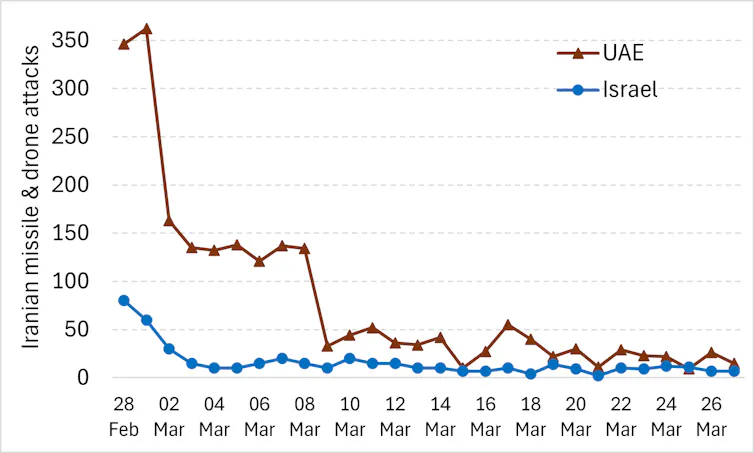
And so it has proved. While Israeli and American forces have been pounding targets across the country, Iran has responded by attacking Israel as well as US military targets in neighbouring Gulf states, including the United Arab Emirates, Bahrain, Saudi Arabia and Kuwait. Attacks have also been reported from Cyprus, Iraq and Jordan.

There is a fresh round of fighting in southern Lebanon after Hezbollah joined Iran in targeting Israel. Beirut is being bombarded.

The economic damage to the region has been enormous. Oil refineries have been shut down, the vital strait of Hormuz – through which 20% of the world’s oil cargo passes – is effectively closed, evacuation flights are leaving the Gulf states around the clock and people are cancelling their travel plans in droves.

And within days of the assassination of Iran’s supreme leader, Ali Khamenei, in a targeted airstrike that also killed a number of his top advisers, a new leader is set to be picked. The smart money appears to be on his son, Mojtaba, known to be cut from very much the same authoritarian clerical cloth as his father. So the notion that with Iran you kill the figurehead and the regime collapses appears to be flawed, to say the least.

Just one week ago, American and Iranian negotiators were engaged in talks in Geneva, which were reported to be making “significant progress”. Now there’s no knowing how this conflict could escalate. On Wednesday, the downing of an Iranian missile over Turkish airspace prompted speculation that Nato would be pulled into a war it clearly doesn’t want. A US submarine sank an Iranian warship in international waters off the coast of Sri Lanka.

There are so many moving parts to this conflict that the sense of jeopardy is at times overwhelming. My email inbox this morning contained a message from Robert Reich, who was Bill Clinton’s secretary of labour between 1993 and 1997 and is a trenchant and energetic critic of the US president, headed: “World War III?
Trump’s and Netanyahu’s illegal war turns global”.

Let’s not second-guess Armageddon just yet. But there’s no denying how dangerous the situation is becoming as the conflict continues to spread. Scott Lucas, an expert in US and Middle East politics at the Clinton Institute, University College Dublin, answers some of the key questions about this fast-developing situation.


Read more:
How dangerous has the conflict in Iran become? Expert Q&A


This has gone beyond what the US president, Donald Trump, referred to as “major combat operations in Iran”. What it might become is anyone’s guess.

What we don’t have to guess is whether Trump is managing to take the American people with him on his foreign adventure. A poll taken on March 2 and published by YouGov/Economist found that US respondents oppose the war by a margin of 45% against to 32% in favour. Predictably, there’s a hugely partisan divide: most Republicans back their president, while Democrats are overwhelmingly anti war.

Significantly, writes Paul Whiteley of the University of Essex, an expert pollster with an interest in UK and US politics, Independents are also against the war by a significant margin. Looking ahead to November’s mid-term elections, as the US president’s advisers undoubtedly are, things do not look good for Republicans’ chances of holding either the House or the Senate.


Read more:
What Americans think of the war in Iran


And the war looks as if it will not end anytime soon. NBC News was reporting this afternoon that the Trump administration may invoke the Defense Production Act to accelerate the production of munitions, which would effectively move the US economy further on to a war footing.

This would seem to hint at something that analysts have speculated about, namely that a lengthy conflict could exhaust America’s stockpile of munitions. The US and its allies — including Israel and the Gulf states — are most acutely exposed to this shortage of defensive interceptors. It’s only been ten months since the US and Israel waged the 12-day war against Iran and that depleted an enormous number of both countries’ defensive missiles, according to Andrew Gawthorpe, an expert in modern American history at Leiden University.

This inevitably means that Washington will have to pull munitions away from other theatres, including those earmarked for South Korea. It’s also fair to say there will be fewer available for Kyiv’s European allies to purchase for the defence of Ukraine, which will please Vladimir Putin no end.


Read more:
How prepared are the US and its allies for a protracted conflict in Iran?


And whether an air campaign will be enough to achieve regime change – if that is indeed the purpose of this conflict – is debatable, writes Matthew Powell, an expert in air power at the University of Portsmouth. Air campaigns rarely work as intended – they often make matters worse, as the world saw after the Nato air campaign that led to the toppling of the country’s ruler, Muammar Gaddafi. With no coherent ground strategy to follow, things fell apart rapidly, with the terrible results that are with us to this day.


Read more:
Iran conflict: air campaigns rarely work as intended – they often make matters worse


‘Special relationship’ under strain

Keir Starmer certainly doesn’t believe in regime change “from the skies”, or so he told the House of Commons this week when fending off criticism of the UK government’s position on whether and how the UK should be involved in this conflict. As the US-Israeli attacks began, Starmer said that the UK would have none of it (due, in large part apparently, to his assessment of a lack of lawful basis for the campaign) and he was not prepared to allow America to use the UK’s bases in any capacity either.

He has since softened his stance, allowing the US to use some British bases, but purely for defensive purposes, to target Iranian ballistic launch sites that could threaten British interests in the region.

‘No Winston Churchill’.

But Donald Trump remains unimpressed and there’s no doubt that this episode has put severe pressure on the so-called “special relationship” between Britain and America. Matt Bar, of Nottingham Trent University, walks us through some of the ups and downs of this relationship over the decades and concludes that it has survived worse setbacks in its time.


Read more:
Iran is putting pressure on the US-UK ‘special relationship’ – but it has survived worse over the years


If this all wasn’t so serious, the US president’s reaction to not immediately getting his way from Starmer would be amusing. In fact it drew an involuntary bark of laughter when I read that, in a press session after a meeting with the German chancellor, Friedrich Merz, on March 3, the US president threw a few barbs Starmer’s way, concluding that: “This is not Winston Churchill that we’re dealing with.”

Indeed. Historian Richard Toye of Exeter University explores that unlikely comparison.


Read more:
What would Winston Churchill make of war with Iran?


The view from Moscow and Beijing

As you’d expect, Beijing was quick to condemn the strikes. China has been heavily dependent on its imports of oil from Iran, and regime change there would threaten this and force it to look elsewhere.

China is linked to Iran in a number of ways, including – significantly – via Tehran’s use of China’s satellite navigation system, BeiDou , which Beijing is touting as a possible replacement for the western Global Positioning System (GPS).

China-watcher Tom Harper, of the University of East London, assesses how this conflict will affect China and concludes that while it will cause turmoil in the short-term, a protracted conflict will play to its benefit in the long term.


Read more:
China set to suffer from turmoil in the Middle East, but it stands to benefit long term


The assassination hit a raw nerve in Moscow. Putin, whose fear of assassination borders on the pathological, watched the killing of a fellow autocrat with undisguised alarm.

Iran is a close ally of Russia. Tehran provided huge numbers of its Shahed drones to Putin to help him wage his illegal war in Ukraine, and Iran has also helped Moscow circumvent the west’s sanctions regime.

Stefan Wolff, an expert in international security at the University of Birmingham, believes that the conflict will play to Moscow’s advantage in the short term at least, as the US diverts munitions earmarked for purchase by Kyiv’s European allies. But he thinks the war is “unlikely to shift the dial significantly towards Russian victory in the long term”.


Read more:
What the conflict in Iran means for Putin and Ukraine


Sign up to receive our weekly World Affairs Briefing newsletter from The Conversation UK. Every Thursday we’ll bring you expert analysis of the big stories in international relations.


The Conversation

ref. Will the Iran war go global? – https://theconversation.com/will-the-iran-war-go-global-277680

Persian Gulf desalination plants could become military targets in regional war

Source: The Conversation – USA (2) – By Michael Christopher Low, Associate Professor of History; Director, Middle East Center, University of Utah

The Ras al-Khair water desalination plant in eastern Saudi Arabia is just one of many along the Persian Gulf coast. Fayez Nureldine/AFP via Getty Images

Saudi Arabia, the United Arab Emirates and neighboring countries in the Persian Gulf region use the fossil fuels under their desert lands not only to make money, but also to make drinking water. The petroleum they produce powers more than 400 desalination plants, which turn seawater into drinkable water.

In the war that began on Feb. 28, 2026, with U.S. and Israeli attacks on Iran, retaliatory attacks from Iranian forces have hit oil refineries and natural gas plants and disrupted tourism and aviation. Those attacks all hurt Gulf nations’ economies and their hard-won reputations for safety and stability.

But Iranian strikes have also already hit close to a key desalination plant in Dubai. Iranian strikes on March 2 on Dubai’s Jebel Ali port hit about 12 miles (20 kilometers) away from a massive complex with 43 desalination units that are key to the city’s production of more than 160 billion gallons of water each year.

And there has already been damage to the UAE’s Fujairah F1 power and water plant and at Kuwait’s Doha West plant. In both cases, the damage seems to have stemmed from attacks on nearby ports or from falling debris from drone interceptions.

Three people walk through a massive space with many large pipes and valves.
The internal workings of desalination plants can be massive and very complex.
Fayez Nureldine/AFP via Getty Images

Saltwater kingdoms

The region’s monarchies are often described as petro-states, but they have also become what I call saltwater kingdoms, global superpowers in the production of human-made fresh water drawn from the sea. Desalination is part of the reason there are golf courses, fountains, water parks and even indoor ski slopes with manufactured snow.

All together, eight of the 10 largest desalination plants in the world are in the Arabian Peninsula. Israel’s two Sorek plants round out the list.

The countries of the Arabian Peninsula have about 60% of global water-desalination capacity. And plants close to Iran, around the Persian Gulf and the Arabian Sea, produce more than 30% of the world’s desalinated water.

Roughly 100 million people in the Gulf region rely on desalination plants for their water. Without them, almost nobody would be able to live in Kuwait, Qatar and the UAE – or much of Saudi Arabia, including its capital, Riyadh.

Under a massive roof, skiers slide down snow-covered slopes while others sit in a chairlift.
A massive indoor ski area in Dubai is just one of the ways Gulf nations use desalinated water.
Karim Sahib/AFP via Getty Images

Sabotage of water supplies

CIA worries about attacks on Gulf region desalination plants date back to the 1980s. During Saddam Hussein’s 1990 invasion of Kuwait, those worries became real.

After coalition forces began bombing Iraqi positions in January 1991, part of Iraqi troops’ response was to release millions of barrels of crude oil into the Persian Gulf. As the massive oil slick drifted south, U.S. and Saudi officials feared it was meant to sabotage desalination systems.

Workers installed protective booms to shield intake valves at major plants, especially the one that supplies much of Riyadh’s water. In Kuwait, Iraqi sabotage damaged or destroyed much of the country’s desalination capacity.

Kuwaiti authorities also turned to Turkey and Saudi Arabia to supply some 750 water tankers and 200 trucks to import an 18-ton emergency supply of bottled water. U.S.-supplied generators and mobile desalination units provided additional temporary relief, though the full recovery took years.

A beach with black oil on it and large buildings in the background.
Oil washes up on a Persian Gulf beach near a Saudi desalination plant in late January 1991.
Chris Lefkow/AFP via Getty Images

More recent threats

Fears of attacks on desalination plants resurfaced after Yemen’s Houthi movement launched drones and missiles at Saudi facilities at Al-Shuqaiq in 2019 and 2022 – though they did no lasting damage.

Iran’s weapons are far more numerous and sophisticated than the Houthis’, though, so if it attacked desalination plants, the damage could be significant.

There is an irony here: Iran’s capital city of Tehran has a water shortage crisis so serious that in 2025 the government reportedly considered relocating the drought-stricken capital to the coast. But Iran is less vulnerable to attacks on desalination, because its water supply relies instead on dams and wells.

Whatever else the war may be about, water could well become a major factor in the violence and leave lasting political scars. And if either side were to intentionally attack water sources or desalination plants, it would clearly be a human-rights violation.

The Conversation

Michael Christopher Low does not work for, consult, own shares in or receive funding from any company or organization that would benefit from this article, and has disclosed no relevant affiliations beyond their academic appointment.

ref. Persian Gulf desalination plants could become military targets in regional war – https://theconversation.com/persian-gulf-desalination-plants-could-become-military-targets-in-regional-war-277597

This is why you only breathe out of one nostril at a time

Source: The Conversation – UK – By Adam Taylor, Professor of Anatomy, Lancaster University

The dominant nostril naturally switches multiple times a day. Daniel Hoz/ Shutterstock

One of the most bothersome things about being sick or having seasonal allergies is that it makes your nose stuffy and blocked. This makes breathing in through your nostrils frustrating – if not altogether impossible.

But even when you aren’t sick, perhaps you’ve noticed that when you take a deep breath, only one of your nostrils seems to be allowing the air in. Before you panic and wonder if you’re coming down with something, what you’re experiencing is actually a normal bodily process.

Multiple times a day, without us even noticing, the nostrils naturally switch between a dominant nostril for airflow. This process is called the nasal cycle and it plays an important role in the health of our nose.

The body actually switches the dominant nostril as frequently as every two hours while we’re awake. This switch is less frequent when we’re sleeping as our breathing rate slows and the volume of air entering and leaving the body lowers.

There are two key aspects to the nasal cycle: congestion and decongestion.

During the congestion phase, one nostril will experience reduced airflow, while the opposite nostril will be open, or decongested – allowing for more air to pass through it. The decongested phase actually fatigues the open nostril, as air dries it out and brings pathogens into contact with it. This is why it’s important for the dominant nostril to swap.

This alternating cycle is automatic, regulated subconsciously by the hypothalamus in the brain. However, some people have no nasal cycle (such as those who have a hypothalamic disorder). There’s also evidence that the left nostril may be more dominant – particularly in right handed people.

Studies looking at nasal breathing even suggest that when the right nostril is dominant, the body is in a more alert or stressed state. But when the left nostril takes over, the body is in a more relaxed state.

The nasal cycle is important for a number of reasons.

First, it protects the lining of the nose and respiratory system. At least 12,000 litres of air pass through it each day, making it a key front-line defence from pathogens. Having the dominant nostril alternate reduces the risk of damage and also makes it easier for the nasal passage to protect against pathogens.

The nose also has to rest and repair. Air exposure dries it out – so without time to recuperate, this could make it easier for pathogens and inflammation to cause damage.

A woman touches her blocked nose with her hand.
Colds can affect our nasal cycle.
Doucefleur/ Shutterstock

Part of the congestion process also sees increased blood flow to the nose’s vessels. This ensures the nostrils are moistened properly for both the repair and recovery processes, and so that air is warmed and moistened as it passes through the nostril.

Nasal cycle function

A number of things can affect the nasal cycle’s normal function. Respiratory conditions such as colds and flu result in an increase in mucous production. This restricts how easily the nasal passages are able to alternate.

Allergens such as pollen or dust mites can cause severe inflammation of the nasal tissues – again impeding proper function of the nasal cycle.

Certain medications, such as those for high blood pressure, can cause irritation of the nasal lining, too. This is because these drugs effect the blood vessels throughout the body – including those in the nose.

Overuse of nasal decongestants (for more than five days at a time) can cause rhinitis medicamentosa – a form of congestion that occurs when you overuse these drugs. The sudden swelling of the nostril tissues affects the nasal cycle.

For others, structural issues interfere with their nasal cycle. Nasal polyps, which are found in up to 4% of people, are an outgrowth of the nasal lining that usually occurs in both nostrils. These limit how easily air can pass through the nostrils, making the nasal cycle ineffective and leaving both nostrils constantly feeling blocked.

A deviated nasal septum – where the cartilage and bone plate between the nostrils is off-centre – can also make the nostrils feel constantly congested or blocked. This often requires surgery to improve breathing and sleep quality.

Even factors as simple as lying in bed or slouching over can affect the nasal cycle. When you lay down, blood pools in the tissues of the nose. Gravity also causes the contents of the sinuses to move into the nostril closest to the pillow. This can block one of the nostrils, making it harder to breathe and preventing the nasal cycle from working as normal.

If you’re struggling with blocked nostrils, infections such as colds and the flu are usually the most common culprit. It can take up to two weeks to clear the congestion. Sinusitis, where the sinuses become infected, can last for four weeks.

Pollen allergies can also be a common culprit of a abnormal nasal cycle. This symptom can last for weeks depending on the specific allergen you’re allergic to. Regularly taking antihistamines during hay fever season may help to reduce symptoms and clear any congestion.

But if you find one nostril is persistently blocked for more than two weeks, it’s usually a good idea to get it checked out – particularly if there’s mucus coming from your nose, or a discharge that doesn’t look normal for you.

The Conversation

Adam Taylor does not work for, consult, own shares in or receive funding from any company or organisation that would benefit from this article, and has disclosed no relevant affiliations beyond their academic appointment.

ref. This is why you only breathe out of one nostril at a time – https://theconversation.com/this-is-why-you-only-breathe-out-of-one-nostril-at-a-time-276407

Why do sports shoes squeak? Here’s what our research reveals

Source: The Conversation – UK – By Gabriele Albertini, Assistant Professor in Structural Engineering, Department of Civil Engineering, University of Nottingham

The unofficial soundtrack of every basketball, squash or hard-court tennis match is the constant high-pitched squeak or shreak of the players’ shoes. But can this squeak be designed out of them while retaining the grip?

That’s the question an international team of engineers and applied physicists, including me, have been investigating. It sounds like a small design tweak. In fact, it cuts to a deep physics problem: how a soft body slides against a rigid one.

Perhaps surprisingly, the mechanism that produces sound when a soft solid slides against a stiffer one has long been the subject of scientific debate. Most theories are linked to the concept of “stick-slip”: when, instead of sliding smoothly, the sliding object rapidly alternates between sticking and slipping.

While it sticks, the soft body (such as a rubber sole) deforms and stores elastic energy. Then it suddenly slips, turning much of that energy into heat through friction – while also releasing rapid vibrations that radiate out as sound.

But this is not exactly what we observed in our experiments.

After Leonardo da Vinci

Our recently published study took inspiration from the simple-but-effective setup used by Leonardo da Vinci in his studies of friction from the late 15th century.

Leonardo da Vinci's sketches of his pioneering friction experiments.
Leonardo da Vinci’s sketches of his pioneering friction experiments.
Codex Arundel, British Library (41r), 1500-05.

Leonardo used a wooden block resting on a flat surface. The block was subjected to two forces: a normal force (its own weight) and a tangential force which was applied using an additional weight attached to a cable.

By stacking and combining multiple blocks, Leonardo discovered the two fundamental laws of friction: that friction is proportional with how hard the surfaces are pressed together, and largely independent of the size of the contact area.

But Leonardo never published these findings, which were finally rediscovered and made public in the 19th century in notebooks scattered throughout Europe. In the meantime, the laws of friction had only been formally enunciated by French physicist Guillaume Amontons in 1699 – two centuries after Leonardo’s studies.

Furthermore, these laws are empirical rather than fundamental, and in extreme cases they break down. This led us to the question of what makes a shoe squeak.


Read more:
Leonardo da Vinci’s early work on friction founded the modern science of tribology


A surprising result

One of the biggest difficulties in friction studies is that the interface being tested (where a shoe sole meets a hardwood floor, for example) is hard to get at, and comes under a lot of pressure while slipping at high speed. Placing sensors at the interface is almost impossible – and even if it were, this would probably alter the frictional response.

Our solution was to use an optical trick: we replaced the hardwood floor with a transparent acrylic plate and mounted an array of LED lights along its sides. When each test object – including multiple rubber blocks – made contact with the plate, light would leak into the contact region, brightening up this area alone. That allowed us to visualise exactly which parts of the soft-rigid interface were in contact.

We used a high-speed camera, capable of capturing up to 1 million frames per second, to film how the contact patches evolved while the “sole” was skidding, and recorded the sounds being emitted with a microphone.

We found that at the point of contact, tiny wrinkles in the surface of the rubber block – known as “opening slip pulses” – were created, which then raced along the interface at nearly 100 metres per second. While most of the block remained stuck in place, these rapidly moving wrinkles created the sound in each friction test.

Surprisingly, even tiny geometrical features at the frictional interface had profound effects on the sound generated. When it was perfectly flat and smooth, the pulses were messy and generated a scratch-like noise of many different frequencies – closer to the sound of peeling adhesive tape than a clean squeak.

But when ridges were present, like those on the soles of sport shoes, the pulses were confined by the width of these ridges, making them very regular (not messy any more). This turned the sound into a more musical tone akin to the squeaks heard on a basketball court.

We were also able to determine what decides the precise pitch of a shoe squeak. In each test, it was largely unaffected by either the speed of sliding or magnitude of the force applied (which relates to the weight of a player).

Rather, the clearest link was with the height of the rubber block – or the thickness of a shoe’s sole. Using this knowledge, we created a series of blocks of different heights in order to play a familiar melody, as shown in this video.

Video: Nature.

Our research lays the groundwork for controlling or suppressing squeaking in many mechanical systems involving soft-on-rigid friction. These range from brakes and tyres to hip and knee replacements, where polymer liners slide against polished metal or ceramic heads.

And yes, it could even lead to the development of squeakless sneakers. Designing intricate patterns that keep plenty of rubber in contact (so the grip stays high) but break the sliding into lots of tiny, out-of-sync microevents could kill the clean note of the squeak, and leave only a soft hush.

Table-top earthquakes

Beyond the realm of sports, this work also relates to much larger geophysical questions. Similar experimental approaches to ours have served as table-top models for studying earthquakes, during which ruptures and slip pulses spread along tectonic faults at extremely high speed.

If we can reproduce earthquake-like slip pulses in the lab, the next challenge is scaling – working out how those centimetre-scale measurements translate to what happens inside real faults in the Earth.

Achieving this could help interpret seismic signals more confidently: using waves recorded far from a fault to infer what has actually happened at the source. Better physics-based models could improve seismic hazard estimates and lead to more reliable hazard maps.

Meanwhile, we’ll keep thinking about squeakless sneakers too.

The Conversation

Gabriele Albertini received funding from the Swiss National Science Foundation (SNSF), the Engineering and Physical Sciences Research Council (EPSRC), and the University of Nottingham.

ref. Why do sports shoes squeak? Here’s what our research reveals – https://theconversation.com/why-do-sports-shoes-squeak-heres-what-our-research-reveals-277518

How to spot the use and abuse of the word ‘context’

Source: The Conversation – UK – By Paolo Heywood, Associate Professor, Social Anthropology, Durham University

‘My comments about how much I dislike my family were taken outrageously out of context’. Shutterstock/Paper Trident

Everyone’s been in a debate when someone says: “You’re taking that out of context.” But what does it actually mean to understand something “in context”?

Appeals to context feel irrefutable. Of course we need context. But “context” is one of those ideas that seems obvious until you actually try to define it. What counts as context? Where does context end and the thing itself begin? And whose context matters?

Take a typical example: a quote from a politician surfaces that seems damning. Condemnation ensues. But a defence is mounted: the quote has been taken out of context – the politician was being sarcastic, as you’ll see when you look at what else they said at the same time.

But the assault continues when it’s pointed out that the quote fits with other remarks the politician has made. Meanwhile, still further defences are mounted on the basis of the wider political debates around the subject of the quote. Everyone’s invoking context, but nobody’s agreeing.

“Context” isn’t one thing, though the way we use the word often suggests it is. It’s dozens of different things we’ve given different names to over centuries. Social context. Historical context. Cultural context. Political context. Economic context. Linguistic context. Biographical context. Institutional context. Each of these emerged as distinct ways of thinking about how to situate meaning, and each implies a different kind of explanation.

We haven’t always been as concerned about context as we are now – and we haven’t always understood it in the same way. The historian Peter Burke dates “context” in roughly its current (and quite capacious) senses to the counter-enlightenment romanticism of the 19th century.

This same counter-enlightenment romanticism is partly the context in which my own discipline of anthropology emerged – and people started insisting we understand human practices “in their total social context”. They meant something specific: that you can’t understand a ritual or belief by isolating it, and you have to see how it fits into an entire way of life.

When historians talk about “historical context”, they often mean the sequence of events and conditions that preceded something – the causal chain. When literary critics invoke “textual context”, they often mean the surrounding words that shape meaning. These are all genuinely different intellectual operations, and they often pull in opposite directions.

The philosopher Ludwig Wittgenstein spent much of his life thinking about this problem. In his early work, he thought meaning depended on logical context – how a statement fits into a formal structure.

Later, he abandoned this for something messier: meaning depends on what he called “form of life” – the shared practices and assumptions that make our words intelligible to one other. There’s no algorithm for context, there’s just the hard work of making explicit what we normally take for granted. This helps to explain why political arguments can sometimes be so frustrating. We think we’re disagreeing about facts when we’re actually disagreeing about which kind of context is relevant.

A woman looking sad holding a chart showing a line going down, another looking happy with a chart showing a line going up and a third between them looking confused.
Things are going great! And also absolutely terribly.
Shutterstock/Maya Lab

Take recent debates about crime statistics. In 2024, the then Conservative government of the UK argued that crime had fallen by 56% since 2010, yet it also claimed that knife crime had risen dramatically in London since the arrival of Labour mayor Sadiq Khan.

More recently, meanwhile, Reform’s Nigel Farage argues that crime has skyrocketed since the 1990s in ways that records fail to make clear because people aren’t reporting crimes. Still others point to the economic context of austerity and cuts to policing that have hit deprived areas the hardest.

Who’s right? They all might be, in a sense. But they’re playing different games with context. The Conservative government used temporal context (crime down since 2010) and regional context (but up in London). Farage invokes methodological context (the problem of unreported crime skewing the data). Critics of austerity point to economic and structural context (resource distribution and its effects). Each context tells you to look at different things, weigh different factors, draw different conclusions.

There’s no neutral context, no view from nowhere. Every context is itself a choice: a decision about what matters, what explains what, which background is relevant. When we invoke context, we’re not just adding information, we’re making a claim about what kind of thing the world is. These aren’t just different amounts of context, they’re different ideas about what makes things meaningful.

What do we do with this?

Choosing a context is itself an argumentative move. When you invoke historical context, you’re claiming – probably – that temporal sequence and precedent matter most. When you invoke social context, you’re claiming that group membership or structural position matter most. These are substantial commitments, not neutral framings.

It’s also helpful to recognise that contexts can conflict. The immediate linguistic context (x was being ironic) might point one way, while the historical context (but x voted for similar measures) points to another. Both can be “true” while supporting opposite conclusions.

None of this means context doesn’t matter. It means it’s helpful to be honest about what we’re doing when we invoke it. We’re not just adding background information. We’re making claims about what kind of background matters, which in turn depend on deeper assumptions about how the world works.

It’s helpful to be explicit about which context we’re operating in, and why we think it’s the relevant one. That certainly won’t resolve all arguments. But it might help us see that we’re not always arguing about the same thing.

Understanding context isn’t an invitation to add more and more information until everyone agrees. It’s an acknowledgement that meaning is situated, and that different situations generate different meanings. The hard part is figuring out which situation we’re actually in.

This article contains references to books that have been included for editorial reasons, and this may include links to bookshop.org. If you click on one of the links and go on to buy something from bookshop.org The Conversation UK may earn a commission.

The Conversation

Paolo Heywood does not work for, consult, own shares in or receive funding from any company or organisation that would benefit from this article, and has disclosed no relevant affiliations beyond their academic appointment.

ref. How to spot the use and abuse of the word ‘context’ – https://theconversation.com/how-to-spot-the-use-and-abuse-of-the-word-context-275875

Why unemployment – and bad jobs – carry hidden social and political costs

Source: The Conversation – UK – By Peter Howley, Professor of Economics and Behavioural Science, University of Leeds

Irene Miller/Shutterstock

The outlook for job seekers in the UK appears to be taking a turn for the worse. Weak economic growth and continued uncertainty for employers have led to forecasts that unemployment will hit 5.3% this year.

In politics, the debate typically follows a familiar pattern: creating jobs, tackling unemployment and making sure welfare benefits are fair. But this economic framing captures only part of what is at stake. Work is not simply a source of income. It is about much more than a paycheck.

When people lose work or cannot find a job, the damage is often psychological as much as financial. With official estimates suggesting that UK unemployment will climb higher this year than previously forecast, that leaves problems for the government beyond just the numbers.

Economists estimate that in terms of life satisfaction the non-financial costs of unemployment are several times larger than the loss of income itself. Unemployment can also leave long-term scarring effects – fears about becoming unemployed again, for example – even after people have found a new job.

One reason is that employment fulfils important psychological needs. Just as vitamins are essential for human bodies, certain aspects of work – autonomy, variety, recognition – are essential for the mind.

When work disappears, people lose not only financial security but often routine and social connection as well. Days can become less structured, social networks might shrink and confidence can erode. In most societies, work is also closely tied to self-worth, meaning unemployment can bring feelings of guilt, shame or personal failure even when job loss is beyond a person’s control.

A good illustration of how powerful these social meanings can be comes from a study of people’s happiness as they transitioned into retirement. People who move directly from employment into life as a pensioner typically experienced little change in their overall satisfaction.

In contrast, those who had been unemployed before retiring reported a marked improvement in wellbeing once they reached retirement age. The difference was not due to changes in financial circumstances. Rather, retirement removed the stigma attached to not working. During working life, being unemployed carries a heavy social stigma. But no one looks down on a pensioner for not working.

Psychological pain

To illustrate further these non-financial costs of not working, research my colleagues and I conducted also looked at how unhappy people feel when they are out of work depending on the overall unemployment rate in their neighbourhood. If unemployment were purely an economic issue, then living in an area with high joblessness should make things worse. It means fewer jobs and tougher competition for those roles, after all.

But what actually happens is the opposite: although the psychological pain of being unemployed is always substantial, this pain reduces as more people around you lose their jobs. Now, it is clearly not the case that people are just cruel and taking pleasure in others’ misfortune. But when job loss becomes more common, the stigma eases and people no longer feel as alone or to blame for their situation.


Read more:
Why unemployment can feel worse when there is less of it around


The current challenge is not limited to outright job loss. Globalisation and technological change have expanded economic opportunities overall, with things like new industries, cheaper goods and services, and greater access to global markets. But they have also contributed to the growth of insecure and lower-quality work. For many people, stable and meaningful employment has become harder to find.

These changes are unevenly distributed: communities that have historically been reliant on manufacturing have suffered lasting declines. These include higher unemployment, lower wages and wider social problems following exposure to competition from cheaper manufacturing bases. In this sense, economic change has created a new geography of disadvantage.

young greek men holding flares in support of the far-right golden dawn party.
High rates of unemployment in Greece fueled the rise of the far-right Golden Dawn party in the mid-2010s.
Alexandros Michailidis/Shutterstock

The consequences extend beyond individual happiness. Rising job insecurity and dissatisfaction with work can reshape how people view government institutions and politics more broadly. They are associated with falling trust and growing frustration: conditions that have been linked to stronger support for populist and anti-establishment movements across advanced economies.

When large groups feel economically marginalised or socially undervalued, political discontent often follows. Labour market policy, therefore, is not only about employment rates or economic growth. The right decisions can help to sustain social cohesion and democratic stability during periods of economic change.

The rapid advance of AI in the workplace brings these questions into sharper focus. It promises extraordinary gains in productivity, but also raises an uncomfortable question for the future. What happens when large numbers of people are no longer needed for the work that once defined economic life?

The challenge posed by AI is not simply how to distribute income, but how to sustain human flourishing in a world where work plays a smaller role. Financial compensation alone may prevent poverty, but it cannot guarantee satisfaction with life. And if citizens do not feel that their lives have value or direction, the political consequences may prove as significant as the economic ones. The future of work is not just an economic question, but a social one.

The Conversation

Peter Howley does not work for, consult, own shares in or receive funding from any company or organisation that would benefit from this article, and has disclosed no relevant affiliations beyond their academic appointment.

ref. Why unemployment – and bad jobs – carry hidden social and political costs – https://theconversation.com/why-unemployment-and-bad-jobs-carry-hidden-social-and-political-costs-277559

Netflix and Paramount bidding for a potentially lucrative back catalogue mirrors 18th-century publishing deals

Source: The Conversation – UK – By Marrisa Joseph, Associate Professor of Organisation Studies & Business History, University of Reading

miss.cabul/Shutterstock

Netflix’s plan to buy the Hollywood studio Warner Bros Discovery is over. The streaming giant was eventually outbid by rival company Paramount Skydance, which is willing to pay around US$111 billion (£82.2 billion) for the company.

It’s not a done deal yet. There will be regulatory hoops that Paramount needs to get through.

But after a tense few months of negotiations, Warner Bros, which put itself up for sale last year, said Paramount’s latest bid was “superior” to the one from Netflix, which then refused to raise its offer.

And if things go according to Paramount’s plan, the company will soon become the new owners of a vast library of content. It will own the likes of Casablanca, Friends, Superman, Harry Potter and Game of Thrones. Plus it will have the Sopranos, Sex and the City and Succession.

Media companies like Paramount and Netflix appear to see high quality back catalogues as valuable strategic assets. The theory is that control over legacy content can provide financial stability and a durable competitive advantage.

And it’s a strategy with a long history. Back in the 18th century for example, Longman, the UK’s oldest commercial publishing house, built up its business by acquiring the catalogues of other firms.

Founded by Thomas Longman in 1724, the company steadily and deliberately expanded its portfolio of titles. One of the most famous and lucrative of these was Robinson Crusoe by Daniel Defoe.

In addition to acquiring catalogues from publishers (who were often retiring or leaving the trade) Longman was also a keen trader of shares in consortiums known as “congers”. This was where publishers collaborated to finance new literary works as a way of spreading the risk of potentially costly publishing ventures. In 1755, for example, Longman joined a consortium with five other publishers to produce and publish Samuel Johnson’s Dictionary of the English Language.

By the time Longman reached its centenary in 1824, the firm was regarded as one of the most distinguished publishing houses of the age. Its fortunes were built on the substantial capital generated through the acquisition of lucrative copyrights, a strategy that successive generations continued.

It was the third generation of Longman publishers for example, who, in 1863, acquired the business of John William Parker & Son, publishers of Gray’s Anatomy. First issued in 1858, the work had already become pivotal to medical education, making it a highly valuable addition to Longman’s catalogue. It has never been out of print, and still sells well to medical students and doctors around the world today.

Longman continued to grow, and was considered one of the major players in British publishing in the 19th century. A steady commitment to purchasing reference and instructional works helped cement the firm’s reputation as a leading educational publisher, a position strengthened by its overseas trade and broad catalogue of school textbooks.

Content is always king

This would become their enduring legacy well into the 20th century, as Longman’s reference works came to define standards in English language educational publishing.

Copy of Gray's Anatomy on a desk.
Still a bestseller.
Tom Quisenaerts/Shutterstock

As successive generations of Longman had pursued this strategy of acquiring established firms with profitable lists, new media companies entered the market seeking to expand their portfolios. Longman’s reputation and extensive back catalogue eventually made the firm an attractive target for a take over.

In 1968 Longman was acquired by Pearson, bringing an end to a publishing dynasty that had lasted for centuries. And although no longer family-owned, the Longman imprint has endured as a strong brand in educational publishing.

Similarly, by absorbing Warner Bros. Discovery’s extensive archive, Paramount will gain control over a vast catalogue of cultural content, influencing which stories persist and how future entertainment landscapes may be shaped.

The deal, if it happens, demonstrates how legacy assets remain powerful tools for shaping markets and culture. It will also show that for media companies in the 21st century, as with publishing companies 300 years ago, ownership of a profitable back catalogue continues to be a cornerstone of growth and innovation.

The Conversation

Marrisa Joseph works for the University of Reading.

ref. Netflix and Paramount bidding for a potentially lucrative back catalogue mirrors 18th-century publishing deals – https://theconversation.com/netflix-and-paramount-bidding-for-a-potentially-lucrative-back-catalogue-mirrors-18th-century-publishing-deals-275955