Source: The Conversation – Canada – By Kate Congreves, Associate Professor, Jarislowsky & BMO Research Chair in Regenerative Agriculture, University of Saskatchewan
Sustainability has become something of a buzzword over the years. From the clothes we wear and the energy that powers our homes to the way we live our lives, the idea of sustainable production and consumption has become commonplace.
That is also true about the way we grow and consume food. Recently, however, another term has come to the fore: regenerative agriculture. It sounds attractive, somehow better than sustainable, but what does it really mean?
Regenerative agriculture began as a grassroots approach to farming led by farmers. It has been described in many different ways, but a common thread is a set of values.
People might be drawn to the word “regenerative” because it evokes a sense of improvement rather than just maintaining the status quo — for example, efforts to rebuild a system and our values. That last bit — rebuilding not only the system but our values — is really important.
Values often include care for the environment, a responsibility to nature and cultivation of good food. Just like there are many ways to grow food, there are also many languages, voices and histories that express the ways that food can be cultivated in alignment with values.
It easier to standardize and market a simple list of practices than a philosophically sound ethical framework, but that doesn’t mean ethical frameworks are irrelevant. Ethics is a branch of philosophy that examines concepts of good and bad, right and wrong and our values.
Ethics might be the one thing that agricultural science has been missing but needs the most. Agriculture has been rudderless when it comes to collectively deciding what is or isn’t good for humans and the environment.
Cornerstone ethical frameworks have provided reasons for taking care of the environment, such as the land ethic and deep ecology.
These laid the foundation for important movements supporting nature preservation and conservation, and the United Nations 30 by 30 goal to set aside 30 per cent of the planet for conservation areas by 2030.
These frameworks, however, are easier to apply outside of agriculture rather than to inform agricultural practice within environments. They might often involve protecting land from agricultural use.
Yet agriculture is a part of the environment, not separate from it. We need an environmental ethic that works for agriculture, one that centrally grounds it as part of the environment. This is where regenerative agriculture might help.
A better approach
In my work, I define regenerative agriculture as an ecological approach and ethic for our agricultural system that involves reciprocity with the land, to support ecosystems with the goal of nurturing the environment.
Ecosystem processes and environmental components such as land, soil, water, air, flora and fauna are all viewed as morally worthy of consideration due to their roles in giving life.
A regenerative agriculture ethic would allow for natural shifts in ecological stability due to cultivation, but would draw the line when the ecosystem processes are damaged, degraded or severed. In this approach, regeneration is valued.
Regenerative agriculture can help other movements like agroecology, as opposed to threatening them. Agroecology is a larger science, practice and social movement to build an inclusive food system with political, social, environmental aspects of sustainability. Bringing in an agricultural environmental ethic will help advance this goal.
However, focusing on a “one-size-fits-all” standard for regenerative agriculture and marketing it for profits has left the concept a hollowed version of itself. It has been reduced to a simple list of agricultural practices or outcomes, like ticking off a grocery list.
Generic practices like diversification and soil health management are frequently cited, without specifying the degree of diversification or whether soil health indicators actually improve.
This oversimplification, and convenient marketing use by agrifood corporations, has caused expert panels and researchers to warn the concept has been co-opted. In its narrowed version, the underlying values have been left out.
If regenerative agriculture becomes just another marketable list of practices, then its potential for real transformation evaporates. However, if we pause and prioritize a truly regenerative agriculture ethic, it may lead us to a prosperous and healthy environment and society.
Kate Congreves receives funding from the Natural Sciences and Engineering Research Council of Canada, the Jarislowsky Foundation and the Bank of Montreal.
It has been said that Persian Gulf countries are both blessed and cursed by their vast oil and gas reserves. Geologic forces over millions of years have meant the region is an energy-rich global flash point, as it is now with a war underway that’s causing a global energy crisis.
As a petroleum geologist who has studied the region, I still find myself amazed at the size of its hydrocarbon endowment. For instance, there are more than 30 supergiant fields, each holding 5 billion barrels or more of oil, around the Persian Gulf. And wells in the region produce two to five times more oil each day than even the best wells in the North Sea and Russia.
Modern geoscience has identified several key factors of rocks that make a region particularly rich in petroleum, including their ability to generate and hold hydrocarbons. In the Persian Gulf region, all of these factors are at or near optimal levels.
For sheer abundance and ease of production, it simply doesn’t get any better than the Persian Gulf region.
Humans knew about the presence of hydrocarbons in the area long before flooding created the Persian Gulf at the end of the last ice age, between 14,000 and 6,000 years ago. Natural seeps of oil and gas are common along rivers and valleys in many parts of the region. Thousands of years before the start of the Common Era people used bitumen, a form of heavy oil, for building mortar and to waterproof boats.
The first modern oil discovery came in 1908 at a known seepage site in western Iran. In the 1950s and ’60s, an era of rapid expansion in oil and gas exploration, it became clear that no other region on Earth was likely to have a similar abundance.
Other areas with huge volumes of oil and gas have been found, such as West Siberia in Russia and, more recently, the Permian Basin in the U.S., but none compare either with the scale of reserves or the high rates at which oil and gas can be produced in the Persian Gulf.
Geologic setting
The Persian Gulf region is located where two continental plates are colliding: the Arabian Plate to the southwest and the Eurasian Plate to the east and north. This collision has been happening for about 35 million years and has resulted in a dynamic setting where rock layers have been bent and broken and, at deeper levels, transformed by significant heat and pressure.
Geologic features differ a great deal between the two sides of the Gulf. On the Iranian side, the the Zagros Mountains stretch 1,100 miles (1,800 kilometers) from the Gulf of Oman to the Turkish border. Part of the great Alpine-Himalayan mountain system, the Zagros are made up of highly folded and broken rocks that formed over the past 60 million years from the collisions of Africa, Arabia and India with Eurasia.
On the Arabian side of the Gulf, that type of bending and fracturing didn’t occur. Instead, the compressive forces of collision warped a rigid platform of deep, hard rock known as “basement rock” into broad, dome-like structures of enormous size, extending for tens, even hundreds, of square miles.
Underlying the Persian Gulf itself is a basin filled with debris eroded from the rising of the Zagros Mountains. In its deeper portions, the basin was subjected to high temperatures and pressures necessary for the generation of oil and gas.
A satellite view of an area of the southwestern Zagros Mountains shows long ridges and valleys, evidence of tectonic plates colliding. NASA via Flickr
Rocks that make oil
Oil and gas form from organic material such as marine zooplankton and phytoplankton, originally concentrated in shales, mud-rich limestones and other rocks exposed to elevated temperatures and pressures. When rocks are composed of at least 2% organic material, they are considered to be high quality for oil and gas generation.
The Gulf region has a particularly large number of layers of such source rocks, some of which are especially thick, widespread and organically rich. Examples are the Hanifa and Tuwaiq mountain formations on the Arabian side of the Gulf, which formed during the Jurassic period, about 200 million to 145 million years ago, and the Kazhdumi formation in Iran, which formed in the Cretaceous period, about 145 to 66 million years ago. These rocks have between 1% and 13% organic content, and even more in some places.
Oil and gas structures
The region’s bent and fractured rock layers, and its domes, are well suited for trapping hydrocarbons.
Folds of the Zagros, which are legendary for geologists due to their spectacular forms on satellite imagery, contain hundreds of billions of barrels of oil and cubic meters of natural gas. A glance at a map of oil and gas in the Persian Gulf region will show a northwest-southeast trend of long, sausage-shaped fields reflective of major fold structures. These features actually include hundreds of individual fields of varied size, reaching from southern Iran through northeastern Iraq.
On the Arabian Plate, the large dome structures have formed especially large oil and gas accumulations. These include Ghawar oil field in Saudi Arabia, the largest in the world, which could produce over 70 billion barrels of crude oil. The South Pars-North Dome gas field, shared by Qatar and Iran, could produce at least 1,300 trillion cubic feet (46 billion cubic meters) of gas – equivalent in energy content to more than 200 billion barrels of oil.
The most important reservoir rocks are limestones in which portions have been partly dissolved, enhancing the ability for oil and gas to move through them. In Zagros reservoirs, fluid flows through fractures created by the folding and faulting related to plate collisions. And in places such as the Arab-D reservoir at the Ghawar Field in Saudi Arabia and the Asmari limestone in many Zagros fields, these high-quality oil-storage rocks cover huge areas – hundreds and even thousands of square kilometers.
Nothing on this scale exists anywhere else on the planet, onshore or offshore, testifying to the unique petroleum geology of the Persian Gulf region.
A natural gas refinery at the South Pars gas field on the northern coast of the Persian Gulf, in Asaluyeh, Iran. AP Photo/Vahid Salemi
Future possibilities
The combined result of these factors is that roughly half of the world’s conventional oil reserves and 40% of its gas lie beneath just 3% of the Earth’s land surface.
U.S. Geological Survey assessments suggest that, even after more than a century of drilling and production, large amounts of oil and gas remain to be discovered in the Persian Gulf region. In a 2012 report covering the Arabian Peninsula and Zagros Mountains, the agency estimated there could be as much as 86 billion barrels of oil and 336 trillion cubic feet of natural gas in the rocks, in addition to the amounts that have already been discovered.
More oil and gas could also be produced using the horizontal drilling and fracking techniques pioneered in the U.S. in the 2000s and 2010s. Saudi Arabia and the UAE are now trying those methods in their petroleum fields. It’s too early to say how successful they may be, but research indicates they could allow even more production.
Scott L. Montgomery does not work for, consult, own shares in or receive funding from any company or organization that would benefit from this article, and has disclosed no relevant affiliations beyond their academic appointment.
Trying a new hobby for the first time can feel surprisingly intimidating. As adults, stepping into beginner territory often comes with discomfort, self-doubt and fear of judgment. Yet research suggests that pushing through this unease can be deeply rewarding, both mentally and emotionally.
Hobbies also foster social connectedness, through both community engagement and bonding with others through similar interests. Even when pursued alone, hobbies can promote a sense of accomplishment and autonomy, contributing to overall well-being.
Hobbies can bring joy, well-being, and focus to our busy lives, but so many of us don’t have one. If you’re ready to replace scrolling with stitching, or hustle with horticulture, The Hobby Starter Kit (a new series from Quarter Life) will help you get going.
Yet many adults often struggle to carve out space for hobbies because of lack of time, money and resources. Unlike childhood, adulthood comes with financial and time pressures, often when we feel like we’re already running on fumes.
Our modern work-centric society compounds this issue by teaching us that personal worth equates to productivity output, and that leisure is wasteful or lazy. This can leave us feeling guilty for spending time on hobbies, even though engaging in them supports the well-being that makes productivity possible.
Why adult hobbies can be hard to start
One of the main reasons why we avoid trying new things is fear — particularly fear of failure and fear of judgment. Everything is scary the first time, whether it’s a first date, the first time driving, the first college class, the first day of work or the first day at a new gym.
Firsts are scary because we can’t predict the outcome. The fear of the unknown can trigger anxiety and avoidance, which can make trying anything new feel overwhelming enough to not even try. This fear can convince us that not trying at all is better than being bad at something new.
Another layer comes from how adults perceive themselves socially. According to developmental psychology, young adulthood is a period focused on forming meaningful relationships and establishing a sense of belonging. Social acceptance becomes a priority, and new activities can make you feel vulnerable, triggering questions like: “Will they like me?” or “Will I perform to my best ability?”
For many, this fear of judgment can outweigh curiosity, making avoidance feel safer than experiencing something new, even though research suggests it’s precisely the discomfort that makes new experiences meaningful.
Why being a beginner is valuable
Despite the discomfort that comes with beginnerhood, research shows that trying new activities is associated with enhanced well-being, improved mental health, lower stress levels and personal growth.
Actively facing the fear that comes with trying something new reduces avoidance and increases motivation. Individuals who approach new experiences with curiosity and openness are more likely to report more fulfilling lives than those who avoid unfamiliar situations.
Engaging in something you love — solely for the sake of loving it — is increasingly rare in adulthood. Yet hobbies offer one of the few spaces where in actuality we can show up without the fear of punishment or imperfection, a luxury that a lot of work and social obligations rarely provide.
Starting a new hobby can be intimidating, but there are strategies to make it easier. The first is extending compassion to yourself if you’re anxious about trying something new.
Self-compassion — treating yourself with warmth and kindness in times of suffering — can be the antidote to the self-criticism you may be currently offering yourself.
If even the thought of a new hobby or new play feels intimidating, you’re not alone. Adult hobbies often feel difficult because it is asking us to show up with both skill and social confidence.
If fear of judgment is holding you back, start with something you can do alone or with one other person. And if trying alone is the fear you are holding on to, remind yourself that research shows the very thing you’re afraid to attempt may also be the thing that benefits your well-being the most.
If fear of imperfection is holding you back, seek out beginner-friendly communities or online classes where learning is the goal, not production. Set small, attainable goals for yourself to stay motivated while releasing the pressure to become perfect at it. But most importantly, give yourself permission to be bad at something without fear of critique, assessment or evaluation.
If, in beginnerhood, you feel like you have no idea what you’re doing, that’s exactly the point. It may feel challenging in the beginning, but the reward could be life-changing in the long run.
Jenna Hepp does not work for, consult, own shares in or receive funding from any company or organisation that would benefit from this article, and has disclosed no relevant affiliations beyond their academic appointment.
Music programs in Canadian colleges and universities support local musical ecosystems. Popular music studies scholars have long argued that music scenes are more than just collections of artists or venues. They are cultural spaces where contemporary musical practices interact and coexist with an area’s heritage.
Colleges and universities in many smaller cities act as anchors within local music scenes. They provide performance space and access to networking within the community. Perhaps most importantly, they provide continuity through a steady influx of new student musicians each year.
These institutions contribute to the training and networking of musicians in London and facilitate consistent performance opportunities for both local and international talent.
The result is a dense and active music ecosystem in a wider arts community that is supported by a continuous relationship among education, performance and industry.
One might think that Hamilton’s proximity to Toronto, with large venues like the newly renovated TD Colosseum that hosts major music events — including this year’s Juno Awards — would offer a degree of protection for music education.
This award was given in a city that no longer offers a college music program. Indeed, Mohawk College’s program suspension suggests how performance-based arts education and infrastructure are vulnerable throughout the country.
While the situation in Ontario specifically seems dire, across Canada, arts andmusic programs are facing similar pressures with shifting funding models, changing enrolment patterns and rising operational costs.
Music programs that require specialized equipment and one-on-one instruction are especially vulnerable.
At the same time, Canada’s live music industry continues to rely on the skills these music programs provide. Performance, production and arts management are all essential components of every local arts economy. These program closures create a growing disconnect between where music training occurs and where music labour is needed.
What’s at stake for Canada’s music industry
When programs like Algonquin’s MIA disappear, it removes a key piece of arts infrastructure that allows a local scene to reproduce itself economically and culturally. Music alone contributed $60 million to Ottawa’s GDP in 2021.
Music scenes do not simply survive on talent; they depend on the institutions that sustain them.
Duncan McCallum does not work for, consult, own shares in or receive funding from any company or organisation that would benefit from this article, and has disclosed no relevant affiliations beyond their academic appointment.
Source: The Conversation – Canada – By Julia Yates, PhD Candidate in Health and Rehabilitation Sciences, Health Promotion, Western University
The recent cancellation of the reality TV show The Bachelorette at first glance appears to be a routine network response to save face as alarming information about a star becomes public.
At the time of the altercation, Paul was arrested on several charges, including domestic violence in the presence of a child, and later pleaded guilty to aggravated assault, with the remaining charges dismissed. She has been on probation ever since.
According to a spokesperson for Paul, she is “very grateful for ABC’s support as she prioritizes her family’s safety and security. After years of silently suffering extensive mental and physical abuse as well as threats of retaliation, Taylor is finally gaining the strength to face her accuser and taking steps to ensure that she and her children are protected from any further harm.”
But the cancellation of the show highlights important societal biases deeply rooted in gender inequities and the perpetuation of patriarchal norms. It underscores a longstanding truth: women who use violence are often held accountable for their actions, while men are rarely held to the same standards. Especially when fame is involved.
As scholars with expertise in gender-based violence, child exposure to parental violence and trauma- and violence-informed care, we of course oppose violence of any kind. But we want to shed light on the differences in how society treats women who have used violence in comparison to men.
The trailer of the cancelled season of ‘The Bachelorette’ featuring ‘The Secret Lives of Mormon Wives’ star Taylor Frankie Paul.
Uneven consequences
It’s well-documented that women and girls are significantly more likely than men and boys to have experienced any form of intimate partner violence (IPV), with violence most often being used by men in relationships.
While society predominantly views IPV through this lens, the reality is that women too use violence in relationships. But understanding who perpetrates it is only part of the story. Equally important is how that violence is interpreted and punished.
However, research shows no meaningful differences in the career trajectories of players arrested for violence against women compared to those not arrested across the NBA and NFL.
What matters in terms of accountability, or lack thereof, for violence against women is player value and on-field performance. This suggests that society is willing to compartmentalize elite athletes’ identities, separating acts of violence from athletic excellence, when their talent and performance are deemed sufficiently valuable.
Women, however, are rarely granted the same leniency. And these disparities are not accidental, they are encouraged by deeply embedded expectations about gender and behaviour.
Gendered expectations
In a society that continues to position women as caregivers first and professionals second, any use of violence in relationships is often interpreted as a fundamental failure of gendered expectations.
The lower value that society assigns to women’s work, especially roles seen as less legitimate — like influencers in comparison with professional athletes — reinforces these disparities by signalling that men’s careers are worth protecting while women’s are treated as more easily replaceable.
This moral framing leads to swift and enduring condemnation. Men, by contrast, are generally expected to prioritize work, which allows their use of violence to be more easily minimized or separated from their professional identities. As a result, women who use violence face consequences that are not only legal or professional but deeply moralized, which men in comparable situations are far less likely to encounter.
The double standard experienced by women compared to men is rooted in patriarchal societal narratives about how women should behave. Evidence shows that women who use violence harm individuals to a similar degree as men do, yet women are judged more harshly, as using violence violates societal expectations of femininity, caregiving and emotional restraint.
This violation of societal expectations means that these women face amplified social condemnation and lasting reputational consequences.
Patriarchal norms
These patriarchal norms around violence have a reach that extends beyond national sports teams and influencers on reality TV.
Recent research demonstrated that patriarchal attitudes strongly predicted personal beliefs about IPV, including tolerance and victim blaming, and that social norms, rooted in patriarchal structures, shape how people judge IPV cases and whether they support accountability or policy change.
These patriarchal norms are, in part, resistant to change because they serve those who hold power and maintain the status quo of gendered expectations. As long as society prioritizes the roles and professions of men over women, regardless of the infraction, women will always face more severe and long-lasting consequences — including how both the public and professionals judge those who use violence.
The cancellation of The Bachelorette reflects more than a reaction to a single incident. It exposes how the patriarchy continues to mould public responses to family violence. And meaningfully addressing these inequities requires challenging the gendered narratives that influence all aspects of our lives.
Julia Yates receives funding from the Social Sciences and Humanities Research Council.
Tara Mantler receives funding from SSHRC.
C. Nadine Wathen does not work for, consult, own shares in or receive funding from any company or organisation that would benefit from this article, and has disclosed no relevant affiliations beyond their academic appointment.
A violinist plays in a cancer ward. A playlist loops in the waiting room. A surgeon hums along to the radio mid-operation. We assume, almost without thinking, that music helps. But what if it doesn’t – or worse, what if it harms?
Music has been used since the beginning of time, in every culture, as a positive part of social and ceremonial events, including eating, hunting, courtship, weddings, funerals, coronations, sports and social celebrations. But music has also been used as a weapon of war, to torture, humiliate and disorientate people.
Music was used as a form of torture in Guantanamo Bay after 9/11 and by the Nazis, who forced musical prisoners to entertain their captors while they starved and awaited death. It’s a jarring thought that the same force that moves us to tears at a concert can be weaponised to break people.
Similarly, in hospitals and clinics, music is generally seen as a low-risk and harmless way to reduce anxiety in waiting rooms, as background support for staff in the operating theatre and as a stimulation to exercise in rehabilitation. It is rare to recognise music as a double-edged sword.
Music therapists are healthcare professionals, trained to use music as a clinical tool rather than simply a pleasant distraction. They work across a wide range of settings – in hospitals, hospices, mental health units, care homes, specialist schools and community clinics – and their work is grounded in evidence, not instinct. They are experts in using music to improve health and wellbeing, attuned to whether music might cause harm or support wellbeing, yet the research in this field rarely focuses on whether music might sometimes do more harm than good.
In practice, music therapists do remarkable work. They help people with dementia to communicate and connect when words have failed them. They support children with brain injuries to develop speech. They help stroke survivors regain physical movement. Music is also used to help people work through complex trauma. These are serious, skilled interventions – not background noise.
But music can cause real harm too, and we don’t talk about this nearly enough.
Think about what happens when music is imposed on people who haven’t asked for it. Premature babies and patients with disorders of consciousness are particularly sensitive to sensory overload. Blasting music at them isn’t soothing, it’s stressful.
Residents in care homes are routinely subjected to music they didn’t choose, played at times that suit the staff rather than the people living there. Well-meaning volunteers turn up to hospital wards with guitars and ukuleles, and nobody asks whether the patients actually want a performance. Good intentions don’t cancel out a bad outcome.
Doctors and managers in hospitals and care homes are reaching for music as an easy, feel-good intervention without asking hard questions about whether it’s appropriate. Music can connect people and bring joy, but it can also exclude, irritate, distress and disorient. The same qualities that make it powerful make it problematic when used carelessly.
The principle should be simple: music should always be chosen by the person listening to it, never imposed on them. It should be thoughtfully selected and of decent quality. A study found that more than half of patients on an older people’s ward had no say over what was on the radio or television. That’s not music as therapy – it’s just noise.
This doesn’t mean music shouldn’t be used in hospitals and care homes. Used well, it can reduce pain, lift mood, aid recovery and help people feel less alone. “Used well” means assessing whether a patient actually wants music. It means choosing the right music for the right person at the right moment. It means training staff to understand when music helps and when it doesn’t. And it means being honest that a cheerful playlist isn’t a neutral act, it’s an intervention. And like any intervention, it can go wrong. It’s about qualified music therapists working with music to improve patient wellbeing.
Family visitors can create meaningful playlists to leave with the patient, and listening to music together is possible when other shared activities are difficult. But always ask first, and remember that silence can be just as valuable as any playlist. As the American entertainer Will Rogers said: “Never miss a good chance to shut up.”
Hilary Moss does not work for, consult, own shares in or receive funding from any company or organisation that would benefit from this article, and has disclosed no relevant affiliations beyond their academic appointment.
Si vous avez un jour laissé entendre que vous aviez envie d’aller (ou de retourner) à Disneyland Paris sans enfants, vous avez peut-être vu des amis hausser les sourcils, pousser des soupirs ou même vous lancer des regards méprisants… Le sujet paraît léger, mais on peut l’analyser sous un angle philosophique, autour de la question de l’authenticité.
Les critiques visant les adultes fans des parcs d’attraction Disney ne vient pas seulement du fait qu’ils pensent que Disney est réservé aux enfants, ou que c’est trop cher. Cette critique repose surtout sur ce que j’appelle « l’objection d’authenticité » : la conviction qu’il y a quelque chose de fondamentalement méprisable dans les visites de parcs à thème, car elles se déroulent dans un environnement entièrement « faux ». Les montagnes et les rivières artificielles, les manèges qui n’offrent rien de plus qu’une distraction, les gens déguisés en personnages fictifs…
Si certains expriment parfois ce point de vue sur le ton de la plaisanterie, d’autres estiment que cet environnement factice frôle l’abomination culturelle. Un forum en ligne américain cite explicitement le caractère artificiel des parcs Disney comme une raison de ne pas y aller, soulignant que « le personnel souriant, la musique d’ambiance, l’aménagement paysager parfait » peuvent donner une impression « inquiétante et excessivement contrôlée ».
La journaliste E. J. Dickson, elle-même fan de Disney, admet que les visiteurs des parcs Disney « dépensent volontiers des milliers de dollars (ou d’euros, à Paris, ndlr) pour une expérience émotionnelle authentique dont ils savent, au moins à un certain niveau, qu’elle n’est pas authentique du tout ». Et un avis représentatif de ce courant critique sur Trip Advisor qualifie Disneyworld d’« expérience fausse, commerciale et étouffante ». Si vous êtes un adepte de la décroissance et que vous n’aimez pas la chaleur, cette critique du parc est tout à fait justifiée : oui, Disney cherche clairement à gagner de l’argent, et il fait chaud en Floride.
Les professeurs de marketing George Newman et Rosanna Smith soulignent que les philosophes ont généralement abordé la question de l’authenticité en se demandant si « les choses sont bien ce qu’elles prétendent être ».
Appliquons ce critère aux parcs Disney : se présentent-t-ils comme autre chose que des parcs d’attractions sur le thème de Disney ?
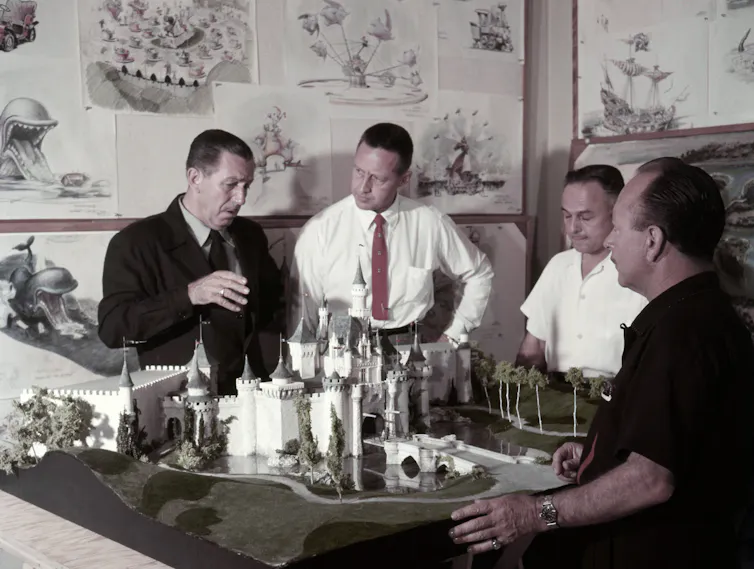
Walt Disney, à l’extrême gauche, discute des plans de Disneyland avec quelques-uns des ingénieurs de son entreprise – connus sous le nom d’« imagineers ». Earl Theisen/Getty Images
Il existe des raisons légitimes de se plaindre de l’authenticité de certaines expériences. Si vous achetez un billet pour une exposition Van Gogh, vous pourriez légitimement vous plaindre si vous découvriez que seules des reproductions étaient exposées. Le fait que vous n’ayez pas pu faire la différence en regardant les tableaux n’aurait aucune importance : vous n’auriez pas vécu l’expérience authentique de voir les œuvres originales de Van Gogh.
En revanche, les attractions Disney ne prétendent pas être autre chose que ce qu’elles sont.
Lorsque les visiteurs des Disney’s Hollywood Studios montent à bord de l’attraction Mickey and Minnie’s Runaway Railway, ils savent qu’ils ne se trouvent pas réellement dans un train fou conduit de manière incompétente par un chien doué de parole nommé Goofy. Si Disney avait commercialisé l’attraction comme étant autre chose – disons, un voyage en train à grande vitesse pour enfants –, il y aurait peut-être lieu de se plaindre de son caractère factice.
Ce n’est clairement pas ce à quoi s’attendent ceux qui font la queue pour vivre cette expérience. Monter à bord du Runaway Railway n’est peut-être pas votre façon préférée de passer le temps, mais il n’y a rien de factice dans ce qu’il prétend être.
Qui êtes-vous pour juger ?
Si la forme initiale de l’objection relative à l’authenticité est relativement facile à déconstruire, une autre préoccupation se cache dans cette critique : l’idée que les fans de Disney seraient en quelque sorte faux eux-mêmes, en raison de leur goût pour ce monde artificiel.
La nature précise de cette critique est un peu difficile à caractériser. Mais elle implique la conviction que les personnes qui passent beaucoup de temps dans des environnements artificiels ont tendance à se bercer d’illusions d’une manière qui les empêche de comprendre et d’entrer en contact avec leur véritable moi. Des termes tels que « authenticité existentielle » ou « moi authentique » semblent saisir ce qui est en jeu.
La spécialiste des médias Idil Galip a souligné le fait que les parcs sont « conçus et testés auprès de groupes cibles ; il y a énormément de travail pour vendre ce genre d’expérience ». Il s’agit de provoquer « une rupture avec la société ordinaire ou la vie réelle ».
Ce lien supposé entre le monde factice de Disney et la corruption de son moi authentique est clairement mis en évidence dans les descriptions des soi-disant « adultes Disney ».
« Être fan de Disney à l’âge adulte, c’est se déclarer rien de moins qu’un idiot sans esprit critique, confortablement lové dans ses privilèges, figé dans un état d’adolescence permanente… refusant de reconnaître la triste réalité : les rêves ne se réalisent pas vraiment. »
Mais je m’inscris en faux contre l’idée selon laquelle l’amour de Disneyworld rendrait les gens faux ou inauthentiques.
Comme l’affirme la journaliste et blogueuse A. J. Wolfe dans son livre publié en 2025, Disney Adults, même les plus fervents adeptes de Disney échappent à toute catégorisation simpliste. Aucun d’entre eux, explique-t-elle, ne semble fuir sa véritable personnalité ni même essayer le moins du monde de vivre dans un monde imaginaire.
Par exemple, Wolfe dresse le portrait de Lady Chappelle, une tatoueuse britannique qui s’est installée à San Diego, où elle réalise exclusivement des tatouages sur le thème de Disney. Il y a aussi Brandon, une drag queen d’Hollywood qui a conçu une cuisine sur le thème du Carousel of Progress en l’honneur de l’attraction qui se trouve désormais au Magic Kingdom de Disney à Orlando, en Floride.
Ces personnes sont représentatives de la quasi-totalité des « Disney Adults » : ils sont passionnés par Disney, mais ils sont également passionnés par le tatouage, le drag et une myriade d’autres activités.
Pour les « Disney Adults », écrit Wolfe, l’affection pour Disney ajoute surtout « une touche de couleur et d’éclat – peut-être un sens, une motivation ou une inspiration si vous avez de la chance – au chef-d’œuvre complexe et en constante évolution qu’est [leur] vie ».
Et si cette complexité s’applique aux plus fervents fans de Disney, il est d’autant plus problématique de présenter les visiteurs occasionnels sous un jour aussi négatif.
Les vertus du « Royaume enchanté »
Si les parcs à thème ne sont pas votre tasse de thé, ce n’est pas grave. Vous pouvez mener une vie merveilleuse sans jamais mettre les pieds à Epcot ou à Animal Kingdom.
Mais comme je le souligne dans le Royaume enchanté et le sens de la vie, Disneyworld possède un certain nombre de qualités que ses détracteurs ont souvent tendance à ignorer.
Je pense que c’est un endroit aussi bien qu’un autre pour que des personnes de tous âges, de tous horizons et de toutes capacités se réunissent et se créent de précieux souvenirs. Lorsque je fais le manège Tiana’s Bayou Adventure avec ma femme et notre fille atteinte d’un handicap intellectuel, chacun y trouve son compte : juste ce qu’il faut de sensations fortes et d’histoire pour les adultes, sans que cela soit trop intense pour ma fille. C’est une combinaison difficile à trouver ailleurs.
De plus, comme nous sommes transportés loin de notre routine quotidienne, les parcs peuvent également offrir des occasions surprenantes de réflexion. Par exemple, j’ai beaucoup réfléchi aux attentes culturelles liées au bonheur pendant mes séjours à Disney. Dois-je essayer de maximiser mon plaisir pendant ce court séjour ? Ou simplement prendre chaque jour comme il vient ? J’ai appris à adopter cette dernière approche.
J’ai également appris à apprécier la valeur du plaisir anticipé, ce sentiment positif que l’on éprouve en attendant avec impatience quelque chose avant qu’il ne se produise. Cela m’est venu en réfléchissant à tout le temps que les gens passent à faire la queue dans les parcs d’attractions.
Oui, nombreux sont ceux qui souhaitent simplement utiliser l’univers de Disney – parcs d’attractions, films ou autres – pour échapper au train-train quotidien. Mais la recherche d’une telle évasion constitue-t-elle une plus grande menace pour l’authenticité que de s’évader en jouant à des jeux vidéo, en regardant du sport, en lisant des romans érotiques ou en consommant de la drogue et de l’alcool ?
Est-il possible de se perdre dans la fantaisie ? Bien sûr – tout comme il est possible de se perdre dans sa carrière, ses relations ou ses loisirs. Mais à l’ère des comptes de réseaux sociaux soigneusement orchestrés, du marketing d’influence et du double langage politique, les mondes artificiels de Disney pourraient bien offrir plus d’authenticité qu’on ne le pense.
Adam Kadlac ne travaille pas, ne conseille pas, ne possède pas de parts, ne reçoit pas de fonds d’une organisation qui pourrait tirer profit de cet article, et n’a déclaré aucune autre affiliation que son organisme de recherche.
Source: The Conversation – UK – By Marlé Hammond, Reader in Arabic Popular Literature and Culture, SOAS, University of London
“I am a king of angels, from beginning to end. Arrani you’ll soon be crying out, weeping endless tears,” sings Akram Qawar in Arabic while gesticulating at his opponent. Muhammad al-Arrani sings back: “What are you mumbling about? No one understands your verse, did you just come here to make a fool of yourself in the arena?”
“Who’s [sic] uncles are out here doing battle raps,” one fan exclaims in the caption on a video in which he dances along to the sound of a similar exchange to the one above. If you’ve seen these videos of predominantly middle-aged men insulting each other poetically in Arabic you too may have likened them to modern day rap battles. What they actually are is a centuries-old genre of Arabic sung poetry called zajal.
In its general sense, zajal refers to poetry composed in any of a number of colloquial Arabic dialects. Much more specifically, it refers to a kind of musical poetic performance, often involving verbal duels, which is especially popular in Lebanon, Palestine, Syria and Jordan.
No one’s 20s and 30s look the same. You might be saving for a mortgage or just struggling to pay rent. You could be swiping dating apps, or trying to understand childcare. No matter your current challenges, our Quarter Life series has articles to share in the group chat, or just to remind you that you’re not alone.
Zajal dates back to 12th-century Islamic Iberia, where it emerged as an alternative to the standard Arabic poetic tradition. Zajal poems differed from that tradition not only in language – the Andalusian dialect of Arabic was used – but also in form. These poems had complex rhyme schemes, unlike the monorhyme that characterised high poetry of the time. And, they were composed to be sung.
Zajal’s most celebrated early practitioner was Ibn Quzman (1078 to 1160), a Cordoban who travelled from court to court seeking favour with his songs of praise, wine and love, which often had a rebellious twist. In one poem, for example, he celebrates the end of Ramadan as a return to illicit behaviour:
Hurrah, drunkards, for the sake of the Prophet, gang!
This is the time when the month of fasting ends!
From Spain, zajal soon spread to North Africa and the Middle East. According to an article by scholar of Arabic Adnan Haydar, there is a theory that, in the particular case of Lebanon, zajal poetry has its roots in the Maronite church. This is a church centred in Lebanon that is part of the Roman Catholic Church but with a distinct Antiochan/west Syrian liturgical tradition.
It’s believed that in late 13th century the Maronite church fathers started translating Syriac hymns into the local Arabic dialect. These zajal hymns were recorded in manuscripts from the 15th until the late 17th century, when zajal became an integral part of Lebanese folk culture.
A famous proponent and composer of zajal in the modern era was Rachid Nakhlé (1873 to 1939). Dubbed the Prince of Zajal, Nakhlé’s vernacular poetry is said to have influenced Lebanon’s Romantic and Symbolist poets.
Haydar describes the occasions for zajal performances as village gatherings, from weddings to saint days to functions in private homes. The best zajal performers from certain districts would sometimes meet for competitions where each would try to outperform the other in improvised verbal artistry. In its heyday in the mid-20th century, zajal performers would team up in bands and have competitions between two rival groups, sometimes before audiences in the tens of thousands.
The verbal sparring involves boasting about their capabilities and putting down their rivals and opponents. Martial imagery is common, but it is poetic supremacy that the zajal performers seek.
Haydar relates a famous exchange between zajal poets Jiryis Bustani and Tali Hamdan that took place in a concert at a monastery in Beit Meri, Lebanon in 1971. In the first stanza, Bustani compares his poetic prowess to slaughter, threatening to scatter heads, and asserting that the “Battle of Beit Miri” will go down in history. In the second stanza Hamdan mocks Bustani’s threats, saying “I shall strangle you and make you a mere echo (sada),” before asserting that he will beat Bustani in every battle, that of Beit Miri being no exception.
Bustani returns in the third stanza, picking up on Hamdan’s “echo”, saying that the registers of history will mention the “echoes of my cannonballs”. A common strategy is to repeat words and phrases at the heart of the competitor’s put-downs and to reframe them as a strength.
An excerpt from a 1968 concert underscores the extent to which wordplay guides the performers. Zajal poet Zein Sheib begins the exchange by waxing poetic about the free soldier who has his own mind. He speaks of piety, on land and in the air, and a quail flying off, as he negotiates the waves of a tumultuous sea. What makes his words cohere is not so much meaning as sound. He is continuously rhyming on the letter “r”, rolled and doubled, using words such as “farr” (escape) and “jarr” (drag). He’s showing off his ability to place these words in grammatically correct, if somewhat frivolous, sentences. Next comes Edouard Harb. He does the same with the letter “m”, continuing with the sea imagery.
Then Tali Hamdan sings of swords and rhymes intensively on the letter “l”. Zaghloul el Damour (aka Joseph al-Hashem) finishes things off decisively as he rhymes on the letter “d”. First, he boasts about himself, saying that although his horse has fallen he has managed to send his rival retreating, and then he taunts each of his three competitors: Zein got worked up, earnestly and in jest; Harb ranks in the minor league, and Hamdan thinks highly of himself but is no taller than a legless table. The insults are slung light-heartedly, and all present – performers and audience members alike – revel in their wit.
Zajal experienced a decline during the Lebanese Civil War (1975 to 1990) but has seen a revival in the decades since. For instance, in the 2010s the zajal competitions in the TV show Owf attracted competitors from throughout the region. Meanwhile, highlights from Lebanese zajal performances in the 1960s and 70s are being sampled in remixes and mashups on YouTube, TikTok and Instagram. Palestinian artists engage in a similar tradition, which is also trending.
So, if a friend shares a video of uncles “doing battle raps” you can tell them what they’re actually doing, which is engaging in the storied poetic tradition of zajal.
The authors do not work for, consult, own shares in or receive funding from any company or organisation that would benefit from this article, and have disclosed no relevant affiliations beyond their academic appointment.
In just a few years, generative artificial intelligence (gen AI) has brought about significant changes in many industries from healthcare to education, entertainment to finance, and even law.
The use of gen AI in court verdicts poses significant risks to justice. Erroneous outcomes generated from “hallucinated” information, discriminatory decisions and lack of transparency are all concerns when this technology is introduced to courtrooms.
But already a number of judges around the world have used it in decision-making and judgment writing. This is why some jurisdictions, including the UK, have issued guidelines for judges regarding AI use.
Broadly, the guidelines suggest judges might use AI as a tool to conduct preparatory works such as drafting summaries of long documents, translating legal documents, identifying legal precedents or enhancing readability of documents. They recommend against the application of it for core judicial functions, including decision-making.
Recently, some senior judicial leaders have opined that AI might be used to decide “low-stakes” or less-complex cases with adequate precautions, such as keeping a human judge in the loop.
In a November 2024 speech, the UK’s second most senior judge, Geoffrey Vos, spoke of a “spectrum” of legal decisions that AI might soon make, or help make.
Vos said the use of AI for “broadly mechanical decisions, like those about the amount of a pension or benefits, or the calculation of personal injury damages and loss of earnings” would likely save money and time. But he called for discussion on whether such use would violate essential human rights.
A year later, Vos again called for “serious debate” about what rights humans should have protected in this context. And he urged that AI be “used responsibly, effectively and safely in legal systems and processes”.
AI has long been discussed as a threat to jobs and livelihoods. But what’s the reality? In this new series, we explore the impact it is already having on different occupations – and how people really feel about their AI assistants.
A number of jurisdictions are testing or using AI in such “mechanical” cases already. Estonia uses a semi-automated small-claims system in civil proceedings for monetary claims up to €7,000 (£6,100), with human clerks overseeing the process.
Frankfurt District Court in Germany has tested an AI system named Frauke to deal with air passenger rights lawsuits. Frauke analyses earlier cases and rulings to create pre-configured draft judgments. Judges assemble final verdicts from these texts following their ruling, significantly reducing the time spent drafting.
Taiwan piloted an AI-powered tool to assist courts by producing ruling notices for Driving Under Influence cases, or aiding and abetting in fraud cases. The AI system generates a complete draft ruling including the facts, legal reasoning, citations and final verdict. The judge reviews this draft and, upon approval, can issue it as the official judgment, with or without modifcations.
It is evident from these examples that the key motivation to replace human judges in a certain category of cases is efficiency. As a result, a few other jurisdictions are also exploring the scope of integrating gen AI to adjudicate certain litigation without human judges.
The cost of using gen AI as judge
Courts are overburdened, and technology like gen AI promises consistency and efficiency. But it would mark a significant change of centuries-old practice. And it risks undermining what some legal scholars argue is a fundamental principle of justice: the right to be judged by a human being.
Court adjudication is not only about reaching a decision. It is about a holistic and fair process that includes the right to be heard – presenting defence, weighing competing narratives, and exercising judgment in light of law and equity.
Algorithmic tools, no matter how advanced, do not hear or “understand” even their own output, let alone human values or changing social contexts. Gen AI cannot recognise suffering, credibility, remorse or vulnerability like a human. That alone makes it unfit to sit in a judge’s seat.
Some legal scholars argue the right to be judged by a human is a fundamental principle of justice. Korawat photo shoot/Shutterstock
Categorising cases as simple or complex may look pragmatic, but it is both legally and morally dangerous. What counts as a “simple, routine or mechanical” case is itself a human decision. Legal disputes over compensation or benefits may appear straightforward on paper, yet carry significant consequences for the person bringing the case.
Allocating such cases as appropriate for algorithmic adjudication risks creating a two-tier justice system – in which one group of citizens gets to present their case before a human judge, while others are handled by machines. Only the former, I would argue, are exercising their right to a fair hearing and trial before an independent and impartial tribunal, as protected under Article 6 of the European Convention on Human Rights.
Additionally, the efficiency argument may become illusory. Algorithmic systems like gen AI require continuous human oversight, auditing and rectification. Hallucination or mistakes, whether from flawed design or biased training data, can completely negate the claimed benefits.
Public trust matters in all legal systems. If people lose trust in automated decisions, appeals will increase – adding to the existing backlog of cases.
Emerging technology such as gen AI may be suitable to manage court administration and reducing clerical burdens. But substituting human judges, even in supposedly low-stakes cases, undermines basic principles of justice. Efficiency should not come at the expense of the values the justice system exists to protect.
Raisul Islam Sourav does not work for, consult, own shares in or receive funding from any company or organisation that would benefit from this article, and has disclosed no relevant affiliations beyond their academic appointment.
Charity shops are generally seen as a responsible way to get rid of unwanted belongings. In theory, donating items allows them to be reused and raises money for important causes. However, many charity shops struggle to make use of the donations they receive.
When goods are donated to charity shops, they are either sold to local customers to be reused or purchased by commercial companies and traded through complex international markets.
An estimated 70-90% of donated goods follow these routes, with local traders reusing and recycling as much as possible. However, large quantities are also dumped and burned, resulting in environmental damage and waste.
My ongoing research shows the challenges charity shops face in reusing donated goods. Charity shops are the primary outlet for used textiles in the UK: roughly half of all textiles currently collected for reuse and recycling are charity shop donations. This role already puts them under significant pressure, and is likely to become more challenging if rates of production and disposal increase.
My research found that many charity retail staff are very focused on fundraising. Shops have strict financial targets to ensure they are supporting the charitable cause. As one charity retail senior manager put it: “That’s why you exist.”
Charity trustees have a legal duty to act in the best interests of their charity and to manage its resources responsibly, so shops which aren’t profitable can end up being closed.
Why some items people hope are being recycled are actually being burned.
This can be problematic for the reuse of low-value goods, which offer a limited return on staff labour time and shop floor space. In the words of another interviewee for my research: “We can’t stick everything out with a penny on it, that’s not how it works. We have to prioritise what we’re going to see the biggest return on.”
This issue is intensified by the overwhelming volume of discarded goods. Charity shops in the UK receive an estimated 350,000 tonnes of used clothing every year, in addition to a wide range of other household items, the quantities of which are not well documented.
Sorting and preparing donated goods for sale is time-consuming and labour-intensive. In one shop, a senior manager at a national charity retailer told me: “They get that many donations, and they’re that understaffed – they don’t have the time or the space, so it’s easier and better to just put it in the bin.”
As a result of these challenges, donated goods which are potentially reusable (as well as those which are too worn out for sale) may be landfilled, incinerated or recycled into low-value applications such as mattress stuffing.
This problem is linked to levels of consumption in the UK and other high-income countries. The average number of garments purchased per person globally increased by roughly 60% between 2000 and 2014, with each item being kept for half as long. In 2022, UK shoppers bought 1.42 million tonnes of new textile products, and this figure could reach 2.37 million tonnes by 2030. Much of this clothing is low quality, with little potential for reuse.
International markets for used goods are increasingly over-saturated, and are also vulnerable to geopolitical unrest, so are increasingly constrained in what they will take.
What you can do to help
1) Make sure your donations are clean and in working order. Overstretched charity shop staff may not have time to sew a new button onto a shirt or even clean a piece of crockery. If something you want to get rid of is broken and you don’t know how to mend it, take it to your local repair cafe first.
2) Try to donate seasonally appropriate goods. If you bring jumpers in June, the charity shop has to find somewhere to store them until September.
3) If you have a lot to donate, call your local charity shop first. Check if they have capacity to take it, and don’t be offended if they politely decline or ask you to come back another day.
4) Take items which can’t be reused, such as worn-out socks and stained teatowels, to a recycling point instead of a charity shop.
5) Find specialised outlets that will offer the best chance of an item being reused. For example, consider a baby bank for buggies and cots, or a scrap store for unwanted craft materials.