Alzheimer’s disease: lithium may help slow cognitive decline – new research in mice

Source: The Conversation – UK – By Rahul Sidhu, PhD Candidate, Neuroscience, University of Sheffield

Previous research has shown that as people move from mild cognitive impairment to Alzheimer’s disease, their lithium levels drop. photo_gonzo/ Shutterstock

Alzheimer’s disease steals memories and devastates lives. Yet despite an abundance of research, the earliest brain changes that trigger this disease still remain unclear, making it challenging to find effective treatments.

But could lithium – a metal most of us know better for its use in batteries or as a treatment for mood disorders – play a role in cognitive health? New research shows that this mineral may play a key role in protecting against Alzheimer’s disease.

Alzheimer’s is linked to the buildup of two harmful proteins: amyloid-beta and tau. Amyloid-beta clumps outside brain cells (neurons), forming sticky plaques that block communication. Tau twists into tangles inside cells, disrupting their structure and function. Together, they damage the delicate network of neurons that supports memory and thinking.

But for nearly a decade now, scientists from Harvard University have also been uncovering lithium’s unexpected importance in the brain.

Lithium is naturally present in small amounts in the brain. This lithium comes from our diet, where it’s transported through the bloodstream to the brain’s cells. But researchers have found that as people move from mild cognitive impairment – a stage often seen as a warning sign for Alzheimer’s – to full Alzheimer’s disease, their lithium levels drop. This loss of lithium appears to set off the cascade of changes that lead to memory loss and confusion.

This recent study now helps to explain why a loss of lithium is linked with Alzheimer’s disease. The study showed that lithium acts as a natural defender – helping to keep amyloid and tau in check. When lithium levels fall, the brain becomes more vulnerable to these toxic proteins.

Researchers uncovered this connection by conducting postmortem examinations of brain tissue taken from people who had been in different stages of cognitive health. Those with mild cognitive impairment had noticeably less lithium in their brains compared to those who had been in good cognitive health. Levels were even lower in Alzheimer’s patients.

Interestingly, they found that the lithium doesn’t just disappear. Much of it becomes trapped within amyloid plaques, which lock it away from the brain cells where it’s needed most. This means even if total lithium levels don’t drop drastically, brain cells may still be starved of its protective effects.

So to explore what happens when lithium is missing completely, the scientists then studied mice – both healthy mice and mice that had been genetically engineered to develop Alzheimer’s symptoms. They cut the mice’s dietary lithium by 50% and observed the results.

The effects were striking. Mice with reduced lithium showed faster amyloid and tau buildup, more brain inflammation and lost connections between neurons – all crucial for learning and memory. The genetically engineered mice also performed worse in memory tests.

A depiction of amyloid plaques forming between the brain's neurons.
Amyloid plaques built up more quickly when the mice had no lithium.
nobeastsofierce/ Shutterstock

At the core of this process is an enzyme called GSK3β. Lithium normally keeps this enzyme under control. But when lithium is low, GSK3β becomes overactive, encouraging tau to behave abnormally and form tangles that damage neurons. This enzyme acts like a switch, tipping brain cells toward disease if unchecked.

The good news is the study didn’t stop at identifying the problem. Researchers treated mice with lithium orotate, a form of the mineral that’s less likely to get trapped by amyloid plaques. This treatment prevented the harmful buildup of amyloid-beta and tau, reduce inflammation, preserved neuron connections and improved memory.

Lithium’s importance

This research recasts lithium as more than a forgotten trace mineral. It appears to be a vital guardian of brain health, protecting neurons and maintaining cognitive function throughout life. Disrupting lithium balance might be one of the earliest steps toward Alzheimer’s – even before symptoms show.

Lithium’s protective role isn’t entirely new. It’s been used in psychiatry for decades, particularly to manage bipolar disorder where it stabilises mood. But medicinal doses are much higher than the tiny amounts naturally present in the brain. This study is the first to reveal that even these small, natural levels have a crucial protective function.

Beyond Alzheimer’s, lithium supports brain growth, shields nerve cells, and calms inflammation, all important for healthy ageing. Keeping lithium levels stable could have wider benefits in preventing dementia and supporting brain resilience.

One reason lithium hasn’t featured prominently in Alzheimer’s research before is its simplicity. It doesn’t target one molecule but acts like a conductor, balancing multiple brain processes. This makes it harder to study but no less important.

The discovery that lithium deficiency worsens Alzheimer’s damage opens new possibilities. Unlike current treatments focusing on removing amyloid plaques or tau tangles, lithium replacement could boost the brain’s defences.


Read more:
Alzheimer’s drug approved in the UK, but it won’t be available on the NHS – here’s why


Lithium orotate is especially promising because it doesn’t get trapped by amyloid and delivers lithium where neurons most need it. Lithium salts have long been used safely in medicine, so this approach could be easy and accessible for older adults.

Still, it’s unclear why lithium levels fall in some people. Is it due to diet, genetics or another cause? Could differences in the natural levels of lithium in drinking water worldwide influence Alzheimer’s risk? These puzzles invite future research.

It’s also important to note that much of this work was done in mice. While animal models offer valuable insights, human brains are more complex. Clinical trials will be needed to see if lithium orotate can safely prevent or slow Alzheimer’s in people.

We also don’t yet know how supplements or diet might affect brain lithium levels over time, or if this would be practical as treatment.

Still, the idea that a simple mineral could delay or prevent one of the world’s most devastating diseases is both exciting and hopeful.

The Conversation

Rahul Sidhu does not work for, consult, own shares in or receive funding from any company or organisation that would benefit from this article, and has disclosed no relevant affiliations beyond their academic appointment.

ref. Alzheimer’s disease: lithium may help slow cognitive decline – new research in mice – https://theconversation.com/alzheimers-disease-lithium-may-help-slow-cognitive-decline-new-research-in-mice-262880


Quentin Blake and Me at the Lowry: the magic touch of Britain’s best-loved children’s illustrator

Source: The Conversation – UK – By Maria Stuart, Course leader, Illustration & Children’s Book Illustration, School of Arts and Media, University of Lancashire

I’m greeted at the Lowry by Roald Dahl’s grinning Enormous Crocodile, who looks a bit too happy to see me and the toddler in a pushchair watching his father snapping his arms open and shut while making crocodile noises. We are both delighted by this, and eager, it seems, to see this new Quentin Blake and Me exhibition, a collection of original illustrations by Britain’s best-known children’s book illustrator.

Now aged 92, Quentin Blake has been illustrating and writing books for more than 70 years and has hundreds of titles under his belt.

So many of us have grown up with Blake’s work, an important part of our formative years. His many books have seen him working with some of the greatest children’s authors including Dahl, Joan Aiken, John Yeoman, Elizabeth Bowen and Michael Rosen. He has also written books himself and animated versions of his work, bringing his storytelling to new generations.

The Lowry exhibition extends an invitation to consider what Blake and his work means to each of us. This makes perfect sense as every visitor is a child or has been at some stage, and each feels connected to their own special memories of these wonderful books.

This is an important point to understand about the practice of illustrating picture books. As a lecturer working with children’s book illustration students, I encourage them to channel and engage with their four-year-old self.

By revisiting this part of ourselves we can understand not only how to capture the right tone, but recognise what makes children laugh, or what intrigues them, the discoveries and places they would enjoy, and who and what they might be scared by. This is evident in all of Blake’s work, about which he once said: “It’s not about knowing about children, but [that] you be them.”

As Blake demonstrates, the picture book illustrator is not just making pictures of the text – an illustrator can bring everything vividly to life using their skills and imagination. I overheard a parent as she pondered Mr Magnolia and his one boot, saying: “He makes it look so easy”. And indeed Blake does.

There is a fluidity and immediacy to his illustrations that make them appear effortless; a rough draft is placed on a light box and Blake draws his final image using this as a guide. This process allows him to work with pen and ink as if drawing the picture for the first time, capturing the expressiveness of an initial idea.

He conjures scenarios on the page that are compelling – nothing is contrived, so it all feels authentic. Readers young and old will go on any journey that Blake wishes to take them because of his genuine warmth and humour, his delightful imagination captured in drawing and painting that is full of energy and charm. This is the magic of illustration.

The exhibition is just as joyful and playful as the work on display. Original illustrations from a range of Blake’s books that span his career are framed and exhibited low enough for children to be able to view them easily. Adults have to stoop a little, ensuring they are on the same level.

Early on in the exhibition some of the Mr Magnolia illustrations are squished into a little V-shaped corner, which made me think of reading a picture book as a child, sitting on the floor wedged between the wall and the side of my bed.

Blake’s books are so cleverly illustrated ensuring that even if you can’t read yet, you can still understand not only the narrative but all the little visual jokes and special surprises that he regularly delivers. Never talking down to children or over explaining things, these are books that help to cultivate a sophisticated and discerning young reader.

The characters of each of the books featured escape from the pages and charge around the walls of the exhibition, taking up every available space. Here the BFG (Big Friendly Giant) towers over children having their photograph taken, and there the fine feathered creatures from Up With Birds swing around the gallery ceiling along with their glorious balloons.

It is fascinating to see Blake’s development work in notebooks, early roughs of book spreads as well as thumbnail plans – all evidence of the hard work that goes in to creating his books.

There are opportunities for children to dress up with The Boy In The Dress, and peep-holes in a wall reveal Blake’s studio set-up. There are also activity sheets and prompts for children to write and draw their own stories. Materials are set up in front of the “Monsters” wall so that visitors can join in creating illustrations. I can’t resist and add my own.

This is a wonderful exhibition that reveals the power of imagination, inspiring creativity, activity and reading in little ones. And those who are no longer children can tap into a delightful sense of nostalgia and revisit distant days of carefree reading and the flamboyant adventures of Blakes’s beautifully drawn characters.

Quentin Blake And Me is on at The Lowry, Manchester until January 4 2026. Admission is free.


Looking for something good? Cut through the noise with a carefully curated selection of the latest releases, live events and exhibitions, straight to your inbox every fortnight, on Fridays. Sign up here.


The Conversation

Maria Stuart does not work for, consult, own shares in or receive funding from any company or organisation that would benefit from this article, and has disclosed no relevant affiliations beyond their academic appointment.

ref. Quentin Blake and Me at the Lowry: the magic touch of Britain’s best-loved children’s illustrator – https://theconversation.com/quentin-blake-and-me-at-the-lowry-the-magic-touch-of-britains-best-loved-childrens-illustrator-262744

The ten best songs under one minute long

Source: The Conversation – UK – By Glenn Fosbraey, Associate Dean of Humanities and Social Sciences, University of Winchester

(L-R) Masters of brevity Kate Bush, Tierra Whack and Billie Joe Armstrong. Wiki Commons/Canva, CC BY-SA

Life is busy these days, so when you manage to get some well-earned free time, it’s important to use it wisely. You could, for example, invest a spare ten minutes listening to King Gizzard & The Lizard Wizard’s song Crumbling Castle (2017) or Taylor Swift’s All Too Well (Taylor’s Version) (2021).

Alternatively, you could listen to these ten songs, each less than a minute long, and each a masterpiece in brevity.

1. Meant for You by the Beach Boys (1968)

Brian Wilson may have taken more of a back seat on Beach Boys albums following the abandonment of his magnum opus Smile, but he was still capable of coming up with extraordinarily beautiful music.

At just 39 seconds, Meant for You is over in a flash, but it’s a flash of Wilson’s genius.

2. Black Nails by Tierra Whack (2018)

Seemingly in defiance of its running time, Tierra Whack takes her time on Black Nails with the slow, relaxed keyboard solo taking up almost a third of the song before the vocals come in.

I could have chosen any of the tracks from Whack’s 2018 album Whack Life, but this is perhaps the one where she makes the best use of the super-short format.

Meant for You by the Beach Boys.

3. My Mummy’s Dead by John Lennon (1970)

John Lennon fans in 1970 were a confused bunch. The year began with their idol still a Beatle (he had, in fact, quit in September 1969, but it was kept quiet), and still sporting the long hair and beard from the Abbey Road album cover.

By its end, The Beatles were officially no more, Lennon had shaved his head, and had released the soul-baring album John Lennon/Plastic Ono Band complete with f-bombs (Working Class Hero), denouncement of his former band (God) and literal screams of anguish at his childhood trauma (Mother).

The final body-blow comes via final track My Mummy’s Dead, which, through its 51 seconds of simplistic, stripped-back, devastating music, signalled that Beatlemania was officially over.

4. Song of The Century by Green Day (2009)

The opening track of Green Day’s epic album 21st Century Breakdown, Song of the Century’s primary function is to set the scene (and tone) for what’s to come.

But it’s a fine song in its own right, with the lo-fi production making Billie-Joe sound like he is singing to us through a transistor radio we’re desperately trying to keep tuned in.

Black Nails by Tierra Whack.

5. Boa Constrictor by The Magnetic Fields (1999)

Just before the start of the century that so troubled Green Day, American indie band The Magnetic Fields released the spectacularly ambitious album 69 Love Songs which contained, yes, you’ve guessed it, a whopping 69 tracks spread over a near three-hour running time.

Among the many tracks are a few delightfully understated vignettes, including this one, with Shirley Simms taking lead vocals.

6. Abide With Me by the Thelonius Monk Septet (1957)

I almost excluded this track – the first on 1957 album Monk’s Music – for it being an instrumental, but in the end decided it was simply too good to leave out.

With only the horn section of the septet playing, Thelonius Monk himself doesn’t appear, but John Coltrane does, which means at least one jazz legend is present and accounted for. Now forever associated with the FA Cup final (having been played before every one since 1927), this version knocks spots off any other I’ve heard and is a fittingly brilliant interpretation of one of music’s truly beautiful melodies.

Abide With Me by the Thelonius Monk Septet.

7. Trouble by Eminem (2024)

You could be forgiven for thinking Trouble was just another of Eminem’s skits. But it’s actually a bonafide song, and one which tackles the dynamic between Eminem and his alteregos Marshall Mathers and Slim Shady head-on.

Although the track does begin with the spoken-word set-up so familiar from his skits, it soon moves into rap. The Slim Shady alter ego launches one of his most offensive tirades yet to deliberately get himself, Marshall and Eminem “cancelled”. This one’s not for the faint of heart.

Trouble by Eminem.

8. The News (A Wholly Owned Subsidiary of Microsoft) by Deltron 3030 (2000)

At the dawn of the new millennium, while other hip-hop artists rapped about money, women, and violence, Deltron 3030 (comprised of Del the Funky Homosapien, Dan the Automator, and Kid Koala A) had their eyes on something altogether different: a dystopian hip-hop space opera set over a thousand years in the future.

This vignette comes midway through the narrative and sees Icelandic singer Hafdís Huld delivering a spoken word piece in her native tongue over a drum and harp backing track. It’s as spectacular as it sounds.

9. Night Scented Stock by Kate Bush (1980)

Appearing toward the end of third studio album Never for Ever, Night Scented Stock is Kate Bush at her ethereal best.

With her wordless layered vocals seeming to joust with one another as they soar and fall, this is the perfect palate cleanser before the final two tracks.

Night Scented Stock by Kate Bush.

10. 50% by Grandaddy (2006)

Almost the polar opposite of Night Scented Stock, 50% is a distorted, in-your-face, assault on the senses, where singer-songwriter Jason Lytle challenges himself to write a song with “Fifty per cent less words”.

Less than what, exactly, remains unclear as the song comes to an abrupt end, but it scarcely matters. And yes – the song’s running time is technically 1m 02s, but who’s really counting?


Looking for something good? Cut through the noise with a carefully curated selection of the latest releases, live events and exhibitions, straight to your inbox every fortnight, on Fridays. Sign up here.


The Conversation

Glenn Fosbraey does not work for, consult, own shares in or receive funding from any company or organisation that would benefit from this article, and has disclosed no relevant affiliations beyond their academic appointment.

ref. The ten best songs under one minute long – https://theconversation.com/the-ten-best-songs-under-one-minute-long-262817

Is mineral water ‘natural’ if it’s filtered? The debate gripping France today has raged since the 18th-century

Source: The Conversation – UK – By Daniel Gettings, Sessional Tutor, Department of History, University of Warwick

A year ago, French newspaper Le Monde and Radio France broke a scandal in big water – Perrier was filtering its product. The filtering began due to worries about water contamination linked to climate change and pollution of spring sources.

It was also revealed that executives at parent company Nestle and French government ministers tried to keep it all quiet. They allegedly covered up reports of contamination and changed the rules to allow micro-filtration.

Under EU law, for a brand to market their products as “natural mineral water” it has to remain unaltered. French mineral water companies are now awaiting a ruling on what level of filtration is considered illegal “treatment”. The result could mean that, after 160 years, Perrier will no longer be able to be call its product “natural mineral water”.

Strikingly, the same issue was debated extensively by scientists during the 18th-century European spring water boom. These men considered the effects of human intervention on the product and what was lost in the process.

A spa boom

In the 17th and 18th centuries, medical interest, in addition to factors like travel for leisure, resulted in the proliferation of new spa towns across Europe.

In England, Buxton and Tunbridge Wells developed in the 1620s and 1660s respectively, while Harrogate, Cheltenham and Leamington came in the 1710s, 1750s and 1790s. Historical survey’s place the number of spas and wells offering healing mineral waters at around 350 in the 18th-century heyday.

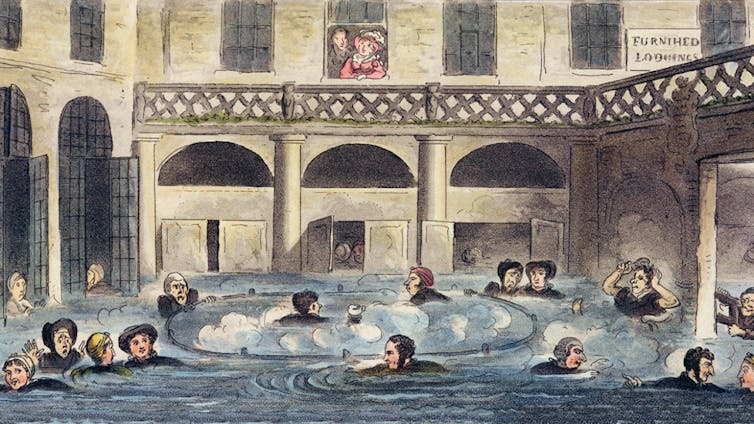
Spas like Bath, Buxton and the Bristol Hotwell were thermal, offering hot bathing. However, other spa sources in England were not heated. This meant that those who wished to bathe had to do so in the cold, which was both undesirable, and at that time, considered dangerous. This was due to fears that the English cold climate, when combined with bodily exposure to cold water, could disrupt bodily rhythms an cause illness.

People bathing at bath spa
Public Bathing at Bath, or Stewing Alive, by Isaac Cruikshank, 1825.
Wikimedia

As a result, many of the cold spas focused on offering health benefits through drinking their waters. When hailing the qualities of the newly discovered waters at Scarborough in 1660, Yorkshire doctor Robert Wittie declared they had “gained such credit” that people: “Come above an hundred miles to drink of it, preferring it to all other medicinal waters they had formerly frequented.”

He later described the health benefits he gained from drinking them:

I had lost two pound and a half of my weight… I found after it better agility of body, and alacrity of spirit then before.

In 1654, the doctor Edmund Deane had similarly described the effects of the waters of Knaresborough: “Those waters at the Spaw doe presently heal, and (as it were) miraculously cure diseases, which are without all hope of recovery.”

Testing the waters

As the number of spas grew, so did the options for consumers. As a result, the 18th century saw increasing attention and experimentation on mineral waters by scientists. Rather than questioning the health benefits, they instead compared waters to one another, experimenting on them to determine processes that produced and changed healing properties.

For example, British doctor George Turner, who translated and expanded upon a German work about the spa of Bad Pyrmont, in 1733. His work discussed experiments on the waters of the spa and the minerals that could be determined within. It noted that if left standing, the carbonated water lost its potency: “Whence it is, that so spiritous a liquid does so easily turn to a flat insipid water.”

He also suggested that boiling caused mineral waters to lose some invisible element important to its proper function. “Why so many globules of air arise out of mineral waters when it is warmed?” he asked, only to conclude that when “spirits fly out of any liquid” they go “incognito without any tumult”. As they “flew”, so too did whatever gave these waters healing properties, making chemical recreation in a lab impossible.

An early mineral water bottle.
An example of glass bottle that would have held English mineral water between 1801 to 1900.
The Board of Trustees of the Science Museum, CC BY-NC-ND

Historians of science have suggested that works like this foregrounded the concept of “gas”, which came more conclusively later in the century.

During experiments on the Scarborough waters, doctor Peter Shaw and natural scientist Stephen Hales each sought to determine the nature of the “subtle sulphurous spirit” in which they felt the “principal virtue of the Chalybeate (flavoured with iron) Waters resided”.

Similar experiments also involved extensive filtering, with physician John Nott in 1793 adding solutions to the waters of Italy’s Pisa and France’s Verdun before filtering them and performing further tests on “what remains in the filter”.

Scottish physician, Thomas Short, had concluded previously that filtering waters was both an important natural process. He described “the several strange alterations that water undergoes, by being strained through different strata of minerals”. But also that the body inherently filtered “raw” mineral waters through its skin when bathing, allowing only those smaller minerals in to provide the health effect, he claimed.

These scientists used their burgeoning chemical understanding to conclude that processes performed on waters fundamentally changed them, going from “spiritous” cures to “flat insipid water”. Even lacking the full knowledge or vocabulary to express why, they felt their processes and tools were incapable of recreating the waters of nature.

Legacies of these ideas can be seen in our changing attitudes to food and drink. Modern branding and consumer value is placed on a lack of processing. We are increasingly concerned with capturing and consuming the natural as it is, before human intervention has muddied it.

In so doing, we continue the ideas of those concerned with mineral waters all that time ago. By filtering their waters, no matter how little Perrier claim it affected them, we feel as though some spirit of the natural has perhaps been lost.


Looking for something good? Cut through the noise with a carefully curated selection of the latest releases, live events and exhibitions, straight to your inbox every fortnight, on Fridays. Sign up here.


The Conversation

Daniel Gettings does not work for, consult, own shares in or receive funding from any company or organisation that would benefit from this article, and has disclosed no relevant affiliations beyond their academic appointment.

ref. Is mineral water ‘natural’ if it’s filtered? The debate gripping France today has raged since the 18th-century – https://theconversation.com/is-mineral-water-natural-if-its-filtered-the-debate-gripping-france-today-has-raged-since-the-18th-century-263149

Young Europeans are losing faith in democracy – here’s how to earn it back

Source: The Conversation – UK – By Patricia Justino, Professor and Deputy Director, World Institute for Development Economics Research (UNU-WIDER), United Nations University

A recent Europe-wide survey has revealed an alarming picture: fewer than six in ten young Europeans believe that democracy is the best form of government. One in five say they would support authoritarian rule under certain circumstances. And only 6% believe their political system functions well.

This suggests something more than disillusionment: the foundational trust democracy relies on is eroding. Why are young people losing faith in democracy? And what will it take to restore it?

Trust in democracy begins with trust in its institutions: governments, courts and public services. When these institutions are seen as unresponsive, unaccountable or unfair, confidence in democracy falters.

The UN World Social Report 2025, which I co-authored, shows that institutional trust is declining globally. This shift is most pronounced among the young: according to latest available barometer data, over a quarter of those born in the 1990s report having no trust at all in their governments. This figure is around 17% for those over 65 years old. This is not a temporary dip. This is a generational shift in how citizens relate to power.

For many years, Europe seemed to defy this trend compared to other regions. Younger generations were more trusting of institutions than their elders. But that pattern has reversed. Today, they are more sceptical, more disillusioned – and more open to alternatives.

Why democracy feels broken

At the heart of this crisis lies inequality, insecurity and eroding trust.

First, persistent inequality widens social distances between social groups, fueling resentment and a belief that the system is rigged. While income inequality in Europe has not risen as sharply as elsewhere, this masks growing generational gaps. According to the IMF, incomes for working-age Europeans have stagnated since the 2007-08 financial crisis. Young people now have the lowest median incomes of any age group, even as pensioners’ incomes have grown.

Economic insecurity compounds the sense that wealth and opportunity are unequally distributed. Many young Europeans feel stuck, unable to afford housing, build stable careers or plan their futures. In the Young Europe 2025 survey, more than one-third say that ensuring affordable living costs should be a top political priority. Yet, the institutions meant to provide security and opportunity are often seen as ineffective and out of touch.

My research confirms that perceived inequality and insecurity are among the strongest predictors of distrust. When institutions fail to protect people from risk or deliver on promises, the social contract that underpins democracy unravels.

The generational bargain of progress is breaking down. Many young Europeans no longer believe democracy guarantees upward mobility or protects their dignity. This disillusionment has been compounded by the crises that have defined their coming of age: from the migrant crisis, the pandemic and climate anxiety to the war in Ukraine, these shocks have shaken faith in institutions’ ability to respond to uncertainty.

How to rebuild trust in democracy

Trust will not be restored by rhetoric alone. Democracy must prove it can deliver tangible results.

This means meeting the basic expectations of younger generations: affordable housing, decent work, a habitable planet and meaningful participation in political processes.

One of the most effective ways to rebuild trust is through universal, inclusive social protection. Where public services are seen as fair, accessible and reliable, trust in institutions tends to be stronger. Social protection is not just a safety net. It is a visible signal that the state works for everyone, not just the privileged few. Governments serious about restoring legitimacy should start here.

But protection must also be inclusive across generations. Across Europe, pension spending remains high while the programmes young people rely on – unemployment insurance, housing support, childcare – are often underfunded across European countries.

A young man looks dejectedly at a bill
Young people’s wages have stagnated, and many are struggling to afford housing or make ends meet.
fizkes/Shutterstock

Europe’s rapidly-aging population means younger generations will be outnumbered at the ballot box for the foreseeable future. Policies must consciously account for this disparity and ensure that the needs of young people are not sidelined.

Young Europeans are not rejecting democracy because they prefer authoritarianism. They are rejecting a version that feels unaccountable, unresponsive and unfair.

We have seen what happens when democratic decay goes unchecked: divisions deepen, civic space shrinks and authoritarianism takes root. Trust can be rebuilt. But it requires political courage, inclusive institutions and social protection systems that reflect young people’s realities. Democracy cannot run on nostalgia. It must prove that it works for everyone. Young people are asking to be taken seriously, to be heard, respected and given a stake in the future. We would do well to listen.

The Conversation

Patricia Justino does not work for, consult, own shares in or receive funding from any company or organisation that would benefit from this article, and has disclosed no relevant affiliations beyond their academic appointment.

ref. Young Europeans are losing faith in democracy – here’s how to earn it back – https://theconversation.com/young-europeans-are-losing-faith-in-democracy-heres-how-to-earn-it-back-261193

Some people just don’t like music – it may be down to their brain wiring

Source: The Conversation – UK – By Catherine Loveday, Professor, Neuropsychology, University of Westminster

Krakenimages.com/Shutterstock

When I ask a lecture theatre full of students how they would feel if they could never listen to a piece of music again, most are horrified. Many have been plugged into their headphones until the moment the class begins. But without fail, one or two will shyly admit that their lives would not change at all if music didn’t exist.

Psychologists call this “music anhedonia”, meaning an absence of pleasure for music. And a new paper from neuroscientists in Spain and Canada suggests it is caused by a problem with communication between different parts of the brain.

For many of us, apathy towards music seems unfathomable. Yet, for 5%-10% of the population, this is their norm.

I see it often in my own research and practice in people with memory loss, where I ask people to select favourite songs as a way of accessing significant memories.

It has always fascinated me that some people look at me blankly and say, “I’ve never been that bothered by music”. It is such a contrast to the majority who love to talk about their first record, or the tune played at their wedding.

Recent evidence shows considerable variation in the depth of people’s emotional response to music. Around 25% of the population are hyperhedonic, which is an almost obsessive urge to engage intensely and frequently with music.

Research in this field typically uses the Barcelona Music Reward Questionnaire (BMRQ), which asks people about the significance of music in daily life: how often they listen to records, whether they hum along, and if there are songs that give them a shiver down the spine.

Low scorers are classified as having music anhedonia and many researchers further verify this in the lab by measuring heart rate, sweat response and breathing while music is playing. For most of us, these physiological markers change dramatically during emotional songs. But in those with music anhedonia, there are often no physiological effects at all.

One theory is that reduced enjoyment for music may reflect a more generalised anhedonia, an absence of pleasure for anything. Often, this is linked to disruption to the reward pathways in the brain, in areas such as the nucleus accumbens, orbitofrontal cortex and insula.

It is a common feature of depression, which, along with other mood disorders, can correlate with a lack of response to music . However, this does not explain specific music anhedonia, where people happily enjoy other rewards such as food, socialising and films, but remain indifferent to music.

Man scowling at violin
Not every child made to take music lessons grows up to thank their parents.
foto-lite/Shuttersock

An alternative possibility is that people with reduced interest in music simply don’t understand it, perhaps due to difficulties with processing melody and harmony. To test this, we can look at people with amusia – a deficit in music perception, which affects the ability to identify familiar tunes or detect wrong notes. This occurs when there is reduced activity in key regions in the frontotemporal cortex in the brain, which handles complex processing of pitch and melody. However, some people with the condition have an extreme and obsessional love of music.

In any case, other research shows that those with music anhedonia often have normal musical perception, with no problem recognising songs or distinguishing major from minor chords.

So, what is going on? The new paper provides a detailed analysis of all the research in this field to date. The researchers explain that while the brain networks underlying music perception and reward are both intact in people with music anhedonia, the communication between them is severely disrupted. There is little to no traffic between the auditory processing parts of the brain and the reward centre.

People with typical responses to music have significant activity in this pathway, which is higher for pleasant music than for neutral sounds. A 2018 study showed that you can increase music-induced pleasure by artificially stimulating these communication tracts using magnetic pulses.

The new analysis may give scientists insights into clinical conditions where everyday rewards seem to be reduced or enhanced, for example eating disorders, sex addictions and gambling problems.

These findings also challenge the common assumption that everyone loves music. Most people do, but not all, and the variation comes down to differences in the wiring of the brain. Sometimes it follows brain injury, but more often people are born this way, and a March 2025 study found evidence of a genetic link.

Music is everywhere – in shops, gyms, restaurants, healthcare settings – and it can be incredibly powerful. But perhaps we should resist the urge to see it as a panacea and respect the fact that for some, silence is golden.

The Conversation

Catherine Loveday does not work for, consult, own shares in or receive funding from any company or organisation that would benefit from this article, and has disclosed no relevant affiliations beyond their academic appointment.

ref. Some people just don’t like music – it may be down to their brain wiring – https://theconversation.com/some-people-just-dont-like-music-it-may-be-down-to-their-brain-wiring-263066

Who was Jane Austen’s best leading man? These experts think they know

Source: The Conversation – UK – By James Vigus, Senior Lecturer in English, Queen Mary University of London

To mark the 250th anniversary of her birth, we’re pitting Jane Austen’s much-loved novels against each other in a battle of wit, charm and romance. Seven leading Austen experts have made their case for her ultimate leading man, but the winner is down to you. Cast your vote in the poll at the end of the article, and let us know the reason for your choice in the comments. This is Jane Austen Fight Club – it’s breeches at dawn.

Edward Ferrars, Sense and Sensibility

Championed by James Vigus, senior lecturer in English, Queen Mary University of London

Edward Ferrars, supposedly “idle and depressed”, gets a bad press. Even Elinor, who loves him, struggles to decipher his reserve. The explanation – his secret engagement to scheming Lucy Steele – seems discreditable. Yet among Sense and Sensibility’s showy, inadequate men, reticent Edward (alongside Colonel Brandon) is a hero.

Unlike Willoughby, who jilts Marianne to marry for money, Edward dutifully sticks with Lucy, wanting her to avoid penury. Significantly, Elinor approves. Edward has an “open affectionate heart”, this inwardness contrasting Willoughby’s more superficial “open affectionate manners”. And his “saucy” teasing of Marianne’s fashionable love of picturesque landscapes elicits her first-name-terms affection for him.

Edward, though, is serious – a Christian stoic like Elinor. Resistant to family pressure, he “always preferred” the church, an understated vocation. No orator, Edward speaks plainly: “I am grown neither humble nor penitent by what has passed. – I am grown very happy.” This happiness, the moral luck of gaining Elinor and a clergyman’s living, is credible because it’s deserved.

Henry Tilney, Northanger Abbey

Championed by Sarah Annes Brown, professor of English literature, Anglia Ruskin University

There are many reasons why I love Jane Austen, but the charm of her leading men isn’t high on the list. In Austen’s novels, a witty and charming male should be approached with extreme caution. He is likely to prove an unsuitable suitor who must be rejected in favour of someone worthier – and duller.

But Northanger Abbey’s Henry Tilney is the exception. This is particularly true of the earlier part of the novel. There, he teases Catherine by imagining how she’ll describe her first meeting with him at the Lower Rooms in Bath in her diary.

He then goes on to gossip about ladies’ fashions with chaperone Mrs Allen. She asks for his opinion on Catherine’s own gown: “It is very pretty, madam,” said he, gravely examining it; “but I do not think it will wash well; I am afraid it will fray.”

It is very difficult to imagine Mr Darcy concerning himself with such trifles.
Admittedly Henry becomes a bit more finger-wagging in the second half of the novel – but then, he has been saddled with Austen’s silliest heroine.


This article is part of a series commemorating the 250th anniversary of Jane Austen’s birth. Despite having published only six books, she is one of the best-known authors in history. These articles explore the legacy and life of this incredible writer.


Colonel Brandon, Sense and Sensibility

Championed by Michael Meeuwis, associate professor of literature, University of Warwick

Austen wrote Colonel Brandon’s background to reflect the violence and seductions of the 18th-century novel. He nearly elopes with his brother’s wife Eliza, then he rescues Eliza and her daughter (also named Eliza) after seduction by someone else. Finally, he fights a duel with Willoughby over Eliza junior.

Here, Austen suggests that women in the 18th-century novel were generally so interchangeable they didn’t even need separate names. Sense and Sensibility’s heroine, Elinor, is magnificently unimpressed by his story. She “sighed over the fancied necessity of this; but to a man and a soldier she presumed not to censure it.”

Such wry commentary is only possible in a novel where quieter life prevails – and Brandon becomes a romantic hero of that world too. In marrying him, Marianne gains access to his library, where she may read – and perhaps even write – the kinds of books where women have names.

Edmund Bertram, Mansfield Park

Championed by Jane E. Wright, senior lecturer in English literature, University of Bristol

Edmund Bertram, the older cousin of Austen’s heroine, Fanny Price, in Mansfield Park, isn’t as dashing, wildly rich, or immediately appealing as some of Austen’s other leading men. A second son with a compromised inheritance, he is a matter-of-fact character training to be clergyman. He also exhibits misjudgment in falling in love (or infatuation) with the unsuitable Mary Crawford.

However, in addition to his seriousness about the church and responsibility in managing his father’s estate, he is the only one of Austen’s leading men who – against his family’s unkindness – is not only consistently caring towards the leading lady, but both notices her intelligence and takes trouble to support it.

In the fluctuations of the novel’s plot, he and Fanny offer care, caution, and comfort to each other, so that, in some respects, they might be said to come to their eventual marriage on slightly more equal terms.

Fitzwilliam Darcy, Pride and Prejudice

Championed by Penny Bradshaw, associate professor of English literature, University of Cumbria

On one level, Mr Darcy needs no championing. Cultural evidence (from branded tea-towels and other merchandise, to multiple portrayals on screen) suggests that he remains the most popular of Austen’s heroes.

His “fine, tall person” and “handsome features” are clearly important factors here, but his chilly reserve and initial dismissal of Elizabeth Bennet as merely “tolerable” do not immediately endear him to the reader.

The source of Darcy’s very great appeal lies partly in the fact that he begins to love her in spite of his own prejudices and because, while Darcy does undoubtedly admire Lizzie’s appearance (including her “fine eyes”), his admiration extends to qualities which, at this point in time, were hardly typical of the fictional heroines of romance.

Lizzie bears little resemblance to the usually rather passive and often victimised heroines encountered in countless popular novels of the late-18th and early-19th century. Crucially, Darcy is drawn to the “liveliness” of Lizzie’s mind and as a hero he therefore validates a new kind of heroine: a woman whose wit and intelligence is as much a part of her attraction as physical appearance.

Captain Wentworth, Persuasion

Championed by Emrys D. Jones, senior lecturer in 18th-century literature and culture, King’s College London

Frederick Wentworth isn’t meant to be admired from a distance like certain other Austen love interests. At various points in Persuasion, his thoughts are relayed to us through the free indirect discourse that more usually channels the inner lives of Austen’s heroines. And then, in the extraordinary penultimate chapter of the novel, we get his longing and his frustration straight from the source, in probably the most beautiful love letter in the history of literary fiction.

“Tell me not that I am too late,” he implores Anne Elliot. Notwithstanding his illustrious naval career, Wentworth is more vulnerable in that moment than any of the leading men before him. He writes of his soul being pierced, of his feelings overpowering him, using language that would, anywhere else in Austen, be mocked as excessive or indulgent. Wentworth carries it off, and in doing so proves that he’s a different kind of hero.

George Knightley, Emma

Championed by Christine Hawkins, teaching associate in school of the arts, Queen Mary University of London

George Knightley is underappreciated. “A sensible man about seven or eight and thirty” of a “cheerful manner” he is often undemonstrative, unshowy and cool. Not the classic dreamboat. But Knightley shows his worth through his honesty, trustworthiness and reliability.

Unlike the ostentatious Darcy, Knightley doesn’t offend and alienate everyone he meets. He is thoughtful and kind to others, championing the derided farmer Mr Martin, covering Harriet’s social embarrassment, and soothing the wounded feelings of Miss Bates. Knightley shows his sense of social responsibility. He is intelligent, practical and grounded.

Knightley is also Emma’s devoted lover: “I have not a fault to find with her … I love to look at her”. He sees her best qualities. But crucially, he questions her behaviour when he must (“I will tell you truths”) offering guidance and support when she acts wrongfully. Knightley is a secure, confident man, and his happy union with Emma is based on what every woman surely wants – equality and respect.

Now the experts have made their case, it’s your turn to decide which of Austen’s seven leading men is her best. Click the image below to vote in our poll, and see if other readers agree with you.

This article features references to books that have been included for editorial reasons, and may contain links to bookshop.org. If you click on one of the links and go on to buy something from bookshop.org The Conversation UK may earn a commission.

The Conversation

The authors do not work for, consult, own shares in or receive funding from any company or organisation that would benefit from this article, and have disclosed no relevant affiliations beyond their academic appointment.

ref. Who was Jane Austen’s best leading man? These experts think they know – https://theconversation.com/who-was-jane-austens-best-leading-man-these-experts-think-they-know-252756

George P. Marsh, pionnier de la protection de l’environnement au XIXᵉ siècle

Source: The Conversation – in French – By Hans Schlierer, Professeur et coordinateur RSE, EM Lyon Business School

Cet été, « The Conversation » vous emmène à la rencontre de figures de pionnières, mais souvent méconnues, en matière d’écologie. Aujourd’hui, redécouvrons la figure de l’Américain George Perkins Marsh, diplomate, savant du XIXe siècle et précurseur du concept de durabilité.


Pionnier de l’écologie oublié des universitaires comme du grand public, George Perkins Marsh (1801–1882) est un diplomate et savant américain du XIXe siècle, mais aussi l’un des premiers environnementalistes, qui a marqué le début de la réflexion moderne sur l’impact de l’industrialisation.

Bien avant que le terme de durabilité ne s’impose, George P. Marsh a reconnu les effets destructeurs des actions humaines sur la Terre. Il est un des premiers à avoir identifié les menaces que le développement du capitalisme faisait peser sur les dynamiques écologiques. Son livre Man and Nature, publié en 1864, a été l’un des premiers à discuter de la gestion des ressources naturelles et de la conservation.

Initialement philologue, c’est-à-dire spécialiste des langues, Marsh parlait couramment une vingtaine de langues, dont le suédois, l’allemand ou encore l’italien. Ce polymathe a été membre de l’Académie américaine des arts et des sciences, de la Royal Society, de l’American Antiquarian Society et de l’Académie américaine des sciences. Il a également enseigné à l’Université Columbia (New York) et écrit de nombreux articles pour des encyclopédies et des revues scientifiques.

Des forêts du Vermont à la Méditerranée

Né en 1801 dans le Vermont rural, le jeune George P. Marsh se révèle vite grand lecteur, autodidacte et intéressé par de nombreux sujets. À l’âge de six ans, il apprend tout seul le grec ancien et le latin pour devenir, plus tard, spécialiste de l’islandais. Contraint cependant d’abandonner la lecture durant plusieurs années à cause de problèmes de vue – il devient presque aveugle –, George P. Marsh se réfugie dans la nature.

George Perkins Marsh entre 1843 et 1849.
Library of Congress

Très jeune, il apprend de son père à distinguer les essences d’arbres et à comprendre la dynamique des eaux dans les montagnes du Vermont. Lui-même se déclare « porté sur les forêts ». Tous ses souvenirs montrent à quel point ce contact direct, sensible et accompagné a été fondateur pour toute sa pensée environnementale.

Ces observations précoces du paysage serviront de socle à sa future et riche réflexion sur les relations entre l’humain et la nature, notamment lorsqu’il constate que la déforestation dans le Vermont entraîne une érosion des sols, une perte de biodiversité et conduit à une désertification du paysage en seulement quelques années.

Il complète plus tard ses propres observations par la lecture d’ouvrages scientifiques et historiques. Ce sont ses années en tant qu’ambassadeur des États-Unis dans l’Empire ottoman (1849–1854) et en Italie (de 1861 jusqu’à sa mort) qui lui permettent de lier observations et analyse historique du bassin méditerranéen.

Il constate en particulier que la perte de productivité agricole des sols érodés peut rendre la terre infertile pendant des siècles, entraînant maladies et famines pour les populations et l’affaiblissement du pouvoir des nations. C’est d’ailleurs ce problème qui aurait contribué, selon lui, à mettre l’Empire romain à genoux – une hypothèse qui figure aujourd’hui parmi celles retenues par les historiens comme élément déterminant de la chute de Rome.

Dans son livre Man and Nature, il ne cesse de multiplier les exemples historiques pour renforcer sa thèse centrale : l’avenir du monde dépend des décisions que prendra l’humanité quant à l’utilisation et à la conservation de ses ressources naturelles. L’essentiel du livre illustre la dégradation environnementale, avec quatre chapitres principaux consacrés à des exemples spécifiques parmi les plantes et les animaux, les forêts, les eaux et les sables.

George P. Marsh s’intéresse, d’abord et avant tout, aux forêts, car, pour lui, leur destruction est la « première violation par l’humanité des harmonies de la nature inanimée », non seulement dans le temps, mais aussi en termes d’importance.

Déjà, au XIXᵉ siècle, un lien entre forêts et climat

Le chapitre sur les forêts commence par une description méticuleuse de l’influence de la forêt sur l’ensemble de l’environnement, des variations de température locales aux propriétés électriques et chimiques de l’air, en passant par les schémas climatiques régionaux. Mais le plus important, ce sont ses effets sur les précipitations et l’humidité du sol.

Les forêts, selon lui, rendent des services inestimables à l’humanité par leur effet modérateur sur le cycle hydrologique. Elles protègent le sol des pluies violentes, réduisant ainsi l’érosion. Les feuilles et les végétaux morts permettent au sol d’absorber d’énormes quantités d’humidité et de les libérer lentement, ce qui non seulement réduit les inondations, mais maintient également le débit des cours d’eau et des sources pendant les saisons sèches. Leur évapotranspiration, enfin, rafraîchit l’air et apporte la pluie à des terres qui en seraient autrement dépourvues.


À lire aussi :
Éloge des feuilles mortes, carburant indispensable des écosystèmes


Mais lorsque les êtres humains font disparaître les forêts, ces avantages cessent. Le sol est emporté par les pluies, des rivières placides se transforment en torrents dévastateurs et les terres s’assèchent lorsque les pluies disparaissent. Les coûts humains, poursuit-il, pourraient être énormes.

Son travail a influencé de nombreux penseurs et décideurs dans le domaine de la conservation et de la protection environnementales. Il a notamment inspiré Gifford Pinchot (1865–1946), un des pères philosophiques et politiques du mouvement environnementaliste aux États-Unis, qui a joué un grand rôle dans la protection des forêts et, plus généralement, des ressources naturelles.

Il a été aussi une référence importante pour John Muir (1838–1914), le chef de file d’un courant qui vise à préserver une nature non affectée par l’activité humaine (« wilderness »). Ce mouvement a aussi initié la création des parcs nationaux aux États-Unis. George P. Marsh lui-même a joué un rôle clé dans la création de l’Adirondack Park (dans l’État de New York), l’un des premiers parcs forestiers aux États-Unis.

Des analyses visionnaires

Au-delà de la réception historique de ses travaux, les constats de George P. Marsh sont d’une actualité brûlante.

Les feux de forêt récurrents l’été, en France et ailleurs dans le monde, causés par des sécheresses elles-mêmes amplifiées par l’activité humaine, le rappellent encore. De même la déforestation en Amazonie et en Indonésie entraîne-t-elle aujourd’hui une érosion massive des sols, affectant la productivité agricole et les écosystèmes locaux.

Bien que Marsh n’ait pas utilisé le terme de « changement climatique », il a compris que la disparition des forêts pouvait modifier les régimes climatiques locaux.

Aujourd’hui, nous savons que la déforestation contribue au réchauffement climatique en libérant le carbone stocké dans les arbres et en réduisant la capacité des forêts à absorber le CO₂. La réduction des émissions provenant du déboisement et de la dégradation des forêts, ainsi que la gestion durable des forêts, la conservation et l’amélioration des stocks de carbone forestier sont des éléments essentiels des efforts mondiaux visant à atténuer le changement du climat.

Avec ses observations et ses conclusions, Marsh s’est forgé la conviction que l’humanité dépend de son environnement, et non l’inverse. Une position qui ébranle la certitude de la suprématie de l’être humain sur la nature, très répandue à son époque. Il arrive finalement à la conclusion que l’être humain « possède un pouvoir bien plus important sur ce monde que n’importe quel autre être vivant », position qui s’apparente à celle plus moderne qui fonde le concept d’anthropocène.

Un héritage toujours d’actualité

La modernité de son approche se manifeste aussi dans sa conception globale des phénomènes naturels. George P. Marsh combine une véritable géographie environnementale à une vue historique et à une approche déambulatoire et paysagère. Cela lui permet de relier entre eux des phénomènes épars afin d’aboutir à une compréhension globale des relations entre l’être humain et la nature.

Au moment de la première industrialisation, Marsh a le mérite de débuter la réflexion sur les dépassements et les limites d’une modernité balbutiante. Les sujets de ses observations que sont le sable, la déforestation, l’utilisation des sols ou la question de l’eau font tous partie des neuf limites planétaires que l’humanité a dépassées depuis.

Alors que la conférence des Nations unies sur les océans à Nice, en juin 2025, ne s’est pas conclue par des déclarations suffisamment fortes en faveur de leur protection et que le retard sur la décarbonation nous approche dangereusement du seuil de +1,5 °C par rapport à l’ère préindustrielle, il est urgent de reconsidérer les analyses de George P. Marsh.

The Conversation

Hans Schlierer ne travaille pas, ne conseille pas, ne possède pas de parts, ne reçoit pas de fonds d’une organisation qui pourrait tirer profit de cet article, et n’a déclaré aucune autre affiliation que son organisme de recherche.

ref. George P. Marsh, pionnier de la protection de l’environnement au XIXᵉ siècle – https://theconversation.com/george-p-marsh-pionnier-de-la-protection-de-lenvironnement-au-xix-siecle-261189

Nouvelle-Calédonie : les indépendantistes du FLNKS rejettent l’accord de Bougival. Et maintenant ?

Source: The Conversation – in French – By Pierre-Christophe Pantz, Enseignant-chercheur à l’Université de la Nouvelle-Calédonie (UNC), Université de Nouvelle Calédonie

Le FLNKS, le principal regroupement de mouvements indépendantistes, a officiellement désavoué le 13 août dernier l’accord de Bougival, qui devait renouer le dialogue avec l’État et permettre à la Nouvelle-Calédonie d’accéder à davantage d’autonomie. Qu’adviendra-t-il de ce texte, toujours soutenu par une partie du camp indépendantiste ?


Quelques semaines à peine après la ratification inespérée d’un accord politique entre l’État et dix-huit représentants politiques néocalédoniens – indépendantistes et non-indépendantistes – les voix dissonantes s’amplifient et contestent parfois avec virulence un compromis politique qu’elles considèrent comme « mort-né ».

Dans un premier temps, l’Union Calédonienne (UC), l’un des principaux partis indépendantistes de l’archipel, a vivement réagi en reniant la signature de ses trois représentants. Logiquement, le Front de libération nationale kanak et socialiste (FLNKS) – coalition de 7 groupes de pression dont l’UC est le principal membre – a suivi, en actant le 13 août son rejet de ce projet d’accord en raison de son « incompatibilité avec les fondements et acquis de sa lutte ». Il réclame par ailleurs des élections provinciales en novembre 2025. Face à cette levée de boucliers, l’accord de Bougival, qualifié d’« historique » par le ministre des Outre-mer Manuel Valls, a-t-il encore des chances d’aboutir ?


Du lundi au vendredi + le dimanche, recevez gratuitement les analyses et décryptages de nos experts pour un autre regard sur l’actualité. Abonnez-vous dès aujourd’hui !


Le rejet de l’UC et du FLNKS condamne-t-il l’accord ?

Dans ce contexte tendu, certains signataires – notamment ceux du FLNKS – se retrouvent désormais contestés par leur propre parti politique et leurs militants. Quelques jours après les signatures et la publication in extenso de l’accord, l’Union Calédonienne et le FLNKS avaient rapidement précisé que la délégation de signataires ne disposait pas du mandat politique pour signer un tel document au nom de leur parti. Sous la pression des militants, ce sont essentiellement de nouveaux responsables politiques qui ont contribué à l’ampleur de la contestation contre l’accord, puis à sa remise en cause. Rappelons tout de même que les trois signataires de l’UC occupent des rôles fondamentaux dans la gouvernance du parti, ce qui les rendait a priori légitimes à le représenter.

Après le rejet formel de l’Union Calédonienne (UC), principale composante du Front, l’organisation a précisé lors de son comité directeur que « le mandat des signataires et des équipes tombe de fait » : une nouvelle équipe devrait donc prendre le relais. Dans la continuité, le congrès extraordinaire du FLNKS du 9 août dernier a entériné cette position. L’organisation annonce désormais une mobilisation active contre le projet : « Nous utiliserons toutes nos forces et toutes les formes de lutte à notre disposition pour que ce texte n’aille pas au vote », affirme ainsi le président du FLNKS, Christian Tein.

Si le FLNKS considère désormais comme acté la mort de l’Accord de Bougival, il se positionne néanmoins pour la poursuite du dialogue, à condition toutefois de n’aborder que « les modalités d’accession à la pleine souveraineté » avec « le colonisateur ».

Si un consensus global autour de l’accord de Bougival semble désormais s’éloigner, qu’en est-il de la viabilité de cet accord, au regard notamment des 5 autres délégations de signataires – l’Union Nationale pour l’Indépendance (UNI), l’Éveil Océanien (EO) et les partis non indépendantistes – qui continuent de défendre et de soutenir ce compromis politique ? Au regard du paysage politique actuel, dont le Congrès de la Nouvelle-Calédonie est l’émanation représentative, et en considérant l’hypothèse d’une unanimité au sein des groupes, ceux en faveur de l’accord de Bougival représenteraient 40 membres sur 54 (12 membres de l’UNI, 3 pour l’EO et 25 pour les non-indépendantistes), contre 13 élus du groupe UC-FLNKS et nationalistes et 1 non-inscrit.

Si ce calcul théorique représente une majorité significative au Congrès de la Nouvelle-Calédonie, il ne tient pas compte d’une crise de légitimité qui frappe les élus territoriaux, dont le mandat de cinq ans a expiré en mai 2024. Il avait à l’époque été prolongé jusqu’en novembre 2025, en raison d’une situation politique particulièrement tendue résultant des émeutes en cours à l’époque.

Un rejet qui clarifie la fragmentation dans le camp indépendantiste

En parallèle du rejet de l’UC et du FLNKS, le soutien renouvelé de l’UNI (rassemblant les partis indépendantistes Palika et UPM – Union progressiste en Mélanésie) à l’accord de Bougival confirme la scission au sein du camp indépendantiste. En effet, durant les émeutes de 2024, l’unité du FLNKS avait déjà été fragilisée avec la mise en retrait des deux partis de l’UNI (Palika et UPM), qui faisaient auparavant partie du Front.

L’une des conséquences de cette fragilisation du Front indépendantiste a été une recomposition institutionnelle : alors que le FLNKS détenait auparavant les présidences des deux principales institutions du Territoire (le Gouvernement et le Congrès), la combinaison des divisions en son sein et de la prise de distance de l’Éveil Océanien, un parti non aligné détenant une position de pivot, a entraîné un recul politique et institutionnel des indépendantistes. Ils ont ainsi perdu successivement la présidence du congrès en août 2024 et celle du gouvernement en décembre 2024.

Au sein du camp indépendantiste, cette recomposition du paysage politique s’apparente à une guerre d’influence entre UC et UNI, notamment sur la question de la stratégie et de la méthode à adopter en vue d’obtenir l’indépendance. L’UNI privilégie ainsi la voie du compromis politique pour parvenir à une souveraineté partagée à moyen terme. L’UC actuelle, quant à elle, se montre plus intransigeante et défend un rapport de force visant une pleine souveraineté immédiate.

Le FLNKS dans sa configuration actuelle se retrouve désormais sous domination de l’UC, marquée depuis août 2024 par la présidence de Christian Tein. Ce dernier s’est d’abord démarqué comme leader de la Cellule de coordination des actions de terrain (CCAT), mise en place par l’UC le 18 novembre 2023 pour lutter contre le projet de dégel du corps électoral. Le FLNKS se revendiquant comme seul mouvement légitime de libération du peuple kanak, son retrait vaudrait donc retrait de ce peuple de l’accord politique, le rendant mécaniquement caduc. L’UNI de son côté assume désormais son soutien au « compromis politique » de Bougival, prévoyant un statut que le parti estime évolutif, et qui permettrait in fine à la Nouvelle-Calédonie d’accéder à une « souveraineté partagée avec la France ».

Cette division risque d’être accélérée par le rejet en bloc de l’accord de Bougival par le FLNKS, qui marginalise en interne une ligne plus consensuelle, incarnée par les trois signataires qui sont désormais désavoués par leur propre camp. Des sanctions disciplinaires sont désormais réclamées par une partie des militants, contribuant à rendre intenable une ligne favorable au compromis politique.

L’État parviendra-t-il à poursuivre le processus tout en maintenant le dialogue ?

Face au rejet catégorique exprimé par une partie du camp indépendantiste, la réaction de l’État, notamment par la voix du ministre des Outre-mer Manuel Valls, n’a pas tardée. Il a insisté sur le fait que l’accord représente un « compromis » et que son rejet risquerait de ramener le territoire au « chaos ». Il précise également qu’un « non-accord » aurait des conséquences sociales et économiques délétères, ce qui a pu être perçu par certains comme un chantage néocolonial.

Le ministre des Outre-mer a également réaffirmé sa disponibilité permanente au dialogue, annonçant se rendre en août une quatrième fois sur le territoire calédonien pour la mise en place d’un comité de rédaction chargé d’affiner les textes, de lever les ambiguïtés et de clarifier l’esprit de l’accord, sans toutefois en altérer l’équilibre. Toutes les forces politiques, y compris l’UC et le FLNKS, sont conviées à ce travail. Mais il y a peu de chances que ces deux organisations, en boycott actif du processus, y participent.

Malgré cette main tendue, Manuel Valls reste déterminé à tenir le calendrier prévisionnel de l’accord : report des élections provinciales à mai-juin 2026, adoption des réformes constitutionnelles et organiques à l’automne 2025, et surtout consultation populaire visant à adopter définitivement l’accord en février 2026.

Interrogé par la chaîne publique Nouvelle-Calédonie la Première peu de temps après le rejet de l’accord par l’UC, Manuel Valls continuait à défendre l’application de ce « compromis politique ».

Deux fragilités majeures pèsent sur ce processus : au plan national, l’instabilité politique et l’incertitude pour le gouvernement d’obtenir la majorité des 3/5e au Congrès, nécessaire à l’adoption finale de l’accord qui implique une révision constitutionnelle ; au plan local, la contestation de la légitimité des signataires, les divisions internes du camp indépendantiste et la menace d’une mobilisation active de l’UC-FLNKS qui compte fermement bloquer la consultation populaire.

Dans un contexte post-émeutes et marqué par de profondes fractures politiques, cette consultation populaire en forme de nouveau référendum interrogera la capacité des signataires à rallier une large majorité de Calédoniens, et conditionnera la viabilité durable de l’accord de Bougival.

The Conversation

Pierre-Christophe Pantz ne travaille pas, ne conseille pas, ne possède pas de parts, ne reçoit pas de fonds d’une organisation qui pourrait tirer profit de cet article, et n’a déclaré aucune autre affiliation que son organisme de recherche.

ref. Nouvelle-Calédonie : les indépendantistes du FLNKS rejettent l’accord de Bougival. Et maintenant ? – https://theconversation.com/nouvelle-caledonie-les-independantistes-du-flnks-rejettent-laccord-de-bougival-et-maintenant-263130

South Africa has chosen a risky approach to global politics: 3 steps it must take to succeed

Source: The Conversation – Africa (2) – By Adam Habib, Vice-Chancellor, SOAS, University of London

South Africa finds itself in a dangerous historical moment. The world order is under threat from its own primary architect. The US wants to remain the premier global political power without taking on any of its responsibilities.

This dangerous moment also presents opportunities.

South Africa’s response has been one of strategic autonomy. This involves taking independent and non-aligned positions on global affairs, to navigate between competing world powers. But South African policymakers lack the political acumen and bureaucratic ability required to navigate this complex global order and to exploit the new possibilities.

Strategic autonomy is not the norm in global affairs. It is very rare for small countries to succeed at it without at least some costs.

Drawing from our expertise – as a political scientist and an economist working on the international economy – we conclude that if South Africa is to succeed in its strategic autonomy ambitions the country must do three things. First, its economic and foreign policy priority must be the African continent. Second, it must pursue bureaucratic excellence, especially in its diplomatic and security apparatus. Third, it must prepare for reprisals that are likely to follow its choice of an independent path to global affairs.

Strategic autonomy

A handful of countries have been able to pursue strategic autonomy in navigating the international system. They include Brazil, India and the Republic of Ireland.

These countries have four necessary assets: global economic importance; leverage; bureaucratic capability; and political will and agency manifested in foreign policy cohesiveness and agility.

India’s size – over 1.4 billion people and the fourth largest market in the world – makes it a location of both production and consumption. This has become more important given the US and western desire to create a counter balance to China as a low-cost producer and a market for exports.

Brazil’s assets are its geographic size, its mid-size population (three times South Africa’s), its mineral wealth, and its political importance to South America. It is also the tenth largest economy in the world.

Ireland is a small country, but it uses its strategic location in the European Union to influence global affairs.

South Africa is currently lacking on all these fronts. But, with strategic planning and reforms, and in partnership with other African countries, it is possible to enhance the country’s strategic importance to the global economy.

Where to from here?

If South Africa is to succeed as a nation, become globally relevant, and have autonomy in the global economy, it must recognise its challenges, understand their drivers and address them pragmatically.

So what should it do?

First, it’s important to recognise that South Africa is a small country. Its economy is marginal to the rest of the world. The continent of Africa has a population of around 1.5 billion people, which is likely to double by 2070 – the only part of the global economy in which demographic growth will occur.

Purely in terms of population size, Africa will be more important than ever before.

This can only be a strategic lever if countries across the continent integrate their economies more strongly. Thus, South Africa’s economic and foreign policy should focus on Africa and on building the African Continental Free Trade Area. Without this, its long-term economic development is in danger and it can’t develop the political leverage that enables independence in global affairs.

With its African partners, South Africa should be rebalancing its international trade. It should shift from being an exporter of raw materials to being a manufacturing and service economy.

Many countries across Africa have deposits of minerals that are strategically important to the global economy, especially as the climate transition shapes relations. This must be used to build integration across the continent so the region engages with powerful economies as a regional bloc.

Second, professional excellence must be taken seriously. South Africa’s political stewardship of the economy has been poor, and driven by narrow political objectives of the ruling party-linked elite. For example, policy in the important mining sector has been chaotic, at best. It has not served as a developmental stimulant or as a political lever for strategic autonomy.

Specific to international affairs, South Africa has to professionalise the diplomatic corps. It has been significantly weakened and its professional capability eroded through political appointments. These make up the vast majority of ambassadorial deployments.

There should be limits to the political appointments of ambassadors from the cohort of former African National Congress politicians and their family members.

In addition, South Africa should have fewer embassies, located in more strategic countries, with appropriate budgets to their job. It is embarrassing that embassies in places like London don’t have enough budget to market the country, undertake advocacy and advance the country’s national agenda.

But professional excellence needs to be extended far beyond the diplomatic corps.

South Africa cannot continue to be compromised by incompetent municipal and national governance. And this is not solely the result of corruption and cadre deployment. It’s also tied to a transformation agenda that eschews academic and professional excellence.

In addition, South Africa cannot pretend to be leading an independent path in global affairs without having the security apparatus that goes with such leadership. On this score, the country is sadly lacking.

Its security apparatus – the South African National Defence Force, police and intelligence service – needs attention. The defence force is poorly funded and, like the police and intelligence, largely a “social service” for former ANC operatives combatants.

Third, South Africa needs to prepare for the reprisals that are likely to follow if it charts an independent path in global affairs, such as the current response from the Trump administration to discipline South Africa for taking an autonomous position on Gaza.

This requires understanding the form that such reprisals could take and their consequences and being prepared for them. This would require diplomatic agility to proactively seek new markets, alternative sources of investment and additional political allies.

In contrast, South Africa’s responses have largely been reactive.

Dangers, as well as opportunities

While it’s a dangerous and uncertain world, it is also full of new possibilities. A new bipolar or multipolar world could enable South Africa and Africa to play off global powers against each other, to maximise opportunities for national economic development and independence.

This will only happen if South Africans collectively become agents of their own change. It will require developing leverage which others take seriously, and a government and public administration that works for the people of the country.

The Conversation

Imraan Valodia receives funding from foundations that support independent academic research.

Adam Habib does not work for, consult, own shares in or receive funding from any company or organisation that would benefit from this article, and has disclosed no relevant affiliations beyond their academic appointment.

ref. South Africa has chosen a risky approach to global politics: 3 steps it must take to succeed – https://theconversation.com/south-africa-has-chosen-a-risky-approach-to-global-politics-3-steps-it-must-take-to-succeed-262370