Carl Knox, OzGrav, Swinburne University of Technology
Ten years ago, scientists heard the universe rumble for the first time. That first discovery of gravitational waves proved a key prediction from Albert Einstein’s theory of general relativity and began a new era of astronomy.
Now, a new gravitational-wave discovery marks the anniversary of this major breakthrough. Published today in Physical Review Letters, it puts to the test a theory from another giant of science, Stephen Hawking.
What are gravitational waves?
Gravitational waves are “ripples” in the fabric of space-time that travel at the speed of light. They are caused by highly accelerated massive objects, such as colliding black holes or the mergers of massive star remains known as neutron stars.
These ripples propagating through the universe were first directly observed on September 14 2015 by the twin Laser Interferometer Gravitational-wave Observatory (LIGO) detectors in the United States.
That first signal, called GW150914, originated from the collision of two black holes, each more than 30 times the mass of the Sun and more than a billion light years away from Earth.
This was the first direct proof of gravitational waves, exactly as predicted by Einstein’s theory of relativity 100 years earlier. The discovery led to the award of the 2017 Nobel Prize in Physics to Rainer Weiss, Barry Barish and Kip Thorne for their pioneering work on the LIGO collaboration.
This simulation shows the gravitational waves produced by two orbiting black holes.
Hundreds of signals in less than a decade
Since 2015, more than 300 gravitational waves have been observed by LIGO, along with the Italian Virgo and Japanese KAGRA detectors.
Just a few weeks ago, the international LIGO/Virgo/KAGRA collaboration released the latest results from their fourth observing run, more than doubling the number of known gravitational waves.
Now, ten years after the first discovery, an international collaboration including Australian scientists from the Australian Research Council’s Centre of Excellence for Gravitational Wave Discovery (OzGrav), has announced a new gravitational-wave signal, GW250114.
The signal is almost a carbon copy of that very first gravitational wave signal, GW150914.
The observed gravitational wave GW250114 (LVK 2025). The observed data is shown in light grey. The smooth blue curve represents the best fit theoretical waveform models, showing excellent agreement with the observed signal. LIGO, Virgo and KAGRA collaboration
The black hole collision responsible for GW250114 had very similar physical properties to GW150914. However, due to significant upgrades to the gravitational wave detectors over the past ten years, the new signal is seen much more clearly (almost four times as “loud” as GW150914).
Excitingly, it’s allowed us to put to the test the ideas of another groundbreaking physicist.
Hawking was right, too
More than 50 years ago, physicists Stephen Hawking and Jacob Bekenstein independently formulated a set of laws that describe black holes.
Hawking’s second law of black hole mechanics, also known as Hawking’s area theorem, states that the area of the event horizon of a black hole must always increase. In other words, black holes can’t shrink.
Meanwhile, Bekenstein showed that the area of a black hole is directly related to its entropy, a scientific measure of disorder. The second law of thermodynamics tells us that entropy must always increase: the universe is always getting messier. Since the entropy of a black hole must also increase with time, it tells us that its area must also increase.
How can we test these ideas? Colliding black holes, it turns out, are the perfect tool.
The precision of this recent measurement allowed scientists to perform the most precise test of Hawking’s area theorem to date.
Previous tests using the first detection, GW150914, showed that signal was in good agreement with Hawking’s law, but could not confirm it conclusively.
Black holes are surprisingly simple objects. The horizon area of a black hole depends on its mass and spin, the only parameters necessary to describe an astrophysical black hole. In turn, the masses and spins determine what the gravitational wave looks like.
By separately measuring the masses and spins of the incoming pair of black holes, and comparing these to the mass and spin of the final black hole left over after the collision, scientists were able to compare the areas of the two individual colliding black holes to the area of the final black hole.
The data show excellent agreement with the theoretical prediction that the area should increase, confirming Hawking’s law without a doubt.
Which giant of science will we put to the test next? Future gravitational wave observations will allow us to test more exotic scientific theories, and maybe even probe the nature of the missing components of the universe – dark matter and dark energy.
Simon Stevenson receives funding from the Australian Research Council. He works for Swinburne University of Technology. He is a member of OzGrav and the LIGO Scientific collaboration.
You’re introduced to someone and your attention catches on their eyes. They might be a rich, earthy brown, a pale blue, or the rare green that shifts with every flicker of light. Eyes have a way of holding us, of sparking recognition or curiosity before a single word is spoken. They are often the first thing we notice about someone, and sometimes the feature we remember most.
Across the world, human eyes span a wide palette. Brown is by far the most common shade, especially in Africa and Asia, while blue is most often seen in northern and eastern Europe. Green is the rarest of all, found in only about 2% of the global population. Hazel eyes add even more diversity, often appearing to shift between green and brown depending on the light.
So, what lies behind these differences?
It’s all in the melanin
The answer rests in the iris, the coloured ring of tissue that surrounds the pupil. Here, a pigment called melanin does most of the work.
Brown eyes contain a high concentration of melanin, which absorbs light and creates their darker appearance. Blue eyes contain very little melanin. Their colour doesn’t come from pigment at all but from the scattering of light within the iris, a physical effect known as the Tyndall effect, a bit like the effect that makes the sky look blue.
In blue eyes, the shorter wavelengths of light (such as blue) are scattered more effectively than longer wavelengths like red or yellow. Due to the low concentration of melanin, less light is absorbed, allowing the scattered blue light to dominate what we perceive. This blue hue results not from pigment but from the way light interacts with the eye’s structure.
Green eyes result from a balance, a moderate amount of melanin layered with light scattering. Hazel eyes are more complex still. Uneven melanin distribution in the iris creates a mosaic of colour that can shift depending on the surrounding ambient light.
What have genes got to do with it?
The genetics of eye colour is just as fascinating.
For a long time, scientists believed a simple “brown beats blue” model, controlled by a single gene. Research now shows the reality is much more complex. Many genes contribute to determining eye colour. This explains why children in the same family can have dramatically different eye colours, and why two blue-eyed parents can sometimes have a child with green or even light brown eyes.
Eye colour also changes over time. Many babies of European ancestry are born with blue or grey eyes because their melanin levels are still low. As pigment gradually builds up over the first few years of life, those blue eyes may shift to green or brown.
In adulthood, eye colour tends to be more stable, though small changes in appearance are common depending on lighting, clothing, or pupil size. For example, blue-grey eyes can appear very blue, very grey or even a little green depending on ambient light. More permanent shifts are rarer but can occur as people age, or in response to certain medical conditions that affect melanin in the iris.
The real curiosities
Then there are the real curiosities.
Heterochromia, where one eye is a different colour from the other, or one iris contains two distinct colours, is rare but striking. It can be genetic, the result of injury, or linked to specific health conditions. Celebrities such as Kate Bosworth and Mila Kunis are well-known examples. Musician David Bowie’s eyes appeared as different colours because of a permanently dilated pupil after an accident, giving the illusion of heterochromia.
Celebrities such as David Bowie, Mila Kunis and Kate Bosworth (L to R) are well-known examples of people whose eyes are different colours. Wikimedia Commons/The Conversation
In the end, eye colour is more than just a quirk of genetics and physics. It’s a reminder of how biology and beauty intertwine. Each iris is like a tiny universe, rings of pigment, flecks of gold, or pools of deep brown that catch the light differently every time you look.
Eyes don’t just let us see the world, they also connect us to one another. Whether blue, green, brown, or something in-between, every pair tells a story that’s utterly unique, one of heritage, individuality, and the quiet wonder of being human.
Davinia Beaver does not work for, consult, own shares in or receive funding from any company or organisation that would benefit from this article, and has disclosed no relevant affiliations beyond their academic appointment.
If you’ve been supermarket shopping lately, you might have noticed more foods with big, bold protein claims on black packaging – from powders and bars to yoghurt, bread and even coffee.
International surveys show people are shopping for more protein because they think it’ll help their fitness and health. But clever marketing can sway our judgement too.
Before your next shop, here’s what you should know about how protein is allowed to be sold to us. And as a food and nutrition scientist, I’ll offer some tips for choosing the best value meat or plant-based protein for every $1 you spend – and no, protein bars aren’t the winner.
‘Protein’ vs ‘increased protein’ claims
Let’s start with those “high protein” or “increased protein” claims we’re seeing more of on the shelves.
Under those rules, labelling a product as a “protein” product implies it’s a “source” of protein. That means it has at least 5 grams of protein per serving.
“High protein” doesn’t have a specific meaning in the food regulations, but is taken to mean “good source”. Under the rules, a “good source” should have at least 10 grams of protein per serving.
Then there is the “increased protein” claim, which means it has at least 25% more protein than the standard version of the same food.
If you see a product labelled as a “protein” version, you might assume it has significantly more protein than the standard version. But this might not be the case.
Take, for example, a “protein”-branded, black-wrapped cheese: Mini Babybel Protein. It meets the Australian and New Zealand rules of being labelled as a “source” of protein, because it has 5 grams of protein per serving (in this case, in a 20 gram serve of cheese).
But what about the original red-wrapped Mini Babybel cheese? That has 4.6g of protein per 20 gram serving.
The difference between the original vs “protein” cheese is not even a 10% bump in protein content.
Black packaging by design
Food marketers use colours to give us signals about what’s in a package.
Green signals natural and environmentally friendly, reds and yellows are often linked to energy, and blue goes with coolness and hydration.
These days, black is often used as a visual shorthand for products containing protein.
When one attribute of a food is seen as positive, it can make us assume the whole product is health-promoting, even if that’s not the case. This is called a “health halo”.
For protein, the glow of the protein halo can make us blind to the other attributes of the food, such as added fats or sugars. We might be willing to pay more too.
It’s important to know protein deficiency is rare in countries like Australia. You can even have too much protein.
How to spend less to get more protein
If you do have good reason to think you need more protein, here’s how to get better value for your money.
Animal-based core foods are nutritionally dense and high-quality protein foods. Meats, fish, poultry, eggs, fish, and cheese will have between 11 to 32 grams of protein per 100 grams.
That could give you 60g in a chicken breast, 22g in a can of tuna, 17g in a 170g tub of Greek yoghurt, or 12g in 2 eggs.
In the animal foods, chicken is economical, delivering more than 30g of protein for each $1 spent.
But you don’t need to eat animal products to get enough protein.
In fact, once you factor in costs – and I made the following calculations based on recent supermarket prices – plant-based protein sources become even more attractive.
Legumes (such as beans, lentils and soybeans) have about 9g of protein per 100g, which is about half a cup. Legumes are in the range of 20g of protein per dollar spent, which is a similar cost ratio to a protein powder.
Nuts and seeds like sunflower seeds can have 7g in one 30g handful. Even one cup of simple frozen peas will provide about 7g of protein.
Peanuts at $6 per kilogram supply 42g of protein for each $1 spent.
Dry oats, at $3/kg have 13g of protein per 100g (or 5g in a half cup serve), that’s 33g of protein per dollar spent.
In contrast, processed protein bars are typically poor value, coming in at between 6-8g of protein per $1 spent, depending on if you buy them in a single serve, or in a box of five bars.
Fresh often beats processed on price and protein
Packaged products offer convenience and certainty. But if you rely on convenience, colours and keywords alone, you might not get the best deals or the most nutritious choices.
Choosing a variety of fresh and whole foods for your protein will provide a diversity of vitamins and minerals, while reducing risks associated with consuming too much of any one thing. And it can be done without breaking the bank.
Emma Beckett has received funding for research or consulting from Mars Foods, Nutrition Research Australia, NHMRC, ARC, AMP Foundation, Kellogg and the University of Newcastle. She works for FOODiQ Global and is the author of ‘You Are More Than What You Eat’. She is a member of committees/working groups related to nutrition and food, including the Australian Academy of Science, the National Health and Medical Research Council, and is a member of the Nutrition Society of Australia and the Australian Institute of Food Science and Technology.
Earlier this week, thousands of mainly young people in Nepal took to the streets in mass protests triggered by the government’s decision to ban 26 social media platforms.
Some 22 people died and hundreds were injured within in a few hours in the clashes between protesters and police.
Provoked by the deaths of the protesters on September 8, angry, young demonstrators burned down several government buildings across the country, including the parliament and supreme court.
Several politicians’ residences were also set on fire, while leaders of major political parties went into hiding.
The Nepal Army is currently mobilising troops on the streets to take control of the situation, but power has not yet been officially transferred to a new government.
Unrest leads to protests
Political protests and public uprisings are not new in Nepal. The country’s first mass uprising in 1990 (labelled “Jana Andolan I”) and the second in 2006 (“Jana Andolan II”) both called for major changes in the political system.
The governments that followed failed to meet the public’s hopes for real reforms.
For the first time in the country’s history, a protest of this size has been entirely led by young people from Generation Z (born roughly between 1997 and 2012). Out of nearly 30 million people in Nepal, about 40% belong to this generation.
Growing up in a digital culture shaped by internet and social media platforms, this generation has lived through Nepal’s worst years of political instability and frequent government changes. There have been 14 governments in the past 15 years.
In 2008, Nepal declared a shift from its constitutional monarchical system to a federal republic system, but the new federal constitution was only passed in 2015. But this massive change has delivered few improvements for everyday people. Despite some improvements in roads, electricity and the internet, inequality, political corruption, elitism and nepotism continue.
Making the situation even worse is an unemployment rate that exceeds 10% overall – and more than 20% for young people.
The social media ban that sparked action
In a country where more than 73% of households own a mobile phone and about 55% of the population uses the internet, social media platforms are not only a source of entertainment and networking, but also a way of amplifying political voices – especially when traditional media is perceived as being biased towards political interests.
Nepal’s Gen Z is using social media both as a social and political space. #Nepobaby is often trending on TikTok, while Instagram posts detail the lavish lifestyle that politicians and their children enjoy compared to the hard reality of many young people, who work low-wage jobs or have to leave the country just to survive.
On September 3, the government banned these social media platforms, citing a directive requiring companies to register in Nepal. The government justified the move as necessary to control fake news, misinformation and disinformation.
But Gen Z saw the ban as censorship. The frustration spreading on social media quickly turned into a nationwide uprising.
The government lifted the ban on September 8, but it could not save the coalition government.
Similarities in other countries
The protests in Nepal mirror similar movements led recently by young people elsewhere in Asia, especially Bangladesh, Sri Lanka and Indonesia.
Like Bangladesh in 2024, the young protesters in Nepal were frustrated with corruption and joblessness.
What comes next for Nepal is unclear. The army chief is now coordinating with Gen Z activists to set up an interim civilian government that will prepare for fresh elections.
This is a remarkable shift: the youth who shook the streets are being asked to help shape the country’s political future.
Yet, challenges remain.
The young protesters are still a loose, leaderless network lacking the experience to run a state system. After an online meeting September 10, the protesters reportedly agreed to propose former Chief Justice Sushila Karki, now in her 70s, as a leader of the interim civilian government.
Nepal’s key institutions, such such as the courts, bureaucracy and security forces, are still largely dominated by older elites, as well. Any attempt to shift power may face resistance.
Perhaps Nepal can take a lesson from Bangladesh’s recent experience, where young protesters stepped in to help form an interim government, under the leadership of Nobel Peace Prize winner Muhammad Yunus.
Despite the challenges ahead, the uprising has provided a historic opportunity to fix Nepal’s broken government system. But real change depends on how power shifts from the old guard to new leaders, and whether they can address the structural and systemic issues that drove young people to the streets.
DB Subedi does not work for, consult, own shares in or receive funding from any company or organisation that would benefit from this article, and has disclosed no relevant affiliations beyond their academic appointment.
NATO fighter jets shot down multiple Russian drones in Polish airspace on Sept. 10, 2025, sparking fears of an expanding Russia-Ukraine war.
The incident represented the first such incursion by unmanned Russian aircraft into the territory of a NATO member since the invasion of Ukraine in February 2022. Moscow said it did not target Poland, raising the possibility of the drones unintentionally straying off course. But several European leaders indicated that they believed the incursion to be intentional.
Article 4 can be invoked by any NATO member that feels threatened. Under its terms, a member state can request a consultation of the North Atlantic Council, or NAC – the highest political decision-making body in the NATO alliance.
A NAC meeting in itself isn’t unusual. Every NATO summit is a NAC meeting at the level of heads of states. And a NAC meeting takes place every Wednesday at ambassadorial level in Brussels.
But what Article 4 does is open the way for a special meeting of the NAC to consult over the next steps that the alliance should take.
While invoking Article 4 is a big deal, it doesn’t carry the same weight as invoking Article 5.
What is Article 5?
Article 5 really is the heart and soul of the NATO alliance. It is the part of the treaty that says that if one member is attacked, then all of the other members will treat it as an attack on them all. In effect, it calls for a collective response once requested by any of the current 32 members of NATO.
The NATO treaty was signed in April 1949, and Article 5 is central to it. In the immediate aftermath of World War II, Western European countries sought a way to defend themselves in the event Germany again arose as a security challenge. By the late 1940s, concerns shifted toward the threat posed by the Soviet Union, which stationed large military forces across Eastern Europe, staged a coup in Czechoslovakia and blockaded Berlin.
Initially, the United States was skeptical of joining any kind of postwar alliance in Europe, but Soviet actions convinced American leaders to sign on as a way of maintaining Western Europe as free and open.
Article 5 doesn’t automatically get triggered once a NATO member is attacked; the country attacked needs to request that the alliance invoke it. In this case, that would mean Poland, should Polish officials conclude that Russian missiles were sent deliberately.
What does triggering either require of the US?
Under Article 4, all NATO members, including the U.S., are required to join discussions at the North Atlantic Council, the alliance’s main decision-making body. That could be followed by a joint declaration or plan of action.
Invoking Article 5, however, has more serious consequences. It means that the United States would be called upon to help defend any European ally, or Canada, if attacked.
But there is an important caveat. Article 5 was written in such a way that it allows each ally to decide for itself the best course of action to take – there is no prescribed response once the article is invoked.
In the case of the U.S., the executive branch – that is, the president – would need to consider the views and responsibilities of Congress. If the president were to decide on direct military action, then Congress would likely be involved in some capacity – and, of course, only Congress has the power to declare war.
But Article 5 doesn’t necessarily require a military response. In fact, there is enough flexibility in the language of the treaty for a more nuanced response.
This is vital. Each member of NATO remains a sovereign state and can’t be compelled into military action. Decision-making over the use of force remains at the national level; such choices are not simply handed over to a supranational organization.
When have articles 4 and 5 been triggered in the past?
Article 4 has been invoked several times over NATO’s lifetime. It was invoked by Turkey amid concerns over cross-border terrorism as a result of the Syrian War. More recently, it was invoked by eight NATO members in Eastern Europe after the Feb. 24 Russian invasion of Ukraine.
Article 5 has been triggered only once before in the seven decades of NATO’s existence. That was on Sept. 12, 2001 – the day after the 9/11 terrorist attacks on the United States.
The European allies came to the U.S.’s defense on that occasion. They did this by deploying patrol aircraft in U.S. airspace. Additionally, when the decision was made to invade Afghanistan, several NATO countries in which American troops are based – especially Germany – provided guards for U.S. military bases overseas so that American soldiers could deploy.
What does Poland hope to achieve in invoking Article 4?
Article 4 allows any member country that perceives a serious security threat to bring it to the attention of all the allies. Taking this step allows Poland to make its case to all NATO members and get across its concerns and the level of threat from Russia it perceives.
In some instances, these violations can be chalked up to pilot or operator error, but in recent years the regularity of violations has led many observers in the West to conclude Russia is purposefully violating allied airspace.
The intent of these violations is varied. Sometimes, as in the case of these drones over Poland, it may be to take a circuitous route to the intended target – likely Ukrainian civilians and military facilities in Western Ukraine – so as to avoid Ukrainian air defenses. In other cases, Russia is likely trying to intimidate smaller NATO allies or probing Western defenses to test reaction times and means of response.
Regardless, Poland, like many allies in Eastern Europe, has justifiably lost patience with Moscow’s repeated violations. By invoking Article 4 and bringing this to NATO’s table, Warsaw likely hopes to secure the unequivocal backing of its allies in responding more aggressively, as it did, in coordination with the Dutch, in shooting down these Russian drones.
How might we expect the US to respond?
The United States is likely to stand firmly behind Poland’s efforts to defend itself in the wake of this egregious violation of Polish airspace.
President Donald Trump and Polish President Karol Nawrocki walk down the colonnade on the way to the Oval Office on Sept. 3, 2025. Saul Loeb/AFP via Getty Images
Polish President Karol Nawrocki had what was regarded as a highly successful meeting at the White House in early September, during which President Donald Trump said the U.S. commitment to Poland – both political as well as the military presence – would remain and could in fact grow. The U.S. sees Poland as a staunch ally in a special category of particularly close partners. Beyond that, it’s at least theoretically possible that U.S. air defense assets based in Germany, including Patriot air defense battalions, might be deployed to Poland to beef up defenses there, but it’s unclear whether such a request has been made.
The views expressed are those of the author and do not necessarily reflect those of any organization he may be affiliated with.
_
_Sections of this article were originally included in a story published by The Conversation on Nov. 16, 2022.
John Deni does not work for, consult, own shares in or receive funding from any company or organization that would benefit from this article, and has disclosed no relevant affiliations beyond their academic appointment.
L’iconique plombier à moustaches, mascotte de la firme Nintendo, célèbre, le 13 septembre, le quarantième anniversaire de sa première aventure vidéoludique. Cet emblème intergénérationnel n’en finit pas de séduire de nouveaux adeptes en réussissant à se renouveler constamment. Alors, d’où ce sympathique personnage puise-t-il son secret de jouvence ?
Avant qu’il ne soit Mario, le personnage est d’abord introduit sous le sobriquet de Jumpman dans le jeu d’arcade Donkey Kong, en 1981. La figure mythique du petit plombier espiègle – à cette époque charpentier et aujourd’hui sans profession attitrée – montrait déjà la volonté du fabricant Nintendo d’installer une mécanique de jeu simple et audacieuse. Le joueur incarne, dans cette première mouture, un personnage haut en couleur évoluant sur des plateaux urbains ascensionnels. Le but du jeu est de déjouer les assauts du gorille Donkey Kong au moyen de sauts allègres, exécutables à l’aide d’une simple pression sur une touche jusqu’à atteindre le vil primate et libérer une demoiselle en détresse.
La fantaisie de l’action et des éléments narratifs affiche d’emblée une forte envie de proposer un univers durable, amusant et identifiable. Plus encore, la volonté initiale du concepteur, Shigeru Miyamoto, est de conférer à son personnage une stature marquée et une vraie personnalité. Ainsi, cette vedette en devenir synthétise dès sa première apparition les attributs d’une entité originale et attractive, qui se démarque de ses prédécesseurs, Pacman ou les space invaders. C’est donc après une seconde incursion dans les salles d’arcade que l’élu de Nintendo va réellement marquer le début de sa légende, durant l’année 1985.
Le raz-de-marée « Super Mario Bros. »
L’arrivée de son propre jeu attitré marque un tournant dans le jeu de plateformes et plus globalement dans l’industrie du jeu vidéo. Désormais baptisé Mario, cet attachant héros dispose alors de tout un « lore » (l’ensemble des éléments relatifs à l’univers d’un jeu) qui lui est propre, jonché de créatures alliées (la princesse Peach, Toad le champignon, etc.) ou ennemies (Bowser, les Koopas, etc.) qui définissent également le caractère incontournable de cette mythologie.
En plus de parcourir des dizaines de niveaux, tous plus colorés, riches en animation et périlleux dans les dangers dont ils sont parsemés, le joueur découvre au cours des péripéties du plombier une approche bien plus enchanteresse du challenge dans le jeu vidéo. Le médium, qui reposait jusqu’ici sur des principes réitératifs et contenus dans des parties courtes, trouve avec Super Mario Bros. la possibilité de combiner le sens de l’amusement machinal et le sentiment pur de voyage immersif. Les effets de jouabilité, simples d’utilisation mais extrêmement exigeants dans ce qu’ils invoquent de dextérité et d’attention, inaugurent également une nouvelle manière de ressentir la difficulté graduelle des épreuves au fil de cette odyssée d’un genre nouveau.
Un univers qui inspire et qui s’exporte
Très rapidement, le modèle instauré par cet opus fondateur cristallise une nouvelle ère vidéoludique, qui se caractérise par une réutilisation appuyée du système simple et efficace des fondements de Mario. Outre les innombrables créations qui s’inspirent directement de cette œuvre instauratrice (Castle of Illusion, Disney’s Duck Tales, Castlevania II: Simon’s Quest, etc.), de nouveaux volets de la saga Mario vont être logiquement mis en chantier. Le personnage évolue continuellement au gré de nombreuses modifications de modélisation (character design), de nouveaux pouvoirs à sa disposition (feu, glace, agilité féline, etc.) et de nouvelles rencontres de personnages en tout genre, en même temps que le public grandit aussi de son côté.
Cette proximité entretenue entre les joueurs et le personnage de fiction marque une permanence de cet espace de dérivation, d’époque en époque. Telle une saga cinématographique ou une série télé, l’univers de Mario se décline en plusieurs épisodes (Super Mario Land, en 1989, Super Mario World, en 1990, etc.) qui apportent tous leurs lots de nouveautés tant sur la technique que sur l’agrandissement du lore.
Ainsi, de nouvelles figures incontournables de l’estampille Nintendo sont introduites pour la première fois dans les jeux Mario. C’est le cas de l’attendrissant dinosaure Yoshi, dans la série Super Mario World, ou du patibulaire double maléfique Wario, dans Super Mario Land 2 en 1992, qui bénéficieront par la suite de leurs propres jeux à succès.
De son côté, Mario ne va cesser d’asseoir son hégémonie et d’étendre sa galaxie. Au cinéma, avec une première adaptation en prises de vue réelles en 1993, à la télévision, avec une série animée datant de 1989, en jeux de société ou en produits dérivés, la machine tentaculaire de Nintendo entend bien investir tous les secteurs du divertissement. L’amélioration substantielle des graphismes au gré de chaque génération de consoles va ensuite permettre la réalisation des ambitions les plus folles des concepteurs.
L’avènement de nouveaux enjeux
L’exploitation du monde de Mario se ressent donc avant tout dans la sphère vidéoludique. Chacune de ses nouvelles apparitions est synonyme d’une version soit alternative, soit sublimée de sa dialectique. Les séries secondaires, telles que le jeu de course Mario Kart 64 (1996) ou le jeu de plateau et minijeu Mario Party (1998), deviennent par conséquent des ouvrages aussi appréciés que les opus de la série mère.
Par la suite, le plombier et sa myriade de compagnons s’inviteront dans toutes sortes de genres vidéoludiques (football, basketball, jeux olympiques, jeux de réflexion, jeux de rôle, jeux de modélisation, etc.) pour définir une mosaïque où l’universalité est au centre du propos. C’est pourtant bel et bien avec son arrivée dans la sphère du jeu de plateformes en 3D que l’égérie de Nintendo marque une nouvelle révolution à l’aube du XIXe siècle.
Jouissant désormais d’une technique graphique permettant de profiter des environnements de façon totale avec une profondeur de champ à 360°, Mario s’illustre dans Super Mario 64 (1996) de façon homérique.
La 3D polygonale, qui était jusqu’à présent l’adage de créations globalement plus sérieuses, atteint avec ce titre des sommets de liberté, de dépaysement et d’enivrement pour l’époque. Les contrées visitées par le plombier (déserts, volcans, plaines enneigées, îles tropicales, etc.), dans ses anciennes aventures, sont remises au goût du jour pour permettre au joueur de redécouvrir leur exotisme à travers un prisme complètement remanié. Le fait de pouvoir aborder ces surfaces en profitant des nouvelles aptitudes du héros, désormais fort de 28 mouvements distincts, configure une ergonomie de l’exploration encore jamais atteinte dans un jeu de ce type.
Cette étape d’innovation marque un tournant dans l’approche du jeu de plateformes et d’aventure dans le secteur du jeu vidéo, qui deviennent des références en matière de prouesses interactives.
Un personnage qui mute dans le sens du perfectionnement
Chaque nouvelle sortie devient ainsi l’occasion de faire évoluer cette formule dans le sens de la modernité, en capitalisant toujours sur l’effet d’originalité et d’amélioration. Les différents gameplay (jouabilité) mis en œuvre participent à cet état de réinvention puisqu’ils mettent à l’honneur une thématique différente à chaque aventure. Super Mario Sunshine (2002) fait la part belle au maniement d’un jetpack (réacteur dorsal) aquatique, qui propulse le personnage pour parcourir les environnements tropicaux de l’île Delfino, pendant que Super Mario Galaxy (2007) mise sur la découverte de plusieurs planètes en mettant au centre du gameplay la gravitation.
Des tonalités atypiques qui composent l’effet de dérivation – un concept qui désigne l’agentivité des règles de fonctionnement et de participation du jeu – et qui créent par conséquent des attentes fortes dans le public quant aux prochaines trouvailles. En 2017, un nouveau cap d’immersion et d’ambition artistique est franchi pour la franchise. Mario s’essaye au genre révolutionnaire de l’open-world (jeu en monde complètement ouvert) avec Super Mario Odyssey, qui propose d’arpenter différentes époques et différents pays (Égypte ancienne, Japon féodal, mégapole américaine, etc.) à la façon des voyages dans le temps. Cette vision de l’épopée spatio-temporelle résonne comme l’aboutissement suprême des prédispositions originelles de la formule Mario.
Le personnage s’est développé au fil du temps, il a éveillé de nouvelles capacités, il a rencontré de nouveaux compagnons puis quitté son royaume Champignon natal pour découvrir le reste du monde jusqu’aux tréfonds de l’espace.
Cette empreinte impérissable démontre la virtuosité de la série à garder constamment en vue les changements de la modernité pour se les approprier sans pour autant perdre l’essence traditionnelle qui a construit la légende de ses premiers triomphes.
La postérité toujours en ligne de mire
Dans son sillage, il laisse une multitude d’influences conceptuelles qui se ressentent jusque dans l’actualité la plus récente. Kirby et le monde oublié (2022) et le tout nouveau Donkey Kong Bananza (2025), des studios Nintendo, réutilisent clairement le système de jeu libre instauré dans Super Mario Odyssey.
Les chiffres parlent d’eux-mêmes. En 2025, la saga Mario Bros. (sans les séries secondaires) a franchi le seuil des 400 millions d’exemplaires vendus depuis ses débuts en 1985. Plus encore, le blockbuster cinématographique de 2023 produit par le studio américain Illumination enregistre la même année plus de 1,3 milliard de dollars de recette, devenant le second long-métrage d’animation le plus rentable au monde.
Aujourd’hui plus que jamais, Super Mario montre son statut d’œuvre indéfectible du jeu vidéo et de la pop culture mondiale, avec ce que cela implique d’adaptation permanente au public et aux transformations sociales. Comme Mickey Mouse en son temps, Mario a littéralement ouvert des portes à tout un espace de création et de rêverie aux yeux du monde. Il est devenu l’ambassadeur légitime de ces contrées virtuelles où s’animent l’ivresse d’un instant stimulant, la féerie d’un univers facétieux, la joie d’un défi relevé.
Arnault Djaoui ne travaille pas, ne conseille pas, ne possède pas de parts, ne reçoit pas de fonds d’une organisation qui pourrait tirer profit de cet article, et n’a déclaré aucune autre affiliation que son organisme de recherche.
For decades, Qatar has balanced its role as an American ally with its open lines of communication to groups that include Hamas and the Taliban. It has provided an indispensable channel for negotiations that the United States itself cannot conduct.
By targeting Qatar directly, Israel has crossed into uncharted territory. The strike is not just a military move — it is an unmistakably revisionist act, challenging the norms, alliances and security architecture of the region.
In international relations, “revisionism” refers to attempts by states to revise the existing order of rules, institutions or the distribution of power.
Revisionist states seek to undermine the constraints imposed by the international system, reshaping it in ways that benefit them. They often do this not only by rejecting particular norms, but also by bending them to suit their own purposes.
Israel’s strike on Qatar demonstrates this pattern clearly.
By attacking a U.S. ally, Israel is not just pursuing Hamas operatives, it’s asserting that its own security imperatives override the norms of sovereignty, alliance management and the delicate balance that underpins regional diplomacy.
Its role has often been tolerated, and even encouraged, by the U.S., which benefits from having a close ally act as a mediator of last resort.
The strike, therefore, is likely not just about Hamas. It is an apparent attempt to discredit Qatar’s mediating role, portraying it instead as a protector of terrorists and therefore unfit to serve as a diplomatic arbitrator. But more importantly, it seems an attempt to undermine diplomacy in the region as it eliminates a crucial venue for negotiation, leaving military action as the primary currency in Israeli–Palestinian relations.
With the massive U.S. Al Udeid airbase located in Qatar, Israel’s actions place American officials in an uncomfortable position: tolerate Israeli overreach and risk undermining their own ally, or confront Israel and fracture an already tense relationship. Either outcome serves Israel’s interests and loosens U.S. influence in the Middle East.
Hijacking U.S. foreign policy
Successive U.S. administrations have increasingly outsourced mediation to partners like Qatar. This reflects a recognition of American limits: its deep alliance with Israel makes it an unconvincing neutral broker, while states such as Qatar can talk to countries and organizations the U.S. designates as adversaries.
Yet Israel has repeatedly undercut such efforts. The 2015 Joint Comprehensive Plan of Action agreement on the Iranian nuclear program was relentlessly opposed by Israel, whose intelligence leaks and lobbying helped derail American efforts at forging a new deal in 2018.
In June 2025, just days before an Iranian delegation was scheduled to meet the American envoy for renewed discussions on the nuclear program, Israel initiated its 12-day war with Iran, collapsing the conditions for diplomacy before talks could even begin.
The strike on Qatari soil takes this interference to a new level. It is not only a rejection of particular negotiations, but an attack on the infrastructure of American-led diplomacy.
Israel is seemingly aiming to hijack American foreign policy, narrowing U.S. options and entrenching Israel’s role as the sole gatekeeper of “acceptable” peace processes in the region.
By selectively engaging in negotiations while simultaneously engaging in settlement expansion in the West Bank, Israeli actions mean talks rarely translate into substantive concessions. The peace process becomes a means of buying time, dividing opponents and presenting Israel as a willing but frustrated partner.
Targeting Qatar continues this pattern. By undermining the one Gulf state that consistently invests in dialogue, Israel shrinks the diplomatic horizon. If no credible mediator is left standing, peace negotiations become a hollow exercise — something Israel could invoke to deflect criticism while pursuing its own security goals via military action.
This seems like peace as spectacle, weaponized to perpetuate the very state of war it claims to want to overcome.
A state of permanent war
One of the striking features of Israel’s regional stance is its reliance on a “permanent war” condition. Periodic escalations with Gaza, Lebanon, Syria, or Iran are not anomalies, but seem to be part of a strategy to normalize insecurity.
This strategy enables Israel to consolidate domestic political support, sustain high levels of military aid and investment and maintain control over the Palestinian Territories under the guise of an omnipresent existential threat.
The strike on Qatar extends this logic outward as Israel signals that there is no neutral space left and that even mediators can be attacked. The result is not the resolution of conflict but its apparent institutionalization: an endless cycle of violence where war is the baseline, not the exception.
Israel’s strategy achieves several goals. By striking a U.S.-allied state, Israel challenges the principle that allied territory is off-limits.
At the same time, undercutting Qatar’s mediating role undermines the American ability to engage in diplomacy in the region, and leaves fewer avenues for talks, which means military action sets the agenda. Finally, expanding the geography of conflict turns instability into the Middle East’s default condition.
Such strategies may achieve short-term gains, but they come at enormous cost. The strike risks fracturing Israel’s quiet alignment with Gulf monarchies, alienating the U.S.
If the U.S. cannot or will not restrain strikes against its key allies, what meaning do American security guarantees truly carry? U.S. allies in the Middle East will point to the Qatar strikes as evidence that American protection is conditional, eroding confidence in the very alliance system that underpins U.S. power.
For the U.S., the attack underscores a deeper dilemma: the more it outsources its regional diplomacy to Israel, the more vulnerable it becomes. Israel’s repeated strikes in the midst of sensitive negotiations — from the Iran nuclear talks to Gaza ceasefires — show how effectively it can hijack American policy and systematically undermine the prospect of peace in the Middle East.
Spyros A. Sofos does not work for, consult, own shares in or receive funding from any company or organisation that would benefit from this article, and has disclosed no relevant affiliations beyond their academic appointment.
Depuis 2022, ce tournant technologique s’est nettement accéléré avec la diffusion massive d’outils d’IA générative accessibles au grand public, dont ChatGPT est devenu la figure de proue.
Nous sommes des chercheurs et professeurs au sein du département de Département de gestion des ressources humaines de HEC Montréal. Notre équipe a mené, à la fin de l’année 2024, une enquête auprès de 400 journalistes canadiens et internationaux. Cinq enjeux en ressortent, qui dessinent autant de défis à venir pour les journalistes et les rédactions.
Enjeu #1 : un risque de polarisation de la profession
L’IA générative est déjà bien implantée dans les rédactions. Deux journalistes sur trois déclarent y avoir déjà eu recours et près d’un tiers l’utilisent au moins trois fois par semaine. Son adoption reste toutefois inégale : les jeunes journalistes et les pigistes en font un usage plus fréquent.
Ces écarts générationnels et statutaires laissent entrevoir une possible fracture au sein du métier. D’un côté, les journalistes les plus stables, souvent mieux rémunérés et plus encadrés, pourraient tirer profit de ces outils pour gagner du temps ou améliorer leur production. De l’autre, les professionnels plus jeunes et plus précaires risqueraient davantage d’être mis en concurrence avec la machine pour l’exécution de tâches routinières ou peu valorisées. Une telle polarisation de la profession pourrait constituer un premier enjeu de taille pour les journalistes, d’autant que ce type de phénomène a déjà été largement documenté dans d’autres secteurs suite à l’introduction de nouvelles technologies.
Enjeu #2 : à qui profiteront les gains de productivité ?
Les journalistes qui utilisent l’IA en tirent souvent des bénéfices concrets. Ils évoquent les gains de temps et l’amélioration de la qualité du travail produit, en particulier pour la collecte et l’analyse de données, ainsi que pour la production et l’édition de textes.
Mais ces bénéfices perçus soulèvent un enjeu central : comment serait utilisé le temps nouvellement « libéré » par la machine ? Servirait-il à produire mieux, ou simplement plus ? Profiterait-il aux journalistes, ou aux organisations qui les emploient ? Cet enjeu du partage des gains de productivité se posera avec d’autant plus d’acuité que, dans certains cas, les journalistes participeront eux-mêmes à l’entraînement de ces outils.
Enjeu #3 : le risque d’une diminution de l’effort intellectuel
Malgré son apparition récente, l’IA générative suscite déjà un sentiment de dépendance chez près d’un quart des journalistes. Cette tendance est particulièrement marquée chez les jeunes journalistes, pour qui ces outils sont présents dès le début de carrière.
En déléguant régulièrement des tâches telles que la structuration d’un raisonnement ou l’organisation d’un récit, les journalistes risqueraient d’affaiblir certaines compétences fondamentales, voire d’en retarder l’acquisition. Des recherches menées dans d’autres professions évoquent même le risque d’une « paresse métacognitive » : une diminution de l’effort intellectuel induite par une confiance excessive dans la machine.
Enjeu #4 : plus on s’en sert, moins on s’en méfie
De nombreux journalistes sondés expriment des craintes liées à l’usage de l’IA générative, notamment en ce qui concerne la qualité et l’authenticité des contenus produits.
Toutefois, ces craintes ne sont pas réparties de manière homogène au sein de la profession. Elles sont particulièrement vives chez les non-utilisateurs, au point de s’apparenter, dans certains cas, à une forme de résistance.
À l’inverse, elles tendent à s’atténuer chez les utilisateurs réguliers : plus l’usage devient fréquent, plus la vigilance éthique diminue. Plus frappant encore, les journalistes se déclarant les plus dépendants à l’IA générative sont aussi ceux qui expriment le moins de craintes vis-à-vis de cette technologie.
Enjeu #5 : une régulation qui reste largement à construire
La régulation de l’IA générative dans les rédactions reste embryonnaire. Seul un tiers des journalistes déclarent que leur rédaction dispose d’une politique claire encadrant l’usage de ces outils. Plus étonnant, ils sont encore plus nombreux (36 %) à ne pas savoir si une telle politique existe.
Nos résultats montrent pourtant que, lorsque ces politiques sont connues, elles influencent directement les usages de l’IA générative. En revanche, la présence syndicale ne semble pas jouer, à ce stade, un rôle significatif dans l’appropriation de ces outils. Cette absence de balises collectives s’explique notamment par le manque de recul, mais aussi par la prudence des employeurs, qui hésitent à freiner l’innovation.
Quel avenir pour le journalisme à l’heure de l’IA générative ?
Sans verser dans l’alarmisme, cette étude met en lumière des transformations rapides et encore insuffisamment encadrées. L’IA générative peut faire gagner du temps et améliorer la qualité des contenus, mais elle pourrait aussi, selon les usages, renforcer la précarité, affaiblir certaines compétences ou accentuer les inégalités professionnelles.
Face à ces enjeux – qu’ils touchent à l’emploi, à l’autonomie, à la rémunération ou aux conditions de travail – la mise en place de garde-fous collectifs apparaît essentielle pour préserver un avenir souhaitable pour la profession.
Nous tenons à souligner l’importance des contributions de Xavier Parent-Rocheleau, Nicolas Turcotte-Légaré, Marie-Claude Gaudet et Antoine Bujold à la réalisation du rapport.
L’équipe coordonnées par Vincent Pasquier a reçu des financements de l’Obvia (Observatoire sur les impacts sociétaux de l’IA et du numérique) pour réaliser ce projet .
Catherine Lespérance ne travaille pas, ne conseille pas, ne possède pas de parts, ne reçoit pas de fonds d’une organisation qui pourrait tirer profit de cet article, et n’a déclaré aucune autre affiliation que son organisme de recherche.
The Israeli airstrike targeting senior Hamas political leaders in Qatar on Sept. 9, 2025, represents the crossing of a number of lines.
Resulting in the deaths of six people but seemingly failing to kill any members of Hamas’ leadership, the strike was the first serious attack on the sovereignty of any of the six Gulf Arab states by Israel to date.
The bombing, which destroyed a building in a busy residential area of the Qatari capital, Doha, was also an act of international aggression under Article 2, paragraph 4 of the United Nations Charter. And it marks a major escalation in the post-Oct. 7, 2023, Israeli-involved conflicts across the Middle East.
But it isn’t the first time Israel has targeted individuals being hosted by one of the Gulf States. In 2010, Israeli operatives were successful in killing a senior Hamas operative in the United Arab Emirates.
That operation in Dubai set back Gulf-Israel relations for years. Similarly, the impact of the Doha strike will be consequential for what remains of Israeli ties in the Gulf now, as well as for the web of U.S.-Arab Gulf state defense partnerships that have underpinned regional security for decades.
Indeed, as an expert on Gulf Arab politics, I believe the latest development represents the gravest crisis for Israel’s budding relations in the Gulf.
The tangled history of Israel-Gulf ties
Aside from a Saudi contingent that fought in the 1948 war, the Arab Gulf countries have not been direct military participants in the Arab-Israeli conflict. Rather, they have deployed resources in other ways, such as providing financial support to states actively involved in fighting Israel and participating in the 1973-74 Arab oil embargo.
In addition, the Gulf states maintained the Arab League boycott of Israel until the 1990s, when the secondary and tertiary aspects of the boycott – which targeted outside companies and third countries that did business with Israel – were gradually diluted. Formal ties also emerged in the 1990s, with Qatar and Oman leading the way in hosting Israeli trade offices and the latter receiving visits by two Israeli prime ministers: Yitzhak Rabin in 1994 and Shimon Peres in 1996. Gulf Arab countries also hosted multilateral meetings as part of the Oslo peace process that launched in 1993 between Israeli and Palestinian leaders.
And yet, Israeli outreach to the Gulf states has always been vulnerable to upswings of violence in the occupied Palestinian territories, which led to the closure of the trade missions in Muscat, the capital of Oman, and Doha in the 2000s. Ties reached their lowest ebb in January 2010 after the Israeli security service Mossad dispatched a 27-strong death squad to Dubai to assassinate Mahmoud al-Mabhouh, a senior weapons procurer for Hamas.
Ties only began to thaw in the turbulent aftermath of the Arab uprisings when Israel authorized the sale of sophisticated Pegasus spyware in 2013 as an “olive branch” to the UAE.
The subsequent upward trajectory of relations, which culminated in the signing of the Abraham Accords in 2020, illustrated how shared interests in regional geopolitics could act as a salve for bilateral antagonism. The accords, initially signed by Bahrain and the UAE, represented the first recognition of Israel by an Arab state since Jordan back in 1994.
A lot has changed in the Middle East since the 2020 signing of the Abraham Accords at the White House. AP Photo/Alex Brandon
The gloomy diplomatic outlook after Doha
But it will be harder to repair ties this time around – not least because the strike on Doha comes after months of Gulf states’ mounting concern at the extensive and open-ended scope of Israeli attacks across the Middle East and the ongoing war in Gaza, which most Arab Gulf leaders have described in genocidal terms.
Over the past year, Israel has hit targets in Lebanon, Syria, Iraq, Iran and Yemen. In the process, Israel has destroyed large areas of southern Lebanon; bombed the ministry of defense in Syria; killed Ismail Haniyeh, a former head of the Hamas political office in Doha; killed the prime minister of the Houthi-controlled government in Yemen and multiple members of his cabinet; and launched the 12-day war against Iran.
That pattern of behavior caused deep alarm among Gulf officials who have strenuously sought to “de-risk” the region as they focus on large-scale development projects such as Vision 2030 in Saudi Arabia.
The war with Iran was particularly emblematic of these regional fears. Indeed, it ended with an Iranian missile strike on Qatar that targeted Al Udeid, the largest U.S. air base in the Middle East and the location of the forward headquarters of U.S. Central Command. The June 23 strike appeared to be a choreographed face-saving measure of limited retaliation after President Donald Trump had ordered U.S. airstrikes against three nuclear facilities in Iran the previous day. But the sight of the Qatari night sky lighting up with interceptor fire and missile debris falling in Doha nevertheless caused shock waves in the Gulf.
It was the first time a Gulf capital had came under attack by a state, rather than a militant nonstate group, since Iraq launched Scud missiles during the Gulf War in 1991 following its invasion of Kuwait.
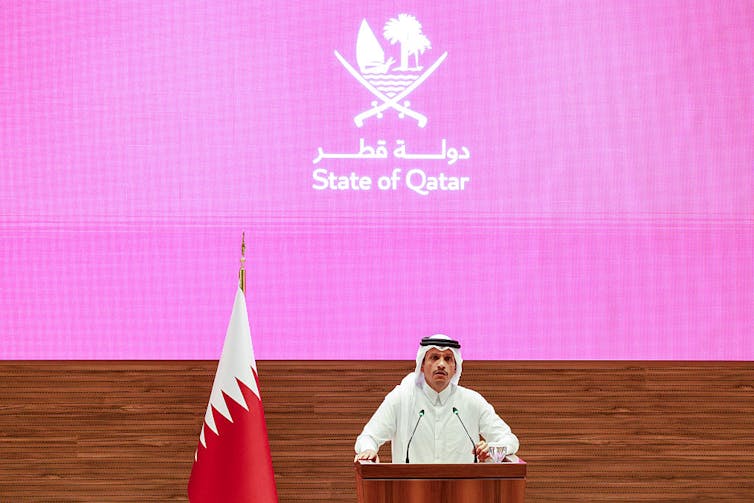
Qatar’s Prime Minister and Foreign Minister Mohammed bin Abdulrahman al-Thani addresses a press conference following Israeli strikes in Doha on Sept. 9, 2025. Photo by Karim Jaafar/AFP via Getty Images
Talk of diplomatic red lines
Iran’s attack on the U.S. air base in Qatar in June generated statements of solidarity with Doha from all other members of the Gulf Cooperation Council, reflecting the degree to which the six Gulf Arab countries have come back together after the political rifts that divided them in the 2010s. The GCC has been most cohesive at times that its members perceive a common external threat, such as during the Iran-Iraq War in the 1980s. That has also been evident after Israel’s military engagements since the Oct. 7, 2023, Hamas attacks.
Over the summer, alarm at Israel’s regional wars led prominent Saudi commentators to describe Israel as a chief spoiler, a routine violator of international norms and a contributor to instability. Such language had previously been reserved primarily for Iranian actions.
Anwar Gargash, a foreign policy advisor to UAE President Sheikh Mohammed bin Zayed Al Nahyan whose name adorns the Diplomatic Academy in Abu Dhabi, described the Sept. 9 Israeli strike on Qatar as “treacherous.” It remains to be seen whether this is a red line which leads the UAE, or Bahrain, to suspend the Abraham Accords or break diplomatic ties with Israel.
Going forward, officials in Doha and other GCC capitals will be urgently assessing the implications of a strike by one U.S. partner and in the vicinity of a U.S. base meant to deter and detect regional aerial threats in the first place. And while the Trump administration has officially denied foreknowledge or involvement in the Israeli attack, even being caught in the dark will invite commentary about the apparent ineffectiveness of American deterrence and further damage Gulf states’ confidence in the U.S. defense and security support.
When Israeli forces killed Haniyeh, another Hamas political leader, in July 2024, they waited until he left Doha to attend the presidential inauguration in Iran before they struck in Tehran. Until now, the assumption had been that Israel would hit targets in states adversarial to the U.S. rather than allies or partners.
That line has been crossed, and across the Gulf there will be concern about what else may happen – for example, to Houthi delegates being hosted in Oman.
Kristian Coates Ulrichsen does not work for, consult, own shares in or receive funding from any company or organization that would benefit from this article, and has disclosed no relevant affiliations beyond their academic appointment.
Scientists first detected ripples in space known as gravitational waves from the merger of two black holes in September 2015. This discovery marked the culmination of a 100-year quest to prove one of Einstein’s predictions.
Gravitational waves are exciting to scientists because they provide a completely new view of the universe. Conventional astronomy relies on electromagnetic waves – like light – but gravitational waves are an independent messenger that can emanate from objects that don’t emit light. Gravitational wave detection has unlocked the universe’s dark side, giving scientists access to phenomena never observed before.
As a gravitational wave physicist with over 20 years of research experience in the LIGO Scientific Collaboration, I have seen firsthand how these discoveries have transformed scientists’ knowledge of the universe.
This summer, in 2025, scientists with the LIGO, Virgo and KAGRA collaboration also marked a new milestone. After a long hiatus to upgrade its equipment, this collaboration just released an updated list of gravitational wave discoveries. The discoveries on this list provide researchers with an unprecedented view of the universe featuring, among other things, the clearest gravitational wave detection yet.
The more operational gravitational-wave observatories there are around the globe, the easier it is to pin down the locations and sources of gravitational waves coming from space. Caltech/MIT/LIGO Lab
What are gravitational waves?
Albert Einstein first predicted the existence of gravitational waves in 1916. According to Einstein’s theory of gravity, known as general relativity, massive, dense celestial objects bend space and time.
When these massive objects, like black holes and neutron stars – the end product of a supernova – orbit around each other, they form a binary system. The motion from this system dynamically stretches and squeezes the space around these objects, sending gravitational waves across the universe. These waves ever so slightly change the distance between other objects in the universe as they pass.
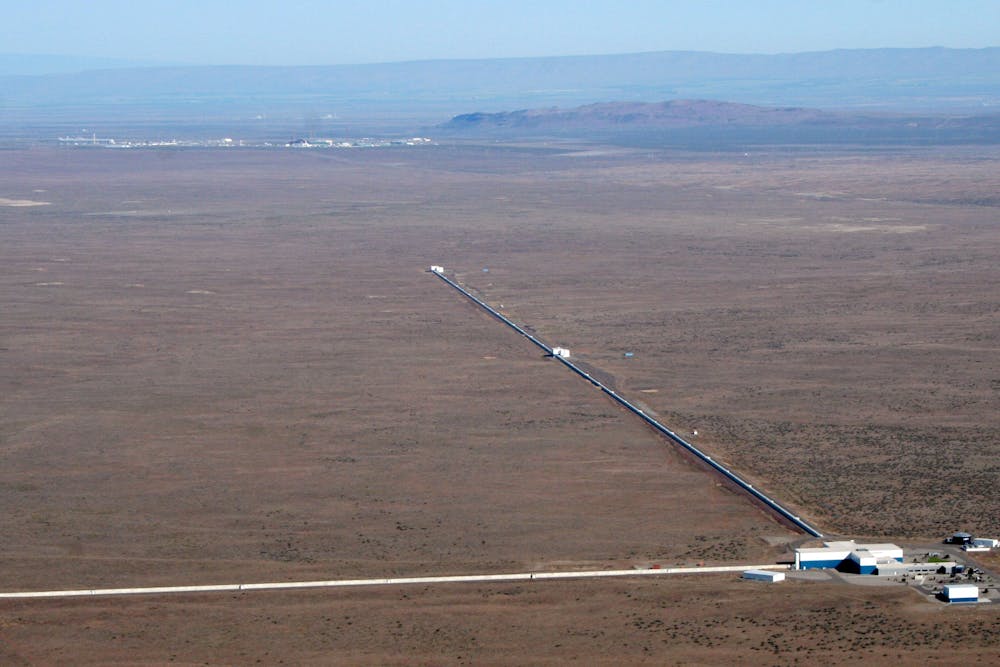
Each detector has L-shaped arms that span over two miles. Each arm contains a cavity full of reflected laser light that precisely measures the distance between two mirrors.
As a gravitational wave passes, it changes the distance between the mirrors by 10-18 meters — just 0.1% of the diameter of a proton. Astronomers can measure how the mirrors oscillate to track the orbit of black holes.
These tiny changes in distance encode a tremendous amount of information about their source. They can tell us the masses of each black hole or neutron star, their location and whether they are spinning on their own axis.
The LIGO detector in Hanford, Wash., uses lasers to measure the minuscule stretching of space caused by a gravitational wave. LIGO Laboratory
A neutron star-black hole merger
As mentioned previously, the LIGO, Virgo and KAGRA collaboration recently reported 128 new binary mergers from data taken between May 24, 2023, and Jan. 16, 2024 – which more than doubles the previous count.
Among these new discoveries is a neutron star–black hole merger. This merger consists of a relatively light black hole with mass between 2.5 and 4.5 times the mass of our Sun paired with a neutron star that is 1.4 times the mass of our Sun.
In this kind of system, scientists theorize that the black hole tears the neutron star apart before swallowing it, which releases electromagnetic waves. Sadly, the collaboration didn’t manage to detect any such electromagnetic waves for this particular system.
Detecting an electromagnetic counterpart to a black hole tearing apart a neutron star is among the holy grails of astronomy and astrophysics. These electromagnetic waves will provide the rich datasets required for understanding both the extreme conditions present in matter, and extreme gravity. Scientists hope for better fortune the next time the detectors spot such a system.
A massive binary and clear gravitational waves
In July 2025, the LIGO, Virgo and KAGRA collaboration also announced they’d found the most massive binary black hole merger ever detected. The combined mass of this system is more than 200 times the mass of our Sun. And, one of the two black holes in this system likely has a mass that scientists previously assumed could not be produced from the collapse of a single star.
When two astrophysical objects – like black holes – merge, they send out gravitational waves.
The most recent discovery announced by the LIGO, Virgo and KAGRA collaboration, in September 2025, is the clearest gravitational wave observation to date. This event is a near clone of the first gravitational wave observation from 10 years ago, but because LIGO’s detectors have improved over the last decade, it stands out above the noise three times as much as the first discovery.
Because the observed gravitational wave signal is so clear, scientists could confirm that the final black hole that formed from the merger emitted gravitational waves exactly as it should according to general relativity.
They also showed that the surface area of the final black hole was greater than the surface area of the initial black holes combined, which implies that the merger increased the entropy, according to foundational work from Stephen Hawking and Jacob Bekenstein. Entropy measures how disordered a system is. All physical interactions are expected to increase the disorder of the universe, according to thermodynamics. This recent discovery showed that black holes obey their own laws similar to thermodynamics.
The beginning of a longer legacy
The LIGO, Virgo and KAGRA collaboration’s fourth observing run is ongoing and will last through November. My colleagues and I anticipate more than 100 additional discoveries within the coming year.
New observations starting in 2028 may bring the tally of binary mergers to as many as 1,000 by around 2030, if the collaboration keeps its funding.
Gravitational wave observation is still in its infancy. A proposed upgrade to LIGO called A# may increase the gravitational wave detection rate by another factor of 10. Proposed new observatories called Cosmic Explorer and the Einstein Telescope that may be built in 10 to 20 years would increase the rate of gravitational wave detection by 1,000, relative to the current rate, by further reducing noise in the detector.
Chad Hanna receives funding from the National Science Foundation.