Elon Musk says he may launch his own party: but US history tells us that’s not a recipe for success

Source: The Conversation – UK – By Matthew Mokhefi-Ashton, Lecturer in Politics and International Relations, Nottingham Trent University

To paraphrase a very old joke, how do you make a small fortune in America? Start with a large fortune and fund a third political party. American political history is littered with the wrecks of challengers who thought they could break the two-party system and failed.

This makes Elon Musk’s tease that he may launch his own new political party as an act of defiance following his falling out with Donald Trump even more intriguing.

What do we mean by a two-party system though? Since the 1860s, the Democrats and Republicans have dominated the US political landscape, holding the presidency, Congress and the vast majority of elected positions. Attempts at third parties have usually floundered at the ballot box.


Get your news from actual experts, straight to your inbox. Sign up to our daily newsletter to receive all The Conversation UK’s latest coverage of news and research, from politics and business to the arts and sciences.


Some have lasted only for a few electoral cycles, including the Progressive Party in the 1910s and the Citizens Party of the 1980s, while others like the Libertarian Party and Green Party have lasted decades and, in some cases, managed some electoral success at the local level.

But this is where an important distinction has to be made between third parties and third-party candidates. Because the US system is so personality-driven rather than party focused compared to Europe, quite often third parties have been built around a single person.

A good example is the previously mentioned Progressive Party. It was founded in 1912 by former president Theodore Roosevelt after he split from the Republicans. Without him it quickly faded away.

The Reform Party was created by billionaire Ross Perot in 1995 after he managed to get 18.9% of the vote in the 1992 presidential election. While it continued without him for some years, it was a shell of its former self. Other parties like the Socialist, Libertarian and Green parties have sprung from more organic movements and thus have been more successful at a local or state level.

When you look at recent polling though, it seems strange that the two parties continue to dominate. Public dissatisfaction with politics as usual seems at an all-time high. In a recent Pew Research poll when asked whether “I often wish there were more political parties to choose from” describes their views, 37% of respondents answered: “Very well” and 31% answered: “Somewhat well”.

In another poll, 25% of respondents said that neither of the two main parties represented their interests.

So if there is an appetite for some sort of change, why have so few challengers succeeded? The two main parties seem entrenched to the point where it resembles a cartel.

Odds stacked against third-party insurgency

The first and arguably most important reason is the electoral system. First past the post does not guarantee a two-party system (look at Britain, for instance). But political scientist Maurice Duverger argued that it does mean that the two main parties have a significant advantage. There are prizes for coming first and second, nothing for third place.

Equally, many of the big prizes in American politics such as the presidency and state governorships are indivisible and cannot be shared. So it has become received wisdom that voting for anyone other than Democrats or Republicans is a wasted vote.

In these cases, people either vote for what they perceive to be the lesser of two evils or stay at home, rather than voting for a candidate with no chance or that they may not support.

The other multi-billion dollar elephant in the room is money. The sheer cost of running for elections in recent years means that any third party is unlikely to be able to raise the funds to be truly competitive. At the last election, the Democrats and Republicans spent hundreds of millions of dollars (which isn’t even counting all of the super-PAC money spent on their behalf).

Whenever billionaires like Perot have attempted to self-fund a party, they have left themselves open to the accusation that it’s a vanity project, or lacks true mass appeal.

There is also the fact that to run successfully you must have media coverage. The media tends to focus almost exclusively on the two main parties. This creates a “chicken and egg” situation where you need success to help raise money and media coverage, but it’s difficult to be successful without first having money and media coverage.

The final reasons are that of the open primary and ideological flexibility of the main parties. Donald Trump briefly considered running as president for the Reform Party back in 2000. In 2016, the open primary system that both main parties use meant that he could impose himself on the Republican Party despite most of the party elite despising him.

Why bother starting your own party when you can run for one that already exists? It could now be argued that the Republicans have effectively become the Trump or Maga party, although whether this will survive his presidency is open to debate.

Money, money, money

Elon Musk has, for the moment, money to burn. Whether he’s willing to invest in the long term to turn this into more than a vanity project remains to be seen.

He also has charisma and a national platform to amplify his voice like few others. But, having been born outside America, he can’t run for president.

If he’s serious about electoral success, he’d have to find someone to run, and that would mean, effectively, they’d lead his party. Musk’s public persona suggests that he does not play well with others.

Founding a third party isn’t impossible, but unless there is a political earthquake it seems difficult to see how one could succeed.

The Conversation

Matthew Mokhefi-Ashton does not work for, consult, own shares in or receive funding from any company or organisation that would benefit from this article, and has disclosed no relevant affiliations beyond their academic appointment.

ref. Elon Musk says he may launch his own party: but US history tells us that’s not a recipe for success – https://theconversation.com/elon-musk-says-he-may-launch-his-own-party-but-us-history-tells-us-thats-not-a-recipe-for-success-260480


Underwater lake heatwaves are on the rise, threatening aquatic life

Source: The Conversation – UK – By Iestyn Woolway, Reader and NERC Independent Research Fellow, Bangor University

A view of Lake Superior, one of the Great Lakes. Travis J. Camp/Shutterstock

Lakes are essential to ecosystems, providing freshwater, supporting biodiversity and offering crucial habitat for fish and other aquatic species.

But a recent study by my colleagues and I shows that lakes around the world are warming, not just at the surface, but deep below as well. Subsurface heatwaves in lakes, defined as extreme periods of high water temperature below the surface, are increasing in frequency, duration and intensity.

These hidden extremes could have serious consequences for lake ecosystems. Despite that, the issue remains largely unmonitored and poorly understood.

Lake heatwaves are similar to those in the atmosphere or ocean. They are prolonged periods of excessive warmth. Most research to date has focused on surface temperatures, where climate change has already caused more frequent and intense heatwaves over recent decades.


Get your news from actual experts, straight to your inbox. Sign up to our daily newsletter to receive all The Conversation UK’s latest coverage of news and research, from politics and business to the arts and sciences.


These surface events can disrupt the chemical and physical balance of lakes, damage food webs and, in some cases, cause mass fish die-offs.

Aquatic species respond to surface heatwaves in different ways. Some benefit if the warming expands their preferred temperature range. But many others, particularly those already living near their thermal limits, face significant stress.

In lakes that stratify during summer – where warm surface water sits above a cooler bottom layer – some species seek refuge from the heat by migrating to deeper water. But what happens when that deeper refuge is no longer cool?

A closer look beneath the surface

To investigate, we analysed temperature data from tens of thousands of lakes worldwide. These included one-dimensional lake models, high-resolution simulations for the Great Lakes of North America, and local models calibrated to specific lake conditions.

By analysing how temperature varies with depth and time, we identified when and where subsurface waters crossed extreme heat thresholds.

We defined subsurface heatwaves as periods when temperatures at particular depths exceeded their typical seasonal range. We also tracked how these events have changed since 1980, and how they might evolve under different emissions scenarios by the end of this century.

Morning sun lights up a rock formation on Lake Huron.
Lake Huron, one of the Great Lakes.
Craig Sterken/Shutterstock

Subsurface heatwaves are already common and they’re becoming more so.

Since 1980, bottom heatwaves (those occurring at the deepest parts of lakes) have increased by an average of more than seven days per decade in frequency, more than two days per decade in duration and they have risen by around 0.2C per decade.

Although these deep-water events tend to be slightly less intense than surface ones, they often last longer.

We also found a rise in “vertically compounding” heatwaves. This is when extreme temperatures happen simultaneously at the surface and bottom of a lake.

These doubled-up events are now happening more than three days per decade more frequently. When they strike, aquatic species can be left with no place to escape the heat.

Even more concerning, the deep-water refuges that once offered shelter during surface heatwaves are shrinking or disappearing altogether. In some lakes, the distance fish need to travel to find cooler water has increased by nearly a metre per decade.

Our simulations suggest that these trends will intensify, especially under high-emission scenarios. By the end of this century, some bottom heatwaves could last for months, with temperature extremes not seen in the historical record.

Why this matters

Lake ecosystems rely on thermal structure. When extreme heat reaches deeper into the water column, it can trigger cascading ecological effects, from shifting fish habitats and altering species distribution, to increased nutrient cycling and algal blooms. It could even affect the release of greenhouse gases like methane from lake bed sediments.

Subsurface heatwaves pose a particular risk to bottom-dwelling species, which may be less mobile or already adapted to cold, stable conditions. The loss of thermal refuges during surface heatwaves also jeopardises species that would otherwise escape to deeper waters.

By ignoring what’s happening below the surface, we risk underestimating the true ecological effects of climate change on freshwater systems.

Our study highlights the urgent need to expand lake monitoring efforts to include subsurface temperatures. While satellites have transformed our understanding of surface warming, they can’t capture what’s happening below.

Future research should examine how different species respond to these deep-water and vertically compounding heatwaves. It should explore how changes in lake thermal structure affect different processes like nutrient cycling and methane production.

For conservation planners, that means incorporating subsurface heatwaves into risk assessments and habitat models. For climate modellers, it means better representing vertical processes in lakes within global Earth system models.

As lakes continue to warm, managing and understanding these hidden heat extremes will be critical to protecting biodiversity and the vital ecosystem services lakes provide.

The Conversation

Iestyn Woolway receives funding from UKRI NERC.

ref. Underwater lake heatwaves are on the rise, threatening aquatic life – https://theconversation.com/underwater-lake-heatwaves-are-on-the-rise-threatening-aquatic-life-258885

From glass and steel to rare earth metals, new materials have changed society throughout history

Source: The Conversation – USA – By Peter Mullner, Distinguished Professor in Materials Science and Engineering, Boise State University

Steel played a large role in the Industrial Revolution. Monty Rakusen/DigitalVision via Getty Images

Many modern devices – from cellphones and computers to electric vehicles and wind turbines – rely on strong magnets made from a type of minerals called rare earths. As the systems and infrastructure used in daily life have turned digital and the United States has moved toward renewable energy, accessing these minerals has become critical – and the markets for these elements have grown rapidly.

Modern society now uses rare earth magnets in everything from national defense, where magnet-based systems are integral to missile guidance and aircraft, to the clean energy transition, which depends on wind turbines and electric vehicles.

The rapid growth of the rare earth metal trade and its effects on society isn’t the only case study of its kind. Throughout history, materials have quietly shaped the trajectory of human civilization. They form the tools people use, the buildings they inhabit, the devices that mediate their relationships and the systems that structure economies. Newly discovered materials can set off ripple effects that shape industries, shift geopolitical balances and transform people’s daily habits.

Materials science is the study of the atomic structure, properties, processing and performance of materials. In many ways, materials science is a discipline of immense social consequence.

As a materials scientist, I’m interested in what can happen when new materials become available. Glass, steel and rare earth magnets are all examples of how innovation in materials science has driven technological change and, as a result, shaped global economies, politics and the environment.

A diagram showing red arrows, labeled 'politics in' 'society in' 'environment in' 'technology in' etc, leading to a box labeled 'innovation' with arrows pointing away from that box with the same labels but 'out' instead of 'in.'
How innovation shapes society: Pressures from societal and political interests (orange arrows) drive the creation of new materials and the technologies that such materials enable (center). The ripple effects resulting from people using these technologies change the entire fabric of society (blue arrows).
Peter Mullner

Glass lenses and the scientific revolution

In the early 13th century, after the sacking of Constantinople, some excellent Byzantine glassmakers left their homes to settle in Venice – at the time a powerful economic and political center. The local nobility welcomed the glassmakers’ beautiful wares. However, to prevent the glass furnaces from causing fires, the nobles exiled the glassmakers – under penalty of death – to the island of Murano.

Murano became a center for glass craftsmanship. In the 15th century, the glassmaker Angelo Barovier experimented with adding the ash from burned plants, which contained a chemical substance called potash, to the glass.

The potash reduced the melting temperature and made liquid glass more fluid. It also eliminated bubbles in the glass and improved optical clarity. This transparent glass was later used in magnifying lenses and spectacles.

Johannes Gutenberg’s printing press, completed in 1455, made reading more accessible to people across Europe. With it came a need for reading glasses, which grew popular among scholars, merchants and clergy – enough that spectacle-making became an established profession.

By the early 17th century, glass lenses evolved into compound optical devices. Galileo Galilei pointed a telescope toward celestial bodies, while Antonie van Leeuwenhoek discovered microbial life with a microscope.

A large round, convex glass lens mounted on a metal stand, with a technician wearing scrubs looking at it.
The glass lens of the Vera Rubin Observatory, which surveys the night sky.
Large Synoptic Survey Telescope/Vera Rubin Observatory, CC BY

Lens-based instruments have been transformative. Telescopes have redefined long-standing cosmological views. Microscopes have opened entirely new fields in biology and medicine.

These changes marked the dawn of empirical science, where observation and measurement drove the creation of knowledge. Today, the James Webb Space Telescope and the Vera C. Rubin Observatory continue those early telescopes’ legacies of knowledge creation.

Steel and empires

In the late 18th and 19th centuries, the Industrial Revolution created demand for stronger, more reliable materials for machines, railroads, ships and infrastructure. The material that emerged was steel, which is strong, durable and cheap. Steel is a mixture of mostly iron, with small amounts of carbon and other elements added.

Countries with large-scale steel manufacturing once had outsized economic and political power and influence over geopolitical decisions. For example, the British Parliament intended to prevent the colonies from exporting finished steel with the iron act of 1750. They wanted the colonies’ raw iron as supply for their steel industry in England.

Benjamin Huntsman invented a smelting process using 3-foot tall ceramic vessels, called crucibles, in 18th-century Sheffield. Huntsman’s crucible process produced higher-quality steel for tools and weapons.

One hundred years later, Henry Bessemer developed the oxygen-blowing steelmaking process, which drastically increased production speed and lowered costs. In the United States, figures such as Andrew Carnegie created a vast industry based on Bessemer’s process.

The widespread availability of steel transformed how societies built, traveled and defended themselves. Skyscrapers and transit systems made of steel allowed cities to grow, steel-built battleships and tanks empowered militaries, and cars containing steel became staples in consumer life.

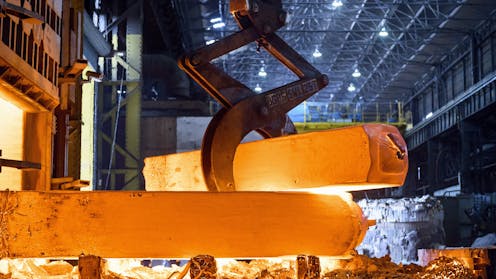
Bright hot metal pouring out of a large metal furnace.
White-hot steel pouring out of an electric arc furnace in Brackenridge, Penn.
Alfred T. Palmer/U.S. Library of Congress

Control over steel resources and infrastructure made steel a foundation of national power. China’s 21st-century rise to steel dominance is a continuation of this pattern. From 1995 to 2015, China’s contribution to the world steel production increased from about 10% to more than 50%. The White House responded in 2018 with massive tariffs on Chinese steel.

Rare earth metals and global trade

Early in the 21st century, the advance of digital technologies and the transition to an economy based on renewable energies created a demand for rare earth elements.

A wind turbine with three thin blades rising out of the water.
Offshore turbines use several tons of rare earth magnets to transform wind into electricity.
Hans Hillewaert/Wikimedia Commons, CC BY-SA

Rare earth elements are 17 chemically very similar elements, including neodymium, dysprosium, samarium and others. They occur in nature in bundles and are the ingredients that make magnets super strong and useful. They are necessary for highly efficient electric motors, wind turbines and electronic devices.

Because of their chemical similarity, separating and purifying rare earth elements involves complex and expensive processes.

China controls the majority of global rare earth processing capacity. Political tensions between countries, especially around trade tariffs and strategic competition, can risk shortages or disruptions in the supply chain.

The rare earth metals case illustrates how a single category of materials can shape trade policy, industrial planning and even diplomatic alliances.

Six small piles of rock
Mining rare earth elements has allowed for the widespread adoption of many modern technologies.
Peggy Greb, USDA

Technological transformation begins with societal pressure. New materials create opportunities for scientific and engineering breakthroughs. Once a material proves useful, it quickly becomes woven into the fabric of daily life and broader systems. With each innovation, the material world subtly reorganizes the social world — redefining what is possible, desirable and normal.

Understanding how societies respond to new innovations in materials science can help today’s engineers and scientists solve crises in sustainability and security. Every technical decision is, in some ways, a cultural one, and every material has a story that extends far beyond its molecular structure.

The Conversation

The National Science Foundation, the Department of Energy, NASA, and other national and regional agencies have funded former research of Peter Mullner.

ref. From glass and steel to rare earth metals, new materials have changed society throughout history – https://theconversation.com/from-glass-and-steel-to-rare-earth-metals-new-materials-have-changed-society-throughout-history-258244

L’écologie politique, progressiste ou conservatrice ?

Source: The Conversation – France in French (3) – By Fabrice Flipo, Professeur en philosophie sociale et politique, épistémologie et histoire des sciences et techniques, Institut Mines-Télécom Business School

L’écologie politique est régulièrement soupçonnée d’appartenir au camp conservateur – parce qu’elle critiquerait le « progrès », défendrait la nature ou encore les peuples autochtones. Certains considèrent même le risque d’un « écofascisme ». Ces critiques sont-elles fondées ? L’écologie politique est plutôt proche du socialisme, à travers une critique de l’ordre industriel et du marché au profit d’une société coopérative.


Qu’est-ce que l’« écologie politique » ? Ce concept désigne en premier lieu un mouvement social pouvant prendre diverses formes, telles que des associations de plaidoyer (contre les pesticides ou pour le vélo) ou d’action directe (à l’image des Soulèvements de la Terre) ou encore des partis politiques. Il émerge dans les années 1960 et 1970 dans les pays industrialisés, mais a des racines plus anciennes, car toutes les sociétés se sont souciées de leur rapport à leur milieu. Sur le plan idéologique, il se distingue de « l’environnementalisme », qui se soucie de protection de la nature de manière sectorielle, sans projet alternatif de société, un peu comme le syndicalisme se distingue du socialisme. L’écologie politique se définit généralement comme critique de la société industrielle.

Depuis longtemps, l’écologisme ou écologie politique (termes utilisés de manière interchangeables ici) est considérée par certains observateurs (tels Philippe Pelletier, Stéphane François ou encore Jean Jacob comme l’expression d’un certain conservatisme : critique du progrès, défense de la nature, des paysages ou d’un ordre supposément passé, tel que celui des peuples autochtones. Certains entrevoient même la possibilité d’un écofascisme. S’intéressant à ce mouvement voici trois décennies, le sociologue Pierre Alphandéry et ses collègues concluaient à un positionnement « équivoque » relativement à la question de l’émancipation. Est-ce réellement le cas ?

Constatons que l’accusation est faible. Il y a tout d’abord l’imprécision des notions clés utilisées pour disqualifier l’écologie. Prenons le cas de la notion de progrès. L’écologisme la critique. Mais l’historien François Jarrige montre que le progrès scientifique et technique a souvent été porté par des conservateurs, depuis le XIXe siècle. Les fascismes ont été violemment progressistes. Marshall Sahlins, David Graeber et David Wengrow ont également montré que les sociétés supposément primitives ne sont pas moins complexes ni soucieuses d’émancipation, par exemple en termes d’égalité. Alors de quel progrès parle-t-on ? La critique d’un certain type de progrès ne permet pas de ranger l’écologie politique du côté du conservatisme.

La critique d’une écologie conservatrice parce que « protectrice de la nature » présente les mêmes faiblesses. La nature peut être mise en avant par les conservatismes, qui cherchent à faire passer l’ordre social pour donné. Au contraire, avec l’écologie politique, l’ordre naturel n’est pas donné. L’écologie en tant que science de la nature enseigne que cet ordre est sans cesse changeant. Serge Moscovici explique dès 1962 que cet ordre doit être inventé. Il en va de même pour l’ordre de la société écologique. Et la nature est le concept-clé que les Lumières opposent aux conservatismes, et en particulier aux religions, au surnaturel. La nature est ce qui est de l’ordre de la preuve. Elle est au fondement du sécularisme, et donc des démocraties, par opposition aux théocraties.

Autre amalgame et raisonnement fallacieux : l’écologie valorise le local, comme les conservatismes, et donc l’écologisme serait conservateur. C’est passer sous silence les différences. Le localisme écologiste est conditionné par un rapport égalitaire à la biosphère (« penser global, agir local »), qui accorde une place à tout vivant, y compris humain. Le localisme conservateur vise à la protection d’un patrimoine et un ordre ethnique. Les deux n’ont donc presque rien de commun, et impliquent une contradiction dans les termes.

Une troisième manière d’entretenir la confusion est de focaliser sur des individus ou des groupuscules, qui peuvent incarner des synthèses improbables, et souvent éphémères. On peut citer Hervé Juvin, un temps conseiller en « écologie localiste » au RN, avant que ce parti de devienne ouvertement anti-écologiste. La revue Limite a également voulu incarner une écologie politique chrétienne, ouvrant ses portes à tous les courants, conservateurs ou non. Elle n’a pas réussi à durer, le projet étant trop contradictoire.

Quant à l’écofascisme, il est également profondément contradictoire. Les fascismes sont des conservatismes extrêmes pour qui la priorité est la préservation de l’unité politique contre les menaces tant internes qu’externes, cela, en utilisant la force. Leur focale est donc anthropocentrique : c’est l’ordre humain qui passe avant tout le reste. La nature n’a de valeur qu’instrumentale, en tant que moyen pour contenir ce qui les menace. C’est également le cas des sociétés primitives conservatrices, à l’exemple des Achuars décrits par Philippe Descola. Leur faible empreinte écologique tient surtout à leur propension à s’entre-tuer. Ils se représentent la nature comme un monde de prédation, à l’opposé de l’écologisme qui défend une vision coopérative.

Alphandéry et ses collègues qualifiaient l’écologisme « d’équivoque ». Pourtant, c’est bien des valeurs progressistes qu’ils découvrent dans leur enquête, quand ils citent l’autonomie, la gratuité, la libération du travail, le fédéralisme ou la solidarité internationale.

Les quatre positions écologiques

Le rapport au conservatisme de l’écologisme est toutefois variable. Dans le champ politique contemporain, quatre positions semblent se dégager.

La première est une écologie plutôt conservatrice, mais pas d’extrême droite. Elle est de faible ampleur, parce qu’elle cherche à concilier l’inconciliable. Le philosophe Roger Scruton ou le député Les Républicains François-Xavier Bellamy peuvent l’incarner. Ils se disent soucieux de la biosphère, mais quand vient l’heure des choix, c’est l’économie qu’ils priorisent. Elle a une conception locale et patrimoniale de la nature, et plus généralement de la vie. Elle est libérale, mâtinée de spiritualité, peu critique du capitalisme bien qu’elle en appelle vigoureusement à sa régulation, contre le néolibéralisme. Elle est proche de ce Green New Deal soutenu un temps par Ursula von der Leyen, issue de la CDU allemande.

La deuxième position est une écologie sociale-libérale. Elle correspond à un social-écologisme, positionné au centre-gauche, à l’exemple du député européen Pascal Canfin, qui se satisfait en partie de ce Green New Deal que la CDU a vite abandonné dès que des obstacles se sont fait jour. Le marché est orienté par des incitations économiques, du côté des consommateurs et des producteurs (taxe carbone, subventions, etc.).

Le troisième courant correspond à une forme d’écosocialisme d’inspiration marxiste mais lui-même divers. Il va des aspirations à une social-écologie à des questions de planification. Un désaccord important porte sur le rôle possible de l’État et donc celui de l’initiative décentralisée, notamment de l’économie sociale et solidaire.

Un dernier courant pousse la rupture et la critique du développement plus loin encore. C’est le cas de Thierry Sallantin qui défend une position anti-industrielle radicale, qu’il qualifie « d’artisanaliste », rappelant le monde dépeint par William Morris, dans lequel les objets sont durables et peu nombreux, et la démocratie directe règne. Mais ce courant peut également se confondre avec des démarches ésotériques et irrationalistes, fétichistes, qui débouchent sans trop s’en rendre compte sur des ordres conservateurs, à l’exemple d’Edward Goldsmith ou de Jerry Mander admirant les sociétés primitives.

Alors, l’écologie politique est-elle un conservatisme ? Rien ne permet de le dire, une fois que les termes de la controverse sont définis. Mais il n’a jamais manqué de conservateurs pour chercher à enrôler cette critique de la modernité pour la mettre au service de buts très différents. L’écologisme est plutôt un proche parent du socialisme, qui portait aussi une critique de l’ordre industriel et du marché au profit d’une société coopérative. Une divergence notable existe néanmoins entre la forme dominante du socialisme et l’écologisme à propos des forces productives et de la croissance.

The Conversation

Fabrice Flipo ne travaille pas, ne conseille pas, ne possède pas de parts, ne reçoit pas de fonds d’une organisation qui pourrait tirer profit de cet article, et n’a déclaré aucune autre affiliation que son organisme de recherche.

ref. L’écologie politique, progressiste ou conservatrice ? – https://theconversation.com/lecologie-politique-progressiste-ou-conservatrice-258722

IA : bombe énergétique ou levier écologique ?

Source: The Conversation – France (in French) – By Patrice Geoffron, Professeur d’Economie, Université Paris Dauphine – PSL

Menace ou opportunité, telle est la question concernant l’impact de l’intelligence artificielle sur l’environnement. Si cette technologie est terriblement énergivore, elle offre aussi des outils pour mieux utiliser et optimiser la consommation des ressources naturelles. Laquelle de ces deux forces l’emportera ? La stratégie adoptée par les grands ensembles continentaux (États-Unis, Chine et Union européenne) dépend en partie de la réponse apportée à la question. Qui a fait le bon choix ?

Cet article est publié dans le cadre du partenariat les Rencontres économiques d’Aix–The Conversation. L’édition 2025 de cet événement a pour thème « Affronter le choc des réalités ».


L’intelligence artificielle pousse encore d’un cran le dilemme classique des technologies de l’information : alors que s’annonce une explosion de la demande électrique liée à cette famille de technologies, l’IA s’affirme dans le même temps comme une « boîte à outils » pour la lutte contre le changement climatique. La voie est étroite entre la tentation de vouer l’IA aux gémonies (au regard de son empreinte en énergie, eau, matières premières, espaces…) et l’espérance d’un technosolutionnisme en considérant la multiplicité de ses usages climatiques. Tentons d’esquisser un chemin entre ces deux écueils.

Selon l’Agence internationale de l’énergie (AIE), la demande d’électricité des centres de données devrait plus que doubler d’ici à 2030 pour tendre vers les 1000 térawattheures (TWh), l’équivalent de la consommation totale du Japon. Le FMI présente des projections encore plus alarmistes, considérant que les besoins en électricité induits par les usages de l’IA pourraient pousser ces consommations jusqu’à 1500 TWh, surpassant toutes autres sources de demande émergentes (véhicules électriques compris) et avoisinant la demande électrique de l’Inde.

Plus de charbon : un retour vers le futur énérgétique

Cette poussée pourrait ajouter 1,7 Gt aux émissions mondiales de gaz à effet de serre (GES) entre 2025 et 2030. Anticipant cette pression, le président des États-Unis,Donald Trump a signé en avril 2025 une série de quatre décrets destinés à doper les usages du charbon, justifiant cette décision par la nécessité de répondre à l’essor de l’IA (dans le contexte d’un « état d’urgence énergétique », déclaré dès janvier). Alors que les États-Unis avaient franchi pour la première fois en mars 2025 le seuil symbolique de moins de 50 % d’électricité fossile, l’IA risque d’inverser cette tendance.

En outre, si l’adaptation des moyens de production (notamment renouvelables) et des infrastructures de transport et de distribution devait ne pas suivre au bon rythme, une hausse des prix de l’électricité en résulterait mécaniquement, frappant ménages et entreprises. Aux États-Unis, cette hausse pourrait atteindre 10 % en 2030.

Certes, l’émergence de modèles d’IA plus sobres, tels que DeepSeek, fait planer un voile d’incertitude sur ces scénarios prospectifs, car les améliorations algorithmiques tendent à réduire les besoins en calcul et la demande en électricité. Mais, cette incertitude risque aussi de retarder des investissements cruciaux en électricité décarbonée, et de concourir à exploiter les centrales thermiques et à pousser les prix à la hausse.


À lire aussi :
Après le sommet sur l’IA, Emmanuel Macron peut-il faire émerger une troisième voie européenne ?


Une profusion d’expérimentations orientées vers l’action climatique

En contrepoint, un rapide inventaire permet de dévoiler un foisonnement d’applications susceptibles de contribuer à l’action climatique ou de mieux anticiper les dérèglements à venir.

L’IA améliore tout d’abord les prévisions météorologiques et climatiques. Le Centre européen de prévision estime que la précision de ses modèles IA dépasse celle des modèles classiques de 20 %. Météo-France a développé un modèle à échelle régionale, utile également pour simuler les climats futurs. GraphCast de Google DeepMind surpasse les systèmes officiels de 20 à 25 % pour la prévision de trajectoires cycloniques, tandis qu’Aurora, soutenu par Microsoft, améliore le suivi des phénomènes extrêmes.

Dans le secteur de l’énergie, l’IA transforme la gestion des systèmes complexes. L’optimisation des réseaux électriques permet une prévision de la demande et de l’offre énergétiques plus précise, réduit les pertes et détecte les pannes. En Allemagne, des projets pilotes ont démontré que l’IA pouvait diminuer les congestions réseau de 40 %, évitant des investissements en infrastructure. Ce potentiel vaut aussi pour les systèmes de transport, avec une optimisation de la circulation en se basant sur les données issues de capteurs, caméras et systèmes GPS. Les Advanced Traffic Management Systems (ATMS) régulent ainsi les feux de signalisation pour fluidifier le trafic tout en diminuant les émissions de CO2 associées aux arrêts et redémarrages fréquents.


Du lundi au vendredi + le dimanche, recevez gratuitement les analyses et décryptages de nos experts pour un autre regard sur l’actualité. Abonnez-vous dès aujourd’hui !


Stratégies de fertilisation adaptées

L’IA en agriculture de précision améliore l’utilisation des ressources en analysant les données de sol, météorologiques et de culture pour recommander des stratégies de fertilisation ciblées. L’analyse des niveaux d’humidité et de la disponibilité des nutriments permet de recommander des stratégies de fertilisation adaptées. Des prévisions météorologiques affinées guident les programmes d’irrigation et de plantation, surveillant également la santé des cultures via l’imagerie satellitaire et des capteurs pour prévenir les maladies ou carences nutritionnelles.

Dans la gestion de l’eau, les algorithmes d’IA analysent les données historiques, intègrent les informations météorologiques en temps réel et les conditions opérationnelles pour optimiser les performances des pompes, vannes et autres équipements critiques. En ajustant dynamiquement les débits, dosages chimiques et cycles de filtration, l’IA minimise la consommation d’énergie, tout en respectant les normes de qualité.

Action en faveur de la biodiversité

L’IA joue aussi un rôle croissant dans la conservation de la biodiversité. Les modèles d’apprentissage automatique entraînés sur l’imagerie satellite et l’ADN environnemental peuvent répertorier la répartition des espèces avec une précision inégalée. Le projet Allen Coral Atlas cartographie ainsi les récifs coralliens et détecte leur blanchissement, augmentant l’efficacité des mesures de conservation. En foresterie, OCELL développe des jumeaux numériques pour améliorer la gestion forestière. Dans la conservation marine, l’IA a permis de réduire significativement le risque de collisions entre navires et baleines, une cause majeure de mortalité des cétacés.

Pour éviter un effet catalogue, on mentionnera simplement les perspectives en économie circulaire, à la fois pour améliorer le tri des déchets et pour développer des produits plus faciles à réparer, recycler et réutiliser.

IA frugale : des perspectives au-delà de l’oxymore ?

Face à cette dualité, des efforts sont déployés pour esquisser le contour d’une IA frugale, soit une approche systémique combinant efficacité matérielle, optimisation algorithmique et questionnement des usages. Les trois principes de l’IA frugale (démontrer la nécessité du recours à l’IA, adopter de bonnes pratiques environnementales et questionner les usages dans les limites planétaires) constituent un cadre pour guider l’action.

France 24 – 2024.

La stratégie nationale française, dans sa troisième phase lancée en 2025, érige l’IA frugale en boussole. Cette approche vise à minimiser les besoins en ressources matérielles et énergétiques tout en garantissant la performance des systèmes d’IA. Le référentiel général pour l’IA frugale (AFNOR Spec 2314), élaboré par Ecolab avec plus d’une centaine d’experts, propose des méthodologies concrètes pour mesurer et réduire l’impact environnemental des projets.

Souverain et durable

L’Union européenne déploie un plan d’action pour devenir “le continent de l’IA”. Cette approche européenne privilégie une régulation fondée sur les risques, classant les systèmes d’IA selon leur niveau de dangerosité. Les futures giga-usines d’IA visent à développer une [infrastructure souveraine],tout en intégrant des critères de durabilité.

De son côté, la Chine coordonne le développement des centres de données avec ses infrastructures d’énergies renouvelables. Le plan d’action publié en juin 2025 par l’Administration nationale de l’énergie prévoit d’implanter les centres de données dans des régions riches en ressources renouvelables comme le Qinghai, le Xinjiang et le Heilongjiang. Cette stratégie s’appuie sur la capacité chinoise à déployer rapidement de nouvelles capacités électriques : en 2024, la Chine a ajouté 429 GW de nouvelles capacités de production, soit plus de 15 fois celles des États-Unis sur la période.

Une déréglementation totale

Ce qui, à l’évidence, ne constitue pas une préoccupation pour les États-Unis qui ont adopté une approche résolument pro-innovation débridée sous l’administration Trump II. Cette dernière a d’ores et déjà abrogé le décret de Joe Biden sur la sécurité de l’IA, qui imposait aux entreprises de communiquer leurs données lorsque leurs programmes présentaient des “risques sérieux”.

Cette décision s’inscrit dans une logique de déréglementation totale et « un développement de l’IA fondé sur la liberté d’expression et l’épanouissement humain ». Aux antipodes, dans ce domaine également, de l’approche de l’UE avec son IA Act.


Cet article est publié dans le cadre d’un partenariat de The Conversation avec les Rencontres économiques organisées par le Cercle des économistes, qui se tiennent du 3 au 5 juillet, à Aix-en-Provence.

The Conversation

Patrice Geoffron est membre fondateur de l’Alliance pour la Décarbonation de la Route

ref. IA : bombe énergétique ou levier écologique ? – https://theconversation.com/ia-bombe-energetique-ou-levier-ecologique-260218

How Donald Trump’s economic policies, including uncertainty around tariffs, are damaging the US economy

Source: The Conversation – UK – By John Whittaker, Senior Teaching Fellow in Economics, Lancaster University

Donald Trump set a deadline of July 9 2025 for trade deals to be made before he hits some of the world’s biggest economies with his controversial tariffs. It’s impossible to predict what will happen on the day, but it is already clear that his economic policies are damaging American interests.

Just look at the state of US government debt for example. Currently it stands at US$36 trillion (£26 trillion). And with total economic output (GDP) worth US$29 trillion per year, that debt is 123% of GDP, the highest it has been since 1946.

Government debts are alarmingly high in other countries too (the UK’s is at 104% of GDP, with France at 116% and China at 113%), but the US is towards the top of the range.

The recently passed budget reconciliation bill (what Trump calls the “big beautiful bill”) is projected to add US$3 trillion to that debt over the next decade. With these sorts of numbers, there is little prospect of putting US debt on a downward track.


Get your news from actual experts, straight to your inbox. Sign up to our daily newsletter to receive all The Conversation UK’s latest coverage of news and research, from politics and business to the arts and sciences.


In 2024, the US government had to borrow an additional US$1.8 trillion to cover spending not supported by tax revenue (the budget deficit). This is equivalent to 6.2% of GDP, a number that is officially predicted to rise to 7.3% during the next 30 years.

The predictable consequence of this fiscal profligacy and the chaotic tariff programme is the high rates of interest that the US government is having to pay for its borrowing.

For instance, the interest rate on ten-year US government debt (otherwise known as its yield) has risen from 0.5% in mid-2020 to 4.3% now. And as government debt yields rise, so do interest rates on mortgages and corporate borrowing.

The power of the dollar

For decades, the United States has enjoyed a high level of trust in the strength, openness and stability of its economy.

As a result, US bonds or “treasuries”, the financial assets that the government sells to raise money for public spending, have long been considered safe investments by financial institutions around the world. And the US dollar has been the dominant currency for international payments and debts.

Sometimes referred to as “exorbitant privilege”, this status of the US dollar as the world’s reserve currency brings big advantages. It benefits US consumers by making imported goods cheaper (albeit contributing to the trade deficits (when US imports to a country are worth more than its exports) which bother the president so much).

It also means the US government can borrow a lot of money before doubts arise about its ability to repay. Investors will generally buy as many bonds as the US govt needs to issue to pay for its spending.

The dominance of the dollar in international transactions also brings political power, such as the ability to exclude Russia from major global payment systems.

But this privilege is being eroded by the US president’s tariff agenda. Economic motives aside, it is the way they are being applied – their size and the unpredictability – that is really sapping investor confidence.

It’s costly to adjust trading patterns and supply chains in response to tariffs. So when the scope of future tariffs is unknown, the rational response is to stop investing while awaiting greater certainty.

The dollar has lost 8% in value since the beginning of the year, reflecting investor doubts about the US economy, and making imports even more expensive.

Financial markets are vulnerable

But perhaps the biggest danger to US financial markets is a sudden rise in yields on government debt. No investor wants to be left holding a bond when its yield rises because – as with all fixed-interest debt – the rise in yield causes the bond’s market value to fall. This is because new bonds are issued with a higher yield, making existing bonds less attractive and less valuable.

A bond holder expecting a rise in yield therefore has an incentive to sell it before the rise occurs. But the rise in yield can become self-reinforcing if the scramble to sell becomes a stampede.

Indeed, there was a jump in US yields after the increases in trade tariffs announced on “liberation day” in early April, with the yield on ten-year treasuries rising by 0.5% in just four days.

Magnifying glass on US dollar bill with US flag and financial chart graphics.
Damaged dollar?
Dilok Klaisataporn/Shutterstock

Fortunately, this rise was halted on April 10 when the tariffs were abruptly paused, allegedly in response to the fall in bond prices and an accompanying fall in share prices. The opinion of a senior central banker, that financial markets had been close to “meltdown”, was one of several such warnings.

The dollar is unlikely to be quickly dislodged from its pedestal as the world’s reserve currency, as the alternatives are not attractive. The euro is not suitable because it is the currency of 20 EU countries, each with its own separate government debt. Nor is the Chinese yuan a likely contender, given the Chinese government involvement in managing the yuan exchange rate.

But since March, foreign central banks have been selling off US treasuries, often choosing to hold gold instead.

On Trump’s watch, the reputation of the US dollar as the ultimate safe asset has been tarnished, leaving the financial system more vulnerable – and borrowing more expensive.

The Conversation

John Whittaker does not work for, consult, own shares in or receive funding from any company or organisation that would benefit from this article, and has disclosed no relevant affiliations beyond their academic appointment.

ref. How Donald Trump’s economic policies, including uncertainty around tariffs, are damaging the US economy – https://theconversation.com/how-donald-trumps-economic-policies-including-uncertainty-around-tariffs-are-damaging-the-us-economy-259809

Agatha Christie’s mid-century ‘manosphere’ reveals a different kind of dysfunctional male

Source: The Conversation – UK – By Gill Plain, Professor of English Literature and Popular Culture, University of St Andrews

This piece contains spoilers for Towards Zero.

Agatha Christie, a middle-class English crime writer who preferred to be known as a housewife, is the world’s bestselling novelist. Since her death in 1976, her work has been translated into over 100 languages and adapted for cinema, TV and even video games.

Her writing is characterised by its cheerful readability and ruthless dissection of hypocrisy, greed and respectability. Christie is fascinated by power and its abuse, and explores this through the skilful deployment of recognisable character types. The suspects in her books are not just there for the puzzle – they also exemplify the attitudes, ideals and assumptions that shaped 20th-century British society.

If we want to know about the mid-century “manosphere”, then, there is no better place to look than in the fiction of Agatha Christie. What did masculinity mean to this writer, and would we recognise it in the gender types and ideals of today? Some answers might be found through the recent BBC adaptation of Towards Zero, which confronts viewers with a range of dysfunctional male types.


Looking for something good? Cut through the noise with a carefully curated selection of the latest releases, live events and exhibitions, straight to your inbox every fortnight, on Fridays. Sign up here.


Chief among these is Thomas Royde, a neurotic twitching figure driven to breakdown by the shame of having his word doubted. Gaslit by his pathologically perfect cousin Nevile, Thomas has been dispatched to the colonies, where he has compounded his injuries through financial failure. Broke and broken, the adaptation imagines him returning to the family home with trauma quite literally written on his body.

This is not the Thomas Royde of Christie’s original 1944 novel. That figure was stoic, silent and perfectly capable of managing his failure to live up to the spectacular masculinity of cousin Nevile. Christie’s Thomas may have regretted his romantic losses and physical limitations, but the idea of exposing his pain in public would have horrified him.

This is not a case of repression; rather it speaks to a world in which pain is respected, but simply not discussed. Thomas’s friends, we are told, “had learned to gauge his reactions correctly from the quality of his silences”. The stoical man of few words is a recurrent type within Christie’s fiction. It’s a mode of masculinity of which she approves – even while poking fun at it – and one recognised by her mid-20th century audience.

These are men who embody ideal British middle-class values: steady, reliable, resilient, modest, good humoured and infinitely sensible. They find their fictional reward in happy unions, sometimes with sensible women, sometimes with bright young things who benefit from their calm assurance.

Christie also depicted more dangerous male types – attractive adventurers who might be courageous, or reckless and deadly. These charismatic figures present a troubling mode of masculinity in her fiction, from the effortlessly charming Ralph in The Murder of Roger Ackroyd (1926), to Michael Rogers, the all too persuasive narrator of Endless Night (1967).

Superficially, these two types of men might be mapped onto Christie’s own experiences. Her autobiography suggests that she was irresistibly drawn to something strange and inscrutable in her first husband, Archie. By contrast, her second husband, the archaeologist Max Mallowan, brought friendship and shared interests.

Yet while it’s possible to see biographical resonances in these types, it is equally important to recognise them as part of a middle-class world view that set limits on acceptable masculinities. In my book, Agatha Christie: A Very Short Introduction, I explore these limits, examining a cultural climate riven with contradictions.

A different time

Mid-20th century culture insisted that men be articulate when discussing public matters – science, politics, sport – but those who extended this to the emotions were not to be trusted. They were seen to be glib, foolish or possibly dangerous.

British masculinity acts rather than talks and does a decent job of work. As a result, work itself is a vital dimension of man-making in Christie’s novels, and in the fiction of contemporaries like Nigel Balchin, Hammond Innes and Nevil Shute.

These writers witnessed the conflicting pressures on men, expected to be both soldiers and citizens, capable of combat and domestic breadwinning. They saw the damage caused by war, unemployment and the loss of father figures. But the answer wasn’t talking. Rather, the best medicine for wounded masculinity was the self-respect that comes with doing a good day’s work.

This ideology still resonates within understandings of “healthy” masculinity, but there are limits to the problems that can be solved through a companionable post-work pint. Which brings us back to the BBC’s Towards Zero. Contemporary adaptations often speak to the preoccupations of their moment, and the plot is driven by one man’s all-consuming hatred of his ex-wife.

With apologies for plot spoilers, perfect Nevile turns out to be a perfect misogynist, scheming against the woman who has – to his mind – humiliated him. But the world of his hatred is a long way from the online “manosphere” of our contemporary age.

Quite aside from the technological gulf separating the eras, Christie does not imagine misogyny as an abusive mass phenomenon, a set of echo chambers which figure men as the victims of feminism. Rather, Nevile, like all Christie’s murderers, kills for reasons that can clearly be defined, detected and articulated: he is an isolated madman, not a cultural phenomenon.

Towards Zero’s topicality – its preoccupation with celebrity, resentment of women and a manipulative gaslighting villain – does much to explain its adaptation, but it does not account for the radical revision of Thomas Royde. Is it an indication that stoicism is out of fashion? Or simply a desire to convert Christie’s cool-tempered fictions into melodramas appropriate for a social-media age?

Whatever the thinking, there is a familiar consolation for Thomas’s pain. He might not get the girl of his dreams, but he does get something better: a steady, reliable woman whose modest virtues illustrate that, in Christie’s world, “ideal masculinity” is unexpectedly non-binary. Women can be just as stoic, reserved and resilient as men.

Christie’s “manosphere”, then, has its share of haters, but they are isolated figures forced to disguise their resentments. They also, frequently, meet untimely ends – another reason why Christie remains a bestseller to this day.


This article features references to books that have been included for editorial reasons, and may contain links to bookshop.org. If you buy something, The Conversation UK may earn a commission.

The Conversation

Gill Plain does not work for, consult, own shares in or receive funding from any company or organisation that would benefit from this article, and has disclosed no relevant affiliations beyond their academic appointment.

ref. Agatha Christie’s mid-century ‘manosphere’ reveals a different kind of dysfunctional male – https://theconversation.com/agatha-christies-mid-century-manosphere-reveals-a-different-kind-of-dysfunctional-male-254726

I survived the 7/7 London bombings, but as a British Muslim I still grew up being called a terrorist

Source: The Conversation – UK – By Neema Begum, Assistant Professor in British Politics, University of Nottingham

Twenty years ago, I was walking through central London with my history teacher when a bus exploded behind us. We were in London for an awards ceremony at Westminster where I was to pick up the award for best opposition speaker in the Youth Parliament competition.

We had arrived at Euston station and all local transport had been cancelled. At this point, we heard that there’d been a bomb scare.

We bought a map at the station and set off to walk to Westminster when the number 30 bus exploded on Tavistock Square. It was the loudest sound I’d ever heard. People were running and screaming. We ran too and took shelter in a nearby park.

We later learned that four bombs had been detonated on London’s transport system. The attack, carried out by British-born Islamist extremists on July 7 2005, claimed the lives of 52 people and injured hundreds. My teacher and I were far enough away from the bus to be physically unhurt.

Four years on from the attacks on 9/11, this was a time when, in the minds of many, Muslims were already associated with terrorism. Despite going to a state school where the pupils were predominantly Muslim, we were called terrorists in the playground.


Get your news from actual experts, straight to your inbox. Sign up to our daily newsletter to receive all The Conversation UK’s latest coverage of news and research, from politics and business to the arts and sciences.


In the aftermath of 7/7, there was no space for Muslim survivors like me. No headlines about our fear, our trauma or our belonging – only suspicion. While I was lucky to walk away physically unscathed, I carried a different kind of wound: being part of a community that was treated with collective blame.

My academic research focuses on ethnic minority voting behaviour, political participation and representation in Britain. The events of 7/7 marked a critical moment in how British Muslims are still viewed as inherently suspect today.

Over the last 25 years, Muslim communities have been viewed as places where terrorism is fostered. Following 7/7, British Muslims were viewed as a security threat by politicians, the media and many non-Muslims.

One stark example was the implementation of the Prevent counter-terrorism programme after 7/7. Prevent has contributed to increased surveillance and marginalisation of Muslim communities in the UK.

Fear of Muslims and especially “home-grown terrorists” has meant that Muslims are made to feel that they must condemn terrorist acts. Despite the fact that an overwhelming majority of Muslims in the UK identify as British and are proud to be British citizens, British Muslims often feel they must prove their “Britishness” and distance themselves from stereotypes of Muslims as terrorists or terrorist sympathisers.

Post-7/7 arguments that British Muslims were at odds with “British values” and fears that Britain was sleepwalking into segregation have persisted in politics and the media. Negative portrayals of Islam and Muslims in media, including stigmatising, offensive and biased news reports have not helped.

In 2013, a device exploded outside the mosque I attended as a child, carried out by an extreme right-wing white supremacist. In 2025, hate crimes against Muslims have reached record levels.

Stereotypes of Muslims in politics

Twenty years after the London bombings, there are more Muslim voices in politics and media, and a greater awareness of Islamophobia. The idea that London could have a Muslim mayor, as it does today with Sadiq Khan, may have been unthinkable in the immediate aftermath of 7/7.

But the fear that gripped the country in 2005 never disappeared, it just changed shape. Today it shows up in political attacks and increases in anti-Muslim hate crimes in the context of the war in Gaza. It also shows up in attacks on the religious freedoms of British Muslims – like calls for a burka ban – under the guise of “British values”.

While there are more Muslims in politics at every level, they are not exempt from stereotypes. In my research on ethnic minority local councillors, I’ve found Muslim women councillors were often stereotyped as submissive and oppressed in white council spaces.

A hijab-wearing Muslim woman councillor received comments that she wasn’t “westernised enough” and that she needed to be “more modernised”. Another Muslim woman councillor had a white male journalist remark that she was “very confident” in a way she felt was derisive.

Working against ingrained stereotypes of how a Muslim woman would behave, these councillors often faced a double burden: having to constantly prove their “modernity” and competence while simultaneously navigating accusations of being either too passive or too assertive – never quite fitting the narrow expectations imposed upon them.

The 7/7 memorial in Hyde Park, a collection of vertical steel columns, against a blue sky
The 7/7 memorial in London’s Hyde Park.
Chris Dorney/Shutterstock

In research on ethnic minority voting behaviour in the EU referendum, I found that campaign groups for Brexit such as Muslims for Britain drew on “good Muslim” narratives to buttress their claims to Britishness. For example, they have referred to the sacrifices Muslim soldiers made for Britain in the two world wars, to position British Muslims – particularly those with south Asian heritage – as established and loyal members of the nation.

Even as a survivor of terrorism, I – like many British Muslims – am constantly made to prove my distance from it. I have particularly noticed this as a woman of Bangladeshi heritage, sharing a surname with Shamima Begum, who joined Islamic State as a teenager and had her UK citizenship stripped.

Begum is also my mother’s name, my classmates’ name, and shared by many British Bengali women. It belongs to Nadiya Hussain (née Begum), winner of The Great British Bake Off and Halima Begum, chief executive of Oxfam. Behind every headline are real, complex communities still hoping to be seen beyond the shadow of suspicion.

The Conversation

Neema Begum receives funding from the British Academy.

ref. I survived the 7/7 London bombings, but as a British Muslim I still grew up being called a terrorist – https://theconversation.com/i-survived-the-7-7-london-bombings-but-as-a-british-muslim-i-still-grew-up-being-called-a-terrorist-259316

Ageing isn’t the same everywhere – why inflammation may be a lifestyle problem

Source: The Conversation – UK – By Samuel J. White, Associate Professor & Head of Projects, York St John University

The Orang Asli age differently. Azami Adiputera/Shutterstock.com

For years, scientists have believed that inflammation inevitably increases with age, quietly fuelling diseases like heart disease, dementia and diabetes. But a new study of Indigenous populations challenges that idea and could reshape how we think about ageing itself.

For decades, scientists have identified chronic low-level inflammation – called “inflammaging” – as one of the primary drivers of age-related diseases. Think of it as your body’s immune system stuck in overdrive – constantly fighting battles that don’t exist, gradually wearing down organs and systems.

But inflammaging might not be a universal feature of ageing after all. Instead, it could be a byproduct of how we live in modern society.


Get your news from actual experts, straight to your inbox. Sign up to our daily newsletter to receive all The Conversation UK’s latest coverage of news and research, from politics and business to the arts and sciences.


The research, published in Nature Aging, compared patterns of inflammation in four very different communities around the world. Two groups were from modern, industrialised societies – older adults living in Italy and Singapore.

The other two were Indigenous communities who live more traditional lifestyles: the Tsimane people of the Bolivian Amazon and the Orang Asli in the forests of Malaysia.

The researchers analysed blood samples from more than 2,800 people, looking at a wide range of inflammatory molecules, known as cytokines. Their goal was to find out whether a pattern seen in earlier studies – where certain signs of inflammation rise with age and are linked to disease – also appears in other parts of the world.

The answer, it turns out, is both yes and no.

Among the Italian and Singaporean participants, the researchers found a fairly consistent inflammaging pattern. As people aged, levels of inflammatory markers in the blood, such as C-reactive protein and tumour necrosis factor, rose together. Higher levels were linked to a greater risk of chronic diseases including kidney disease and heart disease.

But in the Tsimane and Orang Asli populations, the inflammaging pattern was absent. The same inflammatory molecules did not rise consistently with age, and they were not strongly linked to age-related diseases.

In fact, among the Tsimane, who face high rates of infections from parasites and other pathogens, inflammation levels were often elevated. Yet this did not lead to the same rates of chronic diseases that are common in industrialised nations.

Despite high inflammatory markers, the Tsimane experience very low rates of conditions such as heart disease, diabetes and dementia.

Inflammaging may not be universal

These results raise important questions. One possibility is that inflammaging, at least as measured through these blood signals, is not a universal biological feature of ageing. Instead, it may arise in societies marked by high-calorie diets, low physical activity and reduced exposure to infections.

In other words, chronic inflammation linked to ageing and disease might not simply result from an inevitable biological process, but rather from a mismatch between our ancient physiology and the modern environment.

The study suggests that in communities with more traditional lifestyles – where people are more active, eat differently and are exposed to more infections – the immune system may work in a different way. In these groups, higher levels of inflammation might be a normal, healthy response to their environment, rather than a sign that the body is breaking down with age.

Another possibility is that inflammaging may still occur in all humans, but it might appear in different ways that are not captured by measuring inflammatory molecules in the blood. It could be happening at a cellular or tissue level, where it remains invisible to the blood tests used in this research.

A man tucks in to fast food.
Chronic low-level inflammation may be a lifestyle problem.
Nattakorn_Maneerat/Shutterstock.com

Why this matters

If these findings are confirmed, they could have significant consequences.

First, they challenge how we diagnose and treat chronic inflammation in ageing. Biomarkers used to define inflammaging in European or Asian populations might not apply in other settings, or even among all groups within industrialised nations.

Second, they suggest that lifestyle interventions aimed at lowering chronic inflammation, such as exercise, changes in diet, or drugs targeting specific inflammatory molecules, might have different effects in different populations. What works for people living in cities might be unnecessary, or even ineffective, in those living traditional lifestyles.

Finally, this research serves as an important reminder that much of our knowledge about human health and ageing comes from studies conducted in wealthy, industrialised nations. Findings from these groups cannot automatically be assumed to apply worldwide.

The researchers are clear: this study is just the beginning. They urge scientists to dig deeper, using new tools that can detect inflammation not just in the blood, but within tissues and cells where the real story of ageing may be unfolding. Just as important, they call for more inclusive research that spans the full range of human experience, not just the wealthy, urbanised corners of the world.

At the very least, this study offers an important lesson. What we thought was a universal truth about the biology of ageing might instead be a local story, shaped by our environment, lifestyle and the way we live.

The Conversation

The authors do not work for, consult, own shares in or receive funding from any company or organisation that would benefit from this article, and have disclosed no relevant affiliations beyond their academic appointment.

ref. Ageing isn’t the same everywhere – why inflammation may be a lifestyle problem – https://theconversation.com/ageing-isnt-the-same-everywhere-why-inflammation-may-be-a-lifestyle-problem-260322

The ‘Mind’ diet is good for cognitive health – here’s what foods you should put on your plate

Source: The Conversation – UK – By Aisling Pigott, Lecturer, Dietetics, Cardiff Metropolitan University

The ‘Mind’ diet is very similar to the Mediterranean diet, but emphasises consuming nutrients that benefit the brain. Svetlana Khutornaia/ Shutterstock

There’s long been evidence that what we eat can affect our risk of dementia, Alzheimer’s disease and cognitive decline as we age. But can any one diet actually keep the brain strong and lower dementia risk? Evidence suggests the so-called “Mind diet” might.

The Mind diet (which stands for the Mediterranean-Dash intervention for neurocognitive delay) combines the well-established Mediterranean diet with the “Dash” diet (dietary approaches to stop hypertension). However, it also includes some specific dietary modifications based on their benefits to cognitive health.

Both the Mediterranean diet and Dash diet are based on traditional eating patterns from countries which border the Mediterranean sea.

Both emphasise eating plenty of plant-based foods (such as fruits, vegetables, nuts and seeds), low-fat dairy products (such as milk and yoghurts) and lean proteins including fish and chicken. Both diets include very little red and processed meats. The Dash diet, however, places greater emphasis on consuming low-sodium foods, less added sugar and fewer saturated and trans-fats to reduce blood pressure.


Get your news from actual experts, straight to your inbox. Sign up to our daily newsletter to receive all The Conversation UK’s latest coverage of news and research, from politics and business to the arts and sciences.


Both diets are well-researched and shown to be effective in preventing lifestyle-related diseases – including cardiovascular disease and hypertension. They’re also shown to help protect the brain’s neurons from damage and benefit cognitive health.

The Mind diet follows many of the core tenets of both diets but places greater emphasis on consuming more foods that contain nutrients which promote brain health and prevent cognitive decline, including:

Numerous studies have been conducted on the Mind diet, and the evidence for this dietary approach’s brain health benefit is pretty convincing.

For instance, one study asked 906 older adults about their usual diet — giving them a “Mind score” based on the number of foods and nutrients they regularly consumed that are linked with lower dementia risk. The researchers found a link between people who had a higher Mind diet score and slower cognitive decline when followed up almost five years later.

Another study of 581 participants found that people who had closely followed either the Mind diet or the Mediterranean diet for at least a decade had fewer signs of amyloid plaques in their brain when examined post-mortem. Amyloid plaques are a key hallmark of Alzheimer’s disease. Higher intake of leafy greens appeared to the most important dietary component.

A systematic review of 13 studies on the Mind diet has also found a positive association between adherence to the Mind diet and cognitive performance and function in older people. One paper included in the review even demonstrated a 53% reduction in Alzheimer’s disease risk in those that adhered to the diet.

A bowl full of berries, including blackberries, raspberries and blueberries.
The Mind diet encourages eating berries, which contain a plant compound thought to be beneficial for the brain.
etorres/ Shutterstock

It’s important to note that most of this research is based on observational studies and food frequency questionnaires, which have their limitations in research due to reliabiltiy and participant bias. Only one randomised control trial was included in the review. It found that women who were randomly assigned to follow the Mind diet over a control diet for a short period of time showed a slight improvement in memory and attention.

Research in this field is ongoing, so hopefully we’ll soon have a better understanding of the diet’s benefits – and know exactly why it’s so beneficial.

Mind your diet

UK public health guidance recommends people follow a balanced diet to maintain good overall health. But the Mind diet offers a more targeted approach for those hoping to look after their cognitive health.

While public health guidance encourages people to eat at least five portions of fruit and vegetables daily, the Mind diet would recommend choosing leafy green vegetables (such as spinach and kale) and berries for their cognitive benefits.

Similarly, while UK guidance says to choose unsaturated fats over saturated ones, the Mind diet explicitly recommends that these fats come from olive oil. This is due to the potential neuroprotective effects of the fats found in olive oil.

If you want to protect your cognitive function as you age, here are some other small, simple swaps you can make each day to more closely follow the Mind diet:

  • upgrade your meals by sprinkling nuts and seeds on cereals, salads or yoghurts to increase fibre and healthy fats
  • eat the rainbow of fruit and vegetables, aiming to fill half your plate with these foods
  • canned and frozen foods are just as nutrient-rich as fresh fruits and vegetables
  • bake or airfry vegetables and meats instead of frying to reduce fat intake
  • opt for poly-unsaturated fats and oils in salads and dressings – such as olive oil
  • bulk out meat or meat alternatives with pulses, legumes chickpeas or beans. These can easily be added into dishes such as spaghetti bolognese, chilli, shepherd’s pie or curry
  • use tinned salmon, mackerel or sardines in salads or as protein sources for meal planning.

These small changes can have a meaningful impact on your overall health – including your brain’s health. With growing evidence linking diet to cognitive function, even little changes to your eating habits may help protect your mind as you age.

The Conversation

Aisling Pigott receives funding from Health and Care Research Wales

Sophie Davies does not work for, consult, own shares in or receive funding from any company or organisation that would benefit from this article, and has disclosed no relevant affiliations beyond their academic appointment.

ref. The ‘Mind’ diet is good for cognitive health – here’s what foods you should put on your plate – https://theconversation.com/the-mind-diet-is-good-for-cognitive-health-heres-what-foods-you-should-put-on-your-plate-259106