How the explosion of prop betting threatens the integrity of pro sports

Source: The Conversation – USA (2) – By John Affleck, Knight Chair in Sports Journalism and Society, Penn State
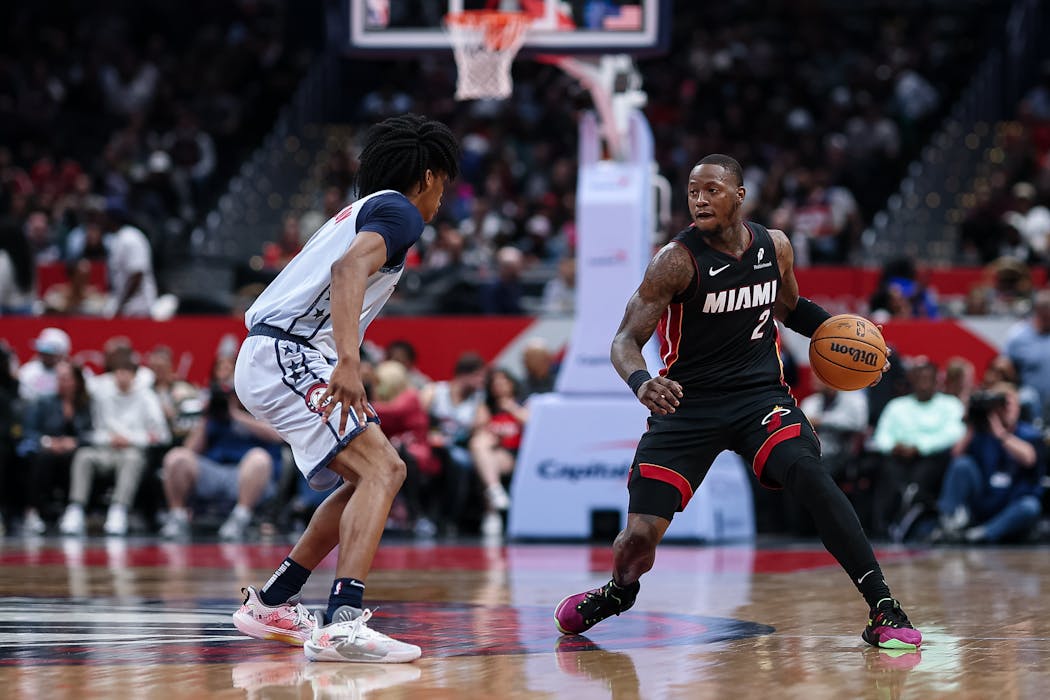
Miami Heat guard Terry Rozier was one of 34 people arrested as part of a wide-ranging investigation into illegal gambling. Scott Taetsch/Getty Images

When I first heard about the arrests of Portland Trail Blazers coach Chauncey Billups, Miami Heat guard Terry Rozier and former NBA player Damon Jones in connection to federal investigations involving illegal gambling, I couldn’t help but think of a recent moment in my sports writing class.

I was showing my students a clip from an NFL game between the Jacksonville Jaguars and Kansas City Chiefs. Near the end of play, Jaguars quarterback Trevor Lawrence threw a perfect pass to receiver Brian Jones Jr. to secure a critical first down. Out of the blue, a student groaned and said that he’d lost US$50 on that throw.

I thought of that moment because it revealed how ubiquitous sports betting has become, how much the types of bets have changed over time, and – given these trends – how it’s naive to think players won’t continue to be tempted to game the system.

The prop bet hits it big

I’ve been following the evolution of sports gambling for about a decade in my position as chair of Penn State’s sports journalism program.

Back when legal American sports betting was mostly confined to Las Vegas, the standard bets tended to be tied to picking a winner or which team would cover a point spread.

But ahead of the 1986 Super Bowl between the Chicago Bears and the overmatched New England Patriots, casinos offered bets on whether Bears defensive lineman – and occasional running back – William “Refrigerator” Perry would score a touchdown. The excitement around that sideshow kept fan interest going during a 46-10 blowout.

Perry did end up scoring, and the prop bet took off from there.

Prop bets are wagers that depend on an outcome within a game but not its final result. They can often involve an athlete’s individual performance in some statistical category – for instance, how many yards a running back will rush for, how many rebounds a basketball center will secure, or how many strikeouts a pitcher will have. They’ve become routine offerings on sports betting menus.

For example: As I write this, I am looking at a FanDuel account I opened years ago, seeing that, for the Green Bay Packers-Pittsburgh Steelers game currently in progress, I can place a wager on which player will score a touchdown, how many yards each quarterback will throw for and much, much more. As the game progresses, the odds constantly shift – allowing for what are called “live bets.”

Returning to my student who lost the bet on Lawrence’s pass completion: It’s possible he’d placed a bet on Lawrence to throw fewer than a set number of yards. Or he could have been part of a fantasy league, which is also dependent on individual player performances.

Either way, a problem with prop bets, from an anti-corruption perspective, is that an individual can often control the outcome. You don’t need a group of players to be in on it – which is what happened during the infamous Black Sox Scandal, when eight players on the Chicago White Sox were accused of conspiring with gamblers to intentionally lose the 1919 World Series.

In the indictment against him, Rozier is accused of telling a co-defendant to pass along information to particular bettors that he planned to leave a March 2023 game early – a move everyone involved knew meant he would not reach his statistical benchmarks for the game. They could then place bets that he wouldn’t hit those marks.

In baseball, meanwhile, Luis Ortiz of the Cleveland Guardians was placed on leave during the 2025 season and is under investigation for possibly illegally wagering on the outcome of two pitches he threw. MLB authorities are essentially trying to determine if he deliberately threw balls as opposed to strikes in two instances. (Yes, prop bets have become so granular that you can even bet on whether a pitcher will throw a ball or a strike on an individual pitch.)

An exploding market with no end in sight

The popularity of prop bets feeds into a worldwide sports gambling industry that has experienced explosive growth and shows no sign of slowing.

Since the U.S. Supreme Court in 2018 ruled that states could decide on whether to allow sports betting, 39 states plus the District of Columbia have done so.

The leagues and media are more than just bystanders. FanDuel and DraftKings are official sports betting partners of the NBA and the NFL.

In the days after the Supreme Court ruling, I wondered whether journalists would embrace sports betting. These days, ESPN not only has a betting show, but it also has a betting app.

According to the American Gaming Association, sportsbooks collected a record $13.71 billion in revenue in 2024 from about $150 billion in wagers. A study released in February 2025 by Siena and St. Bonaventure universities found that nearly half of American men have an online sports betting account.

But those figures don’t begin to touch the worldwide sports betting market, especially the illegal one. The United Nations, in a 2021 report, reported that up to $1.7 trillion is wagered annually in illegal betting markets.

The U.N. report warned that it had found a “staggering scale, manifestation, and complexity of corruption and organized crime in sport at the global, regional, and national levels.”

Who’s the boss?

In early October 2025, I attended a conference of Play the Game, a Denmark-based organization that promotes “democratic values in world sports.” Its occasional gatherings attract experts from around the world who are interested in keeping sports fair and safe for everyone.

One of the most sobering topics was illegal, online sportsbooks that feature wagering on all levels of sport, from the lowest levels of European soccer on up.

It sounded somewhat familiar. This summer at the Little League World Series, which my students covered for The Associated Press, managers complained about offshore sportsbooks offering lines on the tournament, which is played by 12-year-old amateurs.

And with so much illegal wagering in the world, the issue of match fixing was bound to come up.

One session screened a recent German documentary on match fixing. Meanwhile, Anca-Maria Gherghel, a Ph.D. candidate at Sheffield Hallam University and senior researcher for EPIC Global Solutions, both in northern England, told me how she had interviewed a professional female soccer player for a team in Cyprus. The player described how she and her teammates were routinely approached with lucrative offers to throw matches.

Put it all together – the vast sums of money at play and the relative ease of fixing a prop bet, let alone a match – and you cannot be surprised at the NBA scandal.

I used to think that gambling was just a segment of the larger sports industry. Now, I wonder whether I had it exactly backward.

Has sports just become a segment of the larger gambling industry?

The Conversation

John Affleck does not work for, consult, own shares in or receive funding from any company or organization that would benefit from this article, and has disclosed no relevant affiliations beyond their academic appointment.

ref. How the explosion of prop betting threatens the integrity of pro sports – https://theconversation.com/how-the-explosion-of-prop-betting-threatens-the-integrity-of-pro-sports-268340

How the explosion of prop betting risks threatening the integrity of pro sports

Source: The Conversation – USA (2) – By John Affleck, Knight Chair in Sports Journalism and Society, Penn State

Miami Heat guard Terry Rozier was one of 34 people arrested as part of a wide-ranging investigation into illegal gambling. Scott Taetsch/Getty Images

When I first heard about the arrests of Portland Trail Blazers coach Chauncey Billups, Miami Heat guard Terry Rozier and former NBA player Damon Jones in connection to federal investigations involving illegal gambling, I couldn’t help but think of a recent moment in my sports writing class.

I was showing my students a clip from an NFL game between the Jacksonville Jaguars and Kansas City Chiefs. Near the end of play, Jaguars quarterback Trevor Lawrence threw a perfect pass to receiver Brian Jones Jr. to secure a critical first down. Out of the blue, a student groaned and said that he’d lost US$50 on that throw.

I thought of that moment because it revealed how ubiquitous sports betting has become, how much the types of bets have changed over time, and – given these trends – how it’s naive to think players won’t continue to be tempted to game the system.

The prop bet hits it big

I’ve been following the evolution of sports gambling for about a decade in my position as chair of Penn State’s sports journalism program.

Back when legal American sports betting was mostly confined to Las Vegas, the standard bets tended to be tied to picking a winner or which team would cover a point spread.

But ahead of the 1986 Super Bowl between the Chicago Bears and the overmatched New England Patriots, casinos offered bets on whether Bears defensive lineman – and occasional running back – William “Refrigerator” Perry would score a touchdown. The excitement around that sideshow kept fan interest going during a 46-10 blowout.

Perry did end up scoring, and the prop bet took off from there.

Prop bets are wagers that depend on an outcome within a game but not its final result. They can often involve an athlete’s individual performance in some statistical category – for instance, how many yards a running back will rush for, how many rebounds a basketball center will secure, or how many strikeouts a pitcher will have. They’ve become routine offerings on sports betting menus.

For example: As I write this, I am looking at a FanDuel account I opened years ago, seeing that, for the Green Bay Packers-Pittsburgh Steelers game currently in progress, I can place a wager on which player will score a touchdown, how many yards each quarterback will throw for and much, much more. As the game progresses, the odds constantly shift – allowing for what are called “live bets.”

Returning to my student who lost the bet on Lawrence’s pass completion: It’s possible he’d placed a bet on Lawrence to throw fewer than a set number of yards. Or he could have been part of a fantasy league, which is also dependent on individual player performances.

Either way, a problem with prop bets, from an anti-corruption perspective, is that an individual can often control the outcome. You don’t need a group of players to be in on it – which is what happened during the infamous Black Sox Scandal, when eight players on the Chicago White Sox were accused of conspiring with gamblers to intentionally lose the 1919 World Series.

In the indictment against him, Rozier is accused of telling a co-defendant to pass along information to particular bettors that he planned to leave a March 2023 game early – a move everyone involved knew meant he would not reach his statistical benchmarks for the game. They could then place bets that he wouldn’t hit those marks.

In baseball, meanwhile, Luis Ortiz of the Cleveland Guardians was placed on leave during the 2025 season and is under investigation for possibly illegally wagering on the outcome of two pitches he threw. MLB authorities are essentially trying to determine if he deliberately threw balls as opposed to strikes in two instances. (Yes, prop bets have become so granular that you can even bet on whether a pitcher will throw a ball or a strike on an individual pitch.)

An exploding market with no end in sight

The popularity of prop bets feeds into a worldwide sports gambling industry that has experienced explosive growth and shows no sign of slowing.

Since the U.S. Supreme Court in 2018 ruled that states could decide on whether to allow sports betting, 39 states plus the District of Columbia have done so.

The leagues and media are more than just bystanders. FanDuel and DraftKings are official sports betting partners of the NBA and the NFL.

In the days after the Supreme Court ruling, I wondered whether journalists would embrace sports betting. These days, ESPN not only has a betting show, but it also has a betting app.

According to the American Gaming Association, sportsbooks collected a record $13.71 billion in revenue in 2024 from about $150 billion in wagers. A study released in February 2025 by Siena and St. Bonaventure universities found that nearly half of American men have an online sports betting account.

But those figures don’t begin to touch the worldwide sports betting market, especially the illegal one. The United Nations, in a 2021 report, reported that up to $1.7 trillion is wagered annually in illegal betting markets.

The U.N. report warned that it had found a “staggering scale, manifestation, and complexity of corruption and organized crime in sport at the global, regional, and national levels.”

Who’s the boss?

In early October 2025, I attended a conference of Play the Game, a Denmark-based organization that promotes “democratic values in world sports.” Its occasional gatherings attract experts from around the world who are interested in keeping sports fair and safe for everyone.

One of the most sobering topics was illegal, online sportsbooks that feature wagering on all levels of sport, from the lowest levels of European soccer on up.

It sounded somewhat familiar. This summer at the Little League World Series, which my students covered for The Associated Press, managers complained about offshore sportsbooks offering lines on the tournament, which is played by 12-year-old amateurs.

And with so much illegal wagering in the world, the issue of match fixing was bound to come up.

One session screened a recent German documentary on match fixing. Meanwhile, Anca-Maria Gherghel, a Ph.D. candidate at Sheffield Hallam University and senior researcher for EPIC Global Solutions, both in northern England, told me how she had interviewed a professional female soccer player for a team in Cyprus. The player described how she and her teammates were routinely approached with lucrative offers to throw matches.

Put it all together – the vast sums of money at play and the relative ease of fixing a prop bet, let alone a match – and you cannot be surprised at the NBA scandal.

I used to think that gambling was just a segment of the larger sports industry. Now, I wonder whether I had it exactly backward.

Has sports just become a segment of the larger gambling industry?

The Conversation

John Affleck does not work for, consult, own shares in or receive funding from any company or organization that would benefit from this article, and has disclosed no relevant affiliations beyond their academic appointment.

ref. How the explosion of prop betting risks threatening the integrity of pro sports – https://theconversation.com/how-the-explosion-of-prop-betting-risks-threatening-the-integrity-of-pro-sports-268340

Woven baskets aren’t just aesthetically pleasing – materials science research finds they’re sturdier and more resilient than stiff containers

Source: The Conversation – USA – By Guowei (Wayne) Tu, Ph.D. Student in Civil and Environmental Engineering, University of Michigan

Woven fabric is resilient to stress because it tends to bend more than rigid materials before breaking. Jordan Lye/Moment via Getty Images

People have been using flat, ribbonlike materials, such as reed strips, to make woven baskets for thousands of years. This weaving method has reemerged as a technique for engineers to create textile and fabric structures with complex geometry. While beautiful and intricate, these baskets can also be surprisingly strong.

We are a team of structures and materials scientists at the University of Michigan. We wanted to figure out how basketlike structures that use traditional weaving techniques can be so sturdy, load-bearing and resilient.

To explore the resilience of baskets, we designed a series of small woven units that can be assembled into larger structures. These woven designs provide almost the same stiffness as nonwoven structures, such as plastic bins. They also do not fracture and fail when bent and twisted the way nonwoven, continuous systems (made out of a continuous sheet material) do.

Our basketlike woven structures have many potential applications, including tiny robots that are very damage resilient – these robots can be run over by a car and still do not fail. We could also make woven clothes to help protect people from severe impacts such as car crashes. We made these woven structures using Mylar (a type of polymer material), wood and steel.

A pile of woven baskets
Basket weaving as a practice has been around for centuries.
Mlenny/iStock via Getty Images

Testing woven baskets

Early humans made baskets by weaving slender strips of bark or reeds, and some Indigenous societies use these techniques today. Basket weaving was an efficient way to turn one-dimensional strips into three-dimensional containers.

This geometric benefit is a direct motivation for basket weaving, but in our study published in August 2025 in Physical Review Research, we wanted to find out whether basket weaving can provide more than aesthetic value in modern science and engineering.

In our experiment, we compared woven and nonwoven containers that had the same overall shape and were fabricated using the same amount and type of materials.

The “ribbons” we used were 10 millimeters wide and two-tenths of a millimeter thick. They were always woven in the same over/under/over/under pattern. We wove baskets from the flat ribbons and then created models using 3D scans of these woven containers that helped us examine the underlying similarities and differences between the woven and continuous structures.

We found that these containers had similar stiffness to containers not made from woven materials, and they also went back to their initial shape after we bent or twisted them.

A figure with three panels, the first shows two nearly identical boxes, one woven and one continuous (non-woven). The second panel shows both boxes being twisted and squished. The third shows both structure afterwards. The woven has retained its shape while the continuous looks squished and twisted.
When comparing rectangular boxes made of woven sheets of Mylar polyester ribbons and a continuous sheet of the same material, the woven structure could still bear a load after undergoing compression (axial buckling) and twisting (torsional buckling), while the continuous sheet could not. These structures are made of Mylar (a type of polymer material).
Tu & Filipov, 2025

When you place a heavy object on a woven structure, the ribbons are mainly being stretched instead of bent. This stretching makes them stiff because ribbons are much stiffer when they are stretched compared to bent. On top of that, the ribbons are not rigidly connected in woven structures, which gives them their extraordinary resilience.

By harnessing basket-weaving techniques, engineers can potentially create better materials for cars, consumer devices such as smartwatches, and soft robots, which are robots made from soft materials instead of rigid ones. Essentially, these techniques could improve any device when the material needs to be stiff and resilient.

What’s next

Our research team is still exploring a few big, unanswered questions about these woven baskets.

First, we want to understand how the geometry of the woven baskets determines their stiffness and resilience, and create an analytical or numerical model to describe this relationship. We’d then like to use that model to design woven structures that fit a target stiffness and resilience. Most woven baskets are handmade because their geometry is complex and difficult for a machine to manufacture.

Second, we’d like to figure out how to create a machine that can fabricate woven baskets autonomously. Automated machines can produce two-dimensional woven fabrics, but we’d like to learn how to modernize and digitalize the ancient craft of three-dimensional basket weaving.

Third, we want to understand how to integrate electronic materials into three-dimensional basket weaving to create next-generation robotic textiles. These robotic textiles could sense, actuate, move around, bear a load, stay resilient to accidental overload and safely interact with humans at the same time.

Basket-weaving research and applications

Ours isn’t the only study exploring the complex geometry of basket weaving and the potential of applying basket-weaving techniques to architectural design.

For example, researchers teamed up with an artist to tweak a popular basket-weaving approach, finding ways to weave the ribbons and produce any curvature they desired. Later, the same research team used this methodology to fabricate woven domes. They found that they could tune the stiffness and stability of woven domes by varying the curvature of the ribbons.

In another relevant study, researchers built algorithms that optimized the size, shape and curvature of ribbons, then used those ribbons to weave together a geometrically sophisticated structure.

Our new work and these other teams’ work is putting a modern spin on technology that has likely been around since the dawn of humanity.

The Conversation

Evgueni Filipov has received research funding from AFOSR.

Guowei (Wayne) Tu does not work for, consult, own shares in or receive funding from any company or organization that would benefit from this article, and has disclosed no relevant affiliations beyond their academic appointment.

ref. Woven baskets aren’t just aesthetically pleasing – materials science research finds they’re sturdier and more resilient than stiff containers – https://theconversation.com/woven-baskets-arent-just-aesthetically-pleasing-materials-science-research-finds-theyre-sturdier-and-more-resilient-than-stiff-containers-265567

The Trump administration’s anti-immigrant housing policy reflects a long history of xenophobia in public housing

Source: The Conversation – USA – By Rahim Kurwa, Associate professor of Sociology, University of Illinois Chicago

An aerial view of a housing development Las Vegas, Nev., on Aug. 8, 2025. Justin Sullivan/Getty Images

The U.S. housing market has been ensnared in a growing affordability crisis for decades.

The problem has gotten dramatically worse in recent years. Since 2019, home prices are up 60% nationwide. A record-high 22 million renters are “cost-burdened” – spending more than 30% of their income on housing.

Meanwhile, stagnant wages, limited housing supply and lagging federal assistance have helped leave more than 770,000 Americans homeless.

Despite these varied reasons, Vice President JD Vance has blamed the housing affordability crisis on undocumented immigrants. In August 2025, he attributed rising housing costs to immigration: “You cannot flood the United States of America with … people who have no legal right to be here, have them compete against young American families for homes, and not expect the price to skyrocket.”

Deportations, he argued, would lower housing prices. “Why has housing leveled off over the past six months? I really believe the main driver is … negative net migration.”

Despite Vance’s claims, research shows that immigration is not a substantial cause of unaffordable housing. In fact, studies have found that deportations exacerbate housing shortages through reductions in the construction workforce, which lead to lower production of housing units and higher prices.

From this perspective, its hard to see the administration’s deportation policy as a real effort to solve the housing crisis. Rather, it is using the housing crisis as a way to justify mass deportations to the public.

The current administration’s anti-immigrant housing policy reflects a long history of xenophobia in housing. As a sociologist of housing, I’ve traced the history of racial segregation in housing in Los Angeles County. I have found that the same far-right groups that sought to defeat public housing construction and maintain racially restrictive agreements in post-World War II Los Angeles also advocated to ban immigrants from U.S. housing programs.

Earlier anti-immigrant housing plans

Among the leaders of these efforts was the far-right politician and activist Gerald L.K. Smith. Described in 1976 by historian John Morton Blum as “the most infamous American fascist,” Smith helped bridge the American right’s 1940s conspiratorial and isolationist America First era and its 1960s anti-civil rights era.

Smith traveled the country advocating a Christian nationalist vision for American society, offering a religious justification for anti-communism and opposition to civil rights. He also ran for president unsuccessfully in 1944, 1948 and 1956.

A black and white photo shows a man in a suit, right hand raised, speaking in front of a table.
Gerald L.K. Smith speaks in Washington, D.C., on Aug. 7, 1936.
Library of Congress, CC BY

After settling in Los Angeles in 1953, Smith led Red Scare campaigns – driven by hostility to communism – across the country.

In my research, I found that Smith was an early proponent of anti-immigrant housing policy. His 10 principles included a call to “Stop immigration in order that American jobs and American houses may be safeguarded for American citizens.” Elsewhere he called to “Release housing units occupied by aliens in order that they may be occupied by veterans and other American citizens.”

Smith wasn’t alone. His efforts were part of a broader environment in which public officials and local media worked to stop construction of public housing in Los Angeles in the 1950s, accusing its proponents of communism.

Recent anti-immigrant policy in housing

State and federal policymakers have also incorporated anti-immigrant stances into American housing policy over the past half-century.

The 1980 Housing and Community Development Act was the first federal legislation to specifically bar undocumented immigrants from public housing programs. Welfare reform in 1996 further restricted public housing assistance to only legal permanent residents and those with asylum or refugee status.

Echoing the alien land laws of the late 1800s that prohibited foreign property ownership, policymakers in the 2000s in states such as Pennsylvania and Texas passed laws forcing landlords to check immigration status as a condition of rental – though this was struck down by the courts.

Today, immigrant tenants experience fewer housing rights than citizens. These inequalities fall particularly hard on unauthorized immigrants who experience high rates of housing cost burden, crowding and poor housing conditions.

The Trump administration aims to expand restrictions on immigrants in public housing even further. The Department of Housing and Urban Development is in the process of adopting rules that will evict entire families if even one member is ineligible for assistance based on immigration status. Current law allows those families to live in public housing, while prorating their benefits to account for an ineligible member.

From Smith to Vance, anti-immigrant housing policies have been cast as a way for citizens to get more housing. But they fail to prevent or solve the housing shortage driving the crisis.

For example, the Trump administration’s effort to evict mixed status families from public housing will affect roughly 25,000 households. Setting aside the fact that those families may then be made homeless, that number is only one-tenth the amount of housing that the U.S. has lost due to the defunding and demolishing of public housing since 1990.

A construction worker walks in the frame of a house.
Studies show that deportations can reduce the housing construction workforce, which lowers the number of units built and increases costs.
AP Photo/Laura Rauch

Indeed, many of the Trump administration’s immigration and economic policies are likely to exacerbate the housing crisis. The Trump administration has made deportation a priority and has significantly increased deportation rates compared to recent years, while instituting historically high tariffs on imports.

Deportations reduce the housing construction workforce, lowering the number of units built and increasing costs. And tariffs raise prices on building materials such as lumber, steel and aluminum. The National Association of Home Builders estimates that recent tariffs have raised building costs by US$10,900 per home.

In early 2025, the Department of Government Efficiency canceled or delayed a series of HUD grants for housing assistance programs. And the Trump administration has announced plans for more cuts to the nation’s already insufficient housing assistance budget.

Vance, like Smith before him, presents the issue like a pie, where citizens can get a larger slice only by deporting immigrants. But the reality is that the pie can be bigger: The government can fully fund the housing needs of all Americans for less than it has spent on its other priorities. The recently passed “big, beautiful bill,” for example, allocates more funding to border and interior enforcement per year than key rental assistance programs, public housing and Housing Choice Vouchers allocate for housing.

In Smith’s time, everyday Americans resisted this gambit, speaking out to protest his views. Today, as Smith’s anti-immigration housing ideas have ascended to the national stage, the housing justice community is speaking out against anti-immigrant housing policy and offering an alternative vision of how the U.S. can provide housing for all.

The Conversation

Rahim Kurwa does not work for, consult, own shares in or receive funding from any company or organization that would benefit from this article, and has disclosed no relevant affiliations beyond their academic appointment.

ref. The Trump administration’s anti-immigrant housing policy reflects a long history of xenophobia in public housing – https://theconversation.com/the-trump-administrations-anti-immigrant-housing-policy-reflects-a-long-history-of-xenophobia-in-public-housing-263860

Despite naysayers and rising costs, data shows that college still pays off for students – and society overall

Source: The Conversation – USA (2) – By Stanley S. Litow, Adjunct Professor of International and Public Affairs, Columbia University

College graduates earn more immediately after graduation and later on in their careers than high school graduates. DBenitostock/Moment

No industry has perhaps felt the negative effect of a radical shift in federal policy under the second Trump administration more than higher education.

Many American colleges and universities, especially public institutions, have experienced swift and extensive federal cuts to grants, research and other programs in 2025.

Meanwhile, new restrictive immigration policies have prevented many international students from enrolling in public and private universities. Universities and colleges are also facing other various other challenges – like the threat to academic freedom.

These shifts coincide with the broader, increasingly amplified argument that getting a college degree does not matter, after all. A September 2025 Gallup poll shows that while 35% of people rated college as “very important,” another 40% said it is “fairly important,” and 24% said it is “not too important.”

By comparison, 75% of surveyed people in 2010 said that college was “very important,” while 21% said it was “fairly important” and 4% said it is “not too important.”

Still, as a scholar of education, economic development and social issues, I know that there is ample and growing evidence that a college degree is still very much worth it. Graduating from college is directly connected to higher entry-level wages and long-term career success.

A swirl of white papers hang from a ceiling in an ornate room with a chandelier.
College diplomas are seen on display as part of an art exhibition in Grand Central Terminal in New York in 2022.
Timothy A. Clary/AFP via Getty Images

A growing gap

Some people argue that a college degree does not matter, since there might not be enough jobs for college graduates and other workers, given the growth of artificial intelligence, for example. Some clear evidence shows otherwise.

An estimated 18.4 million workers with a college degree in the U.S. will retire from now through 2032, according to Georgetown University’s Center on Education and the Workforce. This is far greater than the 13.8 million workers who will enter the workforce with college degrees during this same time frame.

Meanwhile, an additional 700,00 new jobs that require college degrees – spanning from environmental positions to advanced manufacturing – will be created from now through 2032.

The gap between those expected to leave and enter the workforce with college degrees creates a serious problem. One major question is whether there will be enough people to fill the available jobs that require a college degree.

In 2023, foreign-born people made up 16% of registered nurses in the U.S., though that percentage is higher in certain states, like California. But restrictions on immigration could limit the number of potential nurses able to fill open positions.

Nursing and teaching are two fields expected to grow over the next few decades, and they will require more workers due to retirements.

Other fields, like accounting, engineering, law and many others, are also expected to have more college-educated workers retire than there are new workers to fill their positions.

Worth the cost

The average annual salary of a college graduate from the class of 2023 was US$64,291 in 2024, according to the National Association of Colleges and Employers.

The overall average salary for this graduation class one year after they left school marked an increase from the average $60,028 that the class of 2022 earned in 2023, equivalent to $63,850 today.

While there is not available data that offers a direct comparison, full-time, year-round workers ages 25 to 34 with a high school diploma earned $41,800 in median annual earnings in 2022, or $46,100 today.

Overall lifetime earnings for those with college degrees is about about $1.2 million more than people with a high school make, according to the recent Georgetown findings.

People who earn more generally have more money to support their families and contribute to their immediate communities. Their higher taxes also contribute to the U.S. economy, supporting needed services like education, public safety and health care.

People with college degrees are also more likely than those who are not college graduates to vote, volunteer and make charitable donations to help others in need.

College matters for individuals, but it clearly also helps improve the economy.

With 64 public colleges across the state, the State University of New York system is the largest post-secondary network of higher education schools in the country. For every $1 the state of New York invests in SUNY, the SUNY system returns $8.70 to the state in terms of economic growth, according to 2024 findings by the Rockefeller Institute, an independent public policy research organization affiliated with SUNY. And that is only one state.

A gray building is seen with red signs hanging nearby that say 'Stony Brook University.'
The Stony Brook University campus, part of the State University of New York system, is shown in May 2022.
Howard Schnapp/Newsday RM via Getty Images

A new way forward

It isn’t likely that the expected number of college-educated people who will soon retire will suddenly decrease, or that the anticipated number of people entering the workforce will unexpectedly increase.

There are practical reasons why some people do not want to go to college, or cannot attend. Indeed, the percentage of young people enrolled as college undergraduates fell almost 15% from 2010 through 2022.

For one, tuition and fees at private colleges have increased about 32% since 2006, after adjusting for inflation. And in-state tuition and fees at public universities have also grown about 29% since 2006.

The total of federal student loan debt for college has also tripled since 2007. It stood at about $1.84 trillion in 2024.

I believe that in order to ensure enough college-educated people can fill the anticipated work openings in the future, universities and the government should embrace needed changes to increase both enrollment and completion rates.

Artificial intelligence will transform work worldwide, for example, and that shift should be incorporated into higher education curriculum and degrees. Soft skills – like problem-solving, collaboration, presentation and writing skills – will become more important and should be prioritized in the learning process.

I believe that universities should also prioritize experiential education, including paid internships that offer students academic credit. This can help students gain experience that is both accredited and is connected to direct career pathways.

Universities and high schools could also expand how much they offer microcredentials – or short, focused learning programs that offer practical skills in a specific area – so students can connect their education with clear career pathways.

These reforms aren’t easy. They require a commitment to change, and all of this work will require deep partnerships with the government. While that might be a heavy lift currently at the federal level, it is both possible and achievable to make advances on these and other changes at the state level.

American universities and colleges have always been key to preparing the workforce for economic opportunity. At the end of World War II, for example, Columbia University and IBM worked together to help create the academic discipline now called computer science.

This action did more than help one university or one employer. It fueled change across higher education and across private companies and the government, leading to massive economic growth.

Universities have made countless other contributions to strengthen and expand the economy. Considering solutions to some of the challenges that stop students from going to college could help ensure that more students see the value in a college education – and a tangible way for them to connect it to a future career.

The Conversation

Stanley S. Litow does not work for, consult, own shares in or receive funding from any company or organization that would benefit from this article, and has disclosed no relevant affiliations beyond their academic appointment.

ref. Despite naysayers and rising costs, data shows that college still pays off for students – and society overall – https://theconversation.com/despite-naysayers-and-rising-costs-data-shows-that-college-still-pays-off-for-students-and-society-overall-267612

AI is changing who gets hired – what skills will keep you employed?

Source: The Conversation – USA (2) – By Murugan Anandarajan, Professor of Decision Sciences and Management Information Systems, Drexel University

Success in the age of AI may depend less on technical skills and more on human judgment, adaptability and trust. Malte Mueller/Getty Images

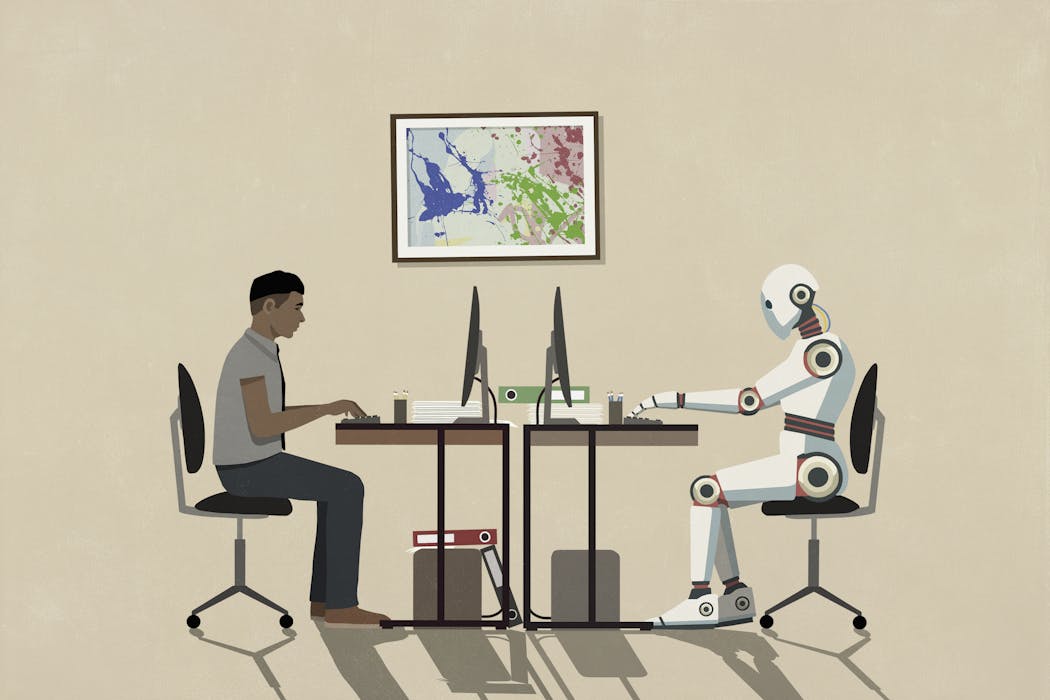
The consulting firm Accenture recently laid off 11,000 employees while expanding its efforts to train workers to use artificial intelligence. It’s a sharp reminder that the same technology driving efficiency is also redefining what it takes to keep a job.

And Accenture isn’t alone. IBM has already replaced hundreds of roles with AI systems, while creating new jobs in sales and marketing. Amazon cut staff even as it expands teams that build and manage AI tools. Across industries, from banks to hospitals and creative companies, workers and managers alike are trying to understand which roles will disappear, which will evolve and which new ones will emerge.

I research and teach at Drexel University’s LeBow College of Business, studying how technology changes work and decision-making. My students often ask how they can stay employable in the age of AI. Executives ask me how to build trust in technology that seems to move faster than people can adapt to it. In the end, both groups are really asking the same thing: Which skills matter most in an economy where machines can learn?

To answer this, I analyzed data from two surveys my colleagues and I conducted over this summer. For the first, the Data Integrity & AI Readiness Survey, we asked 550 companies across the country how they use and invest in AI. For the second, the College Hiring Outlook Survey, we looked at how 470 employers viewed entry-level hiring, workforce development and AI skills in candidates. These studies show both sides of the equation: those building AI and those learning to work with it.

AI is everywhere, but are people ready?

More than half of organizations told us that AI now drives daily decision-making, yet only 38% believe their employees are fully prepared to use it. This gap is reshaping today’s job market. AI isn’t just replacing workers; it’s revealing who’s ready to work alongside it.

Our data also shows a contradiction. While many companies now depend on AI internally, only 27% of recruiters say they’re comfortable with applicants using AI tools for tasks such as writing resumes or researching salary ranges.

In other words, the same tools companies trust for business decisions still raise doubts when job seekers use them for career advancement. Until that view changes, even skilled workers will keep getting mixed messages about what “responsible AI use” really means.

In the Data Integrity & AI Readiness Survey, this readiness gap showed up most clearly in customer-facing and operational jobs such as marketing and sales. These are the same areas where automation is advancing quickly, and layoffs tend to occur when technology evolves faster than people can adapt.

At the same time, we found that many employers haven’t updated their degree or credential requirements. They’re still hiring for yesterday’s resumes while, tomorrow’s work demands fluency in AI. The problem isn’t that people are being replaced by AI; it’s that technology is evolving faster than most workers can adapt.

Fluency and trust: The real foundations of adaptability

Our research suggests that the skills most closely linked with adaptability share one theme, what I call “human-AI fluency.” This means being able to work with smart systems, question their results and keep learning as things change.

Across companies, the biggest challenges lie in expanding AI, ensuring compliance with ethical and regulatory standards and connecting AI to real business goals. These hurdles aren’t about coding; they’re about good judgment.

In my classes, I emphasize that the future will favor people who can turn machine output into useful human insight. I call this digital bilingualism: the ability to fluently navigate both human judgment and machine logic.

What management experts call “reskilling” – or learning new skills to adapt to a new role or major changes in an old one – works best when people feel safe to learn. In our Data Integrity & AI Readiness Survey, organizations with strong governance and high trust were nearly twice as likely to report gains in performance and innovation. The data suggests that when people trust their leaders and systems, they’re more willing to experiment and learn from mistakes. In that way, trust turns technology from something to fear into something to learn from, giving employees the confidence to adapt.

According to the College Hiring Outlook Survey, about 86% of employers now offer internal training or online boot camps, yet only 36% say AI-related skills are important for entry-level roles. Most training still focuses on traditional skills rather than those needed for emerging AI jobs.

The most successful companies make learning part of the job itself. They build opportunities to learn into real projects and encourage employees to experiment. I often remind leaders that the goal isn’t just to train people to use AI but to help them think alongside it. This is how trust becomes the foundation for growth, and how reskilling helps retain employees.

The new rules of hiring

In my view, the companies leading in AI aren’t just cutting jobs; they’re redefining them. To succeed, I believe companies will need to hire people who can connect technology with good judgment, question what AI produces, explain it clearly and turn it into business value.

In companies that are putting AI to work most effectively, hiring isn’t just about resumes anymore. What matters is how people apply traits like curiosity and judgment to intelligent tools. I believe these trends are leading to new hybrid roles such as AI translators, who help decision-makers understand what AI insights mean and how to act on them, and digital coaches, who teach teams to work alongside intelligent systems. Each of these roles connects human judgment with machine intelligence, showing how future jobs will blend technical skills with human insight.

That blend of judgment and adaptability is the new competitive advantage. The future won’t just reward the most technical workers, but those who can turn intelligence – human or artificial – into real-world value.

The Conversation

Murugan Anandarajan does not work for, consult, own shares in or receive funding from any company or organization that would benefit from this article, and has disclosed no relevant affiliations beyond their academic appointment.

ref. AI is changing who gets hired – what skills will keep you employed? – https://theconversation.com/ai-is-changing-who-gets-hired-what-skills-will-keep-you-employed-267376

Trump’s ‘golden age’ economic message undercut by his desire for much lower interest rates – which typically signal a weak jobs market

Source: The Conversation – USA (2) – By Joshua Stillwagon, Associate Professor of Economics, Babson College

President Donald Trump has said he believes the U.S. economy has entered a ‘golden age’ on his watch. AP Photo/Mark Schiefelbein

President Donald Trump seems to want to have it both ways on the U.S. economy.

On the one hand, he recently said the economy is in its “golden age” and referred to the U.S. as the “hottest country anywhere in the world.”

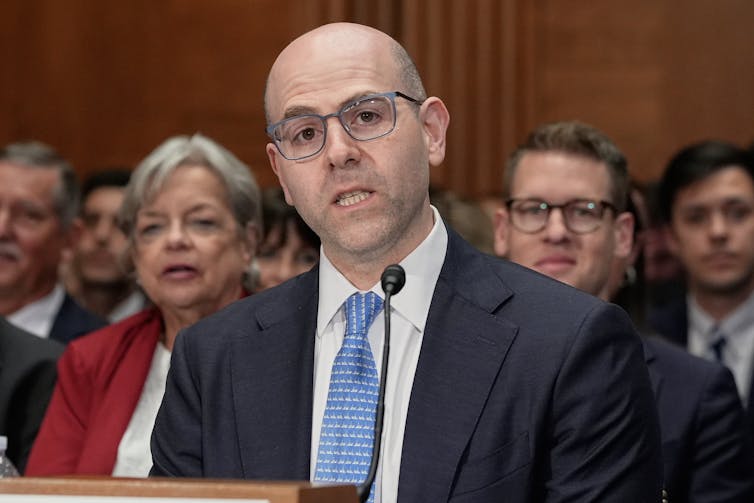
Yet at the same time, he has outright demanded that the Federal Reserve sharply slash interest rates to fuel economic activity. And his recently handpicked governor, Stephen Miran, has led the charge in pushing for a bigger cut than preferred by his new colleagues at the Fed.

When an economy is strong, central banks typically don’t cut interest rates and may even raise them to avoid spurring inflation. And so to support his argument for large cuts, Miran has played up “downside risks” to the economy and a weakening labor market, contrasting with Trump’s talk of a “golden age.”

Trump and Miran also seem to be ignoring the problem of inflation, which the president has said “has been defeated” and Miran considers close enough to the Fed’s target of 2%. Yet, inflation remains high and has been picking back up in recent months – one of the core reasons the Fed has taken a gradual approach to lowering interest rates.

I’m a macroeconomist, which means I study big-picture factors affecting an economy, such as interest rates.

It’s well known that lower rates spur faster growth, and of course all presidents want a stronger economy on their watch. But the Fed’s job when it sets interest rates is to deal with whatever reality the data shows – and make decisions accordingly.

Is the economy hot or not?

In the simplest terms, the Fed raises interest rates when the economy is “hot,” or inflation is above the Fed’s 2% target, and lowers them when there are concerns about unemployment.

At its most recent meeting, in September, the Fed lowered rates a quarter of a point, citing slowing jobs growth, and increased economic uncertainty. Trump nominee Miran was the only one of the 12 members of the Fed’s policy-setting committee to instead vote for a more aggressive half-point cut.

The only credible rationale for that large of an interest rate cut, in the face of still-high inflation, is by believing the labor market is incredibly weak. According to the Fed’s preferred measure, the personal consumption expenditures index, inflation has been accelerating all summer and was 2.7% at the end of August, well above the Fed’s 2% target.

There’s no doubt jobs growth has slowed considerably in recent months, but enough to completely ignore the risk of driving inflation higher? At this point at least, the Fed doesn’t think so.

And if the economy were in fact running hot, as the president claims, the Fed would have little choice but to keep rates flat or raise them, especially given elevated inflation.

a man in a suit speaks in front of a microphone with a few people sitting in the background
Stephen Miran, who was recently nominated to the Federal Open Market Committee, has been pushing for much larger rate cuts than his colleagues.
AP Photo/Mariam Zuhaib

Risks of following political whims

This situation gets at the heart of why central bank independence matters.

Trump’s efforts to influence the Federal Reserve have not been subtle and break with Congress’ intention to insulate the Fed from political manipulation. Besides pressing for big rate cuts, he has tried to fire a member of the Board of Governors over questionable allegations and mused about removing Fed Chair Jerome Powell.

The risks of following the wishes of a president in the face of what the data shows were starkly demonstrated in 2021, when Turkey’s president, Recep Tayyip Erdogan, fired the head of the country’s central bank. The central banker was pushing rates higher to tame inflation, which was at about 20%, but Erdogan demanded they be lowered. In response, Turkey’s lira plunged to record lows and inflation soared to over 70% in 2022.

Something similar could happen in the U.S. if Trump continues down the same path of meddling with the Fed. As a sign of how much Wall Street worries about this risk, a recent study estimated that if Trump followed through on his threat to fire Powell, the stock market could lose an estimated US$1 trillion as a result.

That’s because the Fed’s credibility rests on its ability to make decisions driven by economic evidence, not political expedience. That independence means policymakers must weigh data on inflation, jobs and growth rather than election cycles or partisan demands.

Justifying deeper rate cuts

Looking ahead to the Fed’s next meeting Oct. 28-29, policymakers face a delicate balancing act. With inflation still running above target and signs of slowing jobs growth, it needs to lower rates enough to prevent a downturn but not so low that inflation spirals out of control.

Traders are putting near-100% odds of two more quarter-point cuts this year, one on Oct. 29 and another in December. This would bring the Fed’s benchmark interest rate to a range of 3.5%-3.75% by the end of 2025, down from 4%-4.25% now.

Based on Miran’s own interest rate projections, he’s likely to again push for a larger cut of a half-point or more at both meetings, as he believes the Fed’s benchmark rate should be below 3% by the end of the year.

To me, as an economist, the only way a Fed acting independently could reasonably justify such a significant cut in rates in the next few months is if the unemployment rate begins rising steadily, with the economy clearly at risk of slipping into a recession.

The Conversation

Joshua Stillwagon was a long-time organizer and judge for an academic competition hosted at the Federal Reserve Bank of Boston, and has presented research at the Federal Reserve Bank of Boston.

ref. Trump’s ‘golden age’ economic message undercut by his desire for much lower interest rates – which typically signal a weak jobs market – https://theconversation.com/trumps-golden-age-economic-message-undercut-by-his-desire-for-much-lower-interest-rates-which-typically-signal-a-weak-jobs-market-266969

An Indigenous approach shows how changing the clocks for Daylight Saving Time runs counter to human nature – and nature itself

Source: The Conversation – USA (3) – By Rachelle Wilson Tollemar, Lecturer in Spanish Environmental Cultural Studies, University of Wisconsin-Madison

Humans and nature can find balance in each other. timnewman/E+ via Getty Images

It is that time again. Time to wonder: Why do we turn the clocks forward and backward twice a year? Academics, scientists, politicians, economists, employers, parents – and just about everyone else you will interact with this week – are likely debating a wide range of reasons for and against Daylight Saving Time.

But the reason is right there in the name: It’s an effort to “save” daylight hours, which some express as an opportunity for people to “make more use of” time when it’s light outside.

But as an Indigenous person who studies environmental humanities, this sort of effort, and the debate about it, misses a key ecological perspective.

Biologically speaking, it is normal, and even critical, for nature to do more during the brighter months and to do less during the darker ones. Animals go into hibernation, plants into dormancy.

Humans are intimately interconnected with, interdependent on, and interrelated to nonhuman beings, rhythms and environments. Indigenous knowledges, which despite their complex, diverse and plural forms, amazingly cohere in reminding humans that we too are an equal part of nature. Like trees and flowers, we are beings who also need winter to rest and summer to bloom.

As far as we humans know, we are the only species that chooses to fight against our biological presets, regularly changing our clocks, miserably dragging ourselves into and out of bed at unnatural hours.

The reason, many scholars agree, is that capitalism teaches humans that they are separate from, and superior to, nature – like the point on top of a pyramid. That, and I argue, that capitalism wants people to work the same number of hours year-round, no matter the season. This mindset runs counter to the way Indigenous people have lived for thousands of years.

A group of people stand around an open circle on an island, as the Sun rises behind a bridge across the water.
A large gathering of people celebrate Indigenous Peoples Day in 2024, by watching the Sun rise over San Francisco Bay.
Tayfun Coskun/Anadolu via Getty Images

The nature of time and work

Indigenous views of the world are not the pyramids or lines of capitalism but the circles and cycles of life.

Concretely, time correlates with terrestrial and celestial changes. Historic records and oral interviews document that in traditional Indigenous cultures of the past, human activity was scheduled according to nature’s recurring patterns. So for example, a meeting might have been scheduled not at 4 p.m. on Thursday, but rather at the next full moon. Everyone knew well in advance when that would arise and could plan accordingly.

Such an acute sensitivity to nature’s calendar has symbolic meaning, too. To look up and see the Moon in the sky at night is to see the same Moon that someone once saw centuries ago and someone else will hopefully see centuries into the future. Time is interwoven with nature in a sense that far exceeds Western understanding. It embodies past, present and future all at once. Time is life.

The 2015 movie ‘El Abrazo de la Serpiente (Embrace of the Serpent)’ examines the relationship between Indigenous cultures of knowing and colonizing forces.

In this Indigenous context, Daylight Saving Time is nonsensical – if not outright comical. Time can’t be changed any more than a clock’s hands can grab the Sun and move its position in the sky. The Sun will continue to cycle at its gravitational will for generations – and economic systems – to come.

Like time, Indigenous approaches to work are also more expansive than the capitalist economy’s. They validate and value all life-sustaining activities as work. Taking care of oneself, of the sick, of the elderly, of the young, of the land, or even merely resting, for example, are equally valuable activities.

That’s because the objective of most Indigenous economies is not to increase an economist-invented measurement of production by working from 9 a.m. to 5 p.m., Monday through Friday. Rather, their goal is to find and generate a holistic well-being for all.

Daylight Saving Time is exclusively designed for 9-to-5 workers. It attempts to boost economic activity by giving them, and them alone, more light. Think about it: Care workers, who are predominantly women, work beyond daylight hours year-round. Where is their temporal accommodation? Though likely not malicious or even purposeful, the political intervention of Daylight Saving Time ignores the massive workforce that operates on the periphery of the mainstream economy. In some ways, it reinforces the discriminatory idea that only some workers are worthy of economic recognition and accommodation.

In this sense, Daylight Saving Time raises the question: Does the economy really need that extra hour of sunshine and worker productivity? Traditional economic philosophies would likely answer no out of principle; they may see Daylight Saving Time as trespassing the biophysical, ethical and sacred limits of the world ecology by encouraging cultures of overwork and overconsumption.

A person swipes a card in a machine on a wall.
A worker swipes a time card to clock in at the beginning of their shift.
halbergman/E+ via Getty Images

The working of time and nature

Since the invention of the clock, capitalism has increasingly treated time as an inanimate object largely independent of the environment.

While the rest of nature rises and slumbers to lunar and solar cycles, humans work and sleep to the resetting of their artificial clocks.

In their 2016 book “The Slow Professor,” humanities scholars Maggie Berg and Barbara K. Seeber connect this objectification of time to an inhumane culture of work.

Modern workers, they write, are increasingly expected to treat time as a numerical asset that can be managed, measured and controlled. Time for rest and relaxation has no countable home in the capitalist economy of life.

There are certainly practical benefits to using time to measure and monitor economic activities – such as knowing the precise time a meeting is scheduled to start and end. But Berg’s and Seeber’s work reveals how that reasonable practicality has been subverted to hold workers captive within what I argue is an unsustainable, unnatural and exploitative environment. Work time and life time have blurred into one.

In capitalism, work is expected to grow infinitely, despite existing within a finite world inhabited by limited beings. At a time when human activity depletes the world’s ecology – rather than sustaining it as it once did – this around-the-clock approach to work is simply incompatible with nature.

In sum, Daylight Saving Time reproduces the same destructive logic that has led humans and nonhumans into the present socio-ecological crises. Disobeying and dominating the laws, rhythms and shape of nature, as seen in the seasonal exploitation of human energy and labor via Daylight Saving Time, perpetuates the unparalleled social and environmental decline uniquely characteristic to the current capitalist era.

Looking backwards, progressing forward

Unlike the relatively recent inception of capitalism, Indigenous wisdom espouses a set of philosophies as old as time. It reminds humans that there are other ways of interacting with time, work and the environment – ways that existed before capitalism and that can exist afterward, too.

In my view, people might be better off if the discussion about changing the clocks in the fall and spring wasn’t about how much time we can “make use of” or how much daylight we might “save,” but rather about reducing the number of hours we are expected to be made useful – and profitable – to secure a more just and sustainable existence for all.

The Conversation

Rachelle Wilson Tollemar does not work for, consult, own shares in or receive funding from any company or organization that would benefit from this article, and has disclosed no relevant affiliations beyond their academic appointment.

ref. An Indigenous approach shows how changing the clocks for Daylight Saving Time runs counter to human nature – and nature itself – https://theconversation.com/an-indigenous-approach-shows-how-changing-the-clocks-for-daylight-saving-time-runs-counter-to-human-nature-and-nature-itself-253097

What’s the difference between ghosts and demons? Books, folklore and history reflect society’s supernatural beliefs

Source: The Conversation – USA (3) – By Penelope Geng, Associate Professor of English, Macalester College

Curious Kids is a series for children of all ages. If you have a question you’d like an expert to answer, send it to curiouskidsus@theconversation.com.


What’s the difference between ghosts and demons? – Landon W., age 15, The Colony, Texas


Belief in the spirit world is a key part of many faiths and religions. A 2023 survey of 26 countries revealed that about half the respondents believed in the existence of angels, demons, fairies and ghosts. In the United States, a 2020 poll found that about half of Americans believe ghosts and demons are real.

While the subject of demons and ghosts can inspire dread, the concepts themselves can be confusing: Is there a difference between the two?

Historically, communities have understood the supernatural according to their religious and spiritual traditions. For example, the terrifying ghosts of Pu Songling’s “Strange Tales from a Chinese Studio” operate differently than those haunting the works of William Shakespeare, even though both writers lived in the 17th century.

Engraving of three men agog at the appearance of a ghostly man in armor
‘Hamlet, Horatio, Marcellus and the Ghost,’ from Shakespeare’s ‘Hamlet,’ Act 1, Scene 4.
Robert Thew/Gertrude and Thomas Jefferson Mumford Collection via The Met

Literary representations of ghosts and demons often reflect the anxieties of communities experiencing social, religious or political upheaval. As a scholar of early modern English literature, my research focuses on how everyday people in 16th- and 17th-century Europe used storytelling to navigate major social changes. This era, often called the Renaissance, was punctuated by the establishment of mass media through printing, the global spread of colonization and the emergence of modern science and medicine.

Digging into the literary archive can reveal people’s ideas about demons and ghosts – and what made them different.

Martin Luther and the Reformation

On Oct. 31, 1517, Martin Luther, an ex-law student and former monk, boldly published his Ninety-Five Theses. In it, he rejected the Catholic Church’s promise that monetary payment to the church could reduce the amount of time one’s soul spent in purgatory. What began as a local protest in Wittenberg, Germany, soon swept all the major European powers into a life and death struggle over religious reform. Towns were besieged, landscapes scorched, villages pillaged.

This period, called the Reformation, led to the establishment of new Christian denominations. Among these Protestant churches’ early teachings was the edict that purgatory did not exist and souls could not return to Earth to haunt the living. Protestant reformers insisted that after death, one’s soul was immediately judged. The virtuous flew up to God in heaven; the sinful burned in hell with the Devil.

According to Protestants, ghosts were invented by Catholic priests to scare people into obedience. For example, the English translator of Ludwig Lavater’s 1572 book “Of Ghostes and Spirites Walking by Night” insists ghosts are the “falsehood of Monkes, or illusions of devils, franticke imaginations, or some other frivolous and vaine perswasions.” Should you ever encounter an “apparition,” you must call it out for what it truly is: a devil pretending to be a ghost.

Page of a book reading 'The Tragic History of the Life and Death of Doctor Faustus' with an image of a man holding a book standing in a circle of runes summoning a demon
Title page of Christopher Marlowe’s ‘Doctor Faustus.’
Iohn Wright/Wikimedia Commons

Christopher Marlowe’s play “Doctor Faustus” comments on these debates. Written in the 1580s for a primarily Protestant audience, the play features a scene in which Dr. Faustus and his devil companion, Mephistopheles, trick the pope by snatching away his meal. A bewildered member of the papal court concludes “it may be some ghost … come to beg a pardon of your Holiness.” The audience knows full well, however, that these pranks are committed by the necromancer and his demon.

Ghostly haunting

In spite of Protestantism’s official stance against ghosts, belief in them persisted in the popular imagination.

Archival records show that ordinary people held fast to popular beliefs despite what their religious authorities decreed. For example, the casebook of Richard Napier, an astrological physician, reports several cases of “spirit” hauntings, including that of a young mother named Catherine Wells who had been “vexed … with a spirit” for three continuous years.

Popular plays provide additional evidence. Shakespeare’s “Hamlet” opens with a midnight visitation by the ghost of Hamlet’s father, telling his son he cannot rest in peace until his murderer is brought to justice. Ghostly victims seeking justice appear in other Shakespearean plays, including “Macbeth” and “Richard III.”

Cheap print, a form of common media, capitalized on the public’s interest in the paranormal. Part entertainment, part journalism, cheap print was read by all sorts of people. A 1662 pamphlet titled “A strange and wonderfull discovery of a horrid and cruel murther [murder]” describes Isabel Binnington’s unsettling encounter with the ghost of Robert Eliot. In her testimonial, she claims that Eliot’s ghost promised he would never hurt her. What he wanted was simply for her to hear his story: He had been murdered for his coins in the very house she occupied.

A 1730 broadside ballad called “The Suffolk Miracle” – still performed today – tells the tale of young lovers parted by an overprotective father. After the daughter is whisked away, her beloved dies of a broken heart. When his ghost later appears to her, she “joy’d to see her heart’s delight.”

Demonic possession

While reformed Protestant thinkers rejected the existence of ghosts, they enthusiastically accepted the reality of devils.

Reports of demonic possession were popular. Before his ascension to the English throne, King James VI of Scotland published a literary treatise on demonology in 1597. He argues that “assaultes of Sathan are most certainly practized” and “detestable slaves of the Devill” live among us.

Engraving of a man surrounded by devilish creatures tearing at and beating him
‘Saint Anthony Tormented by Demons,’ 1470–74.
Martin Schongauer/Rogers Fund via The Met

The diaries of English Puritans offer further proof that beliefs about devilish encounters were common. In the 1650s, the Calvinist preacher Thomas Hall insisted that his godliness attracted the attention of Satan like a moth to a candle. From an early age, he complained, he was subjected to “Satanicall buffettings” and terrifying dreams. He believed, however, that surviving demonic temptation demonstrated his unwavering devotion to God.

Distinguishing ghosts from demons

Based on the literature, what can we conclude about how people saw ghosts and demons?

Early modern people often represented ghosts as sad and pitiable. They were depicted as the spiritual remainder of a recently deceased person, haunting their friends and kin – or, occasionally, a stranger. They retained some of their humanity and were psychically connected to a place, such as their former home, or to a person, such as their most cherished companion.

Demons, by contrast, were almost always malevolent tricksters who served the Devil. Demons lacked knowledge of what it meant to be human. Hell was the demons’ lair. Early modern texts describe them visiting the earthly plane to corrupt, possess or tempt humans to commit self-harm or violence against others.

Faustus getting dragged to hell at the Globe Theatre.

Then and now, stories of ghosts and demons have provoked fear and wonder. Tales of the supernatural have inspired the imagination of kings, theologians, playwrights and everyday people.

Approaching the topic of the otherworldly with intellectual humility can inspire deeper curiosity about cultures across space and time. As Hamlet muses to his friend after meeting the ghost of his father, “There are more things in Heaven and Earth, Horatio, than are dreamt of in your philosophy.”


Hello, curious kids! Do you have a question you’d like an expert to answer? Ask an adult to send your question to CuriousKidsUS@theconversation.com. Please tell us your name, age and the city where you live.

And since curiosity has no age limit – adults, let us know what you’re wondering, too. We won’t be able to answer every question, but we will do our best.

The Conversation

Penelope Geng does not work for, consult, own shares in or receive funding from any company or organization that would benefit from this article, and has disclosed no relevant affiliations beyond their academic appointment.

ref. What’s the difference between ghosts and demons? Books, folklore and history reflect society’s supernatural beliefs – https://theconversation.com/whats-the-difference-between-ghosts-and-demons-books-folklore-and-history-reflect-societys-supernatural-beliefs-250997

Pumpkins’ journey from ancient food staple to spicy fall obsession spans thousands of years

Source: The Conversation – USA – By Shelley Mitchell, Senior Extension Specialist, Horticulture and Landscape Architecture, Oklahoma State University

Pumpkin patch excursions have become a fall staple in many U.S. households. Creative Touch Imaging Ltd./NurPhoto via Getty Images

October in much of the U.S. brings cooler weather, vibrant fall colors and, of course, pumpkin-spiced everything. This is peak pumpkin season, with most of the American pumpkin crop harvested in October.

With the pumpkin spice craze fully underway, I find myself thinking more about pumpkins. As an extension specialist working at Oklahoma State University’s botanic garden, I educate the people pouring in to buy pumpkins at our annual sale about the plant’s storied history and its prominence today.

While people often picture pumpkins as bright orange, they actually come in a wide range of colors, including red, yellow, white, blue and even green. They vary in size and texture too: Some are smooth, others warty. They can even be miniature or giant.

The word “pumpkin” comes from the Greek word “peopon,” meaning “large melon.” Botanically, pumpkins are fruits because they contain seeds, and they belong to the squash family, Cucurbitaceae. This family also includes cucumbers, zucchini and gourds. Pumpkins are grown for many purposes: food, seasonal decorating, carving for Halloween and even giant pumpkin contests.

A crowd of people look at five large pumpkins lined up on small platforms
Some pumpkins can be over 1,000 pounds. Pumpkin-growing contests are common at county and state fairs.
Joseph Prezioso/AFP via Getty Images

All 50 states produce some pumpkins, with Illinois harvesting the most. In 2023, Illinois grew 15,400 acres of pumpkins. The next largest amount was grown in Indiana, with about 6,500 acres.

Pumpkin yields vary each year, depending on the varieties grown and the growing conditions in each area. The top six pumpkin-producing states are California, Illinois, Indiana, Michigan, Pennsylvania and Washington.

Early pumpkin history

Pumpkins originated in Central and South America, ending up in North America as Native Americans migrated north and carried the seeds with them. The oldest pumpkin seeds discovered were found in Mexico and date back about 9,000 years.

Pumpkins were grown as a crop even before corn or beans, the other two sisters in a traditional Native American “three sisters” garden. The three sister crops – corn, beans and squash – are planted together, and each has a role in helping the others grow.

Native Americans planted corn in the spring, and once the plants were a few inches tall, they planted beans. The beans vine around the corn as it grows, giving them a natural trellis. Beans also have the ability to take nitrogen from the atmosphere, and with the help of bacteria they convert it into forms that plants can use, such as ammonia, for fertilizer.

After the beans started growing, it was time to plant squash, such as pumpkin. Squash leaves covered the ground, shading the soil and helping keep it moist. The giant leaves also helped reduce the number of weeds that would compete with the corn, bean and squash growth.

Every part of the pumpkin plant is edible, even the flowers. Some Native American groups would dry pumpkins’ tough outer shells, cut them into strips and weave them into mats.

Pumpkins were introduced to Europe from North America through the Columbian Exchange. Europeans found that the pumpkins grown in the New World were easier to grow and sweeter than the ones in 1600s England or France, likely due to the weather and soil conditions in the Americas.

A black and white illustration of a group of people loading pumpkins in a cart.
People have been harvesting pumpkin for centuries. This historical illustration from around 1893 shows the pumpkin harvest in Hungary.
bildagentur-online/uig via Getty Images

Baking American pumpkins

Native Americans introduced early settlers to pumpkins, and the colonists eagerly incorporated them into their diet, even making pies with them.

Early settlers’ pumpkin pies were hollowed-out pumpkins filled with milk, honey and spices, cooked over an open fire or in hot ashes. Others followed English traditions, combining pumpkin and apple with sugar and spices between two crusts.

The custard-style pumpkin pie we know today first appeared in 1796 as part of the first cookbook written and published in the United States, “American Cookery,” by Amelia Simmons. There were actually two pumpkin pie recipes: one used mace, nutmeg and ginger, the other just allspice and ginger.

The pumpkin spice craze

Pumpkin spice as one mixed ingredient was sold beginning in the early 1930s for convenience. The spice mix typically includes a blend of cinnamon, nutmeg, ginger, allspice and cloves.

Pumpkins and pumpkin spice are now synonymous with fall in America. Pumpkin spice flavoring is used in candles, marshmallows, coffees, lotions, yogurts, pretzels, cookies, milk and many other products.

A white mug with a Starbucks logo, filled with foamy coffee and powdered cinnamon on top.
Starbucks’ pumpkin spice latte kicked off the craze thath put this seasonal flavor in high demand.
Beata Zawrzel/NurPhoto via Getty Images

While pumpkin spice is available in one form or another all year long, sales of pumpkin-spiced products increase exponentially in the fall. The pumpkin spice craze is so popular that the start of the pumpkin spice season is a couple of months before the pumpkins themselves are even ready to harvest in October.

Pumpkin excursions

Americans continue to wholeheartedly embrace pumpkins today. Pumpkins in production are typically hand-harvested as soon as they mature, when the skins are hard enough to not be dented when you press it with your thumb.

Children often take field trips to pumpkin patches to pick their own. With the growing popularity of agritourism, many farmers are letting the customers go into the field and pick their own, getting more dollars per pumpkin than farmers could get by selling through the markets. Customer harvesting also reduces labor costs, produces immediate profits and builds community relationships.

In addition, farmers often combine the you-pick experience with other sources of income: corn mazes, hay rides, petting zoos and more. The customers get fresher fruit, enjoy a fun and educational activity and support the local economy.

This year you could get pumpkin spice flavors across the United States by late August, and the industry started promoting pumpkin spice season in July. Because fall has the right conditions for pumpkin picking, the season will keep its hold on pumpkin spice flavor, and consumers will continue to eagerly await its return each year.

The Conversation

Shelley Mitchell does not work for, consult, own shares in or receive funding from any company or organization that would benefit from this article, and has disclosed no relevant affiliations beyond their academic appointment.

ref. Pumpkins’ journey from ancient food staple to spicy fall obsession spans thousands of years – https://theconversation.com/pumpkins-journey-from-ancient-food-staple-to-spicy-fall-obsession-spans-thousands-of-years-268260