Flooding incidents in Ghana’s capital are on the rise. Researchers chase the cause

Source: The Conversation – USA – By Stephen Appiah Takyi, Senior Lecturer, Department of Planning, Kwame Nkrumah University of Science and Technology (KNUST)

Urban flooding is a major problem in the global south. In west and central Africa, more than 4 million people were affected by flooding in 2024. In Ghana, cities suffer damage from flooding every year.

Ghana’s president, John Dramani Mahama, has established a task force to find ways of improving flood resilience in the country. This is partly driven by an increase in flooding incidents in cities such as Accra and Kumasi in the last decade.

We are urban planning and sustainability scholars. In a recent paper we analysed whether flooding in Accra, Ghana’s capital, was caused by climate change or poor land use planning.

We conclude from our analysis that flooding is caused by poor and uncoordinated land use planning rather than climate change. We recommend that the physical planning department and other regulatory agencies are equipped to ensure the effective enforcement the relevant land use regulations.

Mixed push factors

The Accra metropolitan area is one of the 29 administrative units of Ghana’s Greater Accra region. It is the most populous region in Ghana, with over five million residents, according to the 2021 Housing and Population Census.

We interviewed 100 households living in areas such as Kaneshie, Adabraka and Kwame Nkrumah Circle. These areas experience a high incidence of floods. Representatives of agencies such as the Physical Planning Department of the Accra Metropolitan Assembly, the National Disaster Management Organisation and the Environmental Protection Agency were interviewed too, about:

  • the nature and areas most prone to flooding in the study area

  • the frequency of flooding

  • land use planning and regulations and their influence on flooding.

About 40% of the people we interviewed attributed flooding to both weak enforcement of land use regulation and changes in rainfall patterns. Most of the households (52%) said floods in Accra were the result of weak enforcement of land use regulations, while 8% blamed changes in land use regulations.

We also analysed recorded data on flood incidence and rainfall. We found no correlation between increased rainfall and flooding. For example in 2017 there was a decrease in rainfall, but an increase in flooding.

This finding points to the fact that rainfall isn’t the only factor contributing to flooding in the city.

The agencies and city residents reported that between 2008 and 2018, they could see that more people were encroaching on the city’s wetlands by building homes and commercial infrastructure. This has changed the natural flow of water bodies. The Greater Accra Metropolitan and its environs has major wetlands such as Densu Delta, Sakumo Lagoon and Songor Lagoon.

Interview respondents noted that the siting of unauthorised buildings and the encroachment on buffer zones of water bodies in the city could have been averted. They blamed political interference in the enforcement of land use regulation. The government makes the situation worse in two ways, they said:

  • planning standards and regulations are neglected in the development process. The processes involved in acquiring development permits are cumbersome and expensive, so people go ahead and develop without permits.

  • regulatory institutions and authorities are ineffective. This is clear from the fact that planning happens chaotically. No attention is given to the ecological infrastructure that’s needed.

The way forward

We conclude that land use malpractices remain the dominant causes of flooding in Accra. They include:

  • poor disposal of solid waste, which eventually blocks drains and results in water overflow during heavy rains

  • building on wetlands as a result of non-compliance or non-enforcement of land use regulations.

There is an urgent need for Ghana’s cities to adopt best practices in waste management. These include recycling of plastic waste and composting for urban agriculture. An environmental excise tax was introduced in 2011 to fund plastic waste recycling and support waste management agencies.

The increasing encroachment on wetlands should be addressed through the strict enforcement of buffer regulations. Planning authorities and the judiciary can collaborate on this. The city must also encourage green infrastructure, like rain gardens, green roofs, permeable pavement, street trees and rain harvesting systems.
Research has shown these to be environmentally sustainable and cost-effective approaches to managing storm water.

Another suggested approach is the introduction of the polluter pays principle in city management. This is a system where city residents who are involved in the pollution of the environment are made to pay for the cost of mitigating the impact. Residents who dispose of waste indiscriminately and encroach on wetlands would be made to pay for the cost of the environmental degradation. Cities such as Barcelona and Helsinki have applied this principle in the management of their industrial discharge and contaminated waste.

Finally, there should be incentives for city residents to promote environmental sustainability. For example, a deposit refund system has been introduced in several states in the US and Australia. In this system, consumers are made to pay a deposit after purchasing items that can be recycled, such as plastic bottles, and the deposit is reimbursed to the consumer after the return of the empty bottles to a retail store.

The Conversation

The authors do not work for, consult, own shares in or receive funding from any company or organisation that would benefit from this article, and have disclosed no relevant affiliations beyond their academic appointment.

ref. Flooding incidents in Ghana’s capital are on the rise. Researchers chase the cause – https://theconversation.com/flooding-incidents-in-ghanas-capital-are-on-the-rise-researchers-chase-the-cause-254000

Psychology in democratic South Africa: new book explores a post-apartheid journey

Source: The Conversation – USA – By Liezille Jacobs, Associate Professor, Rhodes University

Dr Liezille Jacobs’ book explores the experiences of South Africa’s first generation of post-apartheid Black psychologists. Photo by Dirk Pieters/cover concept Antonio Erasmus, CC BY-NC-ND

When apartheid ended in 1994, South Africa underwent significant social and political transformation. A key aspect of this shift was the push for greater inclusion and representation of Black South Africans across all sectors – including psychology.

Dr Liezille Jacobs was part of a pioneering generation of Black psychologists who started their training in 1995. Now she has written a book, Rocklands: On becoming the first generation of Black psychologists in post-apartheid South Africa. In it she explores the barriers she and her colleagues faced and unpacks misconceptions around what psychology is and does. She also argues that critical (and African) psychology can both “address the legacies of apartheid and heal the relational traumas caused by systemic oppression”. The Conversation Africa asked her about the book and her work.

What is the book about?

I wrote Rocklands to address the widespread misconceptions that both first-year psychology students and the general public often hold about what it truly means to be a psychologist. It’s common for people to oversimplify the profession. They view it merely as talking to people or offering quick-fix solutions to problems. The reality is far more complex.

I wanted to challenge these superficial ideas and provide a more layered and accurate representation of the field. The process of becoming a psychologist is not just about acquiring theoretical knowledge. It’s also about developing emotional intelligence, critical thinking, and a strong ethical foundation. Psychologists must balance empathy with objectivity, personal insight with professional boundaries, all while navigating the vast complexities of human emotions, relationships, and societal influences.

The goal of the book is to make psychological knowledge and expertise more accessible to the public.

Rocklands is also an account of resilience and personal growth in the face of adversity. The first chapter reflects on my early experiences growing up in Rocklands, Mitchell’s Plain. Rocklands was established during apartheid as part of a government plan to segregate communities. Black South Africans were moved to areas like Mitchell’s Plain under the Group Areas Act. Over time, Rocklands grew into a working-class neighborhood, shaped by its apartheid-era history.

The ensuing chapters provide a detailed account of my unique and often difficult journey. I’ve traversed a path less travelled but it’s ultimately led to personal and professional fulfilment.

Why did you decide to study psychology?

I initially dreamed of becoming a journalist. However, my parents encouraged me to explore other career options. The results of a career assessment suggested I should consider social work, occupational therapy or psychology.

Psychology truly caught my attention. As someone with an introverted personality I was drawn to the idea of understanding human behaviour and thought processes on a deeper level. At the time, I envisioned myself working as a clinical psychologist, helping individuals one-on-one.

Everything shifted when I began my formal studies in 1995. I quickly realised that the field of psychology in South Africa – especially in the context of its history – had much more work to do. I saw the gaps in the system and became acutely aware of how psychology had, in many ways, been complicit in perpetuating social injustices. In 1995, as a first year psychology student, I was made aware of the field’s struggle with its apartheid legacy and psychology’s unfinished business.

Hendrik Verwoerd was the architect of the racist policies and segregation system that became known worldwide as “grand apartheid”. He was also a psychologist by training.

Psychology in South Africa has made efforts to adapt to a diverse society. But there are still challenges. These include a disconnect between academic training and professional practice, and the lingering effects of apartheid-era inequalities.


Read more:
Being black in the world: a tribute to pioneering South African psychologist Chabani Manganyi


South Africa desperately needed (and still does today) Critical Psychologists. Critical psychology challenges traditional psychological theories by examining the social, political, and historical contexts that shape psychological issues. It critiques mainstream psychology for overlooking power structures. And it aims to use psychology as a tool for social change and addressing inequalities.

Critical psychologists challenge the dominant narratives of the past, address the legacies of apartheid, and have access to the tools to heal the relational traumas caused by systemic oppression. I knew I wanted to contribute to the transformation of the profession – to make it more inclusive, socially responsible, and oriented towards healing the wounds left by historical injustices. This shift in perspective has shaped my entire career. It’s guided my studies, research and teaching practice.

Have South Africa’s universities changed how they teach psychology?

The academic transformation project continues and universities are striving to adapt to a more diverse student body. But the pace and extent of this change can vary between institutions.

There has been a growing recognition globally that psychology, as a discipline, needs to move beyond its traditional western-centric, individualistic frameworks. It must engage more deeply with local contexts and diverse ways of knowing and experiencing the world.

I was the head of the Psychology Department at Rhodes University in South Africa’s Eastern Cape province from 2022 to 2024. The department has incorporated indigenous knowledge systems such as African philosophical perspectives and non-western psychological practices into our teaching.

For example, community-based service-learning strategies are emphasised in the undergraduate courses I teach. Community-based service-learning combines community service with academic learning. This gives students the opportunity to engage in real-world problems and contribute to the community while applying psychological theories, concepts and methods. Students learn how to become engaged citizens.

We also use a variety of teaching materials – case studies, texts by African scholars, multimedia – that resonate with students’ lived experiences.


Read more:
Decolonising psychology creates possibilities for social change


In a society as culturally and racially diverse as South Africa it is crucial for people to see themselves reflected in the professionals they turn to for help. This can play a role in lowering barriers to mental health services.

South Africa has a legacy of collective struggle and community resilience. Psychology stands to gain from a greater understanding of collective identities, community dynamics and social justice. Psychologists from diverse backgrounds can offer more nuanced, holistic interventions that address systemic issues rather than focusing solely on individual pathology.

The Conversation

Liezille Jacobs receives funding from the Future Professors Programme for the Book publication.

ref. Psychology in democratic South Africa: new book explores a post-apartheid journey – https://theconversation.com/psychology-in-democratic-south-africa-new-book-explores-a-post-apartheid-journey-247699

Life after school for young South Africans: six insights into what lies ahead

Source: The Conversation – USA – By Gabrielle Wills, Senior researcher at Research on Socio-Economic Policy, Stellenbosch University

Matric exams are a crucial moment in a young person’s educational journey. Fani Mahuntsi/Gallo Images via Getty Images

At the dawn of democracy in 1994, South Africa faced a sobering reality. Fewer than a third of 25- to 34-year-olds had achieved at least a matric (12 years of schooling completed) or equivalent qualification.

Thirty years on, the proportion of individuals in this age group that had completed their schooling had almost doubled to 57%. This figure will be further bolstered by the record-breaking results in the National Senior Certificate (matric) examinations in recent years. South Africa’s school completion rates are now high and comparable to other middle-income countries.

But this good news is tempered by very high youth unemployment and a faltering economy. What are the prospects for young South Africans once they’ve matriculated?

I have aimed to answer this question in my new study. By using the Quarterly Labour Force Survey – a nationally representative, household-based sample survey – and other data sources, I have developed six insights that tell us what the post-matric landscape is like today. For the purposes of the study I defined recent matriculants as 15-24-year-olds with 12 years of completed schooling.

This study highlights how increasingly larger proportions of recent matriculants find they have limited opportunities. The rising number of youth leaving school with a matric, especially in recent years, is not being met with enough opportunities beyond school, whether in work or in post-school education and training.

Conditions in South Africa’s labour market must improve and further expansion in quality post-school education and training is required for the country to realise the benefits of rising educational attainment and progress for national development.

1. Less chance of employment

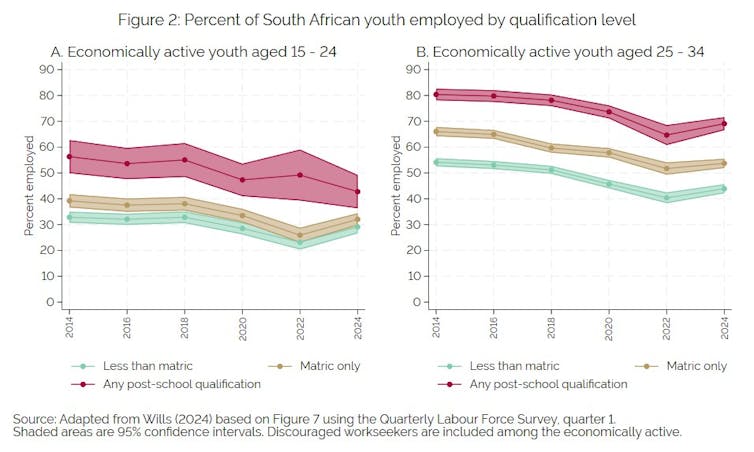
The graph below illustrates a brutal truth: ten years ago finding a job was easier for matriculants than it will be for the matric class who finished school in 2024. Between 2014 and 2018 about 4 of every 10 recent matriculants who were economically active (including discouraged work seekers) were employed. By the start of 2024 this figure was closer to 3 of every 10.

Two graphs, side by side, that show the percent of South African youth employed by qualification level
Percent of South African youth employed by qualification level.
Dr Gabrielle Wills, CC BY-NC-ND

The likelihood of youth with a matric having a job at the start of 2024 roughly resembled the chances of youth without a matric having a job eight to ten years ago.

With more learners progressing to matric, especially due to more lenient progression policy during and just after the COVID-19 pandemic, changes in the composition of the matric group could be driving some of the declines in this group’s employment prospects. But there has been a deterioration in the labour market for all youth over the past decade. Employment prospects have even declined for youth with a post-school qualification.

2. Not in employment, education or training

Proportionally fewer recent matriculants are going on to work or further study.

Before the COVID-19 pandemic (2014-2019), around 44%-45% of recent matriculants were classified as “not in employment, education or training” (NEET). The NEET rate among recent matriculants peaked at 55% in early 2022 and remained high at 49.8% at the start of 2024.

Stated differently, one of every two recent matriculants was not engaged in work or studies in the first quarter of last year. That’s 1.78 million individuals. Coupled with the rising numbers of youth getting a matric, this implies that the number of recent matriculants who were not working or studying rose by half a million from the start of 2015 to the start of 2024.

Among all 15-24-year-olds, the NEET rate rose from 32% in the first quarter of 2014 to 35% in the first quarter of 2024. Even larger increases in the NEET rate occurred among 25-34-year-olds, rising from 45% to 52% over the same period.

This is a worry. But it doesn’t mean the matric qualification has no value.

3. A matric still provides an advantage

In early 2024, nearly half of matriculants aged 15-24 were classified as not in employment, education or training. Almost 8 out of 10 of their peers who had dropped out of school were NEET. In short, you’re still more likely to get a job or further your studies with a matric certificate than without one.

4. A hard road

The road to opportunity beyond school is harder than it was a decade ago.

Among NEET matriculants aged 15-24 at the start of 2014, 27% searched for work for more than a year. By early 2024, this figure had risen to 32%.

It’s even worse for 25-34-year-old NEETs who hold a matric qualification. The percentage searching for work for over a year rose from 37% at the start of 2014 to 50% in early 2024.

The longer young people remain disconnected from employment, education or training, the greater the toll on their mental health. NEET status is associated with worse mental health, particularly among young men.

5. Post-school education and training

The government has made ambitious plans to expand opportunities for young people to study further. But enrolments in post-school education and training are not growing sufficiently to match the rising tide in school completion or to absorb youth who cannot find jobs. And, with projected declines in real per student spending on post-school education as South Africa tries to address escalating national debt servicing costs, this situation is unlikely to improve anytime soon.

The country is not keeping pace with tertiary enrolment rates in other developing nations like Brazil, Indonesia or China. For instance, 2021 estimates from the World Bank identify South Africa’s tertiary enrolment rate at 25%, compared to 41% in Indonesia, 57% in Brazil and 67% in China.

6. Location matters

Where someone lives in South Africa influences their chances for upward mobility. These inequalities are reflected in varying youth NEET rates across provinces. For instance, a third of recent matriculants in the Western Cape were not in employment, education or training in 2023/2024. That figure more than doubles in the North West province to 67%.

How to help

Two things are needed: improving labour market conditions and expanding post-school education and training opportunities.

This is unlikely without improved economic growth.

All of this may sound hopeless. But there are things that ordinary South Africans can do, too:

  • keep encouraging young people in your orbit to complete their schooling

  • where possible, spur them on to obtain a post-school qualification

  • use your social networks to connect youth to work experience opportunities, and help with CVs, referral letters and references.

Young people must also adopt a practical, pragmatic and entrepreneurial mindset. They need to seize every opportunity available to them, whether in the labour market or post-school education.

The Conversation

Gabrielle Wills is a senior researcher with Research on Socio-Economic Policy at Stellenbosch University. This research for the COVID-Generation project was made possible by financial support from Allan and Gill Gray Philanthropies. The findings and conclusions contained within are those of the authors and do not necessarily reflect positions or policies of Allan & Gill Gray Philanthropies.

ref. Life after school for young South Africans: six insights into what lies ahead – https://theconversation.com/life-after-school-for-young-south-africans-six-insights-into-what-lies-ahead-249031

How good are South African kids at maths? Trends from a global study

Source: The Conversation – USA – By Vijay Reddy, Distinguished Research Specialist, Human Sciences Research Council

School mathematics in South Africa is often seen as a sign of the health of the education system more generally. Under the racial laws of apartheid, until 1994, African people were severely restricted from learning maths. Tracking the changes in maths performance is a measure of how far the country has travelled in overcoming past injustices. Maths is also an essential foundation for meeting the challenges of the future, like artificial intelligence, climate change, energy and sustainable development.

Here, education researcher Vijay Reddy takes stock of South Africa’s mathematical capabilities. She reports on South African maths performance at grades 5 (primary school) and 9 (secondary school) in the Trends in International Mathematics and Science Study (TIMSS) and examines the gender gaps in mathematics achievement.

What was unusual about the latest TIMSS study?

The study is conducted every four years. South Africa has participated in it at the secondary phase since 1995 and at the primary phase since 2015. The period between the 2019 and 2023 cycles was characterised by the onset of the COVID-19 pandemic, social distancing and school closures.

The Department of Basic Education estimated that an average of 152 school contact days were lost in 2020 and 2021. South Africa was among the countries with the highest school closures, along with Colombia, Costa Rica and Brazil. At the other end, European countries lost fewer than 50 days.

Some academics measured the extent of learning losses for 2020 and 2021 school closures, but there were no models to estimate subsequent learning losses. We can get some clues of the effects on learning over four years, by comparing patterns within South Africa against the other countries.


Read more:
COVID learning losses: what South Africa’s education system must focus on to recover


How did South African learners (and others) perform in the maths study?

The South African grade 9 mathematics achievement improved by 8 points from 389 in TIMSS 2019 to 397 in 2023. From the trends to TIMSS 2019, we had predicted a mathematics score of 403 in 2023.

For the 33 countries that participated in both the 2019 and 2023 secondary school TIMSS cycles, the average achievement decreased by 9 points from 491 in 2019 to 482 to 2023. Only three countries showed significant increases (United Arab Emirates, Romania and Sweden). There were no significant changes in 16 countries (including South Africa). There were significant decreases in 14 countries.

Based on these numbers, it would seem, on the face of it at least, that South Africa weathered the COVID-19 losses better than half the other countries.

However, the primary school result patterns were different. For South African children, there was a significant drop in mathematics achievement by 12 points, from 374 in 2019 to 362 in 2023. As expected, the highest decreases were in the poorer, no-fee schools.

Of the 51 countries that participated in both TIMSS 2019 and 2023, the average mathematics achievement score over the two cycles was similar. There were no significant achievement changes in 22 countries, a significant increase in 15 countries, and a significant decrease in 14 countries (including South Africa).

So, it seems that South African primary school learners suffered adverse learning effects over the two cycles.

The increase in achievement in secondary school and decrease in primary school was unexpected. These reasons for the results may be that secondary school learners experienced more school support compared with primary schools, or were more mature and resilient, enabling them to recover from the learning losses experienced during COVID-19. Learners in primary schools, especially poorer schools, may have been more affected by the loss of school contact time and had less support to fully recover during this time.

This pattern may also be due to poor reading and language skills as well as lack of familiarity with this type of test.

Does gender make a difference?

There is an extant literature indicating that globally boys are more likely to outperform girls in maths performance.

But in South African primary schools, girls outscore boys in both mathematics and reading. Girls significantly outscored boys by an average of 29 points for mathematics (TIMSS) and by 49 points for reading in the 2021 Progress in International Reading Study, PIRLS.

These patterns need further exploration. Of the 58 countries participating in TIMSS at primary schools, boys significantly outscored girls in 40 countries, and there were no achievement differences in 17 countries. South Africa was the only country where the girls significantly outscored boys. In Kenya, Zimbabwe, Zambia and Mozambique, the Southern and Eastern Africa Consortium for Monitoring Educational Quality (SEACMEQ) reading scores are similar for girls and boys, while the boys outscore girls in mathematics. In Botswana, girls outscore boys in reading and mathematics, but the gender difference is much smaller.

In secondary schools, girls continue to outscore boys, but the gap drops to 8 points. Of the 42 TIMSS countries, boys significantly outscored girls in maths in 21 countries; there were no significant difference in 17 countries; and girls significantly outscored boys in only four countries (South Africa, Palestine, Oman, Bahrain).

In summary, the South African primary school achievement trend relative to secondary school is unexpected and requires further investigation. It seems that as South African learners get older, they acquire better skills in how to learn, read and take tests to achieve better results. Results from lower grades should be used cautiously to predict subsequent educational outcomes.

Unusually, in primary schools, there is a big gender difference for mathematics achievement favouring girls. The gender difference persists to grade 9, but the extent of the difference decreases. As learners, especially boys, progress through their education system they seem to make up their learning shortcomings and catch up.

The national mathematics picture would look much better if boys and girls performed at the same level from primary school, suggesting the importance of interventions in primary schools, especially focusing on boys.

The Conversation

Vijay Reddy received funding from the Department of Science, Technology and Innovation and Department of Basic Education.

ref. How good are South African kids at maths? Trends from a global study – https://theconversation.com/how-good-are-south-african-kids-at-maths-trends-from-a-global-study-251490

New survey explores what people in South Africa expect of publicly visible scientists – why it matters

Source: The Conversation – USA – By Marina Joubert, Science Communication Researcher, Stellenbosch University

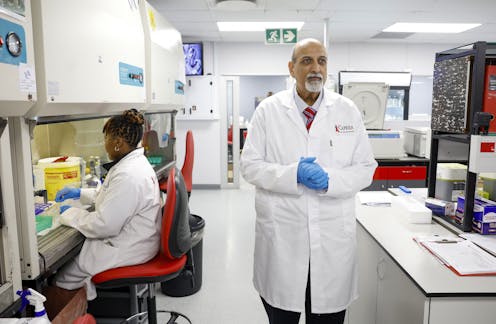
Professor Salim Abdool Karim became one of the most visible scientists in South Africa during the COVID pandemic. Photo by Phill Magakoe/AFP via Getty Images

Whether it’s an astronomical discovery, news of a previously undiscovered disease or a major report about climate change, science is often making headlines.

This means that it’s perhaps more important than ever for scientists to visibly engage with society. By becoming recognisable figures in the media, scientists can share new ideas and influence science policy. They can also shape public opinion, and build public trust in science, offering hope in times of crisis. They’re important players in the fight against misinformation, pseudoscience and anti-science sentiments.

Some scientists have become publicly visible, regularly appearing in the media. Some have become media stars. There are even a few scientific celebrities.

But, as our recently published paper reveals, even these supposedly visible scientists aren’t that recognisable to many. We surveyed 1,000 respondents in South Africa and another 1,000 in Germany, asking people to name up to three living scientists in their own country. More than half in both countries didn’t reply, said they didn’t know or couldn’t remember.

We also asked people to explain what they thought of as a “visible” scientist and what they expected of those scientists.

This kind of research helps to explain the relationship between science and society. It also helps policymakers, science communicators and institutions understand how best to support scientists to play a more prominent role in the public interest.

Not all that visible

When asked to name a living scientist from their own country, more than half of the respondents in both countries did not reply. Or they wrote something like “I don’t know” or “I can’t remember”. Many who did answer listed the names of deceased scientists such as German-born theoretical physicist Albert Einstein, US astronomer Carl Sagan, and South African heart surgeon Christiaan Barnard.

Several South Africans thought of politicians such as former president Jacob Zuma or former health minister Zweli Mkhize as visible scientists. Others named tech entrepreneurs who no longer live in South Africa, like Mark Shuttleworth and Elon Musk. This indicates that whoever publicly talks about science can easily be perceived as a scientist.

Controversial doctor Wouter Basson was mentioned several times. Basson, a cardiologist, headed the apartheid government’s secret chemical and biological warfare project, Project Coast, and was nicknamed “Dr Death” in the media because of his alleged role in the deaths of anti-apartheid activists. (In 2002 he was acquitted of 67 charges related to his involvement in apartheid-era crimes.) A public outcry erupted when it emerged, in 2021, that he had been practising as a cardiologist at a local private hospital since 2005. The fact that he was mentioned by respondents confirms that there’s a link between controversy and perceived public visibility.

Most living scientists mentioned were health researchers who achieved a high media profile during COVID-19, such as the German virologist Christian Drosten and South African HIV/Aids experts Linda-Gail Bekker, Salim Abdool Karim and Glenda Gray.

This demonstrates that, overall, scientists are invisible rather than visible in public. The visible scientist is – and remains – a rare phenomenon despite changing media environments and a recent global pandemic.

Expectations

Echoing other researchers’ earlier findings, the study shows that people expect a visible scientist to have a solid professional reputation. They should also be charismatic leaders who are highly articulate, media-savvy, hard-working and dedicated. Some South Africans emphasised that visible scientists should put the needs of others before their own and that science should serve all citizens equally.

Respondents from Germany and South Africa generally agreed that visible scientists should always base their comments on robust evidence and always tell the truth, even if it was difficult. They should not operate too closely to politics and should serve the public without hidden agendas and vested interests.

Earlier studies have shown that the most visible scientists are usually men in leadership positions. Our survey found that people didn’t mind what a visible scientist looked like, and did not prefer a specific gender or seniority. This suggests that there is scope for younger and female scientists to become more visible in the public sphere.


Read more:
Male voices dominated South African COVID reporting: that has to change


We found only minor differences between South Africa and Germany. Public expectations of scientists are remarkably similar across these two countries from the global north and the global south. The overall similar attitudes towards visible scientists may be explained by a universal public image of science around the world.

Increasing visibility

The study was part of the crowd-sourced Many Labs project “Trust in Science and Science-Related Populism”. The project’s findings on public trust in scientists across 68 countries show that, overall, public trust in science remains high. It also highlighted that people worldwide want scientists to engage more proactively with society and play a more prominent role in evidence-based policymaking.


Read more:
Five golden rules for effective science communication – perspectives from a documentary maker


Scientists who are interested in increasing their media visibility and public profile could start by working with professional communicators in the media or research offices of their universities or similar research organisations. There are also existing resources, like peer-reviewed science communication tips, and even free online courses.

The Conversation

The authors do not work for, consult, own shares in or receive funding from any company or organisation that would benefit from this article, and have disclosed no relevant affiliations beyond their academic appointment.

ref. New survey explores what people in South Africa expect of publicly visible scientists – why it matters – https://theconversation.com/new-survey-explores-what-people-in-south-africa-expect-of-publicly-visible-scientists-why-it-matters-249866

Global crises have hit education hard: 24 years of research offers a way forward for southern Africa

Source: The Conversation – USA – By Emmanuel Ojo, Associate Professor, University of the Witwatersrand

Global crises have shaped our world over the past two decades, affecting education systems everywhere. Higher education researcher Emmanuel Ojo has studied the impact of these disruptions on educational opportunities, particularly in southern Africa.

He looked at 5,511 peer-reviewed articles published between 2000 and 2024 to explore what the research suggests about making education systems more resilient. Here, he answers some questions about his review.


What are the global crises that have undermined education?

In my review I drew up a table documenting how multiple crises have disrupted education systems worldwide.

The cycle began with the 2000-2002 dot-com bubble collapse, which reduced education funding and slowed technological integration. This was followed by the 2001 terrorist attacks, Severe Acute Respiratory Syndrome (SARS) outbreak (2002-2004), Iraq War (2003-2011), Indian Ocean tsunami (2004), and Hurricane Katrina (2005). The Israeli-Palestinian conflict since 2000, global food crisis (2007-2008), financial crisis (2007-2008), and European debt crisis (2010-2012) continued this pattern of disruption.

More recently, the Ebola epidemic, COVID-19 pandemic, and Russia-Ukraine war have destabilised education systems. Meanwhile, the ongoing climate crisis creates challenges, particularly in southern Africa where environmental vulnerability is high.

Who suffers most, and in what ways?

Education has consistently been among the hardest-hit sectors globally. According to Unesco, the COVID pandemic alone affected more than 1.6 billion students worldwide.

But the impact is not distributed equally.

My research shows crises have put vulnerable populations at a further disadvantage through school closures, funding diversions, infrastructure destruction and student displacement. Quality and access decline most sharply for marginalised communities. Costs rise and mobility is restricted. Food insecurity during crises reduces attendance among the poorest students.

In southern Africa, the Covid-19 disruption highlighted existing divides. Privileged students continued learning online. Those in rural and informal settlements were completely cut off from education.

Climate change compounds these inequalities. Unicef highlights that climate disasters have a disproportionate impact on schooling for millions in low-income countries, where adaptive infrastructure is limited.

What’s at stake for southern Africa is the region’s development potential and social cohesion. The widening of educational divides threatens to create a generation with unequal opportunities and capabilities.

What makes southern African education systems fragile?

My review focused on the 16 countries of the Southern African Development Community, revealing what makes them vulnerable to crisis impacts.

Southern Africa’s geographic exposure to climate disasters combines with pre-existing economic inequalities. The region’s digital divide became starkly visible during the Covid-19 pandemic. Some students were excluded from learning by limited connectivity and unreliable electricity.

The region’s systems also rely on external funding. The Trump administration’s sudden foreign aid freeze was a shock to South Africa’s higher education sector. It has affected public health initiatives and university research programmes.

Research representation itself is unequal. Within the region, South African researchers dominate and other nations make only limited contributions. This creates blind spots in understanding context-specific challenges and solutions.

Each successive crisis deepens educational divides, making recovery increasingly difficult and costly. Weaker education systems make the region less able to respond to other development challenges, too.

How can southern Africa build education systems to withstand crises?

One striking finding from my review was the surge in educational research after the Covid-19 pandemic began – from 229 studies in 2019 to nearly double that in 2020, with continued rapid growth thereafter. This indicates growing recognition that education systems must be redesigned to withstand future disruptions, not merely recover from current ones.

Research points to a number of ways to do this:

  • Strategic investment in educational infrastructure, particularly digital technologies, to ensure learning continuity.

  • Equipping educators with skills to adapt teaching methods during emergencies.

  • Innovative, context-appropriate teaching approaches that empower communities.

  • Integration of indigenous knowledge systems into curricula, enhancing relevance, adaptability and community ownership.

  • Interdisciplinary and cross-national research collaborations.

  • Protection of education budgets, recognising education’s role in crisis recovery and long-term stability.

  • Community engagement in education, ensuring interventions are culturally appropriate and widely accepted.

In my view, African philanthropists have a duty to provide the independent financial base that education systems need to withstand external funding fluctuations.

What’s the cost of doing nothing?

The economic and social costs of failing to build resilient education systems are profound and long-lasting. Each educational disruption creates negative effects that extend far beyond the crisis period.

When students miss critical learning periods, it reduces their chances in life. The World Bank estimates that learning losses from the Covid-19 pandemic alone could result in up to US$17 trillion in lost lifetime earnings for affected students globally.

Social costs are equally severe. Educational disruptions increase dropout rates, child marriage, early pregnancy, and youth unemployment. These outcomes create broader societal challenges that require costly interventions across multiple sectors.

Spending on educational resilience avoids those costs.

The question isn’t whether southern African nations can afford to invest in educational resilience, but whether they can afford not to.

The choices made today will determine whether education systems merely survive crises or make society better. Evidence-based policies and regional cooperation are essential for building education systems that can fulfil Southern Africa’s human potential.

The Conversation

Emmanuel Ojo receives funding from National Research Foundation (NRF).

ref. Global crises have hit education hard: 24 years of research offers a way forward for southern Africa – https://theconversation.com/global-crises-have-hit-education-hard-24-years-of-research-offers-a-way-forward-for-southern-africa-251833

Africa’s new credit rating agency could change the rules of the game. Here’s how

Source: The Conversation – USA – By Daniel Cash, Reader in Law, Aston University

For governments, a credit rating is more than a financial signal. It is a verdict that can influence the cost of borrowing, access to markets and, ultimately, the ability to provide for their citizens.

Rating decisions are made behind closed doors in a private process that isn’t open to assessment or scrutiny.

For African countries, this opacity can be especially damaging. When rating decisions lack transparency, it’s impossible to challenge potential biases or inconsistencies in methodology that put developing economies at a disadvantage. The result is higher borrowing costs that drain resources from healthcare, education and infrastructure investment.

Africa’s new credit rating agency has the chance to change this. The African Credit Rating Agency is an initiative under development by the African Union and its partners. It is more than a new entrant; it is an attempt to rethink how financial authority is earned, exercised and scrutinised. The new agency plans to introduce transparent governance structures that could revolutionise rating methodology.

As a researcher who has looked closely at the working of rating agencies, I believe this opportunity to bring transparency to financial governance isn’t just about better ratings. It’s a step towards economic sovereignty.

Success for the African Credit Rating Agency shouldn’t be measured by whether it displaces the “big three” rating agencies (Standard & Poor’s, Moody’s and Fitch). The real question isn’t whether an African agency can compete, but rather whether it can show the world how to rate credit differently.

A flawed process

The three big agencies do publish their methodologies – their criteria and risk models. This creates an illusion of transparency. Yet the final judgments emerge from committee meetings that produce no public record, no accountability, and no right of meaningful appeal.

These rating committees typically comprise five to 10 analysts who meet in closed sessions to make each sovereign rating decision. S&P, Moody’s and Fitch each operate internal rating committees for every sovereign rating decision. The deliberations, dissenting views, and specific reasoning behind final votes remain confidential. Only a brief summary is provided with a rating decision.

Research has shown that credit rating agencies are more accurate at assessing the creditworthiness of advanced economies than developing economies. There have also been studies on the discrepancy between what is expected when the public methodologies are applied and what the agencies actually rate. These studies have been done for economies like Hong Kong and China, but no equivalent research has yet been undertaken for African sovereigns.

This discrepancy exposes an accountability void. When methodology-based predictions miss the mark, we must question what happens in those committee rooms. Especially when African nations are being assessed by analysts stationed continents away, with limited understanding of local economic and political realities.

The African Credit Rating Agency could make three changes to the way ratings are done:

  • through public deliberations

  • by forming hybrid committees

  • with technological intervention.

First, it could release committee transcripts within 30 days of each decision. This would give markets and governments unprecedented insight into rating rationales. This isn’t radical – central banks already publish meeting minutes, and courts publish opinions with dissenting views.

Second, it could pioneer panels that include not only rating analysts, but regional economists, sectoral specialists, and even civil society observers. All with recorded votes. This diversified expertise would disrupt “group think” while capturing nuances of African economies that traditional agencies overlook.

I have examined this idea from the perspective of injecting climate and sustainability-related expertise into credit rating committees. I believe this is a crucial step to take to evolve the concept of the credit rating committee.

Third, the agency could use artificial intelligence to analyse patterns across committee discussions, flagging potential regional biases or inconsistent methodology application. It might be able to use secure digital ledgers to create unchangeable records of decisions.

Why the big three keep it closed

The industry thrives on privacy – protecting proprietary methodologies and shielding decisions from external challenge. And the natural oligopoly (a market dominated by a few large players due to high entry barriers, reinforced by market preference for predictability) helps it stay that way.

The sovereign credit ratings of the three big agencies are built on quantitative and qualitative factors. But research shows that sovereign ratings are subjected to qualitative understandings. This puts developing economies at a disadvantage when agencies demonstrate pro-western biases because they lack data or knowledge.

The impact of a credit rating downgrade for a sovereign borrower is usually multifaceted. Research shows that a single-notch downgrade can raise borrowing costs by more than 100 basis points, equivalent to an extra US$100 million annually on a US$10 billion bond.

Investors prefer fewer, stronger signals rather than many competing views. So there’s little incentive for established players to change. The African Credit Rating Agency, as a new entrant, can offer something the incumbents won’t: governance innovation that serves both markets and nations.

Radical openness will shake markets, at least at first. Committee members might face political pressure. Transparency alone doesn’t guarantee fair outcomes.

But the world already demands transparency from central banks and constitutional courts. Why accept anything less from institutions that shape sovereign destiny?

Next steps

By 2050, one in four people on Earth will be African. The financial architecture serving them must evolve towards systems that recognise the continent’s unique strengths.

Opening the rating committee to view represents more than technical reform – it’s about shifting who holds power in global finance. If it does this, the African agency won’t just deliver better ratings; it will model how global finance can be governed more justly.

The Conversation

Daniel Cash does not work for, consult, own shares in or receive funding from any company or organisation that would benefit from this article, and has disclosed no relevant affiliations beyond their academic appointment.

ref. Africa’s new credit rating agency could change the rules of the game. Here’s how – https://theconversation.com/africas-new-credit-rating-agency-could-change-the-rules-of-the-game-heres-how-257138

Development finance in a post-aid world: the case for country platforms

Source: The Conversation – USA – By Richard Calland, Emeritus Associate Professor in Public Law, UCT. Visiting Adjunct Professor, WITS School of Governance; Director, Africa Programme, University of Cambridge Institute for Sustainability Leadership, University of Cambridge

With the Trump administration slashing US Agency for International Development budgets and European nations shifting overseas development aid budgets to bolster defence spending, the world has entered a “post-aid era”.

But there is an opportunity to recast development finance as strategic investment: “country platforms”.

Country platforms are government-led, nationally owned mechanisms that bring together a country’s climate priorities, investment needs and reform agenda, and align them with the interests of development partners, private investors and implementing agencies. They function as a strategic hub: convening actors, coordinating funding, and curating pipelines of projects for investment.

Think of them as the opposite of donor-driven fragmentation. Instead of dozens of disconnected projects driven by external priorities, a country platform enables governments to set the agenda and direct finance to where it is needed most. That could be renewable energy, climate-smart agriculture, resilient infrastructure, or nature-based solutions.

Country platforms are a current fad. They were the talk of the town at the 2025 Spring meetings of multilateral development banks in Washington DC. Will they quickly fade as the next big new idea comes into view? Or can they escape the limitations and failings of the finance and development aid ecosystem?

The Independent High Level Expert Group on Climate Finance, on which I serve, is striving to find new ways to ramp up finance – both public and private – in quality and quantity. I agree with those who argue that country platforms could be the innovation that unlocks the capital urgently needed to tackle climate overshoot and buttress economic development.

The model is already being tested. More than ten countries have launched their platforms, and more are in the pipeline.

For African countries, the opportunity could not be more timely. African governments are racing to deliver their Nationally Determined Contributions. These are the commitments they’ve made to reduce their greenhouse gas emissions as part of climate change mitigation targets set out in the Paris Agreement. Implementing these plans is often being done under severe fiscal constraints.

At the same time global capital is looking for investment opportunities. But it needs to be convinced that the rewards will outweigh the risks.

Where it’s being tested

In Africa, South Africa’s Just Energy Transition Partnership has demonstrated both the potential and the complexity of a country platform. Egypt and Senegal also have country platforms at different stages of implementation. Kenya and Nigeria are exploring similar mechanisms. The African Union’s Climate Change and Resilient Development Strategy calls for country platforms across the continent.

New entrants can learn from countries that started first.

But country platforms come in different shapes and sizes according to the context.

Another promising example is emerging through Mission 300, an initiative of the World Bank and African Development Bank, working with partners like The Rockefeller Foundation, Global Energy Alliance for People and Planet, and Sustainable Energy for All. It aims to connect 300 million people to clean electricity by 2030.

Central to this initiative are Compact Delivery and Monitoring Units. These are essentially country platforms anchored in electrification. They reflect how a well-structured country platform can make an impact. Twelve African countries are already moving in this direction. All announced their Mission 300 compacts at the Africa Heads of State Summit in Tanzania.

This growing cohort reflects a continental commitment to putting energy-driven country platforms at the heart of Africa’s development architecture.

Why now – and why Africa?

A well-functioning country platform can help in a number of ways.

Firstly, it can give the political and economic leadership a clear goal. The platform can survive elections and show stability, certainty and transparency to the investment world.

Secondly, national ownership and strategic alignment can reduce risk and build confidence. That would encourage investment.

Thirdly, it builds trust among development partners and investors through clear priorities, transparency, and national ownership.

Fourthly, it moves beyond isolated pilot projects to system-level transformation – meaning structural change. The transition in one sector, energy for example, creates new value chains that create more, better and safer jobs. Country platforms put African governments in charge of their own economic development, not as passive recipients of climate finance.

The country sets its investment priorities and then the match-making with international climate finance can begin.

Making it work: what’s needed

Developing the data on which a country bases its investment and development plans, and blending those with the fiscal, climate and nature data, is complex. For this reason country platforms require investment in institutional capacity, cross-ministerial collaboration, and strong coordination between finance ministries, environment agencies and economic planners. And especially, in leadership capability.

African countries must take charge of this capacity and capability acceleration.

Second, development partners can respond by providing money as well as supporting African leadership, aligning with national strategies, and being willing to co-design mechanisms that meet both investor expectations and local realities.

Capacity is especially crucial given the scale of Africa’s needs. According to the African Development Bank, Africa will require over US$200 billion annually by 2030 to meet its climate goals. Donor aid will provide only a fraction of this. It will require smart, coordinated investment and careful debt management. Country platforms provide the structure to govern the process.

Seizing the opportunity

Country platforms represent one of the most promising innovations in climate and development finance architecture. Properly designed and led, they offer African countries the opportunity to take ownership of their climate and development futures – on their own terms.

Country platforms could be the “buckle” that finally enables the supply and demand sides of climate finance to come together. It will require commitment, strategic and technical capability, and, above all, smart leadership.

The Conversation

Richard Calland works for the University of Cambridge Institute for Sustainability Leadership. He is also an Emeritus Associate Professor at the University of Cape Town and an Adjunct Visiting Professor at the University of Witwatersrand School of Governance. He serves on the Advisory Council of the Council for the Advancement of the South African Constitution, Chairs of the Board of Sustainability Education and is a member of the Board of Chapter Zero Southern Africa.

ref. Development finance in a post-aid world: the case for country platforms – https://theconversation.com/development-finance-in-a-post-aid-world-the-case-for-country-platforms-257994

Kenya’s ride-hailing drivers say their jobs offer dignity despite the challenges

Source: The Conversation – USA – By Julie Zollmann, Digital Planet Fellow, The Fletcher School, Tufts University

Many argue that gig work involves exploitation, as research and media coverage have highlighted. But that doesn’t seem to deter ride hailing drivers on platforms like Uber and Bolt.

In Kenya, in fact, many new drivers continued to join platforms even as fares were slashed starting in 2016.

As a PhD student studying the role of digitalisation in development, I spent several years trying to understand how digital drivers experienced the quality of their work. My research found that in 2019, a typical digital driver in Nairobi worked about 58 hours a week and earned well below the minimum wage on an hourly basis. What made this work attractive? Why did drivers stay?

In a new paper, I draw on a 2019 survey of 450 drivers in Nairobi and 38 subsequent qualitative interviews in Nairobi and Kenya’s second largest ride hailing market, Mombasa, in 2021 that explored drivers’ experiences in detail.

In addition to measuring working hours and incomes, my survey team asked drivers if they considered their work “dignified”. Nearly eight in ten (78%) of our survey participants said yes. While that specific share of drivers may have changed since then, the underlying reasons drivers found the work dignified remain unchanged.

In the global north, scholars have rung alarm bells about what “gig work” means for the erosion of standard jobs with legal protections around working hours, minimum wage and other benefits. But the drivers my team and I spoke with in Kenya felt that digital driving was a step towards formalisation rather than a drift away from an ideal formal job. Driving had diginity in contrast to the indignities of low-wage work and the vast informal sector, which was their realistic alternative for making a living.

My findings highlight that workers’ experiences on global platforms like Uber are not universal and that digitisation may deliver some improvements in work quality relative to informal work in African contexts.

How did digital work deliver dignity?

Drivers explained that app companies imposed rules and structure that provided “discipline” in a transport sector more broadly associated with rudeness, unruliness, and disrespect towards passengers. Requirements for things like driving licences, proof of insurance, and ratings seemed to make drivers feel more professional and make passengers see them as such.

Drivers felt proud to be part of a driver community that behaved professionally under these conditions. A 38-year-old male driver in Nairobi who had been working on the platforms for three years told us:

We are very respected … Everyone trusts you to carry them. It’s not like the old days, when the taxi driver might rob you and dump you or even kill you. We are getting attraction from the society, even in the slums. They know you are an app driver, and they trust you because app drivers are good people. They know you can deliver, that you will be honest.


Read more:
Zimbabwe’s economy crashed — so how do citizens still cling to myths of urban and economic success?


On platforms, drivers were matched digitally with riders. Respondents said this brought dignity by ensuring drivers would receive a fairly steady stream of clients. This meant that a driver could rest assured he would earn money every day.

The alternative was to “hustle” in the informal economy to shake loose opportunities and constantly solicit those who might use their labour and beg for payment after a job was done. Constant solicitation and bargaining were exhausting and degrading.

One driver explained:

Most of us are poor. I have never walked out every morning sure that I would do a job. But now I know that if my car has been serviced and my phone is charged and working, I am going to work and not to some charity job. I used to wait at the base all day without getting a customer. Now, ….. at least two, three days are going to be good for you.

Digital matchmaking also meant that drivers were not limited to serving the few clients they already knew or who happened to pass them at a fixed base. They found themselves serving new parts of the city and carrying important people, including business people, celebrities and local politicians. Serving these high-end customers made them feel proud and important. Wealthy neighbourhoods, luxury hotels and high-end restaurants felt more open to them in otherwise exclusionary and segregated cities.

Some drivers felt that digitalisation had removed barriers to entry for taxi driving, like paying to join a parking base and building a client list.

The app did away with parking bases, and about half of drivers joined the system through a “partner”, paying a fixed weekly fee to rent their car instead of buying it themselves.

In efforts to make rides cheaper, in 2018 app companies in Kenya allowed smaller, less expensive cars on their platforms, lowering costs of ownership. Drivers in our survey showed that both formal and informal financiers were willing to offer loans to digital drivers, knowing they would have regular revenue to service their debt.

Buying a car was seen as a huge, dignifying accomplishment. One driver in the survey told us:

Growing up, I thought vehicles were owned only by the rich, but now digital driving has provided a means for me to own one and earn the respect of society.

David Muteru, then chairman of the Digital Taxi Association of Kenya, echoed this sentiment: “Owning a vehicle, that’s an asset”.

Dignity not always guaranteed

The dignifying value of order was only possible when app companies enforced their own rules and did so fairly. Drivers preferred the stringent rule enforcement of one major app over the lax enforcement of another, which made for more stressful and undignified interactions with riders.

When the rules were enforced, drivers could be sure that the app company would help if a rider refused to pay or if there was a dispute with the client. Drivers felt the stricter environment kept bad actors out.

Over time, though, app companies slashed prices, competing for market share. Drivers felt less respected by riders who saw them as desperate for money. Low fares pressed drivers to negotiate with riders for offline trips and higher rates, reintroducing the indignity of haggling.

Lessons for the future

Digitally mediated work raises many questions about labour standards.

This research shows how important it is to keep local context in mind. Digital driving is not the same experience for drivers in every context. Where people suffer indignities and deprivations in the informal sector, digitalisation may offer gains. But this potential depends on rule enforcement and pay. Material and subjective dignity are intertwined.

The Conversation

Julie Zollmann received funding from Mastercard Foundation.

ref. Kenya’s ride-hailing drivers say their jobs offer dignity despite the challenges – https://theconversation.com/kenyas-ride-hailing-drivers-say-their-jobs-offer-dignity-despite-the-challenges-257845

African countries are bad at issuing bonds, so debt costs more than it should: what needs to change

Source: The Conversation – USA – By Misheck Mutize, Post Doctoral Researcher, Graduate School of Business (GSB), University of Cape Town

Over the past two decades, African countries have increasingly turned to international capital markets to meet their development financing needs. For example, Kenya and Benin raised a combined US$2.5 billion through bond issuances during the first half of 2025. Proceeds were used to repay maturing bonds. This means new bonds, with unfavourable terms, are being issued to pay previous lenders.

Yet African bonds are substantially mispriced, resulting in excessively high yields that are not justified by fundamentals – based on economic, fiscal and institutional strengths. Mispricing occurs when a country has high economic growth, stable institutions that support government policy implementation, rule of law and accountability, yet its bonds trade at higher yields than those of its peers. In other words, there will be every reason for investors to trust that the country will repay what it owes, but they still expect a higher return. This is happening because of lack of information and biases perpetuated by global entities that are facilitating bond sells in Africa.

Côte d’Ivoire and Senegal have strong growth (5% to 6.5%), yet they face high yields on their bonds (7.8% to 8.2%) compared to Namibia and Morocco with approximately 3% growth and bond interest of 6%.

This mispricing imposes a heavy debt servicing burden on already constrained public budgets.

At the same time African countries face a puzzling paradox: while they’re paying more for the debt they’re raising, the demand for these bonds is much higher (oversubscribed). All bond issuances in Africa are subscribed by as much as over five times. This has only been common in Africa. It is puzzling why governments are not leveraging on the high demand to bargain for lower interest rates.

In my view, based on my bond pricing modelling expertise, I believe that mispricing of Eurobonds in Africa – debt instruments issued by a country in a currency different from its own – is not a market anomaly. It shows internal capacity failures in African countries, structural market biases and insufficient understanding of the complex mechanics of global debt markets.

Oversubscription of Eurobonds should be a source of power for African governments, not a missed opportunity. African countries can move from being price takers to price negotiators. They should be able to reduce debt costs, freeing up resources for development.

But to get there African countries need to address the power imbalance in the markets.

Governments need to invest in bond pricing expertise to increase their negotiating power.

The false success signal of oversubscription

There are several reasons why African bonds remain mispriced at a higher interest despite the oversubscriptions.

Firstly, a lack of technical expertise in primary bond issuance in the debt management offices of the majority of African governments. Very few on the continent have intelligence systems for gathering information on financial markets and formal investor relations programmes. Neither do they have in-house quantitative analysts or pricing specialists capable of engaging investment banks on an equal footing during roadshows and negotiations.

The debt management offices are unable to engage confidently and critically with financial intermediaries to challenge assumptions, simulate pricing scenarios and conduct their own comparative market analysis.

After initial public offers, most governments don’t engage with holders of their bonds on the secondary market. Nor do they monitor bond post-issuance performance. The lack of interest in the secondary market has created a feedback loop where poor market intelligence has contributed to high coupons on new issuances.

Secondly, advanced economies engage investors regularly through briefings, roadshows and timely reports. Communication by African governments is often ad hoc and usually limited to the period around a new bond issuance.

This prevents investors from forming informed, long-term views. It leads to a default risk premium in pricing.

Thirdly, debt issuance by African governments is often politically driven rather than strategically timed. Often this leads to rushed or ill-prepared entries.

Sometimes it’s done when the cost of debt is rising globally, close to election cycles, or because governments are facing a financial crunch caused by falling reserves.


Read more:
African governments have developed a taste for Eurobonds: why it’s dangerous


Fourth, African sovereigns often approach the Eurobond market with weak negotiating power. They are heavily reliant on a small pool of western investment banks as technical advisors to manage the bond issuance. These banks tend to be more inclined towards their own global investment client networks. Their incentives are not aligned with achieving the lowest possible yield for the issuers.

African issuers often accept the initial price guidance from advisors and agree to high yields even in oversubscribed situations. Even when demand could support a lower yield, African issuers fail to negotiate pricing downwards. Issuing syndicates have no incentive to push for optimal pricing for the issuer as they receive transaction-based fees.


Read more:
African countries aren’t borrowing too much: they’re paying too much for debt


The role of bond issuing syndicates is a major factor in the mispricing. In bond issuance, a syndicate is a group of financial institutions that structures the bond, price and market (also known bookbuilding), underwrite the unsold portion of the bond, sell the bond to their investors, and ensure compliance and documentation. These syndicates set coupon rates higher than necessary as a conservative hedge against perceived investor scepticism.

African governments have become passive participants rather than active price-setters. African-based bond syndicates are systematically bypassed despite growing regional capacity and distribution networks. Bond issues are also allocated to offshore buyers, sidelining local institutional investors.

Breaking the cycle of mispricing

To correct the systemic Eurobond mispricing and reduce debt servicing costs, African countries must undertake reforms.

First, governments should invest in debt management capacity.

Second, they must actively monitor secondary market trading to identify opportunities such as bond buybacks and exchanges that could improve the debt profile. Real-time analytics on bond trading performance should inform future issuance terms and investor communication strategies.

Third, governments must build institutional routines for submitting data, and proactively engage investors and rating agencies. This will challenge and influence risk assumptions. Investors need consistent assurances, especially on the ability to easily exit positions.

Fourth, African countries need to maintain and monitor up-to-date benchmarks from peers with comparable pricing data. Without accurate comparisons, it is difficult to know whether the proposed bond pricing by syndicates is fair and accurate. They must stop solely relying on what investment banks recommends.

Lastly, African governments should involve at least one African-based syndicate member, prioritise allocation to African institutional investors and promote regional arrangements with international banks to ensure knowledge transfer and equitable participation.

The Conversation

Misheck Mutize is affiliated with the African Union as a Lead Expert on Credit Ratings

ref. African countries are bad at issuing bonds, so debt costs more than it should: what needs to change – https://theconversation.com/african-countries-are-bad-at-issuing-bonds-so-debt-costs-more-than-it-should-what-needs-to-change-257128