University students feel ‘anxious, confused and distrustful’ about AI in the classroom and among their peers

Source: The Conversation – USA (2) – By Elise Silva, Director of Policy Research at the Institute for Cyber Law, Policy, and Security, University of Pittsburgh

Artificial intelligence has taken off on campus, changing relationships between students and professors and among students themselves. Photo by Annie Spratt on Unsplash

The advent of generative AI has elicited waves of frustration and worry across academia for all the reasons one might expect: Early studies are showing that artificial intelligence tools can dilute critical thinking and undermine problem-solving skills. And there are many reports that students are using chatbots to cheat on assignments.

But how do students feel about AI? And how is it affecting their relationships with peers, instructors and their coursework?

I am part of a group of University of Pittsburgh researchers with a shared interest in AI and undergraduate education. While there is a growing body of research exploring how generative AI is affecting higher education, there is one group that we worry is underrepresented in this literature, yet perhaps uniquely qualified to talk about the issue: our students.

Our team ran a series of focus groups with 95 students across our campuses in the spring of 2025 and found that whether students and faculty are actively using AI or not, it is having significant interpersonal, emotional effects on learning and trust in the classroom. While AI products such as ChatGPT, Gemini or Claude are, of course, affecting how students learn, their emergence is also changing their relationships with their professors and with one another.

‘It’s not going to judge you’

Most of our focus group participants had used AI in the academic setting – when faced with a time crunch, when they perceive something to be “busy work,” or when they are “stuck” and worry that they can’t complete a task on their own. We found that most students don’t start a project using AI, but many are willing to turn to it at some point.

Many students described positive experiences using AI to help them study or answer questions, or give them feedback on papers. Some even described using AI instead of a professor, tutor or teaching assistant. Others found a chatbot less intimidating than attending office hours where professors might be “demeaning.” In the words of one interviewee: “With ChatGPT you can ask as many questions as you want and it’s not going to judge you.”

But by using it, you may be judged. While some were excited about using AI, many students voiced mild feelings of guilt or shame about their AI use due to environmental or ethical concerns, or just coming across as lazy. Some even expressed a feeling of helplessness, or a sense of inevitability regarding AI in their futures.

Anxiety, distrust and avoidance

While many students expressed a sense that faculty members are, as one participant put it, “very anti-ChatGPT,” they also lamented the fact that the rules around acceptable AI use were not sufficiently clear. As one urban planning major put it: “I feel uncertain of what the expectations are,” with her peer chiming in, “We’re not on the same page with students and teachers or even individually. No one really is.”

Students also described feelings of distrust and frustration toward peers they saw as overly reliant on AI. Some talked about asking classmates for help, only to find that they “just used ChatGPT” and hadn’t learned the material. Others pointed to group projects, where AI use was described as “a giant red flag” that made them “think less” of their peers.

These experiences feel unfair and uncomfortable for students. They can report their classmates for academic integrity violations – and enter yet another zone in which distrust mounts – or they can try to work with them, sometimes with resentment. “It ends up being more work for me,” a political science major said, “because it’s not only me doing my work by myself, it’s me double checking yours.”
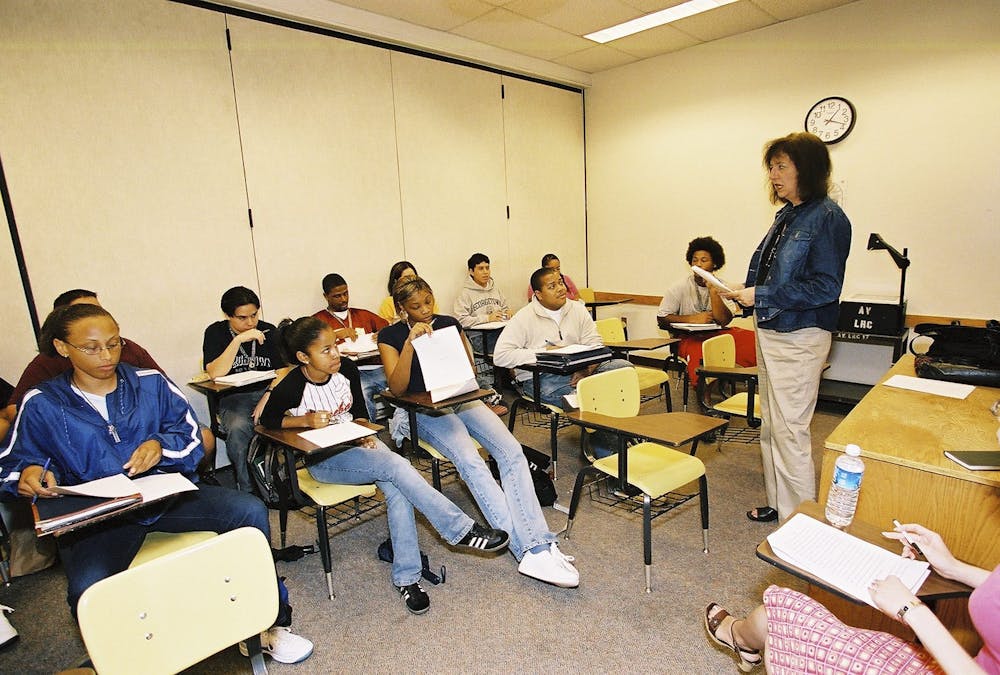
Photos of small college classroom with teacher and students
Student-teacher relationships are a key part of a good college experience. What if students avoid professors and rely instead of always-available chatbots?
U.S. Department of Education

Distrust was a marker that we observed of both student-to-teacher relationships and student-to-student relationships. Learners shared fears of being left behind if other students in their classes used chatbots to get better grades. This resulted in emotional distance and wariness among students. Indeed, our findings reflect other reports that indicate the mere possibility that a student might have used a generative AI tool is now undercutting trust across the classroom. Students are as anxious about baseless accusations of AI use as they are about being caught using it.

Students described feeling anxious, confused and distrustful, and sometimes even avoiding peers or learning interactions. As educators, this worries us. We know that academic engagement – a key marker of student success – comes not only from studying the course material, but also from positive engagement with classmates and instructors alike.

AI is affecting relationships

Indeed, research has shown that faculty-student relationships are an important indicator of student success. Peer-to-peer relationships are essential too. If students are sidestepping important mentoring relationships with professors or meaningful learning experiences with peers due to discomfort over ambiguous or shifting norms around the use of AI technology, institutions of higher education could imagine alternative pathways for connection. Residential campuses could double down on in-person courses and connections; faculty could be incentivized to encourage students to visit during office hours. Faculty-led research, mentoring and campus events where faculty and students mix in an informal fashion could also make a difference.

We hope our research can also flip the script and disrupt tropes about students who use AI as “cheaters.” Instead, it tells a more complex story of students being thrust into a reality they didn’t ask for, with few clear guidelines and little control.

As generative AI continues to pervade everyday life, and institutions of higher education continue to search for solutions, our focus groups reflect the importance of listening to students and considering novel ways to help students feel more comfortable connecting with peers and faculty. Understanding these evolving interpersonal dynamics matters because how we relate to technology is increasingly affecting how we relate to one another. Given our experiences in dialogue with them, it is clear that students are more than ready to talk about this issue and its impact on their futures.

Acknowledgment: Thank you to the full team from the University of Pittsburgh Oakland, Greensburg, Bradford and Johnstown campuses, including Annette Vee, Patrick Manning, Jessica FitzPatrick, Jessica Ghilani, Catherine Kula, Patty Wharton-Michael, Jialei Jiang, Sean DiLeonardi, Birney Young, Mark DiMauro, Jeff Aziz, and Gayle Rogers.

The Conversation

Elise Silva does not work for, consult, own shares in or receive funding from any company or organization that would benefit from this article, and has disclosed no relevant affiliations beyond their academic appointment.

ref. University students feel ‘anxious, confused and distrustful’ about AI in the classroom and among their peers – https://theconversation.com/university-students-feel-anxious-confused-and-distrustful-about-ai-in-the-classroom-and-among-their-peers-258665
Florida is fronting the $450M cost of Alligator Alcatraz – a legal scholar explains what we still don’t know about the detainees

Source: The Conversation – USA – By Mark Schlakman, Senior Program Director, The Florida State University Center for the Advancement of Human Rights, Florida State University

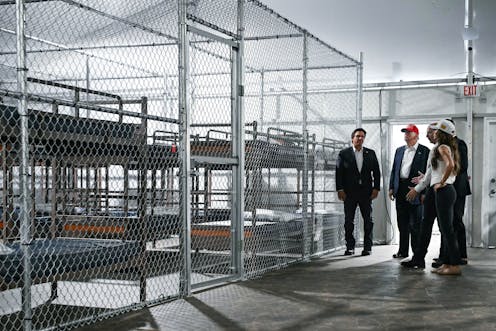
Florida Gov. Ron DeSantis leads a tour of the new Alligator Alcatraz immigration detention facility for President Donald Trump and U.S. Department of Homeland Security Secretary Kristi Noem. Andrew Cabellero-Reynolds/AFP via Getty Images

The state of Florida has opened a migrant detention center in the Everglades. Its official name is Alligator Alcatraz, a reference to the former maximum security federal penitentiary in San Francisco Bay.

While touring Alligator Alcatraz on July 1, 2025, President Donald Trump said, “This facility will house some of the menacing migrants, some of the most vicious people on the planet.” But new reporting from the Miami Herald/Tampa Bay Times reveals that of more than 700 detainees, only a third have criminal convictions.

To find out more about the state of Florida’s involvement in immigration enforcement and who can be detained at Alligator Alcatraz, The Conversation spoke with Mark Schlakman. Schlakman is a lawyer and senior program director for The Florida State University Center for the Advancement of Human Rights. He also served as special counsel to Florida Gov. Lawton Chiles, working as a liaison of sorts with the federal government during the mid-1990s when tens of thousands of Haitians and Cubans fled their island nations on makeshift boats, hoping to reach safe haven in Florida.

U.S. Department of Homeland Security Secretary Kristi Noem has characterized the migrants being detained in facilities like Alligator Alcatraz as “murderers and rapists and traffickers and drug dealers.” Do we know if the detainees at Alligator Alcatraz have been convicted of these sorts of crimes?

The Times/Herald published a list of 747 current detainees as of Sunday, July 13, 2025. Their reporters found that about a third of the detainees have criminal convictions, including attempted murder, illegal reentry to the U.S., which is a federal crime, and traffic violations. Apparently hundreds more have charges pending, though neither the federal nor state government have made public what those charges are.

There are also more than 250 detainees with no criminal history, just immigration violations.

Is it a crime for someone to be in the U.S. without legal status? In other words, is an immigration violation a crime?

No, not necessarily. It’s well established as a matter of law that physical presence in the U.S. without proper authorization is a civil violation, not a criminal offense.

However, if the federal government previously deported someone, they can be subject to federal criminal prosecution if they attempt to return without permission. That appears to be the case with some of the detainees at Alligator Alcatraz.

What usually happens if a noncitizen commits a crime in the U.S.?

Normally, if a foreign national is accused of committing a crime, they are prosecuted in a state court just like anyone else. If found guilty and sentenced to incarceration, they complete their sentence in a state prison. Once they’ve served their time, state officials can hand them over to U.S. Immigration and Customs Enforcement, or ICE. They are subject to deportation, but a federal immigration judge can hear any grounds for relief.

DHS has clarified that it “has not implemented, authorized, directed or funded” Alligator Alcatraz, but rather the state of Florida is providing startup funds and running this facility. What is Florida’s interest in this? Are these mostly migrants who have been scooped up by ICE in Florida?

It’s still unclear where most of these detainees were apprehended. But based on a list of six detainees released by Florida Attorney General James Uthmeier’s office, it is clear that at least some were apprehended outside of Florida, and others simply may have been transferred to Alligator Alcatraz from federal custody elsewhere.

This calls to mind the time in 2022 when Gov. Ron DeSantis flew approximately 50 migrants from Texas to Martha’s Vineyard in Massachusetts at Florida taxpayer expense. Those migrants also had no discernible presence in Florida.

To establish Alligator Alcatraz, DeSantis leveraged an immigration emergency declaration, which has been ongoing since Jan. 6, 2023. A state of emergency allows a governor to exercise extraordinary executive authority. This is how he avoided requirements such as environmental impact analysis in the Everglades and concerns expressed by tribal governance surrounding that area.

For now, the governor’s declaration remains unchallenged by the Florida Legislature. Environmental advocates have filed a lawsuit over Alligator Alcatraz, and the U.S. Supreme Court upheld a decision by a federal judge temporarily barring Florida from enforcing its new immigration laws, which DeSantis had championed. But no court has yet intervened to contest this prolonged state of emergency.

This presents a stark contrast to Gov. Lawton Chiles’ declaration of an immigration emergency during the mid-1990s. At that time, tens of thousands of Cubans and Haitians attempted to reach Florida shores in virtually anything that would float. Chiles’ actions as governor were informed by his experience as a U.S. senator during the Mariel boatlift in 1980, when 125,000 Cubans made landfall in Florida over the course of just six months.

Chiles sued the Clinton administration for failing to adequately enforce U.S. immigration law. But Chiles also entered into unprecedented agreements with the federal government, such as the 1996 Florida Immigration Initiative with U.S. Attorney General Janet Reno. His intent was to protect Florida taxpayers while enhancing federal enforcement capacity, without dehumanizing people fleeing desperate circumstances.

During my tenure on Chiles’ staff, the governor generally opposed state legislation involving immigration. In the U.S.’s federalist system of government, immigration falls under the purview of the federal government, not the states. Chiles’ primary concern was that Floridians wouldn’t be saddled with what ought to be federal costs and responsibilities.

Chiles was open to state and local officials supporting federal immigration enforcement. But he was mindful this required finesse to avoid undermining community policing, public health priorities and the economic health of key Florida businesses and industries. To this day, the International Association of Chiefs of Police’s position reflects Chiles’ concerns about such cooperation with the federal government.

Florida Gov. Ron DeSantis speaking into a microphone
Gov. Ron DeSantis outlines his plans for Alligator Alcatraz to the media on July 1, 2025.
Andrew Caballero-Reynolds/AFP via Getty Images

Now, in 2025, DeSantis has taken a decidedly different tack by using Florida taxpayer dollars to establish Alligator Alcatraz. The state of Florida has fronted the US$450 million to pay for this facility. DeSantis reportedly intends to seek reimbursement from FEMA’s Shelter and Services Program. Ultimately, congressional action may be necessary to obtain reimbursement. Florida is essentially lending the federal government half a billion dollars and providing other assistance to help support the Trump administration’s immigration enforcement agenda.

Florida is also establishing another migrant detention facility at Camp Blanding Joint Training Center near Jacksonville. A third apparently is being contemplated for the Panhandle.

ICE claims that the ultimate decision of whom to detain at these facilities belongs to the state of Florida, through the Florida Division of Emergency Management. Members of Congress who visited Alligator Alcatraz earlier this week have disputed ICE’s claim that Florida is in charge.

You advised Florida Division of Emergency Management leadership directly for several years during the administrations of Gov. Charlie Crist and Gov. Rick Scott. Does running a detention facility like Alligator Alcatraz fall within its typical mission?

The division is tasked with preparing for and responding to both natural and human-caused disasters. In Florida, that generally means hurricanes. While the division may engage to facilitate shelter, I don’t recall any policies or procedures contemplating anything even remotely similar to Alligator Alcatraz.

DeSantis could conceivably argue that this is consistent with a 287(g) agreement authorizing state and local support for federal immigration enforcement. But such agreements typically require federal supervision of state and local activities, not the other way around.

The Conversation

Mark Schlakman served as special counsel to Florida Gov. Lawton Chiles and as a consultant to Emilio Gonzalez at the U.S. Department of Homeland Security during his tenure as U.S. Citizenship and Immigration Services Director during the George W. Bush administration.

ref. Florida is fronting the $450M cost of Alligator Alcatraz – a legal scholar explains what we still don’t know about the detainees – https://theconversation.com/florida-is-fronting-the-450m-cost-of-alligator-alcatraz-a-legal-scholar-explains-what-we-still-dont-know-about-the-detainees-260665

Trump free to begin gutting Department of Education after Supreme Court ‘shadow’ ruling − 5 essential reads

Source: The Conversation – USA (2) – By Bryan Keogh, Managing Editor

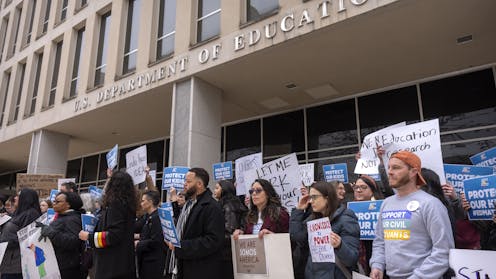
Protesters gather during a demonstration at the headquarters of the Department of Education in Washington. AP Photo/Mark Schiefelbein

The Trump administration was given the green light by the Supreme Court on July 14, 2025, to proceed with mass layoffs at the Department of Education – part of a wider plan to dismantle the agency. In doing so, the conservative majority on the bench overruled a lower court judge that had blocked the move.

While the court didn’t explain its decision – and didn’t rule on the merits of the case – Justice Sonia Sotomayor, one of the three liberal justices who objected, issued a strongly worded dissent: “When the Executive publicly announces its intent to break the law, and then executes on that promise, it is the Judiciary’s duty to check that lawlessness, not expedite it.”

The Conversation has been following the administration’s efforts to take apart the Department of Education since President Donald Trump won the presidential election in November. Here are a few stories from our archives that explain the executive order targeting the department, why the agency has been in the crosshairs of conservatives, and some of the impacts of carrying out the order.

1. Hollowing out education

Trump has promised to eliminate the Department of Education since at least September 2023. What started out as a campaign promise eventually became the executive order he issued on March 20, 2025, released shortly after the administration announced plans to lay off about 1,300 of the 4,000 employees in the department.

“Although the president has broad executive authority, there are many things he cannot order by himself,” wrote Joshua Cowen, a professor of education policy at Michigan State University. “And one of those is the dismantling of a Cabinet agency created by law. But he seems determined to hollow the agency out.”

And that’s what the Supreme Court says he can do while the case plays out in lower courts. Ultimately, Trump’s order creates a lot of “legal and policy uncertainty around funding for children in local schools and communities.”


Read more:
Mass layoffs at Education Department signal Trump’s plan to gut the agency


a woman wearing an orange jacket gestures in front of a microphone
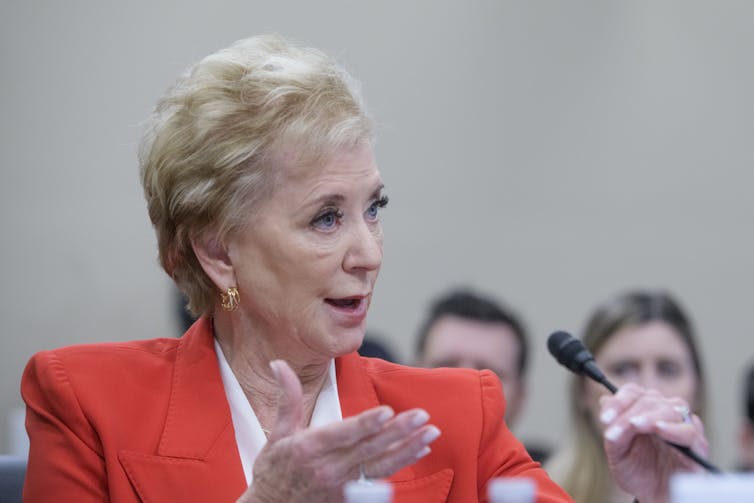
Secretary of Education Linda McMahon is responsible for carrying out Trump’s executive order.
AP Photo/Rod Lamkey Jr.

2. What the education secretary normally does

The person directed to actually carry our the president’s order is the education secretary, Linda McMahon. She has called dismantling the department its “final mission.”

But the secretary – and the department – have many other missions, such as managing students loans and administering Title I funding to help schools serving low-income students obtain an equitable education regardless of their socioeconomic status.

“Every child in the United States is required to attend school in some capacity, and what happens at the federal level can have real-world impacts on students ranging from preschool to grad school,” wrote Dustin Hornbeck, a scholar of educational policy at the University of Memphis.

In his article, Hornbeck explored the key duties of the education secretary and the role of the federal government in education, which he argued will continue even if the Education Department is abolished.


Read more:
US secretary of education helps set national priorities in a system primarily funded and guided by local governments


3. Why MAGA targeted the department

So why did Trump decide getting rid of the Education Department was a top priority and worth the legal risks?

Fighting what he perceived as “wokeness” was likely one reason, wrote Alex Hinton, an anthropologist who has been studying U.S. political culture at Rutgers University − Newark.

“First and foremost, Trump and his supporters believe that liberals are ruining public education by instituting what they call a ‘radical woke agenda’ that they say prioritizes identity politics and politically correct groupthink at the expense of the free speech of those, like many conservatives, who have different views,” he explains.

Trump’s battle against DEI – or diversity, equity and inclusion – is of course a big part of that, but so too are what he and his supporters call “radical” race and gender policies.

Hinton goes on to describe three other reasons – including supposed “Marxist indoctrination” and school choice – he argues that the MAGA faithful want to eliminate the Department of Education.


Read more:
Trump orders a plan to close Education Department – an anthropologist who studies MAGA explains 4 reasons why Trump and his supporters want to eliminate it


4. It didn’t begin with Trump

But conservative efforts to gut the department didn’t begin with Trump or MAGA. In fact, the Heritage Foundation, which created the Project 2025 blueprint for remaking the federal government, has been trying to limit or end its role in education since at least 1981 – just two years after the Department of Education was created.

“In its 1981 mandate, the Heritage Foundation struck now-familiar themes,” including closing the Department of Education and ending funding for disadvantaged students, wrote Fred L. Pincus, a sociology professor focused on diversity and social inequality at the University of Maryland, Baltimore County. “And the Heritage Foundation called for ending federal support for programs it claimed were designed to ‘turn elementary- and secondary-school classrooms into vehicles for liberal-left social and political change.’”

The conservative think tank struck similar themes in its Project 2025 playbook, though it went even further in calling out “leftist indoctrination” and “gender ideology extremism,” Pincus noted.


Read more:
Trump’s executive order to dismantle the Education Department was inspired by the Heritage Foundation’s decades-long disapproval of the agency


young students sitting at their desks in a classroom raise their hands
Changes at the Department of Education will have a big impact on students across the country.
skynesher/E+ via Getty Images

5. Impact on most vulnerable students

After all the already planned layoffs go into effect, the Department of Education will have roughly half the staff it started the year with. That will have a significant impact on its ability to carry out its many tasks, such as managing federal loans for college and tracking student achievement.

The department also enforces civil rights for schools and universities, and that office has been hit especially hard by the job cuts, wrote education professors Erica Frankenberg of Penn State and Maithreyi Gopalan of the University of Oregon.

“The Office for Civil Rights has played an important role in facilitating equitable education for all students,” they wrote. “The full effects of these changes on the most vulnerable public school students will likely be felt for many years.”


Read more:
Big cuts at the Education Department’s civil rights office will affect vulnerable students for years to come


This story is a roundup of articles from The Conversation’s archives.

The Conversation

ref. Trump free to begin gutting Department of Education after Supreme Court ‘shadow’ ruling − 5 essential reads – https://theconversation.com/trump-free-to-begin-gutting-department-of-education-after-supreme-court-shadow-ruling-5-essential-reads-261218

Many Texas communities are dangerously unprepared for floods − lack of funding plays a big role

Source: The Conversation – USA (2) – By Ivis García, Associate Professor of Landscape Architecture and Urban Planning, Texas A&M University

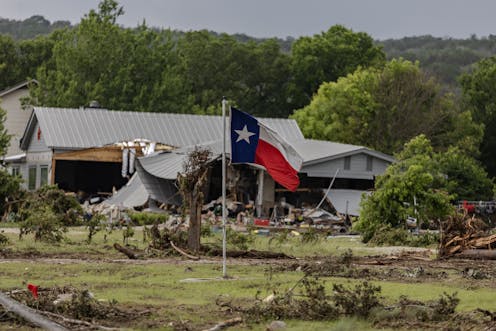
A deadly flash flood on July 4, 2025, destroyed homes near the Guadalupe River in Texas Hill Country. Jim Vondruska/Getty Images

The devastating flash floods that swept through Texas Hill Country in July 2025 highlight a troubling reality: Despite years of warnings and recent improvements in flood planning, Texas communities remain dangerously vulnerable to flood damage.

The tragedy wasn’t caused just by heavy rainfall. It was made worse by a lack of money for early warning systems, by drainage systems and emergency communication networks that haven’t been updated to handle more intense storms or growing populations, and by the many older buildings in harm’s way.

A 2024 state report estimated the cost of flood mitigation and management projects needed statewide at US$54.5 billion. But in Texas, most of that work is left to local governments.

We study disaster planning at Texas A&M University and see several ways the state and Texas communities can improve safety for everyone.

Progress since Hurricane Harvey

Since Hurricane Harvey devastated the Houston area in 2017, Texas has made strides in flood planning.

The state in 2024 created its first comprehensive flood plan, which identifies flood risks statewide and recommends projects to reduce them. The state now requires all local governments to adopt and enforce flood plain regulations that meet federal standards, enabling residents to purchase federal flood insurance.

The plan represented a major shift for a state government that historically left flood planning to local communities.

However, it also revealed widespread risks in Texas: Approximately 5 million Texans live or work in flood-prone areas, and an estimated 1.5 million homes and other structures are in flood plains.

Flood risks are intensifying as Texas experiences more extreme rainfall. State climatologist John Nielsen-Gammon and colleagues at Texas A&M University found that extreme one-day precipitation has increased by 5% to 15% in Texas since the late 20th century, and another 10% increase is expected by 2036.

Rural communities lack resources

The biggest problem for small towns and rural communities isn’t just weak regulations. Many of them can’t afford to hire specialized staff for technical work such as hazard assessment and regulatory enforcement.

While the state provides planning frameworks, implementation and enforcement remain local responsibilities.

Budget limitations can mean one emergency manager serves as fire marshal, building inspector, engineer and flood plain administrator for hundreds of square miles.

These officials must still meet federal standards and develop detailed disaster plans. But cash-strapped communities often lack the funding to implement solutions.

A short older man with glasses stands at podium. Three larger men in cowboy hats, two of them in uniforms, stand behind him.
Kerrville Mayor Joe Herring, Jr. speaks at a news briefing about the July 4, 2025, flooding. Most towns in Texas Hill Country are small, and their government officials wear many hats.
Jorge Salgado/Anadolu via Getty Images

What they need is practical hazard mitigation plans. Those include specific evacuation routes for each neighborhood, identifying which buildings house vulnerable populations, such as older adults, and steps local officials can implement immediately during emergencies. It also means aligning of other local planning documents, such as comprehensive plans or land use plans. Access to flood gauge data, weather monitoring and social vulnerability mapping is also important for determining when to close roads or activate emergency shelters.

That work takes time, expertise and funding.

The challenge of older buildings

Creating safer communities also requires investment to address challenges with both new development and vulnerable existing structures.

For new construction, many communities require buildings to be built above flood level. The state could help small communities in this area by funding new local code enforcement jobs, similar to the way it provided training and guidance to local officials after Hurricane Harvey. However, that might not be possible in the Texas Legislature today.

The bigger challenge is older buildings. According to federal requirements, unless a structure floods or gets “substantially damaged” – meaning damage exceeds 50% of its value – there’s no requirement to make it safer.

Rescue workers are seen on land and on a boat as they search for missing people near Camp Mystic along the Guadalupe River after a flash flood swept through the area Sunday, July 6, 2025, in Hunt, Texas.
The July 4, 2025, flash flood tore off the wall of this building in Camp Mystic. The Guadalupe River rose more than 20 feet in less than an hour and a half early that morning.
AP Photo/Julio Cortez

Research shows that retrofitting homes by improving drainage to avoid future flood damage and [voluntary buyout programs can be effective]. Buyout programs allow families to sell their homes at market rate and relocate to higher ground when the programs are properly designed and funded.

Harris County’s buyout program after Hurricane Harvey acquired nearly 200 flood-damaged homes in the Houston area for a total of $20 million. That helped families escape repeated flooding. The homes were demolished, and the land became permanent open space. By preventing future development, the land can take on floodwater in the future without economic harm.

Many counties can’t afford buyout programs, though. A statewide voluntary buyout program could help them by prioritizing the most vulnerable properties. But to have a wide reach, such a voluntary program would need dedicated funding in the hundreds of millions of dollars.

How Harris County’s buyout program works.

Beyond voluntary buyouts, the state could expand programs that help property owners retrofit existing houses and other buildings, such as elevating structures, installing flood vents that allow water to flow through, or using flood-resistant materials. Tax incentives and low-interest loans could make these improvements more affordable while respecting property owners’ right to choose to participate or not.

Texas currently offers limited retrofit assistance through the General Land Office’s disaster recovery programs. But it lacks a comprehensive retrofit program with dedicated funding that would help homeowners prepare before the disaster strikes.

Where communities are taking important steps

Some innovative approaches are emerging in Texas cities and counties.

Liberty and Comanche counties have partnered with Texas A&M University’s Texas Target Communities program to create comprehensive plans that help their communities grow but in safer ways. Research shows that when communities integrate land use planning, hazard mitigation, emergency response and economic development plans, they can better ensure that new development avoids high-risk areas and that existing vulnerable areas are targeted for improvement projects.

Houston, despite lacking traditional zoning, has implemented strict flood plain regulations that require new construction to be elevated above flood levels and prohibit development in the most dangerous flood-risk areas. By maintaining a top rating in FEMA’s Community Rating System, the city helps residents qualify for discounts on flood insurance.

The tragedy in Hill Country is a reminder that many Texas communities face flood risks yet lack the funding and technical capacity to implement comprehensive flood risk reduction on their own without state support. As extreme weather becomes more common, the question is whether communities will be able to protect themselves without more help.

The Conversation

Shannon Van Zandt is affiliated with Texas Housers, a non-profit advocating for affordable housing for low-income Texans.

Ivis García and Jaimie Hicks Masterson do not work for, consult, own shares in or receive funding from any company or organization that would benefit from this article, and have disclosed no relevant affiliations beyond their academic appointment.

ref. Many Texas communities are dangerously unprepared for floods − lack of funding plays a big role – https://theconversation.com/many-texas-communities-are-dangerously-unprepared-for-floods-lack-of-funding-plays-a-big-role-261090

Sculptor galaxy image provides brilliant details that will help astronomers study how stars form

Source: The Conversation – USA – By Rebecca McClain, Ph.D. Student in Astronomy, The Ohio State University

This image of the Sculptor galaxy will give astronomers detailed information on a variety of stars, nebulae and galactic regions. European Southern Observatory

If you happen to find yourself in the Southern Hemisphere with binoculars and a good view of the night sky on a dark and clear summer night, you might just be able to spot the Sculptor galaxy. And if your eyes were prisms that could separate light into the thousands of colors making it up, then congratulations: After hours of staring, you could have recreated the newest image of one of the nearest neighbors to our Milky Way galaxy.

This is not just another stunningly gorgeous picture of a nearby galaxy. Because it reveals the type of light coming from each location in the galaxy, this image of the Sculptor galaxy is a treasure trove of information that astronomers around the world cannot wait to pick apart.

As an astronomy Ph.D. student at Ohio State University, I (Rebecca) am one of the lucky people who gets to stare at this image for hours every day, alongside my adviser (Adam), discovering meaning behind the beauty everyone can appreciate.

Creating the image

The Sculptor galaxy lies 11 million light-years from the Milky Way. This may sound unfathomably far, but it actually makes Sculptor one of the closest galaxies to Earth.

For this reason, Sculptor has been the primary target for many observations. In 2022, an international team of scientists observed Sculptor with the Multi-Unit Spectroscopic Explorer, MUSE, on the European Southern Observatory’s Very Large Telescope in Chile, and publicly released the data this June.

Most astronomical observations obtain either an image of a single color of light – for example, red or blue – or a spectrum, which splits the light coming from the whole galaxy into many different colors.

MUSE, conveniently, does both, producing a spectrum at every location it observes. One observation creates thousands of images in thousands of colors, each tracing the critical components that make up the galaxy: stars, dust and gas.

It may look like only one picture, but this image of Sculptor is actually over 100 individual observations and 8 million individual spectra, painstakingly stitched together to reveal millions of stars all in one cohesive galaxy.

Scientific significance

The light associated with the stars in Sculptor is colored white, and gas made up of charged particles is colored red. The largest concentration of both is found in the spiral arms. At the very center of the galaxy is a nuclear starburst: a region of extreme star formation that is blowing material out of the galaxy.

There is even information in the absence of light. Dust obscures light emitted from behind it, creating a shadow effect called dust lanes. Tracing these dust lanes reveals the cold, dense material that exists between stars. Scientists believe this dark material is the fuel that will form the next generation of stars.

Clouds of gas punctuated by bright dots which represent stars.
Complex gaseous nebulae (red) surround young and massive stars (white) in this zoom-in of a cluster of star-forming regions.
European Southern Observatory/VLT/MUSE

There is a lot to look at in this image, but the subject of my work and what I find most interesting is the gas illuminated in red. In these star-forming regions, young and massive stars excite the gas around them, which then glows with a specific color to reveal the chemical makeup and physical conditions of the gas.

This image represents one of the first times that astronomers have obtained images of thousands of star-forming regions at this impressive level of detail. A component of our team’s research uses the data from MUSE to understand how these regions are structured and how they interact with the surrounding galaxy.

By meticulously piecing all of this information together, astronomers can use this image to learn more about the formation and evolution of stars across the universe.

The Conversation

Rebecca McClain receives funding from the National Science Foundation.

Adam Leroy receives funding from NASA/Space Telescope Science Institute that supports research related to the survey of NGC 253 discussed in this article.

ref. Sculptor galaxy image provides brilliant details that will help astronomers study how stars form – https://theconversation.com/sculptor-galaxy-image-provides-brilliant-details-that-will-help-astronomers-study-how-stars-form-259754

Weird space weather seems to have influenced human behavior on Earth 41,000 years ago – our unusual scientific collaboration explores how

Source: The Conversation – USA – By Raven Garvey, Associate Professor of Anthropology, University of Michigan

Wandering magnetic fields would have had noticeable effects for humans. Maximilian Schanner (GFZ Helmholtz Centre for Geosciences, Potsdam, Germany)

Our first meeting was a bit awkward. One of us is an archaeologist who studies how past peoples interacted with their environments. Two of us are geophysicists who investigate interactions between solar activity and Earth’s magnetic field.

When we first got together, we wondered whether our unconventional project, linking space weather and human behavior, could actually bridge such a vast disciplinary divide. Now, two years on, we believe the payoffs – personal, professional and scientific – were well worth the initial discomfort.

Our collaboration, which culminated in a recent paper in the journal Science Advances, began with a single question: What happened to life on Earth when the planet’s magnetic field nearly collapsed roughly 41,000 years ago?

Weirdness when Earth’s magnetic shield falters

This near-collapse is known as the Laschamps Excursion, a brief but extreme geomagnetic event named for the volcanic fields in France where it was first identified. At the time of the Laschamps Excursion, near the end of the Pleistocene epoch, Earth’s magnetic poles didn’t reverse as they do every few hundred thousand years. Instead, they wandered, erratically and rapidly, over thousands of miles. At the same time, the strength of the magnetic field dropped to less than 10% of its modern day intensity.

So, instead of behaving like a stable bar magnet – a dipole – as it usually does, the Earth’s magnetic field fractured into multiple weak poles across the planet. As a result, the protective force field scientists call the magnetosphere became distorted and leaky.

The magnetosphere normally deflects much of the solar wind and harmful ultraviolet radiation that would otherwise reach Earth’s surface.

So, during the Laschamps Excursion when the magnetosphere broke down, our models suggest a number of near-Earth effects. While there is still work to be done to precisely characterize these effects, we do know they included auroras – normally seen only in skies near the poles as the Northern Lights or Southern Lights – wandering toward the equator, and significantly higher-than-present-day doses of harmful solar radiation.

The skies 41,000 years ago may have been both spectacular and threatening. When we realized this, we two geophysicists wanted to know whether this could have affected people living at the time.

The archaeologist’s answer was absolutely.

Human responses to ancient space weather

For people on the ground at that time, auroras may have been the most immediate and striking effect, perhaps inspiring awe, fear, ritual behavior or something else entirely. But the archaeological record is notoriously limited in its ability to capture these kinds of cognitive or emotional responses.

Researchers are on firmer ground when it comes to the physiological impacts of increased UV radiation. With the weakened magnetic field, more harmful radiation would have reached Earth’s surface, elevating risk of sunburn, eye damage, birth defects, and other health issues.

In response, people may have adopted practical measures: spending more time in caves, producing tailored clothing for better coverage, or applying mineral pigment “sunscreen” made of ochre to their skin. As we describe in our recent paper, the frequency of these behaviors indeed appears to have increased across parts of Europe, where effects of the Laschamps Excursion were pronounced and prolonged.

lump of reddish crumbly rock
Naturally occurring ochre can act as a protective sunscreen if applied to skin.
Museo Egizio di Torino

At this time, both Neanderthals and members of our species, Homo sapiens, were living in Europe, though their geographic distributions likely overlapped only in certain regions. The archaeological record suggests that different populations exhibited distinct approaches to environmental challenges, with some groups perhaps more reliant on shelter or material culture for protection.

Importantly, we’re not suggesting that space weather alone caused an increase in these behaviors or, certainly, that the Laschamps caused Neanderthals to go extinct, which is one misinterpretation of our research. But it could have been a contributing factor – an invisible but powerful force that influenced innovation and adaptability.

Cross-discipline collaboration

Collaborating across such a disciplinary gap was, at first, daunting. But it turned out to be deeply rewarding.

Archaeologists are used to reconstructing now-invisible phenomena like climate. We can’t measure past temperatures or precipitation directly, but they’ve left traces for us to interpret if we know where and how to look.

satellite image of Earth with a glowing green circle extending down across Europe
An artistic rendering of how far into lower latitudes the aurora might have been visible during the Laschamps Excursion.
Maximilian Schanner (GFZ Helmholtz Centre for Geosciences, Potsdam, Germany)

But even archaeologists who’ve spent years studying the effects of climate on past behaviors and technologies may not have considered the effects of the geomagnetic field and space weather. These effects, too, are invisible, powerful and best understood through indirect evidence and modeling. Archaeologists can treat space weather as a vital component of Earth’s environmental history and future forecasting.

Likewise, geophysicists, who typically work with large datasets, models and simulations, may not always engage with some of the stakes of space weather. Archaeology adds a human dimension to the science. It reminds us that the effects of space weather don’t stop at the ionosphere. They can ripple down into the lived experiences of people on the ground, influencing how they adapt, create and survive.

The Laschamps Excursion wasn’t a fluke or a one-off. Similar disruptions of Earth’s magnetic field have happened before and will happen again. Understanding how ancient humans responded can provide insight into how future events might affect our world – and perhaps even help us prepare.

Our unconventional collaboration has shown us how much we can learn, how our perspective changes, when we cross disciplinary boundaries. Space may be vast, but it connects us all. And sometimes, building a bridge between Earth and space starts with the smallest things, such as ochre, or a coat, or even sunscreen.

The Conversation

Agnit Mukhopadhyay has received funding from NASA Science Mission Directorate and the University of Michigan Rackham Graduate School.

Raven Garvey and Sanja Panovska do not work for, consult, own shares in or receive funding from any company or organization that would benefit from this article, and have disclosed no relevant affiliations beyond their academic appointment.

ref. Weird space weather seems to have influenced human behavior on Earth 41,000 years ago – our unusual scientific collaboration explores how – https://theconversation.com/weird-space-weather-seems-to-have-influenced-human-behavior-on-earth-41-000-years-ago-our-unusual-scientific-collaboration-explores-how-257216

A law from the era of Red Scares is supercharging Trump administration’s power over immigrants and noncitizens

Source: The Conversation – USA – By Daniel Tichenor, Professor of Political Science, University of Oregon

The Trump administration detained former Columbia University student and pro-Palestinian protest leader Mahmoud Khalil, center, for more than two months and is seeking to revoke his lawful permanent resident status. Kena Betancur/AFP via Getty Images

Nativism, the idea that government must guard native-born Americans from various threats posed by immigrants, has a long history in the United States.

Today, the Trump administration is citing the Immigration and Nationality Act of 1952, a restrictive measure written by nativist members of Congress decades ago when fears of communism were rampant, to sharply restrict the rights of noncitizens.

Under this law, also known as the McCarran-Walter Act, federal agencies have arrested and detained noncitizens associated with pro-Palestinian protests, reintroduced immigrant registration requirements, and imposed a new travel ban that affects 19 nations.

Since the 1950s, Congress has removed some of this sprawling federal law’s most discriminatory features, such as racist national origins quotas. But other key provisions remain on the books. Now they are the primary legal basis for some of President Donald Trump’s most controversial immigration crackdowns.

Author and reporter Clay Risen discusses parallels between anticommunist fears in the 1950s and the Trump administration’s anti-immigrant policies.

Foreign policy trumps free speech

In March 2025, the White House invoked the McCarran-Walter Act to justify arresting and deporting Mahmoud Khalil, a legal permanent resident who had participated in pro-Palestinian protests at Columbia University. Officials pointed to Section 237(a)(4)(C) of the law, which states that any “alien whose presence or activities in the United States the Secretary of State has reasonable ground to believe would have potentially serious adverse foreign policy consequences for the United States is deportable.”

This has been tried only once before. In 1995, the Clinton administration unsuccessfully sought to use the provision to deport a former Mexican official, Mario Ruiz Massieu, to face charges in his homeland for extortion and obstructing a murder investigation. Ruiz Massieu was later indicted in the U.S. on money laundering charges and died by suicide shortly before his arraignment.

The Trump administration cited the same provision to justify detaining Tufts University doctoral student Rumeysa Ozturk in March. Ozturk came under government scrutiny because she co-authored an op-ed in the Tufts student newspaper criticizing the university’s position on the Israel-Gaza war.

Surveillance footage of a terrified Ozturk being arrested by masked Immigration Customs and Enforcement agents on a street in Somerville, Massachusetts, drew criticism from government officials and civil liberties advocates. In response, Secretary of State Marco Rubio alleged that Ozturk had harmed U.S. interests by supporting “movements that are involved in doing things like vandalizing universities, harassing students, taking over buildings, creating a ruckus.”

Khalil and Ozturk both were released after weeks in detention, pending final resolution of their cases. Their lawyers argue that their clients’ treatment violates free speech protections and that the defendants were punished for expressing their political beliefs.

Monitoring noncitizens

The McCarran-Walter Act also authorizes intrusive registration and tracking requirements for noncitizens who remain in the U.S. for 30 days or longer.

On Jan. 20, 2025, Trump issued an executive order directing the Department of Homeland Security to enforce an “alien registration requirement.” The agency issued a final rule in April requiring all noncitizens over the age of 14 to register and be fingerprinted. Parents or guardians must register noncitizen children under age 14. The rule also requires adult noncitizens to carry “evidence of registration” at all times.

Such policies aren’t new. Noncitizen registration was codified in the Alien Registration Act of 1940, on the eve of U.S. entry into World War II. The law was designed to regulate the foreign-born population and encourage eligible noncitizens to join the U.S. armed forces. Its requirements were written into the McCarran-Walter Act.

After the 9/11 terrorist attacks, the Bush administration created the National Security Entry-Exit Registration System, which targeted noncitizen males age 16 or older from 25 Muslim-majority countries. It required registrants to submit biometric information, check in regularly with immigration authorities and use specific ports of entry for travel.

The Obama administration suspended this system in 2011 and permanently dismantled it in 2016.

Today, Trump administration officials say they are simply enforcing long-standing legal authority. A federal judge agreed, ruling on April 10 that the Homeland Security Department could require noncitizens to register and carry documentation.

The Trump administration says it will strictly enforce a long-standing requirement for immigrants in the country more than 30 days to register with the federal government.

Travel bans redux

On June 2, Trump announced a new travel ban on foreign nationals from 12 countries, mostly in Africa and the Middle East. The ban draws its authority from the McCarran-Walter Act. Two days later, Trump claimed the same legal discretion to exclude Harvard University’s international students from the U.S.

During his first term, Trump invoked these sections of the law to justify a travel ban on seven predominantly Muslim countries. The U.S. Supreme Court ultimately upheld this action in 2018 by a 5-4 vote in Trump v. Hawaii. Writing for the majority, Chief Justice John Roberts stated that the travel ban was well within broad powers over immigration granted to the president under the McCarran-Walter Act. He added that the court had “no view on the soundness of the policy.”

Trump’s new ban is more carefully crafted than earlier versions and more likely to withstand legal challenges. But his efforts to use the McCarren-Walter Act to ban international students from attending Harvard University face stiff legal headwinds.

On May 22, Homeland Security Secretary Kristi Noem notified Harvard officials that the agency was revoking the school’s certification to participate in the Student and Exchange Visitor Program, which grants visas to international students to come to the U.S. In a June 4 proclamation, the White House claimed that foreign students at Harvard had behaved in ways that threatened U.S. national security.

A federal judge in Boston quickly blocked the revocation, holding that it violated core constitutional free speech rights. “The government’s misplaced efforts to control a reputable academic institution and squelch diverse viewpoints seemingly because they are, in some instances, opposed to this administration’s own views, threaten these rights,” wrote Judge Allison D. Burroughs.

The latest step came on July 9, when the Trump administration subpoenaed Harvard for information on its foreign students, including their disciplinary records and involvement in campus protests.

Broad power over noncitizens

Ironically, congressional sponsors of the McCarran-Walter Act were at odds with the White House when the law was enacted in 1952. They overrode a veto by President Harry S. Truman, who thought the law’s nativist ideas were unfitting for a nation of immigrants and global defender of democracy.

However, the expansive executive powers created by this law have endured largely unaltered over time, through waves of immigration reform.

Now they are a boon to the Trump administration’s ambitious immigration crackdown. It’s a telling reminder that repressive old laws can come back to life – even when they don’t reflect the current views of many Americans.

The Conversation

Daniel Tichenor does not work for, consult, own shares in or receive funding from any company or organization that would benefit from this article, and has disclosed no relevant affiliations beyond their academic appointment.

ref. A law from the era of Red Scares is supercharging Trump administration’s power over immigrants and noncitizens – https://theconversation.com/a-law-from-the-era-of-red-scares-is-supercharging-trump-administrations-power-over-immigrants-and-noncitizens-255307

How universities can keep protests from turning violent: 3 lessons from the 2024 pro-Palestinian encampments

Source: The Conversation – USA (2) – By Matthew J. Mayhew, Professor of Higher Education, The Ohio State University

Pro-Palestinian supporters march outside Columbia University in September 2024. AP Photo/Yuki Iwamura

In spring 2024, pro-Palestinian student encampments that began at Columbia and Harvard spread to university campuses throughout the U.S. as Israel invaded Gaza in response to Hamas’ Oct. 7, 2023, surprise attack. At least 100 campuses had encampments for at least a few days during this period.

While some campuses erupted in violence, others remained peaceful and didn’t experience the open conflict that led to congressional hearings, university presidents losing their jobs and repercussions that are continuing to be felt today.

What made the difference?

In spring 2024, Ohio State University’s College Impact Laboratory, where we all work, surveyed universities to learn more about whether their campuses experienced protests, what happened and how they handled them. Part of our goal was to understand how spiritual leaders played a role, if any, in managing the protests. We’ve been analyzing the data ever since. The results from those who responded point to several lessons universities could learn from to avoid violence in future protests.

Campuses are a critical arena for activism

Campus protests have long been a defining feature of social and political change in the U.S. From the civil rights movements of the 1950s and 1960s to the student-led climate strikes of recent years, higher education institutions have served as a critical space for activism.

Often, these protests reflect broader societal tensions, and how universities respond has played a significant role in shaping their outcomes.

Historically, protests have been most likely to escalate when students feel unheard. In contrast, institutions that adopt proactive strategies, such as facilitating conversations or including students in decision-making, often experience better outcomes.

a student holds a green red and white flag on pavement in front of tents on a college campus
A George Washington University student carries a Palestinian flag at a student encampment protesting the Israel-Hamas war in May 2024.
AP Photo/Jose Luis Magana

Snapshot of the pro-Palestinian protests

As our survey data shows, the pro-Palestinian protests illustrate this dynamic.

To gather data, the College Impact Laboratory sent questionnaires to administrators at the 329 universities that participate in our Interfaith Spiritual, Religious and Secular Campus Climate Index, also known as the INSPIRES Index, as well as hundreds of colleges and universities in our recruitment database.

In all, 35 schools responded to our 23-question survey. Of those, we found that most protests were led by students, half lasted less than a week, and the vast majority were nonviolent. Fifteen did not have protests, while the rest did. While the number of institutions that participated in this survey is relatively small, it does give us key insights into what schools were thinking.

Half of the campuses with protests reported law enforcement involvement – either campus police or city officers – with 20% experiencing physical altercations between protesters and police. Other disruptive actions such as academic interruptions, vandalism, physical violence and doxxing were reported with varying frequencies.

Protests at campuses that participated in our survey peaked during April and May 2024, with 70% of them experiencing demonstrations in these months.

Here are three takeaways from the survey, suggesting steps universities can take before and during future protests to avoid escalation:

1. Involve students in guidelines for engagement – early

At every surveyed institution that reported protests, students were at the forefront of organizing and leading these efforts.

Yet, despite this clear student leadership, about one-third of institutions said they didn’t consult with students to establish guidelines for engagement. Those that did invited representatives from student organizations or student government officers into the policymaking process to determine what protocols would be followed to manage protests and keep them peaceful.

On campuses where administrators didn’t engage with student leaders, tensions tended to escalate, and protests disrupted the institutions for weeks, often after police were called in or curfews were imposed.

While many of the protests lasted only one to seven days, we found that institutions that opened lines of communication early between administration and student protest leaders were more likely to deescalate tensions quickly. In contrast, campuses where administrators did not engage early on saw protests lasting weeks or involving greater disruptions.

Also, institutions that engaged early with student leaders were less likely to face stronger demands, such as calls for administrators to be fired, divestment from Israeli companies or calls to defund the campus police.

Our survey results suggest it’s important for administrators to engage with students early to establish clear guidelines to make it less likely future protests spiral into violence.

2. Communicate openly, often and before protests

Discussion of difficult topics, such as the conflict between Israel and Palestinians, shouldn’t wait until protests break out to begin. We found that every school in our survey that proactively supported dialogue between Jews and Muslims – before the war broke out – didn’t see violence result from the protests.

Dialogue isn’t just a strategy for preventing protests from spiraling out of control; it is fundamental to intergroup learning in higher education. These events create safe spaces for students − whether Arab, Jewish, Palestinian or members of different ethnic or religious groups − to engage with classmates with different points of view.

But even once protests begin, dialogue can help. When institutions engaged in dialogue, during or as a result of a protest, the protests were less likely to involve violence. At half of the campuses that participated in our survey and experienced protests, protests were ended peacefully through dialogue.

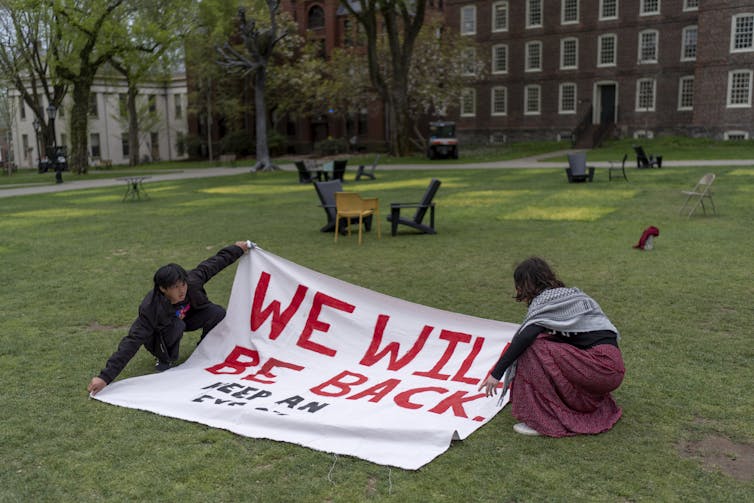
Brown, for example, modeled the power of institutional listening in its response to its April 2024 encampment. Rather than escalating tensions, university leaders engaged directly with student activists, resulting in a peaceful resolution and a commitment to bring the students’ divestment proposal to a formal vote in October. It ultimately failed to pass the board of directors.

two people hold a sign saying we will be back on a mostly empty college lawn
Demonstrators unfurl a banner on a lawn after an encampment protesting the Israel-Hamas war was taken down at Brown University on April 30, 2024, in Providence, R.I.
AP Photo/David Goldman

3. Involve relevant groups in decision-making

Most administrators in our survey, as they considered how to engage with protesters, reached out to relevant student groups such as those that focus on Jewish and Muslim students to better understand their perspectives.

However, only 28% consulted a religious or spiritual life office staff member on campus.

Religious or spiritual life staff are present on both private and public campuses and may include university-employed multifaith chaplains, interfaith coordinators or directors of spiritual life. Unlike student-led religious groups, these professionals often serve as liaisons to the religious and nonreligious communities represented on campus.

The focus of such roles on serving students from all worldviews positions them as key resources for deescalation through community outreach, support and two-way communication. Additionally, these professionals have valuable expertise in religious pluralism and community relationships. This experience helps them to advise administrators on policy and potential courses of action in times of tension.

Consulting with university staff with a focus on religion or spiritual life makes particular sense given the nature of the protests and how religion is intertwined, but our data suggests they may be underutilized more broadly for their expertise in navigating tensions related to competing worldviews.

Proactive engagement with these leaders not only helps campuses navigate an immediate crisis but demonstrates a commitment to inclusivity and respect for different groups’ perspectives.

Leading by example

Put another way, our research suggests institutions can avoid the negative outcomes of protests by embodying the traits commonly associated with universities, such as showing mutual respect, fostering democratic debate and engaging in critical thinking even on divisive issues. Engaging from a mindset of goodwill with student leaders shows administrators value student voices and are willing to work collaboratively toward solutions.

But when campuses ignore peaceful protests or refuse to engage with student leaders, they risk turning manageable situations into prolonged crises.

At a time when divisions run deep, we believe campuses that lead by example by embracing dialogue and engaging student activists before, during and after protests take place are not only likely to see less violence, but are likely to help heal America’s great divides.

The Conversation

Matthew J. Mayhew receives grant funding for various research projects from the National Science Foundation, the ECMC Foundation, the Templeton Religion Trust, the Arthur Vining Davis Foundations, and Pew Charitable Trusts. Currently, Dr. Mayhew leads the College Impact Laboratory at The Ohio State University. He is the Principal Investigator for the INSPIRES Index project and is the current editor of the Digest of Recent Research.

Renee L. Bowling works for the College Impact Lab at The Ohio State University that produces the INSPIRES Index and serves as Chair of NASPA’s Spirituality and Religion in Higher Education Knowledge Community.

Hind Haddad does not work for, consult, own shares in or receive funding from any company or organization that would benefit from this article, and has disclosed no relevant affiliations beyond their academic appointment.

ref. How universities can keep protests from turning violent: 3 lessons from the 2024 pro-Palestinian encampments – https://theconversation.com/how-universities-can-keep-protests-from-turning-violent-3-lessons-from-the-2024-pro-palestinian-encampments-252278

Rethinking the MBA: Character as the educational foundation for future business leaders

Source: The Conversation – USA (2) – By Andrew J. Hoffman, Holcim (US) Professor of Sustainable Enterprise, Ross School of Business, School for Environment & Sustainability, University of Michigan

Questions about the role of business education have led to introspection among business school leaders and researchers. Supatman/iStock via Getty Images

Programs to help students discern their vocation or calling are gaining prominence in higher education.

According to a 2019 Bates/Gallup poll, 80% of college graduates want a sense of purpose from their work. In addition, a 2023 survey found that 50% of Generation Z and millennial employees in the U.K. and U.S. have resigned from a job because the values of the company did not align with their own.

These sentiments are also found in today’s business school students, as Gen Z is demanding that course content reflect the changes in society, from diversity and inclusion to sustainability and poverty. According to the Financial Times, “there may never have been a more demanding cohort.”

And yet, business schools have been slower than other schools to respond, leading to calls ranging from transforming business education to demolishing it.

What are business schools creating?

Historically, studies have shown that business school applicants have scored higher than their peers on the “dark triad” traits of narcissism, psychopathy and Machiavellianism. These traits can manifest themselves in a tendency toward cunning, scheming and, at times, unscrupulous behavior.

Over the course of their degree program, other studies have found that business school environments can amplify those preexisting tendencies while enhancing a concern for what others think of them.

And these tendencies stick after graduation. One study examined 9,900 U.S. publicly listed firms and separated the sample by those run by managers who went to business school and those whose managers did not. While they found no discernible difference in sales or profits between the two samples, they found that labor wages were cut 6% over five years at companies run by managers who went to business school, while managers with no business degree shared profits with their workers. The study concludes that this is the result “of practices and values acquired in business education.”

But there are signs that this may be changing.

Questioning value

A man speaks while holding a microphone.
Business leaders play a significant role in society, but they aren’t always trusted.
miniseries/E+ via Getty Images

Today, many are questioning the value of the MBA.

Those who have decided it is worth the high cost either complain of its lack of rigor, relevance and critical thinking or use it merely for access to networks for salary enhancement, treating classroom learning as less important than attending recruiting events and social activities.

Layered onto this uncertain state of affairs, generative artificial intelligence is fundamentally altering the education landscape, threatening future career prospects and short-circuiting the student’s education by doing their research and writing for them.

This is concerning because of the outsized role that business leaders play in today’s society: allocating capital, developing and deploying new technologies and influencing political and social debates.

At times, this role is a positive one, but not always. Distrust follows that uncertainty.

Only 16% of Americans had a “great deal” or “quite a lot” of confidence in corporations, while 51% of Americans between 18 and 29 hold a dim view of capitalism.

Facing this reality, business educators are beginning to reexamine how to nurture business leaders who view business not only as a means to making money but also as a vehicle in service to society.

Proponents such as Harry Lewis, former dean of Harvard College; Derek Bok, former president of Harvard University; Harold Shapiro, former president of Princeton University; and Anthony Kronman, former dean of the Yale Law School, describe this effort as a return to the original focus of a college education.

Not ethics, but character formation

A woman wearing glasses speaks to people in a sun-filled conference room
Character education could challenge business students to consider what type of leaders they aspire to be.
MoMo Productions/Digital Vision via Getty Images

Business schools have often included ethics courses in their curriculum, often with limited success. What some schools are experimenting with is character formation.

As part of this experimentation is the development of a coherent moral culture that lies within the course curriculum but also within the cocurricular programming, cultural events, seminars and independent studies that shape students’ worldviews; the selection, socialization, training and reward systems for students, staff and faculty; and other aspects that shape students’ formation.

Stanford’s Bill Damon, one of the leading scholars on helping students develop a sense of purpose in life, describes a revised role for faculty in this effort, one of creating the fertile conditions for students to find meaning and purpose on their own.

I use this approach in my course on vocation discernment in business, shifting from a more traditional academic style to one that is more developmental.

This is relational teaching that artificial intelligence cannot do. It involves bringing the whole person into the education process, inspiring hearts as much as engaging heads to form competent leaders who possess character, judgment and wisdom.

It allows an examination of both the how and the why of business, challenging students to consider what kind of business leader they aspire to be and what kind of legacy they wish to establish.

It would mark a return to the original focus of early business schools, which, as Rakesh Khurana, a professor of sociology at Harvard, calls out in his book “From Higher Aims to Hired Hands: The Social Transformation of American Business Schools and the Unfulfilled Promise of Management as a Profession,” was to train managers in the same vocational way we train doctors “to seek the higher aims of commerce in service to society.”

Reshaping business education

A businesswoman holding a smartphone stands in front of a computer generated background
Most business school curricula are similar, but there are examples that break the mold.
Oscar Wong/Moment via Getty Images

The good news is that there are emerging exemplars that are seeking to create this kind of curriculum through centers such as Notre Dame University’s Institute for Social Concerns and Bates College’s Center for Purposeful Work and courses such as Stanford University’s Designing Your Life and the University of Michigan’s Management as a Calling.

These are but a few examples of a growing movement. So, the building blocks are there to draw from. The student demand is waiting to be met. All that is needed is for more business schools to respond.

The Conversation

Andrew J. Hoffman does not work for, consult, own shares in or receive funding from any company or organization that would benefit from this article, and has disclosed no relevant affiliations beyond their academic appointment.

ref. Rethinking the MBA: Character as the educational foundation for future business leaders – https://theconversation.com/rethinking-the-mba-character-as-the-educational-foundation-for-future-business-leaders-259223

How 17M Americans enrolled in Medicaid and ACA plans could lose their health insurance by 2034

Source: The Conversation – USA (3) – By Simon F. Haeder, Associate Professor of Public Health, Texas A&M University

The millions of people losing insurance include many who get coverage through the ACA marketplace. sesame/DigitalVision Vectors via Getty Images

The big tax and spending package President Donald Trump signed into law on July 4, 2025, will cut government spending on health care by more than US$1 trillion over the next decade.

Because the final version of the legislation moved swiftly through the Senate and the House, estimates regarding the number of people likely to lose their health insurance coverage were incomplete when Congress approved it by razor-thin margins. Nearly 12 million Americans could lose their health insurance coverage by 2034 due to this legislation, according to the nonpartisan Congressional Budget Office.

However, the number of people losing their insurance by 2034 could be even higher, totaling more than 17 million. That’s largely because it’s likely that at least 5 million Americans who currently have Affordable Care Act marketplace health insurance will lose their coverage once subsidies that help fund those policies expire at the end of 2025. And very few Republicans have said they support renewing the subsidies.

In addition, regulations the Trump administration introduced earlier in the year will further increase the number of people losing their ACA marketplace coverage.

As a public health professor, I see these changes, which will be phased in over several years, as the first step in a reversal of the expansion of access to health care that began with the ACA’s passage in 2010. About 25.3 million Americans lacked insurance in 2023, down sharply from 46.5 million when President Barack Obama signed the ACA into law. All told, the changes in the works could eliminate three-quarters of the progress the U.S. has made in reducing the number of uninsured Americans following the Affordable Care Act.

Millions will lose their Medicaid coverage

The biggest number of people becoming uninsured will be Americans enrolled in Medicaid, which currently covers more than 78 million people.

An estimated 5 million will eventually lose Medicaid coverage due to new work requirements that will go into effect nationally by 2027.

Work requirements target people eligible for Medicaid through the Affordable Care Act’s expansion. They tend to have slightly higher incomes than other people enrolled in the program.

Medicaid applicants who are between 19 and 64 years old will need to certify they are working at least 80 hours a month or spending that much time engaged in comparable activities, such as community service.

When these rules have been introduced to other safety net programs, most people lost their benefits due to administrative hassles, not because they weren’t logging enough hours on the job. Experts like me expect to see that occur with Medicaid too.

Other increases in the paperwork required to enroll in and remain enrolled in Medicaid will render more than 2 million more people uninsured, the CBO estimates.

And an additional 1.4 million would lose coverage because they may not meet new citizenship or immigration requirements.

In total, these changes to Medicaid would lead to more than 8 million people becoming uninsured by 2034.

Many of those who aren’t kicked out of Medicaid would also face new copayments of up to US$35 for appointments and procedures – making them less likely to seek care, even if they still have health insurance.

The new policies also make it harder for states to pay for Medicaid, which is run by the federal government and the states. They do so by limiting the taxes states charge medical providers, which are used to fund the states’ share of Medicaid funding. With less funding, some states may try to reduce enrollment or cut benefits, such as home-based health care, in the future.

Losing Medicaid coverage may leave millions of low-income Americans without insurance coverage, with no affordable alternatives for health care. Historically, the people who are most likely to lose their benefits are low-income people of color or immigrants who do not speak English well.

Protester holds sign that says 'My friend had cancer. ACA saved his life.'
A supporter of the Affordable Care Act stands in front of the Supreme Court building on Nov. 10, 2020.
Samuel Corum/Getty Images

ACA marketplace policies may cost far more

The new law will also make it harder for the more than 24 million Americans who currently get health insurance through Affordable Care Act marketplace plans to remain insured.

For one, it will be much harder for Americans to purchase insurance coverage and qualify for subsidies for 2026.

These changes come on the heels of regulations from the Trump administration that the Congressional Budget Office estimates will lead to almost 1 million people losing their coverage through the ACA marketplace. This includes reducing spending on outreach and enrollment.

What’s more, increased subsidies in place since 2021 are set to expire at the end of the year. Given Republican opposition, it seems unlikely that those subsidies will be extended.

Not extending the subsidies alone could mean premiums will increase by more than 75% in 2026. Once premiums get that unaffordable, an additional 4.2 million Americans could lose coverage, the Congressional Budget Office estimates.

With more political uncertainty and reduced enrollment, more private insurers may also withdraw from the ACA market. Large insurance companies such as Aetna, Cigna and UnitedHealth have already raised concerns about the ACA market’s viability.

Should they exit, there would be fewer choices and higher premiums for people getting their insurance this way. It could also mean that some counties could have no ACA plans offered at all.

Ramifications for the uninsured and rural hospitals

When people lose their health insurance, they inevitably end up in worse health and their medical debts can mount. Because medical treatments usually work better when diagnoses are made early, people who end up uninsured may die sooner than if they’d still had coverage.

Having to struggle to pay the kinds of high medical bills people without insurance face takes a physical, mental and financial toll, not just on people who become uninsured but also their families and friends. It also harms medical providers that don’t get reimbursed for their care.

Public health scholars like me have no doubt that many hospitals and other health care providers will have to make tough choices. Some will close. Others will offer fewer services and fire health care workers. Emergency room wait times will increase for everyone, not just people who lose their health insurance due to changes in Trump’s tax and spending package.

Rural hospitals play a crucial role in health care access.

Rural hospitals, which were already facing a funding crisis, will experience some of the most acute financial pressure. By one estimate, more than 300 hospitals are at risk of closing.

Children’s hospitals and hospitals located in low-income urban areas also disproportionately rely on Medicaid and will struggle to keep their doors open.

Republicans tried to protect rural hospitals by designating $50 billion in the legislative package for them over 10 years. But this funding comes nowhere near the $155 billion in losses KFF expects those health care providers to incur due to Medicaid cuts. Also, the funding comes with a number of restrictions that could further limit its effectiveness.

What’s next

Some Republicans, including Sens. Mike Crapo and Ron Johnson, have already indicated that more health care policy changes could be coming in another large legislative package.

They could include some of the harsher provisions that were left out of the final version of the legislation Congress approved. Republicans may, for example, try to roll back the ACA’s Medicaid expansion.

Moving forward, spending on Medicare, the insurance program that primarily covers Americans 65 and older, could decline too. Without any further action, the CBO says that the law could trigger an estimated $500 billion in mandatory Medicare cuts from 2026 to 2034 because of the trillions of dollars in new federal debt the law creates.

Trump has repeatedly promised not to cut Medicare or Medicaid. And yet, it’s possible that the Trump administration will issue executive orders that further reduce what the federal government spends on health care – and roll back the coverage gains the Affordable Care Act brought about.

Portions of this article first appeared in a related piece published on June 13, 2025.

The Conversation

Simon F. Haeder has previously received funding from the Centers for Medicare and Medicaid Services, the Pennsylvania Insurance Department, and the Robert Wood Johnson Foundation for unrelated projects.

ref. How 17M Americans enrolled in Medicaid and ACA plans could lose their health insurance by 2034 – https://theconversation.com/how-17m-americans-enrolled-in-medicaid-and-aca-plans-could-lose-their-health-insurance-by-2034-260664