Can AI think – and should it? What it means to think, from Plato to ChatGPT

Source: The Conversation – USA (3) – By Ryan Leack, Assistant Professor of Writing, USC Dornsife College of Letters, Arts and Sciences

Ancient Greek concepts about intelligence can shed light on 21st-century tech they never knew. agsandrew/iStock via Getty Images Plus

In my writing and rhetoric courses, students have plenty of opinions on whether AI is intelligent: how well it can assess, analyze, evaluate and communicate information.

When I ask whether artificial intelligence can “think,” however, I often look upon a sea of blank faces. What is “thinking,” and how is it the same or different from “intelligence”?

We might treat the two as more or less synonymous, but philosophers have marked nuances for millennia. Greek philosophers may not have known about 21st-century technology, but their ideas about intellect and thinking can help us understand what’s at stake with AI today.

The divided line

Although the English words “intellect” and “thinking” do not have direct counterparts in the ancient Greek, looking at ancient texts offers useful comparisons.

In “Republic,” for example, Plato uses the analogy of a “divided line” separating higher and lower forms of understanding.

A close-up of a mosaic shows several men talking and sitting in a semicircle outside, wearing robes.
A Roman mosaic from Pompeii depicts Plato’s academy in Greece.
Wikimedia Commons

Plato, who taught in the fourth century BCE, argued that each person has an intuitive capacity to recognize the truth. He called this the highest form of understanding: “noesis.” Noesis enables apprehension beyond reason, belief or sensory perception. It’s one form of “knowing” something – but in Plato’s view, it’s also a property of the soul.

Lower down, but still above his “dividing line,” is “dianoia,” or reason, which relies on argumentation. Below the line, his lower forms of understanding are “pistis,” or belief, and “eikasia,” imagination.

Pistis is belief influenced by experience and sensory perception: input that someone can critically examine and reason about. Plato defines eikasia, meanwhile, as baseless opinion rooted in false perception.

In Plato’s hierarchy of mental capacities, direct, intuitive understanding is at the top, and moment-to-moment physical input toward the bottom. The top of the hierarchy leads to true and absolute knowledge, while the bottom lends itself to false impressions and beliefs. But intuition, according to Plato, is part of the soul, and embodied in human form. Perceiving reality transcends the body – but still needs one.

So, while Plato does not differentiate “intelligence” and “thinking,” I would argue that his distinctions can help us think about AI. Without being embodied, AI may not “think” or “understand” the way humans do. Eikasia – the lowest form of comprehension, based on false perceptions – may be similar to AI’s frequent “hallucinations,” when it makes up information that seems plausible but is actually inaccurate.

Embodied thinking

Aristotle, Plato’s student, sheds more light on intelligence and thinking.

A small relief depicts two men in robes gesturing while they speak animatedly with each other.
A 15th-century relief of Aristotle and Plato by Luca della Robbia in the Florence Cathedral in Italy.
sailko/Wikimedia Commons, CC BY-SA

In “On the Soul,” Aristotle distinguishes “active” from “passive” intellect. Active intellect, which he called “nous,” is immaterial. It makes meaning from experience, but transcends bodily perception. Passive intellect is bodily, receiving sensory impressions without reasoning.

We could say that these active and passive processes, put together, constitute “thinking.” Today, the word “intelligence” holds a logical quality that AI’s calculations may conceivably replicate. Aristotle, however, like Plato, suggests that to “think” requires an embodied form and goes beyond reason alone.

Aristotle’s views on rhetoric also show that deliberation and judgment require a body, feeling and experience. We might think of rhetoric as persuasion, but it is actually more about observation: observing and evaluating how evidence, emotion and character shape people’s thinking and decisions. Facts matter, but emotions and people move us – and it seems questionable whether AI utilizes rhetoric in this way.

Finally, Aristotle’s concept of “phronesis” sheds further light on AI’s capacity to think. In “Nicomachean Ethics,” he defines phronesis as “practical wisdom” or “prudence.” “Phronesis” involves lived experience that determines not only right thought, but also how to apply those thoughts to “good ends,” or virtuous actions. AI may analyze large datasets to reach its conclusions, but “phronesis” goes beyond information to consult wisdom and moral insight.

‘Thinking’ robots?

Today, AI takes on many physical forms, from autonomous vehicles and humanoid robots to health care robots and drones. If intelligence requires embodiment, as Plato and Aristotle believed, it might seem as if AI is coming closer than ever to human thinking.

AI does take on many forms, but they’re still not bodies; they run on code, algorithms and datasets. Intuitive understanding, emotion, integrity and practical wisdom seem to require an embodied, perishable form that is moved by experience.

Perhaps we should ask AI itself – so I did. When I prompted ChatGPT with the simple question, “Can you think?” it responded: “I can process information, analyze patterns, and generate responses based on data. So in some ways, it might ‘seem’ like I’m thinking. But it’s not thinking like a human does. I don’t have consciousness, emotions, intentions, or awareness. Everything I ‘do’ is based on patterns learned from huge amounts of text and a set of rules and probabilities. I can ‘simulate’ certain aspects of thinking, but I don’t truly think or understand in the human sense.”

That response aligns with Plato and Aristotle’s views. For now.

The Conversation

Ryan Leack does not work for, consult, own shares in or receive funding from any company or organization that would benefit from this article, and has disclosed no relevant affiliations beyond their academic appointment.

ref. Can AI think – and should it? What it means to think, from Plato to ChatGPT – https://theconversation.com/can-ai-think-and-should-it-what-it-means-to-think-from-plato-to-chatgpt-256648

Clawback of $1.1B for PBS and NPR puts rural stations at risk – and threatens a vital source of journalism

Source: The Conversation – USA – By Allison Perlman, Associate Professor of Film & Media Studies, University of California, Irvine

Nathan Heffel and Grace Hood rehearse their Colorado Public Radio public affairs program in Centennial, Colo., in 2017. Andy Cross/The Denver Post via Getty Images

The U.S. Senate narrowly approved on July 16, 2025, a bill that would claw back federal funding for the Corporation for Public Broadcasting, which distributes money to NPR, PBS and their affiliate stations. The US$9 billion rescission package will withdraw $1.1 billion Congress had previously approved for the CPB to receive in the 2026 and 2027 fiscal years. In addition, it makes deep foreign aid cuts. All Democrats present voted against the measure, joined by two Republicans: Sens. Susan Collins of Maine and Lisa Murkowski of Alaska. As long as the House, which approved a previous version, votes in favor of the Senate’s version of the bill by midnight July 18, Trump will be able to meet a budgetary deadline by signing the measure into law in time for it to take effect.

What will happen to NPR, PBS and local stations?

NPR and PBS provide programming to local public television and radio stations across the country. The impact on them will be direct and indirect.

Both NPR and PBS receive money from the Corporation for Public Broadcasting, an independent nonprofit corporation Congress created in 1967 to receive and distribute federal money to public broadcasters. More than 70% of the money it distributes flows directly to local stations. Some stations get up to half of their budgets from the CPB.

But NPR and PBS get much of their funding from foundation grants, viewers’ and listeners’ donations, and corporate underwriting. And local public radio and TV stations also get support from an array of sources besides CPB.

“There’s nothing more American than PBS,” said the network’s CEO, Paula Kerger, at a congressional hearing on March 26, 2025.

Only about 1% of NPR funding, and 15% of PBS funding, comes directly from the government via the CPB. However, once local radio and television stations lose federal funding, they’ll be less able to pay NPR and PBS for the programs they produce.

The nearly 1,500 public media stations in the U.S. rely on a mix of NPR, PBS and third-party producer programming, such as American Public Media and PRX, for the programs they offer. Local stations also produce and air regional news and provide emergency broadcasts for the government.

In rural areas with few broadcast stations and spotty cellphone coverage, public broadcast stations are vital sources of information about important community news and updates during emergencies. Federal support is essential for the programming and day-to-day operations of many local stations and allows for the maintenance of equipment and personnel to operate these vital community resources.

We believe that stations in communities that most need them, especially in rural locations, would be hit especially hard because they rely heavily on CPB funding.

Why are Republicans taking this step?

Public broadcasting has long been a target of conservative Republicans. They say that with a highly diversified media landscape, the public no longer needs media that is subsidized by federal dollars. They also claim that public broadcasting has a liberal bias and taxpayers should not be required to fund media that slants to the left politically.

Why is public media necessary when there’s news on the internet?

As journalism revenue has plummeted, public broadcasting has remained a vital source for news in communities across the nation. This is especially true in rural communities, where economic and political pressures have threatened the survival of local journalism.

In addition, with much online news coverage placed behind paywalls, public radio and television plays an important role in making quality journalism available to the American public.

An online ad for a program, 'Water News,' on a public radio station.
Want crucial information about water systems in your drought-prone community? Public radio station KVMR in Nevada City, Calif., has a program for you.
KVMR screenshot

Why did Congress approve these funds 2 years ahead?

Public broadcasting has gotten roughly $550 million per year from the federal government in recent years. The CPB has always approved and designated those funds two years in advance, due to a provision in the Public Broadcasting Act of 1967, after Congress has voted to provide that money. The CPB then has distributed that funding primarily through grants to PBS and NPR affiliate stations to support their technical infrastructure, program development and audience research.

What are the consequences for Native communities?

Dozens of Native American stations are at risk of closing once the CPB is defunded. Native Public Media, a network of 57 radio stations and four TV stations, is a key source of news and information for tribal communities across the nation and relies on CPB support.

U.S. Sen. Mike Rounds, a South Dakota Republican, publicly stated that he secured an agreement with the White House to move $9.4 million in Interior Department funding to two dozen Native American stations. But there is no provision related to this promise within the legislation.

The Conversation

Allison Perlman is the co-chair of the Scholars Advisory Committee of the American Archive of Public Broadcasting.

Josh Shepperd and Allison Perlman are under contract to co-author an update of the history of public broadcasting for Current, public media’s trade journal, and the Corporation for Public Broadcasting. Josh and Allison are not paid employees or vendors of either institution.

ref. Clawback of $1.1B for PBS and NPR puts rural stations at risk – and threatens a vital source of journalism – https://theconversation.com/clawback-of-1-1b-for-pbs-and-npr-puts-rural-stations-at-risk-and-threatens-a-vital-source-of-journalism-255826

Why male corporate leaders and billionaires may need financial therapy more than anyone

Source: The Conversation – USA (2) – By Prince Sarpong, Associate professor, University of the Free State

Corporate leaders and billionaires are often viewed as visionaries and wealth creators. But beneath the surface, many are trapped in an invisible financial “crisis” – one rooted not in market volatility or poor investments but in their psychological relationship with money.

As a finance professor and editor of the forthcoming book “Financial Therapy for Men,” I study this often overlooked aspect of financial psychology. Money is far more than numbers on a balance sheet – it carries emotional, psychological and social meaning. People’s relationships with money are shaped by childhood experiences, cultural beliefs and personal triumphs and failures. This emotional baggage can influence not only their sense of safety and self-worth but also how they manage power and status.

The field of financial therapy emerged in the mid-2000s to address these dynamics. Drawing from behavioral economics, financial psychology, family systems theory and clinical therapy, it aims to help people understand how their thoughts, feelings and experiences shape financial behavior. Foundational academic work began at Kansas State University, home to one of the first graduate-level programs in the field.

Since then, financial therapy has gained traction in the U.S. and globally: It’s supported by a peer-reviewed journal and is increasingly integrated into professional practice by financial advisers and licensed therapists. Studies have shown that financial therapy can improve relationships and reduce emotional distress.

Yet much of the field focuses on people who are emotionally open and reflective – neglecting executives, who are often socialized to view themselves as purely rational decision-makers. I think this is a mistake.

Research shows that people often project their unconscious anxieties onto markets, experiencing them as mirrors of competence, failure or control. This means that public valuations and capital flows may carry deeply symbolic weight for corporate leaders.

My research suggests that people at the highest levels of wealth and power have deeply complex emotional relationships with money – but the field of financial therapy has largely overlooked them. This isn’t an accident. It reflects a broader assumption that wealth insulates people from psychological distress. In reality, emotional entanglements can intensify with greater wealth and power – and research suggests that men, in particular, face distinct challenges. True inclusion in financial therapy means recognizing and responding to these needs.

When distress becomes a leadership crisis

In a 2023 study – When and why do men negotiate assertively? – Jens Mazei, whose research focuses on negotiations and conflict management, and his colleagues found that men become more aggressive in negotiations when they think their masculinity is being threatened. This was especially true in contexts viewed as “masculine,” such as salary negotiations. In “nonmasculine” contexts, such as negotiations over flexible work and child care benefits, participants weren’t significantly more aggressive when their masculinity was challenged.

On male-coded topics, many men in the study reinforced gender norms by rejecting compromise, using hardball tactics or even inflating financial demands to reassert their masculinity. These behaviors reflect an unconscious need to restore a sense of masculine identity, the researchers suggest. If this reaction occurs in salary negotiations, how might it manifest when the stakes are exponentially higher?

Emerging research in organizational psychology shows that financial stress is linked to abusive supervision, particularly among men who feel a loss of control. Further, traits such as CEO masculinity have been linked with increased risk-taking, while female CEOs tend to reduce risk. Together, these findings point to a dangerous intersection of psychological stress, masculinity and executive decision-making.

As Elon Musk memorably said, “I’ll say what I want to say, and if we lose money, so be it.”

M&A as a masculinity battleground

Financial distress doesn’t always look like bankruptcy or bad credit. Among powerful men, it can manifest as overconfidence, rigidity or aggression – and it can sometimes lead to very uneconomical outcomes.

Consider the research on M&A. Most mergers and acquisitions are value killers – in other words, they destroy more economic value than they create – and the field of M&A is deeply male. These two facts suggest that some mergers are driven more by threatened masculinity than by strategic logic. If men become more aggressive in negotiations when their masculinity is threatened, then CEOs and corporate leaders, who are overwhelmingly male, may react similarly when their companies, and by extension their leadership, are challenged.

Target companies rarely take a passive approach to acquisition attempts. Instead, they deploy defensive measures such as poison pills, golden parachutes, staggered boards and scorched-earth tactics. In addition to serving financial goals, these may also act as symbolic defenses of masculine authority.

Mergers and acquisitions, by their nature, create a contest of power between dominant figures. The very language of M&A – for example, “raiders,” “hostile takeovers,” “defenses” and “white knights” – is combative. This reinforces an environment where corporate leaders may view acquisition attempts as challenges to their authority rather than as just financial transactions.

A growing body of behavioral-strategy research confirms that boardroom decisions are often shaped by emotional undercurrents rather than purely rational analysis. While this research stops short of naming it, the dynamics it describes align closely with what Mazei and colleagues call “masculinity threat.”

This has direct implications for corporate M&A. The overwhelming majority of top CEOs are men, and the language of M&A often evokes siege, power struggles and conquest. In such a symbolic arena, acquisition attempts can trigger deep, emotionally charged responses, as the identity stakes are high. What appear to be strategic financial decisions may actually be reflexive defenses of masculine authority.

On a related note, researchers in behavioral finance have long studied the “endowment effect,” or the tendency for people to value assets more simply because they own them. While the endowment effect has been studied primarily among retail investors making ordinary financial decisions, it could be particularly important for corporate executives and billionaires, who have more to lose.

When combined with threatened masculinity, the endowment effect can produce combustible reactions to declining valuations, missed earnings or takeover bids – even for individuals who remain vastly wealthy after marginal losses. While the research at this intersection is still emerging, the underlying behavioral patterns are well established.

What does financial therapy for the ultrarich look like?

Financial therapy for high-net-worth individuals rarely looks like sitting on a couch discussing childhood trauma. Instead, it takes an interdisciplinary approach involving financial advisers, therapists and sometimes executive coaches. Sessions tend to focus on legacy planning, control issues, guilt over wealth, or strained family relationships.

Many high-net-worth men display behaviors that don’t look like like stereotypical “financial distress.” These can include compulsive deal-making, emotionally driven investment decisions, workaholism and difficulty trusting advisers. In some cases, unresolved financial trauma shows up as chronic dissatisfaction and the sense that no achievement, acquisition or net worth is ever “enough.”

While financial therapy is intended to help individuals, I think it could actually be a tool for global economic stability.

After all, when masculinity is threatened in corporate decision-making, the consequences can extend far beyond the boardroom. These actions can destabilize industries, fuel economic downturns and disrupt entire labor markets. Unchecked financial anxiety among corporate elites and billionaires isn’t just their own problem – it can cascade and become everyone’s problem.

From this perspective, financial therapy isn’t just a personal good. It’s a structural necessity that can prevent unchecked financial distress from driving destructive corporate decisions and broader economic disruptions.

If financial therapy helps people navigate financial distress and make healthier money decisions, then no group needs it more than male corporate leaders and billionaires.

The Conversation

Prince Sarpong does not work for, consult, own shares in or receive funding from any company or organization that would benefit from this article, and has disclosed no relevant affiliations beyond their academic appointment.

ref. Why male corporate leaders and billionaires may need financial therapy more than anyone – https://theconversation.com/why-male-corporate-leaders-and-billionaires-may-need-financial-therapy-more-than-anyone-252094

Supreme Court news coverage has talked a lot more about politics ever since the 2016 death of Scalia and GOP blocking of Obama’s proposed nominee

Source: The Conversation – USA – By Joshua Boston, Associate Professor of Political Science, Bowling Green State University

Reporters used to treat the Supreme Court as a nonpolitical institution, but not anymore. Tetra Images/Getty

The U.S. Supreme Court has always ruled on politically controversial issues. From elections to civil rights, from abortion to free speech, the justices frequently weigh in on the country’s most debated problems.

And because of the court’s influence over national policy, political parties and interest groups battle fiercely over who gets appointed to the high court.

The public typically finds out about the court – including its significant decisions and the politics surrounding appointments – from the news media. While elected officeholders and candidates make direct appeals to their voters, the justices and Supreme Court nominees are different – they largely rely on the news to disseminate information about the court, giving the public at least a cursory understanding.

Recently, something has changed in newspaper coverage of the Supreme Court. As scholars of judicial politics, political institutions and political behavior, we set out to understand precisely how media coverage of the court has changed over the past 40 years. Specifically, we analyzed the content of every article referencing the Supreme Court in five major newspapers from 1980 to 2023.

Of course, people get their news from a variety of sources, but we have no reason to believe the trends we uncovered in our research of traditional newspapers do not apply broadly. Research indicates that alternative media sources largely follow the lead of traditional beat reporters.

What we found: Politics has a much stronger presence in articles today than in years past, with a notable increase beginning in 2016.

When public goodwill prevailed

Not many cases have been more important in the past quarter-century or, from a partisan perspective, more contentious than Bush v. Gore – the December 2000 ruling that stopped a ballot recount, resulting in then-Texas Governor George W. Bush defeating Democratic candidate Al Gore and winning the presidential election.

Bush v. Gore is particularly interesting to us because nine unelected, life-tenured justices functionally decided an election.

A New York Times front page story from Dec. 13, 2000, with banner headline 'BUSH PREVAILS.'
The New York Times story about the Supreme Court’s decision in Bush v. Gore indicated the justices’ names and votes but neither the party of the president who appointed them nor their ideological leanings.
Screenshot, The New York Times

Surprisingly, the court’s public support didn’t suffer, ostensibly because the court had built up a sufficient store of public goodwill.

One reason public support remained steady following Bush v. Gore might be newspaper coverage. Although the court’s decision reflected the justices’ ideologies, with the more conservative members effectively voting to end the recount and its more liberal members voting in favor of the recount, newspapers largely ignored the role of politics in the decision.

For example, the New York Times case coverage indicated the justices’ names and their votes but mentioned neither the party of the president who appointed them nor their ideological leanings. The words “Democrat,” “Republican,” “liberal” and “conservative” – what we call political frames – do not appear in the Dec. 13, 2000, story about the decision.

This epitomizes court-related newspaper articles from the 1980s to the early 2000s, when reporters treated the court as a nonpolitical institution. According to our research, court-related news articles in The New York Times, The Washington Post, Chicago Tribune, Los Angeles Times and The Wall Street Journal hardly used political frames during that time.

Instead, newspapers perpetuated a dominant belief among the public that Supreme Court decisions were based almost completely on legal principles rather than political preferences. This belief, in turn, bolstered support for the court.

Recent newspaper coverage reveals a starkly different pattern.

A contemporary political court

It would be nearly impossible to read contemporary articles about the Supreme Court without getting the impression that it is just as political as Congress and the presidency.

Analyzing our data from 1980 to 2023, the average number of political frames per article tripled. To be sure, politics has always played a role in the court’s decisions. Now, newspapers are making that clear. The question is when this change occurred.

Across the five major newspapers, reporting about the court has gradually become more political over time. That isn’t surprising: America has been gradually polarizing since the 1980s as well, and the changes in news media coverage reflect that polarization.

Take February of 2016, when Justice Antonin Scalia unexpectedly died. Of course, justices have died while serving on the court before. But Scalia was a conservative icon, and his death could have swung the court to the center or the left.

How the politics of naming his successor played out after Scalia’s death was unprecedented.

President Barack Obama’s nomination effort to put Merrick Garland on the court were stonewalled. The Senate majority leader, Republican Mitch McConnell of Kentucky, said the Senate would not consider any nomination until after the presidential election, nine months from Scalia’s death.

Republican candidate Donald Trump, seeing an opening, promised to fill the vacancy with a conservative justice who would overturn Roe v. Wade. The court and the 2016 election became inseparable.

People bowing their heads next to a U.S. flag-covered casket.
President Barack Obama and first lady Michelle Obama pay respects to Justice Antonin Scalia, whose 2016 death brought lasting change in newspaper coverage of the court.
Tom Williams/CQ Roll Call via Getty Images

Scalia vacancy changed everything

February 2016 brought about an abrupt and lasting change in newspaper coverage. The day before Scalia’s death, a typical article referencing the court used 3.22 political frames.

The day after, 10.48.

We see an uptick in political frames if we consider annual changes as well. In 2015, newspapers averaged 3.50 political frames per article about the Supreme Court. Then, in 2016, 5.30.

Using a variety of statistical methods to identify enduring framing shifts, we consistently find February 2016 as the moment newspapers shifted to higher levels of political framing of the court. We find the number of political frames in newspapers remained elevated through 2023.

How stories frame something shapes how people think about it.

If an article frames a court decision as “originalist” – an analytical approach that says constitutional texts should be interpreted as they were understood at the time they became law – then readers might think of the court as legalistic.

But if the newspaper were to frame the decision as “conservative,” then readers might think of the court as ideological.

We found in our study that when people read an article about a court decision using political frames, court approval declines. That’s because most people desire a legal court rather than a political one. No wonder polls today find the court with precariously low public support.

We do not necessarily hold journalists responsible for the court’s dramatic decline in public support. The bigger issue may be the court rather than reporters. If the court acts politically, and the justices behave ideologically, then reporters are doing their job: writing accurate stories.

That poses yet another problem. Before Trump’s three court appointments, the bench was known for its relative balance. Sometimes decisions were liberal; other times, conservative.

In June 2013, the court provided protections to same-sex marriages. Two days earlier, the court struck down part of the Voting Rights Act. A liberal win, a conservative win – that’s what we might expect from a legal institution.

Today the court is different. For most salient issues, the court supports conservative policies.

Given, first, the media’s willingness to emphasize the court’s politics, and second, the justices’ ideologically consistent decisions across critical issues, it is unlikely that the news media retreats from political framing anytime soon.

If that’s the case, the court may need to adjust to its low public approval.

The Conversation

The authors do not work for, consult, own shares in or receive funding from any company or organization that would benefit from this article, and have disclosed no relevant affiliations beyond their academic appointment.

ref. Supreme Court news coverage has talked a lot more about politics ever since the 2016 death of Scalia and GOP blocking of Obama’s proposed nominee – https://theconversation.com/supreme-court-news-coverage-has-talked-a-lot-more-about-politics-ever-since-the-2016-death-of-scalia-and-gop-blocking-of-obamas-proposed-nominee-259120

Research replication can determine how well science is working – but how do scientists replicate studies?

Source: The Conversation – USA – By Amanda Kay Montoya, Associate Professor of Psychology, University of California, Los Angeles

Some research teams work on replicating prior studies to assess the value of a body of work. AzmanL/E+ via Getty Images

Back in high school chemistry, I remember waiting with my bench partner for crystals to form on our stick in the cup of blue solution. Other groups around us jumped with joy when their crystals formed, but my group just waited. When the bell rang, everyone left but me. My teacher came over, picked up an unopened bag on the counter and told me, “Crystals can’t grow if the salt is not in the solution.”

To me, this was how science worked: What you expect to happen is clear and concrete. And if it doesn’t happen, you’ve done something wrong.

If only it were that simple.

It took me many years to realize that science is not just some series of activities where you know what will happen at the end. Instead, science is about discovering and generating new knowledge.

Now, I’m a psychologist studying how scientists do science. How do new methods and tools get adopted? How do changes happen in scientific fields, and what hinders changes in the way we do science?

One practice that has fascinated me for many years is replication research, where a research group tries to redo a previous study. Like with the crystals, getting the same result from different teams doesn’t always happen, and when you’re on the team whose crystals don’t grow, you don’t know if the study didn’t work because the theory is wrong, or whether you forgot to put the salt in the solution.

The replication crisis

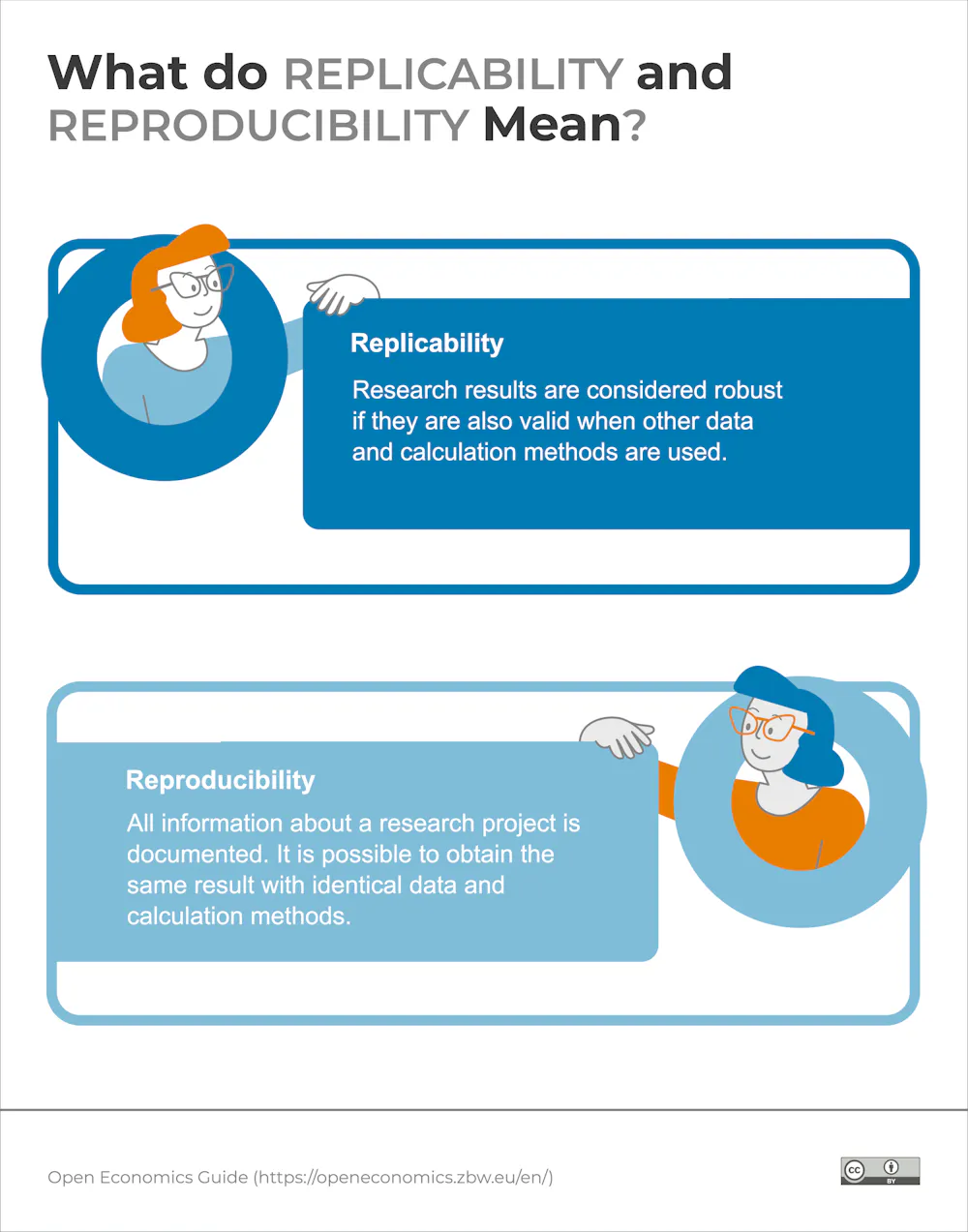
A May 2025 executive order by President Donald Trump emphasized the “reproducibility crisis” in science. While replicability and reproducibility may sound similar, they’re distinct.

Reproducibility is the ability to use the same data and methods from a study and reproduce the result. In my editorial role at the journal Psychological Science, I conduct computational reproducibility checks where we take the reported data and check that all the results in the paper can be reproduced independently.

But we’re not running the study over again, or collecting new data. While reproducibility is important, research that is incorrect, fallible and sometimes harmful can still be reproducible.

By contrast, replication is when an independent team repeats the same process, including collecting new data, to see if they get the same results. When research replicates, the team can be more confident that the results are not a fluke or an error.

A diagram with the two definitions of replicability and reproducibility
Reproducibility and replicability are both important, but have key differences.
Open Economics Guide, CC BY

The “replication crisis,” a term coined in psychology in the early 2010s, has spread to many fields, including biology, economics, medicine and computer science. Failures to replicate high-profile studies concern many scientists in these fields.

Why replicate?

Replicability is a core scientific value: Researchers want to be able to find the same result again and again. Many important findings are not published until they are independently replicated.

In research, chance findings can occur. Imagine if one person flipped a coin 10 times and got two heads, then told the world that “coins have a 20% chance of coming up heads.” Even though this is an unlikely outcome – about 4% – it’s possible.

Replications can correct these chance outcomes, as well as scientific errors, to ensure science is self-correcting.

For example, in the search for the Higgs boson, two research centers at CERN, the European Council for Nuclear Research, ATLAS and CMS, independently replicated the detection of a particle with a large unique mass, leading to the 2013 Nobel Prize in physics.

A large array of machinery arranged in a tunnel, as part of a particle detector experiment.
The ATLAS experiment at the Large Hadron Collider at CERN is one of two that led to the discovery of the Higgs boson.
CERN, CC BY

The initial measurements from the two centers actually estimated the mass of the particle as slightly different. So while the two centers didn’t find identical results, the teams evaluated them and determined they were close enough. This variability is a natural part of the scientific process. Just because results are not identical does not mean they are not reliable.

Research centers like CERN have replication built into their process, but this is not feasible for all research. For projects that are relatively low cost, the original team will often replicate their work prior to publication – but doing so does not guarantee that an independent team could get the same results.

A graph showing time on the x axis and COVID-19 cases on the y axis. A line labeled 'placebo group' goes up from zero at a 45-degree angle, while the line labeled 'vaccine group' goes up slightly and then plateaus.
Because the results on vaccine efficacy were so clear, replication wasn’t necessary and would have slowed the process of getting the vaccine to people.
XKCD, CC BY-NC

When projects are costly, urgent or time-specific, independently replicating them prior to disseminating results is often not feasible. Remember when people across the country were waiting for a COVID-19 vaccine?

The initial Pfizer-BioNTech COVID-19 vaccine took 13 months from the start of the trial to authorization from the Food and Drug Administration. The results of the initial study were so clear and convincing that a replication would have unnecessarily delayed getting the vaccine out to the public and slowing the spread of disease.

Since not every study can be replicated prior to publication, it’s important to conduct replications after studies are published. Replications help scientists understand how well research processes are working, identify errors and self-correct. So what’s the process of conducting a replication?

The replication process

Researchers could independently replicate the work of other teams, like at CERN. And that does happen. But when there are only two studies – the original and the replication – it’s hard to know what to do when they disagree. For that reason, large multigroup teams often conduct replications where they are all replicating the same study.

Alternatively, if the purpose is to estimate the replicability of a body of research – for example, cancer biology – each team might replicate a different study, and the focus is on the percentage of studies that replicate across many studies.

These large-scale replication projects have arisen around the world and include ManyLabs, ManyBabies, Psychological Accelerator and others.

Replicators start by learning as much as possible about how the original study was conducted. They can collect details about the study from reading the published paper, discussing the work with its original authors and consulting online materials.

The replicators want to know how the participants were recruited, how the data was collected and using what tools, and how the data was analyzed.

But sometimes, studies may leave out important details, like the questions participants were asked or the brand of equipment used. Replicators have to make these difficult decisions themselves, which can affect the outcome.

Replicators also often explicitly change details of the study. For example, many replication studies are conducted with larger samples – more participants – than the original study, to ensure the results are reliable.

Registration and publication

Sadly, replication research is hard to publish: Only 3% of papers in psychology, less than 1% in education and 1.2% in marketing are replications.

If the original study replicates, journals may reject the paper because there is no “new insight.” If it doesn’t replicate, journals may reject the paper because they assume the replicators made a mistake – remember the salt crystals.

Because of these issues, replicators often use registration to strengthen their claims. A preregistration is a public document describing the plan for the study. It is time-stamped to before the study is conducted.

This type of document improves transparency by making changes in the plan detectable to reviewers. Registered reports take this a step further, where the research plan is subject to peer review before conducting the study.

If the journal approves the registration, they commit to publishing the results of the study regardless of the results. Registered reports are ideal for replication research because the reviewers don’t know the results when the journal commits to publishing the paper, and whether the study replicates or not won’t affect whether it gets published.

About 58% of registered reports in psychology are replication studies.

Replication research often uses the highest standards of research practice: large samples and registration. While not all replication research is required to use these practices, those that do contribute greatly to our confidence in scientific results.

Replication research is a useful thermometer to understand if scientific processes are working as intended. Active discussion of the replicability crisis, in both scientific and political spaces, suggests to many researchers that there is room for growth. While no field would expect a replication rate of 100%, new processes among scientists aim to improve the rates from those in the past.

The Conversation

Amanda Kay Montoya is an Associate Professor at the University of California, Los Angeles. She serves on the Board of Directors for the Center for Open Science. She receives funding from the US-National Science Foundation.

ref. Research replication can determine how well science is working – but how do scientists replicate studies? – https://theconversation.com/research-replication-can-determine-how-well-science-is-working-but-how-do-scientists-replicate-studies-260771

Philly’s City Council turned down a new rental inspection program − studies show that might harm tenants’ health

Source: The Conversation – USA – By Gabriel L. Schwartz, Assistant Professor of Health Management and Policy, Drexel University

Tenants who complain to landlords about housing conditions can risk eviction. Photo Jeff Fusco/The Conversation U.S., CC BY-NC-ND

As Philadelphia Mayor Cherelle Parker’s US$2 billion housing plan moves forward, heated debates continue about another set of municipal housing proposals that could transform Philadelphia tenants’ rights.

In June 2025, Philadelphia’s City Council considered three housing bills, collectively known as the Safe Healthy Homes Act. The package was introduced by Nicolas O’Rourke, an at-large council member who belongs to the Working Families Party.

One of the bills authorized the city to create a fund for tenants to relocate if their buildings are condemned by city inspectors. It was signed into law, though it remains unclear how the fund will be financed.

The other two bills stalled. One was an ordinance that would broadly strengthen tenants’ rights, and the other – known as the Right to Repairs – would shift how Philadelphia ensures housing is safe for tenants, empowering the city to proactively inspect rentals for housing code violations.

These bills deal with housing policy, but they’re also matters of public health.

I know this because I am a researcher in Philadelphia who studies how housing affects our health outcomes. And in particular, recent research by myself and others suggests the fate of the Rights to Repairs legislation could have major implications for Philadelphians’ well-being.

Housing protections today

To understand this new evidence, it’s important to first understand the system of housing regulations Philadelphia has now, in the absence of the proposed Right to Repairs legislation.

When a landlord rents an apartment, Pennsylvania law mandates that apartment must be habitable and free of hazards such as mold, cockroaches and dangerous dilapidation.

This legal principle is known as the “implied warranty of habitability.”

All 50 states except Arkansas have some kind of policy like this, though they vary in how much they hold landlords responsible for tenants’ safety.

Under Pennsylvania’s warranty and related municipal law, if conditions deteriorate in a rental property, Philadelphia tenants are first supposed to alert their landlord, who has 30 days to fix the given violation – such as rodents or lead exposure.

If landlords refuse, however, tenants are in a bind. They could file a complaint with the Department of Licenses and Inspections, which might come and issue a citation. Tenants could also file a lawsuit against their landlord, and they are entitled to withhold rent. But all of these options risk provoking your landlord – at potentially high cost.

Invoking your warranty rights as a tenant can therefore be tricky. You have to know your rights, document repair requests in writing, and be willing to take your landlord to task legally.

That’s challenging in a city like Philadelphia, where most renters – outside of a pilot program in some ZIP codes – aren’t guaranteed lawyers in housing court.

Indeed, nationally, 9 in 10 landlords have lawyers in housing cases, while 9 in 10 tenants do not.

The stakes are high for tenants. If they complain, they risk eviction – and that’s amid a shortage of affordable housing in Philadelphia and across the country.

In 2018 alone, according to a local news investigation, Philadelphia landlords filed over 2,000 eviction cases soon after tenants raised habitability issues, despite such retaliatory evictions being illegal. More up-to-date estimates are hard to come by, as these illegal evictions are not systematically tracked.

Tenants have little choice. Philadelphia does not require that an apartment pass an inspection before the city issues rental licenses or certificates of rental suitability. If housing violations arise, it’s on tenants to assert and defend their rights.

A man dressed in dark suit and light blue tie gestures while speaking outdoors at a podium
Philadelphia City Council member Nicolas O’Rourke introduced a housing legislation package guided by three rights – the right to safety, the right to repairs and the right to relocation. Only the right to relocation bill was passed.
Lisa Lake for MoveOn via Getty Images

Do habitability laws work?

Housing quality protections for tenants, in other words, largely boil down to implied warranties of habitability, plus associated fines the city can issue. But this works only if tenants are able to properly document violations, submit complaints and defend themselves from the blowback.

Despite warranties forming the backbone of Philadelphia’s housing quality governance system – and concerns that these laws saddle tenants with unreasonable enforcement responsibilities – little is known about whether warranties are even effective. Do they keep tenants from getting sick due to poor housing conditions?

To find out, fellow researchers and I examined what happened when nine states enacted implied warranty of habitability laws like the one in place in Pennsylvania today. We wanted to know whether renters’ health improved after warranty policies were enacted, compared with other states where such laws didn’t go into effect over the same period.

We also used homeowners as a control group, comparing whether renters’ health uniquely improved when these laws were enacted. Homeowners are useful here because we wouldn’t expect homeowners’ health to be affected by these laws.

Our findings were stark: We found no improvements for renters at all, across a slew of housing-related health outcomes, even 10 years after enactment.

There were no effects on renters’ asthma, respiratory allergies, bronchitis, mental health, hospitalizations, or even less clinical outcomes such as self-rated health.

To be clear, implied warranties of habitability are important laws and are surely helpful for individual tenants. Broadly speaking, however, our findings suggest that these policies simply don’t work.

That is likely especially true in Pennsylvania, a state whose implied warranty of habitability was given an F- by researchers who evaluated the comprehensiveness of states’ policies for protecting tenants’ well-being.

A 2014 study in neighboring New Jersey helps shed light on why these policies fall short.

Researchers there examined 40,000 eviction cases, looking for whether tenants successfully raised implied warranty of habitability violations as a defense. Given how often landlords retaliate after violation complaints are made, one might expect thousands of tenants party to these lawsuits to have invoked their warranty rights.

The result? Only 80 tenants did so – 80 out of 40,000.

In practice, then, existing data paints a bleak picture: The vast majority of tenants lack the financial resources, legal knowledge, alternative housing options or freedom from fear necessary to protect themselves from unsafe conditions at home.

Proactive rental inspections show more success

What policies might work instead? Cities such as Rochester, New York, may provide an answer.

In 2005, Rochester implemented a more proactive rental inspection program to combat their child lead-poisoning crisis – a problem Philadelphia shares.

This meant that Rochester’s municipal inspectors began proactively inspecting rental units on a regular basis and issuing fines for any violations they found. Tenants did not have to file a complaint and therefore weren’t forced into adversarial disputes with their landlords.

The results were dramatic. By 2012, childhood lead poisoning in Rochester had dropped by 85%. This decline was nearly 2.5 times faster than the rest of New York state.

Further, scientists found that units that were inspected every three years had one-third of the rate of housing code violations as units inspected every six years.

Whether the Right to Repair is good policy for Philadelphia is a question for city legislators. But research is increasingly clear: The city’s current housing policies do not protect tenants from unsafe housing, while proactive rental inspections show real promise for fighting persistent housing-related health problems.

Read more of our stories about Philadelphia.

The Conversation

Gabriel L. Schwartz’s research described in this article was funded through a pilot grant from the UCSF Benioff Homelessness and Housing Initiative. UCSF had no role in the design, completion, or reporting of that study. The views expressed in this article solely represent the scientific opinion of the author, and do not necessarily represent the opinion of either UCSF or his employer.

ref. Philly’s City Council turned down a new rental inspection program − studies show that might harm tenants’ health – https://theconversation.com/phillys-city-council-turned-down-a-new-rental-inspection-program-studies-show-that-might-harm-tenants-health-260266

Supreme Court justices’ political leanings got a lot more newspaper coverage after the 2016 death of Scalia – and reporters have been mentioning them ever since

Source: The Conversation – USA – By Joshua Boston, Associate Professor of Political Science, Bowling Green State University

Reporters used to treat the Supreme Court as a nonpolitical institution, but not anymore. Tetra Images/Getty

The U.S. Supreme Court has always ruled on politically controversial issues. From elections to civil rights, from abortion to free speech, the justices frequently weigh in on the country’s most debated problems.

And because of the court’s influence over national policy, political parties and interest groups battle fiercely over who gets appointed to the high court.

The public typically finds out about the court – including its significant decisions and the politics surrounding appointments – from the news media. While elected officeholders and candidates make direct appeals to their voters, the justices and Supreme Court nominees are different – they largely rely on the news to disseminate information about the court, giving the public at least a cursory understanding.

Recently, something has changed in newspaper coverage of the Supreme Court. As scholars of judicial politics, political institutions and political behavior, we set out to understand precisely how media coverage of the court has changed over the past 40 years. Specifically, we analyzed the content of every article referencing the Supreme Court in five major newspapers from 1980 to 2023.

Of course, people get their news from a variety of sources, but we have no reason to believe the trends we uncovered in our research of traditional newspapers do not apply broadly. Research indicates that alternative media sources largely follow the lead of traditional beat reporters.

What we found: Politics has a much stronger presence in articles today than in years past, with a notable increase beginning in 2016.

When public goodwill prevailed

Not many cases have been more important in the past quarter-century or, from a partisan perspective, more contentious than Bush v. Gore – the December 2000 ruling that stopped a ballot recount, resulting in then-Texas Governor George W. Bush defeating Democratic candidate Al Gore and winning the presidential election.

Bush v. Gore is particularly interesting to us because nine unelected, life-tenured justices functionally decided an election.

A New York Times front page story from Dec. 13, 2000, with banner headline 'BUSH PREVAILS.'
The New York Times story about the Supreme Court’s decision in Bush v. Gore indicated the justices’ names and votes but neither the party of the president who appointed them nor their ideological leanings.
Screenshot, The New York Times

Surprisingly, the court’s public support didn’t suffer, ostensibly because the court had built up a sufficient store of public goodwill.

One reason public support remained steady following Bush v. Gore might be newspaper coverage. Although the court’s decision reflected the justices’ ideologies, with the more conservative members effectively voting to end the recount and its more liberal members voting in favor of the recount, newspapers largely ignored the role of politics in the decision.

For example, the New York Times case coverage indicated the justices’ names and their votes but mentioned neither the party of the president who appointed them nor their ideological leanings. The words “Democrat,” “Republican,” “liberal” and “conservative” – what we call political frames – do not appear in the Dec. 13, 2000, story about the decision.

This epitomizes court-related newspaper articles from the 1980s to the early 2000s, when reporters treated the court as a nonpolitical institution. According to our research, court-related news articles in The New York Times, The Washington Post, Chicago Tribune, Los Angeles Times and The Wall Street Journal hardly used political frames during that time.

Instead, newspapers perpetuated a dominant belief among the public that Supreme Court decisions were based almost completely on legal principles rather than political preferences. This belief, in turn, bolstered support for the court.

Recent newspaper coverage reveals a starkly different pattern.

A contemporary political court

It would be nearly impossible to read contemporary articles about the Supreme Court without getting the impression that it is just as political as Congress and the presidency.

Analyzing our data from 1980 to 2023, the average number of political frames per article tripled. To be sure, politics has always played a role in the court’s decisions. Now, newspapers are making that clear. The question is when this change occurred.

Across the five major newspapers, reporting about the court has gradually become more political over time. That isn’t surprising: America has been gradually polarizing since the 1980s as well, and the changes in news media coverage reflect that polarization.

Take February of 2016, when Justice Antonin Scalia unexpectedly died. Of course, justices have died while serving on the court before. But Scalia was a conservative icon, and his death could have swung the court to the center or the left.

How the politics of naming his successor played out after Scalia’s death was unprecedented.

President Barack Obama’s nomination effort to put Merrick Garland on the court were stonewalled. The Senate majority leader, Republican Mitch McConnell of Kentucky, said the Senate would not consider any nomination until after the presidential election, nine months from Scalia’s death.

Republican candidate Donald Trump, seeing an opening, promised to fill the vacancy with a conservative justice who would overturn Roe v. Wade. The court and the 2016 election became inseparable.

People bowing their heads next to a U.S. flag-covered casket.
President Barack Obama and first lady Michelle Obama pay respects to Justice Antonin Scalia, whose 2016 death brought lasting change in newspaper coverage of the court.
Tom Williams/CQ Roll Call via Getty Images

Scalia vacancy changed everything

February 2016 brought about an abrupt and lasting change in newspaper coverage. The day before Scalia’s death, a typical article referencing the court used 3.22 political frames.

The day after, 10.48.

We see an uptick in political frames if we consider annual changes as well. In 2015, newspapers averaged 3.50 political frames per article about the Supreme Court. Then, in 2016, 5.30.

Using a variety of statistical methods to identify enduring framing shifts, we consistently find February 2016 as the moment newspapers shifted to higher levels of political framing of the court. We find the number of political frames in newspapers remained elevated through 2023.

How stories frame something shapes how people think about it.

If an article frames a court decision as “originalist” – an analytical approach that says constitutional texts should be interpreted as they were understood at the time they became law – then readers might think of the court as legalistic.

But if the newspaper were to frame the decision as “conservative,” then readers might think of the court as ideological.

We found in our study that when people read an article about a court decision using political frames, court approval declines. That’s because most people desire a legal court rather than a political one. No wonder polls today find the court with precariously low public support.

We do not necessarily hold journalists responsible for the court’s dramatic decline in public support. The bigger issue may be the court rather than reporters. If the court acts politically, and the justices behave ideologically, then reporters are doing their job: writing accurate stories.

That poses yet another problem. Before Trump’s three court appointments, the bench was known for its relative balance. Sometimes decisions were liberal; other times, conservative.

In June 2013, the court provided protections to same-sex marriages. Two days earlier, the court struck down part of the Voting Rights Act. A liberal win, a conservative win – that’s what we might expect from a legal institution.

Today the court is different. For most salient issues, the court supports conservative policies.

Given, first, the media’s willingness to emphasize the court’s politics, and second, the justices’ ideologically consistent decisions across critical issues, it is unlikely that the news media retreats from political framing anytime soon.

If that’s the case, the court may need to adjust to its low public approval.

The Conversation

The authors do not work for, consult, own shares in or receive funding from any company or organization that would benefit from this article, and have disclosed no relevant affiliations beyond their academic appointment.

ref. Supreme Court justices’ political leanings got a lot more newspaper coverage after the 2016 death of Scalia – and reporters have been mentioning them ever since – https://theconversation.com/supreme-court-justices-political-leanings-got-a-lot-more-newspaper-coverage-after-the-2016-death-of-scalia-and-reporters-have-been-mentioning-them-ever-since-259120

Poll finds bipartisan agreement on a key issue: Regulating AI

Source: The Conversation – USA – By Adam Eichen, Ph.D. Candidate in Political Science, UMass Amherst

Are concerns about AI a bridge across the polarization divide? ZargonDesign/iStock via Getty Images

In the run-up to the vote in the U.S. Senate on President Donald Trump’s spending and tax bill, Republicans scrambled to revise the bill to win support of wavering GOP senators. A provision included in the original bill was a 10-year moratorium on any state law that sought to regulate artificial intelligence. The provision denied access to US$500 million in federal funding for broadband internet and AI infrastructure projects for any state that passed any such law.

The inclusion of the AI regulation moratorium was widely viewed as a win for AI firms that had expressed fears that states passing regulations on AI would hamper the development of the technology. However, many federal and state officials from both parties, including state attorneys general, state legislators and 17 Republican governors, publicly opposed the measure.

In the last hours before the passage of the bill, the Senate struck down the provision by a resounding 99-1 vote. In an era defined by partisan divides on issues such as immigration, health care, social welfare, gender equality, race relations and gun control, why are so many Republican and Democratic political leaders on the same page on the issue of AI regulation?

Whatever motivated lawmakers to permit AI regulation, our recent poll shows that they are aligned with the majority of Americans who view AI with trepidation, skepticism and fear, and who want the emerging technology regulated.

Bipartisan sentiments

We are political scientists who use polls to study partisan polarization in the United States, as well as the areas of agreement that bridge the divide that has come to define U.S. politics. In April 2025, we fielded a nationally representative poll that sought to capture what Americans think about AI, including what they think AI will mean for the economy and society going forward.

The public is generally pessimistic. We found that 65% of Americans said they believe AI will increase the spread of false information. Fifty-six percent of Americans worry AI will threaten the future of humanity. Fewer than 3 in 10 Americans told us AI will make them more productive (29%), make people less lonely (21%) or improve the economy (22%).

While Americans tend to be deeply divided along partisan lines on most issues, the apprehension regarding AI’s impact on the future appears to be relatively consistent across Republicans and Democrats. For example, only 19% of Republicans and 22% of Democrats said they believe that artificial intelligence will make people less lonely. Respondents across the parties are in lockstep when it comes to their views on whether AI will make them personally more productive, with only 29% − both Republicans and Democrats − agreeing. And 60% of Democrats and 53% Republicans said they believe AI will threaten the future of humanity.

On the question of whether artificial intelligence should be strictly regulated by the government, we found that close to 6 in 10 Americans (58%) agree with this sentiment. Given the partisan differences in support for governmental regulation of business, we expected to find evidence of a partisan divide on this question. However, our data finds that Democrats and Republicans are of one mind on AI regulation, with majorities of both Democrats (66%) and Republicans (54%) supporting strict AI regulation.

When we take into account demographic and political characteristics such as race, educational attainment, gender identity, income, ideology and age, we again find that partisan identity has no significant impact on opinion regarding the regulation of AI.

State of anxiety

In the years ahead, the debate over AI and the government’s role in regulating it is likely to intensify, on both the state and federal levels. As each day seems to bring new advances in AI’s capability and reach, the future is shaping up to be one in which human beings coexist – and hopefully flourish – alongside AI. This new reality has made the American public, both Democrats and Republicans, justifiably nervous, and our polling captures this widespread trepidation.

Lawmakers and technology leaders alike could address this anxiety by better communicating the pitfalls and potential of AI, and take seriously the concerns of the public. After all, the public is not alone in its trepidation. Many experts in the field also have substantial worries about the future of AI.

One of the fundamental political questions moving forward, then, will be to what degree regulators put guardrails on this emerging and transformative technology in order to protect Americans from AI’s negative consequences.

The Conversation

The authors do not work for, consult, own shares in or receive funding from any company or organization that would benefit from this article, and have disclosed no relevant affiliations beyond their academic appointment.

ref. Poll finds bipartisan agreement on a key issue: Regulating AI – https://theconversation.com/poll-finds-bipartisan-agreement-on-a-key-issue-regulating-ai-259780

College ‘general education’ requirements help prepare students for citizenship − but critics say it’s learning time taken away from useful studies

Source: The Conversation – USA (2) – By Kelly Ritter, Professor of Writing and Communication, Georgia Institute of Technology

Students learn about the arts and humanities, social sciences, and science and mathematics in general education. Olga Pankova/Moment via Getty Images

What do Americans think of when they hear the words “general education”?

By definition, general education covers introductory college courses in arts and humanities, social sciences, and science and mathematics. It has different names, including core curriculum or distribution requirements, depending on the college or university.

It is also sometimes called liberal education, including by the American Association of Colleges and Universities, which describes it as providing “a sense of social responsibility, as well as strong and transferable intellectual and practical skills.”

The liberal label can be fodder for conservative groups who argue that today’s general education is part of an indoctrination into higher education’s purported left-leaning belief systems. Some other conservatives support general education as a concept but want more emphasis on so-called traditional values and less on cross-cultural understanding. These initiatives position general education and college as a space for ideological battles.

As a scholar of historical connections between literacy and social class, I know that general education was designed to provide opportunity for all students without regard for their political preferences.

A young Black man is sitting in front of students in a lecture hall, gesturing as they smile
The value of a college education can be shaped by political affiliation.
bernarddobo/iStock via Getty Images

An education for all

Eighty years ago, a group of Harvard University faculty created what many colleges and universities still follow as a template for general education. This plan was outlined in the book “General Education in a Free Society.”

Harvard’s plan was meant for all students, including veterans studying under the GI Bill, and others we today refer to as first generation, where neither parent had a college degree.

General education made college more accessible to students who were not becoming doctors or lawyers but who also wanted careers outside the vocational trades. It helped make college a place for educating all citizens, not just students of socioeconomic privilege.

Expanding access to higher education was central to the 1947 special report Higher Education for American Democracy, commissioned by President Harry Truman. The goal was to provide a foundational education for all, especially in math and science. But the report, commonly known as the Truman Commission Report, also included disciplines that help students understand the world – such as writing and communication, literature, psychology and history.

The purposes of general education are central to two competing views of college today, views that I also hear expressed by students and parents I’ve met in my 28 years as a professor.

One view of college is of an on-campus experience steeped in the liberal arts that holistically prepares students to live in a functioning democracy. These benefits are seen as worth the time and costs.

The other view is of college as a sum of career-focused credentials that can begin and end anywhere, not specific to one college campus. These benefits are completely financial, to be gained via the cheapest, quickest means.

Both of these views are informed by national perspectives that further divide citizens on higher education as a whole, such as Vice President JD Vance’s 2021 statement that “there was a wisdom in what Richard Nixon said approximately 40, 50 years ago. He said, and I quote, ‘The professors are the enemy.’”

Both these groups of Americans, however, hope that obtaining a college degree will pay off for graduates who find employment and reach a standard of living better than their parents’ generation.

For the first group, general education is critical to developing the whole student for jobs and life. For the latter, it is an expensive obstacle to it.

Not surprisingly, these views on education and college often correspond to political party identification and whether a person attended college themselves.

A July 2023 Lumina Foundation and Gallup Poll showed that only 36% of Americans have a “great deal” of confidence in higher education, with significant partisan differences between the 20% of Republicans who have this confidence, the 56% of Democrats and the 35% of independents who have it. There are also measurable differences between those who have earned a postgraduate degree and those who have not.

A student wearing a hooded sweatshirt slumps over a textbook.
To cut costs, more students are searching for ways to complete general education requirements before they begin college.
PeopleImages/E+ via Getty Images

Questioning value

As college costs continue to rise in 2025, families are struggling – even taking on payment plans for everyday purchases, also known as phantom debt – to make ends meet.

General education represents about a third of the requirements of a bachelor’s degree and most of an associate degree.

For those who see college as a waste of money, general education courses are a calculable loss on future income. In the past two decades, this – and the increasingly competitive admissions process for college – has contributed to a tenfold increase in low-income students who take Advanced Placement courses and a 50% increase since 2021 in the number of students in dual-credit coursework. Both programs allow students to complete general education-equivalent courses for free while still in high school.

Complete College America, a nonprofit advocacy group that works with states to increase college completion rates, supports these moves by students and parents, classifying general education under “gateway courses” to be completed “as soon as possible.”

Other groups promote stackable units of credit toward college degrees. This push to complete general education requirements before entering college is gaining momentum, despite studies that show Advanced Placement classes, and exams, favor and benefit mostly white, middle- to upper-class students because these students tend to have more time and resources to devote to AP coursework and also take multiple exams in order to earn college credit.

Students sit on steps talking to each other on a sunny day.
For college students, general education can offer benefits beyond career attainment.
ferrantraite/E+ via Getty Images

Understanding the world

While arguments for streamlining college and its costs are evergreen, foundational lessons taught across fields of study are as relevant in 2025 as they were in 1945. The U.S. faces threats to its democracy, is navigating rapid advances in technology, and is adapting to population shifts that will change how its residents live and work.

General education gives students broad foundational knowledge that can be used in a variety of careers. By design, it teaches an understanding of the world outside one’s own and how to live in it – a core requirement for a functioning democracy.

The Conversation

Kelly Ritter does not work for, consult, own shares in or receive funding from any company or organization that would benefit from this article, and has disclosed no relevant affiliations beyond their academic appointment.

ref. College ‘general education’ requirements help prepare students for citizenship − but critics say it’s learning time taken away from useful studies – https://theconversation.com/college-general-education-requirements-help-prepare-students-for-citizenship-but-critics-say-its-learning-time-taken-away-from-useful-studies-257083

Data can show if government programs work or not, but the Trump administration is suppressing the necessary information

Source: The Conversation – USA (2) – By Sarah James, Assistant Professor of Political Science, Gonzaga University

Do government programs work? It’s impossible to find out with no data. Andranik Hakobyan/iStock via Getty Images Plus

The U.S. has the highest rate of maternal mortality among developed nations. Since 1987, the Centers for Disease Control and Prevention has administered the Pregnancy Risk Assessment Monitoring System to better understand when, where and why maternal deaths occur.

In April 2025, the Trump administration put the department in charge of collecting and tracking this data on leave.

It’s just one example of how the administration is deleting and disrupting American data of all kinds.

The White House is also collecting less information about everything from how many Americans have health insurance to the number of students enrolled in public schools, and making government-curated data of all kinds off-limits to the public. President Donald Trump is also trying to get rid of entire agencies, like the Department of Education, that are responsible for collecting important data tied to poverty and inequality.

His administration has also begun deleting websites and respositories that share government data with the public.

Why data is essential for the safety net

I study the role that data plays in political decision-making, including when and how government officials decide to collect it. Through years of research, I’ve found that good data is essential – not just for politicians, but for journalists, advocates and voters. Without it, it’s much harder to figure out when a policy is failing, and even more difficult to help people who aren’t politically well connected.

Since Trump was sworn in for a second time, I have been keeping an eye on the disruption, removal and defunding of data on safety net programs such as food assistance and services for people with disabilities.

I believe that disrupting data collection will make it harder to figure out who qualifies for these programs, or what happens when people lose their benefits. I also think that all this missing data will make it harder for supporters of safety net programs to rebuild them in the future.

Why the government collects this data

There’s no way to find out whether policies and programs are working without credible data collected over a long period of time.

For example, without a system to accurately measure how many people need help putting food on their tables, it’s hard to figure out how much the country should spend on the Supplemental Nutrition Assistant Program, formerly known as food stamps, the federal supplemental nutrition program for women, infants and children, known as WIC, and related programs. Data on Medicaid eligibility and enrollment before and after the passage of the Affordable Care Act in 2010 offers another example. National data showed that millions of Americans gained health insurance coverage after the ACA was rolled out.

Many institutions and organizations, such as universities, news organizations, think tanks, and nonprofits focused on particular issues like poverty and inequality or housing, collect data on the impact of safety net policies on low-income Americans.

No doubt these nongovernmental data collection efforts will continue, and maybe even increase. However, it’s highly unlikely that these independent efforts can replace any of the government’s data collection programs – let alone all of them.

The government, because it takes the lead in implementing official policies, is in a unique position to collect and store sensitive data collected over long periods of time. That’s why the disappearance of thousands of official websites can have very long-term consequences.

What makes Trump’s approach stand out

The Trump administration’s pausing, defunding and suppressing of government data marks a big departure from his predecessors.

As early as the 1930s, U.S. social scientists and local policymakers realized the potential for data to show which policies were working and which were a waste of money. Since then, policymakers across the political spectrum have grown increasingly interested in using data to make government work better.

This focus on data grew starting in 2001, when President George W. Bush made holding government accountable to measurable outcomes a top priority.

He saw data as a powerful tool for reducing waste and assessing policy outcomes. His signature education reform, the No Child Left Behind Act, radically expanded the collection and reporting of student achievement data at K-12 public schools.

George W. Bush speaks against a school locker backdrop, next to an American flag and another flag. Above him are the words 'Strengthening our schools.'
President George W. Bush speaks about education in 2005 at a high school in Falls Church, Va., outlining his plans for the No Child Left Behind Act.
Alex Wong/Getty Images)

How this contrasts with the Obama and Biden administrations

Presidents Barack Obama and Joe Biden emphasized the importance of data for evaluating the impact of their policies on low-income people, who have historically had little political clout.

Obama initiated a working group to identify ways to collect, analyze and incorporate more useful data into safety net policies. Biden implemented several of the group’s suggestions.

For example, he insisted on the collection of demographic data and its analysis when assessing the impacts of new safety net policies. This approach shaped how his administration handled changes in home loan practices, the expansion of broadband access and the establishment of outreach programs for enrolling people in Medicaid and Medicare.

Why rebuilding will be hard

It’s harder to make a case for safety net programs when you don’t have relevant data. For example, programs that help low-income people see a doctor, get fresh food and find housing can be more cost-effective than simply having them continue to live in poverty.

Blocking data collection may also make restoring government funding after a program gets cut or shut down even more challenging. That’s because it will be more challenging for people who in the past benefited from these programs to persuade their fellow taxpayers that there is a need for investing in a expanding program or creating a new one.

Without enough data, even well-intended policies in the future may worsen the very problems they’re meant to fix, long after the Trump administration has concluded.

The Conversation

Sarah James does not work for, consult, own shares in or receive funding from any company or organization that would benefit from this article, and has disclosed no relevant affiliations beyond their academic appointment.

ref. Data can show if government programs work or not, but the Trump administration is suppressing the necessary information – https://theconversation.com/data-can-show-if-government-programs-work-or-not-but-the-trump-administration-is-suppressing-the-necessary-information-259760