Ali Khamenei’s killing continues long US tradition of letting others pull the trigger

Source: The Conversation – UK – By Luca Trenta, Associate Professor in International Relations, Swansea University

The US and Israel assassinated Iran’s supreme leader, Ayatollah Ali Khamenei, in a joint operation in late February. In a post on social media, Donald Trump boasted that Khamenei was “unable to avoid our Intelligence and Highly Sophisticated Tracking Systems”. Trump added that “there was not a thing he, or the other leaders that have been killed along with him, could do”.

The US helped plan the operation, provided key intelligence to identify Khamenei’s location and destroyed Iranian defences to pave a path for his executioners. But the US did not pull the trigger. Israeli warplanes launched the strikes that ultimately killed Khamenei.

While the rationale for this division of labour is unclear, it is not unusual for US assassination plots. Declassified documents, some of which we have published ourselves at the National Security Archive, a research institute at George Washington University, reveal striking details about the long history of the US seeking allies and proxies willing to cooperate to kill.

However, these previous operations offer a clear warning. More often than not, they made matters worse – prolonging wars, fuelling local chaos, straining US relations with the targeted state and creating the conditions for future violence.

Cold war assassinations

During the cold war, the US relied on Cuban exiles and the American mafia in its many assassination attempts against Fidel Castro of Cuba. The failed attempts between 1960 and 1962 contributed to moving Castro closer to the Soviet Union and paved the way for the 1962 Cuban missile crisis, which is widely considered the cold war’s most dangerous episode.

Around the same time, the Eisenhower administration entered into confrontation with Patrice Lumumba, the first elected prime minister of Congo. President Dwight Eisenhower and the then-CIA director, Allen Dulles, came to see Lumumba as unable at best and a communist stooge at worst.

While the US started working on a coup with Belgium, an ally and the former colonial power in Congo, assassination emerged as a policy option. US intelligence officials created the poison that was supposed to kill Lumumba, which was to be injected into his food or toothpaste by a local ally.

When that plot fizzled out, the US government contributed to the manhunt that delivered Lumumba to a firing squad of his domestic enemies in 1961. CIA officials later admitted that, while they were squeamish regarding the use of poison, they had no problem in delivering Lumumba to his enemies – even if this entailed a certainty of his killing.

Also in 1961, the CIA armed and supported local proxies – including by reviewing their plans – for the assassination of the Dominican dictator, Rafael Trujillo. Chaos ensued in the following years, contributing to a full-scale US invasion in 1965.
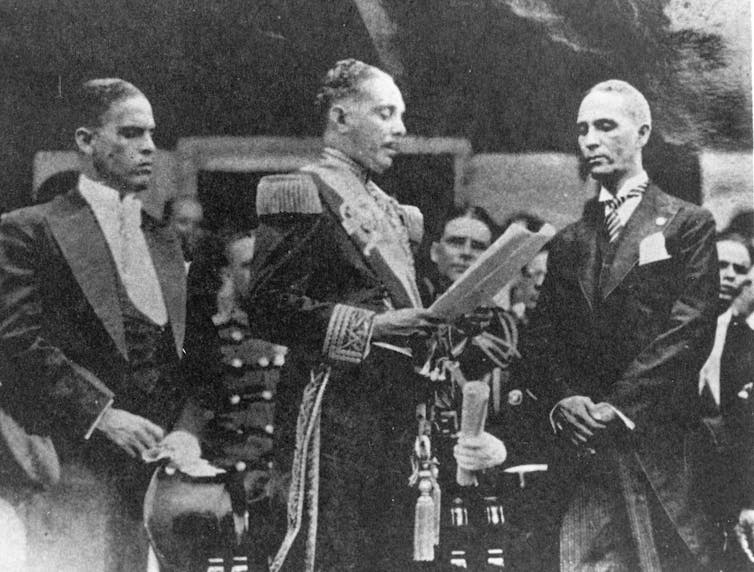
Rafael Trujillo being sworn in as Panamanian president.
Rafael Trujillo (centre) being sworn in as Panamanian president for the first time in 1930.
Archivo General de la Nación / Wikimedia Commons

Setting the conditions for a military coup that was likely to lead to assassination was also at the centre of the 1963 killing of South Vietnamese president Ngô Đình Diệm. Henry Cabot Lodge Jr, the US ambassador to South Vietnam at the time, told President John F. Kennedy that the US had planted the seed for the coup and created a fertile ground where it could flourish.

While top CIA officials were initially reluctant to support a military coup, the agency had an operative, Lucien Conein, in close contact with South Vietnamese generals as the events took place. Kennedy was apparently shocked in learning that Diệm had been brutally murdered. To this, his chairman of the joint chiefs of staff, Maxwell Taylor, remarked: “What did he expect?”

Starting in the 1980s, the US government turned its attention to the Libyan and Iraqi leaders, Muammar Gaddafi and Saddam Hussein. The Reagan administration supported the National Front for the Liberation of Libya in its ultimately unsuccessful efforts to overthrow and kill Gaddafi.

And in its confrontation with Hussein, the Bush Sr administration often called for a “palace coup” that could lead to the elimination of the Iraqi leader – although not necessarily of his regime. This confrontation spilled over into Bill Clinton’s presidency in the 1990s.

The US government supported Kurdish forces – something the Trump administration is considering in Iran – and members of the Iraqi opposition in a series of efforts to mount a coup. Many of these plots were deeply infiltrated and some were dismantled before they could start. A plot against Hussein involving the Kurds in 1996 was marred by betrayals. They all ended in disaster.

‘War on terror’

The “war on terror” after the 9/11 terrorist attacks and the opportunities that new technologies such as armed drones had created meant the US became engaged more directly in the assassination of terrorist leaders. And yet, even at the height of the war on terror, the US at times showed an unwillingness to pull the trigger itself.

Israeli investigative journalist Ronen Bergman has reported that the Bush Jr administration agreed to cooperate with Israel to kill Hezbollah commander Imad Mughniyeh in 2008. But they agreed to do so on three clear conditions: the strike should be kept secret, Mughniyeh alone would be killed and Americans would not do the killing. Mughniyeh was killed by a car bomb placed in his SUV by Mossad agents with key American assistance.

Trump has shown a proclivity for assassinations with what appears to be little concern for the implications of his actions. In his first term, again in collaboration with Israel, the US did pull the trigger in the assassination of Iranian general Qasem Soleimani. This act escalated matters with Iran and made it more likely that a war would materialise in the future.

With Khamenei, the US preferred to let Israel do the actual killing. The assassination is likely to make Khamenei a martyr and provides the Iranian regime an avenue for cohesion when its internal legitimacy was under severe strain. Collaborating to kill can lead to tactical success, but the costs are often grim.

The Conversation

Luca Trenta’s research on assassination was partially funded by the British Academy.

Arturo Jimenez-Bacardi does not work for, consult, own shares in or receive funding from any company or organisation that would benefit from this article, and has disclosed no relevant affiliations beyond their academic appointment.

ref. Ali Khamenei’s killing continues long US tradition of letting others pull the trigger – https://theconversation.com/ali-khameneis-killing-continues-long-us-tradition-of-letting-others-pull-the-trigger-277784
Five paintings that capture the complexity of motherhood – chosen by art historians

Source: The Conversation – UK – By Marius Kwint, Reader in Visual Culture, University of Portsmouth

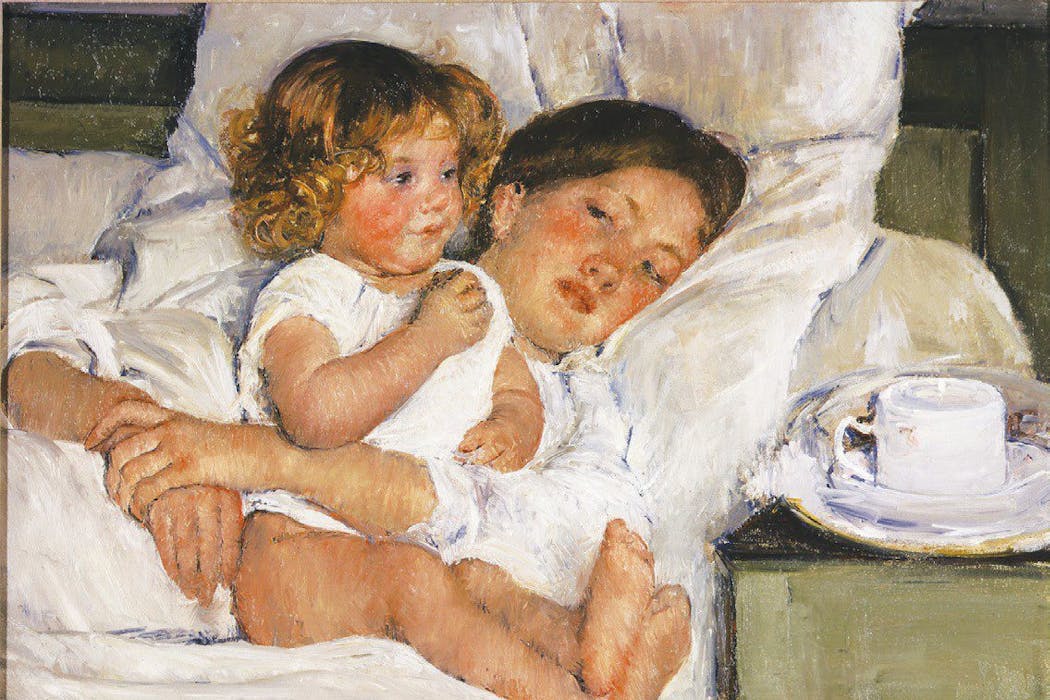
Breakfast in Bed by Mary Cassatt (1897). Huntington Library

The complex relationship between mother and child is no easy thing to capture on canvas. For Mother’s Day, we asked five experts to share their favourite painting of a mother or maternal figure.

1. Hunting for Lice by Gerard ter Borch (1652)

This small painting, displayed in the Mauritshuis in The Hague, is of a scene that might be familiar to any carer for nursery- or school-aged children today. Gerard ter Borch captures the look of concentrated maternal resolve and patient resignation by the child, who is probably a boy, judging by his smock and the ball in his hand.

Painting of a mother combing her son's hair for lice
Hunting for Lice by Gerard ter Borch (1652).
Mauritshuis in The Hague

He has paused his play and leans into the stout frame of his seated and respectably dressed mother. Typical of Dutch genre painting, it carries a moral message and finds spirituality in the humblest acts. The fine-toothed comb was an artistic and poetic symbol for purging the soul as well as the body, so this mother is not only caring for the physical health of her son but also looking to his eventual salvation. But we can also just enjoy her slight smile of pleasure and gratification in this moment of purposeful closeness with her dear child.

Marius Kwint is a reader in visual culture

2. Madonna of the Pilgrims by Michelangelo Merisi da Caravaggio (1603-5)

Caravaggio’s altarpiece, the Madonna of the Pilgrims, offers a beguiling mixture of the ordinary and the extraordinary. The setting is minimal, plain and achingly mundane: a doorframe with chipped masonry; some exposed bricks; a stone doorstep. A young mother – beautiful, but a little down-at-heel – supports a weighty infant on her hip.

Painting showing two grubby men kneeling at the feet of the Virgin Mary, who holds Christ on her hip
Madonna of the Pilgrims by Michelangelo Merisi da Caravaggio (1571–1610).
Basilica of Saint Augustine in Campo Marzio

The bond between mother and child is tangible, believable and thoroughly human. Their faint halos, though, confirm that these figures are far from ordinary. The gloomy doorway where they stand is, apparently, the entrance to the shrine of the Holy House of Loreto, the Virgin Mary’s home.

The humble, kneeling pilgrims at the Virgin’s door are not only shabbily dressed but actually grubby – the dirty feet of one made this painting notorious. Yet their piety is rewarded as the holy figures gaze on them sympathetically and Christ seems to extend his small hand in a gesture of blessing.

Alice E. Sanger is an honorary associate and associate lecturer in art history

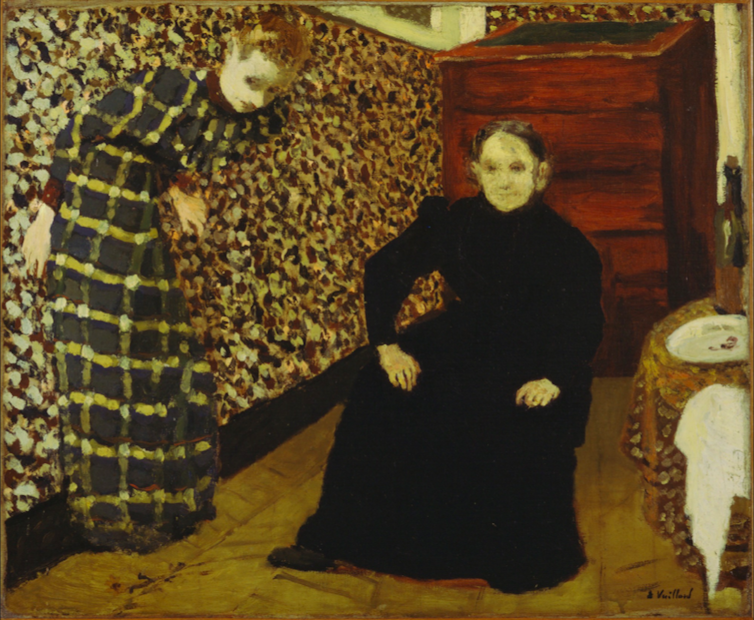
3. Interior, Mother and Sister of the Artist by Édouard Vuillard (1893)

Most western painting romanticises mothers, highlighting blissful, tender intimacy. In these paintings, mothers are usually young, with babies or small children. But where are the complex realities of mother-child difficulty, separation and resentment – and of motherhood as tribulation and endurance (think adolescent and boomerang kids)?

Painting of a mother and daughter
Interior, Mother and Sister of the Artist by Édouard Vuillard (1893).
Moma

Édouard Vuillard’s Interior, Mother and Sister of the Artist (1893) portrays a psychologically intense mother-daughter adult relationship. Vuillard painted his mother more than 500 times and lived with her till she died (when he was 60). He said: “Ma maman, c’est ma muse” – my mother is my muse.

In the crowded space of Interior, a mature Madame Vuillard dominates: legs akimbo, elbows jutting like a seated boxer’s, her solid black body a vortex pulling in the room, its furniture and her daughter. The daughter is consumed by the oppressive domesticity (as shown by the wallpaper) and simultaneously repelled by and drawn – bowing – towards her mother. The power is starkly asymmetrical, and intimacy disturbing. Mother-child relations are sometimes unsavoury. In Interior, Vuillard boldly acknowledges this truth.

Jen Harvie is a professor of contemporary theatre and performance

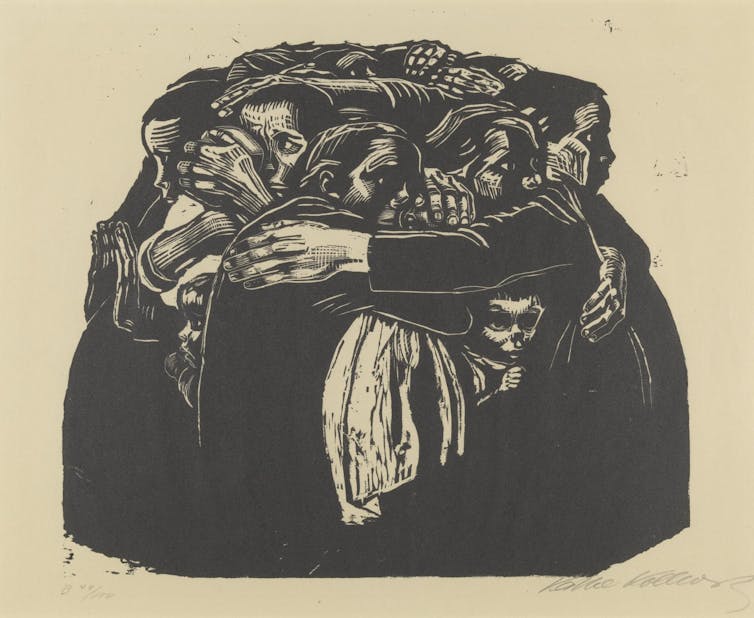
4. The Mothers by Käthe Kollwitz (1921-1922)

Mothers huddled together in unimaginable pain and grief. I just can’t get past this image right now. This woodcut by Käthe Kollwitz is the second last of her war portfolio. Her personal experience informed the print. Her son, Peter, was killed on the front in 1914.

Woodcutting showing women huddled together
The Mothers by Käthe Kollwitz (1921-22).
Tate

The mothers in Kollwitz’s image form almost a sculptural mass, a community bound together by throbbing heartache. This highly emotive image shows the irretrievable consequences of war, the children that these mothers have lost, and are afraid of losing.

Wars might be won and lost in the air, or on the front, or in a control room somewhere far away, but I believe it is the women and children on the ground who suffer the most. And it is the mothers who have to carry the weight of the loss of a generation.

Pragya Agarwal is a visiting professor of social inequities and injustice

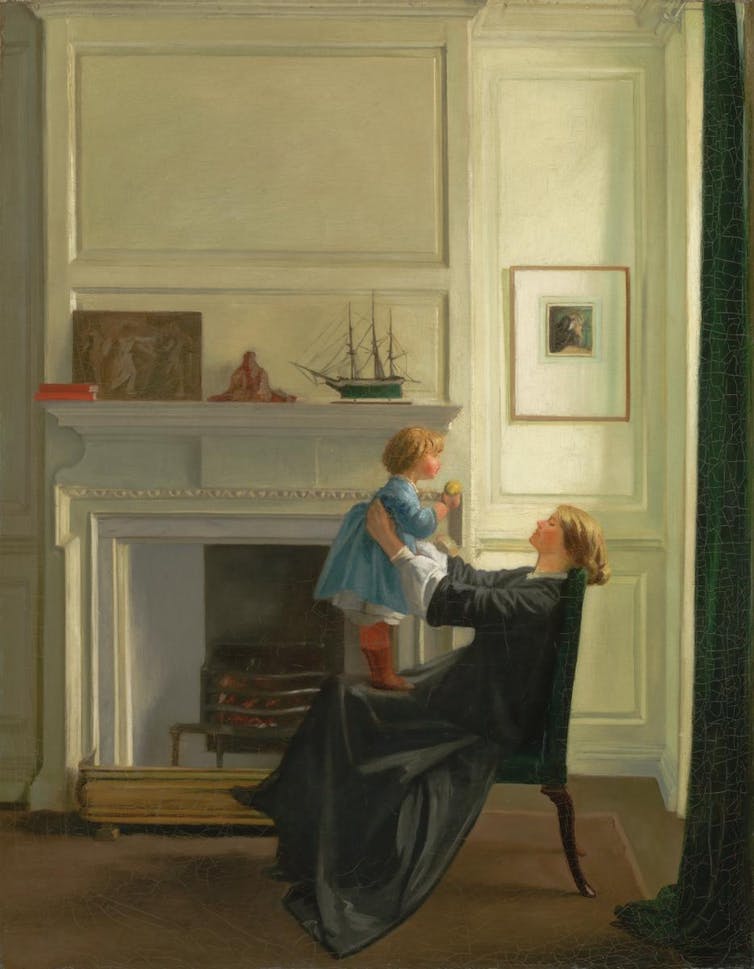
5. Mother and Child by William Rothenstein (1903)

In the 1900s William Rothenstein completed a series of paintings depicting his wife – the actor Alice Knewstub – posed in various interiors. The paintings chart the early years of their marriage and the growth of their family. Mother and Child, which falls somewhere in the middle of this series, represents Alice holding their oldest child John (who would go on to become director of the Tate).

A mother holding her child in front of her
Mother and Child by William Rothenstein (1903).
Tate

Rothenstein’s representations of the mother and child relationship differ across the paintings. What I think he captures especially well in this one is the way in which parents support their children to stand up, knowing that one day those legs may take them far away. Alice’s attention is on John, but John’s attention is on whatever is going on outside the window. The positioning of the model ship just above his head extends the theme of wanting to hold onto something that cannot be held forever.

I’ve always wondered whether this painting was well known to one of Rothenstein’s later students, a young sculptor called Henry Moore, who was similarly (and more famously) drawn to the subject of the mother holding a child. It seems very likely.

Samuel Shaw is a senior lecturer in art history

What is your favourite painting of a mother or maternal figure? Let us know in the comments below.

Our senior arts and culture editor Anna Walker’s favourite is Breakfast in Bed by Mary Cassatt (1897). So much can be read in the mother’s face – exhaustion, love, fear, protectiveness. Through her painting, Cassatt immortalises an intimate moment from the fleeting period of a child’s infancy.

The Conversation

The authors do not work for, consult, own shares in or receive funding from any company or organisation that would benefit from this article, and have disclosed no relevant affiliations beyond their academic appointment.

ref. Five paintings that capture the complexity of motherhood – chosen by art historians – https://theconversation.com/five-paintings-that-capture-the-complexity-of-motherhood-chosen-by-art-historians-275359

Arco blends Studio Ghibli-inspired wonder with a distinctly French surreal imagination

Source: The Conversation – UK – By Malcolm Cook, Associate Professor in Film Studies, University of Southampton

French animation has a rich history. But it has yet to achieve the same widespread recognition as American, British or Japanese animation. Arco could change that. The film’s accessible Studio Ghibli-esque story, unique visual imagination and surreal tone marks it out from run of the mill family fare.

Arco is a 2D hand-drawn time travel fantasy film set in 2075 and 2932. The eponymous hero is ten-year-old boy who steals a cape and gemstone that enable him to travel back in time. Arriving in 2075, Arco meets Iris, an inquisitive girl whose primary caregiver is a robot. It’s a substitute for her parents who work away from home and are only present through holograms. Having lost the gemstone, Arco and Iris try to find a way for him to return home.

As this plot description might already suggest, Arco displays admiration for the Studio Ghibli films of Hayao Miyazaki from the first frame. With its pre-teen protagonists, collision of fantasy with reality, environmental themes and bumbling comedic supporting characters, viewers will be reminded of Laputa: Castle in the Sky (1986), Porco Rosso (1992), Spirited Away (2001) and Ponyo (2008) among others.

The trailer for Arco.

Arco’s depiction of wide-open blue skies accompanied by delicate piano music and later apocalyptic scenes of climate disruption also share an audio-visual heritage with Ghibli films. But far from a mere imitation, the film also offers a distinctly French take on animation.

French animation legacy

France can lay claim to one of the earliest innovators of animation – cartoonist Émile Cohl’s 1908 short Fantasmagorie was the longest and most elaborate animated cartoon to date. In 1973 the surreal sci-fi Fantastic Planet captured the trippy psychedelia of its time, and remains a cult favourite today. More recently, internationally acclaimed and financially successful French animated feature films have included The Triplets of Belleville (2003), Persepolis (2007) and My Life as a Courgette (2016).

These films are all very different. But what unites French animation is not a consistent style or thematic concern. Rather, it has a quirky sensibility that embraces the capacity of animation to look at the world from new perspectives and explore outlandish stories that couldn’t be made any other way.


Read more:
Studio Ghibli’s layering of Japanese and western storytelling is key to their success


An important part of the success of Arco is in balancing that distinctive French sensibility with commercial appeal. Like Studio Ghibli films, that includes using big star names for the English-language dub. This is essential to reach family audiences who might be unable or unwilling to read subtitles.

One of the film’s producers is actor Natalie Portman, lending the production Oscar-winning credibility and contacts. Portman herself voices Iris’ mother, joined by Mark Ruffalo as Iris’ father, America Ferrera as Arco’s mother, and a triple-act comedic turn from Will Ferrell, Andy Samberg and Flea as eccentric cultists.

Future thinking

Despite Arco’s fantastical story elements, its most significant achievement is in tackling timely contemporary environmental themes. Where most cli-fi cinema (science fiction that depicts climate change) often dwells on apocalyptic gloom, Arco’s take is both incisive and uplifting.

The time-travel themes allow for a subtle consideration of the need for long-term “future generations” thinking, while reinforcing the need for human, rather than technological, solutions.

The makers of Arco will no doubt be hoping for a reprise of last year’s surprise animated feature film Oscar, when the low budget Latvian computer animation Flow beat out the usual suspects of Disney, Pixar and DreamWorks. It signalled a new openness of academy voters to international and creatively adventurous animated films.

A win would be well deserved. Just as Arco’s colourful rainbow styling underpins its hopeful vision for the future of humanity, the film’s present day success signals a bright future for animation production in Europe and beyond.


Looking for something good? Cut through the noise with a carefully curated selection of the latest releases, live events and exhibitions, straight to your inbox every fortnight, on Fridays. Sign up here.


The Conversation

Malcolm Cook does not work for, consult, own shares in or receive funding from any company or organisation that would benefit from this article, and has disclosed no relevant affiliations beyond their academic appointment.

ref. Arco blends Studio Ghibli-inspired wonder with a distinctly French surreal imagination – https://theconversation.com/arco-blends-studio-ghibli-inspired-wonder-with-a-distinctly-french-surreal-imagination-276807

MPs’ vote against a social media ban didn’t kill the idea – it may have made it easier later

Source: The Conversation – UK – By Andy Phippen, Professor of IT Ethics and Digital Rights, Bournemouth University

Aguadeluna/Shutterstock

At first glance, the House of Commons vote on March 9 seemed to send a clear political message. MPs have decided against an amendment from the House of Lords to the Children’s Wellbeing and Schools Bill that would have introduced an outright ban on social media use for under-16s.

The reality is more complicated. Rather than rejecting the idea, MPs have effectively postponed the decision. They’ve also proposed powers that could allow a ban to be introduced later.

The vote was less about the merits of a ban and more about timing. A key reason for the government’s position is that it launched a major consultation on children’s digital wellbeing at the start of March 2025. That consultation is due to run until May. It is asking whether stronger restrictions on children’s access to social media and related technologies are needed.

Because the consultation is still underway, ministers argued that it would be premature to write a specific policy, such as a ban for under-16s, directly into law or, more specifically, directly into primary legislation.

Instead, the government has created a compromise that could potentially be more far reaching. MPs rejected the amendment proposed by the House of Lords that would have created an immediate statutory ban. But they supported an alternative approach that would give the secretary of state the power to introduce new restrictions later through secondary legislation.

The powers in the amendment to the Children’s Wellbeing and Schools Bill supported by the commons would allow ministers to impose restrictions on children’s access to certain digital services. These powers would be introduced as part of the bill, and would allow the government to alter any other existing legislation.

In practical terms, this would create the power to regulate, but not the actual rules themselves at this stage.

If the consultation concludes that the public are calling for stronger protections, and the government agrees, these powers could be far reaching. They could potentially include restricting access to social media platforms for certain age groups, limiting features considered harmful or “addictive”, such as autoplay or endless scroll for young people, strengthening age-verification requirements and potentially addressing access to tools such as Virtual Private Networks (VPNs) that could be used to bypass age controls.

Crucially, these measures would not require a new future act of parliament.

While parliament would still have oversight of such regulations, they typically receive far less parliamentary scrutiny than primary legislation and cannot be amended in the same way. MPs usually have to accept or reject them as they are written, rather than change specific parts.

Building evidence

The current consultation on children’s digital wellbeing is unusually broad. It has a cautiously hands on tone, framing young people’s digital lives as an emerging public-policy problem that may require stronger regulation. Although it formally invites views, the consultation documents largely assume that some form of action is necessary and asks respondents to comment on a range of potential interventions.

Boy with phone
A public consultation is seeking opinions on children’s use of social media.
carballo/Shutterstock

It covers a diverse range of digital topics currently in the public eye, such as social media, gaming platforms and AI chatbots. It asks for opinions on whether there is concern and where stronger age-based restrictions should be introduced. It is not simply asking whether action should be taken, but how.

Therefore, should the consultation responses support stricter controls, this raises the possibility that it may ultimately pave the way for a ban or similar restrictions, and the government needs the framework to be able to do this.

Regulatory strategy

Governments can pass framework legislation that gives ministers flexible powers, rather than specifying detailed rules immediately. There is a view that this makes the legislation more flexible in the emergence of new technologies and allows policymakers to respond to technological and political developments without needing to pass new laws each time the regulatory landscape changes.

In this case, the commons has effectively created the legal infrastructure for future restrictions while avoiding committing to them immediately.

Introducing a ban in primary legislation while the consultation is still gathering evidence would have risked undermining the process or making the consultation something of a lame duck. By granting ministers regulatory powers instead, MPs have ensured that the issue can be revisited once the consultation concludes.

Whether those powers are ultimately used to introduce a ban remains to be seen. And at the present time the changes will have to be passed back to the Lords for agreement (sometimes called “parliamentary ping pong”). There is a chance the Lords will ask for further amendments, but it is likely that this will not take long and the bill could reach assent by Easter. However, whether these measures will be effective in their goals will require long term analysis. But the political and legal groundwork is now been laid.

The debate about children, social media and regulation is far from over. If anything, the commons vote signals that the next phase of that debate is only just beginning.

The Conversation

Andy Phippen does not work for, consult, own shares in or receive funding from any company or organisation that would benefit from this article, and has disclosed no relevant affiliations beyond their academic appointment.

ref. MPs’ vote against a social media ban didn’t kill the idea – it may have made it easier later – https://theconversation.com/mps-vote-against-a-social-media-ban-didnt-kill-the-idea-it-may-have-made-it-easier-later-278116

Hearing loss is often called a dementia risk factor – here’s what the research really shows

Source: The Conversation – UK – By Emma Broome, Senior Research Fellow, University of Nottingham

PeopleImages/Shutterstock

Hearing loss and dementia affect millions of people worldwide. But headlines describing hearing loss as the “leading mid-life risk factor” for dementia can be misleading. They often oversimplify complex science, and risk confusing people who are trying to understand what hearing loss can mean for brain health.

Research shows that hearing loss and cognitive decline frequently occur together. Cognitive decline refers to worsening memory and thinking skills.

While these two conditions are linked, we still do not fully understand why. Several biological and social factors are likely to be involved, and they probably interact in complex ways. What we do not yet have is clear evidence that hearing loss directly causes dementia.

Hearing loss is extremely common. Around 430 million people worldwide live with disabling hearing loss, and this number is expected to rise to more than 700 million by 2050. Dementia affects 57 million people globally, with prevalence increasing with age. As populations live longer, more people will experience one or both conditions.

Some of the confusion arises from how dementia risk is calculated and reported. Age and genetics account for much of overall risk, alongside factors such as cardiovascular health, education and social isolation. Hearing loss is one part of this broader picture, which means its role can be misinterpreted when statistics are presented without context.

Another source of misunderstanding is how research findings are described. The Lancet commission on dementia uses a measure called the “population attributable fraction”. This estimates how many dementia cases might be linked to a particular factor, in this case hearing loss. It does not mean that a person with hearing loss will develop dementia.

The figure reflects both how common hearing loss is, and how strongly it is associated with dementia. Because hearing loss is so widespread, it can appear to account for a large proportion of cases at population level, even though the individual risk for most people remains relatively modest.

Clear communication is therefore essential. Hearing aids and other devices should not be promoted as guaranteed ways to prevent dementia. Their main value lies in the broader benefits they provide, including improved communication, stronger social connections and better quality of life. These factors can support cognitive health, but they are not proven protective treatments.

Overstating the link between hearing loss and dementia may create unrealistic expectations. It may also discourage some people from seeking help because of stigma – particularly if hearing loss becomes framed primarily as an early sign of cognitive decline, rather than as a common and treatable condition.

How hearing loss might affect the brain

Researchers have proposed several ways in which hearing loss could influence cognitive decline. Hearing difficulties do not simply make conversations harder. They can also alter how the brain processes information.

When sounds are difficult to hear, the brain must work harder to interpret them. This increased effort may leave fewer mental resources available for memory and thinking. Over time, reduced sound input may also affect how certain brain regions function, similar to how a muscle weakens when it is used less.

Hearing difficulties can also affect social participation. Struggling to follow conversations may lead to withdrawal, loneliness or depression, all of which are linked to a higher risk of dementia. At the same time, shared underlying factors such as ageing, vascular disease and genetics may contribute to both hearing loss and dementia.

The picture is complex. These processes are likely to interact differently across people and stages of life, meaning dementia risk is highly individual rather than uniform.

Can hearing aids prevent dementia?

Hearing aids and cochlear implants improve access to sound. However, evidence that they prevent dementia or significantly slow cognitive decline remains limited.

Clinical trials have generally been small and inconclusive, while observational studies show mixed results. Some suggest slower cognitive decline among long-term hearing aid users, but these studies cannot fully account for other influences such as health status, education or income.

That does not mean hearing aids are unimportant. They can make a substantial difference to daily life by helping people follow conversations, remain socially connected and maintain independence. For people already living with dementia, improved hearing can support communication and wellbeing.

Hearing loss often occurs alongside dementia, and when unaddressed it can reduce the effectiveness of other forms of support. Difficulty hearing can make group activities, therapy sessions and social programmes harder to engage with. By improving access to sound, hearing aids may help people benefit more fully from existing care.

Most research on hearing loss and dementia has been carried out in high-income countries. Many studies exclude minority ethnic groups, people in lower-income settings and those living in care homes. This matters because the risk, experience and management of both conditions vary across populations.

Around 80% of people with hearing loss live in low and middle-income countries, and the fastest growth in dementia is expected in these same regions. Without more inclusive research, understanding will remain incomplete and interventions may fail to reach those who need them most.

The relationship between hearing loss and dementia is still evolving. What is clear is that hearing loss affects far more than just cognition. Supporting people to hear better can help them stay connected, engaged and independent. These benefits matter at every stage of life.

The Conversation

Emma Broome receives funding from an NIHR Development and Skills Enhancement Awards (NIHR306142) and a research grant from WS Audiology A/S.

ref. Hearing loss is often called a dementia risk factor – here’s what the research really shows – https://theconversation.com/hearing-loss-is-often-called-a-dementia-risk-factor-heres-what-the-research-really-shows-276246

Nicotine: the latest wellness hack

Source: The Conversation – UK – By Dipa Kamdar, Senior Lecturer in Pharmacy Practice, Kingston University

Gera Photo/Shutterstock.com

If you spend any time on social media, you may have noticed a curious trend: wellness influencers singing the praises of nicotine. Not smoking or vaping but nicotine patches and pouches, repackaged as cognitive enhancers, productivity boosters and even weight-loss aids. But does the science support this rebrand, or are we watching a familiar substance undergo a very modern makeover?

Nicotine is primarily a stimulant and derived from the tobacco plant. Small amounts of nicotine are also found in other members of the nightshade family, including tomatoes, aubergines, potatoes and green peppers. However, the levels in these foods are minimal compared with those in tobacco.

Nicotine works by latching on to specific receptors found throughout the body, triggering the release of various brain chemicals such as dopamine, noradrenaline, and serotonin. These receptors, along with a chemical messenger called acetylcholine, play an important role in attention, learning and memory.

The evidence on whether nicotine can enhance cognitive performance is mixed. One large review of 41 trials involving healthy adults – both non-smokers and smokers – found that nicotine produced small improvements in areas such as fine motor skills, attention and aspects of short-term and working memory.

An animal study demonstrated nicotine increased working memory and boosted levels of brain-derived neurotrophic factor, a protein important for learning and brain resilience. However, other research shows that in healthy non-smokers, nicotine often has neutral or even negative cognitive effects.

This difference comes down to starting point. People who already have cognitive difficulties have more room to improve, while those with healthy brain function are already performing close to their best. Because of this, nicotine is unlikely to offer any real benefit to people who don’t have cognitive impairments.

Small experimental studies have explored whether nicotine patches might help people with mild cognitive impairment, with one trial reporting slight improvements in memory test scores over six months. Research suggests nicotine may have protective effects in neurodegenerative diseases like Alzheimer’s and Parkinson’s, partly because it reduces inflammation, prevents cell death and supports cognitive function.

Nicotine has also been linked to weight loss and reduced appetite. It appears to influence the parts of the brain that control hunger and makes the body burn more energy by triggering the release of stimulating hormones like adrenaline. While some animal studies suggest nicotine can reduce body weight by speeding up fat burning, there is not yet strong evidence that this holds true in humans

Where nicotine is useful is in smoking cessation. Nicotine replacement therapy is an effective way to help people stop smoking. But this benefit comes from reducing exposure to tobacco smoke, which contains a cocktail of chemicals and cancer-causing agents – not from nicotine itself being healthy.

A woman putting nicotine gum in her mouth.
An effective way to quit smoking.
Andrey_Popov/Shutterstock.com

Highly addictive

Nicotine is not harmless and regular use can lead to dependence. Nicotine activates receptors in the brain that trigger the release of several chemical messengers, including dopamine (the so-called feel-good hormone). This surge in dopamine creates the pleasurable sensations and reinforcement that contribute to nicotine’s addictive effects.

Studies in animals show using nicotine during the teenage years can lead to long lasting changes in the brain and behaviour, including higher risk of other drug use, reduced attention and mood problems.

Teenagers have more nicotine receptors in the brain’s reward areas than adults, which makes nicotine’s effects stronger and the developing brain more vulnerable. Similar effects can be seen in a developing baby during pregnancy.

Common side-effects of using nicotine include nausea, vomiting and headaches. It can also cause more serious heart and blood-vessel harms.

Nicotine triggers the release of chemicals such as adrenaline and noradrenaline, and studies show that higher levels of these can raise heart rate, increase blood pressure and make the heart work harder.

Nicotine also damages the inner walls of blood vessels by causing inflammation, raising blood pressure and disrupting normal blood vessel function. The evidence is clear that no nicotine product is safe for the heart and cardiovascular system – a conclusion now officially backed by major health organisations, including the World Health Organization.

Is nicotine safer without smoke? Yes. Is it safe? No.

Reduced harm is not the same as benefit. The scientific picture is complicated: possible cognitive effects, potential therapeutic avenues, but clear risks and strong addictive potential.

The science does not support using nicotine as a cognitive enhancer or lifestyle supplement for healthy adults. What it does support is using nicotine replacement therapy to help people stop smoking. Outside that context, the risks outweigh the hype. Wellness trends come and go, but addiction is far harder to shake.

The Conversation

Dipa Kamdar does not work for, consult, own shares in or receive funding from any company or organisation that would benefit from this article, and has disclosed no relevant affiliations beyond their academic appointment.

ref. Nicotine: the latest wellness hack – https://theconversation.com/nicotine-the-latest-wellness-hack-276614

Everybody to Kenmure Street: how a feisty Glasgow neighbourhood beat a ‘secret’ immigration raid

Source: The Conversation – UK – By Trish Reid, Professor of Theatre and Performance, University of Reading

The kind of protests that loom large in the collective imagination tend to be compact and dramatic. Everybody to Kenmure Street, Felipe Bustos Sierra’s energising and inspiring film about a spontaneous act of collective civil disobedience in Glasgow, documents just such an event.

At a time when mobile phone footage shared by citizen activists is proving increasingly vital in holding authority to account, it also feels extraordinarily prescient. Most obviously in the US, where the film recently won the world cinema documentary special jury award for civil resistance at the Sundance Film Festival.

Bustos Sierra’s debut was the 2018 documentary Nae Pasaran, about a group of Scottish Rolls-Royce workers who, in 1974, refused to repair jet engines for the Chilean air force in protest against the violent Pinochet regime. It won a Bafta for best feature film. Unsurprisingly, Bustos Sierra handles his material with confidence.

Everybody to Kenmure Street begins with a black and white montage. Children play in the back courts of tenement slums. Suffragettes demand the right to vote. The intense heat of the Glasgow’s blast furnaces sends sparks flying. Crowds march against the installation of a nuclear deterrent on the Clyde. Riveters raise their hammers in synchronised rhythm in the city’s famous ship yards. Glasgow’s industrial heritage and its proud history of protest are established as the film’s backdrop.

As the film moves from black and white to colour, we find ourselves on a tenement-lined street in the Pollokshields area of the city. It is early morning on May 13 2021. An immigration enforcement vehicle has just pulled up on Kenmure Street, and two Indian men have been arrested for possible infringements.

Priti Patel, the UK home secretary, had been aggressively doubling down on the hostile environment promoted by her predecessor Theresa May. The dawn raid had been approved without the knowledge of the Scottish government in Holyrood because immigration legislation and policy are reserved to Westminster. Among other things, then, Everybody to Kenmure Street exposes some of the tensions in the devolution settlement.

This intrusion into one of Scotland’s most ethnically diverse areas, with a large Muslim population, on what also happened to be Eid al-Fitr – the feast day that celebrates the end of Ramadan – was understandably experienced by many as a deliberate provocation.

As Bustos Sierra’s evocative film documents, it quickly becomes the trigger for an extraordinary act of communal resistance. A kind of social media-enabled mass sit down, it results in an eight-hour stand-off with immigration officials and the police, and the eventual release, without charge, of the two men.

Making extensive use of donated mobile phone footage, Bustos Sierra documents the heartwarming combination of improvised tactics and community-based solidarity that won the day from the level of the street itself.

As the day progressed, the number of protestors grew from a handful to dozens, to hundreds and eventually a couple of thousand. Word spread and a number of well-known figures arrived on the scene, perhaps most significantly, the activist and human rights lawyer Aamer Anwar who eventually negotiated the men’s release.

The power of ordinary people

At its most affecting though, Everybody to Kenmure Street is a film about the decency and moral courage of ordinary Glaswegians. Having looked out of their windows and spotted the immigration van, a small number of residents decided to act.

They came out into the street, challenged the officials present, created an obstruction by sitting down, and began texting and posting on social media. Crucially, just after 9am an activist, known only as “Van Man”, crawled under the police vehicle and attached himself to the axle preventing the immigration officers from driving away.

His timely action allowed others to gather, and he was described by many as the hero of the day. Because he wishes to remain anonymous, his words are spoken, here, by the film’s executive producer, the actor and activist Emma Thompson, who looks directly to the camera while adopting a position that echoes the cramped conditions Van Man endured for eight hours.

The Scottish actor Kate Dickie similarly gives voice to the off-duty NHS worker who tended him for most of the day. “The fact that I’m a nurse,” she explains, “gives me a level of protection that other people wouldn’t experience”. It’s difficult to hear her words without thinking of Alex Pretti, the 37-year-old intensive care nurse shot and killed by an ICE agent in Minneapolis, in January of this year.

The absolute horror of events in that city make the dénouement of Bustos Sierra’s film all the more remarkable. Police Scotland, who by the end of the day were in attendance in high numbers, simply agreed to let the men go in order to avert any kind of violent confrontation.

If all this sounds wildly utopian, Bustos Sierra is careful not to allow his adopted home town to become too pleased with itself. Picking up on some of the threads laid down in the opening montage, he uses the middle section to stress Glasgow’s mixed legacies.

While the city’s radical tradition is certainly honoured, from its early opposition to apartheid to its proud history of trades unionism, the film also stresses that its mercantile and industrial wealth, like that of Bristol, Liverpool and London, was built on the labour of enslaved people.

In this way a connection is made between the brown men held in the van, who are victims of an aggressive immigration policy, and the historical victims of colonialism who were also predominantly people of colour.

Given that our news feeds are currently full of images reinforcing the reality that black and brown lives are less grievable than white ones, this connection seems an especially vital one to make. An important film, everybody should see Everybody to Kenmure Street.

Looking for something good? Cut through the noise with a carefully curated selection of the latest releases, live events and exhibitions, straight to your inbox every fortnight, on Fridays. Sign up here


The Conversation

Trish Reid does not work for, consult, own shares in or receive funding from any company or organisation that would benefit from this article, and has disclosed no relevant affiliations beyond their academic appointment.

ref. Everybody to Kenmure Street: how a feisty Glasgow neighbourhood beat a ‘secret’ immigration raid – https://theconversation.com/everybody-to-kenmure-street-how-a-feisty-glasgow-neighbourhood-beat-a-secret-immigration-raid-275713

Mandelson files released at sensitive time for UK relations with Donald Trump

Source: The Conversation – UK – By Christopher Featherstone, Associate Lecturer, Department of Politics, University of York

The release of the “Mandelson files” comes at a difficult moment in relations between the US and UK. It is unlikely to ease tensions.

The UK government has submitted to pressure from MPs to disclose files relating to the hiring and vetting of Peter Mandelson as UK ambassador to the US. Questions have been raised about how much officials, including the prime minister, Keir Starmer, knew about Mandelson’s friendship with paedophile Jeffrey Epstein after his conviction for sex offences in 2008.

The key takeaway from the release doesn’t relate to the US president, Donald Trump. This is that Mandelson tried to negotiate a severance package worth £547,201 after being asked to leave his post in Washington. He ended up getting £75,000. But there are details in the documents that will not be welcomed by the US, and the nature of the release will be of concern to a White House already under pressure for its own approach to Epstein.

Trump has already spent recent weeks publicly criticising Starmer for failing to support him on Iran, saying Starmer is no “Winston Churchill”. The release of these files may well lend further opportunity for Trump to hit out.

Lack of control

The questions about how much Starmer knew about Mandelson and Epstein arose in the first place after the US government partially released the Epstein files in January. These included email exchanges between Mandelson and Epstein revealing a relationship that extended long after the latter’s conviction. They have also led to a police investigation over communications made between the two men while Mandelson was a government minister. These allegedly relate to sensitive government information rather than anything relating sex offences.

Trump will not like the fact that this release has brought the Epstein files back into the spotlight – and particularly that it is happening in circumstances beyond his control.

Trump has repeatedly called for the Department of Justice to “move on” from this story, having faced questions about his own relationship with Epstein. He recently attacked CNN journalist Kaitlan Collins for not smiling as she asked him questions about the Epstein files, in a clear attempt to distract public attention.

There is a risk that the Mandelson document release will renew pressure on Trump to release the full cache of documents held by the US government – and that he will seek to divert attention by lashing out again at Starmer.

Donald Trump and Keir Starmer talking.
Trump and Starmer, pictured in September 2025.
Number 10/Flickr, CC BY

Unsurprisingly, given that many of these released documents were written for private consumption, they contain some comments that may be embarrassing for the authors and subjects.

In the documents, we can see the UK government reviewed public comments Mandelson made condemning Trump policies prior to his appointment as ambassador, apparently to consider whether they were a problem during the vetting process.

When speaking to students in Hong Kong, Mandelson said: “it’s also necessary to recognise Mr Trump’s behaviour for what it is: he is a bully and mercantilist who thinks that the US will gain in trade only when others are losing”. Trump will likely be annoyed by this attack on his treasured “tariffs” policy.

Crucially, given that Starmer appointed Mandelson despite these comments, these documents also show that the UK government did not object to Mandelson’s view.

London v Washington

The release from the UK will fuel a debate that has begun on the difference between how London and Washington have both responded to the the revelations in the Epstein files. The Trump administration continues to refuse to release its own files in full – and continues to be accused of covering up Trump’s relationship with Epstein.

The UK government has demonstrated that it is willing to fire people over their relationships with Epstein and that it won’t protect them from police investigation. Now it has shown willingness to release files showing how much the government knew about these relations. This is of course not the full release of files and Starmer insists several key items can’t be released because they are part of an ongoing police investigation, but it still leaves space for criticism of the US.

Trump and his administration will have been hoping that media attention would move on, focusing on the controversial airstrikes on Iran, or continuing ICE raids across US cities. It will not welcome inevitable comparisons between its unwillingness to act on revelations from the Epstein files – or to keep releasing more files – and the UK government’s decision to do both.

Crucially, US government officials will be watching for further document releases to see if this situation gets any worse.

The Conversation

Christopher Featherstone does not work for, consult, own shares in or receive funding from any company or organisation that would benefit from this article, and has disclosed no relevant affiliations beyond their academic appointment.

ref. Mandelson files released at sensitive time for UK relations with Donald Trump – https://theconversation.com/mandelson-files-released-at-sensitive-time-for-uk-relations-with-donald-trump-278129

Black female footballers are praised for their strength, white players for their intelligence: what our study shows

Source: The Conversation – UK – By Paul Ian Campbell, Associate Professor in Sociology (Race and Inclusion in sport and in education), University of Leicester

Rawpixel.com/Shutterstock

For black female professional footballers, racism has become a distressingly regular part of the game. Earlier this year, England defender Jess Carter told the BBC that the racist abuse she received online during the 2025 Euros made her fearful to leave her hotel room.

Black sportswomen routinely deal with racial abuse from fans and teammates. But less discussed is how their bodies, emotions and on-pitch performances are spoken about by sports commentators. It’s not just negative comments, either. Clear racial stereotypes emerge when comparing positive comments about black players with those about white players. Our 2025 study examines commentary during the 2019 Fifa Women’s World Cup, does just that.

We analysed 2,905 comments of praise given to footballers during 80 hours of BBC and ITV coverage, across all 52 matches at the tournament. We found that white women were more frequently praised for their intelligence and technical proficiency, while black women received the most praise for their perceived physical prowess and natural athleticism.

White players were more frequently praised skills learned through practice, such as having a “lovely technique” (49.4% of all comments about white players), followed by physical (20.3%), character (16.2%), cognitive (10.8%) and natural (3.3%) abilities.

Black players received almost double the amount of praise for their physical prowess (39.5% of comments about black players) and natural abilities (5.8%). They received notably fewer praise comments for learned skills (36.8%), as well as lower amounts of praise for character (11.9%) and cognitive attributes (6.0%).

These differences were especially noticeable in the coverage of national teams from white-majority countries that had more than two black players in their starting squad. England’s two non-white players (accounting for 18.2% of the team) received 50% of all of their team’s praise for natural attributes. These were comments praising qualities that were perceived to be innate, such as being a “magician” on the pitch. England’s visibly white players (81.8% of the team) received almost the entire amount of the praise given to the whole team for cognitive attributes (96%).

Jess Carter discusses her experiences with racism.

France’s black players, who accounted for 43% of team, received 90% and 85% of the team’s total praise for natural and physical attributes, respectively. White French players, who similarly constituted 43% of the playing squad, received 68% of the teams’ total praise for intelligence.

We also found that black female players were more likely to be described as being angry and emotionally unstable during matches. Nigeria’s forward Desire Oparanozie was described as “playing with a bit of anger” and England’s Nikita Parris was said to be unable to maintain her composure, with a tendency to frequently “make her feelings known”.

Their white teammates, on the other hand, were described as calm and composed.
During the England v Cameroon match, commentators praised the almost entirely white England team for keeping their composure and not “reacting” to “unseemly things going on the pitch” by the African players.

The harm of misogynoir

Black women experience a unique form of discrimination called misogynoir. It is different to the exclusions faced by white women and the racism experienced by black men. It is the result of a combination of the misogyny directed at their gender and the anti-black racism directed at their race.

Sport media is a powerful site where the gender and racial stereotypes that exist in society are replicated. It has a long history of portraying black sportswomen as powerful, hyper-masculine and angry.

Studies have shown that black sportswomen are frequently stereotyped as unfeminine, masculine and strong, lacking intelligence, emotionally unstable, inherently angry and overly aggressive. Conversely, white women are seen to embody Eurocentric beauty standards and accepted feminine ideals, such as notions of purity, grace, emotional stoicism and delicacy.

These stereotypes have real-life consequences for black sportswomen. Some footballers have gone so far as to change how they play so that they are not seen as angry or masculine, but just as women who play the game they love. For example, ex-England player Anita Asante explained:

You have to check yourself to make sure people don’t view you in that light. Maybe on that particular day in a training session, I am that sassy person, or I am that competitive person that comes across a bit more feisty – but because there is an association with being a black woman and having that energy and boldness is not always seen a positive thing, [so] I might refrain from being that person and contain more of my emotions.

Evidence shows that misogynoir can influence the career opportunities that are afforded to black women more generally. A recent US study connected racism to higher levels of stress and to higher mortality rates.

Unless, meaningful action is taken by broadcasters to change the practice of commentary through tallying exercises like our research, then commentators might be unwittingly contributing to the racial stereotypes that cause psychological and physiological harm to the same superstars that they idolise and praise.

The Conversation

The authors do not work for, consult, own shares in or receive funding from any company or organisation that would benefit from this article, and have disclosed no relevant affiliations beyond their academic appointment.

ref. Black female footballers are praised for their strength, white players for their intelligence: what our study shows – https://theconversation.com/black-female-footballers-are-praised-for-their-strength-white-players-for-their-intelligence-what-our-study-shows-276993

From Japanese walking to 75 Hard: what the science really says about viral fitness trends

Source: The Conversation – UK – By Jack McNamara, Senior Lecturer in Clinical Exercise Physiology, University of East London

YAKOBCHUK VIACHESLAV/Shutterstock

If TikTok fitness advice is to be believed, you should be interval walking like the Japanese, hanging from a pull-up bar every day and committing to a 75-day challenge with no rest days.

Some of these trends are grounded in scientific research. Others are built on shaky claims or misunderstandings of how the body actually adapts to exercise.

Social media has made fitness advice more accessible than ever. But a review has raised concerns about the accuracy and quality of online fitness content, much of which is produced by creators without relevant qualifications.

So which viral workouts actually hold up when you look at the evidence? Here’s what the science says about four of the most widely shared trends.

Japanese walking

According to an analysis of Google search data, “Japanese walking” saw a 2,968% increase in search interest over the past year. The method is simple: alternate three minutes of brisk walking with three minutes at a gentle pace for around 30 minutes.

What makes this trend unusual is that it’s actually grounded in peer-reviewed research. Developed by researchers at Shinshu University in Japan, a randomised controlled trial studied 246 adults (average age 63). The interval walking group showed significantly greater improvements in thigh muscle strength, aerobic capacity and blood pressure than a steady-pace group. A 2024 review confirmed these benefits hold up across larger populations.

There are caveats, though. In the original study, roughly 22% of participants dropped out of the interval programme – more than in the steady-pace group. And no study has yet linked Japanese walking directly to living longer. We already know that hitting a modest daily step target reduces the risk of death and disease. Japanese walking appears to be a useful upgrade to a regular walking habit – but it’s not the only way to get moving.

75 Hard

The 75 Hard challenge is one of the most widely shared fitness trends on TikTok. The rules: two 45-minute workouts daily (one outdoors), a strict diet, a gallon of water, ten pages of reading and a progress photo – for 75 consecutive days with no rest days.

The no-rest-days rule is the most problematic element. Physiological adaptation to exercise, the process by which your body becomes fitter, doesn’t happen during training. It happens during recovery. Exercise creates a controlled stress; given sufficient rest, the body rebuilds and adapts.

Without it, you accumulate fatigue rather than fitness. A joint consensus statement from the European College of Sport Science and American College of Sports Medicine outlines how sustained overload without adequate recovery can progress to overtraining syndrome: chronic fatigue, declining performance and increased susceptibility to illness and injury.


Read more:
75 Hard: what you need to know before taking on this viral fitness challenge


The 90 minutes of daily exercise also far exceeds the World Health Organization’s guideline of 150–300 minutes per week. For someone currently inactive, jumping to 630 minutes a week is a recipe for injury, not transformation.

Dead hangs

Dead hangs (hanging from a pull-up bar for as long as possible) are a fixture of fitness social media. Proponents claim the exercise decompresses the spine, corrects posture and transforms shoulder health. Some of these claims hold up better than others.

The strongest case for dead hangs is grip strength. This might sound unglamorous, but it’s clinically significant. A 2019 narrative review described grip strength as an “indispensable biomarker” for health, with multiple meta-analyses linking weak grip to higher mortality risk. The PURE study, which tracked nearly 140,000 adults across 17 countries, found grip strength was a stronger predictor of cardiovascular death than systolic blood pressure.


Read more:
What are dead hangs? What are the shoulder pain risks and how do I do them safely?


The “spinal decompression” claims, however, are less convincing. While gravity-based traction can temporarily increase disc height, the spine returns to its normal state once you’re back under gravitational load. No study has shown that brief bouts of hanging produce lasting spinal changes. Dead hangs are a useful exercise, just not for the reasons most often claimed.

Pilates

Pilates was the most-booked workout globally on ClassPass for the third consecutive year, with reservations up 66% from 2024. Research supports its benefits: a systematic review found strong evidence that Pilates improves flexibility and dynamic balance in healthy people, with moderate evidence for muscular endurance.


Read more:
What is reformer pilates? And is it worth the cost?


Where the evidence falls apart is the claim that Pilates builds “long, lean muscles”, as opposed to “bulky” ones from lifting weights. This is a myth. Muscle length is determined by anatomy, where each muscle’s tendons attach to bone. No form of exercise can change that.

What Pilates can do is improve the range of motion around a joint and build endurance under lower loads. But the “lean versus bulky” framing has no basis in physiology, and risks discouraging people from progressive strength training, which carries substantial benefits for bone density, metabolic health and cardiovascular risk.

Social media has got more people interested in exercise – and that’s genuinely valuable. But viral appeal is not the same as evidence. The principles that actually keep people healthy haven’t changed: build up gradually, allow time to recovery and be sceptical of anything promising dramatic results in an unrealistic timeframe.

The Conversation

Jack McNamara does not work for, consult, own shares in or receive funding from any company or organisation that would benefit from this article, and has disclosed no relevant affiliations beyond their academic appointment.

ref. From Japanese walking to 75 Hard: what the science really says about viral fitness trends – https://theconversation.com/from-japanese-walking-to-75-hard-what-the-science-really-says-about-viral-fitness-trends-277339