Iran and Ukraine are changing the EU and testing its unity

Source: The Conversation – UK – By Richard Whitman, Member of the Conflict Analysis Research Centre, University of Kent; Royal United Services Institute

As the US-Israel war against Iran is well into its second week, with no sign of ending, it is having ever wider global ripple effects. Beyond severe consequences for the world economy, the political and diplomatic fallout has also had a significant impact on Europe.

Europe is being forced to address the consequences of two wars of choice that are not of its making: the Trump-Netanyahu war against Iran and Vladimir Putin’s war on Ukraine. The European Union is increasingly straining to maintain unity as its institutions and member states struggle to align their interests confronted by such an unprecedented situation.

Divisions at the top of the EU institutions are increasingly playing out in the open. The EU is drawn between trying to maintain at least a minimum of transatlantic cohesion to keep the US on side in its confrontation with Russia, and its defence of an equally minimal pretence that international law still matters.

The result is mixed messaging on the US-Israeli war against Iran. Commission president Ursula von der Leyen was first clearly at odds with the EU’s foreign policy chief Kaja Kallas, before being contradicted by the commission’s executive vice-president Teresa Ribera and EU council president António Costa.

Such public spats between top EU officials are highly unusual. In fact, one of the least expected and most remarkable developments over the past four years since the beginning of Russia’s full-scale invasion of Ukraine in February 2022 has been the extent to which the European Union has changed and yet remained broadly united.

The EU’s response to Russia’s aggression was – uncharacteristically – one of breaking several taboos and at high speed. First, Brussels provided EU funds to non-member Ukraine for military equipment and training its armed forces. Over the past four years, the EU has risen to become Ukraine’s most important supporter. Second, and as significantly, the EU embarked on the process of making the development of Europe’s military capabilities a core future priority for Brussels. For a bloc whose core philosophy is focused peace through economic integration, this, too, was unheard of before Russia’s invasion of Ukraine.

These changes would not have been possible without the support of key member states, many of whom have abandoned longstanding and often highly cherished traditions as well.

Critically, this has been led by Germany and France, the EU’s two largest powers. In Germany, the then-chancellor Olaf Scholz’s Zeitenwende (turning point) speech just days after the war started triggered a fundamental rethink about the country’s relationship with Russia which had undeniably turned from a potential partner to an openly hostile adversary. This paved the way, among other things, for the sanctions imposed on Russia by the EU.

Scholz’s succcessor, Friedrich Merz, completed Germany’s geopolitical repositioning with his commitment to a European defence identity that will ultimately be independent from the US. This reflects an acknowledgement that the transatlantic pillar of US security for Europe has become too fragile under Donald Trump to continue to provide a dependable safety net for the continent.

The French embrace of European strategic autonomy may have been less surprising than in the German case. However, Paris recently announced concrete steps to expand its nuclear weapons arsenal and extend the French nuclear umbrella to eight European allies. This is a significant shift in doctrine. It will see nuclear-capable planes of the French air force stationed abroad for the first time.

Berlin’s participation in this scheme breaks another major taboo in Germany, while British participation is a clear indication that EU defence thinking has become more flexible. The idea of a “coalition of the willing” that includes members of both the EU and of Nato breaks with the traditional division of labour between them. It has the potential of providing a new anchor of European security that could overcome the rigidity of EU and Nato structures, including their dependence on consensus decisions.

All of these, and other, shifts in the EU’s geopolitical awakening have come at a cost, however.

European disunion

A longstanding row between Hungary and Slovakia, on the one hand, and Ukraine, on the other, over Russian oil deliveries via the Soviet-era Druzhba pipeline has significantly escalated. Budapest has vetoed the delivery of an agreed €90 billion (£77 billion) loan to Kyiv and threatened to block new sanctions against Russia.

There is now also an open debate in Brussels – principally between some member states and the European Commission – on at least the timing, if not the broader prospects, of Ukrainian accession to the EU.

None of these challenges will quickly disappear, nor are there easy answers to them. The idea of the heart of the European project – that economic integration and investment in a rules-based liberal international order would make the continent safe – turned out to be naive.

First, Moscow’s willingness to disrupt the international relations of Europe by force dealt a serious blow to the idea that the EU’s combined power could sufficiently constrain a revisionist and expansionist Russia. Second, and perhaps even more sobering, Washington’s willingness to stake a claim for the acquisition of Greenland, initially not ruling out the use of force, threatened the territory of Denmark, a European Nato ally and EU member. This at once cast the dependability of the transatlantic alliance into a whole new, and unwelcome, light.

The EU’s age of innocence is now over. Trump and Putin have delivered major shocks to the political psyche of European leaders. While this continues to be a painful process, Europe as a whole cannot afford a breakdown in the hard-won consensus over the need to support Ukraine and invest in its own defences. This would have serious negative consequences for the continent’s ability to survive in a world in which once-established rules of state conduct are rapidly dismantled.

After four years of war and more than a year of Trump 2.0, the EU has shaken off the conception of being a “civilian power”. But reshaping the current chaos into a new order that is once again conducive to the European project will require hard work for Europeans to be seen as being geopolitically relevant.

The Conversation

Richard Whitman receives funding from the Economic and Research Council of the UK as a Senior Fellow of the UK in a Changing Europe initiative. He is a past recipient of grant funding from the British Academy of the UK, EU Erasmus+ and Jean Monnet Programme. He is a Senior Associate Fellow at the Royal United Services Institute (RUSI), and an Academic Fellow of the European Policy Centre in Brussels. He is a past Associate Fellow and Head of the Europe Programme of the Royal Institute of International Affairs (Chatham House).

Stefan Wolff is a past recipient of grant funding from the Natural Environment Research Council of the UK, the United States Institute of Peace, the Economic and Social Research Council of the UK, the British Academy, the NATO Science for Peace Programme, the EU Framework Programmes 6 and 7 and Horizon 2020, as well as the EU’s Jean Monnet Programme. He is a Trustee and Honorary Treasurer of the Political Studies Association of the UK and a Senior Research Fellow at the Foreign Policy Centre in London.

ref. Iran and Ukraine are changing the EU and testing its unity – https://theconversation.com/iran-and-ukraine-are-changing-the-eu-and-testing-its-unity-277796

Deep underground, a telescope may soon detect ghosts of stars that died before Earth existed

Source: The Conversation – UK – By Pablo Martinez Mirave, Postdoctoral Researcher in Theoretical High-Energy, Astroparticle and Gravitational Physics, University of Copenhagen

Imagine looking up at the night sky and seeing a star suddenly burst into a blaze of light brighter than anything nearby. A flash so bright that it briefly outshines an entire galaxy before fading forever.

This violent fate is rare: fewer than about 1% of stars are big enough to end their lives this way. Indeed, these dramatic explosions only occur in so-called “massive stars”. These are stars with a mass roughly eight times or more that of the Sun.

But these cosmic explosions, known as supernovae, have naturally fascinated astronomers for centuries. In 1572, for instance, Danish astronomer Tycho Brahe observed a supernova explosion so bright that it could be seen with the naked eye for two years.

Yet what we can see with our eyes, or even with powerful telescopes, when these stars die, is only a tiny fraction of the story. Because most of the energy from a supernova is carried away by neutrinos, these are nearly invisible particles often called “ghost particles” because they pass through almost everything in their path.

Scientists are now finally on the verge of seeing these ghostly messengers. With the help of an extremely powerful telescope buried deep underground in Japan, astronomers may be able to catch a glimpse of these stellar “ghosts” – and with it the remnants of explosions from stars that died as long as 10 billion years ago.

Particles from before time

And there’s a really good chance that scientists might be able to finally see these ghost particles this year. This is largely due to Japan’s Super-Kamiokande telescope receiving an upgrade, which significantly enhances its ability to detect supernova neutrinos.

For me, as a particle astrophysicist, this would probably be one of the most exciting scientific achievements in my lifetime. Indeed, it would mean we could see particles that were produced even before the Earth itself existed, as the telescope is now sensitive enough to catch the faint “glow” of all the exploding stars in the universe.

This is all possible because neutrinos almost never interact with anything. They have no electric charge. So they can travel through space – and even through entire planets – without being absorbed or scattered, so almost nothing can stop them.

In fact, billions of these ghostly particles are passing through your body every second – and you don’t even notice – and some of them have been travelling for more than 10 billion years to get here.

When a star dies

Big ideas lead to big questions, and one such question astrophysicists are trying to figure out is what remains after the explosion of such a star.

Does the collapsing core become a black hole? Or does it form a different type of star known as a neutron star, which then slowly cools over time? A neutron star is an incredibly dense object, only about 20 kilometres (12 miles) across, roughly the size of a large city or about the length of Manhattan.

If scientists are able to detect the combined signal from all the supernovae that have ever occurred, it would bring us closer to being able to answer these questions. It would also allow us to study the deaths of stars across the entire history of the universe, using particles that have been travelling toward us for billions of years without ever stopping.

Supernova remnant N 63A lies within a clumpy region of gas and dust in the Large Magellanic Cloud.
NASA, ESA, HEIC, and The Hubble Heritage Team (STScI/AURA), CC BY

Supernovae are rare in our galaxy, happening only once every few decades. But across the universe, a massive star explodes in a supernova roughly once every second. When they explode, they release enormous energy: only about 1% is visible light, while 99% escapes as neutrinos.

Even though these neutrinos are almost invisible, they carry the story of every star that has ever exploded – and now, for the first time, we may be able to catch them.

So if 2026 does bring the first clear detection, it will mark a new era in astronomy. For the first time, we won’t just observe the brilliant explosions of nearby stars, but the collective story of all the massive stars that have ever lived and died.

And it all starts with a telescope buried deep underground in Japan, patiently watching for the faint, ghostly glow of the universe’s oldest explosions.


This article was commissioned as part of a partnership betweenVidenskab.dk and The Conversation. You can read the article in Danish.

The Conversation

Pablo Martinez Mirave does not work for, consult, own shares in or receive funding from any company or organisation that would benefit from this article, and has disclosed no relevant affiliations beyond their academic appointment.

ref. Deep underground, a telescope may soon detect ghosts of stars that died before Earth existed – https://theconversation.com/deep-underground-a-telescope-may-soon-detect-ghosts-of-stars-that-died-before-earth-existed-275577

Why global methane levels spiked during COVID lockdowns

Source: The Conversation – UK – By Gemma Ware, Host, The Conversation Weekly Podcast, The Conversation

Six years ago, as countries around the world went into COVID lockdowns, the air got cleaner. Factories slowed down, roads emptied and aeroplanes were grounded. As people stayed home, the world burned fewer fossil fuels and so carbon dioxide emissions dropped – by around 7% in 2020.

But something else was also happening in the atmosphere. Levels of methane – an extremely potent greenhouse gas that warms the planet even faster than CO₂ – rose faster in 2020 than at any point since records began in the 1980s. And methane levels kept on rising during 2021 and 2022.

Ever since, scientists have been trying to piece together what caused this sudden mysterious increase in methane. Now, they think they have the answer, and it was partly due to COVID lockdowns.

In this episode of The Conversation Weekly podcast, we speak to Philippe Ciais, a researcher at the Laboratory for Climate and Environmental Sciences at Université Paris-Saclay in France, and one of the authors of a new study in the journal Science about the spike in methane levels, who explains how they solved the mystery.

The atmosphere contains a special type of cleaning agent called hydroxyl radical (OH) which is capable of breaking down methane. Ciais calls it the “pacman of the atmosphere”. The production of these OH particles is facilitated by pollution, including nitric oxide and nitrogen dioxide (known collectively as NOx) from combustion processes.

“ In the chain of complex chemical reactions in the atmosphere that leads to the formation of NOx, OH is generated,” says Ciais. “When you have a reduced emission of NOx, as it was the case during the COVID, you have a weakening of OH … less concentration of this cleaning agent, and as a result, methane increasing faster in the atmosphere”.

The study found that around 80% of the spike in methane was caused by a reduction in OH, but increases in methane from wetlands and from agriculture also played a role.

Ciais says understanding where the growth in methane came from doesn’t mean the world should go on polluting. Rather, it’s a wake-up call. “ It’s not by continuing to drive more that we will reduce methane. It’s by reducing [methane] emissions,” he said. “That’s the ultimate way we have to prevent methane from increasing and amplify the warming of the climate.”

Listen to the interview with Philippe Ciais on The Conversation Weekly podcast. This episode was written and produced by Mend Mariwany, Katie Flood and Gemma Ware. Mixing by Eleanor Brezzi and theme music by Neeta Sarl.

Listen to The Conversation Weekly via any of the apps listed above, download it directly via our RSS feed or find out how else to listen here. A transcript of this episode is available via the Apple Podcasts or Spotify apps.

The Conversation

Philippe Ciais a reçu des financements de la Fondation BNP Paribas (don philanthropique pour le Global Carbon Altas), du projet financé par 4C EU Horizon2020 et du projet Climate Change Initiative de l’Agence spatiale européenne.

ref. Why global methane levels spiked during COVID lockdowns – https://theconversation.com/why-global-methane-levels-spiked-during-covid-lockdowns-278128

Nasa plans to have a permanent base on the Moon by 2030 – how it can be done

Source: The Conversation – UK – By Kevin Olsen, UKSA Mars Science Fellow, Department of Physics, University of Oxford

A US Senate committee has directed Nasa to begin work on a Moon base “as soon as is practicable”. Under legislation advanced by the Senate lawmakers, the outpost would serve as a science laboratory and proving ground, where astronauts would develop the capabilities to live and work beyond Earth’s orbit.

A recent executive order issued by the White House directs Nasa to establish the initial elements of a permanent Moon base by 2030.

Since 2017, Artemis has been the Nasa-led programme working towards a sustained human presence on the Moon. This year, it will send astronauts around the Moon for the first time in more than half a century. And following a shake-up of Artemis announced in late February, the space agency plans to greatly increase the frequency of Artemis missions and return humans to the lunar surface in 2028.

A vote will now decide whether Senate legislation, known as the Nasa Authorization Act of 2026, is passed to Congress, where a second bill is also circulating. The bills, which both break down this year’s funding for specific Nasa programmes, will be reconciled and voted on in both houses to become law.

Underlying some of the announced changes is a deepening concern in Congress and the current administration about the challenge rival powers pose to US leadership in space. A Chinese-Russian led Moon outpost known as the International Lunar Research Station is under development.

A one page summary accompanying the Senate bill calls for a US base “so we can get there before the Chinese” and to “dominate the Moon, control strategic terrain in space, and write the rules of the 21st century.”

Site selection

The American habitat will be located at the Moon’s south pole, a strategically important location which harbours valuable resources such as water ice. The water could support habitation systems at a lunar outpost and be turned into rocket propellant for onward exploration.

Where exactly the base is located will depend on the terrain, how much sunlight the site receives, how extreme the temperatures are, how easily astronauts can communicate with Earth and their access to resources such as water. The rim of a 21km-wide depression known as Shackleton Crater (which may hold abundant ice deposits) and a flat-topped mountain called Mons Mouton are among the leading candidates. The leading locations combine several favourable factors.

At high latitudes, such as the lunar poles, elevated crater rims can receive near-constant solar illumination. This makes them more thermally favourable than many sites at the equator, providing a consistent supply of solar power. However, the strategic value of these sites lies in what are called permanently shadowed regions (PSRs). These impact craters, untouched by sunlight for billions of years, are believed to contain the water-ice deposits.

While the south pole remains a primary focus in upcoming missions, other targets near the equator, such as Marius Hills and Mare Tranquillitatis, offer alternative advantages. These regions feature massive underground lava tubes formed by ancient volcanic activity that can act as natural shields against solar radiation and micrometeorite bombardments. They could insulate human outposts against extreme swings in temperature: from 127°C to -173°C.

The interiors of lunar lava tubes are estimated to remain at about 17°C year-round, making them ideal sites for human bases. However, unlike at the lunar poles, water in these regions is typically trapped as molecules within volcanic glass beads or minerals. Extracting this water to sustain human activities would require intensive heating and significant technological development.

European astronauts explore a lava tube in the Canary Islands. Huge lava tubes on the Moon could protect human habitats from radiation and micrometeoroids.
Esa–L. Ricci

Powering an outpost

The Moon’s day-night cycle means that a given point on the lunar surface sees roughly 14 Earth days of continuous daylight followed by 14 days of darkness. While solar power is a viable entry point, it cannot sustain a permanent human presence through the freezing lunar night. To achieve the 2030 mandate for a “sustained presence” Nasa and the Department of Energy are developing nuclear fission reactors as a potential source of energy.

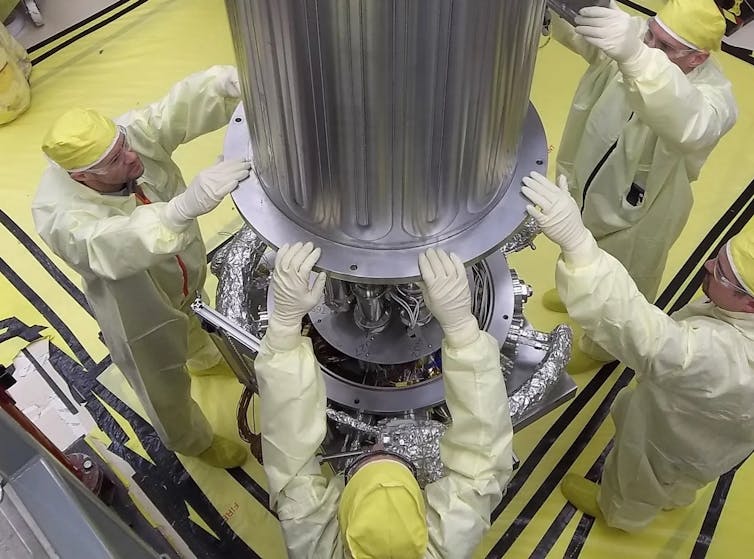
They have been working on 40-kilowatt-class reactors that are designed to be launched from Earth in an inert state and activated upon arrival. To protect the crew from radiation, the reactors will likely be placed at a distance or buried within the lunar regolith (soil), which serves as a natural radiation shield.

Engineers from Nasa and the National Nuclear Security Administration lower the wall of the vacuum chamber around a demonstration fission reactor.
Los Alamos National Laboratory

The deployment of lunar fission reactors raises practical governance questions
under existing international space law. The US-led set of rules for operating in space, known as the Artemis Accords, establishes a framework for peaceful cooperation.

It calls for transparency about space agencies’ activities on the surface and proposes safety zones around nuclear infrastructure. However, this approach conflicts with the Outer Space Treaty of 1967, which guarantees the right of all nations to have unrestricted access to all areas of celestial bodies.

Given that energy security is a strong prerequisite for successful habitation systems, there is a clear need for the governance of the storage and disposal of the materials used for nuclear fission on the lunar surface.

Initial assembly

A lunar base would likely be built up in stages. Early missions would use satellites and autonomous rovers to study the lunar surface, identify areas rich in resources and confirm the presence of water. Under a 2030s timeline, robotic missions could be sent ahead to prepare landing sites by levelling the ground and melting the dusty surface into harder landing pads. This would help reduce the damage caused by highly abrasive lunar dust kicked up during landings.

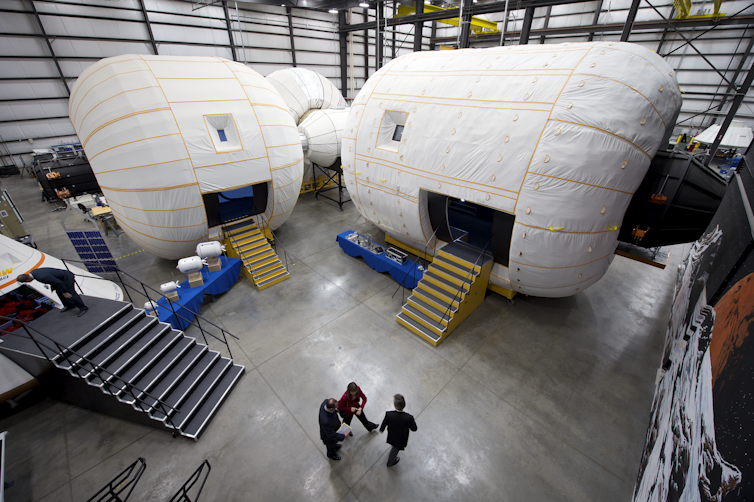
The habitats themselves would probably be built by connecting different modules – a bit like the International Space Station. Current designs favour modules that can be reduced in size for transportation and then expanded after landing. One way to do this is with inflatable structures.

Expandable habitats could be deployed on the Moon before more permanent structures.
Nasa / Bill Ingalls

Later, more permanent architectures may use microwaves or lasers to sinter or melt the lunar regolith into solid structures. This would create protective shells around base modules to protect them against micrometeorites and cosmic radiation.

The Moon serves as a testbed for the life-support, power and robotic systems required to support human missions on Mars and other destinations in deep space.

The fiscal implications of sustained operations on the lunar surface also require a more realistic assessment of funding. With Nasa’s topline budget remaining largely flat, the higher cadence (frequency) of lunar missions outlined in Nasa’s changes to Artemis would increase pressure on agency resources.

This may intensify competition with existing science and Earth observation priorities, but it also strengthens the case for greater commercial participation and international cost-sharing. If these financial pressures can be managed effectively, the long-term legacy of sustained lunar surface operations could be a more durable framework for funding space exploration.

The coming decade will test not only our ability to operate through the lunar night, but also our capacity to build the logistical, legal, and cooperative frameworks needed for a durable human presence beyond Earth.

The Conversation

The authors do not work for, consult, own shares in or receive funding from any company or organisation that would benefit from this article, and have disclosed no relevant affiliations beyond their academic appointment.

ref. Nasa plans to have a permanent base on the Moon by 2030 – how it can be done – https://theconversation.com/nasa-plans-to-have-a-permanent-base-on-the-moon-by-2030-how-it-can-be-done-277752

How psychedelics push your brain to dream while awake – new study

Source: The Conversation – UK – By Andrea Benucci, Professor in Biology and Experimental Psychology, Queen Mary University of London

New Africa/Shutterstock

A new study in mice suggests psychedelics make the brain more likely to “see” images from memory rather than what’s actually in front of it.

Long before modern laboratory testing, indigenous cultures used these substances to
treat psychological and physical ailments. The Aztecs used psilocybin mushrooms as medicine, while Andean cults consumed mescaline-rich San Pedro cacti thousands of years ago. Archaeologists have found a ritual bundle thousands of years old in a Bolivian cave that contains traces of DMT (a potent hallucinogenic found in plants). They also found 5,000-year-old peyote buttons from Texas.

The modern journey began when Swiss chemist Albert Hofmann synthesised LSD in 1938.
In the 1970s and 80s, researchers found that these drugs attach to a specific brain receptor (called 5-HT2A) that can trigger hallucinations. This receptor is part of the serotonin system, which affects mood and can influence anxiety and depression.

Fast-forwarding to today, scientists debate whether the psychedelic trip itself (the mystical experience) is necessary for treating conditions like depression and anxiety. Some scientists think the real benefit of psychedelics comes from their ability to help brain cells rewire and communicate in new ways – a process called “neuroplasticity”. It’s possible the hallucinations are just a side-effect of their therapeutic effect.

It is therefore critical to understand exactly how these substances alter people’s perception. Trends in modern pharmacology are shifting towards drug designs that aim to trigger the therapeutic “trip” of hallucinogens without the side-effects.

In the new study, scientists used mice engineered so certain brain cells would glow when active. The brighter the glow, the more active the cells were.

Technologies developed by one of the study’s lead researchers, Thomas Knöpfel, allowed the researchers to record both increases and decreases in voltage across the surface of the brain. These changes in voltage depend on which cells are being activated for specific tasks.

During the experiment, the mice were shown visual stimuli, such as moving black and white bar patterns, as well as simple blank screens. This allowed the researchers to measure brain activity during both stimulus viewing and resting states.

Halfway through the experiment, the researchers injected the mice with a powerful chemical that activates the same 5-HT2A serotonin receptor as LSD and psilocybin, but in a more selective and controlled way.

Young woman having psychedelic trip with hallucinations
Psychedelic drugs can give people intense visual effects.
BLACKDAY/Shutterstock

The researchers compared the brain’s voltage patterns before and after the drug took effect, which helped them pinpoint the neural circuits affected by the psychedelic. They focused on the brain’s primary visual cortex and on slow rhythmic oscillations (known as theta rhythm) linked to attention, memory consolidation and stimulus familiarity. The high-resolution recordings revealed a fascinating shift in brain communication.

Before the drug, the visual cortex produced 5-Hz brain oscillations. After the psychedelic was administered, theta rhythm oscillations intensified significantly, increasing in both power and duration.

More importantly, these low frequency waves in the brain’s visual processing areas synchronised with the retrosplenial cortex, which has been implicated in the encoding, storing and retrieving memories. This synchronisation had a delay of about 18 milliseconds, consistent with a travelling wave of activity connecting the two regions.

The psychedelic acted like a switch: it dampened the brain’s response to what the eyes were seeing, while boosting connections with memory areas, letting the brain “fill in” missing visuals from its own memory.

Instead of relying on what was actually in front of the eyes, the brain began inserting fragments from its own internal memory banks. This finding provides an explanation for how visual hallucinations may work.

The lead researcher, Dirk Jancke, described this state as being remarkably similar to partial dreaming. Under the influence of the drug, the brain’s internal imagery overrides external reality, creating a vivid, self-generated world.

Despite these insights, the study has limitations. As acknowledged by the authors, some of the findings might reflect the mice getting distracted from the repetitive images. Mice and humans share several fundamental features of brain organisation, but it is unclear whether the phenomena can be mapped onto human hallucinogenic experiences.

Ultimately, though, the study could mark a crucial step towards developing non-hallucinogenic drugs that increase the patient’s neuroplasticity, and hopefully, decrease their mental health symptoms.

The Conversation

Andrea Benucci does not work for, consult, own shares in or receive funding from any company or organisation that would benefit from this article, and has disclosed no relevant affiliations beyond their academic appointment.

ref. How psychedelics push your brain to dream while awake – new study – https://theconversation.com/how-psychedelics-push-your-brain-to-dream-while-awake-new-study-276708

The UN is turning refugees into carbon offset workers

Source: The Conversation – UK – By Nicholas Beuret, Lecturer in Management and Ecological Sustainability, University of Essex

Climate change and related disasters are driving millions from their homes. Now, a new UN initiative aims to put these very refugees to work offsetting the emissions of the world’s biggest producers.

Facing a US$7 billion (£5 billion) funding shortfall, the UN’s refugees agency has launched its Refugee Environmental Protection (REP) fund. The plan? To plant trees and install sustainable cooking stoves in camps, generating carbon credits to sell on the global market.

It sounds like a win for everyone: money for camps, jobs for refugees, and trees for the planet. But our research, carried out with our colleague David Harvie, suggests a darker reality. This is a system that generates questionable climate benefits, while locking refugees into low-wage labour to service the same economies that displaced them.

How the fund works

The fund aims to plant tens of millions of trees to offset carbon emissions elsewhere, while simultaneously providing employment for refugees and funding for UN refugee camps.

It uses donor funding to invest in tree-planting and clean cooking-stove programmes in and around refugee camps. (These cookstoves use electricity or burn liquefied petroleum gas rather than firewood – the cleanness refers to the fact that they’re considered safer for users because there’s less indoor air pollution, not because they are fossil-free).

The claimed carbon savings from these projects are then verified and registered as carbon credits to be sold to people or organisations who want to “offset” their own emissions. Revenues are used to replenish the fund, to improve the camp and finance new projects. Advocates also claim that clean cooking stoves will better protect women against gender-based violence, as they will have a reduced need to collect firewood.

The fund remains at a relatively early stage of development. Following pilots in Uganda and Rwanda, the UN plans to expand it to Brazil, Bangladesh, Kenya, Mozambique, Cameroon and Chad.

The impact on emissions

While the claims sound good, there are significant issues that mean the fund may well fail to reduce carbon emissions – and could possibly even increase them.

Many of the problems with schemes like these are now well known. The carbon credits industry’s self-regulation, combined with its lack of shared methodologies, undermines the credibility of its claims to reduce emissions. Key actors such as the multinationals that buy the credits or the landowners who generate them are also incentivised to overstate the climate benefits.

In addition, carbon credits rely on counterfactual estimates of what would have happened without the project. This is riddled with uncertainty, especially as climate change or reforestation can themselves alter how much carbon is saved.

These issues affect all carbon credits, even including the most rigorously verified – so-called gold standard-certified projects – which is the certification the UN’s fund will use.

The problem with planting trees

Most tree-planting schemes have very high failure rates, often seeing almost half the trees die in the first five years, while some can have mortality rates as high as 90%.

Poorly designed projects can also degrade soils, harm biodiversity and exacerbate water shortages. And as climate change increases the risk of wildfires, stored carbon could be released back into the atmosphere.

These problems have led many researchers to declare carbon offsets as false climate solutions that allow major emitters to continue polluting without any meaningful reductions. Indeed, much research has established that lots of carbon credits are effectively worthless.

The UN’s refugees agency has stated the fund “manages project risks according to high climate standards” and prioritises “measurable improvements in fuel efficiency and emission reductions.” It maintains that revenue is “transparently reinvested in community-driven projects”.

Who gets the carbon credit?

Refugees are paid to plant trees and assemble cookstoves, but the wages are extremely low. Comparable projects in Rwanda and Uganda suggest official wages range from around US$1.30 to US$5 per day, and are often less in practice.

By contrast, gold standard-certified reforestation credits typically sell for US$20–27 per tonne of carbon dioxide equivalent, 2025 prices. Using conservative estimates, the fund’s planned 20,000 hectares of reforestation could generate around US$3.2 million per year, or US$64 million over 20 years.

The UN frames the fund as a way to secure finance for refugee camps, but our analysis of the pilot projects shows a huge disparity between the value of the carbon credits and the money reaching the camps. For the 388,000 people across the three pilot sites, we estimate the US$3.2 million generated annually would contribute roughly 14% of current (insufficient) funding – and less than 5% what is required to provide adequate services.

While the money raised is a fraction of what’s needed to run the camps, the “value” created by refugees doing low- or unwaged labour goes beyond the direct dollar amounts. These credits have enormous strategic value for the buyers. By purchasing gold standard offsets generated by displaced people, major polluters gain a powerful social and environmental license to continue business as usual. That’s why much of the value appears to go not to the refugee workers, but to the companies buying the credits, and to the intermediaries who manage the transactions.

Much of the work involved in generating credits also comes from the use of clean cooking stoves. This labour is entirely unwaged, and is done primarily by women. Where gas is involved as a fuel for these stoves, the companies who provide it also benefit by securing a small but important market for their fuel. That’s one reason why exporting countries such as the US support clean cooking initiatives, even while opposing other climate measures.

The UN’s refugee agency rejects the characterisation of the fund as exploitative, framing it instead as a necessary “innovative financing” mechanism to plug a funding gap.

Ultimately, we worry the fund risks creating a form of climate maladaptation, where something seeks to respond to climate impacts but unintentionally increases vulnerability.

Similar to many aspects of the emerging green economy, the UN’s Refugee Environmental Protection fund risks making climate change worse while exploiting refugee labour. This perversely locks refugees into a green Sisyphean task: producing carbon credits that enable continued emissions, thereby worsening the very conditions that helped displace them in the first place.


Don’t have time to read about climate change as much as you’d like?

Get a weekly roundup in your inbox instead. Every Wednesday, The Conversation’s environment editor writes Imagine, a short email that goes a little deeper into just one climate issue. Join the 47,000+ readers who’ve subscribed so far.


The Conversation

The authors do not work for, consult, own shares in or receive funding from any company or organisation that would benefit from this article, and have disclosed no relevant affiliations beyond their academic appointment.

ref. The UN is turning refugees into carbon offset workers – https://theconversation.com/the-un-is-turning-refugees-into-carbon-offset-workers-273724

Thirty years after Dunblane school shooting, the UK’s gun laws can still be improved

Source: The Conversation – UK – By Peter Squires, Professor of Criminology & Public Policy, University of Brighton

On March 13 1996, a man walked into a primary school in Dunblane, Scotland, armed with four handguns and several hundred rounds of ammunition. In the school gymnasium, he killed 16 young children and their teacher, and injured many others. This horrific tragedy prompted significant gun control reforms, including a ban on civilian possession of most handguns.

But 30 years later, the UK’s gun safety issues have not been fully solved. Two mass shootings in subsequent years, in Cumbria and Plymouth, add to the evidence that gun law reform in Britain has largely been event-driven. Changes only happened following tragedies – preventing future tragedies has been overlooked.


Read more:
After the Plymouth attack, British gun laws under scrutiny


Shotgun regulation has been a particular problem. Shotguns are far more frequently criminally misused than other types of licensed firearm. In the year ending March 2025, 346 shotguns were criminally misused, compared to just 76 rifles. Shotguns are also far more frequently lost or stolen, thereby contributing to illegal firearm supply.

Over the last two decades, there have been 68 domestic firearms deaths, murders and murder/suicides. The perpetrator is almost always a male gun owner, with victims disproportionately female, and most likely to be shot using a licensed firearm.

At the root of these problems are gaps in the process by which police grant firearms certificates. All of Britain’s mass shootings have been perpetrated using licensed, legally owned firearms.

Since Dunblane, police firearm licensing has attracted increasing scrutiny from many quarters. There are concerns about the diligence shown by police firearm licensing units when assessing the suitability of applicants or renewals. Until 2021, very few gun licences were revoked. However, in recent years the number of revoked certificates has increased.

Police have failed to identify disqualifying factors, or overlooked falsehoods made on gun licence applications. And in a number of recent domestic shooting tragedies, police have carelessly returned confiscated firearms to unsuitable people.

Different licensing standards

Many of these challenges are rooted in the complexity of the 1968 Firearms Act, which creates different licensing standards for rifles and shotguns. Rifles were originally thought to be “more lethal” because of their power and range. But of course, this means nothing in close domestic settings.

Meanwhile, the recent statutory safety guidance to police makes it absolutely clear that no-one denied a rifle certificate on safety and suitability grounds should ever be permitted a shotgun. A single licensing standard could significantly simplify matters.

A man in posh hunting clothing shooting a shotgun into the air
Different licensing standards for shotguns and rifles complicate the gun regulation picture.
William Barton/Shutterstock

After the Plymouth shooting in 2021, the coroner identified a “catastrophic failure” in shotgun licensing, and made a number of recommendations. These included improving nationally-accredited training for firearms enquiry officers, better resourcing of licensing departments, improved information sharing between police and health authorities and tighter statutory guidance. Importantly, it also included subjecting both shotguns and rifles to the same rigorous safety standards.

Following a shooting incident in Euston in 2023, the prime minister, Keir Starmer, suggested that the rules for the licensing of shotguns should be aligned with the more rigorous standards applied to rifles.

These proposals were broadly endorsed by the Independent Office for Police Conduct and the Scottish Affairs Select Committee. The College of Policing began a major overhaul of firearm licensing procedures and the training of firearms enquiry officers. That programme is currently being rolled out. In August 2025, the Home Office announced additional proposals to tighten the licensing process, but promised to consult on the changes.

Shooting representatives have objected to many of the proposals, voicing concerns about increased costs and further inconvenience to gun owners. They have longstanding complaints about delays and alleged inefficiencies in the licensing process. The All-Party Parliamentary Group on Shooting and Conservation, effectively parliament’s own gun lobby, organised a petition and debate to resist the proposal to combine the licensing standards.

Firearms controls fit for the future

There is unlikely to be any single quick fix for the deeply-rooted problems facing firearm licensing in the UK. The key legislation is outdated and exhibits “labyrinthine complexity”.

The law has been substantially amended at least nine times and supplemented by new case law and guidance. Yet it still contains major gaps, contradictions and ambiguities. It has been outpaced by new firearm trends and technologies such as 3D-printing, online marketing and new weapons trafficking practices.

Another area of concern involves the country’s forensic science capacity, which a recent House of Lords committee report described as “dysfunctional” and barely fit for purpose.

Recent research has also exposed important information gaps undermining the capability of the National Firearms Licensing Management System. And the National Ballistics Intelligence Service, which coordinates the country’s hitherto successful national intelligence-led approach to gun crime since 2008, is not fully utilised by all police forces. This significantly affects its ability to develop a thorough intelligence-led assessment of illegal firearms in the country and reduce gun crime.

Successful firearm safety depends on many factors: clear national policies, precise laws, vigilant policing, scrupulous licensing processes and effective intelligence capabilities. In the case of Dunblane and Plymouth, tragedy energised political will and overcame opposition to firearm safety reforms. We must continue to work for public safety today, we cannot wait for another tragedy.

The Conversation

Peter Squires (Emeritus Professor) has previously received funding from the Arts & Humanities Research Council. He is affiliated with the University of Brighton, but took voluntary severance in 2019. He has been a member of the UK Gun Control Network since around 2000. He is a member of the National Crime Agency Criminal use of Firearms Board, and a member of the HMICFRS ‘Academic Group’.

Rachel Bolton-King receives funding from the Economic and Social Research Council and National Police Chiefs’ Council. She has previously received funding from The Churchill Fellowship and The Lady Hind Trust. She is affiliated with the University of Staffordshire, Staffordshire Police and the Staffordshire Forensic Partnership. She is a member of two Forensic Science Regulator Working Groups; Firearms and Interpretation.

ref. Thirty years after Dunblane school shooting, the UK’s gun laws can still be improved – https://theconversation.com/thirty-years-after-dunblane-school-shooting-the-uks-gun-laws-can-still-be-improved-277805

Oil price escalation could help China grasp more green global leadership

Source: The Conversation – UK – By Chee Meng Tan, Assistant Professor of Business Economics, University of Nottingham

Prices are rising at the pumps due to the Iran war. Leka Sergeeva/Shutterstock

With crude oil prices incredibly volatile as the war in Iran continues, some countries are already warning they may run out of oil.

Pakistan and Bangladesh are both introducing emergency measures as petrol and diesel reserves come under pressure. Both countries are already closing down public buildings to reduce energy use and putting restrictions on fuel use. In Bangladesh the military are guarding oil depots and there are queues building up at petrol stations in Vietnam, Pakistan and the Philippines as prices escalate.

The case for diversifying energy supplies and having more power plants in your home country potentially means being less vulnerable to what happens in conflicts in other parts of the world. And that argument might well push a change in energy strategy for countries that are struggling with supplies right now.

China is already the world’s leading green‑tech manufacturing hub in solar panels, windmills and electric vehicles, and produces more than 70% of the world’s clean tech. So Beijing is in an ideal position to benefit from any growth in the green economy.

As Washington walks away from its climate commitments and continues to act unilaterally on the world stage, Beijing has an opportunity to step in and also enhance its reputation with other nations.

Oil prices are volatile.

China can do this by continuing to export affordable green technologies, and finance low‑carbon projects. Over time, it could even share its expertise with nations abroad. The goodwill that these initiatives generate could help enhance its reputation and alliances with other countries.

Yet China’s leadership in green technology brings its own challenges. Strong state backing has fuelled rapid expansion in sectors such as solar panels, electric vehicles and batteries, creating significant overcapacity and even losses.


Read more:
Who profits from war with Iran? Understanding that will be key to resolving the conflict


And many Chinese manufacturers now depend on overseas sales to stay afloat, which has led to accusations of unfair competition and market flooding. China needs to address these issues, otherwise it risks turning a potential soft-power asset into a source of friction even as the US cedes its role as a global climate leader.

Greenhouse gas emissions

To be an international green economic leader, China may also need to continue to work on its own environmental practises. China remains the world’s largest emitter of greenhouse gases, and was once called the “air pollution capital of the world”.

From 2014 however, China has made strides in reducing air pollution.

There are some indications that China’s carbon dioxide emission have been falling since 2024, and its large-scale tree planting and forest reparation program has reduced sandstorms and land degradation across the country.


Read more:
How would the Iran crisis play out in a world powered by renewables not fossil fuels?


Since the mid-1990s, China’s armed forces have rapidly modernised into a highly capable force. And its economy has been ranked as the world’s second largest since 2010. Yet, China’s willingness to use its growing trade and military influence to achieve its objectives has alarmed western governments and its regional neighbours.

China’s current strength lies in its hard power, which is the ability to get what it wants through economic and military might. But therein lies the problem. For a country that insists its rise is “peaceful”, this sort of aggression sends mixed signals. If China wishes other countries to see its ascent as benign and not threatening, it will need to rely less on coercion and more on attraction (soft power) to raise its image and limit the push back it receives, and enhancing its green image could be part of that.

But beyond its iconic panda diplomacy, which is the practice of sending giant pandas on long‑term loan to foreign zoos, China’s other notable soft-power tools have produced mixed results. Confucius Institutes, focusing on educational partnerships with foreign institutions, have faced political backlash in some countries, while China’s flagship economic initiative, the Belt and Road, has attracted both praise and criticism.

How Beijing responds to the growing oil crisis and its ability to grow green economic partnerships may give an indication of how it wants the rest of the world to see it in the future.

The Conversation

Chee Meng Tan does not work for, consult, own shares in or receive funding from any company or organisation that would benefit from this article, and has disclosed no relevant affiliations beyond their academic appointment.

ref. Oil price escalation could help China grasp more green global leadership – https://theconversation.com/oil-price-escalation-could-help-china-grasp-more-green-global-leadership-276569

Why the rise of multi-party politics is good for democracy

Source: The Conversation – UK – By Ronja Heymann, Fixed-Term Lecturer, Essex Pathways Department, University of Essex

If a general election were held today, many British voters would notice something that has been quietly changing for years. They have more choice on the ballot than they used to. The dominance of Labour and the Conservatives is being eroded by multi-party politics. The recent Gorton and Denton byelection clearly showed that the Green Party and Reform UK are emerging as serious forces. Elsewhere, Your Party is preparing to enter the race.

These changes have already fuelled renewed calls for electoral reform, particularly for the introduction of proportional representation. But the significance of a shift towards multiparty politics goes beyond the rules of the electoral system. It also has the potential to change the democratic role of political competition in the UK.

In any healthy democracy, it is essential that diverging opinions and different views about society and public policy can compete openly. Political parties express and organise this democratic competition. Yet in a two-party system, it is limited to a select few. Multiparty competition offers the possibility of a more open and inclusive political arena.

Many people in the UK today feel disconnected from politics. Trust in elected representatives is low, and it is not uncommon to hear that politicians are “all the same” or “only in it for themselves”. These sentiments are often treated as symptoms of the current political moment. But the sense of distance between “ordinary citizens” and professional politics has deeper roots. In fact, it is closely tied to a political system dominated by two parties.

Democratic theorists who prefer two-party systems typically argue that democratic politics works best if professional politicians compete over ideas and policies. Ordinary citizens only participate at the ballot box. In other words, the job of shaping political visions is left to the experts; the rest of us should stick to voting.

For them, democracy does not depend on ordinary citizens actively shaping policy. Instead, it is sufficient for political parties to compete for power. It is this competition that ensures that governments respond to voters’ preferences. After all, parties will only be elected (and governments re-elected) if their policies appeal to voters. In a system dominated by two parties, the theory goes, citizens need only vote, while parties adjust their policies to win elections.

But the widespread dissatisfaction with both Labour and the Conservatives, along with the rise of other political parties, shows that theory does not always match reality. Clearly, two-party competition does not automatically produce the kind of policies voters want.

Options are emerging

The fact that parties beyond Labour and the Conservatives now have a chance of winning power could shake things up. A wider range of parties does not just give voters more choices; it can also create new opportunities for people to get involved in politics themselves. New or growing parties have reason to set themselves apart from established elites. One way to do that is to be, or at least appear to be, more accessible and responsive to ordinary citizens. That might include inviting greater participation from ordinary people.

Your Party has clearly understood there is opportunity here and is experimenting with a collective leadership model and a system of random selection to attend its party conference.

Of course, there is no guarantee that new parties will enhance participation and replace old elites. From the start, the democratic experimentation of Your Party has been overshadowed by the tension between its founders, Jeremy Corbyn and Zarah Sultana, who made their political names in the Labour Party. Even more strikingly, recent defections of prominent Conservative politicians to Reform cast doubt on the party’s proclaimed anti-establishment orientation.


Read more:
Survey shows support for electoral reform now at 60% – so could it happen?


Given the UK’s first-past-the-post system, it is also unclear whether today’s multiparty competition will last or whether politics will eventually settle back into a battle between two major parties.

The rise of new parties alone does not guarantee a more democratic Britain. Still, the current political moment holds hope: it points to the possibility of a democratic future in which the competition between different political visions for Britain offers more options to the public.

The Conversation

Ronja Heymann does not work for, consult, own shares in or receive funding from any company or organisation that would benefit from this article, and has disclosed no relevant affiliations beyond their academic appointment.

ref. Why the rise of multi-party politics is good for democracy – https://theconversation.com/why-the-rise-of-multi-party-politics-is-good-for-democracy-273963

Skin mites explained: harmless passengers or health problem?

Source: The Conversation – UK – By Alejandra Perotti, Associate Professor in Invertebrate Biology, University of Reading

_Demodex follicolorum_ collected on human nose. Pasotteo/Shutterstock

Almost everyone carries microscopic mites on their skin. They live inside pores and hair follicles, feeding on skin oils and dead cells.

When people first hear this, the reaction is often disgust or alarm. It is easy to imagine infestation, poor hygiene or something going wrong.

In reality, these tiny organisms are a normal, lifelong part of being human and part of the natural balance of the skin.

Nearly all mammals host follicular mites that live inside the pores of the skin. They are absent only in monotremes, egg-laying mammals such as the platypus and echidna, which have different skin and mammary structures. In humans, mites inhabit hair follicles and sebaceous glands, feeding on skin oils and dead cells. Healthy skin can host large numbers without any symptoms.

These organisms exist in a symbiotic relationship with us. We provide a protected environment and nutrients, while their presence forms part of the wider community of microorganisms that helps the skin function normally.

We acquire our mites from our mothers through early close contact, including birth, breastfeeding and skin-to-skin care. Babies begin life with very small populations. Numbers increase through adolescence and adulthood, and by later life almost everyone carries them.

Creatures of the night

Humans carry two main species of follicular mite: Demodex folliculorum and Demodex brevis. Both are tiny, around 0.2 millimetres long, roughly a third to half the width of a typical human hair, and invisible to the naked eye. D. folliculorum tends to cluster near the openings of hair follicles, while D. brevis lives deeper within sebaceous glands. Both remain inside pores and are most active at night.


Read more:
You are covered in mites – and most of the time that’s completely normal


At night, when levels of melatonin (the hormone that helps regulate sleep and circadian rhythms) rise, demodex mites move between pores and reproduce. This activity is microscopic and cannot be felt. Males and females mate at the openings of hair follicles, and several mites can share a single follicle without causing any symptoms.

Mites are not the cause of most skin problems. Evidence suggests they are opportunistic rather than causal. When inflammation or changes in the skin’s microbial balance occur, mite populations may increase because the conditions favour them.

Only in certain circumstances do demodex mites become linked with disease. In people who are immunocompromised, mite populations can increase dramatically and contribute to irritation and inflammation. Even then, they are usually part of a broader shift in the skin environment rather than the sole cause.

Rosacea sits in a similar grey area. People with rosacea often have higher numbers of demodex mites on affected skin, and some research suggests they may help sustain inflammation. But they are unlikely to be the original trigger. Rosacea appears to involve interactions between the immune system, the skin barrier, microbes such as bacteria and fungi, and environmental factors such as ultraviolet exposure, temperature extremes and stress, with mites sometimes contributing to that wider process.

Online forums are full of claims of “infestations” and advice on eliminating mites. Many of these claims are not grounded in science. Some people become convinced they can feel mites crawling on their skin. In certain cases this can be linked to delusional parasitosis, a mental health condition involving persistent sensations of infestation despite no medical evidence. The distress can lead to excessive scratching and skin damage.

Beyond the skin, humans interact with many other mites. House dust mites live in bedding, carpets and clothing, especially in warm and humid environments. They feed on shed skin cells and microscopic fungi. Some people develop allergies to proteins in dust mite waste. This reaction is caused by immune sensitivity rather than the mites attacking the body.

There are also mites that genuinely cause disease. Scabies mites burrow into the skin, causing intense itching and spreading through close physical contact. These infections are more likely where people are vulnerable, such as in overcrowded living conditions, limited access to healthcare or weakened immunity. Scabies is a medical condition, not a sign of poor hygiene or personal failure.

Understanding the difference between symbiotic mites and parasitic ones is important. Most mites that live with us are part of a natural system and do not need to be eliminated. Attempts to remove them aggressively with harsh chemicals or excessive cleansing can damage the skin barrier, leading to dryness, irritation and flare-ups of conditions such as eczema or acne.

In everyday life, simple hygiene is enough. Washing with water or mild products supports healthy skin without disrupting its ecosystem. Heavy use of strong cleansers or cosmetics may reduce mite numbers temporarily but does not necessarily improve skin health.


Read more:
Your ‘skin barrier’ protects your skin and keeps it hydrated – here’s how to look after it


There is one condition directly linked to high numbers of demodex mites called demodicosis. This occurs when populations become unusually dense and contribute to redness, scaling and rough patches. It is uncommon and usually associated with weakened immunity or existing skin disorders. Treatment focuses on restoring skin health and, when needed, using targeted medications rather than trying to sterilise the skin.

Our skin is not sterile. It is a living habitat that supports bacteria, fungi and microscopic animals. This community helps regulate inflammation, maintain balance and protect the skin.

Within that ecosystem, mites are not invaders but long-standing companions in a shared biological environment. In most cases, their presence simply reflects healthy, functioning skin.

Strange Health is hosted by Katie Edwards and Dan Baumgardt. The executive producer is Gemma Ware, with video and sound editing for this episode by Sikander Khan. Artwork by Alice Mason.

In this episode, Dan and Katie talk about a social media clip via TikTok from prettyspatricia.

Listen to Strange Health via any of the apps listed above, download it directly via our RSS feed or find out how else to listen here. A transcript is available via the Apple Podcasts or Spotify apps.

The Conversation

Alejandra Perotti receives funding from UKRI and EU-Commission.

ref. Skin mites explained: harmless passengers or health problem? – https://theconversation.com/skin-mites-explained-harmless-passengers-or-health-problem-276027