The Tasters: a quietly devastating film about the women forced to test Hitler’s food for poison

Source: The Conversation – UK – By Laura O’Flanagan, PhD Candidate, School of English, Dublin City University

Director Silvio Soldini’s wartime drama The Tasters is a gripping and deeply affecting film. Inspired by the testimony of Margot Wölk, who claimed in 2012 that she had been forced to taste Adolf Hitler’s food during the second world war, the film examines survival and moral compromise among those caught inside the machinery of the Nazi regime.

The film is adapted from Rosella Postorino’s 2018 historical fiction novel The Women At Hitler’s Table (also known as At The Wolf’s Table in the US), itself inspired by Margot Wölk’s account.

At its centre is Rosa Sauer (Elisa Schlott), a young woman who leaves Berlin in 1943 to live with her parents-in-law in rural East Prussia while her husband fights on the Russian front. Hoping to escape the bombing of the capital, she quickly finds herself facing a different danger when Nazi soldiers arrive and force her into a van with several other women from the village.

They are taken to the nearby Wolf’s Lair, Hitler’s secret headquarters, where the women are ordered to taste every meal prepared for the Führer to confirm that the food has not been poisoned. They sit together under guard to eat dishes prepared by the kitchen staff and then wait under supervision to see whether anyone falls ill.

The film unfolds within a muted visual palette that reflects the bleakness of its rural wartime setting. The countryside is drained of colour and the interiors appear subdued. This restraint extends to Hitler himself, whose presence is constantly acknowledged but never shown. The unseen dictator hangs over the film and shapes the lives of the women without ever appearing to them.

Elisa Schlott delivers a quietly commanding central performance. Her Rosa is observant and uneasy, a woman trying to understand a situation imposed on her without explanation. Schlott conveys the character’s anxiety through small gestures and careful silences, creating a performance with steady emotional weight which anchors the film.

The ensemble surrounding Schlott is equally impressive. The other women gradually come into focus, each drawn carefully with her own complexities. Emma Falck gives a strong performance as the wide-eyed and optimistic Leni, while Alma Hasun is compelling as the guarded Elfriede. Their shared circumstances create moments of closeness as well as distrust, so that survival becomes a matter of constant adjustment.

Rivalries emerge and alliances shift as the women spend long hours together under surveillance. Bonds form through conversation and secret gestures of care, and even within a system that treats them as expendable, the women continue to recognise one another as individuals.

The Nazi soldiers are a constant threatening presence. Their authority over the women is absolute and the violence behind it surfaces in sudden moments. One lieutenant (Max Riemelt) begins to single out Rosa and the two enter a clandestine sexual relationship that offers brief escape for them both before the reality of their situation, and their own role in the horror of war intrudes.

Soldini’s patient, understated direction allows the story to unfold through confined interiors and careful observation. Composer Mauro Pagani’s impressive score carries an insistence beneath the action, evoking the war beyond the boundaries of the film. The conflict remains outside the frame, while the score intrudes at key moments and unsettles the fragile calm of the women’s routines.

In the crowded field of second world war films, The Tasters is a rare story that places women at its centre. These women continue their lives as best they can within the constraints of their reality. They talk and confide in one another, and small acts of kindness carry enormous weight in an environment shaped by control and fear.

Exploring the fragile humanity which persists within an oppressive system, The Tasters is a thought-provoking, compelling and quietly powerful film that will devastate you softly.

This article features references to books that have been included for editorial reasons, and may contain links to bookshop.org; if you click on one of the links and go on to buy something, The Conversation UK may earn a commission.

The Conversation

Laura O’Flanagan does not work for, consult, own shares in or receive funding from any company or organisation that would benefit from this article, and has disclosed no relevant affiliations beyond their academic appointment.

ref. The Tasters: a quietly devastating film about the women forced to test Hitler’s food for poison – https://theconversation.com/the-tasters-a-quietly-devastating-film-about-the-women-forced-to-test-hitlers-food-for-poison-278222

The ten worst mothers in literature – according to our experts

Source: The Conversation – UK – By Alison Taft, Course Director of Creative Writing, Leeds Beckett University

For Mother’s Day, we asked ten of our academic experts to tell us who they think is the worst mother in literature. From serious villains to children’s book baddies, these mothers subvert every maternal instinct.

1. Mummy, Eleanor Oliphant is Completely Fine by Gail Honeyman (2017)

Isolated, broken and wedded to routine, 30-year-old Eleanor avoids mirrors, not due to the physical scars she bears, but because she sees “too much of Mummy’s face there”.

Readers meet “Mummy” only through her weekly conversations with Eleanor, but as a critical voice she is unsurpassed: “You’re not smart, Eleanor. You’re someone who lets people down. Someone who can’t be trusted. Someone who failed.” We soon learn there are no depths to which this mother hasn’t sunk.

The novel serves as a stark reminder that a mother’s reach goes far beyond childhood. “The two of us are linked forever, you see – same blood in my veins that’s running through yours. You grew inside me, your teeth and your tongue and your cervix are all made from my cells, my genes.”

The novel’s message – that recovering from an experience so embodied is possible – offers hope to all those with less than ideal mothers.

Alison Taft is a senior lecturer in creative writing

2. Edith Stoner, Stoner by John Williams (1965)

Stoner was the first novel that gave me a book hangover with its devastating family dynamics and tragic ending. Edith is a chilling example of maternal dysfunction. I only realised in later readings that her emotionally repressed upbringing and potential abuse result in her perpetuating familial dysfunction.

Edith is initially indifferent and cold towards her daughter Grace, but her interest awakens when a bond develops between Grace and her husband. Grace then becomes a weapon: Edith systematically isolates the girl from her father by controlling her time and manipulating her affections. Over time, she manages to place a wedge between them.

Grace eventually grows into a struggling young woman. She’s an alcoholic and escapes her troubled home when she accidentally falls pregnant and marries. She becomes a distant, unavailable mother herself. The novel’s engagement with trauma cycles left me feeling heartbroken for days.

Christina Hennemann is a PhD candidate in English

3. Arabella Don, Jude the Obscure by Thomas Hardy (1895)

The conniving Arabella Donn from Thomas Hardy’s Jude the Obscure illustrates the uncomfortable truth that being a bad mother can sometimes be essential for self preservation.

Hardy shows Arabella bathed in blood as she cheerfully slaughters a long-suffering pig, signalling her pragmatic refusal of feminine sentimentality. She approaches marriage, pregnancy and motherhood with similarly callous logic; as strategies for survival in a world offering women woefully little security. Arabella initially fakes pregnancy to trap Jude, and then blithely abandons her son when he proves inconvenient.

By conventional standards, Arabella’s maternity appears monstrous. Yet Hardy’s portrayal reflects a far more monstrous reality; selfless maternity is a dangerous liability in a society that neither protects women nor meaningfully supports motherhood. Arabella survives precisely because she is an appalling mother. Yet if we were to cast blame for her maternal failures, it lies less with Arabella than with the social conditions that make motherhood such a profoundly vulnerable predicament.

Angela Dunstan is a reader in English literature and visual culture

4. Samira, The Beginning and the End by Naguib Mahfouz (1949)

Egyptian Nobel laureate Naguib Mahfouz’s novel The Beginning and the End presents widowed mother Samira as a figure often praised for her strength and virtue. After losing her husband, she takes on the challenge of holding together a family reduced to poverty. She is strict and disciplined and expects her four children to sacrifice for one another.

For me, however, she is a deeply flawed mother. Like other neglectful maternal figures in Mahfouz’s work, she cloaks her selfishness and emotional blindness in the language of duty and sacrifice.

Nefisa, the plain member of the family, is pushed into making sacrifices for her brothers. Samira directs all her concern and ambition toward her sons, while remaining blind to her daughter’s needs.

Nefisa becomes a seamstress, starved of love and deprived of any prospect of marriage. Left unprotected, she encounters unsavoury characters on her way to and from work, and eventually becomes a sex worker.

Samira may seem a paragon of virtue, but her rigid morality and refusal to see her daughter’s suffering make her complicit in Nefisa’s tragic end.

Wen-chin Ouyang is a professor of Arabic and comparative literature

5. Mrs Wormwood, Matilda by Roald Dahl (1988)

Before “phubbing” – snubbing your child in favour of interacting with your phone – there was Mrs Wormwood, the mother of Roald Dahl’s Matilda.

Wormwood is in thrall to TV shows and TV dinners, looks not books. She is uninterested in her preschooler’s safety, let alone pastimes. While she plays bingo on weekday afternoons, four-year-old Matilda walks across town to the public library.

Mrs Phelps, a kindly librarian, is the first of two substitute mothers. She watches over Matilda while she reads, with concern but without interference, guiding her reading only when asked. Miss Honey – a mild, quiet and exceptionally empathetic teacher – stretches her clever little charge, while teaching the rest of the juniors to read.

When Matilda’s equally awful father gives her half-an-hour to pack for a permanent move to Spain, she arranges to be adopted by Miss Honey – with her mother’s blessing: “It’ll be one less to look after.”

Sarah Olive is a senior lecturer in English literature

6. Adora Crellin, Sharp Objects by Gillian Flynn (2006)

The struggle for maternal perfection turns monstrous in Gillian Flynn’s novel Sharp Objects.

Adora, matriarch of the Crellin family, has Munchausen by Proxy Syndrome, a psychological disorder where, as the book explains: “The caregiver, usually the mother, almost always the mother, makes her child ill to get attention for herself.”

Adora is monstrous because she takes the cultural ideal of the devoted mother too far. She harms her children so that they must blindly accept her medicines and perverse care, telling them it is only then that she will love them forever. For rejecting Adora’s toxic remedies, her daughter Camille is emotionally neglected.

Both girls act out against this suffocating mothering through risky sexual behaviour, self-harm and crime. Flynn’s portrayal of Adora as the “perfect mother” undercuts the ideal that motherhood is a natural role for all women.

Ailish Brassil is a PhD candidate in English literature

7. The ‘new’ Bobbie, The Stepford Wives by Ira Levin (1972)

In the suburb of Stepford, Connecticut, local women’s husbands conspire to murder their wives and replace them with compliant robot duplicates. Bobbie Markowe becomes one such replaced woman.

The “new” Bobbie’s children appear happy with their changed mother who “doesn’t shout any more” and “makes hot breakfasts”. But the Stepford wives are not built for the complex demands of motherhood. These wife replacement robots are designed by their husbands to please and appease them, and this treatment is extended by Bobbie to her sons.

Although not as obviously harmful as physical or verbal abuse, this dynamic of constant indulgence warps the children’s understanding of mothers and of women in general. And despite her supposed gentleness, in “new” Bobbie’s garden the family dogs have been chained up – an ominous warning to any dependants who become too messy or inconvenient.

Faye Lynch is a PhD candidate in English literature

8. Rose, On Earth We’re Briefly Gorgeous by Ocean Vuong (2019)

As Ocean Vuong opens his semi-autobiographical novel, readers are introduced to a mother who appears volatile and abusive. Yet as the story develops, Vuong decodes the layered identity of this seemingly monstrous mother, revealing a woman whose life has been profoundly shaped by forces beyond her control.

As a Vietnamese refugee in America, Rose’s experiences of violence and poverty – as well as the way her limited English marks her as an outsider – showcase how trauma and displacement can distort expressions of love.

Through his letters, fragmented memories and poetic reflections, Vuong illustrates how his mother’s violence is embroiled with sacrifice, fearsome resilience and an unspoken wish to protect her son in a world that has caused her so much pain. The result is a maternal figure who represents a nuanced portrayal of motherhood under duress.

Vuong frames Rose as a cubist figure, presenting her from several angles at once, revealing complex and contradictory sides of her personality. Her maternal identity is inseparable from her experience of displacement, and its enduring psychological toll.

Clodagh Guerin is a PhD candidate in refugee world literature

9. Tamora, Titus Andronicus by William Shakespeare (circa 1558)

There are few mothers in Shakespeare’s dramas, but Tamora in Titus Andronicus is one of the most memorable – for all the wrong reasons.

Tamora seeks revenge for the death of her eldest son at the hands of Titus. She is cunning and ruthless, scheming to wreak bloody havoc on Titus and his family. But this is Shakespeare’s take on ancient Rome, where might and masculinity rule, so violence breeds violence and the war hero Titus gets the last word.

In retaliation for Tamora’s crimes, Titus kills her wicked sons and, in the tragedy’s spectacular finale, serves them up to her baked in a pie. After this, Rome’s new emperor symbolically marks the regime change by expelling Tamora’s corpse from the city. Though Tamora has some maternal virtues – she is fiercely loyal at least – her vindictiveness, power and lust mean that she is destined for an unforgettable Shakespearean death.

Edel Semple is a senior lecturer in Shakespeare studies

10. Undine Spragg, The Custom of the Country by Edith Wharton (1913)

Undine Spragg is a strong candidate for the worst mother in literature. Ruthless, ignorant and narcissistic, this anti-heroine marries four times in a self-absorbed project of social climbing and celebrity seeking.

When her son Paul is born, Undine’s reaction is so unimportant that it is missing from the novel. When he’s a toddler, she forgets about his birthday because she is at a party (although Paul’s father also fails to turn up on time).

The final chapter of the novel opens on a description of the timid and tender nine-year-old Paul wandering alone through her latest residence. Undine’s lack of maternal feeling stands as an example of ultra-rich folly that has long thrilled and horrified Wharton’s largely middle-class readership.

Stephanie Palmer is a senior lecturer in English literature

Who do you think is the worst mother in literature? Let us know in the comments below.

This article features references to books that have been included for editorial reasons, and may contain links to bookshop.org. If you click on one of the links and go on to buy something from bookshop.org The Conversation UK may earn a commission.

The Conversation

The authors do not work for, consult, own shares in or receive funding from any company or organisation that would benefit from this article, and have disclosed no relevant affiliations beyond their academic appointment.

ref. The ten worst mothers in literature – according to our experts – https://theconversation.com/the-ten-worst-mothers-in-literature-according-to-our-experts-275252

‘Opera needs to attract good writers and tell better stories’: four experts on how opera can survive, thrive and reach new audiences

Source: The Conversation – UK – By Jen Harvie, Professor of Contemporary Theatre and Performance, Queen Mary University of London

Earlier this month, former English National Opera artistic director John Berry said opera in the UK needed to “attract good writers and tell better stories” that could tap into the zeitgeist, making the art form more contemporary and accessible. But is this kind of approach enough to capture the attention of new and younger audiences? In the same week, actor Timothée Chalamet caused a furore when he dismissed ballet and opera as art forms that younger people “did not care about”.

Often regarded as an “elite” art form, opera undoubtedly has an image problem in that it is seen as the preserve of rich older white people, which risks alienating those who feel it excludes and is not for them. At the same time – like much of the arts – opera is under attack from funding cuts and needs to attract new and more diverse audiences if it is to survive long term. So what is the position of opera in the UK and what does it need to do to secure its future? We asked four experts in the field.

Embrace a greater range of influences

Jen Harvie, Professor of Contemporary Theatre and Performance, Queen Mary University of London

John Berry’s comment raises crucial questions: more generally, what should the arts do? And for opera: what should a traditionally “elitist” art form do? My answer: publicly subsidised arts have an ethical duty to reach as wide an audience as possible.

This doesn’t mean the arts should dumb down – a horrible, patronising phrase. It means traditionally elite arts like opera must adapt to broaden their appeal. I am not alone in my view. Research commissioned by Arts Council England on opera in 2024 says the same thing: that opera’s audiences are usually white, older and richer than England’s general population.

To expand audiences, opera must embrace a greater range of influences, from musicals to concept albums and music videos. It should commission new English-language librettos and mixed spoken/sung operettas. It should commission stories that resonate with audiences across all ages, classes and ethnicities. At the same time, opera’s funders must support both formal innovation and arts education, to facilitate access to opera.

Opera is full of extraordinary performance, music, song, storytelling, stagecraft, costume and design. It faces an ethical responsibility – and an opportunity – to share these riches with more of us.

Popular Spanish singer-songwriter Rosalia’s latest album embraces all kinds of musical forms.

Transform the operatic ecosystem

Edward Venn, Professor of Music at the University of Leeds

Beneath its attention-grabbing provocations, Berry’s call for the evolution of opera contains a deceptively simple question: how are we going to
encourage writers? Clearly, opera benefits from showcasing authentic creative
voices that speak to a wide audience.

But the answer does not lie in enticing the latest Netflix sensation to pen a libretto. Rather, evolution requires the whole operatic ecosystem to transform so that those performing, directing and creating operatic stories better reflect our society.


This article is part of our State of the Arts series. These articles tackle the challenges of the arts and heritage industry – and celebrate the wins, too.


The opera industry is working hard within the considerable constraints of arts and education funding cuts and a wider cost-of-living crisis to effect such a transformation. But there is still a long way to go before the demographics of performers replicate those of wider society, and longer still for the creative teams backstage.

The industry tends towards creative reworkings of canonic repertoire rather than financially more risky new commissions. This means opportunities for composers and writers to produce new work that speaks to contemporary issues become vanishingly rare.

Sustainable evolution comes from nurturing a diverse, rich talent pool; such diversity can in turn result in a wealth of authentic, compelling operatic stories. But this requires creative risk-taking at a time when opera companies can ill afford to do so.

Itch by Alasdair Middleton and Jonathan Dove.

Develop new writers, composers and audiences

Jennifer Daniel, Senior Lecturer in Musical Theatre at Edge Hill University

To “own the zeitgeist in the performing arts”, as Berry suggests, opera does need to develop its form, its artists – and crucially, its audiences. Is that really about drawing big names into the writing process? Opera librettists are distinctive – they create musically, often in established partnerships with composers (such as Alasdair Middleton with Jonathan Dove).

They take on dramaturgical responsibility for musical storytelling, often finding ways to write less. Writing an opera can take years, is seldom profitable, and skills most often developed for the love of it rather than acclaim or financial reward. Opera writers really want to write opera. And companies such as Opera North have made the case that the publicly funded opera company has the public responsibility to develop those distinct artists in developing the form.

Just as important, audiences also have to be developed in readiness to receive. In the best cases, companies’ outreach and education work extends our understanding and enhances our reception of opera, including the challenging and the new.

Such initiatives are applied across an incredibly broad social and age spectrum by companies such as Opera North, ENO, Royal Opera and the rest. The balance of cost and popularity means that relatively few full-scale new operas are produced. Small, agile productions can be hugely innovative and accessible if we can tear ourselves away from the grandeur of the mainstage auditorium.

But concurrent and equally important to the development of new work is the development of a wide audience. There must be a commitment to ensuring that each generation anew is culturally primed and able to access an art form – from the 1700s right up to the present moment – that is live, spectacular, unmediated and essentially human. If “opera if wants to own the zeitgeist” in an age of AI, technology and unprecedented mediation, this is, perhaps, where we should place our attention.

Invest in well-conceived outreach programmes

Kiera Vaclavik, Professor of Children’s Literature & Childhood Culture and Director of the Centre for Childhood Cultures at Queen Mary University of London

When I was a teenager my class got on a coach to London to take part in a workshop with Glyndebourne Opera, where I sang and found out about Dvořák and his gripping mermaid story, Rusalka (1901). In the evening, we went to see that story performed. I was not much of a singer and there was no way I would have seen an opera otherwise. Nor would I have been able to make much sense of it without the workshop. The entire trip cost £5 and I’ve never forgotten it.

Opera companies don’t need TV writers as much as they need well-funded and well-conceived outreach programmes. They need to be operating within a culture where, from birth, children have opportunities to experience the sheer wonder of sound that a voice can produce. Fortunately, companies like HurlyBurly in shows like You Are The Sun are already offering this with great skill and care. We need children to be regularly singing, shouting and using their voices.

Young audiences can’t tell what they like or don’t like unless they get to experience it for themselves. Invest in outreach. And as the massive success of an artist like Rosalía suggests, don’t underestimate their eclecticism and openness.

The Conversation

Edward Venn has received funding from the AHRC.

Jennifer Daniel has received funding from the AHRC, Opera North Futures, and the Fund for Women Graduates.

Kiera Vaclavik has received funding from the AHRC Follow-on Impact Fund.

Jen Harvie does not work for, consult, own shares in or receive funding from any company or organisation that would benefit from this article, and has disclosed no relevant affiliations beyond their academic appointment.

ref. ‘Opera needs to attract good writers and tell better stories’: four experts on how opera can survive, thrive and reach new audiences – https://theconversation.com/opera-needs-to-attract-good-writers-and-tell-better-stories-four-experts-on-how-opera-can-survive-thrive-and-reach-new-audiences-277934

Why we keep swimming in polluted waters – researchers

Source: The Conversation – UK – By Kate Moles, Reader in Sociology, Cardiff University

More than 7.5 million people immerse themselves in lakes, rivers, seas and lidos every year in the UK.

But getting in the water means getting in pollution too for most outdoor swimmers. Raw sewage was discharged into UK waters for 4.7 million hours during 2024. But sewage is only part of the water pollution problem. Rain washing into rivers and streams contains fertilisers, pesticides and animal waste from farmlands, forever chemicals from car tyres, plus drugs from our own bodies. Industry deregulation and privatisation have produced a water crisis.

Dirty Business, a new Channel 4 docudrama highlighting this crisis, is a welcome call for action, though not a surprising one for anyone who swims outdoors regularly.

Through our research, and in our own swimming, we have explored how outdoor swimming is not simply a recreational hazard to be avoided. Within outdoor swimming communities, negotiating risk, responsibility and vulnerability has always been central to this activity.

As one swimmer shared with us: “I have followed [the environmental charity] Surfers Against Sewage for many years. My first glimpse of a condom was as a child, swimming near a sewage outlet.” Through these experiences, swimmers learn to read the water around them, developing skills and knowledge that help them to keep swimming through it all.


Read more:
Why wild swimming is better for your mental wellbeing than open-air pools


Feminist philosopher and social theorist Donna Haraway writes about “staying with the trouble”: sitting with difficulty rather than looking away from it. For the swimmers we spoke to and swam with, this is exactly what getting in the water means. The swimmer’s body becomes a site where ecological crisis is felt directly.

One swimmer described how his understanding shifted: “My awareness of pollution massively increased as I started to swim. You realise [Lake] Windermere is polluted, Grasmere is polluted. Your eyes open to it. Your nose opens to it.”

Writing about surfing in the UK, cultural theorist Clifton Evers and health and wellbeing professor Cassandra Phoenix describe the sport as “polluted leisure”. Swimmers encounter this contradiction directly. They feel pollution in the water against their skin, in the smells of their swim spots and in the residues left on their bodies, kit and memories.


Read more:
England’s sewage scandal hinges on lack of water industry regulation – new docudrama reveals how profit drives pollution


To swim with the trouble of polluted waters is not to accept their degradation. Our research has consistently shown that outdoor swimmers refuse to look away. To continue swimming alongside pollution, swimmers draw on situated, embodied knowledge of their swim spots. They monitor sewage outflow maps, keep their heads above water or decide to stay on shore if the water smells wrong.

Through navigating pollution, outdoor swimmers are reminded that the health and wellbeing of our bodies is bound to the quality of our waters and is folded into wider relations of cause and consequence. Swimmers, like everyone in modern society, are implicated in the agricultural systems, consumer habits and infrastructural demands that contribute to polluted waters.

When we swim alongside microbial life, fish, algae, our waste and agricultural runoff, we experience what Haraway calls “response-ability”: not just the capacity to respond, but the obligation to do so. Indeed, as feminist cultural studies researcher Rebecca Olive has argued, taking care of our waters must move beyond aspiration: it must be about action.

Swimming with the trouble

Across the UK, outdoor swimmers are enacting that response ability: through collective action and protest, legal challenges and awareness-raising swims. Some get involved with citizen science and water testing or build progressive alliances that build communities of change, expertise and action.

As a result, bathing water designations are increasing. These are locations protected in law for swimming, and the only sites where investment in water quality has historically been approved and monitored. There are currently around 600 designated sites in the UK. Thirteen new sites were proposed in February 2026.

We often see the processes that bring about these changes led by outdoor swimming communities and others with a deep love for the water. For one swimmer we spoke to, London’s first potential bathing water designation was a “legacy”, an opportunity to care for a river that has given her joy, solace and rejuvenation.

Dirty Business is a demand for systemic change in the water industry, change that swimmers are fighting for. As writer and outdoor swimmer Ella Foote has explained, this crisis must not force us to sit on the shore. To accept that is to accept that shared waters are a sacrifice zone that has been degraded by private interests, abandoned by regulators and made inaccessible to the public.

To swim with the trouble of pollution is to immerse yourself in the relationship between human and ecological health – to feel it on your skin, to carry it home with you and to refuse to look away.


Swimming, sailing, even just building a sandcastle – the ocean benefits our physical and mental wellbeing. Curious about how a strong coastal connection helps drive marine conservation, scientists are diving in to investigate the power of blue health.

This article is part of a series, Vitamin Sea, exploring how the ocean can be enhanced by our interaction with it.


The Conversation

Safia Bailey receives funding from ESRC for her PhD research.

Kate Moles does not work for, consult, own shares in or receive funding from any company or organisation that would benefit from this article, and has disclosed no relevant affiliations beyond their academic appointment.

ref. Why we keep swimming in polluted waters – researchers – https://theconversation.com/why-we-keep-swimming-in-polluted-waters-researchers-277120

Iran war: the search for an ‘off ramp’

Source: The Conversation – UK – By Jonathan Este, Senior International Affairs Editor, Associate Editor, The Conversation

This is the text from The Conversation UK’s World Affairs Briefing email. Sign up here to receive weekly analysis of the latest developments in international relations, direct to your inbox.


From the defiant tone struck by Iran’s newly appointed supreme leader, Mojtaba Khamenei, in his first statement as leader on Thursday, it appears that the ayatollah has no intention of calling an end to Iranian resistance. Instead, Khamenei – who did not appear in public but whose words were read out on state media – said Iran was preparing to open new fronts in the war and would continue to block the strait of Hormuz.

He also vowed to avenge Iran’s “martyrs”, among whom he counts his own father and wife, stressing that “every member of the nation who is martyred by the enemy is an independent subject for revenge”.

The messages coming from the Trump administration continue to be mixed. The president himself seems to change his mind on this fairly regularly. He told a rally in Kentucky on March 11 that while: “You never like to say too early you won. We won.” On Monday March 9 he was saying that: “I think the war is very complete, pretty much … we’re very far ahead of schedule.”

But at the same time he has also declared that nothing short of “unconditional surrender” will do and that he wants to pick Iran’s new leader personally.

Andy Gawthorpe believes Donald Trump is talking himself out of seeking an early exit ramp from the war. He explains that whether a conflict is a success or failure is “typically judged against the goals the combatants set for themselves”. But, he notes, not only has Trump set some lofty and unlikely goals, but his senior advisers are also introducing other factors into the equation.

Gawthorpe says it may be that the war aims as expressed by secretary of state and national security adviser, Marco Rubio, are more realistic. Rubio wants to destroy Iran’s ballistic missile programme and its navy. This is a more achievable wishlist, although it might cost the US a fortune and seriously deplete its stock of air defence interceptors, with as yet unknown consequences for global geopolitics.

For Trump to stick with his stated aims but be forced to settle for less risks looking as if the war is a failure. And that would be a disaster for the Republican Party just months away from the midterm elections.


Read more:
Trump says the Iran war will end ‘very soon’ – but it is not clear how


It’s all so different from what the president promised on the campaign trail. Back then the message was “America first” and “no new wars”. Trump’s message to his base has always been that America has been drawn into unnecessary and costly foreign conflicts on the back of what previous “liberal” administrations have seen as pointless nation-building missions to boost democracy in support of a rules-based order. Rather than being “number one”, the US had become a “do-gooder” abroad while neglecting American families suffering the fallout of globalisation at home.

So what are we to make of the reality of Trump 2.0? Bamo Nouri and Inderjeet Parmar, both experts in US foreign policy at City St George’s, University of London, believe that very little has materially changed. They write that US foreign policy, even when cooperating with regional partners and proxies as it has over the years, has been based on the overarching principle of supporting American hegemony. America first without the baseball cap, if you like.

The language is different. As Nouri and Parmar conclude: “Liberal internationalists justified primacy through universalist ideals. America first recasts it in nationalist terms: sovereignty, strength, deterrence.”


Read more:
Middle East conflict shows the real meaning of Trump’s ‘America first’ foreign policy


Over the past 14 months, the EU has had to scramble to adjust to the new realities of US foreign policy under Trump 2.0 – a new world in which European security is a long way down the agenda. This has been most evident over Russia’s war in Ukraine, which has put huge economic pressure on the EU (and other European allies such as the UK) as they’ve scrambled to find funds to support Kyiv. This has put a great deal of pressure on EU solidarity, and at least two member states, Hungary and Slovakia, are at loggerheads with the rest of the EU and threaten to derail its plans to continue to supply Ukraine with weapons.

Now the US-Israeli war in Iran is threatening to expose yet more fissures, write Richard Whitman and Stefan Wolff.


Read more:
Iran and Ukraine are changing the EU and testing its unity


Meanwhile, following the assassination of Iran’s former supreme leader, Ali Khamenei, on the opening day of the war, Luca Trenta and Arturo Jimenez-Bacardi, point out that the groundwork for that was all laid by the US, which “helped plan the operation, provided key intelligence to identify Khamenei’s location and destroyed Iranian defences to pave a path for his executioners, [but] did not pull the trigger”. The actual killing strike was delivered by Israeli warplanes.

It is, they write, something of a tradition going back many decades and spanning several continents, for the US to hatch assassination plots but allow a proxy to do the killing.


Read more:
Ali Khamenei’s killing continues long US tradition of letting others pull the trigger


View from the Gulf

Trump always claimed the Abraham accords, which aimed at normalising relations between Israel and the Gulf states, as one of the great foreign policy successes of his first term. But it’s hard to see how the stability and prosperity for all that were the aim of the accords will survive this conflict.

While so much of the Middle East was wracked with conflict over three decades (the Iran-Iraq war, the Gulf wars of Bush father and son, and the Arab Spring) the six countries of the Gulf Cooperation Council (GCC) – Bahrain, Kuwait, Oman, Qatar, Saudi Arabia and the United Arab Emirates have been largely tranquil. (A nascent uprising in Bahrain in 2011 was quickly and savagely put down with the help of its neighbours.)

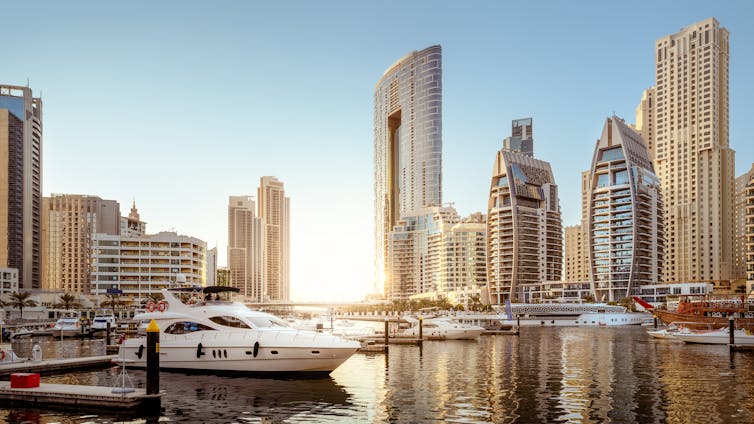
Boats in marina surrounded by skyscrapers.
Dubai marina.
frank_peters/Shutterstock

Instead, stability, safety and modernity were the hallmarks of their success. But now, writes economist Emilie Rutledge of the Open University, this is at risk. For those states whose wealth has been underwritten by their oil exports, this will of course be a challenging time. But perhaps more important is the reputational damage as the hordes of businesspeople, holidaymakers and lifestyle influencers raced to get flights (some of the latter group without the pets they had delighted in posing with on Instagram). Whether and how quickly these countries’ reputations will recover will be down to how long and damaging the conflict turns out to be, Rutledge concludes.


Read more:
The Middle East conflict has swiftly exposed economic vulnerability in the region


The same goes for the price of oil, writes Adi Imsirovic. Usually oil markets are robust enough to absorb short-term supply shocks, but a lot will depend on how long Iran is able to keep the strait of Hormuz closed for. Imsirovic, an expert in energy systems at the University of Oxford, weighs up the economic and geopolitical risks of a prolonged conflict.


Read more:
These are shaky times for oil markets. An expert explains what a prolonged war will mean for prices


We’ll miss them when they’re gone

One of Iran’s great gifts to the world is its cultural heritage. The country has 29 Unesco world heritage sites spanning thousands of years of artistic, literary and architectural greatness. From the Achaemenid ceremonial capital at Persepolis to the tomb of Cyrus the Great at Pasargadae, Shiraz, the “city of poets, gardens, and wine” and the Safavid-era Persian glories of Isfahan, Iran is pretty much unparalleled as a store of cultural wonderment.

Deliberately targeting cultural monuments is prohibited under numerous international conventions. But precious things are often also delicate and easily damaged. British-Iranian academic Katayoun Shahandeh of SOAS, University of London, identifies several important sites that have already been damaged in the air campaign. They will be hard to properly repair, she concludes: “Once destroyed, these monuments cannot truly be replaced.”

The Conversation

ref. Iran war: the search for an ‘off ramp’ – https://theconversation.com/iran-war-the-search-for-an-off-ramp-278253

Inside the Manosphere: Louis Theroux opts for superficial spectacle over serious scrutiny

Source: The Conversation – UK – By Annabel Hoare, PhD Candidate in Gender-Based Political Violence, Anglia Ruskin University

The recent Netflix hit series Adolescence crystallised growing public concern about the proliferation of male supremacist beliefs targeted at young men. So Inside the Manosphere, Louis Theroux’s new documentary for the same platform, arrives at a critical moment in the masculinity debate.

Inside the Manosphere sets out to explore a group of prominent “manfluencers” who promise young men status, wealth and sexual success through a worldview shaped by misogynistic and male-supremacist beliefs about gender and power.

By crafting a stylised storyline that focuses on the few people benefiting from this phenomenon, the documentary risks presenting an idealised portrait of the manosphere that downplays the insecurity, hostility and exploitation that sustains it.

Despite moments of scrutiny, this documentary’s glamorisation of its subjects (epitomised by a slow motion shot of one subject stepping out of a sports car) renders the interrogation superficial. In other words, the show presents performative, profit-driven masculinity through the same aspirational lens that fuels these figures online appeal.

In doing so, Inside the Manosphere simplifies the vast range of misogynistic and male-supremacist attitudes, beliefs and identities circulating online and downplays the sheer scale of the harm caused by it.

What the documentary reveals

While this documentary is limited in its portrayal, it does offer viewers a glimpse behind the curtain of a growing “manfluencer” economy.

In following around several notable figures, Theroux places a spotlight on how these influencers carefully curate online identities that project moral authority, financial success and masculine credibility. And all while functioning as lucrative personal brands built on selling solutions to the anxieties of their audience. In this way, Theroux exposes the commercial logic that is driving the rise in extreme misogyny, where provocation, controversy and algorithmic engagement translate directly into profit and visibility.

The film also introduces viewers to the notion of “the red pill”, a metaphor borrowed from The Matrix (1999). This is widely used in manosphere spaces to describe an awakening to what some believe are the hidden truths governing gender relations and social power.

Through his exploration of the red pill idea, Theroux repeatedly stumbles upon an idea at the crux of what makes this worldview so exploitable: that men need to earn their worth in society. The red pill worldview frames modern society as hostile and stacked against men, portraying mainstream institutions and feminism as forces that have obscured the “true” rules governing gender and status.

In response, the red pill philosophy reframes masculinity as a competitive hierarchy that must be continuously navigated and optimised. By casting masculine value as something that must continually be earned, followers are left striving to keep up with ever-shifting standards of status and success. Meanwhile, influencers profit from offering the supposed path to achieving them.

Although the documentary repeatedly brushes against this critical dynamic, it rarely pauses to interrogate its significance, nor the harms these masculine norms produce, including the mental health struggles of those who internalise them. As a result, it falls short of the kind of sustained scrutiny that Theroux himself has argued is what gives spotlighting such figures its social value.

Instead, this documentary portrays the manosphere through a stylised and aspirational aesthetic. Slow-motion shots of his subjects in the gym, driving high-performance sportscars, wearing expensive watches and living in luxury apartments frame these influencers’ lifestyles with a cinematic sheen.

This means the show echoes the same aspirational aesthetics that underpin much of these influencers’ own branding. Elsewhere, clips of manfluencer content appear against stylised backdrops of red and black binary code over-dubbed with synth-wave music. This has the effect of rendering the content closer to internet theatre than a harmful ideological phenomenon.

The result risks trivialising the gravity of the misogynistic and male-supremacist ideas being promoted. Rather than showing how this booming economy has contributed to the normalisation of misogynistic ideas that have inspired mass violent attacks, and violence against women and girls, this documentary risks misleading viewers that the manosphere is no more than an entertainment culture.

The narrative framing of this documentary becomes clear in the way Theroux himself describes the manosphere’s composition, origins and ideological epicentre. Far from being largely made up of “relatively uncontroversial comedians and podcasters”, the manosphere encompasses a far broader network of forums, content and communities united by an anti-feminist and male-supremacist worldview.

While the misogynistic beliefs and male oppression narratives commonly seen online seem new due to their crossover with modern lifestyle, fitness, financial and entertainment cultures, these ideas did not originate with contemporary influencers, as Theroux suggests. Rather, they draw on much older traditions of anti-feminist thought.

These include “men’s self-help” movements centred on reclaiming declining masculine identities and political men’s rights movements that predate the internet. Recognising these historical roots is important because their familiarity makes these ideas more resonant and persistent.

While Theroux’s characterisation appears intended to justify the documentary’s focus on manfluencers, it inadvertently falls into the very trap that allows manosphere content to proliferate online: its ability to hide in plain sight.

The attention economy

How this documentary portrays the manosphere matters, not just for how it informs viewers, but for how it interacts with the forces that feed the phenomenon itself. On the internet, attention functions as the most valuable currency. Content that is provocative and engaging spreads quickly, rewarded by social media algorithms and amplified by cycles of debate and outrage.

In attempting to place a spotlight on the manosphere, this documentary becomes entangled in the spectacle that sustains it. The danger is that viewers may come away with a clear understanding of the style and aspirations of the manosphere. But they are left in the dark as to its harmful effects both to young men and women – and how this harm occurs.

As a result, Inside the Manosphere further fuels the attention economy that allows these figures to thrive. In these spaces, visibility equals power: controversy attracts clicks, clicks drive engagement, and engagement extends the reach and legitimacy of the ideas themselves.

This article features references to books that have been included for editorial reasons, and may contain links to bookshop.org; if you click on one of the links and go on to buy something, The Conversation UK may earn a commission.

The Conversation

Annabel Hoare does not work for, consult, own shares in or receive funding from any company or organisation that would benefit from this article, and has disclosed no relevant affiliations beyond their academic appointment.

ref. Inside the Manosphere: Louis Theroux opts for superficial spectacle over serious scrutiny – https://theconversation.com/inside-the-manosphere-louis-theroux-opts-for-superficial-spectacle-over-serious-scrutiny-277902

Why Friday the 13th was bad luck for the Knights Templar and their legacy

Source: The Conversation – UK – By Patrick Masters, Lecturer, University of Portsmouth

In Ridley Scott’s 2005 epic Kingdom of Heaven, The Knights Templar are portrayed as violent extremists. The film is about a crusader, Balian of Ibelin, who is fighting to defend the Crusader Kingdom of Jerusalem from the first Sultan of Egypt and Syria, Saladin.

The Knights Templar were formed on Christmas Day 1119, as a revolutionary type of knighthood in which knights lived as monks, taking vows of poverty and piety. Their mission was to protect travellers on the dangerous roads of the Kingdom of Jerusalem. So it struck me as interesting that in Scott’s crusades film they would be portrayed as antagonists of the Crusader Kingdom.

Their singling out in Kingdom of Heaven was the spark that led to my book The Knights Templar: Crusade, Myth and Hollywood. What I found was that villainising the order was fairly common in films that include them. However, rather than being a modern trope, their vilification can be traced back to 700 years ago.

On Friday October 13 1307, the grandmaster Jacques de Molay was arrested by a debt-ridden pope along with every other Templar found in France. The sudden arrest caused widespread shock throughout Europe. Some of the confessions that would be extracted from them would have a mysterious occult edge and it would be these that would shape the order’s legacy from then on.

The Templars amassed vast riches, land, and political power for nearly 200 years. Their downfall began in 1291 with the loss of the Crusader states, or Outremer (modern Israel, Lebanon, Syria, and Turkey). After the Crusader capital of Acre fell to the Mamluk forces of Egypt and Syria, the Templars were left without a cause, making the order appear redundant and vulnerable to criticism.

The two figures central to their downfall were French Pope Clement V and French King Phillip IV, who was burdened with significant debt and had previously moved against groups within his power, such as Italian bankers in 1291 and the Jews in 1306, seizing their property and assets to ease his financial problems.

Friday 13th

On Friday October 13 1307, Jacques de Molay was in France negotiating another crusade. That military campaign would never happen and instead, he and every Templar in France (around 2000 of them) were suddenly arrested and imprisoned in the Paris Temple.

Although the news shocked Christendom, Clement V had written to Phillip IV in 1305 detailing the rumours about the Templars and plans for an investigation. Phillip IV issued the Templars’ arrest order a month prior, charging them with blasphemy, sodomy and heresy.

The first charges related to the initiation into the order, where, according to the Order for Arrests, initiates must deny Christ and spit on an image of him three times. The document then details how the initiate is stripped naked and kisses the receiving Templar on “the lower part of the dorsal spine”, “the navel” and “on the mouth”.

Once in the King’s clutches, the Templars were deprived of sleep and shackled with irons. Templar Ponsard de Gizy described in detail how he was unable to move in a pit for three months, with his hands tied behind his back so tightly that blood ran down his fingernails.

Those who did not confess faced the rack and suffered the strappado – this is where the victim was strung up by the hands, which were bound behind their back. Under these horrific conditions, 134 of the of the 138 Templars questioned in Paris confessed to some or all of the charges. Under torture, even the grandmaster admitted to denying Christ, but instead of spitting on his image, he claimed to have spat on the floor instead.

It wasn’t the charge of blasphemy, however, that haunted the Templars’ legacy, it was the accusations of worshipping false idols.

Extracted under torture, Hugues de Pairaud describes worshipping a head with two feet under its face and two feet behind it. Very few Templars had any knowledge of the mysterious head idol, and only nine admitted to knowing about it. Those who did gave contradictory accounts: the head with feet was described as having a beard, of being painted on a beam and made of wood, silver, and gold leaf. Others claimed to worship an idol called Baphomet and a bearded head called Yalla.

The origin and identity of the idol Baphomet are mysterious. However, historian Sharan Newman suggests it’s most likely a corruption of the name Mohammed.

The Templar order was abolished in 1312 and Jacques de Molay was burned at the stake in 1314 as a relapsed heretic. The majority of the Templars caught in France were either executed or confined to prison indefinitely. However, it wasn’t until the 16th century that the Templars’ heresy entered popular imagination.

The German physician Heinrich Agrippa’s 1531 book De Occulta Philosophia, recontextualised the failed order alongside witchcraft. While French writer Guillaume Paradin detailed the Templars’ sordid heresy in his 1552 Chronicle of Savoy. In his history of Savoy, the Templars engage in orgies with women after initiates worshipped an image covered in human skin with glowing carbuncles for eyes.

The salacious occult imagery of the 16th century remained a widely held perception of the Templars into the 20th and 21st centuries. This lasting association is clear in cinema.

The 1972 Spanish/Portuguese horror film Tombs of the Blind Dead portrays undead Templars rise from their graves to prey on a group of teenagers. The undead Templar recently resurfaced again in the 2017 film The Mummy, where the titular villain raised Templars from their tombs to act as her minions.

There are Templars across cinema enacting evil and its interesting to think about how this all came to be because of a handful of confessions about worshipping false idols, which were obtained through torture.

This article features references to books that have been included for editorial reasons, and may contain links to bookshop.org. If you click on one of the links and go on to buy something from bookshop.org The Conversation UK may earn a commission.

The Conversation

Patrick Masters wrote the book The Knights Templar: Crusade, Myth and Hollywood. In 2018, he received funding from the Templar Heritage Trust to present a paper at the International Medieval Conference.

ref. Why Friday the 13th was bad luck for the Knights Templar and their legacy – https://theconversation.com/why-friday-the-13th-was-bad-luck-for-the-knights-templar-and-their-legacy-278033

Have we passed ‘peak sheep’?

Source: The Conversation – UK – By Caroline Flanagan, Head of School, Agriculture, Anglia Ruskin University

Farmers are drastically reducing their sheep flocks. EddieCloud/Shutterstock

The classic view of British countryside is of hilly green fields, stone walls and sheep dotted about in the distance.

But that scene could be disappearing as farmers move away from keeping sheep, or reduce their flocks, in many areas of the country.

The total number of sheep and lambs decreased by 3.8%, to 13.3 million in June 2025. Breeding flock numbers have also dropped from 6.8 million in 2021 to 6.4 million in 2025.

Meanwhile, the nation’s eating habits also appear to be shifting as mutton and lamb production has dropped from 400,000 tonnes per year in the early 1990s to 276,000 tonnes today.

The geographical distribution of sheep across the UK is changing too, with Scotland – long celebrated for its hill flocks – reporting marked declines of sheep numbers particularly in the northwest and the Highlands.

So has the UK reached “peak sheep”?

The largest fall in sheep numbers occurred after the 2001 foot and mouth outbreak, and in England this decline deepened when government subsidies related to numbers of sheep were replaced with subsidies for looking after the land in 2024/25. This reduced the incentive to keep large flocks and led farmers to retain fewer animals. Simultaneously, UK and global dietary habits have been changing. UK red meat consumption fell by 13.7g per day per head between 2008 and 2019.

Cost, health concerns and the difficulty of positioning lamb as a fast food option have reduced demand. In 2021 60% of lamb was purchased by shoppers aged 55 plus, with younger consumers increasingly preferring alternative protein sources such as chicken and processed meat.

Planning for the future on low-income hill farms is also problematic. In the UK, 84% of farmers are over 45 (and 38% over 65), with many young people reluctant to enter an uncertain industry. On upland and hill farms, the average farm profit was just £32,000 in 2023/24, 69% of which came from government payments due to be phased out by 2027.

However, sheep are adaptable to changing circumstances and their ability to select plants to sustain themselves might offer a route to securing their future as the national flock continues to shrink.

A Scottish sheep farmer talks about some of his challenges.

That fastidious eating, once essential for survival, is proving invaluable for conservation. Many native breeds excel at balancing shrub browsing with grazing in areas inaccessible to machinery. Conservation success stories include the restoration of violets vital for fritillary butterflies and the maintenance of biodiverse mosaic grasslands.

Sheep eat different plants to cattle, so they can be deployed as appropriate to eat selectively, tackling problem plants that cattle might not. They also have less impact on the soil, which in some instances is beneficial.

Some rewilding supporters worry that sheep can harm nature in certain situations, but when they’re carefully managed, sheep can actually help store carbon and are important for looking after landscapes such as fens, saltmarshes, moorland and meadows.

Poorly managed, they can hinder conservation efforts, grazing too close to the soil. But the rise of “flying flocks” – mobile groups shepherded across different sites – demonstrates how sheep can support flexible land use on both lowland and upland farms. Meanwhile, the UK’s commitment to net zero, and the expansion of solar energy have created another niche.

Sheep, conveniently sized and behaviourally suited, are ideal for grazing underneath solar panels, keeping vegetation under control.

So, where does this leave the UK’s sheep industry?

We may be witnessing a move to lower levels with new breeds, and other changes emerging. In lowland areas, you may already be seeing more sheep, as arable farmers turn to them to graze cover crops which are used to avoid soils laying bare over long periods of time. Cover crops enhance soil structure and biodiversity, providing nutrients to the soil.

Lowland sheep are heavier, better suited to meat production and can be stocked more densely than on upland terrain, boosting efficiency. A growing proportion of the UK’s lamb supply is likely to come from lowland flocks, with reducing reliance on the traditional flow of breeding ewes from the hills. So sheep are more likely to be seen on the lower levels, and there could be fewer of them.

Beyond their ecological contributions, sheep produce a remarkable annual bonus. From carpets and jumpers to natural insulation and high-end suits, wool is natural, renewable, sustainable and biodegradable. As the clothing industry increases the use of natural fibres, demand and prices are rising, this could offer a more lucrative alternative product for sheep farmers to sell.

Sheep still have a vital place in the UK. The country may have reached “peak sheep”, but given their versatility, their capacity to thrive in tough environments, our growing commitment to sustainable land management and our deepening understanding of their grazing behaviour, sheep are well placed to help us be better custodians of our landscapes.

The Conversation

The authors do not work for, consult, own shares in or receive funding from any company or organisation that would benefit from this article, and have disclosed no relevant affiliations beyond their academic appointment.

ref. Have we passed ‘peak sheep’? – https://theconversation.com/have-we-passed-peak-sheep-277815

Middle East conflict shows the real meaning of Trump’s ‘America first’ foreign policy

Source: The Conversation – UK – By Bamo Nouri, Honorary Research Fellow, Department of International Politics, City St George’s, University of London

Now well into its second week, the US-Israeli war against Iran has gone beyond the “combat operation” the US president, Donald Trump, announced when it began on February 28. Civilians and infrastructure have been struck across the region from Lebanon, to the UAE, Saudi Arabia and Iraq. The conflict has spread rapidly across the Middle East. Now, with the strait of Hormuz effectively closed, oil prices have risen sharply threatening global economic chaos.

This is not an abstract strategic contest. It is unfolding in a region shaped by decades of conflict driven both by external intervention and by regional actors themselves. Israel’s overwhelming use of military force in recent years in Gaza, Lebanon and now against Iran has been a central factor in the current escalation, while Iran and allied armed movements such as Hezbollah, Hamas and the Houthis have pursued their own strategies of deterrence and retaliation.

The latest US-Israeli strikes and Tehran’s response therefore add another layer to an already volatile landscape in which multiple actors pursue security, influence or survival through force. The human cost is mounting. Meanwhile, the legal principles meant to constrain the use of force under the UN Charter have increasingly been overshadowed by power politics.

In this context, the meaning of the “America first” slogan on which Donald Trump campaigned in 2024 demands urgent reassessment. So does the manner in which American power operates.

US involvement in and response to the conflicts in Ukraine and the Middle East show a pattern of Washington enlisting regional partners to help realise its foreign policy aims. It is letting Europe bear the main burden in economic terms in the Ukraine conflict while in the Middle East, it has partnered with Israel. Meanwhile, it is happy to directly manage affairs in the Americas – in the Venezuela raid in January, for example, or the Cuba blockade.

When Barack Obama called it “leading from behind”, there was a furore on the American right. But now, this approach is central to maintaining America’s dominant global position.

One of this article’s authors, Inderjeet Parmar, has highlighted elsewhere how US policy seeks to combine realist power projection with liberal ideological framing, using the language of universal values such as human rights. This enables it to legitimise interventions, alliances and proxy arrangements that distribute burdens to partners and sustain America’s global position while helping avoid overextension. Washington’s approach masks self-interested expansionism as consensual leadership rather than the naked unilateralism it actually represents.

This approach reduces the risk of domestic backlash from costly direct engagements. It avoids the pitfalls of imperial overstretch that were seen in cases such as Iraq, while retaining ultimate control and benefits.

In his analysis of US actions, this article’s other author, Bamo Nouri, suggests that US foreign policy often serves corporate and elite interests under such guises as the promotion of democracy. Nouri portrays how Washington’s use of partners in foreign policy arenas in recent years has been a calculated tactic that sustains empire efficiently. But it risks partner fatigue, escalation, or blow-back when partners falter, fail to achieve their goals or where it leads to wider regional escalation.

But ultimately it underscores a consistent US strategy: using its networked power to get its way. In other words, leading from behind.

‘America first’ interrogated

The “America first” slogan that Trump has adopted (a 19th-century phrase used by nativists. It gained prominence in the US after the first world war when it became associated with the Ku Klux Klan and other far-right organisations) was framed by the president as a decisive break from the post-cold war bipartisan foreign policy consensus. Trump denounced regime change, criticised the Iraq war’s architects, and promised to end “forever wars”. That resonated with a weary American public lamenting costly interventions that destabilised the Middle East while achieving little.

America first was presented as a strategic correction: abandoning liberal interventionism, rejecting ideological crusades and restoring prudence to US statecraft. Intellectually, it appeared to prioritise realist recognition of limits, restraint and national interests over moral grandstanding.

Yet Trump 2.0 actions – with the raid on Venezuela, threats against Greenland and Canada and now the full-scale war against Iran – have cast serious doubts on that claim. Evidence suggests continuity in the pursuit of American primacy, but expressed now in more nationalist and unapologetic language. The rhetoric has shifted, but the structure of power and the willingness to employ force remain strikingly familiar.

US president, Donald Trump, with his chief of staff Susie Wiles, secretary of state Marco Rubio and other senior advisers in the White House situation room, March 2 2026.
White House

To Trump’s base, the appeal of America first was partly due to its critique of liberal internationalism. For decades, both Republican and Democratic administrations justified US primacy through the language of promoting democracy, humanitarian intervention and multilateral order-building. Trump argued that these ventures drained American resources while delivering little tangible benefit. Indeed, both parties’ presidential candidates in 2020 stood on a platform of ending “forever wars”. But ultimately, America first was largely a branding exercise led by influential thinktanks.

The Washington-based conservative thinktank, the Heritage Foundation, played an important role in developing policy frameworks and identifying personnel for Trump’s second administration.

Heritage had historically championed a robust national defence and assertive US leadership. Under Trump, newer networks explicitly branded under the banner of America First Policy Institute emerged to provide intellectual support for the movement. These institutions promoted the idea that Trumpism represented a decisive shift toward state-centred realism, as opposed to liberal nation-building.

But realism, properly understood, is not simply a rhetoric of strength, but a doctrine of prudence. Classical realists, from the German-born scholar Hans Morgenthau onwards, have always stressed the dangers of ideological crusading, the unpredictability of military escalation and the limits of power. War was to be a last resort, not a way to demonstrate power and resolve.

But America first has not dismantled the core architecture of US global primacy. The US continues to rely on military superiority, sanctions regimes and alliance systems to maintain its position of global primacy. The difference lies in presentation. Liberal internationalists justified primacy through universalist ideals. America first recasts it in nationalist terms: sovereignty, strength, deterrence. But the underlying strategic objective remains constant – preventing the emergence of challengers and preserving US dominance.

The escalation with Iran underscores this continuity. It signals that when confronted with perceived threats to its authority or credibility, Washington will often consider the use of coercion, whether economic or other means, including force. In this sense, America first may represent not a rejection of primacy but its simplification, stripped of multilateral vocabulary and reframed as unapologetic power politics.

The costs of abandoning restraint

The consequences are profound. Domestically, America first promised a renewed focus on national reconstruction. But the gap between promise and practice risks deepening public cynicism about foreign policy and political leadership alike.

If Trump’s foreign policy “art of the deal” culminates in airstrikes, region-wide escalation and blowback, the claim that it represents a realist recalibration of US foreign policy becomes difficult to sustain. Rather than ending liberal interventionism, America first appears to have refashioned American primacy in starker, less apologetic terms, without the veneer of restraint.

The recent strikes are therefore more than tactical decisions for the Trump administration. They reveal how deeply embedded primacy politics remains in Washington, regardless of who is doing it. The rhetoric has shifted. The structural impulse to defend US dominance through force has not.

The Conversation

The authors do not work for, consult, own shares in or receive funding from any company or organisation that would benefit from this article, and have disclosed no relevant affiliations beyond their academic appointment.

ref. Middle East conflict shows the real meaning of Trump’s ‘America first’ foreign policy – https://theconversation.com/middle-east-conflict-shows-the-real-meaning-of-trumps-america-first-foreign-policy-277275

Iran’s cultural heritage in the crossfire – expert explains what has been damaged and what could be lost

Source: The Conversation – UK – By Katayoun Shahandeh, Lecturer in Museum Studies, SOAS, University of London

Following joint attacks by the United States and Israel on Iran on February 28, the country has come under repeated strikes. These attacks, which were ostensibly supposed to target Iran’s nuclear and missile capabilities, have also caused civilian casualties and damage to cultural sites.

Airstrikes near historic districts in Tehran and Isfahan have damaged monuments that have survived for centuries. The losses highlight how war can endanger not only lives but also the historical memory embedded in cities and landscapes. As an Iranian art historian, watching these events unfold in my country is deeply and doubly painful.

Iran contains one of the world’s richest concentrations of historic architecture and urban heritage. The country has 29 Unesco world heritage sites, spanning more than two millennia, from ancient imperial capitals to Islamic urban ensembles and desert cities. Yet monuments that have survived centuries of invasions, political upheaval and regime change remain vulnerable in modern conflict. Even when heritage sites are not deliberately targeted, nearby explosions, fires and shockwaves can damage fragile masonry, glazed tiles and decorative interiors.

Cultural sites affected

In the capital, Tehran, airstrikes have damaged two important historic sites: Golestan Palace and the Grand Bazaar.

Golestan Palace, a Unesco world heritage site, served as the ceremonial residence of the Qajar dynasty in the 19th century. Its halls feature elaborate mirror mosaics, painted tiles and an architectural style blending Persian traditions with European influences, reflecting a moment when Iran was engaging more directly with global artistic currents.

The Tehran bazaar, meanwhile, is far more than a commercial district. Like many historic bazaars across the Middle East, it functions as a living urban organism linking trade, religious institutions and social life. Historically it has also played an important role in Iran’s political movements (being influential in the Iranian Revolution of 1978/79 with the support of the bazaar merchants for the eventual leader of the Islamic Republic, Ayatollah Ruhollah Khomeini) and economic networks.


Read more:
‘My home city was destroyed by war but I will not lose hope’ – how modern warfare turns neighbourhoods into battlefields


Damage to such spaces therefore affects not only historic architecture but also the social and urban structures that shape everyday life.

Strikes have also affected Isfahan, one of Iran’s most important historic cities and the Safavid capital during a golden age of art, architecture and trade. Under Shah Abbas I, the city was transformed into an imperial centre of culture and urban planning, anchored by Naqsh-e Jahan Square, the monumental complex of mosques, palaces and bazaars that earned the nickname Nesf-e Jahan – “half the world”.

According to cultural heritage officials, blast waves affected several historic buildings including Timuri Hall, the Jebe-Khaneh building, the Rakib-Khaneh (Isfahan Museum of Decorative Arts), Ashraf Hall and the Chehel Sotoun palace complex. Damage reportedly included collapsed ceilings, broken doors and windows, and shattered glass at nearby monuments such as Ali Qapu Palace.

The damage in Isfahan is especially concerning because the city occupies a central place in Iran’s architectural and cultural history. The city flourished as the Safavid capital in the 17th century and remains one of the most important historic cities in the Islamic world. Even limited damage in this historic city raises serious concerns. Decorative elements such as tile work, murals and mirror mosaics are among the most fragile components of Safavid architecture and are extremely difficult to restore once lost.

International heritage organisations have also expressed alarm. The US committee of Blue Shield, an international NGO that works to protect cultural heritage during war and disasters, warned that disregarding international conventions protecting cultural property in wartime could lead to violations of international law. Blue Shield also referred to recent damage at sites including Chehel Sotoun Palace in Isfahan and Golestan Palace in Tehran.

The vulnerability of Isfahan also highlights broader risks facing Iran’s cultural heritage. Sites such as Persepolis, the Achaemenid ceremonial capital; Pasargadae, home to the tomb of Cyrus the Great and the historic desert city of Yazd represent different layers of Iranian civilisation, from ancient imperial history to Islamic urban culture.

Why cultural heritage matters to Iranians

Iran’s historic monuments are not simply archaeological sites or tourist attractions. They form part of a cultural identity shaped by thousands of years of artistic, literary and architectural traditions. Cities such as Shiraz, Isfahan and Yazd are closely intertwined with the poetry of figures such as Hafez and Ferdowsi. Their works continue to shape Iranian cultural life today.

For many Iranians, historic monuments symbolise a sense of continuity linking the ancient Persian past, the Islamic period and the modern nation.

At the same time, concern for damaged monuments has provoked strong reactions online. On social media, posts lamenting the destruction of historic sites often draw angry responses arguing that human lives are more important than buildings. For many Iranians, already angered by war and years of internal repression – including the killing of protesters during waves of unrest – this contrast raises difficult questions about whose losses receive attention.

Some have also asked why the international community showed little concern when Iran’s ecosystems were being damaged over many years through environmental mismanagement. Lake Urmia, for example, which was once one of the world’s largest salt lakes, has lost most of its surface area due to dam construction and agricultural water diversion.

For many Iranians, these overlapping crises – environmental degradation, political repression and war – form part of a broader landscape of loss affecting both people and cultural memory.

When war damages historic monuments, more than architecture is lost. Fragments of cultural memory that have endured for centuries disappear with them.

Many of Iran’s historic sites have survived invasions, revolutions and political upheaval, yet today’s conflicts pose new risks when historic cities lie close to strategic targets. Once destroyed, these monuments cannot truly be replaced.

Protecting cultural heritage in times of conflict is therefore not only about preserving buildings, but about safeguarding the memories and histories that connect societies across generations.

The Conversation

Katayoun Shahandeh does not work for, consult, own shares in or receive funding from any company or organisation that would benefit from this article, and has disclosed no relevant affiliations beyond their academic appointment.

ref. Iran’s cultural heritage in the crossfire – expert explains what has been damaged and what could be lost – https://theconversation.com/irans-cultural-heritage-in-the-crossfire-expert-explains-what-has-been-damaged-and-what-could-be-lost-278216