¿Es peligroso pillar una mojadura o acaso Jane Austen era demasiado dramática?

Source: The Conversation – France – By Ana Fernandez Mosquera, Doctora en Filología Inglesa. Oficina de Proyectos Internacionales de Investigación, Universidade de Vigo
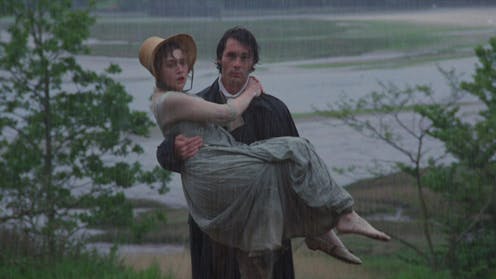
La primera vez que Marianne Dashwood es sorprendida por un chaparrón Willoughby la rescata pronto y ella solo tiene que recuperarse de un esguince de tobillo. Captura de pantalla de la película ‘Sentido y sensibilidad’.

Han pasado más de 250 años desde su nacimiento y seguimos leyendo a Jane Austen. Sus novelas se reinventan con cada nueva mirada que las interroga desde el presente. Más allá del amor, los bailes y las herencias, esconden capas que solo el tiempo –y una lectura atenta– permite descubrir. Ahí es donde brilla la elegancia de su ironía.

Siempre me ha fascinado cómo representa el cuerpo y la salud de sus personajes. En todas sus novelas hay referencias al estado físico, a dolencias o a consejos sobre el bienestar. La palabra salud aparece más de cien veces en sus seis obras clásicas. No son descripciones médicas al uso, pero sí muestran una sorprendente precisión y coherencia narrativa.

¿Y si el verdadero dramatismo de Austen no estuviera en el romance… sino en el resfriado?

¿Por qué le interesa a Jane Austen la enfermedad?

Entre finales del siglo XVIII y comienzos del XIX, la enfermedad formaba parte de la vida cotidiana. Sin antibióticos ni anestesia, cualquier dolencia podía volverse grave. La medicina se basaba en teorías como el desequilibrio de los humores, y los tratamientos incluían sangrías, tónicos y purgas. Los médicos, boticarios y curanderos existían y convivían, pero muchos cuidados –especialmente en el caso de las mujeres– se daban en casa. Las infecciones eran frecuentes y los hospitales, un último recurso.

La naturaleza, el aire fresco, el reposo y los baños eran centrales en las recomendaciones sanitarias. Jane Austen aconsejaba ejercicio diario, contacto con la naturaleza y una dieta moderada como claves para una buena salud. Apreciaba los paseos al aire libre y desconfiaba de los tratamientos médicos excesivos. Sus cartas reflejan un enfoque práctico y equilibrado del bienestar físico y mental.

Se cree que, en 1815, cuando fue a cuidar a su hermano, probablemente se infectó de tuberculosis. Eso degeneró en una infección renal y finalmente en la enfermedad de Addison, de la que en ese momento no se sabía nada. Todavía hay algún debate sobre la causa de su muerte: si fue esa enfermedad, un linfoma, un cáncer de estómago o incluso un envenenamiento… aunque eso lo dejamos para las teorías más conspiranoicas.

La amistad de Jane Austen con el médico de su hermano le dio buena base para hablar de dolencias con precisión: en sus novelas abundan los catarros, el reuma y, cómo no, las temidas mojaduras.

¿Pero qué hay del riesgo real de caminar bajo la lluvia inglesa? En Reddit no faltan debates sobre si la alta fiebre que sufrió Marianne Dashwood en Sentido y sensibilidad después de salir a pasear en pleno chaparrón fue mala suerte o puro dramatismo. Porque sí, tanto Jane Bennet –en Orgullo y prejuicio– como Marianne acaban enfermas tras mojarse… y esta última se queda a las puertas de la muerte. ¿Advertencia sanitaria o recurso narrativo made in Austen?

Una mujer estornuda en el marco de una puerta.
La señora Bennet envía a Jane a casa de su pretendiente en un día que amenaza lluvia calculando que tal vez su hija coja un catarro y tenga que quedarse allí unos días…
IMDB

En el contexto del siglo XIX, una mojadura no era un asunto menor. Hoy sabemos que no causa por sí misma un resfriado, pero en aquella época se creía que el enfriamiento del cuerpo podía desencadenar enfermedades graves. Esta preocupación tenía fundamento: sin acceso a antibióticos ni tratamientos eficaces, una infección respiratoria leve podía evolucionar fácilmente en una bronquitis o una neumonía potencialmente mortal. Por eso, las narraciones de la época solían tratar estas situaciones con una carga dramática que, lejos de ser exagerada, respondía al temor real a las consecuencias de una simple exposición al frío y la humedad.

William Buchan, en su célebre Domestic Medicine –un manual médico que empezó a circular en 1769 y que se reeditó durante todo el siglo XIX– lo tenía claro: el clima británico era un problema de salud pública. Según él, no había otro lugar donde el tiempo cambiara tanto y tan rápido como en Gran Bretaña. Y esas variaciones, decía, eran algunas de las principales causas de resfriados, porque interrumpían la transpiración del cuerpo.

Buchan insistía especialmente en el riesgo de quedarse con la ropa mojada. No solo por el frío, que ya era un problema en sí mismo, sino porque la humedad podía “penetrar” en el cuerpo y agravar la situación. Incluso las personas más fuertes podían enfermar: fiebres, reumatismos y dolencias graves se volvían algo común, también entre jóvenes sanos.

Claro que Buchan no pretendía que nadie dejara de salir de casa por miedo a mojarse. Pero sí recomendaba actuar con rapidez: cambiarse de ropa cuanto antes o, si no era posible, al menos mantenerse en movimiento hasta secarse. Lo que no se debía hacer nunca –y sin embargo mucha gente hacía– era sentarse en el campo o, peor aún, dormir con la ropa empapada. Para él, era una receta segura para enfermar.

Una mujer con el pelo mojado se lo seca con una toalla.
Elizabeth Bennet sabía que si la pillaba el agua era urgente secarse rápido.
IMDB

La enfermedad como recurso literario

Estas enfermedades también reflejan muchos condicionantes sociales y de género que afectan a las mujeres. En la literatura, la enfermedad se convierte en una herramienta para que los personajes femeninos llamen la atención, expresen vulnerabilidad o incluso resulten más atractivos en su fragilidad. Enfermedades y accidentes pueden irrumpir en sus vidas y cambiarlo todo, a veces para siempre.

En el siglo XIX, muchas mujeres fueron diagnosticadas con la llamada “enfermedad inglesa”, un término que englobaba síntomas vagos como fatiga, ansiedad, insomnio o melancolía. Servía sobre todo para reforzar los estereotipos de fragilidad femenina. Austen retrata distintos matices de este mal: los “nervios” teatrales de la señora Bennet –en Orgullo y prejuicio–, la pasión desbordada de Marianne Dashwood, la melancolía silenciosa de Anne Elliot –protagonista de Persuasión– o la palidez resignada de Jane Fairfax –en Emma–.


¿Quiere recibir más artículos como este? Suscríbase a Suplemento Cultural y reciba la actualidad cultural y una selección de los mejores artículos de historia, literatura, cine, arte o música, seleccionados por nuestra editora de Cultura Claudia Lorenzo.


Mary Elliot, en Persuasión, recurre a dolencias fingidas para llamar la atención o evitar responsabilidades como el cuidado de los niños. Sus quejas –dolores de cabeza, fatiga, indisposición– resultan poco creíbles tanto para los personajes como para el lector. Austen critica con ironía esta “enfermedad ficticia”, típica de ciertos sectores acomodados donde el aburrimiento y el egocentrismo se disfrazaban de malestar físico. Esta mirada ciertamente crítica nace también de su experiencia personal cuidando a su madre, cuya salud era frágil y variable.

¿Entonces Marianne Dashwood casi muere por un simple chaparrón… o Austen la pone al borde de la muerte para cambiarle el destino? En sus novelas, enfermedades y accidentes no solo generan drama: también alteran el rumbo de los personajes. Louisa Musgrove, en Persuasión, se golpea gravemente y eso abre paso a otro pretendiente. Jane Bennet se resfría tras cabalgar bajo la lluvia y su convalecencia acerca a Elizabeth, su hermana, al señor Darcy. En las tramas, la fiebre a menudo precede al giro romántico.

Un hombre entra en una casa con una mujer en brazos mientras otra mujer corre hacia ellos.
El segundo chaparrón que recibe Marianne Dashwood es mucho más grave y la coloca a las puertas de la muerte.
Prime Video

Una metáfora corpórea

En el mundo de Austen, el cuerpo no solo enferma: también habla.

A través de fiebres, desmayos o catarros, sus novelas dan forma a emociones reprimidas, tensiones de clase y desigualdades de género. La enfermedad funciona como metáfora de lo que cambia, duele o simplemente no puede decirse en voz alta. Austen no miraba el malestar desde fuera: lo conocía, lo vivía y lo convertía en literatura. Sus personajes sufren, pero también resisten.

Y siguen hablándonos hoy, con una lucidez que no caduca. Como escribió con su ironía intacta, en una carta de 1816: “Estoy razonablemente bien hoy… lo cual es más de lo que esperaba”. Quizá no se refería solo al cuerpo. En todo caso, cuidado con mojarse. O no; tal vez un buen chaparrón nos cambie la vida.

The Conversation

Ana Fernandez Mosquera no recibe salario, ni ejerce labores de consultoría, ni posee acciones, ni recibe financiación de ninguna compañía u organización que pueda obtener beneficio de este artículo, y ha declarado carecer de vínculos relevantes más allá del cargo académico citado.

ref. ¿Es peligroso pillar una mojadura o acaso Jane Austen era demasiado dramática? – https://theconversation.com/es-peligroso-pillar-una-mojadura-o-acaso-jane-austen-era-demasiado-dramatica-255252


Carissa Véliz, filósofa: “Muchos adolescentes ni siquiera alcanzan a imaginar cómo es vivir con privacidad”

Source: The Conversation – France – By Elena Sanz, Directora

Asegura Carissa Véliz (Reino Unido) que aprende lo indecible en las conversaciones con sus estudiantes de la Universidad de Oxford, con los que habla del valor de lo analógico, de las relaciones personales, de qué hace que una vida sea buena… Está convencida de que solo protegiendo la privacidad podemos mantener a salvo la democracia. Y le preocupa que muchos jóvenes, acostumbrados a crecer sin ella, no se den cuenta de las implicaciones que su ausencia puede tener para su futuro.

En alguna ocasión ha comentado que la privacidad es un instinto animal que compartimos con todas las especies y, sin embargo, últimamente vivimos como si pudiéramos prescindir de ella. ¿Son conscientes las generaciones más jóvenes de su importancia?

Es difícil responder porque “los jóvenes” no son un grupo homogéneo: hay diferencias importantes en función de dónde nacen, dónde viven, incluso depende de si son hombres o son mujeres. Últimamente me ha sorprendido bastante que mis estudiantes son más conscientes de la importancia de la privacidad y están menos enganchados a la tecnología que muchos adultos. Aunque quizás mis estudiantes no sean lo suficientemente representativos de la población.

En general, me preocupa el hecho de que haya muchos chavales que no han crecido con privacidad, que ni siquiera alcanzan a imaginar lo que es vivir con privacidad y, sobre todo, que no se dan cuenta de las implicaciones que su ausencia tiene para su futuro.

La privacidad no es solo una cuestión de si permitimos o no que nos vean o sepan de nosotros. Cuando empresas y gobiernos tienen acceso a información acerca de quiénes somos, qué hacemos, si gozamos de buena o de mala salud, cuáles son nuestras tendencias políticas o religiosas o de quién nos enamoramos, eso tiene implicaciones.

Así es. Sobre todo porque cuando has vivido siempre en una democracia es difícil imaginar que es frágil, que es vulnerable, que puede tener un fin si no la cuidamos.

La pérdida de la privacidad puede coartar tu libertad, la libertad de poder decir lo que piensas, la libertad de juntarte con quien elijas, la libertad de poder protestar de manera pacífica. Cuando todo eso desaparece, uno empieza a tener miedo de lo que ha dicho, o de lo que puede decir, y acaba autocensurándose.

Ocurre ya que en Inglaterra y Estados Unidos se invade la privacidad de quienes tratan de alquilar un piso: los propietarios contratan compañías de datos para obtener información sobre el posible inquilino. Y si le rechazan, si le niegan el acceso a una vivienda, no tienen que justificar por qué, no necesitan dar un motivo.

Se vulneran, entonces, varios de los derechos que recoge el artículo 12 de la Declaración Universal de los Derechos Humanos, que proclama garantizar la protección de la vida privada, la familia, el domicilio, la reputación…

Claro. Y lo más preocupante es que los problemas no surgen en el momento en el que se recolectan los datos, sino que suelen aparecer mucho más tarde. Es más, ni siquiera cuando surgen es fácil hacer una conexión directa entre el momento en el que un dato deja de pertenecerte y el momento en que sufrimos discriminación o exclusión por ese dato perdido.

Los derechos son derechos justamente porque son un bien a proteger, imprescindible. Y, si la sociedad vive con una perspectiva demasiado individualista, nos arriesgamos a perder derechos y libertades.

A veces son los propios padres quienes empiezan a compartir los datos de los chavales antes de que ellos puedan decidir, sin darse cuenta de que, en el futuro, puede tener consecuencias negativas para sus hijos.

Sin duda. Y eso me hace pensar que todos tenemos que estar mejor informados, algo nada fácil porque muchas compañías y muchos gobiernos no tienen interés en que se conozca cómo tratan los datos.

Pero no debemos caer en el error de poner toda la responsabilidad sobre los hombros de los individuos, que estamos sobrepasados con el actual nivel de burocracia y de trabajo, y con la cantidad de exigencias que supone nuestro día a día. Lo ideal sería que pudiéramos disponer de mejores productos, poder tener todos acceso a correos electrónicos privados y móviles que respeten la privacidad.

La necesidad de probar cosas nuevas y la atracción por el riesgo es inherente a la adolescencia. Pero ¿qué pasa con los riesgos digitales? ¿Se asumen con la misma consciencia que, por ejemplo, un salto en paracaídas?

Indudablemente, no. Uno de los problemas con la vida digital es que es muy nueva. No tenemos experiencia suficiente para tener reacciones viscerales de miedo al riesgo al que nos exponemos. En parte por la novedad, en parte porque es muy abstracto, y en parte porque está diseñado para ser opaco.

Cuando escribo un mensaje que parece privado en una plataforma como X, pero en realidad está a la vista de todos, hay una incongruencia entre lo que realmente estoy haciendo y la sensación que experimento.

Por otra parte, somos seres biológicos y, si nos lanzamos desde un avión, la sensación física de riesgo es muy tangible. Pero, si alguien te empuja a la dark web o vende tus datos a un data broker particularmente irresponsable, no hay ninguna sensación física que te alerte.

¿Explicar a los más jóvenes esos riesgos invisibles puede ayudarles a poner límites?

Considero que sí. He conocido a muchos estudiantes que evitan compartir ciertas cosas porque se preocupan por el día de mañana, por si en el futuro, cuando vayan a pedir trabajo, tienen problemas porque alguien ve aquella foto en la que habían bebido más de la cuenta, o lee aquel comentario desafortunado.

Yo, sobre todo, animaría a los jóvenes a que participen en la construcción de su propio mundo. Es su mundo, el mundo que van a habitar, y tienen derecho a construirlo. Me gustaría ver jóvenes que programen, dedicados a crear aplicaciones mejores de las que hay, que no quieran trabajar para Google sino crear su propia compañía, con otra ética diferente y sin sesgos racistas o sexistas.

¿Digitalizar implica vigilar?

No necesariamente. Según hemos diseñado lo digital, ahora mismo ambas cosas están indisolublemente unidas. Por eso hay que reinventar lo digital.

Tal y como lo plantea, el debate no es tecnología sí o tecnología no, sino tecnología cómo y, sobre todo, con qué ética.

En efecto, la clave es quién tiene el poder sobre la tecnología, quién la controla y hasta qué punto nos da autonomía. Un adolescente que tiene 18 años vive en un mundo en el que siempre ha existido Google, pero lo cierto es que, si lo vemos en perspectiva, Google ha existido un microsegundo en la historia de la humanidad. Las nuevas generaciones deben darse cuenta de que todo es temporal, y de que tienen la oportunidad de cambiar lo que no les gusta.

Muchas redes sociales y apps nos ofrecen constantemente contenidos a medida, y eso nos encierra en una especie de pecera, una burbuja donde solo se muestran contenidos que coinciden con nuestra forma de pensar, mientras el resto de la realidad se diluye. Así, parece más fácil que triunfen los discursos de odio y la desinformación.

Sí, así es. Pero la tecnología no tiene por qué colocarnos necesariamente en estos guetos de información, de ahí mi insistencia en que los propios jóvenes inventen algo diferente, algo menos personalizado. Porque todo lo personalizado nos aísla de los otros.

Insisto en que estamos en un momento en que es necesario involucrarse en la sociedad que tenemos, hacernos responsables de ella, forjarla, cultivarla, cuidarla.

Y eso, entiendo, va más allá de crear nueva tecnología.

Sí. Y, aunque podemos caer en el error de pensar que en este momento, con el auge de la inteligencia artificial, lo más importante para construir el futuro son las ciencias experimentales, la realidad es que es el momento de las humanidades. Porque sin humanidades, sin un entendimiento de cómo gobernar la tecnología, podemos terminar peor que si no desarrollamos esa tecnología.

Hace un rato leí en un artículo del Financial Times que las empresas se quejan de que sus empleados no son capaces de pensar por sí mismos. Y las disciplinas que nos enseñan a pensar son, precisamente, las humanidades.

No sé si conoce el debate que ha habido en España hace poco, con la última reforma de la Ley de Educación, sobre si mantener o no como obligatoria la asignatura de Filosofía, si es lo bastante útil.

Que podamos tan siquiera insinuar que la Filosofía no es útil deja en evidencia que estamos manejando un concepto de utilidad increíblemente superficial, cortoplacista, centrado solo en producir y obtener resultados que podamos cuantificar, traducir a números. Cuando lo cierto es que todos nosotros tenemos una idea bastante intuitiva de que las cosas que más importan en la vida no se pueden medir.

¿Qué mensaje le mandaría a los jóvenes?

Mandaría dos. El primero, que es el momento perfecto para leer. Leer todo lo que puedas leer. Leer historia, leer filosofía, leer política, leer antropología, aprender de las generaciones pasadas, de cómo superaron los momentos más difíciles de sus vidas. Y leer en papel, porque el acto de leer es un acto de desafío a todo lo que está pasando. Es decir: no, no voy a estar en tu ordenador, ni voy a estar en tus redes sociales, voy a leer a los grandes pensadores de la historia.

El segundo: que la vida no es digital, sino analógica… La vida es la vida de las cosas, de la cafetería de la esquina, la vida de tus amigos, de las conversaciones en persona, de la naturaleza, de salir a correr. Y mientras menos dependamos de lo digital, más robusta y satisfactoria será esa vida. Lo digital es un fantasma de lo analógico, es un second best, lo que usamos cuando no tenemos la opción de hacer algo analógico. Hablamos por Zoom cuando no podemos vernos en persona.


Esta entrevista se publicó originalmente en la Revista Telos de la Fundación Telefónica, y forma parte de un número monográfico dedicado a la Generación Alfabeta.

The Conversation

ref. Carissa Véliz, filósofa: “Muchos adolescentes ni siquiera alcanzan a imaginar cómo es vivir con privacidad” – https://theconversation.com/carissa-veliz-filosofa-muchos-adolescentes-ni-siquiera-alcanzan-a-imaginar-como-es-vivir-con-privacidad-259932

Pets get hay fever too – how to spot it and manage it

Source: The Conversation – in French – By Jacqueline Boyd, Senior Lecturer in Animal Science, Nottingham Trent University

alexei tm/Shutterstock.com

Summer often brings with it the unmistakable sniffles and sneezes of hay fever. As plants and trees release pollen into the air, many of us start to feel the effects – itchy eyes, runny noses and general discomfort. But hay fever doesn’t just affect people – our pets can suffer too.

Like us, dogs, cats, horses and even small animals like rabbits and guinea pigs can struggle during pollen season. So how can you spot the signs – and more importantly, how can you help?


Get your news from actual experts, straight to your inbox. Sign up to our daily newsletter to receive all The Conversation UK’s latest coverage of news and research, from politics and business to the arts and sciences.


What is hay fever?

Hay fever is an allergic reaction to airborne pollen. Grass pollen is considered the most common trigger, though pollen from trees and weeds can also play a part. Normally, the immune system protects us from harmful invaders like bacteria and viruses. But sometimes, it becomes oversensitive and reacts to things that aren’t dangerous.

Allergies like hay fever happen when the immune system mistakenly treats harmless substances – such as dust or pollen – as threats. When exposed again, the body tries to defend itself, triggering a cascade of reactions including itching, sneezing, congestion, watery eyes and coughing. These symptoms, although frustrating, are the body’s attempt to shield itself – just against the wrong enemy.

What are the signs of hay fever in pets?

Humans with hay fever usually experience an itchy throat, sneezing, watery eyes and a runny nose. Pets show many of the same symptoms: sneezing, nasal discharge and eye irritation are all common.

Dogs and cats often show signs through their skin, rubbing or scratching at itchy areas and sometimes chewing their paws or belly. These parts of the body are more likely to come into contact with pollen when outdoors. In more severe cases, pets can develop dermatitis – an intensely itchy and inflamed skin condition that may require veterinary care.

If you think your pet might be suffering, it’s important to speak with your vet. Many people with hay fever learn to tell the difference between colds, flu and pollen allergies. But our pets can also catch colds and other infections, which may look similar. To treat the problem properly, it’s best to get a clear diagnosis.

How to help your pet with hay fever

If you or your pet are dealing with hay fever, there are steps you can take to make things more manageable.

Start by keeping a diary of symptoms – it might help you connect flare-ups with particular plants or trees. In the UK, tree pollen tends to peak in April and May, while grass pollen is highest in June and July. If grass seems to be the culprit, keeping lawns short can help. You might also need to remove problem plants from your garden or restrict access to them.

Regular grooming and washing your pet – along with cleaning their bedding – can reduce the amount of pollen they’re exposed to. Less pollen means fewer symptoms.

Pollen forecasts are also a helpful tool. On days when pollen levels are particularly high – usually during warm, dry spells – you can take extra precautions.

Pollen tends to be most concentrated during the day, especially when it’s hot and humid. Try walking your dog early in the morning or later in the evening when levels are lower, which also helps protect them from dangerously high temperatures.

Keeping cats indoors and ensuring horses have appropriate shelter and rugging can also reduce exposure.

While antihistamines are a common remedy for people, don’t be tempted to use them on pets unless prescribed by your veterinary surgeon. Many over-the-counter options are not safe for animals and could cause harm. Your vet can recommend safe alternatives and help create a management plan tailored to your pet.

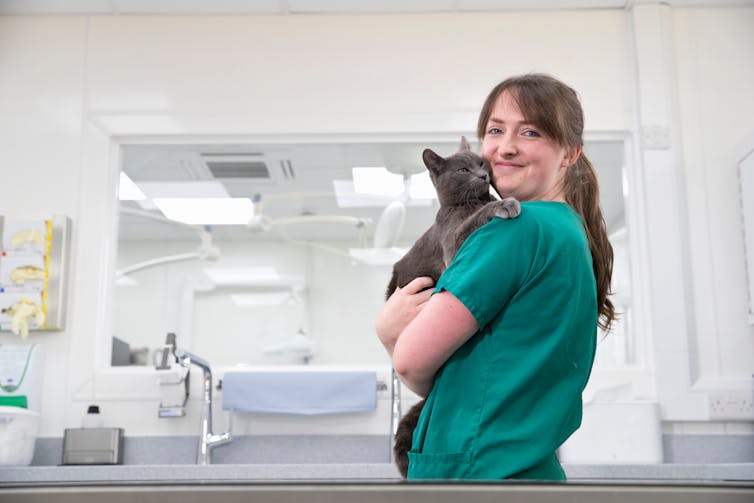
A vet holding a cat.
Don’t use over-the-counter antihistamines to treat your pet. Speak to your vet about the correct treatment.
Juice Flair/Shutterstock.com

Pollen allergies are expected to become more common, with climate change and pollution both playing a role. Higher temperatures prompt plants to release more pollen, and pollution can make our immune systems more reactive to it. Even thunderstorms can worsen hay fever by breaking pollen into smaller particles that are more easily inhaled.

Spotting the signs early and taking steps to limit your pet’s exposure can make a big difference, helping them stay comfortable, healthy and happy during the pollen-heavy months.

The Conversation

In addition to her academic affiliation at Nottingham Trent University (NTU) and support from the Institute for Knowledge Exchange Practice (IKEP) at NTU, Jacqueline Boyd is affiliated with The Kennel Club (UK) through membership and as advisor to the Health Advisory Group. Jacqueline is a full member of the Association of Pet Dog Trainers (APDT #01583). She also writes, consults and coaches on canine matters on an independent basis.

ref. Pets get hay fever too – how to spot it and manage it – https://theconversation.com/pets-get-hay-fever-too-how-to-spot-it-and-manage-it-259155

Can the NHS shift from treatment to prevention? What healthcare bosses think

Source: The Conversation – in French – By Lisa Knight, Head of External Engagement & Professional Programmes, Liverpool John Moores University

PongMoji/Shutterstock

Imagine a healthcare system where preventing illness is just as important as treating it. This is the vision for the English NHS – but right now, it’s still far from reality. To become more sustainable and better serve patients in the long run, the NHS needs to shift its focus from reactive care to proactive, preventative support.

On July 3 2025, the UK government published its Fit for the Future: Ten-Year Health Plan for England, laying out a blueprint to rebalance the health service toward prevention, digital transformation and localised care. The plan includes:

  • expanding up to 300 neighbourhood health centres to bring preventative services closer to communities

  • digitising services with 24/7 access through the NHS app, AI triage – the use of artificial intelligence to help prioritise and assess patients more efficiently, particularly in high-demand areas like emergency departments, GP surgeries and outpatient care – and robot-assisted surgery

  • tackling chronic illness earlier, including more support for obesity, smoking cessation and mental health

  • integrating prevention into everyday care, with a shift in national performance targets to better reflect long-term health outcomes.

Prime minister Keir Starmer described it as a shift “from a sickness service to a health service,” marking a deliberate move away from crisis response toward early intervention and community-based support.

But making this vision real won’t be easy.

System still isn’t built for prevention

In my research, I’ve looked at what good leadership should look like in the NHS – especially within England’s new integrated care systems (ICSs). A key part of these systems is place-based partnerships.

These are local collaborations between NHS services, councils, charities and community groups, all working together to improve people’s health. The idea is to better join up care in each area and tackle the broader issues that affect health, such as housing, education and access to support.

I spoke to NHS leaders, including chief executives of major health organisations, on the basis of anonymity, who agree that the system needs to change. But many of them say it will face major obstacles – especially financial constraints and fragmented funding models that continue to reward reactive care, such as A&E. As one NHS leader put it:

All the things that come down from NHS England and the Department of Health and Social Care respond to the now, rather than where we are going.

While the ten-year plan lays out ambitions for rebalanced funding, existing financial mechanisms won’t support this shift. The NHS can overspend during emergencies, but local authorities – who fund most social care and public health – must stay within strict budgets.

This undermines integration and creates unequal footing between services. One senior leader noted”

Local authorities will never consider us as a partner until we get our act together on finance… you’ve got to sit back and look at what impression that gives them – that we’re not equals.

The ten-year plan acknowledges these disparities but offers limited detail on how to resolve them. Without concrete reform of funding flows and accountability structures, prevention may remain a priority in name only.

In 2024, the health and social care secretary, Wes Streeting, described the NHS as “broken” and called for a review to expose the “hard truths” needed to fix it. He has been outspoken in championing both prevention and better integration with social care, viewing these as key to reforming a system overwhelmed by rising demand and worsening outcomes.

Improving housing, social care, education, and jobs can reduce reliance on costly hospital treatments and significantly enhance overall health. In 2022, the NHS took a structural step toward this by merging health and social care services into “integrated care systems”, aiming to better coordinate services across sectors.

However, it has now been more than a decade since key targets for emergency care, hospital waiting times, or cancer services were met – raising questions about whether structural changes alone are enough.

The COVID pandemic deepened these pressures. Waiting lists for treatment surged, while NHS staff faced soaring stress levels. Many healthcare leaders describe the current moment as a perfect storm, in which long-term planning is increasingly difficult while trying to meet immediate needs.

Why risk and measurement matter

Preventative services, new technologies and integrated care models carry uncertainty. Leaders are understandably hesitant to shift resources away from acute services when “hospitals get the headlines.” One told me:

We’re shuffling public service delivery cash around and not thinking through how we develop something fundamentally different.

National performance frameworks also reinforce this inertia. Most targets still focus on wait times, emergency response, and treatment outcomes. As one executive put it:

We manage what’s measured… If we were made to look at deprivation figures and elective recovery figures based on postcode and ethnicity, that might change the conversation.“

The ten-year plan promises new indicators and better data sharing, but it remains to be seen whether these tools will actually shift behaviour at scale.

Listening to communities?

An effective shift to prevention requires more than structural reform – it needs genuine community engagement. One of the aims of integrated care systems was to involve local people in decisions about their health. Most leaders I have interviewed support this principle, but many admit that public involvement remains limited: “We’re not doing enough to listen… We’re not giving people opportunities.”

The ten-year plan reiterates the importance of local voices and promises a stronger focus on “co-produced care,” but delivery will depend on time, trust and cultural change within the system.

My research suggests that the NHS won’t be fixed by continuing to treat illness after it happens. It must evolve into a service that prevents poor health at its root – in homes, schools, workplaces and local communities.

The government’s ten-year plan offers a renewed opportunity to make this shift. But if the plan is to succeed, it will require more than bold promises. It demands redesigned funding, rebalanced risk, shared power with communities – and, above all, the political will to change the system before it collapses under its own weight.

The Conversation

Lisa Knight is affiliated with Mersey and West Lancashire NHS Trust as a Non-Executive Director

ref. Can the NHS shift from treatment to prevention? What healthcare bosses think – https://theconversation.com/can-the-nhs-shift-from-treatment-to-prevention-what-healthcare-bosses-think-234601

Hope for a ceasefire in Gaza (but not much)

Source: The Conversation – in French – By Jonathan Este, Senior International Affairs Editor, Associate Editor

This article was first published in The Conversation UK’s World Affairs Briefing email newsletter. Sign up to receive weekly analysis of the latest developments in international relations, direct to your inbox.


Each day that has passed recently has brought another report of mass killings in Gaza. Today’s headline was as grim as any: according to reports from Gaza’s Hamas-run health ministry, another 118 people were killed in the past 24 hours, including 12 people trying to get aid supplies. This is a particularly unpalatable feature of a wretched conflict: the number of people being killed as they queue for food.

A bulletin carried on the United Nations website bore the headline: “GAZA: Starvation or Gunfire – This is Not a Humanitarian Response.” It said that more than 500 Palestinians have been killed and almost 4,000 injured just trying to access or distribute food.

There are, however, hopes of a hiatus in the violence. Donald Trump announced on July 2 that Israel had accepted terms for a 60-day ceasefire and Hamas is reportedly reviewing the conditions. Donald Trump on his TruthSocial platform wrote: “I hope… that Hamas takes this Deal, because it will not get better – IT WILL ONLY GET WORSE.”


Sign up to receive our weekly World Affairs Briefing newsletter from The Conversation UK. Every Thursday we’ll bring you expert analysis of the big stories in international relations.


For his part, the Israeli prime minister, Benjamin Netanyahu, said: “There will be no Hamas [in postwar Gaza]”. This doesn’t bode well for the longevity of any deal, writes Julie M. Norman.

Norman, an expert in international security at UCL who specialises in the Middle East, says we’ve been here before. The ceasefire deal negotiated with great fanfare as the Biden presidency passed over to Trump’s second term in January, fell to bits after phase one of a mooted three-phase deal, with accusations of bad faith on both sides.

Further talk of a new deal in May never got any further than the drawing board. And the two sides’ positions seem to remain utterly irreconcilable. Hamas wants the ceasefire to end in a permanent peace deal and the withdrawal of Israeli forces from Gaza. Israel wants Hamas dismantled, out of Gaza and out of the picture, full stop.

Netanyahu is due to visit Washington next week, for the third time in less than six months. Whether the US president can bring pressure to bear on Netanyahu to compromise remains to be seen.

As Norman points out after the 12-day war against Iran, which both Trump and Netanyahu have been trumpeting as a huge success, the Israeli prime minister may have the political clout to defy his more hardline colleagues in pursuit of a deal. Trump, meanwhile, having done everything he can to help Netanyahu, can call in some big favours in his quest to play dealmaker. Hamas is seriously weakened and its main ally in the region, Iran, seems unlikely to intervene after its recent conflict with Israel and the US.

So while recent history makes a cessation of violence in Gaza seem as far off as ever, there is at least some reason for hope.


Read more:
A new Gaza ceasefire deal is on the table – will this time be different?


As noted higher up, one of the more terrible features of this wretched conflict of late has been the number of people being killed as they queue to get food. The death toll at aid distribution centres has mounted steadily since Israel, with US backing, introduced a new system run by an American company: Gaza Humanitarian Foundation (GHF). This organisation replaced more than 400 aid points (previously run by a UN agency) with just four, mainly in the south of the Gaza Strip.

This was always going to cause problems, writes Leonie Fleischmann of City St George’s, University of London, who specialises in the conflict between Israel and Palestine. While Israel says the new system is designed to prevent Hamas taking control of aid supplies, all reports are that the scenes around the four distribution centres are descending into anarchy. According to a UN report, “Thousands [of people] released into chaotic enclosures to fight for limited food supplies … These areas have become sites of repeated massacres in blatant disregard for international humanitarian law.”

“Arguably, this chaos and violence is inbuilt in the new aid delivery system,” writes Fleischmann, who concludes that the new system should be seen as a “a mechanism of forced displacement” which is part of a plan by the Netanyahu government “relocate Palestinians to a ‘sterile zone’ in Gaza’s far south” as it continues to clear the north of the Gaza strip.


Read more:
Chaotic new aid system means getting food in Gaza has become a matter of life – and often death


The 12-day war

But if Trump and Netanyahu think the recent short war will lead to a complete reset in the region, leaving a crippled Iran licking its wounds, they way well have miscalculated. That’s the assessment of the situation by Bamo Nouri, a Middle East specialist at City St George’s, University of London. He believes that the 12-day war may prove to have been a strategic blunder by Israel and the US.

For a start, he writes, one outcome of the conflict is that Iran suspended cooperation with the International Atomic Energy Agency (IAEA), ending inspections and giving Tehran the freedom to expand its nuclear programme with no oversight. And its response to Israel’s airstrikes, involving more than 1,000 missiles and drones, breached the country’s “iron dome” defensive system, causing considerable damage and inflicting a serious psychological blow against Israel.

Tehran has also deepened its relationships with both Moscow and Beijing. And far from prompting regime change, the war appears to have prompted an upsurge in nationalist sentiment in Iran.

Nouri concludes: “Israel emerges militarily capable but politically shaken and economically strained. Iran, though damaged, stands more unified, with fewer international constraints on its nuclear ambitions.”


Read more:
The US and Israel’s attack may have left Iran stronger


It’s hard to get a clear picture of what was achieved, which isn’t surprising when you consider that there remains considerable doubt, even in this information age, what was achieved by the US bombing raid against Iran’s heavily fortified nuclear installations.

First they were “completely obliterated”. Or at least that was what Donald Trump posted on the night of the raid. Then it seemed that they may not have been as obliterated as first thought. In fact an initial assessment prepared by the US Office of Defense Intelligence thought that the damage may only have hindered Iran’s nuclear programme by a few months.

Cue outrage from the US president and his senior colleagues, amplified by their friends in the US media. There followed some new intelligence which seemed to favour Trump’s position. Then the head of the IAEA, Rafael Grossi, weighed in, saying Iran could be enriching uranium again in a “matter of months”. The latest contribution was from the Pentagon which is saying that timescale is actually closer to “one to two years”. Clear as mud then.

But as Rob Dover reminds us, former US defense secretary Donald Rumsfeld once pronounced: “If it was a fact it wouldn’t be called intelligence.” Dover, who is an intelligence specialist at the University of Hull, explains that intelligence almost always has a political dimension and should be viewed through that prism.

“The assessment given to the public may well be different from the one held within the administration,” writes Dover. This is not necessarily a bad thing, he concludes as “security diplomacy is best done behind closed doors”. Or at least it used to be. Now the US president seems happy to discuss sensitive information in public.


Read more:
Row over damage to Iran’s nuclear programme raises questions about intelligence


The medium is the message

But then, as Sara Polak observes, Donald Trump’s use of social media is changing the way government is conducted in the US. Polak is a specialist in US politics at Leiden University with a particular interest in the way politics and media intersect.

As she writes, for more than a century since Teddy Roosevelt cultivated print journalists, through FDR’s adept use of radio and JFK’s mastery of television, each new media platform has its master. For Trump it is social media. And he is using it to remake politics.


Read more:
How Trump plays with new media says a lot about him – as it did with FDR, Kennedy and Obama


Nowhere has Trump’s mastery of art of issuing simple messages which make for effective soundbites been displayed so clearly than in the name of his landmark tax-cutting legislation still being wrangled over in the US Congress at the time of writing: the One Big Beautiful Bill Act.

While undoubtedly big – it runs to 940 pages – its beauty is what the US House of Representatives has been debating fiercely for 24 hours or more, after it passed the Senate with the help of a casting vote from US president J.D. Vance when three Republican senators voted against it.

Dafydd Townley from the University of Portsmouth, who writes regularly for The Conversation about US politics, has written this incisive analysis of the politics around the legislation which appears set to continue for some time to come.


Read more:
Trump wins again as ‘big beautiful bill’ passes the Senate. What are the lessons for the Democrats?


World Affairs Briefing from The Conversation UK is available as a weekly email newsletter. Click here to get updates directly in your inbox.


The Conversation

ref. Hope for a ceasefire in Gaza (but not much) – https://theconversation.com/hope-for-a-ceasefire-in-gaza-but-not-much-260460

NHS ten-year plan for England: what’s in it and what’s needed to make it work

Source: The Conversation – in French – By Judith Smith, Professor of Health Policy and Management, University of Birmingham

The UK government has published its eagerly awaited ten-year health plan for England, setting out how billions of pounds in NHS funding will be used to transform healthcare delivery across the country.

As anticipated, the plan is framed around the government’s three missions for the NHS: shifting care from hospital into the community, moving from analogue to digital communication, and focusing on preventing ill health rather than treating illness.

The 168-page document responds to a stark warning that the NHS is “in serious trouble”. It is remarkable for the sheer number of ideas and proposals. As well as describing major new developments to improve people’s access to local in-person and virtual NHS care and disease prevention, it sets out a blizzard of other proposals.

These include abolishing Healthwatch (a national watchdog that listens to people’s views on health and social care services to improve them), and bringing back some of the reforms of the Tony Blair era such as “new foundation trusts” and using private funding for new buildings.

From hospital to community

The big idea in the ten-year plan is a neighbourhood health service: large local health centres where people can access GP, nursing, dental, pharmacy, diagnostic and other services six days a week, 12 hours a day. These are intended to relieve pressure on hospitals and emergency departments, eventually replacing many outpatient clinics.

The idea of shifting care into the community is not new. It has been advocated for over 30 years, including in the NHS white paper of 1997, the 2006 policy paper Our health, our care, our say, the NHS five-year forward view of 2014, and the NHS long-term plan of 2019.

Some progress has been made in this direction. For example, much of the care for people living with asthma and diabetes is now provided in local general practices. Many general practices already have large teams of doctors, nurses, pharmacists, physiotherapists and other staff who offer aspects of the wider “neighbourhood care” described in the new plan.

But what has not been achieved is having larger-scale primary care teams consistently available across the NHS. The new plan proposes new contracts and shifts of funding to enable wider change, and while welcome, these will be challenging to put into practice against a backdrop of major service pressures.

From analogue to digital

The plan emphasises strongly the need to extend the role of the NHS app, with it becoming the “doctor in your pocket” and the main route into NHS services. It proposes that the app holds your full patient record, enables you to book GP and hospital appointments and becomes a key source of healthcare advice.

This sounds very attractive. However, the devil will be in the detail. There are so many NHS IT systems to harmonise, and major data security and privacy issues to overcome.

Most critically, much attention must be given to sorting out basic NHS admin systems that are too often confusing and paper-based. This will entail lots of work with NHS clinical and administrative staff, changing long-standing ways of working, introducing new technology and adapting “the way we do things round here”.

Using AI to record doctor visits, understand test results and give health advice could really change how healthcare works. But this will take lots of time and money to train staff, try out new systems and put them in place. Also, people will need clear information about what to expect from their local health services in the future.

From sickness to prevention

England is getting sicker, and there are stark inequalities between the richest and the poorest.

To achieve the plan’s goal of empowering people to make healthier choices, robust cross-government action is essential across sectors, including housing, education and welfare. While some important measures such as the tobacco and vapes bill, plans to measure supermarkets’ sales of healthy foods, and the expansion of free school meals are included in the plan, others such as minimum alcohol pricing have been notably excluded.

Integrated care boards (ICBs), the regional bodies who plan and fund NHS services in England, and local councils will be vital in enabling these public health measures to be implemented. However, this will be difficult in the short to medium term as ICBs are being forced to merge, cut headcount and reorganise their work.

Making it work

For the ten-year plan to succeed, three key elements are essential.

First, there is an urgent need to set priorities. The public expects much swifter access to on-the-day GP appointments, an end to excessive waits in accident and emergency departments, and reductions in waiting lists for operations.

The Department of Health and Social Care must guide the NHS in which aspects of the plan are to be addressed first. If everything is a priority, nothing is a priority.

Second, implementation really matters. There is only so much management capacity, staff time, funding and goodwill to introduce new technologies and services. This government has already embarked on another “redisorganisation” of the oversight agency NHS England, and now plans to axe or merge a number of other national and local NHS bodies. NHS managers are vital to implementing the plan, but need to feel valued and supported, not denigrated as superfluous.

Finally, the plan is almost silent on the two most pressing needs for government health reform. Without a properly funded system of adult social care to support older people and those living with enduring mental health needs, it is hard to see how hospital care can be transformed.

And without an urgent and significant shift of resources to general practice and community services, neighbourhood health services will remain more of a dream than reality.


Read more:
NHS unveils ten-year plan to shift from treatment to prevention – here’s what needs to change to make that happen


The Conversation

Judith Smith receives funding from the National Institute for Health and Care Research for research and evaluation. Judith is Senior Visiting Fellow at the Health Foundation.

ref. NHS ten-year plan for England: what’s in it and what’s needed to make it work – https://theconversation.com/nhs-ten-year-plan-for-england-whats-in-it-and-whats-needed-to-make-it-work-260077

In search of Labour’s ‘working people’ – the paradox at the heart of Keir Starmer’s first year in power

Source: The Conversation – in French – By George Newth, Lecturer in Politics and member of Reactionary Politics Research Network, University of Bath

Number 10/Flickr, CC BY-NC-ND

It’s one year since Keir Starmer led the Labour party to a landslide victory. Starmer’s manifesto, “Change” had proposed “securonomics” as a solution to the UK’s many crises. This was sold as a way of ensuring “sustained economic growth as the only route to improving the prosperity of our country and the living standards of working people”.

The document mentioned “working people” a total of 21 times. It was clear this demographic had been identified as the key target beneficiary of “securonomics”, otherwise referred to as “the plan for change”.

But there is a paradox at the heart of the proposal to deliver “change” to “working people” – one that helps explain the chaos of Labour’s first year in government. By obsessively pitting this demographic against “non-working people”, Labour is in fact not promising any real change at all.


Get your news from actual experts, straight to your inbox. Sign up to our daily newsletter to receive all The Conversation UK’s latest coverage of news and research, from politics and business to the arts and sciences.


One of the key premises of Labour’s securonomics is that growth must precede any significant investment. “Working people’s” priorities are therefore presented as being in line with that of a fiscally responsible state.

In the autumn budget, there was a pledge to “fix the foundations of the economy and deliver change by protecting working people”. To do this, the chancellor needed to fix a “black hole” of £22 billion in government finances.

The refusal to lift the two-child benefit cap, alongside “reforming the state to ensure […] welfare spending is targeted towards those that need it the most”, was framed as “putting more money in working people’s pockets”. There has, meanwhile, been a continued emphasis on encouraging those on benefits back to work.


Want more politics coverage from academic experts? Every week, we bring you informed analysis of developments in government and fact check the claims being made.

Sign up for our weekly politics newsletter, delivered every Friday.


Besides the clear deepening of inequality wrought by similar reforms in the past, welfare cuts make no sense on an economic or societal level. They undermine the economy, and the consequences put additional pressure on already underfunded social services.

As highlighted by the Office of Budgetary Responsibility (OBR), such cuts fail to deliver the promised behavioural change to force people into work. People instead become more focused on day-to-day survival.

Despite the government’s last ditch climbdown to save its flagship welfare reform policy its cuts are still forecast to push more than 150,000 people into poverty

Such reforms carried out in the name of “working people” perpetuate a pernicious myth of us v them. Not only are people in work also affected by these cuts but people’s lives – including their jobs, income, family situations, and health – shift regularly, making the “strivers v skivers” divide both simplistic and inaccurate.

Even “secure borders” and “smashing the criminal gangs” were positioned as “grown up politics back in the service of working people”. This association of working people with anti-immigrant attitudes links to a broader homogenisation of “working people” as both “patriotic” and in search of “security”. “Fixing the foundations” has been depicted in several social media posts as a patriotic act via use of the Union Jack.

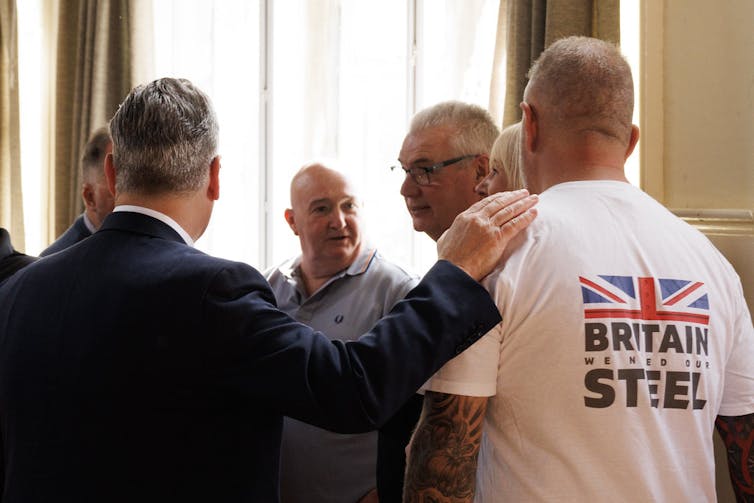
Keir Starmer with his hand on the shoulder of a man wearing a tshirt saying 'British steel'.
Starmer meets ‘working people: steel category’.
Number 10/Flickr, CC BY-NC-ND

Meanwhile, stage-managed photoshoots of Starmer in factories with people wearing hard hats and hi-visibility jackets give a clear impression of the types of manufacturing jobs the government believes “working people” carry out. This gives an impressions that belies the reality of modern Britain – and an economy that is dominated by the service sector,, not manufacturing or building.

Old wine in new bottles

While Starmer framed his “plan for change” as a break with previous administrations, his “working people” narrative betrays this claim as anything but.

The idea that the deserving “working people” are different and separate from people who don’t (or can’t) work has been deployed by government after government to justify austerity and cuts to services. It has always been useful to separate the “scroungers from the strivers” and there is no sign of Labour changing course.

Keir Starmer talking to a pilot sitting in a fighter jet.
Hello! Are you working people?
Number 10/Flickr, CC BY-NC-ND

The term “working people” also builds on a previous trope of the “hard-working family”.

While initially coined by New Labour, this term has roots in Margaret Thatcher’s idea of the family, rather than the state, as the locus of welfare. It was not for the state to take care of you but your own kin.

Like “working people” now, “hard-working families” were those who played by the rules and knuckled down to earn a living. Previous Conservative administrations have depicted “hard-working families” as burdened by the unemployed, the poor, the sick and disabled and immigrants.

Add to this, the signalling continues to imply that the “authentic” working class of Britain are solely white – sometimes also male – and typically older, manual labourers, who are assumed to hold socially conservative views. This is another divide-and-rule trope which neglects the reality of the multiracial and multiethnic composition of the working classes.

In light of all this, any real “change” promised in Labour’s manifesto has been betrayed by a continuity with tired and damaging tropes of deserving and undeserving people. This is contributing to the sense, a year in, that this Labour government is merely repeating past government failures rather than striking out in a new direction.

The Conversation

George Newth works for University of Bath and is a member of the Green Party

ref. In search of Labour’s ‘working people’ – the paradox at the heart of Keir Starmer’s first year in power – https://theconversation.com/in-search-of-labours-working-people-the-paradox-at-the-heart-of-keir-starmers-first-year-in-power-260230

Mental health in England really is getting worse – our survey found one in five adults are struggling

Source: The Conversation – in French – By Sally McManus, Professor of Social Epidemiology, City St George’s, University of London

Anxiety and depression were among the most common mental health issues people struggled with. Inna Kot/ Shutterstock

The proportion of people in England with poor mental health has risen sharply over the past 30 years, according to England’s most robust national mental health survey. While in 1993 15% of 16- to 64-year-olds surveyed were found to have an anxiety disorder or depression, this reached 23% in 2024.

The Adult Psychiatric Morbidity Survey (APMS) is the longest running mental health survey series in the world. It began in 1993 and has published five waves of data since. The survey series is commissioned by NHS England and conducted by the National Centre for Social Research, alongside the University of Leicester and City St George’s, University of London.

The findings from this series are our best barometer of trends in the nation’s mental health because of the quality of the survey samples and the rigour of the mental health assessments. Each wave, a random sample of addresses are invited to take part. By drawing from the whole population, and not just those in contact with health services, we can examine population change.

Around 7,000 adults aged 16 to 100 took part in the most recent survey. The detailed, at-home interviews asked participants questions from the Revised Clinical Interview Schedule (CIS-R) – a detailed mental health assessment tool with over 130 questions.

This recent survey revealed many things about the state of mental health in England. While it’s clear the prevalence of several mental health conditions have risen this century, there are also signs that access to mental healthcare has also increased.

Young people are a priority group

A quarter of 16- to 24-year-olds in this latest survey had a common mental health condition – the highest level observed since the APMS series began. An upward trajectory was also evident for rates of self-harm.

Evidence from a sister survey we conducted suggests that for young people, the Covid pandemic had a sustained effect on mental health. However, both surveys show the upward trend in young people’s poor mental health predated the pandemic.

Although concerns have been linked to social media, evidence for this as a key causal factor is weak. There’s likely multiple causes: environmental, social, economic, technological and political changes may all play a part.

Anxiety disorders have increased

Generalised anxiety disorder is now one of the most prevalent types of mental health condition in England – present in one in 12 adults. The condition is characterised by feelings of stress or worry that affects daily life, are difficult to control and which have persisted longer than six months.

The proportion of 16- to 64-year-olds meeting generalised anxiety disorder criteria also doubled since the series began – from 4.4% in 1993 to 8.5% in 2023-2024. The steepest increase was seen in 16- to 24-year-olds – with prevalence rising from just over 2% in 1993 to nearly 8% in 2024.

Socioeconomic inequalities persist

The survey also confirmed that people struggling financially and those with a limiting physical health condition (such as asthma, cancer or diabetes), were particularly at risk of experiencing poor mental health. About 40% of people who were unemployed had depression or an anxiety disorder.

The survey also revealed area-level disparities, with common mental health conditions being more prevalent among those living in the most deprived fifth of neighbourhoods. In these areas, 26% of people had a common mental health condition – compared with 16% of those living in the least deprived areas.

A man sits on his bed, looking out the window.
Mental health conditions were more prevalent in deprived regions.
WPixz/ Shutterstock

Regional disparities emerged as well – with people living in more deprived regions of England experiencing worse mental health. Around 25% of adults in the East Midlands and the north-east had a common mental health condition – compared with around 19% of people living in the south-west and 16% of those in the south-east.

Age and ethnic inequalities in treatment persist

Likelihood of receiving mental health treatment varied between groups. People aged 75 and over were the least likely to receive treatment compared to people from other age groups. This could partly stem from lack of help-seeking.

Ethnic inequalities were also observed, with people from Asian or black backgrounds less likely to receive treatment compared to people from white backgrounds. Ethnic disparities in treatment access have also been noted in linked primary care data – disparities which may also have worsened during the pandemic.

Persistent treatment inequalities have been attributed to problems with recognition and diagnosis of symptoms in people from ethnic minority backgrounds by healthcare workers. Cultural variations in expressions of distress may also be missed in consultation processes – affecting whether or not treatments are offered.

Men may be seeking help more

A decade ago, the survey found that among people with a common mental health condition, women were around 1.58 times more likely than men to get treatment.

This difference was no longer evident in the latest results. It may be that mental health services have become better at recognising and responding to mental health need in men, or that reduced stigma around mental health has meant more men are seeking help.

People are now more likely to get treatment

The proportion of people with depression or an anxiety disorder receiving mental health treatment – either in the form of prescription medication or psychological therapy – has increased substantially since the survey began.

Between 2000 and 2007, one in four people with a common mental health condition received treatment. This increased to 39% in 2014 – and nearly half in the latest survey. The increase was evident for both psychological therapies (rising from 10% in 2007 to 18% in 2024) and prescription medication (rising from 20% in 2007 to 38% in 2024).

Future of mental health

The APMS has been conducted with consistent methods over decades, using the same robust mental health assessments with large, random samples of the population. This means the results are largely not affected by changes in levels of mental health awareness or stigma, and changes in levels of diagnosis or service contact.

As such, this gives us confidence in the figures: that mental health in England really is getting worse, and that access to mental health treatment among people with a condition has increased.

It will now be important for future research to consider what are the drivers of change in population mental health, and how we can improve mental health care for all.

The Conversation

Sally McManus receives funding from UKRI Violence, Health and Society (VISION) consortium (MR/V049879/1). The Adult Psychiatric Morbidity Survey was conducted by the National Centre for Social Research, with Leicester University and City St George’s, University of London. The latest survey in the series was commissioned by NHS England with funding from England’s Department for Health and Social Care.

Sarah Morris leads the Adult Psychiatric Morbidity Survey and works on the Health Survey for England at the National Centre for Social Research, which is commissioned by NHS England, with funding from England’s Department of Health and Social Care.

ref. Mental health in England really is getting worse – our survey found one in five adults are struggling – https://theconversation.com/mental-health-in-england-really-is-getting-worse-our-survey-found-one-in-five-adults-are-struggling-260120

¿Por qué la diabetes tipo 2 sigue ganando la batalla?

Source: The Conversation – (in Spanish) – By Arantxa Bujanda, Enfermera especializada en diabetes, Universidad Pública de Navarra

Un paciente de diabetes tipo 2 se mide los niveles de glucosa. Halfpoint/Shutterstock

Si le pidiera que pensara en alguien con diabetes, es probable que conozca a una persona en su círculo cercano. No es casualidad, ya que una de cada once personas la padece. Actualmente, hablamos de 589 millones de casos en el mundo, y la cifra sigue en aumento. La Federación Internacional de Diabetes estima que en 2050 los afectados podrían alcanzar los 852 millones.

Estamos ante una de las grandes epidemias del siglo XXI. Pero lo más alarmante es que, según los expertos, la diabetes tipo 2 podría prevenirse. Entonces, ¿por qué sigue aumentando sin control?

Un proceso silencioso

Para entender la diabetes tipo 2, primero hay que hablar de una hormona clave: la insulina. Su función es permitir que la glucosa entre en las células y se transforme en energía. En las personas con esta enfermedad, las células se vuelven resistentes a la insulina. Al principio, el páncreas aumenta su producción para compensarlo, pero con el tiempo se agota. Como resultado, la glucosa se acumula en la sangre, dando lugar a la diabetes tipo 2.

Este proceso ocurre de forma progresiva y silenciosa. Los primeros signos no generan síntomas evidentes, lo cual hace que muchas personas no sean conscientes de que la padecen hasta que acuden a una revisión médica o aparecen complicaciones.

Así nos influye lo que nos rodea

Cuando pensamos en la diabetes tipo 2, solemos imaginar a una persona mayor, con sobrepeso, sentada en un sofá y con una bolsa de comida basura en las manos. Y, aunque el estilo de vida influye, esta imagen es solo una parte de la historia.

Un concepto clave para comprender el origen de la diabetes tipo 2 es el exposoma. Con este nombre nos referimos al conjunto de factores ambientales a los que estamos expuestos a lo largo de la vida y que influyen en nuestra salud. No se trata únicamente de lo que comemos o del ejercicio que hacemos, sino de todo aquello que nos rodea y de cómo interactúa con nuestro cuerpo.


Leer más:
Los casos de diabetes tipo 1 aumentan en todo el mundo, pero cada vez los gestionamos mejor


Uno de los factores más determinantes es el llamado exposoma externo, que alude al entorno en el que vivimos. Imagine a una persona que reside en una gran ciudad, en un barrio con altos niveles de contaminación, bajos ingresos y un empleo con gran carga de estrés. Pues solo por el hecho de vivir allí, tiene un mayor riesgo de desarrollar diabetes tipo 2. Las investigaciones han demostrado que la exposición prolongada a la contaminación del aire puede alterar el metabolismo y aumentar la resistencia a la insulina.

Dentro de este contexto, existe un nivel más específico conocido como exposoma externo modificable, que abarca aquellos hábitos que sí podemos cambiar. Es aquí donde entran en juego la alimentación y la actividad física, los factores que tradicionalmente se han asociado con la diabetes tipo 2. Un consumo excesivo de azúcar eleva los niveles de glucosa en sangre, y la falta de ejercicio contribuye a la resistencia a la insulina. Sin embargo, estas elecciones individuales también están condicionadas por el entorno, las normas sociales y las oportunidades que cada persona tiene a su alcance.

Mirando al interior

Y, por último, el exposoma interno, aquello que ocurre dentro de nuestro cuerpo, también desempeña un papel fundamental. Un ejemplo clave es la microbiota intestinal, el conjunto de bacterias que habitan en nuestro sistema digestivo y que influyen en cómo procesamos los alimentos. Se ha demostrado que una microbiota alterada puede afectar la regulación del azúcar en sangre y aumentar el riesgo de resistencia a la insulina.

Asimismo, ciertos fármacos, como antibióticos y corticoides, pueden modificar el metabolismo de la glucosa y contribuir al desarrollo de la enfermedad.

El entorno favorece la aparición de la diabetes

Por lo tanto, la diabetes tipo 2 no es simplemente el resultado de malas decisiones personales, sino de una compleja interacción entre factores biológicos, ambientales y sociales. Comprender esta realidad es fundamental para diseñar estrategias de prevención eficaces y abordar la enfermedad desde una perspectiva más amplia.

Hasta ahora, hemos puesto el foco en la alimentación y el ejercicio físico porque son variables modificables y dependen de decisiones individuales. Sin embargo, ¿es suficiente centrarnos solo en la responsabilidad personal? La realidad es que vivimos en un entorno que favorece la aparición de la diabetes tipo 2.

En primer lugar, la comida poco saludable es más accesible y barata que los alimentos frescos. En segundo lugar, los automóviles, los ascensores, las largas jornadas laborales y el ocio digital han reducido drásticamente la actividad física. Y, por si fuera poco, el estrés crónico eleva el cortisol, favoreciendo la resistencia a la insulina. Por todo ello, la solución no puede recaer únicamente en el individuo.

Políticas que salvan vidas

Necesitamos estrategias a gran escala que aborden el problema desde la raíz. Es imprescindible implementar políticas que limiten la publicidad y el acceso a productos ultraprocesados, reduzcan el uso de azúcares añadidos y promuevan opciones saludables asequibles.

Además, el diseño urbano debe facilitar la movilidad activa: ciudades con más espacios peatonales, ciclovías seguras y acceso a áreas recreativas pueden marcar la diferencia en la actividad física cotidiana. La educación también juega un papel fundamental si se incluyen conocimientos sobre hábitos saludables y prevención.

Aún estamos a tiempo

Si no actuamos ahora, el impacto en la salud pública y en los sistemas sanitarios será devastador. Pero aún estamos a tiempo de cambiar la historia de la diabetes tipo 2.

Porque no se trata solo de sobrevivir, sino de adaptarnos de manera inteligente a un entorno que está jugando en nuestra contra. Como decía Darwin: “No sobrevive la especie más fuerte ni la más inteligente, sino la que mejor responde al cambio”. Ha llegado el momento de cambiar las reglas del juego.

The Conversation

Arantxa Bujanda no recibe salario, ni ejerce labores de consultoría, ni posee acciones, ni recibe financiación de ninguna compañía u organización que pueda obtener beneficio de este artículo, y ha declarado carecer de vínculos relevantes más allá del cargo académico citado.

ref. ¿Por qué la diabetes tipo 2 sigue ganando la batalla? – https://theconversation.com/por-que-la-diabetes-tipo-2-sigue-ganando-la-batalla-260235

¿Cuánto dependen las energías renovables de la extracción minera? Así lo hemos calculado

Source: The Conversation – (in Spanish) – By Pere Roura Grabulosa, Catedrático emérito de Física, Universitat de Girona

Bocamina de Peña del Hierro. Nerva (Huelva, España). Wikimedia Commons., CC BY

Cuando se toma en consideración la base material de la transición energética, la captación de la energía del viento o de la radiación solar no parecen tan sostenibles como desearíamos. Porque para generar electricidad renovable, resulta indispensable el uso de materiales sin los cuales no se podrían construir los millones de aerogeneradores y paneles fotovoltaicos necesarios con el fin de prescindir de los combustibles fósiles.

Este dilema entre energía renovable y explotación no renovable de recursos minerales se resuelve parcialmente con un ejemplo significativo: el peso de los materiales necesarios para generar una unidad de energía eléctrica es 65 veces mayor en una central térmica de carbón que en un parque eólico terrestre.

Sin embargo, si consideramos los tipos de materiales, la valoración cambia. La transición hacia las energías renovables conlleva el uso de una gran variedad de minerales calificados como “críticos” por las dificultades previsibles de abastecimiento. En particular, resulta preocupante la dependencia respecto de unos pocos países, ya sea porque albergan los principales yacimientos (el caso del cobalto en el Congo) o porque monopolizan la capacidad de procesamiento (el silicio en China).

El reto de los minerales críticos

La Unión Europea prevé reducir su dependencia exterior respecto de los minerales críticos con una directiva reciente: el Reglamento de Materias Primas Fundamentales. Este busca, por una parte, diversificar los suministradores y, por otra, asegurar una producción mínima dentro del propio territorio. En los próximos años veremos, pues, una intensificación de la actividad minera que va a enfrentarse, sin lugar a dudas, con movimientos de oposición popular.

Su impacto más visible se manifiesta en forma de escombreras de roca residual, balsas de relavado o tala de bosques. En general, estos impactos están relacionados con el volumen de roca que se debe extraer para obtener el material deseado. Dicho volumen será, pues, el parámetro que utilizaremos para evaluar el impacto minero.

No obstante, es un factor con limitaciones evidentes: por ejemplo, a igual volumen de roca el impacto de una mina situada en la selva tropical será superior que en un desierto. Y por otro lado, no todos los procesos de obtención de mineral contaminan de la misma manera.

A continuación nos centraremos en comparar el volumen (la masa en kg) de roca extraída por unidad de energía eléctrica generada con diferentes tecnologías: eólica, fotovoltaica y carbón. Añadiremos en el análisis la energía nuclear, ya que, siendo una tecnología libre de emisiones de CO₂, contribuirá en mayor o menor grado al mix eléctrico global del futuro.

¿Cuánta roca hay que extraer en cada caso?

La roca extraída de una mina es la suma de la ganga (roca residual sin valor económico) más la mena (que contiene el mineral o metal de interés). Huelga decir que interesa minimizar el volumen de ganga. En cualquier caso, la riqueza o ley de la mena es el factor que mayormente incide en el volumen de roca extraída. También es el factor que más varía de un material a otro.

Como ejemplo, vamos a comparar la plata utilizada en las soldaduras eléctricas de las placas fotovoltaicas y el aluminio para la estructura de los paneles. La ley de las menas de plata, que depende enormemente del yacimiento, oscila alrededor del 0,001 %. Contrariamente, el aluminio se obtiene de menas de bauxita muy ricas en este metal. Su ley promedio se sitúa cerca del 20 %. Como consecuencia, aunque se utiliza unas 500 veces menos plata que aluminio para la generación fotovoltaica, su contribución al impacto minero es 8 veces mayor que la del aluminio.

En definitiva, la ganga y la riqueza de la mena, junto con algunos factores relativos a la eficiencia de los procesos, permiten calcular el impacto minero de los materiales utilizados en la construcción y funcionamiento de las instalaciones de generación de energía.

Contribución de los diferentes materiales a la cantidad de roca extraída por MWh de electricidad dependiendo de la tecnología de generación. Las áreas son proporcionales al peso de roca, excepto en el caso del carbón, ya que excede el área de la figura.
Pere Roura.

Minería de carbón frente a uranio

Una vez cuantificada la roca correspondiente a los materiales, sólo nos falta conocer la cantidad de los diversos materiales usados en cada tecnología para generar una unidad de energía. En una central térmica de carbón y, en menor medida, en una central nuclear, el impacto minero viene determinado principalmente por el combustible. Para generar 1 MWh eléctrico se deben “quemar” 350 kg de carbón o una cantidad cien mil veces inferior de óxido de uranio enriquecido (unos 3,5 gramos).

Esta disparidad enorme en la cantidad de combustible se reduce cuando consideramos el impacto minero: más de 350 kg/MWh de roca para el carbón y 48 kg/MWh para la energía nuclear.

Aquí aparece otra de las sorpresas del impacto minero. La relación roca extraída/uranio enriquecido se sitúa alrededor de 12 000. Es un valor muy elevado por dos razones: primero, una parte significativa del uranio se obtiene de menas muy pobres de Namibia (ley inferior a 0,05 %). Y, segundo, solo alrededor del 0,72 % del uranio natural es uranio-235 –el único con capacidad para provocar una reacción en cadena de fisión nuclear–; y este se tiene que enriquecer hasta el 3,5-4,5 %.

Eólica y solar

Llegamos, finalmente, a las energías renovables. Sin necesidad de combustible, la base material de estas tecnologías son los materiales para la construcción de las instalaciones. El impacto minero dependerá de las horas anuales de generación (el factor “capacidad”). Tomando el valor global de este parámetro (27 % para la eólica y 14 % para la fotovoltaica) y una vida útil de 25 años, se obtiene un impacto minero de 81 kg por MWh eólico y 116 kg por MWh fotovoltaico.

Si tenemos en cuenta el contenido en metal reciclado en el cobre (>30 %), el acero (32 %) y el aluminio (40 %), estos impactos mineros se reducen considerablemente, pasando a ser 64 y 86 kg/MWh, respectivamente. Ambos valores son muy inferiores al impacto minero del carbón y similares del de la energía nuclear.

Llegamos a la conclusión que, sea cual sea el mix eléctrico resultante de la transición energética, el impacto minero –medido en función de masa de roca necesaria para obtener una unidad de energía– disminuirá considerablemente. Será así, a pesar de la gran cantidad y variedad de materiales necesarios para las energías renovables en comparación con los combustibles fósiles y la energía nuclear.

The Conversation

Pere Roura Grabulosa es miembro de Renovem-nos; asociación de académicos para la promoción de las energías renovables con garantias ambientales y sociales.

Carlos Pozo Fernández no recibe salario, ni ejerce labores de consultoría, ni posee acciones, ni recibe financiación de ninguna compañía u organización que pueda obtener beneficio de este artículo, y ha declarado carecer de vínculos relevantes más allá del cargo académico citado.

ref. ¿Cuánto dependen las energías renovables de la extracción minera? Así lo hemos calculado – https://theconversation.com/cuanto-dependen-las-energias-renovables-de-la-extraccion-minera-asi-lo-hemos-calculado-256361