Trente ans après les derniers essais nucléaires français en Polynésie, un héritage toxique

Source: – By Roxanne Panchasi, Associate Professor, Department of History, Simon Fraser University
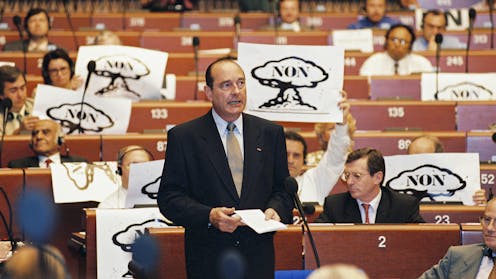
En visite officielle, au Parlement européen à Strasbourg en juillet 1995, Jacques Chirac se heurte à une protestation de la part de ses membres.
(European Parliament)

Le 13 juin 1995, le président Jacques Chirac annonçait la reprise des essais nucléaires dans le Pacifique Sud. La population de la Polynésie française attend encore une juste indemnisation pour les préjudices subis. En 2021, le président Macron a reconnu que la France avait une « dette » envers le peuple de Maō’hui Nui, appelant à l’ouverture d’archives clés. Une commission d’enquête parlementaire s’est emparée du sujet.


Ces derniers mois, la viabilité de l’arsenal nucléaire français a fait la une des journaux, entraînant des discussions sur un « parapluie nucléaire » français qui pourrait protéger ses alliés sur le continent européen. Face à la guerre entre la Russie et l’Ukraine, et aux déclarations du président russe Vladimir Poutine concernant la possibilité de déployer des armes nucléaires dans ce conflit, la question quant à la meilleure manière de défendre l’Europe crée une urgence inédite depuis l’époque la plus tendue de la guerre froide.

Malgré ses capacités nucléaires plus solides, les États-Unis, sous l’ère Donald Trump, semblent moins engagés dans la défense de leurs alliés de l’OTAN. Les débats sur le parapluie nucléaire français mis à part, ces discussions – combinées à l’augmentation des dépenses militaires dans le monde entier et à la résurgence des craintes d’une guerre nucléaire – rendent l’histoire française de la préparation nucléaire et de ses essais d’armes, douloureusement contemporaine.

Le 13 juin 1995, le président Jacques Chirac a annoncé que la France allait reprendre ses essais nucléaires dans le Pacifique Sud. Quelques semaines seulement après son élection, Jacques Chirac a mis fin à un moratoire de trois ans sur les essais que son prédécesseur, François Mitterrand, avait mis en place en avril 1992.

Jacques Chirac a insisté sur le fait que cette nouvelle série d’essais nucléaires était essentielle à la sécurité nationale de la France et au maintien de l’indépendance de sa force de dissuasion nucléaire. Les huit essais prévus au cours des mois suivants fourniraient, selon lui, les données nécessaires pour passer des explosions réelles à de futures simulations informatiques. Il a également déclaré que cela permettrait à la France de signer le Traité d’interdiction complète des essais nucléaires (CTBT) interdisant toutes les explosions nucléaires, à des fins militaires ou autres, d’ici à l’automne 1996.

L’histoire des essais nucléaires en France

Un reportage sur les essais nucléaires français dans le Pacifique Sud. (Disclose).

L’annonce faite par Jacques Chirac en juin 1995, suivie de la première nouvelle explosion en septembre de la même année, a suscité une vive opposition de la part des groupes écologistes et des pacifistes, ainsi que des protestations allant de Paris à Papeete, à travers la région Pacifique et dans le monde entier.

Des représentants des autres puissances nucléaires mondiales ont exprimé leur inquiétude face à la décision de la France de mener de nouveaux essais si près de l’entrée en vigueur d’une interdiction complète. Les gouvernements de l’Australie, de la Nouvelle-Zélande et du Japon ont également manifesté leur ferme opposition, en publiant des déclarations diplomatiques, ainsi qu’en appelant au boycott des produits français et en mettant en œuvre d’autres mesures de rétorsion.

Une posture défensive a constitué un pilier de la politique française en matière d’armement nucléaire depuis l’entrée du pays dans le club atomique en 1960, avec la détonation de « Gerboise Bleue », une bombe de 70 kilotonnes, à Reggane, en Algérie. Les trois essais atmosphériques suivants ainsi que les treize essais souterrains réalisés au Sahara ont entraîné de graves conséquences sanitaires et environnementales à long terme pour les populations de la région.

En 1966, le programme d’essais nucléaires de la France fut transféré à Maō’hui Nui, connue sous le nom colonial de « Polynésie française ».

Au cours des 26 années suivantes, 187 détonations nucléaires et thermonucléaires françaises supplémentaires furent réalisées, en surface et en souterrain, sur les atolls pacifiques de Moruroa et Fangataufa. Ces essais ont exposé la population locale à des niveaux dangereux de radiation, contaminé les réserves alimentaires et en eau, endommagé les coraux ainsi que d’autres formes de vie marine.

Ces expériences – ainsi que les six dernières détonations souterraines menées par la France en 1995 et 1996 – ont laissé un héritage toxique pour les générations futures.

Des préjudices persistants, une indemnisation insuffisante

Lorsque Jacques Chirac a exposé ses raisons pour la nouvelle série d’essais nucléaires de la France devant une salle pleine de journalistes réunis au palais de l’Élysée en juin 1995, il a insisté sur le fait que ces essais prévus, ainsi que toutes les détonations nucléaires françaises, n’avaient absolument aucune conséquence écologique.

Aujourd’hui, nous savons que cette affirmation était bien plus qu’inexacte. Il s’agissait d’un mensonge fondé sur des données et des conclusions qui ont gravement sous-estimé les effets néfastes du programme d’essais nucléaires français sur la santé des soldats français et du personnel non militaire présents sur les sites, sur les habitants des zones environnantes, ainsi que sur les environnements où ces explosions ont eu lieu.


Du lundi au vendredi + le dimanche, recevez gratuitement les analyses et décryptages de nos experts pour un autre regard sur l’actualité. Abonnez-vous dès aujourd’hui !


Plus récemment, lors des Jeux olympiques de Paris 2024, il était difficile de ne pas ressentir l’évidente contradiction entre la « Polynésie française » en tant que paradis touristique et lieu idyllique pour les compétitions de surf, et celle d’un territoire marqué par l’injustice persistante envers les victimes des essais nucléaires – une réalité qui met en lumière l’histoire de l’impérialisme nucléaire de la France dans la région.

En 2010, le gouvernement français a adopté la loi Morin censée répondre à la souffrance des personnes gravement affectées par les radiations lors des détonations nucléaires françaises entre 1960 et 1996.

Le nombre de personnes ayant obtenu une reconnaissance et une indemnisation reste insuffisant, en particulier en Algérie. Sur les 2 846 demandes déposées – émanant seulement d’une fraction des milliers de victimes estimées – un peu plus de 400 personnes à Maō’hui Nui et une seule en Algérie ont été indemnisées depuis 2010.

En 2021, le président Emmanuel Macron a reconnu que la France avait une « dette » envers le peuple de Maō’hui Nui. Il a depuis appelé à l’ouverture d’archives clés liées à cette histoire, mais de nombreux efforts restent à faire sur tous les fronts.

Les conclusions d’une récente commission parlementaire française sur les effets des essais dans le Pacifique, dont la publication est prévue prochainement, pourraient contribuer à une plus grande transparence et à une meilleure justice pour les victimes à l’avenir.

À Maʻohi Nui, les demandes de reconnaissance et de réparation sont étroitement liées au mouvement indépendantiste, tandis que l’impact et l’héritage des explosions nucléaires en Algérie restent une source de tensions persistantes avec la France, d’autant plus liée à son passé colonial.

L’avenir du traité d’interdiction des essais nucléaires

En janvier 1996, la France a procédé à son dernier essai nucléaire en faisant exploser une bombe de 120 kilotonnes sous terre dans le Pacifique Sud. En septembre de la même année, elle a signé le Traité d’interdiction complète des essais nucléaires (TICE), rejoignant les États-Unis, la Russie, le Royaume-Uni, la Chine et 66 autres États non dotés d’armes nucléaires dans leur engagement à ne plus effectuer d’explosions nucléaires, quel qu’en soit le motif.

Près de 30 ans plus tard, le TICE n’est toujours pas entré en vigueur. Bien que la majorité des signataires l’aient ratifié, la Chine, l’Égypte, l’Iran, Israël et les États-Unis figurent parmi les neuf pays qui ne l’ont pas encore fait. Par ailleurs, la Russie a retiré sa ratification en 2023. Parmi les principaux non-signataires se trouvent l’Inde, la Corée du Nord et le Pakistan – trois États dotés de l’arme nucléaire ayant mené leurs propres essais depuis 1996.

En raison de ces exceptions majeures à l’interdiction des essais, les perspectives d’un projet aussi ambitieux que le Traité sur l’interdiction des armes nucléaires de 2017, qu’aucun État possédant l’arme nucléaire n’a signé à ce jour, restent pour le moins incertaines.

The Conversation

Roxanne Panchasi a reçu des financements du Conseil de recherches en sciences humaines du Canada (CRSH).

ref. Trente ans après les derniers essais nucléaires français en Polynésie, un héritage toxique – https://theconversation.com/trente-ans-apres-les-derniers-essais-nucleaires-francais-en-polynesie-un-heritage-toxique-258994
Hygiène : les barbes sont-elles des nids à microbes ?

Source: – By Primrose Freestone, Senior Lecturer in Clinical Microbiology, University of Leicester

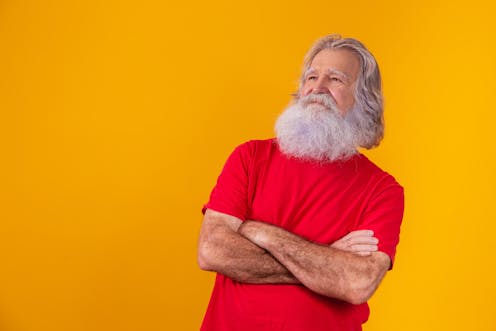
Les barbes fournies demandent un entretien certain. Bernardo Emanuelle/Shutterstock

Les barbes les plus fournies suscitent souvent un mélange d’admiration, pour le style qu’elles confèrent à leurs porteurs, et de suspicion, quant à leur propreté et aux problèmes d’hygiène qu’elles pourraient poser. À tort, ou à raison ?


La peau humaine héberge des milliards de microorganismes – non seulement des bactéries, pour l’essentiel, mais aussi des champignons et des virus. Or, la pilosité faciale constitue un environnement propice à leur prolifération. Des travaux de recherche ont révélé que les barbes abritent une population microbienne particulièrement dense et variée, ce qui a contribué à alimenter l’idée selon laquelle elles seraient intrinsèquement peu hygiéniques.

On a même récemment pu lire, dans les colonnes du très sérieux quotidien Washington Post, qu’une barbe « moyenne » pouvait contenir davantage de germes que certaines cuvettes de WC… Est-ce à dire que porter la barbe fait courir un risque sanitaire ?

Un examen attentif des données scientifiques disponibles révèle une réalité plus nuancée.

Des études contradictoires

La composition microbienne de la peau varie selon la zone considérée. Elle dépend de divers facteurs, tels que la température, le pH (qui rend compte du caractère acide ou basique d’un milieu), l’humidité et la disponibilité en nutriments. Le port de la barbe crée un milieu chaud et souvent humide où le sébum – et parfois les résidus alimentaires – peuvent s’accumuler, ce qui constitue des conditions idéales pour la prolifération microbienne.

Cette situation favorable est d’autant plus propice aux microorganismes que notre visage est exposé en permanence à de nouveaux contaminants, notamment par l’intermédiaire de nos mains, que nous portons fréquemment à notre visage.

Les premières préoccupations scientifiques quant à l’hygiène des barbes remontent à plus de cinquante ans. Des études pionnières avaient à l’époque démontré que la pilosité faciale pouvait retenir bactéries et toxines bactériennes, même après nettoyage, ce qui avait alimenté l’idée que la barbe aurait pu constituer un réservoir bactérien dangereux pour autrui, car exposant à des risques d’infection.

Chez les professionnels de santé, le port de la barbe a longtemps été controversé, notamment dans les hôpitaux, où la lutte contre la transmission des pathogènes est cruciale. Les résultats des recherches menées en milieu hospitalier sont toutefois contrastés. Certes, une étude a révélé que les soignants barbus avaient une charge bactérienne faciale plus élevée que leurs homologues rasés de près.

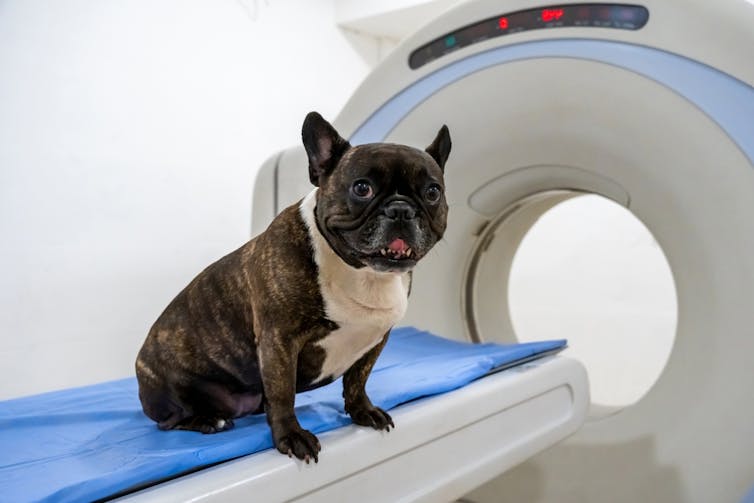
D’autres travaux, qui avaient comparé la charge microbienne de pilosités faciales humaines avec celle de pelages de chiens (pour savoir s’il existait un risque à employer un même appareil d’IRM pour les uns et pour les autres), ont révélé que la plupart des barbes hébergent nettement plus de microbes que le pelage des chiens, et notamment davantage de bactéries potentiellement pathogènes. La conclusion était claire : « Utiliser les mêmes machines d’IRM pour les chiens et les êtres humains ne présentent aucun risque pour ces derniers ».

Un chien se tenant devant une machine d’IRM.
Chiens et humains peuvent partager les mêmes IRM sans risque particulier.
Dmytro Zinkevych/Shutterstock

Cependant, d’autres recherches remettent en cause l’idée que le port de la barbe pourrait être à l’origine d’un surrisque infectieux. Ainsi, des travaux comparant des soignants barbus avec leurs collègues glabres n’ont mis en évidence aucune différence significative de colonisation bactérienne entre les uns et les autres. Les mêmes chercheurs ont, par ailleurs, observé que les praticiens barbus étaient moins souvent porteurs de la bactérie Staphylococcus aureus, qui est le principal agent à l’origine d’infections nosocomiales (infections acquises à l’hôpital). Ils n’ont pas non plus remarqué de taux d’infection plus élevés chez les patients opérés par des chirurgiens barbus (et portant un masque) que chez les autres.


Du lundi au vendredi + le dimanche, recevez gratuitement les analyses et décryptages de nos experts pour un autre regard sur l’actualité. Abonnez-vous dès aujourd’hui !


Les barbes peuvent toutefois véhiculer certaines infections cutanées, telles que l’impétigo, un rash (ou éruption) contagieux souvent dû à S. aureus, lequel est malgré tout fréquemment présent au niveau de la pilosité faciale. Dans de rares cas, on peut aussi retrouver dans certaines barbes des parasites tels que les poux du pubis (communément appelés morpions) – qui, comme leur nom l’indique, sont habituellement plutôt localisés au niveau inguinal. En cas de mauvaise hygiène, ou de contact prolongé avec une personne infectée, ceux-ci peuvent en effet finir par coloniser la barbe, les sourcils voire les cils.

Maintenir une bonne hygiène de barbe

Une barbe négligée peut favoriser irritation, inflammation et infection. La peau sous la barbe – riche en vaisseaux sanguins, terminaisons nerveuses et cellules immunitaires – est en effet très sensible aux agressions microbiologiques et environnementales. L’accumulation de sébum, de cellules mortes, de résidus alimentaires et de polluants peut l’irriter, et favoriser la croissance de champignons et de bactéries.

En définitive, est-ce que les barbes sont sales ? Comme souvent, tout dépend du soin qui leur est porté. Les experts recommandent vivement de laver quotidiennement sa barbe et son visage afin d’éliminer saletés, sébum, allergènes et cellules mortes, et prévenir ainsi la prolifération microbienne.

Les dermatologues conseillent également de procéder à une hydratation, pour éviter la sécheresse. Autres recommandations : peigner régulièrement sa barbe avec un peigne consacré à cet usage, afin d’en éliminer les saletés, et la tailler régulièrement. Ces quelques gestes quotidiens améliorent l’esthétique de la barbe, et permettent de la garder en pleine santé, en assurant une hygiène irréprochable.

The Conversation

Primrose Freestone ne travaille pas, ne conseille pas, ne possède pas de parts, ne reçoit pas de fonds d’une organisation qui pourrait tirer profit de cet article, et n’a déclaré aucune autre affiliation que son organisme de recherche.

ref. Hygiène : les barbes sont-elles des nids à microbes ? – https://theconversation.com/hygiene-les-barbes-sont-elles-des-nids-a-microbes-258850

Abandon du Nutri-Score de Danone : retrait de sa qualité de société à mission ?

Source: – By Stéphane Besançon, Associate Professor in Global Health at the Conservatoire National des Arts et Métiers (CNAM) / CEO NGO Santé Diabète, Conservatoire national des arts et métiers (CNAM)

En juin 2020, Danone est la première entreprise cotée au CAC 40 à obtenir cette qualité juridique. Pourra-t-elle encore le rester longtemps ? HJBC/Shutterstock

En abandonnant le Nutri-Score, Danone vient-elle d’acter le retrait de sa qualité de société à mission ? Toutes les hypothèses sont sur la table… Un véritable crash test pour l’avenir des entreprises à mission.


Danone décide le 5 septembre 2024 d’abandonner le logo nutritionnel Nutri-Score pour cinq de ses marques : Danonino, Actimel, Activia, Danone, HiPro. Le groupe d’agroalimentaire l’adopte en 2017. Il lui permet de remplir parfaitement sa mission d’information auprès des consommateurs pour les aider à faire leurs choix alimentaires de façon éclairée.

Une actualité en dissonance avec sa qualité de société à mission acquise en 2020 ? En France ce dispositif est créé par la loi Pacte de 2019. Il permet aux entreprises d’affirmer leur engagement dans la poursuite d’objectifs environnementaux et sociaux, et non plus seulement économiques. Un organisme tiers indépendant (OTI) assure la vérification de l’atteinte de ces objectifs et un comité de mission est chargé du suivi de l’exécution de cette mission.

Le 8e baromètre de l’Observatoire des sociétés à mission souligne le succès de cette démarche : fin 2024, 1 961 sociétés à mission sont recensées, soit un triplement en trois ans, dont Doctolib, Transdev, KMPG, KS Groupe, Camif, Bel, etc. Alors, Danone qui pourtant a été la première entreprise cotée au CAC 40 à obtenir cette qualité juridique, pourra-t-il rester une entreprise à mission ?

Santé des personnes

Pour illustrer sa vision et son ambition, Danone a choisi pour raison d’être : « apporter la santé par l’alimentation au plus grand nombre ». Dans ce cadre, Danone s’est fixé quatre objectifs généraux dont le premier vise à :

« Avoir un impact positif sur la santé des personnes au niveau local grâce à un portefeuille de produits plus sains, avec des marques encourageant de bons choix nutritionnels, et promouvoir de bonnes habitudes alimentaires. »

Le groupe Danone s’est engagé d’un côté à produire des aliments de meilleure qualité pour la santé des enfants, moins sucrés. De l’autre, permettre aux consommateurs de faire des choix nutritionnels éclairés, à l’aide d’un système d’information nutritionnelle interprétatif sur les emballages ou en ligne. Des engagements, sous forme de jalons quantifiés, sont pris, comme le rappelle le rapport du comité de mission de Danone en avril 2024 destiné à être présenté aux actionnaires lors de leur Assemblée générale.

Retour en arrière

Danone, qui a fortement soutenu le Nutri-Score depuis son officialisation en France en 2017, explique son retour en arrière. Selon le groupe, la version mise à jour de l’algorithme du Nutri-Score par le comité scientifique européen en charge de sa révision « pénaliserait » plus le classement de ses yaourts à boire et boissons végétales sucrées en les classant moins bien sur l’échelle du Nutri-Score par rapport à la « version initiale ».


À lire aussi :
Pourquoi Danone retire le Nutri-score de ses yaourts à boire


Avec le désengagement du Nutri-Score pour certaines de ses marques phares, moins de produits afficheront un logo interprétatif en 2025. Un recul par rapport à la situation de 2023. La question est de savoir si, avec ce retrait, Danone est en mesure d’atteindre les objectifs quantifiés annoncés dans le rapport de 2024 publié par son comité de mission. Le cas échéant, assiste-t-on à un retour en arrière par rapport à l’avancée des engagements évalués en 2023 et présentés dans ce même rapport ?


Abonnez-vous dès aujourd’hui !

Chaque lundi, recevez gratuitement des informations utiles pour votre carrière et tout ce qui concerne la vie de l’entreprise (stratégie, RH marketing, finance…).


On trouve la réponse à cette question dans le rapport de mission 2024 paru le 02 avril 2025. Ses résultats démontrent que sur la question de l’étiquetage nutritionnel, les engagements pris ne sont pas tenus et que les objectifs chiffrés ne sont pas atteints. Malgré ces écarts, le comité de mission conclut que Danone a honoré l’intégralité de ses engagements en 2024. Cette conclusion peut interroger sur le rôle réel du comité de mission de Danone.

Rôle du comité de mission

Le comité de mission de Danone est composé de huit membres : Pascal Lamy, président du comité de mission, Arancha González, Lise Kingo, Hiromichi Mizuno, David Nabarro, Ron Oswald, Gabriela Ilian Ramos et Emna Lahmer. Son rôle ? Veiller à ce que Danone respecte ses engagements en tant que société à mission. Comment ? En évaluant les progrès réalisés et en formulant des recommandations à travers un rapport joint au rapport de gestion et présenté annuellement à l’Assemblée générale ordinaire de l’entreprise.

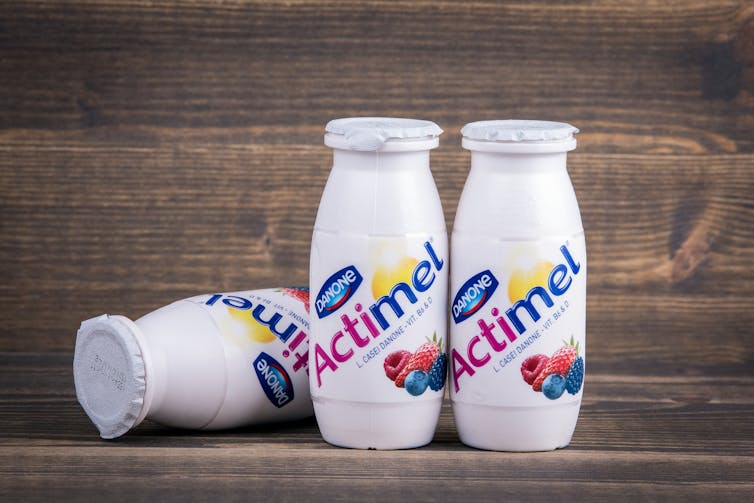
Actimel est un produit phare de Danone concerné par la suppression du Nutri-Score.
stoatphoto/Shutterstock

Il aurait été attendu que le comité de mission notifie, dans son dernier rapport 2024, le désengagement de Danone sur le Nutri-Score. Par conséquent, la non-atteinte de l’objectif concernant l’aide aux consommateurs pour faire des choix éclairés et la non atteinte du jalon « 95 % des volumes vendus de produits laitiers et d’origine végétale et de boissons aromatisées sont assortis d’un étiquetage nutritionnel interprétatif sur les emballages et/ou en ligne ».

Malheureusement, cela n’a pas été le cas. Le rapport de mission 2024 paru le 02 avril 2025 conclut :

« Concernant le bilan des résultats déjà obtenus, nous pouvons affirmer que Danone a honoré ses engagements. En 2024, l’entreprise a atteint ou dépassé tous les objectifs dont nous avons accepté de suivre la réalisation, à une exception près (la formation en ligne des salariés) – à laquelle Danone devrait remédier cette année. »

Plus préoccupant, le rapport du comité de mission affirme que « 95 % des volumes vendus de produits laitiers et d’origine végétale et de boissons aromatisées sont assortis d’un étiquetage nutritionnel interprétatif sur les emballages et/ou en ligne ». Pour combler le Nutri-Score, l’entreprise déploiera les Health Star Rating (HSR), utilisés en Australie et en Nouvelle-Zélande. Leur mode de calcul repose sur l’algorithme que le Nutri-Score utilisait avant sa mise à jour. Remplacer un logo qui informe le consommateur sur la forte teneur en sucre de gammes de produits peut-il être interprété comme une stratégie pour désinformer et tromper le consommateur ?

Retrait de la qualité par l’OTI ?

Si une entreprise ne tient pas ses engagements, elle peut perdre sa qualité de société à mission. L’organisme tiers indépendant (OTI), en charge de vérifier l’exécution des objectifs sociaux et environnementaux de l’entreprise, peut rendre un avis négatif. Il doit indiquer pourquoi l’entreprise ne respecte pas ou n’atteint pas les objectifs qu’elle s’est fixés. Le ministère public (procureurs de la République, ndlr) ou toute personne intéressée peut saisir le président du tribunal de commerce pour le retrait de la mention de société à mission.

Mazars est l’organisme tiers indépendant (OTI) de Danone. Le rapport du comité de mission de Danone évaluant l’année 2024 contient en annexe B « le rapport de l’organisme tiers indépendant sur la vérification de l’exécution des objectifs sociaux et environnementaux ». Le rapport du comité de mission 2024 contient la même annexe que le rapport du comité de mission 2023 à savoir l’analyse de la période allant du 1er janvier 2022 au 31 décembre 2023.

L’OTI n’a pas encore fourni de rapport concernant l’année 2024, année où Danone, par le choix du retrait du Nutri-Score, n’a pas été en mesure de respecter pleinement les engagements pris ainsi que les objectifs fixés.

Il est maintenant central d’attendre le rapport de l’OTI couvrant l’année 2024 pour savoir, si en analysant les données de l’année 2024, il joue pleinement son rôle. Rendra-t-il un avis négatif indiquant que la société ne respecte pas et n’a pas atteint certains de ces objectifs qu’elle s’était fixés ? Le rendu d’un avis négatif serait une première pour une société à mission. Il montrerait que les éléments économiques et financiers ne doivent pas l’emporter sur la poursuite d’objectifs visant la protection de la santé dans le cas d’une entreprise à mission.

DROIT DE REPONSE DU GROUPE DANONE, envoyé le 19 juin 2025

« L’article en question fonde son raisonnement sur une information fausse : l’engagement de société à mission de Danone ne porte pas sur le Nutri-Score. L’objectif opérationnel auquel il fait référence (parmi les 12 que s’est fixés l’entreprise dans le cadre de son statut de société à mission) est clair et formulé ainsi : « à fin 2025, Danone s’engage à rendre disponible sur emballage ou en ligne un indicateur d’information nutritionnelle interprétative pour 95% de ses produits dans le monde ».

Sur la base de cette allégation erronée, l’article multiplie les fausses informations, que nous vous listons ci-dessous :

-Il indique que les « résultats [du rapport de mission 2024] démontrent que sur la question de l’étiquetage nutritionnel, les engagements pris ne sont pas tenus et que les objectifs chiffrés ne sont pas atteints ». Cette affirmation est fausse. Le rapport 2024 du Comité de mission indique (p.10) : « Danone a ainsi dépassé son jalon 2024, atteignant 71,5 % de volumes vendus de produits laitiers et d’origine végétale et de boissons aromatisées (Aquadrinks) assortis d’un étiquetage nutritionnel interprétatif sur les emballages et/ou en ligne ».

-Par ailleurs, l’auteur avance qu’« il aurait été attendu que le comité de mission notifie, dans son dernier rapport 2024, le désengagement de Danone sur le Nutri-Score. Par conséquent, la non-atteinte de l’objectif concernant l’aide aux consommateurs pour faire des choix éclairés et la non atteinte du jalon « 95 % des volumes vendus de produits laitiers et d’origine végétale et de boissons aromatisées sont assortis d’un étiquetage nutritionnel interprétatif sur les emballages et/ou en ligne ». L’ensemble de cette affirmation est faux. D’abord, le rapport du Comité de mission note bien, à plusieurs reprises, le retrait de l’étiquetage nutritionnel Nutri-Score des produits laitiers et d’origine végétale à boire de Danone. Ensuite, l’objectif de 95% mentionné est un objectif à 2025, comme indiqué ci-dessus et précisément indiqué dans le rapport du Comité de mission. L’auteur ne peut donc en conclure qu’il n’a pas été atteint.

-Nous dénonçons par ailleurs vivement l’allégation de l’auteur, qui laisse entendre que l’adoption du système HSR serait « une stratégie pour désinformer et tromper le consommateur ». Le système HSR est un système d’étiquetage nutritionnel interprétatif fondé sur la science et référence de plusieurs organisations internationales pour évaluer la qualité nutritionnelle des portefeuilles de produits de grande consommation. Il ne saurait être assimilé à une entreprise de désinformation.

Danone est fier d’être reconnu pour notre mission d’apporter la santé par l’alimentation au plus grand nombre en figurant à la 1ère place de l’indice mondial d’accès à la nutrition 2024 (ATNI). Faire preuve de transparence pour aider les consommateurs à faire des choix d’alimentation sains et équilibrés est une priorité de notre Groupe.

Nous continuerons donc à soutenir la mise en place d’un étiquetage nutritionnel interprétatif à une échelle européenne, scientifiquement étayé, facile à comprendre pour le consommateur et permettant de distinguer les aliments à la fois au sein de leur catégorie et entre différentes catégories. »

The Conversation

Je travaille pour une ONG intervenant dans la santé

ref. Abandon du Nutri-Score de Danone : retrait de sa qualité de société à mission ? – https://theconversation.com/abandon-du-nutri-score-de-danone-retrait-de-sa-qualite-de-societe-a-mission-253169

Trump is not like other presidents – but can he beat the ‘second term curse’ that haunts the White House?

Source: The Conversation – Canada – By Garritt C. Van Dyk, Senior Lecturer in History, University of Waikato

Getty Images

While he likes to provoke opponents with the possibility of serving a third term, Donald Trump faces a more immediate historical burden that has plagued so many presidents: the “second term curse”.

Twenty-one US presidents have served second terms, but none has reached the same level of success they achieved in their first.

Second term performances have ranged from the lacklustre and uninspiring to the disastrous and deadly. Voter dissatisfaction and frustration, presidential fatigue and a lack of sustainable vision for the future are all explanations.

But Trump doesn’t quite fit the mould. Only one other president, Grover Cleveland in the late 19th century, has served a second nonconsecutive term, making Trump 2.0 difficult to measure against other second-term leaders.

Trump will certainly be hoping history doesn’t repeat Cleveland’s second-term curse. Shortly after taking office he imposed 50% tariffs, triggering global market volatility that culminated in the “Panic of 1893”.

At the time, this was the worst depression in US history: 19% unemployment, a run on gold from the US Treasury, a stock market crash and widespread poverty.

More than a century on, Trump’s “move fast and break things” approach in a nonconsecutive second term might appeal to voters demanding action above all else. But he risks being drawn into areas he campaigned against.

So far, he has gone from fighting a trade war and a culture war to contemplating a shooting war in the Middle East. His “big beautiful bill” will add trillions to the national debt and potentially force poorer voters – including many Republicans – off Medicaid.

Whether his radical approach will defy or conform to the second term curse seems very much an open question.

No kings

The two-term limit was enacted by the 22nd Amendment to the Constitution in 1951. Without a maximum term, it was feared, an authoritarian could try to take control for life – like a king (hence the recent “No Kings” protests in the US).

George Washington, James Madison and Thomas Jefferson all declined to serve a third term. Jefferson was suspicious of any president who would try to be re-elected a third time, writing:

should a President consent to be a candidate for a 3d. election, I trust he would be rejected on this demonstration of ambitious views.

There is a myth that after Franklin Delano Roosevelt broke the de facto limit of two terms set by the early presidents, the ghost of George Washington placed a curse on anyone serving more than four years.

At best, second-term presidencies have been tepid compared to the achievements in the previous four years. After the second world war, some two-term presidents (Eisenhower, Reagan and Obama) started out strong but faltered after reelection.

Eisenhower extricated the US from the Korean War in his first term, but faced domestic backlash and race riots in his second. He had to send 500 paratroopers to escort nine Black high school students in Little Rock, Arkansas, to enforce a federal desegregation order.

Reagan made significant tax and spending cuts, and saw the Soviet Union crumble in term one. But the Iran-Contra scandal and watered down tax reform defined term two.

Obama started strongly, introducing health care reform and uniting the Democratic voter base. After reelection, however, the Democrats lost the House, the Senate, a Supreme Court nomination, and faced scandals over the Snowden security leaks and Internal Revenue Service targeting of conservative groups.

Truly disastrous examples of second term presidencies include Abraham Lincoln (assassination), Woodrow Wilson (first world war, failure of the League of Nations, a stroke), Richard Nixon (Watergate, impeachment and resignation), and Bill Clinton (Lewinsky scandal and impeachment).

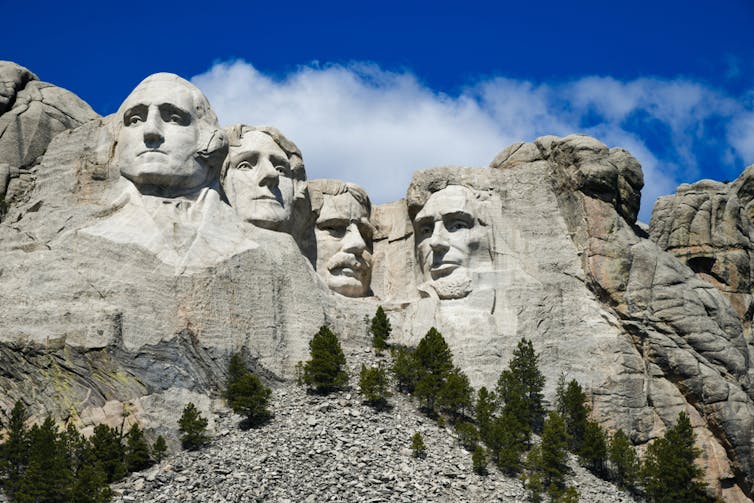
Room for one more? Trump has joked about being added to Mount Rushmore.
Shutterstock

Monumental honours

It may be too early to predict how Trump will feature in this pantheon of less-than-greatness. But his approval ratings recently hit an all-time low as Americans reacted to the bombing of Iran and deployment of troops in Los Angeles.

A recent YouGov poll showed voters giving negative approval ratings for his handling of inflation, jobs, immigration, national security and foreign policy. While there has been plenty of action, it may be the levels of uncertainty, drastic change and market volatility are more extreme than some bargained for.

An uncooperative Congress or opposition from the judiciary can be obstacles to successful second terms. But Trump has used executive orders, on the grounds of confronting “national emergencies”, to bypass normal checks and balances.

As well, favourable rulings by the Supreme Court have edged closer to expanding the boundaries of executive power. But they have not yet supported Trump’s claim from his first term that “I have an Article 2, where I have the right to do whatever I want as President”.

Some supporters say Trump deserves a Nobel Peace Prize. And he was only half joking when he asked if there is room for one more face on Mount Rushmore. But such monumental honours may only amount to speculation unless Trump’s radical approach and redefinition of executive power defy the second-term curse.

The Conversation

Garritt C. Van Dyk has received funding from the Getty Research Institute.

ref. Trump is not like other presidents – but can he beat the ‘second term curse’ that haunts the White House? – https://theconversation.com/trump-is-not-like-other-presidents-but-can-he-beat-the-second-term-curse-that-haunts-the-white-house-260002

The Dalai Lama is a cisgender man – yet he has an unexpected connection to the trans community

Source: The Conversation – Canada – By Stephen Kerry, Lecturer in Sociology, Charles Darwin University

Tenzin Gyatso, the 14th Dalai Lama, turns 90 this week – a milestone that’s reigniting speculation over his eventual successor.

While the Dalai Lama is the face of Buddhism to many people across the world, he is actually the head of just one tradition within Tibetan Buddhism known as the Gelug school.

Tibetans believe the Dalai Lama to be the manifestation of Avalokiteśvara, the bodhisattva of compassion, and the “one who hears the cries of the world”.


Read more:
What is a bodhisattva? A scholar of Buddhism explains


Avalokiteśvara is prayed to across Asia, and is known as Chenrezig in Tibet, Guanyin in China, and Kannon or Kanzeon in Japan.

A statue of Avalokiteśvara.
Wikimedia, CC BY-SA

In Buddhism, a bodhisattva is a person, or a mythic representation of a person, who denies themselves enlightenment until all beings can achieve enlightenment. Avalokiteśvara appears to living beings in whatever form could best save them.

Although Avalokiteśvara originated in India as a man, they can be depicted as either a man, woman, or non-binary being. This gender fluidity has led to them being revered as a trans icon in the West.

I have spent the past five years investigating the lives of queer Buddhists in Australia. As part of this research, I have surveyed and interviewed 109 LGBTQIA+ Buddhist Australians.

The words of these individuals, and my own experience as a genderqueer Buddhist person, reveal how the Dalai Lama emerges an an unlikely inspiration for individuals sharing a trans and Buddhist identity.

The Big Buddha is a large bronze sculpture located near the Po Lin Monastery on Lantau Island, Hong Kong.
Joshua J. Cotten/Unsplash

Letting go of binaries

Through my work I have found LGBTQIA+ Buddhist Australians are generally reluctant to disclose their queer identities to their Buddhist communities, and may be told to remain silent about their identities.

For some, Avalokiteśvara’s gender fluidity has been important for reaffirming both their queer and Buddhist selves.

One Buddhist trans woman, Annie*, told me Guanyin had special significance for her. Annie spoke about Avalokiteśvara travelling from India to China as a male, before “transitioning” to the mainly female presentation of Guanyin over centuries. Annie said:

I pray to her regularly and often find I get a response. Of course the enlightened state is beyond all manner of worldly binaries, including gender, and is immensely important in letting go of binaries in my journey towards enlightenment.

Walter* has had a long fascination with depictions of Avalokiteśvara that “showed ‘him’ looking effeminate and handsome, with a cute moustache […] A little bit homoerotic, a little bit provocatively gender fluid, as seen through my eyes”.

Walter adds:

A great many people in different cultures, across history, worship these figures. Clever how this figure can morph into a radical trans! We all want to feel comforted, safe and saved from suffering.

As queer Buddhists, we turn to to Avalokitesvara to feel “comforted, safe and saved”.

Another interviewee, Brian*, told me about a Tibetan invocation practice he did with a senior Tibetan monk, in which he encountered Guanyin:

[She] took my right hand and passed some sort of power into it. She never spoke to me but just returned the way she had come. I was given some sort of gift, that’s all I know.

Since this experience, Brian has “always felt a strong connection to the feminine through her”. He has a special Guanyin altar on his farm.

You can’t be what you can’t see

Some Buddhists deny Avalokiteśvara’s queerness.

Asher*, a genderqueer Buddhist I interviewed, told me about a teacher who said to them, “there was absolutely no way a gay person could be enlightened”.

Asher retorted:

What about Kanzeon, the bodhisattva of compassion, who has manifested as both male and female and, in the stories from Japan, has had erotic relationships with monks?

The teacher dismissed this, replying, “those are just stories”.

A black statue of Avalokiteśvara outside a Japanese temple.
Wikimedia, CC BY

In her 1996 book Transgender Warriors, trans activist Leslie Feinberg writes: “I couldn’t find myself in history. No one like me seemed to have ever existed.”

Similarly, Annie evoked the statement: “You can’t be what you can’t see.”

I, too, experience this need to see myself as a genderqueer, non-binary practitioner of Zen Buddhism. It was only through doing these interviews with other queer Buddhists that I came to realise Guanyin, a trans icon, is a statuette which adorns the altar of the Buddhist group I belong to.

Knowing Avalokitesvara may be depicted as a man, woman, or non-binary being lets us queer Buddhists know we exist – and have always existed – within Buddhism.

Despite being a cisgender man who has been somewhat inconsistent in his support of queer people, the Dalai Lama, as the manifestation of the bodhisattva of compassion, is a possible spiritual link between today’s queer Buddhists and centuries-long traditions of gender transition and fluidity.

*Names have been changed.

The Conversation

Stephen Kerry does not work for, consult, own shares in or receive funding from any company or organisation that would benefit from this article, and has disclosed no relevant affiliations beyond their academic appointment.

ref. The Dalai Lama is a cisgender man – yet he has an unexpected connection to the trans community – https://theconversation.com/the-dalai-lama-is-a-cisgender-man-yet-he-has-an-unexpected-connection-to-the-trans-community-260106

Too much vitamin B6 can be toxic. 3 symptoms to watch out for

Source: The Conversation – Canada – By Nial Wheate, Professor, School of Natural Sciences, Macquarie University

Selena3726/Shutterstock

Side effects from taking too much vitamin B6 – including nerve damage – may be more widespread than we think, Australia’s medicines regulator says.

In an ABC report earlier this week, a spokesperson for the Therapeutic Goods Administration (TGA) says it may have underestimated the extent of the side effects from vitamin B6 supplements.

However, there are proposals to limit sales of high-dose versions due to safety concerns.

A pathologist who runs a clinic that tests vitamin B6 in blood samples from across Australia also appeared on the program. He told the ABC that data from May suggests 4.5% of samples tested had returned results “very likely” indicating nerve damage.

So what are vitamin B6 supplements? How can they be toxic? And which symptoms do you need to watch out for?

What is vitamin B6?

Vitamin B6, also known as pyridoxine, plays an important role in keeping the body healthy. It is involved in the metabolism of proteins, carbohydrates and fats in food. It is also important for the production of neurotransmitters – chemical messengers in the brain that maintain its function and regulate your mood.

Vitamin B6 also supports the immune system by helping to make antibodies, which fight off infections. And it is needed to produce haemoglobin, the protein in red blood cells that carries oxygen around the body.

Some women take a vitamin B6 supplement when pregnant. It is thought this helps reduce the nausea associated with the early stages of pregnancy. Some women also take it to help with premenstrual syndrome.

However, most people don’t need, and won’t benefit from, a vitamin B6 supplement. That’s because you get enough vitamin B6 from your diet through meat, breakfast cereal, fruit and vegetables.

You don’t need much. A dose of 1.3–1.7 milligrams a day is enough for most adults.

Currently, vitamin B6 supplements with a daily dose of 5–200mg can be sold over the counter at health food stores, supermarkets and pharmacies.

Because of safety concerns, the TGA is proposing limiting their sale to pharmacies, and only after consultation with a pharmacist.

Daily doses higher than 200mg already need a doctor’s prescription. So under the proposal that would stay the same.

What happens if you take too much?

If you take too much vitamin B6, in most cases the excess will be excreted in your urine and most people won’t experience side effects. But there is a growing concern about long-time, high-dose use.

A side effect the medical community is worried about is peripheral neuropathy – where there is damage to the nerves outside the brain and spinal cord. This results in pain, numbness or weakness, usually in your hands and feet. We don’t yet know exactly how this happens.

In most reported cases, these symptoms disappear once you stop taking the supplement. But for some people it may take three months to two years before they feel completely better.

There is growing, but sometimes contradictory, evidence that high doses (more than 50mg a day) for extended periods can result in serious side effects.

A study from the 1990s followed 70 patients for five years who took a dose of 100 to 150mg a day. There were no reported cases of neuropathy.

But more recent studies show high rates of side effects.

A 2023 case report provides details of a man who was taking multiple supplements. This resulted in a daily combined 95mg dose of vitamin B6, and he experienced neuropathy.

Another report describes seven cases of neuropathy linked to drinking energy drinks containing vitamin B6.

Reports to the TGA’s database of adverse events notifications (a record of reported side effects) shows 174 cases of neuropathy linked with vitamin B6 use since 2023.

What should I do if I take vitamin B6?

The current advice is that someone who takes a dose of 50mg a day or more, for more than six months, should be monitored by a health-care professional. So if you regularly take vitamin B6 supplements you should discuss continued use with your doctor or pharmacist.

There are three side effects to watch out for, the first two related to neuropathy:

  1. numbness or pain in the feet and hands

  2. difficulty with balance and coordination as a result of muscle weakness

  3. heartburn and nausea.

If you have worrying side effects after taking vitamin B6 supplements, contact your state’s poison information centre on 13 11 26 for advice.

The Conversation

Nial Wheate in the past has received funding from the ACT Cancer Council, Tenovus Scotland, Medical Research Scotland, Scottish Crucible, and the Scottish Universities Life Sciences Alliance. He is a fellow of the Royal Australian Chemical Institute. Nial is the chief scientific officer of Vaihea Skincare LLC, a director of SetDose Pty Ltd (a medical device company) and was previously a Standards Australia panel member for sunscreen agents. He is a member of the Haleon Australia Pty Ltd Pain Advisory Board. Nial regularly consults to industry on issues to do with medicine risk assessments, manufacturing, design and testing.

Slade Matthews provides scientific evaluations to the Therapeutic Goods Administration as a member of the Therapeutic Goods Assessment and Advisory Panel. Slade serves on the NSW Poisons Advisory Committee for NSW Health as the minister-nominated pharmacologist appointed by the Governor of NSW.

ref. Too much vitamin B6 can be toxic. 3 symptoms to watch out for – https://theconversation.com/too-much-vitamin-b6-can-be-toxic-3-symptoms-to-watch-out-for-260400

How Europe dropped the ball on its own defence and was left fawning over Donald Trump – podcast

Source: The Conversation – Canada – By Gemma Ware, Host, The Conversation Weekly Podcast, The Conversation

The language from European leaders was fawning and obsequious. At one point, the head of Nato, Mark Rutte, even called Donald Trump “daddy”. But when the US president left the Nato summit in late June, there was a sigh of relief that he had not made any more angry criticism of the alliance.

After months of American pressure, Nato members – with the exception of Spain – agreed to increase their spending on defence to 5% of GDP by 2035. Trump called it “very big news”, and even reconfirmed his commitment to Nato’s article 5, which means an attack on one Nato country is an attack on them all.

 How did Europe become so unable to defend itself that it was forced to resort to outright flattery of an American president?

In this episode of The Conversation Weekly podcast, we report from the recent Siena Conference on the Europe of the Future in Italy about how the EU dropped the ball on its own defence and what its options are now.

 The European Commission, the executive branch of EU government, only appointed its first commissioner for defence in December 2024. There is no EU army, and no consensus as to whether democratic nations could ever allow one to be built.

But in the period after the second world war, ambitions for a united European defence policy were much grander, as Ana Juncos Garcia, professor of European politics at the University of Bristol in the UK, explains:

There was this idea to establish a European Defence Community which would pool competencies at the national level in defence to the European level, creating a supranational organisation with its own minister of defence, its own military committee.

That failed in 1954 when the French national assembly rejected ratification of the treaty and progress on a pan-European defence strategy stalled. Nato, founded in 1949, became the core military alliance organising Europe’s defence, with the US as its main guarantor.

Ever since, the EU has tried to balance the need for maintaining that transatlantic relationship, and figuring out a way to organise, and procure, its own defence capabilities in a joined up way.

Listen to The Conversation Weekly podcast, which includes interviews with Francesco Grillo, academic fellow in political science at Bocconi University in Italy, and François Lafond, former assistant professor at  Sciences Po University in Paris and former advisor to the Western Balkans on European integration.

This episode of The Conversation Weekly was written and produced by Gemma Ware with assistance from Katie Flood and Mend Mariwany. Mixing and sound design by Eloise Stevens and theme music by Neeta Sarl.

Newsclips in this episode from National Defence, NBC News, CNBCtelevision, Forbes Breaking News, CBS News and Critical Past.

Listen to The Conversation Weekly via any of the apps listed above, download it directly via our RSS feed or find out how else to listen here. A transcript of this episode is available on Apple Podcasts or Spotify.

The Conversation

Ana Juncos Garcia has received UKRI funding for a MSCA Doctoral Network and funding from Horizon Europe, ESRC IAA and WUN. She is also a visiting professor at the College of Europe.

Francesco Grillo is associated to VISION think tank.

ref. How Europe dropped the ball on its own defence and was left fawning over Donald Trump – podcast – https://theconversation.com/how-europe-dropped-the-ball-on-its-own-defence-and-was-left-fawning-over-donald-trump-podcast-260152

Scientists look to black holes to know exactly where we are in the Universe. But phones and wifi are blocking the view

Source: The Conversation – Canada – By Lucia McCallum, Senior Scientist in Geodesy, University of Tasmania

ESA / Hubble / L. Calçada (ESO), CC BY

The scientists who precisely measure the position of Earth are in a bit of trouble. Their measurements are essential for the satellites we use for navigation, communication and Earth observation every day.

But you might be surprised to learn that making these measurements – using the science of geodesy – depends on tracking the locations of black holes in distant galaxies.

The problem is, the scientists need to use specific frequency lanes on the radio spectrum highway to track those black holes.

And with the rise of wifi, mobile phones and satellite internet, travel on that highway is starting to look like a traffic jam.

Why we need black holes

Satellites and the services they provide have become essential for modern life. From precision navigation in our pockets to measuring climate change, running global supply chains and making power grids and online banking possible, our civilisation cannot function without its orbiting companions.

To use satellites, we need to know exactly where they are at any given time. Precise satellite positioning relies on the so-called “global geodesy supply chain”.

This supply chain starts by establishing a reliable reference frame as a basis for all other measurements. Because satellites are constantly moving around Earth, Earth is constantly moving around the Sun, and the Sun is constantly moving through the galaxy, this reference frame needs to be carefully calibrated via some relatively fixed external objects.

As it turns out, the best anchor points for the system are the black holes at the hearts of distant galaxies, which spew out streams of radiation as they devour stars and gas.

These black holes are the most distant and stable objects we know. Using a technique called very long baseline interferometry, we can use a network of radio telescopes to lock onto the black hole signals and disentangle Earth’s own rotation and wobble in space from the satellites’ movement.

Different lanes on the radio highway

We use radio telescopes because we want to detect the radio waves coming from the black holes. Radio waves pass cleanly through the atmosphere and we can receive them during day and night and in all weather conditions.

Radio waves are also used for communication on Earth – including things such as wifi and mobile phones. The use of different radio frequencies – different lanes on the radio highway – is closely regulated, and a few narrow lanes are reserved for radio astronomy.

However, in previous decades the radio highway had relatively little traffic. Scientists commonly strayed from the radio astronomy lanes to receive the black hole signals.

To reach the very high precision needed for modern technology, geodesy today relies on more than just the lanes exclusively reserved for astronomy.

Radio traffic on the rise

In recent years, human-made electromagnetic pollution has vastly increased. When wifi and mobile phone services emerged, scientists reacted by moving to higher frequencies.

However, they are running out of lanes. Six generations of mobile phone services (each occupying a new lane) are crowding the spectrum, not to mention internet connections directly sent by a fleet of thousands of satellites.

Today, the multitude of signals are often too strong for geodetic observatories to see through them to the very weak signals emitted by black holes. This puts many satellite services at risk.

What can be done?

To keep working into the future – to maintain the services on which we all depend – geodesy needs some more lanes on the radio highway. When the spectrum is divided up via international treaties at world radio conferences, geodesists need a seat at the table.

Other potential fixes might include radio quiet zones around our essential radio telescopes. Work is also underway with satellite providers to avoid pointing radio emissions directly at radio telescopes.

Any solution has to be global. For our geodetic measurements, we link radio telescopes together from all over the world, allowing us to mimic a telescope the size of Earth. The radio spectrum is primarily regulated by each nation individually, making this a huge challenge.

But perhaps the first step is increasing awareness. If we want satellite navigation to work, our supermarkets to be stocked and our online money transfers arriving safely, we need to make sure we have a clear view of those black holes in distant galaxies – and that means clearing up the radio highway.

The Conversation

Lucia McCallum does not work for, consult, own shares in or receive funding from any company or organisation that would benefit from this article, and has disclosed no relevant affiliations beyond their academic appointment.

ref. Scientists look to black holes to know exactly where we are in the Universe. But phones and wifi are blocking the view – https://theconversation.com/scientists-look-to-black-holes-to-know-exactly-where-we-are-in-the-universe-but-phones-and-wifi-are-blocking-the-view-259977

On her new album, Lorde creates pop at its purest – performative, playful and alive to paradox

Source: The Conversation – Canada – By Rosemary Overell, Senior Lecturer in Communication Studies, University of Otago

✏️Describe the vibe” goes the demand to commenters underneath the YouTube video for Lorde’s latest single, “Hammer”. Fans form a flow; a “vibe check” in Zillenial parlance:

The pure rawness … (@lynmariegm)

A more raw true-to-self form … (@m3lodr4matic)

This is pure art … (@anishm-g1r)

Lorde’s 2013 debut album was titled Pure Heroine. But, she tells us – and fans and critics agree – Virgin is the first album which “does not lie”. Pure pop. Not lying is not necessarily synonymous with truth, however. Rather, not lying in the present cultural moment is more akin to the careful articulation of a whole vibe.

For women in particular, truth, authenticity – dare I say realness – mean modulating their feelings, but also a particular calibration and presentation of their bodies in media.

Such a balancing act is captured in that YouTube imperative which moves between the pencil (“✏️”) – the demand to describe – and the “vibe”, the very thing we often find too hard to write down or put into words.

Pop music is often at the nexus of these two seemingly opposite moves. Think about going to a gig and afterwards being asked “how was it?”, and all you can say is “you had to be there”.

Of course it is not so simple. We are always putting our feeling into words – describing all manner of bodily responses. Lorde herself sings in “Broken Glass” about how her eating disordered body was marked by language: the “arithmetic” of calorie counting. Elsewhere, she lists other social signifiers in which she is enmeshed: daughter (“Favourite Daughter”), siren, saint (“Shapeshifter”).

Words and the body

Nonetheless, the repeated theme in press interviews is that Virgin moves beyond language, towards a pure woman’s body, free of the mark of sexuality. At the same time, the album is also “ravenously horny” according to one review. She is both as pure as a newborn (a “Virgin”), but marked by her sexuality.

The song “Current Affairs” most clearly demonstrates proximity between the sexed body and its description in lyrics. Lorde collapses into her lover’s body (“He spit in my mouth”). But when he breaks her heart, she cannot put into language the hurt. Rather she blames her anguish on the news: “current affairs”.

Pop music and pop culture thrives off the market exchange and saleability of sex, particularly young women’s sex. When I first wrote about Lorde 11 years ago, I pitted her against Miley Cyrus, noting the outrage at Miley’s “growing up” (from Hannah Montana to adulthood), which mapped onto her perceived new working class, tasteless identity.

Against the crass vulgarity of Miley, I argued then, we had the middle-class intellectualism of Lorde. The argument stands. Virgin certainly adds a heightened sexiness to Lorde, but it is far from crude. She is branded, not just by the market (the cost of tour tickets and merchandise), but also by her identity as a tasteful and hip woman.

More fleshy (“wide hips/soft lips” she sings in “GRWM”) than the teen “Royal” of 2012, but still on Universal Music Group’s repertoire and still circulated as an “alt” option for pop fans.

We can also think of Lorde’s collaboration with her current working class alter, and last year’s popstar commodity, Charli XCX. In Lorde’s verse in “Girl, so confusing” she notes Charli is, essentially, a “Chav” – “still a young girl from Essex”. But in the same verse, Lorde shows her awareness of both women’s function on the market:

People say we’re alike

They say we’ve got the same hair

It’s you and me on the coin

The industry loves to spend

This knowing wink to how women move within the pop-culture marketplace produces a different kind of purity, one based on an intimacy between the popstar and her listeners. We all know Lorde’s difference from Charli is about image: the “poet” versus the party girl.

Intimacy as purity is part of what cultural theorist Anna Kornbluh recently dubbed the pressure of “immediacy”, characterised by an apparently ceaseless flow and demand to constantly share images and video of our bodies, afforded by the scroll of social media.

While the depiction of our bodies and selves on screens is fundamental to this moment, according to Kornbluh, we contradictorily lose sight of this screening. Feeling as though we are #NoFilter – present and real. Key to this is the exhibition of our feelings and emotions.

For all women, but particularly those in the public eye, the sharing of these feelings materialise into “coin”. Vulnerability, pleasure, all-the-feels-all-the-time – especially for women – make “bank”.

Intimacy and knowingness

Vulnerability has been a catch-cry in media characterisations of Virgin. Critics and fans equate Lorde’s lyrical confessions and press tour patter with a market-valuable “purity”, equated with immediate access (to quote the YouTube fan above) to a “true-to-self” Lorde.

One of her more amusing (but fitting) press engagements was on Bella Freud’s Fashion Neurosis podcast. On the couch, we hear Lorde, wearing a Yohji Yamamoto blazer, musing about vulnerability, gender and her mother – with the great granddaughter of Sigmund Freud.

Fashion Neurosis: Lorde on the psychiatrist’s couch.

While the Charli XCX track shows Lorde’s intimacy through her knowingness about her role as “coin” for the music industry, the music videos from Virgin offer a more embodied intimacy. The clip for the album’s first single, “What Was That?”, features an extreme closeup inside her mouth. The album cover itself is an X-ray showing her hips and her IUD.

Kornbluh suggests this emphasis on often literal bodily interiors – people’s “insides” – produces an ersatz sense of closeness and sociality, as our relationships become more and more beholden to the alienating circuits of “social” media.

Virgin does not lie. It traces a truth of our times – a paradoxical truth – that we are at our most intimate, our most pure, when we are unmediated, all the while bearing out the imperative to “✏️Describe the vibe” – to mediate and expose ourselves onscreen.

My own vibe check? I love the album. It is pop at its purest – performative, playful and certainly worth paying attention to.

The Conversation

Rosemary Overell does not work for, consult, own shares in or receive funding from any company or organisation that would benefit from this article, and has disclosed no relevant affiliations beyond their academic appointment.

ref. On her new album, Lorde creates pop at its purest – performative, playful and alive to paradox – https://theconversation.com/on-her-new-album-lorde-creates-pop-at-its-purest-performative-playful-and-alive-to-paradox-259994

Australia’s cutest mammal is now Australia’s cutest three mammals

Source: The Conversation – Canada – By Cameron Dodd, PhD Student in Evolutionary Biology and Taxonomy, The University of Western Australia

The long-eared kultarr (_A. auritus_) is the middle child in terms of body size, but it has by far the biggest ears. Ken Johnson

Australia is home to more than 60 species of carnivorous marsupials in the family Dasyuridae. Almost a quarter of those have only been scientifically recognised in the past 25 years.

Other than the iconic Tasmanian devil, chances are most of these small, fascinating species have slipped under your radar. One of the rarest and most elusive is the kultarr (Antechinomys laniger), a feisty insect-eater found in very low numbers across much of the outback.

To the untrained eye, the kultarr looks very much like a hopping mouse, with long legs, a long tail and a tendency to rest on its hind legs. However, it runs much like a greyhound – but its tiny size and high speed makes it look like it’s hopping.

Kultarr or kultarrs?

Until now, the kultarr was thought to be a single widespread species, ranging from central New South Wales to the Carnarvon Basin on Australia’s west coast. However, a genetic study in 2023 suggested there could be more than one species.

With backing from the Australian Biological Resources Study, our team of researchers from the University of Western Australia, Western Australian Museum and Queensland University of Technology set out to investigate.

We travelled to museums in Adelaide, Brisbane, Darwin, Melbourne, Sydney and Perth to look at every kultarr that had been collected by scientists over the past century. By combining detailed genetic data with body and skull measurements, we discovered the kultarr isn’t one widespread species, but three distinct species.

Three species of kultarrs

The eastern kultarr (A. laniger) is the smallest of the three, with an average body length of about 7.5cm. It’s darker in colour than its relatives, and while its ears are still big, they are nowhere near as big as those of the other two species.

The eastern kultarr is now found on hard clay soils around Cobar in central NSW and north to around Charleville in southern Queensland.

A small mouselike creature.
The eastern kultarr (A. laniger) is the smallest of the three species.
Pat Woolley

The gibber kultarr (A. spenceri) is the largest and stockiest, with an average body length of around 9cm. They are noticeably chunkier than the other two more dainty species, with big heads, thick legs and much longer hindfeet.

As its name suggests, the gibber kultarr is restricted to the extensive stony deserts or “gibber plains” in southwest Queensland and northeast South Australia.

A small mouselike creature.
The gibber kultarr (A. spenceri) is largest and stockiest.
Ken Johnson

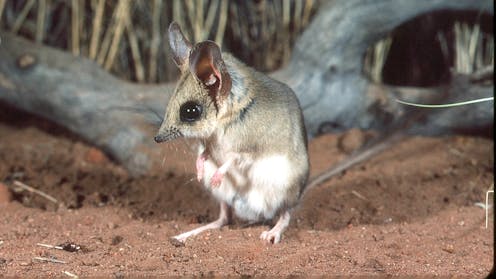
The long-eared kultarr (A. auritus) is the middle child in terms of body size, but its ears set it apart. They’re nearly as long as its head.

It’s found in patchy populations in the central and western sandy deserts, living on isolated stony plains.

A very cute mouse-like animal in front of a fallen branch.
The long-eared kultarr (A. auritus) is the middle child in terms of body size, but it has by far the biggest ears.
Ken Johnson

Are they threatened?

All three species of kultarr are hard to find, making it difficult to confidently estimate population sizes and evaluate extinction risk. The long-eared and gibber kultarrs don’t appear to be in immediate danger, but land clearing and invasive predators such as cats and foxes have likely affected their numbers.

Map of Australia showing past and present ranges of the three species of kultarr.
The three species of kultarr seem to now inhabit smaller areas than in the past.
Cameron Dodd

The eastern kultarr, however, is more of a concern. By looking at museum specimens going back all the way to the 1890s, we found it was once much more widespread.

Historic records suggest the eastern kultarr used to occur across the entirety of arid NSW and even spread north through central Queensland and into the Northern Territory. We now think this species may be extinct in the NT and parts of northwest Queensland.

What’s next?

To protect kultarrs into the future, we need targeted surveys to confirm where each species still survives, especially the eastern kultarr, whose current range may be just a shadow of its former extent. With better knowledge, we can prioritise conservation actions where they’re most needed, and ensure these remarkable, long-legged hunters don’t disappear before we truly get to know them.

Australia still has many small mammal species that haven’t been formally described. Unless we identify and name them, they remain invisible in conservation policy.

Taxonomic research like this is essential – we can’t protect what we don’t yet know exists. And without action, some species may disappear before they’re ever officially recognised.


The authors wish to acknowledge the important contributions of Adjunct Professor Mike Westerman at La Trobe University to the research discussed in this article.

The Conversation

Cameron Dodd receives funding from the Australian Biological Resources Study and Society of Australian Systematic Biologists.

Andrew M. Baker receives funding from the Federal Government, State Governments, Australian Biological Resources Study and various Industry sources.

Kenny Travouillon receives funding from Australian Biological Resources Study.

Linette Umbrello receives funding from the Australian Biological Resources Study (ABRS) National Taxonomy Research Grant Program (NTRGP)

Renee Catullo does not work for, consult, own shares in or receive funding from any company or organisation that would benefit from this article, and has disclosed no relevant affiliations beyond their academic appointment.

ref. Australia’s cutest mammal is now Australia’s cutest three mammals – https://theconversation.com/australias-cutest-mammal-is-now-australias-cutest-three-mammals-260006