Female politicians can be punished at the polls for not smiling – but men aren’t

Source: The Conversation – France – By Iona Astier, PhD Candidate in Economics, Université Paris 1 Panthéon-Sorbonne

When election time comes around, campaign posters feature candidates with a determined look in their eye, their local promises, well thought-out slogans in full view, and a smile – which particularly among women politicians has become something of a quiet, political prerequisite.

In 2016, during the Democrat National convention Hillary Clinton was commented more on supposedly not smiling or lacking warmth than on her electoral manifesto. Some years later Élisabeth Borne, who was then Prime Minister of France, was described several times as being “cold” and “stiff.” Recounting her twenty months spent at Matignon in a book (2024), she explains how her attitude was more harshly judged than if she had been a man. She appears on the cover of her book with a frank smile. In both cases, it was her appearance and allure that was being held against her rather than her ideas.

Women often get criticised for not smiling. But does this expectation have an impact electorally speaking? In other words, does choosing not to smile cost women more votes than it does men?

A ‘smile monitor’ for candidates?

A recent study carried out on 9,000 electoral manifestos from local elections in France in 2022 and 2024 subjected the phenomenon to a statistical reality test Lippmann, 2026. The promises that were examined are a precious source of analysis. In France, each elector whether male or female receives a copy before the ballot, presenting their manifesto pledges with a photo of the candidate alongside prominent politicians from the political parties they are affiliated with.

The emotions and smiles that could be detected or that were missing from the photos were measured with the help of artificial intelligence. Almost 80% of women were perceived to be “smiling” in the photo compared with 60% of men, representing a difference of 19% percentage points. Women appear to be smiling far less than their male counterparts.

What does a smile cost candidates?

The statistical analysis also shows that this difference is not electorally neutral. Using the same data from the 2022 and 2024 legislative elections, we measured the impact of smiling on the election results by taking into account the candidate’s age, political party, profession, department, and the type of constituency, as well as the content of their manifestos.

At comparable characteristics, smiling men and smiling women score about two points more in the polls compared to non-smiling men. But the asymetry lies with the candidates who don’t smile; a female candidate that doesn’t smile scores about two points less than a non-smiling male politician. For men, smiling adds value. For women, it’s more of a condition to avoid being penalised.

Chart representing a rough estimate of the effect of a smile and gender on the segment of the vote in the 1st round (in French)
A rough estimate of the effect of a smile and gender on the segment of the vote in the 1st round DR.
Fourni par l’auteur

To confirm these results, we set up an online experiment with 1000 people – a representative sample of the French population. We provided participants with a pair of photos of “mock,” AI generated female and male candidates. For each imaginary candidate, two versions of the same photo were created, one smiling and the other with a neutral expression, then they were presented to the participants in order to measure whether a smile can affect voting intentions.

We asked each participant the following question: “If you had to choose between two candidates what is the probability that you would vote for candidate A rather than candidate B.”

The preliminary results indicate that a neutral expression reduces voting intentions for all candidates, but that it is more strongly affects the women candidates. Not smiling reduces their chances of being selected by approximately three percentage points more than men. These results that tally with the analysis based on the electoral programmes, are currently the subject of a scientific paper that is being edited.

Examples of deepfakes that were used in the experiment to study the impact of smiling on voting intentions. DR.
Fourni par l’auteur

A ‘double-edged sword’ for women in politics

Why is the stigma attached to smiling so strongly directed at women? Psychology establishes that gender stereotypes make women into people who are naturally warm, attentive and less likely to be aggressive whereas men are associated with competitiveness, self-assuredness and emotional control. But when women obtain positions of power these expectations meet are met with tension.

Female candidates face “double trouble:” as women, they are situated on the register of warmth and empathy while as politicians, they must incarnate authority, firmness, which are qualities considered to be masculine. If they display too much heat, they risk being deemed insufficiently credible or less competent.

Conversely, if they adopt the codes of seriousness and distance, which are valued in politics, they expose themselves to criticism of coldness, of “stiffness” or of a lack of empathy, as experienced by Hillary Clinton or Élisabeth Borne. This double-edged sword raises a strategic question: should you smile to get elected, even if it means having to recompose your image once in office? While our data does not allow us to answer this question, it does point towards a paradox: the cogs behind electoral victory are not necessarily the same cogs that are in motion during the exercise of power.

For men, this conflict is much less marked. The stereotypes associated with them immediately correspond to those related to the exercise of power. This concordance offers them greater emotional freedom. Showing warmth is not considered a transgression, it is simply a mark of accessibility, which does not take anything away from their credibility.

Conversely, if a woman meets the expectations of warmth and empathy traditionally associated with femininity, she risks being perceived as less competent. Smiling then becomes a tool for adjustment that reduces the tension between these contradictory requirements, a way of “countering” access to a power function still perceived as a transgression of the female role. This constraint forces women to invest more in controlling their image.

An emotional load is thus added to the political burden, a form of “invisible tax” that would represent an expenditure of energy and resources that their male counterparts do not have to bear. Although this emotional cost is theoretically well documented, investigations conducted directly with women politicians on this experience are still rare.

Dealing with expectations

Faced with these constraints, women politicians can adopt different strategies. The first is conformity: displaying warmth and a smile to meet gendered expectations, at the cost of an additional effort. The second is the challenge by refusing these standards and assuming neutrality or distance. But this path is electorally risky. As our data shows, unlike her male counterparts, a candidate who does not smile exposes herself to a penalty at the ballot box.

A third strategy consists in instrumentalising these constraints. In his study, French political scientist Frédérique Matonti demonstrated that stereotypical media coverage of female politicians can, in some contexts, be turned to their advantage. In the case of Marine Le Pen, this treatment contributed to humanise her in contrast to her politically notorious father, thus serving her strategy of de-demonising France’s far right party.

A smile may seem trivial. But when we observe who is asking for it, and at what moment it is valued, then it reveals the norms that are still framing women’s access to positions of power. Understanding these mechanisms invites us to reflect and ask ourselves questions about what we expect, often unconsciously, from those who govern us.


A weekly e-mail in English featuring expertise from scholars and researchers. It provides an introduction to the diversity of research coming out of the continent and considers some of the key issues facing European countries. Get the newsletter!


The Conversation

Les auteurs ne travaillent pas, ne conseillent pas, ne possèdent pas de parts, ne reçoivent pas de fonds d’une organisation qui pourrait tirer profit de cet article, et n’ont déclaré aucune autre affiliation que leur organisme de recherche.

ref. Female politicians can be punished at the polls for not smiling – but men aren’t – https://theconversation.com/female-politicians-can-be-punished-at-the-polls-for-not-smiling-but-men-arent-279011
Jürgen Habermas: a philosopher whose hopes for a better future are more important than ever

Source: The Conversation – UK – By Susan Smith, Honorary Professor of Geography, University of Cambridge

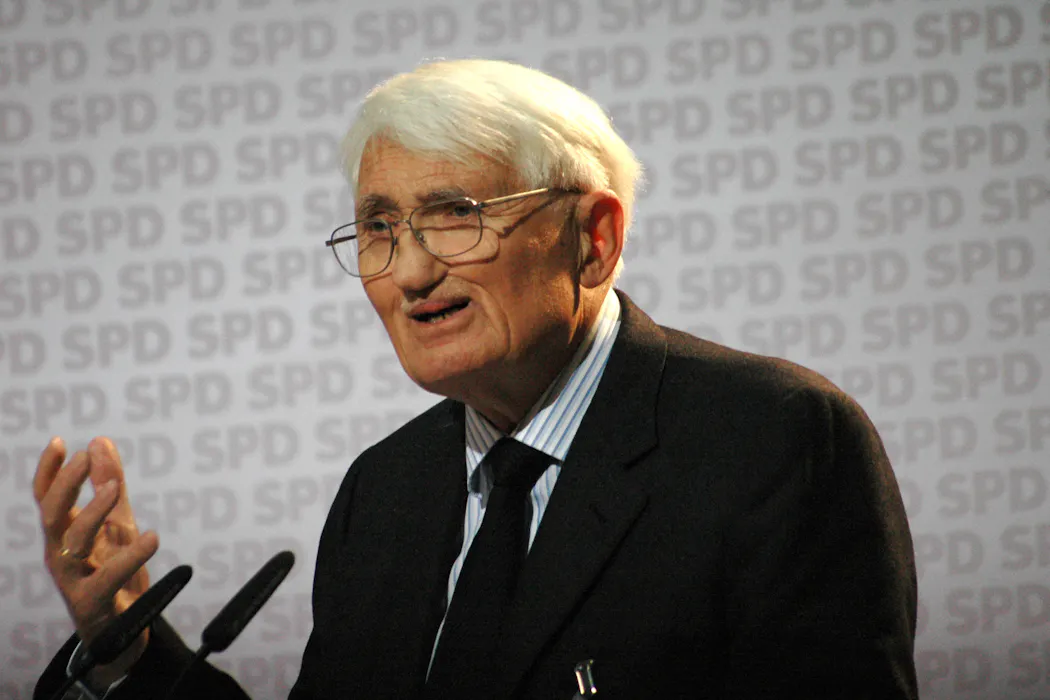
Jürgen Habermas speaking in 2007. 360b/Shutterstock

It is impossible to capture seven decades of formidable intellect, wrapped into some 14,000 books and articles, in less than a thousand words. Yet German philosopher Jürgen Habermas staked his career on the power of dialogue and deliberation, so it is worth chiming in.

Habermas, who died on March 14 at the age of 96, was among the greatest thinkers of our time. He was unshakeable in his conviction that people have minds of their own, can hope for a better future, and have the capability, collectively and democratically, to bring that future to life.

Born in Düsseldorf in 1929, he escaped conscription to the Wehrmacht by a whisker. His later realisation that, as a child, he had been enveloped by “a politically criminal system” propelled him into a lifelong scholarly, political and personal campaign to rescue democracy and restore the future.

It was an uphill struggle of breathtaking proportions. If the best was still to come, the journey towards enlightenment would require “nothing less than a comprehensive theory of modern society and its underlying dynamics”.

That was the scholarly project, and few 20th century theorists could tackle it. Habermas led the way with sweeping interdisciplinary reach: historical understanding, geographical imagination, sociological insight, grasp of legal theory, sustained engagement with ethics, aesthetics, psychology, epistemology, theology and more. Any one of these approaches would have moved the dial, but in Habermas they came together with a powerful political message.

Variously described as a socialist, democrat, internationalist, and above all humanitarian, his philosophy – practical, perhaps pragmatic – was his politics. Its centrepiece was the formation, functioning and fragility of a public sphere – Öffentlichkeit – mediating between states and civil societies, promising an alternative to the authoritarian, totalitarian regimes he eschewed.

Bookended by two landmark works, Habermas’s lifelong conviction was that the formation of public opinion through rational, reasoned conversation was vital for the conduct and survival of parliamentary democracy. Both works are cautionary tales concerned equally with the forces stifling deliberative democracy and with the conditions in which it might flourish.

The first, the Structural Transformation of the Public Sphere (1962) finds the scope for informed, inclusive, critical debate compromised by the intrusion of calculative, commercial and bureaucratic interests. Six decades later, A New Structural Transformation of the Public Sphere and Deliberative Politics (2022) takes on the algorithms driving social media. These, he argued – by accident, design or vested interests – fragment the public sphere, undermining the possibility for collective action against environmental change, excessive inequality and more.

Meanwhile, anchored on the two-volume Theory of Communicative Action (1981), Habermas mounted a sustained effort to make the public sphere work.

What scholar in the humanities and social sciences in the last half century is untouched by this project? My own reckoning, for example, was his prequel on Knowledge and Human Interests (1968). Once you realise that knowledge is not a thing to be discovered but a practice constituted by competing interests, there is no going back.

We were all critical theorists then, on a self-reflective pilgrimage to more rational, fairer futures. Habermas stayed with us every step of the way, not least because he did not confine himself to scholarly books and articles. His journalistic output and other public interventions were equally prodigious. Consider, for example, some 12 volumes of talks, speeches and commentary gathered in his Kleine Politische Schriften.

There is, it must be said, a well-developed feminist critique – and re-visioning – of Habermas’ core ideas. Those very public spaces in which deliberative democracy thrives (if it does) have traditionally been occupied by men, and are generally exclusionary in other ways. Not that such challenges fazed Habermas, who regularly exchanged views with a wide range of public intellectuals. These debates were how he expected the future to unfold.

Hope for the future

For Habermas, hope has not always triumphed over experience. Early in his career he underestimated how tame “conversation” might seem to his students. In the middle years, he probably oversold the potential of intellectuals to steer public debate.

More recently, a trend towards democratic decline and strengthening authoritarianism might suggest that he fell into a classic “democracy trap”. Was it futile to hope that the mandate for fully enfranchised populations to choose their governments through regular free and fair elections would spread?

Habermas was, in fact, acutely aware that the capacity for deliberative democracy can never be taken for granted. However, he never gave up on its promise. On this, he wrote actively to the end, sometimes controversially.

Not everyone liked his style: one obituary describes him as “brilliant, influential and stupefyingly tedious”. But the more telling view is that his work “has given us a vocabulary in which the promises of dignity, autonomy, and emancipation are kept alive and true”.

All in all, Habermas’ achievements are a valorisation of everything that populism is not. He held fast to his conviction that deep knowledge and cogent arguments can win the day, that even the smallest gesture towards a better world is worth the effort.

That is why a recent reviewer could describe his final three-volume project – Also a History of Philosophy – as “a work of willed optimism”. And it is why, in his last work, a collection of biographical conversations – Things Needed to Get Better – Habermas still pins his hopes on critical dialogue and reasoned debate.

This article features references to books that have been included for editorial reasons, and may contain links to bookshop.org. If you click on one of the links and go on to buy something from bookshop.org The Conversation UK may earn a commission.

The Conversation

Susan Smith has received funding from the ESRC, ARC and AHURI. She is affiliated with the British Academy and the University of Cambridge.

ref. Jürgen Habermas: a philosopher whose hopes for a better future are more important than ever – https://theconversation.com/jurgen-habermas-a-philosopher-whose-hopes-for-a-better-future-are-more-important-than-ever-279020

High vet bills have eroded pet-owners’ trust – but vets aren’t getting rich from their fees

Source: The Conversation – UK – By Rachel Williams, Reader in Human Resource Management, Cardiff University

Korawat photo shoot/Shutterstock

What would you pay to ease the pain of a beloved pet? For pet owners, vet bills are likely to be one expense that’s tightly bound up with emotion. But it seems the market is not working as well as it should. A report into the UK’s veterinary sector has identified concerns about price transparency and the growing dominance of large corporate groups that own local vet practices.

In the lead-up to the report by regulator the Competition and Markets Authority (CMA), much of the media coverage focused on rising veterinary fees. But behind practice doors, there is a subtler but equally important issue at play – declining trust between pet owners and professionals.

Vets have long been portrayed as trusted figures, from the James Herriot novels to Mrs Hamster in the Peppa Pig cartoons. But, increasingly, that trust is being questioned and vets report that clients are suspicious of the advice they offer. One vet I spoke to this week was frustrated that a client had refused all treatment options because they believed the recommendations were motivated by financial targets and not their pet’s welfare.

In my research with early-career vets, this shift in the public’s perception is clear. Some vets describe hostility from clients, while others avoid telling people they are a vet to escape conversations about fees. One vet in my study even left the profession due to the stress of these interactions.

High fees for clients do not equate to high salaries for vets. Vets I interviewed with around four years’ experience reported salaries ranging from £37,000 to £48,000. This is broadly comparable to other graduate professions such as teaching.

However, unlike teachers, some vets are offered only statutory sick pay, and have no enhanced holiday or pension benefits. Despite this, they are often seen as personally profiting from rising fees, when in reality they have limited control over pricing decisions.

Trust matters not only for the wellbeing of vets, but also for animal welfare. When trust breaks down, clients may delay or decline treatment. Vets told me they struggled to balance the best outcome for the pet with the owner’s willingness or ability to pay.

This can lead to distressing outcomes, including the euthanasia of animals with treatable conditions. Some owners are also taking their pets to Europe for surgery, where lower wages and overheads, as well as different regulatory frameworks, can significantly reduce the cost of treatment.

What will the new rules mean for pet owners?

The CMA’s findings suggest that part of this distrust may stem from how the veterinary market operates. It proposes a series of reforms, to come in later this year, to give pet owners more control and clearer information about pricing and practice ownership.

In a central change, price transparency will be mandatory. Practices will be required to publish prices for common treatments and provide written estimates before expensive procedures take place. In addition, price comparison tools will be introduced to allow people to shop around. Together, these measures aim to inform and empower pet owners.

The CMA is also targeting the way medicines are sold. Many pet owners don’t know that they can request a prescription and purchase medications online, often at lower cost. Under the new proposals, vets will be required to make this option clear, and there will be a £21 cap on prescription fees.

However, many online retailers of animal medication are owned by the corporate practices and so some believe this will merely transfer income from independent practices.

springer spaniel lying on a tiled floor
When trust between vet and client breaks down, it can delay vital treatment.
Cavan-Images/Shutterstock

Another key recommendation is greater transparency around practice ownership. Around 60% of practices are owned by a small number of corporate groups – up from 10% just over a decade ago. These practices are funded through venture capitalists and large corporations, although two also offer joint ownership models with vets.

Yet this information is often hidden, as practices work under their own names. In future, practices will need to state clearly who their parent company is on all signage and communications. They must also identify if this company also owns related businesses such as pet crematoria, online pharmacies and referral hospitals.

In theory, these changes should help rebuild trust. When clients have the ability to compare options, they may be less likely to assume that their vet’s recommendations are driven by profit.


Read more:
Are independent vets really better? The real issue isn’t necessarily who owns them


But transparency alone may not fully address the loss of trust in the profession. There is a risk that more focus on pricing could reinforce the perception of veterinary care as a commercial transaction rather than a professional service grounded in animal welfare.

In my interviews, vets frequently told me that they did not join the profession for the money. And yet the public perception is that high veterinary charges lead to high salaries.

The CMA also highlighted the need for broader regulatory reform, including potential changes to the Veterinary Surgeons Act, which regulates vets’ training, conduct and disciplinary processes. Updating this to regulate whole practices rather than just individual vets will reflect the dominance of large corporate providers and ensure minimum standards of care.

The veterinary profession is navigating a complex set of pressures, including the rising cost of living, increasing overheads in the UK and difficulty in retaining experienced vets. The CMA’s recommendations are an important step towards improving transparency and empowering pet owners, but rebuilding trust will take more than clearer pricing. It will depend on people understanding and anticipating the cost of pet ownership and valuing the expertise and care at the heart of veterinary relationships.

The Conversation

Rachel Williams does not work for, consult, own shares in or receive funding from any company or organisation that would benefit from this article, and has disclosed no relevant affiliations beyond their academic appointment.

ref. High vet bills have eroded pet-owners’ trust – but vets aren’t getting rich from their fees – https://theconversation.com/high-vet-bills-have-eroded-pet-owners-trust-but-vets-arent-getting-rich-from-their-fees-279170

Donald Trump’s ‘new’ 15-point plan is the biggest sign yet that Washington fears it is losing this war

Source: The Conversation – UK – By Bamo Nouri, Honorary Research Fellow, Department of International Politics, City St George’s, University of London

The language of power often reveals more than it intends. In a rare moment of candour on March 7, the US president, Donald Trump, described the confrontation with Iran as “a big chess game at a very high level … I’m dealing with very smart players … high-level intellect. High, very high-IQ people.”

If Iran is, by Trump’s own admission, a “high-level” opponent, then the sudden revival of a 15-point plan previously rejected by Iran a year ago suggests a disconnect between how the adversary is understood and how it is being approached. It’s a plan already examined in negotiation by Iran and dismissed as unrealistic and coercive. Despite this, the Trump administration is once again framing the “roadmap” as a pathway to de-escalation. Tehran has once again dismissed the gambit as Washington “negotiating with itself – reinforcing the perception that the US is attempting to impose terms rather than negotiate them.

The US president is right about one thing – Iran is not an opponent that can be easily dismissed or overwhelmed. Trump’s own description is a tacit acknowledgement that this is a far more capable and complex adversary than those the US has faced in past Middle Eastern wars, such as Iraq. And that is why the odds are increasingly stacked against the United States and Israel.

This conflict reflects a familiar but flawed imperial assumption: that overwhelming military force can compensate for strategic misunderstanding. The US and Israel appear to have misjudged not only Iran’s capabilities, but the political, economic and historical terrain on which this war is being fought.

Unlike Iraq, Iran is a deeply embedded and adaptable regional power. It has resilient institutions, networks of influence, and the capacity to impose asymmetric costs across multiple theatres. It knows how to manage maximum pressure.

The most immediate problem is lack of legitimacy. This war has authorisation from neither the United Nations or, in the case of America, the US Congress. Further, US intelligence assessments indicate Iran was not rebuilding its nuclear programme following earlier strikes – contradicting one of Washington’s justifications for war. The resignation of Joe Kent as head of the National Counterterrorism Center on March 17, was even more revealing. In his resignation letter Kent insisted that Iran posed no imminent threat.

This effectively collapses one of the original narratives underpinning the US decision to start the war – a further blow to legitimacy.


Read more:
Iran war lacks strategy, goals, legitimacy and support – in the US and around the world


A majority of Americans oppose the war, reflecting deep fatigue after Iraq and Afghanistan – hardly ideal conditions for what increasingly looks like another “forever war” in the Middle East. Current polling shows Trump’s Republicans trailing the Democrats ahead of the all-important midterm elections in November.

The war is both militarily uncertain and politically unsustainable. International allied support is also eroding. The United Kingdom — often trumpeted as Washington’s closest partner — has limited itself to defensive coordination, while Germany and France have distanced themselves from offensive operations. European allies also declined a US request to deploy naval forces to secure the strait of Hormuz. This reflects not just disagreement, but a deeper loss of trust in US leadership and strategic judgement.

US influence has long depended on legitimacy as much as force. That reservoir is now rapidly draining. Global confidence is falling, while images of civilian casualties — including over 160 schoolchildren killed in an airstrike on the first day of the war – have shocked international onlookers. Rather than reinforcing leadership, this war is accelerating its erosion.

Israel faces a parallel crisis of legitimacy – one that began in Gaza and has now deepened. The war in Gaza severely damaged its global standing, with sustained civilian casualties and humanitarian devastation drawing unprecedented criticism, even among traditional allies. This confrontation with Iran compounds that decline.

Striking Iran during active negotiations — for the second time — reinforces the perception that escalation is preferred over diplomacy. The issue is no longer just conduct, but credibility.

Strategic failure, narrative defeat

The conduct of the war compounds the problem. The assassinations of Iranian leaders, framed as tactical victories, are strategic failures. They have unified rather than destabilised Iran. Mass pro-regime demonstrations illustrate how external aggression can consolidate internal legitimacy.

The issue is no longer just the conduct of the war, but the credibility of the conflict itself. Regardless of how impressive the US and Israeli military are, it doesn’t compensate for reputational collapse. When building support for a conflict like this – domestically and internationally – legitimacy is a strategic asset. Once eroded across multiple conflicts, it is extraordinarily difficult to rebuild.

Rather than stabilising the system, US actions are fragmenting it. Allies are distancing themselves, adversaries are adapting, and neutral states are hedging.

The most decisive factor may be economic. The war is already destabilising global markets – driving up oil prices, inflation, and volatility at levels that combine the effects of 1970s and Ukraine war oil shocks.

This is a war that cannot be contained geographically nor economically. The deployment of 2,500 US marines to the Middle East (and reports that up to another 3,000 paratroopers will also be sent), reportedly with plans to secure Kharg Island – and with it Iran’s most important oil infrastructure – would be a dangerous escalation.

For Gulf states, the assumption that the US can guarantee security is increasingly questioned. Some states are reportedly now looking to diversify their partnerships and turning toward China and Russia, mirroring post-Iraq shifts, when US failure opened space for alternative powers.

Iran holds the cards

Wars are not won by destroying capabilities alone, but by securing sustainable and legitimate political outcomes. On both counts, the US and Israel are falling short.

Iran, by contrast, does not need military victory. It only needs to endure, impose costs, and outlast its adversaries. This is the logic of asymmetric conflict: the weaker power wins by not losing, while the stronger one loses when the costs of continuing become unsustainable.

This dynamic is already visible. Having escalated rapidly, Trump now appears to be searching for an off-ramp — reviving proposals and signalling openness to negotiation. But he is doing so from a position of diminishing leverage. In contrast, Iran’s ability to threaten energy flows, absorb pressure, and shape the tempo of escalation means it increasingly holds key strategic cards. The longer the war continues, the more that balance tilts.

Empires rarely recognise when they begin to lose. They escalate, double down, and insist victory is near. But by the time the costs become undeniable – economic crisis, political fragmentation, global isolation – it is already too late. The US and Israel may win battles. But they may be losing the war that matters: legitimacy, stability and long-term influence.

And, as history suggests, that loss may not only define the limits of their power, but mark a broader shift in how power itself is judged, constrained, and resisted.

The Conversation

The authors do not work for, consult, own shares in or receive funding from any company or organisation that would benefit from this article, and have disclosed no relevant affiliations beyond their academic appointment.

ref. Donald Trump’s ‘new’ 15-point plan is the biggest sign yet that Washington fears it is losing this war – https://theconversation.com/donald-trumps-new-15-point-plan-is-the-biggest-sign-yet-that-washington-fears-it-is-losing-this-war-279001

Matt Brittin: BBC’s new director general appointed at an existential moment for the broadcaster

Source: The Conversation – UK – By Steven Barnett, Professor of Communications, University of Westminster

The BBC has appointed former Google executive Matt Brittin as its new director general. Brittin will replace outgoing director general Tim Davie. He resigned last year in the wake of revelations about the editing of a Panorama documentary about Donald Trump and board disagreements over how it should be handled.

Brittin’s appointment comes at a critical moment, as the broadcaster prepares to renew its royal charter. This is the constitutional basis for the BBC’s existence, which sets out its mission and public purposes. It is traditionally renewed once a decade to make sure the BBC keeps up to date with political and technological changes.

Because the renewal process is run by the government of the day, it can involve difficult conversations with ministers who – while acknowledging the BBC’s independence – can insist on major changes. Despite some challenging political environments, each charter renewal has generally resulted in an evolution from previous years. The BBC has moved from radio to TV, from analogue to digital and online.

But this time around feels more existential. In a world dominated by American streamers and online platforms owned by tech billionaires, the government has proposed a range of options for the BBC’s future that raise fundamental questions, in particular about its funding and governance.

The culture secretary, Lisa Nandy, announced the government’s intention to make the charter permanent to avoid the risk of political interference. Following a period of consultation, the government will publish firmer proposals in the autumn, with the new charter signed off by Nandy (or her successor) early next year.

This was a significant victory for the BBC, which argued for a permanent charter in its own response to the government consultation. It also called for changes to how appointments are made to the BBC board, to avoid any suggestion of government influence. This was perhaps influenced by the circumstances of Davie’s departure.


Read more:
The political meddling that led to BBC crisis – and how to stop it in the future


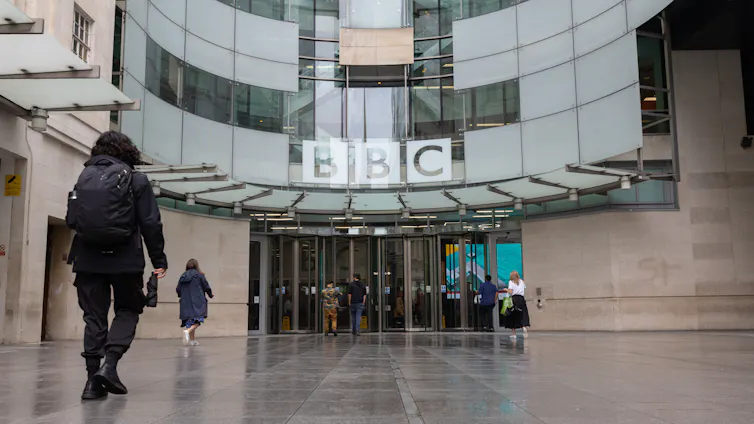
Front facade of BBC broadcasting house
The BBC faces a key moment with the renewal of its charter.
Zeynep Demir Aslim/Shutterstock

There are three key pieces of context that make this review so important.

First, it is quite possible that the broadcast signal will be switched off in the next charter period. The government is now considering options for the distribution of TV, which will require upgrading existing infrastructure if the current terrestrial system is to continue into the 2040s. Given that households are moving to broadband via smart TVs and other devices, broadcasters have expressed a clear preference for an earlier switch-off to avoid the cost of running two distribution systems.

At that point, the BBC ceases to be a broadcaster (except perhaps via radio) and becomes a public service content provider. It will have to compete not just with powerful streamers like Netflix, but with platforms like YouTube. A tech background like Brittin’s will arguably help the BBC in this new competitive environment. But he will need an experienced deputy with the kind of journalistic background required to deal with the (inevitable) editorial controversies that the BBC will face.

Second, the notion of a TV licence fee has become increasingly anachronistic in the digital world. There is greater pressure – especially in a cost-of-living crisis – for a more progressive payment system that takes better account of ability to pay.

The government has ruled out a German-style household tax and funding through general taxation, but not advertising or the idea of top-up subscription (where a “premium” is charged for content beyond a basic tier). It is also considering a reformed licence fee.

Third, the current political environment is more volatile than it has been for decades. Nigel Farage has made his contempt for the BBC abundantly clear, as well as his party’s determination to cut its funding by half. The charter renewal is an opportunity to insulate the BBC from longer term attempts to undermine or dismantle it.

Protecting the BBC

Critics may want to see a downsized BBC. But in a media world dominated by US-based tech billionaires and entertainment behemoths – and where disinformation poses serious risks to democracy – the broadcaster is more necessary than ever.

It is not only the most trusted news brand in the UK, but provides billions in investment to Britain’s creative industries. And, it is a vital element of Britain’s soft power in an unstable geopolitical environment.

The new charter must therefore guarantee the BBC’s independence. No parliament can tie the hands of its successors. But the next charter can ensure there are obstacles to any government determined to inflict damage on the BBC.

Nandy’s announcement of a permanent charter is an important first step, guaranteeing the BBC’s long-term existence. While it would of course be seriously weakened by a major funding cut, the institution itself would survive and could be revived by a subsequent government.

That permanent charter could be accompanied by a much more independent process of appointing a chair and non-executive directors, to insulate the BBC from political influence. A recent report from the British Academy, examining how other countries manage their public broadcasting systems, drew attention to Germany’s model. There, an independent body is charged both with protecting the independence of German public broadcasters and independently setting the level of funding.

A second area of fundamental reform would be a funding system that provides for universal payment, but is not linked specifically to television and makes some allowance for ability to pay. An evolution from the current licence fee – one possibility floated by the government – would provide the BBC with a more secure and sustainable funding base, along with options to provide discounts for struggling households.

The BBC’s future is now in the hands of a government that appears to appreciate its continuing importance to Britain’s cultural and democratic life. We will soon find out whether this government is up to the job of a much-needed radical renewal.

The Conversation

Steven Barnett is a member of the British Broadcasting Challenge which campaigns for Public Service Broadcasting. He is on the management and editorial boards of the British Journalism Review. He is on the Advisory Board of the Charitable Journalism Project which campaigns for public interest journalism and on the board of Hacked Off which campaigns for a free and accountable press.

ref. Matt Brittin: BBC’s new director general appointed at an existential moment for the broadcaster – https://theconversation.com/matt-brittin-bbcs-new-director-general-appointed-at-an-existential-moment-for-the-broadcaster-278453

Kent meningitis outbreak: the latest on the bacterial strain at its centre

Source: The Conversation – UK – By Mark Fielder, Professor of Medical Microbiology, Kingston University

A meningitis outbreak in Kent has been caused by a strain of bacteria that appears to be genetically distinct from anything scientists have seen before. Health officials are working urgently to understand what that means.

As of March 23, 23 young people have been confirmed as cases or considered probable cases of invasive meningococcal disease linked to the outbreak. Two have died. The majority attended a nightclub in Canterbury called Club Chemistry in the first week of March, and almost all are students or young people in education, with an average age of 19.

The strain belongs to a well-known family of meningococcal bacteria called clonal complex 41/44, which accounts for around 40% of invasive meningococcal disease in the UK. Within that family, it sits in a subgroup that has been circulating in England since 2020. But when scientists at the UK Health Security Agency sequenced its genome – essentially reading its genetic code – they found it was slightly different from its closest known relatives, with around 80 genetic differences between it and the most similar strains on record.

One differences is in the pilX gene, which affects structures on the surface of the bacterium that are known to play a role in how infectious it is. Scientists are cautious about reading too much into this at this stage – genetic differences do not automatically translate into changes in disease-causing properties – but it is one of several features that need to be investigated further.

What does this mean in practice? Officials are not yet sure why this outbreak is larger and spreading faster than usual. Three possible explanations are on the table. The bacteria may be more transmissible or virulent than usual. The population of young people affected may have lower immunity than expected. Or social and environmental factors, such as crowded venues, close contact and shared drinks, may have driven the spread. Most likely, say officials, it is a combination of all three.

The good news is that the strain responds to standard antibiotics. Tests have confirmed it is sensitive to penicillin, ciprofloxacin, rifampicin and cefotaxime, the drugs routinely used to treat and prevent meningococcal disease. Anyone who has been in close contact with a confirmed case has been offered preventative antibiotics.

Antibiotic pills.
Antibiotics are still effective against the strain that caused the outbreak.
Sonis Photography/Shutterstock.com

The vaccine question

There are two vaccines in the UK that protect against MenB – the strain causing this outbreak – called Bexsero and Trumenba. But the situation around vaccines is not straightforward. Both work by triggering the immune system to recognise proteins on the surface of the bacteria.

Testing suggests the outbreak strain is likely to be covered by at least one component of Bexsero, which is encouraging. However, a full assessment is still underway, and none of the people who fell ill would have been eligible for MenB vaccination through the standard childhood programme, which was introduced in 2015 and given to babies at eight weeks old.


Read more:
Kent’s meningitis outbreak was years in the making – here’s why


Vaccination has been offered to students and close contacts linked to the outbreak, and health officials say this remains an important protective measure.

The outbreak is currently classified at its lowest active level – a known cluster with cases directly linked to one another, all in Kent, with no sign of wider spread across the country. However, officials consider it likely that a few cases connected to the cluster but outside Kent will emerge in the coming weeks, as some of those who attended Club Chemistry may have returned to other parts of the country.

The chance of this outbreak spreading nationwide is currently considered remote. But officials are urging increased vigilance. Risk assessments will be updated as new evidence comes in.

Several studies are now underway. Researchers are examining blood samples from young people to understand how much natural immunity exists against this particular strain. A separate study will look in detail at what happened at Club Chemistry on the nights of 5 to 7 March, in an effort to understand exactly how transmission occurred.

The Conversation

Mark Fielder has received funding from JPIAMT/MRC

ref. Kent meningitis outbreak: the latest on the bacterial strain at its centre – https://theconversation.com/kent-meningitis-outbreak-the-latest-on-the-bacterial-strain-at-its-centre-278925

Hoppers embraces the messy reality of nature – and shows why diversity matters in environmental storytelling

Source: The Conversation – UK – By Yuan Pan, Lecturer in Digital Infrastructures & Sustainability, King’s College London

Pixar’s new film Hoppers follows Mabel Tanaka, a young environmentalist who grew up exploring a forest glade with her grandmother. When the city of Beaverton’s mayor announces plans to demolish the glade for a new highway, Mabel’s attempts to stop him go nowhere. This is until she discovers a secret university lab.

Scientists in the lab have developed a technology that transfers human consciousness into lifelike robotic animals, allowing people to experience the world from an animal’s perspective. Mabel (Piper Curda) hops into a robotic beaver to rally the creatures of the glade. What she discovers there – a world governed by its own complex rules of coexistence – is far more complicated than anything she expected.

The film’s central line is spoken by Grandma Tanaka (Karen Huie) as she and Mabel sit quietly in nature: “It’s hard to be mad when you feel like you’re part of something big.” It is a simple line that anchors the film’s entire moral values.

Hoppers arrives 17 years after Wall-E, Pixar’s last overtly environmentally themed film. Traditionally, mainstream western-centric animation has favoured anthropomorphic sentimentality over ecological realism. However, Hoppers signals a shift toward more complexity, where animals eat one another and humans are not simple villains. By depicting the uncute realities of nature, Pixar is embracing more nuanced environmental storytelling.

The trailer for Hoppers.

The film is populated by angry characters: Mabel at the destruction of nature; Mayor Jerry (Jon Hamm) at Mabel’s obstruction of his superhighway; the Monarch butterfly insect queen (Meryl Streep) at human disrespect for wildlife; and her heir Titus (a caterpillar voiced by Dave Franco) at humans and animals alike for disrespecting insects.

Their anger will be recognisable to anyone working in environmental conservation. The feeling that nature is continually losing ground to economic interests generates intense frustration – something I have experienced repeatedly over the course of my career.

Set against all of this, however, is the beaver leader of the pond, King George (Bobby Moynihan) whose “pond rules” offer a quietly radical alternative. He knows every creature in the pond by name, down to the earthworms. He believes that hunger must be fed, even if one animal must eat another. Above all, he holds that “we’re all in this together” – a principle he extends even to the humans destroying his habitat.

George embodies what environmental researchers call relational values: the connections that link humans to nature and to other humans, which shape who we are as people.

His worldview gives Grandma Tanaka’s line its full weight. The film resists the temptation to make its human antagonist a straightforward villain. Mayor Jerry is not just an evil developer. He is, by most measures, a well-liked and good mayor. He simply fails to care for the wildlife.

This reflects the genuine complexity of social-ecological systems, where the trade-offs between human development and environmental protection are rarely a contest between good and evil. This moral complexity is more reminiscent of the Japanese animation studio Studio Ghibli, than mainstream Pixar. Ghibli films like Princess Mononoke (1997) resist clean resolutions, portraying neither humans as purely destructive nor nature as passive.


Read more:
How Studio Ghibli films can help us rediscover the childlike wonder of our connection with nature


As I have argued elsewhere, this is a distinctly non-western approach to environmental storytelling. The fact that Pixar appears to be borrowing from this tradition is significant. It suggests that the most effective environmental narratives do not come from western animation’s default moral framework. Hoppers’ argument is that the rhetoric of “us versus them” has never resolved any environmental crisis, or any global crisis. Anger and fear divide people. A sense of shared belonging connects us.

Representation in environmental stories

Hoppers does something else that matters. It puts an east Asian woman at the centre of an ecological story. This is not simply a question of representation. It is a question of who belongs in environmental spaces.

As a British-Chinese environmental researcher, I am acutely aware of these questions. In the UK, 95% of the environmental sector identifies as white. This lack of diversity is not merely a matter of numbers. The term “environmentalist” has long carried associations with whiteness and wealth, and those associations shape who enters the profession, who stays, and whose approaches are considered legitimate.

Growing up with pressure to choose a stable and high-status profession, many people from minority communities never see environmental conservation as a path available to them. I have experienced this tension personally, and it disproportionately affects those from minority backgrounds. When media narratives exclude minority voices from environmental stories, they reinforce the homogeneity that weakens environmental conservation as a field.

Mabel’s role in Hoppers, as a bridge between King George’s nature realm and the human world, mirrors a position that many academics from underrepresented backgrounds would know well. They act as the translator, the intermediary and the person who moves between worlds. From a personal perspective, seeing that role embodied by an east Asian woman in a major animated film is not a small thing. It signals to diverse young people that environmental advocacy is a space that belongs to them. I hope this film inspires a new generation of diverse environmental conservationists.

Animation can reach audiences through emotional pathways that differ from academic research. Hoppers uses that reach wisely, by not oversimplifying the environmental crisis. Grandma Tanaka’s line: “It’s hard to be mad when you feel like you’re part of something big,” is the kind of environmental message that stays with people. Not a warning. But an invitation for humans to be reconnected to nature.


The climate crisis has a communications problem. How do we tell stories that move people – not just to fear the future, but to imagine and build a better one? This article is part of Climate Storytelling, a series exploring how arts and science can join forces to spark understanding, hope and action.


The Conversation

Yuan Pan does not work for, consult, own shares in or receive funding from any company or organisation that would benefit from this article, and has disclosed no relevant affiliations beyond their academic appointment.

ref. Hoppers embraces the messy reality of nature – and shows why diversity matters in environmental storytelling – https://theconversation.com/hoppers-embraces-the-messy-reality-of-nature-and-shows-why-diversity-matters-in-environmental-storytelling-279127

Le cancer frappe de plus en plus de jeunes parents. À l’inquiétude s’ajoutent la culpabilité et une quête de normalité

Source: The Conversation – in French – By Gabrielle Fortin, PhD, travailleuse sociale, professeure agrégée à l’École de travail social et de criminologie, Université Laval

Ce n’est pas qu’une impression : de plus en plus de jeunes adultes sont frappés par le cancer. Une augmentation mondiale. Parmi eux, plusieurs sont aussi parents de jeunes enfants. Une réalité encore peu visible dans l’espace public, pourtant bien réelle et dont les impacts sont majeurs pour plusieurs générations.


Une étude publiée en 2023 dans le réputé British Medical Journal Oncology (BMJ Oncology) montre que le taux de nouveaux diagnostics de cancer chez les moins de 50 ans dans le monde a augmenté de 79,1 % de 1990 à 2019. Selon la revue The Lancet Oncology, sur les 18,7 millions de nouveaux cas de cancer observés dans 115 pays en 2022, 1,3 million touchaient de jeunes adultes, et ce chiffre pourrait croître de 12 % d’ici 2050.

Au Canada, selon les données les plus récentes de la Société canadienne du cancer, environ 1 200 jeunes adultes sont décédés de la maladie en 2023. Ces statistiques sont frappantes – et elles soulèvent des questions cruciales sur l’adéquation de nos services.

Je constate cette réalité à la fois dans ma pratique comme travailleuse sociale au Centre Bonenfant-Dionne, à Québec, un centre de jour en soins palliatifs, et dans mon travail de recherche comme professeure en travail social à l’Université Laval. C’est avec ce bagage que j’ai mené, entre 2023 et 2025, une étude qualitative auprès de jeunes adultes atteints d’un cancer avancé et de leurs proches.

Je me suis particulièrement intéressée à celles et ceux qui sont aussi parents d’enfants mineurs, afin de mieux comprendre leur vécu, alors que la majorité des services en oncologie et en soins palliatifs sont encore pensés pour des personnes plus âgées ou en toute fin de vie.

Comment vivre pleinement quand l’avenir est profondément incertain ?

Un diagnostic commun, des trajectoires profondément différentes

Les récits recueillis font émerger deux profils contrastés, qui illustrent la diversité des trajectoires possibles malgré un même diagnostic.

Le premier est celui de David, 35 ans, père d’un enfant de deux ans et demi. Il a reçu un diagnostic de cancer de stade IV il y a moins d’un an. Malgré les traitements, la maladie progresse rapidement, à un rythme qui lui laisse peu de temps pour s’adapter.

Je suis devenu envahi par la mort, par la peur de mourir, constamment.

Pour David, la mort est omniprésente : dans ses pensées, dans ses projections, dans sa relation à son enfant. Il se demande s’il est encore pertinent de s’engager pleinement dans son rôle parental.

Je me dis : “est-ce que ça vaut la peine ?” […] Ça aura pas d’impact comme si j’étais en santé et que j’allais le voir grandir.

Cette réflexion est traversée par un fort sentiment de culpabilité : culpabilité de ne pas être là plus longtemps, de ne pas en faire assez, de ne pas « profiter » comme il le devrait.

Si je crève demain… je veux juste me dire : “J’en ai-tu fait assez aujourd’hui pour en profiter puis que mon monde en profite aussi ?”

Un autre participant à notre recherche abonde dans le même sens :

Je me sens forcé de vivre le moment présent. […] C’est comme si on me mettait un fusil sur la tempe puis qu’on me disait : « aie du plaisir ». Ça peut te tuer tout de suite, mais ça se peut que ça soit plus long. Aie du plaisir. Profite. Profite de la ride de char avec un gun sur la tête.

L’incertitude qui s’étire dans le temps

Un second profil est celui de Victoria, 40 ans, mère de deux enfants âgés de 9 et 12 ans. Diagnostiquée d’un cancer de stade IV il y a quatre ans, elle est toujours sous traitement visant à prolonger sa vie. Les lignes de traitement se succèdent, avec des effets secondaires qui affectent son énergie et son quotidien.

Victoria vit une grande ambivalence entre le désir de normalité pour elle et sa famille, et le besoin de parler de ce qu’elle traverse. Avec le temps, son entourage tend parfois à oublier qu’elle est malade.

Je connais bien mon enfant et je sais que c’est pas toujours présent dans sa tête que maman est malade. On l’oublie, on l’oublie facilement et c’est correct. Je suis contente de ça, mais c’est un double discours pour moi. […] J’ai comme un masque tout le temps.

Chez Victoria, la culpabilité prend plusieurs formes : celle de voir ses parents vieillir sous le poids de l’inquiétude, celle de laisser davantage de responsabilités à son conjoint, mais surtout celle d’avoir transmis un cancer génétique à ses enfants.

Même quand je vais aller dans mon lit de mort, je vais regarder mes enfants, puis je vais avoir le sentiment d’avoir été une mauvaise mère parce que je leur ai donné vraiment un bagage génétique de merde.

Ce sentiment est nourri par la peur que l’avenir de ses enfants soit durablement marqué par la maladie.

Je sais que c’est pas de ma faute, mais c’est comme si je m’en voulais de leur faire ça pour plus tard.

De quoi ces jeunes parents ont-ils réellement besoin ?

Quatre besoins majeurs émergent des récits recueillis dans l’étude.

1. Maintenir une vie la plus normale possible

Mes besoins ? C’est de garder le plus possible un semblant de vie normale.

Pour ces parents, préserver une routine, des projets et des moments ordinaires est essentiel. Il s’agit de ne pas laisser toute la place à la maladie et à la mort.

On n’est pas obligés de parler toujours de la mort !

2. Être entendus, sans pitié ni silence

Les participants expriment un fort besoin d’être écoutés et compris, sans être réduits à leur diagnostic ni mis à l’écart. Pourtant, plusieurs filtrent leurs paroles pour protéger leurs proches.

Mes parents savent pas tout. Je ne leur dis pas tout. Souvent le monde fait comme : “Ah, tu vas mieux !” Puis je dis : “Oui, oui.” […] J’ai comme un masque tout le temps.

3. Plus d’humanité dans les soins

Les jeunes parents souhaitent des relations plus humaines avec les équipes soignantes : de l’écoute, de la transparence et une reconnaissance de leurs inquiétudes existentielles, celles qui concernent leur famille, pas seulement médicales.

Je trouve que ça manque d’humain pour être dans le prendre soin.

4. Retrouver du pouvoir sur leur trajectoire

Enfin, ils cherchent à reprendre du pouvoir : dans les décisions médicales, dans ce qu’ils mettent en place pour leur famille et dans le sens qu’ils donnent à leur vie malgré la maladie.

Qui je suis avec la maladie ? Qu’est-ce qu’il me reste et qu’est-ce que je veux faire ?

Cette reprise de pouvoir s’est aussi exprimée dans leur participation à la recherche, plusieurs souhaitant que leur expérience serve à d’autres.

J’aurais envie de lui dire de garder espoir. J’aurais envie de lui dire de s’entourer. […] de parler, de ne pas rester avec ça, de se faire du bien au quotidien, de penser à elle.

L’enjeu des soins n’est pas seulement de prolonger la vie

Reconnaître la réalité des jeunes parents atteints d’un cancer incurable, c’est accepter que vivre le présent ne soit pas toujours un choix apaisant, mais souvent un effort constant, fait d’ajustements, de résistances et de petites victoires. Derrière l’injonction à « profiter », ces parents composent avec une menace qui ne disparaît jamais complètement.


Déjà des milliers d’abonnés à l’infolettre de La Conversation. Et vous ? Abonnez-vous gratuitement à notre infolettre pour mieux comprendre les grands enjeux contemporains.


Quand je joue de la guitare, j’arrive parfois à le mettre de côté. Avec mon fils aussi, quand je le fais rire […] j’essaie d’être dans le moment présent. Mais c’est difficile. Le sentiment du gun sur la tempe est constamment là.

Prendre au sérieux cette parole, c’est reconnaître que l’enjeu des soins n’est pas seulement de prolonger la vie. La rencontre de ces parents met en lumière l’importance d’humaniser nos soins pour qu’ils soutiennent non seulement la qualité de vie physique des jeunes parents atteints de cancer avancé, mais aussi être à l’écoute de leurs besoins existentiels et soutenir leur parentalité même lorsque le présent se vit sous pression.

La Conversation Canada

Gabrielle Fortin a reçu des financements de Conseil de recherches en sciences humaines du Canada (CRSH).

ref. Le cancer frappe de plus en plus de jeunes parents. À l’inquiétude s’ajoutent la culpabilité et une quête de normalité – https://theconversation.com/le-cancer-frappe-de-plus-en-plus-de-jeunes-parents-a-linquietude-sajoutent-la-culpabilite-et-une-quete-de-normalite-275269

De plus en plus de jeunes adultes souffrent d’arthrose. Un diagnostic précoce peut éviter les dommages irréversibles

Source: The Conversation – in French – By Atiqah Aziz, Senior Research Officer at the Tissue Engineering Unit (TEG), National Orthopaedic Centre of Excellence for Research & Learning (NOCERAL), Department of Orthopaedic Surgery, Faculty of Medicine, University of Malaya

L’arthrose se développe généralement sur des années. Plus la maladie est détectée tôt, mieux on peut prévenir les dommages sur les articulations. (Shutterstock)

Des études montrent que de plus en plus des personnes jeunes et actives reçoivent des diagnostics d’arthrose. J’ai pu constater cette situation de mes propres yeux dans mon entourage. Une de mes amies, passionnée de marathon, a développé une arthrose de stade 2 à l’âge de 35 ans. Plusieurs célébrités, dont Robbie Williams, Tiger Woods et Andy Murray, ont également évoqué publiquement leur expérience avec cette maladie à un âge relativement jeune.

Si l’on considère généralement l’arthrose comme une conséquence inévitable du vieillissement, elle peut nuire à la qualité de vie à tout âge, en transformant des activités quotidiennes telles que marcher, monter des escaliers ou s’entraîner en moments douloureux. Plus de 600 millions de personnes sont atteintes d’arthrose dans le monde, et les facteurs de risque sont variés. On compte parmi eux l’obésité, le vieillissement, les troubles métaboliques, l’inflammation chronique, les antécédents de blessures articulaires et les contraintes mécaniques répétitives.

L’arthrose peut avoir des effets dévastateurs chez les jeunes. La douleur et la raideur peuvent limiter l’activité physique pendant les années où l’on travaille, où l’on prend soin de ses proches et où la vie de famille est exigeante. Elle peut affecter la santé mentale, restreindre les choix de carrière et les possibilités d’activité physique, ce qui augmente le risque de développer d’autres problèmes de santé à long terme. De plus, les jeunes devront gérer leurs symptômes et subir des traitements répétés pendant des décennies.

Douleurs, raideurs, craquements et grincements

L’arthrose se développe quand le cartilage qui protège les articulations se détériore progressivement. Le cartilage agit normalement comme un amortisseur, permettant aux os de bouger facilement les uns contre les autres. S’il s’use, les articulations perdent cette protection. Les surfaces osseuses commencent alors à frotter les unes contre les autres, ce qui provoque des douleurs, des raideurs ainsi que des craquements et des grincements que beaucoup évoquent avec humour jusqu’à ce qu’il devienne impossible de faire abstraction de la douleur.

L’arthrose ne se déclare pas du jour au lendemain. Elle se développe généralement sur des années, voire des décennies. Les premiers symptômes sont souvent subtils et faciles à ignorer : légère douleur au genou après une activité physique, raideur qui s’atténue avec le mouvement ou douleur intermittente. Beaucoup de personnes ne consulteront un médecin qu’au moment où la douleur est devenue persistante et que les lésions articulaires sont avancées.

Soulager les symptômes

À l’heure actuelle, les traitements visent davantage à soulager les symptômes qu’à guérir la maladie. Ils comprennent des exercices thérapeutiques, des analgésiques et des injections thérapeutiques.

Ces injections peuvent être constituées de plasma riche en plaquettes, fabriqué à partir d’une partie concentrée du sang du patient et contenant des facteurs de croissance censés favoriser la réparation des tissus. D’autres utilisent des vésicules dérivées des plaquettes, qui sont de minuscules particules libérées par ces dernières et qui transportent des signaux biologiques impliqués dans l’inflammation et la guérison.

Cependant, la plupart des preuves à l’appui des approches basées sur les vésicules proviennent d’études animales menées, notamment, sur des rats, et elles ne sont pas encore utilisées de manière courante dans la pratique clinique avec des humains. On peut également injecter de l’acide hyaluronique. Il s’agit d’une substance gélatineuse naturellement présente dans le liquide articulaire qui aide à lubrifier et à protéger l’articulation.

Tous ces traitements visent à réduire la douleur et à améliorer la mobilité articulaire plutôt qu’à réparer le cartilage endommagé. Chez certaines personnes, ils procurent un soulagement temporaire. Cependant, lorsque les lésions articulaires sont graves, il est possible que le remplacement total de l’articulation soit l’unique solution envisageable.

Mais que se passerait-il si l’on pouvait dépister l’arthrose beaucoup plus tôt, avant même l’apparition de la douleur et des lésions irréversibles ?

La prévention et l’intervention précoces peuvent réduire la douleur, préserver la mobilité et diminuer considérablement les coûts en soins de santé. Le défi a toujours été de détecter l’arthrose suffisamment tôt pour pouvoir agir.

Diagnostic précoce

C’est dans ce contexte que les nouvelles technologies de diagnostic pourraient apporter une avancée décisive. Chaque composé chimique présent dans l’organisme possède une structure moléculaire unique qui, lorsqu’elle est analysée, produit un profil distinctif appelé « signature spectrale ».

Cette signature révèle la composition chimique d’un échantillon, comme du sérum sanguin par exemple. Chez les personnes atteintes d’arthrose, les chercheurs ont observé de légers changements au niveau de l’inflammation, du métabolisme et du renouvellement tissulaire susceptibles de modifier ce profil chimique.

On peut étudier ces signatures grâce à une technique appelée spectroscopie infrarouge à transformée de Fourier en réflectance totale atténuée[JG2]. Malgré son nom intimidant, le principe est simple.

On expose un petit échantillon de sang à une lumière infrarouge, et la façon dont cette lumière est absorbée fournit des informations sur les types de molécules présentes. Les changements dans les protéines, les lipides et d’autres biomolécules peuvent laisser des signatures mesurables, que les chercheurs considèrent comme des indicateurs potentiels de l’arthrose.

Ces approches sont principalement utilisées dans le cadre d’études et ne font pas encore partie des soins cliniques courants. Même si elles n’en sont qu’à un stade précoce, ces recherches sont importantes, car elles pourraient permettre d’identifier plus tôt les risques d’arthrose et de mettre en place des mesures de prévention ainsi que des traitements ciblés pour protéger la santé des articulations.

En combinant cette approche à l’analyse computationnelle, les chercheurs peuvent distinguer des structures chimiques complexes associées à la maladie. Concrètement, il s’agit de comparer des échantillons sanguins de personnes atteintes ou non d’arthrose afin de détecter des différences invisibles à l’œil nu. Des approches similaires peuvent être utilisées avec d’autres techniques de laboratoire, telles que la spectroscopie et des outils de biologie moléculaire, pour identifier des biomarqueurs liés à une maladie articulaire précoce.


Déjà des milliers d’abonnés à l’infolettre de La Conversation. Et vous ? Abonnez-vous gratuitement à notre infolettre pour mieux comprendre les grands enjeux contemporains.


Une détection hâtive pourrait transformer la prise en charge de l’arthrose. La reconnaissance d’un problème avant l’aggravation des symptômes permettrait aux personnes concernées d’agir plus tôt, grâce à des exercices ciblés, à la gestion du poids, à la prévention des blessures et à des stratégies de traitement personnalisées.

Les années de douleur et de limitations ne devraient pas être une fatalité en cas d’arthrose. En mettant l’accent sur la détection précoce et la prévention plutôt que sur le traitement à un stade avancé, on pourrait modifier l’évolution de la maladie et améliorer la qualité de vie de millions de personnes dans le monde.

La Conversation Canada

Atiqah Aziz est affiliée au groupe d’ingénierie tissulaire (TEG) du Centre national d’excellence pour la recherche et l’apprentissage en orthopédie (NOCERAL), département de chirurgie orthopédique de la faculté de médecine de l’Université Malaya, 50603 Kuala Lumpur, Malaisie.

ref. De plus en plus de jeunes adultes souffrent d’arthrose. Un diagnostic précoce peut éviter les dommages irréversibles – https://theconversation.com/de-plus-en-plus-de-jeunes-adultes-souffrent-darthrose-un-diagnostic-precoce-peut-eviter-les-dommages-irreversibles-275621

Encourager la marche, un gain qui se compte en milliards pour la société française

Source: The Conversation – in French – By Mathieu Chassignet, Ingénieur transports et mobilité, Ademe (Agence de la transition écologique)

Santé, espace gagné sur les infrastructures routières, autonomie des enfants, économies de voirie… les territoires qui mettent en place des politiques publiques en faveur de la marche en perçoivent des bénéfices socio-économiques plus larges que ceux pensés à première vue. Dans une étude, l’Agence de la transition écologique, Ademe, les a évaluées : les résultats sont édifiants.


Il n’y a pas beaucoup de risque à avancer que la marche est vertueuse. En matière de santé physique et psychologique notamment, toutes les personnes en mesure de marcher en ont fait l’expérience. D’innombrables études étayent ces bienfaits.

Mais sommes-nous conscients, au-delà de cette échelle individuelle, des retentissements bien plus larges que les trajets à pied ont sur la société ? C’est pour répondre à cette question et tenter de quantifier ces bénéfices que l’Agence de la transition écologique (Ademe) a mené une vaste étude. Celle-ci est appuyée sur un important corpus de 130 sources bibliographiques et un comité scientifique constitué de chercheurs, d’associations et de membres de l’administration.

Ce travail avait deux grands objectifs :

  • d’une part, réévaluer l’ampleur de nos trajets à pied, qui sont en réalité minorés dans les statistiques de par la façon dont ils sont comptabilisés. Les Français marchent en moyenne 1,2 heure (ou soixante-douze minutes) et 3,5 kilomètres par jour.

  • de l’autre, et c’est tout l’enjeu de cet article, comparer et estimer les bénéfices observés entre des territoires de même type (villes, zones rurales, et périphéries urbaines) selon qu’ils mettent en œuvre ou non des politiques publiques en faveur de la marche.

Ne sont considérés ici que les trajets en extérieur, c’est-à-dire ceux que les politiques publiques sont en mesure d’influencer. Cela peut, par exemple, passer par l’aménagement d’espaces publics plus agréables et plus praticables pour les piétons, y compris les plus vulnérables (enfants, personnes âges ou à mobilité réduite) ou encore par le développement d’activités et de commerces de proximité.


À lire aussi :
La marche, premier mode de déplacement en France : ce que disent vraiment les statistiques de mobilité


La démarche, toute scientifique qu’elle soit, ne prétend pas être exempte d’incertitudes ; toutes les dimensions abordées ne sont pas toutes aussi bien documentées. Mais sa conclusion donne un ordre de grandeur impressionnant : les politiques en faveur de la marche font gagner 57 milliards d’euros par an à la société.

Des gains en santé et en productivité

Débutons par le plus intuitif. La marche, c’est avant tout des gains pour la santé. L’étude de l’Ademe valorise à 16,7 milliards d’euros par an de bénéfices pour la société les années de vie gagnées grâce aux politiques favorisant la marche. Elles permettent d’éviter 10 500 décès par an. La marche prévient, en effet, le développement de nombreuses pathologies (maladies cardiovasculaires, diabète, obésité…).

Principaux bénéfices socio-économiques de la marche.
Ademe, Fourni par l’auteur

Ces bénéfices sanitaires se traduisent aussi dans les performances au travail. Ainsi, un salarié physiquement actif se montrerait plus concentré (hausse moyenne de sa productivité de 6 à 9 %), plus satisfait au travail (les activités physiques au travail réduiraient le turnover de 25 %) et moins souvent malade (une baisse des absences de 1,5 jour par an en moyenne).

La marche n’est évidemment qu’une partie de l’activité physique réalisée par les salariés et l’étude a estimé que l’effet des politiques en faveur de la marche représentait environ 19,6 milliards d’euros par an gagnés par les employeurs et l’Assurance maladie.

S’ils ne sont pas quantifiés ici, des gains similaires sont observés dans la littérature scientifique sur la meilleure concentration des élèves qui se rendent vers leur établissement scolaire à pied ou à vélo.


À lire aussi :
Le vélo, un potentiel inexploité pour améliorer la santé (et le climat)


La marche, moins coûteuse pour la collectivité

Pour une collectivité, d’autres gains tangibles sont observés : l’étude met en évidence le fait que les villes ayant favorisé la marche ont progressivement réduit la place de la voiture. Les trottoirs et les espaces pour les piétons étant moins coûteux au mètre carré que les chaussées, à la fois à construire et à entretenir. Ces villes minimisent alors leurs dépenses de voirie. L’étude chiffre ces économies à 7,5 milliards d’euros par an.

Une meilleure « marchabilité » a des effets également sur l’attractivité de la ville, de ses commerces de proximité, ses marchés et ses cafés de quartier. Ce levier représenterait autour de 870 millions d’euros de retombées économiques par an.

Cela se répercute notamment sur le taux de vacance commerciale, qui s’approche des 5 % dans les villes où plus de 40 % des trajets sont réalisés à pied, alors qu’il dépasse fréquemment les 15 % dans les villes dominées par la voiture.

Or, un euro dépensé dans les commerces de proximité d’un centre-ville génère en moyenne davantage d’emplois et d’activités que s’il l’est dans une zone commerciale périphérique.


À lire aussi :
« No parking, no business » en centre-ville : un mythe à déconstruire


Des économies pour les ménages, davantage d’autonomie pour les enfants

À l’échelle des foyers aussi, les retombées sont notables : l’étude estime à 1,9 milliard d’euros par an les économies réalisées par les ménages qui habitent dans une ville où la marche est facilitée. Ce gain tient majoritairement aux économies de carburant des ménages pour leurs propres déplacements.

À cela s’ajoute un deuxième gain, estimé à 2,1 milliards d’euros par an, permis par l’autonomisation des enfants et des personnes qui ne conduisent pas, qui peuvent alors plus aisément se déplacer seuls.

Ceci libère leurs proches de contraintes liées à l’accompagnement et génère un gain de temps et de moindres dépenses de carburant.


À lire aussi :
Du car scolaire aux rues piétonnes, repenser le chemin de l’école


Pollution, bruit… le coût des nuisances évitées

Enfin, c’est toute une série d’externalités négatives causées par la place prépondérante de la voiture dans nos villes qui est évitée grâce à la marche.

Les quatre externalités qui ont été monétarisées dans cette étude (diminution des émissions de gaz à effet de serre, de la pollution de l’air, du bruit routier et de la congestion routière) conduisent à une économie nette de 4,8 milliards d’euros par an grâce aux déplacements à pied.

Notons par ailleurs que d’autres externalités négatives liées à l’automobile et donc réduites par la pratique de la marche n’ont pas été incluses ici, comme les économies d’énergie et de matières premières.


À lire aussi :
Réduire la vitesse, changer de revêtement… Quelles solutions contre la pollution sonore routière ?


Une marge de progression encore possible

Les bénéfices perçus lorsque l’on encourage la marche sont donc majeurs. Et surtout, ils ont encore une belle marge de progression. Aujourd’hui, les trajets à pied représentent 24 % de nos déplacements et ils sont en augmentation. S’ils atteignent à nouveau 30 % – comme c’était le cas à la fin des années 1980 –, un gain supplémentaire de 35 milliards d’euros par an est possible, estime l’étude.

Pour cela, de nombreux leviers existent :

  • rendre la marche plus sûre et agréable à l’aide d’aménagements (trottoirs continus et accessibles, zones piétonnes étendues, traversées sécurisées, protection des abords des écoles, végétalisation…),

  • rapprocher les lieux de vie et d’activité (commerces, écoles, services publics, transports) pour créer ce que les urbanistes appellent « une mixité fonctionnelle ».

Une proximité qui bénéficiera à la fois à la santé des habitants, à la vitalité économique des territoires et à la réduction des émissions de CO₂ et de polluants. Sur tous ces plans, encourager la marche est donc gagnant-gagnant.

The Conversation

Mathieu Chassignet est membre de Lille Demain et Axe Culture.

ref. Encourager la marche, un gain qui se compte en milliards pour la société française – https://theconversation.com/encourager-la-marche-un-gain-qui-se-compte-en-milliards-pour-la-societe-francaise-275493