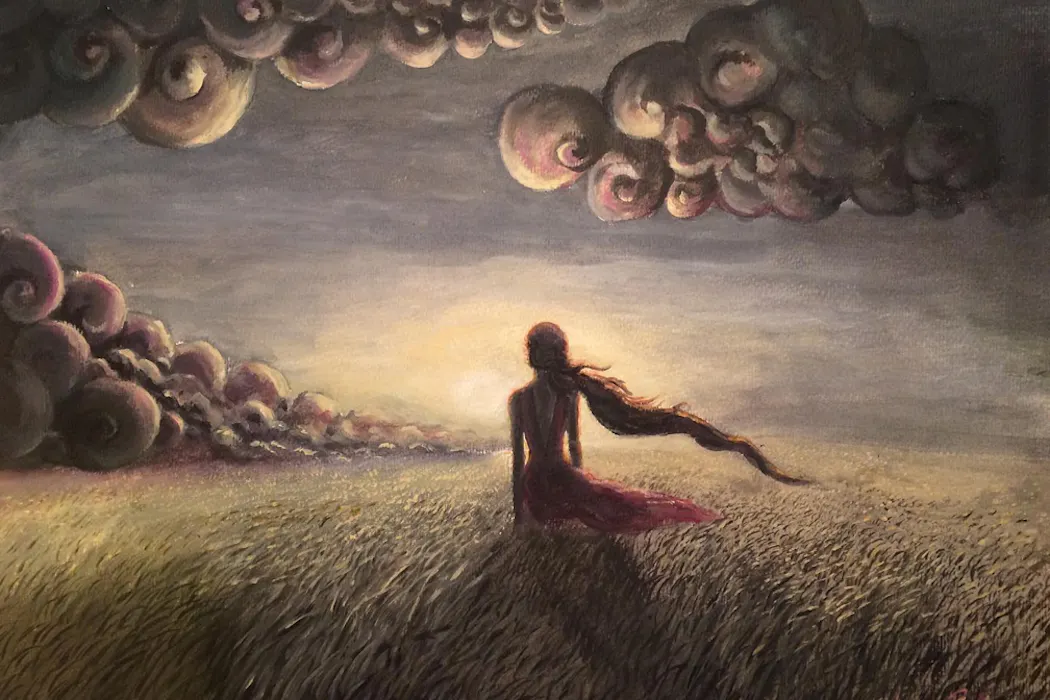
Pets, plants and a ‘coming-of-old-age’ story – what to see and watch this week

Source: The Conversation – UK – By Anna Walker, Senior Arts + Culture Editor, The Conversation

This curation of The Conversation UK’s arts and culture coverage was first published in our fortnightly newsletter, Something Good.

Hollywood still has an aversion to telling older women’s stories.

Research has found that older women are frequently relegated to supporting roles, or portrayed as grumpy, frumpy or senile. So when I saw the Brazilian film The Blue Trail at the Leeds Film Festival earlier this year, it felt like a breath of fresh air.

Tereza (Denise Weinberg) lives in a chilling near-future where a totalitarian regime forcibly removes anyone over 75, relocating them to remote colonies without consultation or consent. Faced with this looming threat of exclusion and invisibility as she turns 77, Tereza refuses to comply. Instead, she embarks on a surreal journey along the Amazon River to chase one final dream before she is “put out to pasture”. As she takes the steering wheel of a boat she has commandeered to engineer her escape, she also takes control of her life.

The trailer for The Blue Trail.

Throughout the film, Tereza proves younger people’s assumptions about her body wrong. When she is forced to wear an adult nappy she clearly doesn’t need, she uses it to kick-start her escape. When others assume she is ready to end her life quietly, she instead embarks on a surprising and thrilling new love affair. The Blue Trail affirms the joy and novelty that can be found at any age and offers a damning indictment of ageism across the world.

The Blue Trail is in select cinemas now and streaming on Prime Video.


Read more:
The Blue Trail is a dystopian ‘coming-of-old-age’ gem


Pets and plants

I adopted a cat in January and already I can’t remember life without her. Cheddar naps on my lap while I work (when she’s not disturbing Zoom calls with her acrobatics) and snuggles up to watch films in the evening (Flow was a particular favourite). So I’m intrigued by Pets & Their People, an exhibition at Oxford’s Bodleian Library that asks big questions about our furry (or feathered) companions.

What motivates pet owners – and when did we begin turning wild animals into the “fur babies” of the family? Equally importantly, what’s in it for the animals? Were their wild ancestors lured in by the promise of a warm fire, perhaps in exchange for catching mice or guarding livestock? Or did they deliberately ingratiate themselves into our homes and affections, offering companionship, comfort and even therapy?

Philip Howell, a professor who researches animal-human relations, described the exhibition as “wonderful”. He left reflecting that being human may involve “looking at our pets and asking what separates us from them”.

Pets & their People is at the Bodleian Library in Oxford until September 27.


Read more:
Pets & their People explores the long, strange history of human-animal companionship


The Garden Museum is something of an overlooked gem among London’s museums. Housed in a deconsecrated church in Lambeth, it’s a beautiful space that explores the history of flora and fauna and how they’ve shaped human society. The museum’s latest exhibition, Seeds of Exchange centres on a short-lived but fascinating collaboration between an English botanist and his Chinese counterparts. Together, they documented the plant life of Canton (modern-day Guangzhou) at a time when global trade, science and empire were becoming deeply intertwined. Our reviewer, botanist Max Carter-Brown, found it “fascinating”.

Seeds of Exchange: Canton and London in the 1700s is at the Garden Museum until May 10 2026.


Read more:
Seeds of Exchange reveals the untold story of the plant collectors who connected Canton and London in the 18th century


Fashion and freedom

Another London exhibition, Queen Elizabeth II: Her Life in Style at The King’s Gallery, Buckingham Palace, marks the centenary of the late monarch’s birth with the largest display of her wardrobe ever mounted.

The result, says fashion expert Hannah Rumball-Croft, is “a masterclass in what the Royal Palaces do best: celebrating the British monarchy – its pomp, pageantry and performativity – through the medium of clothes”. It also underscores why Her Life in Style, rather than in fashion, is such an apt title.

Queen Elizabeth II: Her Life in Style is at The King’s Gallery until October 18.


Read more:
Queen Elizabeth II: Her Life in Style – an unwavering sense of self expressed through fashion


Queen Elizabeth II: Her Life in Style exhibition trailer.

Eighty years on from the second world war, what does freedom mean in Britain today? That question lies at the heart of Our Freedom: Then and Now, a superb photography exhibition currently touring the UK.

Our reviewer, photography professor Mark Rawlinson, appreciated the “alternative perspective” it offers to the idea that the nation is currently divided. He left the gallery struck by the many ways freedom is experienced and understood across the UK. Whether it’s a veteran in Wolverhampton or a student in Hartlepool, he found the cumulative effect of these reflections on freedom and community both fascinating and thought-provoking.

Our Freedom: Then and Now is on tour across the UK until October 30.


Read more:
Our Freedom: Then and Now explores what freedom means to Brits, 80 years after the second world war


The Conversation

ref. Pets, plants and a ‘coming-of-old-age’ story – what to see and watch this week – https://theconversation.com/pets-plants-and-a-coming-of-old-age-story-what-to-see-and-watch-this-week-281370

Needlecraft: this hobby has a long history as a subversive form of protest

Source: The Conversation – UK – By Helen Pleasance, Senior Lecturer in Creative Writing and English Literature, York St John University

Fotopogledi/Shutterstock

To pass the time while filming, before her eyesight deteriorated, actor Judi Dench could often be found sewing. The picture of submissive femininity, she sat bent over her needlework. The finished work however, which she gave as gifts, were actually expletive-filled insults worked in ornate embroidery.

There has been a resurgence of people taking up needlecrafts of all kinds in recent years, including knitting, crochet, embroidery and sewing, as a hobby.

Much has been made of the mindful qualities of needlework. As a stitcher myself, I know how much pleasure and relaxation can be gained from the flow of yarn and thread through needles. But beyond the mindful benefits of needlework, there is a long history of needlecraft as a form of expressive protest.


Hobbies can bring joy, wellbeing and focus to our busy lives, but so many of us don’t have one. If you’re ready to replace scrolling with stitching, or hustle with horticulture, The Hobby Starter Kit (a new series from Quarter Life) will help you get going.


In December 2024, textile artist, Sue Spence posted a photograph on Facebook. It showed the words “Middle class WOMAN of a certain age” embroidered in rudimentary stitches onto a small piece of fabric. It was a response to comments made by former MasterChef presenter Gregg Wallace, who claimed allegations of sexual misconduct against him came from “a handful of middle-class women of a certain age”. She later turned the design into brooches reading: “Middle class WOMAN of a certain RAGE.”

Spence subverted Wallace’s original insult so it instead became a celebration of her identity. In doing so, she was participating in a long tradition of subversive stitching. For hundreds of years, silenced women have turned to needlecraft to express taboo emotions and protest their position in the world.

Her materials – needle and thread – are significant to her act of protest. Like the words being reclaimed, the medium she is using is also being reclaimed from its containment within the sphere of patriarchal domesticity as a submissive activity for genteel women.

Art historian Rozsika Parker’s seminal book The Subversive Stitch (2019) traces the history of women and needlework. In it, she identifies how from the 17th century, needlecraft – particularly the embroidering of samplers – “had been employed to inculcate obedience, submission, passivity and piety”. Samplers were used to practise embroidery stitches and frequently involved the stitching of Bible passages and devotional images.

Resisting patriarchy

By the 19th century domestic needlework was widely practised by middle- and upper-class women. It was understood as an activity that tied mothers and daughters to the service of home, husbands and fathers. This is illustrated in the character of Rose Pargiter in Virginia Woolf’s novel The Years (1937).

Painting of a woman sewing at the kitchen table
Sewing Fisherman’s Wife by Anna Ancher (1890).
Randers Museum of Art

At the opening of the novel, in the 1880s, Rose is a little girl. Rose’s sewing – she is embroidering roses onto a boot bag for her father – solidifies her position as “a good girl”, performing submissive obedience to a patriarchal order. Rose is literally stitching the flowers with which she shares a name at the feet (or at least the footwear) of her father. When she refuses to finish her sewing, she also refuses to accept her position in the order of society.

In The Subversive Stitch, Parker identifies more subtle ways in which women could subvert this dominant meaning of needlework. The bent head and quiet activity gave the appearance of passivity, allowing their resistance to hide in plain sight.

The Changi Quilts provide a good example of this from the 20th century. Changi, a prison in Singapore, was used by the Japanese army during the second world war to detain people from Allied countries on the island.

Men and women prisoners were separated. Denied access to writing materials, they could not communicate with each other. The women prisoners were, however, allowed to sew.

They set about making a series of patchwork quilts to be sent to the military hospital. Each woman made a square, including an embroidered picture and her signature. Once they were sent to the hospital, the male patients could read the quilts to get both a list of the women who had survived and some insight, through their artwork, of their feelings about internment. Preserved by the Red Cross Society, the quilts are a testament to the women’s resistance.

Olga Henderson talks about life as a child in a prisoner of war camp and the Changi Quilt.

A more overt challenge to the submissive meanings attached to women’s needlework can be seen in the Suffragette banners of the early 20th century. They were created by women who, like Rose Pargiter, would have been brought up with the obligation to be good girls through domestic stitching. Through the banners, they used their craft as a tool in their fight for the vote.

Much contemporary textile work draws on this subversion of the historical consignment of needlework to patriarchal domesticity. The Craftivist Collective, a global movement founded by Sarah P. Corbett in 2008, combines craft and activism to intervene for social change. Corbett defines it as “gentle activism”, but upends the meaning of gentle, not to mean “passive or weak, but gentle as in compassionate and nuanced”.

So, the next time you see someone, quiet, still and with bent head, wielding needle and thread, consider how they might be using incisive and creative tools to make a sophisticated point.

And if you’re a stitcher, you can try it yourself. Try reimagining traditional patterns or adding bold text or symbols to transform your mindful hobby into a quiet but powerful form of creative expression.

This article features references to books that have been included for editorial reasons, and may contain links to bookshop.org. If you click on one of the links and go on to buy something from bookshop.org The Conversation UK may earn a commission.

The Conversation

Helen Pleasance does not work for, consult, own shares in or receive funding from any company or organisation that would benefit from this article, and has disclosed no relevant affiliations beyond their academic appointment.

ref. Needlecraft: this hobby has a long history as a subversive form of protest – https://theconversation.com/needlecraft-this-hobby-has-a-long-history-as-a-subversive-form-of-protest-247969

Meta and Microsoft have joined the tech layoff tsunami – but is AI really to blame?

Source: The Conversation – Global Perspectives – By Kai Riemer, Professor of Information Technology and Organisation, University of Sydney

Dimitri Otis / Getty Images

Meta and Microsoft are the latest software companies to announce big cuts to their global workforce. Both companies are also making big investments in artificial intelligence (AI).

The link seems obvious. Meta’s chief people officer, Janelle Gale, said the job cuts – about 10% of staff or almost 8,000 workers – serve to “offset the other investments we’re making”. Meta boss Mark Zuckerberg has previously spoken about a “major AI acceleration” with spending in excess of US$115bn planned this year.

Microsoft is also betting big on AI. The company also just announced early retirement packages for about 7% of its US workforce.

The two tech giants join Atlassian, Block, WiseTech Global and Oracle, who have all made similar announcements this year, each evoking AI without outright blaming it.

What is happening here? How we understand these layoffs depends on what we think AI is, and what implications it will have. Broadly speaking, there are three ways of looking at it: that AI is superintelligence, that it’s mostly hype, and that it’s a useful tool.

The end of white-collar work?

In the first view, AI is emerging superintelligence. It is a new kind of mind, that learns, reasons, and will soon outperform humans at most cognitive tasks (hint: it’s not!).

The job losses are not just a corporate restructuring. They are an early tremor of something seismic.

In February 2026, AI entrepreneur Matt Shumer put this view vividly – comparing the current moment to the strange, quiet weeks before COVID-19 broke into global consciousness. Most people, he argued, haven’t yet realised we are facing an “intelligence explosion”.

The essay drew significant criticism. Commentators noted it contained little hard data and read at times like a pitch for Shumer’s company’s own AI products.

But it captured a genuine anxiety. Something real is happening in software engineering, at least, where tasks are well-defined and success is easy to verify.

But the leap to “all white-collar work will be automated” is a big one. The view that AI is a kind of universal mind that learns and improves itself is far-fetched.

And most professional work is far messier than coding: ambiguous briefs, competing stakeholder interests, outputs that are hard to verify, and shifting success criteria. Coding may be a canary in the coal mine, but coal mines and boardrooms are very different places.

Are tech companies winding back hiring sprees?

The second view sees the conversation around AI as mostly hype. AI is being invoked as cover. Companies that hired aggressively during the pandemic boom, and now face financial pressure, are blaming AI as the more palatable explanation.

OpenAI CEO Sam Altman called this dynamic “AI washing”: companies blaming AI for layoffs they would have made regardless.

For example, Meta announced in March it would shut down its Metaverse platform Horizon World by June. Reality Labs, the division developing the technology, employed 15,000 people as of January 2026.

We don’t know in detail the make-up of the present job cuts, so Meta may just be repackaging earlier failiures as AI-driven productivity gains.

Another cynical reading suggests that laying off workers in the name of AI is a way to drive up stock prices. When Block invoked AI and cut nearly 4,000 roles, its stock jumped the following day.

Announce AI-driven layoffs and you may find investors reward you for being future-focused. It is a historically familiar trick: technology has repeatedly served as convenient cover for financial restructuring.

Are layoffs a way to make staff use AI?

The third view is more nuanced. It sees AI as a powerful tool, but one that companies will need to transform themselves to take advantage of.

This has implications for what jobs are needed and in what quantities. We think this view has the most merit.

On this reading, the tech leaders believe AI will change how software gets built. But they don’t know exactly how.

So they do what tech companies often do when faced with uncertainty: they create pressure. They cut headcount staff, expect those remaining to produce just as much as before, and force teams to find ways to meet those expectations using AI.

It’s not a bet that AI will do everything, but that the pressure will force humans to work out how to use AI to increase productivity.

This also lines up with industry experience. For example, Google chief executive Sundar Pichai claims a 10% increase in engineering speed from AI adoption across the company. This could tally with cuts of around 7-10% of total workforce for most of the mentioned companies.

What this means for knowledge workers

These three views are often presented as mutually exclusive. In practice, all three expectations exist simultaneously. The honest answer to “what is really happening here” is probably “a bit of everything”.

What is true is that software development tends to be an early indicator of broader shifts in knowledge work. Productivity benefits from AI are real for those who adopt it. Yet adoption is unevenly distributed, and lags in less technical industries.

In this context, the ability to understand AI and make good decisions about how and where to use it is becoming a baseline professional skill.

The workers most at risk are not necessarily those whose tasks can be replicated by AI. They are those who wait for pressure to arrive from outside rather than getting ahead of it now.

We will have answers to the question of whether AI is mostly hype or a useful tool in the next few years.

If Meta, Microsoft, and their peers rehire staff with different skills, redesign workflows, and emerge genuinely more capable, the case for useful AI looks good. If they simply pocket the payroll savings, the cynics were right.

If you want to know where tech companies are going, don’t look at what they cut – watch what they hire.

The Conversation

The authors do not work for, consult, own shares in or receive funding from any company or organisation that would benefit from this article, and have disclosed no relevant affiliations beyond their academic appointment.

ref. Meta and Microsoft have joined the tech layoff tsunami – but is AI really to blame? – https://theconversation.com/meta-and-microsoft-have-joined-the-tech-layoff-tsunami-but-is-ai-really-to-blame-281436

Mali : pourquoi les djihadistes ferment les écoles

Source: The Conversation – in French – By Lamine Savané, PhD science politique, ATER, CEPEL (UMR 5112) CNRS, Montpellier, Post doctorant PAPA, Université de Ségou

Longtemps épargnées par les groupes djihadistes, les écoles du village de Dia à Ténenkou dans la région de Mopti, ont finalement été fermées sous la pression des groupes armés, notamment la Katibat Macina, affiliée au JNIM, principal groupe djihadiste actif dans cette région. Cette fermeture serait anecdotique si elle ne touchait que la région de Mopti. Or, la quasi-totalité des régions du Mali est touchée par cette fermeture des écoles.

En tant que chercheurs en sciences politiques et de l’éducation, nous avons récemment publié une recherche dans un ouvrage collectif sur l’école africaine face aux crises sécuritaires. Cette recherche se base sur des enquêtes menées principalement dans les régions de Ségou (cercle de Farako) et de Mopti (cercle de Ténenkou) de 2022 à 2025.

Nous voulions comprendre, entre autres questions, pourquoi l’école était une des premières institutions à laquelle les groupes djihadistes s’attaquaient chaque fois qu’ils veulouaient étendre leur influence dans une localité. Au-delà de l’école, les groupes djihadistes s’en prennent à tous les services sociaux de base qu’il s’agisse des administrations publiques, des commissariats de police ou des marchés hebdomadaires

Fragilités du système éducatif bien avant la crise

Au Mali, comme dans d’autres pays voisins, plus d’un million d’enfants ne sont pas scolarisés, pour des raisons indépendantes de la crise sécuritaire. Il demeure d’importants déséquilibres entre enfants des zones rurales et ceux du monde urbain. Leur accès à l’école étant fortement déterminé par leur localité de résidence, les enfants vivant en milieu rural sont souvent obligés de marcher plusieurs kilomètres pour atteindre l’école primaire la plus proche. Il y a aussi une disparité villes/villages en termes d’enseignants qualifiés, les villages servant de lieux d’affectation pour les débutants .

Toutes ces difficultés vont s’accentuer avec la crise sécuritaire, surtout que les zones rurales sont plus propices à l’influence des groupes djihadistes. Les chiffres globaux sur la fermeture des écoles n’ont cessé de croître sur l’ensemble du territoire malien depuis le début de la crise en 2012. Selon les données fournies par Cluster Education sur le Mali, au mois de janvier 2026, 2343 écoles sur un total de 10766 étaient non fonctionnelles, affectant 702 900 enfants non scolarisés.

Ce taux de fermeture des écoles représente 22 % des écoles au Mali. Dans la région de Ségou, 24 % des écoles ne sont pas fonctionnelles, tandis que ce taux monte à 35 % dans la région de Mopti, derrière Ménaka (52 %).

L’impact de la crise sécuritaire sur les écoles

La fermeture des écoles n’impacte pas seulement les élèves : les enseignants sont aussi concernés. Ils sont 14 058 enseignants à être au chômage technique selon la même source. Néanmoins, la menace contre les écoles est essentiellement celle des groupes djihadistes. Il s’agit principalement de zones où l’on constate un retrait de l’État (administrations, justice, forces de sécurité). L’administration n’est présente que partiellement dans ces localités sous pression des groupes djihadistes. Les populations accèdent difficilement aux services sociaux de base.

Toutes ces difficultés que l’école rencontrait vont s’accentuer avec la crise sécuritaire. En effet, les groupes djihadistes constituent les premiers acteurs de l’insécurité. Ils sont responsables de nombreuses attaques, qu’elles soient dirigées contre les Forces armées maliennes (FAMA), les autres groupes armés non étatiques, les représentants de l’État, les communautés ou la population civile qui leur résiste de manière générale. La fermeture des écoles est le principal indicateur de la présence djihadiste. Plus les écoles restent ouvertes, plus c’est la preuve que l’influence djihadiste est amoindrie.

A contrario, la fermeture des écoles est la manifestation d’une présence djihadiste accrue. L’école est une cible de prédilection des groupes djihadistes en raison de l’esprit critique qu’elle développe. Dans les zones sous influence djihadiste, les écoles sont souvent saccagées, voire brûlées en guise d’avertissement. Les enseignants qui veulent résister, en continuant à dispenser les cours sont menacés par les djihadistes.

Plusieurs enseignants ont été arrêtés avant d’être relâchés, parfois suite à des médiations. Face à ces risques réels, certains finissent par abandonner leur poste. Les mouvements djihadistes se rejoignent tous sur ce point, leur opposition à « l’école républicaine » ou « formelle ». La consigne est on ne peut plus claire : pas « d’école formelle » dans les zones sous leur influence. C’est ce que nous explique cet agent d’une ONG dans la région de Mopti. Originaire de la zone, il a pu voir l’impact de l’insécurité sur les écoles. Cette insécurité émane essentiellement des djihadistes :

S’agissant des écoles, dans plusieurs cas, elles ont été saccagées, les portes et les fenêtres ont toutes été enlevées. Les djihadistes sont partis avec tout ce qu’on peut enlever comme les tables-bancs. Il n’y a plus rien qui reste de l’école et la question d’une éventuelle réouverture n’est pas à l’ordre du jour (entretien, mai 2023, Ténenkou).

Les écoles dans leur ensemble sont attaquées par les mouvements djihadistes. À cet égard, l’étymologie du mouvement terroriste nigérian Boko Haram est illustrative. Son nom signifie littéralement en langue haoussa que le « livre » ou l’école occidentale, sous-entendu « la civilisation occidentale », est haram, c’est-à-dire interdite par la religion. Dans la phraséologie Boko Haram, le détournement des deniers publics par les élites nigérianes, la mauvaise gouvernance, l’injustice, la dépravation des moeurs, toutes les tares de la société nigériane ont une même et unique cause: l’école occidentale.

Les mouvements djihadistes reprochent aux écoles républicaines de propager l’enseignement des mécréants (occidentaux) qu’ils jugent contraires à leur vision de l’islam salafiste à l’encontre des valeurs de l’islam salafiste. Les djihadistes imposent donc que ces écoles deviennent des écoles coraniques ou que l’enseignement soit dispensé en arabe. Les populations sont plutôt encouragées à envoyer leurs enfants dans les écoles coraniques.

Déscolarisation et vulnérabilité

La conséquence de cette pression des djihadistes est la privation de plus de 702 900 enfants de leurs droits à l’éducation, compromettant ainsi leur avenir. Les enseignants de ces localités, intimidés voire menacés — plusieurs d’entre eux ayant été arrêtés avant d’être relâchés à Farako — finissent par abandonner leur poste, par peur pour leur vie. En revanche, les populations sont plutôt encouragées à envoyer leurs enfants dans les écoles coraniques. L’objectif est clair : c’est la fin de toute présence d’école dans ces zones.

Ils agressent physiquement les enseignants, récupèrent leurs biens, brûlent le matériel didactique, et dans certains cas, récupèrent les vivres destinés aux élèves. Une des conséquences directes de cette interdiction est la privation de milliers d’enfants maliens de leurs droits à l’éducation, compromettant ainsi leur avenir. De ce fait, ces enfants sans éducation peuvent constituer un large vivier de recrutement futur pour ces diverses organisations djihadistes.

Mopti et Ségou affectées

Dans les régions de Mopti et de Ségou, les écoles dans leur majorité ont commencé à être affectées à partir de 2017, avec des exceptions comme dans le cercle Ténenkou où l’on constate des fermetures depuis 2012, avec le Mouvement national de libération de l’Azawad (MNLA), un groupe indépendantiste touareg devenu aujourd’hui le Front de libération de l’Azawad (FLA). Mais beaucoup de ces écoles de Ségou et de Mopti ont fermé leurs portes en 2018. Les fermetures ont concerné d’abord la région de Mopti, bastion d’origine de la Katibat Macina. Déjà à cette époque, la plupart des écoles dans les communes rurales sont/étaient fermées.

A partir de 2019, on trouvait des écoles fonctionnelles principalement dans les chefs-lieux des cercles de la région de Mopti tels que Mopti ville, Ténenkou, Youwarou. Certains enseignants se sont donc refugiés dans les capitales régionales, à la suite de menaces de la part des groupes djihadistes.

Les chiffres sur la fermeture des écoles sont expressifs dans la région de Mopti. Sur les 829 écoles de la région, 289 sont fermées suite à la menace djihadiste, ce qui fait un taux de fermeture de 35 %. Ces fermetures affectent plus de 86700 enfants qui se retrouvent déscolarisés, et 1734 enseignants qui quittent les communes rurales.

Les stratégies observables sur le terrain

Malgré le nombre élevé d’écoles non fonctionnelles, certaines demeurent ouvertes. Deux stratégies principales apparaissent dans la pratique : la sécurisation des écoles et l’engagement communautaire. La sécurisation des écoles est ce qu’on a appelé la stratégie par le « haut », c’est-à-dire celle déployée par les autorités étatiques. Cette stratégie porte sur le déploiement des détachements militaires dans les villes pour restaurer la présence de l’État.

La présence militaire rassure le personnel scolaire et lui permet de travailler sereinement. Les villes qui se caractérisent par une forte présence militaire sont les moins affectées par les fermetures d’écoles. A Ténenkou ville et à Dioura, les écoles fonctionnent normalement en raison de la présence militaire dissuasive.

C’était le cas à Diondjori dont le blocus a été levé en novembre 2023 – et à Diafarabé avant que ces deux communes ne soient l’objet d’un blocus.

La deuxième stratégie par le « bas » porte sur l’engagement communautaire. Cette stratégie par le « bas », profite à la fois d’imaginaires populaires qui confèrent un statut spécifique à certaines localités, mais aussi, de contacts avec les groupes djihadistes.

Le village de Dia, chef-lieu de la commune de Diaka, était illustratif de cette stratégie. Sans présence des forces militaires et des groupes d’autodéfenses dozos, des dynamiques locales communautaires parvenaient à préserver le fonctionnement des écoles. Il s’agissait de la primauté de la coexistence pacifique comme mode de gouvernance de la société.

Avec la fermeture des écoles dernièrement à Dia, c’est la limite de la stratégie par le « bas » qui nous invite à analyser les groupes djihadistes à l’aune de leur matrice idéologique réfractaire à toute critique.

The Conversation

The authors do not work for, consult, own shares in or receive funding from any company or organisation that would benefit from this article, and have disclosed no relevant affiliations beyond their academic appointment.

ref. Mali : pourquoi les djihadistes ferment les écoles – https://theconversation.com/mali-pourquoi-les-djihadistes-ferment-les-ecoles-280023

Comment la chasse à la baleine s’est étendue du Pays basque au reste du monde… jusqu’à être interdite

Source: The Conversation – in French – By Álex Aguilar, Profesor de Biología Animal, Universitat de Barcelona

Pendant des siècles, la chasse à la baleine a fait vivre des économies entières. Jan Pieter Strijbos/Nationaal Archief

Entre prospérité économique, surexploitation et régulation tardive, près de mille ans de chasse à la baleine ont laissé une empreinte durable sur les sociétés et les littoraux.


Les archives les plus anciennes attestant l’existence d’une pêche à la baleine organisée remontent au XIe siècle au Pays basque. De là, l’activité s’est rapidement étendue aux ports du littoral cantabrique, de la Galice jusqu’au Labourd, puis à l’ensemble de l’Atlantique, atteignant des pays comme le Brésil et l’Islande.

Bien qu’elle soit aujourd’hui presque abandonnée, cette activité a longtemps constitué un secteur très rentable. À tel point que l’ampleur des captures et leur mauvaise gestion ont conduit à son interdiction afin de protéger les cétacés.

Les débuts de la chasse à la baleine

Au Pays basque, la pêche se pratiquait à partir de petites embarcations à rame, qui prenaient la mer dès qu’une baleine était repérée. Une fois le cétacé atteint, il était immobilisé à l’aide de harpons lancés à la main, puis achevé à la lance. Le corps était ensuite remorqué jusqu’à la plage pour être exploité.

Par ailleurs, les baleiniers recherchaient activement les petits, sachant que s’ils s’en emparaient, la mère les suivrait jusqu’à des eaux abritées, ce qui facilitait sa capture ultérieure.

Dans la pêche côtière traditionnelle, les baleines étaient généralement traitées sur les plages, à la force des bras, avec de simples hachettes, couteaux et crocs.
Gravure extraite de l’Histoire générale des drogues, de Pierre Pomet, París 1694

Pendant des siècles, les baleines étaient principalement pêchées pour leur lard, dont on tirait l’huile, utilisée pour l’éclairage et la fabrication de savon, essentiel à l’industrie lainière.

Bien que la capture du cétacé comporte des risques — car, aussi paisible soit-il, un animal blessé se retourne toujours contre son attaquant — les bénéfices faisaient vivre des économies locales entières. À tel point qu’une cinquantaine de ports du littoral cantabrique se sont engagés dans cette activité.

Expansion de l’activité à l’échelle mondiale

À partir du XVIe siècle, les Basques ont étendu cette activité à l’Atlantique, jusqu’à atteindre l’Islande, le Groenland, Terre-Neuve et même le Brésil. Cette expansion n’est pas passée inaperçue et, dès cette époque, d’autres puissances comme la France, le Royaume-Uni et les Pays-Bas se sont lancées à leur tour dans la chasse à la baleine, faisant fortement augmenter les captures à l’échelle mondiale.

Dès la première moitié du XIXe siècle, la chasse à la baleine était pratiquée dans tous les océans du globe et sa rentabilité atteignait des niveaux exceptionnels : les taux de profit annuels se situaient généralement entre 25 % et 50 %, permettant d’amortir rapidement les investissements nécessaires à une expédition.

Le Lagoda, un trois-mâts barque américain de New Bedford (Massachusetts), a ainsi rapporté à ses armateurs, en seulement douze ans, une somme cent vingt fois supérieure à l’investissement initial, avec certains dividendes annuels atteignant 361 %.

Au XXe siècle, la modernisation s’est traduite par l’utilisation de navires en fer équipés de moteurs à vapeur et de canons tirant des harpons de 80 kilos munis de grenades explosives, ce qui a encore accru la létalité et la rentabilité de cette activité. Rentabilité qui dépassait souvent 100 % par an, avant de commencer à diminuer avec l’épuisement progressif des populations de cétacés.

Un business juteux qui n’a jamais cherché à être durable

Dans le même temps, l’expérience accumulée par des générations de baleiniers a montré que le rendement exceptionnel des baleines était limité par leur lente reproduction. Logiquement, il aurait fallu adapter les captures à la capacité de renouvellement des populations. Mais l’industrie a fait un autre choix : maximiser les profits, quitte à épuiser rapidement les ressources d’une zone avant de se déplacer ailleurs lorsque les stocks locaux s’effondraient.

Pour permettre cette stratégie, des usines baleinières démontables et transportables ont été mises au point, adaptées à une exploitation intensive et mobile.

La saga familiale norvégienne des Herlofson, qui a introduit la chasse à la baleine moderne sur les côtes espagnoles, en est un bon exemple. Le patriarche, Peter, commence ses activités en Norvège dans les années 1880. En 1896, il installe une première station en Islande, qu’il ferme cinq ans plus tard pour la transférer en 1902 sur l’île de Harris, en Écosse.

Il est ensuite remplacé par son fils Carl, qui déplace en 1921 le centre d’opérations vers le golfe de Cadix, puis en 1925 vers la Galice. En 1928, il s’installe à Terre-Neuve, avant d’opérer en Namibie à partir de 1932, pour finir sa carrière à bord d’un navire-usine en Antarctique. À eux deux, père et fils ont exploité en cinquante ans huit zones de pêche baleinière différentes — soit en moyenne une tous les six ans.

Dans une lettre, Carl exposait clairement sa stratégie : il fallait prélever rapidement « la crème » de chaque caladero (zone de pêche) — autrement dit en tirer le maximum — puis, une fois la zone épuisée, se déplacer vers la suivante.

Baleine fraîchement harponnée par un navire de la compagnie galicienne Industria Ballenera SA en 1982.
Alex Aguilar

La régulation et la Commission baleinière internationale

Ces abus ont profondément transformé la perception publique. La baleine est passée du statut de créature redoutée — pensons à Moby Dick — à celui de symbole de la conservation. En 1946, la Commission baleinière internationale (CBI) a été créée afin de réguler cette activité. Dans les années 1970, la CBI avait déjà protégé de nombreuses populations et encadrait l’exploitation des autres au moyen de quotas stricts. La pêche était enfin sous contrôle.

Cependant, le passé pesait trop lourd et la pression écologiste, très active dans les années 1980, a conduit à l’adoption d’un moratoire sur la chasse commerciale entré en vigueur en 1986, initialement prévu pour durer cinq ans. La mesure a été adoptée de justesse, avec un rôle décisif de l’Espagne, dont le vote a fait basculer le résultat.

Bien que la fin du moratoire ait été envisagée pour 1991, celui-ci a été prolongé indéfiniment en raison de sa forte portée symbolique. Pour beaucoup, l’idée de relancer la chasse à la baleine restait inacceptable. Le Japon, la Norvège et l’Islande, pays aux intérêts baleiniers importants, ont contesté cette décision en faisant valoir que les populations qu’ils exploitaient étaient en bon état — un point appuyé par des études scientifiques — et ont quitté la CBI, reprenant la chasse dans le cadre de quotas nationaux. Aujourd’hui, les deux tiers des captures de baleines ont lieu en dehors de cette organisation, selon des règles fixées par chaque pays.

Une grande partie de ses revenus provenant des cotisations versées par les pays membres — elles-mêmes liées à leur activité baleinière —, la CBI a été contrainte de vendre son siège et d’espacer ses réunions. Paradoxalement, cette organisation, pionnière dans la régulation internationale d’une ressource halieutique, traverse aujourd’hui une profonde crise en raison même de son succès. L’efficacité de son action a été dépassée par l’inertie d’une perception sociale forgée à une époque où l’exploitation des baleines était peu régulée et souvent abusive.

La CBI s’est depuis réinventée en s’intéressant à des enjeux comme le tourisme d’observation des baleines ou les effets de la pollution.

Vestiges de la vigie baleinière de Mendata, dans la commune basque de Deva.
Alex Aguilar

Près de mille ans de pêche à la baleine ont laissé sur le littoral cantabrique une empreinte profonde et bien visible. Les petits ports du nord de la péninsule Ibérique abritent musées, monuments, vestiges de vigies et d’anciennes usines, blasons ornés de motifs baleiniers, ainsi que linteaux, sépultures et pierres tombales décorés de harpons et de scènes de chasse aux cétacés. Un patrimoine historique de premier plan, qui subsiste comme le témoignage d’une activité aujourd’hui disparue.

The Conversation

Álex Aguilar a reçu des financements du Plan Nacional de Investigación no Orientada.

ref. Comment la chasse à la baleine s’est étendue du Pays basque au reste du monde… jusqu’à être interdite – https://theconversation.com/comment-la-chasse-a-la-baleine-sest-etendue-du-pays-basque-au-reste-du-monde-jusqua-etre-interdite-281450

Could warming seas bring great white sharks back to the North Sea? A 5-million-year-old shark tooth may provide clues

Source: The Conversation – UK – By John Stewart, Professor of Evolutionary Palaeoecology, Bournemouth University

As the Earth shifts to climates not seen for several hundred thousand years, we may need to look at ancient environments for clues about what could happen next.

Our new study of two whale fossils, with preserved fragments of shark teeth, suggests the modern descendants of these animals could once again roam the southern region of the North Sea, between the UK, Belgium and Denmark. Climate change may recreate the conditions that allowed the ancestors of great white sharks to hunt in these waters.

If you want information about how animals and other organisms might respond to the kind of climate changes our planet is experiencing right now, you need evidence of former responses to such changes.

Palaeoecology, the study of the interactions between organisms in the deep past, has been coopted in the service of conservation science for some years now.

One example of a past seascape which may tell us important information is that of the southern part of the North Sea, which was occupied a few million years ago by large marine animals. In modern times, the area has had a relatively low diversity in its wildlife.

But about 4-5 million years ago the North Sea was home to several large shark species, including the now locally extinct bluntnose sixgill shark and a relative of the modern great white shark. The Greenland shark used to live in this region, as well as tiny right whales, a relative of the beluga whale, and rorqual baleen whales. It was also home to extinct dolphins, such as Pliodelphis doelensis which was about the size of a common dolphin, plus porpoises and several seal species. Many of these animals, like all the cetaceans and seals, and some of the sharks, are now extinct. Others, including many other sharks, have since moved to distant oceans.

It appears that there was large-scale turnover of cetacean species in the southern North Sea during the ice age of the Pliocene-Pleistocene epoch, with the extinctions of most small baleen whales and the departure of other cetacean families (such as that of the beluga whale). This turnover may well have been responsible for the disappearance of the large sharks including the great white relatives and the bluntnose sixgill sharks, that were feeding on the smaller whales, from the North Sea.

Occasionally, the fossil record provides a glimpse of the past relationships between species. This can help scientists better understand these food webs and how ancient ecosystems worked.

Shark bite marks on fossil marine mammal bones are relatively common, revealing intervals of time when two animals interacted. However, it is often difficult to identify the predator species. Much more rarely, bite marks come with fossilised tooth fragments. This is what we found in two cetacean skulls from the Early Pliocene (approximately 5-4 million years ago) of the North Sea.

Fossil teeth marks
Detail of some shark bite marks on the skull of the extinct right whale. The lower photo shows a bite made by the bluntnose sixgill shark, with a tooth tip deeply embedded in the bone.
Olivier Lambert (RBINS)., CC BY-NC-ND

The first of these two skulls belonged to a diminutive extinct right whale which was found by father and son fossil enthusiasts (Robert and John Stewart – coauthor of this piece) in the mid-1980s in the docks in Antwerp, Belgium. Some 40 or so years later the skull was donated to the Institute of Natural Sciences in Brussels where it was identified by one of us (Olivier Lambert) as one of only two fossil specimens of Balaenella brachyrhynus, a tiny right whale species only known from the North Sea.

Further examination revealed bite marks on the top of the skull and in one such mark there was a tooth fragment of a shark. In our study, with the help of the shark specialist Frederik Mollen, the tooth tip was identified using microCT scanning as belonging to part of a lower tooth of a bluntnose sixgill shark Hexanchus griseus, which today is common in the Mediterranean Sea. The position of the bites makes it likely that the whale was scavenged as it lay drifting belly-up.

The second skull, from a close relative of the extinct beluga whale Casatia thermophila was discovered in the early 1980s. It was found during the excavation of a new dock in the Port of Antwerp by another father and son team – Paul Gigase, a pathologist by profession, and his son Pierre.

In this case the whale, which also had bite marks with the tip of a shark tooth embedded, may have been attacked by an extinct mako shark, a relative of today’s great white shark. It appears that the shark was attempting to separate the whale’s head from the rest of the body and focusing on the fat-rich melon, a mass of tissue involved in echolocation on the top of the animal’s head.

Image of fossil skull
Shark bite marks targeting the fat-rich melon. The skull on the lower part of the illustration is of a modern beluga whale.
Olivier Lambert (RBINS)., CC BY-NC-ND

These fossils represent direct evidence that relatives of sharks today fed on these whales. Even if the fossil evidence is limited to two pairs of animals, they are tangible examples of such behaviour.

The ongoing biodiversity crisis is directly related to climate change, and has (or will have) an impact on the distribution of marine mammals. Global warming is likely to affect shallow seas in particular. The southern part of the North Sea is not large or deep enough for modern baleen whales, which are larger than their ancestors and live in the North Atlantic, like the modern right whale, the humpback and fin whales. But warming seas could attract dolphins and seals, and in turn great white sharks or other large marine predators.

In the North Sea, scientists have already observed short-term changes in the distribution of porpoises and seals. New seal colonies have established along the coast of the southern North Sea and there have been abrupt fluctuations in the number of porpoises stranded yearly on Belgian beaches.

The fossilised behaviour of the disappeared whales and sharks emphasise that all is change in the ecology of the North Sea.

The Conversation

The authors do not work for, consult, own shares in or receive funding from any company or organisation that would benefit from this article, and have disclosed no relevant affiliations beyond their academic appointment.

ref. Could warming seas bring great white sharks back to the North Sea? A 5-million-year-old shark tooth may provide clues – https://theconversation.com/could-warming-seas-bring-great-white-sharks-back-to-the-north-sea-a-5-million-year-old-shark-tooth-may-provide-clues-279157

Great Expectations by Charles Dickens is an early exploration of ‘romance fraud’

Source: The Conversation – UK – By Emma Linford, Honorary research associate, English literature, University of Hull

Shrinking into her yellowing wedding gown with the decay of her wedding breakfast around her, Miss Havisham, from Charles Dickens’s 1861 novel, Great Expectations, is one of the best-known characters in English literature.

Jilted on her wedding day by her unscrupulous fiancé, Havisham can be understood by modern readers as a victim of “romance fraud”, where in a fraudster manipulates someone under the guise of courtship for their own financial gain. Although romance fraud is a 21st-century term, through the character of Havisham, Dickens clearly demonstrated its often-devastating effects.

In her youth, Havisham was manipulated by her fiancé, the conman Compeyson and her half-brother Arthur, in a plan to rob her of her fortune. Both the romance itself and wedding are a ploy and she is jilted at the altar, losing not only her wealth (which she had signed away prior to her nuptials) but also any hope of future romantic prospects due to the scandal that followed.

Alone, rich and looking for a companion, Havisham was particularly vulnerable to a criminal wanting to take advantage. Though she lost her fortune, Dickens makes it clear that the romantic betrayal is what had the biggest impact on her psychology.

The romantic duplicity shapes her relationships with both her adopted daughter, Estella, and Pip, the novel’s protagonist, making her cold and hostile toward them.


This article is part of Rethinking the Classics. The stories in this series offer insightful new ways to think about and interpret classic books, films and artworks. This is the canon – with a twist.


The psychological impact of romance fraud

Since being jilted, Havisham has become a recluse, “stuck” within the moment of her abandonment. She remains in the house with the clocks all stopped, perpetually wearing her wedding gown. Her decayed hopes of romance are reflected in the decayed objects which surround her. As Pip muses:

Avoiding her eyes … I took note of the surrounding objects in detail, and saw that her watch had stopped at twenty minutes to nine, and that a clock in the room had stopped at twenty minutes to nine. “Look at me,” said Miss Havisham. “You are not afraid of a woman who has never seen the sun since you were born?”

The clocks are all stopped at the time the promise of her future life ended – the moment that she received the letter from Compeyson which made the crime apparent.

Olivia Colman as Miss Havisham in Great Expectations.

Herbert (a relative of Miss Havisham and friend of Pip) recounts the story to Pip:

A certain man, who made love to Miss Havisham … Well! This man pursued Miss Havisham closely and professed to be devoted to her. I believe she had not shown much susceptibility up to that time; but all the susceptibility she possessed certainly came out then, and she passionately loved him.

This description mirrors many modern elements of romance fraud. Compeyson “made love” to her and she became “susceptible”. Like contemporary romance fraudsters, Compeyson inserted himself into Havisham’s life and manipulated and controlled her to believe that he loved her.

Romance fraud in Dickensian Britain

There was a lack of progression in fraudulent law during Dickens’ time. It wasn’t until the Fraud Act of 2006, that real change came about, making fraud by misrepresentation a criminal offence in the UK. Today, romance fraud is considered a “serious crime”.

Long before this most personal form of fraud became illegal, Dickens saw its prevalence and drew attention to it. Others followed in his path, such as Mary Elizabeth Braddon in Lady Audrey’s Secret (1862), Arthur Conan Doyle in A Case of Identity (1891) and Agatha Christie in Death on the Nile (1937).

Havisham can be viewed in two ways, either as a victim or a fool. It is hard to determine how Dickens wanted her to be interpreted. Was she the stereotypical hysterical Victorian woman, as seen in other novels such as The Woman in White by Wilkie Collins (1860) or the character of Bertha Rochester in Jane Eyre (1847)?

I don’t think so. As he was with so many other social issues, I believe that Dickens was ahead of his time and was actively trying to raise the profile of the crime of romance fraud and the impact it has on his victims.

Beyond the canon

As part of the Rethinking the Classics series, we’re asking our experts to recommend a book or artwork that tackles similar themes to the canonical work in question, but isn’t (yet) considered a classic itself. Here is Emma Linford’s suggestion:

If you’re gripped by Dickens’s depiction of fraudsters and criminals, you may also enjoy Dickens’s Villains: Melodrama, Character, Popular Culture by Juliet John (2003). In it, John explores the complex villains and anti-heroes of Dickens’ novels. She looks at what inspired his writing, as well as the dramaturgical characteristics of his work.


This article features references to books that have been included for editorial reasons, and may contain links to bookshop.org. If you click on one of the links and go on to buy something, The Conversation UK may earn a commission.

The Conversation

Emma Linford does not work for, consult, own shares in or receive funding from any company or organisation that would benefit from this article, and has disclosed no relevant affiliations beyond their academic appointment.

ref. Great Expectations by Charles Dickens is an early exploration of ‘romance fraud’ – https://theconversation.com/great-expectations-by-charles-dickens-is-an-early-exploration-of-romance-fraud-241820

The many literary lives of Mary Wollstonecraft – author of novels, travel writing and children’s books

Source: The Conversation – UK – By Aditi Upmanyu, PhD candidate in English Literature, University of Oxford

In his biography of Mary Wollstonecraft, written after her death, her husband William Godwin remarked of her travel writing: “If ever there was a book calculated to make a man fall in love with its author, this appears to me to be the book.”

Today, however, Wollstonecraft is best known for a different work: A Vindication of the Rights of Woman (1792). While this landmark text helped lay the foundations of western feminist thought, focusing solely on it risks narrowing our view of a writer who was far more radical and prolific than this single book suggests.

Wollstonecraft wrote across genres – from fiction, travel and children’s books to literary criticism, translations and political essays. Tracing this wide-ranging authorship reveals that her lifelong concerns – women’s education, gender inequality and resistance to political authority did not start or end with A Vindication of the Rights of Woman.

The novelist

Wollstonecraft believed in the political power of storytelling. Writing in The Cambridge Companion to Mary Wollstonecraft, literature professor Claudia L. Johnson observes that “novels are the very bookends of Wollstonecraft’s life as a writer”.

In the preface to Mary: A Fiction (1788), Wollstonecraft declares her intention to reveal the “mind of a woman who has thinking powers”. The novel traces the fictional Mary’s emotional and intellectual life through intense relationships with both a man and a woman. The novel emphasises female intimacy and friendship – at times bordering on the homoerotic – and rejects the plot of conventional domestic fulfilment.

An introduction to Mary Wollstonecraft by National Museums of Liverpool.

This reimagination of domesticity becomes even more polemical in the unfinished novel Maria: or, The Wrongs of Woman (1798), where Wollstonecraft explores marital oppression, parental neglect, sexual violence and moral rigidity.

Maria is forcibly separated from her infant daughter and imprisoned in a “madhouse”, where she suffers further abuse and torture. The novel includes a graphic narration of sexual exploitation through Jemima, a working-class asylum attendant of illegitimate origins who has endured rape, prostitution and abortion. Maria and Jemima’s friendship introduces radical class solidarity forged through shared suffering.

The novel presents a bleak vision in which women’s most meaningful relationships lie beyond heteronormative family structures.

The travel writer

Wollstonecraft’s Letters Written During a Short Residence in Sweden, Norway and Denmark (1798) was the most popular of her works in her own lifetime.

It was written during an intensely turbulent period, marked by her abandonment by her first lover, Gilbert Imlay, after which she made two suicide attempts. The event left her a single, unwed mother to her daughter Fanny.

Letters departs from Wollstonecraft’s usual rational tone. Instead, this book explores emotional intensity and imagination. She writes at the outset: “I determined to let my remarks and reflections flow unrestrained.” It signposted a literary style that privileges feeling and self-exploration.

An excerpt from Mary Wollstonecraft’s Letters Written During a Short Residence in Sweden, Norway, and Denmark.

But beyond personal reflection, Letters also traces her inner growth alongside her observations of society as she travels across Scandinavian terrain. She reflects on landscape, commerce and social organisation, and through them considers broader questions of civilisation and progress. Here emerges a distinctive, female romantic imagination, grounded in sensibility and subjective experience.

Wollstonecraft’s merging of the personal and the political, so central to her writing, finds its fullest expression in this work. The Letters significantly influenced Romantic poets such as Robert Southey and Samuel Taylor Coleridge.

The children’s author

A deep intellectual investment in women’s education runs throughout Wollstonecraft’s career, evident even in the self-explanatory title of her early work, Thoughts on the Education of Daughters (1787).

This commitment takes a fictional form in Original Stories from Real Life (1791), a children’s book featuring illustrations by the poet William Blake. It traces the moral and intellectual development of two young girls under the guidance of a maternal governess. Wollstonecraft drew on her own year-long experience as a governess to the aristocratic Kingsborough family in Ireland between 1786 and 1787.

Engraving of a governess, with two girls looking up at her adoringly
The frontispiece to the 1791 edition of Original Stories from Real Life engraved by William Blake.
William Blake Archive

Influenced by enlightenment, the book presents learning as both structured instruction and experience shaped by nature and society. For Wollstonecraft, education cultivates judgement, self-discipline and moral awareness.

Her interest in childhood care and its formative role in later years is further reflected in three unfinished works: Lessons, Hints and Fragments of Letters on the Management of Infants. The works were all published posthumously in a compilation by Godwin in 1798. These works explore the issues of women’s health and nutrition, and rethink maternity as an acquired practice, rather than innate feelings women automatically possess.

An autodidact herself, Wollstonecraft saw the improvement of women’s education as essential to their development as rational citizens. Thus, pedagogy becomes the cornerstone of broader social reform, linking the cultivation of the mind to the possibility of equality between the sexes.

The reviewer, correspondent and translator

Wollstonecraft wrote extensively for Joseph Johnson’s progressive journal, the Analytical Review, contributing reviews of contemporary poetry and novels.

A silver statue of a woman emerging from what a wave
A Sculpture for Mary Wollstonecraft by Maggi Hambling (2020), located in Newington Green, London.
WikiCommons, CC BY-SA

These reviews reveal Wollstonecraft as an active participant in contemporary literary culture. This sustained engagement with the ideas of her time helped shape her own trajectory as a writer.

Her reviews were public yet often anonymous, but her letters offer a more intimate record of her voice. Wollstonecraft’s prolific correspondence suggests a life lived, in part, through letters. She wrote frequently to her sisters, her husband Godwin and fellow women writers such as Amelia Opie and Mary Hays. These letters reveal the complexity and contradictions of her character, and her reflections on motherhood, morality and intellectual life.

Wollstonecraft also participated in a wider transnational literary culture, translating works primarily from French, German and Dutch. Her own writings continued to circulate in translation across Europe after her death, distinctly contributing to the development of feminist thought well beyond England.

This article features references to books that have been included for editorial reasons, and may contain links to bookshop.org. If you click on one of the links and go on to buy something from bookshop.org The Conversation UK may earn a commission.

The Conversation

Aditi Upmanyu does not work for, consult, own shares in or receive funding from any company or organisation that would benefit from this article, and has disclosed no relevant affiliations beyond their academic appointment.

ref. The many literary lives of Mary Wollstonecraft – author of novels, travel writing and children’s books – https://theconversation.com/the-many-literary-lives-of-mary-wollstonecraft-author-of-novels-travel-writing-and-childrens-books-279885

Why delaying climate action now means higher seas by 2100 – new research

Source: The Conversation – UK – By Helen Millman, Postdoctoral Researcher, Polar Science, University of Exeter

Imagine your favourite sunny beach. Anywhere will do. You look out and see the ocean stretching to the horizon. To a glaciologist, that view is not just water; it’s melted ice.

Our new study shows that the best case sea-level rise scenarios may now be out of reach.

Around 20,000 years ago, during the most recent ice age, the Earth was about 5°C cooler than today. Vast ice sheets, comparable in scale to Greenland and Antarctica, covered Canada, northern Europe, and other regions. Those ice sheets formed as water evaporated from the oceans, fell as snow, and accumulated year after year on land.

Locked away as ice, that water was removed from the ocean, lowering sea level by around 130m and reshaping the planet’s coastlines. You could have walked from Britain to mainland Europe or from Siberia to North America as much of today’s continental shelf was dry land.

Between 20,000 and 10,000 years ago, global temperatures increased and those ice sheets melted. Sea level rose, flooding coastal plains and river valleys, and leading to modern coastlines. The lesson from Earth’s recent history is simple: When global temperature changes, sea level changes, and coastlines change with it.

The triple threat

Sea level rise has three main causes. First, as the ocean warms, seawater expands, increasing its volume. Second, hundreds of thousands of mountain glaciers worldwide are melting, adding water to the sea. Third, the great ice sheets of Greenland and Antarctica are losing mass. All three matter, but they do not contribute equally, and their importance is changing.

Since around 1850, the burning of fossil fuels has raised greenhouse gas concentrations to levels not seen for more than three million years. As a result, global temperatures have increased by nearly 1.5°C and global mean sea level has risen by more than 20cm. Just under half of this rise came from thermal expansion of warming oceans. A similar amount comes from the melting of about 300,000 glaciers worldwide, but with a rising contribution from the great ice sheets.

What is striking is how fast this change has happened. Around half of the total sea level rise since 1850 has occurred in just the past 30 years. During this time, Greenland and Antarctica have begun to contribute more to sea-level rise than all other glaciers combined, and together now exceed the contribution from ocean warming. Mass loss from Antarctica alone is around six times greater than it was three decades ago.

aerial shot of mountainous ice sheet
Greenland’s ice cap is melting.
Vadim_N/Shutterstock

This shift matters because glaciers and ice sheets are not equal. If every small glacier on Earth were to melt completely, global sea level would rise by only about 24cm. If the polar ice sheets were to melt, sea level would rise by more than 65m, almost 300 times more.

Ice sheets usually respond slowly to warming air and ocean temperatures. But some regions are far more vulnerable than others. In these hotspots, retreat can trigger dynamic processes that accelerate ice loss, destabilising neighbouring regions and speeding up sea level rise.

Researchers like us are starting to see just this, particularly in the Amundsen Sea sector of West Antarctica and the margins of the Greenland ice sheet. Mass loss from these ice sheets commits the planet to metres of sea level rise – and once retreat begins it may be impossible to stop.

The reality gap

The pace of change still depends on us, but the starting point keeps shifting. Observations show that current sea level rise is already tracking along the mid-to-high projections provided by the UN’s climate science advisory group, the Intergovernmental Panel on Climate Change (IPCC), placing the lowest, most manageable outcomes out of reach. Sea levels rising by more than 0.5m by 2100 are now increasingly likely, with consequences that include large-scale displacement and the abandonment of many coastal regions at immense and avoidable cost.

This does not mean the outcome is fixed. The world stops warming almost immediately after reaching net zero. Rapid decarbonisation would slow ice loss, buying time for coastal cities, communities, ports, wetlands and beaches to adapt.

Yet a clear gap remains between where the scientific consensus says emissions need to go to avoid rapid rise, and where current government commitments, known as nationally determined contributions are taking us. Many estimates say that we are currently on a path toward roughly 3°C of warming. For context, the threshold for the irreversible loss of the Greenland ice sheet is estimated to be as low as 1.7°C to 2.3°C. We are flirting with a temperature that would commit the planet to several metres of long-term rise from Greenland.

Now return to that beach. The shoreline is not fixed. It is a product of past warming and it is already being reshaped by the warming we have caused. The question is no longer whether sea level rise can be kept low, but how high it will go, how quickly it will rise, and how much damage we are prepared to accept.
The longer action is delayed, the fewer good options remain, and the more of that familiar coastline is lost to the tide.

The Conversation

Helen Millman is on the advisory council of the Conservative Environment Network.

Martin Siegert receives funding from the UK Natural Environment Research Council.

Richard Alley does not work for, consult, own shares in or receive funding from any company or organisation that would benefit from this article, and has disclosed no relevant affiliations beyond their academic appointment.

ref. Why delaying climate action now means higher seas by 2100 – new research – https://theconversation.com/why-delaying-climate-action-now-means-higher-seas-by-2100-new-research-272290

Why Italy’s Giorgia Meloni broke with Donald Trump

Source: The Conversation – UK – By Margherita de Candia, Lecturer in Comparative Politics, King’s College London

The Italian prime minister and leader of the far-right Brothers of Italy party, Giorgia Meloni, has made fostering ties with foreign leaders a central part of her political strategy. A few years before winning Italy’s 2022 general elections, she started cultivating ties with the US and European conservative world as part of a broader political rebranding effort aimed at projecting a more moderate image at home and gaining legitimacy abroad.

She subsequently became a familiar face within Donald Trump’s “Make America Great Again” (Maga) movement. Meloni shares similar views to Maga on migration, sovereignty and national identity. She also aligns with the movement on a constellation of other themes ranging from fighting against “wokeism” and defending the traditional family to the rejection of liberalism, globalism and environmentalism.

After Trump was elected as US president for the second time in late 2024, Meloni’s ties with the American far-right suddenly became a matter of foreign policy. But her relationship with Trump has turned out to be a more demanding balancing act than Meloni may have anticipated. And now their alliance – at least for the time being – appears to be over.

On April 13 Meloni described Trump’s recent social media attack on Pope Leo, who had criticised the US and Israel’s war on Iran, as “unacceptable”. This prompted a rebuke from Trump, who said Meloni “lacked courage” for not joining the war. The conditions for this breakdown have been in place for some time.

Trump and Meloni’s alliance

Trump and Meloni’s shared far-right traits should not hide some key differences between the two leaders. In foreign policy, Meloni has adopted a pro-Nato position and is a staunch supporter of Ukraine. These positions have aided Meloni in what has been called her quest for “respectability”, but they clash with Trump’s lack of support for Ukraine and belligerent position towards Nato.

Politically, Meloni has also faced constraints that have moderated her leadership. Externally, the EU’s institutional and financial straitjacket has required Meloni to work collaboratively with the bloc. This requirement has limited Meloni’s room for manoeuvre in her dealings with Trump and clashes with the US president’s rejection of multilateralism.

Internally, the logic of coalition politics – in particular the moderating presence of the pro-European Forza Italia party in her government – and the fact that centrist voters represent a decisive constituency in Italy have both acted as a further centripetal force on Meloni’s agenda.

Despite these divergences, Meloni’s ideological closeness to Trump did initially translate into diplomatic gains that helped boost her profile with fellow EU leaders. She was the first EU leader to meet with Trump after the imposition of his global trade tariff regime in 2025.

Meloni also managed to organise a trilateral meeting in Rome with the president of the European Commission, Ursula von der Leyen, and the US vice-president, J.D. Vance. Following the meting, Vance called Meloni a “bridge” between the two sides of the Atlantic.

Still, beyond the legitimacy gains for Meloni and her party, the material advantages Italy has extracted from her relationship with Trump have been limited. Italy was not spared trade tariffs, for instance. Nor did it manage to obtain a discount on Trump’s demand for Nato members to raise military spending to 5% of their GDP.

The scarcity of tangible policy gains from her ties with Trump may be one reason for Meloni’s decision to distance herself from the US president. But Italian domestic politics are another important factor.

The indirect effects of Trump’s policies are likely to have played a key role in the recent defeat Meloni suffered in a referendum on judicial reform. This referendum, which came one month into Trump’s war in Iran, morphed into a vote on the Meloni government.

The Iran war has caused energy prices across Europe to rise and has generated fears among Italians of possible security repercussions. With a recent survey indicating 79% of Italians now hold a negative opinion on Trump, it seems that voters used the referendum to signal their discontent to Meloni ahead of general elections in 2027.

Opposition parties, both on the left and right, hailed the result as a sign that voters are looking for change. And Roberto Vannacci, a former general turned politician, is capitalising on voters’ increased unease with the impact of Trump’s policies. He has criticised Meloni for what he sees as her Washington-first alignment and soft approach to key far-right issues.

Trump’s attack on the Pope – indefensible for Meloni as someone who has defined herself as a Christian and whose party draws on a vast Catholic electorate – gave the Italian prime minister the exit she needed to signal her distance from Trump’s recent actions to voters.

Meloni’s agenda remains far-right in its orientation, aligning with Trump’s in many ways from identity politics and migration to his stance on the green transition. How these ideological similarities are received by Italian voters over the coming year is likely to play a crucial role in determining Meloni’s political future.

The Conversation

Margherita de Candia does not work for, consult, own shares in or receive funding from any company or organisation that would benefit from this article, and has disclosed no relevant affiliations beyond their academic appointment.

ref. Why Italy’s Giorgia Meloni broke with Donald Trump – https://theconversation.com/why-italys-giorgia-meloni-broke-with-donald-trump-280956