New federal figures reveal 1 in 3 US households struggle to pay energy bills, but the reality is likely even worse

Source: The Conversation – USA (2) – By Diana Hernández, Associate Professor of Sociomedical Sciences, Columbia University

Energy costs are hitting more American households harder than in past years. Olga Rolenko/Moment via Getty Images

Americans’ concerns about being able to afford electricity and home heating fuel are elevated since the beginning of the Iran war. But newly released nationwide data shows that even before the war began, these concerns were widespread, long-standing and getting worse faster than the data can reflect.

The new information is from preliminary reports based on the Residential Energy Consumption Survey, a representative survey of U.S. households conducted every four to five years by the U.S. Energy Information Administration. These early results show that energy insecurity, a hidden hardship defined as the inability to adequately meet household energy needs, affects millions of American households and is worsening quickly.

As a scholar who has spent years sitting in hundreds of homes around the country, hearing firsthand accounts about energy insecurity, I turn to this survey data to quantify the suffering I have witnessed up close.

The latest tranche of data was collected in 2024 and released in March 2026, but full results won’t be available for some time. The preceding survey was taken in 2020, but results weren’t finalized until August 2025.

Though that data is incomplete and slow to emerge, the picture is unambiguous: Even households once confident they could afford energy costs are at risk of falling behind on bills, making hard trade-offs to keep the lights on and living in homes they can’t afford to properly heat and cool.

A pandemic success story

The survey asks respondents whether, in the prior 12 months, they received a disconnection notice threatening to terminate their home’s electricity, gas or other fuel service because they hadn’t paid the bills. It also asks whether any of those services were in fact disconnected; whether they bought less food or skipped taking medication to be able to afford their energy bills; or whether they left their home at an unhealthy temperature because running or repairing the heating or cooling equipment would be too expensive.

The result is a portrait of a significant swath of the population that has a hard time affording housing and energy, and who adopt various coping strategies to get through.

A closer look at the data over time reveals that more Americans live with energy insecurity now than in years past. In 2024, 43.6 million American households – 32.9% of all homes – reported experiencing some form of energy insecurity. In 2015, that figure was 31.3%, and in 2020 it was 27.2%.

The lower rate in 2020 confirms that pandemic-era government policies, including cash relief payments and bans on utility shutoffs, were effective, though they were too short-lived to last through the 2024 survey data.

Recent surge hits new households

Middle-income households, those earning between $60,000 and $200,000 a year, were hit hardest by post-pandemic inflation of housing costs, food prices and interest rates on loans and mortgages. The new survey data shows that energy costs added to the squeeze.

In 2020, 20.1% of households earning between $60,000 and $100,000 reported experiencing problems affording their energy. In 2024, 32.1% of those households did – a 12 percentage point increase, more than double the overall national increase of 5.7 percentage points.

There were also racial differences. Historically, Black, Hispanic and American Indian households have been disproportionately likely to have trouble affording energy bills. And between 2020 and 2024, those households’ risk grew.

But white households’ risk climbed even more steeply: In 2020, 20.1% of white households reported trouble with energy costs. By 2024, 26.4% of them did.

Working-age adults and seniors are increasingly insecure

In 2024, higher proportions of householders under 60, and of householders with children, reported struggling to meet their home energy needs than in 2020. The similarities in these increases verify that younger, working-age households are more strained.

Yet working-age adults without children, particularly moderate-income renters, don’t have as much potential support as seniors when they fall behind on utility bills. That’s because energy assistance programs direct support toward those who have historically been the most vulnerable.

Seniors have historically been among the most protected, partly by the designs of government and corporate programs to assist with energy costs and partly because wealth usually peaks in later life. Even so, the share of older Americans experiencing energy insecurity climbed to 1 in 4 in 2024 from roughly 1 in 5 in 2020 – a sign that long-standing safeguards for older Americans are no longer making as much of a difference as they used to.

Housing in good repair is no longer enough protection

An efficient home has long been considered a solution to high energy bills. But the data shows that’s not enough anymore. People who live in well-insulated homes and those with double-pane windows saw their likelihood of energy insecurity rise by a similar amount as those who live in poorly insulated homes.

People in uninsulated homes still have the highest risk of being unable to afford their energy costs, though their risk grew more slowly than those in homes with better insulation.

And people with single-pane windows, already in a tenuous position, saw their risk of being unable to afford their energy costs rise by 7 percentage points.

Where need is greatest, help is least available

Geographically, the steepest increases in energy insecurity were found in warm-weather regions. The Southwest experienced the largest increase of any climate category – 10 percentage points – followed by the Southeast and Gulf Coast, which rose from 30.1% to 35.6%.

Though rising temperatures are increasing the need for cooling in warm-weather climates, most attention and government assistance for energy costs continue to be concentrated on the need for home heating in cold-weather states.

But even in the Northeast, where federal assistance with energy costs helps large proportions of the population, higher percentages of households had trouble affording energy costs.

A problem that has outgrown its framing

The severity of energy insecurity remains highest among the most disadvantaged Americans, which includes low-income people, renters and Black, Hispanic and American Indian households.

But the trend lines show that energy insecurity is now spreading into middle-income, white, working-age families in efficient homes in warm-weather climates – families that previously had relatively little trouble meeting their household energy needs.

The 2024 RECS data indicates that the safety net designed to address energy affordability is insufficient and does not match the regions or populations where energy insecurity is actually growing.

The Low-Income Home Energy Assistance Program, which provides money to help families pay their utility bills, was created in response to the oil crisis of the 1970s. It was built to prioritize home heating assistance – not cooling – and help for people in immediate danger of having life-preserving utilities shut off. Little has changed in its focus or funding level since its inception.

Meanwhile, the economics of household energy costs have shifted dramatically and are quickly evolving.

New wars are sustaining old energy regimes, driving price volatility through the same fossil-fuel supply chains the Low-Income Home Energy Assistance Program was designed to buffer against half a century ago. On the domestic front, meanwhile, data centers are increasing residential electricity rates. Clean energy developments that might have shielded households from price shocks have been politicized and curtailed, harming both affordability and public health.

The 2024 data – high-quality and reliable as it is – is already behind in an escalating energy affordability crisis. Many more Americans are having trouble keeping the lights, heating and cooling on in recent years, and it’s a trend that may already be worse than what the most recent data shows.

The Conversation

Some of Diana Hernández’ funding at Columbia University includes a service agreement with a regulated utility company in New York that supports compliance with state laws regarding disadvantaged communities and community-centered capital planning efforts.

ref. New federal figures reveal 1 in 3 US households struggle to pay energy bills, but the reality is likely even worse – https://theconversation.com/new-federal-figures-reveal-1-in-3-us-households-struggle-to-pay-energy-bills-but-the-reality-is-likely-even-worse-279627

What if Texas’ destructive Tax Day flood had centered on inner Houston instead? It’s why cities should plan for the improbable

Source: The Conversation – USA (2) – By James R. Elliott, Professor of Sociology, Rice University

A couple battle floodwaters as they evacuate their Houston apartment complex on April 18, 2016. AP Photo/David J. Phillip

Ten years ago, the infamous Tax Day storm swamped the Houston area with off-the-charts rainfall. Nearly 2 feet of rain fell in less than 15 hours in parts of the region, starting on April 17, 2016. The rain flooded thousands of homes and exceeded a 10,000-year event at some gauges.

But the storm’s damage could have been much worse.

The brunt of the deluge hit Waller County, west of Houston, where the impact was largely on farms and ranches. Had the same volume of water fallen just a few miles to the east, over Houston’s dense urban core, the tragedy would have been far worse.

What made the Tax Day flood so devastating was its speed. It was a flash event that struck overnight, without warning.

People in an airboat going past buildings surrounded by water.
The strongest rains from the 2016 Tax Day flood hit less-populated areas west of Houston, but communities across the city flooded. An airboat rescued residents from a flooded neighborhood in Spring, Texas.
AP Photo/David J. Phillip

At Rice University’s Center for Coastal Futures and Adaptive Resilience, we used state-of-the-art hydrological modeling to see what would happen if a similar storm struck more populated parts of the city today.

The results suggest that current flood planning strategies in Houston – and similar strategies used in communities across the U.S. – are dangerously narrow in how they consider what’s at risk. In today’s world of increasingly extreme downpours, preparing for flood disasters means preparing for more than just what’s probable – it means also preparing for extreme situations that are less likely but could be far more dangerous.

The perils of relying on probability

In the United States, flood risk is publicly defined by maps produced by the Federal Emergency Management Agency. These maps, suggesting which properties face flood risks, guide everything from emergency planning to decisions related to the National Flood Insurance Program.

However, FEMA’s risk maps are based on probabilistic modeling that typically stops at the 500-year flood risk level, meaning a property has 0.2% odds – a 1 in 500 chance – of being flooded in any given year. There is a mathematical reason for doing this: There are simply too few cases to reliably estimate probabilities below that threshold.

Consequently, “off the charts” events like the Tax Day flood are effectively ignored in official planning. Authorities often prefer to view them as unrealistic until more data is collected – a process that can take decades. Yet, parts of Houston suffered another 1,000-year event the following year when remnants of Hurricane Harvey stalled over the city in 2017, and Houston has seen other 500-year floods in recent years.

People carry their belongings in trashbags and adults have small children on their shoulders as they walk through waist-deep water.
Residents wade through floodwaters as they leave a Houston apartment complex on April 18, 2016, after an overnight downpour.
AP Photo/David J. Phillip

The Dutch, who are global leaders in flood science by necessity, since more than half their country is at risk of flooding, use a different approach. They take what they consider “worst credible floods” seriously. These are events that extend beyond standard probability models but are still considered by experts to be realistic, or credible, possibilities.

If the Tax Day storm hit today

To get a clearer picture of the Houston area’s credible risks, we simulated the impact of the Tax Day flood from rainfall alone if the storm had centered over two different watersheds in Houston’s Harris County.

The suburban risk: Clear Creek runs through a middle-class suburban area near NASA’s Johnson Space Center. Vast stretches of suburban concrete block its natural drainage, and thousands of homes have been built along its winding, sluggish tributaries.

Even moderate rainfall can quickly transform these waterways into destructive torrents that overflow into nearby townships, including Friendswood and League City.

Our simulations show that if the Tax Day storm had centered over the Clear Creek area, more than 13,500 properties with homes would have quickly flooded with at least 6 inches of water. Above 6 inches is the danger zone where roads become unsafe for most passenger vehicles. In a home, when drywall gets wet it begins to wick water upward, requiring tear-outs. Even in elevated homes, that much water can damage equipment and contaminate water systems. In some areas, our simulations indicate the water depths would have exceeded 3 feet within hours.

A map shows widespread flooding
In this simulation of flooding of the Houston area’s Clear Creek watershed, properties in orange would have flooded to 6 inches or more.
Center for Coastal Futures and Adaptive Resilience/Rice University

The financial “what if” is even more staggering. Our analysis of publicly available data indicates that 92% of homes in Clear Creek’s flood zone likely have no flood insurance, and 52% fall outside the 100-year flood plain in FEMA’s latest proposed maps. Even with FEMA’s latest map updates, most mortgage holders would not be required to carry flood insurance on homes in the area that would have flooded.

The equity gap: When we moved the storm over Hunting Bayou, a working-class area in inner Houston populated largely by residents of color, the results were even more severe. Here, flooding represents the legacy risk of midcentury urbanism, where a naturally shallow, sluggish stream was penned in by industrial warehouses and tightly packed residential streets long before modern drainage standards existed, restricting the waterway’s ability to expand and meander gracefully.

Because much of the area has flat, poorly draining soils, this watershed has become a bottleneck that can rapidly overflow during heavy rains. We found the Tax Day storm would have flooded more than half of all residential lots there with at least 6 inches of water, compared to 16% of residential lots in the Clear Creek area. And flood insurance in the Hunting Bayou area is nearly nonexistent.

A map shows widespread flooding
Had the Tax Day storm centered over Houston’s Hunting Bayou, this simulation shows that properties in orange would have flooded to 6 inches or more.
Center for Coastal Futures and Adaptive Resilience/Rice University

Both simulations, viewable through our interactive online tool at the Center for Coastal Resilience and Adaptive Futures, reveal a sobering reality: Devastation that local, state and federal government planning dismisses as improbable is, in fact, entirely possible.

When FEMA or state planners prioritize probabilistic mapping over “worst-case” modeling like we conducted, they treat historic deluges like the Tax Day flood as improbable anomalies rather than predictable consequences of a changing climate and rapid urban expansion. Moreover, unlike hurricanes, which typically arrive with several days’ notice, the sudden destructive force of “normal” storm systems like the Tax Day storm is discounted.

Learning from ‘worst cases’

The levels of destruction we simulated could easily occur in the coming years as global temperatures rise and storm intensity increases.

To prepare, U.S. emergency planners and flood authorities can look to three lessons from the Dutch planners’ possibilistic playbook.

Embrace flexible planning: Overly detailed plans can create a false sense of control and end up paying less attention to neighborhoods considered to be outside the flood plain. Simple and flexible plans that empower local officials to repurpose everyday assets in real time work best. That might include preemptively mobilizing high-water rescue vehicles into geographically vulnerable areas.

Map potential disruption, not just probability: Extending flood planning beyond who is in or out of the 100-year flood zone can also help identify where road networks and critical infrastructure are likely to fail during extreme events. This approach also helps identify infrastructure such as public parks that can double as temporary water retention basins.

Raise public risk perception: Residents can respond more effectively when local flood authorities share plans for “what if” scenarios with the public, along with guidance on how best to prepare.

The 10th anniversary of the Tax Day flood is a reminder of why it’s crucial to stop ignoring improbable events and start scientifically leveraging the possible to make all cities safer in an age of worsening climate change.

The Conversation

Dominic Boyer receives funding from the National Science Foundation and the John S. Guggenheim Foundation.

James R. Elliott and Yilei Yu do not work for, consult, own shares in or receive funding from any company or organization that would benefit from this article, and have disclosed no relevant affiliations beyond their academic appointment.

ref. What if Texas’ destructive Tax Day flood had centered on inner Houston instead? It’s why cities should plan for the improbable – https://theconversation.com/what-if-texas-destructive-tax-day-flood-had-centered-on-inner-houston-instead-its-why-cities-should-plan-for-the-improbable-279964

AI companions can give constant support – but distort ideas about what a relationship really is

Source: The Conversation – USA (3) – By Oluwaseun Damilola Sanwoolu, Ph.D. Candidate in Philosophy, University of Kansas

Human love is valuable precisely because it’s limited – we can’t be everything to everyone all the time. Maria Korneeva/Moment via Getty Images

When the movie “Her” debuted in 2013, its plot felt like science fiction. The protagonist, Theodore, is a jaded man with no vigor for life. He comes alive after talking daily with his artificial intelligence chatbot, Samantha, with whom he eventually falls in love.

But today people actually report being in relationships with AI companions. According to a 2025 survey by the Center for Democracy and Technology, about 1 in 5 high school students say they or someone they know has had a romantic relationship with an AI.

In “Her,” Theodore was taken aback that his AI companion claimed to be in love with more than 600 people, and talking to more than 8,000, at the same time “she” was professing her love to him. It was simply unimaginable for him: How could someone truly love hundreds of people? In other words, he viewed their interaction through his own limitations – his limitations as a human.

The core question here is not whether Theodore could accept being just one of many objects of the AI’s “love.” Eventually, he did. The more revealing question is why he was taken aback in the first place – and what that tells us about the meaning of relationships.

Less is more

Drawing from Aristotle, philosopher Martha Nussbaum argues that a loving relationship is one involving great vulnerabilities. To begin with, finding love is not a given; it requires some sort of luck. There are many limitations: For starters, both parties must “find each other physically, socially and morally attractive and are able to live in the same place for a long time.”

Nussbaum’s point, however, goes deeper than identifying love’s obstacles. Vulnerability and limitations are not just problems for love; they are part of what defines it. As finite beings, we are unable to pour ourselves into many close relationships at once. We must choose. It is because we cannot love everyone that choosing someone means something.

In a 2025 article in the research journal Philosophy and Technology, philosopher John Symons and I argue that close, personal relationships are marked by finitude and shared histories – the accumulated experiences and difficulties loved ones weather together. These give relationships their depth and meaning.

In 1927’s “Being and Time,” German philosopher Martin Heidegger explained that because humans are mortal and our time is finite, what we give our attention to carries weight. In romantic relationships, that means that we must choose how to allocate our resources. We choose who we want to spend our time with, and our partners do the same. Even so, we cannot always be there for people we love.

A woman holds a pen as she writes in an agenda book, sitting bent over a table.
Too many loved ones, too little time.
timnewman/E+ via Getty Images

‘Always here’

This presents a sharp contrast with how artificial companions have been marketed and presented. For example, consider Replika, which reports that more than 30 million people have used its platform. Users create their own personalized companion and tend to interact with it daily.

Replika’s motto is, “The AI companion who cares: Always here to listen and talk, always on your side.” On the website, one user describes his Replika as “always there for me with encouragement and support and a positive attitude. In fact, she is a role model for me about how to be a kinder person!”

This implicitly signals that AI companions are not faced with the same limitations that humans have. A human may or may not care; it’s not a given. A human will not always be there to listen and will not always be on your side.

For humans, being in love means recognizing how vulnerable we are. People are finite; they may not always be there, either because of their other priorities or because it is just impossible, no matter how much they want to be. When someone makes time for you despite a demanding week, or stays present through their own difficulty, that gesture carries meaning precisely because it involves sacrifice.

In our article, Symons and I call this “opportunity cost.” When someone chooses to spend time with you, that choice forecloses other possibilities. Every moment given is a moment not spent elsewhere.

An AI companion faces no such trade-offs; its attention costs nothing, forecloses nothing and, therefore – to put it bluntly – means nothing.

Shifting norms

Increasingly, though, people are turning to chatbots for quick, easy support. Character.AI, another app, reports about 20 million active monthly users.

A young man seen from behind looks at a laptop screen with an image of a young man in a white shirt and black pants.
Character.AI allows users to create a customizable avatar to chat with them.
AP Photo/Katie Adkins

If their constant availability becomes normalized as the standard of good companionship, it may gradually reshape what people expect from one another in relationships.

At the interpersonal level, this shift is already visible in dating culture, where delayed responses are usually read as disinterest rather than the ordinary rhythm of a busy life. The expectation of 24/7 accessibility – similar to an AI companion that responds instantly, never cancels and is never distracted – is not a reasonable standard for any human being to meet.

The stakes are cultural, too. Relationships are not just between the people involved; they are shaped by shared norms about what love and companionship are supposed to look like. If AI companionship becomes widespread enough to influence those norms, popular ideas about what makes a good partner may prioritize availability and responsiveness, displacing other aspects of love and affection.

Human limits are part of how people evaluate expectations within romantic relationships. Normalizing interactions where such limitations do not exist risks distorting the very standard by which human love is measured. In doing so, we forget that love that costs nothing may well be worth the same.

The Conversation

Oluwaseun Damilola Sanwoolu does not work for, consult, own shares in or receive funding from any company or organization that would benefit from this article, and has disclosed no relevant affiliations beyond their academic appointment.

ref. AI companions can give constant support – but distort ideas about what a relationship really is – https://theconversation.com/ai-companions-can-give-constant-support-but-distort-ideas-about-what-a-relationship-really-is-278284

Antibiotics can trigger bacteria to release bubbles of inflammation tinder, making it harder to treat infection

Source: The Conversation – USA – By Panteha Torabian, Ph.D. Candidate in Biomedical and Chemical Engineering, Rochester Institute of Technology

_E. coli_ is mostly harmless and sometimes beneficial – but some strains can cause serious infection. Photo by Eric Erbe, Colorization by Christopher Pooley/USDA ARS

Antibiotics are designed to kill harmful bacteria and help the body recover from infection. But some antibiotics may also push bacteria to release tiny particles that can make inflammation worse.

While inflammation is part of the body’s natural defense against infection, too much inflammation can damage healthy tissue and interfere with healing. In severe cases, excessive inflammation can become life-threatening.

These particles are called bacterial extracellular vesicles, or BEVs. These microscopic, bubblelike structures carry proteins, toxins and other molecular signals that influence how the immune system of the host responds. Bacteria naturally release BEVs into their surroundings as a way to communicate with their environment, remove damaged cellular material and interact with host cells.

Although incredibly small, these structures can have powerful effects on the human body. When BEVs enter the bloodstream, they can interact with cells that line blood vessels and trigger an immune response. In some cases, this can increase inflammation and lead to sepsis, a condition where the body’s response to infection becomes dangerously uncontrolled, damaging tissues and sometimes leading to organ failure.

I am a biomedical engineer studying how bacterial extracellular vesicles influence inflammation during infection. In my recently published research, I found that certain types of antibiotic cause bacteria to release significantly more of these vesicles than others. This finding suggests that the way an antibiotic kills bacteria may also influence how much inflammatory material is released into the body.

When antibiotics stress bacteria

Antibiotics work in different ways. Some target the bacterial cell wall, weakening it until the cell breaks apart and dies. Others interfere with key cellular processes such as protein production or DNA replication, preventing bacteria from growing. Whatever their mechanism, antibiotics control infection by killing the bacteria that are causing it.

But antibiotics also place bacteria under stress, and that stress can cause bacteria to release more extracellular vesicles carrying inflammatory molecules. To explore this process, I exposed the bacteria E. coli to several commonly used antibiotics and measured how many vesicles they made. The goal was simple: Compare how different types of antibiotics influence vesicle release and determine whether the way an antibiotic kills bacteria affects vesicle production.

Diagram of a large spherical sac containing various molecules targeted by antibiotics beta-lactam, amino-glycoside and quinolone
Antibiotics not only kill bacteria in different ways, they also interact with bacteria extracellular vesicles in different ways.
CC BY-NC-ND

The results showed that not all antibiotics have the same effect on the vesicles bacteria produce.

Antibiotics that target the bacterial cell wall, including a widely used group of drugs known as beta-lactams, led to a noticeable increase in vesicle production. In contrast, antibiotics that act on protein or DNA processes showed a much smaller effect.

This difference likely reflects how bacteria respond to damage. When the bacteria’s cell wall is disrupted, bacteria may release more vesicles as a way to shed damaged material or adapt to stress. The inflammatory molecules these vesicles carry can further activate the body’s immune response.

This raises an important question: Could some antibiotics unintentionally amplify inflammation and make an infection worse?

My findings do not show that antibiotics directly contribute to infections, but they do suggest that antibiotic type could potentially influence not only how effectively bacteria are killed but also how the body responds to the infection. More research is needed to understand how these bacterial responses affect patients during severe infections, such as sepsis.

Why this matters for treating infections

It is important to emphasize that antibiotics remain one of the most effective and lifesaving tools in modern medicine. This research does not suggest they should be avoided. Instead, it highlights that bacteria are not passive targets. They actively respond to treatment, and those responses can have additional effects on the body.

Understanding how bacteria react to antibiotics could help researchers and clinicians better evaluate how different treatments influence both infection and inflammation. In situations where controlling inflammation is critical, such as severe infections, these differences may become especially important.

This work also reflects a broader shift in how scientists think about infection. Rather than focusing only on killing bacteria, researchers are increasingly studying how bacteria communicate, respond to stress and interact with the human body.

As scientists continue to uncover how bacteria behave under antibiotic pressure, it becomes clear that treating infection is not only about stopping bacterial growth but also about understanding the signals bacteria leave behind.

The Conversation

Panteha Torabian receives funding from NIH.

ref. Antibiotics can trigger bacteria to release bubbles of inflammation tinder, making it harder to treat infection – https://theconversation.com/antibiotics-can-trigger-bacteria-to-release-bubbles-of-inflammation-tinder-making-it-harder-to-treat-infection-277818

A justice department opinion arguing the Presidential Records Act is unconstitutional could revert the nation to a time when presidents freely burned their papers

Source: The Conversation – USA – By Austin Sarat, William Nelson Cromwell Professor of Jurisprudence and Political Science, Amherst College

At least one past president burned his papers. Stephen Hyun/Getty Images

Prior to 1978, U.S. presidents could do what they pleased with the records from their time in office. They owned them.

But in 1978, the Presidential Records Act established new rules for the official records of a president. Passed in the wake of Watergate, when President Richard Nixon tried to keep incriminating materials from being made public, the law changed who legally owned the papers: It was now the American public.

Under the act’s terms, “all records must be furnished to the White House Archivist and ultimately made subject to public disclosure … and the President may not discard or destroy records without the express agreement of the Archivist.”

When he signed the act, President Jimmy Carter heralded it as a way to “make the Presidency a more open institution” and ensure “that our Government … merits the trust of the people from whom a President and his Government derive their power.”

But now the Trump administration wants to undo the reform that put presidential papers in the hands of the public.

On April 1, 2026, the Justice Department’s Office of Legal Counsel, known as the OLC, released an opinion claiming that the Presidential Records Act is unconstitutional. Its opinion says that Congress lacks authority to regulate what happens to documents maintained in the executive branch and, as a result, the Presidential Records Act violates the separation of powers.

Public interest groups and some historians responded to the OLC memo with alarm. The watchdog group American Oversight called the Presidential Records Act a bulwark against the possibility that presidents will “hide evidence of corruption, abuse of power, and misconduct from the public …” On April 6, 2026, the group filed a lawsuit seeking to prevent the president from acting on the OLC memo.

Whether the Trump administration or American Oversight is right about the Presidential Records Act is likely to be determined by a judge. In the meantime, the significance of the OLC’s opinion cannot be overstated.

That’s because the Office of Legal Counsel is “the Executive Branch’s preeminent legal advisor,” wrote federal judge Florence Pan in 2025. “Executive Branch agencies treat OLC’s legal conclusions as binding.”

I’ve written about secrecy in government, and the argument about the Presidential Records Act has a familiar ring. It is the latest version of an ongoing conflict about how much transparency is necessary and desirable in American government.

A man at a desk with two men standing behind him as he signs a piece of paper.
President Jimmy Carter, seen here at his Oval Office desk, signed legislation in 1978 that he said would ‘ensure that Presidential papers remain public property after the expiration of a President’s term.’
Corbis/Getty Images

Neglected, burned, sold, vanished

Throughout most of U.S. history, presidential records have been treated as the president’s personal property. They could dispose of them as they wished.

The Indiana University library’s Guide to Presidential Papers, Congressional Papers, and Classified Materials says, “Sometimes the Library of Congress purchased a president’s papers from his heirs, as in the case of George Washington. Sometimes the president’s heirs sold off or donated various parts of the collection to different collectors and organizations.”

Some presidential materials were neglected and vanished. And one president, Martin Van Buren, burned some of his papers.

The idea that presidential papers had some public value began to emerge in the 20th century. In 1934, Congress passed legislation establishing the National Archives. It charged the new agency with preserving the official records of the federal government.

However, that legislation did not require that the president turn over his records to the archives. So in 1955, Congress passed the Presidential Libraries Act.

That law was designed to encourage presidents to turn over their records to the federal government. It also provided funding for presidential libraries to provide places to keep presidential records and make them available to the public. But here again, there were no teeth: The law did not require a departing president to give anything to the government, nor to build a library to house his papers.

All that changed in the wake of the Watergate scandal. That’s when it became clear that, but for the intervention of the U.S. Supreme Court in the 1974 United States v. Nixon case, Nixon intended to cover up what had happened and would have gotten rid of his incriminating White House tapes.

The passage in 1978 of the Presidential Records Act was a response to the Nixon scandal. Yet as attorney Sara Worth writes in a blog post for Yale Law School’s Media Freedom and Information Access Clinic, Congress “declined to include an enforcement mechanism to ensure compliance,” instead envisioning “future Presidents’ good-faith cooperation with the statutory mandate.”

DOJ: It’s a negotiation

After the FBI raid on his Mar-a-Lago residence in 2022 uncovered a trove of classified documents that had been removed from government premises, then former-President Trump argued that the Presidential Records Act didn’t apply to what he had done. He said he was actually complying with the act by refusing to relinquish presidential records.

In March 2023, Trump told Fox News that the law is “very specific”: “It says you are going to discuss the documents. You discuss everything – not only docu– everything – about what’s going in NARA, et cetera, et cetera. You’re gonna discuss it. You will talk, talk, talk. And if you can’t come to an agreement, you’re gonna continue to talk.”

A man in white shirt, red tie, blue jacket holds up a folded piece of paper.
President Donald Trump says the ultimate disposition of presidential papers should be a negotiation.
Jim Watson/AFP via Getty Images

Trump apparently meant that there would be negotiation over what constituted a presidential document that could be kept by the former president and what didn’t. That view is hard to reconcile with one of the Presidential Records Act’s unambiguous provisions: “Presidential records automatically transfer into the legal custody of the Archivist as soon as the President leaves office.”

Now, the Office of Legal Counsel is telling Trump that he can ignore that provision.

In addition, in its consideration of the Presidential Records Act, the OLC embraced Trump’s expansive view of presidential power. It argued that the Presidential Records Act is “unconstitutional for two independent but interlocking reasons: It exceeds Congress’s enumerated and implied powers, and it aggrandizes the Legislative Branch at the expense of the constitutional independence and autonomy of the Executive.”

The Justice Department’s lawyers appealed to history and tradition to buttress their conclusion: “Over the first two centuries of the American experiment in self-government, Presidents owned and controlled presidential papers, and Congress obtained such papers through political negotiation and interbranch accommodation, rather than as a matter of right. That historical practice was interrupted by the Presidential Recordings and Materials Preservation Act.”

‘Let the people know the facts’

The idea that citizens have a right to access information of the kind made possible by the Presidential Records Act can be traced back to the Enlightenment. American revolutionary Patrick Henry observed in 1788, “The liberties of people never were, nor ever will be, secure, when the transactions of their rulers may be concealed from them.”

Seven decades later, Abraham Lincoln echoed Henry when he said, “Let the people know the facts, and the country will be safe.”

In our era, that is what laws like the Presidential Records Act make possible. The Presidential Records Act plays an important role in preserving the liberty and security that Henry and Lincoln spoke about.

The Conversation

Austin Sarat does not work for, consult, own shares in or receive funding from any company or organization that would benefit from this article, and has disclosed no relevant affiliations beyond their academic appointment.

ref. A justice department opinion arguing the Presidential Records Act is unconstitutional could revert the nation to a time when presidents freely burned their papers – https://theconversation.com/a-justice-department-opinion-arguing-the-presidential-records-act-is-unconstitutional-could-revert-the-nation-to-a-time-when-presidents-freely-burned-their-papers-280078

Industries most exposed to AI are not only seeing productivity gains but jobs and wage growth too

Source: The Conversation – USA – By Christos Makridis, Associate Research Professor of Information Systems, Arizona State University; Institute for Humane Studies

Financial analysis is an industry that is seeing job growth even as AI is increasingly used. Orientfootage/iStock via Getty Images

Forecasts of the impact of artificial intelligence range from the apocalyptic to the utopian. An October 2025 report from Senate Democrats, for example, predicted AI will destroy millions of U.S. jobs. A couple of years earlier, consultant company McKinsey forecast AI will add trillions to the global economy, while emphasizing job losses can be mitigated by training workers to do new things.

The problem is that many of these claims are based on projections, overly simplified surveys or thought experiments rather than observed changes in the economy. That makes it hard for the public, and often policymakers, to know what to trust.

As a labor economist who studies how technology and organizational change affect productivity and well-being, I believe a better place to start is with actual data on output, employment and wages – which are all looking relatively more hopeful.

AI and jobs

In one of my new research papers with economist Andrew Johnston, we studied how exposure to generative AI affected industries across America between 2017 and 2024, using administrative data that covers nearly all employers. Our analysis covered a crucial period when generative AI use exploded, allowing us to analyze the effect within businesses and industries.

We measured AI exposure using occupation-level task data matched to each industry and state’s occupational workforce mix prior to the pandemic. A state and industry with more workers in roles requiring language processing, coding or data tasks scored higher on exposure, for example, compared with one with more plumbers and electricians.

We then took that exposure ranking by occupation and looked at changes in the standard deviation in occupational exposure, comparing that with labor market and GDP across states and industries from 2017 to 2024.

Think of a standard deviation as roughly the gap between a paramedic – whose work centers on physical assessment, emergency response and hands-on care that AI cannot easily replicate – and a public relations manager, whose work involves drafting communications, analyzing sentiment and synthesizing information that AI tools handle well. That gap in AI exposure is roughly what we’re measuring when we ask: Does being on the higher-exposure side of that divide change your industry’s trajectory?

This data allowed us to answer two questions: When AI tools became widely available following the public release of ChatGPT in late 2022, did states and industries that were more exposed to generative AI become more productive, and what happened to workers?

Our answers are more encouraging, and more nuanced, than much of the public debate suggests.

We found that industries in states that were more exposed to AI experienced faster productivity growth beginning in 2021 – before ChatGPT reached the public – driven by enterprise tools already embedded in professional workflows, including GitHub Copilot for software development, Jasper for marketing and content writing, and Microsoft’s GPT-3-powered business applications. In 2024, for example, industries whose AI exposure was one standard deviation higher saw gains of 10% in productivity, 3.9% in jobs and 4.8% in wages than comparable industries in the same state.

Those patterns suggest that, at least so far, AI has acted as a productivity-enhancing tool that boosts employment and wages rather than a simple substitute for labor.

chatgpt's app is shown on a phone with other apps.
Use of generative AI exploded in 2022 with the launch of ChatGPT.
AP Photo/Kiichiro Sato

Augmentation versus displacement

A crucial distinction in the data is between tasks where AI works with people and tasks where AI can act more independently. In sectors where AI mainly complements workers – think marketing, writing or financial analysis – our data show that employment rose by about 3.6% per standard deviation increase in exposure.

In sectors where AI can execute tasks more autonomously – including basic data processing, generating boilerplate code, or handling standardized customer interactions – we found no significant employment change, though workers in those roles saw slower wage growth.

What these findings suggest is that when AI lowers the cost of completing a task and raises worker productivity, companies expand output enough to increase their demand for labor overall — the same logic that explains why power tools didn’t eliminate construction workers.

The economic question is not whether any given task disappears. It is whether businesses and workers can reorganize fast enough to create new productive combinations. And so far, in most sectors, our evidence suggests they can.

But state policies also matter: These benefits were concentrated in the states with more efficient labor markets, meaning that the impact of generative AI on workers and the economy also depends on the types of policies and institutions of the local economy.

Importantly, these findings hold beyond occupational exposure. In additional work with co-authors at the Bureau of Economic Analysis, we found a similar effect on GDP and employment when looking at actual AI utilization — that is how often workers use AI. Drawing on the Gallup Workforce Panel, we measured workers actively using AI daily or multiple times a week. We found that each percentage-point increase in the share of frequent AI users in a state and industry is associated with roughly 0.1% to 0.2% higher real output and 0.2% to 0.4% higher employment.

To put that in context: The share of frequent AI users across all occupations rose from about 12% in mid-2024 to 26% by late 2025, a shift our estimates suggest corresponds to roughly 1.4% to 2.8% higher real output – or about 1 to 2 percentage points of annualized growth over that period.

New technologies rarely leave work untouched. But they also rarely eliminate the need for human contribution altogether. Instead, they change the composition of work, as our research shows. Some tasks shrink. Others expand. New ones emerge that were previously too costly or too hard to perform at scale. Put simply, some occupations might go away, but most of them just change.

If anything, the trends documented here are likely to strengthen rather than fade. Not only are generative AI tools rapidly improving, but also the experimentation and research and development that many workers and companies are engaging in are likely to pay large dividends. These investments – often referred to as intangible capital – tend to get unlocked a few years after a technology comes onto the scene, once complementary investments have been made.

The role of companies and managers

Whether AI leads to anxiety or adaptation for workers depends in part on what happens inside organizations. Using additional data collected over many years in the Gallup Workforce Panel covering more than 30,000 U.S. employees from 2023 to 2026, I found in a 2026 paper that workplace adoption of generative AI rose quickly over the period, with the share of workers using AI often increasing from 9% to 26%.

But the more important finding is that adoption was far more common where workers believed their organization had communicated a clear AI strategy and where employees said they trust leadership. This suggests that growing adoption and effective use of AI depends not only on the availability of the technology but on whether managers make its use clear, credible and safe.

Where that clarity exists, frequent AI use is associated with higher engagement and job satisfaction, and it even reverses the burnout penalties that appear elsewhere.

In other words, the broader economic effects of AI depend not only on how sophisticated the tools are but on whether companies and managers create environments where workers can experiment, reorganize tasks and integrate new tools into productive routines. That is, if employees do not feel the psychological safety to experiment, they are less likely to use AI, and they are especially less likely to use it for higher-value work.

That is precisely the kind of adaptation that I believe makes labor markets more resilient than the most alarmist forecasts suggest.

The Conversation

Christos Makridis is a senior researcher at Gallup.

ref. Industries most exposed to AI are not only seeing productivity gains but jobs and wage growth too – https://theconversation.com/industries-most-exposed-to-ai-are-not-only-seeing-productivity-gains-but-jobs-and-wage-growth-too-224487

Using atomic nuclei could allow scientists to read time more precisely than ever – what this research could mean for future clocks

Source: The Conversation – USA – By Eric R. Hudson, Professor of Physics and Astronomy, University of California, Los Angeles

Atomic clocks exploit the properties of atoms to create incredibly precise ‘ticks.’ Nate Phillips, NIST

Most clocks, from wristwatches to the systems that run GPS and the internet, work by tracking regular, repeating motions.

To build a clock, you need something that ticks in a perfectly repeatable way. In a pendulum clock, that tick is the regular swinging of the pendulum: back and forth, back and forth, at nearly the same rate each time.

Our team of physicists studies whether an even better kind of clock could one day be built from the atomic nucleus. Today’s best clocks already use atoms to keep extraordinarily accurate time. But in principle, a clock based on a nucleus – the tiny, dense core at the center of an atom – rather than an atom’s electrons, could keep a steadier rhythm because it would be less sensitive to environmental disturbances such as temperature changes. In our research, published in the journal Nature, we measured and interpreted a unique nuclear property of thorium-229 in a crystal that could help make such nuclear clocks possible.

Ultraprecise clocks are more than scientific curiosities. They play key roles in navigation, communications and international timekeeping. Improvements in timing accuracy can also open doors to new science.

How atomic clocks work

In an atomic clock, researchers shine a laser on a material and carefully tune the light until it triggers a specific atomic response, typically by pushing or exciting an electron from one energy level to another. They can tell this has happened because the atoms absorb the laser light most strongly when its energy is exactly right.

That absorption happens at an exquisitely precise frequency. Frequency is how often something repeats over time. For a pendulum, it is the number of back-and-forth swings each second. For light, it is the number of wave cycles that pass each second. A light wave’s frequency also determines its energy and, in the visible light range, its color.

By detecting when atoms absorb the laser light most strongly, scientists can use the laser as a metronome. Rather than counting swings, these clocks count light waves.

To ensure the tick rate stays constant and the clock remains accurate, scientists closely match the laser’s energy to the energy needed to excite an electron in an atom.

Because the electron excitation energy is set by the laws of physics, atomic clocks based on the same atom tick at the same rate everywhere in the universe – even E.T. would agree with your clock.

Using this energy to calibrate a clock, like atomic clocks do, does not come without consequence, though. If anything changes the energy of the atom, like an unaccounted for magnetic field or the temperature of the room, the clock will tick at a different rate.

Deep inside every atom is something even smaller: the nucleus. Today’s atomic clocks keep time by tracking changes in an atom’s electrons. A nuclear clock, by contrast, would use an excitation in the nucleus itself, which is far more compact.

Because a nucleus is 10,000 times smaller than an atom, it is much less sensitive to temperature, electric fields and other environmental disturbances than the electrons in an atom. That makes it an appealing candidate for an even more stable clock.

The challenge is that nature does not make such a clock easy to build. The unique property we found in our research could help.

What makes thorium-229 special?

In one exceptionally rare case, the nucleus of the element thorium-229 has a property based on its two states: a ground state and a slightly higher-energy excited state. These states represent two different configurations of the nucleus, and scientists are able to use lasers to excite the nucleus from one state to the other.

A diagram showing an ultraviolet wave entering an atomic nucleus, which vibrates and emits energy, which feeds into a clock.
Nuclear clocks could work by using a laser to excite the atomic nucleus in an atom so that it emits energy in the form of light – or transfers energy to another electron, as in the case of thorium-229.
N. Hanacek/NIST

The first step was to determine exactly how much energy is needed to push the thorium-229 nucleus into its excited state. That took nearly 50 years – a feat that we and other groups accomplished in 2024. That transition occurs at an extraordinarily high frequency, about 2 quadrillion – 2 * 1015 – cycles per second.

Next, in order to ensure your laser is at the right frequency to create a clock, you have to verify that the nucleus was indeed excited. Until now, physicists thought the best way to do that was to look for the very faint flashes of light that excited nuclei usually emit.

However, there are two problems with that approach.

First, in most materials, the thorium nuclei release their energy not as light, but through a process called internal conversion, where the energy is transferred to an electron in the material instead.

Second, even when light is emitted, it is extremely hard to detect. It lies in the vacuum ultraviolet, a part of the electromagnetic spectrum that air absorbs and is difficult to observe.

A laser beam shot at an opaque material
In an opaque material, a light can only travel a few nanometers in the material before it is completely absorbed. However, scientists can detect electrons excited by the light and emitted from the material, to observe a process called the nuclear transition, which could one day help make a nuclear clock ‘tick.’
Albert Bao and Grant Mitts

A different way to ‘listen’ to the nucleus

In our work, we flipped the problem around. Instead of trying to collect the light from the nucleus, we looked directly for the internal conversion electrons it produces.

We created a very thin layer – just a few dozen atoms across – of thorium dioxide on a small metal disc. A laser tuned to the right energy excited the thorium nuclei in the sample. When some of these nuclei relaxed, they transferred their energy to nearby electrons, which then could leave the surface. We use carefully arranged electric and magnetic fields to guide those electrons into a detector.

By scanning the laser across different frequencies and recording how many electrons we detected, we could measure how closely the laser energy matched the energy needed to excite the nucleus. When the two matched exactly, the signal appeared clearly in the data, revealing the precise laser frequency at which thorium-229 nuclei absorb most strongly.

We also measured how long the excited nuclear state survived in this material before relaxing, giving us a direct window into how the surrounding material influences the nucleus.

Scientists are studying a form of the element thorium to determine if it could one day be used in a nuclear clock.

The measurement becomes much more powerful when paired with theory.
Calculations can estimate how the type of material used shifts the energy needed to excite thorium and how efficiently it converts energy from the nucleus into emitted electrons. These calculations help researchers tell apart the nucleus’s intrinsic behavior from outside effects caused by the solid around it. That understanding is crucial for designing practical nuclear clocks.

Why this approach matters

Detecting electrons instead of light has two major advantages.

First, it opens the door to studying thorium-229 in a much wider range of solid materials, including some that researchers had previously ruled out. Earlier approaches worked best only in materials where electrons were hard to knock off, which limited the options. Our method relaxes that constraint, allowing scientists to explore materials that were not practical before. That broader category of materials could make it easier to design and build future nuclear clocks.

Second, this method could enable a new type of nuclear clock that is simpler and potentially easier to miniaturize. Instead of needing sensitive light detectors, a clock based on this approach could read out time by measuring a tiny electrical current produced by the emitted electrons.

What could nuclear clocks be used for?

One day, researchers may use nuclear clocks to test whether the fundamental constants of nature truly remain constant over long periods of time, or to search for signs of new physics, such as dark matter, in the universe. More stable clocks could also improve technologies that depend on synchronized timing, such as advanced navigation systems.

Our work is an early step in that direction. It does not provide a finished clock, but it removes a practical barrier and provides a new experimental tool for studying how the thorium nucleus behaves inside solids.

The Conversation

Eric R. Hudson receives funding from ARO, DARPA, NIST, NSF, and RCSA.

Andrei Derevianko receives funding from NASA and National Science Foundation.

ref. Using atomic nuclei could allow scientists to read time more precisely than ever – what this research could mean for future clocks – https://theconversation.com/using-atomic-nuclei-could-allow-scientists-to-read-time-more-precisely-than-ever-what-this-research-could-mean-for-future-clocks-272017

Why anatomy’s naughtiest mnemonics work so well

Source: The Conversation – UK – By Michelle Spear, Professor of Anatomy, University of Bristol

alvarog1970/Shutterstock.com

Some lovers try positions that they can’t handle – I’m referring to the bones of the wrist, of course. The phrase is a classic mnemonic used to remember the eight carpal (wrist) bones – scaphoid, lunate, triquetrum, pisiform, trapezium, trapezoid, capitate and hamate – whose initials form the memorable sentence.

One of the most curious features of anatomy education is that people often remember mnemonics for decades, long after the rest of their anatomical knowledge has faded. And it’s often the filthiest ones that work best.

These short phrases, rhymes or sentences – used to remember ordered lists of nerves, bones or arteries – have been a staple of anatomy teaching for generations. Some are harmlessly quirky. Others are decidedly less polite. What they share is an unusual staying power.

That persistence is not just a quirk of medical culture. It reveals something important about how learning works.

Anatomy requires understanding and applying the structure of the body. But it begins with something far less glamorous: learning a vast and specialised technical vocabulary. The online database Terminologia Anatomica lists around 7,500 standardised anatomical terms, a figure broadly similar to estimates of the active vocabulary used by fluent speakers in everyday language (often cited at 5,000-10,000 words).

Mnemonics emerged as a practical response to this challenge, helping students organise and retrieve unfamiliar terms while a deeper understanding of anatomical relationships develops. As generations of students have discovered, the more distinctive the phrase, the harder it is to forget.

Why the brain struggles with lists

Much of anatomy involves remembering sequences. The bones of the wrist, the branches of major arteries or the 12 cranial nerves must be recalled in a precise order. The problem is that the brain is not particularly well suited to remembering long lists of unfamiliar terms.

Working memory – the system that allows us to hold information temporarily in mind – has a limited capacity. When faced with a string of technical words, especially ones derived from Latin or Greek, it quickly becomes overloaded.

Mnemonics help solve this problem by converting a list into a structured phrase. Instead of remembering eight separate bones of the wrist, the learner remembers a single sentence whose first letters act as cues for each structure.

Chunking

This strategy is referred to as chunking – grouping several pieces of information into a single meaningful unit. Once the phrase itself has been learned, the brain can use it as a scaffold to reconstruct the original list.

It’s not new either. Renaissance students faced the same challenge of remembering large amounts of anatomical information, and they often relied on mnemonic techniques inherited from the classical ars memoriae, or “art of memory”.

Anatomical knowledge was sometimes taught through didactic Latin verse, making long lists easier to recall in an era when learning was largely oral. One example is the tradition of anatomia versificata, in which anatomical structures were described poetically so they could be memorised. Medical verses attributed to the 12th-13th century French physician Gilles de Corbeil circulated in universities for centuries.

Early printed medical works, such as physician Johannes de Ketham’s Fasciculus Medicinae (1491), also reflected this culture of structured memorisation, pairing text with striking anatomical illustrations to aid recall. Behind these approaches lay classical memory techniques described by writers such as Cicero and Quintilian, who encouraged learners to organise knowledge using vivid imagery and spatial mental maps – an approach that aligns remarkably well with the inherently spatial nature of anatomy itself.

But structure alone does not explain why certain mnemonics, particularly the slightly outrageous ones, tend to stay with us for years.

Why the rudest mnemonics are the most memorable

If mnemonics simply organised lists into manageable chunks, almost any tidy sentence would do. Yet the more outrageous or slightly inappropriate the mnemonic, the more firmly it tends to lodge in memory.

This phenomenon is known as the distinctiveness effect. Information that stands out from its surroundings is more likely to be remembered than material that blends into the background. In a lecture full of unfamiliar Latin terminology, an unexpected or risque phrase becomes instantly distinctive. It interrupts the steady flow of technical language and draws attention to itself.

Attention is the gateway to memory. Information that captures attention is processed more deeply by the brain and is therefore more likely to be stored.

A puzzled doctor holds a spine and hip bones.
The hip bones connected to the … something bone.
Kues/Shutterstock.com

Humour adds another layer. When something makes us laugh, or even causes a moment of mild embarrassment, it activates emotional centres in the brain, including the amygdala, which plays a role in regulating how memories are consolidated. Emotionally marked information is often stored more strongly than neutral material.

There is also a social element. Mnemonics are often shared between students, repeated in revision sessions, and passed down through successive cohorts. The phrases become part of the informal folklore of medical education, remembered not just as words but as part of a shared experience.

Put these elements together – distinctiveness, humour, emotional reaction and social repetition – and it becomes clear why the slightly outrageous mnemonic tends to win out over its more respectable rivals.

Used well, these phrases act as scaffolding: temporary supports that help students organise unfamiliar vocabulary while a deeper three-dimensional understanding of the body gradually develops. In time, they become less necessary.

The Conversation

Michelle Spear does not work for, consult, own shares in or receive funding from any company or organisation that would benefit from this article, and has disclosed no relevant affiliations beyond their academic appointment.

ref. Why anatomy’s naughtiest mnemonics work so well – https://theconversation.com/why-anatomys-naughtiest-mnemonics-work-so-well-279171

My Year in Paris with Gertrude Stein by Deborah Levy – a boundary pushing work of which the modernist would be proud

Source: The Conversation – UK – By Robin Styles, Researcher in the Sustainability Research Institute, University of Leeds

My Year in Paris with Gertrude Stein is Deborah Levy’s latest genre-defying novel. It is at once a compelling contemporary fiction and an extended meditation on the importance of Stein, who Levy describes as the godmother of modernism, a queer icon, a self-declared genius and a writer who has baffled readers and critics for a century.

The structure of Levy’s novel artfully embraces many of Stein’s concerns. Stein was an artist fascinated by methods of making, as shown in her magnum opus, The Making of Americans (1925). Levy embraces this approach, constructing a novel in which her protagonist is continually composing her essay on Stein, as she debates Stein’s works with her friends, recreates recipes from the cookbook of the American writer and Stein’s life partner, Alice B Toklas, and retraces the paths that Stein and Toklas followed around Paris. The form of the novel evolves as Levy’s characters are continually composing their thoughts and composing themselves.

Stein is thought to have coined the term “The Lost Generation” to describe the community of expatriate writers who made Paris their home in the early 20th century. Levy’s characters are similarly exiled from their homes; their lives split in important ways. Eva is an artist who has travelled to Paris to finish a graphic novel, leaving her husband in Toronto, Canada. They speak once a week. Fanny is a sexually adventurous financier from Paris attempting to conduct many simultaneous lives. Together they are searching for Eva’s missing cat.

There are wonderful moments, including when the narrator is walking through Pere Lachaise Cemetery searching for Stein’s grave and reflecting on the lives of great modernists. Some of the most impressive sections of the novel come when Levy expands upon the source material, riffing on her own version of Stein’s projects. In Wars I Have Seen (1945), Stein’s memoir of life in occupied France, she observed that “however near a war is it is always not very near. Even when it is here”. Levy crafts an updated vision, giving a sense of the simultaneous presence and absence of war in our own contemporary moment:

The 21st century was in its 20s. Always a turbulent time. We were the lucky ones. We were not under the rubble. We were on our screens, scrolling, scrolling, scrolling through the various wars in the 24th year of the 21st century.

This duality of presence and absence haunts the novel, and the protagonist faces a similar crisis as she ruminates on Stein’s poetry, and returns to the archives, frustrated, lamenting “when I look at photographs of her, I cannot get into her eyes”. Stein’s eyes have meant so much to her critics and admirers. Picasso’s famous portrait of her hangs in New York’s Metropolitan Museum of Art, with its geometrically perplexing eyes that appear to gaze outwards, beyond the limits of its frame.

In Passionate Collaborations: Learning to Live with Gertrude Stein (2005), the poet and scholar Karin Cope ponders some of the questions which enter the viewer’s mind when faced with these unusual eyes, suggesting that Stein “does not look as one ought to”. This phrase holds its multiplicity of meaning, and figures Stein as a transgressor, looking out beyond the limits of the frame – and, by extension, beyond any fixed idea of what a portrait is or could be.

And here we return to Levy’s novel which is at once an extended portrait of Stein but also a contemporary fiction, and a nuanced reimagining of Stein’s ideas. It is playful, experimental, formally innovative yet also grounded in a realist approach. It is original. As Levy’s narrator observes of Stein: “Every century needs an artist to dismantle coherence as we have been taught it and make a space for something new to happen.”

This article features references to books that have been included for editorial reasons, and may contain links to bookshop.org. If you click on one of the links and go on to buy something from bookshop.org The Conversation UK may earn a commission.

The Conversation

Robin Styles does not work for, consult, own shares in or receive funding from any company or organisation that would benefit from this article, and has disclosed no relevant affiliations beyond their academic appointment.

ref. My Year in Paris with Gertrude Stein by Deborah Levy – a boundary pushing work of which the modernist would be proud – https://theconversation.com/my-year-in-paris-with-gertrude-stein-by-deborah-levy-a-boundary-pushing-work-of-which-the-modernist-would-be-proud-280491

Could dark matter be made of black holes from a different universe?

Source: The Conversation – UK – By Enrique Gaztanaga, Professor of Astrophysics at Institute of Cosmology and Gravitation, University of Portsmouth

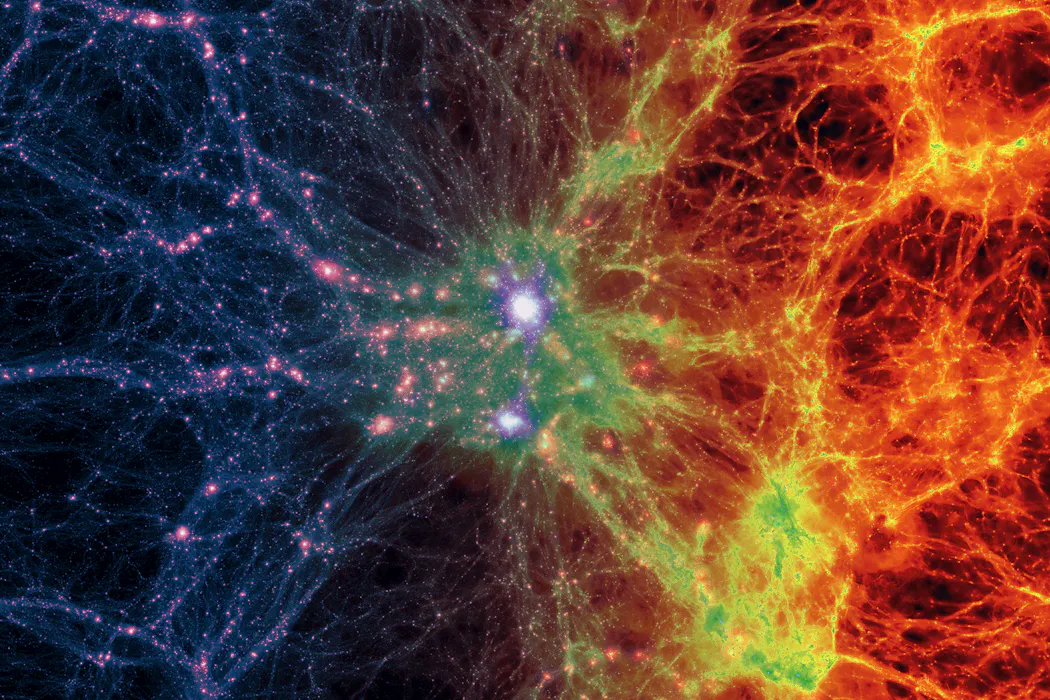
A simulation of the ‘cosmic web’, the vast network of threads and filaments that extends throughout the Universe. Dark matter density is represented by the blue-purple colours on the left. Gas density is represented by the orange-red colours on the right. Esa

New research suggests that relic black holes from before the big bang may still shape galaxies today. These black holes could explain dark matter, one of the biggest unsolved questions in cosmology.

Generally speaking, black holes are regions of spacetime where matter is compressed into a tiny space. Dark matter, meanwhile, is matter that does not reflect or absorb light. We know it exists because of its gravitational influence on galaxies and other cosmic structures.

It can be viewed as the “glue” that holds galaxies together, but we do not know what it is made of at a fundamental level. Most physicists think dark matter is composed of an as-yet-undiscovered sub-atomic particle.

But ancient black holes from before the big bang also fit the bill. They are dark, but also carry mass – exactly the properties required.

I have explored this idea in a new paper. Of course, the idea of relic black holes also requires a re-think of the big bang itself.

For nearly a century, cosmologists traced the history of the universe back to this single, dramatic moment. But maybe this wasn’t the absolute beginning of time. Perhaps there was a universe before the big bang.

Under this scenario, the universe collapsed before undergoing an expansion. The big bang represents the transition between the two phases.

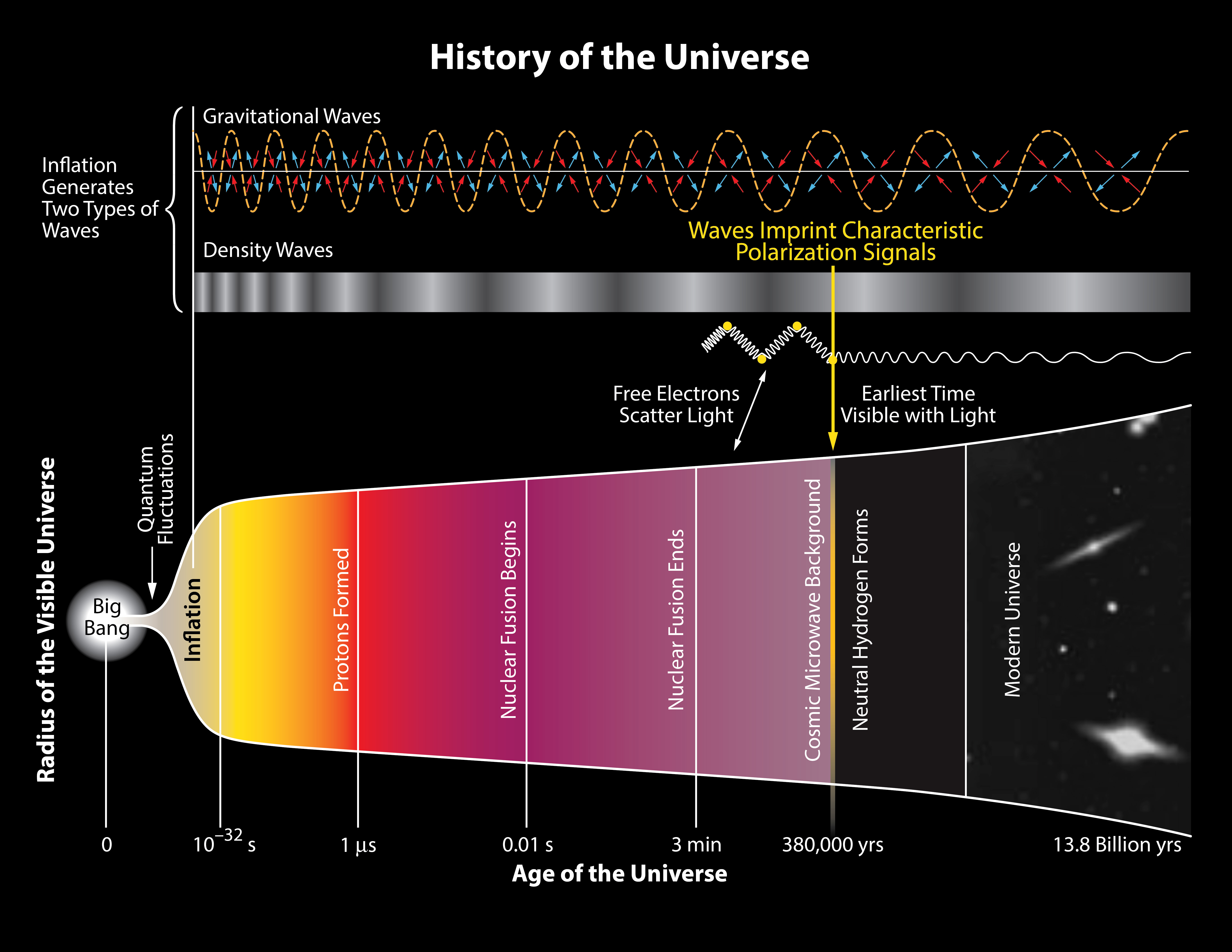
A conventional view of how the universe came to be. Here, the Big Bang is immediately followed by a period of rapid expansion known as inflation.
Bicep2 Collaboration

The big bang model has been remarkably successful. It explains the cosmic microwave background – the afterglow of the early universe – and predicts the large scale distribution of galaxies with astonishing accuracy.

But in Einstein’s theory of general relativity, it is also a singularity – a point where density becomes infinite and the known laws of physics break down.

Many physicists interpret this not as a physical reality, but as a sign that something is missing. Singularities are less like physical objects and more like mathematical warnings: they tell us that our current theories cannot describe the earliest moments of the universe.

A bounce, not a bang

One alternative is a bouncing cosmology. In this picture, the universe undergoes a phase of contraction before the big bang, reaching an extremely high – but finite – density. Instead of collapsing into a singularity, it rebounds, beginning a new expanding phase.

Bouncing models have been explored for decades, often requiring modifications to gravity or exotic new ingredients. But our work shows that a bounce can arise as a regular solution within standard physics, when gravity and the effects of quantum mechanics – the laws governing nature at the tiniest scales – are consistently taken into account.

In standard cosmology, the big bang is quickly followed by a period where the early universe undergoes a period of rapid and exponential expansion. This stage, known as inflation, effectively erases all traces of earlier structures.

Black hole
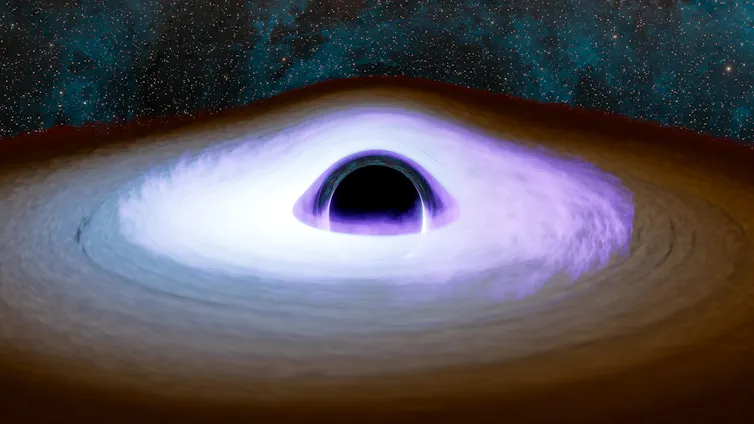
Illustration of a large black hole. Could relic black holes explain the mystery of dark matter?
NASA/Caltech-IPAC/Robert Hurt

The situation is different for a bouncing universe. In our work, we found that things larger than 90 metres could have survived the transition from collapse to expansion. This leaves behind “relics” that carry information from a previous cosmic epoch. These relics can include black holes, gravitational waves and density fluctuations.

Quantum physics contains a powerful clue to how this is possible. According to the Pauli exclusion principle – a cornerstone of quantum theory – matter becomes “degenerate” at extremely high densities. The matter generates a pressure that resists further compression even in the absence of heat.

In our model, a similar effect operates on cosmological scales. It may explain why the universe doesn’t collapse completely – and why structures formed before or during the bounce can survive into the expanding phase.

Surviving the apocalypse

We identify two main routes through which relic black holes can arise.

The first one is direct survival. Compact objects and perturbations (fluctuations in density or gravity) generated during the collapse phase of the universe can persist through the bounce.

The second route is even more intriguing. During contraction, matter naturally clumps under gravity, forming structures similar to the halos that host galaxies today. After the bounce, they are able to collapse efficiently into black holes.

Galaxies and stars from the contraction phase effectively collapse into black holes, erasing most of their detailed structure but preserving their mass.

Could these black holes be dark matter? For decades, the leading candidate has been a fundamental particle — but none has been detected despite extensive searches.

Could the ‘little red dots’ seen by JWST represent relic black holes?
Image: NASA, ESA, CSA, STScI, Dale Kocevski (Colby College)

Relic black holes offer a compelling alternative. If the bounce produces enough of them, they could make up a significant — perhaps dominant — fraction of dark matter.

This idea may also connect to one of the most intriguing observational puzzles of recent years.

The James Webb Space Telescope (JWST) has revealed a population of compact, extremely red objects in the early universe, sometimes called “little red dots”. These astronomical sources appear to be unexpectedly massive and luminous only a few hundred million years after the big bang.

Many astronomers suspect they are associated with rapidly growing black holes – perhaps the seeds of the supermassive black holes found at the centres of galaxies today. But their existence is difficult to explain within standard cosmology. How could such massive objects form so quickly?

Relic black holes provide a natural explanation. If massive seeds already existed immediately after the bounce, the early universe would not need to start from scratch. Supermassive black holes could grow from ancient survivors rather than newly formed objects.

In this sense, JWST may already be glimpsing the descendants of pre-bounce relics.

A new cosmological framework

Taken together, the bounce scenario offers a unified way to address several long-standing problems in cosmology.

  • The big bang singularity is replaced by a quantum transition. This transition could be related to the concept of the “Einstein–Rosen bridge”: a mathematical link between two disparate regions of spacetime.
  • Inflation emerges naturally from the dynamics near the bounce.
  • Dark energy can be related to the global structure of a finite universe.
  • Dark matter may be composed of relic black holes —perhaps our own universe started as one.
  • Gravitational waves could carry signals from a previous cosmic phase.
  • Supermassive black holes may have ancient origins consistent with recent JWST observations.

Much work remains to be done. These ideas must be tested against data – from gravitational-wave backgrounds to galaxy surveys and precision measurements of the cosmic microwave background.

But the possibility is profound: the universe may not have begun once, but may have rebounded. And the dark structures shaping galaxies today could be relics from a time before the big bang.

The Conversation

Enrique Gaztanaga receives funding from the Spanish Plan Nacional (PGC2024) and Maria de Maeztu (CEX2020-001058-M) grants. Enrique Gaztanaga is also a Professor at the Institute of Space Sciences (CSIC/IEEC) in Barcelona and publishes a science blog called DarkCosmos.com.

ref. Could dark matter be made of black holes from a different universe? – https://theconversation.com/could-dark-matter-be-made-of-black-holes-from-a-different-universe-278469