Will voters turn against Donald Trump in the US midterms? What we know so far

Source: The Conversation – UK – By Richard Hargy, Visiting Research Fellow in International Studies, Queen’s University Belfast

The US is bracing for another cycle of elections, with November’s midterms determining the scope of Donald Trump’s power in the final two years of his presidency. All seats in the House of Representatives will be contested, as will one-third of the Senate.

Trump’s Republican party currently controls both branches of Congress. However, polls are indicating a swing to the Democrats that would see them retake the House. A current RealClear generic congressional vote poll, in which people are asked whether they will vote for Democrats or Republicans for Congress, gives the Democrats a five percentage point lead over the Republicans at 47.4% to 42%.

One major variable that is likely to affect the outcome of November’s elections is the war in Iran. Some Republican political operatives believe the conflict and its repercussions, namely the increased cost of living, could prove fatal to their party’s hopes of securing a slim retention of the House.

A March poll by the Pew Research Center revealed 61% of Americans disapproved of Trump’s handling of the conflict. One voting demographic of particular concern for Republicans is people aged 18 to 29. An Economist/YouGov poll also from March showed that 63% of these people opposed the war.

Men within this age bracket were an important factor in Trump’s 2024 election victory. Philip Wang, political reporter for Time magazine, argued in an article on April 8 that this “same voting bloc … is showing far less interest in voting in the midterms”.

William A. Galston, a senior fellow at the Brookings Institution, has asserted that the affordability issue is affecting Trump’s standing. He has also stated that, for a majority of Americans, the president’s “priorities do not align with theirs”. A recent survey conducted by American non-profit Consumer Action for a Strong Economy revealed that voters’ most pressing concern was the price of groceries, with the cost of healthcare coming second.

A queue of cars on a road in Florida.
Three weeks into the Iran war, petrol prices had surged to an average of US$4 a gallon.
Carmen K. Sisson / Shutterstock

Over the past year, both parties have also engaged in redistricting efforts designed to increase their respective chances of controlling the House. In a number of mainly – though not exclusively – Republican controlled states, legislators have redrawn congressional maps in an attempt to secure more seats.

The redistricting war has come down to two final states: Democratic-led Virginia and Republican-dominated Florida. On April 21, voters in Virginia will decide the fate of proposed new congressional boundaries heavily favouring Democrats. Florida’s legislature will vote days later on a revised Republican-leaning electoral map.

However, there are growing concerns in both political camps about these votes and their impact on the result of the midterms. Florida Republicans fear Trump’s low approval ratings could cost them redrawn districts, while Democrats are encountering tepid backing from their supporters for their aggressive redistricting in Virginia.

Growing Democrat momentum

There have already been significant election results in recent weeks that have shed light on the trajectory of the upcoming midterms. In Republican-led Texas, a fascinating race is shaping up between both parties for a Senate seat. The last time a Democrat won here was in 1988.

In primary elections in March, Democratic voters chose state representative James Talarico as their candidate for November’s election. Republicans are yet to confirm theirs, with incumbent Senator John Cornyn facing Texas attorney-general Ken Paxton in a run-off election in May.

Primary voting numbers in Texas are encouraging for Democrats. For the first time in six years, more of its supporters cast early vote ballots in a March primary than Republicans. Democrats also saw a major shift in Latino voters to their side, a voting bloc that had swung to Trump in record numbers in 2024.

According to analysis by American broadcaster NPR: “In the ten most populous counties in Texas that are also at least 50% Latino, votes in the Democratic primary increased by an average of 128%.” The same analysis concluded that, in those same counties, the Republican primary saw an average drop in votes of 4.8%.

Then, in early April, liberal judge Chris Taylor won a seat on the state of Wisconsin’s supreme court. She secured 60.1% of the vote to her conservative opponent’s 39.8%. Taylor’s statewide vote is an impressive 21 percentage points higher than Democratic presidential candidate Kamala Harris’s vote share was in the state in 2024.

Also in early April, an election took place in Georgia to fill the congressional seat vacated by former Trump ally Marjorie Taylor Greene. Greene, who has publicly broken with Trump over his handling of the Epstein files, won in 2024 by almost 29 percentage points. Her replacement, Clay Fuller, held the seat for the Republican party by a much narrower margin of just 12 percentage points.

The forecasts for November’s midterm elections are moving in the Democrats direction, especially for taking control of the House. But there is some reason for hope among Republicans.

Figures from CBS News and CNN/SSRS show that at the same point in 2006 and 2018 – also midterm election years where a Republican president was in office – Democrats were ahead on party favourability by 18 points and 12 points respectively. At this stage in 2026, the data reveals Republicans are actually sitting with a five-point favourability lead.

Seven months out from November’s midterms, Democrats have momentum on their side as well as a Republican president whose poll ratings are plummeting. The most likely outcome is that the Democrats will emerge with control of at least one branch of Congress.

The Conversation

Richard Hargy does not work for, consult, own shares in or receive funding from any company or organisation that would benefit from this article, and has disclosed no relevant affiliations beyond their academic appointment.

ref. Will voters turn against Donald Trump in the US midterms? What we know so far – https://theconversation.com/will-voters-turn-against-donald-trump-in-the-us-midterms-what-we-know-so-far-280395

Man convicted of causing his wife’s suicide – why this is a landmark moment for abuse victims

Source: The Conversation – UK – By Mags Lesiak, PhD Researcher in Psychological Criminology, University of Cambridge

tonkid/shutterstock

Kimberly Milne was 28 when she climbed over the barrier of a motorway bridge and jumped to her death. That night, witnesses saw her cowering from her husband, Lee Milne, in a retail park in Dundee, as he trapped her against a wall. CCTV footage showed her trying to get away while he shouted, drove a car at her and pulled her back into his orbit.

In the year before her death, he had choked her, dragged her by the hair, hit her until she fell and lost consciousness, and apologised, promising he was “not that type of guy”. He went through her phone, controlled her movements and, according to messages shown in court, created a situation where leaving felt impossible: “How can I leave him if he’s saying he’s going to do himself in without me?”

In a first-of-its-kind case in Scotland, Lee Milne has now been held criminally responsible for his wife’s suicide. The 39-year-old was convicted of culpable homicide and sentenced to eight years in custody.

In Spain, Noelia Castillo, 25, underwent euthanasia after a long and highly contested legal battle. In early adulthood, she reported multiple incidents of sexual assault. Days after being gang-raped, she attempted suicide by jumping from a building. She survived, but with irreversible paraplegia, chronic physical pain, neurological damage and profound psychological suffering.

Her euthanasia was legally granted on the basis of that condition. But the question remains: if the injuries that made her life unbearable followed a suicide attempt triggered by sexual violence, can her death be understood without that violence?

Homicide has long been treated as the most extreme outcome of abuse. But recent evidence suggests that abuse-related suicide may be at least as common, if not more so. Yet it remains far less recognised in law, policy and public understanding.

In 2022, an England-wide study found that people who had ever experienced intimate partner violence were almost three times as likely to have attempted suicide in the previous year, even after adjusting for other adversities.

Data in England and Wales suggests that what might be termed “perpetrator-produced suicide” (where sustained abuse produces the conditions in which a person ends their own life) is not uncommon. The Domestic Homicide Project, a research project led by the National Police Chiefs’ Council, recorded 98 suspected suicides following domestic abuse between April 1 2023 and March 31 2024. This was more than the 80 intimate partner homicides recorded, overtaking them for the second year in a row.


Read more:
Are women more safe today in England and Wales than they were in the past – or less? What the evidence shows


This suggests that fatal outcomes linked to domestic abuse may be being categorised as individual acts, rather than perpetrator-produced harm. The result is underrecognition of abusers’ role in their victims’ suicide. There have only been five prosecutions of this kind in England and Wales, leading to just one confirmed conviction for manslaughter.

In Kimberly Milne’s case, the court found that sustained physical and psychological abuse was a significant contributing factor in her death. The judge concluded that Lee Milne’s actions drove his wife to a point of despair, from which she took her own life.

In Castillo’s case, the question of responsibility remains unresolved. The violence that preceded her suicide attempt and ultimately led to her death sits outside the frame of legal accountability. The law breaks these events apart: the assault is treated as a crime, the suicide attempt as her own act, and the later death as a medical decision, rather than recognising how violence can set the whole chain in motion.

‘Choice’ under coercion

To understand the link between suicide and domestic violence or coercive control, we must ask: what does it mean to “choose” to end one’s life, when that choice is made under coercion or threat?

My research explores weaponised attachment, where perpetrators of abuse deliberately use emotional bonds to control their victims. They form attachment through grooming, trauma-sharing and vulnerability, and then use that attachment to influence decisions about whether to stay, leave or seek help. Coercion often operates by shaping how decisions are made – narrowing the options a person can see and making the choice to leave feel impossible.

couple arguing behind frosted glass
Abuse and coercion can change the options a victim thinks are available.
hxdbzxy/Shutterstock


Read more:
How domestic abusers use emotional bonding to control their victims – new study


Research in behavioural economics and cognitive psychology shows that people make choices within the set of options they perceive as available, not the set that objectively exists. Under threat and loss, people seek more risk and are more likely to choose extreme options to escape unpleasant states.

When coercion shapes what a person sees as their obligations and options, a resulting decision cannot be treated as fully self-authored. It is made, but under conditions structured by another. In cases of perpetrator-produced suicide, the issue is not simply whether a victim “chose” to die, but whether that choice was made with the authority required for responsibility. The same mechanism operates in cases where victims are said to have “consented” to abuse.

Justice for victims

This conviction could change how criminal justice systems approach perpetrator-produced suicide. It could lead to more homicide-style investigations where suicide follows coercive control. In investigations, this would mean greater emphasis on patterns of abuse over time, rather than isolating the final event.

For this shift to be meaningful, changes are needed. First, there is a need for better recording of perpetrator-produced suicides, which are currently fragmented or likely misclassified as individual deaths. Second, what police consider as evidence must expand to include patterns of coercion, digital traces and how the relationship unfolded over time, rather than focusing only on what happened in the final moments.

Third, the law needs to be clearer about when sustained abuse leads to responsibility for a death, moving beyond vague labels like “vulnerability” and focusing on how a person’s options were restricted.

Finally, risk assessment practices should move away from predicting isolated incidents towards identifying coercive environments that generate escalating harm. Without these changes, this landmark ruling risks remaining an exceptional case, rather than a foundation for future accountability.


If you’re struggling with suicidal thoughts, the following services can provide you with support: In the UK and Ireland – call Samaritans UK at 116 123. In the US – call the National Suicide Prevention Lifeline at 1-800-273-TALK (8255) or IMAlive at 1-800-784-2433. In Australia – call Lifeline Australia at 13 11 14. In other countries – visit IASP or Suicide.org to find a helpline in your country.

The Conversation

Mags Lesiak does not work for, consult, own shares in or receive funding from any company or organisation that would benefit from this article, and has disclosed no relevant affiliations beyond their academic appointment.

ref. Man convicted of causing his wife’s suicide – why this is a landmark moment for abuse victims – https://theconversation.com/man-convicted-of-causing-his-wifes-suicide-why-this-is-a-landmark-moment-for-abuse-victims-280480

Cairo’s City of the Dead is more than a cemetery – it’s a living neighbourhood at risk

Source: The Conversation – UK – By Lamya Elsabban, Doctoral Researcher in Architecture, Design and the Built Environment, Nottingham Trent University

On religious festival mornings, Egyptians gather among tombs in Cairo’s City of the Dead, a four-mile medieval necropolis at the foot of the Mokattam Hills. They’re upholding a longstanding tradition of remembrance and honouring their deceased loved ones. Though you might expect this ceremony to be marked with silence, the necropolis’s narrow alleys are filled with life as inhabitants carry on with their everyday routines.

Dating back to the 7th century, the City of the Dead has been a Unesco world heritage site since 1979. It began as a burial ground, but over time it has grown into a complex, lived-in urban area. Today, it’s home to generations of families who have adapted the cemetery’s structures into places for everyday living.

The City of the Dead reflects different layers of Egypt’s history. Its early Islamic character can be seen in the domed tombs, mosques, shrines and burial complexes, often built around inner courtyards with carved stone details, all connected by narrow paths and passageways.

Living among the dead

People used to mourn the loss of a relative in the City of the Dead for 40 days – a tradition inherited from ancient Egyptians. During this mourning period, they would stay in small built structures at the cemetery. Over the centuries, more of these buildings were constructed in and around the graves and monuments. They were then transformed into homes.

Over time, the necropolis became home to hundreds of thousands of people looking for a place to live. Many were drawn there by the lack of affordable housing in Cairo, as well as its central location, which makes it easier to access jobs and city life. Today, families continue to pass down stories about the area through generations. To get by, they rely on small businesses and informal work, such as looking after tombs, running cafés and kiosks, or continuing traditional carving and craft skills.

Though this Unesco site contains centuries of architectural and social history, it faces increasing external pressures due to ongoing urban development interventions. In 2020, the Egyptian government decided to build a network of roads and bridges through the area to connect central Cairo with the New Capital, a new city about 60km to the east.

The site is now only partly protected and recognised. This is partly because nearby historic areas are seen as having more tourism value and better fit official ideas about the city. As a result, large development projects often ignore the social, cultural and everyday importance of the City of the Dead as a place where people still live and maintain traditions.

Hundreds of graves have been cleared, and several important structures have been demolished, including the locally significant Halim Pasha Dome. This 19th-century royal mausoleum was part of the burial complex for the family of Muhammad Ali Pasha, who is often regarded as the founder of modern Egypt. Over time, it became an important local landmark and a symbol of the area’s history and identity.

Beyond the loss of buildings, long-term residents are also being forced to leave, which breaks up established social networks and on-site livelihoods. Activists, NGOs, heritage experts and local residents managed to temporarily stop some demolitions in 2024, including in parts of the northern cemetery around the Sultan Qaytbay Complex, as well as areas of Bab al-Nasr and Sayyida Aisha Cemeteries. However, despite this pause, demolition work began again later that year.

Local community resilience

People living in the City of the Dead deal with outside pressures by using a mix of everyday strategies that help them manage uncertainty, make a living and keep their social and cultural traditions alive.

A big part of this is how they adapt spaces to suit different needs. A courtyard, for instance, might be used for work, socialising, or prayer at different times. Spaces shift depending on what’s needed. Some families even rearrange the inside of tombs and nearby buildings to make room for extended relatives.

Residents of the City of the Dead also deal with the threat of demolition through strong community ties and support networks. They get by in uncertain conditions by relying on informal work and helping each other out. Many also work with NGOs like the Sultan Foundation and Archinos to keep their traditions going and strengthen their belonging in the area.

As Cairo continues to modernise, the necropolis faces a difficult situation, caught between pressure to develop the city, the need to preserve its history and the rights of the long-standing community who live there.

The City of the Dead is a rare and fragile place where tombs, everyday life and cultural traditions exist side by side. What makes it special isn’t just its historic buildings, but the way people continue to live there and keep its traditions alive every day.

The Conversation

Lamya Elsabban does not work for, consult, own shares in or receive funding from any company or organisation that would benefit from this article, and has disclosed no relevant affiliations beyond their academic appointment.

ref. Cairo’s City of the Dead is more than a cemetery – it’s a living neighbourhood at risk – https://theconversation.com/cairos-city-of-the-dead-is-more-than-a-cemetery-its-a-living-neighbourhood-at-risk-277583

Scientists make Parkinson’s drug from plastic in world first

Source: The Conversation – UK – By Godfrey Kyazze, Professor of Sustainable Bioprocess Engineering, University of Westminster

Photka/Shutterstock.com

It’s easy to see discarded plastic as nothing more than waste. Much of it ends up in landfill, breaking down into microplastics that seep into water supplies and threaten the environment, and potentially human health. But what if the same plastic waste could instead be transformed into life-saving medicines?

In a recent study published in Nature Sustainability, scientists at the University of Edinburgh have shown that everyday plastic waste is not just an environmental burden but an untapped source of embedded carbon – the carbon atoms locked within plastic’s chemical structure. They demonstrated that engineered E coli bacteria can convert polyethylene terephthalate (PET) – commonly used in bottles and food packaging – into levodopa, a key treatment for Parkinson’s disease.

This approach offers a promising alternative to traditional levodopa production, which relies on multiple fossil fuel–based chemical steps and is energy intensive, costly, and carbon heavy.

Parkinson’s affects more than 10 million people worldwide and becomes more common as populations age. Levodopa remains the most effective treatment for managing the disease’s hallmark symptoms, including tremors and muscle stiffness. As demand for the drug rises, finding sustainable ways to produce levodopa has become increasingly urgent.

In previous studies, the same Edinburgh researchers showed that plastic can be turned into paracetamol, a common painkiller. In the lab, they converted up to 90% of the plastic from a one-litre PET bottle into paracetamol in just 24 hours – an amount roughly the same as nine 500mg paracetamol tablets.

A person holding a mug, their other hand supporting their wrist.
Over 10 million people have Parkinson’s.
chainarong06/Shutterstock.com

Early work in this area began to show that plastics could serve as chemical feedstocks for medicine. In 2022, researchers at the University of Southern California demonstrated that polyethylene (PE) – a different plastic from PET, commonly used in plastic bags and films – could be broken down by engineered fungi into useful compounds, including building blocks for antibiotics, antifungals and cholesterol-lowering drugs.

Building on this, more recent studies have focused on higher-value drugs. For example, a collaborative study led by the University of St Andrews with partners in the Netherlands and Germany showed that PET plastic could be converted into starting materials for cancer therapies and drugs that stop uncontrolled bleeding.

These results show that it’s possible to turn everyday plastic waste into useful medicines. This approach could cut down on the need for fossil fuels and support a more sustainable, circular economy where waste is reused instead of thrown away.

The road ahead

Turning this lab breakthrough into industrial-scale production won’t happen overnight. Engineers must develop cost-effective manufacturing processes, and regulators will need to be satisfied that the products meet strict safety standards.

Collecting enough plastic waste is another challenge, since it has to compete with traditional fossil fuels. Success will require long-term investment and close teamwork between scientists, industry and policymakers.

So, while the idea is exciting, it’s still at an early stage. It offers a glimpse of what might be possible in the future, where biology and engineering help turn some types of plastic waste into medicines.

The Conversation

The authors do not work for, consult, own shares in or receive funding from any company or organisation that would benefit from this article, and have disclosed no relevant affiliations beyond their academic appointment.

ref. Scientists make Parkinson’s drug from plastic in world first – https://theconversation.com/scientists-make-parkinsons-drug-from-plastic-in-world-first-279289

More joy, less juggle? Why workplaces should get on board with the value of care

Source: The Conversation – UK – By Caroline Millar, Visiting Scholar, Queen’s Business School (Organisation, Work and Leadership), Queen’s University Belfast

zEdward_Indy/Shutterstock

The core premise of feminism is this: women can do anything. And yes, these days in developed economies, women without children earn about the same as men. The problem is not the opportunities available to them. It’s the opportunities that disappear as women become mothers.

This disconnect between paid work and care work is evident. In my research on work and motherhood, I have often found that organisations give little thought to the tensions that arise between women’s work and care identities.

A 2025 overview of how care is understood in feminist economic debates recognises the fundamental value of unpaid and underpaid care. But it doesn’t discuss how to reconcile paid work and care.

The unpaid work women do in the home alongside their paid work leads to reduced participation in the workforce, income inequality between the genders, time-poverty, and increased stress for women.

The challenges and constraints that women encounter in the workplace have long been recognised. But caring is also often viewed in a negative way – something that interrupts and stymies their participation in paid work. Motherhood is frequently framed as something that curtails ambition and income.

In contrast, paid work is valued because it generates financial resources. These perspectives speak to the outdated concept of the “ideal worker”, and the capitalist priorities of productivity and efficiency that underpin this idea.

Across academic research, financial resources are often seen as a means to buy exemption from some aspects of motherhood. Other research concedes that caring for older relatives can be rewarding, but then cites all the problems that caregivers may experience.

In short, it is almost impossible to find caring for children framed in a positive way. One paper positions care work as “responsibilities” and “obligations” that fall on women. But this framing is directly at odds with how the women I have spoken to understood their role as mothers: they talked fondly of their children, attended their needs and enjoyed spending time with them.

Rediscovering the value of care

The problem for both feminism and capitalism is that mothers must routinely combine paid work and caring responsibilities in order to make a living. This reflects the tensions that the research identifies but does not resolve: women are navigating systems that position care as a disruption rather than an important and valued form of work and identity.

Older women often recount their career success through a lens of sacrifice, while many younger parents resist long-hours cultures, experimenting with ways to share work and care. What this suggests is that there is a need for employers to have a more nuanced appreciation of parenting identities.

However, work structures often still rely on outdated breadwinner/caregiver identities – dictating how parents juggle paid work and care, and limiting the space for more flexible hybrid roles.

A model where the mother becomes the breadwinner and the father the caregiver is not ideal either. It may appear progressive, but in practice care work continues to be pressed to the margins and the financial precarity it leads to is not acknowledged or fixed. It is simply transferred to the male caregiver.

Breadwinner/caregiver norms are just not suited to society and family dynamics any more. But they can be dismantled and replaced by hybrid roles that allow people to combine work and care identities.

woman at work in a dark office looking at the clock on the wall.
Flexible working arrangements can help parents to do a good job at work and at home.
Andrey_Popov/Shutterstock

While the tensions of work and motherhood have not disappeared, other groups have emerged and are developing momentum. For example, fathers who understand and value their parenting role are prompting a groundswell of change.

In the UK, campaigns such as Parenting Out Loud, as well as demands for extended, government-funded paternity leave (for example, six weeks of leave paid at 90% of income), seek to enable fathers to care and bond with their children without worrying about work pressures. These movements imagine a future where care is equally valued and recognised for its importance to society.

Governments, employers and trade unions have an opportunity to create work cultures that enable parents to do their jobs well at the same time as caring. Structures that value both work and care will allow everyone to contribute to the economy while actively participating in their caregiving roles.

Acknowledging an employee’s care identity needs to extend far beyond workplaces begrudgingly accommodating a mother working from home to care for a sick toddler. It involves enabling and trusting parents to respond to routine parenting challenges in an appropriate way – without penalty or judgment. For example, a dad being able to take emergency leave to respond to his child’s sickness, or a mum arriving late to work after supporting a teenager who is stressed by exams.

Funded, high-quality and reliable care infrastructure is essential, alongside flexible working. The persistent motherhood wage penalty is a good barometer to see how things are changing: interventions that normalise combining work and care will narrow this pay gap, and give a clear indication of what works.

The Conversation

Caroline Millar received PhD funding from Department for the Economy (NI).

ref. More joy, less juggle? Why workplaces should get on board with the value of care – https://theconversation.com/more-joy-less-juggle-why-workplaces-should-get-on-board-with-the-value-of-care-280179

Football is being spoiled by time-wasting – what can be done ahead of the World Cup?

Source: The Conversation – UK – By Carl Singleton, Senior Lecturer in Economics, University of Stirling

Italian referee Marco Guida signals that he is taking account of time-wasting during a Serie A football match. Marco Iacobucci Epp/Shutterstock

Football fans, broadcasters and even head coaches have been complaining this season about excessive time-wasting spoiling the flow of the men’s game.

In the Premier League, the proportion of a match where the ball is in play is at a near-record low. Football’s world governing body Fifa has a target of 60 minutes of ball-in-play per game. Yet two Premier League matches this season had only just above 45 minutes of action – less than half the total match time.

There are numerous factors explaining this decrease. One is the length of time players are taking over each corner, throw-in and free-kick. Repeated injury stoppages (including some that are allegedly faked by players seeking to delay a game) are also blamed – along with lengthy decision-making by each game’s video assistant referee (VAR).

Video reviews have increased the number and length of stoppages, particularly for penalties, red cards and goals. There is now a benefit to staying down after contact in the penalty area while officials check for possible infringements. What might once have been a marginal appeal can trigger a lengthy interruption that, according to our research, is not always fully accounted for in the time added by the referee at the end of each half.

With concerns mounting about how time-wasting could turn off viewers of the men’s World Cup in North America this summer, new rules are being introduced allowing referees to start five-second countdowns at throw-ins and goal-kicks. Teams may also face sanction if their substituted players take longer than ten seconds to leave the field of play.

So, will this make a difference to the amount of action fans see this summer?

Our research, published in the Journal of Sports Economics, suggests no amount of rule-tightening will solve football’s issue with time-wasters until referees are properly supported to withstand the psychological pressure placed on them by players, team officials and fans during each game.

We found that the time taken up by stoppages is often added inaccurately, depending on unconscious biases of referees who alone decide how much time is added. This can especially benefit home teams with stronger support in the stadium.

The “natural experiment” of playing football without fans during the COVID pandemic showed that referees are susceptible to the social pressure exerted by stadium crowds, especially for more subjective or marginal calls like awarding yellow cards and added time.

Football’s early history

Football has always been played in continuous rather than active time. Unlike sports where the clock stops, football absorbs interruptions rather than isolating them. This design goes back to the sport’s early history.

When the match length was standardised in the 19th century, a simple running clock was practical. One interpretation is that 90 minutes became the standard because it reliably produced 60 minutes of ball-in-play action. By the 1890s, this length of match was ingrained in the official rules by the International Football Association Board (Ifab).

The concept of added time was formally adopted in 1891 and applied at the referee’s discretion. It was – and still is – supposed to correct the most obvious losses of time during the 45 minutes of each half.

But added time is not measured mechanically. It is estimated by humans who often apply rules of thumb under pressure from players, managers and spectators.

At the last World Cup in 2022, Fifa extended the amount of added time referees could add at the end of each half in an attempt to discourage players from time wasting. It came close to delivering Fifa’s 60-minute target for ball-in-play. But it came at the expense of games that seemed to go on forever.

Decisions were not the same

We analysed the 2022 World Cup and 2024 European Championship for differences in how referees added time on at the end of the first and second halves. According to Fifa and Ifab, added time should be applied consistently across both halves, since the rules governing stoppage time are identical.

In practice, these decisions were not the same. Referees added on substantially more time in the second half than the first – in part because of the rising stakes of each game as it nears a conclusion. These patterns were stronger at the World Cup, which probably related to Fifa’s edict to increase ball-in-play time.

In particular, we found that referees allowed substantially more stoppage time in tight second halves, while first halves in close (low-scoring) contests were sometimes cut short. This can advantage the trailing team in second halves, giving them a greater chance of getting back to parity since the rate of goal-scoring generally increases as football matches near their conclusion.

Added time is often framed as a technical adjustment. But it is truly where football’s human element is exposed.

Should football introduce a stop-clock?

Does this mean football should follow the path of sports like basketball, American football and rugby and adopt a stop-clock, ending each half when the official time expires (with stopped-clock pauses along the way)? The appeal might seem obvious. But it would also change the nature of football.

We believe matches would grow even longer, interruptions would multiply and lengthen, and the continuous flow that gives the game its rhythm and tension would be under even greater threat.

The temptation to factor in television commercial windows might also grow. This summer’s World Cup will already include three-minute hydration breaks in the middle of every half to mitigate high temperatures in games.

Ultimately, added time is a reminder of what football is: a sport played in running time that cannot be perfectly measured. Referees will never be fully consistent, because the moments they arbitrate are charged with uncertainty – despite VAR’s best (and worst) efforts.

But the game’s authorities are still right to be addressing the issue of time wasting ahead of this summer’s World Cup. One of football’s great attractions is the pace at which it is played. Lose this and the game becomes a lot less beautiful.

The Conversation

Carl Singleton receives funding from the Economic and Social Research Council (UKRI). He is affiliated with the Luxembourg Institute of Socio-Economic Research through the IZA@LISER network.

David Butler and Robert Butler do not work for, consult, own shares in or receive funding from any company or organisation that would benefit from this article, and have disclosed no relevant affiliations beyond their academic appointment.

ref. Football is being spoiled by time-wasting – what can be done ahead of the World Cup? – https://theconversation.com/football-is-being-spoiled-by-time-wasting-what-can-be-done-ahead-of-the-world-cup-280501

What Viktor Orbán’s election loss means for Putin, Trump and the rise of right-wing populism

Source: The Conversation – Global Perspectives – By Matthew Sussex, Associate Professor (Adj), Griffith Asia Institute; and Fellow, Strategic and Defence Studies Centre, Australian National University

Hungary’s most consequential election in decades has just delivered an important victory for democracy and accountability.

For Hungarians, opposition leader Péter Magyar’s emphatic defeat of Prime Minister Viktor Orbán and his ruling Fidesz Party ends 16 years of corruption and quasi-authoritarianism.

The outcome will also be felt widely, from Moscow to Washington and beyond.

In a contest characterised as a referendum on whether Hungary should pivot west or continue its authoritarian drift, Magyar’s victory is a stern rebuke to the dark, transnational forces of nativism, division and the politics of resentment that have become part of mainstream political discourse.

Perhaps the most surprising thing about the election was not the turnout (more than 74%, shattering previous records), or even the result (a two-thirds supermajority for Magyar’s Tisza party, winning at least 138 of 199 parliamentary seats).

Both had been predicted for some time, and Orbán’s soft authoritarianism had always left the door ajar for a possible opposition victory at the polls.

Rather, the biggest surprise might have been Orbán’s immediate concession. He didn’t try to manufacture a crisis or use his security services to hold onto power. Given the strength of anti-government sentiment in Hungary, such a move could have led to a “colour revolution” – the type of massive street protests seen previously in Ukraine, Georgia and other countries.

This could have turned bloody. Liberal Hungarians, and the European Union more broadly, will be heaving a collective sigh of relief.

Why Orbán was suddenly vulnerable

Having won office, Magyar will need to move quickly but also carefully to bring change, so as not to alienate too many former Fidesz voters.

He has already asked President Tamaś Sulyok to resign, along with other Orbán loyalists. The Tisza supermajority in parliament is important here. It will be required for constitutional amendments to dismantle the architecture of Orbán’s authoritarian state.

Fortunately, this will be easier in Hungary than fully fledged autocratic systems. Indeed, Orbán’s longevity can somewhat be attributed to the fact that his brand of authoritarianism was only partial.

Certainly, it had the structural elements of an autocracy. That included widespread, government-controlled gerrymandering to ensure Fidesz victories, and the cynical diversion of state funds to cities and provinces controlled by Orbán’s political allies.

In addition, the nationalised media ecosystem was heavily supportive of the government, although alternative voices kept debate alive via foreign-owned news organisations.

But Orbán’s success also came from facing weak and easily fragmented or coopted oppositions. Magyar – a former Orbán ally – ran a disciplined campaign that nullified the electoral advantage for Fidesz.

Ultimately, though, when voters have a choice – even a constrained one – they will eventually reject governments that rely on blame and victimhood to mask their inability to offer people a better future.

Under Orbán, Hungary was consistently ranked the most corrupt nation in Europe. In 2025, it ranked last in the EU on relative household wealth. It had also suffered rampant inflation and economic stagnation after Russia’s invasion of Ukraine in 2022.

Video footage of country estates built by Hungary’s elites, complete with zebras roaming the grounds, perfectly symbolised the popular outrage with wealth inequality.

A setback for Putin, Trump and right-wing populism

Hungary’s new start also sends a powerful message to other nations. Clearly the biggest loser from the election is Vladimir Putin’s Russia, which had hastily tapped Kremlin powerbroker Sergey Kiriyenko and a team of “political technologists” to assist Orbán.

Under Orbán, Hungary was the strongest pro-Kremlin voice in the EU. It regularly stymied aid packages for Ukraine, tied up decision-making on the war in bureaucratic processes, and held the European Commission to ransom by threatening hold-out votes.

In fact, just days before the election, Bloomberg published a transcript of a phone call between Orbán and Putin from October 2025, in which Orbán compared himself to a mouse helping free the caged Russian lion.

This came on the back of revelations that Orbán’s foreign minister, Péter Szijjártó, and other Hungarian officials had regularly been leaking confidential EU discussions to Moscow.

Another loser from the Hungarian election is the Trump White House.

The pre-election Budapest visit by US Vice President JD Vance to shore up support for Orbán was breathtakingly hypocritical. Vance farcically demanded an end to foreign election meddling, while engaging in precisely that. The White House then doubled down, with Trump promising on Truth Social to aid Orbán with the “full Economic Might of the United States”.

JD Vance puts Donald Trump on speakerphone during a speech in Hungary.

Now, though, Trump is very publicly on the losing side. And like the debacle of his Iran war, he tends to chafe at losing.

The election also shows that US foreign interference campaigns are not invulnerable, though the White House will doubtless continue excoriating Europe. The Trump administration’s view that Europe is heading for “civilisational erasure”, necessitating US efforts to “cultivate resistance” and “help Europe correct its current trajectory” is documented in its 2025 National Security Strategy.

But the broader movements representing what Russian journalist Mikhail Zygar calls the “Putinisation of global politics” have been repudiated by Hungary’s election result.

Under Orbán, Hungary was a hub for ultraconservative voices. Think tanks like the MAGA-boosting US Heritage Foundation and Hungary’s Danube Institute regularly held prominent dialogues bemoaning Europe’s capitulation to wokeism.

The Hungarian iteration of the Conservative Political Action Conference (CPAC), sponsored by the American Conservative Union, was a key calendar for Western right-wing politicians and commentators, including former Australian Prime Minister Tony Abbott, Reform UK leader Nigel Farage, and former Fox News host Tucker Carlson.

China will also be keenly watching Magyar’s new government, especially since it has viewed Hungary as a soft entry point to the EU. The large-scale investment in electric vehicle manufacturing, especially battery production, are part of a growing Chinese business footprint in the country.

For Beijing, the question will be whether Magyar seeks to sacrifice this lucrative investment to burnish his European credentials.

What about the winners?

In addition to Hungarians outside Orbán’s orbit of elites, the EU will welcome the news that it remains an attractive force.

Ukraine, too, may find it easier to secure European assistance. At the very least, smaller Ukraine detractors like Slovakia will have to choose between acquiescing quietly or thrusting themselves uncomfortably into the open.

Yet, although Hungary’s result is promising, the world is still trending towards illiberalism.

And with the US midterm elections fast approaching, far-right American politicians, including Trump himself, will be studying Hungary’s lessons closely. If they conclude that Orbán’s brand of authoritarianism was too soft, a more hardline path looms as an ominous alternative.

The Conversation

Matthew Sussex has received funding from the Australian Research Council, the Fulbright Foundation, the Carnegie Foundation, the Lowy Institute and various Australian government departments and agencies.

ref. What Viktor Orbán’s election loss means for Putin, Trump and the rise of right-wing populism – https://theconversation.com/what-viktor-orbans-election-loss-means-for-putin-trump-and-the-rise-of-right-wing-populism-280447

He exposed corruption and walked across Hungary. Now Péter Magyar has defeated a powerful state machine

Source: The Conversation – Global Perspectives – By Robert Horvath, Senior lecturer, La Trobe University

The landslide victory of Péter Magyar’s Tisza Party in Hungary’s parliamentary election represents much more than a routine change of government. It marks the fall of an “electoral autocracy”, a regime that used elections to shroud and legitimise a system designed to keep the ruling Fidesz party and its leader, Viktor Orbán, in power indefinitely.

The Orbán regime was founded on three pillars. The first was the concentration of power in Orbán’s hands and the destruction of constitutional restraints and oversight mechanisms.

Propelled to power in 2010 by a wave of revulsion at corruption scandals and economic crisis, Orbán quickly took over key state institutions like the judiciary, the taxation office, the prosecutor’s office and the election commission. Each were stacked with Fidesz loyalists, who transformed them into instruments of the regime.

The second pillar was corruption. The Orbán regime enriched Hungary’s elite by transferring vast resources to a group of loyal oligarchs and Orbán cronies.

It achieved this through skewered tendering processes to award massive state contracts to people like Lőrinc Mészáros, a former gas-fitter who had been one of Orbán’s close childhood friends. In 2010, Mészáros was a minor local businessman, but his wealth doubled every year of Orbán’s rule. By 2018, he was the richest man in Hungary.

The third pillar was the media, slowly subjugated by a pincer movement of government institutions and loyal oligarchs.

Legislation passed in 2011 created a Fidesz-controlled Media Council, which was empowered to impose fines for “unbalanced” reporting. This had a chilling effect on journalists.

At the same time, the regime distributed lavish subsidies and advertising contracts to pro-regime outlets. And loyal oligarchs acquired the last bastions of the Hungarian mainstream media. In 2016, one of Hungary’s most influential newspapers, Népszabadság, was purchased by a company linked to Mészáros and promptly shut down.

The culmination of this war of attrition was the creation of a massive media conglomerate, the Central European Press and Media Foundation. It came to control hundreds of media holdings donated by pro-regime businesses. The result was the consolidation of the regime’s control over an estimated 80% of Hungary’s media market.

Orbán justified this concentration of power by posing as a defender of Hungary’s sovereignty and traditional values against threats to the nation.

His rule was punctuated by a series of scare campaigns constructed around external threats – the philanthropist George Soros, the European Union, refugees and Ukraine. He used these threats to justify increasingly draconian controls over civil society and the domestic opposition.

Who is Péter Magyar?

What enabled opposition leader Péter Magyar to topple this system in Sunday’s election was the fact he was an insider.

As a moderate conservative and former Fidesz functionary, Magyar was not easy to stigmatise using the regime’s usual stereotypes. At the same time, he had deep knowledge of the inner workings of the system.

In early 2024, he broke with Fidesz during a massive scandal over a presidential pardon for a man convicted of covering up paedophilia in a children’s home. And he became an anti-corruption crusader.

On his Facebook page, Magyar reflected he had always believed in Fidesz’s vision of a “national, sovereign, civic Hungary”, but had slowly come to realise:

[…]this is really just a political product, a sugar coating that serves only two purposes: to conceal the operation of the power factory and to amass immense wealth.

A few weeks later, he magnified the impact of this bombshell by releasing audio recordings of a conversation in which his ex-wife, former Justice Minister Judit Varga, discussed how Orbán’s Cabinet chief had organised the removal of files in a corruption case.

Before the Orbán regime had time to react, Magyar had emerged as the leader of an obscure centre-right party, Tisza, in the elections to the European parliament. In a blow to Fidesz, it came from nowhere to win 30% of the vote. The result transformed Magyar into the undisputed leader of Hungary’s democratic movement.

Taking down an autocrat

Magyar undermined the Orbán regime in two ways.

The first was to neutralise Orbán’s populist, anti-elitist politics by focusing on corruption. Magyar repeatedly drew attention to the luxurious estate at Hatvanpuszta, a 19th century country estate and model farm that was massively redeveloped after 2018.

Although formally owned by Orbán’s father, Győző, it was widely believed to be a personal retreat of Viktor Orbán himself. Magyar called Hatvanpuszta “the heart of the system”, and likened it to one of Putin’s palaces.

The second was to reach out to Orbán’s rural heartland. In 2025, Magyar walked hundreds of kilometres in a series of political marches across the Hungarian countryside, visiting the small towns and villages that traditionally voted for Fidesz.

Péter Magyar walks across border the Hungarian border to Romania.

His party, Tisza, soon overtook Fidesz in the pre-election polls, but a peaceful transition of power was far from inevitable.

During its final years, the Orbán regime had became increasingly repressive. It used the security services to conduct a covert operation to penetrate the Tisza party’s computer servers. It also laid espionage charges against the country’s famous investigative journalist, Szabolcs Panyi, for exposing how Orbán’s foreign minister was collaborating with the Kremlin.

And a disinformation campaign, apparently of Russian origin, prepared the ground for a government crackdown by raising the spectre of post-election violence and attempts to assassinate Orbán.

But what broke the regime was the tidal wave of popular support for Magyar’s campaign. In the lead-up to the election, fractures began to emerge within the regime. A combination of whistleblower testimony and leaks from the security forces shone a spotlight on its abuses of power.

When the scale of Magyar’s victory became clear on election night, there was no room to dispute the verdict of the people. Orbán was finished.

The Conversation

Robert Horvath has received funding from the Australian Research Council.

ref. He exposed corruption and walked across Hungary. Now Péter Magyar has defeated a powerful state machine – https://theconversation.com/he-exposed-corruption-and-walked-across-hungary-now-peter-magyar-has-defeated-a-powerful-state-machine-280455

Mark Carney secures majority after ‘unwinnable’ 2025 election victory, building new momentum

Source: The Conversation – Canada – By Allison Harell, Professor of Political Science, Université du Québec à Montréal (UQAM)

A year ago this month, Canadians delivered a result that seemed impossible just a few weeks earlier: another Liberal minority government, this time under newly chosen leader Mark Carney. Now, after three byelections, the Liberals have a majority for the first time since 2019.

It’s been an astonishing reversal of fortune for the Liberals. For more than two years, the Conservatives had held a comfortable advantage in the polls. Many analysts treated a Conservative victory as all but inevitable.

Yet on election night on April 28, 2025, the Liberals finished with 43.8 per cent of the vote, edging out the Conservatives at 41.3 per cent, while the NDP and Bloc Québécois dropped sharply from their 2021 levels.

Two major developments upended what had appeared to be a predictable political landscape — and, if the byelection results are any indication, their effects may be lasting.

The first was the return of Donald Trump to the United States presidency. This brought an immediate wave of tariffs and an adversarial posture toward Canada. The policy shock had economic consequences, but it also triggered a shift in how Canadians perceived the risks facing the country.

The second development came in early January 2025. Justin Trudeau resigned after intense internal and external pressure. His departure reset the Liberal brand almost overnight.

With Carney newly installed as leader, the Liberals entered the election presenting not continuity but transformation in the face of Trump’s threats about making Canada the 51st American state.


Read more:
Canada, the 51st state? Eliminating interprovincial trade barriers could ward off Donald Trump


Trump and tariffs were primary issues

Taken together, these shocks reshaped voters’ priorities. Instead of evaluating parties along familiar ideological lines, many Canadians approached the election as a question of who could best protect the country during an unusually turbulent moment. It seems that a year later, Canadian voters are still regarding the Liberals in this light.

New data from the 2025 Canadian Election Study (CES) has helped illuminate this dynamic. When asked which party was best suited to manage Canada’s relationship with the United States, Canadians across nearly all partisan groups — including those who typically support other parties — chose the Liberals most often (57.8 per cent).

While Liberal and Conservative partisans selected their own respective parties more than 80 per cent of the time, what’s noteworthy is that strong majorities of NDP (71.6 per cent) and Bloc (62.8 per cent) supporters also selected the Liberals.

The significance of this pattern is hard to overstate. The relationship with the U.S. dominated voter concerns during the election. One in five Canadians mentioned the relationship with the U.S., Trump or tariffs as the most important issue in the 2025 Canadian federal election.

This was the second most common response behind general economic concerns, which were closely tied to the U.S. situation. About one in three Canadians said the economy was the most important issue.

Economic stewardship

Historically, Conservatives benefit when voters prioritize economic competence. But in 2025, the turbulence caused by U.S. tariffs did not translate into increased trust in Conservative stewardship.

Instead, a sizable majority of Canadians supported the use of retaliatory tariffs (68.7 per cent), and more Canadians identified the Liberals as the party best able to manage the economy (48 per cent versus 39 per cent for Conservatives).

This shift in perceived competence had profound cascading effects. Strategic voting among NDP supporters, in particular, proved decisive. While partisans typically remain loyal to their own party, 2025 saw an unprecedented number of traditionally NDP voters casting ballots for the Liberals.

While more than 80 per cent of NDP supporters voted for their own party in 2021, a majority of NDP partisans voted for the Liberals in 2025, a highly unusual pattern for partisans in most elections.

This trend extended to Bloc voters as well, though to a lesser extent, leading to a Liberal minority that was unimaginable six months earlier.

Carney and the Liberals still popular

As we approach the one-year anniversary of this election, the aftermath of those choices is still visible in public opinion.

Polling conducted in early 2026 shows the Liberals holding a six‑point lead in national vote intention, along with a 52 per cent government approval rating. Carney’s net favourability sits at +20.

These indicators, as well as the byelection results, suggest that voters have not experienced the “buyer’s remorse” that sometimes follows strategic elections. Instead, many appear reassured by the combination of stability and technocratic competence they sought in 2025.

Multiple floor-crossings by Conservative and NDP members — the most recent is longtime Conservative MP Marilyn Gladu, whose defection left the Liberals just one seat short of a majority before the byelections — suggest optimism about the Liberal government’s stability.

Whether this stability endures will depend heavily on developments outside Canada’s borders. But for now, Canadians seem broadly satisfied with the strategic choice they made in April 2025.

The Conversation

The Canadian Election Study was funded from the Social Science and Humanities Research Council (grant #891-2019-2011).

Daniel Rubenson receives funding from the Social Sciences and Humanities Research Council of Canada

Laura Stephenson has received funding from SSHRC (Social Sciences and Humanities Research Council of Canada) and Max Bell Foundation for her research.

Lewis Krashinsky receives funding from the Social Sciences and Humanities Research Council of Canada (#756-2024-0366).

ref. Mark Carney secures majority after ‘unwinnable’ 2025 election victory, building new momentum – https://theconversation.com/mark-carney-secures-majority-after-unwinnable-2025-election-victory-building-new-momentum-279061

Trump’s exchange with Pope Leo reflects deep-rooted tensions between the Vatican and the United States: 4 essential reads

Source: The Conversation – USA (3) – By Kalpana Jain, Senior Religion + Ethics Editor, Director of the Global Religion Journalism Initiative, The Conversation

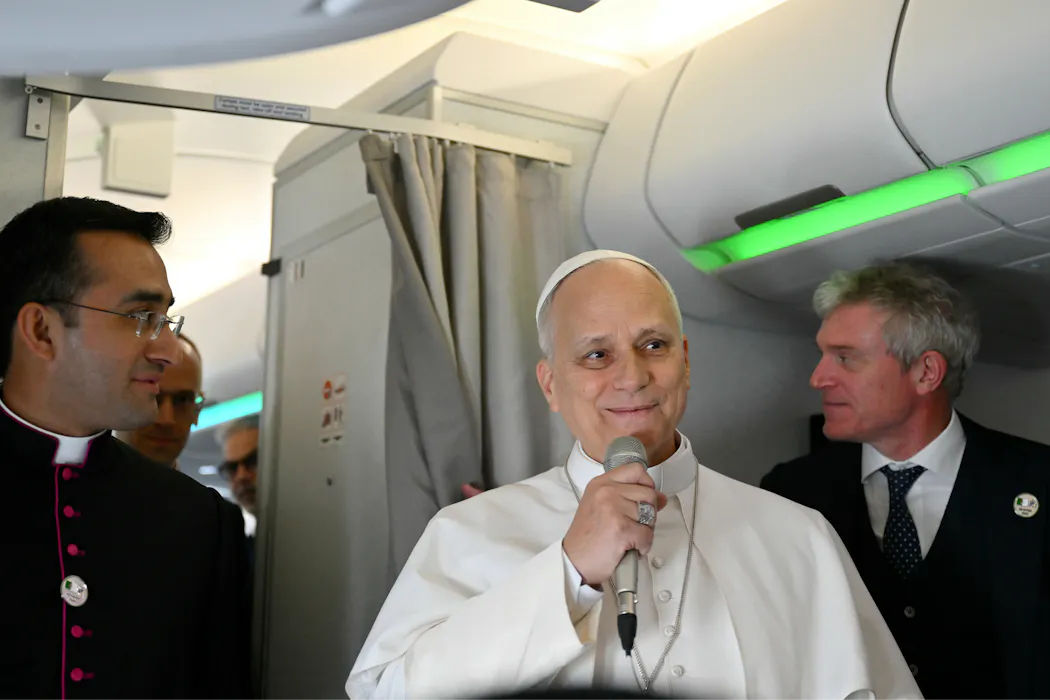
Pope Leo XIV speaks to journalists aboard his flight bound for Algiers on April 13, 2026. Alberto Pizzoli/Pool Photo via AP

President Donald Trump and Pope Leo XIV, the U.S.-born head of the Catholic Church, had an unusual and acrimonious public exchange over the weekend.

In a scathing attack on Truth Social, the social media platform he launched in 2022, Trump accused the pope of being “WEAK on Crime and terrible for Foreign Policy.” The lengthy post on April 12, 2026, told Leo to “focus on being a Great Pope, not a Politician.”

Later that night, Trump told reporters that he was “not a big fan of Pope Leo” and did not think the pope was “doing a very good job.” Leo has repeatedly called for peace amid wars in the Middle East and described Trump’s April 7 threat to destroy Iranian civilization as “truly unacceptable.”

Several hours later, aboard a papal flight to Algiers – where he will begin a 10-day trip to AfricaLeo told reporters that he did not want to get into a debate with Trump, and that his words were not “meant as attacks on anyone.” But striking a firm note, he said he had “no fear” of the Trump administration.

“I do not look at my role as being political, a politician,” the pope said, adding, “I will continue to speak out loudly against war, looking to promote peace, promoting dialogue and multilateral relationships among states, to look for just solutions to problems. Too many people are suffering in the world today. Too many innocent people are being killed. And I think someone has to stand up and say, ‘There’s a better way to do this.’”

The public nature of Trump’s criticism may feel unprecedented. But there have long been tensions between the United States and the Vatican’s effort to seek peace, as scholars writing for The Conversation have shown in past articles.

1. History of anti-Catholicism

In February 2016, Pope Francis criticized Trump’s campaign pledge of building a wall on the U.S.-Mexico border. Back then, too, Trump attacked Francis for being a “very political person.”

Temple University historian David Mislin wrote how the comments suggesting that the pope was interfering in U.S. politics reminded some commentators of an “older religious bigotry.”

During the 19th century, when large numbers of Catholics immigrated to the U.S., they were looked at with suspicion. Some Americans claimed that “Catholics maintained allegiance to the church first and to American values and institutions second,” Mislin explained.

“Anti-Catholic cartoons suggested that Catholics would use political power to dismantle the nation’s institutions,” he added.

It was once “unthinkable” for American presidents to be seen with the pope. Dwight Eisenhower became the first U.S. president to visit the Vatican in 1959.

A man in a black suit and another in white priestly robes bow toward each other, as some others stand quietly in the background.
President Dwight Eisenhower with Pope John XXIII on Dec. 6, 1959, at the Vatican.
AP Photo


Read more:
Why it was once unthinkable for the president to be seen with the pope


2. Mutual influence

It was only in 1984 – under President Ronald Reagan – that the U.S. and the Vatican established diplomatic relations, as church historian Massimo Faggioli noted in an 2015 article.

Faggioli, a professor at Trinity College Dublin, wrote in the lead-up to Francis’ trip to the United States. That visit reflected “a story about change in religion and politics,” he noted – about relations between the papacy and the Catholic Church, on one side, and the United States, on the other.

Francis addressed Congress on this trip, which, according to Faggioli, “would have shocked most Americans only 30 years ago.”

He also noted how much world Catholicism had been influenced by American ideas in recent years, becoming “much more American than it used to be – and much more American than Italian, for that matter.” Catholic teachings “on religious freedom and democracy and the new sensibility on the role of women in the Church came to Rome largely thanks to the experience of Catholics in the United States,” Faggioli wrote.

His broader point was that the Vatican and the U.S. have had an influence on each other – something that can be “seen only over a long period of time.”


Read more:
Why should we care about Pope Francis’ visit to the US?


3. How Francis changed church’s foreign policy

Part of the change – at least at the Vatican end – is reflected in the church’s relationship with political power, as Loughborough University researcher Massimo D’Angelo pointed out.

Francis’ predecessor, Joseph Ratzinger – who became Pope Benedict XVI – may have often seen political alliances as a necessity for the church’s survival in times of secular decline. “Francis rejected this approach,” D’Angelo wrote.

Two men, one in priestly robes, sit facing each other on ornate golden chairs, with flags behind them set against a gilded backdrop.
Pope Francis talks to Myanmar’s President Htin Kyaw during their meeting at the Presidential Palace in Naypyitaw, Myanmar, on Nov. 28, 2017.
Max Rossi/Pool Photo via AP

“The sacred must not be instrumentalised by the profane,” Francis stated in Kazakhstan in 2022. In other words, religion should not be a tool in the hands of the powerful. Francis also made constant appeals for peace amid the Ukraine and Gaza wars, though he avoided direct condemnation – which, at times, led to some criticism.

Even so, as D’Angelo said, it was “another major transformation” in how the church related with political power.


Read more:
How Pope Francis changed the Catholic Church’s foreign policy


4. Shared principles

Trump’s Truth Social post accused Leo of “catering to the radical left.” Mark Yenson, a religious studies scholar at Western University in Canada, explained why such terms may not be applicable in the context of the papacy, where “conservative” and “liberal” labels don’t work the same way as in polarized American politics.

Many Americans viewed Benedict as more conservative than Francis, his successor. Yet some of the two popes’ history suggests that they appealed to shared principles, which were theological rather than political, Yenson wrote in 2025. These were “not reducible to liberal versus conservative categories.”

As he wrote, “The role of the pope, highlighted in Francis’ teaching on ecology, is to inspire a different kind of social and moral imagination, one not reducible to particular ideological positions.”

Leo, like Francis, has been critical of the Trump administration. Yenson reminds readers that the pope’s choice of name hearkens to Pope Leo XIII, who initiated modern Catholic social teaching and emphasized peace and justice. Additionally, he wrote, Leo’s “career as a missionary, bishop and Vatican cardinal outside of the U.S. means that his context is not confined to the polarizations of the U.S. Catholic Church and its bishops.”

Far from an isolated spat, Trump and Leo’s exchange might well show a recurring dynamic – in which papal intervention on global issues is rarely seen as neutral.


Read more:
Is Pope Leo XIV liberal or conservative? Why these labels don’t work for popes


This story is a roundup of articles from The Conversation’s archives.

The Conversation

ref. Trump’s exchange with Pope Leo reflects deep-rooted tensions between the Vatican and the United States: 4 essential reads – https://theconversation.com/trumps-exchange-with-pope-leo-reflects-deep-rooted-tensions-between-the-vatican-and-the-united-states-4-essential-reads-280510