The surprising power of seashells: how oyster waste can recapture rare earth elements

Source: The Conversation – UK – By Juan Diego Rodriguez-Blanco, Ussher Associate Professor in Nanomineralogy, Trinity College Dublin

On many coastlines around the world, piles of discarded oyster and mussel shells are a common sight — the leftovers of a global seafood industry that produces millions of tonnes of waste each year. At the same time, hidden in rocky deposits far from the coast, a very different sort of resource — rare earth elements — is plentiful. These metals are in soaring demand as they are essential for technologies such as wind turbines, electric vehicles, and most modern electronics.

My team’s new research explores an interesting connection between this waste and the critically needed rare earth elements. We found that common seashells, particularly oyster shells, can capture and trap rare earth elements from water. In doing so, the seashells transform from waste into a potential tool for cleaning up pollution linked to the green energy transition.

People in Japan often describe rare earth elements as the “vitamins of modern industry” because, like vitamins in the body, they are essential for many modern technologies but only small amounts are needed. Extracting and processing rare earth minerals them can generate contaminated wastewater, where these elements may leak into the environment.

In our labs at Trinity College Dublin, we have been investigating whether seashell waste could help address this problem. We collected oyster, mussel and cockle shells from Irish beaches, cleaned them and crushed them into small grains. These fragments were then placed in water containing rare earth elements — specifically lanthanum, neodymium and dysprosium — at concentrations similar to those found in severe industrial contamination.

What happens next is not immediately visible to the naked eye, but under the microscope it is striking – and beautiful. At the surface of each shell grain, a chemical reaction begins. The calcium carbonate that makes up the shell starts to dissolve, while new minerals containing rare earth elements begin to crystallise in its place. Over time, a thin layer forms, like a kind of mineral “skin” that coats the grain.

Using a high-resolution microscope, we observed this process in detail. Tiny crystals first appear as needle-like structures, then grow and merge into a continuous crust. In some cases, this crust eventually blocks further reaction, effectively shutting down the process.

But not all shells behave the same way: oyster shells, it turns out, have a unique internal structure. They are made of thin layers and porous, chalky regions that allow water and dissolved elements to circulate more freely. This means the reaction does not stop at the surface. Instead, it continues inward, gradually replacing the entire shell.

Under the right conditions, 1g of oyster shells can capture and lock away up to around 1.5g of the rare earth elements present in the solution. Rather than simply sticking to the surface, these elements become part of a new, stable carbonate mineral.

From pollution control to resource recovery

Many materials used in water treatment rely on adsorption, the process whereby contaminants bind or “adsorb” to a surface. But in this case, it’s a process called full mineral transformation that incorporates the rare earth elements into solid crystals. This makes them far less likely to be released back into the environment.

Once captured, these elements could follow different paths. The material could be potentially processed further to recover the metals. Because they are concentrated in a solid phase, established chemical extraction methods could, in principle, be used to recycle them. Potentially, those waste shells could be used not only to clean up pollution, but also to recover valuable resources that would otherwise be lost.

There is no shortage of seashells. Nature makes them for free. Global shellfish aquaculture produces vast quantities of shell waste each year, much of which ends up in landfill or stockpiled near coastlines. Crushed shells could be used in filtration systems, treatment beds or permeable barriers, where contaminated water flows through reactive material. These approaches are already commonly used in water treatment, for example for the removal of heavy metals from seawater.

The challenge lies in maintaining efficiency. Some shell types quickly develop impermeable coatings that limit their effectiveness. Our results suggest that oyster shells, thanks to their structure, are particularly well suited to overcoming this limitation.

Making this technology work on a larger scale will depend less on finding new materials and more on designing systems that let as much water as possible come into contact with the active surfaces, while preventing those surfaces from becoming blocked or less effective over time.

This approach alone will not reduce the need for mining rare earth elements. Global demand for these materials is vast and growing very rapidly. However, that does not make this solution insignificant. It can help support a less wasteful and more “circular” approach to critical materials by offering a way to capture rare earth elements from waste streams, reduce environmental contamination and potentially recover part of what is currently lost during processing.

Scaling this approach from the lab to real-world applications requires testing under more complex conditions, as industrial wastewaters contain mixtures of metals, variable chemistry and flowing systems. Pilot-scale studies are needed to assess performance, durability and how quickly shell fragments develop a rare earth-rich mineral coating, like an armour, that blocks further reaction with the water.

Practical questions also matter: how much processing (cleaning, crushing) is truly necessary, and can it be done cost-effectively at scale? If rare earth recovery is the goal, efficient methods must be developed to extract them from the newly formed minerals. Addressing these challenges will determine whether this becomes a viable large-scale solution.

The Conversation

Juan Diego Rodriguez-Blanco receives funding from Science Foundation Ireland (Research Ireland), Geological Survey Ireland and the Environmental Protection Agency (Ireland).

ref. The surprising power of seashells: how oyster waste can recapture rare earth elements – https://theconversation.com/the-surprising-power-of-seashells-how-oyster-waste-can-recapture-rare-earth-elements-279494
The Islamabad talks were doomed to failure – and Hormuz blockade has thrown another obstacle to any Iran-US deal

Source: The Conversation – Global Perspectives – By Farah N. Jan, Senior Lecturer in International Relations, University of Pennsylvania

U.S. Vice President JD Vance leaves Islamabad on April 12, 2026. Jacquelyn Martin – Pool/Getty Images Jacquelyn Martin/Getty Images

Twenty-one hours of direct negotiations. The highest-level face-to-face engagement between Washington and Tehran since the 1979 Islamic Revolution.

And yet, U.S. Vice President JD Vance boarded Air Force Two in Islamabad on the morning of April 12, 2026, with no deal to end the U.S. and Israeli war against Iran, including an understanding over Tehran’s nuclear ambitions.

The U.S. has since begun what it says is a blockade of any and all ships originating in Iranian ports and would interdict every vessel that has paid a toll to Iran.

The collapse of the talks wasn’t the fault of bad faith or clumsy diplomacy. Rather, the talks failed because of structural obstacles that no amount of negotiating skill can overcome in a single weekend.

I and other exponents of international relations theory predicted this outcome. Understanding why matters enormously for what comes next.

The commitment barrier

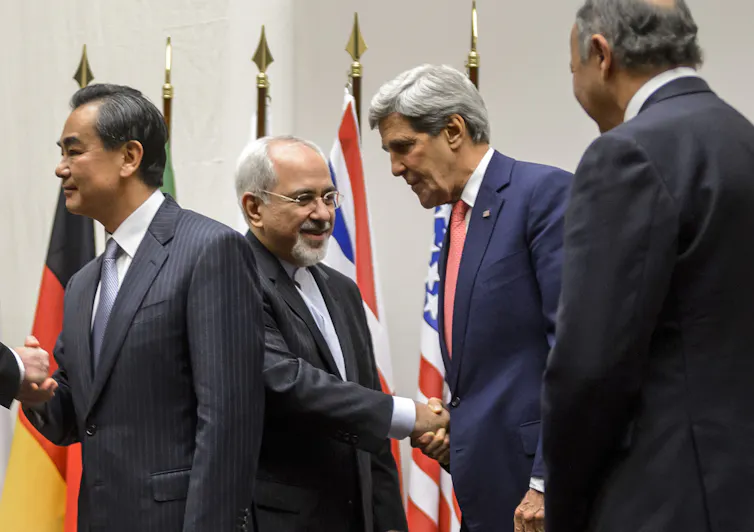
The meeting in Islamabad wasn’t the first time representatives from the United States and Iran have sat around a table. In 2015, the Joint Comprehensive Plan of Action agreed to by Iran, the U.S. and five other nations showed that a formal agreement with nuclear inspections and verification is possible.

But that deal, which saw sanctions on Iran relaxed in return for limits over Tehran’s nuclear program, collapsed because the first Trump administration unilaterally walked away from the deal in 2018. In fact, the International Atomic Energy Agency had consistently certified Tehran was holding up its end of the bargain.

Four men oin suits shake hands.
Iranian Foreign Minister Mohammad Javad Zarif shakes hands with U.S. Secretary of State John Kerry on Nov. 24, 2013, in Geneva.
Fabrice Coffrini/AFP via Getty Images

Then came the June 2025 strikes by Israel and the U.S. on Iran’s nuclear facilities.

Successive rounds of indirect talks between the U.S. and Iran followed in early 2026. But despite an Omani mediator telling the world that a breakthrough was within reach, the U.S. bombed Iran on Feb. 28, 2026.

Mohammad Bagher Ghalibaf, Iran’s parliamentary speaker who led Iran’s delegation in Islamabad, cited recent U.S. military action as a barrier to successful negotiations: “Due to the experiences of the previous two wars, we have no trust in the other side.”

Rather than an Iranian negotiating position, however, that was merely a description of a structural reality. Iran cannot be confident that any agreement it signs will be honored by this or subsequent American or Israeli administrations. And Washington isn’t sure Iran will not quietly rebuild what was destroyed once pressure lifts.

Moreover, while verification mechanisms on Iran’s nuclear program solve a technical problem, they do not solve the ongoing political one, in which both states are effectively still at war. Trust, once comprehensively destroyed, cannot be rebuilt in a hotel in Islamabad over 21 hours.

The scope of the problem

“The simple fact is that we need to see an affirmative commitment that (Iran) will not seek a nuclear weapon, and they will not seek the tools that would enable them to quickly achieve a nuclear weapon,” Vance said amid the Islamabad talks.

Iran’s enrichment knowledge is one of those tools. But the knowledge of how to enrich uranium to weapons-grade purity does not disappear when centrifuges are destroyed.

In this way, nuclear expertise is not like territory, equipment or sanctions relief. Centrifuges can be dismantled, and sanctions can be lifted in stages – both lend themselves to phased, verifiable agreements.

What the U.S. is demanding – a verifiable, permanent end to Iran’s breakout potential – requires Iran to surrender something that cannot be given back once conceded. Tehran and Washington both know this.

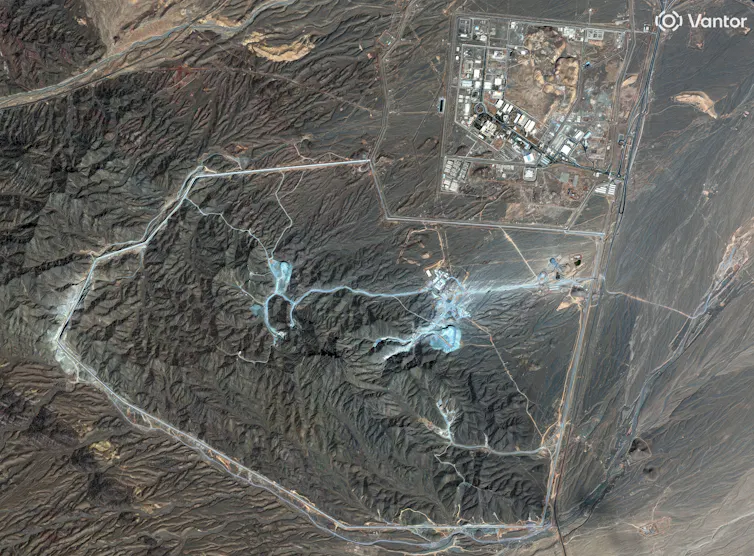
A complex of roads and buildings seen from a satellite image.
Satellite image shows the Natanz nuclear facility and underground complex in and around Pickaxe Mountain, Iran.
Maxar/Getty Images

The problem is compounded by the extraordinary breadth of American demands on nonnuclear issues. Tehran’s demands included the release of frozen assets, guarantees around its nuclear program, the right to charge ships passing through the Strait of Hormuz, an end to Israeli attacks on Hezbollah and war reparations.

Washington’s 15-point proposal reportedly demanded a 20-year moratorium on enrichment, ballistic missile suspension, reopening of Hormuz, recognition of Israel’s right to exist and an end to Iran’s support for its regional proxy network, including Hezbollah, the Houthis and Hamas.

These are not two sides haggling over price. They are two sides who cannot even agree on what the negotiation is about.

Israel veto

Iran has also made ending Israeli strikes on Hezbollah in Lebanon a condition of any comprehensive settlement, conditions which Washington and Jerusalem have both rejected.

The result is a structural deadlock that has nothing to do with Iranian or American negotiating skill. Moreover, even if the two parties in Islamabad found common ground on the nuclear question, Israel could always torpedo any deal through a continuation of its military action in Lebanon and Iran.

And Israeli Prime Minister Benjamin Netanyahu did not need to be in Islamabad to shape what happened there. While Vance and Ghalibaf were negotiating, Netanyahu was on television, telling the world: “Israel under my leadership will continue to fight Iran’s terror regime and its proxies.” He made no mention of the talks at all – and has since come out strongly in support of the U.S. blockade.

What happens next?

Where does this leave the 14-day ceasefire, and what happens after that?

While the Trump administration immediately ramped up pressure on Tehran after the failure of talks, such escalation has thus far failed to bring about Iran’s capitulation in the current conflict.

Iran has declared the blockade an act of “piracy” and placed the country on “maximum combat alert,” with the country’s Revolutionary Guard warning that any military vessels approaching Hormuz would receive a “firm response.”

But like the nuclear negotiations, the blockade runs into the same wall. Iran controls the strait through mines, drones and geography. The U.S. can interdict ships but cannot reopen the strait without Iran’s cooperation – absent an unlikely military occupation.

As such, the blockade is largely a pressure tactic without a clear path for how it would resolve, which is exactly the problem that produced the Islamabad failure in the first place. The blockade also holds the risk of pulling in more countries. Trump’s interdiction order – “it’s going to be all or none” – in theory means the U.S. Navy would be prepared to interdict a Chinese tanker that has done business with Iran, risking a direct maritime confrontation with a nuclear power.

The alternative would be to let Chinese tankers through to avoid confrontation, but in so doing expose the blockade as a hollow strategy.

In either case, Beijing has become an active stakeholder in Iran’s leverage.

Same old problems … and a new one to boot

The structural obstacles that broke the Islamabad meetings will not dissolve before April 22, when the current ceasefire is due to expire.

The difficulty of convincing either side that any agreement will actually be honored will not be resolved by more talks, but is rather a product of what happened before the current negotiations. The nature of the nuclear question itself will not be negotiated away – it is a feature of physics and knowledge, not of political will. Moreover, Israel’s veto over any regional settlement will not disappear because Washington wants a deal.

Signs suggest that talks are still alive, and both Iran and the U.S. have shown a willingness to change previous red lines on the nuclear question even since the failure in Islamabad. Absent a larger shift in the status quo, however, the next round will face the same structural obstacles as before. But this time, there will be the added complication of a naval blockade that narrows, rather than expands, the diplomatic space.

The Conversation

Farah N. Jan does not work for, consult, own shares in or receive funding from any company or organization that would benefit from this article, and has disclosed no relevant affiliations beyond their academic appointment.

ref. The Islamabad talks were doomed to failure – and Hormuz blockade has thrown another obstacle to any Iran-US deal – https://theconversation.com/the-islamabad-talks-were-doomed-to-failure-and-hormuz-blockade-has-thrown-another-obstacle-to-any-iran-us-deal-280553

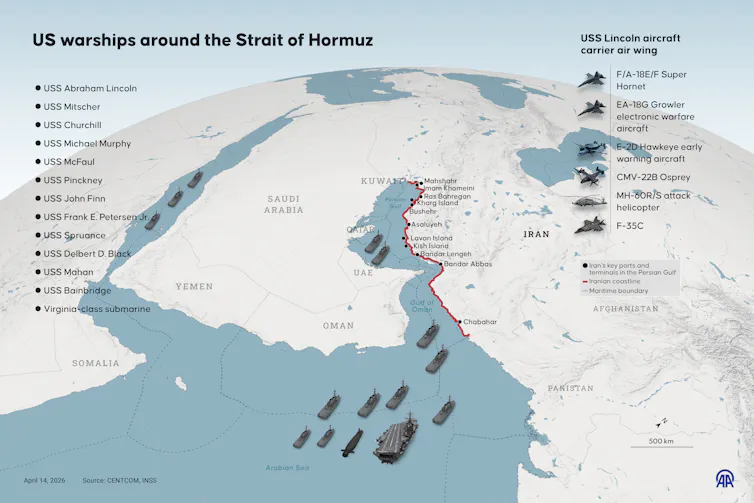
Strait of Hormuz: Why the US and Iran are sailing in very different legal waters

Source: The Conversation – Global Perspectives – By Elizabeth Mendenhall, Associate Professor of Marine Affairs, University of Rhode Island

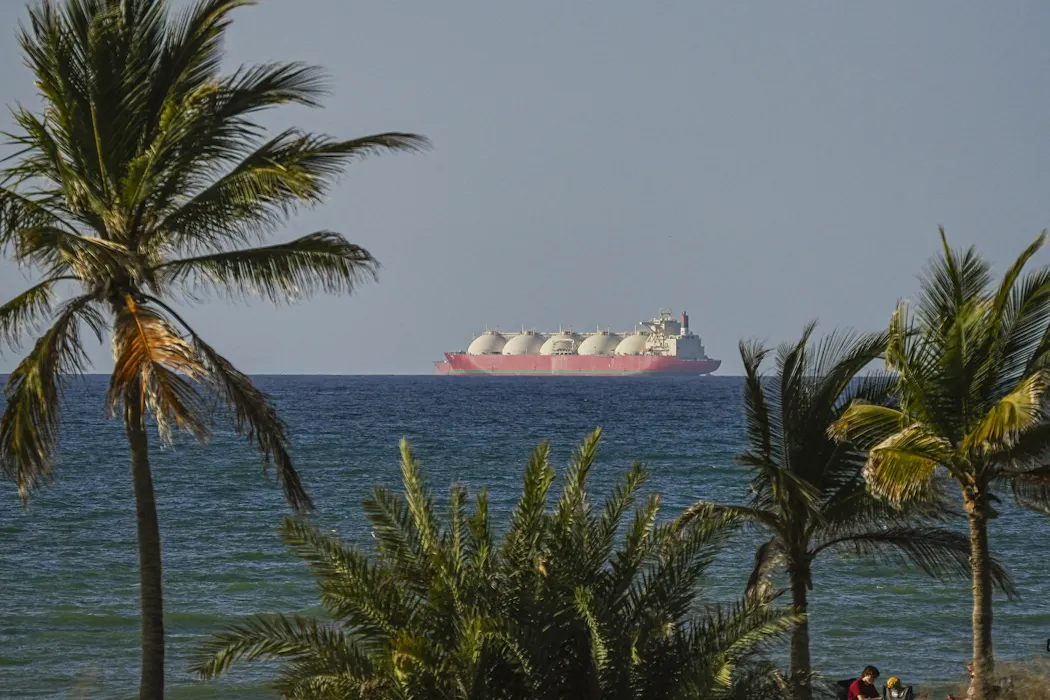
A vessel heads toward the Strait of Hormuz on April 8, 2026. Shady Alassar/Anadolu via Getty Images

The Strait of Hormuz exists in the eye of the beholder.

While everyone agrees that, geographically speaking, it is a strait – a narrow sea passage connecting two places that ships want to go – its political and legal status is rather more complicated.

The United States and Iran both eye the strait – a choke point through which 20% of the world’s oil passes – very differently. Washington sees the Strait of Hormuz as exclusively an international waterway, whereas Tehran sees it as part of it territorial waters.

It follows that Iran’s toll-charging of ships is seen by the U.S. as illegal. Similarly, U.S. President Donald Trump’s blockade of the passage is a “grave violation” of sovereignty to Iran.

As an expert in the law of the sea, I know part of the problem is that the U.S. and Iran are living in two different worlds when it comes to the international laws governing the strait. Further complicating matters, both are in a different legal universe than most of the rest of the world.

The law of the sea

The “law of the sea” is a network of international laws, customs and agreements that set out the foundation for rights of access and control in the ocean. The framework sits apart from the laws of warfare, which are also relevant to the Persian Gulf situation.

The United Nations Convention on the Law of the Sea, or UNCLOS, is a major plank of the law of the sea. Completed in 1982 and in force since 1994, it aims to create a stable set of zones and places – like international straits – where everyone agrees on who can do what. It has been ratified by 171 countries and the European Union, but not Iran or the United States. Iran has signed it but has yet to ratify; the U.S. has done neither.

This means that the rules which almost every country in the world has consented to can’t serve as a basis of agreement over how the U.S. and Iran should govern their actions in the strait during the current war.

The view from Iran

Both Iran and the U.S. agree that under the law of the sea, the Strait of Hormuz is an international strait, but not on what kind of international strait it is. Moreover, they disagree on the relevant laws that exist, and how they apply.

For Iran, the Strait of Hormuz is an international strait as set out under international law predating UNCLOS – notably the International Court of Justice’s ruling in the 1949 Corfu Channel case and the 1958 Territorial Seas Convention.

These older standards state that foreign ships have a right of “innocent passage” through international straits. Put in other terms, this means that if a ship is simply passing through, without doing anything else and without harming the security of the coastal countries, it must be allowed passage.

This gives Iran – and Oman, the strait’s other bordering country – power to make and enforce some rules over passage, such as rules for safety and the environment. They also have wide discretion to decide if passage is “non-innocent” and therefore not allowed. But it does not give them the right to impede innocent passage.

Contrary to the older standard, however, Tehran claims the right to “suspend” passage through its half of the strait, citing the waters as its territorial sea. This is a violation of the 1958 Territorial Seas Convention that Iran relies on for legal support, which says that when a territorial sea is also an international strait, innocent passage cannot be suspended.

The US interpretation

For the U.S., the Strait of Hormuz is an international strait requiring “transit passage,” as per UNCLOS. Although the United States is not a member of UNCLOS, it argues that the agreement’s updated concept of an “international strait” should apply.

Understanding a waterway as the newer type of “international strait,” which requires transit passage, shifts the balance against a coastal country’s control and toward free navigation.

Under this standard, countries bordering straits – like Iran and Oman in the case of Hormuz – must also allow overflight and submarines below the surface. Passage must be allowed so long as it is “continuous and expeditious.”

The U.S. has forcefully asserted this position at sea through regular “Freedom of Navigation” patrols through the Strait of Hormuz and other straits around the world. The patrols are a visible rejection of claims over the ocean that the U.S. deems illegal or excessive.

The basic U.S. argument is supported by some leading legal scholars, such as James Kraska, a professor of international maritime law at the U.S. Naval War College, who decries the Iranian position as “lawfare” and argues that Iran must abide by the compromises made in UNCLOS.

A ‘persistent objector’

But the U.S. is a global outlier here, and one of only a handful of countries – alongside the United Kingdom, France, Australia, Thailand and Papua New Guinea – which argue that “transit passage” is required by custom.

Custom, in this sense, is established if a practice at sea is seen as consistent and is backed by wide agreement over its legality. If something is seen as customary law, it applies to everyone. The only way to prevent a custom from applying to you is through the “persistent objection rule,” which gives a country an exemption to newly emerging standards if it has shown itself to be consistently against it.

Legal scholars are split on whether transit passage is customary law – although law of the sea specialists tend to say it is not.

Tehran argues that even if transit passage were customary international law, Iran is a “persistent objector,” and therefore, the rule doesn’t apply to them.

And it is true that Iran’s objection has been consistent. Both Iran and Oman argued in favor of innocent passage, and against transit passage, at the UNCLOS negotiations.

Iran reaffirmed its perspective upon signing UNCLOS in 1982. Tehran argues that because transit passage is tied up in the compromises made by UNCLOS, only countries that ratify the treaty can claim the right to transit passage – and neither the U.S. nor Iran has ratified it.

A graphic shows a map with warships.
U.S. warships float around the Strait of Hormuz.
Yasin Demirci/Anadolu via Getty Images

Navigating troubled waters

The complex military situation and economic disruption are only part of the story of the Strait of Hormuz.

What lies beneath is a complicated legal situation. Not only do the U.S. and Iran disagree about the legal status of the strait, but the countries that flag oil tankers – and which are therefore responsible for them – must also navigate their own commitments and perspectives under the law of the sea.

Every nation wants to avoid a legal precedent that is contrary to its long-term interests. But for international law to function – to reduce conflict and enable trade – what is needed is an agreement about what rules exist, and a shared commitment to abide by them.

Only that would achieve a stable post-war status for the Strait of Hormuz. How we get there, however, requires navigating some very tricky waters.

The Conversation

Elizabeth Mendenhall does not work for, consult, own shares in or receive funding from any company or organization that would benefit from this article, and has disclosed no relevant affiliations beyond their academic appointment.

ref. Strait of Hormuz: Why the US and Iran are sailing in very different legal waters – https://theconversation.com/strait-of-hormuz-why-the-us-and-iran-are-sailing-in-very-different-legal-waters-280557

How debate about gender identity could undermine global efforts to protect victims of violence

Source: The Conversation – Global Perspectives – By Jenna Norosky, Postdoctoral Fellow at the Institute for Genocide and Mass Atrocity Prevention, Binghamton University, State University of New York

A transgender woman takes part in an International Day For The Elimination Of Violence Against Women demonstration in El Salvador on Nov. 25, 2019. Camilo Freedman/APHOTOGRAFIA/Getty Images)

Aided by the Trump administration, debate over gender identity has gone from being a touchstone of domestic culture wars to infiltrating the work of international groups – including those designed to protect vulnerable communities.

In March 2026, at the 70th session of the U.N. Commission on the Status of Women, a U.S. delegate submitted a draft resolution to define gender in alignment with what the representative described as “its ordinary, generally accepted usage, as referring to men and women.”

While this may seem like a relatively benign or procedural intervention, the proposed resolution invited significant blowback from other delegates. Sweden’s representative framed it as an attempt “to turn back the clock 30 to 40 years.” The resolution ultimately failed after being blocked from going to a vote by Belgium, on behalf of the EU.

As an expert on gender, sexuality and conflict, I see the latest dispute over terminology at a key U.N. conference as reflecting a wider fight among the international community that has rumbled on for months. I believe that contest, moreover, threatens to undermine critical work to serve survivors of violence across the world.

Shifting approaches to gender

In recent years, some international organizations, nongovernmental organizations and countries have moved to understand gender beyond equating it with biological sex.

This had included expanding its meaning within the peace and security sector.

The U.N. Refugee Agency, for example, now follows an “age, gender and diversity” policy that defines gender as “socially constructed roles for women and men, which are often central to the way people define themselves and are defined by others.” In other words, trans women are women, and trans men are men.

The International Criminal Court takes a similar stance in its approach to gender-based crimes.

Both bodies contend that this gender lens is important for understanding the full scope of experiences and vulnerabilities not just of women and girls, but also LGBTQ+ individuals and men and boys during conflict.

While heavily contested by some nations, this approach departs from a previous implicit assumption that only women are targeted for sexual violence in conflict – and that these women are all cisgender.

Gender identity and violence

Despite the normalization of more inclusive approaches to gender, the pushback has recently gained a lot of traction, aided in part by the reversal of the U.S. from its previous stance under the Biden administration.

Only two months into the Trump administration, the U.S. pulled out of a working group of nations on LGBTQ+ concerns. Then, in January 2026, it withdrew from a slew of international bodies it claimed were “often dominated by progressive ideology and detached from national interests,” including U.N. Women. Most recently, the administration has called on FIFA, soccer’s international governing body, to change its policy on trans athletes.

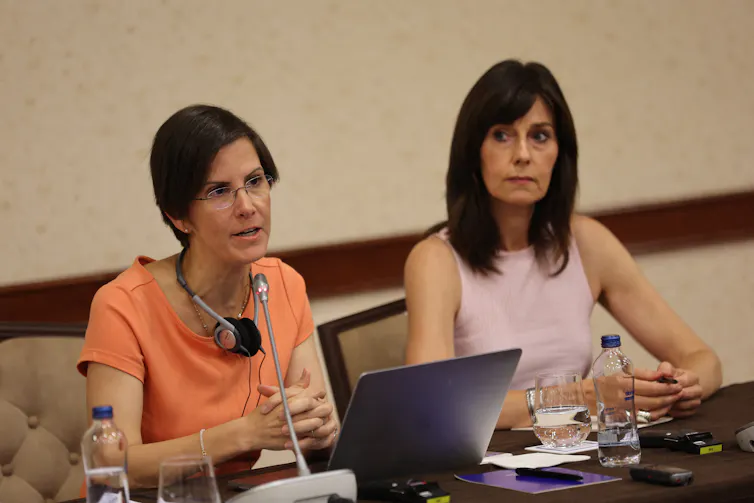
It isn’t just the U.S. contesting inclusive language, however. In June 2025, the U.N. special rapporteur on violence against women and girls, Reem Alsalem, published a report suggesting that gender-neutral language and the recognition of gender identity in policy erases the category of what it refers to as “sex-based discrimination” against women and girls.

Two women sit at a table.
A draft report by the United Nations special rapporteur, Reem Alsalem, left, sparked controversy.
Adem Altan/AFP via Getty Images

The draft resolution also argues that “gender identity theory” contributes to violence against women by advancing “stereotypes” and “sexist norms about how women should dress and behave.”

In effect, the report introduces a far narrower understanding of violence against women – and “gender” writ large – which notably excludes trans women.

Human rights professionals and NGOs, including Amnesty International and various feminist organizations, submitted a response to the draft version of the report claiming that its adoption of the term “sex-based violence … undermines decades of feminist advocacy, scientific evidence and legal advances.” Moreover, it “risks excluding vulnerable populations from essential protections.”

Nations were unsurprisingly split in their response, with some offering praise for the report’s approach and others raising concerns. Such was the feeling aroused by the special rapporteur’s position that in late 2025, Australia’s commissioner on sex inequality asked internally about potentially blocking Alsalem’s reappointment to her post.

Gender in conflict situations

Debates over language are familiar to those working in international crisis work, and some important tensions remain unaddressed. I argue, though, that a narrow interpretation of “gender” based on sex assigned at birth risks missing harms against certain groups.

Research on conflict and humanitarian contexts suggests that expansive conceptualizations of gender can better reveal dimensions of harms experienced by people who are not cisgender, heterosexual women or girls.

For example, my research with UMass Amherst’s Charli Carpenter demonstrates that a gender lens shows how Ukraine’s travel ban on “battle-aged” civilian men places these men, their families, trans women and nonbinary people misidentified as men at undue risk. In this case, it’s not biological sex but beliefs about gender – for example, the characterization of men as warriors and protectors – that create these vulnerabilities.

Similarly, understanding wartime violence against gender and sexual minorities as gender-based highlights how these groups can be singled out by state and armed groups for transgressing sanctioned gender norms.

However, there are also trade-offs to more expansive approaches to gender, as evidenced by my research on changing global approaches to wartime sexual violence against men and boys.

Some practitioners I spoke with expressed concern that the inclusion of violence against men and boys under the rubric of gender-based violence would detract from the disproportionate impact and structural roots of violence against women.

This is particularly troubling at moment of increasingly limited resources earmarked to serve conflict- and other crisis-affected women and girls, as well as rising backlash against women’s rights.

The silhouette of a woman's head
A South Sudanese victim of sexual violence in the Sudanese capital Khartoum.
Ashraf Shazly/AFP via Getty Images

The anti-trans backlash

The resolution brought forward by the U.S., as well as the special rapporteur’s report, should, I believe, be understood in the context of a wider anti-trans backlash.

This backlash – which involves diverse groups, from religious conservatives to even some women’s rights advocates – mobilizes fears about public safety, marriage and the family structure.

Some of the backlash is predicated on harmful stereotypes about trans women that portray them as predatory opportunists.

While there is no evidence of this being a common trend, such narratives permeate the special rapporteur’s report. For example, the document includes claims that “males who identify as women retain a male pattern of criminality” and that lesbians get “coerced into sexual relations with males who identify as women.”

The report also constructs hypothetical scenarios about trans-inclusive spaces as a threat to cisgender women’s safety, such as the absence of “single-sex” washrooms in refugee camps “often leads to women avoiding using mixed-sex facilities.”

Navigating transphobic rhetoric

Significantly, this latter claim is embedded within partial truths. There is evidence that women’s vulnerability increases when refugee camps don’t have women’s washrooms, when they are placed too close to men’s washrooms or are in remote, unlit locations.

But there is no evidence in the draft report or elsewhere that the threat comes from trans women and not men.

In fact, research suggests that LGBTQ+ refugees and detained migrants experience unique and exacerbated vulnerabilities to sexual harassment, violence and exploitation.

Moreover, in conflict and humanitarian situations, violence against LGBTQ+ people shares some key root causes driving violence against women and girls, such as restrictive gender norms and militarism.

The agenda to prevent violence against women is, I would argue, increasingly co-opted by transphobia. Ultimately, this distracts from the struggles experienced by all those marginalized on the basis of gender.

The Conversation

Jenna Norosky received funding from the American Political Science Association to conduct research referenced in this article.

ref. How debate about gender identity could undermine global efforts to protect victims of violence – https://theconversation.com/how-debate-about-gender-identity-could-undermine-global-efforts-to-protect-victims-of-violence-267177

Why is alcohol use declining in Canada?

Source: The Conversation – Canada – By Timothy Naimi, Director, Canadian Institute for Substance Use Research; Professor, Division of Medical Sciences, University of Victoria

Lately, there has been a lot of news about declining alcohol sales in North America, and speculation as to why that might be.

As director of the Canadian Institute for Substance Use Research at the University of Victoria, I consider this an important development and a topic worth exploring given its implications for health and society more broadly.

Is the decline real?

Based on alcohol sales data (which is more reliable than self-reported survey data), the decline appears to be real. According to Statistics Canada, per capita alcohol sales (the average amount sold per person aged 15 years and older) declined for the fourth consecutive year, from 8.3 litres of ethanol (roughly 487 standard drinks per year) in 2020-21 to 6.8 litres (399 standard drinks) in 2024-25, a rather dramatic decline of 18 per cent.

Alcohol sales have also declined recently in the United States, so this is not a Canada-only phenomenon.

Wine bottles on a shelf
The notion of purported benefits from moderate drinking, particularly of wine, has been largely debunked.
(Unsplash/Scott Warman)

Possible contributing factors

There are many possible contributors to consider, some of which overlap with one another:

  • Increasing health concerns? Increased concern about health effects of alcohol, including from socially “moderate” levels of use, may be contributing to reduced use and changing social norms.

    Scientifically, the notion of purported benefits from moderate drinking, particularly of wine, has been largely debunked. Canada’s Guidance on Alcohol and Health found increased risk of an alcohol-caused death at more than two drinks per week.

    The recent U.S. Surgeon General’s report on alcohol and cancer highlighted the growing recognition that alcohol is causally related to seven types of human cancer including cancers of the breast, colon, liver and esophagus. Interest in the sober-curious movement and participation in abstinence periods such as Dry January may partly reflect health concerns.

  • Inflation and affordability?
    Inflation has been relatively high in Canada over the past five years, and the affordability of staples like food has declined. Alcohol is a price-responsive good; most people purchase more of it when they have more disposable income, and less when they are trying to spend less.

  • Post-COVID normalization?
    Canadian alcohol consumption increased during the COVID-19 pandemic. Although the factors behind that increase are not fully understood, it is logical that consumption would decline with the waning of the pandemic. However, consumption has now fallen well below pre-COVID levels.

  • Immigration?
    In recent years, Canada has experienced a large influx of immigrants, many of whom come from countries with lower alcohol use than Canada, like India. While this would contribute to the decline in per-capita use (the average consumption among all people, including non-drinkers), total alcohol sales have also declined, indicating lower consumption among those who are not recent immigrants.

  • The rise of no- and low-alcohol products? There has been an explosion of no- and low-alcohol products, particularly for beer. But it’s unclear to what extent this category is replacing traditional alcohol sales versus adding to overall consumption. Stay tuned.

  • Cannabis substitution for alcohol? Research evidence about whether cannabis use is associated with more or less alcohol use (that is, whether people are using cannabis in addition to alcohol or using cannabis instead of alcohol) is mixed. But cannabis use has been increasing in Canada for some time, and even the 2018 legalization of cannabis for recreational use occurred during a time when alcohol sales were stable or increasing, so this is unlikely to be an important contributor.

  • Reduced use by youth? Although still common across North America, the prevalence of alcohol use among youth has declined over the past decade. Since drinking trajectories tend to persist with age, average consumption would decline over time as yesterday’s youth become a progressively larger share of the adult population.

  • Boycott of U.S. alcohol products? This is not a major contributor. The boycott of U.S. alcohol products came several years after alcohol sales began to decline. Furthermore, there are many non-U.S. product alternatives across all alcoholic beverage types and price ranges.

  • Increased use of GLP-1 agonist medications? The use of GLP-1 agonists such as Ozempic to treat obesity and diabetes has mushroomed. These medications are now used by approximately three million Canadians adults.

    In addition to reducing interest in eating, these medications also reduce interest in alcohol, and are being studied to treat alcohol use disorders. Although the population effect is not fully understood, their widespread use and impacts on consumption may be contributing to alcohol declines among middle-aged and older adults.

Possible impact of the decline

Over time, reductions in consumption should translate into gains for public health and savings for the health-care system and taxpayers, as alcohol-related costs exceed tax revenues. While reductions in alcohol sales adversely affect alcohol-related industries, reallocating dollars spent on alcohol benefits other sectors of the economy.

Ironically, adopting minimum pricing policies for alcohol could both improve public health and increase industry revenues by implementing what amounts to government-sponsored price collusion at the low end of the alcohol market, where profit margins are otherwise low.

Finally, although there has been a clear trend towards lower alcohol use in recent years, future sales may stabilize or reverse course. It remains to be seen whether the current trend is a long-term development or a fleeting one.

The Conversation

Timothy Naimi receives funding from:
BC government;
Health Canada;
SSHRC (Canadian federal government)

ref. Why is alcohol use declining in Canada? – https://theconversation.com/why-is-alcohol-use-declining-in-canada-277962

Canada is producing more graduates than ever — so why is it harder to find a job?

Source: The Conversation – Canada – By David J Finch, Professor, Innovation and Marketing, Mount Royal University; University of Calgary

Canada has a paradox at the heart of its labour market. The country leads the G7 for the most educated workforce and is producing more graduates than ever before. Yet for millions of young Canadians, the path from school to stable work has never been harder.

Between 2022 and 2025, vacancies for jobs requiring a bachelor’s degree and fewer than three years of experience fell by more than half.

About 40 per cent of Canadian graduates are underemployed, and youth unemployment reached 15 per cent in September 2025, more than double the adult rate and the highest in 15 years outside the pandemic.

The familiar diagnosis of a skills gap is not wrong, but it focuses on the wrong problem. The problem isn’t just skills; it’s that the system that converts learning into recognized workplace performance is broken.

Our new report, Entry-Level Employment: The Canary in Canada’s Labour Market Coal Mine, argues that the collapse of entry-level opportunities should not be viewed narrowly as an isolated challenge unique to a generation of young people.

It’s an early warning of broader challenges facing Canada’s labour market. To build a more productive economy, we must start by rebuilding the system that converts learning into recognized performance.

Eroding conversion infrastructure

Entry-level jobs were never just jobs. They were part of a larger system that converted learning into labour-market value. This system delivered four functions: skills were developed and refined under supervision, professional identities were formed, networks were built and capability became visible to employers.

For much of the 20th century, this risk was shared among government, individuals and employers. Governments and individuals funded education, and employers converted this education into workplace value. Employers were prepared to invest in employee development because the return on this investment was measured over decades of employee contribution.

Over the past 30 years, this conversion system deteriorated. The “hire and develop” model of the 20th century has given way to short-term, contract and gig work, which now represents up to one-quarter of Canada’s workforce.

Early research also suggests that the rapid expansion of remote and hybrid work during the COVID-19 pandemic is further diluting this conversion function.

The result is a shift of this conversion role from employers to individuals. As evidence, OECD countries, including Canada, now devote just 0.1 per cent of GDP to workforce training, the lowest level recorded.

Concurrently, over this period, post-secondary attainment in Canada has skyrocketed. However, expanding this educational supply, without scaling the corresponding conversion system, has only accelerated the widening of the conversation gap.

Employers aren’t irrational when they require “entry level” candidates with several years of experience. They are adapting to an absence of mechanisms that once allowed them to observe and develop emerging talent directly.

In the vacuum left by a weakening conversion system, they are left to rely on weak proxies of performance, such as academic credentials, school reputation or references. Each of these proxies reinforces systemic advantage, which locks many qualified new workers out of the very experiences that would let them demonstrate performance.

This is the distinction that matters: a skills gap points to missing qualifications; a conversion gap reflects a loss of system-wide ability to turn those qualifications into proven performance.

The canary in the coal mine

Just as the canary warned miners of invisible danger, the accelerating breakdown of the conversion system signals a risk not just for young people, but for the broader labour market.

Working lives now stretch across four or five decades and multiple employers, sectors and technologies. The World Economic Forum estimates that 39 per cent of current skill sets will be outdated within five years.

Converting learning into recognized performance is no longer limited to entry-level employment but is now an ongoing requirement across every job transition, technological shift or re-entry into work.

Yet the infrastructure supporting this conversion was built for an era of stable firms and linear careers. It no longer fits today’s increasingly dynamic labour market.

What needs to change

To rebuild our conversion capacity, our report identifies four priorities:

1. Rebuild structured entry-level pathways.

Structured conversion pathways must be expanded. Apprenticeships, graduate training programs and residencies must move beyond the trades and health care into all occupations. This restores employers as active partners in the conversion function rather than passive consumers of skills.

2. Embed continuous, work-integrated learning.

Continuous work-integrated learning must be expanded across career stages, with flexible opportunities designed to develop skills, generate observable performance, form professional relationships and appropriately share risk. The conversion gap is not a problem confined to the start of a career; it recurs at every transition, displacement and re-entry.

3. Rebalance risk and responsibility.

The legacy conversion system worked because the risk was shared by employers, government and individuals. The collapse of this system forces people to look for alternative conversion pathways to demonstrate performance, including unpaid internships or pursuing additional education.

These alternatives are not based on merit; they’re often rooted in financial capacity, which is a form of systemic privilege. The new conversion system must be designed to unlock the skills of all Canadians from the outset.

4. Build an open-recognition system.

We must develop open-recognition infrastructure. Open recognition establishes a harmonized system for verifying skills that are recognized across the full labour force, regardless of where or how they were developed. Without this, expanding the first three reforms becomes impossible.

The question is not whether Canadians have the education and skills to succeed. They do. The breakdown is converting this education and skills into recognized workplace performance.

Rebuilding the conversion system is how Canada renews productivity, widens opportunity and builds a workforce capable of meeting the demands of the decades ahead.

The Conversation

David Finch receives funding from the Alberta Centre for Labour Market Research. He is also the Director of The Productivity Project, a collaboration of Mount Royal University, the University of Calgary’s School of Public Policy, the Alberta Centre for Labour Market Research, and the LearningCITY Collective.

ref. Canada is producing more graduates than ever — so why is it harder to find a job? – https://theconversation.com/canada-is-producing-more-graduates-than-ever-so-why-is-it-harder-to-find-a-job-279178

How ‘books for development’ campaigns reveal an unjust global order

Source: The Conversation – Canada – By Jody Mason, Associate Professor, Department of English, Carleton University

The gutting of the United States Agency for International Development (USAID) in 2025 has had catastrophic consequences,
including in South Sudan where amid ongoing war, an estimated 33 million people require humanitarian assistance.

The federal government in Canada has similarly slashed foreign aid in response to the economic fallout of U.S. President Donald Trump’s trade war.

International aid groups have met such policy decisions with regret.

This regret is understandable. At the same time, many Western powers avoid acknowledging that the broad liberal international consensus that emerged after the Second World War — and shaped modern development — was built on global inequality.

In Prime Minister Mark Carney’s 2026 speech to the World Economic Forum, he only tentatively alluded to disparities and inequalities when he acknowledged “the story of the international rules-based order was partially false … ”

In Books for Development: Canada In the Late Twentieth-Century World I argue that this “partially false” story helped to elaborate Canada’s late 20th-century image as both benevolent and innocent regarding internal colonialism.

Language of ‘development’

What social scientist Wolfgang Sachs has called the “age of development” emerged in the decade following the Second World War.

Scholars point to U.S. President Harry Truman’s 1949 inaugural address as a key moment in this post-Second World War history.

The speech referred to a U.S. obligation to make its scientific and industrial progress available for the “improvement and growth of underdeveloped areas.”

The classification of the world’s population into “developed” and “underdeveloped” came to shape the post-war order and its international institutions, such as the United Nations.

Critiques of developmentalism began to emerge in the 1960s from what was then called the “Third World.” In the context of the Structural Adjustment Programs after the economic crises of the late 1970s, post-development theorists such as Sachs and Gilbert Rist amplified this kind of criticism.

They argued that developmentalism was premised on related and false claims — that global inequalities were without cause and “underdeveloped” nations could catch up to their “developed” counterparts.

‘Developmentalism’ and books

In Books for Development, I examine how the book became a dominant symbol of the age of development through the efforts of the new international institutions, and the United Nations Education Scientific and Cultural Organization (UNESCO), in particular.

Orange book cover says Books for development and shows graphic image of books in a cirlce.
Books for Development: Canada in the Late Twentieth-Century World.
(McGill-Queen’s University Press)

This had implications both in Canadian foreign policy and in relationships with Indigenous Peoples in Canada.

In the context of post-Second World War development, books, though typically framed as “good,” nonetheless often played a harmful role.

In the post-war decades, UNESCO focused on literacy initiatives and improving global access to books, partly through its research on conditions in global publishing.

As Robert Escarpit reported in a 1982 study for UNESCO, “decolonization often stimulated book production less in the new nations than in the old colonizing countries.” The latter, he notes, now “had to meet the new demands from their former colonies for literacy campaigns or educational development.”

At their worst, book development programs undercut domestic publishing initiatives in newly independent nations in Africa, the Caribbean and elsewhere.

Canada’s role

Canada played a significant role in post-war development linked to the book.

The deep involvement of educationalist and liberal internationalist J.R. Kidd at UNESCO is a key element of this history.

As historian Kevin O’Sullivan has shown, Canadians drew on a longstanding book-centric Protestant missionary and service tradition to become leaders in the late 20th-century non-governmental organization (NGO) movement.

In addition to Kidd’s roles at UNESCO, he was also one of the founders of Canada’s first NGO, the Overseas Book Centre. Founded in 1959, this book donation program sent Canadian books to Global South nations.

Book donation schemes like those undertaken by the Overseas Book Centre undermined local book publishing initiatives in recipient nations. The organization’s self-assessments later confirmed this problem, and led to a reorientation of its efforts (and a renaming, in 1982, as the Canadian Organization for Development in Education).

Serving Canada’s interests

Kidd’s book- and literacy-related work often used UNESCO’s new international stage to argue for what he called Canada’s “special mission” in international development.

Canada was presented as a model and potential friend for newly decolonizing nations because of its recent experience as a colony of Britain (a status that changed with Confederation).

While historians of Canada’s post-war myth-making have pointed to the disingenuousness of claims that Canada was a “friend of the Third World,” these claims also served to make internal colonialism illegible on the international stage.

Adult literacy

Beginning in the later 1960s, Canada’s international development efforts began to shape NGO and government relations with Indigenous Peoples.

Developmentalist-influenced initiatives linked to books, literacy and education were focused on Indigenous communities. They were part of a longer history of consolidating settler liberal rule via education, exemplified most notoriously in Canada’s Residential School system.


Read more:
Why Canadians need two dramatic educational shifts to honour reconciliation


For instance, Canada’s longest running adult literacy program, Frontier College, began addressing its efforts to Indigenous Peoples at the end of the 1960s, when it began to ship magazines to schools run by the Department of Indian Affairs and Northern Development. The goal was to aid the department’s policy of integrating Indigenous Peoples into what it called “the Canadian way of life.”

‘The Fourth World’

Indigenous leaders, activists and writers such as as George Manuel (Secwépemc) responded to such initiatives by adapting Third World anti-imperialist revisions of developmentalist thought to their own settler colonial situation.

Manuel’s 1974 book, The Fourth World: An Indian Reality, co-authored with Michael Posluns, was published during Manuel’s tenure (1970-1976) as leader of the National Indian Brotherhood. The book positions economic development at the core of any possible political sovereignty:

“Self-government … without an economic base simply creates the economic colonialism we are witnessing throughout much of Asia and Africa today.”

For Manuel, this “economic base” would come from the land. As he observed, usurping the basis of traditional Indigenous economies — land — was the primary obstacle to contemporary economic development.

Structural conditions of injustice

The Fourth World extends this thinking to the National Indian Brotherhood’s 1972 policy paper, Indian Control of Indian Education. Change at the level of education, Manuel argued, would not be sufficient (even if it meant Nations could control hiring, curriculum and so on). He saw education as fundamentally tied to the question of economic development, which he understood to be contingent on a land base.

Like the broader development framework, the approach applied to Indigenous Nations after 1965 failed to name the structural conditions of injustice. It perpetuated the status quo and, viewed more negatively, it cloaked the very political and economic conditions that created it.


Read more:
Who benefits from ‘nation-building’ projects like Ksi Lisims?


Canada’s relationships with other nations, including Indigenous Nations, cannot be premised on what Carney called a “partially false” story.

The Conversation

Jody Mason receives funding from the Social Sciences and Humanities Research Council of Canada. She is a member of the New Democratic Party of Canada.

ref. How ‘books for development’ campaigns reveal an unjust global order – https://theconversation.com/how-books-for-development-campaigns-reveal-an-unjust-global-order-276594

The National Gallery’s £750m new wing has reignited London’s art turf war

Source: The Conversation – UK – By Jonathan Conlin, Professor of Modern History, University of Southampton

“When should painters become old masters?” Former National Gallery director Philip Hendy put that question to then Tate director John Rothenstein almost 70 years ago. Founded in 1897 as the National Gallery’s annexe for British Art, by the 1950s Tate had developed into a gallery of modern as well as British art. Rothenstein wanted it to emerge from its parent’s shadow. Any move towards independence, however, required agreement between the National Gallery and Tate on how to divide the collection they shared.

Now that same question, of where one collection ends and the other begins, is getting another airing. The National Gallery has announced the winner of a competition to design “Project Domani”, a £750 million expansion. A new building by architect firm Kengo Kuma and Associates will replace the 1960s office block that currently stands on Orange Street, behind the gallery’s Sainsbury Wing. According to the National Gallery, the annexe will allow Trafalgar Square to show the “continuum” of “the history of painting in the western tradition”.

That phrase, “the western tradition”, is itself something of a land grab. Until fairly recently the National Gallery was understood to be a collection of western European painting. In 2014, however, it paid £18.6 million for Men of the Docks, a painting by American artist George Bellows. Unlike his fellow countrymen John Singer Sargent and James McNeill Whistler, Bellows had never travelled to Europe and could not be considered an honorary Englishman.

According to the gallery, the purchase represented “a new direction in its acquisition policy”. They now sought to “represent paintings in the western European tradition, rather than solely those made by artists working in western Europe”. Men of the Docks dated to 1912, close to the chronological border between the National Gallery and Tate collections. For those fond of viewing London’s museums as a turf war, it was a shot across Tate’s bows.

Rather than fighting over this or that patch of art history, surely London’s museums can agree that all art is a “continuum”?


This article is part of our State of the Arts series. These articles tackle the challenges of the arts and heritage industry – and celebrate the wins, too.


“To me there will always be only one national collection,” noted Hendy in 1953, “and I don’t believe that carving it up in this rigid way is in anybody’s interest.”

Despite the gallery’s rhetoric of give-and-take, over the years Tate was repeatedly left feeling bruised, after being obliged to let the National Gallery take back British paintings that the Tate had come to consider its own. This included one of the highlights from the National Gallery’s Joseph Wright of Derby show: An Experiment on a Bird in the Air Pump was given to the National Gallery by the politician Edward Tyrrell in in 1863. The National Gallery later passed it to Tate, only to take it back in 1986.

The history of the gallery turf war

Under an influential model developed in late 19th-century Paris, the Musée du Luxembourg served as purgatory for modern French painters. After a decent interval, after any initial controversy as well as the artist had died, works that passed the test of time were promoted to the heaven of the Louvre.

For much of Tate’s history, it has been viewed as the Luxembourg to Trafalgar Square’s Louvre. In 1935, National Gallery director Kenneth Clark opposed the idea that Tate might achieve complete independence from his institution. It “would deprive us of the purgatorial function of the Tate”. It would also force Tate to decide whether it was a “National Gallery of British Art” or a “modern art gallery”.

Worse of all, Clark noted, if Tate did decide it was a modern art gallery, the two institutions would have to agree a historical date at which modern painters became old masters. In 1954, the National Gallery and Tate Act appeared to grant Tate the independence it craved, while ordaining that the two galleries should periodically consult each other about loans and transfers, in order to ensure that all paintings were “on view in the best context”.

The Tate Modern building
The Tate Modern opened in May 2000.
Mistervlad/Shutterstock

In 1957 Hendy suggested that all paintings “graduate” to Trafalgar Square when they reached their 100th birthday. Rothenstein refused such a rigid rule. The history of art was not “a regular and predictable process”, he insisted. As the “founding fathers of the modern movement”, Van Gogh, Cézanne and Seurat would have to remain at Tate, regardless of how much time had passed.

Under Nicholas Serota’s directorship Tate blossomed into a constellation of galleries in the 1990s. Tate Liverpool demonstrated how a contemporary art space could regenerate post-industrial cities. In 2016 Tate Modern opened its own, £220 million annexe. Meanwhile it seemed that the National Gallery was happy (Sainsbury Wing aside) to expand within its existing footprint.

If Project Domani treads on Tate toes, there will be repercussions. When New York’s Metropolitan Museum of Art announced the gift of Leonard Lauder’s collection of Cubist paintings in 2013 and later opened the Met Breuer as a temporary annexe for contemporary art, New York’s Whitney and Museum of Modern Art (MoMA) were concerned. Fearing that relationships with “their” funders, collectors and critics were under threat, the Metropolitan Museum of Art was told to keep their hands off their patch.

Compared to the Met Breuer’s Madison Avenue site, that of the National Gallery’s proposed new wing is low-profile. Architects Kengo Kuma and Associates say that their building will create a new pedestrian artery between Leicester and Trafalgar Squares. But similar assurances were made about the Sainsbury Wing, which opened over 30 years ago, so this might be equally impossible to deliver.

A new building will create space for temporary exhibitions and artist residencies, replacing the poky and unloved Sainsbury Wing basement and Sunley Room. Knitting three gallery buildings into a continuum, however, will be as difficult as finding a new answer to an old question, one that has always set the National Gallery and Tate at odds. When should painters become old masters?

The Conversation

Jonathan Conlin does not work for, consult, own shares in or receive funding from any company or organisation that would benefit from this article, and has disclosed no relevant affiliations beyond their academic appointment.

ref. The National Gallery’s £750m new wing has reignited London’s art turf war – https://theconversation.com/the-national-gallerys-750m-new-wing-has-reignited-londons-art-turf-war-280481

Could Viktor Orbán be back in 2030? Why Péter Magyar has a fight on his hands after landslide win

Source: The Conversation – UK – By Gerhard Schnyder, Professor of International Management & Political Economy, Loughborough University

The mood was jubilant among liberals and pro-Europeans in Hungary and beyond on April 13 as Péter Magyar led the Tisza party to a landslide election victory. His win ended the 16-year administration of Viktor Orbán’s pro-Russian Fidesz party. Given the high turnout and margin of victory, giving Tisza a two-thirds constitutional majority in parliament, the jubilant mood seems justified.

However, defeating Orbán will be a long-term project. While several centrist politicians around the world have successfully unseated governing far-right populists in recent years, fewer have been successful in keeping them at bay long term. Poland’s Donald Tusk and Joe Biden in the US are probably the most obvious examples of this struggle.

A major challenge for Magyar will be to undo the system Orbán has put in place over the past 16 years to exercise control over the country. A key component of that system is Fidesz’s extensive control over the media.

Research I have carried out alongside colleagues shows that, despite a semblance of pluralism, most Hungarian media outlets are now controlled by people close to Fidesz. The pro-Fidesz Central European Press and Media Foundation (Kesma) plays a particularly central role, controlling more than 500 national and local media outlets.

Here, the experience of Poland is informative. When Tusk’s centre-right Civic Coalition replaced the populist, right-wing Law and Justice (PiS) party as Poland’s governing coalition in December 2023, one of the first actions of the new government was to try and depoliticise public media.

In eight years of PiS government, Polish state media was accused of promoting the party’s policies and launched personal attacks on opposition figures, including Tusk. During a campaign rally months ahead of the election, Tusk said: “We will need exactly 24 hours to turn the PiS TV back into public TV. Take my word for it.”

And when in power, his government acted swiftly. It fired the supervisory boards of all three of Poland’s public media institutions – Polish Television, Polish Radio and the Polish Press Agency.

The PiS and its supporters quickly pushed back. PiS organised street protests and a sit-in at the public broadcaster, prompting the government to send in the police. This created an opportunity for PiS to denounce the new government’s action as an anti-democratic attack on the free press.

Mishandling the depoliticisation of the media was part of the Tusk government’s bad start to the post-populist era. At least partly as a result of this, PiS was able to regroup. In June 2025 it secured a big electoral win when PiS-backed Karol Nawrocki beat the governing party’s candidate, Rafał Trzaskowski, to the presidency.

Post-Orbánomics

Beyond the depoliticisation of captured public institutions – which include not only the media but also courts and parliament – the economic performance of Hungary’s post-populist government will be important. It is one thing to promise a brighter future; it is another to deliver it.

Here, the Biden administration provides a cautionary tale. According to American political scientist Paul Pierson, Biden’s economic programme was arguably the most ambitious democratic economic programme of investment and stimulus since the 1960s.

As a result, unemployment fell more quickly in the US than elsewhere after the COVID pandemic and, for the first time since the 1970s, wage inequality in the US decreased. Yet, during the 2024 presidential election campaign, the democrats were not able to take advantage of this success.

Instead, inflation largely caused by external factors such as post-pandemic supply chain disruptions and increasing energy prices became the key economic talking point. The usual authoritarian populist “culture wars” campaign did the rest to see US voters elect Donald Trump for a second term.

Magyar will face an equally daunting task when it comes to reforming the Hungarian economy. Since the end of socialism in the late 1980s, Hungary’s economic model has been strongly dependent on foreign direct investment (FDI).

It initially depended on inward investment from western Europe, in particular from Germany. Now it depends increasingly on investment from east Asia. The strong reliance on FDI has created what researchers have called a dependent market economy model of capitalism.

Orbán has sought to attract investment from China and South Korea into EV battery manufacturing. Due to, among other things, the massive water usage of EV battery plants, this part of “Orbánomics” is ecologically disastrous and highly unpopular among the Hungarian population. This led some observers to consider foreign EV battery investments as an electoral liability for Orbán.

In this context, Hungary’s post-socialist strategy of relying on FDI may have run its course. But developing an alternative economic strategy will be no easy task. Over the past decade or so, the EU has relaxed its traditionally hostile approach to industrial policy, giving member states more leeway to pursue industrial change.

So far, governments in eastern and central Europe have used this leeway to try and take back control over their domestic economies by reducing FDI dependence and driving out foreign companies from some industries. But this strategy has not helped to provide the economic growth and uplift in living standards that these countries need.

Magyar will need to surround himself with the right economic advisers to figure out what an alternative model that delivers on the promise of a more prosperous future for Hungarians could look like. If that fails, Orbán – with the help of his backers in Russia and the US – will try and regroup in opposition and possibly return in 2030 portraying Fidesz as the saviour of the Hungarian people.

The Conversation

Gerhard Schnyder receives funding from NORFACE under the “Democratic Governance in a Turbulent Age” programme for the project “Populist Backlash, Democratic Backsliding, and the Crisis of the Rule of Law in the European Union” (POPBACK project – popback.org)

ref. Could Viktor Orbán be back in 2030? Why Péter Magyar has a fight on his hands after landslide win – https://theconversation.com/could-viktor-orban-be-back-in-2030-why-peter-magyar-has-a-fight-on-his-hands-after-landslide-win-280604

Queen Elizabeth II: Her Life in Style – an unwavering sense of self expressed through fashion

Source: The Conversation – UK – By Hannah Rumball-Croft, Lecturer in Cultural Studies and Fashion Design, School of Arts, University of Westminster

As Britain’s longest‑reigning monarch, and one rarely out of the public eye since childhood, Queen Elizabeth II left behind a wardrobe so extensive and meticulously archived that the curators at Historic Royal Palaces have had an embarrassment of riches to draw upon for a new exhibition at the King’s Gallery in Buckingham Palace.

Queen Elizabeth II: Her Life in Style bills itself as the largest exhibition of the late monarch’s wardrobe ever mounted, and the scale alone is arresting. More than 300 items, many on public display for the first time, attempt a sartorial biography spanning every decade of a life that lasted almost a century.

The result is a masterclass in what the Royal Palaces do best: celebrations of the British monarchy – their pomp, pageantry and performativity – delivered through the medium of clothes. It also underscores why Her Life in Style, rather than in fashion, is such an apt title.

Queen Elizabeth II valued constancy, a deliberate contrast to the restless churn of high fashion. As a figure who embodied Britishness while standing on a global stage, her appearance had to resonate widely, and what read as high style in Britain could easily have seemed out of place in parts of the Commonwealth. In such a negotiation subtlety trumped bravura.

The Queen’s wardrobe reads like a roll call of British heritage makers: Molyneaux, Burberry, Hawes and Curtis, Kinloch Anderson, Bernard Weatherill Ltd, Philip Somerville, and Gieves Ltd. Norman Hartnell and Hardy Amies appear with predictable regularity, which will come as no surprise to anyone familiar with the Queen’s sartorial loyalties. But the exhibition also highlights the quieter and long-enduring relationships with tailors, dressmakers and milliners who helped craft her public image.

For example, her dresser Angela Kelly created a style for the Queen which she favoured in her later years. As an assistant dresser, then dresser and finally called designer, Kelly was intimately familiar with the Queen as a woman long before her sartorial interventions. But the exhibition seems to reveal more about the designers, who saw the dress as the main event, than about someone like Kelly, for whom the Queen herself was always the focus.

What emerges most strongly is the centrality of collaboration in the crafting of her style. The Queen was not a mannequin at the mercy of designers, but a woman who presided over her wardrobe with clear autonomy and a keen understanding of the symbolism her clothes carried.

Public service, personal style

The exhibition opens with a brisk chronological sweep from infancy to early adulthood. The transition from baby clothes to the military ensembles worn during her late teenage years make plain how abruptly she was thrust into public service.

Here, however, as is the case throughout, the curators favour the makers over the meaning. The garments are beautifully displayed, but the interpretive text often stops short of probing the “why” behind stylistic shifts and choices. For instance, the Queen’s later‑life preference for a straighter silhouette is asserted but not explored, a missed opportunity given the exhibition’s ambition to chart a life through her style.

The exhibition curation borrows liberally from recent V&A fashion blockbusters to great success. Most notably the double‑decker display technique used to kaleidoscopic effect in Gabrielle Chanel: Fashion Manifesto and the circular and tiered arrangements of Dior: Designer of Dreams. In Queen Elizabeth II: Her Life in Style a double-stacked rainbow wall of colour‑blocked coats and suits is visually striking but also underscores the sameness that defined the Queen’s wardrobe.

That said, individual garments indicate occasional moments when she embraced stylistic choices that felt markedly more daring, such as a First Nations jacket that she wore with an evening dress in 1970. The exhibition makes clear, however, that once her style was set in the 1950s, evolution was subtle and nuanced rather than flamboyant or bold.

Her sartorial consistency seems to have become a kind of representation of national reassurance: a stability of taste, of choice of makers, and silhouette across a near century of life defined by political and social change.

The contributions by Erdem Moralıoğlu, Richard Quinn and Christopher Kane, who have produced contemporary reimaginings of the Queen’s style, are well executed but ultimately redundant. Her fashionable legacy speaks loudly enough without reinterpretation.

Meanwhile navigation through the exhibition can be challenging. The King’s Gallery becomes a rabbit warren of narrow corridors and bottlenecks, exacerbated by the otherwise informative audio guide that slows foot traffic to a crawl. Still, the text panels are excellent – clear, concise, and often illuminating – and the overall display is both attractive and thoughtfully arranged.

The final room is a crescendo of encrusted and bejewelled gowns, which almost, but not quite, overwhelm the coronation dress. It is a fittingly theatrical conclusion, a reminder of the Queen’s ceremonial presence and the role fashion played in projecting it.

Even in death, she seems to transcend mortality here. Despite the diminutive stature of the mannequins proxying the royal body, her physical and ceremonial presence evoked through her luxurious couture gowns feels mighty.

The exhibition has arrived at a moment when an evocation of her popularity and a celebration of the British royals is needed for their brand now more than ever. Public appetite to celebrate the woman who represented an untarnished royalty – which now seems more remote than ever – is clearly voracious judging by the queue outside the exhibition. In this setting, even as the nation moves on, her reputation has settled into a rich and celebratory one.

Ultimately, the exhibition succeeds not simply because it dazzles, but because it reveals Queen Elizabeth’s harnessing of the soft power of clothing in shaping a public life. Through tweeds and tiaras, coats and coronation gowns, the exhibition charts a life defined by duty, diplomacy, and an unwavering sense of self, expressed always through fashion.

The Conversation

Hannah Rumball-Croft does not work for, consult, own shares in or receive funding from any company or organisation that would benefit from this article, and has disclosed no relevant affiliations beyond their academic appointment.

ref. Queen Elizabeth II: Her Life in Style – an unwavering sense of self expressed through fashion – https://theconversation.com/queen-elizabeth-ii-her-life-in-style-an-unwavering-sense-of-self-expressed-through-fashion-280541