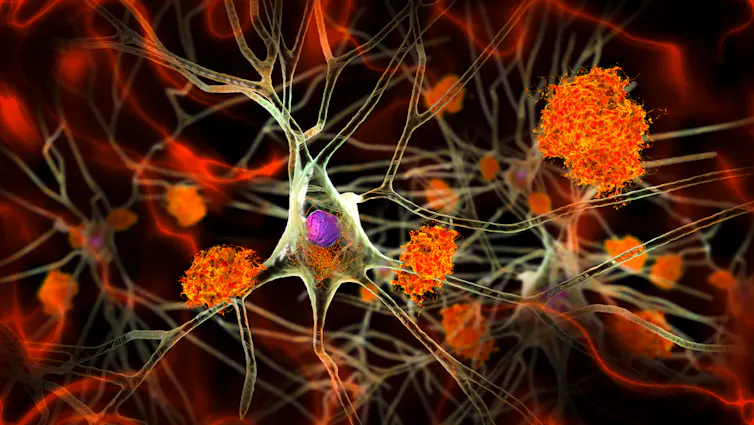
How is it possible to spend tens of billions of dollars developing drugs to treat a serious disease that affects millions of people, and yet end up with something that does not work? This is a mystery that has bedevilled Alzheimer’s research for years.
A new review of the evidence has concluded that the leading class of Alzheimer’s drugs “probably result in little to no difference” in a range of measures, including reducing dementia severity. This finding was quickly used to further justify the NHS’s decision two years ago not to fund these drugs.
These findings are disappointing, not just for researchers and drug companies, but also for the tens of millions of people and their families suffering from the effects of a devastating disease.
Medical research is often reported through success stories, but Alzheimer’s disease has remained stubbornly resistant to the development of life-changing breakthroughs. This has not gone unnoticed. A couple of years ago, investigative journalists uncovered significant fraud in important studies underpinning some of the science behind the leading Alzheimer’s drugs.
While this fraud is not solely responsible for the lack of progress in Alzheimer’s research, it does reveal how vested interests can distort science and how commercial interests can sometimes override indications that a specific approach may not actually be working. It also reveals how social, political and economic factors can distort and hold back entire fields of research.
A century of science and still no answers
The German psychiatrist Alois Alzheimer first identified the disease that bears his name in 1906. Over the subsequent years, it was found to be characterised by abnormal protein deposits in the brain called amyloid “plaques” and similarly misfolded protein tau tangles.
As these misfolded proteins are not found in healthy brains, it was assumed that they were the cause of the disease. But subsequent studies showed that the amounts of these protein deposits did not correlate well with disease severity, unlike similar diseases, where misfolded protein deposits occurring in other parts of the body led directly to organ failure.
This complex relationship between the pathological changes in the brains of people with Alzheimer’s and the psychological progression of the disease has split the research field for many years.
At one point, those proposing that amyloid deposits (or at least the molecular processes leading to them) were the main cause of the disease were even referred to as “Baptists”, while those holding tau as responsible were called the “Tauists”. Although these have been the main two theories as to the cause of the disease, there have been numerous others, such as linking the disease to the abnormal behaviour of neurotransmitters, inflammation, presence of pollutants, age-related changes, DNA damage, viruses and even sleep disturbance.
In situations like this, when there are many competing theories, researchers who start working on one theory can start to become entrenched. This is an unfortunate byproduct of competitive funding models, where research money tends to flow to the researchers who are most successful at arguing that their approach is the most promising and therefore worthy of receiving more research money. This is an interesting example of how science is not always an entirely objective endeavour.
This pressure on researchers to publish papers and attract funding is probably a contributing factor to the significant fraud linked specifically to some working on the amyloid hypothesis for Alzheimer’s. In one case, a researcher in the US was forced to resign from his university following the retraction of a much-cited paper, and the discovery that over 20 other papers may have similarly questionable data.
In a separate case, an academic faced fraud charges, while a pharmaceutical company they worked with came under investigation for allegedly misleading investors. Both of these cases were in connection with a different approach to treating Alzheimer’s, namely, targeting a protein called filamin A.
Indeed, controversies within Alzheimer’s research have become so frequent that they have inspired an entire book dedicated to examining the issue.
Matthew Schrag, a neuroscientist who played a key role in exposing elements of fraud in Alzheimer’s research, said: “You can cheat to get a paper. You can cheat to get a degree. You can cheat to get a grant. You can’t cheat to cure a disease. Biology doesn’t care.”
While scientific breakthroughs undoubtedly underpin much of modern life, the example of Alzheimer’s research serves as a reminder that the path from defining a problem to discovering a solution is rarely straightforward.
It would be nice to think that the main incentive for most researchers might be solving a problem or curing a disease, but the actual situation is far more complex. Research relies on funding, and researchers get jobs based on reputation, often in the form of publications. Because of this, the wrong behaviour can become incentivised.
The complexity of Alzheimer’s disease and the lack of obvious answers or cures make this field particularly susceptible to distortion by the social factors that can influence science.
As researchers and pharmaceutical companies compete for funding and investment, the science starts to get lost behind the games that are played. The end result is not only financial loss and lack of progress, but in the case of this devastating disease, millions of people also end up suffering through a lack of effective treatments.
Prior to moving into Bioethics Simon Kolstoe spent 17 years working on protein folding diseases (including Alzheimer’s) on grants funded by the MRC, BBSRC, Wellcome Trust and with a number of pharmaceutical companies. He receives no income from his former research in this area.
Today, Apple announced the tech company’s longtime chief executive Tim Cook will step down and transition to the role of executive chairman of Apple’s board of directors.
This change will take effect from September 1 2026. John Ternus, currently Apple’s senior vice president of hardware engineering, will take over as chief executive.
However, Cook will remain in place until then to ensure a “smooth takeover”. As chairman, he’ll then take on a more strategic role of engaging with policy makers and corporate governance.
Rather than signalling a dramatic shift, this transition is likely going to be more subtle, without a major strategic reset.
A rich legacy for Cook
Cook was only the second chief executive in Apple’s history, after cofounder Steve Jobs resigned in 2011 and died six weeks later.
Cook is widely recognised for his strengths in operations, scale and business model innovation. Under his leadership, Apple became one of the most successful global supply chain organisations reaching more than 200 markets worldwide. The company’s value grew from about US$350 billion in 2011 to US$4 trillion today.
Importantly, Cook drove a decisive shift towards service monetisation – charging users fees for Apple’s digital services and subscriptions, rather than just making money from selling devices such as iPhones, iPads and laptops. Cook’s strategy capitalised on Apple’s already massive base of 2.5 billion active devices.
Service monetisation led to high-margin revenues from Apple’s offerings such as iCloud, Apple Music and the Apple store. Consequently, Apple made more than US$100 billion in 2025 from this business, providing a stable and predictable income beyond cyclical hardware sales.
Who is John Ternus?
In contrast to Cook, Ternus has a deeply technical, product-oriented background shaped by more than two decades in hardware engineering.
At Apple, he has overseen the development of key product lines that include many iterations of the iPhone, iPad, AirPods and the Apple Watch, among others. He’s been closely associated with advances in materials, durability and performance.
The difference in background between Cook and Ternus suggests a subtle but important shift in emphasis for the technology giant.
While Cook focused on transforming Apple into a highly monetised ecosystem anchored in services and global scale, Ternus is likely to reassert the importance of product-led innovation. In his current role, he’s been focusing on engineering excellence and integrating fresh technologies into Apple devices.
With Ternus at the helm, it’s likely the company will try to balance an optimised ecosystem of revenue (that is, service monetisation) with reinvigorating the hardware products that sustain it. That would make a lot of sense.
Apple faces numerous pressures
A stronger product focus under Ternus may also become the company’s response to multiple structural pressures facing Apple.
Apple’s device-centric approach will ensure products are meaningfully distinct from competitors through partnerships. For example, the company will be using Google’s Gemini AI as the basis for an enhanced Siri assistant. At the same time, consumers are upgrading their devices more slowly, so Apple will need more compelling product innovation to drive demand.
Time will tell, but so far everything suggests Ternus succeeding Cook as Apple chief executive will represent a logical and necessary calibration of strategy, rather than a radical shakeup.
Rajat Roy does not work for, consult, own shares in or receive funding from any company or organisation that would benefit from this article, and has disclosed no relevant affiliations beyond their academic appointment.
The OpenAI offices in San Francisco (California) when it was established in 2015.HaeB/Wikimedia, CC BY-SA
OpenAI, the creator of ChatGPT, is gearing up to launch its Initial Public Offerings (IPO) this year. This financial manoeuvre would represent a pivotal shift for a project originally designed for the “common good” towards a market-driven logic. Established in 2015, OpenAI started out amidst growing anxiety regarding artificial intelligence (AI). Founded by Sam Altman and Elon Musk, the tech company adopted a non-profit structure and made no secret of its goal to develop AI that is “beneficial to humanity” and prevent it from remaining in the hands of a few dominant players.
This ambition distinguished it from tech giants like Google, Microsoft, Meta, and Amazon, which were built on proprietary models and rent-seeking effects.
In contrast, OpenAI intended to champion general public interest by emphasising open research and sharing knowledge. However, this orientation – symbolised by its name – quickly collided with a structural constraint: the astronomical cost of generative AI.
Massive costs
Unlike traditional software, where marginal costs tend towards zero (for example, the millionth copy of Windows costs Microsoft nothing), generative AI requires massive infrastructure.
Every interaction mobilises computing resources, energy, and specialised equipment. A standard ChatGPT query, consisting of one question and one answer, costs between $0.01 and $0.10. Similarly, generating a high-definition image can cost between $0.10 and $0.20. While these amounts seem negligible in isolation, they become staggering when scaled to the billions of daily queries seen in 2026.
This is explained by the underlying infrastructure, particularly the Graphics Processing Units (GPUs) supplied by players like Nvidia. These chips can cost tens of thousands of dollars to purchase and several dollars per hour via cloud access.
OpenAI, like its competitors, depends on tens of thousands of these GPUs running continuously in massive data centers. According to some estimates,the necessary investments will reach hundreds of billions by the end of this decade.
As early as the late 2010s, it became clear that a purely non-profit model could not meet such capital intensity. This is why OpenAI adopted a hybrid status in 2019, allowing it to raise funds while maintaining control through a foundation. It was a first foray into the market economy, albeit one tempered by the ambition to resist investor demands.
Brutal acceleration with ChatGPT
However, at the end of 2022, the chatbot ChatGPT radically changed the game, attracting 100 million users in just two months, before surpassing 900 million weekly users by early 2026.
OpenAI’s revenue surged from approximately $200 million (€173.15 million) in 2022 to over $10 billion (€8.65 billion) in 2025 – a sixty-fold increase in three years.
This exponential growth was accompanied by the implementation of a business model with multiple revenue streams. For individuals, OpenAI offers paid subscriptions (ranging from $20 to $200 per month). However, the bulk of the revenue comes from enterprises, via subscriptions priced between $25 and $60 per user per month. A company with 10,000 employees thus represents several million dollars in annual revenue.
Corporate money
OpenAI additionally bills for the use of its models by companies that integrate them directly into their own solutions. Every use is metered, often on a massive scale. An application processing a million queries a day can generate tens of thousands of dollars in monthly billing.
Finally, a growing portion of revenue comes from strategic agreements, notably with Microsoft, which integrates OpenAI technologies into its products under the Copilot brand.
It is the sum of these flows – subscriptions, licences, third-party usage, and partnerships – that allowed OpenAI to reach approximately $1 billion in monthly revenue in 2025. Yet, this commercial rise masks an intrinsic economic fragility.
A gigantic cash-burning machine
Despite sharply rising revenues, OpenAI remains structurally loss-making. In the first half of 2025, the company reportedly generated approximately $4.3 billion in revenue while recording losses between $7 billion and $13 billion – more than $2 billion in losses every month. In total, cumulative losses could exceed $140 billion (€121.19 billion) between 2024 and 2029.
This drift is explained by the very nature of OpenAI’s business model, where every interaction incurs a cost alongside gargantuan necessary investments. Beyond infrastructure, Research and Development (R&D) is a major expense. To stay in the technological race against an increasingly competitive environment, OpenAI reportedly invested nearly $16 billion in R&D in 2025 alone.
To this is added the cost of human resources, which is sometimes extraordinary. While base salaries for the most in-demand AI experts range from $250,000 – $700,000 per year, their total compensation – including stock and bonuses – frequently exceeds $1 million. In some cases, annual compensation even exceeds $10 million. Here again, bidding wars from competitors like Meta force OpenAI to match these offers for fear of seeing its key talent vanish.
Nearing bankruptcy?
In short, OpenAI’s business is not enough to cover its costs, to the point that some analysts suggest that at this rate, it could be forced to file for bankruptcy as early as 2027. Recourse to external financing is therefore indispensable to cover these losses.
To sustain its growth, OpenAI has already raised approximately $58 billion since its inception, including more than $13 billion from Microsoft. In 2025, an exceptional funding round reportedly raised up to $40 billion more, pushing its valuation to several hundred billion dollars.
At the end of March 2026, a new $122 billion funding round – notably involving Amazon ($50 billion), Nvidia, and SoftBank ($30 billion each) – brought the valuation to $852 billion (€737.6 billion). Yet, these amounts remain insufficient given the requirements.
Industrial Dependency
Dependency on industrial partners appears particularly problematic. Microsoft provides OpenAI with its cloud infrastructure via Azure, while Nvidia plays a key role upstream by providing GPUs. Much like the Gold Rush era, when shovel sellers grew rich at the expense of prospectors, it is the infrastructure providers in the AI sector making a fortune, not the model designers.
In practice, every AI query generates revenue for infrastructure providers, amounting to a form of “invisible tax” captured upstream.
OpenAI’s economic tensions have spilled over into its corporate governance. The hybridisation of a public interest mission with private financing mechanisms resulted in a complex structure. A non-profit foundation controls a for-profit “public benefit corporation”, which is funded by investors and tasked with raising capital and developing activities – all while theoretically remaining subordinate to the foundation’s public interest mission. This construction, designed to avoid purely financial logic, quickly fuelled tensions between different stakeholders.
Elon Musk’s departure in 2018 was the first signal of a strategic disagreement. In 2020, several researchers left OpenAI to found Anthropic, citing differences over safety and governance. However, it was primarily the crisis of November 2023 that fully revealed the system’s fragilities, when the board of directors suddenly announced the firing of Sam Altman, citing a lack of transparency in his communications.
Within hours, the situation spiralled into an open crisis. Nearly all employees threatened to leave the company if Altman was not reinstated. Microsoft, the main partner and investor, publicly supported Altman and even discussed the possibility of hiring him and his teams. Faced with this pressure, the board was forced to reverse its decision within days. Sam Altman was reinstated, and the board’s composition was profoundly overhauled. This episode highlighted internal tensions, specifically the difficulty of making divergent logics coexist within the same company: ethical posturing, industrial imperatives, and investor demands.
Intensifying Competition
In addition to these internal constraints, competitive intensity is particularly fierce.
Google, the inventor of generative AI, is making rapid progress with Gemini. Anthropic, with Claude, has established itself in certain segments, particularly programming, while emphasising safety.
China’s DeepSeek has claimed to use less expensive processors. France’s Mistral AI advocates for a frugal approach and European digital sovereignty. In a sign of this shifting landscape, Apple which initially partnered with OpenAI to include ChatGPT for certain Siri features – has chosen to replace it with Gemini.
In this context of ecosystem reorganisation, OpenAI’s position, while still central, is being challenged. Intensifying competition reinforces the need for ever-greater financial resources.
The stock market: lifeline or mirage?
OpenAI’s Initial Public Offering (IPO) is presented as a response to these constraints: a way to fund massive investments and consolidate a weakened competitive position. An IPO could raise between $50 billion and $100 billion by selling 10% to 20% of the capital. Such an operation would constitute one of the largest in the history of financial markets.
However, this transformation involves delicate trade-offs. A listed company is subject to profitability and transparency requirements that may clash with the experimental nature of artificial intelligence. Added to this is the persistent dependence on Microsoft and Nvidia, which limits the company’s strategic autonomy.
Most importantly, there is no indication that an IPO would suffice to resolve OpenAI’s structural problems. At best, without a significant shift in the business model, it would only delay its bankruptcy by a few years. The economic model of generative AI remains fundamentally unstable today.
A Question Beyond OpenAI
Beyond the case of OpenAI, one can legitimately question the current functioning of an economy dominated by tech giants. Artificial intelligence is establishing itself as an essential infrastructure whose effects far exceed the economic sphere. For some analysts, control over AI now carries the same geostrategic importance link please as the possession of nuclear weapons.
Consequently, a civilisational question arises: can we entrust the development and direction of such a technology solely to financial markets? Can we imagine Elon Musk or Mark Zuckerberg personally owning the equivalent of one or more atomic bombs? OpenAI’s IPO will not provide the answer alone. However, it will constitute one of the first large-scale tests.
A weekly e-mail in English featuring expertise from scholars and researchers. It provides an introduction to the diversity of research coming out of the continent and considers some of the key issues facing European countries. Get the newsletter!
Frédéric Fréry ne travaille pas, ne conseille pas, ne possède pas de parts, ne reçoit pas de fonds d’une organisation qui pourrait tirer profit de cet article, et n’a déclaré aucune autre affiliation que son organisme de recherche.
In the opening moments of Vladimir, Netflix’s new erotic drama series, the protagonist M (Rachel Weisz) is sprawled on a couch in her negligee, writing in her notepad. She leans towards the camera, then stares into the lens to address you, the viewer, on your couch.
In film and television, this is called “breaking the fourth wall”. It is a ploy of metafiction: a kind of self-aware mode of storytelling.
The fourth wall is the invisible plane through which the camera observes the action. To break the fourth wall is to play with – or sever – audiences’ suspension of disbelief, and abandon the norms of screen narration.
The history of breaking the fourth wall is almost as long as the history of cinema itself. Edwin S. Porter’s film The Great Train Robbery ends with an outlaw firing his gun directly towards the camera. Back in 1903, audiences ducked for cover.
Nearly a century later, director Martin Scorsese paid homage to Porter in Goodfellas (1990) in a scene where Mobster Tommy DeVito (Jo Pesci) fires his gun directly at the screen. Here, the fourth wall break is used in an existential moment for Henry Hill (Ray Liotta) – rather than for pure shock.
In fact, the shock value of the technique has depleted over time, as audiences have become more media literate.
Making the invisible visible
The fourth wall breaks from early cinema fast disappeared with the industrialisation of the medium. The rise of the American studio system privileged some film techniques over others.
The “Classical Hollywood” style – think Casablanca (1942) – was built on a premise of invisibility, from the carefully directed eye-lines of actors, to “continuity” editing that stitched together different camera angles.
In Breathless (À bout de souffle, 1959) Jean-Luc Godard opted for jump-cuts and “direct address”. This is when a character speaks to, or looks directly at, the viewer.
Today, direct address is used widely across genres, from Barbie (2023), to Marvel’s Deadpool films (2016, 2018, 2024), and Jane Austen adaptations such as Persuasion (2022).
On television, we’ve seen women creators and characters explore the power of direct address in a re-calibration of the “male gaze”.
One example is Phoebe Waller-Bridges’ confessions to the camera in Fleabag (2016–19). Cinematographer Tony Miller notes how creative camera choices work in conjunction with direct address to make viewers “complicit in her [character’s] journey”.
The direct gaze
A fourth wall break is not always dialogue-driven. In Persona (1966) film auteur Ingmar Bergman directed his actors to stare deep into the abyss of the camera lens, delivering existential malaise.
This direct gaze has been remediated for streaming programs, including in the
intense close-up shots of Carmy (Jeremy Allen-White) in the final season of The Bear (2025), and knowing glances from the troubled Rue (Zendaya) in Euphoria (2019–26).
Fourth wall breaks can also be graphic. In Pulp Fiction, Mia Wallace (Uma Thurman) traces a square of light on the screen with her finger instead of calling Vincent Vega (John Travolta) a “square”.
And in Michael Haneke’s films Funny Games (1997, 2007) a home invader literally “rewinds” the story when a victim kills his accomplice. These kind of wall breaks call attention to the invisible membrane of the screen.
As filmmaker Mark Cousins attests in The Story of Film: An Odyssey, the medium has advanced over time through innovation and the recycling of techniques such as fourth wall breaks.
Is breaking the fourth wall back in vogue?
With the dominance of literary adaptations for the screen (and IP-driven screen stories in general) we’re likely to see more cases of direct address, as screenwriters seek to creatively refashion texts for the screen. Vladimir, for instance, is an adaptation of Julia May Jonas’ 2022 novel of the same name.
While breaking the fourth wall may have lost its shock value, it remains a bold storytelling device which, if done well, can set apart one screen production from another.
Actor Matt Damon recently pointed out how streamers such as Netflix are discussing the potential to reiterate “the plot three or four times in the dialogue” of a film, to account for people who scroll on their phone while listening to “background TV”.
Having a character speak directly to a distracted audience may be one way to return their gaze to the bigger screen.
Hyper-reality in unscripted TV
Breaking the fourth wall sits within a wider envelope of “metafictional” storytelling.
As screen culture becomes increasingly aware of its own machinery, unscripted genres such as reality TV are not merely breaking the fourth wall, but abandoning the conceit of separation entirely. The boundaries between cast, camera, story producers and audience have become increasingly porous.
Alex Baskin, executive producer of the long-running series Vanderpump Rules (2013–25), describes this as “hyperreality”. In the wake of Scandoval, the cheating scandal of Tom Sandoval, the reality TV cast started to intervene in the producers’ narrative arcs by speaking on camera about audience feedback, and providing meta commentary on their own “edits”.
When Ariana Madix (Sandoval’s ex) refused to film with him, it disrupted plans for a neat season finale based on his apology. Madix left the set, effectively ending the entire show. Fellow cast member Tom Schwartz called it a “plot twist”. Unsurprisingly, Scorsese is a fan of the show.
Meta and hyperreal storytelling will continue to be on the rise as screen creators seek to imbue a point-of-difference in a congested market – serving an ever-distracted audience.
Alex Munt does not work for, consult, own shares in or receive funding from any company or organisation that would benefit from this article, and has disclosed no relevant affiliations beyond their academic appointment.
With a shaky ceasefire in place between the US, Israel and Iran – and little progress on talks to resolve the complex issues at the heart of the war – where is this conflict going?
The most likely scenario is a frozen conflict.
A frozen conflict is not static, but is an unresolved war that continues at a low-level below the threshold of full-scale combat.
Even if negotiations resume this week in Pakistan and an eventual agreement is reached, there are still three reasons we believe this is headed towards a frozen conflict, not a comprehensive peace agreement.
1) Trump equates ceasefires with an end to war
US President Donald Trump’s approach to foreign policy has shown he does not treat ceasefires as pauses for negotiations to agree on substantive political issues. Rather, he declares a ceasefire as a US success, then moves on to the next global issue.
Trump claims to have ended ten wars, including the current conflict with Iran and Israel’s war in Lebanon. A closer look reveals that in most of these conflicts, a shaky ceasefire has held while substantive issues remain unresolved.
This has left frozen conflicts in place with ongoing tensions. In India and Pakistan, which engaged in a brief armed conflict last year, for example, there is a continued risk of renewed hostilities. And a lasting peace between Thailand and Cambodia after last year’s border spats remains elusive.
Yet, Trump has walked away from these conflicts and claimed an end to war as soon as a cessation of major hostilities was in place.
2) Asymmetric wars are difficult to resolve
The current war is asymmetric because of the huge difference in military strength between the US and Israel on one side, and Iran on the other.
Iran has intentionally used asymmetric tactics to counter the US’ overwhelming military power, including targeting infrastructure in Persian Gulf countries not involved in the war and closing the Strait of Hormuz to commercial shipping traffic to disrupt the global economy.
Research shows asymmetric wars are inherently protracted and often open-ended. As a result, they are more likely to end in a frozen conflict than an enduring political settlement.
The reason for this is simple. The weaker actor cannot win a conventional military battle against the stronger actor. So, it tries to exhaust the more powerful nation with political, economic and psychological pressure, forcing a withdrawal and cessation of hostilities.
This is what we are seeing now between the US and Iran. Trump is feeling these rising pressures and is pursuing a ceasefire, while trying to claim a US victory.
Iran, meanwhile, has agreed to a ceasefire in a bid for survival as the weaker actor, rather than a commitment to an enduring end to the conflict.
This is reminiscent of the Taliban in Afghanistan, who survived 20 years in a frozen conflict with the US before taking back control of the country when the US withdrew.
3) There’s been no focus on the more complex issues
Neither the US nor Iran appears committed to any long-term resolution of the underlying tensions at the root of the conflict. Key among these is the question of Iran’s nuclear program.
For Washington, the first round of peace talks in Pakistan on April 11–12 were aborted because Iran refused to compromise on its nuclear program. And Iran has long argued it has an inalienable right to enrich uranium for civilian purposes.
The negotiations that led to the multilateral 2015 deal on Iran’s nuclear program – the Joint Comprehensive Plan of Action – took 20 months to conclude. Trump withdrew from the agreement three years later, calling it a “horrible one-sided deal”.
Given this history, a quick and clear resolution to this complex dispute is unlikely.
Some analysts believe the US and Iran could announce a partial agreement that would leave many of the technical aspects to be ironed out later.
But Trump is now facing an opponent that is unlikely to become more accommodating with respect to its long-term “nuclear rights”. In fact, Iran has already shown its resolve by asserting a new geostrategic normal, closing the Strait of Hormuz and disrupting the global economy.
What a frozen conflict means for the region
The Iran-US war may conclude with a series of ceasefires, but will likely remain a frozen conflict due to these underlying tensions. This means more threats from both sides over Iran’s nuclear program and periodic flare-ups of violence between Israel and Iran, the US and Iran, or both.
This is much like the frozen situation in Gaza. Last October, Israel and Hamas agreed to a ceasefire under Trump’s 20-point peace plan. The first phase of the plan was then largely implemented, leading to a hostage-prisoner exchange, a decrease in Israel’s heavy bombardments of Gaza and a resumption of aid into the strip.
However, there has since been no progress on the more complex questions of the post-war governance of Gaza, redevelopment of the strip and – crucially – the disarmament of Hamas fighters. As a result, Israel has refused to completely withdraw its troops and violence has continued.
From a historical perspective, the frozen conflict in the Koreas is also instructive. The war ended with an armistice in 1953 and no peace treaty, effectively leaving North and South Korea at war to this day. This led to the North developing an underground nuclear weapons program that continues to pose a threat to the world.
Similarly, the decades-long frozen India-Pakistan conflict has led to an arms race (including the development of nuclear weapons on both sides), instability in South Asia and periodic flare-ups of violence.
A frozen conflict between the US, Israel and Iran will no doubt create similar long-term instability in the Middle East, including a possible arms race in the Middle East and more flare-ups of violence, particularly around control of the Strait of Hormuz.
The authors do not work for, consult, own shares in or receive funding from any company or organisation that would benefit from this article, and have disclosed no relevant affiliations beyond their academic appointment.
Over the past several days, there have been conflicting reports about the Strait of Hormuz. It’s difficult to know what’s happening from one moment to the next.
Iran said the waterway was open to commercial shipping again, then turned around and said it was closed.
Iran then fired at two Indian-flagged ships going through the strait, forcing them to turn around.
The next day, the US fired on an Iranian cargo vessel, which Tehran called a violation of the two countries’ temporary ceasefire and threatened retaliation.
What’s actually happening in the strait? Are both sides acting lawfully? We asked naval expert Jennifer Parker to explain.
What happened over the weekend?
There have been several key developments over the last 48 hours.
The first was the statement from US President Donald Trump and the Iranian foreign minister on social media that the Strait of Hormuz remained open. It was an interesting announcement because it was consistent with what the foreign minister had said at the beginning of the ceasefire a week and a half ago.
On Saturday, we saw a large number of tankers and cargo vessels move towards the top of the strait to follow what Iran has designated as a new passageway. Some ships that are clearly desperate to get out of the strait were obviously more confident they were safe to transit through at that point.
The Joint Maritime Information Centre in Bahrain said 18 ships were able to transit through, at least ten through the new Iranian-designated transit route, which is north of the normal transit route.
However, Iranian Revolutionary Guard Corps Navy then reportedly attacked a number of
civilian merchant vessels. One was an Indian tanker that was on an approved list with the IRGC to travel through the strait.
This suggests the Iranian military may have been disagreeing with the statement of the Iranian foreign minister, saying the strait remains closed.
Is the US blockade legal?
Then, on Sunday, the US fired on an Iranian-flagged cargo ship in the Arabian Sea.
The US is blockading Iranian ports through what’s called a distant blockade. This means US Navy ships are not sitting right off Iran’s ports to stop vessels. Rather, they are positioned further back in the Gulf of Oman and the northern Arabian Sea, with a blockade line effectively drawn between the Iranian-Pakistan border to around the Omani-UAE border.
The US Central Command has reported turning away a number of ships – at least 23 as of April 18.
When a ship approaches the blockade line en route to or from an Iranian port, the US Navy will radio the vessel and say it is not free to go through. Most ships will then turn around.
This is allowed in a lawful blockade under the law of naval warfare. Once a conflict has started, a blockade is a lawful if it complies with certain provisions:
the blockade must be declared
it must be impartial, meaning it needs to apply to all ships
humanitarian goods must be permitted to go through
it must be effective, meaning you can’t declare a blockade, start doing it, and then not actually enforce it
it can’t close off neutral ports.
Many news reports have said the US is blockading the Strait of Hormuz. But it is actually blockading Iranian ports, not the strait. A blockade of the strait would be illegal because this would affect neutral ports in the Persian Gulf. Ships in an international strait enjoy unimpeded transit passage, which cannot be hampered or suspended by the coastal state.
Is the US permitted to fire on a cargo vessel?
The US says it warned the Touska, the Iranian-flagged vessel, to stop over a six-hour period.
If a vessel doesn’t comply with warnings like this, warning shots can then be fired, depending on your country’s rules of engagement. The country maintaining the blockade may also use “disabling fire” against the ship.
This is what the US claims happened – the US Navy destroyer fired on the Touska’s engine room to make it stop. My assessment is this is consistent with the law of naval warfare because the US Navy is enforcing an effective blockade. It also appears to have adhered to the principles of proportionality and necessity under international law.
The US also seized the ship, which is consistent with the law. In terms of the crew, the US has not announced what it intends to do with them. If the crew is non-Iranian, they would likely be released and repatriated. If the crew is Iranian, or if some of the crew are linked to the IRGC, they could be detained.
By contrast, based on current reporting, the ships fired on by Iran appear to have been neutral merchant vessels transiting an international strait. On the information publicly available, there is no indication they had become lawful military objectives.
This is not a lawful use of force because these vessels are not a lawful military objective.
Neutral merchant vessels are generally considered civilian objects under the law unless, by their nature, location, purpose or use, they make an effective contribution to military action. Therefore, it’s not lawful to attack them.
There are some exceptions to that, including a merchant vessel seeking to breach a lawful blockade.
Where do things go from here?
The US is not saying it’s in control of the strait, it’s saying it’s in control of the vessels going in and out of Iran, which is different.
Iran has claimed it’s in control of the strait since the war began. It has been attacking and threatening civilian, predominantly neutral vessels since then.
What I think we are seeing is a tussle for leverage to supercharge the negotiations between the US and Iran, should they continue this week in Pakistan.
Ten years earlier, Kim Gordon’s career began during New York’s post-punk era. Her book, Girl In A Band (2015), recently re-released as a tenth anniversary edition, chronicles her time with Sonic Youth, and charts her role within an alternative scene that shaped and influenced independent music culture across the United States.
By the early 1990s, she was something of a godmother figure for Auf der Maur’s generation of women.
Review: Even the Good Girls Will Cry: My 90s Rock Memoir – Melissa Auf Der Maur (Atlantic); Girl in a Band – Kim Gordon (Faber)
Introverted individuals with distinct perspectives on the peculiar challenges of the rock industry, Gordon and Auf der Maur appear to have benefited from a stability missing in many of their peers.
As bass players, they avoided the spotlight until embarking on their solo projects. And with backgrounds in the visual arts, they each had access to independent creative identities away from the stage, which no doubt minimised the pitfalls of rock stardom.
As a music journalist throughout the 1990s, I interviewed many of the people in their stories, including Courtney Love, Billy Corgan, Dave Grohl, Thurston Moore and Kurt Cobain. I witnessed their complex politics and fierce power plays, some still ongoing.
For example, a very high profile singer tried to persuade other women not to speak to me for my first book because my magazine profile of her was badly altered by a male editor. Another musician blamed me for publishing personal details in an interview after I’d given her full copy approval.
It was, as Auf der Maur says, a time of “messy humanity”, low-level trust, and delicate egos.
It was also, as she points out, the last analogue decade: a time before the music scene was transformed by the internet, when rock culture appeared to be finally embracing powerful women and female agency. But in my experience, and as each of these books reveals, it was never that straightforward.
Musical callings and romantic dreams
An artistic free spirit raised in Montreal by unorthodox, creative parents, Melissa Auf der Maur first saw Hole and Smashing Pumpkins within a fortnight of each other in July 1991. Both bands played at the legendary punk club, Les Foufounes Électriques, where she worked part-time while studying photography.
More impressed by Hole’s calm, centred bassist, Jill Emery, than the band’s infamous, volatile frontwoman, Auf der Maur was truly starstruck by Corgan. She introduced herself to him after he was bottled on stage by her roommate. Watching him play, she experienced a “new musical calling”. Four months later, she travelled to a Pumpkins show in Vermont and spent the night “soul fucking” him in his motel room.
“I am you and you are me,” she remembers Corgan saying to her, in what sounds like a rock-starry show of narcissism towards an impressionable fan. But for Auf der Maur, who occasionally veers into grandiose claims, the encounter was a “romantic dream come true” and “a turning point […] musically, personally and cosmically”.
More tellingly perhaps, though she describes Corgan as eventually exerting “more influence on my life than anyone other than my parents”, Auf der Maur didn’t question his patriarchal power dynamic for many years – despite being in one of rock’s most notorious female-fronted bands.
But Corgan’s hold extended to his former girlfriend, Courtney Love, long after she left him for Kurt Cobain. When Hole’s second bassist, Kristen Pfaff, died from an overdose, it was Corgan who decided Auf der Maur should be the replacement.
The Hole drama
Life in Hole was nothing if not dramatic – and Auf der Maur’s account harbours no illusions about the difficulty of working with a grieving, traumatised widow.
But her empathy and compassion keep her story from collapsing into the critical terrain so often provoked by the outspoken, uncontained Love who attracted considerable vitriol, particularly after becoming involved with Kurt Cobain.
Auf der Maur is also more forgiving than drummer Patty Schemel, who paints a harsher picture of the ambitious, tempestuous singer in her brilliant memoir, Hit So Hard. But she was very aware of her marginalised position as Love’s “good girl” in the autocratic Hole. She had no artistic freedom in the band and eventually grew frustrated with her unfulfilling situation.
After five years in Love’s orbit, Auf der Maur wanted out. By 1998, the singer’s Hollywood film career had catapulted her into a different stratosphere of celebrity culture, further widening the existing chasm between her and her band members.
And the glamour and excitement of big festival billings and hit records were not enough to prevent the bass player from feeling ultimately “disillusioned and disconnected”.
Her decision to quit was compounded when she fell in love with ex-Nirvana drummer Dave Grohl, now with the Foo Fighters. His long-running rift with Love had previously made him “off-limits”.
But before she was released from her restrictive contract with Hole, Corgan was back in touch, asking her to replace D’arcy Wretzky in Smashing Pumpkins for a year of intensive touring. Wretzky’s sudden departure is glossed over in the book as a “touchy subject”, though she played with the Pumpkins for 11 years, and was reputedly a friend of Auf der Maur.
I remember Wretzky as a quietly intelligent individual with a striking stage presence, but Corgan’s domineering personality and punishing work ethic apparently proved too much for her.
And Auf der Maur makes no secret of Corgan’s ruthlessness. At her first rehearsal, he issued her with three rules: “One, you can’t make a mistake. Two, you can’t get sick. And three, there are no days off.”
Away from Grohl, who was also on the road with his band, she was bound to a gruelling schedule at the hands of a man she now saw as a moody overachiever. In response, she began to change her perspective.
Corgan’s partner at the time was the gifted photographer Yelena Yemchuk, who, Auf der Maur notes, had become “a bit of a kept woman”. Knowing Grohl wanted marriage and children, she witnessed Yemchuk with “her beautiful talent trapped in the bell jar of Billy’s world” with growing alarm.
As the two women became close, together they realised they needed to “step out of the shadows of these bigger, more successful men” and forge their own paths.
With the culmination of the Pumpkins world tour in 2001, Auf der Maur was 29 and finally ready for a new direction. She left her relationship with Grohl and turned down Corgan’s invitation to collaborate on a new project. She finishes her book with a glimpse into her next chapter: motherhood, and a grounded life of artistic ventures in upstate New York.
It’s more of a beginning than an end.
Feminism and challenges with men
The first time I interviewed Kim Gordon was over the phone in 1990. At the time, she was the bass player with Sonic Youth, the seminal no wave band she co-founded with her husband, singer/guitarist Thurston Moore, in 1981. Hinting at what I suspected was sometimes a lonely situation, she told me that while the band’s relationship was essentially a beautiful one, her male colleagues could be “so non-communicative”.
Three years later, I had a second, longer conversation with Gordon in her New York apartment for my aforementioned book, during which she elaborated on her original theme. Being in a band with men could be challenging, she said, because “there are some really boring aspects to it” and “no matter how much of a new man someone thinks they are, they’re just not!”
Gordon’s experience is summed up by both the content and title of her acclaimed memoir. With a new foreword by her friend, celebrated American writer, Rachel Kushner, and an additional closing chapter where Gordon reflects on the intervening decade, the latest version of the book is testament to its ongoing relevance for feminism, popular culture and music history.
Infused with the visceral, embodied sensuality of her artistic perspective, Gordon’s memoir details her upbringing in Los Angeles with her schizophrenic brother, Keller, whose moods clouded her early life, and whose death in 2023, aged 74, she recounts in the new edition.
It charts her pivotal move to New York as a 27-year-old in 1980, her involvement with the city’s post punk arts and music scene, her relationship with Moore and their resulting career with Sonic Youth.
Crucially, it details her influence in the Riot Grrrl movement, and her side projects, Free Kitten, with best friend Julie Cafritz, and fashion label, X-Girl, with Daisy von Furth, all of which afforded her the female companionship she lacked in Sonic Youth.
‘Painfully protracted’ marriage breakdown
It also tells the more universal story of a painfully protracted marriage breakdown and a couple’s failed attempts to save their relationship, following Gordon’s discovery of Moore’s affair. The book refrains from specifying dates, but by the time she found out through texts and emails, her husband had been unfaithful for several years.
The woman in question, who is not named in the book, was Eva Prinz, who became Moore’s second wife in 2020. At the time of the affair, Prinz was married to her second husband. She had previously been involved with one of Sonic Youth’s collaborators.
An editor for an independent publisher, she had initially approached Gordon about a potential book project in the early 2000s, but Gordon had passed it onto Moore, with fateful consequences.
Sickened by Moore’s long-concealed infidelity with someone well known to their inner circle, Gordon was left to navigate the devastating impact on her family, her career and her sense of self. Given the pivotal nature of this episode, it seems fitting that she starts her story here, at the end of a significant personal and professional era, with Sonic Youth’s final performance in 2011.
According to Gordon, this last appearance in Sao Paulo, Brazil “was all about the boys”. Struggling to hide her misery, anxiety and anger on stage, while her ex regressed into an adolescent display of “rock star showboating”, she was tempted to verbalise her fury on stage. But she didn’t want to follow the unboundaried example of Courtney Love, who was then ranting and raving her way around South America on tour with Hole.
“I would never want to be seen as the car crash she is,” writes Gordon. “I didn’t want our last concert to be distasteful when Sonic Youth meant so much to so many people; I didn’t want to use the stage for any kind of personal statement, and what good would it have done anyway?”
Distance as power
Gordon is highly adept at balancing between strong emotion and careful restraint. Throughout her book, she considers herself honestly, but thoughtfully. She conveys a quiet self-possession and enigmatic presence, writing as she speaks: with intelligence and a guarded openness. It’s how I remember her: warm enough to gift me a pair of John Fluevog sandals straight from her own closet, yet somehow always slightly removed. As Kushner says in her introduction to the memoir, “distance is the power of her performance”.
Now 72, Kim Gordon has been a touring musician for almost 40 years. Having made multiple forays into the worlds of fashion, art and film, since Sonic Youth she has launched two experimental bands with male collaborators, Body/Head and Glitterbust, been nominated for two Grammy awards, and released three highly acclaimed solo albums as a formidable frontwoman with an all-girl band.
These days, Gordon performs as if her life depends on it. With her second chapter well underway, she’s on fire – and cooler than ever. Let’s hope a second memoir is in the works.
Liz Evans does not work for, consult, own shares in or receive funding from any company or organisation that would benefit from this article, and has disclosed no relevant affiliations beyond their academic appointment.
Transparent acrylic samples coated in the new material.RMIT
Think of how many surfaces you touch every day, from your kitchen bench to the hand rail on the bus or train, your work desk and your phone screen.
A range of nasty viruses and other germs can easily spread via these surfaces. The typical route of infection involves touching a contaminated surface – and then touching your eyes, nose or mouth.
Of course, it’s possible to clean surfaces with chemical products. But these can wear off, harm the environment or contribute to antimicrobial resistance, where germs no longer respond to medicines because of repeated exposure.
In our new study, published in Advanced Science, colleagues and I created a thin plastic surface with tiny nanoscale features, billionths of a metre in size, that mimic the nanotextured surface of insect wings and can physically rupture viruses – specifically human parainfluenza virus type 3 (hPIV-3).
This new material offers a cheap, scalable way to make surfaces such as phones and hospital equipment far less likely to spread disease.
The downsides of disinfectants
Current methods for combating the spread of viruses via surfaces usually involves cleaning to remove dirt and disinfection to remove hidden contaminants.
Disinfectant must remain wet for some time to kill germs. This can be challenging in some real-world settings.
Surfaces can also be recontaminated quickly when other people touch them. And disinfection often involves the use of harsh chemicals which can damage equipment and the environment.
Scientists have previously developed antiviral surface modifications. These strategies often involve incorporating materials such as graphene or tannic acid and other natural agents into personal protective equipment such as masks, gloves, goggles, hard hats, and respirators.
These coatings are efficient. But they can pose a risk to human health. They can also be environmental hazards due to chemical leaching and have declining effectiveness over time as the potency of the active ingredients weakens.
A decade-long journey
Our journey toward a virus-bursting surface started more than a decade ago.
We initially aimed to engineer a surface so smooth that germs would simply slide off. Surprisingly, we discovered the opposite. Bacteria adhere quite readily to nanoscopically smooth surfaces.
Nature offers examples of bacteria-free surfaces. Take the water-repelling wings of cicadas and dragonflies. While these wings are self-cleaning, they act less by repelling bacteria and more as natural bactericides. That is, they kill bacteria. Natural bactericides are nature-derived “agents” that can kill germs, rather than inhibit their growth.
Experiments my colleagues and I did with gold-coated wings confirmed this bacteria-killing effect is not driven by surface chemistry, but rather by topography.
The physical nanostructures on the surface essentially force bacterial cell membranes to stretch and rupture.
Our earlier work showed that nanospike-covered silicon effectively destroys viruses on contact. But its rigid nature restricts its use on complex objects.
Microscope image of a virus cell being ruptured by the nanotextured surface. RMIT
A lightweight, flexible and virus-bursting material
In this new study, we addressed this problem by creating a virus-bursting material that was lightweight, cost-effective and flexible.
This material is a thin acrylic film covered in thousands and thousands of ultra fine pillars. The nanotextured materials are smooth to touch. However, these nanopillars grab and stretch a virus’s outer shell until it ruptures. This kills viruses through mechanical force.
Lab tests with hPIV 3, which causes bronchiolitis and pneumonia, found up to 94% of virus particles were ripped apart or fatally damaged within an hour of contact with this material.
We discovered the distance between nanopillars matters far more than their height, with tightly packed pillars about 60 nanometres apart working best.
The mould we used to create this material can be easily scaled to provide wide-ranging industrial opportunities, from food packaging to public transport systems to hospital equipment and office desks.
Nanostructured surfaces are built for durability. But they are susceptible to the same physical, chemical, and environmental stressors as any other material, and will degrade over time.
Much remains to be discovered in the search for germ-free surfaces. But these nanotextured surfaces have enormous potential in the fight against viruses and provide an alternative to traditional, chemical-based methods.
Elena Ivanova does not work for, consult, own shares in or receive funding from any company or organisation that would benefit from this article, and has disclosed no relevant affiliations beyond their academic appointment.
Source: The Conversation – Canada – By Joshua Gonzales, PhD, Management, Lang School of Business and Economics, University of Guelph
If you spend any amount of time on LinkedIn, you’ll have certainly come across this type of phrasing: “This isn’t a job, it’s a calling” or “This isn’t marketing, it’s a movement” or “This isn’t a tool, it’s a paradigm shift.”
If you’re like me, you find it annoying and scroll past as soon as you read it. Your exasperation is warranted. Negation can be a powerful literary device when used thoughtfully, but when unearned, it feels hollow.
For most AI tropes currently in circulation, it’s enough to just ignore them. The negation form of AI slop, however, isn’t just annoying, it distorts how people process and remember information. Before you get the chance to absorb something meaningful, your attention is already anchored to what is not.
Learning a language is hard, but even native speakers get confused by pronunciation, connotations, definitions and etymology. The lexicon is constantly evolving, especially in the social media era, where new memes, catchphrases, slang, jargon and idioms are introduced at a rapid clip.
The Conversation Canada’s series Slanguage dives into how language shapes the way we see the world and what it reveals about culture, power and belonging. Welcome to the wild and wonderful world of linguistics.
How the brain processes negation
There’s a reason this structure feels off. Cognitive psychologists have known for decades that negation doesn’t work the way speakers intend it to. When someone tells you what something isn’t, your brain doesn’t skip to the alternative. It processes the negated concept first.
This was demonstrated in a 2003 study. After reading negated information, readers’ mental models still retained the negated concept at short processing intervals. Negation didn’t function as an eraser. The concept entered the reader’s mind, and only with additional processing time and contextual support could the reader move past it.
Every time you read “This isn’t marketing,” for example, you process marketing before you can get to whatever the writer claims it actually is.
That would be manageable if it happened once, but that cognitive load compounds with repetition.
‘Don’t think about the white bear’
In a classic 1987 experiment, psychologist Daniel Wegner asked participants not to think about a white bear. They couldn’t.
Those told to suppress the idea mentioned it more than once per minute. Worse, participants who had first tried to suppress the thought later showed a rebound effect, thinking about white bears significantly more than participants who had been free to think about them from the start.
The effort of pushing a concept away made it stick even harder.
When your LinkedIn feed delivers dozens of posts built on the same negation-reframe structure, each one is a new instruction not to think about the thing the writer wanted you to forget.
The consequences go beyond annoyance. In a 2004 social psychology study examining how people encode negated information, researchers explained why some negations fail more than others.
When a negated phrase has an obvious, commonly inferred alternative, readers mentally replace it. For example, they can substitute “not guilty” for “innocent” or “not cold” for “warm.” Without the alternative, the original concept remains active with a negation tag attached, like a mental sticky note reading “not this.”
That sticky note can fall off quite easily. In the study, participants lost it more than a third of the time for concepts without clear alternatives, remembering the affirmed version instead.
Consider what that means for “This isn’t marketing, it’s a movement.” Marketing has no ready-made substitute for our mind to consider. What readers store is “marketing” with a tag that may or may not survive their scroll to the next post.
Scaling a cognitive problem
The problem is scale. A 2024 study on generative AI by economics and strategy researchers found that when people write with AI assistance, their outputs converge. Individual pieces may be more polished, but the collective pool of writing becomes more similar. AI-assisted texts were found to be roughly 10 per cent more alike than those written by humans alone.
Their study examined creative fiction, but the results have obvious implications for other forms of writing. When a rhetorical formula saturates an entire platform, it stops being one person’s stylistic habit and becomes a default frame through which ideas enter public conversation.
Right now, that frame often starts from a deficit. It emphasizes what something fails to be rather than what it offers.
The alternative is straightforward. Say what it is. Say what you built, what you believe, what you offer. It’s a better cognitive strategy.
Readers who encounter “I am a movement builder” store “movement builder.” Readers who encounter “This isn’t marketing” store “marketing” with a sticky note that’s already peeling off.
One formulation gives people something to remember. The other gives them something to forget, and psychology suggests it won’t work.
Joshua Gonzales does not work for, consult, own shares in or receive funding from any company or organisation that would benefit from this article, and has disclosed no relevant affiliations beyond their academic appointment.
A long-running experiment is testing tree mixes to develop the healthiest forests.Mickey Pullen/Smithsonian Environmental Research Center
Around the world, people plan to plant more than 1 trillion trees this decade in an ambitious effort to slow climate change and reduce biodiversity loss. But if the past is prologue, many of those planted trees won’t survive. And if they do, they could end up as biological deserts that lack the richness and resilience of healthy forests.
However, many tree-planting commitments have a critical flaw: They rely too heavily on monoculture plantations – vast areas planted with just a single tree species.
A grove of commercially grown poplar trees, planted in lines with not much active beneath them. Mint Images via Getty Images
Rather than gambling on a single species and hoping for the best, science now points to a smarter path that captures both ecological and economic benefits while minimizing risk: mixed-species plantings that mirror the biodiversity of a natural forest, ultimately creating forests that grow faster and are more resilient in the face of constant threats.
The long-running BiodiversiTREE study compares forest plots containing several tree species with single-species monocultures. The results, illustrated here, show that mixed-species plots (right) produce 80% larger trees compared with monocultures (left), resulting in denser canopy growth that creates cooler understory microclimates, leading to more abundant and species-rich communities of insects, spiders and birds. Sergio Ibarra/Smithsonian Environmental Research Center
We are community and landscape ecologists at the Smithsonian Environmental Research Center. Since 2013, we and our colleagues have been rigorously testing this idea in a large, ecosystem-scale experiment called BiodiversiTREE. The verdict is striking: Trees in mixed forests don’t just survive – they outgrow their monoculture counterparts and support dramatically more biodiversity.
Trees with diverse neighbors grow larger
Thirteen years ago, we teamed up with volunteers to plant nearly 18,000 tree seedlings on 60 acres of fallow fields on the Smithsonian Environmental Research Center campus near the Chesapeake Bay.
We didn’t plant just a single species. We planted 16 different native species from all walks of tree-life. Some species were fast-growing timber species, some were mid-story species, and some were slow-growing species that might not reach full size for a century or more.
Some plots we planted with just a single species – homogenous rows of the same species over and over again. But others were planted with random allotments of four and 12 species, reflecting the middle and upper ends of tree diversity in similar-sized areas of our local forests.
We asked a simple question: What would happen if we tried to mirror nature and plant a mixture of species instead of a monoculture?
A drone image shows some of the BiodiversiTREE plots, including monocultures, outlined in white, and mixture plantings, outlined in green. Mickey Pullen/Smithsonian Environmental Research Center
The monoculture plots – those that survived – resemble traditional plantation forestry that historically has dominated rural lands in the Southeast and Pacific Northwest in the U.S. They contain rows of tall, narrow trees with sparse canopies and little life below.
The mixed-species plots, by contrast, are layered, complex and dynamic, with foliage filling the canopy and a diversity of plants and animals thriving underneath.
These visual contrasts reflect real ecological gains. Trees grown in mixtures, including important timber species like poplar and red oak, are up to 80% larger than the same species when grown alone. Mixed plots supported fewer leaf pathogens, more abundant caterpillar communities that provide food for birds, and increased phytochemical diversity in their leaves. We hypothesize that these leaf chemicals, some of which deter animals from eating them, reduced browsing damage from hungry deer, ultimately leading to higher tree growth in the mixed plots.
Plots with several tree species also had much fuller, denser leaf canopies, leading to cooler, shadier conditions that help understory plants flourish and support up to 50% more insects, spiders and birds.
The fuller canopy of 12-species forest plots like the one above supports more insects and birds than the monoculture plots. John Parker/Smithsonian Environmental Research Center A sycamore monoculture plot at the BiodiversiTREE project provides little canopy cover. John Parker/Smithsonian Environmental Research Center
This pattern isn’t unique to our site. The BiodiversiTREE project is part of TreeDivNet, a global network of large-scale experiments spanning more than 1.2 million trees and hundreds of species. Across continents and climates, the results are consistent: Forests with a mix of species tend to grow larger, store more carbon and better withstand stress from drought, pests and disease.
So why are monocultures still common?
Despite decades of evidence, mixed-species plantings remain relatively rare in practice. Most commercial forestry operations still rely on monocultures, and these plantations are counted toward international planting campaigns aimed at slowing climate change and reversing biodiversity loss.
Technician Shelley Bennett uses high-resolution GPS to lay out plots for an experiment at the Smithsonian Environmental Research Center in Maryland. Regan Todd/Smithsonian Environmental Research Center
A new experiment at the Smithsonian Environmental Research Center called “Functional Forests” aims to bridge some of the gaps between science and practice. We’re developing intentionally designed combinations of trees to test whether specific mixtures of species can contribute ecological benefits while also providing timber and other services that humans need to support a thriving, sustainable economy.
Each of the 20 tree species in the Functional Forests project was chosen to provide one or more benefits, including timber, wildlife habitat, food for people, resistance to deer and climate resilience. But no single species provides all of these benefits.
Some of the nearly 200 plots will contain a single species, while others include carefully selected combinations of five species assembled based on the functions they provide. Some plots are protected from deer browsing, while others are left exposed.
The Functional Forests project includes trees with edible fruits like the pawpaw (Asimina triloba), one of 20 different tree species being planted there. Jamie Pullen/Smithsonian Environmental Research Center
By comparing these approaches, we can test how different planting strategies perform across a range of goals, from timber production to food production and from biodiversity to climate resilience.
Landowners and communities have different priorities, whether that’s producing wood, supporting wildlife or creating forests that can withstand a changing climate. The idea behind Functional Forests is to design plantings that can deliver these multiple benefits all at once, rather than optimizing for just one, essentially leveraging the positive effects of biodiversity to achieve real-world goals.
Planting 1 trillion trees wisely
The stakes are high. Restoration has become a major global investment, with hundreds of billions of dollars already being spent annually. Getting it wrong means wasted resources and missed opportunities to address some of the most pressing environmental challenges of our time.
If the world is going to plant a trillion trees, we believe it needs to do more than just put seedlings in the ground. It needs to rethink what a forest should be.
The goal isn’t just to grow trees. It’s to grow forests that last.
John Parker receives funding from the National Science Foundation and the United States Department of Agriculture. He is affiliated with TreeDivNet, a global network of tree diversity experiments.
Justin Nowakowski receives funding from the National Aeronautics and Space Administration, Department of Defense, and through Maryland Environmental Service.