From oil to cod – ISRF event explores what yesterday’s empires reveal about today’s wars

Source: The Conversation – UK – By Adam Smith, Senior Consultant, Universal Impact, The Conversation

Modern warfare is high-tech, violent and often incomprehensible. It is also widespread with one in eight people globally exposed to conflict last year.

The shocking images which daily fill news reports and social media feeds can leave us feeling confused and helpless. But researchers can at least offer context to help us better understand these turbulent times.

This was the motivation behind a recent series of events organised by the Independent Social Research Foundation (ISRF), which The Conversation UK works with via its subsidiary Universal Impact. And a common theme was the argument that imperialism laid the foundations for many contemporary power struggles.

In these lectures on decolonisation, Martin Thomas, Julia Laite and Adam Hanieh detailed how the world we know today was shaped by the rise of empire.

For centuries, the world’s wealthiest nations forcibly acquired territory and access to natural resources, not least oil.

For Adam Hanieh oil runs through the history of Empire and decolonisation.

Adam Hanieh, Professor of Political Economy and Global Development at the University of Exeter, explained how oil propelled the allies to victory in the First and Second World Wars. Not just by fuelling their militaries but also as the raw material behind the petrochemicals essential for developing the atomic bomb.

Indeed, as Hanieh revealed, the biggest individual institutional consumer of oil remains the US military. And yet its emissions were neither counted in the Kyoto Protocol nor the Paris Agreement.

To ensure ongoing control over oil supplies, Hanieh told how the US has forged connections in the Middle East, establishing two pillars of “influence and domination”: Israel on one side and the Gulf States, and particularly Saudi Arabia, on the other.

He said that the Middle East is one of the world’s biggest importers of arms, mainly from the US, so “petrodollar wealth is recirculating into American markets and American war making companies”.

“The centrality of both war making and the ways our lives are run through global finance gives the Middle East a central role in American power globally,” Hanieh said.

“One of the root causes of conflict, of violence, is the kind of deep ways in which global power depends upon the Middle East and controlling and building alliances with those states.”

Martin Thomas looked at how successful decolonialisation has been in remaking the modern world.

According to Martin Thomas, this global financial order has thwarted many aspirations of the former colonies which fought for self-determination after the Second World War.

Thomas, Professor of Imperial History at the University of Exeter, explained how many newly independent countries were embroiled in “Cold War rivalries which condemned third world states to subservience to the rich world’s economic demands”.

Thomas views the Soviet Union as “undoubtedly an empire”. He argued that following its fall, Russia’s governing elite was unable to “come to terms with the reality of a decolonising world”. Consequently, it is now waging a “war of imperialism” in Ukraine.
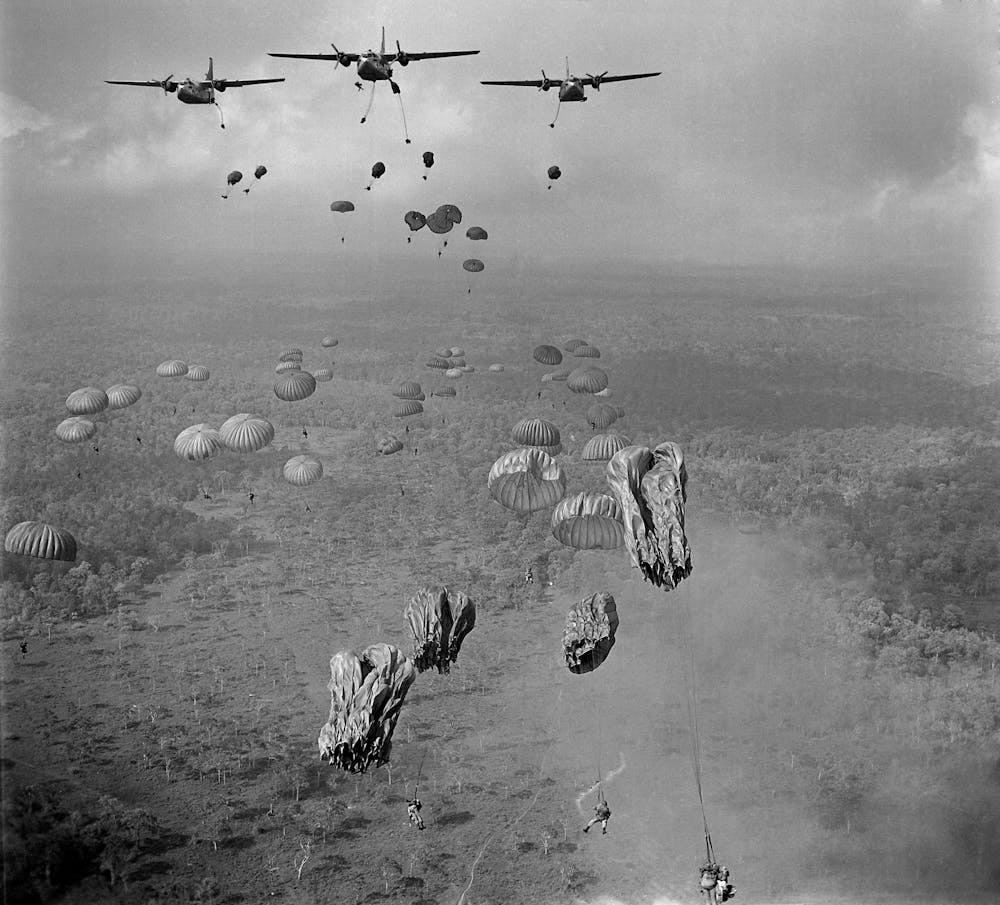
A black and white image of paratroopers jumping out of a plane.
US paratroopers carrying out a strike in the Tay Ninh province of South Vietnam in 1963.
Everett Collection/Shutterstock

“Central to President Putin’s claims is the fact that in his, or in the Russian leadership’s, world view Ukraine is not an authentic nation state that self-determination could legitimately apply to,” Thomas said.

“I don’t accept that. I don’t think most Western governments accept that. And therefore I do see this as, crudely put, imperial bullying with dreadful human consequences.”

Ukraine’s rare mineral reserves have been at the centre of the war, as a reason for both the Russian invasion, as well as the involvement of the United States as a self-styled peacemaker. Indeed, if there’s a consistent theme running through the history of colonialism it is this struggle over natural resources.

Another example is Newfoundland where, as Julia Laite, Professor of History at Birkbeck, University of London, explained, cod was another prized commodity of empire. This unfashionable but extremely profitable product provided, in its dried salted form, one of the main food sources for enslaved people working on plantations.

Laite revealed how Newfoundland — which became England’s “very first transatlantic colonial possession” in 1583 — was one of the earliest places “to experience the environmental cost of this avarice”.

It was also the site of one of the most “totalising destructions of an indigenous culture in British imperial history” with Laite explaining how indigenous culture of the Beothuk people was destroyed by the “particular brand of negligent extractive colonialism” practised in Newfoundland.

Julia Laite’s family has been on Newfoundland since 1635.

Laite told the story of Shanawdithit, the final known living member of the Beothuk, and how her artwork is the last remaining first-hand account of their history and culture.

“Shanawdithit’s story is also the story of these imperial entanglements, the violence and the greed that underwrote them, and the price that people and the planet paid.

“She single-handedly ensured the survivance – however fragile and slight – of an entire culture of people. She reminds us of what an act of hope it is to tell a story, even at the end of the world.”

The ISRF’s mission is to find new solutions to some of today’s most pressing social issues.

Few things seem more pressing than halting the bloodshed in Ukraine, Palestine and Sudan. But while peace currently seems unimaginable – the end of empire once seemed unimaginable, too.


Universal Impact offers specialist training, mentoring and research communication services – donating profits back to The Conversation UK, our parent charity. If you’re a researcher or research institution and you’re interested in working together, please get in touch – or subscribe to UI’s weekly newsletter to find out more. Universal Impact is a partner of the ISRF

The Conversation

ref. From oil to cod – ISRF event explores what yesterday’s empires reveal about today’s wars – https://theconversation.com/from-oil-to-cod-isrf-event-explores-what-yesterdays-empires-reveal-about-todays-wars-263072

Zelensky leaves Washington with Trump’s security guarantees, but are they enough?

Source: The Conversation – Global Perspectives – By Sonia Mycak, Research Fellow in Ukrainian Studies, Australian National University

The last time Ukrainian President Volodymyr Zelensky visited the White House earlier this year, he was berated by Donald Trump.

On Monday, he returned with European leaders by his side. He emerged with some signs of progress on a peace deal to end Russia’s war against Ukraine.

The presence of the European leaders no doubt had a great impact on the meeting. After Trump’s recent summit with Russian President Vladimir Putin in Alaska, they were concerned he was aligning the United States with the Russian position by supporting Putin’s maximalist demands.

We see from Trump’s statements over the last couple of months, the only pullback from his erratic pronouncements, largely based on Russian disinformation, seems to come when a body politic around him brings him back to a more realistic and informed position. So, this show of European unity was very important.

Security guarantees remain vital

There was considerable progress on one critical part of the negotiations: security guarantees for Ukraine.

It is significant that the US is to be involved in future security guarantees. It was not that long ago Trump was placing all the responsibility on Europe. So, this signals a positive development.

I listened to the briefing Zelensky gave outside the White House in Ukrainian for Ukrainian journalists. He explained it will take time to sort out the details of any future arrangement, as many countries would be involved in Ukraine’s future security guarantees, each with different capabilities to assist. Some would help Ukraine finance their security needs, others could provide military assistance.

Zelensky also emphasised that funding and assistance for the Ukrainian military will be a part of any future security arrangement. This would involve strategic partnerships in development and production, as well as procurement.

Zelensky made a point of this at a news conference in Brussels prior to Monday’s meeting. It is a priority for Ukraine to have a military strong enough to defend itself from future Russian attacks.

Reports also indicate the security guarantees would involve Ukraine buying around US$90 billion (A$138 billion) of US military equipment through its European allies. Zelensky also suggested the possibility of the US buying Ukrainian-made drones in the future.

According to NATO Secretary General Mark Rutte, there was also discussion about an Article 5-type security guarantee for Ukraine, referring to the part of the NATO treaty that enshrines the principle of collective defence for all members.

However, contrary to popular belief, NATO’s Article 5 does not actually commit members of the alliance to full military intervention if any one member is attacked. It allows NATO states to decide what type of support, if any, to provide. This would not be enough for Ukraine.

Ukraine has already seen the result of a failed security arrangement. In the
Budapest Memorandum of 1994, the United States, the United Kingdom and Russia guaranteed to respect Ukraine’s borders and territorial integrity in exchange for Ukraine giving up the third-largest nuclear arsenal in the world.

However, look what happened. Russia invaded in 2014 without any serious consequences, and then launched a full-scale invasion in 2022.

Given this, any future security guarantee for Ukraine will need to be rigorous. Ukrainians are very cognisant of this.

Loss of Ukrainian territory

Prior to his Alaska summit with Trump, I would have said Putin is not interested in any kind of deal. We saw how in previous meetings in Istanbul, Russia sent low-level delegations, not authorised to make any decisions at all.

However, I think the scenario has changed because, unfortunately, in Alaska, Trump aligned himself with Putin in supporting Russia’s maximalist demands. It’s highly likely Putin now believes he has an advocate for those demands in the White House.

This could mean Putin now perceives there is a realistic chance Russia could secure Donbas, the regions of Donetsk and Luhansk.

I don’t believe Ukraine would ever agree to any formal or legal recognition of a Russian annexation of Crimea or any of the other four regions that Russia now partly occupies – Donetsk, Luhansk, Kherson and Zaporizhzhia.

Zelensky has been adamant Ukraine would not cede territory to Russia in any peace deal. And he alone cannot make such a decision. Changing any borders would need a referendum and a change to the constitution. This would not be easy to do. For one thing, it’s a very unpopular move. And Ukrainians living in Russian-occupied territory would not be given a free and fair vote.


Putin’s war against Ukraine is an attempt at illegally appropriating very valuable land. In Alaska, he demanded Russia essentially be gifted the entire regions of Donetsk and Luhansk, including land not currently occupied by the Russian military.

This land has extensive Ukrainian military fortifications. Giving up this territory would leave Ukraine completely exposed to future Russian invasions – the country would effectively have no military protection along its eastern border regions. This would put Russia in a very advantageous position in future plans to regroup and attack again.

Even if Zelensky felt compelled to agree to some kind of temporary occupation and a frozen conflict along the current front lines, I don’t believe Ukraine could give up any land still under Ukrainian control.

In a recent Gallup poll, 69% of Ukrainians favoured a negotiated settlement to the war as soon as possible. In my view, this reflects the fact the United States, under the Trump administration, is proving to be an unreliable partner.

A settlement that rewards Russia for its genocidal war against Ukraine would set a very dangerous precedent, not only for the future of Ukraine but for Europe and the rest of the world.

At recent negotiations between the two sides in Istanbul, the head of the Russian delegation reportedly said “Russia is prepared to fight forever”.

That has not changed, no matter what niceties have occurred between Trump and Putin. They are prepared to continue to fight.

The Conversation

Sonia Mycak does not work for, consult, own shares in or receive funding from any company or organisation that would benefit from this article, and has disclosed no relevant affiliations beyond their academic appointment.

ref. Zelensky leaves Washington with Trump’s security guarantees, but are they enough? – https://theconversation.com/zelensky-leaves-washington-with-trumps-security-guarantees-but-are-they-enough-263423

‘There’s no such thing as someone else’s children’ – Omar El Akkad bears witness to the destruction of Gaza and the West’s quiet assent

Source: The Conversation – Global Perspectives – By Clare Corbould, Associate Professor of History and Associate Head (Research) of the School of Humanities and Social Sciences, Deakin University

Omar El Akkad does not want you to look away. An award-winning journalist and novelist, El Akkad was born in Egypt, lived as a teenager in Qatar and Canada, and migrated as an adult to the US, where he now lives with his family in the Pacific Northwest.

His essay collection, One Day, Everyone Will Have Always Been Against This, draws on his life, from childhood to new fatherhood. He combines these reflections with a sharp grasp of modern history to examine responses in the west to “the world’s first livestreamed genocide” in Gaza.

Finding that response wanting, he urges readers to watch, listen, reflect and act.


Review: One Day, Everyone Will Have Always Been Against This – Omar El Akkad (Text Publishing)


As someone whose parents migrated to the west for the freedoms and opportunities it would afford their children, El Akkad has an acute sense of the past events, ideas and structures that have shaped the present. He pays keen attention to the legacies of colonial rule.

Witnessing history

El Akkad’s descriptions of atrocity are not easy to read. Nor is his blunt demand to do something. Yet the force of his observations and the bite of his prose make it hard to turn away.

His purpose is akin to many famed witnesses in history. Contemporaneous statements about violence often serve later as testimony in determining what happened, who was responsible, and what recompense is due.

Think of George Orwell on propaganda in Spain. Or British journalists Gareth Jones and Malcolm Muggeridge exposing famine in 1930s USSR, while other western communists looked away. Or Victor Klemperer’s diaries, published after the war, which tracked how the Nazis twisted everyday speech.

Above all, this kind of testimony guards against future claims of innocence, against the reassuring assertion that “they didn’t know what was going on” or “they were of their time”.

Less well-known to Australian readers may be American journalist Ida B. Wells, but El Akkad’s fire and fury also brought her to mind. In the 1890s, Wells fiercely attacked lynching in her own newspaper, the Memphis Free Speech. She investigated specific instances of ritualised mob violence.

Wells also catalogued how news outlets told those stories. They minced words to protect the perpetrators, while smearing the reputations of the dead, who were always named.

El Akkad also pays close attention the way the violence in Gaza is framed and described. He observes how reporters use the passive voice, which not only hides the names of killers but implies mass death came about by accident or magic. “Palestinian Journalist Hit in Head by Bullet During Raid on Terror Suspect’s Home,” read one Guardian headline, he notes.

Both Wells and El Akkad show how victims of racist and colonial violence are cast as already guilty. With lynching, the pretext was often an accusation of rape, though that was rarely the actual spark. Far more common were disputes between men over land, pay, labour organising, business competition or voting drives.

In the case of Gaza, the media mimics the claims of Israeli politicians, its military and allies of both. They all cast civilians as terrorists or terrorists-in-waiting, even children. The words clean the consciences of onlookers. They launder harm as if it were cash.

Modes of resisting

As the book’s title, which began life as a viral tweet, goes: One Day, Everyone Will Have Always Been Against This.

Bearing witness to the atrocities and the gutless responses, El Akkad reminds liberal readers that if Gaza had happened in the past, they would condemn the violence. What’s more, they would imagine that, had they been alive at the time, they would have firmly resisted the wrong or even taken a heroic stance against it.

One blistering passage will hit very close to home for Australian readers:

I read an op-ed in which a writer argues that the model for Palestinian-Israeli coexistence is something like Canada’s present-day relationship with the Indigenous population, and I marvel at the casual, obvious, but unstated corollary: that there is an Indigenous population being colonized, but that we should let this unpleasantness run its course so we can arrive at true justice in the form of land acknowledgments at every Tel Aviv poetry reading.

As well as diagnosing the problem, El Akkad surveys and evaluates modes of resisting what is happening in Gaza. He discards as ineffective the old appeal to westerners’ self-interest. Pointing out that horrors they permit elsewhere will eventually come for them just doesn’t work.

His essays were written between the Hamas attack on Israel on October 7, 2023, and August 2024, when the US presidential campaign was in full swing. Much of his energy goes to addressing the “lesser of two evils” debate about voting in a democracy where the options are far right and, at most, centre-a-bit-left. Only from a relatively protected position, he observes, could one vote for the Democratic Party on the grounds that the other side “would be so much worse”.

Making this case, El Akkad says, rests on a quiet assent to mass death. He calls this a “reticent acceptance of genocide” and asks liberals in the United States (and by implication in other western democracies) to examine their consciences.

The remedying action El Akkad proposes is widespread negation, or “walking away”. People, en masse, must refuse to accept that the meagre promises of the less conservative political parties are the best options on offer.

This will require sacrifices. El Akkad provides examples of people he admires: the writer who refused a prize from an organisation that had been silent about Gaza; the teacher brave enough to talk with teenage students about the intolerable rate of children and civilians (not “noncombatants”) dying. Most starkly, he writes of Aaron Bushnell, the US Air Force veteran, whose last words before setting himself on fire outside the Israeli embassy in Washington D.C. were “free Palestine”.

Systematic violence

Like Wells, El Akkad links systematic violence to the structures that underpin the modern world. Chief among them is capitalism. Real change, he suggests, will come when enough of us, to use the old 1960s parlance, “drop out”, though he prefers “negation”, a word that that implies there is something to defy.

Omar El Akkad.
Text Publishing

It is time, he argues, for a well-educated western citizenry to say “enough”. Our phones are smart enough; we are (collectively) rich and sated enough.

It might be hard at first, but we will learn that “maybe it’s not all that much trouble to avoid ordering coffee and downloading apps and buying chocolate-flavored hummus from companies that abide slaughter”.

Doing so might just halt a genocide. In time, this kind of collective action might also stop other looming calamities, not least climate collapse. El Akkad’s steady focus throughout the book on the death, maiming and immeasurable psychic injury to the children of Gaza makes that case feel urgent.

If that sounds hyperbolic, El Akkad might ask what children you had in mind when you flinched from his diagnosis and prognosis. Your answer likely turns on the location, colour and wealth of the children you have in mind. Children in Tuvalu, for example, know he is not exaggerating.

In one of the book’s most arresting lines, El Akkad asks: “How does one finish the sentence: ‘It is unfortunate that tens of thousands of children are dead, but …’”

Better, he suggests, that we all behave in a way whose ethics is grounded in the claim: “there’s no such thing as someone else’s children.”


Omar El Akkad will be appearing at the Wheeler Centre, Melbourne, on October 22, 2025

The Conversation

Clare Corbould does not work for, consult, own shares in or receive funding from any company or organisation that would benefit from this article, and has disclosed no relevant affiliations beyond their academic appointment.

ref. ‘There’s no such thing as someone else’s children’ – Omar El Akkad bears witness to the destruction of Gaza and the West’s quiet assent – https://theconversation.com/theres-no-such-thing-as-someone-elses-children-omar-el-akkad-bears-witness-to-the-destruction-of-gaza-and-the-wests-quiet-assent-251615

Werewolf exes and billionaire CEOs: why cheesy short dramas are taking over our social media feeds

Source: The Conversation – Global Perspectives – By Wenjia Tang, Postdoctoral Research Associate in Digital Communication, University of Sydney

What can you do in 60 seconds? In short dramas, or “micro dramas”, that’s enough time for a billionaire CEO to fall in love with his contracted wife, or for a werewolf mafia boss to break a curse.

These vertically framed, minute-long serials are reshaping the way we consume screen entertainment.

ReelShort, NetShort and DramaBox are currently the leading short drama platforms. DramaBox has been downloaded more than 100 million times on Google Play, while ReelShort was ranked second on Apple’s top free entertainment apps at the time of writing, ahead of Netflix, HBO Max, Prime Video and Disney+.

Short dramas originated in China in the early 2020s through short video platforms such as Douyin (TikTok’s sister app) and Kuaishou (also known as Kwai).

The format has since expanded globally through both Chinese platforms and social media apps such as TikTok and Instagram. It reflects a growing trend in smartphone entertainment towards shorter, scrollable content.

Our new research, which involved interviewing 12 people in the short drama industry, shows it is creating much-needed job opportunities. At the same time, this industry is expanding faster than regulation can catch up – and that spells trouble.

Cliffhangers and outrageous storytelling

Short dramas are optimised for fragmented viewing via smartphones. The format blends TikTok’s fast-paced plotting style with recognisable screen genres. Think: a cheesy lifetime flick delivered in one-minute bursts. Most series have between 50 and 100 episodes.

Their appeal lies in dramatic storylines and cliffhangers. Each episode ends with a twist, designed to keep you hooked. This might be the revelation of a mysterious identity, or a tangled misunderstanding that is bound to lead to conflict. As ReelShort puts it: “every second is a drama”.

Let’s look at the hit series Playing by the Billionaire’s Rules as an example. Over 89 episodes, the series features a contract lover, million-dollar debts, an accidental pregnancy and a secret love triangle.

While it falls short of Hollywood standards of plot, dialogue and acting, it captures viewers’ attention through a conflict-ridden plot and provocative (sometimes amateurish) performances.

Playing by the Billionaire’s Rules is one of thousands of such series available online. In most cases, the first five to ten episodes are free, after which viewers must pay (usually right when the story is at its most thrilling).

A low-cost format, ripe for expansion

Despite illogical storytelling, crude production and exaggerated, stereotypical characters, short dramas are proving to be highly lucrative. In one 2023 article, The Economist described this “latest Chinese export to conquer America” as a hybrid of TikTok and Netflix.

Their popularity can also be linked to the COVID pandemic and the Hollywood writers’ strike, both of which slowed down the global screen industry.

Our research shows short drama production teams, which are mostly led by Chinese producers, have now expanded globally to the United States, Australia, eastern Europe and other parts of Asia, in search of new collaborative opportunities.

Los Angeles is emerging as the fastest-growing production hub. According to one LA Times article, short drama apps outside of China made US$1.2 billion (about A$1.8 billion) last year. Some 60% of this revenue came from the US.

Companies the world over are cashing in on the opportunity. Spanish-language media company TelevisaUnivision has started investing in the format, as has Ukrainian startup Holywater, which is using AI to generate almost fully synthetic short dramas.

Even the Hollywood giant Lionsgate has taken notice of short dramas, and is exploring their commercial potential.

It’s also possible short dramas will open the door for new players in the streaming wars. Although Netflix isn’t currently producing short dramas, it has started experimenting with the vertical short format (in the form of series and movie clips) on its mobile app.

Short dramas are also easily replicated across countries and various market conditions, and allow for localised content strategies. For example, the short drama Breaking the Ice reboots the Chinese campus romance template into a story centred on hockey players, making it more relatable for North American audiences.

Fantasy templates, such as those featuring werewolves, vampires, and witches, have also proven universally successful – and are often used by Chinese producers as low-risk, easily localised genres to test new markets.

Concerns behind the scenes

Our research finds the short drama industry is seen as a promising avenue for creating job opportunities, and for allowing actors and creators to get significant exposure on a modest budget.

But we’ve also found the industry to be far less regulated than more established screen industries.

There are growing concerns in the industry around labour exploitation and copyright infringement, as well as uncertainty over how sustainable the model will be in the long run.

One of our interviewees, a producer based in Los Angeles, revealed several concerning practices including problems with overtime work, stealing and recycling of drama scripts, underpayment of film school graduates, and a prevalence of unfair contracts for screenwriters.

The screenwriters we interviewed told us they hadn’t received proper credit for their work, and were bound by “buyout contracts” that excluded them from receiving additional compensation – even if their scripts garnered millions of views.

Earlier this year, the Media, Entertainment & Arts Alliance and Casting Guild of Australia issued a joint statement urging local actors to verify the credentials of any “vertical series” production teams before signing contracts with them.

Still, the short drama format continues to draw significant attention from across the screen industry. More than just a passing content trend, this may be the beginning of a structural shift in what “television” means: low-cost, easily replicated and recklessly fast-paced.

The Conversation

The authors do not work for, consult, own shares in or receive funding from any company or organisation that would benefit from this article, and have disclosed no relevant affiliations beyond their academic appointment.

ref. Werewolf exes and billionaire CEOs: why cheesy short dramas are taking over our social media feeds – https://theconversation.com/werewolf-exes-and-billionaire-ceos-why-cheesy-short-dramas-are-taking-over-our-social-media-feeds-259385

Alaska summit and its afterlife provides a glimpse into what peace looks like to Putin and Trump

Source: The Conversation – Global Perspectives – By Ronald Suny, Professor of History and Political Science, University of Michigan

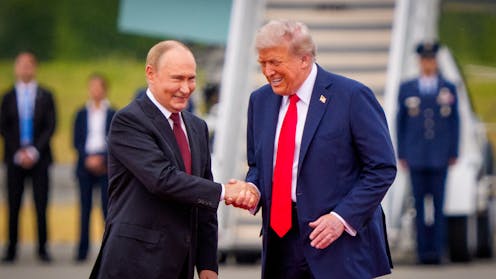
U.S. President Donald Trump greets Russian President Vladimir Putin in Anchorage, Alaska. Andrew Harnik/Getty Images

For all the pomp and staged drama of the summit between Presidents Donald Trump and Vladimir Putin in Alaska, the substantive part of the spectacle – that is, the negotiations between two great powers over the grinding war in Ukraine – did not at first appear to yield much. There was no deal and little detail on purported areas of progress.

The post-Alaska analysis, however, suggested the U.S. had shifted away from Ukraine’s position. Trump, it was reported, essentially agreed to Putin’s call for territorial concessions by Ukraine and for efforts toward a conclusive peace agreement over an immediate ceasefire – the latter opposed by Putin as Russia makes gains on the battlefield.

Those apparent concessions were enough to prompt alarm in the capitals of Europe. A hastily arranged follow-up meeting between Ukraine President Volodymyr Zelenskyy – and assorted European Union allies – and Trump in the White House on Aug. 18 yielded vague promises of security guarantees for Ukraine.

This is all very frustrating for those looking for some concrete foundations of a peace deal.

Yet, as a longtime scholar of Russian and Soviet history, I believe that the diplomatic whirl has revealed glimpses of what a future peace deal may look like. Or, more precisely, what it looks like for Putin and Trump.

It may be a bitter pill for Ukraine to swallow, but what it all suggests is a meeting of minds between the leaders of the two great powers involved: Russia and the United States. After all, as Trump told Fox News following the Alaska summit: “It’s good when two big powers get along, especially when they’re nuclear powers. We’re No. 1 and they’re No. 2 in the world.”

Known knowns and unknowns

Some of what we already knew remains unchanged. First, the European powers – notably Germany, France and the U.K. – remain fully supportive of Ukraine and are prepared to back Kyiv in resisting the Russian invasion and occupation.

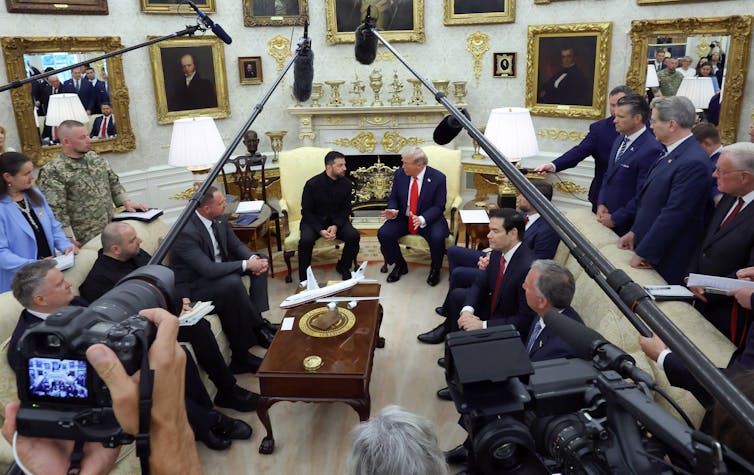
Second, Zelenskyy opposes concessions to Russia, at least publicly. Rather, Ukraine’s leader seemingly believes that with Western – and most importantly, American – arms, Ukraine can effectively resist Russia and secure a better end to the conflict than is evident at this moment. Meeting Trump again in the Oval Office after being ambushed by Trump and Vice President JD Vance in February, Zelenskyy was as deferential and grateful to the U.S. president as his more formal dress indicated.

Microphone booms and cameras frame two men sitting on chairs.
All eyes were on Presidents Donald Trump and Volodymyr Zelenskyy in the Oval Office on Aug. 18, 2025.
Anna Moneymaker/Getty Images

In contrast to Zelenskyy and the European powers, the aims and positions of the United States under Trump appear to be fluid. And while Putin talks of the need to address the “primary causes” of the Ukraine conflict and publicly pushes a maximalist position, it isn’t entirely clear what he will actually settle for in regard to the security and land arrangements he says he needs.

The imperial mindset

I would argue that there are two ways of interpreting the aims of both the United States and Russia: “imperial” and “hegemonic.” The former stems from an understanding of those countries’ long experience as empires. Countries that have descended from empires have memories of former greatness that many wish to repeat in the present.
And while there is nothing fatalistic about such imperial fantasies that translate the past into the present, they often echo in the repertoire of the influential and powerful.

There are signs in the rhetoric of both Trump and Putin of such grandiose imperial impulses. Both have talked of returning their country to a “great” past and have harbored desires of annexing or dominating other countries.

And many Western analysts of Russia are convinced that Putin dreams of becoming another Peter the Great, who expanded his empire into the Baltic region, or Catherine the Great, who sent her armies south into “New Russia” – that is, what is today Ukraine.

Hegemonic thinking

But there is also another way, short of empire, that explains how great powers act in the world: as hegemons, either regionally or globally.

Instead of the colonizing of other territories and peoples, hegemons act to dominate other countries economically and militarily – and perhaps ideologically and politically, as well. They do so without taking over the smaller country.

The United States, through its dominant position in NATO, is a hegemon whose sway is paramount among the members of the alliance – which can hardly operate effectively without the agreement of Washington.

Putin’s interests, I would contend, are short of fully imperial – which would require complete control of Ukraine’s domestic and foreign policy. But they are flagrantly hegemonic. In this reading, Putin may well be satisfied to get what the Soviets achieved in Finland during the Cold War: a compliant state that did not threaten Moscow, but remained independent in other ways.

Putin has such an arrangement with Belarus and might be satisfied with a Ukraine that’s not fully sovereign, militarily weak and outside of NATO. At the Alaska summit, Putin not only mentioned Ukraine as a “brotherly nation,” but also emphasized that “the situation in Ukraine has to do with fundamental threats to Russian security.”

One can read Putin’s words in many ways, but his public comments in Alaska framed the Ukraine conflict in Russian security terms, rather than in imperialist language.

Are negotiations possible?

The problem for Putin is that Russia does not have the economic and military power, or the reputational soft power attraction, to become a stable, influential hegemon in its neighborhood. Because it cannot achieve what the U.S. has accomplished through a mix of hard and soft power since the fall of the Soviet Union – that is, global hegemony – it has turned to physical force. That move has proved disastrous in terms of casualties, domestic economic distress, the mass migration of hundreds of thousands of Russians opposed to the war, and isolation from the global capitalist economy.

What Putin desires is something that shows to his people that the war was worth the sacrifices. And that may mean territorial expansion in the annexation of four contested provinces of Ukraine – Luhansk, Donetsk, Zaporizhzhia and Kherson – as well as Crimea, taken in 2014. That goal certainly seems imperial.

And while the distinctions between an imperial foreign policy and a hegemonic one may seem semantic or academic, they are crucial when looking at the prospects of peace. Imperialism is always about conquest and total subordination of one regime to another.

If indeed Putin is an imperialist who wants full control of Ukraine – or, as is often claimed, its elimination as a sovereign state and the recreation of a polity akin to the Soviet Union – then negotiation and compromise with Russia become impossible.

My sense is that to solidify his relations with Trump and his territorial gains in Ukraine, Putin will be satisfied with accepting the rest of Ukraine as a nation-state that remains outside of NATO and is neither a base for Western powers nor a perceived military threat to Russia.

The problem here, of course, is that such a solution may be unacceptable to Zelenskyy and would have to be imposed on Kyiv. That would be anathema to the major European powers, though not necessarily for Trump.

And here we find another obstacle to peace in Ukraine: Europe and the U.S. do not have a united position on the final solution to the war. Even if both accept the view that Russia’s aims are primarily about its own idea of security rather than conquest or elimination of Ukraine, would Europe accept Putin’s demands for a major overhaul of the military balance in east-central Europe.

Trump appears less concerned about the prospect of a truncated Ukraine subordinated to Russia. His major concerns seem to lie elsewhere, perhaps in the Nobel Peace Prize he covets. But the United States may have to guarantee the security of Ukraine against future Russian attacks, something that Trump has hinted at, even as he abhors the idea of sending American troops into foreign conflicts.

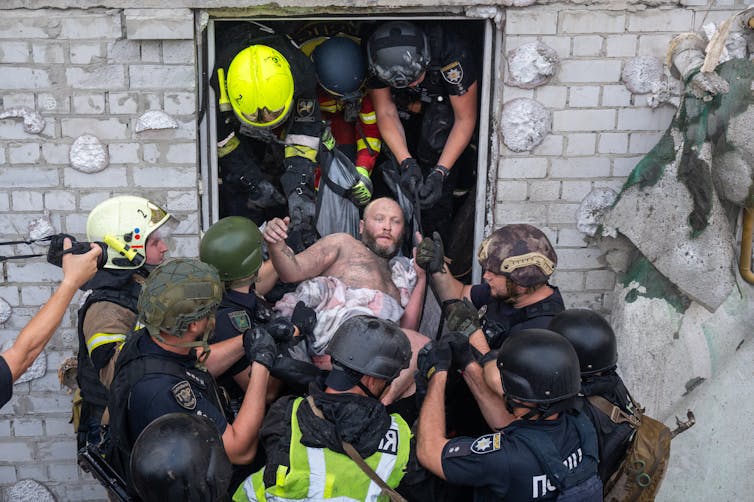
A man is carried out of a building by rescue workers.
While leaders talk peace, Russian drone strikes continue in Ukraine.
Serhii Masin/Anadolu via Getty Images

Realism at odds with a just peace

Wars have consequences, both for the victorious and the defeated. And the longer this war goes on, the more likely the grinding advance of Russia further into Ukraine becomes, given the military might of Russia and Trump’s ambivalent support of Ukraine.

With those realities in mind, the solution to the Russia-Ukraine war appears to be closer to what Russia is willing to accept than Ukraine. Ukraine, as Trump so brutally put it, does not have cards to play in this tragic game where great powers decide the fate of other countries.

We are back to Thucydides, the ancient Greek founder of political science, who wrote: “Right, as the world goes, is only in question between equals in power, while the strong do what they can and the weak suffer what they must.”

Not surprisingly, this is what international relations theorists call “realism.”

The Conversation

Ronald Suny does not work for, consult, own shares in or receive funding from any company or organization that would benefit from this article, and has disclosed no relevant affiliations beyond their academic appointment.

ref. Alaska summit and its afterlife provides a glimpse into what peace looks like to Putin and Trump – https://theconversation.com/alaska-summit-and-its-afterlife-provides-a-glimpse-into-what-peace-looks-like-to-putin-and-trump-263309

Generative AI is not a ‘calculator for words’. 5 reasons why this idea is misleading

Source: The Conversation – Global Perspectives – By Celeste Rodriguez Louro, Associate Professor, Chair of Linguistics and Director of Language Lab, The University of Western Australia

Vadishzainer / Getty / The Conversation

Last year I attended a panel on generative AI in education. In a memorable moment, one presenter asked: “What’s the big deal? Generative AI is like a calculator. It’s just a tool.”

The analogy is an increasingly common one. OpenAI chief executive Sam Altman himself has referred to ChatGPT as “a calculator for words” and compared comments on the new technology to reactions to the arrival of the calculator.

People said, ‘We’ve got to ban these because people will just cheat on their homework. If people don’t need to calculate a sine function by hand again […] then mathematical education is over.’

However, generative AI systems are not calculators. Treating them like calculators obscures what they are, what they do, and whom they serve. This easy analogy simplifies a controversial technology and ignores five crucial differences from technologies of the past.

1. Calculators do not hallucinate or persuade

Calculators compute functions from clearly defined inputs. You punch in 888 ÷ 8 and get one correct answer: 111.

This output is bounded and unchangeable. Calculators do not infer, guess, hallucinate or persuade.

They do not add add fake or unwanted elements to the answer. They do not fabricate legal cases or tell people to “please die”.

2. Calculators do not pose fundamental ethical dilemmas

Calculators don’t raise fundamental ethical dilemmas.

Making ChatGPT involved workers in Kenya sifting through irreversibly traumatising content for a dollar or two an hour, for example. Calculators didn’t need that.

After the financial crisis in Venezuela, an AI data-labelling company saw an opportunity to snap up cheap labour with exploitative employment models. Calculators didn’t need that, either.

Calculators didn’t require vast new power plants to be built, or compete with humans for water as AI data centres are doing in some of the driest parts of the world.

Calculators didn’t need new infrastructure to be built. The calculator industry didn’t see a huge mining push such as the one currently driving rapacious copper and lithium extraction as in the lands of the Atacameños in Chile.

3. Calculators do not undermine autonomy

Calculators did not have the potential to become an “autocomplete for life”. They never offered to make every decision for you, from what to eat and where to travel to when to kiss your date.

Calculators did not challenge our ability to think critically. Generative AI, however, has been shown to erode independent reasoning and increase “cognitive offloading”. Over time, reliance on these systems risks placing the power to make everyday decisions in the hands of opaque corporate systems.

4. Calculators do not have social and linguistic bias

Calculators do not reproduce the hierarchies of human language and culture. Generative AI, however, is trained on data that reflects centuries of unequal power relations, and its outputs mirror those inequities.

Language models inherit and reinforce the prestige of dominant linguistic forms, while sidelining or erasing less privileged ones.

Tools such as ChatGPT handle mainstream English, but routinely reword, mislabel, or erase other world Englishes.

While projects exist that attempt to tackle the exclusion of minoritised voices from technological development, generative AI’s bias for mainstream English is worryingly pronounced.

5. Calculators are not ‘everything machines’

Unlike calculators, language models don’t operate within a narrow domain such as mathematics. Instead they have the potential to entangle themselves in everything: perception, cognition, affect and interaction.

Language models can be “agents”, “companions”, “influencers”, “therapists”, and “boyfriends”. This is a key difference between generative AI and calculators.

While calculators help with arithmetic, generative AI may engage in both transactional and interactional functions. In one sitting, a chatbot can help you edit your novel, write up code for a new app, and provide a detailed psychological profile of someone you think you like.

Staying critical

The calculator analogy makes language models and so-called “copilots”, “tutors”, and “agents” sound harmless. It gives permission for uncritical adoption and suggests technology can fix all the challenges we face as a society.

It also perfectly suits the platforms that make and distribute generative AI systems. A neutral tool needs no accountability, no audits, no shared governance.

But as we have seen, generative AI is not like a calculator. It does not simply crunch numbers or produce bounded outputs.

Understanding what generative AI is really like requires rigorous critical thinking. The kind that equips us to confront the consequences of “moving fast and breaking things”. The kind that can help us decide whether the breakage is worth the cost.

The Conversation

Celeste Rodriguez Louro receives funding from the Australian Research Council and Google.

ref. Generative AI is not a ‘calculator for words’. 5 reasons why this idea is misleading – https://theconversation.com/generative-ai-is-not-a-calculator-for-words-5-reasons-why-this-idea-is-misleading-263323

Why are young men ‘T maxxing’ testosterone? Do they need it? And what are the risks?

Source: The Conversation – Global Perspectives – By Samuel Cornell, PhD Candidate in Public Health & Community Medicine, School of Population Health, UNSW Sydney

Carole Yepes/Getty

Videos promoting #testosteronemaxxing are racking up millions of views. Like “looksmaxxing” or “fibremaxxing” this trend takes something related to body image (improving your looks) or health (eating a lot of fibre) and pushes it to extreme levels.

Testosterone or “T” maxxing encourages young men – mostly teenage boys – to increase their testosterone levels, either naturally (for example, through diet) or by taking synthetic hormones.

Podcasters popular among young men, such as Joe Rogan and Andrew Huberman, enthusiastically promote it as a way to fight ageing, enhance performance or build strength.

However, taking testosterone when there’s no medical need has serious health risks. And the trend plays into the insecurities of young men and developing boys who want to be considered masculine and strong. This can leave them vulnerable to exploitation – and seriously affect their health.


Read more:
Get big or die trying: social media is driving men’s use of steroids. Here’s how to mitigate the risks


What is testosterone?

We all produce the sex hormone testosterone, but levels are naturally much higher in males. It’s produced mainly in the testes, and in much smaller amounts in the ovaries and adrenal glands.

Testosterone’s effects on the body are wide ranging, including helping you grow and repair muscle and bone, produce red blood cells and stabilise mood and libido.

During male puberty, testosterone production increases 30-fold and drives changes such as a deeper voice, developing facial hair and increasing muscle mass and sperm production.

It’s normal for testosterone levels to change across your lifetime, and even to fluctuate daily (usually at their highest in the morning).

Lifestyle factors such as diet, sleep and stress can also affect how much testosterone you produce.

Natural testosterone levels generally peak in early adulthood, around the mid-twenties. They then start to progressively decline with age.

A doctor can check hormone levels with a blood test. For males, healthy testosterone levels usually range between about 450 and 600 ng/dL (nanograms per decilitre of blood serum). Low testosterone is generally below 300 ng/dL.

Diagnosing low testosterone

In Australia, taking testosterone is only legal with a doctor’s prescription and ongoing supervision. The only way to diagnose low testosterone is via a blood test.

Testosterone may be prescribed to men diagnosed with hypogonadism, meaning the testes don’t produce enough testosterone.

This condition can lead to:

  • reduced muscle mass
  • increased body fat
  • lower bone density (increasing the risk of fracture)
  • low libido
  • erectile dysfunction
  • fatigue
  • depression
  • anaemia
  • difficulty concentrating.

Hypogonadism has even been linked to early death in men.

A manufactured panic about ‘low T’

Hypogonadism affects around one in 200 men, although estimates vary. It is more common among older men and those with diabetes or obesity.

Yet on social media, “low T” is being framed as an epidemic among young men. Influencers warn them to look for signs, such as not developing muscle mass or strength as quickly as hoped – or simply not looking “masculine”.

Extreme self-improvement and optimisation trends spread like wildfire online. They tap into common anxieties about masculinity, status and popularity.

Conflating “manliness” with testosterone levels and a muscular physical appearance exploits an insecurity ripe for marketing.

This has fuelled a market surge for “solutions” including private clinics offering “testosterone optimisation” packages, supplements claiming to increase testosterone levels and influencers on social media promoting extreme exercise and diet programs.

There is evidence some people are undergoing testosterone replacement therapy, even when they don’t have clinically low levels of testosterone.

What are the risks of testosterone replacement?

Taking testosterone as a medication can suppress the body’s own production, by shutting down the hypothalamic-pituitary-gonadal axis, which controls testosterone and sperm production.

While testosterone production can recover after you stop taking testosterone, this can be slow and is not guaranteed, particularly after long-term or unsupervised use. This means some men may feel a significant difference when they stop taking testosterone.

Testosterone therapy can also lead to side effects for some people, including acne and skin conditions, balding, reduced fertility and a high red blood cell count. It can also interact with some medications.

So there are added risks from using testosterone without a prescription and appropriate supervision.

On the black market, testosterone is sold in gyms, or online via encrypted messaging apps. These products can be contaminated, counterfeit or incorrectly dosed.

People taking these drugs without medical supervision face potential infection, organ damage, or even death, since contaminated or counterfeit products have been linked to toxic metal poisoning, heart attacks, strokes and fatal organ failure.

Harm reduction is key

T maxxing offers young men an enticing image: raise your testosterone, be more manly.

But for healthy young men without hypogonadism, the best ways to regulate hormones and development are healthy lifestyle choices. This includes sleeping and eating well and staying active.

To fight misinformation and empower men to make informed choices, we need to meet them where they are. This means recognising their drive for self-improvement without judgement while helping them understand the real risks of non-medical hormone use.

We also need to acknowledge that young men chasing T maxxing often mask deeper issues, such as body image anxiety, social pressure or mental health issues.

Young men often delay seeking help until they have a medical emergency.

If you’re worried about your testosterone levels, speak to your doctor.

The Conversation

Samuel Cornell receives funding from an Australian Government Research Training Program Scholarship.

Timothy Piatkowski receives funding from Queensland Mental Health Commission. He is affiliated with Queensland Injectors Voice for Advocacy and Action and The Loop Australia.

Luke Cox does not work for, consult, own shares in or receive funding from any company or organisation that would benefit from this article, and has disclosed no relevant affiliations beyond their academic appointment.

ref. Why are young men ‘T maxxing’ testosterone? Do they need it? And what are the risks? – https://theconversation.com/why-are-young-men-t-maxxing-testosterone-do-they-need-it-and-what-are-the-risks-263203

1 in 5 Bolivians spoiled their ballots – a sign of voter dissatisfaction as nation tips to the right

Source: The Conversation – Global Perspectives – By Mollie J. Cohen, Associate Professor of Political Science, Purdue University

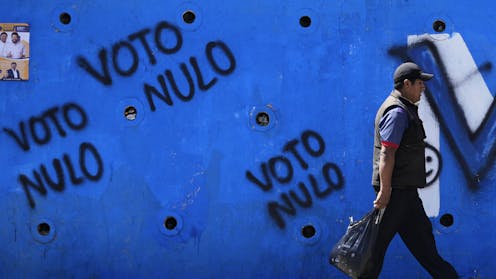
A pedestrian walks past graffiti promoting a null vote in the 2025 Bolivian presidential elections. AP Photo/Juan Karita

For the first time since the country’s return to democracy in 1982, Bolivia’s presidential election will go to a runoff after no candidate secured the required absolute majority in the first-round vote on Aug. 17, 2025.

The choice Bolivians now face means that the country is set to elect a non-left-wing candidate for the first time in a generation. In October, they will choose between the center-right Sen. Rodrigo Paz Pereira, who led the first round with approximately 32% of the valid vote, and former right-wing interim President Jorge “Tuto” Quiroga, who had close to 27%.

As many predicted, the left lost spectacularly, with the best-performing leftist candidate, Andrónico Rodríguez, winning only around 8% of the valid vote.

In fact, the left performed so poorly that its vote count was surpassed by invalid ballots. More than 19% of all ballots were spoiled and an additional 2.5% left blank. Indeed, the invalid vote roughly quadrupled compared to presidential elections between 2006 and 2020, when only about 5% of ballots were invalid.

Invalid votes are those that have been left unmarked – “blank” votes – or mismarked – “null” or “spoiled” votes – so that a voter’s intent is unclear. They are usually counted but excluded from official electoral math. But as I document in my 2024 book, “None of the Above,” blank and spoiled votes are also one of the most widely used tools of protest in Latin American democracies. Every year, millions of voters use the tactic to express their frustration with the candidates on the ballot, while at the same time demonstrating their commitment to democracy and elections.

In the case of Bolivia, I believe the rise in invalid votes is both a symptom of widespread dissatisfaction with the political and economic status quo and a signal of persistent, but not overwhelming, support for the divisive former president, Evo Morales.

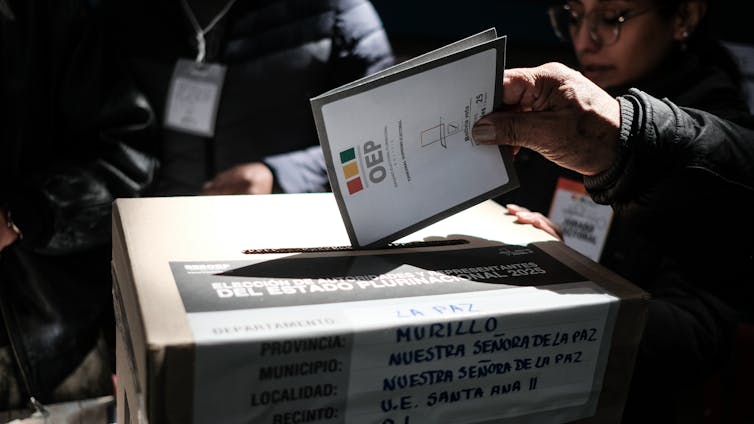
Someone puts in a ballot in a voting box.
A man in La Paz, Bolivia, casts his vote in the country’s presidential elections on Aug. 17, 2025.
Jorge Mateo Romay Salinas/Anadolu via Getty Images

Political and economic crisis

Bolivia’s presidential election took place as the country experiences dual economic and political crises. Like many of its neighbors, Bolivia experienced a commodity-driven economic boom at the beginning of the 21st century, fueled in this case by the export of lithium and natural gas. However, boom turned to bust in the 2010s as global commodity prices plunged. With its currency pegged to the U.S. dollar and a heavy reliance on gas exports, Bolivia’s economy suffered.

The country’s economic situation remains fraught. The national debt has ballooned to 95% of the size of its GDP in 2024. Meanwhile there are widespread fuel shortages; a decline in international currency reserves, meaning a likely further devaluation of the national currency; and a rising annual inflation rate that in July reached 24%.

Presidential candidates across the political spectrum promised economic austerity measures, like ending popular fuel subsidies.

This rightward shift also reflects growing divides among Bolivia’s political left, centered around Morales, a former labor leader and the first Indigenous president in a country where about half of the population is of native, non-European descent.

Morales’ 2006 victory was hailed at the time as a victory for Bolivian democracy. His government dramatically reduced the poverty rate, and expanded Bolivia’s middle class. However, critics contended that Morales also degraded democracy by, for example, stacking the courts and ignoring term limits. Morales’ time in office ended with allegations of fraud during the 2019 election, which he steadfastly denied. He fled the country soon after, returning in 2020 when his then-political ally and one-time protege Luis Arce assumed the presidency.

After seeing his popularity plummet during his term, Arce opted not to run this time around. Meanwhile, the coutry’s constitutional court, citing term limits, barred Morales from running for a fourth term as president. However, he continues to be a force in Bolivian politics. Recently, infighting between Morales, Arce and left-wing presidential candidates contributed to the inability to pass legislation meant to fix the current economic crisis.

These intraparty fights split the Bolivian left, leaving Morales supporters without a viable candidate.

Shut out, Morales campaigns for a null vote

In late July, the former president began actively campaigning for the invalid vote.

Campaigns promoting the blank or spoiled vote in presidential elections are not uncommon, with similar movements occurring in more than 30% of Latin American presidential elections during the 2010s. Indeed, nearly every country in the region has experienced at least one invalid vote campaign during a presidential election since 1980.

And as I found in the course of my research, most null vote campaigns self-consciously promote democratic values. Campaigners protest the persistent underperformance of democratic politics, ongoing corruption by high-ranking politicians or blatant efforts to rig elections.

Bolivia’s 2025 invalid vote campaign in some ways echoes those previous efforts. In Morales’ telling, Bolivia’s term limits curtailed his fundamental right to run for office and his supporters’ right to select their preferred candidate. Widespread ballot spoiling would be a way to send a strong message to those currently in power to allow Morales to run.

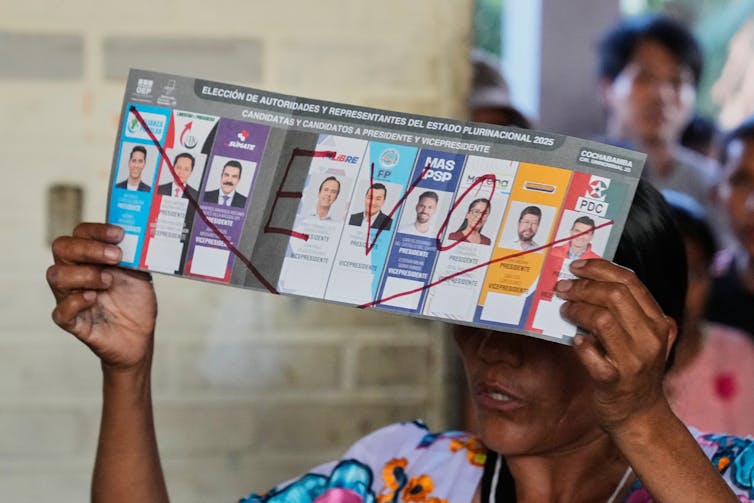
A person holds up a candidate list.
An electoral official shows a null vote that has ‘Evo’ — referring to former President Evo Morales, who is barred from running — written on it, as they count votes after polls closed for general elections.
AP Photo/Jorge Saenz

But Morales’ campaign also faced challenges that often undo invalid vote campaigns. Such campaigns are generally unpopular with the public, and are even less popular when they are led by politicians who would benefit personally from an increase in the invalid vote. Morales was just such a candidate. Increased invalid vote rates would show his ability to sway the public and increase his political influence, something he appeared to acknowledge when declaring at a recent rally that he would have “won the elections” if the null vote reached 25%.

In this way, Morales is different from most null vote campaigners. He has been the central figure in Bolivian politics for nearly 20 years. He has a track record of both strong economic performance and of undermining Bolivian democracy and the rule of law. It is a testament to his popularity and influence that nearly 1 in 5 Bolivians spoiled their ballots.

The health of Bolivian democracy

Still, it would be a mistake to conclude that the increase in spoiled ballots signals overwhelming support for Morales, as he contends. Pre-election polling showed that Bolivians intended to cast invalid votes at a higher rate well before Morales began his campaign. Rather, Morales’s campaign likely harnessed existing anti-candidate sentiment, while leaching support from left-wing alternatives.

Additionally, while the spoiled vote rate was quite high, Morales did not achieve his goals: The null vote did not “beat” the runoff candidates, nor did it reach 25% of the vote. While Morales has staked a strong claim that the Bolivian public “voted but did not choose,” this argument is belied by the results: Most Bolivians did select a candidate, and a majority of them voted for a candidate from the political right. By that metric, Morales does not retain majoritarian support in Bolivia.

But neither should the relatively high number of invalid ballots be ignored. Over 1 million Bolivians used their ballots to send a message to politicians. Those leaders now have an opportunity to respond by working to restore trust with these voters.

Whoever wins the runoff in October 2025, Bolivian society will likely continue to be plagued by the social, political and economic divisions that have been present for years.

Indeed, the high rate of spoiled votes suggests that citizens are dissatisfied with their democratic choices. And those charged with protecting Bolivia’s democracy might well be advised to heed this signal.

The Conversation

Mollie J. Cohen does not work for, consult, own shares in or receive funding from any company or organization that would benefit from this article, and has disclosed no relevant affiliations beyond their academic appointment.

ref. 1 in 5 Bolivians spoiled their ballots – a sign of voter dissatisfaction as nation tips to the right – https://theconversation.com/1-in-5-bolivians-spoiled-their-ballots-a-sign-of-voter-dissatisfaction-as-nation-tips-to-the-right-263166

How Trump’s separate meetings with Putin and Zelenskyy have advanced Russian interests

Source: The Conversation – Canada – By James Horncastle, Assistant Professor and Edward and Emily McWhinney Professor in International Relations, Simon Fraser University

The current phase of the war in Ukraine continues unabated into its fourth year, with grinding offences and strikes against civilian infrastructure increasingly the norm.

It is, for Ukraine, arguably the most vulnerable that it has been since 2022.

These developments have prompted calls among world leaders to end the conflict. On the surface, United States President Donald Trump’s meetings with both the Ukrainian and Russian leaders suggests a balanced approach. In reality, however, Trump’s actions primarily benefit Russia.

The Alaska summit

After the recent meeting with Russian President Vladimir Putin in Alaska, Trump declared that their summit had been “very useful.” When asked how he would rate the meeting on a scale of one to 10, the president declared the meeting “was a 10 in the sense we got along great.”

While Trump and Putin may have hit it off, the issue with such an assessment is that it failed to address the underlying reason for the meeting: Russia’s invasion of Ukraine. In this regard, the meeting was far more useful for Putin and Russia than Ukraine and its allies.

Putin managed to stoke tensions, and potentially divisions, among Ukraine’s principal supporters by not including Ukraine in the summit. No other countries participated in the summit.

This format caused considerable consternation in Ukraine, where it was feared that Trump would make an agreement without Ukrainian consent, as well as in Europe, where Russian aggression and revisionism is a more direct threat.

Prior to Trump assuming power for a second time in 2025, Ukraine benefited from a largely united front among NATO and the European Union. This unity has declined over the last several months, and the Alaska summit reinforced this decline to Russia’s benefit.

Ceasefire demand evaporated

Putin and his negotiators managed to obtain a major concession from Trump at the summit as Trump renounced his own recent calls for a ceasefire.

For Ukraine and its allies, achieving a ceasefire was a fundamental requirement for any peace negotiations in 2025. This precondition has become more significant as Russia ramps up its attacks on Ukrainian cities and civilians.

Lastly, the very nature of the Alaska meeting itself helped legitimize Russia in international opinion.

Since its full-scale invasion of Ukraine in 2022, Russia has courted international opinion. It’s been more successful than most people in Europe and North America realize as significant portions of Asia, Africa and Latin America remain ambivalent or even support Russia in its war against Ukraine.

Nonetheless, Russia was always restrained by the condemnation it’s received from multiple international organizations, most notably the United Nations and the International Criminal Court.

Trump welcoming Putin on American soil, when the Russian leader is under what amounts to a de facto travel ban by the International Criminal Court, undermines these institutions’ condemnations.

Zelenskyy’s visit to Washington

The benefits that Putin obtained from Trump in Alaska demanded an immediate response by Ukraine. President Volodymyr Zelenskyy promptly arranged a White House meeting with Trump in the aftermath of the Alaskan summit. And he didn’t arrive alone: European leaders accompanied him to show solidarity with Ukraine.

Secretary of State Marco Rubio insisted the European leaders weren’t on hand to prevent Trump from bullying Zelenskyy, as occurred during their last Oval Office meeting.


Read more:
What the U.S. ceasefire proposal means for Ukraine, Russia, Europe – and Donald Trump


That’s probably only partly true. Several European leaders — ranging from the president of the European Commission, Ursula von der Leyen, to French President Emmanuel Macron — almost assuredly accompanied Zelenskyy to prevent Trump from forcing the Ukrainian leader into concessions that are detrimental to their interests as well.

Trump’s pre-meeting social media post undoubtedly heightened their concerns. In the post, he placed the burden of peace on Zelenskyy and argued that Ukraine must accept the loss of Crimea and never accede to NATO.

Carefully orchestrated

Ukrainian officials sought to carefully orchestrate Zelenskyy’s one-on-one Oval Office meeting with Trump. Zelenskyy wore a suit and delivered a letter from the Ukrainian first lady to Melania Trump.

These and other efforts aimed to stroke Trump’s ego, and the president’s response — in particular agreeing with a reporter that Zelenskyy “look(ed) fabulous” in a suit — suggests it was a success. The same American reporter criticized Zelenskyy for failing to don a suit during his ill-fated February White House visit.

Notably, Trump did not rule out a role for American soldiers in helping to maintain peace in Ukraine during the meeting. Outside observers believe an American presence in Ukraine to maintain any eventual peace is a fundamental requirement for its success.

Unfortunately, while Trump did not immediately oppose the idea, he did not make any firm commitment either. Trump’s propensity to reverse course on statements that he makes in the moment, furthermore, undermines any firm takeaways from the meeting.

Hope versus reality

Any direct American involvement in Ukraine would also undermine his support among his political base. One of Trump’s key campaign promises was not to involve the U.S. in “endless foreign wars.”

A move by Trump to deploy American soldiers to Ukraine would be politically tenuous, as fractures are already emerging among his political base over his handling of the Jeffrey Epstein files.


Read more:
Trump’s changing stance on Epstein files is testing the loyalty of his Maga base


Trump’s cordial meetings with Zelenskyy and European leaders may fuel hope among Ukraine’s supporters in the coming days. But any optimism should be tempered by the damage done by Trump’s meeting with Putin. Trump reportedly interrupted the meetings in Washington to call Putin.

Trump’s unwillingness to make firm commitments at the meetings with Zelenskyy and European leaders means that Russia, on the balance, has succeeded in advancing its interests to the detriment of Ukraine and the prospects for a long-term, sustainable peace.

The Conversation

James Horncastle does not work for, consult, own shares in or receive funding from any company or organisation that would benefit from this article, and has disclosed no relevant affiliations beyond their academic appointment.

ref. How Trump’s separate meetings with Putin and Zelenskyy have advanced Russian interests – https://theconversation.com/how-trumps-separate-meetings-with-putin-and-zelenskyy-have-advanced-russian-interests-263372

Air Canada flight attendant ‘unlawful’ strike exposes major fault lines in Canadian labour law

Source: The Conversation – Canada – By Gerard Di Trolio, PhD candidate, Labour Studies, McMaster University

Air Canada flight attendants say they will continue to defy a government back-to-work order after the federal labour relations board declared the strike “unlawful.” The walkout, which began early on Aug. 16, grounded hundreds of flights and left passengers stranded.

Less than 12 hours into the strike, the federal government intervened in the dispute between Air Canada and the union representing its flight attendants. Minister of Jobs and Families Patty Hajdu invoked Section 107 of the Canada Labour Code to impose binding arbitration and order employees back to work.

The Canadian Union of Public Employees (CUPE) condemned the move, accusing the government of “crushing flight attendants’ Charter rights.”


Read more:
Air Canada flight attendants have issued a strike notice: Here’s what you need to know


Air Canada reportedly encouraged the government to intervene, while CUPE pushed for a negotiated solution, arguing binding arbitration would ease pressure on the airline to negotiate fairly.

After a Sunday hearing, the Canada Industrial Relations Board released an order reiterating flight attendants should “cease all activities that declare or authorize an unlawful strike of its members” and “resume the performance of their duties.”

As an expert in unions and the politics of labour, I see this dispute as highlighting several fault lines in Canada around work, how we value it and the ways the law affects workers.

Mark Carney’s labour dilemma

Prime Minister Mark Carney currently faces the first labour crisis of his term. Carney had worked alongside labour leaders in the face of United States President Donald Trump’s tariff threats, even appointing Lana Payne, president of the Unifor trade union, to the new Canada-U.S. Relations Council.

The federal government’s decision to invoke Section 107 to send Air Canada and its flight attendants to arbitration continues a growing trend of its increasing use.

Section 107 has been part of the Canada Labour Code since 1984. It was rarely used for decades, but became more common last year when Justin Trudeau’s government invoked it several times to end work stoppages at ports, rail yards and Canada Post.

This is part of a longer history. Dating back to the 1970s, federal and provincial governments started interfering with free and fair collective bargaining through back-to-work legislation or by imposing contracts on public sector workers.

What has changed in recent decades is the federal government’s growing creep into the private sector. Under Stephen Harper’s Conservative government, there were increasing threats to use back-to-work legislation, targeting CN Rail, CP Rail and Air Canada. These interventions were justified as protecting an economy emerging from a global financial crisis. The Harper government followed through with back-to-work legislation in the Air Canada and CP Rail cases.

If the Carney government continues to use back-to-work legislation, it could alienate unions that once saw him as a potential ally. Yet the public may be more receptive to it, given the country’s economic weakness and continued Trump threats.

The Air Canada strike could effect the trajectory not only of the government, but also the labour movement as well. It’s a strike that has major consequences for all workers in Canada, and its outcome will signal to workers across the country what they can expect in these uncertain times.

Defying the law is rare

CUPE’s decision to defy the Canadian government’s use of Section 107 of the Canada Labour Code comes with big risks but also potential victories.

A union or workers defying the law is hardly unprecedented, but is increasingly rare in an era where unions have been in an overall decline in Canada and globally.

The risks are significant for workers: heavy fines, termination of employment or even jail time for flight attendants and union officials.

If CUPE is successful, it would have a galvanizing effect, sending a message to workers across the country that they can stand up not only to their bosses, but to the state, in order to improve their labour circumstances.

However, for any kind of unlawful strike to be successful, there must be an incredible amount of unity among the workers. While CUPE leadership and the Canadian labour movement are strongly supportive of continuing the strike, rank-and-file flight attendants must be willing to stand their ground.

Even in a legal strike, unions only take the step of stopping work if they have an overwhelming amount of the membership on board. That need for solidarity is even greater for illegal action.

The reason why Canada has laws allowing unions, workplace safety and strikes is because of industrial militancy that often defied the law to force governments to enact legislation allowing for unions and strikes.

The flight attendant strike could be a barometer of increased labour organizing and action experienced across Canada since the COVID-19 pandemic, and whether that momentum for the labour movement can continue.

Work and gender

Another key issue at the heart of the strike is the gender wage gap, which continues to be an issue in Canada. While it has narrowed during this century, women in Canada still earn on average 12 per cent less than men. This gap is even wider for women who are newcomers, Indigenous, transgender or living with disabilities.

This disparity is closely tied to sectors where women are overrepresented, such as flight attendants, a workforce overwhelmingly made up of women. Across the Canadian workforce, 56 per cent of women are employed in the “5 Cs”: caring, clerical, catering, cashiering and cleaning. These occupations tend to be precarious and underpaid.

While airlines are part of transportation, the work that flight attendants perform is unmistakably service-based and covers much of the 5 Cs, including emotional labour and customer care.

For Air Canada flight attendants, the situation is compounded by the fact they are paid only while the plane is in motion, meaning they often perform unpaid work.

The gender dynamics become even clearer when comparing the treatment of flight attendants with that of Air Canada pilots.

In 2024, Air Canada pilots — who are mostly men — won a 26 per cent wage increase in the first year of their new contract and a 42 per cent increase overall. Air Canada’s most recent offer to its flight attendants was only an eight per cent increase in year one and 38 per cent overall.

“Air Canada’s male-dominated workforce received a significant cost-of-living wage increase. Why not the flight attendants, who are 70 per cent women?” Natasha Stea, president of the CUPE division that represents the Air Canada flight attendants, said in an Aug. 15 CUPE article.

In this context, the Air Canada strike is also a spotlight on systemic gender inequality, the undervaluing of service work and the fight for fair compensation in occupations dominated by women.

The Conversation

Gerard Di Trolio is a member of CUPE 3906 as a teaching assistant and sessional instructor at McMaster University.

ref. Air Canada flight attendant ‘unlawful’ strike exposes major fault lines in Canadian labour law – https://theconversation.com/air-canada-flight-attendant-unlawful-strike-exposes-major-fault-lines-in-canadian-labour-law-263325