Trump-Putin summit: Veteran diplomat explains why putting peace deal before ceasefire wouldn’t end Russia-Ukraine war

Source: The Conversation – USA – By Donald Heflin, Executive Director of the Edward R. Murrow Center and Senior Fellow of Diplomatic Practice, The Fletcher School, Tufts University

U.S. President Donald Trump (R) and Russian President Vladimir Putin leave at the conclusion of a press conference on Aug. 15, 2025 in Alaska. Andrew Harnik/Getty Images

If you’re confused about the aims, conduct and outcome of the summit meeting between U.S. President Donald Trump and Russian leader Vladimir Putin held in Anchorage, Alaska, on August 15, 2025, you’re probably not alone.

As summits go, the meeting broke with many conventions of diplomacy: It was last-minute, it appeared to ignore longstanding protocol and accounts of what happened were conflicting in the days after the early termination of the event.

The Conversation U.S.’s politics editor Naomi Schalit interviewed Donald Heflin, a veteran diplomat now teaching at Tufts University’s Fletcher School, to help untangle what happened and what could happen next.

It was a hastily planned summit. Trump said they’d accomplish things that they didn’t seem to accomplish. Where do things stand now?

It didn’t surprise me or any experienced diplomat that there wasn’t a concrete result from the summit.

First, the two parties, Russia and Ukraine, weren’t asking to come to the peace table. Neither one of them is ready yet, apparently. Second, the process was flawed. It wasn’t prepared well enough in advance, at the secretary of state and foreign minister level. It wasn’t prepared at the staff level.

What was a bit of a surprise was the last couple days before the summit, the White House started sending out what I thought were kind of realistic signals. They said, “Hopefully we’ll get a ceasefire and then a second set of talks a few weeks in the future, and that’ll be the real set of talks.”

Two men in dark clothes hugging each other.
UK Prime Minister Keir Starmer, here embracing Ukrainian President Volodymyr Zelenskyy in London on Aug. 14, 2025, is one of many European leaders voicing strong support for Ukraine and Zelenskyy.
Jordan Pettitt/PA Images via Getty Images

Now, that’s kind of reasonable. That could have happened. That was not a terrible plan. The problem was it didn’t happen. And we don’t know exactly why it didn’t happen.

Reading between the lines, there were a couple problems. The first is the Russians, again, just weren’t ready to do this, and they said, “No ceasefire. We want to go straight to permanent peace talks.”

Ukraine doesn’t want that, and neither do its European allies. Why?

When you do a ceasefire, what normally happens is you leave the warring parties in possession of whatever land their military holds right now. That’s just part of the deal. You don’t go into a 60- or 90-day ceasefire and say everybody’s got to pull back to where they were four years ago.

But if you go to a permanent peace plan, which Putin wants, you’ve got to decide that people are going to pull back, right? So that’s problem number one.

Problem number two is it’s clear that Putin is insisting on keeping some of the territory that his troops seized in 2014 and 2022. That’s just a non-starter for the Ukrainians.

Is Putin doing that because that really is his bottom line demand, or did he want to blow up these peace talks, and that was a good way to blow them up? It could be either or both.

Russia has made it clear that it wants to keep parts of Ukraine, based on history and ethnic makeup.

The problem is, the world community has made it clear for decades and decades and decades, you don’t get what you want by invading the country next door.

Remember in Gulf War I, when Saddam Hussein invaded and swallowed Kuwait and made it the 19th province of Iraq? The U.S. and Europe went in there and kicked him out. Then there are also examples where the U.S. and Europe have told countries, “Don’t do this. You do this, it’s going to be bad for you.”

So if Russia learns that it can invade Ukraine and seize territory and be allowed to keep it, what’s to keep them from doing it to some other country? What’s to keep some other country from doing it?

You mean the whole world is watching.

Yes. And the other thing the world is watching is the U.S. gave security guarantees to Ukraine in 1994 when they gave up the nuclear weapons they held, as did Europe. The U.S. has, both diplomatically and in terms of arms, supported Ukraine during this war. If the U.S. lets them down, what kind of message does that send about how reliable a partner the U.S. is?

The U.S. has this whole other thing going on the other side of the world where the country is confronting China on various levels. What if the U.S. sends a signal to the Taiwanese, “Hey, you better make the best deal you can with China, because we’re not going to back your play.”

Police dressed in combat gear help an old woman across rubble left after a bombing.
Ukrainian police officers evacuate a resident from a residential building in Bilozerske following an airstrike by Russian invading forces on Aug. 17, 2025.
Pierre Crom/Getty Images

At least six European leaders are coming to Washington along with Zelenskyy. What does that tell you?

They’re presenting a united front to Trump and Secretary of State Marco Rubio to say, “Look, we can’t have this. Europe’s composed of a bunch of countries. If we get in the situation where one country invades the other and gets to keep the land they took, we can’t have it.”

President Trump had talked to all of them before the summit, and they probably came away with a strong impression that the U.S. was going for a ceasefire. And then, that didn’t happen.

Instead, Trump took Putin’s position of going straight to peace talks, no ceasefire.

I don’t think they liked it. I think they’re coming in to say to him, “No, we have to go to ceasefire first. Then talks and, PS, taking territory and keeping it is terrible precedent. What’s to keep Russia from just storming into the three Baltic states – Estonia, Latvia, and Lithuania – next? The maps of Europe that were drawn 100 years ago have held. If we’re going to let Russia erase a bunch of the borders on the map and incorporate parts, it could really be chaotic.”

Where do you see things going?

Until and unless you hear there’s a ceasefire, nothing’s really happened and the parties are continuing to fight and kill.

What I would look for after the Monday meetings is, does Trump stick to his guns post-Alaska and say, “No, we’re gonna have a big, comprehensive peace agreement, and land for peace is on the table.”

Or does he kind of swing back towards the European point of view and say, “I really think the first thing we got to have is a ceasefire”?

Even critics of Trump need to acknowledge that he’s never been a warmonger. He doesn’t like war. He thinks it’s too chaotic. He can’t control it. No telling what will happen at the other end of war. I think he sincerely wants for the shooting and the killing to stop above all else.

The way you do that is a ceasefire. You have two parties say, “Look, we still hate each other. We still have this really important issue of who controls these territories, but we both agree it’s in our best interest to stop the fighting for 60, 90 days while we work on this.”

If you don’t hear that coming out of the White House into the Monday meetings, this isn’t going anywhere.

There are thousands of Ukrainian children who have been taken by Russia – essentially kidnapped. Does that enter into any of these negotiations?

It should. It was a terror tactic.

This could be a place where you can make progress. If Putin said, well, “We still don’t want to give you any land, but, yeah, these kids here, you can have them back,” it’s the kind of thing you throw on the table to show that you’re not a bad guy and you are kind of serious about these talks.

Whether they’ll do that or not, I don’t know. It’s really a tragic story.

The Conversation

Donald Heflin does not work for, consult, own shares in or receive funding from any company or organization that would benefit from this article, and has disclosed no relevant affiliations beyond their academic appointment.

ref. Trump-Putin summit: Veteran diplomat explains why putting peace deal before ceasefire wouldn’t end Russia-Ukraine war – https://theconversation.com/trump-putin-summit-veteran-diplomat-explains-why-putting-peace-deal-before-ceasefire-wouldnt-end-russia-ukraine-war-263314


Cop30: the accommodation crisis plaguing Brazil’s upcoming UN climate summit

Source: The Conversation – UK – By Bruno Soeiro Vieira, Professor Adjunto, Universidade Federal do Pará (UFPA)

Cop30, the UN climate summit scheduled to take place this November in the Brazilian city of Belém, is embroiled in a controversy that has nothing to do with solving the planet’s environmental problems. Currently occupying debate about the conference is what Brazil’s press is calling the “hosting crisis”.

André Corrêa do Lago, president of Cop30, said that countries have been pressurising Brazil to move the UN climate conference from Belém to another city because of the “exorbitant prices” being charged for hotels. Some governments have even considered not taking part in the conference or reducing their delegations. But the Brazilian government has dismissed this possibility.

How did this happen? A very low number of available beds, the raising of room rates to a premium by hotel chains, and historical prejudice have all led to the perfect storm of the current crisis.

At the end of the 17th century, Belém had three times as many inhabitants as São Paulo. The state capital of Pará was also one of the first cities in the country to have public energy, powered by gas. The city was also experiencing the first rubber extraction boom.

But with the subsequent decline of rubber, Belém and other cities in the Amazon lost their prominence. Today Belém is a city of the developing world which, like many others, including Baku in Azerbaijan which hosted the Cop29 summit last year, faces a host of infrastructure problems.

In addition to the obvious lack of urban infrastructure which generates and deepens social inequalities, there are other problems. The hotel network is too small to accommodate a demand for more than 50,000 beds, the amount of people expected for Cop30.

The problem has been cascading, but it all started with the city’s hotel chains. From the start of the year, hotels began to increase the prices of accommodation, and raise prices even higher for the period of the event.

The problems with lack of affordable hotel accommodation and the state of the city’s infrastructure are of great concern. But any public and media discussion of the issues tends to end up belittling the city and the entire Amazon region, revealing an internal colonialism that has always existed in Brazil.

Behind the criticism of infrastructure and hotel prices often lies an enduring and historic prejudice that assumes that an Amazonian city could never host an event of this size and importance.

Possible solutions

It could be argued that there has been a historical inertia, or even lack of oversight on the part of national and state governments for not having foreseen these issues and taking steps to pre-empt them.

In the short term, price regulation is necessary, which the state can’t impose because it lacks the legal authorisation to do so. The consumer secretariat even requested that hotels provide information on room rates. But this request was ignored, with chains claiming that this is a market issue, a view endorsed by the Brazilian Hotel Association.

The federal Brazilian government has responded by bringing two ocean liners to the city, which will provide around 6,000 beds. The government has also created an online accommodation platform which will make 2,500 rooms available.

There are other options available. The UN could, for example, offer a greater subsidy to delegations from developing countries, in order to guarantee a greater number of participants. Accommodating delegates in neighbouring cities is another alternative.

With time running out, there is a risk that the event won’t be attended as well as it is hoped. And the presence of the largest number of countries and delegates at Cop30 is fundamental to legitimise the decisions that will be taken.

The people of Pará are hospitable and enjoy receiving visitors, and the area is rich in culture, architecture and cuisine. This is not a time for greed, but for welcoming people and showing them the city, its way of life and what the Amazon needs. After all, the people who understand the Amazon best are the Amazonians.


Don’t have time to read about climate change as much as you’d like?

Get a weekly roundup in your inbox instead. Every Wednesday, The Conversation’s environment editor writes Imagine, a short email that goes a little deeper into just one climate issue. Join the 45,000+ readers who’ve subscribed so far.


The Conversation

Bruno Soeiro Vieira does not work for, consult, own shares in or receive funding from any company or organisation that would benefit from this article, and has disclosed no relevant affiliations beyond their academic appointment.

ref. Cop30: the accommodation crisis plaguing Brazil’s upcoming UN climate summit – https://theconversation.com/cop30-the-accommodation-crisis-plaguing-brazils-upcoming-un-climate-summit-263165

In Jane Austen’s Persuasion, respite is a key ingredient for romance

Source: The Conversation – UK – By Barbara Cooke, Programme Leader and Senior Lecturer in English, Loughborough University

It’s that time of year again. Flight costs are up, schools are out, and anyone lucky enough to afford a break is heading – literally or metaphorically – for the hills. Some might harbour visions of a beautiful stranger alone in a beach or bar, someone who takes a keen interest in them, gives them the best two weeks of their lives then disappears into the sunset. This is probably what most of us imagine when we think of a holiday romance: something magical and fleeting, but removed from everyday life.

One writer, however, proved in novel after novel that a change of scene can also inspire a lasting change of mind. It might shake the blinkered out of an unhelpful way of seeing the world, or reveal hidden depths in overlooked friends and acquaintances. It can take people away from those who do not appreciate them, and introduce them into new communities in which they thrive.

Jane Austen’s heroines are a nomadic bunch, by and large. The author is known for psychological development, but the emotional and educational progress of her romantic plot lines is almost always kick-started by a series of more literal journeys. Movements between home, “seasons” in the city and prolonged visits to family and friends map out narrative progress towards love.

Following the footsteps of one Austen protagonist, Anne Elliot of Persuasion (1817), reveals how the different narrative locations she inhabits present different opportunities for her to grow in confidence and reclaim a love that she thought lost forever. At the same time, they also enable Frederick Wentworth, her erstwhile fiancé, to reconsider his false assumptions about her and see her in a more truthful (not to mention more flattering) light.

It’s something I explore in my soon-to-be-published book, Love and Landscape: Iconic Meeting Places in Classic and Contemporary Literature.


This article is part of a series commemorating the 250th anniversary of Jane Austen’s birth. Despite having published only six books, she is one of the best-known authors in history. These articles explore the legacy and life of this incredible writer.


When we meet Anne at the beginning of Persuasion, she clearly needs to get out more. She is 26 and unmarried, having been convinced at 19 by her snobbish family to end her engagement to Wentworth.

Now, she is unloved and overlooked by her father and elder sister Elizabeth and, when her family’s profligate spending means they must rent out their home and seek cheaper accommodation, it is a blessing in disguise for Anne.

She goes first to visit her other, married sister in the Somerset village of Uppercross. Mary is as self-centred as Elizabeth and their father, but does at least love and appreciate Anne. Mary’s sisters-in-law, Louisa and Henrietta Musgrove, live nearby with their parents and are fond of her too. Crucially, this kinder branch of Anne’s family is also connected to the now-Captain Wentworth, who has made a good career for himself in the Napoleonic wars and is warmly welcomed into their circle.

Anne’s first move having brought her into better company, she then makes a second journey, with this group, to the coastal town of Lyme Regis. Here, the fresh sea air restores her faded youth, and Wentworth is gratifyingly present when a passing stranger looks at her “with a degree of earnest admiration”.

Anne however is more than a pretty face, and her stay at Lyme also allows her to show off her pragmatism and good judgment when Louisa is knocked unconscious by a bad fall. Wentworth, who blames himself for the accident, benefits directly from Anne’s taking charge of the situation.

Their last move, to Bath, shows the nascent couple carving out small opportunities for intimacy among crowded ballrooms and claustrophobic family gatherings.

When they are finally able confirm their mutual affection, they engineer a retreat to a gravel walk which is only “comparatively quiet and retired”, and count on their fellow walkers being too wrapped up in their own business to pay them much attention.

In Northanger Abbey (1817), Austen’s most satirical novel, it is observed that “if adventures will not befall a young lady in her own village, she must seek them abroad”. In Persuasion, Anne’s particular adventures bring her into a more supportive community, reinvigorate her youth and give her the chance to prove her worth.

In Austen’s footsteps

Over the past two centuries, a huge variety of writers have forged their own romantic plot lines from paths first cut by Anne Elliot, Catherine Morland of Northanger Abbey and Elizabeth Bennet of Pride and Prejudice (1813).

For those whose stories feature marginalised characters, for example, the value of a sympathetic and supportive community becomes even more important. So it is that author Sarah Waters imaginatively reconstructs pockets of Victorian London in Tipping the Velvet (1998) in which queer characters are visible and able to celebrate their love. The South London barbershops and jazz clubs of Open Water (2022) offer a similar respite for Caleb Azumah Nelson’s young Black lovers, who crave spaces in which they can be themselves away from the prejudices and false assumptions of mainstream society.

Jane Austen’s novels perform a kind of romantic alchemy in which travel is the catalyst. From Lyme to Bath, Hertfordshire to the Peak District, her protagonists move through a holiday atmosphere, but the transformations they undergo along the way are anything but fleeting. There might be a depressing uniformity in marriage as the inevitable, final destination, but we are left in no doubt that these are marriages – like Austen’s legacy – are built to last.

This article features references to books that have been included for editorial reasons, and may contain links to bookshop.org. If you click on one of the links and go on to buy something from bookshop.org The Conversation UK may earn a commission.


Looking for something good? Cut through the noise with a carefully curated selection of the latest releases, live events and exhibitions, straight to your inbox every fortnight, on Fridays. Sign up here.


The Conversation

Barbara Cooke does not work for, consult, own shares in or receive funding from any company or organisation that would benefit from this article, and has disclosed no relevant affiliations beyond their academic appointment.

ref. In Jane Austen’s Persuasion, respite is a key ingredient for romance – https://theconversation.com/in-jane-austens-persuasion-respite-is-a-key-ingredient-for-romance-263070

Six tips from the middle ages on how to beat the summer heat

Source: The Conversation – UK – By James Clark, Professor of Medieval History, University of Exeter

Summers in the 1500s were hot. Wikimedia

England has entered its fourth heatwave of 2025. Historical comparisons for our current weather situation have seemed to beach at 1976.

Seared into the memory of many Britons over 55, that was the year when temperatures stuck at 30 degrees and there was no rain for nearly 50 days in a row. As a result, the UK government was forced to ration water. But Britain’s longest dry spell of the 20th century was not the worst for the wider continent.

For heat intensity and human cost across Europe we need to return to 2003. Back further, the heat and drought of 1911 easily eclipsed 1976 for European impact and before that 1757. And, above all, 1540, when there was no rainfall for almost the entire year. German chroniclers recorded that it was possible to walk across the Rhine.

Reaching further into the medieval past, the North Atlantic region passed through a climate anomaly between the 10th and 13th centuries. Research temperatures rose to around one degree celsius above the level that was typical at the turn of the 21st century.

Medieval Europeans became accustomed to hot, dry seasons – and they knew how to endure them.

Sadly, their experience cannot set us on a different course but it may have something to teach us about how to survive. Researchers are beginning to recognise that there are lessons for our own sustainability in the middle ages’ management of the environment, agriculture and food production. The same may be true in how they lived and worked under the sun.

Here are six tips from the middle ages to beat the heat:

1. Work flexibly

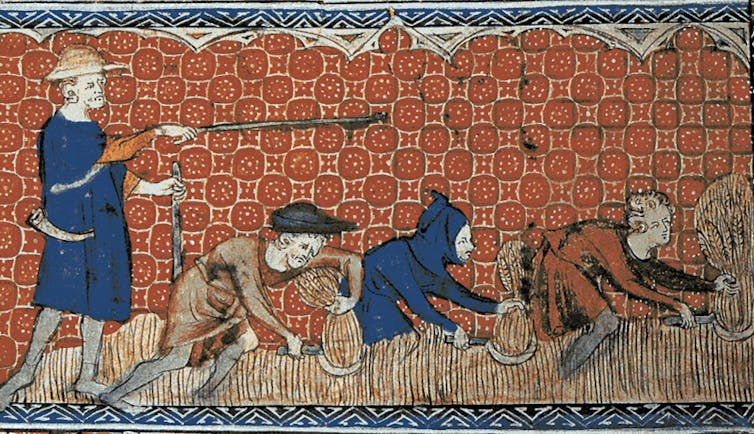
In June, July and August, start work at the first light of dawn, advised the 14th-century shepherd, Jehan de Brie, author of Le Bon Berger (The Good Shepherd).

Medieval artwork of serfs working in a field
Work would begin and end earlier to avoid the worst heat of the day.
Wikimedia

In fact, all three medieval estates – those who worked, prayed and fought – compressed their tasks to the cooler morning hours in the long summer days. Clergy adapted their services to fit a shorter night and longer day and after Corpus Christi (June) their worship year wound down. Knighthood curbed its taste for tournaments. They would never lift a lance in August.

2. Wear the right hat

Although hardly a habit unique to the middle ages, it is only in the past half-century or so that the hat has lost its status as a staple, everyday item.

Hats were worn daily for practical as well as social reasons in European society.

Medieval images, manuscript illuminations, murals and panel paintings, gesture at the endless variety of shaped hats, soft caps and hoods they reached for as a matter of course. For high summer, the half-metre brim of a hat like the Swedish Lappvattnett hat may have been the norm.

3. Eat to lower body temperature

In the unrefrigerated world of the middle ages, food could still be cool. Salad leaves (known then as salat) were preferred because they were palatable and digestable in the heat.

Fish and meat dishes were cooled down for the season by being doused with verjuice (pressed, unripe grapes), vinegar and perhaps even pomegranate juice.

4. Try wild swimming

Swimming was an increasingly common, communal recreation in later medieval Europe. When monasteries allowed their inmates periods of downtime, besides blood-letting, they encouraged river and sea swimming for health, hygiene and general fitness.

A man falling into water and then drowning.
A woodcut fro Everard Digby’s book on swimming.

In late medieval European cities crowded with tens of thousands, the breadth and depth of the Danube, Rhine, Seine and Tiber were an essential lifeline. The medieval theologian Everard Digby’s manual on the Art of Swimming, first published in 1587, described what may have long been a common sight – leaping and diving through the water “just like the summer’s roach”.

5. Use aftersun

Look after those burns. The monks of Citeaux Abbey were chronicled gathering herbs and roots in summer to salve their “perished skin”.

A 10th-century book of remedies, Bald’s Leechbook , recommended stalks of ivy sauteed in butter to apply to burns. Later, the recommendation was rosewater distilled from the flower’s petals.

Today we would say a bottle of aftersun or aloe gel will do.

6. Flee

When Emperor Charles V (king of Sicily and Naples from 1516 to 1554) found himself in a sweltering Rome with his young children, who were struggling in the rising temperatures, he made the household leave the city. High society generally left city palazzos to go up country and into shadier climes.

The author Giovanni Boccaccio recalled in his Decameron how the “dames of the city fly off” in summer to their country houses. King Richard II
(1377 until 1399) of England built a summer house at Sheen Palace (now Richmond palace) on the banks of the Thames to escape the close climate of the capital.

Even round-the-clock monastic institutions sometimes broke up and decamped to outlying country priories. Of course, it was rarely an option for those beneath them on the social scale.


Looking for something good? Cut through the noise with a carefully curated selection of the latest releases, live events and exhibitions, straight to your inbox every fortnight, on Fridays. Sign up here.


The Conversation

James Clark does not work for, consult, own shares in or receive funding from any company or organisation that would benefit from this article, and has disclosed no relevant affiliations beyond their academic appointment.

ref. Six tips from the middle ages on how to beat the summer heat – https://theconversation.com/six-tips-from-the-middle-ages-on-how-to-beat-the-summer-heat-263290

A humanoid robot is now on sale for under US$6,000 – what can you do with it?

Source: The Conversation – UK – By Kartikeya Walia, Lecturer, Department of Engineering, Nottingham Trent University

You might have noticed that humanoid robots are having a bit of a moment. From Tesla’s Optimus to Figure AI’s Figure 02,
these machines are no longer just science fiction – they’re walking, and in some cases, cartwheeling into the real world.

Now China’s Unitree Robotics, best known for its nimble quadruped robots, has unveiled something that’s turning heads: the Unitree R1.

For one thing, it’s a humanoid robot priced at under US$6,000 (£4,400). That’s not pocket change, but it’s orders of magnitude cheaper than most robots in its class, which can run into tens or even hundreds of thousands of dollars.

The R1 packs serious mobility, sensors and AI potential into a package that could fit in a university lab, a workspace – or even, if you’re adventurous, your living room.

Unitree R1.

What can the R1 do?

The Unitree R1 is around 1.2 metres tall and weighs roughly 25kg (similar to a packed suitcase). This makes it compact and relatively easy to move around. It’s equipped with 24 to 26 degrees of freedom (think of these as “joints” that allow it to bend, twist and rotate), giving it a surprisingly human-like range of motion. It can walk, squat, wave, balance, kick and – according to Unitree’s own demos – pull off athletic tricks like cartwheels.

It’s loaded with sensors: cameras to see in 3D, microphones to hear where sounds
are coming from, and wireless connections to talk to other devices. Its built-in
computer can handle both what it sees and hears at the same time, and you can
even give it extra computing power if you buy Nvidia’s Jetson Orin, a high-performance computer often used in AI projects which retails for about £180. It’s like adding a “turbo boost” that lets the robot handle more demanding tasks such as advanced image recognition, real-time decision-making or running complex software like real-time 3D graphics platform Unreal Engine.

Battery life is about an hour, with a quick-release system that lets you swap in a
fresh battery. That’s not a full day’s work, but it’s enough for short bursts of training, testing or demonstration. At least for most research teams, that’s plenty.

Here’s the thing: while the R1’s hardware is impressive, the software is still finding its feet. For example, Unitree’s website says that users need to “understand the limitations” of humanoid robots before making a purchase, reflecting constraints to the robot’s autonomy. This is not unique to Unitree; it’s the state of the humanoid robotics field as a whole. The challenge isn’t just making a robot move; it’s making it understand, adapt and interact safely in unpredictable real-world environments.

Right now, much of what we see in humanoid demos is either scripted routines or
teleoperation (remote control). But in research labs, there’s exciting work happening to bridge that gap – from task-specific AI such as teaching a robot to sort packages, to fundamental skills like maintaining balance, responding to uneven terrain, and fine-tuning finger dexterity for delicate object handling.

Humanoid robots like the R1 provide a platform where all these capabilities can be
tested in one body. The hardware says: “I can do it.” The software still has to figure out how.

Why a humanoid form?

Why is it necessary to have humanoid robots at all? Why not just make machines purpose-built for specific tasks? The truth is, there’s a strong argument for both approaches. The humanoid form has a big advantage in social acceptance. People are used to seeing other humans, so a machine with two arms, two legs and a head tends to feel more relatable than a box on wheels or an industrial arm.

In settings like elderly care, hospitality or public assistance, a humanoid robot might be easier for people to interact with – especially if it can use gestures, facial cues or natural conversation.

On the practical side, humanoids are designed to operate in environments built for
humans – climbing stairs, opening doors, using tools. In theory, this means you don’t have to rebuild your home, office or factory for these robots to work there.

But are they always the most practical solution? Not necessarily. A robot with wheels can be faster and more energy-efficient on flat surfaces. A specialised arm can be stronger and more precise in a factory. Humanoids often sacrifice peak efficiency for versatility and familiarity. For many applications, that trade off might be worth it. For others, maybe not.

The Unitree R1 isn’t about replacing people – it’s about making humanoid robotics
more accessible. By lowering costs, it opens the door for universities, small
companies and even hobbyists to explore everything from AI vision and balance
control to dexterous hand movements and creative performances.

Imagine students developing a robot that can walk around a care home, carrying out
small helpful tasks. Or a research team teaching it to work alongside humans in a warehouse without needing elaborate safety cages to protect the humans. Or even artists and performers using it to take part in a show.

The whole robotics community is in a golden age of experimentation. Different AI modes are being tested – some focused on single, repetitive tasks;
others on general adaptability. Some robots are learning to squat and maintain
balance under sudden pushes. Others are developing precise finger movements for
tool use. It’s a worldwide collaborative puzzle, and humanoids like the R1 give
researchers a flexible piece to work with.

For now, the R1 is not “the robot that will change everything.” But it’s a signpost
pointing toward a future where robots like it are much more common, much more
capable, and perhaps … a little more human.

The Conversation

Kartikeya Walia does not work for, consult, own shares in or receive funding from any company or organisation that would benefit from this article, and has disclosed no relevant affiliations beyond their academic appointment.

ref. A humanoid robot is now on sale for under US$6,000 – what can you do with it? – https://theconversation.com/a-humanoid-robot-is-now-on-sale-for-under-us-6-000-what-can-you-do-with-it-262183

Emerging parasite threats in the UK and Ireland: the role of climate change and pet travel

Source: The Conversation – UK – By Nikki Walshe, Associate Professor in Equine Science, Department of Biological Sciences, University of Limerick

Mazur Travel/Shutterstock

Toby, a fun-loving Labrador, was a beloved member of the Murphy household. So, when the family noticed patches of hair loss and red, itchy skin on his paws and legs, they were concerned. Still, they thought: “All dogs get itchy sometimes.” A medicated shampoo and a modified diet seemed to help.

But by the following winter, Toby’s condition worsened. He began losing more hair around his head, dropped weight rapidly and his lymph nodes became swollen. The family sought further veterinary help. Blood tests and tissue samples revealed something unexpected: Leishmania infantum, a parasite typically found in southern Europe, transmitted by the bite of sand flies.

Toby had never left the UK, but his owners had visited the Jalón Valley, Spain just months earlier. Toby hadn’t gone with them, but the possibility arose: could an infected sand fly or contaminated item have made its way back in luggage or belongings? Toby was treated and recovered well.

This is an adapted version of one of just three recorded cases of leishmaniasis in UK dogs since 2019. Canine leishmaniasis causes chronic, sometimes fatal disease in dogs and can infect humans, particularly those with a weakened immune system. Once confined to the Mediterranean basin, it is now spreading northwards through Europe.

The rise of vector-borne diseases

One growing concern in both the veterinary parasitology and public health sector is vector-borne disease (illness spread by arthropods like flies, ticks and mosquitoes). These diseases don’t respect borders; instead, they migrate with changing habitats and climates.

The UK’s island geography has historically offered a degree of natural protection. But global warming, increased international travel and trends like cross-border pet rehoming are eroding that protection. What was once “exotic” is now edging closer to home.

In fact, the international rehoming of animals and routine pet travel are now major contributors to the rise of exotic diseases in domestic animals. In one large group of imported dogs, more than a quarter tested positive for conditions not typically seen in the UK, including heartworm Dirofilaria immitis. Spread by mosquitoes, heartworm damages the heart and lungs of dogs. Once restricted to southern Europe, it is now being reported in central and eastern Europe, with sporadic cases further north and west.

It’s not just dogs. Horses are also vulnerable.

Equine piroplasmosis (EP) – transmitted by ticks – can cause severe illness or death. Once considered a southern European problem, it is now a concern for the UK’s equine industry due to expanding tick habitats, increased animal movement and blood tests showing antibodies to the parasite in some horses in Britain and Ireland – a sign they have been exposed to the disease.

African Horse Sickness, a midge-borne virus, has caused devastating outbreaks, such as in Spain, Portugal and Morocco, in the late 1980s, killing hundreds of horses. While the current risk of the virus spreading in the UK is low, species of midges capable of transmitting it are already found in parts of Europe. Climate and environmental modelling suggest that conditions across the region are becoming increasingly suitable for the virus to establish and spread.

When pets and people share risks

Our close relationships with companion animals mean some parasites can leap from them to us.

Exotic parasites like Echinococcus multilocularis, Leishmania infantum and Dirofilaria immitis can infect humans, sometimes with serious consequences.

Take Echinococcus, for example. Dogs often carry it without symptoms, shedding eggs in their faeces that can contaminate soil, water, or food. Humans may become infected by accidentally ingesting these eggs, such as through contact with infected dogs or unwashed produce.

The two species of greatest concern for zoonotic transmission are Echinococcus granulosus, which causes Cystic echinococcosis, and E. multilocularis, which can cause a more serious, invasive form of the disease affecting the liver and other organs. In the UK, E. granulosus is present at low levels, with isolated cases reported in imported and farm-associated dogs.

E. multilocularis has not been detected in the UK and remains under active surveillance. In Ireland, there are no confirmed cases of Echinococcus in dogs, yet a 2019 case involving a woman with no travel history suggests the parasite may already be circulating undetected highlighting the importance of continued surveillance.

Echinococcus granulosus
Parasites like Echinococcus granulosus have the potential to infect humans.
medicalNN/Shutterstock

And what of exotic parasites that have already entered our domestic animal population? The first recorded UK case of a cyst-forming parasite in donkeys was documented in 2020, the first recorded Irish case was in 2023 and researchers are investigating suspected Onchocerca cervicalis in Connemara ponies. Initially mistaken for “sweet itch” – a common allergic skin condition in horses caused by midge bites – these cases presented with unusual symptoms but responded to deworming.

Protecting the UK

Protecting the UK from emerging vector-borne threats requires a proactive approach:

  • screen animals before importation to reduce the risk of bringing parasites into the country

  • formally monitor insect vectors – flies, ticks and mosquitoes – to track and predict spread

  • test local animal populations to establish a clear disease baseline

  • educate vets and owners about the risks of animal movement and encourage responsible practices, especially for dogs and horses.

Most importantly, we need a true One Health approach – a framework that recognises the health of people, animals and the environment are deeply interconnected. This approach brings together veterinary and human health professionals, environmental scientists and policymakers to share data, monitor threats and design coordinated prevention strategies. By acting early, we can limit the spread of parasites before they become established in the UK and Ireland.

If we wait until disease emerges, the horse will have truly bolted and we may discover the infection has already spread to our animals, our communities and, potentially, ourselves

The Conversation

Nikki Walshe is affiliated with ESCCAP (European Scientific Counsel Companion Animal Parasites)

ref. Emerging parasite threats in the UK and Ireland: the role of climate change and pet travel – https://theconversation.com/emerging-parasite-threats-in-the-uk-and-ireland-the-role-of-climate-change-and-pet-travel-260846

Rebranding equity as ‘belonging’ won’t advance justice — it’s DEI rollback in disguise

Source: The Conversation – Canada – By Simon Blanchette, Lecturer, Desautels Faculty of Management, McGill University

Since 2024, pushback against diversity, equity and inclusion (DEI) has gathered momentum across North America. This year, that retreat has taken on a new form: the rebranding of “equity” with softer, less contentious terms like “belonging” or “community.”

The University of Alberta, for instance, no longer has a vice-provost of equity, diversity and inclusion. Instead, it now has an office for “access, community and belonging.”

Similarly, Alberta’s public pension fund eliminated its lead DEI role during a restructuring. A spokesperson maintained that “the departure of the individual responsible for the formal DEI program has not lessened AIMCo’s firm commitment to these principles.”

A similar shift is underway at the University of Lethbridge, which established an office of “accessibility, belonging and community” in December.

While language naturally evolves, this current shift appears to lack the deliberate engagement needed for genuine progress. Instead, it may be obscuring a step back from equity rather than a step forward.

A retreat disguised as progress

Calls for rebranding DEI work have existed for years and are valid, even within the field itself. What we are seeing now, however, often lacks genuine community engagement and the voices of the very stakeholders these shifts to “belonging” are meant to include.

Today’s so-called rebranding efforts are more about appeasement than progress. Rather, they are reactive moves that respond to external pressures rather than to the needs and demands of the communities most affected.

Once embraced as essential to address systemic discrimination, the term equity has now become a political lightning rod.

Some institutions now face political, shareholder and donor pressures that frame DEI initiatives as divisive or ideologically extreme, pushing them to distance themselves from such programs.

In the corporate world, the trend is stark. Mentions of “DEI” in S&P 500 corporate filings have dropped 70 per cent since 2022, replaced by softer terms like “belonging” and “inclusive culture.”

This shift allows organizations to sidestep accountability, obscure inequities and replace measurable equity frameworks with vague platitudes.

Why this matters

By softening language, organizations secure a socially acceptable way to exit from the difficult work of equity. It suggests these organizations have somehow moved beyond equity without ever having done the work.

Removing equity from organizational language has tangible consequences. First, it undermines accountability. Effective equity frameworks create measurable, trackable goals. Terms like “belonging” are harder to define and easier to abandon. They allow organizations to gesture toward inclusion without doing the hard work of systemic change.


Read more:
Businesses must stop caving to political pressure and abandoning their EDI commitments


Second, it risks leaving people behind. Equity centres those facing real structural barriers, like women, Black and racialized people, Indigenous Peoples, 2SLGBTQI+ communities and people living with disabilities. When the term disappears, so too can their visibility in policies, funding and accountability.

Finally, there’s a risk to organizations themselves. DEI rollbacks hurt morale, retention, innovation and performance, and can even increase legal risk.

A 2025 survey from New York University’s Meltzer Center for Diversity, Inclusion, and Belonging found 80 per cent of leaders believe reducing equity efforts increases reputational and legal risk. It also found widespread agreement that DEI initiatives improved firms’ financial performance.

The myth of meritocracy

A common justification for dropping “equity” is desire to return to “meritocracy.” Meritocracy is the idea that individuals should be rewarded based on their talent and hard work.

But meritocracy assumes a level playing field and obscures the fact that “merit” is socially constructed and context-dependent. It ignores that unequal barriers, like access to education and networks, impacts individual success despite a person’s achievements.

Meritocracy also assumes that diversity is prioritized over qualifications, which is not the case. We can successfully focus on both skills and inclusion.

Research by MIT management professor Emilio J. Castilla has shown that organizations claiming to be meritocratic often end up reinforcing biases instead — this is also called the “paradox of meritocracy.”

For instance, in a study involving 445 participants with managerial experience, researchers asked participants to make bonus, promotion and termination decisions for fictional employees. When an organization’s culture emphasized meritocracy, male employees received higher bonuses than equally qualified female employees.

Conversely, when the work culture emphasized managerial discretion instead, the bias reversed in favour of women. This likely occurred because the prompt signalled a potential gender bias, triggering an over-correction. In a third scenario where neither meritocracy nor managerial discretion was emphasized, there was no significant difference in the bonuses assigned.

While the last scenario sounds promising, most work environments emphasize meritocracy, consciously or not. Merit- or performance-based pay remains the norm in many organziations, meaning the first scenario is most common.

Without transparency, merit-based rhetoric about who supposedly “deserves” advancement often reinforces existing inequalities. Nepotism, network-based advantages and selective visibility often fill the gap when equity frameworks are abandoned. Networks and visibility matter, but they should not be mistaken for merit.

Ironically, sometimes the loudest critics of equity initiatives are silent when inherited privilege or insider connections determine who rises to leadership.

What can organizations do?

While some institutions are backpedalling on DEI commitments, others in Canada and across Europe are holding firm by embedding equity in their strategy, leadership and performance frameworks.

Advancing equity in today’s climate requires both strategy and sustained action. Here’s where organizations can begin:

  1. Establish and embed explicit, measurable equity objectives aligned with your business strategy.

  2. Increase data transparency by collecting and publicly sharing disaggregated information on recruitment, promotion, pay equity, turnover and employee experience.

  3. Give diverse voices real decision-making authority over policies and initiatives. Employee resource groups are a great way to start.

  4. Hold leaders accountable by training them to champion equity and tying their incentives to concrete DEI outcomes.

  5. Communicate DEI impacts transparently and authentically by sharing stories and metrics that showcase how equity efforts have improved business performance.

These solutions are already working. In my consulting practice, I have accompanied organizations that are making progress by building trust, energizing teams and driving innovation. In the end, they are measurably more successful and resilient.

The business case for equity is well-established: it drives performance, helps fuel growth and is an overall leadership imperative. In today’s political climate, it’s critical to stay focused on outcomes rather than rhetoric that frames equity as divisive or unnecessary.

The way forward

Rebranding “equity” as “belonging” doesn’t advance justice, especially when there’s no shared definition of what “belonging” actually means. It politely denies the need to dismantle real systemic barriers. For individuals facing those barriers, it sounds like an empty promise.

No one chooses their race, sex, socio-economic background, sexual orientation or to live with a disability or the lasting impacts of military service. But institutions can choose whether to confront the inequities tied to those experiences and dismantle barriers that individuals face.

This moment also calls for an honest reflection within the DEI space itself. Some initiatives have overreached or lost focus, contributing to this current backlash. Addressing missteps openly is part of rebuilding credibility in DEI work.

Equity, at its core, is about ensuring dignity and providing everyone with a fair chance to succeed. Walking away from equity work or watering it down until it becomes meaningless is not the answer. Moving forward requires less political polarization and more co-ordinated action so that everyone can have a fair chance to thrive.

The Conversation

Simon Blanchette does not work for, consult, own shares in or receive funding from any company or organisation that would benefit from this article, and has disclosed no relevant affiliations beyond their academic appointment.

ref. Rebranding equity as ‘belonging’ won’t advance justice — it’s DEI rollback in disguise – https://theconversation.com/rebranding-equity-as-belonging-wont-advance-justice-its-dei-rollback-in-disguise-261730

From resort buffets to long flights: simple tips for eating well on holiday

Source: The Conversation – UK – By Rachel Woods, Senior Lecturer in Physiology, University of Lincoln

David Prado Perucha/Shutterstock

Holidays should be about relaxing, enjoying yourself and making memories – not obsessing over a “perfect” eating plan. A healthy diet is built over months and years, not in a single week (or two). Instead of restricting what you eat, a better approach is to add healthy extras to your holiday meals. This way, you can nourish your body, support your digestive system and stay hydrated without feeling deprived.

If you usually count every calorie, giving yourself a mental break can be refreshing and well deserved. Recent research even suggests that strict calorie restriction can have a detrimental effect on mental health. Of course, this advice assumes holidays are occasional. If you travel frequently, your approach might need to be different. And if you have health conditions or specific dietary needs, tailored guidance is always best.

A few extra holiday calories won’t undo your long-term health – but side effects from overeating like bloating, constipation and fatigue can put a damper on your trip. These tips focus on helping you avoid those issues so you can feel your best and make the most of your time away.

Add, don’t restrict

It’s often easier to add something to your diet than to cut things out, especially on holiday. Rather than having a list of foods to avoid, eat what you fancy and then add nourishing extras.

Where you’re staying will influence how easy this is. At an all-inclusive resort, the variety makes it simple to include more fruit and vegetables. Adding a side salad or extra vegetables to every plate, or piling on chopped fruit at breakfast, keeps your fibre intake up and provides valuable nutrients. If you want to moderate calorie intake, starting meals with salad or fruit can help fill you up before the main course.

If your hotel offers breakfast, use it as a chance to start the day with nourishing foods. A plate with mushrooms, tomatoes, beans, or fresh fruit can set you up well, making it easier to relax about food choices for the rest of the day.

Self-catering or dining out can be trickier, but not impossible. Ordering vegetable sides, buying fresh fruit for your room, and keeping a bag of nuts or seeds handy can all help.

Wherever you are, enjoy the local cuisine. In the Mediterranean, for example, traditional diets are rich in vegetables, olive oil and fresh fish – all linked to heart health and longevity.

If you’re near the coast, make the most of fresh fish, an excellent source of healthy fats. Choosing whole, minimally processed foods as often as possible is generally the healthiest option.

Staying hydrated

Hot climates and busy days make hydration especially important. Keep a water bottle with you, sip regularly, and watch for early signs of dehydration, such as thirst, dark urine, or dizziness. Water and sugar-free drinks are the healthiest choices.


Read more:
Drinking lots of water may seem like a healthy habit – here’s when and why it can prove toxic


If alcohol is part of your holiday, balance it with non-alcoholic fluids. From a health perspective, alcohol isn’t good for the body – but it’s understandable to want a glass of wine at dinner or a cold beer by the pool. Enjoy it in ways that minimise the after-effects: alternate with water, dilute with soda or lemonade to make spritzers or shandies, or plan a few drink-free days.


Read more:
Even a day off alcohol makes a difference – our timeline maps the health benefits when you stop drinking


Cocktails and even mocktails can be surprisingly high in sugar, so save them for when you’ll really enjoy them. Having alcohol with food can soften its effects, but remember it’s dehydrating – so top up with plenty of water.

Eating and drinking on flights

Long flights can be dehydrating and tiring, so what you eat and drink on board can make a big difference to how you feel when you land. Cabin air is extremely dry, so drink water regularly – ideally a glass every hour – and limit alcohol and caffeine, which can worsen dehydration.

If possible, bring your own snacks. Fresh fruit like grapes or apple slices, vegetable sticks, unsalted nuts, and oat-based bars are healthier and often more satisfying than high-salt, high-sugar snacks sold on board. Salty foods can make you more thirsty, and heavy meals may leave you bloated or sluggish in the confined space of an aircraft seat.


Read more:
What happens to your body on a long-haul flight?


Airline meals can vary in quality, but you can often request a lighter or special option (such as vegetarian or low-salt) when booking. Eating smaller portions and stretching your legs when possible can help keep digestion moving and reduce the risk of deep vein thrombosis (DVT).

Travelling with children

With children, mealtimes can be more challenging, especially when routines are disrupted. Young travellers are more prone to dehydration, stomach upsets and constipation – particularly if their diet changes suddenly. A loose structure of three balanced meals, healthy snacks and regular water breaks can help maintain appetite and keep digestion on track.


Read more:
Dehydration: how it happens, what to watch out for, what steps to take


Holidays can also be a great opportunity for children to try new foods. Buffets work well for this, allowing them to explore small, low-pressure portions. In restaurants, sharing a few dishes between the table can encourage tasting without the commitment of a full plate. Offering new flavours alongside familiar favourites – and keeping it low-pressure – may make them more likely to try new foods.

Children can be especially vulnerable to dehydration, as they may not recognise or communicate the symptoms. Make sure they regularly have access to drinks. Some parents mark water levels on a child’s cup to track intake.

Foods with high water content – such as watermelon, cucumber and other fruit and vegetables – also contribute to hydration. Treats such as ice lollies count too, though watch the sugar. Slush drinks are often popular, but many are high in sugar and some contain glycerol, which the Food Standards Agency advises against for children under seven.

Holiday eating isn’t about perfection. Healthy eating is built over months and years, not a week or two. Keeping up your fruit and vegetable intake supports digestion, and regular fluids keep you hydrated. Simple steps to nourish your body mean more energy for exploring, relaxing with family, or simply enjoying a well-earned break.

The Conversation

Rachel Woods does not work for, consult, own shares in or receive funding from any company or organisation that would benefit from this article, and has disclosed no relevant affiliations beyond their academic appointment.

ref. From resort buffets to long flights: simple tips for eating well on holiday – https://theconversation.com/from-resort-buffets-to-long-flights-simple-tips-for-eating-well-on-holiday-262965

I got an AI to impersonate me and teach me my own course – here’s what I learned about the future of education

Source: The Conversation – UK – By Alex Connock, Senior Fellow, Said Business School, University of Oxford

‘Alex meet Alex.’ Midjourney, CC BY-SA

Imagine you had an unlimited budget for individual tutors offering hyper-personalised courses that maximised learners’ productivity and skills development. This summer I previewed this idea – with a ridiculous and solipsistic test.

I asked an AI tutor agent to play the role of me, an Oxford lecturer on media and AI, and teach me a personal master’s course, based entirely on my own work.

I set up the agent via an off-the-shelf ChatGPT tool hosted on the Azure-based Nebula One platform, with a prompt to research and impersonate me, then build personalised material based on what I already think. I didn’t tell the large language model (LLM) what to read or do anything else to enhance its capabilities, such as giving it access to learning materials that aren’t publicly available online.

The agent’s course in media and AI was well structured – a term-long, original six-module journey into my own collected works that I had never devised, but admit I would have liked to.

It was interactive and rapid-fire, demanding mental acuity via regular switches in formats. It was intellectually challenging, like good Oxford tutorials should be. The agent taught with rigour, giving instant responses to anything I asked. It had a powerful understanding of the fast-evolving landscape of AI and media through the same lens as me, but had done more homework.

This was apparently fed by my entire multimedia output – books, speeches, articles, press interviews, even university lectures I had no idea had even been recorded, let alone used to train GPT-4 or GPT-5.

The course was a great learning experience, even though I supposedly knew it all already. So in the inevitable student survey, I gave the agentic version of me well-deserved, five-star feedback.

For instance, in a section discussing the ethics of non-playing characters (NPCs) in computer games, it asked:

If NPCs are generated by AI, who decides their personalities, backgrounds or morals? Could this lead to bias or stereotyping?

And:

If an AI NPC can learn and adapt, does it blur the line between character and “entity” [independent actor]?

These are great, philosophical questions, which will probably come to the fore when and if Grand Theft Auto 6 comes out next May. I’m psyched that the agentic me came up with them, even if the real me didn’t.

Agentic me also built on what real me does know. In film, it knew about bog-standard Adobe After Effects, which I had covered (it’s used for creating motion graphics and visual effects). But it added Nuke, a professional tool used to combine and manipulate visual effects in Avengers, which (I’m embarrased to say) I had never heard of.

The course reading list

So where did the agent’s knowledge of me come from? My publisher Routledge did a training data deal with Open AI, which I guess could cover my books on media, AI and live experience.

Unlike some authors, I’m up for that. My books guide people through an amazing and fast-moving subject, and I want them in the global conversation, in every format and territory possible (Turkish already out, Korean this month).

That availability has to extend to what is now potentially the most discoverable “language” of all, the one spoken by AI models. The priority for any writer who agrees with this should be AI optimisation: making their work easy for LLMs to find, process and use – much like search engine optimisation, but for AI.

To build on this, I further tested my idea by getting an agent powered by China’s Deep Seek to run a course on my materials. When I found myself less visible in its training corpus, it was hard not to take offence. There is no greater diss in the age of AI than a leading LLM deeming your book about AI irrelevant.

Robot teacher in front of a blackboard
Optimising your output to be seen by the AIs is the new SEO.
Vasilyev Alexandr

When I experimented with other AIs, they had issues getting their facts straight, which is very 2024. From Google’s Gemini 2.5 Pro I learned hallucinatory biographical details about myself like a role running media company The Runaway Collective.

When I asked Elon Musk’s Grok what my best quote was, it said: “Whatever your question, the answer is AI.” That’s a great line, but Google DeepMind’s Nobel-winning Demis Hassabis said it, not me.

Where we’re heading

This whole, self-absorbed summer diversion was clearly absurd, though not entirely. Agentic self-learning projects are quite possibly what university teaching actually needs: interactive, analytical, insightful and personalised. And there is some emerging research around the value. This German-led study found that AI-generated tuition helped to motivate secondary school students and benefited their exam revision.

It won’t be long before we start to see this kind of real-time AI layer formally incorporated into school and university teaching. Anyone lecturing undergraduates will know that AI is already there. Students use AI transcription to take notes. Lecture content is ripped in seconds from these transcriptions, and will have trained a dozen LLMs within the year. To assist with writing essays, ChatGPT, Claude, Gemini and Deep Seek/Qwen are the sine qua non of Gen Z projects.

Schoolgirl with AI in her head
It’s happening.
Metamorworks

But here’s the kicker. As AI becomes ever more central to education, the human teacher becomes more important, not less. They will guide the learning experience, bringing published works to the conceptual framework of a course, and driving in-person student engagement and encouragement. They can extend their value as personal AI tutors – via agents – for each student, based on individual learning needs.

Where do younger teachers fit in, who don’t have a back catalogue to train LLMs? Well, the younger the teacher, the more AI-native they are likely to be. They can use AI to flesh out their own conceptual vision for a course by widening the research beyond their own work, by prompting the agent on what should be included.

In AI, two alternate positions are often simultaneously true. AI is both emotionally intelligent and tone deaf. It is is both a glorified text predictor and a highly creative partner. It is costing jobs, yet creating them. It is dumbing us down, but also powering us up.

So too in teaching. AI threatens the learning space, yet can liberate powerful interaction. A prevailing wisdom is that it will make students dumber. But perhaps AI could actually be unlocking for students the next level of personalisation, challenge and motivation.

The Conversation

Alex Connock does not work for, consult, own shares in or receive funding from any company or organisation that would benefit from this article, and has disclosed no relevant affiliations beyond their academic appointment.

ref. I got an AI to impersonate me and teach me my own course – here’s what I learned about the future of education – https://theconversation.com/i-got-an-ai-to-impersonate-me-and-teach-me-my-own-course-heres-what-i-learned-about-the-future-of-education-262734

Game changer: how data science is revolutionising athlete performance

Source: The Conversation – UK – By Christophe Ley, Associate professor in Mathematics, University of Luxembourg

Marco Iacobucci Epp/Shutterstock

Sports coaches have always made decisions based on experience, observation and intuition. But they are increasingly relying on hard evidence. Behind the scenes, a quiet revolution is transforming sport – driven not by human skills but by data.

Wearable sensors, video trackers, GPS and health monitors now capture almost everything an athlete does. From their speed and movement to heart rate and positioning, countless data are being recorded.

But how best apply all that data?

I work at the intersection of sports, statistics and artificial intelligence, leading the Modelling, Interdisciplinary, Data, Applied, Statistics (Midas) research team at the University of Luxembourg. Our goal is simple: use data to help athletes and coaches make better decisions.

Whether that’s adjusting tactics pre-match, predicting outcomes or preventing injury, data science is changing the game.

The challenge is to make sense of this plethora of data, which comes from different sources and is of different types. And that is precisely where statistical modelling and machine learning come into play.

By finding patterns in the data – such as why a certain (over-)training has led to reduced performance or even injury, for example – we can provide actionable insights. Indeed, these insights don’t just reveal or explain what has happened, but can also predict what is going to happen – and most importantly why.

To be able to predict as accurately as possible future performances and results and to estimate the risk of injuries, we’ve developed a new approach called statistically enhanced learning (SEL) — a framework that blends statistical modelling with machine learning.

In short, statistical insights can be transformed into features that help predictive algorithms work better. Consider “team strength”. This is an abstract concept we’ve come up with to represent the team’s current playing ability. And we model it out of data from the games teams have previously played.

It isn’t meaningful to use all individual games as input to a predictive algorithm. So we first build a statistical model to estimate team strengths from all these matches (giving more weight to more recent matches), and the estimated team strengths will then be used as input for the predictive algorithm.

Think of it as giving AI smarter inputs, such that it makes smarter predictions. In our studies, this approach consistently improves accuracy and interpretability across different sports.

Working with the Metz women’s handball team, champions of France in 2025, we developed prediction models that achieved over 80% accuracy. In a recent scientific paper, we combine game information (such as day of the week the game takes place, importance of the game) and team’s structure (height, weight, age of players) with the team strengths (which we estimate based on several previous match results) and feed all this into the programme. Without the team strengths, the accuracy would drop by roughly 20%.

Crucially, these models are not black boxes. We use explainable AI techniques so coaches can understand which variables drive the predictions, helping them adjust strategy and prepare more effectively.

Preventing injuries

Another key area is injury prevention. Injuries can derail a season, or even a career. By analysing patterns in performance and workload data, we can identify early warning signs. For example, slight declines in speed, jump height or reaction time may signal that a player is at risk.

Once flagged, coaches and medical staff can step in by adjusting training, adding rest days or tailoring recovery. Instead of reacting after an injury, teams can act proactively to keep athletes healthy.

Clearly our tools do not replace coaches. Rather they enhance their decision-making, be it at the level of tactical preparation or training setup. By turning data into insight, we help teams compete smarter.

Challenges and the future

Of course, this new era brings challenges. Data quality is not always consistent. Not all clubs can afford the same technology. And ethical questions arise around data ownership and athlete privacy. But the direction of travel is clear. Data science is becoming an essential part of sport, not just for top clubs and national teams, but across all levels.

We are also expanding our collaborations. This approach can be used in various sports including football, basketball and rugby. Our aim is to make analytics more accessible, explainable and useful, so that athletes and coaches, not just data scientists, benefit from what we learn.

As fans, we see the goals, the saves, the rallies, the celebrations. What we do not see is the science behind the scenes – the models predicting outcomes, the algorithms flagging risks, the data informing every sprint and substitution.

Sport will always be about passion, talent and human drama. But increasingly, it is also about probability, precision and the quiet power of data. And that might just be one of the most important game changers of all.

The Conversation

Christophe Ley is co-founder of the company GrewIA and President of the Luxembourg Statistical Society.

ref. Game changer: how data science is revolutionising athlete performance – https://theconversation.com/game-changer-how-data-science-is-revolutionising-athlete-performance-261400