Great Expectations by Charles Dickens is an early exploration of ‘romance fraud’

Source: The Conversation – UK – By Emma Linford, Honorary research associate, English literature, University of Hull

Shrinking into her yellowing wedding gown with the decay of her wedding breakfast around her, Miss Havisham, from Charles Dickens’s 1861 novel, Great Expectations, is one of the best-known characters in English literature.

Jilted on her wedding day by her unscrupulous fiancé, Havisham can be understood by modern readers as a victim of “romance fraud”, where in a fraudster manipulates someone under the guise of courtship for their own financial gain. Although romance fraud is a 21st-century term, through the character of Havisham, Dickens clearly demonstrated its often-devastating effects.

In her youth, Havisham was manipulated by her fiancé, the conman Compeyson and her half-brother Arthur, in a plan to rob her of her fortune. Both the romance itself and wedding are a ploy and she is jilted at the altar, losing not only her wealth (which she had signed away prior to her nuptials) but also any hope of future romantic prospects due to the scandal that followed.

Alone, rich and looking for a companion, Havisham was particularly vulnerable to a criminal wanting to take advantage. Though she lost her fortune, Dickens makes it clear that the romantic betrayal is what had the biggest impact on her psychology.

The romantic duplicity shapes her relationships with both her adopted daughter, Estella, and Pip, the novel’s protagonist, making her cold and hostile toward them.


This article is part of Rethinking the Classics. The stories in this series offer insightful new ways to think about and interpret classic books, films and artworks. This is the canon – with a twist.


The psychological impact of romance fraud

Since being jilted, Havisham has become a recluse, “stuck” within the moment of her abandonment. She remains in the house with the clocks all stopped, perpetually wearing her wedding gown. Her decayed hopes of romance are reflected in the decayed objects which surround her. As Pip muses:

Avoiding her eyes … I took note of the surrounding objects in detail, and saw that her watch had stopped at twenty minutes to nine, and that a clock in the room had stopped at twenty minutes to nine. “Look at me,” said Miss Havisham. “You are not afraid of a woman who has never seen the sun since you were born?”

The clocks are all stopped at the time the promise of her future life ended – the moment that she received the letter from Compeyson which made the crime apparent.

Olivia Colman as Miss Havisham in Great Expectations.

Herbert (a relative of Miss Havisham and friend of Pip) recounts the story to Pip:

A certain man, who made love to Miss Havisham … Well! This man pursued Miss Havisham closely and professed to be devoted to her. I believe she had not shown much susceptibility up to that time; but all the susceptibility she possessed certainly came out then, and she passionately loved him.

This description mirrors many modern elements of romance fraud. Compeyson “made love” to her and she became “susceptible”. Like contemporary romance fraudsters, Compeyson inserted himself into Havisham’s life and manipulated and controlled her to believe that he loved her.

Romance fraud in Dickensian Britain

There was a lack of progression in fraudulent law during Dickens’ time. It wasn’t until the Fraud Act of 2006, that real change came about, making fraud by misrepresentation a criminal offence in the UK. Today, romance fraud is considered a “serious crime”.

Long before this most personal form of fraud became illegal, Dickens saw its prevalence and drew attention to it. Others followed in his path, such as Mary Elizabeth Braddon in Lady Audrey’s Secret (1862), Arthur Conan Doyle in A Case of Identity (1891) and Agatha Christie in Death on the Nile (1937).

Havisham can be viewed in two ways, either as a victim or a fool. It is hard to determine how Dickens wanted her to be interpreted. Was she the stereotypical hysterical Victorian woman, as seen in other novels such as The Woman in White by Wilkie Collins (1860) or the character of Bertha Rochester in Jane Eyre (1847)?

I don’t think so. As he was with so many other social issues, I believe that Dickens was ahead of his time and was actively trying to raise the profile of the crime of romance fraud and the impact it has on his victims.

Beyond the canon

As part of the Rethinking the Classics series, we’re asking our experts to recommend a book or artwork that tackles similar themes to the canonical work in question, but isn’t (yet) considered a classic itself. Here is Emma Linford’s suggestion:

If you’re gripped by Dickens’s depiction of fraudsters and criminals, you may also enjoy Dickens’s Villains: Melodrama, Character, Popular Culture by Juliet John (2003). In it, John explores the complex villains and anti-heroes of Dickens’ novels. She looks at what inspired his writing, as well as the dramaturgical characteristics of his work.


This article features references to books that have been included for editorial reasons, and may contain links to bookshop.org. If you click on one of the links and go on to buy something, The Conversation UK may earn a commission.

The Conversation

Emma Linford does not work for, consult, own shares in or receive funding from any company or organisation that would benefit from this article, and has disclosed no relevant affiliations beyond their academic appointment.

ref. Great Expectations by Charles Dickens is an early exploration of ‘romance fraud’ – https://theconversation.com/great-expectations-by-charles-dickens-is-an-early-exploration-of-romance-fraud-241820


The many literary lives of Mary Wollstonecraft – author of novels, travel writing and children’s books

Source: The Conversation – UK – By Aditi Upmanyu, PhD candidate in English Literature, University of Oxford

In his biography of Mary Wollstonecraft, written after her death, her husband William Godwin remarked of her travel writing: “If ever there was a book calculated to make a man fall in love with its author, this appears to me to be the book.”

Today, however, Wollstonecraft is best known for a different work: A Vindication of the Rights of Woman (1792). While this landmark text helped lay the foundations of western feminist thought, focusing solely on it risks narrowing our view of a writer who was far more radical and prolific than this single book suggests.

Wollstonecraft wrote across genres – from fiction, travel and children’s books to literary criticism, translations and political essays. Tracing this wide-ranging authorship reveals that her lifelong concerns – women’s education, gender inequality and resistance to political authority did not start or end with A Vindication of the Rights of Woman.

The novelist

Wollstonecraft believed in the political power of storytelling. Writing in The Cambridge Companion to Mary Wollstonecraft, literature professor Claudia L. Johnson observes that “novels are the very bookends of Wollstonecraft’s life as a writer”.

In the preface to Mary: A Fiction (1788), Wollstonecraft declares her intention to reveal the “mind of a woman who has thinking powers”. The novel traces the fictional Mary’s emotional and intellectual life through intense relationships with both a man and a woman. The novel emphasises female intimacy and friendship – at times bordering on the homoerotic – and rejects the plot of conventional domestic fulfilment.

An introduction to Mary Wollstonecraft by National Museums of Liverpool.

This reimagination of domesticity becomes even more polemical in the unfinished novel Maria: or, The Wrongs of Woman (1798), where Wollstonecraft explores marital oppression, parental neglect, sexual violence and moral rigidity.

Maria is forcibly separated from her infant daughter and imprisoned in a “madhouse”, where she suffers further abuse and torture. The novel includes a graphic narration of sexual exploitation through Jemima, a working-class asylum attendant of illegitimate origins who has endured rape, prostitution and abortion. Maria and Jemima’s friendship introduces radical class solidarity forged through shared suffering.

The novel presents a bleak vision in which women’s most meaningful relationships lie beyond heteronormative family structures.

The travel writer

Wollstonecraft’s Letters Written During a Short Residence in Sweden, Norway and Denmark (1798) was the most popular of her works in her own lifetime.

It was written during an intensely turbulent period, marked by her abandonment by her first lover, Gilbert Imlay, after which she made two suicide attempts. The event left her a single, unwed mother to her daughter Fanny.

Letters departs from Wollstonecraft’s usual rational tone. Instead, this book explores emotional intensity and imagination. She writes at the outset: “I determined to let my remarks and reflections flow unrestrained.” It signposted a literary style that privileges feeling and self-exploration.

An excerpt from Mary Wollstonecraft’s Letters Written During a Short Residence in Sweden, Norway, and Denmark.

But beyond personal reflection, Letters also traces her inner growth alongside her observations of society as she travels across Scandinavian terrain. She reflects on landscape, commerce and social organisation, and through them considers broader questions of civilisation and progress. Here emerges a distinctive, female romantic imagination, grounded in sensibility and subjective experience.

Wollstonecraft’s merging of the personal and the political, so central to her writing, finds its fullest expression in this work. The Letters significantly influenced Romantic poets such as Robert Southey and Samuel Taylor Coleridge.

The children’s author

A deep intellectual investment in women’s education runs throughout Wollstonecraft’s career, evident even in the self-explanatory title of her early work, Thoughts on the Education of Daughters (1787).

This commitment takes a fictional form in Original Stories from Real Life (1791), a children’s book featuring illustrations by the poet William Blake. It traces the moral and intellectual development of two young girls under the guidance of a maternal governess. Wollstonecraft drew on her own year-long experience as a governess to the aristocratic Kingsborough family in Ireland between 1786 and 1787.

Engraving of a governess, with two girls looking up at her adoringly
The frontispiece to the 1791 edition of Original Stories from Real Life engraved by William Blake.
William Blake Archive

Influenced by enlightenment, the book presents learning as both structured instruction and experience shaped by nature and society. For Wollstonecraft, education cultivates judgement, self-discipline and moral awareness.

Her interest in childhood care and its formative role in later years is further reflected in three unfinished works: Lessons, Hints and Fragments of Letters on the Management of Infants. The works were all published posthumously in a compilation by Godwin in 1798. These works explore the issues of women’s health and nutrition, and rethink maternity as an acquired practice, rather than innate feelings women automatically possess.

An autodidact herself, Wollstonecraft saw the improvement of women’s education as essential to their development as rational citizens. Thus, pedagogy becomes the cornerstone of broader social reform, linking the cultivation of the mind to the possibility of equality between the sexes.

The reviewer, correspondent and translator

Wollstonecraft wrote extensively for Joseph Johnson’s progressive journal, the Analytical Review, contributing reviews of contemporary poetry and novels.

A silver statue of a woman emerging from what a wave
A Sculpture for Mary Wollstonecraft by Maggi Hambling (2020), located in Newington Green, London.
WikiCommons, CC BY-SA

These reviews reveal Wollstonecraft as an active participant in contemporary literary culture. This sustained engagement with the ideas of her time helped shape her own trajectory as a writer.

Her reviews were public yet often anonymous, but her letters offer a more intimate record of her voice. Wollstonecraft’s prolific correspondence suggests a life lived, in part, through letters. She wrote frequently to her sisters, her husband Godwin and fellow women writers such as Amelia Opie and Mary Hays. These letters reveal the complexity and contradictions of her character, and her reflections on motherhood, morality and intellectual life.

Wollstonecraft also participated in a wider transnational literary culture, translating works primarily from French, German and Dutch. Her own writings continued to circulate in translation across Europe after her death, distinctly contributing to the development of feminist thought well beyond England.

This article features references to books that have been included for editorial reasons, and may contain links to bookshop.org. If you click on one of the links and go on to buy something from bookshop.org The Conversation UK may earn a commission.

The Conversation

Aditi Upmanyu does not work for, consult, own shares in or receive funding from any company or organisation that would benefit from this article, and has disclosed no relevant affiliations beyond their academic appointment.

ref. The many literary lives of Mary Wollstonecraft – author of novels, travel writing and children’s books – https://theconversation.com/the-many-literary-lives-of-mary-wollstonecraft-author-of-novels-travel-writing-and-childrens-books-279885

Why delaying climate action now means higher seas by 2100 – new research

Source: The Conversation – UK – By Helen Millman, Postdoctoral Researcher, Polar Science, University of Exeter

Imagine your favourite sunny beach. Anywhere will do. You look out and see the ocean stretching to the horizon. To a glaciologist, that view is not just water; it’s melted ice.

Our new study shows that the best case sea-level rise scenarios may now be out of reach.

Around 20,000 years ago, during the most recent ice age, the Earth was about 5°C cooler than today. Vast ice sheets, comparable in scale to Greenland and Antarctica, covered Canada, northern Europe, and other regions. Those ice sheets formed as water evaporated from the oceans, fell as snow, and accumulated year after year on land.

Locked away as ice, that water was removed from the ocean, lowering sea level by around 130m and reshaping the planet’s coastlines. You could have walked from Britain to mainland Europe or from Siberia to North America as much of today’s continental shelf was dry land.

Between 20,000 and 10,000 years ago, global temperatures increased and those ice sheets melted. Sea level rose, flooding coastal plains and river valleys, and leading to modern coastlines. The lesson from Earth’s recent history is simple: When global temperature changes, sea level changes, and coastlines change with it.

The triple threat

Sea level rise has three main causes. First, as the ocean warms, seawater expands, increasing its volume. Second, hundreds of thousands of mountain glaciers worldwide are melting, adding water to the sea. Third, the great ice sheets of Greenland and Antarctica are losing mass. All three matter, but they do not contribute equally, and their importance is changing.

Since around 1850, the burning of fossil fuels has raised greenhouse gas concentrations to levels not seen for more than three million years. As a result, global temperatures have increased by nearly 1.5°C and global mean sea level has risen by more than 20cm. Just under half of this rise came from thermal expansion of warming oceans. A similar amount comes from the melting of about 300,000 glaciers worldwide, but with a rising contribution from the great ice sheets.

What is striking is how fast this change has happened. Around half of the total sea level rise since 1850 has occurred in just the past 30 years. During this time, Greenland and Antarctica have begun to contribute more to sea-level rise than all other glaciers combined, and together now exceed the contribution from ocean warming. Mass loss from Antarctica alone is around six times greater than it was three decades ago.

aerial shot of mountainous ice sheet
Greenland’s ice cap is melting.
Vadim_N/Shutterstock

This shift matters because glaciers and ice sheets are not equal. If every small glacier on Earth were to melt completely, global sea level would rise by only about 24cm. If the polar ice sheets were to melt, sea level would rise by more than 65m, almost 300 times more.

Ice sheets usually respond slowly to warming air and ocean temperatures. But some regions are far more vulnerable than others. In these hotspots, retreat can trigger dynamic processes that accelerate ice loss, destabilising neighbouring regions and speeding up sea level rise.

Researchers like us are starting to see just this, particularly in the Amundsen Sea sector of West Antarctica and the margins of the Greenland ice sheet. Mass loss from these ice sheets commits the planet to metres of sea level rise – and once retreat begins it may be impossible to stop.

The reality gap

The pace of change still depends on us, but the starting point keeps shifting. Observations show that current sea level rise is already tracking along the mid-to-high projections provided by the UN’s climate science advisory group, the Intergovernmental Panel on Climate Change (IPCC), placing the lowest, most manageable outcomes out of reach. Sea levels rising by more than 0.5m by 2100 are now increasingly likely, with consequences that include large-scale displacement and the abandonment of many coastal regions at immense and avoidable cost.

This does not mean the outcome is fixed. The world stops warming almost immediately after reaching net zero. Rapid decarbonisation would slow ice loss, buying time for coastal cities, communities, ports, wetlands and beaches to adapt.

Yet a clear gap remains between where the scientific consensus says emissions need to go to avoid rapid rise, and where current government commitments, known as nationally determined contributions are taking us. Many estimates say that we are currently on a path toward roughly 3°C of warming. For context, the threshold for the irreversible loss of the Greenland ice sheet is estimated to be as low as 1.7°C to 2.3°C. We are flirting with a temperature that would commit the planet to several metres of long-term rise from Greenland.

Now return to that beach. The shoreline is not fixed. It is a product of past warming and it is already being reshaped by the warming we have caused. The question is no longer whether sea level rise can be kept low, but how high it will go, how quickly it will rise, and how much damage we are prepared to accept.
The longer action is delayed, the fewer good options remain, and the more of that familiar coastline is lost to the tide.

The Conversation

Helen Millman is on the advisory council of the Conservative Environment Network.

Martin Siegert receives funding from the UK Natural Environment Research Council.

Richard Alley does not work for, consult, own shares in or receive funding from any company or organisation that would benefit from this article, and has disclosed no relevant affiliations beyond their academic appointment.

ref. Why delaying climate action now means higher seas by 2100 – new research – https://theconversation.com/why-delaying-climate-action-now-means-higher-seas-by-2100-new-research-272290

Why Italy’s Giorgia Meloni broke with Donald Trump

Source: The Conversation – UK – By Margherita de Candia, Lecturer in Comparative Politics, King’s College London

The Italian prime minister and leader of the far-right Brothers of Italy party, Giorgia Meloni, has made fostering ties with foreign leaders a central part of her political strategy. A few years before winning Italy’s 2022 general elections, she started cultivating ties with the US and European conservative world as part of a broader political rebranding effort aimed at projecting a more moderate image at home and gaining legitimacy abroad.

She subsequently became a familiar face within Donald Trump’s “Make America Great Again” (Maga) movement. Meloni shares similar views to Maga on migration, sovereignty and national identity. She also aligns with the movement on a constellation of other themes ranging from fighting against “wokeism” and defending the traditional family to the rejection of liberalism, globalism and environmentalism.

After Trump was elected as US president for the second time in late 2024, Meloni’s ties with the American far-right suddenly became a matter of foreign policy. But her relationship with Trump has turned out to be a more demanding balancing act than Meloni may have anticipated. And now their alliance – at least for the time being – appears to be over.

On April 13 Meloni described Trump’s recent social media attack on Pope Leo, who had criticised the US and Israel’s war on Iran, as “unacceptable”. This prompted a rebuke from Trump, who said Meloni “lacked courage” for not joining the war. The conditions for this breakdown have been in place for some time.

Trump and Meloni’s alliance

Trump and Meloni’s shared far-right traits should not hide some key differences between the two leaders. In foreign policy, Meloni has adopted a pro-Nato position and is a staunch supporter of Ukraine. These positions have aided Meloni in what has been called her quest for “respectability”, but they clash with Trump’s lack of support for Ukraine and belligerent position towards Nato.

Politically, Meloni has also faced constraints that have moderated her leadership. Externally, the EU’s institutional and financial straitjacket has required Meloni to work collaboratively with the bloc. This requirement has limited Meloni’s room for manoeuvre in her dealings with Trump and clashes with the US president’s rejection of multilateralism.

Internally, the logic of coalition politics – in particular the moderating presence of the pro-European Forza Italia party in her government – and the fact that centrist voters represent a decisive constituency in Italy have both acted as a further centripetal force on Meloni’s agenda.

Despite these divergences, Meloni’s ideological closeness to Trump did initially translate into diplomatic gains that helped boost her profile with fellow EU leaders. She was the first EU leader to meet with Trump after the imposition of his global trade tariff regime in 2025.

Meloni also managed to organise a trilateral meeting in Rome with the president of the European Commission, Ursula von der Leyen, and the US vice-president, J.D. Vance. Following the meting, Vance called Meloni a “bridge” between the two sides of the Atlantic.

Still, beyond the legitimacy gains for Meloni and her party, the material advantages Italy has extracted from her relationship with Trump have been limited. Italy was not spared trade tariffs, for instance. Nor did it manage to obtain a discount on Trump’s demand for Nato members to raise military spending to 5% of their GDP.

The scarcity of tangible policy gains from her ties with Trump may be one reason for Meloni’s decision to distance herself from the US president. But Italian domestic politics are another important factor.

The indirect effects of Trump’s policies are likely to have played a key role in the recent defeat Meloni suffered in a referendum on judicial reform. This referendum, which came one month into Trump’s war in Iran, morphed into a vote on the Meloni government.

The Iran war has caused energy prices across Europe to rise and has generated fears among Italians of possible security repercussions. With a recent survey indicating 79% of Italians now hold a negative opinion on Trump, it seems that voters used the referendum to signal their discontent to Meloni ahead of general elections in 2027.

Opposition parties, both on the left and right, hailed the result as a sign that voters are looking for change. And Roberto Vannacci, a former general turned politician, is capitalising on voters’ increased unease with the impact of Trump’s policies. He has criticised Meloni for what he sees as her Washington-first alignment and soft approach to key far-right issues.

Trump’s attack on the Pope – indefensible for Meloni as someone who has defined herself as a Christian and whose party draws on a vast Catholic electorate – gave the Italian prime minister the exit she needed to signal her distance from Trump’s recent actions to voters.

Meloni’s agenda remains far-right in its orientation, aligning with Trump’s in many ways from identity politics and migration to his stance on the green transition. How these ideological similarities are received by Italian voters over the coming year is likely to play a crucial role in determining Meloni’s political future.

The Conversation

Margherita de Candia does not work for, consult, own shares in or receive funding from any company or organisation that would benefit from this article, and has disclosed no relevant affiliations beyond their academic appointment.

ref. Why Italy’s Giorgia Meloni broke with Donald Trump – https://theconversation.com/why-italys-giorgia-meloni-broke-with-donald-trump-280956

In a fractured world order, where does the global south fit in?

Source: The Conversation – Global Perspectives – By Dilnoza Ubaydullaeva, Lecturer – National Security College, Australian National University

Canadian Prime Minister Mark Carney was one of the first world leaders to speak out about the “ruptured” world order caused by the Trump administration in the United States. He called for middle powers to band together to safeguard what’s left of the liberal world order.

But what role will the global south play in all of this?

Some believe it will be decisive. Earlier this year, Finland’s president, Alexander Stubb, said at a conference in India, “the global south will decide what the next world order will look like”.

The global balance of power has shifted. The global south has both demography and economy on its side. The era of a Western-dominated world order is over. This is obvious, but it will take some time to sink in across the West.

So, how can the global south influence which direction the world takes?


Read more:
Finland’s president Alexander Stubb has some ideas to save the international order – and ourselves


What is the global south?

It may be too early to declare the end of the Western-dominated world order. While the war in Iran may be leading some countries to question the current system – in which might appears to make right – the global south is far from a unified bloc.

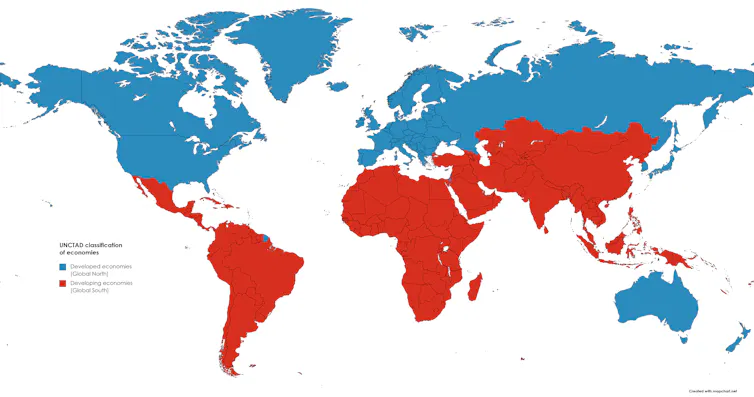
First, there is no agreed definition or scope of the “global south”. The name infers countries located in the southern hemisphere, but many global south countries are north of the equator, while Australia and New Zealand are considered part of the “global north”.

Some lump Africa, Latin America and Asia together in the global south grouping, but this is too simplistic. And what to make of a major economy like China? Some include it in the global south, while others do not.

An important feature of the global south is there is no single state widely accepted as its leader, nor is there strong support for such leadership.

While China is influential in parts of the developing world through its “non-interference” foreign policy approach, India, with its strong ties to the West, is unlikely to accept Chinese global leadership.

Economic classification of the world’s countries and territories by the UN Conference on Trade and Development in 2023. It’s important to note there is disagreement about which countries belong in this framework.
Wikimedia Commons

The global south and the Iran war

Whatever definition one uses, the behaviour of some states in the global south shows they are trying to conduct foreign policy with multiple players, joining different clubs to pursue their national interests above all else.

These groups, however, haven’t proven to be very effective or united in responding to recent conflicts, raising questions about their level of influence.

Take the BRICS, for example. The coalition has expanded in recent years to ten countries, including Iran and the United Arab Emirates (which has been attacked by Iran in the current war).

Yet the group has failed to take a unified position on the war. China and Russia have condemned the US–Israeli attacks on Iran, while other members such as India have taken a cautious approach, calling for de-escalation.

Some commentators have noted a central problem: the BRICS members remain divided on many core strategic issues, without a central platform to resolve disputes.

When it comes to the Iran conflict and the future of the Middle East, individual nations in the global south have their own agendas, as well.

China, for instance, would lose a key partner if the Iranian regime were to collapse. Iran is a member of the China-led Shanghai Cooperation Organisation and an important partner in China’s efforts to create alternatives to Western-dominated governance. Moreover, China relies on a stable, secure access to oil and gas shipments through the Strait of Hormuz.

Pakistan has emerged as a key mediator between the US and Iran. This is a chance for it to take a much bigger role on the global stage. But it is also keen to ensure its defence partner, Saudi Arabia, is not drawn into a wider war. Under their defence arrangement, Pakistan would have to assist Saudi Arabia if the kingdom were attacked.

And India maintains an independent foreign policy based on “strategic autonomy”, allowing it to manage relations across competing blocs. As Foreign Minister S. Jaishankar has noted, India is not a Western country, nor is it “anti-Western”. This allows it to remain a key strategic partner to the United States, while also renewing purchases of Iranian oil and gas.

Other ways to exert influence

In his recent book, The Triangle of Power, Stubb argues the world is dividing into three parts – the global west (still led by the US), the global east (led by China and Russia) and the global south (comprised of middle and small powers in Africa, Latin America, the Middle East and Asia).

According to Stubb, the global order is at a crossroads between west and east, with the south being the pendulum that will decide which way the world swings. To maintain the old liberal world order, the west needs to get the south on its side.

But again, this is too simplistic a view. I believe nations in the global south have a preference for multipolarity, this is, a world order not dominated by one power, such as the United States or China.

They are also interested in having their voices heard in the global arena. Because many global south countries are former colonies of Western powers, they want to address the harm or injustices of colonialism they perceive as continuing in the current international system. South Africa’s move to hold Israel accountable at the International Court of Justice for its war in Gaza is an example of this.

At the same time, the current rupture in the international system has reinforced the importance of alternative diplomatic spaces and flexible alignments, allowing states to shift partnerships where it best serves their interests.

That means cooperating with the West when it suits them, while simultaneously cooperating with China, Russia or other blocs and powers.

Indonesia is a case in point. In the past month, it has signed a major defence agreement with Washington, while its president, Prabowo Subianto, also visited Moscow to meet with President Vladimir Putin.

The global south is clearly becoming more relevant in today’s power politics. Just how these nations choose to exert their influence remains to be seen.

The Conversation

Dilnoza Ubaydullaeva does not work for, consult, own shares in or receive funding from any company or organisation that would benefit from this article, and has disclosed no relevant affiliations beyond their academic appointment.

ref. In a fractured world order, where does the global south fit in? – https://theconversation.com/in-a-fractured-world-order-where-does-the-global-south-fit-in-278410

Why the world’s banks are so worried about Anthropic’s latest AI model

Source: The Conversation – Global Perspectives – By Toby Walsh, Professor of AI, Research Group Leader, UNSW Sydney

Monstera Production/Pexels

The legendary American bank robber Willie Sutton spent 40 years robbing banks because, as he claimed in his autobiography, he loved doing it. And when asked why he chose banks of all places to rob, he allegedly replied “Because that’s where the money is.”

Back in 2017, I wrote a book predicting it wasn’t just lovable rogues like Sutton who would soon be robbing banks, but artificial intelligence (AI).

That day, it appears, could now be about to arrive. Banks around the world are seriously worried cyber criminals will soon take advantage of the latest advances in AI to try to rob them.

The digital back door into the vault

The finance world’s concern rests on the impressive cyber capabilities of a product called “Mythos”. This is the latest and most capable AI model from Anthropic, the company behind the popular Claude chatbot.

As a member of the public, you can’t access or use this model – for now. That’s because Anthropic (and many others) believe Mythos is too capable to launch upon an unsuspecting world.

Internal testing of Mythos has uncovered thousands of severe security vulnerabilities across every major operating system and web browser.

Some of these vulnerabilities have gone undetected for decades. Many are what tech insiders call “zero day” vulnerabilities – attacks that are so dangerous that developers need to fix them in zero days’ time.

Not for public use

To counter this emerging threat, Anthropic has made the model available to a dozen partners of a defensive coalition that includes Microsoft, Amazon Web Services, Apple, Cisco and the Linux Foundation.

The company has also committed US$100 million (about A$140 million) in usage credits and US$4 million (about A$5.6 million) in open-source grants to start finding and fixing these bugs.

In addition, more than 40 additional organisations – including a number of US banks – have also received access. But worryingly, as far as we know, Anthropic has not yet granted access to any banks in Australia, the United Kingdom or Europe.

To add to concerns, on Wednesday, Anthropic confirmed it was investigating claims in a Bloomberg report that a small group of unauthorised users had gained access to Mythos. However, at this stage, there is no suggestion this alleged access was for malicious purposes.


Read more:
Claude Mythos and Project Glasswing: why an AI superhacker has the tech world on alert


Should you be worried?

Last week, regulators and policymakers from around the world gathered at the International Monetary Fund spring meeting in Washington. The Iran war was a major focus. But attendees also issued a series of warnings about this emerging cybersecurity threat to the banking industry.

Not only are banks an attractive target, being where the money is, but the industry runs on many legacy systems, decades old technology that may be especially vulnerable to these sorts of attacks.

You personally don’t need to be too worried. Many countries have strong protections for bank customers. In Australia, for example, the first A$250,000 of a customer’s deposits are insured through the government-backed Financial Claims Scheme.

And the Australian Securities and Investments Commission ensures banks investigate and reimburse fraudulent transactions where the customer is not at fault.

So, it’s probably not a wise idea to withdraw your cash and put it under the mattress. But banks should be (and are) rushing to plug these vulnerabilities.

I would recommend you regularly update your computer and smartphone to have the latest operating system and banking apps. There are likely to be many more updates in the near future as new vulnerabilities are uncovered and patched.

And, as I’m sure you have been, you need to be ever vigilant for phishing attacks by email and SMS trying to obtain your banking credentials.

The evolving threat landscape

In the longer term, Mythos exposes the challenge that defence is much harder than attack. Software is one of the most complex products humanity builds. It is therefore almost impossible to ensure it is bug-free.

That puts us in an unending race against the “bad guys” to uncover and fix faults before they get exploited.

For example, with significant fanfare, the European Union just released its age verification app, designed to be a cornerstone to the emerging laws on access to social media, pornography and other age-restricted content. However, within hours, security experts found cyber vulnerabilities that underage users could easily exploit.

In the most critical settings, we can try to prove mathematically that our software is bug-free. For instance, the Beneficial AI Foundation just announced an ambitious “moonshot” project to prove that the popular messaging app Signal is bug-free and protects privacy as claimed.

But such efforts are the exception today rather than the norm. Perhaps further advances in AI could soon help reverse this.

The Conversation

Toby Walsh receives funding from the Australian Research Council for a Laureate Fellowship on trustworthy AI.

ref. Why the world’s banks are so worried about Anthropic’s latest AI model – https://theconversation.com/why-the-worlds-banks-are-so-worried-about-anthropics-latest-ai-model-281218

Heavy rain on snow is testing aging dams across Michigan and Wisconsin – this is the future in a warming world

Source: The Conversation – USA (2) – By Richard B. (Ricky) Rood, Professor Emeritus of Climate and Space Sciences and Engineering, University of Michigan

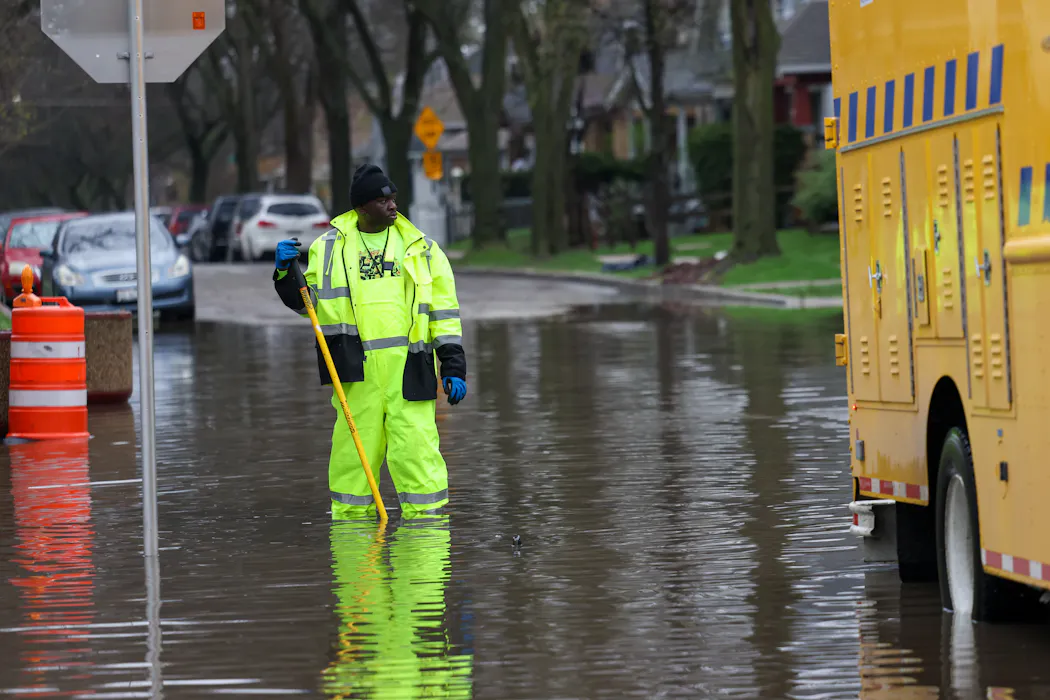
In the upper Midwest, aging infrastructure, from dams to city drains, was overwhelmed by floodwater in April 2026. Jonathan Aguilar/Milwaukee Neighborhood News Service/CatchLight via Getty Images

Michigan and parts of Wisconsin are in the midst of a historic flooding event in spring 2026. Days of heavy rainfall on top of snow have sent lakes and rivers over their banks and threatened several dams in both states, forcing people to evacuate homes downstream.

By April 20, 2026, nearly half of Michigan’s counties were under a state of emergency. In Cheboygan, Michigan, large pumps were brought in to lower pressure on a century-old dam in the city.

The region’s aging water infrastructure was never designed for the volume of water it is facing. That’s a troubling sign for the future, with flooding becoming more common as global temperatures rise.

In many areas, the damage has been exacerbated by a culture of building homes and cabins on the shores of inland lakes and along riverine lakes behind small, often privately owned dams. Many of these dams were built over 100 years ago, with some long forgotten.

Michigan State Police captured scenes of stressed dams and flooding across Cheboygan County, near the tip of the Lower Peninsula, including the century-old dam in the city of Cheboygan that was nearly overwhelmed by flood water.

I am a professor emeritus of meteorology at the University of Michigan whose work focuses on helping communities adapt to climate change. The warming climate is worsening the flood risk, and disasters like the one Michigan is experiencing are setting higher benchmarks for safety as communities plan future infrastructure.

Where is all the water coming from?

For much of Michigan and Wisconsin, as well as northern Illinois, 2026 has been the wettest March and April on record.

In March, much of that precipitation fell as snow, including in an enormous blizzard that brought 3 feet of snow to parts of Michigan. In mid-April, persistent rains began. The rain, on top of all that snow, sent floodwaters running into rivers, streets and homes. The water carries large amounts of ice that damages shores, infrastructure and homes.

The moisture for much of these storms has been funneled northward from the warm Gulf of Mexico, thanks in part to a high pressure system sitting over the southeastern U.S.

A US map showing the highest increase in rainfall from extreme downpours across the Upper Midwest and Northeast.
Extreme downpours are becoming intense across the United states. This map shows the percentage change in total precipitation falling on the heaviest 1% of rainy days from 1958 to 2021.
NOAA/adapted from Fifth National Climate Assessment

The problem of warming winters

The kind of flooding Michigan and Wisconsin are experiencing in 2026 is what forecasters expect to see more of as global temperatures rise.

Winters have been warming faster than other seasons across the U.S. In Michigan and Wisconsin, winter months used to be reliably below freezing, but that’s changing. In the Cheboygan area, near the tip of Lower Michigan, March temperatures used to be below freezing on all but a few days. By the 1991-2020 period, the region averaged 10 days above or close to the freezing point – about twice as many as the 1951-1980 period.

Charts show the shift toward warmer March weather.
March is warming, as a comparison of daily high temperatures in the Cheboygan area in 1991-2020 and 1951-1980 shows. The bar chart comparison shows that the number days above freezing is rising.
GLISA

The air coming in from the south is also warmer than in the past. Nationally, 2026 was the warmest March on record in 132 years of record-keeping in the contiguous U.S., with an average temperature more than 9 degrees Fahrenheit (5 degrees Celsius) higher than the 30-year average. So, in addition to snowmelt starting earlier, melting is happening faster.

Michigan’s average wintertime temperature rose by more than 4 F (2.3 C) from 1951 to 2023. Though winter 2026 in Michigan was colder than the 1991-2020 average, the Gulf of Mexico, where the moisture originated, was warmer than average, accelerating the snowmelt.

How warming leads to downpours and flooding

A few aspects of a warming climate can lead to flooding.

First, temperatures are increasing. In higher temperatures, moisture evaporates faster from the ground, plants and surface water. That moisture, once in the atmosphere, eventually falls again as precipitation. However, for each degree Celsius that temperatures increase, the atmosphere can hold about 7% more moisture, resulting in more heavy downpours.

A warmer winter also means more melting snow and more rain-on-snow events that can quickly increase the amount of runoff into rivers.

Much of the upper Midwest was exceptionally wet in March and April 2026.
Since March 1, 2026, most of Michigan and Wisconsin have experienced their wettest stretch in the 134 years that the region’s precipitation has been recorded.
Iowa Environmental Mesonet

The Great Lakes region and much of the Northeast already experience more precipitation than in the past. Winters with more persistent wetness – not just snow but also rain – prime the region for floods. With continued warming in the coming decades, 2026 might be among the least disruptive in the future.

Data shows that a scenario of persistent wetness, changes in winter and seasonal runoff is part of the future for Michigan and the other states and Canadian provinces along the Great Lakes Basin, as well as New England.

Fixing dams for the future

All of this means communities across the region will have to pay closer attention to the growing risks facing their vital infrastructure – particularly dams.

Even prior to the 2026 floods, Michigan had a well-documented problem with its aging inventory of 2,600 dams. In May 2020, an intense storm system that stalled over the region brought so much rain that the Edenville and Sanford dams both failed near Midland, Michigan, forcing 10,000 people to evacuate and causing an estimated US$200 million in damage.

After that disaster, a state task force issued recommendations for fixing the state’s water control infrastructure to meet the growing risks. But a member of the task force told The Detroit News in April 2026 that little had been done to address those recommendations.

Water spills from the Cheyboygan dam, where the water level came close to the top, threatening the century-old dam's integrity.
Officials ordered evacuations as floodwater nearly overwhelmed the century-old dam in Cheboygan, Mich., in April 2026.
Michigan Department of Natural Resources via AP

Because warming will continue for the coming decades, the 2026 flooding should be considered at the lower end of capacity for stormwater infrastructure and dams. Rather than relying on the statistics that described floods in the past, planners will have to anticipate the floods of the future.

Michigan is often touted as a climate haven because it is relatively cool and has plenty of water. The state is not, however, immune to the amped-up weather of a warming climate. Environmental security in the future requires improved and more adaptive infrastructure.

The Conversation

Richard B. (Ricky) Rood receives funding from the National Oceanic and Atmospheric Administration.

ref. Heavy rain on snow is testing aging dams across Michigan and Wisconsin – this is the future in a warming world – https://theconversation.com/heavy-rain-on-snow-is-testing-aging-dams-across-michigan-and-wisconsin-this-is-the-future-in-a-warming-world-281221

Strait of Hormuz: Iran’s ‘nuclear deterrent’

Source: The Conversation – UK – By Jonathan Este, Senior International Affairs Editor, Associate Editor, The Conversation

This is the text from The Conversation UK’s World Affairs Briefing email. Sign up here to receive weekly analysis of the latest developments in international relations, direct to your inbox.


Napoleon Bonaparte is said to have commented in connection with his invasion of Russia that “geography is destiny”. Take a look at a live maritime tracker to see how Napoleon’s aphorism is playing out in the Middle East today. There are presently hundreds of vessels either side of the Strait of Hormuz, idling in either the Persian Gulf or the Gulf of Oman. But nothing is passing though.

In normal times, 20% of the world’s oil flows through this waterway. But since the US and Israel began to launch attacks at the end of February, Iran has effectively closed down the Strait, both by depositing mines and by threatening to board any ships trying to pass without their permission.

The US has countered with its own blockade. And both sides have demonstrated how serious they are in recent days by threatening, boarding or forcing vessels to reroute.

That Iran would close the Strait of Hormuz should have come as no surprise to anyone. The leaders of the Islamic Republic have threatened to do so every time they have felt under threat over more than four decades. Christian Emery, an expert in US-Iran relations and Persian Gulf security at University College London, believes this is why no previous US president has chosen to launch a full-scale attack on Iran.

As we’ve already seen, the ability of Iran to hugely disrupt the global economy by shutting down the Strait was obvious: “The only person who seems not to have understood this is Donald Trump,” Emery concludes.


Read more:
Has the Strait of Hormuz emerged as Iran’s most powerful form of deterrence?


So now there appears to be a deadlock. It’s an unwinnable war, write Bamo Nouri and Inderjeet Parmar, experts in international security at City St George’s, University of London. The US and Israel may enjoy massive military superiority over Iran, but this is beside the point, Nouri and Parmar believe.

While both the US president, Donald Trump, and Israeli prime minister, Benjamin Netanyahu, need to be able to demonstrate to their voters that they have emerged triumphant, Iran isn’t looking to win. It is looking to endure – while making sure that the cost of this conflict becomes unsustainable. And not just for the US and Israel, but for pretty much everybody else besides.

We’re already seeing that. Oil prices have surged and reserves are coming under strain. Supply chains are disrupted. And political friction is stressing relationships, not just between the US and its Nato allies, but – more ominously – with China, which typically buys between 80% and 90% of Iran’s oil exports and said this week that the Strait must be opened without delay.

Iran, our experts conclude, “does not need to win. It only needs to prevent its adversaries from achieving their aims. So far, it has done exactly that.”


Read more:
Middle East conflict looks increasingly like a war nobody can win


There’s a principle in classical game theory which explains why Iran’s position is so strong. It’s known as Rubinstein bargaining, writes Renaud Foucart, an economist at Lancaster University. As Foucart explains it, this holds that in a conflict the respective strength of adversaries each depends on two things: “how badly off it would be without a resolution, and how impatient it is to get things resolved”.

As we’ve heard, all the pressure is on the US, while the leverage is mainly in Iran’s hands. “The US’s position is much weaker than first thought because of a stretch of water the world can’t do without,” he concludes.


Read more:
The Strait of Hormuz shows how everything is now about leverage


On Tuesday, as we waited to see what might happen if the 14-day deadline imposed by Trump on April 8 expired without Tehran opening the Strait, it was clear that both the US and Iran, to varying degrees, were looking for an off-ramp. The blockade is financially ruinous for Iran – whether it is losing US$500 million (£370 million) a day, as Trump claims, we don’t know. But the shutting down of its oil exports is hitting an already parlous economy and this week the social security minister said 2 million people had lost their jobs since the beginning of the war.

For Trump, it’s soaring prices at the gas pumps and the prospect of rising inflation angering voters ahead of November’s midterm elections. The war is very unpopular with Americans – and, significantly, it’s beginning to fracture the Maga coalition which brought Trump to power in the 2024 election.

But there are ways both sides can find off-ramps, writes David Galbreath of the University of Bath. The key thing is to find a settlement that the leaders of both sides can sell as a “win”.

For Iran, this could be an easing of sanctions and access to some of the many billions of dollars of frozen assets held overseas. It could be a recognition of its right to enrich uranium to the level needed for medical uses – particularly given the recent assertion by the Chinese president, Xi Jinping, that such a solution would “safeguard its [Iran’s] national sovereignty”.

We know a little about what Iran is prepared to offer because a great deal of it was on the table in February when the US and Israel launched their strikes. But one of the stumbling blocks for the US president appears to be that Iran’s proposals may too closely resemble the deal struck in 2015 by his predecessor, Barack Obama.

But Galbreath concludes that as things stand, some combination of opening the Strait of Hormuz, acceptance of limits on uranium enrichment and agreeing to stringent inspections could be made to appear a “win” for Trump. This could be a starting point, writes Galbreath, in what is known in conflict resolution as “sequenced de‑escalation”. It could deliver an initial settlement and allow negotiators on both sides to get to work and hammer out the details. Obama’s treaty took 20 months to agree. It’s early days yet.


Read more:
Middle East conflict: how the US and Iran could step back from the brink


One stumbling block is likely to be that there appears to be something of a power struggle raging at the top of Iranian politics. This was seen very clearly last weekend, when Iran’s foreign minister, Abbas Araghchi, announced that the Strait of Hormuz was completely open, only to be swiftly overruled by the Islamic Revolutionary Guard Corps (IRGC), which said it would decide when and how the Strait would be opened.

Since then, a new figure has emerged at the head of the IRGC: a longtime guards member and hardline former commander of its elite Quds force, Ahmad Vahidi. And it seems that with Iran’s freshly minted supreme leader, Mojtaba Khamenei, badly injured after the attack that killed his father on February 28, Vahidi is now calling the shots in Iran. Andreas Krieg, an expert in Middle East politics at King’s College London explains the power struggle that has led to Vahidi assuming control.


Read more:
Who is calling the shots in Iran?


Sign up to receive our weekly World Affairs Briefing newsletter from The Conversation UK. Every Thursday we’ll bring you expert analysis of the big stories in international relations.


The Conversation

ref. Strait of Hormuz: Iran’s ‘nuclear deterrent’ – https://theconversation.com/strait-of-hormuz-irans-nuclear-deterrent-281376

Why the Southeast is burning – extreme drought is only part of the reason

Source: The Conversation – USA (2) – By Zachary Handlos, Atmospheric Science Educator, Georgia Institute of Technology

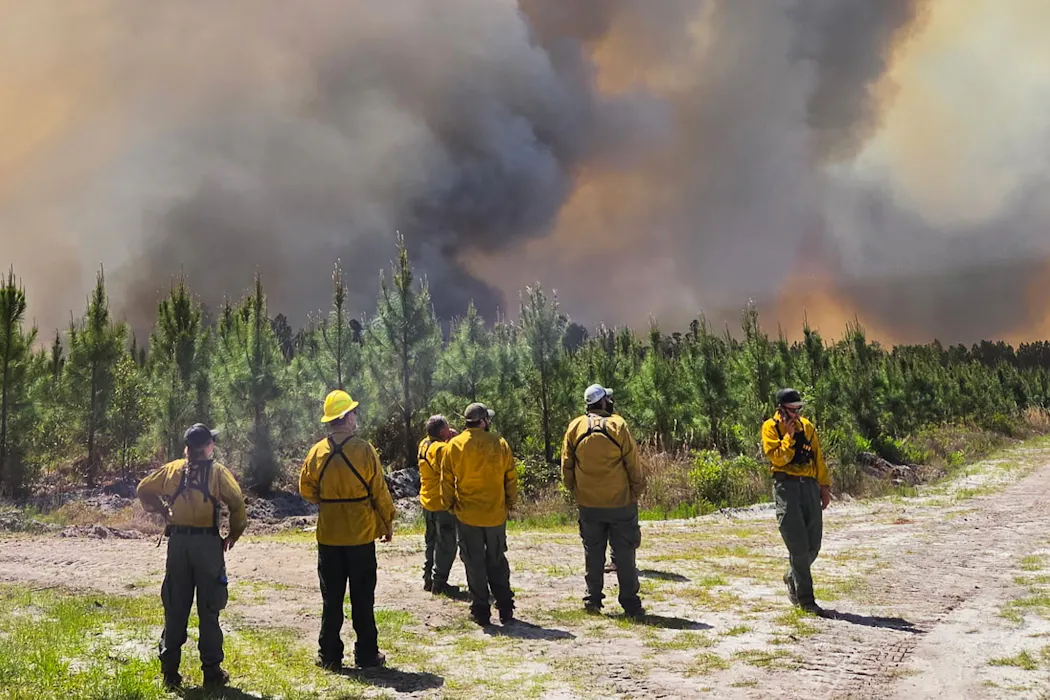
Fire crews responded to dozens of wildfires burning in Georgia and northern Florida on April 23, 2026. Georgia Department of Natural Resources via AP

Large parts of the southeastern U.S. are in the midst of an exceptional drought, and it is fueling dozens of wildfires in Florida and Georgia.

One of those wildfires, in southeastern Georgia’s Brantley County, had destroyed more than 50 homes by April 23, and state officials said about 1,000 other homes were at risk. Another fire near the Georgia-Florida border had burned almost 30,000 acres and was only about 10% contained. The smoke from the blazes triggered air quality alerts in Atlanta, in the north-central part of the state.

So why is a region of the U.S. more often known for thunderstorms and humidity in spring seeing so many wildfires?

A forested area with a burned-out vehicle, burned trees and gray ash covering everything.
A fire near the Florida-Georgia line had burned nearly 30,000 acres by April 23, 2026, leaving ash behind.
Georgia Department of Natural Resources via AP

I teach meteorology at the Georgia Institute of Technology, including how weather patterns can lead to conditions conducive to wildfires. Here’s what’s happening to drive these conditions:

Key ingredients for a wildfire

Wildfires need a few key ingredients to spread: low relative humidity, dry fuels and strong winds.

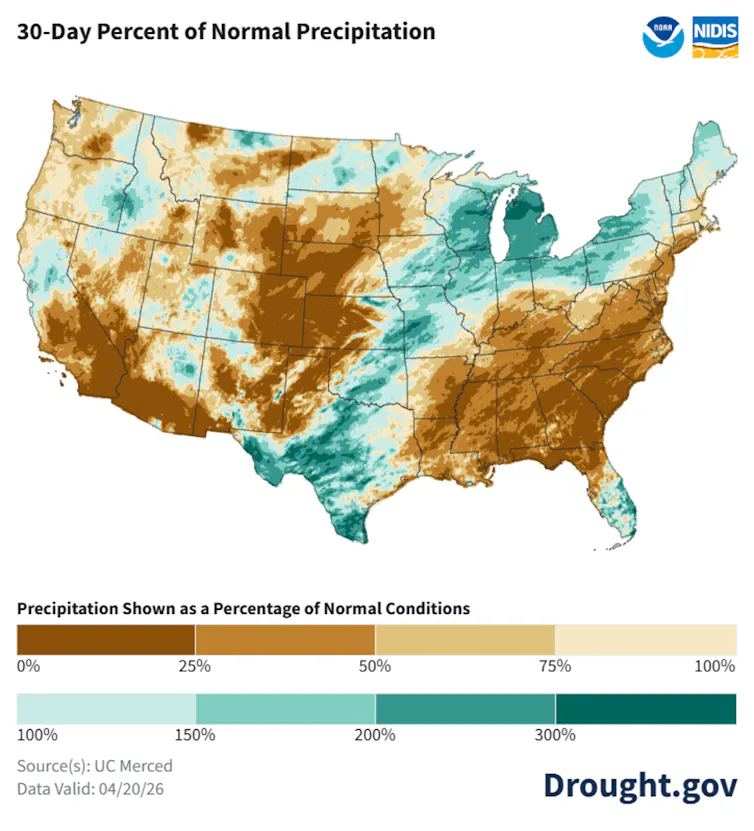
Much of the Southeast has been in a drought since July 2025. From mid-March to mid-April 2026, the region saw less than a quarter of its normal precipitation for that time of year.

A U.S. map showing very dry conditions over much of the eastern U.S., the Southwest and the Great Plains.
A map showing how far above or below average precipitation has been in each region from mid-March to mid-April 2026 shows just how dry much of the U.S. Southeast has been.
Drought.gov

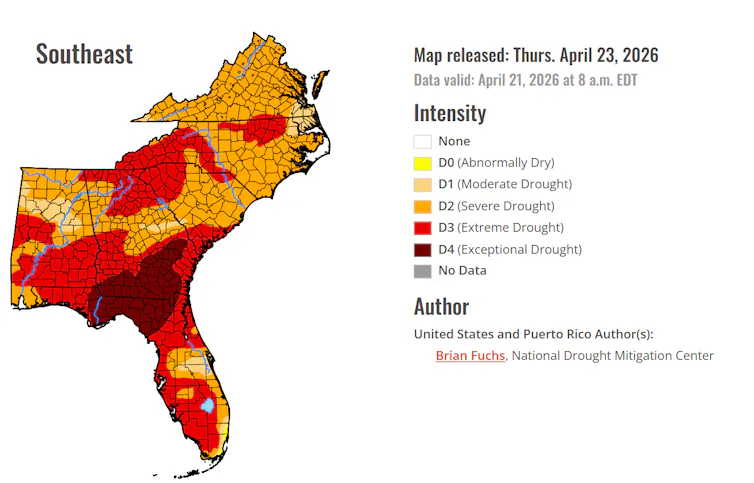
As a result, the U.S. Drought Monitor classified most of this region in “extreme” or “exceptional” drought by mid-April.

In the map of the Southeast, an area of exceptional drought stretches from the Florida Panhandle to central coastal Georgia. much of the rest of the two states are extreme drought.
A map of the U.S. Southeast as of April 21, 2026, shows exceptional drought across the Georgia-Florida border area and extreme drought in many other areas.
Brian Fuchs, National Drought Mitigation Center/U.S. Drought Monitor

Part of the reason for the lack of rainfall has been a persistent high-pressure system over the Southeast.

High-pressure systems are areas where air aloft sinks toward the surface, preventing clouds and precipitation from forming. The Southeast high-pressure system resulted from the presence of a “ridge” in the jet stream, a northward bend in this fast current of air several miles above Earth’s surface.

Another consequence of this high pressure has been the presence of generally southeast winds, which have transported warm and fairly dry air into the area.

The relative humidity – a measure of the amount of moisture in the air relative to the maximum amount the air can contain at its actual air temperature – has also been very low due to warmer-than-usual temperatures and lower-than-usual moisture.

A weather map shows the high-pressure system over the Southeast keeping conditions dry.
A weather map from the Global Forecast System shows the forecasted low-pressure (red L) and high-pressure (blue H) systems.
Pivotal Weather

As a result of these conditions, trees, grass and leaves dry out and can quickly become fuel for wildfires. That kind of dry fuel is widespread throughout rural areas of Georgia and north Florida.

Once a fire starts, whether from lightning, power lines or other human sources, strong winds can spread it rapidly in these conditions.

What’s ahead for the region?

As global temperatures rise, the frequency of drought conditions in the Southeast will increase. This, in combination with less soil moisture content in the summer, could be conducive for increased wildfire activity.

Wildfires do eventually burn out. It takes a combination of help from the atmosphere, with moisture to douse them, and firefighters clearing away dry fuel to stop their spread.

Georgia and Florida may get a reprieve soon from the weather, as multiple low-pressure systems are forecast for the region in late April and early May that could bring rainfall. In the meantime, more than half of Georgia’s counties are under a state of emergency, as several agencies battle the flames to protect homes with helicopters in the air and firefighters on the ground.

The Conversation

Dr. Zachary Handlos receives funding from the U.S. National Science Foundation. He is affiliated with the Georgia Institute of Technology (i.e., “Georgia Tech”) School of Earth and Atmospheric Sciences (EAS) and is the Director of their Atmospheric and Oceanic Sciences (AOS) undergraduate degree program. He is also currently the chair of the American Meteorological Society (AMS) Board on Higher Education (BHE).

ref. Why the Southeast is burning – extreme drought is only part of the reason – https://theconversation.com/why-the-southeast-is-burning-extreme-drought-is-only-part-of-the-reason-281392

Supreme Court’s ‘shadow docket’ brings hasty decisions with long-lasting implications, outside of its usual careful deliberation

Source: The Conversation – USA – By Wayne Unger, Associate Professor of Law, Quinnipiac University

The U.S. Supreme Court is being criticized for decisions that are made quickly and outside of public view. Al Drago/Bloomberg via Getty Images

The recent publication of confidential Supreme Court memoranda by The New York Times has brought to light a pivotal moment in the court’s history. “The birth of the Supreme Court’s shadow docket has long been a mystery,” wrote reporters Jodi Kantor and Adam Liptak. “Until now.”

Originally coined by legal scholar William Baude, the term “shadow docket” refers to the Supreme Court’s emergency docket, which, as Baude wrote, includes “a range of orders and summary decisions that defy its normal procedural regularity.”

That’s law professor-speak for cases that are given abbreviated consideration and accelerated review by the justices, all out of public view – what The New York Times story referred to as the court “sprinting.” These cases aren’t included in the annual list of cases the justices have chosen to consider and that are presented by attorneys in public sessions, called “oral argument,” at the court.

During the second Trump administration, such shadow docket cases have proliferated as President Donald Trump has continued to push boundaries, challenge precedents and expand executive power. These cases have typically involved a request by the presidential administration “to suspend lower court orders” that temporarily block “an administration policy from taking effect,” according to liberal legal advocacy group the Brennan Center for Justice at New York University School of Law.

The lack of transparency in considering and ruling on the shadow docket, combined with the weight of the issues presented to the court via that docket, mean that the practice has come under strong criticism by many court watchers. Here’s how the process works and what you need to know to evaluate it.

A man with short hair, wearing a black robe over a white shirt and blue tie.
Supreme Court Chief Justice John Roberts played a key role in pressing for the court to consider a major case first through the shadow docket.
Leah Millis-Pool/Getty Images

The merits docket

The emergency docket is different from the court’s merits docket, which is the customary path for cases to reach the Supreme Court.

Ordinarily, in federal courts, a case begins in a federal district court. An appeal of the decision in the case is made to a federal appeals court. If a party in the case wants to appeal further, they can aim for U.S. Supreme Court review. That requires filing a “petition for writ of certiorari” to the court.

The Supreme Court does not take all the cases for which it has been petitioned. The court holds complete discretion to choose which cases to consider each term and always rejects the vast majority of petitions that it receives. By custom, the court agrees to consider a case if at least four justices vote to grant the writ of certiorari.

For the cases that the court agrees to consider, the parties to that case file briefs – written legal arguments – with the Supreme Court. Third parties can also file briefs with the court to assert their own arguments; these are known as “friend of the court” or amicus curiae briefs.

The justices then read those briefs and hear oral arguments in the case in a public session, during which they can question attorneys for both sides, before they meet and confer. At the end of this conference, the justices vote on the outcome in the case before assigning an author to draft the opinions.

The merits docket – the ordinary process – is methodical. It promotes deliberation and reasoned decision-making resulting in lengthy opinions that explain the justices’ rationale and provide guidance for lower courts in future cases.

The emergency docket

On the other hand, the emergency docket is a process whereby the court makes quick decisions without full briefing and deliberation, and it produces orders and rulings that almost always present little to no explanation.

As Baude wrote, “Many of the orders lack the transparency that we have come to appreciate in its merits cases.”

Most of the court’s rulings and orders in cases on the emergency docket go without explanation. On occasion, however, the court produces short opinions that provide some explanation in emergency docket cases, albeit these are often dissents from the justices who disagree with the ruling.

Transparency is important, especially for the Supreme Court, because it builds trust and legitimacy. According to Gallup, as of September 2025, 42% of respondents approve, 52% disapprove and 6% have no opinion of the Supreme Court. A 2025 Pew Research Center poll found that 48% of Americans have a favorable view of the court, down from 70% five years earlier.

As a constitutional law scholar, I’ve written elsewhere that the low approval might be attributable to the court’s undisciplined overruling of landmark cases regarding individual rights, such as the abortion rights case Roe v. Wade. In my view, it is reasonable to conclude that the court’s lack of transparency, specifically with its growing emergency docket, contributes to distrust in the court.

As the late Justice Sandra Day O’Connor stated, “The Court’s power lies … in its legitimacy, a product of substance and perception that shows itself in the people’s acceptance of the Judiciary as fit to determine what the Nation’s law means and to declare what it demands.”

Conversely, a lack of transparency breeds distrust and erodes institutional legitimacy.

Unprecedented action

The 2016 case at the center of the memoranda published by The New York Times –West Virginia v. EPA – concerned environmental regulation. As the justices’ memoranda illustrate, West Virginia, North Dakota and several energy companies sued the Obama administration over its Clean Power Plan and sought to block the new, transformative regulation from going into effect.

The Clean Power Plan would have required states and energy companies to shift electricity production from higher-emitting to lower-emitting production methods to reduce carbon dioxide emissions.

After losing at the trial court, the states and energy companies filed an emergency appeal to the Supreme Court asking the justices to pause the Obama regulation from going into effect while the parties litigated the case in the lower courts.

This was a highly unusual request because, as Taraleigh Davis at SCOTUSblog confirms, “nobody had previously asked the court to halt such a major executive regulatory action before any appellate court had ruled on it.”

The court granted the unprecedented stay on Feb. 9, 2016, without any explanation as to why it temporarily blocked the Clean Power Plan. It eventually struck down the plan on June 22, 2022.

Defenders of the emergency docket frequently claim that the court’s conduct is permissible because its orders are temporary. In West Virginia v. EPA, the court temporarily blocked the Clean Power Plan from going into effect until it eventually struck it down after hearing the case on its merits docket.

What is overlooked, however, is that even temporary orders from the court can have lasting implications that are difficult, and in some cases impossible, to undo.

Damage done

A group of people holding signs and speaking in front of a large, white building with pillars.
Advocates for Haitians holding temporary protected status appear at a press conference on March 16, 2026, in front of the Supreme Court, which has agreed to rule through its shadow docket on whether they can remain in the U.S.
Roberto Schmidt/AFP via Getty Images

Consider the example of one of Trump’s immigration actions.

The administration seeks to terminate the temporary protected status for Haitian nationals, which had shielded them from deportation. But a federal district court temporarily blocked the president from doing so as the litigation continued.

The administration then filed an emergency appeal to the Supreme Court – still pending as of this writing – asking the court to overrule the district court. If granted, the court effectively would allow the administration to revoke TPS for Haitian nationals.

As an amicus brief in the case articulated, if TPS is revoked, Haitians “will be forced to face the untenable options of leaving behind their citizen children and/or partners, bringing family members with them to a country submerged in crisis, violence, and food insecurity, or staying in the U.S. without any legal status or work authorization and facing the constant threat of deportation.”

In other words, if the Supreme Court overrules the district court in this case on its emergency docket, then the Trump administration could deport the Haitian nationals even as their cases challenging the revocation of their TPS continue.

If the Haitian nationals ultimately prevail, reversing their deportation would be exceptionally difficult to do.

The Conversation

Wayne Unger does not work for, consult, own shares in or receive funding from any company or organization that would benefit from this article, and has disclosed no relevant affiliations beyond their academic appointment.

ref. Supreme Court’s ‘shadow docket’ brings hasty decisions with long-lasting implications, outside of its usual careful deliberation – https://theconversation.com/supreme-courts-shadow-docket-brings-hasty-decisions-with-long-lasting-implications-outside-of-its-usual-careful-deliberation-281212