Viral violent videos on social media are skewing young people’s sense of the world

Source: The Conversation – Global Perspectives – By Samuel Cornell, PhD Candidate in Public Health & Community Medicine, School of Population Health, UNSW Sydney

When news broke last week that US political influencer Charlie Kirk had been shot at an event at Utah Valley University, millions of people around the world were first alerted to it by social media before journalists had written a word.

Rather than first seeing the news on a mainstream news website, footage of the bloody and public assassination was pushed directly onto audiences’ social media feeds. There weren’t any editors deciding whether the raw footage was too distressing, nor warnings before clips auto-played.

Australia’s eSafety commissioner called on platforms to shield children from the footage, noting “all platforms have a responsibility to protect their users by quickly removing or restricting illegal harmful material”.

This is the norm in today’s media environment: extreme violence often bypasses traditional media gatekeepers and can reach millions of people, including children, instantly. This has wide-ranging impacts on young people – and on society at large.

A wide range of violence

Young people are more likely than older adults to come across violent and disturbing content online. This is partly because they are more frequent users of platforms such as TikTok, Instagram and X.

Research from 2024 from the United Kingdom suggests a majority of teenagers have seen violent videos in their feeds.

The violence young people see on social media ranges from schoolyard fights and knife attacks to war footage and terrorist attacks.

The footage is often visceral, raw and unexpected.

A wide range of harms

Seeing this kind of violent footage on social media can make some children not want to leave the house.

Research also shows engaging with distressing media can cause symptoms similar to trauma, especially if the violence feels close to our own lives.

Research shows social media is not simply a mirror of youth violence but also a vector for it, with bullying, gang violence, dating aggression, and even self-directed violence playing out online. Exposure to these harms can have a negative effect on young people’s mental health, behaviour and academic performance.

For others, violent content on social media risks “desensitisation”, where people become so used to suffering and violence they become less empathetic.

Communication scholars also point to cultivation theory – the idea in this case that people who consume more violent content begin to see the world as potentially more dangerous than it really is.

This potentially skewed perception can influence everyday behaviour even among those who do not directly experience violence.


Read more:
How images of knives intended to stop youth knife crime may actually be making things worse


A long history of violence

Violence distributed by media is as old as media itself.

The ancient Greeks painted their pottery with scenes of battles and slaying. The Romans wrote about their gladiators. Some of the first photographs ever taken were of the Crimean War. And in the second world war, people went to the cinema to watch newsreels for updates on the war.

The Vietnam war was the first “television war” – images of violence and destruction were beamed into people’s homes for the first time. Yet television still involved editorial judgement. Footage of violence was cut, edited, narrated and contextualised.

Seeing violence as if you were there has been transformed by social media.

Now, footage of war, recorded in real time on phones or drones, is uploaded to TikTok or YouTube and shared with unprecedented immediacy. It often appears without any additional context – and often isn’t packaged any differently to a video of, say, somebody walking down the street or hanging out with friends.

War influencers have emerged – people who post updates from conflict zones, often with no editorial training, unlike war journalists. This blurs the line between reporting and spectacle. And this content spreads rapidly, reaching audiences who have often not sought it.

Israel’s military even uses war influencers to “thirst trap” social media users for propaganda purposes. A thirst trap is a deliberately eye-catching, often seductive, social media post designed to attract attention and engage users.

How to opt out of violence

There are some practical steps that can be taken to reduce your chances of encountering unwanted violent content:

  • turn off autoplay. This can prevent videos from playing unprompted

  • use mute or block filters. Platforms such as X and TikTok let you hide content with certain keywords

  • report disturbing videos or images. Flagging videos for violence can reduce how often they are promoted

  • curate your feed. Following accounts that focus on verified news can reduce exposure to random viral violence

  • take a break from social media, which isn’t as extreme as it sounds.

These actions aren’t foolproof. And the reality is that users of social media have very limited control over what they see. Algorithms still nudge users’ attention toward the sensational.

The viral videos of Kirk’s assassination highlight the failures of platforms to protect their users. Despite formal rules banning violent content, shocking videos slip through and reach users, including children.

In turn, this highlights why more stringent regulation of social media companies is urgently needed.

The Conversation

Samuel Cornell receives funding from an Australian Government Research Training Program Scholarship.

T.J. Thomson receives funding from the Australian Research Council. He is an affiliate with the ARC Centre of Excellence for Automated Decision Making & Society.

ref. Viral violent videos on social media are skewing young people’s sense of the world – https://theconversation.com/viral-violent-videos-on-social-media-are-skewing-young-peoples-sense-of-the-world-265371

Emmy-winning ER drama ‘The Pitt’ shines a light on compassionate teaching

Source: The Conversation – Canada – By Elizabeth A. Marshall, Professor of Education, Simon Fraser University

The Pitt, HBO Max’s Emmy-winning television medical drama, is a breakout hit.

Medical professionals and critics alike laud the show for its realistic portrayal of an emergency room.

That the show is also a master class in teaching has largely escaped notice.

As a critic and scholar who writes about representations of teachers in popular media,
I hadn’t expected to think about teaching when tuning in for a fictional show about Pittsburgh Trauma Medical Hospital.

Popular media: education and escape

Philosopher of education Adam Greteman and K.J. Burke, an expert in teacher education, highlight how popular media serves as an educational space. Lessons about schooling can appear as a pleasurable escape from reality, both reflecting and sometimes distorting the full scope of people’s lived experiences.

Television, film and even children’s picture books shape public perceptions of the teaching profession — and so does The Pitt.

Trailer for ‘The Pitt’

Dr. Michael “Robby” Robinavitch (Noah Wyle) mentors a team of nurses and doctors at a teaching hospital. The ER may not be a formal classroom, but what makes The Pitt so intriguing as a case study about education is its setting outside the classroom. Interns learn on the go in a hands-on setting with real-world consequences and problems.

While I cannot comment specifically about the show’s depictions of what may be needed for best-practice ER infrastructure and education, I’m interested in how the show offers compelling insights around what it means to teach with and through trauma that are relevant for education in schools and at post-secondary levels at large.


Read more:
Living to tell the story: Lawsuit accuses ER doctor of anti-Indigenous racism


The COVID-19 pandemic

The COVID-19 pandemic looms large in The Pitt, and flashbacks to one particularly awful day intrude into Dr. Robby’s mind throughout the episodes. Like doctors and nurses, educators were on the front lines during the pandemic.

A recent study highlights the pandemic’s lingering adverse effect on teacher recruitment and retention. Likewise, in a 2022 study, researchers in the Department of Psychiatry at the University of Colorado School of Medicine found that the stressors on K-12 educators led to burnout and other mental health challenges. Attending to the mental health of both students and teachers as part of, rather than outside of, teacher training is a start.


Read more:
Teachers lack resources to meet classroom needs, and absences shouldn’t surprise us


Stereotypes of male educators

To fully understand Dr. Robby, it is essential to recognize how his character transcends familiar stereotypes of male educators in popular culture. Familiar tropes include the buffoon (Mr. D. in the show of the same name), the burnout (the teacher in Ferris Bueller’s Day Off), the disciplinarian (the assistant principal in The Breakfast Club), the maverick (Dewey Finn in School of Rock, John Keating in Dead Poet’s Society), the villain (Severus Snape in Harry Potter) and the wise mentor (Albus Dumbledore in Harry Potter).

The Pitt’s Dr. Robby doesn’t fit neatly into any of these categories. Specifically, he embraces vulnerability and compassion that expand previous representations of teaching in popular culture.

Dr. Robby has more in common with characters like the teacher Justine Gandy in the 2025 film Weapons or Dan Dunne in the 2006 Half Nelson; deeply flawed, yet highly empathetic — super feelers who connect with the people they teach.

Compassionate teaching methods

Struggling with PTSD from the pandemic and the loss of his mentor, Dr. Robby suffers a panic attack in Episode 13. This background informs Dr. Robby’s compassionate teaching methods, which align with current calls for trauma-informed approaches in education.


Read more:
Hard choices put health workers at risk of mental anguish, PTSD during coronavirus


Dr. Robby leans into trauma on both a social (the pandemic and its aftermath; an epidemic of drug overdoses) and an individual level (the loss of his own mentor to COVID-19 under his watch) as the starting point for instruction.

After 15 years of university teaching, I, too, begin with the assumption that most students are merely holding it together for class as they deal with a range of experiences like personal depression, anxiety, grief and abuse, as well as collective distress about wildfires, war and increasing authoritarianism across the globe.

Cultural diversity

The Pitt’s diverse cast speaks multiple languages and brings different cultural perspectives to the ER. Dr. Robby’s ability to build on the differences of the interns, doctors and staff endorses equity and inclusion as essential to the art of teaching, especially as DEI initiatives are being dismantled or rebranded across North America.

While classrooms in the United States and Canada are increasingly ethnically and linguistically diverse, the teachers are not. The ER is stronger because of the differences that the interns bring.

Violence

In Episode 12, “6:00 p.m.,” a mass shooting at a music festival fills the hospital with victims who need to be triaged.

Not only in the U.S., but also in Canada, educational systems advise lockdown drills. The Aug. 27, 2025, Annunciation Catholic Church shooting in the U.S. is just one example of how teachers in the U.S. live with the reality and fear of threats from guns. Such threats are not as present across Canadian educational spaces, but still a reality.

And in both health care and schools, such stark eruptions point to wider systemic problems that need to be addressed across society, not only when they become crises.

Dr. Robby receives constant pressure to prioritize profits over patient care. Likewise, as post-secondary institutions struggle with financial constraints as they navigate the pandemic’s fallout, The Pitt teaches us that now, more than ever, we need to value face-to-face interaction.

Across disciplines, institutions need to provide supports for educators to shape emergent curricula co-built with and for the students who show up in our classrooms. Students need opportunities in their own communities to work side by side with an experienced mentor, like Dr. Robby, in hands-on, real-world spaces outside of the formal classroom.

The teacher we need

Dr. Robby is no John Keating of Dead Poets Society, and that’s a refreshing break from romanticized ideas about individual teachers saving the day.

The Pitt offers us instead a vulnerable yet compassionate male teacher with fears and flaws like his interns and patients. Dr. Robby is the teacher we all need right now.

The Conversation

Elizabeth A. Marshall does not work for, consult, own shares in or receive funding from any company or organisation that would benefit from this article, and has disclosed no relevant affiliations beyond their academic appointment.

ref. Emmy-winning ER drama ‘The Pitt’ shines a light on compassionate teaching – https://theconversation.com/emmy-winning-er-drama-the-pitt-shines-a-light-on-compassionate-teaching-265429

Ukraine is starting to think about memorials – a tricky task during an ongoing war

Source: The Conversation – Global Perspectives – By Kerry Whigham, Associate Professor of Genocide and Mass Atrocity Prevention, Binghamton University, State University of New York

Three and a half years after Russia invaded Ukraine, there are few immediate signs of a cessation to the ongoing hostilities. Yet amid the steady toll of front-line fighting and near-daily Russian airstrikes, Ukrainians are already considering how to remember the tens of thousands of lives lost over the course of this conflict.

A spontaneous memorial of flags and photographs already exists and grows daily, having first sprung up in 2022 in Kyiv’s Independence Square. Now, government and civil society groups have begun conversations on how such acts of commemoration can be made more permanent through monuments and memorials across the country.

As a scholar of public memory and how societies remember large-scale violence and mass atrocities, I study and support the work of governments and organizations developing memory sites around the world. As Ukraine negotiates its own related challenges, lessons from research on how memorials have changed and the role they can play in post-violence societies can help guide these processes.

The long history of remembering war dead

The impulse to create public monuments to remember collective death, like war, is millennia old. The first known war memorial dates to over 4,000 years ago in modern-day Syria. Obelisks and triumphal arches that dotted ancient Egypt and ancient Rome have served similar purposes.

As societies have progressed and architectural tastes have changed, so too have war monuments. Still, there are some underlying traits that have remained relatively consistent for thousands of years.

Traditionally, war memorials used monumental architecture to remember those who died during conflict. Typically, they were aimed at honoring soldiers who died fighting for their country. The monuments framed the death of soldiers as a sacrifice for a higher cause, often using larger-than-life architectural elements and materials like marble and granite to convey a sense of both grandeur and memory permanence.

In that traditional vein of glorification, war memorials typically feature recognizable symbols, like sculptures of soldiers and inscriptions with names or information. By honoring the soldiers who died fighting a war, the monuments also legitimize the war and the state that waged it, marking it as a cause worthy of dying for. In this way, such war memorials are not only about revering soldiers but also venerating the nation-state.

That all started to change following World War I, however. The scale of destruction and death was so widespread and total that countries began erecting war memorials depicting soldiers with their faces downcast or their bodies tired. The sacrifices of the soldiers were still framed as valiant, but the monuments also revealed a war weariness not present in earlier memorials.

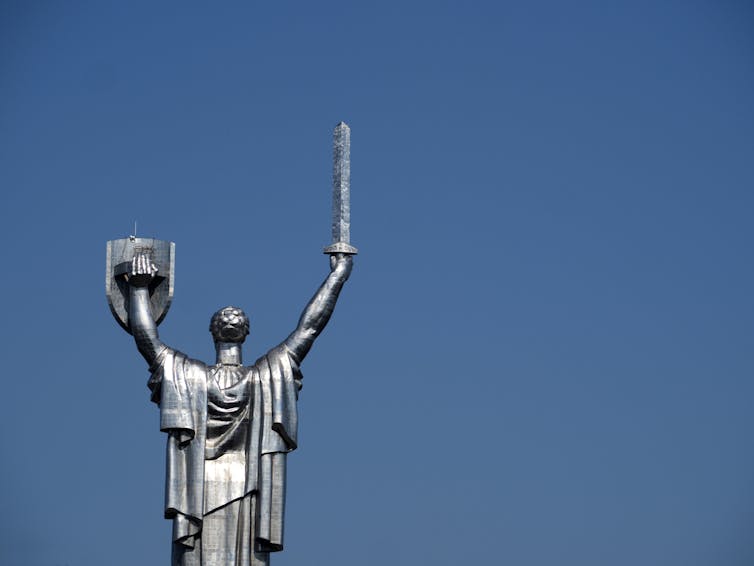
At the same time, communist countries in Eastern Europe and the Soviet Union maintained the tradition of using memorials to celebrate the state. In Soviet-era Ukraine, for instance, the 335-foot-tall Mother Ukraine was erected to tower over Kyiv as a monument to World War II.

A picture of a large statue.
Mother Ukraine Monument statue in Kiev.
Igor Golovniov/SOPA Images/LightRocket via Getty Images

Memorializing the horrors of the 20th century

Outside of the former Soviet Union and Eastern Bloc, however, the horrors of World War II completely transformed the way societies memorialized collective death. This is largely because the deaths that needed commemoration were not only those of soldiers but of the millions of civilians murdered by the Nazi regime, especially European Jews.

Indeed, the Holocaust changed everything about the way the world memorializes large-scale death. The architectural language of the war memorial was completely insufficient for remembering the victims of genocide. They did not sacrifice themselves to the glory of the nation, but instead were slaughtered by governmental leaders.

As a result and over time, memorials focused far less on monumental forms and realistic imagery glorifying the state and opted for abstract and immersive styles intended to invoke a sense of loss and a commitment to preventing future violence. These memorials to victims of genocides and other atrocities also respond to an increasingly recognized “right to memory,” as victims demand acknowledgment of the trauma they have experienced.

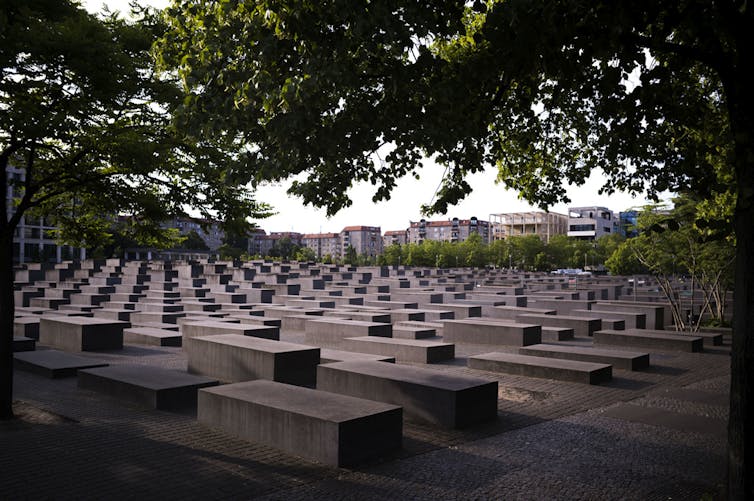
One of the most influential examples of how memorialization has changed is the Memorial to the Murdered Jews of Europe in Berlin. Designed by American architect Peter Eisenman and inaugurated in 2005, it features over 2,700 concrete columns arranged in a grid over almost 5 acres of land in central Berlin. Visitors are invited to walk through the grid-work of columns, which are meant to evoke an emotional response in visitors.

Echoes of this abstract and immersive space can now be seen in numerous other memorials to collective death globally, including the National Memorial for Peace and Justice in Montgomery, Alabama, which memorializes the Black victims of racial terror lynchings in the United States, and the Parque de la Memoria in Buenos Aires, Argentina, which remembers the thousands of people disappeared in the 1970s and 1980s during a military dictatorship.

A monument of stone pieces.
The morning light illuminates the Memorial to the Murdered Jews of Europe, or the Holocaust Memorial, in Berlin.
AP Photo/Markus Schreiber

Ukraine and memorializing the present

As Ukrainians begin the process of determining how best to commemorate their own recent losses, they face some notable challenges.

For one, Ukraine has lost both soldiers, who have died fighting for their country, and civilians, killed through the attacks of invading forces from Russia. Can and should these losses be memorialized together? Or should there be separate memorials to those who died on the battlefield and those others who were killed in atrocities, like the massacre in Bucha of March 2022, which saw the death, torture and rape of hundreds of civilians, including children, by Russian forces?

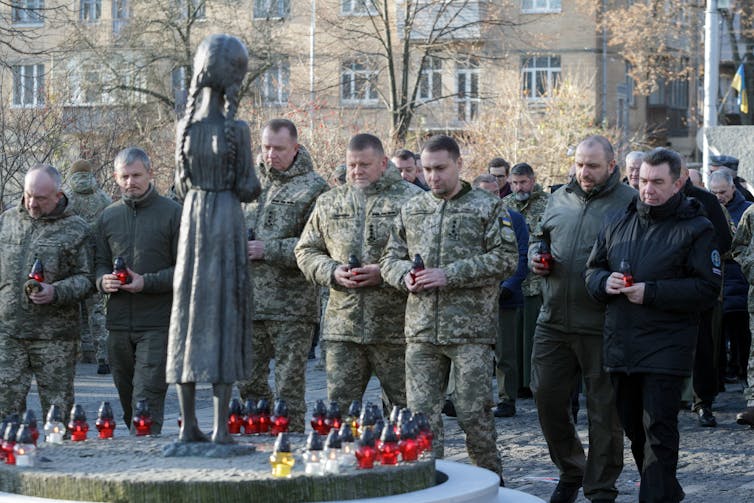
Ukraine is not without experience in memorializing both war and atrocity. Many of its war memorials were constructed during the Soviet period, however, so they tend to utilize the socialist realism style that characterizes most communist-era monuments. But Ukraine has also experienced atrocities, such as the Holodomor, the human-made famine implemented by Josef Stalin in the 1930s that led to the deaths of millions of Ukrainians. The Memorial in Commemoration of the Holodomor-Genocide in Ukraine opened in Kyiv in 2008, 75 years after the Holodomor began.

But determining how to memorialize more recent violence can be a challenge. Memorials serve to literally and figuratively concretize memory. But memory — that is, the story a society tells itself about its past and its impact on the present and future — evolves over time. Communities of victims may desire a memorial as a recognition of the harms that they have suffered, and this can indeed be an important step in symbolically repairing those damages.

But it may be difficult to get a full “picture” of the story a memorial should tell while violence is ongoing. The victim count is increasing every day. And now there is also some pushback within Ukraine against the way President Volodymyr Zelenskyy is governing and approaching issues of internal corruption.

Ukrainians had 75 years to determine how they wanted to relate to and remember the Holodomor. With so much uncertainty, any memorial built now to the current war may need to be reconsidered in the very near future as government officials, victim groups and other stakeholders continue to discuss how they want to remember this violence.

Soldiers stand before a memorial.
Senior members of the Ukrainian military establishment leave vigil lanterns at the Bitter Memory of Childhood monument at the National Museum of the Holodomor-Genocide in Kyiv.
Kirill Chubotin/Ukrinform/Future Publishing via Getty Images

Today, many experts and practitioners advocate for conversations on memorialization to take place alongside other processes that societies undergo to deal with histories of violence and human rights abuses. Often labeled “transitional justice,” these processes of truth-seeking, justice, reparations and reform can complement processes of memorialization. Engaging actively with all the consequences of past violence can be crucial in developing a consensus on how to remember that violence and educate future generations about it.

Undertaking such tasks while violence is ongoing, however, can be difficult, if not impossible. The underlying instability caused by war, along with the uncertainty around what the future will bring, leaves so many open questions that it may be too soon to start answering them. That said, the groundwork can be laid now so that these processes can begin as quickly as possible once the war finally comes to an end.

Ukrainians are understandably ready to move forward and deal with the repercussions of this horrific violence. But building a memorial will not, in itself, mark the end of the conflict and, as such, may be putting the cart before the horse. Victims have a right to memory, but they first and foremost have a right to peace. The picture of what story should be told through public memorials and monuments will become clearer once it is not so obscured by the fog of war.

The Conversation

Kerry Whigham is affiliated with the Auschwitz Institute for the Prevention of Genocide and Mass Atrocities, an international non-governmental organization that works on atrocity prevention.

ref. Ukraine is starting to think about memorials – a tricky task during an ongoing war – https://theconversation.com/ukraine-is-starting-to-think-about-memorials-a-tricky-task-during-an-ongoing-war-263598

Can Charlie Kirk really be considered a ‘martyr’? A Christianity historian explains

Source: The Conversation – Global Perspectives – By Jonathan L. Zecher, Associate Professor, Institute for Religion and Critical Inquiry, Australian Catholic University

Charlie Kirk: white nationalist, conservative Christian, right-wing social media personality, shooting victim, and now, a “martyr”. That is, according to his supporters.

Since Kirk’s death last week, a number of his followers from the Christian right have ascribed him the title of “martyr”. President Donald Trump himself called Kirk a “martyr for truth and freedom”.

Similarly, Rob McCoy, a pastor emeritus from California, said at a Sunday morning church service

Today, we celebrate the life of Charlie Kirk, a 31-year-old God-fearing Christian man, a husband, father of two, a patriot, a civil rights activist, and now a Christian martyr.

Looking back at the history of martyrdom offers insight into what it means for Kirk to be hailed a martyr, both for his memory, and for the future of the United States.

From witness to criminal to witness again

The term martyr emerged in ancient law courts with the Greek word martus, meaning a witness or person who gives testimony.

From their earliest days, Christians appropriated it to refer to those who testified to the gospel of Jesus Christ. The gospel of Luke even concludes with Jesus telling his disciples: “You are witnesses – martyres – of these things” (Luke 24:48).

Early Christians regularly ran afoul of Roman authorities, and were brought to court as criminals. The charges generally revolved around questionable loyalty to the Roman state and religion. Could someone worship Jesus and also offer sacrifice to the traditional gods, including the emperor or his divine spirit (his “genius”)?

Christians and Romans alike thought not. From the 2nd century onward, accounts of these trials centred on a single question: “are you a Christian?”. If the answer was “yes”, execution followed.

For local authorities, the executed person was a criminal. But for fellow Christians, they were witnesses to the truth of the gospel, and their deaths were evidence of the Christian God. They were both witness and testimony – “martyrs” in every sense.

In 2004, scholar of early Christianity, Elizabeth Castelli, argued martyrs are born only after their death. The martyr isn’t a fact, but a figure produced by the stories told about them, and the honour afforded them in ritual commemorations. A person isn’t a martyr until other people within a specific community decide they are.

To understand what makes someone a martyr, we have to ask two questions:

  1. what are they a witness to? As in, what ideal or cause led to their death and how did their death testify to it?

  2. who are they a witness for? Who tells their story and who calls them a martyr?

Boundaries and borderline cases

The history of martyrdom is also a history of debates over what kind of death “counts”, and what role martyrs play in the church.

Questionable cases have accumulated through the decades. Some “martyrs” volunteered eagerly, perhaps too eagerly.

On April 29 304 CE, an archdeacon named Euplus stood outside the city council chamber in Catania, Sicily, shouting: “I want to die; I am a Christian”. After some discussion, the governor sentenced him to torture and he died of his injuries. Was this martyrdom, or suicide?

Under Christian emperors from the 4th century on, soldiers who died fighting Persians (or later Arabs) also came to be called martyrs. A soldier’s death is especially considered martyrdom if they fought against members of a different religion.

However, the soldier-martyr label has also raised anxieties. The most recent example came from the troubling claim by Russian Orthodox Patriarch Kyrill that Russian soldiers who die fighting in Ukraine are martyrs – despite fighting fellow Orthodox Christians. What do these soldiers testify to?

The stories of martyrs define community borders. Those who kill martyrs tend to be treated as enemies of the faith, whether they are Roman authorities, enemy combatants, or even people assumed to be complicit in the event.

The MAGA martyr

Let’s apply the two questions above to Charlie Kirk, who has been dubbed both “martyr” and “patron saint of MAGA”.

What would Kirk be a martyr to? To his supporters and those on the MAGA right, he died for free speech, for Judeo-Christian values, for a commitment to “Western civilisation”, and supposedly for the “truth” itself.

To others, especially those he attacked and denigrated publicly – such as queer and trans people, immigrants, Muslims and feminists – he died for white nationalism, hatred and exclusion.

This takes us back to the second question: who is Charlie Kirk a martyr for? Clearly, the answer to this is Christian nationalists, MAGA supporters and the broader American right.

He testified in life to their shared beliefs and values, and in death is their “patron saint”. The legacy of Kirk’s death will be to define who is part of this community, and who is excluded. The question then is, will a division framed in such polarising terms come to define American society as a whole?

From revenge to love

Following Kirk’s death, people on the far-right called for violent revenge against the left – even though the shooting suspect’s political motivations are unknown.

Media have reported a surge in radicalisation on right-wing platforms. There was even a website, now removed, dedicated to doxxing anyone who spoke negatively about Kirk and using that information to get them fired.

Against this rhetoric of revenge, the history of martyrdom offers a different way forward. The early theologian, Clement of Alexandria, said someone becomes a martyr not because of their death, but because of their love.

The only true witness, he argued, is love, because God is love. The only honour one can offer the martyrs is to love as they loved. Clement suggests it’s possible to reject vengeance and sectarianism, even if one loves the martyrs.

The Conversation

Jonathan L. Zecher does not work for, consult, own shares in or receive funding from any company or organisation that would benefit from this article, and has disclosed no relevant affiliations beyond their academic appointment.

ref. Can Charlie Kirk really be considered a ‘martyr’? A Christianity historian explains – https://theconversation.com/can-charlie-kirk-really-be-considered-a-martyr-a-christianity-historian-explains-265283

How hardships and hashtags combined to fuel Nepal’s violent response to social media ban

Source: The Conversation – Global Perspectives – By Nir Kshetri, Professor of Management, University of North Carolina – Greensboro

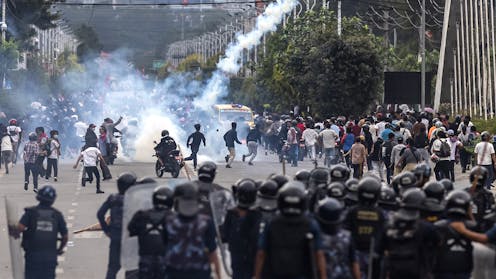
Riot police fire tear gas into crowds of demonstrators in Kathmandu on Sept. 8, 2025. Prabin Ranabhat/AFP via Getty Images

Days of unrest in Nepal have resulted in the ousting of a deeply unpopular government and the deaths of at least 50 people.

The Gen Z-led protests – so-called due to the predominance of young Nepalese among the demonstrators – appeared to have quieted down with the appointment on Sept. 12, 2025, of a new interim leader and early elections.

But the protests leave behind dozens of burned government offices, destroyed business centers and financial losses estimated in the billions of dollars.

The experience has also underscored the importance of social media in Nepal, as well as the consequences of government attempts to control the flow of online information.

I study the economic, social and political impacts of social media and other emerging technologies. Being based in Kathmandu, I have watched firsthand as what began as a protest over a short-lived ban on social media snowballed into something far greater, leading to the toppling of Prime Minister K.P. Sharma Oli.

Indeed, social media has played a crucial role in this ongoing turmoil in two ways. First, the government’s decision on Sept. 4 to ban social platforms served as the immediate catalyst to the unrest. It provoked anger among a generation for whom digital spaces are central not only to communication, identity and political expression, but also to education and economic opportunities.

And second, the pervasive use of these platforms primed the nation’s youth for this moment of protest. It heightened Gen Z’s awareness of the country’s entrenched social, economic and political problems. By sharing stories of corruption, privilege and inequality, social media not only informed but also galvanized Nepal’s youth, motivating collective mobilization against the country’s systemic injustice.

The role of social media

As with many other nations, social media is central to daily life and commerce in Nepal, a landlocked nation of 30 million people situated between two Asian giants: China and India.

As of January 2025, just short of half the population had social media accounts. This includes some 13.5 million active Facebook users, 3.6 million Instagram users, 1.5 million LinkedIn users and 466,100 X users.

Indeed, social media platforms drive roughly 80% of total online traffic in the country and serve as vital channels for business and communication. Many users in Nepal depend on these platforms to run and promote their businesses.

As such, the government’s decision to block 26 social media platforms sparked immediate concern among the Nepalese public.

The move wasn’t completely out of the blue. Nepal’s government has long been concerned over the growth of social media platforms.

In November 2023, the Ministry of Communication and Information Technology introduced new social media regulations, requiring platforms to register with the government, set up a local contact point, appoint a grievance officer and designate an oversight official. Platforms were also obliged to cooperate in criminal investigations, remove illegal content and comply with Nepali law.

The Nepalese government, citing concerns over fake accounts, hate speech, disinformation and fraud, said the measures were to ensure accountability and make operators responsible for content on their platforms. Then, in January 2025, the government introduced a Social Media Bill that placed further requirements on social media platforms.

Censorship concerns

Regardless of their intent, these government measures sparked immediate civil liberties concerns. Critics and rights groups argued that both the ban and the bill function as tools for censorship, threatening freedom of expression, press freedom and fundamental rights.

Ncell, Nepal’s second-largest telecommunications service provider, noted that shutting down all platforms at once was, in any case, technically difficult and warned that the move would severely impact business. Small business owners, who rely on social media to promote and sell their products, were especially worried with a busy festive season looming.

The ban also had significant implications for education. Many students rely on social media platforms to access online classes, research materials and collaborative learning tools.
More generally, the Nepalese public criticized the government’s measures disproportionate impact on ordinary users.

As such, this deep reliance on social media by Nepalese society turned the ban into a flashpoint for public dissent.

The rise of #NepoKids

Even before the protests began on Sept. 8, the pervasive use of social media, along with exposure to content showcasing inequality and elite privilege, had heightened Gen Z’s awareness of Nepal’s entrenched social, economic and political problems.

A few weeks before the protests began, the hashtags #NepoBaby and #NepoKids began trending, fueled by viral videos of politicians’ lavish lifestyles.

The content drew attention to the country’s inequality by contrasting the lives of the children of the country’s elite – with designer clothing and foreign vacations – with images of Nepali migrant workers returning home in coffins from dangerous jobs abroad.

The hashtag campaigns gained traction on TikTok and Reddit, leading to calls for asset investigations, anti-corruption reforms and even transferring the assets of the wealthy to public ownership.

One particularly notable viral video featured the son of a provincial government minister posing in front of a tree made from boxes of luxury labels including Louis Vuitton, Cartier and Gucci.

Such posts served to further fuel public outrage over perceived elite privilege.

The immediacy and interactivity of social media platforms amplified the outrage, encouraging group mobilization. In this way, social media acted both as a magnifier and accelerator, linking perceived injustice to on-the-ground activism and shaping how the movement unfolded even before the Sept. 8 protests began.

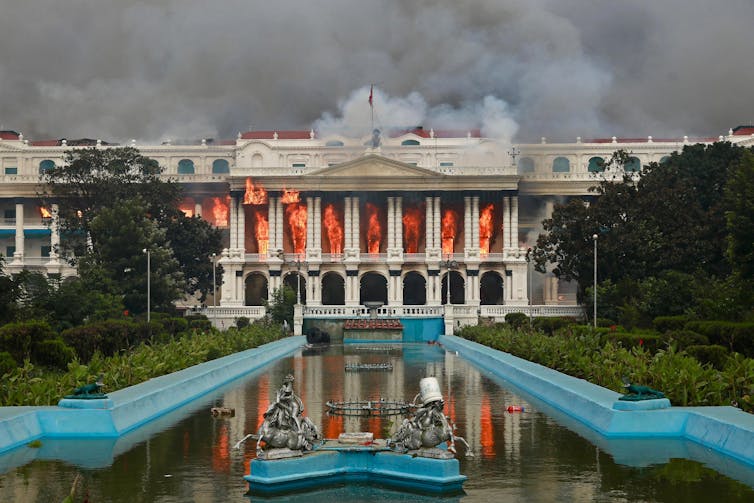
Flames are seen coming out of a large white buildins.
Fire rages through the Singha Durbar, the main administrative building for Nepal’s government, in Kathmandu on Sept. 9, 2025.
Prabin Ranabhat/AFP via Getty Images

A deeper story of hardship and corruption

Yet a social media campaign is nothing without a root cause to shine a light on.

Economic insecurity and political corruption have for years left many of Nepal’s youth frustrated, setting the stage for today’s protest movement. While the overall unemployment rate in 2024 was 11%, the youth unemployment rate stood significantly higher at 21%.

But these figures only scratch the surface of Nepal’s deep economic problems, which include pervasive vulnerable employment – informal and insecure work that is prone to poor conditions and pay – and limited opportunities that constrain long-term productivity.

Between 2010 and 2018, fewer than half of new entrants into the workforce secured formal, stable jobs; the remainder were primarily engaged in informal or precarious work, which often lacked consistent income, benefits or legal protections. Most available positions are informal, poorly compensated and offer little stability or room for career growth.

All told, children born in Nepal today face a grim economic reality. By age 18, they are likely to achieve only about 51% of their productivity potential – that is, the maximum economic output they could reach if they had full access to quality health, nutrition and education.

Meanwhile, corruption is widespread. In 2024, Nepal ranked 107th out of 180 countries on Transparency International’s Corruption Perceptions Index, with 84% of people perceiving government corruption to be a major problem.

An upshot of corruption is the growing influence of Nepal’s politically connected business elite, who shape laws and regulations to benefit themselves. In the process, they secure tax breaks, inflate budgets and create monopolies that block competition.

This capture of public policy by an entrenched elite stifles economic growth, crowds out genuine entrepreneurs and exacerbates inequality, while basic public services remain inadequate.

Combined, these economic and political pressures created fertile ground for social mobilization. While persistent hardships helped fuel the rise of the #Nepokids movement, it was social media that gave voice to Nepali youths’ frustration.

When the government attempted to silence them through a ban on social media platforms, it proved to be a step too far.

The Conversation

Nir Kshetri does not work for, consult, own shares in or receive funding from any company or organization that would benefit from this article, and has disclosed no relevant affiliations beyond their academic appointment.

ref. How hardships and hashtags combined to fuel Nepal’s violent response to social media ban – https://theconversation.com/how-hardships-and-hashtags-combined-to-fuel-nepals-violent-response-to-social-media-ban-264932

Canada’s tariff wall on Chinese electric vehicles is deepening dependence on the U.S.

Source: The Conversation – Canada – By Addisu Lashitew, Assistant Professor, DeGroote School of Business, McMaster University

In October 2024, Canada imposed a 100 per cent tariff on all electric vehicle (EV) imports from China, effectively barring consumers from accessing some of the world’s most innovative, affordable models. These tariffs are deepening the country’s dependence on the United States and undermining its climate goals.

Canada’s unusually prohibitive tariff mirrored the strategy of the U.S., which imposed a 100 per cent duty on Chinese EVs in September 2024.

The government justified its “tariff fortress” by pointing to China’s extensive industrial policy, such as subsidies, that artificially lower production costs. The tariffs were claimed to protect domestic producers by offsetting the cost advantage enjoyed by Chinese EV manufacturers.

While this rationale has some basis, it is highly overstated. The European Union’s in-depth investigation into Chinese support for the EV industry revealed company-specific subsidy levels, ranging from 7.8 per cent for Tesla Shanghai to 35.3 per cent for the SAIC Group, which subsequently became the basis for imposing countervailing duties.

Agriculture Minister Heath MacDonald recently said the government is considering scrapping the tariffs — a recognition that the policy may now be outdated.

A year ago, co-ordinating with the U.S. against China’s growing EV industry might have seemed defensible, but today, it leaves Canada in a weakened position in its ongoing trade war with the U.S.

This policy is misaligned with Canada’s long-term interests. It weakens economic independence, slows decarbonization and forces Canadians to pay more for EVs.

Tariffs are distorting Canada’s EV market

In July 2025, Tesla sales in the EU fell by 40 per cent even as overall EV sales rose by 39 per cent. BYD, China’s biggest EV manufacturer and a rival to Tesla, tripled its sales and moved ahead of Tesla in market share.

In Canada, too, Tesla’s sales are falling. Its market share is now a fraction of what it used to be and General Motors has recently taken first place in Canadian EV sales.

Still, Canadians continue to buy thousands of Teslas each year, while plans to sell BYD and other Chinese EVs have come to a grinding halt.

The reason why BYD has risen to the top in the EU but American automakers dominate in Canada is an outcome of Canada’s trade policy toward China, which has had the unintended effect of propping up U.S. automakers.

Canada’s auto market is already heavily dependent on American manufacturers. Tariffs that deepen this dependence further narrow consumer choice and expose Canadian EV buyers to unpredictable policy shifts in the U.S. It’s clear Canada needs a new approach.

A more nuanced strategy

Canada should adopt a more nuanced strategy that safeguards national priorities without stifling competition or limiting consumer choice. Instead of erecting tariff walls that shut out rivals, Canada should gradually open its market to prepare for the inevitable competition from China and beyond.

At the same time, it should offer targeted incentives for top Chinese EV firms to set up plants locally, transfer advanced technology and share technical know-how.

Such a policy would help stabilize car prices for Canadians, who have been hit hard amid U.S.–Canada trade tensions.

Although Ottawa recently suspended most counter-tariffs ahead of trade talks, levies on autos, steel and aluminum remain in place, keeping costs elevated. These retaliatory measures, while necessary, have burdened Canadian households, for whom vehicle purchases are the third-largest expense.

A freer trade regime with China would substantially broaden the range of affordable EVs available to Canadians, who are currently limited to costly U.S. brands averaging more than US$55,000. By contrast, Chinese manufacturers offer numerous models priced near US$25,000, a factor that would likely spur a substantial increase in EV adoption.

Second, access to Chinese EVs would help Canada meet its ambitious target of 100 per cent zero-emission new vehicle sales by 2035. Since Canada’s electricity grid is largely powered by renewable hydro and nuclear power, a faster uptake of EVs would significantly reduce emissions.

Third, lowering the tariff would support Canada’s pursuit of greater economic autonomy from the U.S.

A moderate tariff, combined with targeted incentives to attract foreign investment from Chinese EV makers, could enhance the global competitiveness of Canada’s auto industry. This also aligns with the country’s long-term strategy of incentivizing leading foreign EV producers to set up local operations.

Canada cannot hope to lead in a vital global industry by shutting itself off from competition. It must dismantle tariff walls, welcome world-class rivals and attract new investment. Only by diversifying its EV supply chain and fostering innovation can Canada secure a key position in the emerging EV economy.

The Conversation

Addisu Lashitew has received funding from the Social Sciences and Humanities Research Council of Canada. He is a Nonresident Fellow at the Brookings Institution.

ref. Canada’s tariff wall on Chinese electric vehicles is deepening dependence on the U.S. – https://theconversation.com/canadas-tariff-wall-on-chinese-electric-vehicles-is-deepening-dependence-on-the-u-s-264868

Deinfluencing shapes how we think about shopping, and our economy

Source: The Conversation – Canada – By Aidan Moir, Sessional Instructor, University of Windsor

Valued at more than US$250 billion, the influencer industry is the centre of the digital economy.

Popular haul videos, where influencers display and discuss a recent collection of purchases, and unboxings — videos where content makers open, showcase and review new products — have long been promoting endless streams of consumer goods that can be purchased with an easy click.

But what happens to influencer culture and popular consumption practices when many are worried about their financial futures?

Social media feeds become full of content-makers encouraging us to save our money — influencers telling us not to buy trendy, perhaps unnecessary, goods, like tons of Halloween decor or luxury skincare products.

This comes as American tariffs wreak havoc on the global economy and youth unemployment soars, and points to growing economic uncertainty. Consumption, the social practice that becomes publicly and hotly debated during times of economic uncertainty, is back on our radars.

For the past year, social media users have declared almost everything and anything as “recession indicators.” Influencer Kate O’Brien’s viral TikTok, for example, showing users how to squeeze out the remaining beauty product from its packaging to not waste anything, is one of many examples.

As talk of a recession continues to build, social media trends like deinfluencing help us understand how popular culture navigates economic downturns.

The rise of the recessionista

Economic recessions have always had a major impact on popular culture. The jobs lost during the 2007-08 global financial crisis helped pave the way for today’s influencer industry. Fashion bloggers grew in popularity during this time.

Unemployed media workers and younger creatives wanting to break into the industry turned to web blogging — and eventually, new social media platforms like YouTube and Instagram — to post fashion, beauty and lifestyle content.

Early 2000s pop culture was defined by excess, with shoppers spending on goods like designer “it bags.” When the recession hit, shoppers were blamed for bringing about the economic downturn, mainly for spending beyond their means. In order to pay for these purchases, consumers were taking on more household and mortgage debt, which became contributing factors.

The “recessionista” emerged as a popular trope in fashion blogs. Recessionistas were savvy, mainly female consumers who spent hours shopping at discount chains like TJ Maxx to find good deals on fashionable purchases.

They taught their online followers how to spend money efficiently and avoid overpriced designer goods. Recessionistas became coded as productive consumers. Almost 20 years later, the recessionista has re-emerged, this time as the deinfluencer on TikTok.

Deinfluencing content goes viral

In January 2023, deinfluencing — where social media users encourage their followers to purchase cheaper products rather than more expensive alternatives — became a popular TikTok trend. It quickly went viral, collecting more than one billion views on TikTok.

Deinfluencing content on TikTok was first made buzzworthy within the platform’s beauty community. The trend has since expanded to include other niche areas like fall seasonal shopping and Amazon Prime Days.

Like the recessionista, deinfluencing gained attention during a unique cultural moment. The cost-of-living crisis dominated news headlines. Watching online videos by influencers displaying lavish PR hauls became difficult for people who were struggling to afford basics, like groceries.

Mascaragate and authenticity

In addition to financial anxiety, people’s search for authenticity was a catalyst for deinfluencing content. Enter: Mascaragate, the TikTok scandal surrounding the infamous sponsored TikTok video by beauty influencer Mikayla Nogueira. Nogueira was promoting L’Oréal’s new Telescopic Lift Mascara, but TikTok users noticed that she was wearing false eyelashes.

Early deinfluencing videos condemned Nogueira for unethically promoting mindless consumption. In this way, Nogueira was framed as the same wasteful female consumer of the early 2000s, and the deinfluencer as the more ethical recessionista.

Critics, however, argue that deinfluencing is meaningless because, as a trend, it still encourages users to shop. Whether you promote a $50 foundation from a high-end beauty brand or a cheaper drugstore alternative, you’re still promoting consumption.

But that’s the whole point of the viral trend. Deinfluencing informs social media users how to keep the consumer cycle going by still shopping, only now more efficiently. It’s a trend where social media users are rebranding consumption into an efficient, productive activity for today’s turbulent economy.

What’s ahead for consumer trends?

Deinfluencing certainly makes social media users think harder about how they’re spending their money. And we might all need a little bit of that.

But deinfluencing can also have the unintended effect of making it seem consumers are solely responsible for navigating financial crises. What recession-era consumption trends like deinfluencing can sometimes do is shift focus from the institutional figures responsible for economic stability to individual shoppers.

And it’s frequently purchases made by female consumers, like designer bags and beauty products, that are judged as wasteful or unnecessary. Consumer culture and the influencer industry are both historically female domains. Gendered tropes like the excessive consumer or unethical influencer often get blamed for economic crises, and then recessionistas and deinfluencers — oftentimes women — are then tasked to help address the issue.

As the economy struggles, influencers will continue to post deinfluencing content. Just like the recessionistas before them, they are set on teaching their followers just how to spend their money despite an economy reeling from tariffs — whether it’s their job or not.

The Conversation

Aidan Moir previously received funding from the Social Sciences and Humanities Research Council of Canada.

ref. Deinfluencing shapes how we think about shopping, and our economy – https://theconversation.com/deinfluencing-shapes-how-we-think-about-shopping-and-our-economy-264454

Enhanced Games athletes can dope to compete for US$1 million prizes. But at what cost to sport?

Source: The Conversation – UK – By Alexandra Consterdine, Senior Lecturer in Sociology of Sport, Exercise and Health, Liverpool John Moores University

Olympic swimmer Ben Proud has become the first British athlete to join the Enhanced Games – a controversial new event that allows athletes from all over the world to compete using performance-enhancing drugs. The prize money on offer can hit US$1 million (£730,000). But the swimmer, who won a silver medal at last year’s Paris Olympics, has sparked sharp criticism from sporting bodies after announcing he would be taking part.

In essence, Proud’s decision challenges the core values of fair play and athlete safety. While he frames it as a pursuit of human potential, motivated by financial reward, critics argue it undermines clean sport, poses health risks and is very likely to damage his legacy.

It also leaves him unable to compete in future Olympic Games and raises questions about his suitability to receive public funding.

The Enhanced Games will debut in Las Vegas in May 2026. The event offers prizes of US$250,000 per event and US$1 million for breaking the world record. It was created as an alternative to sport controlled by the International Olympic Committee, with athletes being permitted to use substances approved by the US Food and Drug Administration (FDA). These could include steroids, testosterone and growth hormones.

Athletes will compete in swimming (50m and 100m freestyle, 50m and 100m butterfly), athletic events (100m sprint, 100m/110m hurdles) and weightlifting (snatch, clean and jerk). So far, five elite-level swimmers have signed up, including four-time world champion Megan Romano. She is the first American and the first woman to commit. Australian Olympic swimmer James Magnussen has indicated that he will come out of retirement to compete in the 50m freestyle.

The event has had to look to alternative sources for funding. International venture capitalists and private investors have provided a multimillion-dollar investment into the project – reportedly Peter Thiel (co-founder of PayPal) and German entrepreneur Christian Angermayer are among those backing the project.

But outside the world of venture capitalism, the World Anti-Doping Agency (Wada) has labelled the Enhanced Games “dangerous and irresponsible”. The governing bodies Aquatics GB and UK Sport have condemned Proud’s decision.

As well as his Olympic success, Proud is also a former world and European champion in the 50m freestyle. So you might think he has little left to prove. But in an interview, the swimmer said his goal is to test the limits of human potential, and become the fastest man on the planet.

But, of course, the question of money is looming large. Proud has also admitted that this played a major part in his decision. Elite-level swimming, compared to sports like men’s football, rugby and tennis, does not offer big financial wins for athletes.

Proud claimed that prize money of US$250,000 would take “13 years of winning world championship titles” to earn. A gold medal at the world championships in 2025 would have earned a swimmer US$20,000 at most.

Inequality in sport

Within sport, there are deep divisions in terms of how it is financed and supported, with variations in sponsorship, commercial investment and viewing figures. At the high-performance level, this inequality is most keenly felt in minority sports such as swimming, where even highly successful athletes struggle for financial rewards.

In fact, the British Elite Athletes Association (the independent representative body) has warned that the majority of athletes funded by the World Class Programme from UK Sport will not be able to afford to stay in their sport until the 2028 Los Angeles Olympics without a funding increase.

According to a survey done by the association last year, two thirds of the 87 respondents who travelled to Paris in 2024 said they would be forced to quit before 2028. This could put British sport in a precarious situation with potentially serious ramifications.

It would mean that the number of athletes representing the UK would fall, with consequences for the longevity of sports programmes, community initiatives and grassroots schemes to get people more active. At a time of rising obesity levels, sedentary lives and declining health, the UK cannot ignore the positive effects of getting more exercise, bolstered by sporting role models.

So while it could earn him serious prize money, Proud’s decision is a direct challenge to clean sport values. And it risks normalising drug use in sport, undermining decades of anti-doping efforts. Experts have defined clean sport as being free of “drugs and other forms of artificial enhancements”.

What’s more, it pits athlete autonomy against their responsibility to the public. There is a tension between Proud’s decision to test his limits and the responsibilities he has as a role model – and a recipient of public funding.

And the health risks of performance-enhancing drugs is a problem. Even if FDA-approved, the use of otherwise-banned substances in competitive sport introduces unknown long-term health consequences, especially when used in extreme training environments.

This highlights the inherent contradiction of sport as a desirable, healthy activity, while at the same time promoting potentially dangerous practices.

And the impact on an athlete’s legacy and reputation cannot be overstated. Proud’s Olympic achievements are now likely to be overshadowed by his association with a movement widely condemned by sporting bodies. Regardless of his success at the Enhanced Games, his presence there could shut him out of the many opportunities that sporting heroes can enjoy long after they’ve retired.

The Conversation

Alexandra Consterdine does not work for, consult, own shares in or receive funding from any company or organisation that would benefit from this article, and has disclosed no relevant affiliations beyond their academic appointment.

ref. Enhanced Games athletes can dope to compete for US$1 million prizes. But at what cost to sport? – https://theconversation.com/enhanced-games-athletes-can-dope-to-compete-for-us-1-million-prizes-but-at-what-cost-to-sport-265319

Richard Burbage: the Elizabethan De Niro to Shakespeare’s Scorsese

Source: The Conversation – UK – By Siobhan Keenan, Professor of Shakespeare and Renaissance Literature, De Montfort University

How did Shakespeare become the world’s greatest playwright? It’s a question that has long fascinated scholars and fans alike. My latest research suggests that one answer lies in the Bard’s close collaboration with his leading man, Richard Burbage.

Their partnership lasted more than 25 years, and as my new book, Richard Burbage and the Shakespearean Stage, reveals, the creative chemistry between writer and actor transformed their art and elevated their respective profiles – a bit like an Elizabethan Martin Scorsese and Robert De Niro.

Shakespeare and Burbage’s careers likely started in the 1580s. But the first time we hear of them being members of the same acting company is in 1595.

In March that year, the pair was paid £20 (about £8k today) alongside the famous Elizabethan clown, Will Kemp, for performing two plays at court before Queen Elizabeth I with a troupe known as the Lord Chamberlain’s Men (named after the lord chamberlain, Henry Carey). At this stage, Shakespeare and Burbage were newcomers on the flourishing Elizabethan theatrical scene. But they soon made their mark.

By the turn of the century the Lord Chamberlain’s Men had moved to the legendary Globe theatre, and the pair had become famous. Shakespeare was being praised by contemporaries as “the most excellent” writer of comedies and tragedies in English, while Burbage had become the Elizabethan stage’s newest star, with a breakout performance as Shakespeare’s witty and wicked tragic hero, Richard III.

One fan apparently admired Burbage’s Richard III so much that she even arranged a secret off-stage rendezvous with him, only for Shakespeare to get there first, sending word to Burbage that William the Conqueror was before Richard III – or so claimed gossipy lawyer John Manningham in 1602.

There aren’t any contemporary reviews of Burbage’s Richard III, or his other early performances, but we know that he was especially admired for his versatility and the authenticity of his acting.

This included an ability to portray powerful emotions convincingly and to immerse himself in his roles completely, “putting off himself with his Clothes” as contemporary Richard Flecknoe put it in 1664 – like an early modern Daniel Day-Lewis. These qualities were to prove a source of powerful inspiration to Burbage’s fellow actor and company playwright, Shakespeare.

Writing for Burbage

When Shakespeare became a member of the Lord Chamberlain’s players, it marked a significant new phase in his career as an actor and writer. For perhaps the first time, he found himself writing regularly for the same group of players – a position he would enjoy for the rest of his career.

It’s not surprising that he started to tailor his plays for the men and boys he knew would act in them. Sometimes he even mistakenly wrote their names instead of their characters’ names in his scripts.

But in Burbage’s case the collaboration proved an especially rich and enduring one, the mutual talents of writer and actor inspiring the creation of a series of memorably complex and believable tragic heroes of a kind not seen not known before on the English stage.

These range from tragic kings, such as King Lear and Macbeth, to murderously jealous husbands, such as Othello and Leontes (A Winter’s Tale). They also include roles shaped by another of Burbage’s talents – the ability to feign madness convincingly. The most famous example of this is Hamlet.

The story was not new when Shakespeare created his updated Hamlet play around 1601, probably a star vehicle for Burbage. The role is famously demanding in length – 1,338 lines in the edition published in 1604. It also requires incredible versatility in its performer, who must play several roles in one: grieving son, bereft lover and revenger.

Perhaps most memorably of all, Hamlet must put on an “antic” or mad disposition, as he seeks to conceal his plans of revenge from Claudius, the uncle who murdered his father and married his mother.

Hamlet’s feigned madness can be found in Shakespeare’s source, but Shakespeare’s late Elizabethan reworking of the play gives more room to Hamlet’s performance of madness – including his sudden changes in speech and behaviour – and it creates more uncertainty about whether the madness remains a performance or becomes the real thing in the character.

Implicitly, Shakespeare made these changes influenced by his experience of working with Burbage and to give his star more room to show off his versatility and his aptitude for playing men who had gone mad. The result was a hit for both: Hamlet became one of Shakespeare’s most famous plays and its hero one of Burbage’s most memorable roles.

For many years, the conversation about Shakespeare’s authorship has focused on his work with other playwrights. But Burbage also helped shape Shakespeare’s plays, and his role in the Bard’s creative process deserves more recognition.

The Conversation

Siobhan Keenan received funding from the Society for Theatre Research.

ref. Richard Burbage: the Elizabethan De Niro to Shakespeare’s Scorsese – https://theconversation.com/richard-burbage-the-elizabethan-de-niro-to-shakespeares-scorsese-263962

Middle Eastern countries are among the most exposed to climate change – so why is media coverage so low there?

Source: The Conversation – UK – By Marianna Poberezhskaya, Associate Professor in Politics and International Relations, Nottingham Trent University

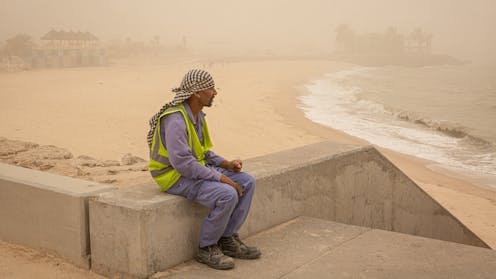
A worker looking out to sea as a sandstorm hits Kuwait. Sebastian Castelier / Shutterstock

The Middle East is experiencing a period of intense political and economic turbulence, with several countries in the region embroiled in conflict. These conflicts are taking place against the backdrop of an escalating climate crisis.

In 2023, global thinktank the Carnegie Endowment for International Peace concluded that Middle Eastern countries “are among the world’s most exposed states to the accelerating impacts of human-caused climate change – including soaring heatwaves, declining precipitation, extended droughts, more intense sandstorms and floods, and rising sea levels”.

The capacity of a society to receive, process and act upon climate-related information is at the heart of an effective climate change response. Media plays an important role: it is central to advancing public understanding of climate change and its connection to individual, communal and national security.

Yet over the past two decades or so, media coverage of climate change in the Middle East has been among the lowest in the world. According to the University of Colorado Boulder’s Media and Climate Change Observatory, media organisations in the Middle East each produced an average of around one article about climate change in August 2025 – compared with 66 articles for North American media in the same month.


Wars and climate change are inextricably linked. Climate change can increase the likelihood of violent conflict by intensifying resource scarcity and displacement, while conflict itself accelerates environmental damage. This article is part of a series, War on climate, which explores the relationship between climate issues and global conflicts.


The lack of climate coverage in the Middle East is because media outlets there face a number of structural problems. How does one talk about climate change when armed conflicts are spiralling out of control, or when public discourse is monopolised by what are perceived to be more pressing issues?

Jordan presents a useful example to help us understand these challenges and how to overcome them.

Media in Jordan

Jordan has long played a stabilising role in the Middle East. It has accepted large numbers of refugees from neighbouring conflicts and has acted as a mediator and peace broker between Middle Eastern rivals. However, climate change is threatening Jordan’s stability.

Raed Abu Soud, Jordan’s minister of water and irrigation, said in May 2025: “Jordan is grappling with one of the most severe water crises in the world, with per-capita water availability dropping to just 60 cubic metres per year.”

A host of other factors are worsening the situation. Economic underdevelopment in Jordan is leading to persistent unemployment and public unrest, while regional conflicts are undermining social cohesion.


Read more:
Jordan joins regional push to sideline Islamist opposition


How Jordan responds to the risks presented by climate change, and preserves its stability, is extremely important for the Middle East and beyond. Public understanding of this challenge is going to be pivotal to an effective response. And here enters the role of media.

Our research on climate change in Jordan has involved analysing more than 2,500 news articles in the country’s major print media and carrying out extensive interviews with local people. We have found that, while climate change is becoming a more important topic in the country, there are still many barriers preventing a coherent climate change discussion there.

It is common in Jordan, as in many other countries affected by conflict, for conversations related to climate change to be pushed to the background when other crises emerge. Since 2023, when the war in Gaza began, Jordanian media outlets have understandably been drawn to covering the humanitarian crisis there at the expense of climate change.

This has been exacerbated by the fact there are very few journalists in Jordan who work consistently on climate-related issues and can offer accurate and timely coverage. The shortage of climate journalists is a common problem across the Middle East.

When climate change is covered by Jordanian media, it is often discussed as a secondary consideration relative to geopolitical threats – not as a challenge in its own right. Due to the country’s policy of hosting refugees, Jordanian media outlets have often portrayed their country as a “second victim” of the civil war in Syria and the intractable Israel-Palestine conflict. Refugees are depicted as another strain on scarce resources.

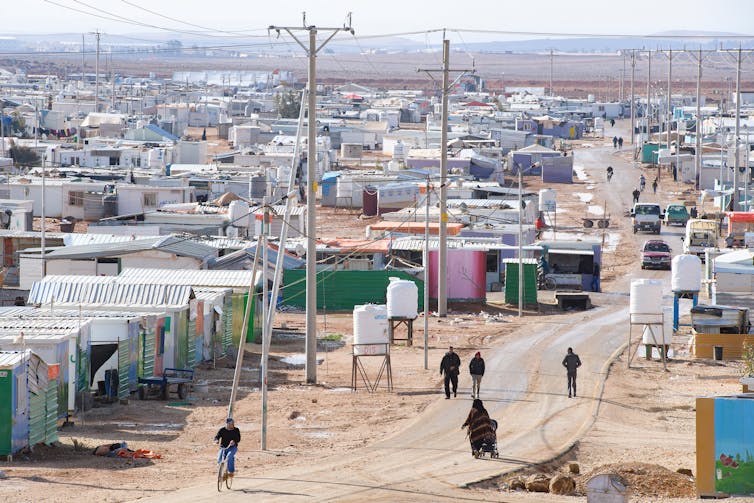
People and cars on a road running through a refugee camp in Jordan.
The Zaatari refugee camp near the border with Syria in northern Jordan.
Richard Juilliart / Shutterstock

Eroding trust

Climate change discourse in Jordan tends to be heavily influenced by international partners including foreign governments, charities and funding bodies.

There are numerous externally funded educational and vocational courses focused on climate change available in Jordan for various audiences, including media professionals. While this facilitates the advancement of climate change discussions, it can distance climate coverage from the local context and knowledge. This is particularly true if external partners merely “teach” Jordanians what they believe is necessary, without fully understanding the specific challenges Jordan faces.

It can also erode trust between Jordanians and these foreign partners. In some of the cases we studied, journalists in Jordan saw climate change as part of a western-imposed agenda aimed at controlling developing countries.

Jordan is highly important for the Middle East, Europe and beyond. Without effective climate adaptation, it risks losing its role as a refugee haven and regional stabiliser.

Media can play a vital role in advancing climate change discourse in the Middle East, both by holding governments to account and raising awareness of climate issues. Some studies suggest that public concern correlates with the volume of media coverage, and attention can fade when other issues dominate the media space.

Sustained, inclusive coverage is essential to ensure long-term engagement and informed public participation in climate action, even during times of political and economic turbulence.

The Conversation

Marianna Poberezhskaya received funding for the associated research project from the Climate Social Science Network.

Imad El-Anis receives funding from the Council for British Research in the Levant and the Climate Social Science Network.

Marwa Mustafa received funding from Climate Social Science Network.

ref. Middle Eastern countries are among the most exposed to climate change – so why is media coverage so low there? – https://theconversation.com/middle-eastern-countries-are-among-the-most-exposed-to-climate-change-so-why-is-media-coverage-so-low-there-262757