Is the ‘Biggest Loser’ documentary entangled in its own internalized fatphobia?

Source: The Conversation – Canada – By Darby M. Babin, PhD Candidate, L’Université d’Ottawa/University of Ottawa

Were you expecting Fit for TV: The Reality of the Biggest Loser to peel back the curtain and provide hard-hitting truths on what really happened on the show that captivated millions in its heyday?

Well, uh, fat chance.

Instead, the three-part Netflix documentary, released mid-August, seems to traffic in some of the same problematic aspects of the show that spurred the need for an exposé in the first place.

Best of intentions?

This purported tell-all documentary — billed as exposing the truth of The Biggest Loser — is a bit of a nothing burger. There is no groundbreaking admission from the producers of the reality show that it shamelessly exploited fat people.

Instead, viewers are told the show’s creators had only the best of intentions and that it was just an unfortunate accident that things got out of hand when the trainers — Jillian Michaels and Bob Harper — took their roles too seriously.

The focus, for example, shifts to Michaels’ alleged failings, like providing contestants with banned caffeine pills. Michaels has refuted those claims and threatened legal action against Netflix.

Dr. Robert Huizenga, the show’s medical director tasked with overseeing the contestants’ health and well-being, is cast as the embodiment of concern and the voice of reason. Michaels is portrayed as the main villain while Harper gets off relatively scot-free. To elicit sympathy for him, we are reminded of his heart attack — so out of character for such a fit guy, of course.

The fatphobia problem

This is the fatphobic myth: bad health happens only to bad (see: fat) people, like the ones who auditioned to appear on The Biggest Loser. People like Harper should be safe from illness because they have lived lives worshipping at the altar of the fitness goddesses.

All the tropes about fat people lacking will power and being “lazy” (a term loaded with ableism) coalesce in this two-hour watch.

A welcome breath of fresh air is provided by Aubrey Gordon, a razor-sharp fat activist who writes under the moniker, Your Fat Friend. Her thoughtful critique is accessible to viewers who are less familiar with fat studies. And with her first appearance, she reminds us that what the show markets as its inspirational ideology differs in practice both on screen and behind when she remarks: “I’ll tell you what I think the show thinks it’s about…”

Gordon also challenges The Biggest Loser‘s overarching message by highlighting Harper’s heart attack. She says: “It sort of punctures one of the main arguments of the show, ‘If you’re fat, you’re going to die.’ And if you exercise ‘correctly,’ as determined by Bob and Jillian, all of these health outcomes will be warded off.”

Gordon’s observations are as close as the series gets to truly examining the fatphobia at the heart of the reality show.

The racism problem

Joelle Gwynn, who joined the show with friend Carla Triplett in 2009, is the only person in the documentary to openly raise concerns about race. She mulls over feeling as though the producers and fellow contestants were trying to frame her as the “angry Black woman.”

The angry Black woman trope is tied to what race, gender and class scholar Patricia Hill Collins calls “controlling images” of Black women, in particular the Sapphire, the Mammy and the Jezebel. These images are intended to demean, dehumanize and punish Black women in the name of white supremacy. The angry Black woman is the Sapphire’s contemporary, described by The Jim Crow Museum as “rude, loud, malicious, stubborn and overbearing.”

Triplett was perceived as more committed and jovial. When the pair was eliminated, Triplett was offered apologies while Gwynn faced hostility.

Indeed, as the producers confirm on the documentary, they sought out people who were downtrodden. In executive producer JD Roth’s own words: “We were not looking for people who were overweight and happy. There’s a lot of ’em. That’s fine. We were looking for people who were overweight and unhappy.”

Gwynn was too willful, unwilling to accept the treatment that the show seemed to believe she deserved by virtue of her fat, Black body. During one of her interview segments in Fit for TV, Gwynn looks directly into the camera after she shares a difficult memory of Harper berating her and says: “Fuck you, Bob Harper.” Somebody had to say it.

Of course, fatphobia and racism are deeply intertwined. As Sabrina Strings explains in her book Fearing the Black Body: The Racial Origins of Fat Phobia, anti-fatness emerged through chattel slavery when colonizers realized they had fat bodies in common with those they enslaved. This similarity was incompatible with their beliefs about superiority, so they mobilized chattel slavery and eugenics to tie anti-fatness to Blackness.

The misogyny problem

Perhaps the most puzzling case is that of Tracey Yukich, who made a dramatic entrance in Season 8 when she collapsed during her first running challenge and was hospitalized and diagnosed with rhabdomyolysis (an injury where muscle tissue breaks down).

Yukich explains that the reason she was willing to push herself so hard was her belief that weight-loss would improve her abusive marriage. She shares that the infidelity and abuse in her relationship felt inseparable from her weight gain and that the show was her opportunity to turn things around.

It is difficult to watch as there is no onscreen evidence to suggest Yukich ever received support from anyone at The Biggest Loser about the abuse in her marriage.

For all the talk about health in the reality show, Yukich’s mental health didn’t seem a priority. Instead, the doctor acts as counsellor and encourages Yukich to use the show as a second chance. Unable to exercise, however, she followed in the footsteps of other contestants who reduced their caloric intake to 800 or less — in other words, starvation.

The individual problem

A hyper-focus on individual responsibility is embodied in the entrepreneurial contestants who jockeyed for a spot on the show. The promise of freedom from fat is intoxicating.

The collective fascination with weight loss under the contradictory “weight” of liberalism, as critical food scholars Julie Guthman and Melanie DuPuis so aptly put it, reminds us that we live in societies that exhort us to consume more and eat less.

This, Guthman and DuPuis argue, “produces contradictory impulses such that the neoliberal subject is emotionally compelled to participate in society as both out-of-control consumer and self-controlled subject.”

The Biggest Loser reflects this neoliberal paradox of consumption and restraint: contestants were berated during exercise and told to try harder, yet given temptation challenges with desirable foods that tested their ability to resist so-called bad eating habits.

Who is the biggest loser?

More than a decade later, viewers are left to wonder, in the age of wall-to-wall weight loss drugs such as Ozempic, have we really moved the needle?

Is it surprising that when we paused viewing, a Dairy Queen ad popped up beside the cover image of the documentary? Like The Biggest Loser, it seems society and entertainment industries, bolstered by advertising, want both our self-control and our consumption.

And if we fail to appreciate that the media spectacle of weight loss is as grotesque as the profits made from weight-loss products, then maybe “the biggest loser” is us.

The Conversation

Darby M. Babin receives funding from the Social Sciences and Humanities Research Council of Canada

Michael Orsini receives funding from the Social Sciences and Humanities Research Council of Canada

ref. Is the ‘Biggest Loser’ documentary entangled in its own internalized fatphobia? – https://theconversation.com/is-the-biggest-loser-documentary-entangled-in-its-own-internalized-fatphobia-264752


SHIELD: A simple, memorable model to help prevent Alzheimer’s disease and dementia

Source: The Conversation – Canada – By Donald Weaver, Professor of Chemistry and Senior Scientist of the Krembil Research Institute, University Health Network, University of Toronto

Up to one-third of Alzheimer’s disease cases could be prevented simply by avoiding certain risk factors. (Piqsels)

Alzheimer’s disease (AD) is on track to become one of the defining public health challenges of our time. Every three seconds, somewhere in the world, someone is diagnosed with dementia, and it’s usually Alzheimer’s disease.

Currently, approximately 50 million people worldwide have AD. By 2050, this number will exceed 130 million.

The human health and socioeconomic consequences of this are going to be immense. But perhaps it doesn’t have to be this way.

Preventing Alzheimer’s disease

A 2024 report from the influential Lancet Commission suggests that up to one-third of AD cases could be prevented simply by avoiding certain risk factors. These 14 modifiable risk factors encompass: traumatic brain injury, hypertension, depression, diabetes, smoking, obesity, high cholesterol levels, low physical activity levels, too much alcohol consumption, too little education, vision loss, hearing loss, social isolation and air pollution.

While this comprehensive list is rooted soundly in science, it’s not easy for members of the general public to monitor and manage 14 separate health targets — especially when prevention efforts need to start decades before symptoms appear.

This is a problem that needs addressing. Tackling this problem requires a prevention model that is simple and memorable — something the public can easily embrace, understand and follow.

There are successful examples that can serve as a template. Stroke prevention associations, for instance, have successfully adopted the FAST (Face, Arm, Speech, Time) mnemonic to teach stroke warning signs. AD prevention needs a FAST equivalent.

SHIELD (Sleep, Head Injury prevention, Exercise, Learning and Diet) may fill that role. SHIELD brings together the most significant, overlapping dementia risk factors into five core pillars, offering a clear and effective strategy for prevention.

Sleep

Sleep is a foundational element of SHIELD. Maintaining healthy sleep habits is a key protective factor against dementia. Adequate sleep supports brain function, memory, mood and learning.

Insufficient (less than five hours per night) or poor-quality sleep (frequent awakenings), especially in midlife, increases the risk of cognitive decline and dementia. Chronic poor sleep leads to build-up in the brain of amyloid-beta protein, which is implicated in the development of AD.

Poor sleep also increases the likelihood of obesity, high blood pressure and depression, all risk factors for AD. If you’re currently sleeping four to five hours per night, consider changing this habit to avoid increasing your risk for developing dementia in later life. Sleep is a vital tool for brain protection and AD prevention.

Head injury

Head injury prevention is, rather surprisingly, often overlooked in conversations about dementia. There are strong links between traumatic brain injuries, including concussions, and higher AD risk.

Such head injuries can occur in a wide variety of settings, not just professional sports. Intimate partner violence, for example, is unfortunately common in our society and is a frequent, but neglected, cause of head trauma.

Head injury prevention should start early and continue throughout life, as damage can accumulate over time. Broader safety measures (such as improved helmet designs, stronger concussion protocols in youth and adult sports and efforts to prevent head injuries in all settings) can play a significant role in protecting long-term brain health and avoiding AD.

Exercise

A woman with grey hair using exercise equipment.
Regular movement, even in small amounts, enables better brain aging.
(Unsplash/Centre for Ageing Better)

Exercise is perhaps the most powerful lifestyle habit for reducing the risk of AD. Exercise directly addresses multiple major risk factors, including obesity, high blood pressure, high cholesterol and depression. It also supports the growth of brain cells, memory and emotional health.

Despite this, physical inactivity remains common, especially in high-income countries, where it may contribute to as many as one in five AD cases. Exercise is not just “heart medicine,” but “brain medicine” too. Regular movement, even in small amounts, enables better brain aging and can help avoid AD.

Learning

Learning, both in and out of school, remains one of the strongest protective factors against dementia. Lower educational levels, such as not finishing secondary school, are linked to a significantly increased risk for dementia. Learning contributes to the brain’s “cognitive reserve,” which is the brain’s ability to function well despite damage or disease.

Individuals with AD maintained better mental function if they had continued learning throughout life. Public health messaging should promote life-long learning in all forms — from reading and language learning to engaging hobbies that keep the brain active. It’s never too early (or too late) to learn another language or to challenge your brain. Boosting your cognitive reserve boosts your brain against AD.

Diet

Diet also plays a major role in brain health and dementia prevention. No single food prevents dementia. Rather, a combination of nutrient-rich foods supports overall brain health. A healthy diet can lower dementia risk by emphasizing whole foods like fruits, vegetables, whole grains, nuts and fish, while restricting processed foods, red meat and sweets.

Adhering to dietary patterns like the Mediterranean diet has shown promising results in protecting against cognitive decline. The Mediterranean diet is a brain/heart-healthy eating style inspired by the traditional diets of people in countries bordering the Mediterranean Sea. It emphasizes plant-based foods with olive oil as the primary fat source, while limiting red meat, processed foods and added sugars.

What we eat influences brain inflammation and brain vascular health — all of which are increasingly tied to AD. A healthy diet shouldn’t feel restrictive or like a punishment for trying to improve brain health. Instead, it can be framed as a positive investment in long-term independence, clarity and energy.

By simplifying the science, the SHIELD framework offers a realistic and research-backed approach to brain health. Until a cure is discovered, prevention is the strongest tool. Concepts like SHIELD provide a starting point for achievable prevention.

Alzheimer’s disease should not be seen as inevitable. The statistic that there will be more than 130 million people with AD by 2050 must not be accepted as predestined. With the right decisions and actions, we can work towards AD prevention by protecting the minds and memories of millions.

Emma Twiss, a fourth year undergraduate student in Life Sciences at Queen’s University, co-authored this story.

The Conversation

Donald Weaver does not work for, consult, own shares in or receive funding from any company or organisation that would benefit from this article, and has disclosed no relevant affiliations beyond their academic appointment.

ref. SHIELD: A simple, memorable model to help prevent Alzheimer’s disease and dementia – https://theconversation.com/shield-a-simple-memorable-model-to-help-prevent-alzheimers-disease-and-dementia-265053

US adds Colombia to list of countries failing in fight against drugs – here’s why that matters

Source: The Conversation – UK – By Adriana Marin, Lecturer in International Relations, Coventry University

The US has “decertified” Colombia as an ally in the fight against drugs, adding it to a list of countries including Afghanistan, Myanmar and Venezuela. Behind the decision lie surging coca cultivation and a desire to signal that US support for Colombia is no longer unconditional. It represents a rupture in one of Washington’s longest-standing security partnerships in the region.

Under US law, the president must annually assess whether major drug-producing or transit countries are “fully cooperating” with American counternarcotics efforts. Those judged to be “failing demonstrably” risk losing access to most US foreign assistance and face US opposition in multilateral lending bodies such as the International Monetary Fund and World Bank.

Colombia, which has long been regarded as Washington’s anchor in Latin America, has not been decertified since 1997. That move followed allegations that the then-Colombian president, Ernesto Samper Pizano, had accepted campaign contributions from drug traffickers. Washington’s frustration now focuses on a different concern: the transformation of Colombia’s drug policy under President Gustavo Petro.

When Petro took office in 2022 as Colombia’s first leftist leader, he pledged to end what he called the “failed war on drugs”. His government has shifted away from militarised crackdowns and the forced eradication of coca plantations toward negotiated transitions, voluntary crop substitution and rural development.

Petro argues that the drug trade is rooted in poverty, inequality and state absence, and that decades of repression have only entrenched cycles of violence. He has resisted resuming aerial spraying of coca fields with glyphosate herbicide, which Colombian courts suspended in 2015 over environmental and health concerns.


Read more:
Why Colombia sees legalising drugs as the way forward. Here’s what’s being proposed


US officials view Petro’s policy as dangerously permissive. From Washington’s perspective, eradication and interdiction remain the clearest indicators of cooperation. Both have declined as cocaine output has surged.

According to the UN Office on Drugs and Crime (UNODC), around 253,000 hectares of Colombia were under coca cultivation in 2023. This figure was close to a historic high. Colombia now produces more than six times as much cocaine as it did in 1993, the year the Medellín cartel leader Pablo Escobar was killed.

The UNODC says Colombia is now responsible for 67% of global cocaine production. And research also shows coca cultivation expanding into protected areas, including national parks, where enforcement is difficult and environmental risks are acute.

Washington’s concerns go beyond eradication metrics. US officials have quietly criticised Petro’s government for slowing or conditioning the extradition of drug traffickers. Handing drug traffickers to the US to stand trial is a practice that has long been central to bilateral cooperation.

The US has also grown wary of Petro’s foreign policy. He has overseen warmer ties with Venezuela and more engagement with China, all while displaying scepticism toward US-led security initiatives. These developments have raised doubts about Colombia’s long-term alignment with Washington’s strategy.

Why decertification matters

Decertification is a blunt instrument that is useful for punishment. But it is hard to calibrate without collateral damage across other areas of cooperation such as security, environmental protection and migration.

Legally, decertification allows the US to suspend most foreign assistance, block or oppose international loans and limit trade preferences. But in practice, Washington often tempers these consequences by issuing “national interest” waivers that allow aid to continue.

The Trump administration has signalled that such a waiver will apply to Colombia. This will preserve some assistance while making other funds conditional on policy shifts. However, the symbolic impact of decertification is still significant.

Colombia’s reputation as Washington’s anchor in the region has been dented and private investors may see the move as a warning sign of heightened risk in the Colombian security and economic environment. It also injects mistrust into a diplomatic relationship that has long underpinned US security strategies in Latin America.

The decision places Petro in a delicate position. It hands ammunition to his political opponents, who accuse him of being soft on crime and presiding over deteriorating security. It may also pressure Petro to resume aerial spraying. Civil society groups warn that fumigation could spark protests, harm health and damage ecosystems.

At the same time, capitulating to US demands risks undermining Petro’s flagship agenda of peace-building and rural development. Many coca-growing communities support his shift away from militarisation; reversing course could alienate them and erode trust in the state. Petro must therefore walk a fine line: show enough cooperation to unlock US support without betraying his domestic mandate.

Although framed as a response to drug policy failures, the timing and tone of the decertification have fuelled speculation that Washington is seeking leverage on broader issues. Some analysts argue the US may use it to extract concessions on extradition policy, Colombia’s stance toward Venezuela and China, and governance and human rights safeguards in drug enforcement.

Ultimately, Washington’s decision reflects both acute frustration and calculated pressure. It shows how far the approaches of the two governments toward the drug war have diverged, and how the US is now willing to use cooperation as a means to advance broader strategic aims.

For Petro, the challenge is to prove that his developmental model can contain his country’s cocaine economy without reverting to policies that many Colombians see as destructive. For Washington, the risk is that coercion may not bring Bogotá back onside, but instead push it further away.

How both sides respond could reshape US-Colombia relations for years to come.

The Conversation

Adriana Marin does not work for, consult, own shares in or receive funding from any company or organisation that would benefit from this article, and has disclosed no relevant affiliations beyond their academic appointment.

ref. US adds Colombia to list of countries failing in fight against drugs – here’s why that matters – https://theconversation.com/us-adds-colombia-to-list-of-countries-failing-in-fight-against-drugs-heres-why-that-matters-265410

‘Greenhushing’ is a trend that leaves businesses downplaying their environmental wins

Source: The Conversation – UK – By Marta Nieto-Garcia, Senior Lecturer in Marketing, University of Portsmouth, Universidad de Salamanca

Cast Of Thousands/Shutterstock

These days, institutions and companies love to announce what they’re doing to tackle the climate crisis. Terms like “sustainable”, “environmentally friendly” and “low-carbon” are often used to trumpet messages about production and consumption. But in reality, the claims are not always accompanied by real, effective action – a shady practice known as greenwashing.

But at the same time, other companies are not communicating their sustainability actions.

This phenomenon is known as “greenhushing” and it could be just as dangerous as greenwashing. When organisations downplay their efforts, the broader sustainability conversation can be weakened – and the opportunity for businesses to be agents of social change could be lost.

But why would companies deliberately hide things that they are doing well?

Our research has investigated how and why organisations take part in greenhushing. We focused particularly on how this occurs in service organisations, such as those in the travel sector.

First, we examined the communication strategies of 300 UK hotels across three channels: hotel websites, profiles on travel site Booking.com, and social media platforms. We found that 62% of UK hotel websites do not include sustainability information, with only 2% of social media posts referring to it.

Although booking platforms signal the sustainability of hotels that have third-party certifications, hotel websites often don’t provide much explanation in this regard. This highlights the gap between implementing practices and effectively communicating them to potential customers.

Next, we dug deeper into the reasons for this by interviewing marketers across service sectors, including accommodation, food and wellness.

We uncovered three main reasons for the tendency towards not communicating – or even hiding – sustainability actions. First, managers spoke of reputational risks, highlighting their fear of being accused of greenwashing.

This is risky when companies are not genuinely committed to the sustainability cause, but instead adopt a superficial approach to it. But when a business has genuinely made efforts towards more sustainable practices, transparent communication – supported by evidence of what action they have taken – could prevent damage to reputations.

They could, for example, enrich their communications with photos of their environmental initiatives (things like before-and-after photos of an upgrade to energy-efficient lighting, for example).

They could also demonstrate the effectiveness of their actions (how much they’ve cut food waste, perhaps) or show their commitment to improving ecosystems (such as restoring green spaces at a location where they operate).

Empower employees

Second, managers said they lacked confidence about the effectiveness of their sustainability practices. But this uncertainty stands in contrast to the increasing public demand for companies to take action on sustainability. Businesses need to make sure employees feel confident in talking about how powerful and meaningful their sustainability actions can be.

To support this, organisations should ensure employees have the resources and systems to understand and engage in sustainability efforts.

Providing tools that demonstrate the impact of their work on the planet can boost employees’ confidence – and their motivation to make a difference. This involves not only offering performance measures but also creating a culture of care and implementing policies that strengthen employees’ connections to nature in their communities.

For example, companies might use immersive experiences or visualisations to help employees grasp the business’s impact on the natural environment.

a hotel breakfast buffet with people just visible at the side
Businesses could demonstrate their commitment to cutting food waste.
Ksenija Toyechkina/Shutterstock

Finally, many service managers highlighted that instead of communicating good practice, they relied on sustainability certifications provided by third-party institutions (such as the Booking.com Travel Sustainable programme) to do the talking for them.

Trusted certification schemes can help consumers make decisions on who to buy from – or who to work for. But consumers don’t always understand all these certifications. The sheer number can make it difficult for the public to know which ones are credible or relevant.

Over-reliance on certifications can even be risky: scepticism towards some schemes means that consumers may lose trust in the business if the certification badge it displays loses credibility in some way. And taken alone, they may offer little insight into the specific actions a company may be taking.

To build trust, it would be better for organisations to go beyond the label and provide clear, accessible, comprehensive information about their specific sustainability actions. Inviting employees to publicly share the company’s commitments and initiatives can make its stance on sustainability more tangible and credible.

Greenhushing is not just a missed marketing opportunity – it is a missed opportunity for progress. When companies choose to stay silent about their sustainability efforts for fear of negative consequences, it stifles discourse and limits the exchange of ideas that could inspire broader environmental change.

Open communication lets businesses share best practice, acknowledge challenges and learn from one another. More importantly, it enables consumers to hold companies to account while encouraging and rewarding responsible behaviour. The sustainability dialogue needs to be nurtured so that businesses have the opportunity to act as genuine agents of social change.

The Conversation

The authors do not work for, consult, own shares in or receive funding from any company or organisation that would benefit from this article, and have disclosed no relevant affiliations beyond their academic appointment.

ref. ‘Greenhushing’ is a trend that leaves businesses downplaying their environmental wins – https://theconversation.com/greenhushing-is-a-trend-that-leaves-businesses-downplaying-their-environmental-wins-264640

Songs for Littles: the research that explains YouTube sensation Ms Rachel

Source: The Conversation – UK – By Elizabeth Coombes, Senior Lecturer in Music Therapy, University of South Wales

For many parents of babies and toddlers, there is one YouTube channel that is a household name. Ms Rachel and her Songs for Littles has attracted nearly 17 million subscribers, offering a colourful, playful space where music, movement and early learning meet.

But beyond the catchy tunes and pink overalls, research backs up why her videos are so effective, and why parents should consider joining in, not just letting their children watch.

For years, music therapists have studied how musical interaction supports early development. My own research has looked at how music can strengthen the bonds between parents and their children.

Before becoming a global phenomenon, Rachel Anne Accurso was a pre-school music teacher. When her son experienced a language delay, she sought speech therapy support and noticed a lack of resources for children needing help with language development.

Drawing on her teaching experience, she began creating small music classes tailored to early learners, which eventually became the online content we now know.

When the pandemic hit in 2020, parents were starved of social interactions for their children. Ms Rachel’s videos – featuring her signature pink overalls, funky headbands and high-energy performances – became a lifeline for many.

Learn to Talk with Ms Rachel.

Her colourful videos offer engaging activities that parents and children can listen to and explore together. Simple musical games such as peek-a-boo and action songs encourage family playtime, while attractive graphics and high production standards make the channel very appealing.

Today, the channel has more than 11 billion views, while Ms Rachel herself is estimated to be worth US$6.5 million (£4.8 million).

So, why are her videos so appealing to children and effective for their development? Part of the answer lies in what psychologists call “communicative musicality”. Research has shown that early interactions between parents and infants are intrinsically musical.

‘Parentese’

Elements like rhythm, timing, pitch and phrasing are central to how babies and toddlers engage with the world. When adults speak to children, they instinctively use “parentese”. This is a higher-pitched, exaggerated style of speech with lively gestures and expressive faces. These cues capture attention and make learning fun. They help children absorb language naturally.

Ms Rachel’s videos mirror these principles. Her songs are simple, repetitive and often interactive. They encourage children to respond, copy gestures or sing along.

The videos’ structure, like predictable openings and closings, clear cues and pauses, support attention and help children feel secure while exploring language. Funny moments, surprises and lively expressions make the experience enjoyable, helping the children learn without it feeling like a lesson.

Baby’s First Words with Ms Rachel.

Building on these musical connections can also help develop the bond between parents and child. My research in 2021 into the importance of parents singing with premature babies shows this.

Parents were excited to learn that their babies recognised their voices from before birth. The connection was already there and they just needed to build on it to keep the bond growing and developing.

Ukraine

In 2022, a book I co-authored, looked at the benefits of group music therapy families with pre-school children displaced from Ukraine to the UK due to the war. Some children had speech delays or were struggling to socialise with their peers. In some cases, parents were struggling to bond with their children.

After eight weeks of small group music therapy sessions, significant changes began to take place. Parents reported not only language development but progress in sharing and playing with others as well as feeling more love for their children.

Music became a feature at home too. The songs the children learned became part of family life. Parents were making up their own songs too, about brushing teeth and getting ready for nursery. They realised that making these activities into a musical game made them special times that were full of fun.


Read more:
Music therapy improves the health of premature babies and boosts parental bonding


What was important in the music therapy groups was to keep the format the same each week. The groups began with a “hello” song on the guitar, where every child was greeted by name. From this beginning, other songs were introduced.

There was time for improvised music with everyone playing and trying out new sounds with instruments before a quieter section using lullabies was introduced. The group ended with a “goodbye” song to finish the experience.

Keeping the same structure ensured the group was a safe space where everyone knew what was going to happen next. This meant the families could really let themselves be part of the experience.

Ms Rachel’s formula of simple repetitive songs using “parentese” is a brilliant way of helping pre-school and nursery-age children develop language and social skills. And, perhaps just as importantly, it’s fun. For children and parents alike, music provides a chance to connect, laugh and grow together.

The Conversation

Elizabeth Coombes received funding from The Music Therapy Charity for the work with premature babies. Very small amount; less than £1000.The first study with Ukrainian Families was not funded. I have since done another study (not referenced here as data analysis still ongoing) with Afghan and Ukrainian families.

ref. Songs for Littles: the research that explains YouTube sensation Ms Rachel – https://theconversation.com/songs-for-littles-the-research-that-explains-youtube-sensation-ms-rachel-263589

Twilight at 20: the many afterlives of Stephenie Meyer’s vampires

Source: The Conversation – UK – By Sarah Olive, Senior Lecturer in Literature, Aston University

This year marks the 20th anniversary of Stephenie Meyer’s novel, Twilight. The book series of the same name has sold over 160 million copies, been translated into 38 languages and adapted into five blockbuster films.

Vampires are perennially popular, largely because we make and remake them to help us address our social concerns and fears. As author Nina Auerbach argues in her 1995 book Our Vampires, Ourselves: “We make the vampires we need for the times we live in.”

The vampires of Twilight captured the spirit of 2005. Fantasy fiction and film with a central struggle between good and evil abounded: think Harry Potter and The Lord of the Rings. The melancholy of Twilight’s characters also chimed with chart-topping emo music (which formed some of the soundtrack for the film adaptations).

The novel follows the relationship between teenage human Bella Swan and vampire Edward Cullen, a centenarian soul in an immortal late-teenage boy’s body. The book appealed to the millennial feminism of 2005: it was told from Bella’s point of view, and Edward’s aesthetic (preppy minimalism) and pastimes (reading and playing piano) offered an alternative to machismo. But does Twilight offer the vampires we need in 2025?


This article is part of a mini series marking 20 years since the publication of Stephenie Meyer’s first Twilight novel.


Criticism of the Twilight saga has gained momentum in recent years. Much attention has focused on the series’ representations of abstinence. Some of the abstinence has been widely celebrated, including the way that Edward eschews human blood and has converted his family to “vegetarian” vampirism. They feed off animals rather than humans. Other instances are more divisive, such as his refusal to “turn” Bella into a vampire – despite her repeated requests – and insistence on abstaining from sex until they are married in the fourth novel, Breaking Dawn (2008). He only relents and turns her into a vampire when she nearly dies during childbirth.

Edward’s leading role in determining the couple’s physical relationship, and their subsequent dominant-submissive dynamic, has attracted much feminist critique. Especially about the suitability of a Bella as role model for young women.

Critics and those who “love to hate” Twilight alike have also explored a prominent moment where Edward gaslights Bella. Gaslighting refers to consciously manipulating someone into thinking their perception of reality is untrue.

A fan video about Edward’s ‘gaslighting’ behaviour with over 1.5 million views on YouTube.

Meyer describes him racing across a carpark in time to stop an out-of-control car from crushing Bella using only his bare hands. Fearing his supernatural nature will become public, he repeatedly tells Bella that she’s deluded because of her injuries – he claims he was stood next to her at the time of the accident. He makes Bella and other characters question her true version of events and persuades them to believe his lie.

Another behaviour that has met with debate is Edward repeatedly breaking into Bella’s bedroom to watch her sleep – is it romantic, creepy or criminal?

Meyer’s response

Partly in response to these accusations of anti-feminism, Meyer published the novel, Life and Death: Twilight Reimagined in 2015 to celebrate the tenth anniversary of Twilight’s release.

Stephenie Meyer at a microphone stand
Stephenie Meyer in 2012.
Gage Skidmore, CC BY-SA

The novel is a gender-swapped version of Twilight with vampire Edythe and human Beau. The debate around turning Beau into a human takes up far less space than in Twilight. He is turned after being attacked by a vampire from another coven, a marked departure from Bella’s slower trajectory. Meyer’s claims in the book’s introduction that it is possible to invert the protagonists’ genders and have the same story were therefore undercut.

Meyer has retold the saga from the perspective of other characters too. There’s The Short Second Life of Bree Tanner (2010) based on the third book in the saga, Eclipse (2007), and Midnight Sun (2020), which recounts Twilight from Edward’s point of view.

There has been much speculation that Meyer has a tricky relationship with Twilight fan fiction, such as the Fifty Shades of Grey series by E.L. James – best-selling sado-masochistic erotica novels and blockbuster films that began life as Twilight fan fiction.

Creating alternative versions of her novels seems to be Meyer’s way of regaining control over them in the face of the abundant, unauthorised, creative responses made by fans.

Twilight’s lack of diversity

In addition to its debated feminist credentials, shortfalls in the diversity of the series may also influence Twilight’s longevity.

Where the Me Too movement has made a significant impression on attitudes towards sexual assault, movements such as Black Lives Matter and We Need Diverse Books have shifted them in relation to race, sexuality and other marginalised identities since the saga was first published.

A scene showing adult werewolf Jacob Black “imprinting” on baby Renesmee in Breaking Dawn has been decried not only in relation to consent and age inappropriateness, but also racist stereotyping.

The moment Jacob ‘imprints’ on Bella and Edward’s infant daughter in the film.

Imprinting in the saga is depicted as an involuntary phenomenon wherein Quileute shape-shifters (an Indigenous community to which Jacob belongs) are bound for life to someone instinctively perceived to be their soulmate. It works a little like love at first sight, except that it immediately entails the imprinter’s utter dedication to and responsibility for their imprintee.

Openly queer characters aren’t a feature of Twilight but, as with gaps in its racial and gender representation, fans have filled the voids they identify with their own interpretations and creations.

Meyer is currently collaborating with Netflix to adapt Midnight Sun as an animation. This may add impetus to the “Twilight renaissance” exemplified by user-generated content in recent years, but the truly powerful reincarnations that will enable Twilight to navigate the challenges thrown at it in recent years, and in years to come, will continue to come from the Twihards (as fans of the series are known) themselves.


Looking for something good? Cut through the noise with a carefully curated selection of the latest releases, live events and exhibitions, straight to your inbox every fortnight, on Fridays. Sign up here.


This article features references to books that have been included for editorial reasons, and may contain links to bookshop.org. If you click on one of the links and go on to buy something from bookshop.org The Conversation UK may earn a commission.

The Conversation

Sarah Olive does not work for, consult, own shares in or receive funding from any company or organisation that would benefit from this article, and has disclosed no relevant affiliations beyond their academic appointment.

ref. Twilight at 20: the many afterlives of Stephenie Meyer’s vampires – https://theconversation.com/twilight-at-20-the-many-afterlives-of-stephenie-meyers-vampires-263008

Is acupuncture worth it for back pain? New study has answers

Source: The Conversation – UK – By Kieran O’Sullivan, Professor, Physiotherapy, University of Limerick

Papa Wor/Shutterstock.com

Lower back pain is the leading cause of disability worldwide, yet most treatments offer limited relief. One of the most divisive is acupuncture – recommended in US guidelines for lower back pain but not in the UK. A new study has now examined whether it truly helps.

The study found that acupuncture does provide some relief for people with lower back pain, though the benefit was modest. Having additional maintenance sessions did not boost the effect.

More significantly, the improvement was smaller than that seen in studies using different approaches from Australia and the US. Although acupuncture is unlikely to be the best treatment for lower back pain, the fact that it helps at all reveals something important about the condition and how people can find relief.

The study included 800 older adults who were randomly assigned to “usual care” or one of two acupuncture plans. The standard programme involved 11 sessions over 12 weeks, while the enhanced version added five more maintenance sessions over the following 12 weeks. The trial took place with 55 acupuncturists in different parts of the US and focused on older adults.

After six and 12 months, both acupuncture groups had similar results, so the extra follow-up sessions didn’t help. Both acupuncture groups had less pain and disability after six months than those who received usual care – and about 40% improved by at least 30%. These improvements persisted until the 12-month evaluation, and no major safety concerns emerged.

Woman sitting on the edge of a bed, holding her lower back in agony.
Lower back pain is the leading cause of disability.
Fizkes/Shutterstock.com

These findings align with large reviews of lower back pain treatments focusing on acupuncture or all non-drug and non-surgical approaches. Overall, acupuncture performs somewhat better than no treatment or usual care at improving pain and disability, though this benefit is typically small.

More tellingly, reviews show that any benefit from acupuncture appears even smaller when compared with sham (pretend) or placebo treatments. This means some of the benefit may come from the experience of being treated, not the acupuncture itself.

What patients expect can affect how much they say they improve, which is important in all studies that rely on self-reported pain. This makes it crucial to consider what comparison treatment was used when any study claims acupuncture helps, as usual-care groups – who typically receive less time and attention – are easiest to outperform.

Better options exist

Some people might say that any relief from lower back pain is worth celebrating or even paying for. But it’s also important to think about whether safer and cheaper options are available.

The benefits of different mind-body treatments for lower back pain studied in Australia and the US are worth considering, as they appear to offer greater reductions in pain and disability without increasing costs or risks.

The Australian study showed much greater reductions in disability and pain (using the same outcome measures) through a rehabilitation programme delivered by physiotherapists that addressed both physical and psychological aspects of back pain. Even more importantly, the economic analysis revealed significant cost savings.

The US study involved teaching people that back pain comes from their brain being overprotective, rather than actual damage to their back. It used talk therapy techniques to help the participants think about and respond to pain differently. As with the Australian study, the US study also demonstrated much larger reductions in pain and disability than those seen with acupuncture – albeit using slightly different measures.

The fact that these holistic, mind-body rehabilitation programmes outperform acupuncture – and other relatively basic interventions such as massage and medication – reflects the emerging international consensus that comprehensive approaches help people manage their lower back pain.

Effective help for people with lower back pain exists; the challenge is ensuring healthcare professionals are properly trained to deliver these treatments, and that sufferers are aware of the available approaches.

Without accessible alternatives, people with lower back pain will understandably continue seeking treatments such as acupuncture which they know about, can access and provide some modest symptom relief. It is hard to fault them when alternatives that are both accessible and affordable are not available.

The Conversation

Kieran O’Sullivan receives funding from the EU (Erasmus+) and the Irish Government (Research Ireland) for research on low back pain. He also receives honoraria and expenses for speaking about low back pain at conferences. He is a co-author on one of the studies cited in this article.

ref. Is acupuncture worth it for back pain? New study has answers – https://theconversation.com/is-acupuncture-worth-it-for-back-pain-new-study-has-answers-265342

Caribbean coral reefs are running out of time to keep up with rising seas – new study

Source: The Conversation – UK – By Chris Perry, Professor in Tropical Coastal Geoscience, University of Exeter

Weedy corals colonise a dead reef structure in the Turks and Caicos Islands. Lauren T Toth, CC BY-NC-ND

Caribbean coral reefs are sounding the alarm. These ecosystems, which protect millions of people and sustain billion-dollar industries, are on the verge of collapse – not in some distant future, but within our lifetimes.

We have been studying reefs across the western Atlantic region for more than 25 years to understand the ways reef communities are changing, and how this affects their ability to keep growing.

Our new research shows that reefs across the region are now reaching a point where they will no longer keep pace with sea-level rise. This will affect the ability of reefs to buffer coastlines from wave energy, threatening nearshore habitats.

Unless global warming by 2100 is limited to below 2°C (relative to pre-industrial levels), our study suggests nearly every reef will stop growing – and most will start eroding by the end of this century. The consequences for coastal communities will be severe.

Coral reefs aren’t just attractive dive sites. They are living breakwaters: dampening wave energy, reducing storm damage, and creating sheltered environments for habitats like seagrass meadows that serve as fish nurseries. Lose the reef structure and you don’t just lose biodiversity – you expose shorelines, weaken food security, and put lives at risk.


Read more:
Safe havens for coral reefs will be almost non-existent at 1.5°C of global warming – new study


Globally, reefs protect an estimated 5.3 million people and coastal assets worth more than US$100 billion (£74 billion) every decade. Even if reef decline seems like a distant issue for many, the changes taking place now – and the consequences of these changes in future – are illustrative of what happens when regional ecosystems pass thresholds for their persistence.

Many of the world’s coastal ecosystems, which also provide protection and habitable land, are equally threatened – with implications for us all.

A coral bleaching time series in Mexico.

Historically, Caribbean reefs grew upward at rates averaging 4–5 millimetres a year – fast enough to keep up with past sea level changes. Our research shows that their average growth rate has slowed to less than 1 millimetre per year, or just a centimetre each decade.

Reefs have been battered for decades by overfishing, disease outbreaks and pollution. Climate change is accelerating their decline; a trend we have been monitoring at many reef sites. Unprecedented levels of thermal stress occurred in 2023 and 2024 across the western Atlantic, leading to widespread coral bleaching.

Rising ocean temperatures can kill corals outright, slow the growth of surviving corals and increase coral vulnerability to disease, while simultaneously driving sea levels higher.

This “double squeeze” means reefs are moving in the wrong direction. Instead of building upward as sea levels rise, many are starting to erode. Our new modelling shows that by 2040, more than 70% of Caribbean reefs will be in states where their structures are starting to erode away. If warming passes 2°C, that figure rises to over 99% by 2100.

coral reef, surface of waves in blue sea
A degraded reef crest in the Caribbean island of St Croix.
Lauren T Toth, CC BY-NC-ND

Modelling reef growth rates

One of the big challenges in our research is linking today’s reef ecology with reef growth potential – in other words, how the balance of living organisms translates into vertical “accretion” (reef building).

We analysed sequences of corals preserved in fossilised reefs from locations across the tropical western Atlantic region, and used that information to improve our understanding of how reef growth rates vary depending on the types of coral present on a reef.

We then combined this with ecological data collected during diving surveys to determine the types and abundance of corals that contribute to reef building. These surveys were conducted on more than 400 modern reef sites across the region. We collected data on corals and other marine species, such as parrot fish and urchins, that contribute to reef building.

This allowed us to calculate present-day reef growth rates – and to project how rates will change in the future. We could then compare these rates against present and future sea level rise projections for different levels of climate warming.

Climate scientists predict we are on track for around 2.7°C of warming by the end of the century under current climate policies and emission levels. That would drive sea levels up by 8-10 millimetres a year by 2100 – far faster than reefs can currently match.

By 2060 under such warming, reefs in the region are likely to see an extra 30–40cm of water above today’s levels. By 2100, the figure could reach in excess of 70cm, and would exceed one metre under higher warming trends. The consequences will be stark: reduced storm protection, faster shoreline erosion, disrupted ecosystems and damaged infrastructure.


Read more:
Restored coral reefs can grow as fast as healthy reefs after just four years – new study


We also investigated whether reef restoration could reverse these trends. Efforts to plant corals and breed heat-tolerant strains are under way and offer some hope. In small areas, with enough resources, they have been shown to boost growth and recovery.

However, the scale of the problem – thousands of square miles of reef – means restoration alone is very unlikely to be enough. Cutting emissions is critical to halting declines in reef growth, and essential to give restoration efforts any chance.

turquoise ocean, waves breaking, brown coral reefs visible underwater
A wave breaks over a reef crest in Mexico.
Lorenzo Alvarez-Filip, CC BY-NC-ND

The uncomfortable truth

The science is blunt: our emissions trajectory will decide whether reefs can continue to grow or will start to erode away. Staying close to 1.5°C of warming would offer reefs a fighting chance. Push much beyond that and we condemn them – and the people who depend on them – to widespread loss.

Technologies that help cut emissions and reduce greenhouse gas concentrations in the atmosphere already exist, and new technologies are emerging. Green energy, carbon capture and ecosystem restoration can all play a role, but require political will and investment. Our own choices matter too – from how we live on a daily basis to the politicians we elect.

Coral reefs are the canaries in the climate coal mine. If we allow their degradation to continue, it won’t stop there. It will be shorelines, food systems and communities next.


Don’t have time to read about climate change as much as you’d like?

Get a weekly roundup in your inbox instead. Every Wednesday, The Conversation’s environment editor writes Imagine, a short email that goes a little deeper into just one climate issue. Join the 45,000+ readers who’ve subscribed so far.


The Conversation

Chris Perry receives funding from the Natural Environment Research Council, The Leverhulme Trust and the Bertarelli Foundation.

Christopher Cornwall receives funding from The Royal Society of New Zealand and the Tertiary Education Commission.

Lorenzo Alvarez-Filip does not work for, consult, own shares in or receive funding from any company or organisation that would benefit from this article, and has disclosed no relevant affiliations beyond their academic appointment.

ref. Caribbean coral reefs are running out of time to keep up with rising seas – new study – https://theconversation.com/caribbean-coral-reefs-are-running-out-of-time-to-keep-up-with-rising-seas-new-study-265203

Earth’s inner core: nobody knows exactly what it’s made of – now we’ve started to uncover the truth

Source: The Conversation – UK – By Alfred Wilson-Spencer, Research fellow of Mineral Physics, University of Leeds

Alfred Wilson-Spencer, CC BY-SA

The iron-rich core at the centre of our planet has been a crucial part of Earth’s evolution. The core not only powers the magnetic field which shields our atmosphere and oceans from solar radiation, it also influences plate tectonics which have continually reshaped the continents.

But despite its importance, many of the most fundamental properties of the core are unknown. We do not know exactly how hot the core is, what it is made of or when it began to freeze. Fortunately, a recent discovery by me and my colleagues brings us much closer to answering all three of these mysteries.

We know the temperature of Earth’s inner core is very roughly about 5,000 Kelvin (K) (4,727°C). It was once liquid, but has cooled and become solid over time, expanding outwards in the process. As it cools, it releases heat to the overlying mantle, driving the currents behind plate tectonics.

This same cooling also generates the Earth’s magnetic field. Most of the field’s energy today comes from freezing the liquid part of the core and growing the solid inner core at its centre.

However, because we cannot access the core, we have to estimate its properties to understand how it is cooling.

A key part of understanding the core is knowing its melting temperature. We know where the boundary between the solid inner core and liquid outer core is from seismology (the study of earthquakes). The temperature of the core must equal its melting temperature at this location, because this is where it is freezing. So, if we know what the melting temperature is exactly, we can find out more about the exact temperature of the core – and what it’s made of.

Mysterious chemistry

Traditionally, we have two ways to figure out what the core is made of: meteorites and seismology. By examining the chemistry of meteorites – which are thought to be pieces of planets that never formed, or pieces of the cores of destroyed Earth-like planets – we can get an idea of what our core could be made of.

The problem is that this only gives us a rough idea. Meteorites show us that the core should be made of iron and nickel, and maybe a few percent of silicon or sulphur, but it’s difficult to be more specific than this.

Seismology, on the other hand, is far more specific. When the sound waves from earthquakes travel through the planet, they speed up and slow down depending on what materials they pass through. By comparing the travel time of these waves, from earthquake to seismometer, with how fast waves travel through minerals and metals in experiments, we can get an idea of what the interior of the Earth is made of.

It turns out these travel times require that the Earth’s core is about 10% less dense than pure iron, and that the liquid outer core is denser than the solid inner core. Only some known chemistry of the core can explain these properties.

But even among a small selection of possible constituents, the potential melting temperatures vary by hundreds of degrees – leaving us none the wiser about the precise properties of the core.

A new constraint

In our new research, we’ve used mineral physics to study how the core might first have begun to freeze, discovering a new way to understand the chemistry of the core. And this approach appears to be even more specific than seismology and meteorites.

Supercooled water.
Supercooled water.
wikipedia, CC BY-SA

Research simulating how atoms in liquid metals come together to form solids has found that some alloys require more intense “supercooling” than others.
Supercooling is when a liquid is cooled below its melting temperature. The more intense the supercooling, the more often atoms will come together to form solids, making a liquid freeze faster. A water bottle in your freezer can be supercooled to -5°C for hours before freezing, whereas hail forms in minutes when water droplets are cooled to -30°C in clouds.

By exploring all possible melting temperatures of the core, we find that the most supercooled the core could have been is around 420°C below the melting temperature – any more than this and the inner core would be larger than seismology finds it to be. But pure iron requires an impossible ~1000°C of supercooling to freeze. If cooled this much, the entire core would have frozen, contrary to seismologists’ observations.

Adding silicon and sulphur, which both meteorites and seismology suggest could be present in the core, only make this problem worse – requiring even more supercooling.

Our new research explores the effect of carbon in the core. If 2.4% of the core’s mass was carbon, around 420°C of supercooling would be needed to begin freezing the inner core. This is the first time that freezing of the core has been shown to be possible. If the carbon content of the core was 3.8%, only 266°C of supercooling is needed. This is still a lot, but far more plausible.

This new finding shows that while seismology can narrow the possible chemistry of the core down to several different combinations of elements, many of these cannot explain the presence of the solid inner core at the centre of the planet.

The core cannot be made just of iron and carbon because the seismic properties of the core require at least one more element. Our research suggests it is more likely to contain a bit of oxygen and possibly silicon as well.

This marks a significant step toward understanding what the core is made of, how it started freezing, and how it has shaped our planet from the inside out.

The Conversation

Alfred Wilson-Spencer receives funding from the Natural Environment Research Council (NERC) grants NE/T000228/1 and NE/V010867/1. He works for the University of Leeds.

ref. Earth’s inner core: nobody knows exactly what it’s made of – now we’ve started to uncover the truth – https://theconversation.com/earths-inner-core-nobody-knows-exactly-what-its-made-of-now-weve-started-to-uncover-the-truth-265408

Canada’s $43-billion subsidy scheme for critical minerals misses supply chain steps

Source: The Conversation – Canada – By Chris Arsenault, Chair of the Master of Media in Journalism and Communication Program (MMJC) and assistant professor of journalism, Western University

Construction workers gather at facility in Kingston, Ont., which will be used as a start-up laboratory to test new processes related to critical minerals and other emerging technologies. (Chris Arsenault), CC BY-NC-SA

As climate change intensifies, companies and countries are attempting to build new low-carbon supply chains. From electric vehicles to solar panels and wind turbines, these technologies require vast amounts of critical minerals.

These are commodities such as cobalt, lithium and nickel, and also include a smaller set of 17 rare earth elements like dysprosium, neodymium, praseodymium and terbium.

Canada’s federal government, and provincial officials in Ontario, have pledged some of the biggest public subsidies to private companies in a generation — more than $43 billion — to create this new supply chain.

Plans for new mines in Northern Ontario’s “Ring of Fire” to extract critical minerals parallel billions in production subsidies to EV producers and related manufacturers in the province’s southern manufacturing heartland.

The idea is to supply southern factories with northern minerals. Instead of only exporting unrefined primary commodities like oil, copper or lumber, Canadian industry would also export high-value, renewable technology-related products.

In addition to promises around jobs, innovative industries and fighting climate change, politicians, business executives and military analysts frame the country’s critical minerals strategy around countering China’s dominance.

However, our new study identified several challenges to subsidizing supply chain integration in Canada.

Based on 20 interviews with government officials and industry leaders in Ontario’s critical minerals sector, and a review of existing literature, we identified challenges including: opposition to new mining and infrastructure projects, particularly from some Indigenous communities; some policymakers lacking understanding of the complexity of supply chains; slowing global EV demand and regional trade barriers at a time of uncertainty for the sector.

Processing: The weak link

First, there is a weak link in the planned supply chain: processing. Policymakers and average Canadian can picture a mine or an EV factory, business leaders said.

Understanding how to separate terbium, a rare earth element used to make stronger alloys for EVs, from mined stock is a more difficult process conducted in unassuming industrial parks. It doesn’t necessarily excite the public imagination.

A 2023 map of critical minerals mining and processing projects.
Advanced mining and processing projects for battery minerals in Ontario.
(Natural Resources Canada/Eric Leinberger), CC BY-NC

This is not merely complicated chemistry. Processing and refining critical minerals is where China dominates, controlling about 90 per cent of the industry. Under the current plan, even if mines are built in Northern Ontario, the minerals would likely be sent to China to be processed and then shipped back, leaving manufacturers dependent on the Chinese.

As one long-time chemical processing executive said: “Governments have convoluted the resource sector, the stuff in the ground, the product in the end (EVs and related technologies) and forgotten this middle section” before adding “infrastructure isn’t sexy and [processing facilities] are weirdo infrastructure nobody sees.”

Companies in Canada or the United States, the executive said, don’t want to pay a premium for rare earths processed in Canada. China can do the work more cheaply.

Investments suspended and delayed

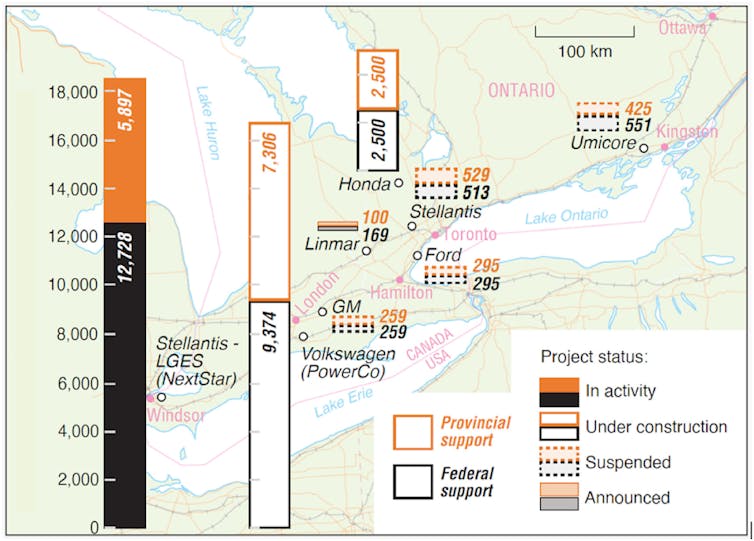
Second, many high-profile manufacturing projects have been shelved or suspended, despite billions in promised subsidies. Of eight major EV manufacturing plants in Ontario selected to receive a combined $43.6 billion in subsidies, five have suspended or delayed their activities, including the European firm Umicore’s planned $2.7 billion battery plant near Kingston, Stellantis’ EV jeep production in Brampton and GM’s EV van plant in Ingersoll, which halted then reduced production earlier this year.

Subsidies promised to these firms are far higher than what the companies themselves pledged to invest. Our analysis suggests pledged public subsidies for the eight renewable manufacturing projects, including money from the federal government and Ontario, are more than 13 per cent higher than what the companies themselves promised to spend from their own coffers.

This doesn’t seem like a good use of the public purse. Subsidies can certainly help spur growth in new industries if leveraged effectively: South Korea and Taiwan’s development from the 1960s illustrates this. But spending more public money than private companies themselves are willing to invest does not seem wise in the current trade climate, especially considering government deficits and the costs of financing them given high interest rates.

In fairness to provincial and federal officials, much of the pledged money has not left the treasury. A substantial portion of the promised funds are production subsidies for each car or battery produced.

The cancelled projects, and uncertainty over access to U.S. markets and EV sales in North America, are making companies skittish, subsidies be damned. Canada this month suspended its own planned EV mandate which would have required 20 per cent of all new vehicles sold here to be electric by next year.

A map showing proposed EV manufacturing facilities and their costs.
Location of battery and EV manufacturing investments in Canada and Ontario (millions of Canadian dollars).
(Author provided/Eric Leinberger), CC BY-NC

Subsidies and the new mercantalism

Recent problems in the EV industry notwithstanding, the broader subsidy race to build out renewable energy supply chains, and the geopolitical scramble to control critical minerals, has a distinctly 19th century, neo-mercantalist vibe.

Hearkening back to the days of the British East India Company and gunboat diplomacy, corporations are working arm-in-arm with governments to advance commercial and military objectives. U.S. President Donald Trump has demanded Ukraine give American companies preferential access to the country’s vast critical minerals deposits in exchange for continued military aid amid the war with Russia.

China currently mines roughly 70 per cent of the world’s rare Earth elements, according to Canadian government data. More importantly, it processes nearly 90 per cent of the strategic commodities and also holds near processing monopolies for graphite (95 per cent), manganese (91 per cent), and cobalt (78 per cent).

China is not afraid to weaponize its control of rare earths, limiting access for U.S. companies following Trump’s tariff threats or temporarily cutting them off to Japan following a dispute over fishing and territorial rights in 2010.

“If China embargoed rare earths right now, that would put us out of business,” said one senior Ontario government official we interviewed. “They are a critical part of the supply chain.”

Against that backdrop, and threats against Canada from the Trump government, there is value in building coherent public policy around critical minerals.

However, following billions in pledged subsidies delivering mixed results, federal and provincial governments need to focus their limited financial firepower on what’s actually achievable. Developing the means to refine and process critical minerals extracted here would be a good first step.

The Conversation

Chris Arsenault has received funding from the Michener Awards Foundation under the 2025 Michener-L. Richard O’Hagan Fellowship for Journalism Education. His journalism has also been supported by The Pulitzer Center.

Philippe Le Billon receives funding from the Social Sciences and Humanities Research Council of Canada.

Raphael Deberdt does not work for, consult, own shares in or receive funding from any company or organisation that would benefit from this article, and has disclosed no relevant affiliations beyond their academic appointment.

ref. Canada’s $43-billion subsidy scheme for critical minerals misses supply chain steps – https://theconversation.com/canadas-43-billion-subsidy-scheme-for-critical-minerals-misses-supply-chain-steps-264742