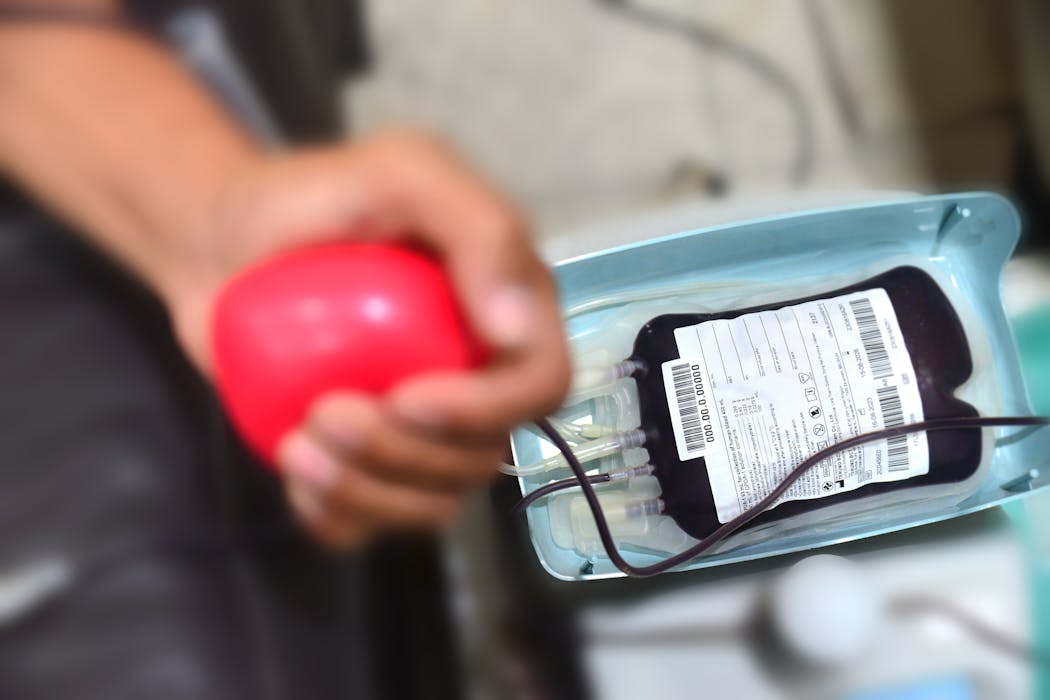
It is late, the ward is crowded, and the clock is moving faster than everyone would like. A doctor has stabilised the patient as best they can, but one thing is missing – blood.
A relative is asked to “try somewhere else”, and within minutes, the family is on the phone, calling friends, contacting church groups, posting in WhatsApp chats, hoping that someone nearby is eligible, willing and able to reach the hospital in time.
In that moment, healthcare stops being only about medicine. It becomes about networks, trust and whether a lifesaving resource can be found quickly enough.
This is not an unusual drama in Ghana. It is a recurring reality, quietly shaping outcomes in emergencies, childbirth, surgery and severe illness. Ghana has made progress, but the gap between what is needed and what is available remains wide.
In 2024, Ghana’s National Blood Service collected 187,280 units of blood. This falls far short of the World Health Organization recommended annual stock requirement of 308,000 units. The consequences are tangible, including delays to surgery, difficult clinical decisions, and families carrying the burden of searching for blood at the worst possible time.
One way to gauge the scale is the “blood collection index”, defined as donations per 1,000 people. Ghana’s index increased from 5.9 in 2023 to 6.1 in 2024, but it remains well below the ten per 1,000 level that is often cited as a basic benchmark by the WHO.
The contrast is stark. The WHO’s global figures show an average (median) donation rate of 31.5 per 1,000 in high-income countries, compared with 6.6 per 1,000 in lower- and middle-income countries and 5.0 per 1,000 in low-income countries. Ghana is a low-income country, yet its donation level remains below average for this group of countries, underscoring a persistent gap between demand and supply.
Why does this matter so much? Because blood availability is not a niche issue. It underpins everyday healthcare and becomes decisive in emergencies.
Few examples are more urgent than childbirth. Postpartum haemorrhage (severe bleeding after delivery) can escalate rapidly, and survival often depends on timely transfusion.
In 2025, the WHO highlighted that bleeding following childbirth causes nearly 45,000 deaths globally each year. When anaemia is common, the danger increases further: women have less physiological “buffer” against blood loss.
Women who enter labour with severe anaemia have around seven times higher odds of dying or becoming critically ill from heavy bleeding after childbirth, compared to those with moderate anaemia. In plain terms, they start with less room for error, and without fast access to transfusion, things can spiral quickly.
So why is Ghana’s blood supply so difficult to secure? Part of the answer is structural. Blood services require investment in collection, testing, transport at the right temperature and distribution networks.
These systems must work reliably every day, not only during crises. Yet the demand is rising with population growth and expanding clinical services, while resources remain constrained. The result is a system that is often stretched, especially outside major urban centres.
Another part of the story is how donations are sourced. In many settings, a stable supply depends on a large base of regular voluntary donors. Ghana is still working towards that goal.
In 2024, voluntary donations nationwide decreased from 40% to 29%, even as regional blood centres saw some improvement. That matters because heavy reliance on replacement donors (family members or friends recruited at the point of need) creates unpredictability. Emergencies do not wait for someone to finish work, travel across town and pass eligibility screening.
Then there is trust. People don’t donate in a vacuum; they donate into a system they believe in.
In our ongoing national survey in Ghana on people’s blood donation experiences, trust is clearly concentrated in familiar and formal sources. Around nine in ten respondents report trust in requests coming from a family member or close friend, and similarly high trust in requests issued by an official hospital or clinic.
Trust drops as the source becomes more distant or less verifiable, with markedly higher scepticism towards non-hospital community donation groups and, most of all, unknown people.
Yet high trust in hospitals does not automatically translate into action. When people are unsure how blood is used, whether it reaches patients fairly, or whether it might be diverted or sold, willingness can stall.
Even when people want to help, uncertainty can lead to hesitation: “Will this really go where they say it will?” In a high-stakes context, doubt is costly.
This gap points to a transparency problem, where confidence depends not only on who makes the request, but also on whether the system can credibly show where the blood goes.
Finally, communication channels shape outcomes. When a hospital lacks a rapid, reliable way to reach suitable donors, it falls back on what is available: phone calls, personal networks and social media posts.
But social feeds are noisy, messages get buried, and not everyone has the same connectivity or social reach. The ability to mobilise donors becomes uneven, depending on who you know, where you live, and how quickly information travels.
None of this means Ghana lacks goodwill. In fact, the opposite is often true: communities respond generously when they understand a need and feel confident their help will make a difference. The challenge is that goodwill alone cannot compensate for gaps in infrastructure, coordination and trust.
Telling people to “donate more” is not a strategy if the system cannot consistently reach donors, support them and show them that their contribution mattered.
The solution?
What would meaningful progress look like? It starts with stronger hospital services and blood-bank capacity, so that safe collection, testing and storage can happen consistently.
Alongside that, Ghana needs a more organised digital way to mobilise donors: a channel that can reach the right people quickly, rather than relying on broad social media appeals that get buried, skimmed past, or spread too widely without finding eligible donors nearby.
A well-run system could also keep clear, traceable records for each donation and request, making it easier to show where blood goes and to coordinate fast, accountable responses when an emergency hits.
That is exactly the gap our research is tackling. We’re developing a hospital-linked digital platform designed for Ghana’s realities. Here, urgent requests can be sent quickly to nearby eligible donors through a trusted channel, with location-aware matching and follow-up rather than blanket posts. It also builds in transparent, auditable donation-to-use tracking, helping hospitals coordinate emergencies more efficiently while giving donors clearer reassurance about where their blood goes.
Because, in the end, the story of blood in Ghana is not only about shortages. It is about a simple question with life-or-death consequences: when someone is bleeding, will help arrive in time?
This article was commissioned in conjunction with Prototypes for Humanity, a global initiative that showcases and accelerates academic innovation to solve social and environmental challenges. The Conversation is the media partner of Prototypes for Humanity 2025.
This article was commissioned in conjunction with Prototypes for Humanity, a global initiative that showcases and accelerates academic innovation to solve social and environmental challenges. The Conversation is the media partner of Prototypes for Humanity 2025.
Michael Head has previously received funding from the Bill & Melinda Gates Foundation, Research England and the UK Department for International Development, and currently receives funding from the UK Medical Research Foundation, and UK Research and Innovation
Honghui Shen receives funding from the NIHR Southampton Biomedical Research Centre.
Markus Brede receives funding from UK Research and Innovation and has previously received funding from the Royal Society and the Alan Turing Institute.
Growing up in Greece, wildfires were a constant presence each summer. In 2007, I remember watching TV footage of fires ravaging the Peloponnese peninsula and island of Evia, destroying forests and homes, taking lives. The sight of helicopters and firefighting aircraft crossing the smoky skies was both terrifying and awe-inspiring.
Then when I was 17, flames crept dangerously close to my home in Kavala, northern Greece. I recall standing outside with water-hose in hand, scanning the horizon and hoping our nearby treeless street would stop the fire’s advance. Thankfully, firefighting aircraft reached the area just in time – but the feeling of vulnerability at seeing how easily entire landscapes could be consumed stayed with me.
Those experiences shaped my curiosity about how people could better respond to such disasters. Wildfires are becoming more intense, frequent and harder to manage worldwide as fire seasons become longer, affecting communities from California to Australia.
According to the UN environment programme, longer droughts, heatwaves, and erratic winds are pushing ecosystems past their natural limits, endangering both human lives and biodiversity. Nasa reports that extreme wildfire activity has more than doubled worldwide over the past two decades.
In 2018, Greece suffered the deadliest wildfires in its modern history when fires in the southern seaside town of Mati and in the general Attica region claimed over 100 lives. The devastation renewed my determination to find better ways to combat fires.
The following year, while doing a master’s degree in robotics at the University of Bristol, I joined a hackathon event, organised by the UK government’s Defence Science and Technology Laboratory and the Lancashire Fire and Rescue Service, about using “swarm intelligence”, AI and drones to improve wildfire detection and response.
Swarm intelligence describes the exchange of information by decentralised, self-organised systems in order to solve complex problems. It is inspired by such collective behaviour in nature, for example by flocks of birds or swarms of insects. The competition sparked my interest to investigate how these tools could be used in such potentially catastrophic events.
After the hackathon, my supervisor Sabine Hauert, a professor of swarm engineering, and I were approached by Windracers, a UK company specialising in heavy-lift drones capable of carrying hundreds of kilograms of payloads including water to remote areas.
Transforming my childhood wildfire experiences into tangible technology through a PhD project was irresistible. The challenge was how to develop these drones into a swarm that could be used for quicker and more effective detection of, and response to, potentially catastrophic wildfires.
XPrize challenge
Today, I lead the Aura team (short for Autonomous Ubiquitous Response with Aware Robots), one of 15 semi-finalists in the wildfire section of XPrize – the series of competitions seeking technological solutions for the world’s “most urgent and complex challenges”. We were also chosen to be one of the Prototypes for Humanity exhibiting in Dubai in 2025.
Aura comprises experts from the universities of Bristol and Sheffield plus members of Lancashire Fire and Rescue. The challenge set by XPrize was simple to describe, but technologically demanding: monitor 1,000 square kilometres of land for a full day and, upon detecting a fire, extinguish it within ten minutes.
Aura’s technology stems in part from my PhD research during the pandemic lockdowns. Unable to work in the lab, I reached out to firefighters, foresters and emergency professionals worldwide for insights. Through interviews and focus groups including extensive collaboration with the Lancashire Fire and Rescue Service, who frequently use drones when responding to wildfires, we shaped the swarm system based on real operational needs.
The Aura team do a wildfire detection test using swarming drones, October 2025. Video: Aura.
Our approach uses commercially available drones, such as quadcopters, equipped with custom software that transforms them into a coordinated swarm. Like a flock of birds, they operate without a central leader, relying on interactions with one another about their location and other information to continuously adapt to their environment.
This allows a single operator to control multiple drones simultaneously, because the drones perform some tasks safely without any need for human intervention. This is an essential capability for large-scale, rapid responses.
The firefighters guided us on what truly matters in the field: reliability, usability and speed. They emphasised the human challenges of wildfire response: long shifts under extreme heat, difficult terrain, with a constant risk to their as well as other people’s lives.
Eradication is not always the answer
By offering firefighters an aerial support team that can scout, map and even deploy extinguishing material autonomously, Aura aims to extend their reach and safety rather than replace their expertise.
The fire practitioners we work with, in the UK and other countries such as Greece and Canada, often remind us their goal is not to eradicate every wildfire. Fire is a natural and necessary element of many ecosystems, so the challenge lies in managing it, preventing small fires from becoming catastrophic ones while allowing controlled burns that sustain biodiversity.
Our swarming drones system supports that balance by acting as an intelligent tool to help firefighters and land managers make faster, more informed decisions. Our vision is to see drones not only fighting fires but also assisting in disaster logistics: delivering supplies, monitoring hotspots, and supporting crews in the field.
A BBC news report on Lancashire Fire Service’s trial of Windracers’ drones, August 2024.
Despite the rapid pace of innovation, however, drone regulation still lags behind technology. In most countries, operating drones “beyond visual line of sight” (BVLOS) requires special authorisation. Dropping payloads of even small amounts of water on a wildfire also involves lengthy safety assessments. These restrictions make testing swarm systems such as Aura challenging.
But progress is on the horizon. Regulators are beginning to approve limited BVLOS operations for certified operators in the US, Australia, Canada and the UK. But a more flexible, data-driven approval process, one that builds cumulative safety cases from successful missions, could unlock greater potential for autonomous systems like ours.
We still have a long way to go to make these technologies a reality, but the ambition that drives me is the one that began when those flames threatened my childhood home. To protect lives and landscapes from preventable loss, while enabling people to live in balance with nature.
This article was commissioned in conjunction with Prototypes for Humanity, a global initiative that showcases and accelerates academic innovation to solve social and environmental challenges. The Conversation is the media partner of Prototypes for Humanity 2025.
This article was commissioned in conjunction with Prototypes for Humanity, a global initiative that showcases and accelerates academic innovation to solve social and environmental challenges. The Conversation is the media partner of Prototypes for Humanity 2025.
Georgios Tzoumas has received funding from Innovate UK, including the Future Flight challenges.
We were standing by a large white board in one of the prison’s educational areas, debriefing how our study on hope had gone when the man slipped into the room without a sound. Like the other participants he was over 60, and serving a life sentence. He had grey hair, and was very tall and slim.
He slowly picked up a chair before slamming it down. I invited him to join us, but he stayed still while the others watched. Then he dragged the chair across the floor with a piercing scrape. I could hear my own pulse.
As I began to speak I noticed he was crying. At first, it sounded like a whisper of sobs, but then it got louder. He rose abruptly, and came up close to me. I wrote in my fieldwork notes from that day:
My heart is racing. He asks, towering over me: ‘How dare you ask us about hope.’ The alarm blares. Guards escort him out. The others sit in stunned silence, eyes locked on us, waiting for a reaction.
In the months that followed, I would meet many other men for whom hope was not necessarily a lifeline as is so commonly assumed, but a burden that they had to carry, sometimes painfully.
The Insights section is committed to high-quality longform journalism. Our editors work with academics from many different backgrounds who are tackling a wide range of societal and scientific challenges.
Hope is not a soft word in prison. It shapes how people cope with their sentence and it determines whether – and how – they engage with staff and other prisoners. It shapes whether they commit to vocational and educational activities, and it sustains connections with people on the outside.
For older life-sentenced prisoners specifically, hope becomes interlinked with accelerated ageing, with bullying from younger prisoners, and with the fear of release into an unknown world.
My project (In search of Hope: the case of elderly life-sentenced prisoners) began in August 2022. We were investigating how the “right to hope” – as defined by Judge Ann Power-Forde in her concurring opinion to the European Court of Human Rights judgment Vinter and others v the UK (2013)– translates behind prison walls for older people serving life sentences, many of whom face slim prospects of release due to their advanced age and the length of their prison sentence.
The research was carried out across three English prisons over 12 months by myself and research associate, Helen Gair, with a small team of research assistants. We conducted fieldwork in a Category A prison (reserved for people presenting the highest levels of risk), a Category C (mid-security level prison, often aimed at training and resettlement), and a Category D (open prison or the last stage before release).
Each facility had its own smell and sound. The spatial layout and daily rhythm varied too. For instance, the high security site was an old red brick Victorian building, and the wings were arranged in a half panopticon (circular) design. Outside the main block, guard dogs were walked on a strip of green that ran along a ten-metre-high wall. Inside it was loud; lockdowns were frequent, and it smelled of sweat and mould.
In the open prison, the smell of cannabis drifted through the grounds. Men greeted us in grey tracksuits, often carrying disposable cups of tea. There were ducks and a pond and a RAF plane on display.
In the Category C prison, we often got lost. The alphabetical alignment of buildings made little sense to us. We had our own set of keys which meant we could move around independently. However, rusty locks slowed us down often, and every gate and door had to be opened and closed behind us.
Men aged 50 and above and serving life sentences were invited to participate. We collected diaries, completed ethnographic prison observations, and ran one-to-one interviews with each participant.
Additionally, interviews were conducted with prison staff, both working in frontline and office-based roles, to get a sense of how those who work closest to ageing life-sentenced prisoners perceived hope and whether prison practices preserved or restrained it. Overall, we wanted to find out how hope was experienced by prisoners and how it was handled as a prison practice.
Idealised hope v prison reality
In the 2010s, a case was brought before the European Court of Human Rights by Jeremy Bamber, Douglas Vinter and Peter Moor. They had each been convicted of murder in the UK and been given whole-life orders – the most severe form of life sentence.
This means that by law, they were sentenced to spend the rest of their lives in prison with no minimum term set for parole or release. Only a small percentage of people get such severe sentences: Myra Hindley and the Yorkshire Ripper Peter Sutcliffe being two examples.
On July 9, 2013, the human rights court ruled that whole-life orders which do not include any prospect of release or review would amount to inhuman or degrading treatment, contrary to Article 3 of the European Convention on Human Rights. The notion of a “right to hope” was first mentioned by Judge Ann Power-Forde’s concurring judgment:
… Even those who commit the most abhorrent and egregious of acts … nevertheless retain their essential humanity and carry within themselves the capacity to change. Long and deserved though their prison sentences may be, they retain the right to hope that, someday, they may have atoned for the wrongs which they have committed. They ought not to be deprived entirely of such hope. To deny them the experience of hope would be to deny a fundamental aspect of their humanity and to do that would be degrading.
The right to hope is thus vested in a possibility of release and review. What this means is that there must be a realistic possibility that any prisoner sentenced to life imprisonment be considered, at some point in time, for release or that the justification for their continued detention needs to be reviewed.
But how does the right to hope account for the fact of ageing in prison?
The rapid and global “greying” of the prison population indeed complicates the human rights jurisprudencial understanding of a right to hope. As of March 2025, there were 87,919 people in prison in England and Wales, with nearly one in five (18%) aged 50 or older, according to the Ministry of Justice.
Compounding matters, life-sentenced prisoners now make up around 10% of the sentenced population, and this group is ageing rapidly. Almost a third of “lifers” are over 50. As a result, old, life-sentenced prisoners are the fastest-growing subgroup in the system.
This phenomenon combined with the current overcrowding crisis produces a range of managerial and ethical challenges: bed spaces are tied up for decades, healthcare and social care demands are on a steep rise, and the pressures on ill-equipped prison staff increase.
The myth of prison release
One important finding from our project is that parole and the possibility of release during a prisoner’s life span becomes somewhat of a myth for those serving life sentences at an advanced age. Usually, life-sentenced prisoners are given a minimum tariff, which is a period when they are not eligible for parole. This legal principle does not account for age however. Dean, 62 , was a life-sentenced prisoner at the Category A prison who had served six years. He told us how unrealistic parole felt in light of his age:
I will be 80 years old before my first parole hearing and in all honesty I don’t know if I will reach that milestone. Although my health is reasonable, I’m on all kinds of medication to keep me going but incarceration has a way of dragging you down so I am not optimistic.
Trevor was 73 when we interviewed him in the Category C prison and had been inside for 27 years. He was sat in a wheelchair and had an elastic band wrapped around his middle finger and thumb. He explained to us that it helped him hold a pen.
He described years of postponed parole hearings, medical delays, and transfers to lower security prisons being denied because his health needs could not be met in open prison conditions. He asked us simply:
If you were in my situation would you live in hope or would you resign yourself to your future?
The experience of no longer believing in release is supported by official data that shows that few prisoners sentenced to life get released during their lifetime.
One in five lifers are now beyond their tariff, often by several years with age-related barriers to parole contributing to prolonged incarceration. What we noticed during fieldwork was that older prisoners often struggled to access or complete accredited programmes because of mobility issues and cognitive impairment, but also due to managerial prioritisation of younger prisoners or those convicted of shorter sentences.
Rising deaths in England and Wales among older prisoners further underscores the illusory prospect of release.
Nearly nine in ten of the 192 deaths from natural causes in the year 2025 involved older prisoners and the number of people in prison requiring palliative care continues to grow.
From 2016 to 2020, hospitals recorded 190 admissions of older male prisoners with a palliative care diagnosis. In roughly 40% of those cases, cancer was the main condition on entry. The charity, Inquest, reported in 2020 that many of the deaths in prison were neither inevitable nor unforeseeable, pointing instead to systemic failings in healthcare provision, communication, emergency intervention, and medication management.
Building on this, academic scholars Philippa Tomczak and Ròisìn Mulgrew argued that classifying deaths in custody as “natural” obscure the ways in which prison environments contribute to deaths that might otherwise have been avoided.
Additionally, research has repeatedly linked self-harm and suicide patterns to experiences of hopelessness and social isolation. The participants in our study similarly tied the removal of hope to suicides, citing examples they had witnessed in prison.
In his prison diary, a participant with thick rectangular glasses called Ian, 65, who had served 33 years of his life sentence and was now held in a Category C prison, wrote:
With the absent (sic) of hope you have despair. I have known prisoners who have committed suicide, they had no hope or expectations only misery and despair.
So there appears to be a contradiction between the legal possibility of release and its practical improbability in the context of old and ageing, life-sentenced prisoners.
The fear of release
Beyond the practical improbability of release, many participants described how much they feared the world they would hypothetically re-enter one day. Several participants in their 60s and 70s reflected on how they no longer recognised the world outside.
For them, the time spent in prison combined with their physical and cognitive decline has institutionalised them. They felt they could not fare alone outside prison rules and environments. One man named Roy, who had spent decades in various Category A prisons wrote in his diary:
I have no hope of, or real wish to leave prison, where I am now completely institutionalised, I have no responsibilities other than abiding by prison rules, and few expenses.
Another frail-looking man named Russell, 68, described in his diary (which he completed from his Category C cell) how the very idea of a future had become hollow: “It’s difficult really because like I say, I haven’t got any hope of getting out of prison as far as I’m concerned. That is it. I’m in prison and that’s as far as it will go.”
Practical matters such as technological advances and housing also made the very thought of release overwhelming. Gary, 63, who had served 24 years, wrote poignantly about his fears of release, saying: “Release frightens me because of the label that has been firmly given to me and that brings its own problems. Where will I live? How will I live?”
A 73-year-old participant named Kevin, who was transferred during the project from a Category C to an open prison, spoke about how, after 21 years in prison, things will have changed too much on the outside for him to deal with. As he stood on the doorstep of freedom, he worried about getting his head around new technology and accessing simple things like his pension. He said: “Technology has moved on at a phenomenal pace, seems very scary to me … I should stay here in prison where everything is regulated and structured rather than going out to something that is quite alien to me.”
These feelings are exacerbated by the erosion of social networks, the death of family and friends, and the disappearance of any meaningful horizon. Social isolation means that the world they would be reintegrating into has become alien and they will have to navigate it mostly alone. Kevin added:
People that I used to call friends no longer want to know me or have died. One thing for sure that I can [say] is true, you certainly find out who your true friends are … when you come to prison and especially if you come to prison for a long time.
This sense of destroyed horizons, where release holds no promise and the outside world has become even more terrifying than the cell, has been dramatised in popular culture.
In The Shawshank Redemption (1994) the character Brooks, released after 50 years inside, finds himself unable to cope with the pace and impersonality of the modern world. His suicide becomes a haunting metaphor for the crushing effect of institutionalisation that hollows out the self and the possibility of meaningful social reintegration.
When hoping becomes harmful
Other prisoners we spoke to seemingly decided it was more beneficial for them to give up on hope altogether. Some – like Barry -– wondered if giving up on hope of release would be less torturous.
Barry was 65 when we spoke to him and has spent over four decades in prison on a life sentence. He’s tall and slim. When he walked in, we noticed he had a limp and used a cane. The first time we met, he sat with his hands clasped, speaking in a measured voice that occasionally broke into a laugh, not from humour but more from what I felt like was exhaustion. Though parole is technically available to him, he has come to see the pursuit of release not as hopeful but as harmful.
Over years of disappointments, Barry wondered if living with no hope would be less painful and felt it had become “pointless” to hope. He wrote in his diary:
Hope is when I want something to happen or something to be true … I often ask myself would it be kinder to live with no hope and just live with a ‘wait and see’ kind of attitude.
Indeed, every parole hearing postponed, every dashed expectation had eroded the value of hoping. Ultimately, giving up on hope is captured as something that eventually preserves mental health. As Barry added:
An empty case of hope is healthy, I say that because of the amount of men I have seen become ill; disappointment becomes despair, becomes depression, becomes mental ill health … then when you stop hoping, you start to recover and you no longer feel hopeless, as you are not hoping for anything. So hope is a paradox, it can disappoint or make you feel there is a real possibility of things to come.
He recalled reading about an American woman sentenced to life without parole who had begged for the death penalty instead. Her explanation (“I don’t just want to be alive, I want to be able to live”) resonated with him so powerfully that he said it, “almost knocked me off my chair”. He recognised in her plea the same cruel paradox he faced: that to prolong his existence in hopeless conditions was no life at all. His conclusion was irrevocable:
I understand more than most the need for hope, but all the years that I have been in prison and all the hopes I have had destroyed, I see hope as an enemy.
But then Barry equally admitted that he still hoped, no matter what. His hope was like a human natural reflex, over which he had no control, it just happened. He said: “We all hope … I hope I’ll get out on my next parole.”
What then, is hope in prison? Is it cruel and torturous or is it a human feature that brings relief and drive?
Recalibrating hope
We found hope meant different things to different people. It is not just about release. Some needed detailed plans, others focused on the day to day. Sometimes hope shifted towards modest goals that are tied to imagined places outside prison: a quiet retirement, a chance to study, to garden.
Terry was 65 and had served 38 years in category A prison. He told us that all he hoped for was “a quiet life in retirement”, while Russell, who was about the same age but had served over 12 years and was in a Category C when he wrote his diary, said that he hoped to, “… someday be released and to live the remaining years I have left in a small bungalow with a small garden in a village miles away from my old area of England. Have a pet cat.”
Others cast their hopes in more detailed and concrete plans about what the future would look like. Carl, 60, who enjoyed cooking and working out, for example, said he hoped to move in with his daughter and grandchildren for a while in an area where his ambition is to build his own house. He added: “I designed and roughly costed the development plan that helped to reinforce the hope that these plans were achievable.”
In the moment
But other participants recalibrated hope to more immediate aspirations set in the present, and in day-to-day encounters.
Barry said: “My hope is that I continue to live in the moment … You know, cause right now I’m in this office with you two guys, it’s calm. It’s nice. It’s peaceful. It’s a nice moment. But I’m not gonna think about what it’s gonna be like at 4pm because I might walk out that door and straight into a prison riot.”
Russell agreed, adding: “Looking for the future, I just go from one day to the next. It’s no good planning too far ahead.”
This shift of hope raises questions about how prisons shape and even limit the ways people can access and imagine their futures.
Another participant, Craig, who was 66 and had only served just over five years in the Category A prison when we met him wrote: “… you personalise hope to suit the circumstances.”
For the institution and those working in prison, these attitudes towards hope could be perceived as successful because prisoners sentenced to the longest sentences demonstrated a commitment to live a crime-free life, set in the present moment, focused on small menial things that will not raise any risk for management.
But when hope becomes so short-termist and bland, we are able to capture a shift in the very logic of imprisonment – one which is less about nourishing transformation aimed at resocialisation, and more about the life-long containment of decaying and dying bodies.
Hope matters
This article opened with a man telling my colleagues and I: “How dare you ask us about hope?” That moment has echoed throughout this study, both as an outburst that shows how prison research can be fraught with complexity but can also propel further and deeper reflection on humanitarian ideals such as hope.
When people in prison speak of the cruelty and fallacy of hope, you begin to wonder how much beauty and promise hope really holds in spaces of high control and constraint.
When transposed to prisons, hope no longer seems to be attached to an open horizon, evocative of lightness and liberty found anew. Instead, it represents dissociation from the outside world, and the cause of frustration, mistrust and a sense of abandonment.
Hope in prison exposes a disconnect between abstract legal humanitarian ideals and the empirical realities of ageing while incarcerated for long periods of time. And this claim could probably be extended to other settings of heightened regulation and tight monitoring, such as care homes, immigration detention centres, or even youth justice facilities.
The decision to depart from hope’s conventional, perhaps slightly romanticised meaning, and to recalibrate it towards real, daily conditions could nonetheless illustrate new ways for how older life-sentenced prisoners (and others under constraint) regain agency and keep going.
Ultimately, hope matters – not only for the people I met and interviewed – but also for broader society.
Imprisonment marked by hopelessness is linked to deteriorating mental and physical health, increasing pressure on prison healthcare and, upon release, on community health and social care services.
This is exacerbated for older prisoners released after decades inside. Hope is not a sentimental indulgence, but a condition that shapes whether imprisonment prepares people to live safely beyond prison or releases them with profound unmet needs. Regimes that erode hope risk merely displacing, rather than resolving, social harm.
To hear about new Insights articles, join the hundreds of thousands of people who value The Conversation’s evidence-based news. Subscribe to our newsletter.
Marion Vannier receives funding from the UK Research and Innovation Future Leader Fellowship.
Source: The Conversation – UK – By Catherine Wynne, Associate Dean for Research and Enterprise, Faculty of Arts, Social Sciences and Education, University of Hull
It is 1925 and the scene is Chimneys. It’s the English stately pile of the Caterham family, but the penurious Lady Caterham (Helena Bonham Carter), has been forced to rent it to the industrial magnate Sir Oswald Coote (Mark Lewis Jones).
Inside the house, a party is in full swing and the misanthropic Lady Caterham, a visitor in her own house, observes to her daughter, Lady Eileen “Bundle” Brent (Mia McKenna Bruce), that the guests are “industry, aristocracy, and the foreign office”.
Agatha Christie’s The Seven Dials Mystery, published in 1929, is now a lavish three-part Netflix series written by Chris Chibnall and directed by Chris Sweeney. This new adaptation uses Christie’s puzzle of the seven dials not just to entertain, but to confront the political and imperial world her novels often leave implicit.
During the party, the young men of the foreign office play a prank on their colleague by setting eight alarm clocks in his room timed to go off at 11.15am the next morning. Why? Because their colleague famously sleeps late.
When one of the clocks goes missing, later found by Bundle on the lawn, and the other seven are arranged neatly on the bedroom’s mantelpiece, Bundle is perplexed. And there’s a death – naturally.
Despite the suggestion that the victim was under stress in his work (a contemporary reference to the rapid rise in mental health issues in young men), Bundle rejects the verdict that he took his own life. Her certainty is compounded when she later comes upon another young male victim, whose final words are “seven dials”. But what is he really referring to? Bundle intends to find out.
The trailer for Seven Dials.
Trailed by a figure unknown to her, her pursuit of her shadow leads her to Scotland Yard and to Inspector Battle (Martin Freeman, no stranger to sleuthing having played Watson in the BBC Sherlock Holmes series). Bundle mirrors Irene Adler from Arthur Conan Doyle’s A Scandal in Bohemia (1891). In the story, Adler follows a disguised Holmes to Baker Street and becomes the only person ever to outwit the detective.
Like Adler before her, the intrepid Bundle is a feminist trailblazer. McKenna Bruce is superb, occupying the role with aplomb. In Christie’s novel Bundle cannot sit still. In the series she jumps out of an upper-storey window in Chimneys to avoid a proposal of marriage from a boring and older MP, George Lomax (Alex Macqueen), landing in the garden where Kettle is investigating the evidence. She has made her choice.
What Netflix adds to Christie’s original
The Netflix series is a more straightforward thriller than Christie’s novel. In the introduction to the 2026 signature edition of the novel, which comes with new cover art and design from Netflix, Val McDermid posits that Christie operates on the terrain of thriller pastiche, sending up the masculine John Buchan-type thrillers of the 1910s and 1920s. She is also Jane Austen-like with her ironic take on the aristocracy, the nouveaux riche and purposeless young men and women.
The series echoes Christie’s critique of the rigid social structures of the 1920s. Bonham Carter’s Lady Caterham observes that Lady Coote should not thank servants, Sir Oswald Coote declares that he can buy class. But it does more too: Christie avoided references to the first world war, writing in the decade after its ending. During the war, she worked dispensing medicines for the Voluntary Aid Detachment of the British Red Cross in Torquay (where she learned all about poison). By contrast war is embedded into the Netflix series.
Bundle has lost her brother in the conflict and her connection to the young foreign office men is a comradeship made through war. They are survivors of a sort. Life, Bundle says, is “far too short”. Her late brother Tommy served with the foreign office’s Gerry Wade (Corey Mylchreest), who recovered his body.
In the series’ climax, Lady Caterham, powerfully articulated by Bonham Carter, describes the war as an “abattoir” with no “glory”. She lives, Miss Havisham-like, in a house where a bucket catches the drops of water from a leaky roof and the footman doesn’t get paid. As Bundle discovers (in line with the thriller genre) no one is what they seem to be.
But the most chilling indictment of European empires and the social structures they support is articulated by Dr Cyril Matip (Nyasha Hatendi), a brilliant Cameroonian inventor whom Lomax tries to get to work for Britain by inviting him to his country pile.
When Lomax puts on a pheasant shoot to entertain Matip, the inventor refuses to participate – he has seen what guns can do. Meanwhile, Bundle’s eyes rest on a shot pheasant in the grass. At dinner, Matip describes the impact of war and his distrust of Europeans. He has seen how “Africans have fought other Africans for white Europeans”.
In homage to Christie’s most famous work, Murder on the Orient Express, the climax occurs on a train. But not all is over. The final secret – that of the seven dials – is still to be revealed. Seven Dials refreshes Christie for our times, and it does it admirably. Christie still has much to say. We underestimate her at our peril.
Looking for something good? Cut through the noise with a carefully curated selection of the latest releases, live events and exhibitions, straight to your inbox every fortnight, on Fridays. Sign up here.
This article features references to books that have been included for editorial reasons, and may contain links to bookshop.org. If you click on one of the links and go on to buy something from bookshop.org The Conversation UK may earn a commission.
Catherine Wynne does not work for, consult, own shares in or receive funding from any company or organisation that would benefit from this article, and has disclosed no relevant affiliations beyond their academic appointment.
“When a child has a fever, crush a ‘candlenut’ (fiyaai [Aleurites moluccanus]). Add water to the mixture, and apply it to the child’s body. The fever will go down.”
Indigenous Indonesian communities — like the Papuan Abui people of Alor — are the custodians of very ancient knowledge. Their traditional healing practices rely on the masterful use of medicinal plants.
Through years of fieldwork and research, we have documented how the names of local healing plants, their properties, and the related treatments are integrated into everyday conversation and practice among Indigenous communities. These names even shape local human geography (toponyms) and the plots of legends and folktales.
In short, those plant names are more than just vocabulary items in endangered or undocumented languages. They provide us with leads to a treasure trove of medical knowledge, cultural history, and unrecorded oral traditions.
Collecting the names, understanding the culture
Our studies on local phytonyms and medicinal plants represent an interdisciplinary effort originating from language documentation. We combine ethnobotany with field linguistics to document mainly Papuan Indigenous contexts from Southeast Indonesia (Alor-Pantar Archipelago) — including Abui, Kape, Papuna, Kamang, Kabola, Kula, and Sawila.
Collecting and analysing plant samples and their names involves working closely with Indigenous speakers — through direct and systematic interviews — as well as fieldwork and the development of an ongoing database. To ensure taxonomic accuracy, we verify every identification with botanists from the Royal Botanic Gardens, Kew.
For every plant, we record more than just its scientific classification and specimen data. We document its local name, English translation, and cultural roots — uncovering the oral traditions, ancestral medical practices, and unwritten histories attached to each species.
This interdisciplinary work proves that medicinal properties, undocumented stories and myths, and ancestral beliefs are deeply and intricately interwoven.
Intertwined practices and heritage
Beyond their medicinal use, plants and fungi are woven into the cultural beliefs and traditions of the Abui people. They shape a complex system of Indigenous knowledge.
Take the ruui haweei, or ‘rat’s ears’ mushroom (Auricularia polytricha). Pregnant women eat this in the hope that their children will be born with beautiful ears.
Then there is the naai or ‘pigeon pea’ (Cajanus cajan). This plant is used to treat diseases in children believed to be caused by their father’s adultery.
In this ritual, healers serve cooked pea porridge to the mother. The number of seeds left behind in the pot is said to reveal the number of women the husband has slept with. According to local belief, this revelation heals the sick child.
Plants also play a role in conflict resolution. During tribal wars, the luul meeting or ‘long pepper’ (Piper retrofractum) was used to symbolically cleanse the ‘warm blood’ spilled in battle. By eating the roots or nuts, villagers purified the bloodshed, allowing them to share meals again and chew betel nuts in peace.
Finally, the bayooqa tree (Pterospermum diversifolium) bridges the gap between medicine and the spirit world. While its leaves treat wounds and dysentery, its wood is sacred. It was traditionally used to build worship platforms for the ancient god ‘Lamòling’.
Locals used these platforms in a ritual called bayooqa liik hasuonra (‘pushing down the platform’), performed forty days after a burial. Family members shared a ritual meal on a wooden slab before cutting down the posts and flipping the platform over — a final farewell to their relative.
Our findings show that healing plants are not only central to the daily medicinal needs of Indigenous Papuan communities, but are also part of a deep-rooted cultural heritage. This knowledge shapes their local identity and guides them through every stage of life — from birth to death.
Francesco Perono Cacciafoco received funding from Xi’an Jiaotong-Liverpool University (XJTLU): Research Development Fund (RDF) Grant, “Place Names and Cultural Identity: Toponyms and Their Diachronic Evolution among the Kula People from Alor Island”, Grant Number: RDF-23-01-014, School of Humanities and Social Sciences (HSS), Xi’an Jiaotong-Liverpool University (XJTLU), Suzhou (Jiangsu), China, 2024-2025.
We were standing by a large white board in one of the prison’s educational areas, debriefing how our study on hope had gone when the man slipped into the room without a sound. Like the other participants he was over 60, and serving a life sentence. He had grey hair, and was very tall and slim.
He slowly picked up a chair before slamming it down. I invited him to join us, but he stayed still while the others watched. Then he dragged the chair across the floor with a piercing scrape. I could hear my own pulse.
As I began to speak I noticed he was crying. At first, it sounded like a whisper of sobs, but then it got louder. He rose abruptly, and came up close to me. I wrote in my fieldwork notes from that day:
My heart is racing. He asks, towering over me: ‘How dare you ask us about hope.’ The alarm blares. Guards escort him out. The others sit in stunned silence, eyes locked on us, waiting for a reaction.
In the months that followed, I would meet many other men for whom hope was not necessarily a lifeline as is so commonly assumed, but a burden that they had to carry, sometimes painfully.
The Insights section is committed to high-quality longform journalism. Our editors work with academics from many different backgrounds who are tackling a wide range of societal and scientific challenges.
Hope is not a soft word in prison. It shapes how people cope with their sentence and it determines whether – and how – they engage with staff and other prisoners. It shapes whether they commit to vocational and educational activities, and it sustains connections with people on the outside.
For older life-sentenced prisoners specifically, hope becomes interlinked with accelerated ageing, with bullying from younger prisoners, and with the fear of release into an unknown world.
My project (In search of Hope: the case of elderly life-sentenced prisoners) began in August 2022. We were investigating how the “right to hope” – as defined by Judge Ann Power-Forde in her concurring opinion to the European Court of Human Rights judgment Vinter and others v the UK (2013)– translates behind prison walls for older people serving life sentences, many of whom face slim prospects of release due to their advanced age and the length of their prison sentence.
The research was carried out across three English prisons over 12 months by myself and research associate, Helen Gair, with a small team of research assistants. We conducted fieldwork in a Category A prison (reserved for people presenting the highest levels of risk), a Category C (mid-security level prison, often aimed at training and resettlement), and a Category D (open prison or the last stage before release).
Each facility had its own smell and sound. The spatial layout and daily rhythm varied too. For instance, the high security site was an old red brick Victorian building, and the wings were arranged in a half panopticon (circular) design. Outside the main block, guard dogs were walked on a strip of green that ran along a ten-metre-high wall. Inside it was loud; lockdowns were frequent, and it smelled of sweat and mould.
In the open prison, the smell of cannabis drifted through the grounds. Men greeted us in grey tracksuits, often carrying disposable cups of tea. There were ducks and a pond and a RAF plane on display.
In the Category C prison, we often got lost. The alphabetical alignment of buildings made little sense to us. We had our own set of keys which meant we could move around independently. However, rusty locks slowed us down often, and every gate and door had to be opened and closed behind us.
Men aged 50 and above and serving life sentences were invited to participate. We collected diaries, completed ethnographic prison observations, and ran one-to-one interviews with each participant.
Additionally, interviews were conducted with prison staff, both working in frontline and office-based roles, to get a sense of how those who work closest to ageing life-sentenced prisoners perceived hope and whether prison practices preserved or restrained it. Overall, we wanted to find out how hope was experienced by prisoners and how it was handled as a prison practice.
Idealised hope v prison reality
In the 2010s, a case was brought before the European Court of Human Rights by Jeremy Bamber, Douglas Vinter and Peter Moor. They had each been convicted of murder in the UK and been given whole-life orders – the most severe form of life sentence.
This means that by law, they were sentenced to spend the rest of their lives in prison with no minimum term set for parole or release. Only a small percentage of people get such severe sentences: Myra Hindley and the Yorkshire Ripper Peter Sutcliffe being two examples.
On July 9, 2013, the human rights court ruled that whole-life orders which do not include any prospect of release or review would amount to inhuman or degrading treatment, contrary to Article 3 of the European Convention on Human Rights. The notion of a “right to hope” was first mentioned by Judge Ann Power-Forde’s concurring judgment:
… Even those who commit the most abhorrent and egregious of acts … nevertheless retain their essential humanity and carry within themselves the capacity to change. Long and deserved though their prison sentences may be, they retain the right to hope that, someday, they may have atoned for the wrongs which they have committed. They ought not to be deprived entirely of such hope. To deny them the experience of hope would be to deny a fundamental aspect of their humanity and to do that would be degrading.
The right to hope is thus vested in a possibility of release and review. What this means is that there must be a realistic possibility that any prisoner sentenced to life imprisonment be considered, at some point in time, for release or that the justification for their continued detention needs to be reviewed.
But how does the right to hope account for the fact of ageing in prison?
The rapid and global “greying” of the prison population indeed complicates the human rights jurisprudencial understanding of a right to hope. As of March 2025, there were 87,919 people in prison in England and Wales, with nearly one in five (18%) aged 50 or older, according to the Ministry of Justice.
Compounding matters, life-sentenced prisoners now make up around 10% of the sentenced population, and this group is ageing rapidly. Almost a third of “lifers” are over 50. As a result, old, life-sentenced prisoners are the fastest-growing subgroup in the system.
This phenomenon combined with the current overcrowding crisis produces a range of managerial and ethical challenges: bed spaces are tied up for decades, healthcare and social care demands are on a steep rise, and the pressures on ill-equipped prison staff increase.
The myth of prison release
One important finding from our project is that parole and the possibility of release during a prisoner’s life span becomes somewhat of a myth for those serving life sentences at an advanced age. Usually, life-sentenced prisoners are given a minimum tariff, which is a period when they are not eligible for parole. This legal principle does not account for age however. Dean, 62 , was a life-sentenced prisoner at the Category A prison who had served six years. He told us how unrealistic parole felt in light of his age:
I will be 80 years old before my first parole hearing and in all honesty I don’t know if I will reach that milestone. Although my health is reasonable, I’m on all kinds of medication to keep me going but incarceration has a way of dragging you down so I am not optimistic.
Trevor was 73 when we interviewed him in the Category C prison and had been inside for 27 years. He was sat in a wheelchair and had an elastic band wrapped around his middle finger and thumb. He explained to us that it helped him hold a pen.
He described years of postponed parole hearings, medical delays, and transfers to lower security prisons being denied because his health needs could not be met in open prison conditions. He asked us simply:
If you were in my situation would you live in hope or would you resign yourself to your future?
The experience of no longer believing in release is supported by official data that shows that few prisoners sentenced to life get released during their lifetime.
One in five lifers are now beyond their tariff, often by several years with age-related barriers to parole contributing to prolonged incarceration. What we noticed during fieldwork was that older prisoners often struggled to access or complete accredited programmes because of mobility issues and cognitive impairment, but also due to managerial prioritisation of younger prisoners or those convicted of shorter sentences.
Rising deaths in England and Wales among older prisoners further underscores the illusory prospect of release.
Nearly nine in ten of the 192 deaths from natural causes in the year 2025 involved older prisoners and the number of people in prison requiring palliative care continues to grow.
From 2016 to 2020, hospitals recorded 190 admissions of older male prisoners with a palliative care diagnosis. In roughly 40% of those cases, cancer was the main condition on entry. The charity, Inquest, reported in 2020 that many of the deaths in prison were neither inevitable nor unforeseeable, pointing instead to systemic failings in healthcare provision, communication, emergency intervention, and medication management.
Building on this, academic scholars Philippa Tomczak and Ròisìn Mulgrew argued that classifying deaths in custody as “natural” obscure the ways in which prison environments contribute to deaths that might otherwise have been avoided.
Additionally, research has repeatedly linked self-harm and suicide patterns to experiences of hopelessness and social isolation. The participants in our study similarly tied the removal of hope to suicides, citing examples they had witnessed in prison.
In his prison diary, a participant with thick rectangular glasses called Ian, 65, who had served 33 years of his life sentence and was now held in a Category C prison, wrote:
With the absent (sic) of hope you have despair. I have known prisoners who have committed suicide, they had no hope or expectations only misery and despair.
So there appears to be a contradiction between the legal possibility of release and its practical improbability in the context of old and ageing, life-sentenced prisoners.
The fear of release
Beyond the practical improbability of release, many participants described how much they feared the world they would hypothetically re-enter one day. Several participants in their 60s and 70s reflected on how they no longer recognised the world outside.
For them, the time spent in prison combined with their physical and cognitive decline has institutionalised them. They felt they could not fare alone outside prison rules and environments. One man named Roy, who had spent decades in various Category A prisons wrote in his diary:
I have no hope of, or real wish to leave prison, where I am now completely institutionalised, I have no responsibilities other than abiding by prison rules, and few expenses.
Another frail-looking man named Russell, 68, described in his diary (which he completed from his Category C cell) how the very idea of a future had become hollow: “It’s difficult really because like I say, I haven’t got any hope of getting out of prison as far as I’m concerned. That is it. I’m in prison and that’s as far as it will go.”
Practical matters such as technological advances and housing also made the very thought of release overwhelming. Gary, 63, who had served 24 years, wrote poignantly about his fears of release, saying: “Release frightens me because of the label that has been firmly given to me and that brings its own problems. Where will I live? How will I live?”
A 73-year-old participant named Kevin, who was transferred during the project from a Category C to an open prison, spoke about how, after 21 years in prison, things will have changed too much on the outside for him to deal with. As he stood on the doorstep of freedom, he worried about getting his head around new technology and accessing simple things like his pension. He said: “Technology has moved on at a phenomenal pace, seems very scary to me … I should stay here in prison where everything is regulated and structured rather than going out to something that is quite alien to me.”
These feelings are exacerbated by the erosion of social networks, the death of family and friends, and the disappearance of any meaningful horizon. Social isolation means that the world they would be reintegrating into has become alien and they will have to navigate it mostly alone. Kevin added:
People that I used to call friends no longer want to know me or have died. One thing for sure that I can [say] is true, you certainly find out who your true friends are … when you come to prison and especially if you come to prison for a long time.
This sense of destroyed horizons, where release holds no promise and the outside world has become even more terrifying than the cell, has been dramatised in popular culture.
In The Shawshank Redemption (1994) the character Brooks, released after 50 years inside, finds himself unable to cope with the pace and impersonality of the modern world. His suicide becomes a haunting metaphor for the crushing effect of institutionalisation that hollows out the self and the possibility of meaningful social reintegration.
When hoping becomes harmful
Other prisoners we spoke to seemingly decided it was more beneficial for them to give up on hope altogether. Some – like Barry -– wondered if giving up on hope of release would be less torturous.
Barry was 65 when we spoke to him and has spent over four decades in prison on a life sentence. He’s tall and slim. When he walked in, we noticed he had a limp and used a cane. The first time we met, he sat with his hands clasped, speaking in a measured voice that occasionally broke into a laugh, not from humour but more from what I felt like was exhaustion. Though parole is technically available to him, he has come to see the pursuit of release not as hopeful but as harmful.
Over years of disappointments, Barry wondered if living with no hope would be less painful and felt it had become “pointless” to hope. He wrote in his diary:
Hope is when I want something to happen or something to be true … I often ask myself would it be kinder to live with no hope and just live with a ‘wait and see’ kind of attitude.
Indeed, every parole hearing postponed, every dashed expectation had eroded the value of hoping. Ultimately, giving up on hope is captured as something that eventually preserves mental health. As Barry added:
An empty case of hope is healthy, I say that because of the amount of men I have seen become ill; disappointment becomes despair, becomes depression, becomes mental ill health … then when you stop hoping, you start to recover and you no longer feel hopeless, as you are not hoping for anything. So hope is a paradox, it can disappoint or make you feel there is a real possibility of things to come.
He recalled reading about an American woman sentenced to life without parole who had begged for the death penalty instead. Her explanation (“I don’t just want to be alive, I want to be able to live”) resonated with him so powerfully that he said it, “almost knocked me off my chair”. He recognised in her plea the same cruel paradox he faced: that to prolong his existence in hopeless conditions was no life at all. His conclusion was irrevocable:
I understand more than most the need for hope, but all the years that I have been in prison and all the hopes I have had destroyed, I see hope as an enemy.
But then Barry equally admitted that he still hoped, no matter what. His hope was like a human natural reflex, over which he had no control, it just happened. He said: “We all hope … I hope I’ll get out on my next parole.”
What then, is hope in prison? Is it cruel and torturous or is it a human feature that brings relief and drive?
Recalibrating hope
We found hope meant different things to different people. It is not just about release. Some needed detailed plans, others focused on the day to day. Sometimes hope shifted towards modest goals that are tied to imagined places outside prison: a quiet retirement, a chance to study, to garden.
Terry was 65 and had served 38 years in category A prison. He told us that all he hoped for was “a quiet life in retirement”, while Russell, who was about the same age but had served over 12 years and was in a Category C when he wrote his diary, said that he hoped to, “… someday be released and to live the remaining years I have left in a small bungalow with a small garden in a village miles away from my old area of England. Have a pet cat.”
Others cast their hopes in more detailed and concrete plans about what the future would look like. Carl, 60, who enjoyed cooking and working out, for example, said he hoped to move in with his daughter and grandchildren for a while in an area where his ambition is to build his own house. He added: “I designed and roughly costed the development plan that helped to reinforce the hope that these plans were achievable.”
In the moment
But other participants recalibrated hope to more immediate aspirations set in the present, and in day-to-day encounters.
Barry said: “My hope is that I continue to live in the moment … You know, cause right now I’m in this office with you two guys, it’s calm. It’s nice. It’s peaceful. It’s a nice moment. But I’m not gonna think about what it’s gonna be like at 4pm because I might walk out that door and straight into a prison riot.”
Russell agreed, adding: “Looking for the future, I just go from one day to the next. It’s no good planning too far ahead.”
This shift of hope raises questions about how prisons shape and even limit the ways people can access and imagine their futures.
Another participant, Craig, who was 66 and had only served just over five years in the Category A prison when we met him wrote: “… you personalise hope to suit the circumstances.”
For the institution and those working in prison, these attitudes towards hope could be perceived as successful because prisoners sentenced to the longest sentences demonstrated a commitment to live a crime-free life, set in the present moment, focused on small menial things that will not raise any risk for management.
But when hope becomes so short-termist and bland, we are able to capture a shift in the very logic of imprisonment – one which is less about nourishing transformation aimed at resocialisation, and more about the life-long containment of decaying and dying bodies.
Hope matters
This article opened with a man telling my colleagues and I: “How dare you ask us about hope?” That moment has echoed throughout this study, both as an outburst that shows how prison research can be fraught with complexity but can also propel further and deeper reflection on humanitarian ideals such as hope.
When people in prison speak of the cruelty and fallacy of hope, you begin to wonder how much beauty and promise hope really holds in spaces of high control and constraint.
When transposed to prisons, hope no longer seems to be attached to an open horizon, evocative of lightness and liberty found anew. Instead, it represents dissociation from the outside world, and the cause of frustration, mistrust and a sense of abandonment.
Hope in prison exposes a disconnect between abstract legal humanitarian ideals and the empirical realities of ageing while incarcerated for long periods of time. And this claim could probably be extended to other settings of heightened regulation and tight monitoring, such as care homes, immigration detention centres, or even youth justice facilities.
The decision to depart from hope’s conventional, perhaps slightly romanticised meaning, and to recalibrate it towards real, daily conditions could nonetheless illustrate new ways for how older life-sentenced prisoners (and others under constraint) regain agency and keep going.
Ultimately, hope matters – not only for the people I met and interviewed – but also for broader society.
Imprisonment marked by hopelessness is linked to deteriorating mental and physical health, increasing pressure on prison healthcare and, upon release, on community health and social care services.
This is exacerbated for older prisoners released after decades inside. Hope is not a sentimental indulgence, but a condition that shapes whether imprisonment prepares people to live safely beyond prison or releases them with profound unmet needs. Regimes that erode hope risk merely displacing, rather than resolving, social harm.
To hear about new Insights articles, join the hundreds of thousands of people who value The Conversation’s evidence-based news. Subscribe to our newsletter.
Marion Vannier receives funding from the UK Research and Innovation Future Leader Fellowship.
The UK government has just announced the results of its biggest-ever auction for new offshore wind projects. By doubling the budget at the eleventh hour, it managed to award contracts for a massive 8.4 gigawatts of new capacity. Energy secretary Ed Miliband described it as “a monumental step towards clean power by 2030”.
But despite the headline success, this outcome actually makes the government’s own clean power targets harder – not easier – to meet. While the auction successfully awarded contracts, it does nothing to address the bottlenecks that mean these projects won’t start producing electricity for many years.
German company RWE dominated the auction. It has been awarded contracts for 6.9GW of capacity, securing revenue for its Dogger Bank South, Norfolk Vanguard and Awel y Môr projects. The only other big winner was SSE, for the next phase of its Berwick Bank project in the North Sea, currently the largest planned offshore wind farm in the world.
The government’s “contracts for difference” scheme guarantees developers a fixed price for electricity to protect them from market volatility. This auction result should help stabilise an industry that was running into problems.
After the disastrous collapse of projects like the proposed Hornsea 4 wind farm last year, the government tweaked the rules for this round of auctions to prioritise deliverability over costs. It also extend guaranteed revenue contracts from 15 to 20 years, giving investors long-term certainty.
It’s a pragmatic move. By relying on established giants like RWE and prioritising projects that are actually likely to get built, the UK hopes to leave the era of high-profile collapses in the past.
Installing a large floating wind turbine at a pilot project in France, 2023. Obatala-photography / shutterstock
Floating wind risks sinking
But this safety-first approach has left the more innovative end of the sector out in the cold.
Floating turbines are the next big thing in the wind industry. They enable electricity generation further offshore, where winds are even stronger and more consistent.
However, their low level of funding was already a talking point in the industry, and in these new auctions the budget for floating wind projects remained stagnant. Only two floating offshore wind farms have been awarded contracts, each a modest 100 megawatts (these days, a single big fixed-bottom turbine can generate about 15 megawatts).
The UK government has doubled down on established technology, but has missed a crucial chance to drive the standardisation floating wind will need before it can be deployed on a much larger scale.
Behind the bottleneck
But the ultimate problem is time.
The government’s clean power 2030 action plan sets the ambitious target of taking fixed-bottom offshore wind capacity from around 16GW today to nearly 50GW by 2030. The new 8.4GW may sound like a huge step towards that total, but signed contracts aren’t the same as actual turbines.
In the short-term, there are still serious bottlenecks. There aren’t enough of the huge and specialised ships needed to transport and deploy offshore wind farms. Grid connections are backlogged, and essential port upgrades can take a decade to complete.
Despite the government prioritising the most mature projects, doubling the budget at the last minute just adds even more capacity lined up behind these backlogs. In fact, the UK already has a significant pipeline of 96.4GW of offshore wind in various stages of development.
The newly-awarded projects will almost certainly not be generating power by 2030. Even with more investment in ports and supply chains, the timing is simply too tight.
The new auction demonstrates the balancing act between the need to grow confidence among investors and progress towards renewable energy generation targets.
Tweaks made to the auction design should result in fewer incidents like Hornsea 4 and will help revive a struggling industry, but political uncertainty is growing. In the UK, Reform is leading the polls and has promised to roll back net zero initiatives while, in the US, Donald Trump’s vendetta against offshore wind has resulted in legal battles that have global ramifications for the industry.
The industry needed a win and it got one. The new auction should ultimately deliver more wind farms. However, it won’t accelerate the transition to net zero. If the goal really is clean power by 2030, the government will need to do much more.
Thomas York receives funding from the University of Leicester’s Future 50 Doctoral Training Pathway.
Source: The Conversation – UK – By Matt Jacobsen, Senior Lecturer in Film History in the School of Society and Environment, Queen Mary University of London
Few long-running horror franchises manage to feel both expansive and intimate. The Bone Temple, the second film in a projected trilogy revisiting the world of classic British horror 28 Days Later, achieves exactly that balance.
The Bone Temple is a brilliant example of a well-told, powerful yet small-scale story operating confidently within the parameters of an existing franchise. With this film, American film-maker Nia DaCosta takes the directorial reins from Danny Boyle and puts her unique stamp on the series. Working from writer Alex Garland’s screenplay, she has created a wonderfully off-kilter, wild horror film about survival and the legacy of shared trauma on the national psyche.
In the world of the franchise, Britain has been overrun with the hyper-contagious “rage” virus, resulting in hordes of violent infected.
Garland and Boyle changed the zombie genre forever in 28 Days Later (2002) by making the traditionally shambling creatures fast-moving and aggressive. This newest film follows the example set by the first film by asserting that the most immediate threat following the collapse of civilisation may not be the zombies themselves but fellow survivors, irrevocably altered by the breakdown of society.
Returning from the excellent, bracing 28 Years Later (2025) are teenage Spike (Alfie Williams) and former GP Ian Kelson (Ralph Fiennes). The hauntingly beautiful and brilliantly conceived bone temple of the title is Kelson’s monumental construction, first revealed in 28 Years Later. It’s a sprawling series of obelisks made from the bones of the dead, created as a memorial to the loss of British life.
The trailer for 28 Years Later: The Bone Temple.
In the last film’s most memorable and impressive scene, Spike ascends a tower of skulls to place and memorialise the remains of his mother (Jodie Comer). The act signifies a cultural commemoration and a momentary acknowledgement of grief and mourning that is usually unavailable to survivors living with uncertainty.
The Bone Temple follows two stories that converge inevitably and explosively in a startling climax. In the first, Kelson forms an unexpected bond with the “Alpha” – an infected man he names Samson – and the discoveries he makes about the rage virus in the process. The other follows Spike’s encounter with the group of survivors called The Jimmys, named and styled by their leader Jimmy Crystal (Jack O’Connell) after British celebrity Jimmy Savile.
Sporting Savile’s trademark tracksuit, platinum blonde wig and gold chains, the group are trained in martial arts. Crystal is convinced he is the offspring of Satan – as teased in the superbly baffling final minutes of the previous film.
Savile, the formerly well-loved presenter of Jim’ll Fix It – the BBC programme that delivered life-changing experiences to needy children – was revealed to be a serial child sex offender in 2012, a year after his death. In the film’s world, where society collapsed in 2002, Savile is still an apparently charitable if eccentric personality.
It is deeply unsettling and uncomfortably humorous seeing his tarnished image animated so aggressively in acts of extreme violence. A version of his catchphrase “Howzat!” is uttered by the group in cultish reverence.
Through The Jimmys and their peculiarly brutal, ritualised existence, DaCosta’s tragic film is concerned with the psychological effect of collective trauma and suffering.
DaCosta’s brilliance
DaCosta has spoken about Garland and Boyle’s encouragement that she take creative control and put her stamp on the material, and about her attitude to making this film as “letting her freak flag fly”.
She has certainly delivered on that promise. This is a brilliantly strange film that is continuously surprising and provocative despite its small-scale storytelling.
I would be surprised if anything else at the cinema in 2026 can match the bizarre spectacle of The Bone Temple’s best sequence. In a tour de force of over-the-top theatrics that is as joyously silly as it is visionary, Fiennes gives a career highlight performance, complemented by pyrotechnics and set to the searing riffs of Iron Maiden’s heavy metal anthem The Number of the Beast.
DaCosta’s treatment of location plays a key role in defining the eerie, unsettling character of The Bone Temple. While the director’s father is British-born and raised and she visited the UK regularly during her childhood, as an American she brings an outside perspective and sense of wonder to the northern British rural landscape.
Where 28 Days Later gained its critical reputation from the melancholy uncanniness of dilapidated urban spaces fallen into disrepair, this film is set entirely in the lush, dramatic pastoral environments of Cumbria.
DaCosta intersperses the action of the film with deeply unsettling, atmospheric shots of the countryside. The choice recalls the mythic strangeness of influential folk horror films Witchfinder General (1968) and The Wicker Man (1973).
More so than any other film genre, horror pushes boundaries and it must evolve to stay relevant and potent. DaCosta and Garland follow that ethos and have crafted a continuously surprising, spiky and abrasive take on familiar elements of folk horror and the zombie film.
The Bone Temple stands proudly within the recent wave of acclaimed horror films including Weapons and Bring Her Back as a bold and original experience that genre fans will celebrate.
Looking for something good? Cut through the noise with a carefully curated selection of the latest releases, live events and exhibitions, straight to your inbox every fortnight, on Fridays. Sign up here.
Matt Jacobsen does not work for, consult, own shares in or receive funding from any company or organisation that would benefit from this article, and has disclosed no relevant affiliations beyond their academic appointment.
Governments across the world want AI to do more of the heavy lifting when it comes to public services. The plan is apparently to make make things much more efficient, as algorithms quietly handle a country’s day to day admin.
For example, AI might help tackle tax fraud, by working out ways of targeting those most likely to be offending. Or it might be to help public health services screen for various cancers, triaging cases at scale and flagging those deemed most at risk.
But what happens when such a triaging system makes a mistake? Or when government agencies deploy AI to identify fraud and the model simply gets it wrong?
There is already sobering evidence that AI errors can have devastating consequences. In the Netherlands for example, flawed algorithmic assessments of tax fraud were dealt with in ways which tore families apart and separated children from their parents.
In that case, a risk‑scoring system was used to identify families it deemed likely to be committing benefits fraud. It then fed these assessments into automated operations that ordered repayments, driving innocent households into financial ruin.
So states should be extremely wary of substituting human judgement with AI. The assumption that machines will almost always get it right is simply not true. People’s lives cannot be easily reduced to data points for algorithms to draw conclusions from.
And when things do go wrong, who is responsible? What happens to human accountability?
These are the kind of questions that have often been overlooked amid all the clamour – and vast levels of investment – that AI has attracted. Yet even if we set aside the possibility that this is another speculative bubble ready to burst, there is growing evidence that AI in its current form does not deliver what it promised. The problem of “hallucinations” – when AI generates plausible yet nonfactual content – [remains unresolved] [https://dl.acm.org/doi/pdf/10.1145/3703155], and expensive developments have often been underwhelming.
Even leading figures in the industry, including the co-founder of OpenAI have acknowledged that that simply making large language models (LLMs) larger will not improve things significantly.
Yet these systems are rapidly being embedded into key sectors of our lives, including law, journalism and education.
It’s not even that hard to imagine a future university where lectures and assignments are generated by LLMs operated by a particular faculty, to be absorbed and completed by LLMs operated by students. Human learning could then become a byproduct of machine-to-machine communication, and the long-term consequence could be that critical thinking and expertise are hollowed out in the very institutions charged with cultivating them.
All In?
But all of this integration is highly profitable for AI companies. The more AI is woven into public infrastructures and business operations, the more indispensable these firms become, and the harder they are to challenge or regulate.
Integration into the defence sector for example, with the development of autonomous weapons could simply make a firm too big to fail, if a country’s military security depended on it.
And when things go wrong, the asymmetry of expertise between governments and citizens on one side, and AI developers on the other, simply increases the overall reliance on the very firms whose systems created the problems in the first place.
To understand where this trajectory might lead, it’s worth looking back a couple of decades to when social media companies first appeared, apparently with the simple goal of connecting people across the world.
Today though, the reach and power of some of those firms is the source of major concerns around privacy, surveillance and manipulation. There have been scandals on everything from undermining democracy and spreading misinformation to inciting violence.
Yet we now find ourselves experimenting with a potent mix of social media, AI and machine learning. Social media feeds on attention while LLMs can generate vast amounts of attention grabbing content. Meanwhile, machine learning systems determine what each of us sees on our various screens, trapping us in ever tighter informational bubbles.
So even if, for the sake of argument, AI evolves as promised, becoming more accurate, more robust and more capable, should we really be ceding control over more domains of life to algorithmic coordination in pursuit of order and efficiency?
Technology alone cannot resolve social, economic or moral problems. If it could, children would not go hungry in a world that already produces enough food to feed everyone.
Critics of AI are often dismissed as Luddites. But this is a misreading of history. Luddites, the 19th-century English textile workers who opposed some automated machinery in the mills where they worked, were not opposed to technology per se.
They were simply opposed to its misuse and unreflective deployment, and sought a deeper examination of how technology reshapes work, communities and everyday life. Some 200 years later, surely that remains a reasonable demand.
Akhil Bhardwaj does not work for, consult, own shares in or receive funding from any company or organisation that would benefit from this article, and has disclosed no relevant affiliations beyond their academic appointment.
Source: The Conversation – UK – By Vassilis Galanos, Lecturer in Digital Work in the Management, Work and Organisation Division, Stirling Business School, University of Stirling
Around the turn of the century, the internet underwent a transformation dubbed “web 2.0”. The world wide web of the 1990s had largely been read-only: static pages, hand-built homepages, portal sites with content from a few publishers.
Then came the dotcom crash of 2000 to 2001, when many heavily financed, lightly useful internet businesses collapsed. In the aftermath, surviving companies and new entrants leaned into a different logic that the author-publisher Tim O’Reilly later described as “harnessing collective intelligence”: platforms rather than pages, participation rather than passive consumption.
And on January 15 2001, a website was born that seemed to encapsulate this new era. The first entry on its homepage read simply: “This is the new WikiPedia!”
Wikipedia wasn’t originally conceived as a not-for-profit website. In its early phase, it was hosted and supported through co-founder Jimmy Wales’s for-profit search company, Bomis. But two years on, the Wikimedia Foundation was created as a dedicated non-profit to steward Wikipedia and its sibling projects.
Wikipedia embodied the web 2.0 dream of a non-hierarchical, user-led internet built on participation and sharing. One foundational idea – volunteer human editors reviewing and authenticating content incrementally after publication – was highlighted in a 2007 Los Angeles Times report about Wales himself trying to write an entry for a butcher shop in Gugulethu, South Africa.
His additions were reverted or blocked by other editors who disagreed about the significance of a shop they had never heard of. The entry finally appeared with a clause that neatly encapsulated the platform’s self-governance model: “A Wikipedia article on the shop was created by the encyclopedia’s co-founder Jimmy Wales, which led to a debate on the crowdsourced project’s inclusion criteria.”
As a historical sociologist of artificial intelligence and the internet, I find Wikipedia revealing not because it is flawless, but because it shows its workings (and flaws). Behind almost every entry sits a largely uncredited layer of human judgement: editors weighing sources, disputing framing, clarifying ambiguous claims and enforcing standards such as verifiability and neutrality.
Often, the most instructive way to read Wikipedia is to read its revision history. Scholarship has even used this edit history as a method – for example, when studying scientific discrepancies in the developnent of Crispr gene-editing technology, or the unfolding history of the 2011 Egyptian revolution.
Co-founder Jimmy Wales explains how Wikipedia was created, July 2005. Video: TedX.
The scale of human labour that goes into Wikipedia is easy to take for granted, given its disarming simplicity of presentation. Statista estimates 4.4 billion people accessed the site in 2024 – over half the world and two-thirds of internet users. More than 125 million people have edited at least one entry.
Wikipedia carries no advertising and does not trade in users’ data – central to its claim of editorial independence. But users regularly see fundraising banners and appeals, and the Wikimedia Foundation has built paid services to manage high-volume reuse of its content – particularly by bots scraping it for AI training. The foundation’s total assets now stand at more than US$310 million (£230 million).
‘Wokepedia’ v Grokipedia
At 25, Wikipedia can still look like a rare triumph for the original web 2.0 ideals – at least in contrast to most of today’s major open platforms, which have turned participation into surveillance advertising.
Some universities, including my own, have used the website’s anniversary to soothe fears about student use of generative AI. We panicked about students relying on Wikipedia, then adapted and carried on. The same argument now suggests we should not over-worry about students relying on generative AI to do their work.
This comparison is sharpened by the rapid growth of Elon Musk’s AI-powered version of Wikipedia (or “Wokepedia”, as Musk dismissively refers to it). While Grokipedia uses AI to generate most of its entries, some are near-identical to Wikipedia’s (all of which are available for republication under creative commons licensing).
Grokipedia entries cannot be directly edited, but registered users can suggest corrections for the AI to consider. Despite only launching on October 27 2025, this AI encyclopedia already has more than 5.6 million entries, compared with Wikipedia’s total of over 7.1 million.
So, if Grokipedia overtakes its much older rival in scale at least, which now seems plausible, should we see this as the end of the web 2.0 dream, or simply another moment of adaptation?
Credibility tested
AI and the human-created internet have always been intertwined. Voluntary sharing is exploited for AI training with contested consent and thin attribution. Models trained on human writing generate new text that pollutes the web as “AI slop”.
Wikipedia has already collided with this. Editors report AI-written additions and plausible citations that fail on checking. They have responded with measures such as WikiProject AI Cleanup, which offers guidance on how to detect generic AI phrasing and other false information.
But Wales does not want a full ban on AI within Wikipedia’s domain. Rather, he has expressed hope for human-machine synergy, highlighting AI’s potential to bring more non-native English contributors to the site. Wikipedia also acknowledges it has a serious gender imbalance, both in terms of entries and editors.
A video made by Wikipedia to mark its 25th anniversary.
Wikipedia’s own credibility has regularly been tested over its 25-year history. High-profile examples include the John Seigenthaler Sr biography hoax, when an unregistered editor falsely wrote about the journalist’s supposed ties to the Kennedy assasinations, and the Essjay controversy, in which a prominent editor was found to have fabricated their education credentials.
There have also been recurring controversies over paid- or state-linked conflicts of interest, including the 2012 Wiki-PR case, when volunteers traced patterns to a firm and banned hundreds of accounts.
These vulnerabilities have seen claims of political bias gain traction. Musk has repeatedly framed Wikipedia and mainstream outlets as ideologically slanted, and promoted Grokipedia as a “massive improvement” that needed to “purge out the propaganda”.
As Wikipedia reaches its 25th anniversary, perhaps we are witnessing a new “tragedy of the commons”, where volunteered knowledge becomes raw material for systems that themselves may produce unreliable material at scale. Ursula K. Le Guin’s novel The Dispossessed (1974) dramatises the dilemma Wikipedia faces: an anarchist commons survives only through constant maintenance, while facing the pull of a wealthier capitalist neighbour.
According to the critical theorist McKenzie Wark: “It is not knowledge which is power, but secrecy.” AI often runs on closed, proprietary models that scrape whatever is available. Wikipedia’s counter-model is public curation with legible histories and accountability.
But if Google’s AI summaries and rankings start privileging Grokipedia, habits could change fast. This would repeat the “Californian ideology” that journalist-author Wendy M. Grossman was warned about in the year Wikipedia launched – namely, internet openness becoming fuel for Silicon Valley market power.
Wikipedia and generative AI both alter knowledge circulation. One is a human publishing system with rules and revision histories. The other is a text production system that mimics knowledge without reliably grounding it. The choice, for the moment at least, is all of ours.
Vassilis Galanos has received funding from the University of Edinburgh and the University of Stirling. He is affiliated with the Hype Studies group, the AI Ethics & Society network, and We and AI.