Bill C-223 aims to protect kids while navigating complex family violence cases — but will it work?

Source: The Conversation – Canada – By Eden Hoffer, PhD Candidate – Faculty of Health Sciences, Faculty of Information and Media Studies, Western University

When parents separate, decisions about children are often among the most contested aspects of the legal process. In cases involving allegations of intimate partner violence (IPV), judges are often tasked with resolving disputes of extraordinary complexity as they try to balance children’s best interests and safety with parents’ rights to remain involved in their kids’ lives.

In these types of cases, rulings about access to the children are about more than determining parenting schedules. Decisions shape whether children are protected and if abuse continues through the legal system itself.

Bill C-223, the Keeping Children Safe Act, is Parliament’s attempt to address how Canadian courts navigate these tensions. Introduced in September 2025 by Liberal MP Lisa Hepfner, the bill proposes changes to the Divorce Act aimed at strengthening how courts address family violence during divorce and custody proceedings.

Misused parental alienation claims

Research shows that accusations of parental alienation are sometimes used to undermine or silence parents who report abuse or coercive control. This dynamic disproportionately affects mothers.

IPV survivor support groups and advocates have long raised concerns about the weaponization of parental alienation claims against mothers in cases involving IPV — especially against those who raise concerns about their children’s contact with an abusive parent.

This dynamic often follows a familiar pattern — a mother experiencing IPV may seek to limit parenting time due to child safety concerns. In response, the other parent may allege parental alienation.

When courts accept these allegations, the focus shifts away from abuse and toward the primary caregiver’s behaviour, which can then be interpreted as manipulation.

In some cases, this has led to expanded or even court-ordered contact, including reunification interventions, despite children’s expressed fears or resistance to contact with the other parent.

Requiring evidence, facts

Bill C-223 aims to address this by directing courts to rely on evidence-based understandings of coercive control, trauma and abuse dynamics rather than on the assumption that violence stops when partners separate or that children’s resistance to contact with one parent is always the result of influence from the other.

Organizations like the National Association of Women and the Law and Battered Women’s Support Services have argued that the bill addresses well-established research findings that in cases where alienation is alleged and IPV has happened, protective mothers are often penalized for prioritizing their children’s safety.

Limiting alienation claims, then, is not a denial that children can be harmed when one parent undermines their relationship with the other. Instead, it acts as a safeguard against post-separation abuse continuing through the legal process.

Oversimplifying complex family situations

Despite support for the bill among advocacy groups, some legal scholars and family justice researchers have raised concerns about how it may limit judges’ ability to respond effectively. This is particularly the case in situations where one parent has genuinely undermined a child’s relationship with the other parent, even in the absence of IPV.

Critics point out that when children resist contact with one parent, it’s often due to a mix of emotional, relational and environmental factors, including loyalty conflicts, emotional pressures or prolonged exposure to parental conflict or abuse — even if that abuse wasn’t directed at them.

It is precisely because similar dynamics can arise in both abusive and non-abusive situations that critics argue judges require broad discretion to examine multiple possible explanations for a child’s resistance, including — in some cases — deliberate interference by a parent.

This suggests that limiting reliance on alienation-style evidence could restrict how courts evaluate such complexity, raising concerns about how effectively high-conflict parenting disputes can be resolved.

Critics of the bill aren’t defending or overlooking the historic misuse or weaponization of alienation claims. Instead, they question whether the bill risks replacing one flawed framework with another — one that may be poorly suited to ambiguous or less typical cases.

Balancing protection and children’s voices

At the centre of debates over Bill C-223 is a broader question about what effective child protection should look like in family law.

On one hand, the bill strengthens children’s voices and moves away from reducing their views as simply a product of parental influence.

At the same time, there is value in maintaining judicial flexibility. Even though clearer legislation may reduce the misuse of claims like parental alienation, there is still risk when limiting the range of options available to judges faced with complex situations.

Bill C-223 certainly reflects a positive shift in Canadian law towards trauma- and violence-informed approaches. It’s a clear effort to align legal frameworks with the research on abuse, coercive control and child well-being

But whether the bill ultimately achieves its intended goal will depend not only on its final wording, but also how courts interpret and apply its principles in practice.

As debates over Bill C-223 continue, the question is not whether reform is needed, but how to develop legal frameworks that protect children from harm while also preserving the flexibility that is needed to respond to complex, highly individualized cases.

The Conversation

The authors do not work for, consult, own shares in or receive funding from any company or organisation that would benefit from this article, and have disclosed no relevant affiliations beyond their academic appointment.

ref. Bill C-223 aims to protect kids while navigating complex family violence cases — but will it work? – https://theconversation.com/bill-c-223-aims-to-protect-kids-while-navigating-complex-family-violence-cases-but-will-it-work-280195


To improve literacy, Ontario should invest in students and educators

Source: The Conversation – Canada – By Kathryn Hibbert, Distinguished University Professor, Faculty of Education, cross-appointed to Medical Imaging, Schulich School of Medicine & Dentistry, Western University

Tucked into the Ontario Ministry of Education’s newly introduced Putting Student Achievement First Act is a mandate requiring teachers to use ministry-approved learning resources in classrooms.

Providing learning resources sounds neutral and even helpful. But it raises deeper questions about teacher professional autonomy, and where the Ontario government is directing education dollars.

The most important resource in any classroom is the educator, supported by conditions needed to do the work they were professionally prepared to do.

When problems become products

In a digitized education market, learning resources increasingly arrive as “bundled systems:” assessments, textbooks, subscriptions, scripted lessons, professional development and data-tracking tools.

Researchers have long warned that “edu-business” expands when public systems are described as being in crisis, creating demand for market-based solutions.


Read more:
Tax ‘pandemic profiteering’ by tech companies to help fund public education


30 years of literacy reform

Ontario schools have not lacked literacy initiatives. Over three decades, Ontario educators have worked through waves of reform: Education Quality and Accountability Office (EQAO) accountability, early reading expert panels, guides to effective instruction, the Literacy and Numeracy Secretariat, as well as reforms targeting putting research into practice, multimedia literacy and serving students with special needs.

In my 44 years in education, I have seen Ontario schools cycle through one purchased literacy program after another, such as Jolly Phonics, Four Blocks and Fountas & Pinnell’s Leveled Literacy Intervention.

Ontario’s Right to Read Inquiry called for evidence-based approaches, particularly for students with disabilities. Within this wider aim, the inquiry also challenged classrooms’ reliance on programs, calling for boards and teachers to “determine on their own what programs, approaches and materials are best and how they can implement them.”

Teaching reading is complex and repeated reforms have not produced the measurable improvements policy frameworks seek to capture.

Right to Read inquiry

The Right to Read inquiry report issued 157 recommendations to improve students’ literacy learning with emphasis on curriculum, teacher professional development and early screening of foundational reading skills.

Beginning in 2023, Ontario required twice yearly screening for all children in kindergarten, Grade 1 and Grade 2.

To support this, Ontario approved commercial suppliers and in 2024–25, allocated $12.5 million for screening tools and another $12.5 million for intervention program licences.

Some resources covered by these agreements are associated with large multinational vendors such as Pearson. Policy researcher Curtis B. Riep examines how this education company is an example of the growing role of corporate “partners, contractors and enablers” in education systems increasingly shaped by market logic.

Parents may recognize marketed resources in classrooms today like scripted lessons, slide decks or worksheets or readers sold by companies like UFLI (University of Florida Literacy Institute) Foundations.

Ontario’s Information and Privacy Commissioner has called for open contracting so the public can see what is purchased, how suppliers are chosen, what contracts cost and who is accountable.

Yet reporting about awarded suppliers on the the Ontario Education Collaborative Marketplace (OECM) — a not-for-profit sourcing organization that partners with Ontario’s education sector and the broader public sector — still gives scarce detail about where public funds are going.

Appeal of ‘the quick fix’

The appeal of the quick fix is not new. As American journalist H.L. Mencken warned more than a century ago: “There is always a well-known solution to every human problem — neat, plausible and wrong.”

My own research has shown how commercial products can displace teachers’ professional judgment with externally designed systems.

Even when screening tools are efficient and well-designed, teachers often lack the time, class-size conditions and specialist support needed to respond meaningfully to the results.

Canadian political scientist Janice Gross Stein has warned that public institutions can become so focused on measurable accountability that they lose sight of the broader context. While the Right to Read inquiry identified failures in Ontario’s reading approaches, Canada still scored well above the OECD average in reading in 2022, with Ontario among the stronger-performing provinces.

Strengthening reading instruction is essential. That doesn’t mean buying commercial programs is the answer — especially when deteriorating classroom conditions are driving qualified teachers away, leaving schools increasingly reliant on unqualified supply workers.

Literacy and the opportunity gap

Canadian literacy professor Jim Cummins cautions against moving too quickly, from labelling children “at risk” to buying new programs. The “right to read,” he argues, must also include the “opportunity to read” — early immersion in language and books gives children advantages no commercial package can reproduce.

Often overlooked in the rush to purchase products is the fact that the Right to Read report also called for improving the conditions that make effective instruction possible: sustained professional learning, specialist support and adequate funding. Yet the Financial Accountability Office of Ontario shows that real per-student operating funding has fallen to its lowest level in 10 years.

Those cuts land in classrooms where nearly one in five Ontario children lives in poverty and where educators are responding to rising violence, mental-health concerns, food insecurity and housing instability.

These are the conditions under which purchased programs are being asked to do the work of a properly supported education system.

Invest in people, not just products

Durable outcomes take time and are measured in years, not tests. The broader goal is to cultivate readers whose literacy enables full civic participation.

Comparative research on high-performing education systems points to sustained investment in well-prepared teachers, professional autonomy and coherent public systems.

Ontario stands at a familiar crossroads: keep reaching for solutions that are quick to purchase and easy to measure, or do the harder work of building lasting public capacity.

Equitable conditions for learning

The Right to Read report called for a stronger system grounded in professional knowledge, sustained support and equitable learning conditions: smaller primary classes, restored specialist support, rich early language environments and teacher education grounded in deep literacy expertise.

If we invest in teachers, and in the conditions children need to learn, literacy improvement becomes what it should be: a public education system serious about building our children’s future.

The Conversation

Kathryn Hibbert does not work for, consult, own shares in or receive funding from any company or organisation that would benefit from this article, and has disclosed no relevant affiliations beyond their academic appointment.

ref. To improve literacy, Ontario should invest in students and educators – https://theconversation.com/to-improve-literacy-ontario-should-invest-in-students-and-educators-280758

What Trump’s post as a Jesus-like figure tells us about political messianism

Source: The Conversation – USA – By Austin Sarat, William Nelson Cromwell Professor of Jurisprudence and Political Science, Amherst College

President-elect Donald Trump speaks during Turning Point USA’s AmericaFest at the Phoenix Convention Center on Dec. 22, 2024, in Arizona. Rebecca Noble/Getty Images

President Donald Trump sparked immediate outcry on April 12, 2026, when he posted an image of himself as a Jesus-like figure. The post, which Trump later said was supposed to depict him as a doctor, came shortly after the president criticized Pope Leo XIV as “weak” and “terrible.”

Three days later, Trump posted an image depicting Jesus with his left hand on the president’s shoulder. Referring to that post, Trump observed, “Radical Left Lunatics might not like this, but I think it is quite nice!!!”

These posts help illustrate the political messianism that Trump has brought to the Oval Office.

Political messianism is a style of leadership that places great faith in a single leader who is endowed with godlike attributes. It does not welcome dissent, and it portrays politics as a struggle between good and evil.

Eric Voegelin, a 20th-century political thinker, warned that political messianism often fuels authoritarian rule. It divides society, with a messianic leader’s supporters seeing him as a savior who will deliver their country into a golden age, while opponents foresee a coming apocalypse.

Democratic politics thrive when leaders and followers act with modesty and humility, when no one sees themselves as infallible or indispensable. As someone who teaches and writes about U.S. democracy, I don’t think it can thrive, or even survive, when its leaders see themselves as godlike and when the citizenry is divided into true believers and heretics.

Trump’s messianic vision

The image depicting Trump as a Jesus-like figure is the latest evidence of the president’s messiah complex.

At the Republican National Convention in 2016, he boasted that “I alone can fix it,” referring to a system that was responsible for what he would later call “American carnage.”

In a 2019 speech, Trump referred to himself as “the chosen one.”

In 2023, he described what he had done in his first term this way: “I think you would have a nuclear war if I weren’t elected.” As president, “I was very busy. I consider this the most important job in the world, saving millions of lives.”

And in a Jan. 8, 2026, interview with The New York Times, Trump said, “I don’t need international law,” since his actions as commander in chief were guided only by “my own morality. My own mind.”

The president is not alone in believing in his messiah status, or in comparing himself to Christ. On April 2, 2026, at a White House Easter celebration, Paula White-Cain, one of his spiritual advisers, used Jesus’ death and resurrection to explain what had happened to Trump.

“Jesus taught so many lessons through his death, burial, and resurrection,” she said. “He showed us great leadership, great transformation requires great sacrifice. And Mr. President … you were betrayed and arrested and falsely accused. It’s a familiar pattern that our lord and savior showed us.”

Mugshot of a man dressed in suit and tie.
In this handout provided by the Fulton County Sheriff’s Office, former U.S. President Donald Trump poses for his booking photo at the Fulton County Jail on Aug. 24, 2023, in Atlanta, Ga.
Fulton County Sheriff’s Office via Getty Images

Democracy and humility

In a democracy, it’s dangerous for leaders to see themselves as better than or morally superior to the people they serve. President Joe Biden captured that insight when, after he was elected, he recalled a family mantra instilled in him by his mother: “‘Joey, no one is better than you. Everyone is your equal, and everyone is equal to you.’”

The political philosophy scholar Michael Sandel, whose book “The Tyranny of Merit” seeks to explain what happens to democracy when people, not just leaders, think that they are better than others, argues that such a view breeds “meritocratic hubris.” Such hubris has “a corrosive effect … on the social bonds that constitute our common life,” he writes.

“Humility is a civic virtue essential to this moment,” he adds. “It’s a necessary antidote to the meritocratic hubris that has driven us apart. It points … toward a less rancorous, more generous public life.”

Michael Walzer, another political theorist, explained the dangers of messianic politics this way: It “poses dangers to social order and national survival.” When it takes hold, he writes, “compromise is preempted by command; moral absolutism leaves no room – or all too little – for maneuver in times of crisis and emergency.”

Presidential fallibility

Even the greatest American presidents have not seen themselves as American saviors. They embraced at least some of the humility Sandel describes.

George Washington described the kind of person who would succeed him in office as just “a citizen,” not a savior or a person of extraordinary gifts. Their task, he thought, would not be grand. They would be chosen “to administer the executive government of the United States.”

Washington acknowledged that his judgment was “fallible” and that he’d made numerous errors during his time in office. “Whatever they may be,” he said, “I fervently beseech the Almighty to avert or mitigate the evils to which they may tend.”

He resisted the idea advanced by John Adams, who wanted the first U.S. chief executive to be called “His Elective Majesty,” “His Mightiness” and even “His Highness, the President of the United States of America and the Protector of their Liberties.” Washington turned down the pompous titles and accepted instead the simple title adopted by the House: “The President of the United States.”

Not a trace of a messiah complex in someone who could understandably have seen himself that way.

A photo of a man pointing next to an image of a Jesus-like figure placing his right hand on the forehead of another man.
This photo illustration created on April 13, 2026, shows a picture of President Donald Trump on a screen and an AI-generated picture he posted on his Truth Social platform depicting himself as Jesus Christ after criticizing Pope Leo XIV.
Mandel Ngan/AFP via Getty Images

Or take Abraham Lincoln.

In his Gettysburg Address, considered one of the greatest speeches in American history, Lincoln did not toot his own horn or exaggerate the significance of his own words. Just the opposite.

As Rabbi Menachem Genack observes, Lincoln asserted during the dedication of the cemetery for fallen soldiers at Gettysburg that “’the world will little note, nor long remember, what we say here.’ (T)hat phrase was not an expression of false modesty nor just a poor prediction of how that tribute would be recorded. It was a symbol of deep-seated humility.”

And in an 1860 letter to an admirer who wanted to inscribe a book to him during his first presidential campaign, Lincoln responded that “begging only that the inscription may be in modest terms, not representing me as a man of great learning, or a very extraordinary one in any respect.”

Almost 100 years later, President Harry Truman referred to himself as nothing more than an “old man who by accident became president of the United States.”

‘If men were angels’

Writing in 1788, Alexander Hamilton reminded Americans of a key maxim of life in a constitutional democracy. Government, he said, is “the greatest of all reflections on human nature. If men were angels, no government would be necessary.”

“If angels were to govern men, neither external nor internal controls on government would be necessary,” Hamilton said. “In framing a government which is to be administered by men over men, the great difficulty lies in this: you must first enable the government to control the governed; and in the next place oblige it to control itself.”

Democracy is a mode of government built on the idea that none of us is infallible, including those who assume positions of leadership. Elections give the people the chance to change course and correct mistakes.

Presidential scholar Stephen Hess captured the essence of democratic leadership in a 2009 interview with Reuters. He said: “It’s more important to admit mistakes than to make them.”

In the end, as Walzer observes, there can be no messiahs in a democracy. The leader cannot “cast aside” the people. In a democracy, they must be “chastised, defended, argued with, educated” by those who lead.

Those “activities,” Walzer insists, “undercut and defeat” any pretense that it is only the leader who knows the way.

The Conversation

Austin Sarat does not work for, consult, own shares in or receive funding from any company or organization that would benefit from this article, and has disclosed no relevant affiliations beyond their academic appointment.

ref. What Trump’s post as a Jesus-like figure tells us about political messianism – https://theconversation.com/what-trumps-post-as-a-jesus-like-figure-tells-us-about-political-messianism-281415

Supreme Court ruling: The latest in history of diminishing minority voting rights

Source: The Conversation – USA – By Robert D. Bland, Assistant Professor of History and Africana Studies, University of Tennessee

The Supreme Court issued a significant ruling that could limit minority voting rights in states across the country. Bloomberg Creative via Getty Images

Divided along ideological lines, the U.S. Supreme Court on April 29, 2006, issued a ruling that severely weakens a provision of the landmark Voting Rights Act of 1965. That provision, known as Section 2, prohibited any discriminatory voting practice or election rule that results in less opportunity for minority groups to exercise their political clout.

In her dissent on the ruling, Justice Elena Kagan wrote that it is the “latest chapter in the majority’s now-completed demolition of the Voting Rights Act.”

The decision in the case known as Louisiana v. Callais struck down a Louisiana voting district drawn to consolidate Black voters into a district where they would be the majority. The court’s conservative majority deemed the drawing of the district an unconstitutional gerrymander.

That, wrote Kagan, will “systematically dilute minority citizens’ voting power.”

I’m a historian of racial formation and electoral and cultural politics in the U.S. I see this decision by the nation’s highest court as the latest in a long line of successful attempts, by both state and federal authorities, to limit the political power of Black Americans and, most recently, to reverse the gains they won in two periods of civil rights advancement.

Etching away at voting rights

Back in 2013, the Supreme Court tossed out a key provision of the Voting Rights Act regarding federal oversight of elections.

In the Louisiana v. Callais case, the court seemed ready to abolish Section 2 of the Voting Rights Act.

While the conservative majority in Louisiana v. Callais did not explicitly strike down Section 2, the ruling appears likely to nonetheless open the floodgates for widespread vote dilution by allowing primarily Southern state legislatures to redraw political districts, weakening the voting power of racial minorities.

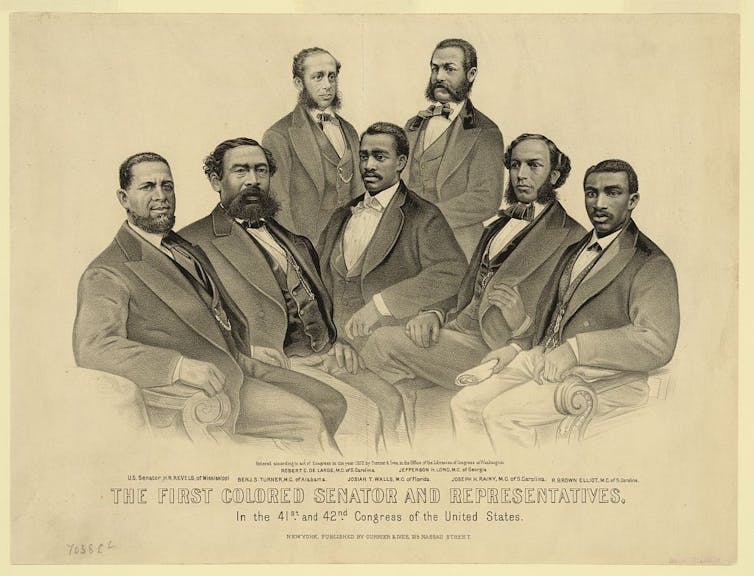
A group portrait depicts the first Black senator and a half-dozen Black representatives.
The first Black senator and representatives were elected in the 1870s, as shown in this historic print.
Library of Congress

The case was brought by a group of Louisiana citizens who declared that the federal mandate under Section 2 to draw a second majority-Black district violated the equal protection clause of the 14th Amendment and thus served as an unconstitutional act of racial gerrymandering.

Initially designed to enshrine federal civil rights protections for freed people facing a battery of discriminatory “Black Codes” in the postbellum South, the 14th Amendment’s equal protection clause has been the foundation of the nation’s modern rights-based legal order, ensuring that all U.S. citizens are treated fairly and preventing the government from engaging in explicit discrimination.

The cornerstone of the nation’s “second founding,” the Reconstruction-era amendments to the Constitution, including the 14th Amendment, created the first cohort of Black elected officials.

As I highlight in my new book “Requiem for Reconstruction,” the struggle over the nation’s second founding not only highlights how generational political progress can be reversed but also provides a lens into the specific historical origins of racial gerrymandering in the United States.

Without understanding this history – and the forces that unraveled Reconstruction’s initial promise of greater racial justice – we cannot fully comprehend the roots of those forces that are reshaping our contemporary political landscape in a way that I believe subverts the true intentions of the Constitution.

The long history of gerrymandering

Political gerrymandering, or shaping political boundaries to benefit a particular party, has been considered constitutional since the nation’s 18th-century founding, but racial gerrymandering is a practice with roots in the post-Civil War era.

Expanding beyond the practice of redrawing district lines after each decennial census, late 19th-century Democratic state legislatures built on the earlier cartographic practice to create a litany of so-called Black districts across the postbellum South.

The nation’s first wave of racial gerrymandering emerged as a response to the political gains Southern Black voters made during the administration of President Ulysses S. Grant in the 1870s. Georgia, Alabama, Florida, Mississippi, North Carolina and Louisiana all elected Black congressmen during that decade. During the 42nd Congress, which met from 1871 to 1873, South Carolina sent Black men to the House from three of its four districts.

Initially, the white Democrats who ruled the South responded to the rise of Black political power by crafting racist narratives that insinuated that the emergence of Black voters and Black officeholders was a corruption of the proper political order. These attacks often provided a larger cultural pretext for the campaigns of extralegal political violence that terrorized Black voters in the South, assassinated political leaders, and marred the integrity of several of the region’s major elections.

Election changes

Following these pogroms during the 1870s, southern legislatures began seeking legal remedies to make permanent the counterrevolution of “Redemption,” which sought to undo Reconstruction’s advancement of political equality. A generation before the Jim Crow legal order of segregation and discrimination was established, southern political leaders began to disfranchise Black voters through racial gerrymandering.

These newly created Black districts gained notoriety for their cartographic absurdity. In Mississippi, a shoestring-shaped district was created to snake and swerve alongside the state’s famous river. North Carolina created the “Black Second” to concentrate its African American voters to a single district. Alabama’s “Black Fourth” did similar work, leaving African American voters only one possible district in which they could affect the outcome in the state’s central Black Belt.

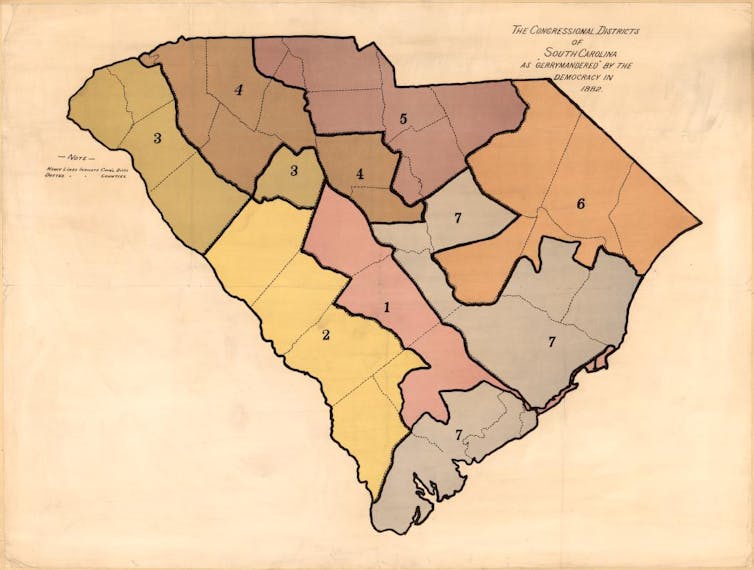
South Carolina’s “Black Seventh” was perhaps the most notorious of these acts of Reconstruction-era gerrymandering. The district “sliced through county lines and ducked around Charleston back alleys” – anticipating the current trend of sophisticated, computer-targeted political redistricting.

Possessing 30,000 more voters than the next largest congressional district in the state, South Carolina’s Seventh District radically transformed the state’s political landscape by making it impossible for its Black-majority to exercise any influence on national politics, except for the single racially gerrymandered district.

A map showing South Carolina's congressional districts in the 1880s.
South Carolina’s House map was gerrymandered in 1882 to minimize Black representation, heavily concentrating Black voters in the 7th District.
Library of Congress, Geography and Map Division

Although federal courts during the late 19th century remained painfully silent on the constitutionality of these antidemocratic measures, contemporary observers saw these redistricting efforts as more than a simple act of seeking partisan advantage.

“It was the high-water mark of political ingenuity coupled with rascality, and the merits of its appellation,” observed one Black congressman who represented South Carolina’s 7th District.

Racial gerrymandering in recent times

The political gains of the Civil Rights Movement of the 1950s and 1960s, sometimes called the “Second Reconstruction,” were made tangible by the 1965 Voting Rights Act. The law revived the postbellum 15th Amendment, which prevented states from creating voting restrictions based on race. That amendment had been made a dead letter by Jim Crow state legislatures and an acquiescent Supreme Court.

In contrast to the post-Civil War struggle, the Second Reconstruction had the firm support of the federal courts. The Supreme Court affirmed the principal of “one person, one vote” in its 1962 Baker v. Carr and 1964 Reynolds v. Sims decisions – upending the Solid South’s landscape of political districts that had long been marked by sparsely populated Democratic districts controlled by rural elites.

The Voting Rights Act gave the federal government oversight over any changes in voting policy that might affect historically marginalized groups. Since passage of the 1965 law and its subsequent revisions, racial gerrymandering has largely served the purpose of creating districts that preserve and amplify the political representation of historically marginalized groups.

This generational work is being undone by the current Supreme Court with its ruling in Louisiana v. Callais.

This is an updated version of an article originally published on Feb 3, 2026.

The Conversation

Robert D. Bland does not work for, consult, own shares in or receive funding from any company or organization that would benefit from this article, and has disclosed no relevant affiliations beyond their academic appointment.

ref. Supreme Court ruling: The latest in history of diminishing minority voting rights – https://theconversation.com/supreme-court-ruling-the-latest-in-history-of-diminishing-minority-voting-rights-281815

Universities returning Native American remains and artifacts isn’t just about physical objects – it’s about dignity and justice

Source: The Conversation – USA (2) – By Kerri J. Malloy, Assistant Professor of Native American and Indigenous Studies, San José State University

A museum curator removes a rare Native American Chumash basket from California, circa 1800, at the Peabody Essex Museum in Salem, Mass., in 2003. MediaNews Group/Boston Herald via Getty Images

Many universities and museums in the U.S. have long held Native American burial artifacts, other sacred objects and even human remains.

Most of these collections were acquired in the late 19th and 20th centuries. They came from grave excavations, anthropological research and other practices carried out without the consent of Native American communities.

In 1990, Congress passed the Native American Graves Protection and Repatriation Act, or NAGPRA. This law requires federally funded institutions, including museums and universities, to identify Native American artifacts, consult with tribes and return them to descendants, tribes and Native Hawaiian organizations.

Some institutions, like the University of California, have publicly committed to returning Native American artifacts and remains to the proper communities, in a process known as repatriation. But progress has been slow, and many sacred objects and remains are still held in collections.

As a scholar of Native American genocide, memory and justice, I think repatriation is about more than merely returning items taken without permission.

It’s about how universities and other institutions are confronting the histories that produced these collections in the first place.

A series of brown masks of faces is seen mounted against wood
Yup’ik masks are displayed at the National Museum of the American Indian in Washington.
Kerri J. Malloy

The case of the University of California

The University of California is not the only institution confronting this issue of repatriation. But it is one of the country’s most visible university systems, with 10 campuses across the state.

The University of California has publicly stated in a detailed policy document and other places online that it is “committed to the repatriation of Native American human remains and cultural items.” It publicly tracks its work on returning Native American items and remains via a searchable database.

As of February 2026, the university repatriated 9,303 human remains, 476,592 items used for burials, and 140,443 other cultural items, among other objects, according to its database.

Between 2020 and 2024 alone, the University of California campuses completed 100 repatriations involving thousands items, according to the California state audit released in April 2025.

However, the university is facing criticism from tribal leaders and state auditors for moving too slowly.

The 2025 audit found that the University of California still holds the remains of thousands of Native American individuals, along with hundreds of thousands of cultural items. The university’s own database confirms this analysis.

The audit also found gaps in the repatriation work. Some campuses are still discovering new collections that they did not initially document. The University of California’s office of the president does not systematically track this recovery effort, the audit found.

At the university’s current pace, some of its campuses could take more than a decade to finish repatriation.

Earlier state audits in 2019 and 2021 reached similar conclusions. They pointed to weak oversight, delayed planning and limited funding to make good on repatriation promises.

Although the president of the University of California required all campuses to create repatriation plans, many still lack full timelines or other clear steps to solve complex situations.

At the University of California, Santa Barbara, for example, some items were loaned to other institutions and have not been returned.

At the University of California, Davis, 30 items believed to be part of Native American collections were stolen from a display case in 2022. In this case, the university was not sure whether the stolen items initially came from Native communities or not.

A deeper meaning for Native Americans

For Native American communities, ancestral remains are not specimens – they are relatives.

Some of these artifacts were placed with the dead as part of burial practices. These sacred and cultural objects carry ceremonial, historical and communal meaning that does not disappear when they enter a university or museum collection.

Some tribes believe their ancestors’ spirits cannot rest until they are properly reburied, as California’s audits note.

When institutions hold on to Native people’s bodies and belongings for decades, fail to track them fully and then delay their return, the issue is not only administrative. It is also a matter of authority and respect.

This question is especially urgent in California, where many Native American tribes are not federally recognized.

In 2001, California created its own repatriation law, CalNAGPRA, to include these tribes in repatriation work.

However, changes to federal rules in 2024 have made it harder to return certain ancestral remains and cultural items to nonfederally recognized California tribes.

That conflict between federal and state law has made an already difficult process harder.

A widespread issue

This problem is not limited to California.

Across the country, a small number of universities, museums and government agencies hold a large share of the Native American remains and cultural items that have not yet been returned.

Harvard University and Indiana University, for example, are among the schools working to repatriate Native American ancestral remains and cultural items.

Some institutions have interpreted the 1990 law narrowly. In some cases, they have discounted tribal knowledge and labeled ancestral remains as “culturally unidentifiable,” meaning no clear tribal affiliation could be determined.

Moving beyond symbolism

Repatriation at the University of California is part of a broader reckoning. Universities and museums across North America and Europe face the same question: How will they move beyond symbolic statements and address the legacy of colonialism in their collections?

The University of California says campuses are updating plans, budgets and reporting in response to the 2025 audit. It has pledged to return all items by 2028.

I think that these are important steps. But a larger question remains: Will this action lead to more accountability and a quick return of all Native American items and ancestral human remains?

Repatriation is not only about correcting the past. It is a test of how universities serve the public, including Native American communities.

The University of California has adopted policies that include language of repair. The challenge now is to match that language with meeting self-imposed deadlines, and holding true to promises and the federal law in a timely matter.

The Conversation

Kerri J. Malloy does not work for, consult, own shares in or receive funding from any company or organization that would benefit from this article, and has disclosed no relevant affiliations beyond their academic appointment.

ref. Universities returning Native American remains and artifacts isn’t just about physical objects – it’s about dignity and justice – https://theconversation.com/universities-returning-native-american-remains-and-artifacts-isnt-just-about-physical-objects-its-about-dignity-and-justice-281278

Warmer temps bring soaring tick populations – here’s how to stay safe from Lyme disease

Source: The Conversation – USA (3) – By Lakshmi Chauhan, Associate Professor of Infectious Disease Medicine, University of Colorado Anschutz Medical Campus

Exposure to ticks can be a downside to spending time in the woods. skaman306/Moment via Getty Images

Spring’s warmer weather lures people outdoors – and into possible contact with ticks that spread Lyme disease.

Already, the 2026 tick season is booming. On April 23, the Centers for Disease Control and Prevention warned that emergency room visits due to tick bites are at their highest level since 2017. That may portend an especially severe season for Lyme disease and other tick-borne illnesses.

State health departments reported more than 89,000 cases of Lyme disease in 2023, the last year for which data is available. But public health experts believe that close to 500,000 people in the U.S. get Lyme disease every year.

As an infectious disease doctor with experience treating some of this infection’s long-term outcomes, I know that Lyme disease can be tricky because people often don’t notice tick bites and may overlook early symptoms of an infection. But left untreated, the infection can cause serious lingering – and even permanent – health issues.

Here’s what you need to know about Lyme disease to stay safe this season:

What causes Lyme disease?

Lyme disease, named after the Connecticut town where the disease was first identified in 1975, is caused by a group of bacteria called Borrelia – most often, the species Borrelia burgdorferi.

Deer ticks – also called black-legged ticks, and members of a group called Ixodes – transmit the disease after feeding on an infected animal, usually a bird, mouse or deer. When they then bite a person, they can transmit the bacteria into the person’s bloodstream.
Usually, the tick must attach for 24-48 hours to transmit the bacteria causing Lyme disease.

Where and when does Lyme disease occur?

Lyme disease can occur in most regions where deer ticks live.

These ticks are most active in late spring, summer and fall – usually April to November in most regions. They emerge when the temperature is above freezing. In years when winter is shorter, ticks can emerge earlier. And they may be active year-round in regions where freezing temperatures are rare.

Approximately 90% of U.S. cases are reported from states in the Northeast, mid-Atlantic from Virginia to eastern Canada, and Upper Midwest regions including Wisconsin, Michigan and Minnesota. A few cases occasionally pop up in California, Oregon and Washington.

Map of the U.S. showing lots of Lyme disease incidence in the Northeast and in Upper Midwest states, plus a smattering elsewhere in the country
Northeast and Upper Midwest states have the highest incidence of Lyme disease, according to the Centers for Disease Control and Prevention in 2023.
Centers for Disease Control and Prevention

Since 1995, the incidence of Lyme disease in the U.S. has almost doubled.

Warmer weather and changes in rainfall patterns now allow ticks to survive in new regions of the country – and for longer periods. But even in regions where ticks lived before, Lyme disease has become more common due to increases in deer populations. As woodland areas are increasingly being developed, it may be bringing the habitat of deer and mice closer to people, increasing the risk of transmission.

Lyme disease symptoms to watch for

Early symptoms of Lyme disease – fever, muscle aches and fatigue – generally emerge within three to 30 days after a tick bite. Another classic symptom in the first month is a target or bull’s eye rash at the site of tick bite, which occurs in about 70% to 80% of cases.

Other rashes following a tick bite can also occur. Some may be due to irritation from the bite, and not necessarily an infection.

If you know you’ve had a tick bite and experience flu-like symptoms – or if you see a bull’s-eye rash, whether you know you were bitten or not – it’s important to check with your healthcare provider about whether you should be treated with antibiotics.

A blood test for antibodies can help confirm the infection, but it can sometimes yield a false negative result, particularly in the first couple of weeks of the disease.

Deer ticks at four stages of development, from larva to adult
In the larval stage, deer ticks can be tiny – and difficult to spot on your body.
Centers for Disease Control and Prevention

In most people, the rash goes away on its own. However, treatment may shorten its duration and is important for preventing other symptoms. A two- to four-week course of antibiotics can generally treat Lyme disease. Severe cases might require intravenous antibiotics.

A promising new vaccine for Lyme disease is currently being tested. In March 2026, Pfizer, the pharmaceutical company developing it, announced that in a late-stage study, the vaccine prevented the disease in 70% of people who received it.

Later Lyme symptoms

If left untreated, the bacteria that causes Lyme can spread, potentially causing longer-term symptoms. About 60% of people who get Lyme disease and don’t treat it can develop arthritis.

In rare cases, Lyme disease can also affect the heart and the nervous system. Inflammation in the brain or the tissues surrounding it, called meninges, can cause headaches and neck pain, as well as balance issues and memory and behavior changes. It can also cause nerve damage that results in numbness, tingling and muscle weakness.

These symptoms can appear right away or much later – sometimes months to years after infection. And in cases where the disease wasn’t promptly treated, late-stage symptoms can linger even after antibiotics kill the bacteria.

Scientists don’t fully understand why, but one intriguing study found that some particles from the bacteria’s cell wall leak into the joints and can persist after treatment, spurring ongoing inflammation and arthritis symptoms.

Another reason for Lyme’s long-term effects is that it can trigger autoimmune disease, which is when the immune system attacks its own cells. What’s more, because the nervous system may be particularly sensitive to damage caused by the bacteria and related inflammation, it may take an especially long time to heal. In some situations, the damage could be permanent.

Preventing Lyme disease

Until a vaccine becomes available, there are steps you and your family can take to help protect against Lyme disease:

  • Use tick and insect repellents such as DEET and picaridin, which can be applied to skin, and permethrin, which is sprayed onto clothing, to keep ticks at bay. Treating clothing with permethrin may be especially beneficial, since the substance withstands several washes.

  • Wear long-sleeve shirts and pants while you are gardening, hiking or walking through grass or woods to prevent tick bites. Wearing light-colored clothes makes ticks more visible, and tucking your pants into your socks can also prevent the little buggers from traveling from your pants, shoes and socks onto your legs.

  • Remove your outdoor clothes immediately. Washing and drying clothes at high temperature can help kill any ticks that managed to hitch a ride. And a quick shower immediately after spending time outdoors can wash ticks off the skin before they have a chance to attach.

  • If you spend time outdoors, perform daily tick checks, paying special attention to warm areas like your armpits, neck, ears and underwear line. If you find a tick attached, pull it off with tweezers, holding them perpendicular to the skin.

  • If you find a tick that may have been on the skin for more than 36 hours, ask your healthcare provider whether a dose of preventive antibiotics – generally given within 72 hours of the bite – would be appropriate.

The Conversation

Lakshmi Chauhan receives funding from NIH.

ref. Warmer temps bring soaring tick populations – here’s how to stay safe from Lyme disease – https://theconversation.com/warmer-temps-bring-soaring-tick-populations-heres-how-to-stay-safe-from-lyme-disease-263303

Supreme Court bolsters donors’ free speech rights in unanimous crisis pregnancy center ruling

Source: The Conversation – USA (3) – By Wayne Unger, Associate Professor of Law, Quinnipiac University

State governments have had trouble regulating what crisis pregnancy centers should tell their clients and donors. AP Photo/Mark Zaleski

The U.S. Supreme Court has cleared the way for a chain of crisis pregnancy centers based in New Jersey to challenge a subpoena from New Jersey’s attorney general.

First Choice Women’s Resource Centers operates at several locations throughout New Jersey. There are more than 2,500 of these Christian-led nonprofits in the United States. Most try to discourage pregnant women from obtaining abortions. Some offer free medical services, such as over-the-counter pregnancy tests and sonograms. Many give their clients clothing, diapers and other items that the parents of babies require.

First Choice caught the attention of Matthew Platkin in 2023 while he served as the state’s attorney general. He suspected that it violated New Jersey’s Consumer Fraud Act by misleading its donors about its mission and operations. According to court filings, Platkin wanted to determine if First Choice had misled its donors and patients into believing that the centers provide “comprehensive reproductive health care services, including abortion care and contraception, when they in fact have an objective of deterring individuals from seeking such services.”

As part of New Jersey’s investigation, Platkin issued a subpoena demanding that First Choice produce donation records, including the personal information of the donors, over a 10-year period so that his office could “contact a representative sample” of them to determine if they had “been misled” by First Choice about what the group does – that is, whether or not it provided abortions.

First Choice asserted that the subpoena violated its First Amendment rights, and that it had a right to sue New Jersey’s attorney general in federal court to quash the subpoena.

The Supreme Court sided with First Choice in its unanimous ruling on First Choice Women’s Resource Centers, Inc. v. Davenport. The case now bears the name of New Jersey’s current attorney general, Jennifer Davenport.

In my view as a privacy and constitutional law scholar, the court ruled correctly by concluding that issuing a subpoena for personal information regarding a crisis pregnancy center’s donors may deter those donors from supporting the organization.

Quashing New Jersey’s subpoena

After First Choice sued to block the subpoena, Platkin argued that federal courts lacked jurisdiction to decide the case. That’s because First Choice’s alleged injury – deterring donors from supporting the organization – had not yet materialized because New Jersey had not yet tried to enforce the subpoena in court.

In other words, Platkin argued that the case was premature.

But First Choice argued that merely issuing a subpoena can deter donors from making a gift. To further its argument, First Choice presented what it said was an “anonymous declaration from several donors describing the present chill on their First Amendment-protected association.” In its view, the injury was real and concrete enough for the federal courts to decide the case.

The justices have now cleared the way for First Choice to continue with its lawsuit against New Jersey authorities in federal court.

Court ruled on a related case in 2018

The First Choice case might sound similar to a case the court decided in 2018.

In National Institute of Family and Life Advocates v. Becerra, the Supreme Court considered a different First Amendment claim asserted by a California-based organization that counsels crisis pregnancy centers.

In 2015, California enacted the Reproductive Freedom, Accountability, Comprehensive Care, and Transparency Act, better known as the Reproductive FACT Act. That law required clinics to inform their patients of California’s free or low-cost access to family-planning services, prenatal care and abortion. Several anti-abortion groups objected to California’s mandate, claiming the Reproductive FACT Act unconstitutionally compelled crisis pregnancy centers to disclose a message they do not support.

The Supreme Court agreed. Justice Clarence Thomas, writing for the court, concluded that the Reproductive FACT Act required clinics to “provide a government-drafted script about the availability of state-sponsored activities” that the clinics opposed.

In the court’s view, this violated the clinics’ First Amendment rights because it compelled them to speak a message containing an implicit viewpoint – support for abortion – that the clinics fundamentally opposed.

Both cases sit at the intersection of abortion politics and the First Amendment, but they raise distinct questions. The prior one, which addressed California’s attempt to regulate crisis pregnancy centers, asked whether the government can force those centers to make mandated statements. This new one, First Choice, asks whether the government can force the centers to disclose their donors’ identities.

A woman who supports abortion rights protests outside the Supreme Court building.
An abortion rights supporter protests outside the Supreme Court building in 2018, when the court heard a different crisis pregnancy center case.
AP Photo/Carolyn Kaster

Precedent set in an old NAACP case

The court has found previously that donations are a form of protected speech, including in its Citizens United v. Federal Elections Commission ruling. In that 2010 decision, the majority recognized that “All speakers, including individuals … use money amassed from the economic marketplace to fund their speech.”

As Justice Neil Gorsuch wrote in the Free Choice ruling, each right protected by the First Amendment “necessarily carries with it a corresponding right to associate with others.” Without such a right, he added, “no two men could safely share the same soapbox.”

This crisis pregnancy center ruling also reaffirms what the court decided about seven decades earlier in NAACP v. Alabama. The NAACP, founded in 1909, is one of the nation’s biggest civil rights groups.

In this 1958 ruling, the court concluded that any government actions that “may have the effect of curtailing the freedom to associate” warrant the highest form of protection under the First Amendment.

That ruling protected the privacy of NAACP members in Alabama. While there were no donors involved in that case, I believe that the rights of donors in the First Choice case are analogous to the rights of the NAACP’s members in the 1958 case – in that both have the right to the protection of their privacy.

In the 1950s, Alabama Attorney General John Patterson wanted to shut down the local NAACP chapter, based on his belief that the civil rights organization was “causing irreparable injury to the property and civil rights of the residents and citizens of the State of Alabama” by operating within the state as an unincorporated association.

As a part of his effort to oust the NAACP from Alabama, Patterson sought the membership lists of the local chapter, which, if disclosed, would have unquestionably caused “intimidation, vilification, economic reprisals, and physical harm.”

Similarly, in the 2026 First Choice case, Gorsuch, who wrote the 9-0 decision, “demands for private donor information inevitably carry with them a deterrent effect on the exercise of First Amendment rights.”

That is similar to Alabama’s demand for the NAACP’s membership list in 1958.

“It is hardly a novel perception that compelled disclosure of affiliation with groups engaged in advocacy may constitute as effective a restraint on freedom of association,” Supreme Court Justice John Marshall Harlan II declared in the ruling, which essentially shut down Alabama’s effort to ban the NAACP.

“This Court has recognized the vital relationship between freedom to associate and privacy in one’s associations,” Harlan added.

How to read this ruling

Many conservatives today will surely see the court’s decision as a win for the anti-abortion movement and its associated organizations. And many progressives will perceive it as another ruling from a supermajority conservative court that favors the rights of Americans who oppose access to abortion over those who support abortion rights.

The court, for example, overturned the nationwide right to abortion in 2022 in its Dobbs v. Jackson’s Women’s Health Organization ruling.

I think both interpretations are wrong because this case is more about free speech than abortion.

The fundamental principle the court asserted in NAACP v. Alabama remains intact – there is a vital relationship between the right to privacy and the freedom to associate.

Since its ratification in 1791, the First Amendment has protected much more than the rights that are expressly mentioned in its text. It protects the right to speak freely, just as it protects the right not to speak and the right to speak anonymously.

The First Amendment protects the right to associate with groups and organizations, just as it protects the right to associate with those groups and organizations anonymously.

It protects the right to think freely, to hold certain beliefs and to reject others. And as the Supreme Court reaffirmed in the First Choice case, the First Amendment protects individuals’ rights to associate with organizations that align with their beliefs by donating to them.

The Conversation

Wayne Unger does not work for, consult, own shares in or receive funding from any company or organization that would benefit from this article, and has disclosed no relevant affiliations beyond their academic appointment.

ref. Supreme Court bolsters donors’ free speech rights in unanimous crisis pregnancy center ruling – https://theconversation.com/supreme-court-bolsters-donors-free-speech-rights-in-unanimous-crisis-pregnancy-center-ruling-281211

Three women sit for Israeli Rabbinate’s exam, amid growing recognition for Orthodox Jewish women’s religious leadership

Source: The Conversation – USA (3) – By Michal Raucher, Associate Professor of Jewish Studies, Rutgers University

Orthodox Jewish women attend an event celebrating the completion of the 7½-year cycle of daily study of the Talmud, the central text of Jewish law, on Jan. 5, 2020, in Jerusalem. AP Photo/Tsafrir Abayov

When people picture a rabbi, they may imagine a man standing in front of a congregation in a synagogue. But “rabbi” means much more than that. For example, a rabbi could be a teacher, a nonprofit executive for a Jewish organization, or a scholar of Jewish law – and, increasingly, some of those roles are held by Orthodox women.

For decades, liberal denominations have permitted women to be ordained. Orthodox Judaism, however, has largely prohibited it. Yet attitudes toward women’s study of rabbinic texts is changing, leading some Orthodox leaders to conclude that women are qualified for rabbinic jobs.

Israel’s chief rabbis – known as the Rabbinate, and historically seen as the top authority for the country’s Orthodox institutions – do not recognize women as rabbis or permit their ordination. But on April 27, 2026, after an hourslong delay and an emergency injunction from the country’s High Court of Justice, three women sat for one of the Rabbinate’s exams about Jewish law. The exam followed a legal battle over the course of the past few years, culminating in a High Court of Justice decision in July 2025 that women must be allowed to take the tests. The chief rabbis appealed the decision, but the court rejected their request for a retrial.

These tests are required to apply for public sector jobs as any kind of Jewish religious authority in Israel: ensuring that restaurants adhere to Jewish dietary laws, for example. Passing does not make someone an ordained rabbi; ordination is conferred through private rabbis and schools, and most Orthodox communities do not recognize female rabbis. But it does allow women to apply for jobs previously available only to men and receive higher salaries for the educational jobs they have already. Most importantly, the High Court of Justice’s decision recognized that women have achieved high levels of education in rabbinic law.

I am a scholar of Jewish women and gender who researches religious authority among Orthodox women. While there have always been highly educated women, the court’s ruling reflects a growing trend among Orthodox women, while also opening up professional opportunities.

From Torah to Talmud

Formed in the 19th century, Orthodox Judaism is oriented around a strict observance of Jewish law and commitment to traditional gender roles. The denomination contains many divisions, each one adjusting their observance of Jewish law differently in response to modernity. While boys and men have been traditionally educated in Torah and rabbinic texts, historically girls and women did not have access to any formal Jewish education.

In the early 20th century, Jewish Polish teacher Sarah Schenirer revolutionized Orthodox girls’ education by founding the Bais Yaakov school system, now found in many countries. The Bais Yaakov education focused on teaching women Torah, while maintaining women’s place within the Jewish home.

A black and white photo shows several rows of girls formally posed for a large class picture outside.
A Bais Yaakov Orthodox school for girls in what is now Bielsko-Biala, Poland, around 1938.
Collection of the Archive of the Jewish Community in Bielsko-Biala, Poland/Wikimedia Commons, CC BY-SA

But soon another debate arose: whether women could study Talmud. This text, composed between the second and seventh centuries C.E., contains the building blocks of rabbinic law. Studying the Talmud means learning the language, references and argument style of the Jewish legal system, called “halakha.”

Supporters and opponents of Talmud study for women both argued that it would forever alter orthodoxy. Opponents feared that if women understood Talmudic discussions, they would be interested in participating more in public religious life, upsetting the gender norms at the heart of orthodoxy.

Yet, in the 1970s, some well-known rabbis in Israel and America invited women into Talmud study. Since then, the number of Orthodox institutions that offer advanced Talmud study for women has grown significantly. Fifty years ago, there were only two options: Stern College of Yeshiva University in New York, or Michlelet Bruriah in Israel, now called Midreshet Lindenbaum. Today, dozens of institutions offer programs for Orthodox women who want to study rabbinic law.

The institutions where women can learn Talmud and rabbinic law span the Orthodox landscape. Many are affiliated with open or modern orthodoxy, which have embraced changes related to gender roles. Some cater to the Haredi or “ultra-Orthodox” population, and others to communities in between.

Most students who complete these programs are not seeking traditional ordination as rabbis. But the women graduate prepared for several other types of religious leadership, such as Jewish education, or as halakha guides for other women. Some programs prepare students to answer Jewish legal questions in particular areas, such as practices during menstruation or childbirth.

Feminist network

This growth in opportunities for Orthodox women is the result of a network of Orthodox feminists working across borders since the 1970s.

A woman in a purple dress and headwrap gestures as she speaks on stage, facing a large, darkened auditorium full of people.
Orthodox women attend an event to celebrate the completion of a 7½-year cycle of daily Talmud study in Jerusalem on Jan. 5, 2020.
AP Photo/Tsafrir Abayov

Michlelet Bruriah, for example, was founded by two American Jews who immigrated to Israel in the 1960s. Several other educational institutions developed through this network – including Matan, Nishmat and Drisha, which are currently located in Israel.

Yeshivat Maharat, the first Orthodox seminary to ordain women as rabbis, is in New York. Several of its teachers and students came from these Israeli institutions, and some of their donors have also supported the schools in Israel.

The lawsuit challenging the Israeli chief rabbis’ restriction on women taking the Jewish law exam was filed by several people involved in this network.

Rabbi Seth Farber, for example, is an American immigrant to Israel and the founder of ITIM, a nonprofit that advocates for Jewish religious pluralism within Israeli society. He filed the lawsuit along with his wife, Michelle Cohen Farber, another American immigrant to Israel. She uses the title “rabbanit,” which traditionally refers to someone married to a rabbi. In her case, it also refers to her own expertise in Jewish legal texts: She co-founded Hadran, an organization that promotes Talmud study among women.

Other petitioners include Rabbanit Avital Engelberg, an Israeli-born graduate of Yeshivat Maharat who directs the seminary’s Israeli branch.

Impact

Women’s training allows them to enter a variety of fields. Opportunities for Orthodox women’s religious leadership is growing, and it’s not all about ordination. “Yoatzot halacha,” for example, counsel other women about issues related to marriage, sex and reproduction.

More broadly, these programs – and the fact that women have now actually taken one of the Rabbinate’s exams – validate women’s religious leadership. For decades, many Orthodox Jews have looked to Israel’s Orthodox Rabbinate as the arbiter of religious authenticity. The ruling from the Israeli High Court of Justice forces Orthodox Judaism worldwide to recognize that women can achieve high levels of Talmudic education.

Finally, the proliferation of educational programs reflects – and creates – a need within orthodoxy. It is not just a small cadre of women seeking these opportunities. Programs continue to open because there is a demand among Orthodox women for the chance to study rabbinic texts. As more institutions create programs for women, they are creating a new reality: one where Orthodox women are religious leaders.

This is an updated version of an article originally published on Nov. 19, 2025.

The Conversation

Michal Raucher received funding from the Israel Institute, the University of Cincinnati, and the Hadassah Brandeis Institute to conduct research related to this article.

ref. Three women sit for Israeli Rabbinate’s exam, amid growing recognition for Orthodox Jewish women’s religious leadership – https://theconversation.com/three-women-sit-for-israeli-rabbinates-exam-amid-growing-recognition-for-orthodox-jewish-womens-religious-leadership-281847

Americans care more about future generations than many think – and that gap could matter for policy

Source: The Conversation – USA (3) – By Kyle Fiore Law, Postdoctoral Research Scholar in Sustainability, Arizona State University

Decisions made now can affect people far into the future. Andriy Onufriyenko/Moment via Getty Images

Caring about future generations means believing that people who will live decades or centuries from now deserve ethical consideration. In practice, that means taking their interests into account when making all kinds of decisions across a range of issues – from aggressively cutting carbon emissions to investing in pandemic preparedness initiatives and regulating powerful emerging technologies, such as artificial intelligence.

While it may sound like a niche moral view to care about future generations in this way, our new research, published in the academic journal Futures, suggests otherwise. In fact, Americans appear to care substantially about future generations. Nevertheless, they also systematically underestimate how much other Americans care.

To study this, we conducted two online surveys of U.S. adults, totaling 1,000 respondents. The samples were built to roughly match the U.S. population in age, gender, race or ethnicity, and political affiliation. In one survey, people told us their own views about future generations. In the other, a different group told us what they thought the average American believes.

We examined this in three ways. First, we asked how many future generations people think society should keep in mind when making collective decisions. For example, when setting climate targets or designing pandemic response systems, how many future generations should count as stakeholders in that decision? Second, we asked how many future generations elected officials should keep in mind when making decisions about laws and public policy. Third, we asked how far into the future people still deserve “moral concern.”

For the third question, participants were shown a list of the present generation and the next 50 generations, with each generation defined as a 25-year period. They then indicated how many of those generations still belonged inside their “moral circle.” In plain terms: If someone will live 100, 200, or even 1,000 years from now, does their suffering matter – and do we have some responsibility to help make their lives go better?

We found that Americans, on average, extended at least some moral concern about 28 generations into the future, or roughly 700 years. But there was a mismatch about when other people’s concern faded – respondents guessed that it happened around 21 generations out, about 175 years sooner.

A similar pattern appeared on the policy questions. Americans said society and government should take into account people living roughly 16 to 17 generations ahead, respectively – around 400 to 425 years into the future. But they assumed other Americans would endorse a shorter horizon of only about 13 generations, or roughly 325 years. In other words, Americans are more future-oriented than they think their fellow citizens are.

Why it matters

Public support for long-term policies depends partly on what people think other people value. Research on climate policy, for example, shows that Americans often underestimate how much support already exists for major mitigation measures. When people wrongly think their view is unusual, they can become less likely to speak up, join with others or pressure leaders to act.

Our findings suggest a similar dynamic may shape support for future-oriented policies more broadly. For issues such as pandemic preparedness, nuclear risk and emerging technologies, decisions made now can affect people far into the future.

It’s possible that a person might support stronger emissions cuts, better disease-prevention systems or safeguards on high-risk technologies, but stay quiet if they assume most other Americans do not care about those kinds of long-term consequences.

What’s next

Several hands holding up a globe which appears to be made from blue and green fabric.
Research shows Americans underestimate support for major climate change mitigation measures.
Alistair Berg/DigitalVision via Getty Images

For climate change, misperceptions are partly driven by partisan polarization, visible disagreement among leaders and vocal opposition from skeptics. Together, they can make public support appear weaker than it is.

Concern for future generations, by contrast, is much less overtly politicized – meaning it does not divide along party lines the way climate policy does. Most Americans, regardless of political affiliation, say they care about people living centuries from now. Yet this concern is rarely voiced in everyday conversation, in media coverage or in political debate.

Future research needs to examine why concern for future generations isn’t more visible in public life, such as in the media or voiced in everyday conversations. As a result, people might assume that others do not care as much as they actually do.

The Research Brief is a short take on interesting academic work.

The Conversation

The authors do not work for, consult, own shares in or receive funding from any company or organization that would benefit from this article, and have disclosed no relevant affiliations beyond their academic appointment.

ref. Americans care more about future generations than many think – and that gap could matter for policy – https://theconversation.com/americans-care-more-about-future-generations-than-many-think-and-that-gap-could-matter-for-policy-280315

How immigration is playing a role in the Scottish election, even though policy is set in Westminster

Source: The Conversation – UK – By Colin Clark, Professor of Sociology and Social Policy, University of the West of Scotland

No single issue has dominated the agenda ahead of the Scottish parliament election in May. But immigration, despite being a matter not devolved to Holyrood, has been part of campaigns. This is because some parties use it to feed wider anxieties about housing, jobs, public services and identity.

Glasgow has been a particular flashpoint because of its role as a City of Sanctuary for asylum seekers. About 6% of the UK’s asylum seekers live in Scotland, with over half in Glasgow, though data suggests this proportion is falling.

Reform UK has sought to capitalise on this. Although no small boats have landed on Scottish coastlines, Reform’s leader in Scotland, Malcolm Offord, unveiled a billboard in Glasgow with an image of migrants crowded into a dinghy. Large red text reads: “Scotland is at a breaking point.”

Polling shows that cost of living, health and the economy rank above immigration as voter priorities in Scotland. Yet these issues can be closely connected in public debate throughout the UK. If people worry about GP appointments, housing waiting lists or jobs, some politicians will blame migration – even if the underlying causes lie elsewhere.

Reform’s Scotland manifesto mentions “strangers” being “prioritised ahead of Scots” by local councils in terms of access to social housing. Offord has claimed that asylum seekers arriving in Glasgow are “jumping the queue”, and his party has promised to “prioritise local people” for such housing.

Asylum seekers are not prioritised for housing because of their immigration status. But Scottish councils are obliged to prioritise homeless people seeking temporary housing – who may be asylum seekers.

What the parties are saying

All major parties recognise that Scotland faces population and economic challenges. An ageing population, low birthrates and labour shortages are affecting sectors such as health, housing, agriculture, social care and hospitality.

Many industries understand that without immigration, parts of the Scottish economy would struggle. That reality has, for years, sustained a relatively broad pro-migration consensus across the Scottish political spectrum.

The governing Scottish National Party argues that Scotland needs a more flexible migration system tailored to Scottish demographic and economic needs. Its 2026 manifesto presents migration as both a social good and an economic necessity. The manifesto is also strong on refugee protection, and argues for a Scottish-specific visa scheme.

Reform UK, polling consistently as the second or third leading party, has spotlighted immigration in its manifesto. One of the party’s five core pledges is to “prioritise local people in communities and restore law and order”.

Like the SNP, the Scottish Liberal Democrats champion relatively pro-migration policies for Scotland. The Lib Dem manifesto states that the party “believe[s] in fairness for everyone, no matter who you are or where you come from”. The manifesto mentions making immigration policy that is “sensitive to the skills needs” of certain sectors, as well as allowing asylum seekers to work if they have waited more than three months for a decision on their application.

For Scottish Labour, the emphasis has been less on immigration and more on housing, jobs and public service reform. Its campaign focus on affordable homes, more support for teachers, improving childcare and better economic competency suggests an awareness that many Scottish voters are more concerned with delivery of key services than anti-migrant rhetoric.

The Scottish Greens approach migration through a lens of refugee protection, anti-racism and social justice, with a manifesto prioritising public services for everyone, regardless of immigration status. In addition to calling for the UK government to devolve immigration to the Scottish parliament, the party would also pilot giving asylum seekers the right to work.

The Scottish Conservative party, while aligned with UK-wide calls for firmer border control, has focused on taxation, public services, crime and policing, SNP competence and the state of the union in its manifesto. Issues of immigration and asylum are contained mainly to attacking the SNP. The Scottish Conservatives have accused the SNP of a “reckless” open-door policy on immigration that has led to “an influx of immigrants” and made Glasgow a “magnet for asylum seekers”.

Scotland’s immigration story

Scotland often tells itself a comforting political story: that it is a progressive society, more welcoming of newcomers, and less susceptible to anti-immigrant politics than other parts of Britain.

There is some truth in this. The Scottish government’s “New Scots” strategy is generally regarded as a positive statement for welcoming and integrating migrants to Scotland.

Survey data has generally shown attitudes in Scotland to be slightly more positive towards migrants and migration, while openly hostile rhetoric has been less common in mainstream politics. Yet national myths can conceal uncomfortable realities. Scotland is not immune to xenophobia, racism or populism, nor, as Reform’s rhetoric around social housing suggests, is it protected from the politics of scapegoating.

Public services are under pressure, housing shortages do exist, and trust in politics has weakened. But migrants did not create decades of underinvestment, stagnant wages or failures in social housing supply. Migrants are often caught within those same crises, even if headlines rarely acknowledge this.

Most of Scotland’s political parties are comfortable supporting the “good migrant” – NHS nurses, engineers, scientists, international students or seasonal workers. Far fewer defend asylum seekers, undocumented migrants or family reunion rights. A hierarchy of deservingness can emerge: migrants are welcomed when economically useful, yet become politically expendable when portrayed as costly or controversial.

Scotland cannot be complacent in its self-image. Years of anti-Irish prejudice, racism towards minority ethnic communities, and longstanding discrimination against Gypsy and Traveller communities tell their own story. Matters of economic insecurity and contested identities can be converted into anti-migrant rhetoric.

Immigration matters in Scotland because the country is vulnerable to the same pressures seen elsewhere. But ultimately, migrants should not be used as political cover for deeper failures of policy and governance.

The Conversation

Colin Clark does not work for, consult, own shares in or receive funding from any company or organisation that would benefit from this article, and has disclosed no relevant affiliations beyond their academic appointment.

ref. How immigration is playing a role in the Scottish election, even though policy is set in Westminster – https://theconversation.com/how-immigration-is-playing-a-role-in-the-scottish-election-even-though-policy-is-set-in-westminster-280235