Reforms to South Africa’s technical colleges keep failing students and employers: why?

Source: The Conversation – Africa – By Stephanie Allais, Faculty member, Centre for Researching Education and Labour, University of the Witwatersrand
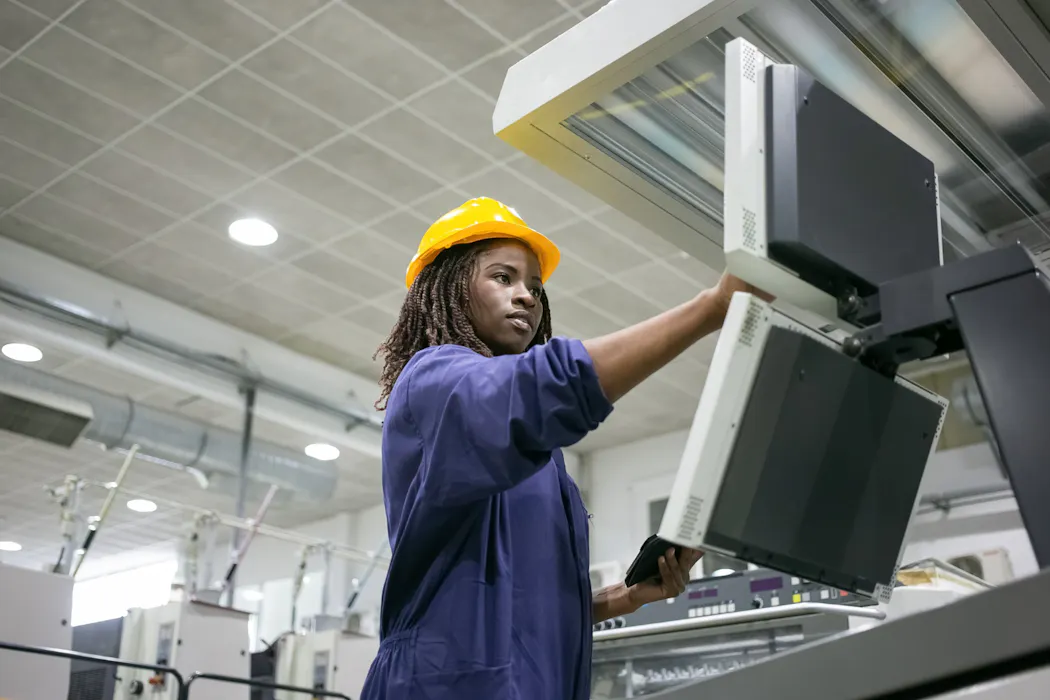
Freepik, CC BY

South Africa’s 50 public technical and vocational education and training (TVET) colleges are, in the main, struggling institutions.

In many, throughput rates – how many students qualify in the expected time – are low. Some lecturers are under-qualified and under-resourced. Relationships with employers, which are crucial for the type of training that these colleges offer, are uneven.

Colleges are hard pressed to provide training to young people with weak schooling behind them and no clear path to employment ahead. The youth unemployment rate is almost 44%.


Read more:
Life after school for young South Africans: six insights into what lies ahead


The response to problems in the sector has been reform: rename the colleges, restructure them, give them new governance models, new qualification types, new funding arrangements. Over 30 years of democracy, South Africa has done all of these things, repeatedly. It has not worked.

And now there’s another round of changes being rolled out. There is little clearly documented explanation of what the new system is and how it will work in practice. But colleges have been instructed that most current qualification offerings will be phased out and replaced by new “occupational” qualifications.

In 2024 I wrote a paper tracing the history of the technical and vocational training sector, drawing on published literature, my research on skills development and my own involvement in South Africa’s education and training policy processes. The paper sets out why the sector is not working and what it needs to succeed.

In my view, based on the history of the sector, there is a serious risk that the latest reforms will make things worse.

Thirty years of the same mistake

South Africa’s policy vision and funding model for TVET colleges has, like that of many other countries, been to base funding on student enrolment for programmes that are linked to employer demand. It assumes colleges will respond to what employers want, and channel young people into jobs.

It has a long and largely unsuccessful track record, with problems in many countries – most extensively documented in Australia and the UK, the originators of the broad policy model.

The problem is structural. Funding institutions only through enrolments in specific programmes provides no institutional stability. It creates no incentive to invest in equipment, lecturers, or long-term relationships with employers. It treats colleges as if they were competing as private training providers.

When the programmes that attract funded enrolments change – as they do, repeatedly – colleges are left with stranded staff, obsolete equipment, and no financial buffer. And when new funding is made available, for new programmes, they don’t have lecturers who can teach them.

Private institutions tend not to offer manufacturing-related programmes – those are expensive. They focus on business-related programmes, which are cheaper.

Consider the National Technical Education Diploma (Nated) qualifications, the government-funded programmes that colleges have provided for decades. First, they were to be phased out. Then, when the National Development Plan created TVET enrolment targets, colleges were told to expand them. Colleges have built up staffing around them and enrolled students in them.

Now, the Department of Higher Education and Training has instructed colleges to phase them out. What replaces them are “occupational qualifications”.

The occupational qualifications problem

The department defines an occupation as

a set of jobs whose main tasks and duties are characterised by a high degree of similarity (skill specialisation).

The theory behind occupational qualifications is sound: link qualifications to specific occupations, make workplace experience part of the qualification, and graduates will have credentials that employers recognise and value.

The framework has thousands of occupations.

The problem – and here is where our new research (not yet published online) is indicating an uncomfortable finding – is that many of the “occupations” to which these new qualifications are linked do not really exist in workplaces and labour markets. And there is little publicly available information about them.

Some “occupations” have special skills that need special training, and others are really just jobs.

For example, in our research (not yet online) across 53 food and beverage manufacturing plants, we found that there are artisan trades like millwrighting, fitting and turning, and electrical work which fit the idea of an occupation. But machine operators don’t fit that description. Yet machine operators are among the new qualifications to be offered. The employers we visited don’t need those qualifications. They would rather hire someone they can train themselves, to use the equipment in their plant.

Training in a “knowledge module” like “personal mastery and interpersonal relationships” is not specific to the “occupation” of operating a machine.

You cannot create an occupation by developing a qualification for it. It works the other way: the occupation must exist before you create a qualification for it.


Read more:
Jobs of the future: South Africa has major gaps in skills needed to shape the green economy


This is not an abstract concern. Colleges are now being instructed to gain accreditation to offer these qualifications, to hire staff to teach them, to find workplace placements for students doing them – all on the assumption that there is a real occupational destination at the end.

For artisans, this assumption holds: there are real occupations that translate to opportunities in the workplace. But for the majority of new occupational qualifications being developed, far more analysis is needed.

What institutions actually need

Colleges cannot become strong institutions through enrolment-driven funding alone, any more than a school can become strong by being paid per pupil with no base funding for teachers or classrooms. And calling qualifications “occupational” does not mean that they will lead to work where there is no meaningful occupation in labour markets or workplaces.

Institutions need a stable core – employed lecturers, maintained equipment, administrative capacity – that allows them to function as institutions rather than as collections of projects cobbled together from different funding streams.

Some of them may be better off offering second-chance matric (secondary school leaving certificate) programmes instead of narrowly focused programmes where there are few real opportunities for employment in the surrounding areas, and no way colleges can find work placements for their learners.

Pockets of genuine excellence exist in the current system: colleges with good employer relationships and real employment outcomes for graduates. What they have in common is principled management, experienced staff, and enough stability to build relationships over time. The system should be trying to replicate those conditions.

In my view, what needs to happen is this:

  • colleges should be funded with a core institutional grant, and enabled to provide a mix of training that reflects their local economic contexts

  • occupational qualifications should be rolled out only where employers need them.

Otherwise the latest reforms risk repeating the errors of the past 30 years. Colleges and young people deserve better than that.

The Conversation

Stephanie Allais receives funding from the South African National Research Foundation. I have also recently worked on research funded by the Food and Beverage Manufacturing SETA.

ref. Reforms to South Africa’s technical colleges keep failing students and employers: why? – https://theconversation.com/reforms-to-south-africas-technical-colleges-keep-failing-students-and-employers-why-278711

Working from home in Nigeria: study finds women don’t have much choice

Source: The Conversation – Africa – By Ikechukwu (Ike) Nwaka, Assistant Lecturer, Business Economics, University of Alberta

Nigerian women of working age are mostly (90%) self-employed. By comparison, self-employment accounts for less than 16% of employment in high-income countries such as the United States, Germany and the United Kingdom. It is far lower in middle-income countries like South Africa and Turkey too.

Official statistics show that self-employment in Nigeria is concentrated in the northern regions. And there’s a gender difference: women make up the majority of those working for themselves (Figure 1).

What these numbers do not explain is why women are far more likely than men to operate businesses from their homes, or whether those businesses generate meaningful economic returns.

As economists working on labour, gender, energy and development, we addressed these questions in a recent paper.

Using nationally representative household data from 2010 to 2019, the study examines why Nigerian women run enterprises from their homes. These kinds of operations include selling goods from a front room, preparing food at home, or offering haircuts, beauty services, laundry and dry cleaning, and shoe repair. They also make textiles, crafts, garments, shoes and cosmetics at home rather than in shops, kiosks or workshops.

The findings challenge the idea that home-based self-employment is mainly about personal preference or flexibility.

Childcare responsibilities, housing access, electricity and cultural norms strongly shape women’s work location. These insights reveal that supporting women in business must go beyond training or microfinance, and remove structural barriers.

Childcare limits women’s workplaces

We first identified factors associated with operating home-based businesses, using data (2010-2019) from national surveys that follow the same households over time.

We then examined how individual, household and contextual factors shape the likelihood of operating a business from home. We found that childcare was the strongest factor influencing women’s choice of work location.

The presence of young children doesn’t much affect where men work. For women, however, having young children makes it more likely they will run a business from home.

In Nigeria, women shoulder most of the unpaid domestic labour, including childcare, cooking and cleaning. Home-based businesses allow women to earn income while doing that labour.

For many women, home-based work may not be the most attractive option. Rather, the patterns we saw in the data suggest that it’s a way to reconcile income-earning with unpaid domestic responsibilities. Other research into women’s experiences has also shown that working from home may be a necessity rather than a choice.

Why home ownership doesn’t benefit women equally

Homeowners who operate home-based enterprises are better positioned to use property as collateral, access credit, expand workspace, or invest in equipment. They are able to turn housing into productive capital.

However, these advantages are not equally accessible to women.

Only 8.2% of women aged 20-49 are sole owners of land, compared with 34.2% of men, according to World Bank research into gender disparities in property ownership in sub-Saharan Africa.

The Nigerian constitution grants women equal rights to own, inherit and manage property. But many face legal, financial and social barriers that limit their actual control over assets.

Even in owner-occupied households, customary and patriarchal practices can mean that ownership doesn’t translate into decision-making power. Consequently, the same asset generates different economic returns for men and women. It confines women to lower-return home-based activities.

We found that 67% of female homeowners operate home-based enterprises compared with 33% of male owners. Most men who own homes work away from home.

Geography and social norms matter

We found that home-based enterprises are concentrated in poorer regions where returns are low, particularly in northern Nigeria, as shown in figure 2.

Even after accounting for income and education, women in northern Nigeria are far more likely to run businesses from home than women in the south. Cultural and religious norms that restrict women’s mobility and public participation probably play a central role.

This complicates global policy narratives that frame home-based work as inherently empowering. In Nigeria, it often reflects the need to juggle paid work with household obligations under restrictive conditions. These businesses tend to cluster in low-entry sectors, offer limited skill development, and have little growth potential.

Education helps, but only up to a point

Education and household income do expand women’s options, but their effects are limited. Our study shows that better-educated women are less likely than equally educated men to remain in home-based businesses when alternatives are available.

As household income rises, women are also less likely to operate enterprises from home. Importantly, observable characteristics do not explain the full gender gap. The study finds that less than half of the difference in home-based self-employment can be attributed to education, household size, marital status and housing. The rest likely reflects deeper structural forces that shape outcomes differently for men and women. These are forces like social norms, unequal access to finance, gendered returns to assets, and expectations around unpaid care work.

What this means for policy

Promoting home-based self-employment as a route to women’s economic empowerment can be misleading. When women are pushed into home-based enterprises because childcare is expensive, institutions and property rights are weak, or finance is inaccessible, entrepreneurship becomes a response to constraint, not opportunity.

Policies that reduce childcare costs, strengthen women’s property and inheritance rights, and improve access to credit are likely to do more to expand women’s choices than entrepreneurship programmes alone.

Digital infrastructure can help some home-based businesses reach wider markets, but only if deeper barriers are addressed. And because constraints vary across regions, one-size-fits-all solutions are unlikely to work.

More than flexibility

Home-based self-employment in Nigeria reflects deeply gendered expectations about work and care. Many women work from home not to assert independence, but because they have limited options.

Recognising this distinction matters. Celebrating women’s “flexibility” without addressing the constraints behind it risks turning resilience into a permanent requirement. A more equal future is one in which women can choose where and how they work, rather than adjusting their livelihoods around structural barriers.

The Conversation

Ikechukwu (Ike) Nwaka is affiliated with REACH Edmonton Council for Safe Communities as a Board Member

George Nwokike Ike does not work for, consult, own shares in or receive funding from any company or organisation that would benefit from this article, and has disclosed no relevant affiliations beyond their academic appointment.

ref. Working from home in Nigeria: study finds women don’t have much choice – https://theconversation.com/working-from-home-in-nigeria-study-finds-women-dont-have-much-choice-274792

How to talk to children when terrorist attacks and violence dominate the news

Source: The Conversation – UK – By Trudy Meehan, Lecturer, Centre for Positive Psychology and Health, RCSI University of Medicine and Health Sciences

When a man stabbed Jewish people in Golders Green, London, in what police declared a terrorist incident, the story spread fast – through news alerts, social media and the whispered conversations of anxious adults. When this happens, children notice.

Whether they catch a fragment of a TV bulletin, overhear a parent on the phone, or simply sense that something has shifted in the atmosphere at home, the news has a way of reaching them before they are ready. The question isn’t really whether to talk to children about violence and fear; it’s how.

First, it’s important to know that children have the resilience and capacity to process difficult topics, but bear in mind that this needs to happen in a supportive environment.

Start with safety. Ensure your child feels relaxed and secure. Safety comes from routines, keeping daily rhythms and practising rituals that remind everyone you are together and safe – for example, a nighttime story or song, a special time on the couch after dinner.

Your capacity to deal with issues like violence and fear is the most important factor in contributing to your child feeling safe during these conversations. If you feel overwhelmed or anxious, wait until you feel calmer and more grounded, or have someone to support you with the conversation.

Some families – particularly those who face racism or other forms of discrimination – will already be familiar with these conversations. But if this is new to you, the main thing to do is to be honest and clear. Be direct and specific. Avoid metaphors and euphemisms and vague ideas like “bad people”.

Adjust your language to the child’s age, but don’t overthink it. Simply pause often, ask questions, and watch their face for confusion.

Children don’t stay afraid for long. They move in and out of difficult feelings quickly, which is why short, repeated conversations work better than one big, serious talk.

Come back to them to check understanding and listen for misunderstandings. Ask them if they have any questions. And don’t be surprised if the child looks particularly bored or disinterested. Children prefer delight and joy and play rather than serious adult conversations. It doesn’t mean they are not listening or appreciating the explanation, it just means their priorities are elsewhere – and that’s a good thing.

Keeping children grounded amid fear

Limit media exposure and try to avoid talking about scary events around them – they are always listening and there’s huge room for misunderstanding when they hear rather than take part in conversations.

Research shows that if children are exposed to media and talk about fearful events, that it’s important what they hear is mediated through a supportive adult who can explain the content appropriately. They can pick up on the signs of fear and anxiety from adults, particularly in times of uncertainty, even if they can’t fully understand the words in the conversation.

Follow your child’s lead. Your job is to open the door. They decide whether to walk through it and when to leave. Don’t mistake silence for shutdown. Children often process fear through movement, play, singing, dancing, making and even breaking things.

It’s OK to say “I don’t know” to questions you can’t answer. And it’s OK to say: “I know the answer, but it’s too much information for you at your age, I’ll tell you a little bit now and explain more when I think you are old enough.”

Most important of all, for you and your child, look at your circle of safety. Remind your child they are safe here and now with you, that there is a community that you live in and link with who are there to support you and keep you safe. Focus on hope and efficacy and on what can we do right now for the future we want.

The Conversation

Trudy Meehan does not work for, consult, own shares in or receive funding from any company or organisation that would benefit from this article, and has disclosed no relevant affiliations beyond their academic appointment.

ref. How to talk to children when terrorist attacks and violence dominate the news – https://theconversation.com/how-to-talk-to-children-when-terrorist-attacks-and-violence-dominate-the-news-281879

Dolls beat screens for building children’s social skills, study finds

Source: The Conversation – UK – By Sarah Gerson, Lecturer in Developmental & Health Psychology, Cardiff University

Vach cameraman/Shutterstock

What’s the point of play? Is it simply a way to keep children occupied, or something more? For some, it’s about learning literacy and numeracy. For others, it’s how friendships form and relationships deepen. But it can be all of these at once, and more.

Most parents recognise that play matters. But there’s less agreement on what kind of play is best. Should children be guided towards activities designed to build specific skills, like sports for coordination, or construction for maths and engineering? Or should the child’s own interests lead the way, regardless of perceived educational value?

Our research focuses on a type of play often dismissed as “just for fun” – playing with dolls. Across a series of studies, we found that doll play can help children understand other people’s thoughts and feelings. This is a skill that underpins social interaction throughout life.

There is pressure on parents to create the “right” environment for development, often filled with toys that promise clear educational outcomes. STEM-focused toys (science, technology, engineering and maths), in particular, are widely seen as beneficial for learning. Doll play, on the other hand, can be viewed as having little educational benefit.

Our findings challenge that assumption.

More than make-believe

When playing with dolls, children often play out scenes between characters. These may seem simple on the surface but could present opportunities for the child to develop social and emotional skills.

As parents, it seems obvious that playmates are important for building and learning about relationships and other people, and recognising others’ emotions (empathy). But what if children can develop these skills even when playing alone?

Previous studies have found that children who engage more in pretend play tend to have stronger social understanding and empathy. Earlier studies, however, didn’t often use controlled methods to separate out the different factors linking pretend play and social understanding.

A child cuddles a doll.
Doll play can help children understand other people’s thoughts and feelings.
AlesiaKan/Shutterstock

So, we set out to test this more directly. We worked with children aged four to eight, assessing their ability to understand that others can hold different beliefs and desires to their own. This is an important milestone in social development. If children recognise that their own mental states may vary from others, this should help them better understand other people and know how to interact with them.

After that initial assessment session, children were randomly assigned either a set of dolls or a tablet with open-ended creative games. They were asked to play several times a week, with parents logging how and when play occurred. We didn’t instruct children how to play because we wanted to understand their natural behaviour.


Read more:
How realistic is Mattel’s new autistic Barbie?


After approximately six weeks, both sets of children came back and again completed the task about understanding others’ mental states. We found that the children who had been assigned dolls to play with, rather than tablets, showed a greater improvement in their understanding of others’ mental states during the intervening period.

The findings suggest that doll play can actively support the development of social understanding. This is consistent with prior research of ours showing that areas of the brain linked to social processing are activated during doll play, and that children use more language about thoughts and feelings when playing with dolls than when using tablets.

Why it matters beyond childhood

For parents, the message is reassuring – playing with dolls lets children practice skills that they can also use when playing with playmates, like understanding others, anticipating behaviour and responding appropriately.

These abilities matter far beyond childhood. They help us collaborate, resolve conflicts and navigate relationships. In a world that often feels increasingly divided, the capacity to see things from another person’s perspective is not just useful – it’s essential.

The Conversation

Sarah Gerson received funding for this project from Mattel Inc.

Ross E Vanderwert received funding from Mattel for this research.

Salim Hashmi received funding for this research from Mattel Inc.

ref. Dolls beat screens for building children’s social skills, study finds – https://theconversation.com/dolls-beat-screens-for-building-childrens-social-skills-study-finds-280330

What alternatives do Gulf states have to the Strait of Hormuz?

Source: The Conversation – UK – By David B Roberts, Associate Professor, School of Security Studies, King’s College London

The Gulf states have built a variety of emergency pipelines over the years to bypass the Strait of Hormuz. Md. Raihan Uddin Rafi / Shutterstock

Two months into the Iran war and the Strait of Hormuz is still mostly shut. Vessel traffic is running at a fraction of pre-war levels, with the patchwork of ceasefires, blockades and re-closures since February 28 not restoring confidence on the bridge of any tanker.

Hormuz has long been understood as one of the world’s central trade chokepoints. It normally carries around 20 million barrels of crude and oil products each day, as well as roughly a fifth of global liquefied natural gas (LNG) exports. A third of the world’s helium and a similar amount of the urea that ends up as fertiliser also pass through the strait.

Plans and projects to diversify away from Hormuz have been on drawing boards for decades, and those workarounds are now being stress-tested as never before. The bypass infrastructure is doing roughly what architects had hoped, providing around 3.5 million barrels to 5.5 million barrels a day of crude capacity.

But this is still nowhere near enough.

Hormuz workarounds

The most important pipeline on the planet right now runs across Saudi Arabia. The East-West Pipeline – also known as Petroline – was built in the 1980s during the original Tanker war, when Iran and Iraq attacked merchant vessels in the Gulf as part of their wider conflict.

The pipeline’s capacity was expanded to a 7 million barrel emergency ceiling in 2019. However, the loading terminals in the city of Yanbu on Saudi Arabia’s Red Sea coast were never designed to carry this much oil this fast, and analysts tracking tanker traffic estimate that less oil is currently flowing through the pipeline than its theoretical ceiling.

From Yanbu, oil bound for Europe still has to cross Egypt via the Sumed pipeline, which has a capacity of just 2.5 million barrels per day. Although oil flows through this pipeline have surged by 150% since the start of the war, its comparatively small capacity remains a binding constraint on European supply.

Iran noticed the geoeconomic importance of Petroline and has targeted it accordingly. An Iranian drone strike on a pumping station in April knocked 700,000 barrels a day offline. Saudi Aramco, the operator, had the line back at full capacity within three days. While the repair time is reassuring, the fact of the strike is not.

The other half of the Gulf bypass story runs through the United Arab Emirates (UAE). The Abu Dhabi Crude Oil Pipeline (Adcop) goes from Habshan to Fujairah on the Gulf of Oman side of the country. With a capacity of just under 2 million barrels per day, Adcop is the only major bypass that exits the Gulf directly into the Indian Ocean.

But as with Petroline, it has been targeted during the war. Iranian drone strikes on Fujairah on March 3, 14 and 16 set storage tanks on fire and suspended loadings. While Adcop offers some diversification for the UAE, it does not solve the targeting problem.

A map showing the East-West Pipeline in Saudi Arabia and the Abu Dhabi Crude Oil Pipeline in the United Arab Emirates.
The East-West Pipeline in Saudi Arabia and the Abu Dhabi Crude Oil Pipeline in the United Arab Emirates are two crucial Hormuz workarounds.
Peter Hermes Furian / Shutterstock

The situation is worse for the Gulf region’s other big oil producers. Iraq’s 3.4 million barrels per day of pre-war crude exports went almost entirely through the southern port city of Basra and the Strait of Hormuz.

There is one northern pipeline, connecting oil fields in Kirkuk to Ceyhan in Turkey. This pipeline was reopened in September 2025 after a two-and-a-half-year halt, with flows ramped up to 250,000 barrels a day in March. But this volume pales in comparison to what Iraq has lost.

Kuwait has it worse still. Pre-war crude exports ran at around 2 million barrels per day, with every barrel exiting through Hormuz. Kuwait has no pipeline alternative. Kuwait Petroleum Corporation declared force majeure in March, temporarily allowing it to suspend its obligations to meet delivery contracts.

This was extended on April 20, with the oil company saying it could not meet contractual obligations even if Hormuz reopened. Overcoming the damage that has been inflicted on Kuwait’s production base – and then ramping up production – will take months.

Qatar’s vulnerability is a different shape. Its pre-war crude exports were smaller than its Gulf neigbours, at around 0.6 million barrels per day. These exports all left Qatar via the strait. For Qatar, the story is gas. Its 77 million tonne LNG capacity at Ras Laffan is the largest in the world, supplying about 19% of global LNG trade. There is no alternative to shipping this gas through Hormuz.

Iran itself has built a Hormuz bypass: a 1,000-kilometre pipeline from Goreh at the head of the Gulf to a terminal at Jask on the Gulf of Oman. It is designed for 1 million barrels per day. But in practice, sanctions and unfinished terminal infrastructure have kept actual throughput at a fraction of design.

The US Energy Information Administration estimated that, in summer 2024, under 70,000 barrels per day were flowing through the pipeline. Loadings stopped altogether that September. According to Kpler, which provides real-time data on global shipping movements, only a single tanker – around two million barrels – has loaded at Jask in the war so far.

A call for more pipes in the Gulf, as there have been since the war began, is understandable. But it is no answer. Replicating Hormuz in pipelines would cost hundreds of billions of US dollars and a decade of construction. And at the end of it, new pipelines and terminals at Yanbu, Fujairah and wherever else would be no harder to reach with a drone than the old ones.

The Conversation

David B Roberts does not work for, consult, own shares in or receive funding from any company or organisation that would benefit from this article, and has disclosed no relevant affiliations beyond their academic appointment.

ref. What alternatives do Gulf states have to the Strait of Hormuz? – https://theconversation.com/what-alternatives-do-gulf-states-have-to-the-strait-of-hormuz-281805

What is a just war? Inside the war of words between the Trump administration and the Catholic church​

Source: The Conversation – UK – By Gemma Ware, Host, The Conversation Weekly Podcast, The Conversation

Pope Leo’s words on Palm Sunday were pointed. “Jesus does not listen to the prayers of those who wage war”, he said during an address at the Vatican.

A few days later in early April, when Timothy Broglio, the archbishop for US military services, was asked on CBS’s Face the Nation if the Iran war is a “just war” in the tradition of the Catholic church, he said: “It is not. While there was a threat with nuclear arms, it’s compensating for a threat before the threat is actually realised.”

US Vice President JD Vance – a recent convert to Catholicism – and Mike Johnson, speaker of the House, pushed back, arguing that the conflict does fit within the church’s just war tradition.

Just war theory, first articulated by St Augustine in the fifth century, outlines the church’s moral guidelines for political and military leaders to consider before choosing to go to war. But it’s not static, and the church’s own position has become more restrictive in recent years.

In this episode of The Conversation Weekly podcast, Jerry Powers, the director of Catholic Peace Building Studies at the University of Notre Dame in Indiana, explains how the Catholic church’s just war tradition evolved and the influence it’s had on US military thinking. Powers was a senior advisor on international policy for the U.S. Conference of Catholic Bishops during the Iraq war, and was involved in efforts to persuade the Bush administration not to invade.

He sets out the difficulty now facing Catholics serving in the US military, whose archbishop has now spoken out against the war they’re being asked to fight. “It puts military officers and especially soldiers in a real conundrum,” says Powers. “A soldier has no choice but to obey orders, and if you disobey orders you could very serious repercussions. The officer question is a different one because officers are more senior, and I think officers have to just resign their commission if at some point, they think this is an immoral war.”

Listen to the interview with Jerry Powers on The Conversation Weekly podcast. This episode of The Conversation Weekly was written and produced by Katie Flood and Mend Mariwany and the executive producer was Gemma Ware. Mixing by Eleanor Brezzi and theme music by Neeta Sarl.

Newsclips in this episode from CB S News, AP Archive, BBC, CBS Sunday Morning, ABC News, Rome Reports, KREM 2 News, MS NOW and WUSA 9.

Listen to The Conversation Weekly via any of the apps listed above, download it directly via our RSS feed or find out how else to listen here. A transcript of this episode is available via the Apple Podcasts or Spotify apps.

The Conversation

Gerard F. Powers received a grant from the Nuclear Threat Initiative that helped support the Catholic Peacebuilding Network’s Project on Revitalizing Catholic Engagement on Nuclear Disarmament. He is an expert consultant (unpaid) to the Holy See Mission to the UN. From 1987-2004, Powers was a senior advisor on international policy for the U.S. Conference of Catholic Bishops.

ref. What is a just war? Inside the war of words between the Trump administration and the Catholic church​ – https://theconversation.com/what-is-a-just-war-inside-the-war-of-words-between-the-trump-administration-and-the-catholic-church-281788

Which bird has the best song? These experts think they know

Source: The Conversation – UK – By Joey Baxter, PhD Candidate in Biosciences, University of Sheffield

To mark International Dawn Chorus day we’ve asked wildlife experts to make their case for why their favourite songbird deserves your vote. Cast your vote in the poll at the end of the article and let us know why in the comments. We hope their words will inspire you to step outside and soak up some birdsong this spring.

Song thrush

Brown bird perches on branch, beak open in song
Could the song thrush steal your heart this spring?
WildMedia/Shutterstock

Championed by Cannelle Tassin de Montaigu, Research Fellow in Ecology and Evolution, University of Sussex

When people talk about the UK’s best bird songs they often go straight for the big names – loud, dramatic performers that grab your attention. But quietly in the background is the song thrush, a bird whose song is far more impressive than it first appears.

What sets the song thrush apart is not volume or flair, but structure. Its song is built from short, clear phrases, each repeated two or three times before moving on. It’s as if the bird is politely checking that its audience is paying attention. In a dawn chorus that often feels a bit chaotic, there’s something refreshingly organised about it. It’s a bird that’s actually thought things through.

It might not have the dramatic flair of the common nightingale, and it’s less showy than some of the usual favourites. There are no soaring crescendos or dramatic flourishes. But that’s part of its charm. The song is neat, rhythmic and surprisingly memorable once you start listening for it.

In the early morning soundscape, where many birds seem determined to out-sing one another, the song thrush isn’t trying to steal the spotlight. It just quietly does its thing, and does it very well. Underrated? Definitely. Worth your vote? I’d say so.

Robin

Robin perching neatly on log.
The robin – so much more than just a red breast.
Tomatito/Shutterstock

Championed by Judith Lock, Principal Teaching Fellow in Ecology and Evolution University of Southampton

The European robin is a delightfully common sight in gardens. You will very likely have heard the characteristic “tic”, followed by a tuneful verse lasting a few seconds. In noisy urban environments they sing louder, less complex songs, in order to be heard.

The male robins use their spring song (January to June) to signal their quality to females, then forming breeding pairs, and to signal competitive ability to other males. The spring song lasts one to three seconds, composed of four to six short motifs. They have an impressive repertoire of about 1,300 motifs, indicating that song is the particularly important for robins, in comparison to birds that rely more on colourful plumage or behavioural displays to communicate with each other.

Most birds sing mainly in the morning but robins sing all day. People often mistake their lovely evening song for a nightingale’s. Constant territory defence from non-migrating robins means that the robin song is a year-round soundtrack too. From July to December, both males and females sing the autumn song, of higher-pitched long, descending notes, with interspersed warbles. This song is to defend their individual winter territories. This indicates that song first evolved first in songbirds to ensure survival, before it became a signal used by males for reproduction. Each robin’s song is dynamic, constantly changing in response to the condition and age of the bird, and their rival.

Great tit

Championed by Josh Firth, Associate Professor of Behavioural Ecology, University of Leeds

Its song may not be as flashy as the nightingale or as poetically melancholy as the blackbird. But scientists have been taught so much by the great tit’s song, heard across British habitats from ancient woodlands to urban gardens. This spring marks 80 continuous years of UK-based scientists studying great tits at Wytham Woods, Oxford, the world’s longest-running study of individually-marked animals.

The unique dataset includes a family tree totaling over 100,000 great tits, with some birds’ lineages traceable back 37 generations. Early research on
Wytham’s great tits during 1970s-1980s resulted in some the first studies to inform the scientific world about how bird song can help males find mates and defend territories, how larger song repertoires can bring more reproductive success, and how young birds learn these repertoires from neighbours (not just their fathers).

And a pioneering study published in 1987 taught us how male great tit song even tracks female fertility, increasing their singing efforts as their female partner’s egg-laying period approaches, and then quietening after she starts laying. Modern technological advances are allowing insight into the hidden meaning embedded in great tits’ songs. In-depth processing of 109,000 recordings of great tit songs has revealed how each bird’s melody tells the story of their own identity as well as that of their local culture and social circles.

A great tit’s age also affects their song: older males keep singing rarer, fading song types while younger birds adopt newer ones. So, Britain’s greatest song belongs to the great tit’s “teacher-teacher” call, for all it has taught us, and for all we have left to learn.

Chaffinch

Finch with copper and grey plumage.
Is the chaffinch underappreciated? Joey certainly thinks so.
SanderMeertinsPhotography/Shutterstock

Championed by Joey Baxter, PhD Candidate in Ecology and Evolutionary Biology, University of Sheffield

Why change a winning formula? As far as I’m concerned, the chaffinch sings the biggest banger that UK birds have to offer. While the blackcap attempts to impress with ostentatious bells and whistles, the chaffinch keeps things simple with a catchy riff. Where the starling goes for quantity and novelty, with a frankly plagiaristic repertoire of mimicry, the chaffinch goes for quality, singing proudly in the knowledge that it is delivering a true earworm.

Bubbling trills accelerate before tumbling downwards, slowing to rich watery chirps and finishing with the final flourish. This jaunty lick, the real hook of the song, is often punctuated by an upward inflection at its end, the rising intonation giving it the air of an unanswered question. The chaffinch’s song has rhythm, it has melody, and it’s instantly recognisable. It possesses the wisdom that sometimes it is better not to do everything, but to do one thing well.

The Conversation

Joey Baxter receives funding from UK Research & Innovation (UKRI), via the Engineering and Physical Sciences Research Council (EPSRC).

Josh Firth receives from UK Research & Innovation (UKRI), via the Natural Environment Research Council (NERC).

Cannelle Tassin de Montaigu and Judith Lock do not work for, consult, own shares in or receive funding from any company or organisation that would benefit from this article, and have disclosed no relevant affiliations beyond their academic appointment.

ref. Which bird has the best song? These experts think they know – https://theconversation.com/which-bird-has-the-best-song-these-experts-think-they-know-281259

20,000 stranded seafarers in the Strait of Hormuz face missile fears, exhaustion and isolation

Source: The Conversation – Global Perspectives – By Claudio Bozzi, Lecturer in Law, Deakin University

As the closure of the Strait of Hormuz drags on, the United Nations’ International Maritime Organization has sounded the alarm over a related humanitarian crisis: the plight of the crew stuck on ships at or near the strait.

Up to 20,000 seafarers on 2,000 vessels remain stranded in and around the strait, enduring a combination of physical danger and psychological stress typical of combat zones.

They face daily horrors at work. Exhausted by the risk of being hit by missiles or falling debris, they cannot rest in safe harbours, as nearby ports are not secure.

As their supplies dwindle to dangerously low levels, they must ration food and water and rely on charities such as Mission to Seafarers for supplies (at great risk to the charity workers).

The longer the crisis persists, the more likely seafarers will be working after their contracts expire. They risk not being paid and being unable to get home. Desperate seafarers have also reportedly been targeted by scammers offering safe passage through the strait in exchange for cryptocurrency.

The current crisis is deeply troubling. But the grim reality is that even at the best of times, seafarers generally experience appalling working conditions, while contending with geopolitical crises and unpredictable trade cycles.

These workers face financial insecurity, job uncertainty, physical and mental hazards, isolation, overwork and limited career prospects. Fatigue and sleep deprivation expose them to serious injuries or illnesses on vessels that often operate without adequate medical facilities or qualified doctors.

Lessons of COVID

The current crisis echoes problems revealed during the COVID pandemic. Then, some 400,000 seafarers were stranded at sea. Many were unpaid, and couldn’t be repatriated.

Some ship operators introduced “no crew change” clauses (which ban crew changes while the operator’s cargo is onboard). Such clauses in contracts undermine seafarers’ rights under the Maritime Labour Convention 2006. This exists to promote safety, security and good working conditions on ships, and protect seafarers’ rights.

As a result of an amendment to this convention, seafarers have since been designated as “key workers”. This facilitates access to shore leave, repatriation, crew changes and medical care ashore.

However, the amendments do not take effect until December 2027.

More broadly, the Maritime Labour Convention requires shipowners to provide accommodation, food, transportation, cover for medical expenses and repatriation (the cost of the seafarers’ journeys home, including accommodation).

But it relies on the countries where ships are registered (known as flag states) to regulate shipping – and ships are constantly moving and beyond the reach of regulators. Many are registered under flags of convenience (that is, not where they are owned) in countries with low labour standards that are seldom enforced.

Risk of attack or abandonment

Many commercial ships currently stuck in the Strait of Hormuz have been targeted in military operations, by both Iranian and US forces.

Seafarers also face the unique threat of abandonment. This is where shipowners – in breach of maritime law – leave them without wages, support or maintenance. This occurs when shipowners fail to secure new business.

And it is very difficult for seafarers to leave the ship on which they work. Maritime law also compels crews to keep ships safe and operational and prevents them abandoning ships except under the most extreme circumstances, such as if the vessel is sinking.

In 2025, 6,223 seafarers were abandoned on 410 ships – the sixth yearly increase in a row.

According to the International Seafarers’ Welfare and Assistance Network, there are probably many more unreported cases as seafarers fear dismissal and being blacklisted from other work.

Early indications for 2026 are that the number of seafarers abandoned by shipowners already exceeds 6,000 cases.

Abandoned seafarers were also owed US$25.8 million in unpaid wages in 2025, of which just $16.5 million was recovered.

Shadow fleets

Most abandonments are linked to the shadow fleet, meaning ships that carry oil, gas and other goods in breach of sanctions. The shadow fleet has expanded to 20% of the world’s tankers and 7.5% of LPG carriers.

Shadow fleet vessels have opaque ownership, inadequate insurance and poorly trained crew obtained through illegal recruitment methods bordering on human trafficking.

They are registered in countries with lenient labour laws and poor labour protections, few safety regulations and little oversight. More than half of these ships are more than 15 years old (the traditional cut off age for tankers used by major oil companies) and are in substandard condition. They also use ports where they are unlikely to be inspected.

In addition, they are often run by small ship management companies with little technical knowledge or industry experience, about which very little information is available.

Stranded in the strait

Under the circumstances in the strait, seafarers have been denied the right of repatriation. First, the US blockade prevents ships accessing ports from which they could transit. Second, the fuel crisis has driven the price of flights to a level that many shipowners cannot afford.

India, which maintains diplomatic relations with Iran and imports 90% of its gas from the Persian Gulf, has negotiated the safe passage of its seafarers.

But thousands of others remain stranded, with no states coming to their aid.

The Conversation

Claudio Bozzi does not work for, consult, own shares in or receive funding from any company or organisation that would benefit from this article, and has disclosed no relevant affiliations beyond their academic appointment.

ref. 20,000 stranded seafarers in the Strait of Hormuz face missile fears, exhaustion and isolation – https://theconversation.com/20-000-stranded-seafarers-in-the-strait-of-hormuz-face-missile-fears-exhaustion-and-isolation-281330

The US has long used economic coercion to achieve foreign policy goals — the war in Iran shows how that power has declined

Source: The Conversation – Global Perspectives – By Charmaine N. Willis, Assistant Professor of Political Science, Old Dominion University

The Iranian closure of the Strait of Hormuz has largely brought oil traffic to a halt, hitting petroleum-exporting countries hard. Asghar Besharati / Getty Images

Two months after the United States, along with Israel, launched a war against Iran, that conflict appears far from a lasting resolution.

Much commentary on the protracted nature of the conflict has centered on the limits of both the military and diplomatic approaches to the war. But the conflict has also exposed another key reality: the limits of U.S. sanctions.

The U.S. has been the world’s preeminent economic and military power for decades, certainly since the end of the Cold War. It is at the center of much global financial activity and has a military budget well beyond China, the closest competitor.

Leveraging that power, the U.S. has long used economic coercion to achieve its foreign policy goals, whether against North Korea under the Kim regime, Russia over its invasion of Ukraine or Iran since the 1979 revolution that overthrew the U.S.-allied shah.

But as U.S. power in the world has slowly declined amid the rise of China and an increasingly multipolar world, the country has likewise lost some of its ability to effectively use economics as a weapon. Indeed, as scholars of economic sanctions and statecraft, we believe that the conflict against Iran has made clear the diminishing returns of U.S. economic sanctions.

The limits of sanctions on Iran

Since 1979, relations between Washington and Iran have been antagonistic. U.S. policy has been largely to punish, contain or isolate Iran, and successive administrations have done so in part through a mix of primary, secondary and targeted financial economic sanctions.

U.S. economic coercion has been applied on Iran for a variety of reasons, including its alleged state sponsorship of terrorism throughout the region and its nuclear program.

The emergence of that nuclear program in 2003, which later resulted in United Nations sanctions against Iran, saw U.S. and European Union interests around Iran converge.

A man in a suit stands at a podium during a press conference.
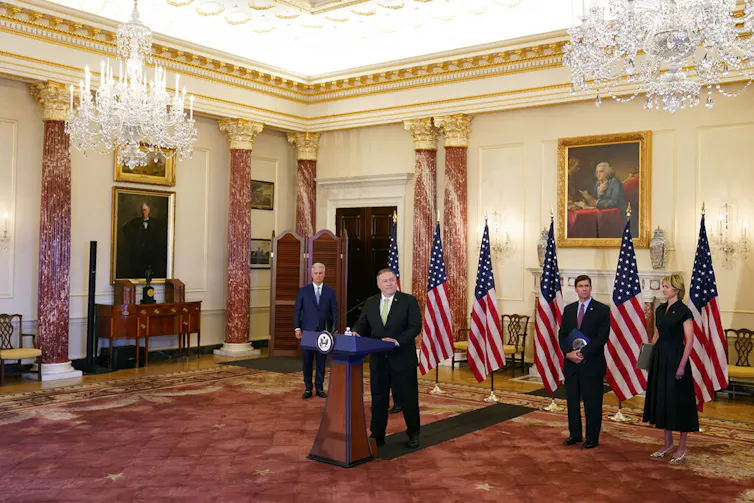
Then-Secretary of State Mike Pompeo speaks during a news conference announcing the Trump administration’s restoration of sanctions on Iran in 2020, two years after it left a nuclear non-proliferation deal with Iran.
AP Photo / Patrick Semansky

This convergence led to the U.S. and EU cooperating on economic sanctions against Iran, which limited Iranian access to the European banking system. The combined coordinated efforts proved onerous for the Iranian economy, which, as political scientist Adam Tarock notes, meant Iran was “winning a little, losing a lot.”

The Joint Comprehensive Plan of Action (JCPOA), negotiated between the U.S., Iran, members of the EU, Russia and China in 2015, placed limits on Iran’s nuclear program in exchange for sanctions relief. At the time, the Iranian economy was suffering crushing inflation and rampant food prices. The agreement would provide relief from decades of economic punishment and the removal of EU, UN and U.S. economic sanctions.

However, the U.S. withdrew from the agreement in 2018 under the first Trump administration and later reimposed sanctions on Iran. The return of economic sanctions as part of the first Trump administration’s maximum pressure campaign – even if not supported by other nations – saw most global firms refrain from doing business with Iran out of risk aversion.

Additionally, despite the EU’s efforts to preserve the JCPOA, Iran restarted its nuclear enrichment program in 2019, one year after the U.S. withdrawal. The Biden administration’s subsequent expressed intention to reenter the deal never came to fruition.

Believing sanctions relief was not a realistic outcome after the agreement’s failure, Iran – though battered by losing access to the global financial system – has found increasingly creative workarounds. Those have included utilizing so-called shadow fleets shipping illicit Iranian goods, creating successful homemade military products like cheaply made drones and ramping up trade with partners outside the Western orbit.

Indeed, since the nuclear agreement’s collapse, Iran has pursued much closer ties with China and Russia at the expense of prior robust economic relations with Europe. As Iran reorients its trade and economic relations, the U.S. and the West have lost economic coercive leverage.

Separated from a diplomatic endgame, U.S. sanctions – and the current blockade of Iranian-linked ships – appear to be only hardening Iranian resolve. Even if a deal were reached to reopen the Strait of Hormuz, Iran has said it plans to push for commercial ships to pay a toll going forward – something that didn’t exist before the war.

In effect, Iran’s ongoing de facto closure of the strait has redirected U.S. economic coercion back at the Trump administration.

Blowback in the energy markets

The biggest costs of that ongoing closure for the U.S. has been in energy.

The U.S. today is one of the largest exporters of crude and refined petroleum globally, making it particularly exposed to oil price volatility. At the same time, some Americans see the development of fossil fuel resources as a key policy priority. As the U.S. becomes more embedded in the export energy sector, it is increasingly experiencing collateral damage – namely, higher oil and gasoline prices – when its foreign policy decisions disrupt oil-related trade.

A woman fills up her car with gas.
The price of oil has reached the highest level since 2022, making for higher costs at the gas pump.
AP Photo / Jenny Kane

One way that collateral damage manifests is the affordability problem for many Americans as gas prices rise, which is likely to also create political costs for the Trump administration.

While the U.S. has taken steps to ease the economic disruptions to American consumers by relaxing oil sanctions on Russia and Iran – thus undermining its own sanctions policy – these policy shifts have done little to nothing to offset rising fuel prices. They will likewise fail to ameliorate the potential for economic damage caused by the ongoing disruptions to commerce due to the Strait of Hormuz dangers and uncertainties.

Famed economist Albert O. Hirschman once noted that countries use their strategic position to shift others’ cost–benefit calculations, especially through trade disruptions. And for decades, the U.S. used its privileged position in the global financial system to pressure both rising countries and those not explicitly part of the U.S. alliance.

But as the U.S. becomes more exposed to the consequences of its own decisions, its ability to lead and coerce has stalled under costs it cannot easily absorb.

No longer leading by example

Historically, U.S. economic power was made possible not only by the country’s unilateral strengths but its willingness to pool resources and work multilaterally with other nations.

The Trump White House’s inability to put together a multinational coalition to address the political and economic challenges caused by U.S.-Israeli attacks on Iran is not surprising. But they further reflect the evaporation of goodwill the U.S. previously enjoyed with allies in and outside the region.

As the U.S. abandons a playbook that has buttressed its power for decades, Russia has grown bolder, China is edging ahead of the West and middle powers like Iran are able to hold out against American economic and military strength.

None of this means the U.S. no longer holds significant global power. But its turn toward a sanction-first, ask-questions-later approach has, we believe, eroded its ability to shape the behavior of other nations. And it has done so while imposing increasingly tangible costs on both American strategy and the well-being of its own citizens.

The Conversation

The authors do not work for, consult, own shares in or receive funding from any company or organization that would benefit from this article, and have disclosed no relevant affiliations beyond their academic appointment.

ref. The US has long used economic coercion to achieve foreign policy goals — the war in Iran shows how that power has declined – https://theconversation.com/the-us-has-long-used-economic-coercion-to-achieve-foreign-policy-goals-the-war-in-iran-shows-how-that-power-has-declined-280066

Robots can run a marathon and play ping pong. But will they ever achieve true sporting greatness?

Source: The Conversation – Global Perspectives – By Jonathan Roberts, Professor in Robotics, Queensland University of Technology

Sony AI

A humanoid robot recently made headlines around the world for running a half-marathon and beating the human world record. Around the same time, an AI-powered robot defeated an elite human player in table tennis. What the robot lacked in experience, it made up for by reacting faster and more consistently than any person could.

These moments feel like milestones. Finally, it seems machines are stepping into one of the most human arenas – sports.

But while it is tempting to frame this as robots versus humans, sport robotics isn’t really about competition. It’s about how machines can learn to move, react and interact in dynamic, unpredictable environments – and what that means for human performance.

How do you train a robot to play sport?

Training a robot to play sport is fundamentally different from training a human athlete.

People learn through practice, coaching and experience, constantly adjusting to changing conditions. In sport science, this is often described as a tight coupling between perception and action. That is, seeing, deciding, and moving in one continuous loop.

Robots, by contrast, are trained using a combination of simulation, data and control algorithms. Engineers build detailed virtual environments where robots can “practice” millions of times. They learn how to track objects, predict motion and coordinate their bodies. Sometimes, motion analysis techniques are used to track athletes doing the specific movements the robot needs to emulate.

For fast-paced sports such as table tennis, the challenge is extreme. A robot must detect the ball, predict its trajectory and execute a precise movement within fractions of a second. This requires close integration between computer vision, machine learning and real-time control.

One of the biggest advances in recent years has been the ability to train robots in simulation and then transfer those skills into the real world – a process known as “sim-to-real”. Combined with rapid improvements in sensors and computing, this has dramatically accelerated progress.

We’ve seen similar developments in robot basketball and robot soccer, where systems have evolved from simply locating the ball to coordinating as teams, making tactical decisions and adapting to opponents.

Beyond entertainment

While robot athletes make for compelling demonstrations, their greatest impact will likely be behind the scenes where they can be used to train human athletes.

One of the central challenges in sport is designing effective practice. Athletes need repetition to build skill. But they also need variability to reflect real competition. Too much repetition becomes predictable; too much variability becomes chaotic.

Robotics offers a potential way to balance both.

A robotic training partner can deliver highly repeatable actions at elite intensity, while also introducing carefully controlled variation. For example, a robotic tennis server could replicate the motion of a world-class player while systematically varying ball speed, flight and placement.

From a sport science perspective, this creates what is known as a “representative learning environment”. The key benefit is it replicates the key perceptual and decision-making demands of elite competition, which is difficult for coaches to recreate in the training environment.

In our work, we’ve been exploring how robotics could support sports such as tennis, cricket and the football codes. The goal is to combine realism, repeatability, variability, and data to enhance skill development and link technique to outcomes.

Robots may also help manage training load. They can reduce the physical demands on coaches and training partners while still exposing athletes to high-quality game-like scenarios.

Beyond performance, there are opportunities for fan engagement. Interactive robots at live events or demonstrations of elite skills could offer new ways for audiences to experience sport.

Will robots ever be ‘great’?

Over the next decade, robots will likely become more agile, more robust and better able to operate in complex environments. Tasks that robots currently find difficult, such as running on uneven terrain and catching or throwing balls, will become increasingly achievable.

But even as robots improve, there are important limits.

Sporting greatness is not just about executing movements perfectly. It involves creativity, decision-making under pressure, and the ability to adapt in ways shaped by experience, emotion and context.

From a sport science perspective, elite performance emerges from the interaction between the athlete, the task and the environment. Robots can be engineered to perform specific tasks extremely well, but they do not experience this interaction in the same embodied, meaningful way.

This means robots may surpass humans in tightly defined challenges – such as bowling a cricket ball with perfect consistency – but they are unlikely to achieve greatness in the holistic human sense.

A new role for robots in sport

Rather than replacing athletes, robots are more likely to become part of the sporting ecosystem.

In the same way that video analysis and wearable sensors have transformed training, robotics offers a new tool for coaches and sport scientists. It enables practice environments that can be precisely controlled, repeated, and adapted to individual needs.

The real opportunity is not to build robot champions, but to better understand human performance, and help athletes reach higher levels.

The Conversation

Jonathan Roberts receives funding from the Australian Research Council.

Marc Portus does not work for, consult, own shares in or receive funding from any company or organisation that would benefit from this article, and has disclosed no relevant affiliations beyond their academic appointment.

ref. Robots can run a marathon and play ping pong. But will they ever achieve true sporting greatness? – https://theconversation.com/robots-can-run-a-marathon-and-play-ping-pong-but-will-they-ever-achieve-true-sporting-greatness-281335